Growth of function
&
Asymptotic Notations
By
Mamata Pandey
Growth of function
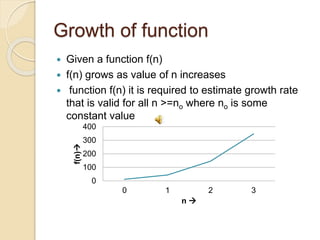
 Given a function f(n)
 f(n) grows as value of n increases
 function f(n) it is required to estimate growth rate
that is valid for all n >=no where no is some
constant value
0
100
200
300
400
0 1 2 3
f(n)
n 
Asymptote
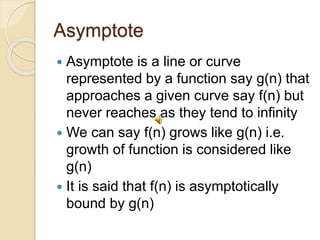
 Asymptote is a line or curve
represented by a function say g(n) that
approaches a given curve say f(n) but
never reaches as they tend to infinity
 We can say f(n) grows like g(n) i.e.
growth of function is considered like
g(n)
 It is said that f(n) is asymptotically
bound by g(n)
What are Asymptotic
Notations
 For a given function f(n) asymptotic
notations Asymptotic notations are
used estimate or to bound the growth
of f(n) in terms of other simpler
function g(n) like n, n2, log(n) etc.
 They provide approximate but
meaningful assumptions about
complexity of f(n)
Asymptotic Notations
 Big Oh notation
 Big Omega notation
 Big Theta notation
 Little oh notation
 Little omega notation
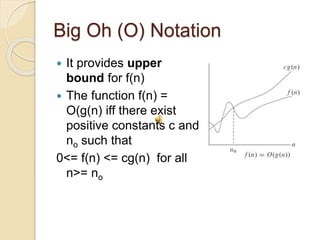
Big Oh (O) Notation
 It provides upper
bound for f(n)
 The function f(n) =
O(g(n) iff there exist
positive constants c and
no such that
0<= f(n) <= cg(n) for all
n>= no
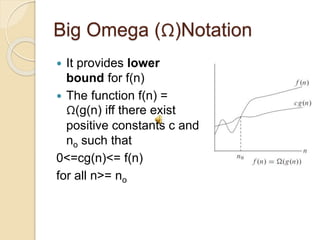
Big Omega (Ω)Notation
 It provides lower
bound for f(n)
 The function f(n) =
Ω(g(n) iff there exist
positive constants c and
no such that
0<=cg(n)<= f(n)
for all n>= no
Theta( )Notation
 It provides tight bound
for f(n)
 The function f(n) =
(g(n) iff there exist
positive constants c1
and c2, and no such that
c1g(n)<= f(n) <= c2g(n)
for all n>= no
~
~
Little oh (o) Notation
 Little o-notation to denote an upper
bound that is not asymptotically tight.
 The function f(n) = o(g(n)) iff there
exist positive constants c and no such
that
0<= f(n) < cg(n) for all n>= no
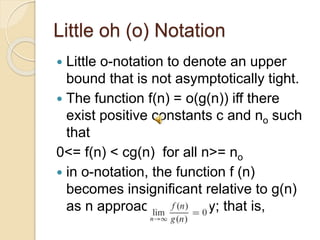
 in o-notation, the function f (n)
becomes insignificant relative to g(n)
as n approaches infinity; that is,
Little omega (w ) Notation
 w –notation is used to denote a lower
bound that is not asymptotically tight
 The function f(n) = w(g(n)) iff there
exist positive constants c and no such
that0<=cg(n)< f(n) for all n>= no
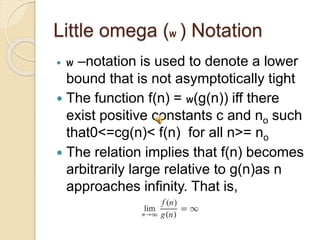
 The relation implies that f(n) becomes
arbitrarily large relative to g(n)as n
approaches infinity. That is,
Example:
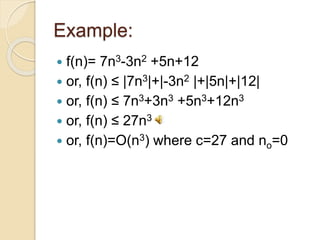
 f(n)= 7n3-3n2 +5n+12
 or, f(n) ≤ |7n3|+|-3n2 |+|5n|+|12|
 or, f(n) ≤ 7n3+3n3 +5n3+12n3
 or, f(n) ≤ 27n3
 or, f(n)=O(n3) where c=27 and no=0
Example
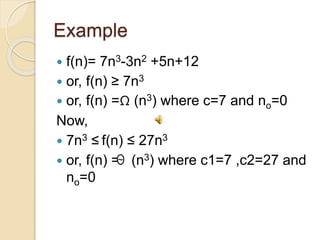
 f(n)= 7n3-3n2 +5n+12
 or, f(n) ≥ 7n3
 or, f(n) =Ω (n3) where c=7 and no=0
Now,
 7n3 ≤ f(n) ≤ 27n3
 or, f(n) = (n3) where c1=7 ,c2=27 and
no=0
~
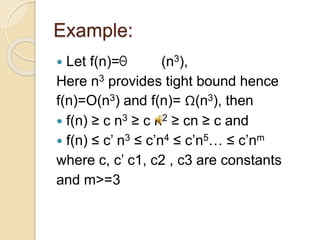
Example:
 Let f(n)= (n3),
Here n3 provides tight bound hence
f(n)=O(n3) and f(n)= Ω(n3), then
 f(n) ≥ c n3 ≥ c n2 ≥ cn ≥ c and
 f(n) ≤ c’ n3 ≤ c’n4 ≤ c’n5… ≤ c’nm
where c, c’ c1, c2 , c3 are constants
and m>=3
~
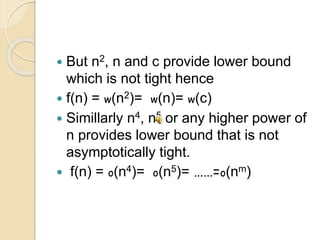
 But n2, n and c provide lower bound
which is not tight hence
 f(n) = w(n2)= w(n)= w(c)
 Simillarly n4, n5 or any higher power of
n provides lower bound that is not
asymptotically tight.
 f(n) = o(n4)= o(n5)= ……=o(nm)
Application of asymptotic
notations
 Calculating and comparing time
complexities of algorithms
 f(n) is a function representing number
of operations for a problem of size n

Asymptotic notations

  • 1.
    Growth of function & AsymptoticNotations By Mamata Pandey
  • 2.
    Growth of function Given a function f(n)  f(n) grows as value of n increases  function f(n) it is required to estimate growth rate that is valid for all n >=no where no is some constant value 0 100 200 300 400 0 1 2 3 f(n) n 
  • 3.
    Asymptote  Asymptote isa line or curve represented by a function say g(n) that approaches a given curve say f(n) but never reaches as they tend to infinity  We can say f(n) grows like g(n) i.e. growth of function is considered like g(n)  It is said that f(n) is asymptotically bound by g(n)
  • 4.
    What are Asymptotic Notations For a given function f(n) asymptotic notations Asymptotic notations are used estimate or to bound the growth of f(n) in terms of other simpler function g(n) like n, n2, log(n) etc.  They provide approximate but meaningful assumptions about complexity of f(n)
  • 5.
    Asymptotic Notations  BigOh notation  Big Omega notation  Big Theta notation  Little oh notation  Little omega notation
  • 6.
    Big Oh (O)Notation  It provides upper bound for f(n)  The function f(n) = O(g(n) iff there exist positive constants c and no such that 0<= f(n) <= cg(n) for all n>= no
  • 7.
    Big Omega (Ω)Notation It provides lower bound for f(n)  The function f(n) = Ω(g(n) iff there exist positive constants c and no such that 0<=cg(n)<= f(n) for all n>= no
  • 8.
    Theta( )Notation  Itprovides tight bound for f(n)  The function f(n) = (g(n) iff there exist positive constants c1 and c2, and no such that c1g(n)<= f(n) <= c2g(n) for all n>= no ~ ~
  • 9.
    Little oh (o)Notation  Little o-notation to denote an upper bound that is not asymptotically tight.  The function f(n) = o(g(n)) iff there exist positive constants c and no such that 0<= f(n) < cg(n) for all n>= no  in o-notation, the function f (n) becomes insignificant relative to g(n) as n approaches infinity; that is,
  • 10.
    Little omega (w) Notation  w –notation is used to denote a lower bound that is not asymptotically tight  The function f(n) = w(g(n)) iff there exist positive constants c and no such that0<=cg(n)< f(n) for all n>= no  The relation implies that f(n) becomes arbitrarily large relative to g(n)as n approaches infinity. That is,
  • 11.
    Example:  f(n)= 7n3-3n2+5n+12  or, f(n) ≤ |7n3|+|-3n2 |+|5n|+|12|  or, f(n) ≤ 7n3+3n3 +5n3+12n3  or, f(n) ≤ 27n3  or, f(n)=O(n3) where c=27 and no=0
  • 12.
    Example  f(n)= 7n3-3n2+5n+12  or, f(n) ≥ 7n3  or, f(n) =Ω (n3) where c=7 and no=0 Now,  7n3 ≤ f(n) ≤ 27n3  or, f(n) = (n3) where c1=7 ,c2=27 and no=0 ~
  • 13.
    Example:  Let f(n)=(n3), Here n3 provides tight bound hence f(n)=O(n3) and f(n)= Ω(n3), then  f(n) ≥ c n3 ≥ c n2 ≥ cn ≥ c and  f(n) ≤ c’ n3 ≤ c’n4 ≤ c’n5… ≤ c’nm where c, c’ c1, c2 , c3 are constants and m>=3 ~
  • 14.
     But n2,n and c provide lower bound which is not tight hence  f(n) = w(n2)= w(n)= w(c)  Simillarly n4, n5 or any higher power of n provides lower bound that is not asymptotically tight.  f(n) = o(n4)= o(n5)= ……=o(nm)
  • 15.
    Application of asymptotic notations Calculating and comparing time complexities of algorithms  f(n) is a function representing number of operations for a problem of size n