Time Complexity of Algorithms
(Asymptotic Notations)
• The level in difficulty in solving mathematically
posed problems as measured by
– The time
(time complexity)
– memory space required
– (space complexity)
What is Complexity?
1. Correctness
An algorithm is said to be correct if
• For every input, it halts with correct output.
• An incorrect algorithm might not halt at all OR
• It might halt with an answer other than desired one.
• Correct algorithm solves a computational problem
2.Algorithm Efficiency
Measuring efficiency of an algorithm,
• do its analysis i.e. growth rate.
• Compare efficiencies of different algorithms for the
same problem.
Major Factors in Algorithms Design
• Algorithm analysis means predicting resources such as
– computational time
– memory
• Worst case analysis
– Provides an upper bound on running time
– An absolute guarantee
• Average case analysis
– Provides the expected running time
– Very useful, but treat with care: what is “average”?
• Random (equally likely) inputs
• Real-life inputs
Complexity Analysis
Asymptotic Notations Properties
• Categorize algorithms based on asymptotic growth
rate e.g. linear, quadratic, exponential
• Ignore small constant and small inputs
• Estimate upper bound and lower bound on growth
rate of time complexity function
• Describe running time of algorithm as n grows to ∞.
Limitations
• not always useful for analysis on fixed-size inputs.
• All results are for sufficiently large inputs.
Dr Nazir A. Zafar Advanced Algorithms Analysis and Design
Asymptotic Notations Θ, O, Ω, o, ω
 We use Θ to mean “order exactly”,
 O to mean “order at most”,
 Ω to mean “order at least”,
 o to mean “tight upper bound”,
∀ ω to mean “tight lower bound”,
Define a set of functions: which is in practice used
to compare two function sizes.
Asymptotic Notations
( ) ( )( )
( )( ) ( ){
( ) ( ) }
( ) ( )( ) ( )
( ).forboundupper
allyasymptoticanisfunctionmeans
allfor,0
such thatandconstantspositiveexistthere:
functions,ofsetthebydenoted,0functiongivenaFor
nf
ngngnf
nnncgnf
ncnfng
ngng
o
o
Ο=
≥≤≤
=Ο
Ο≥
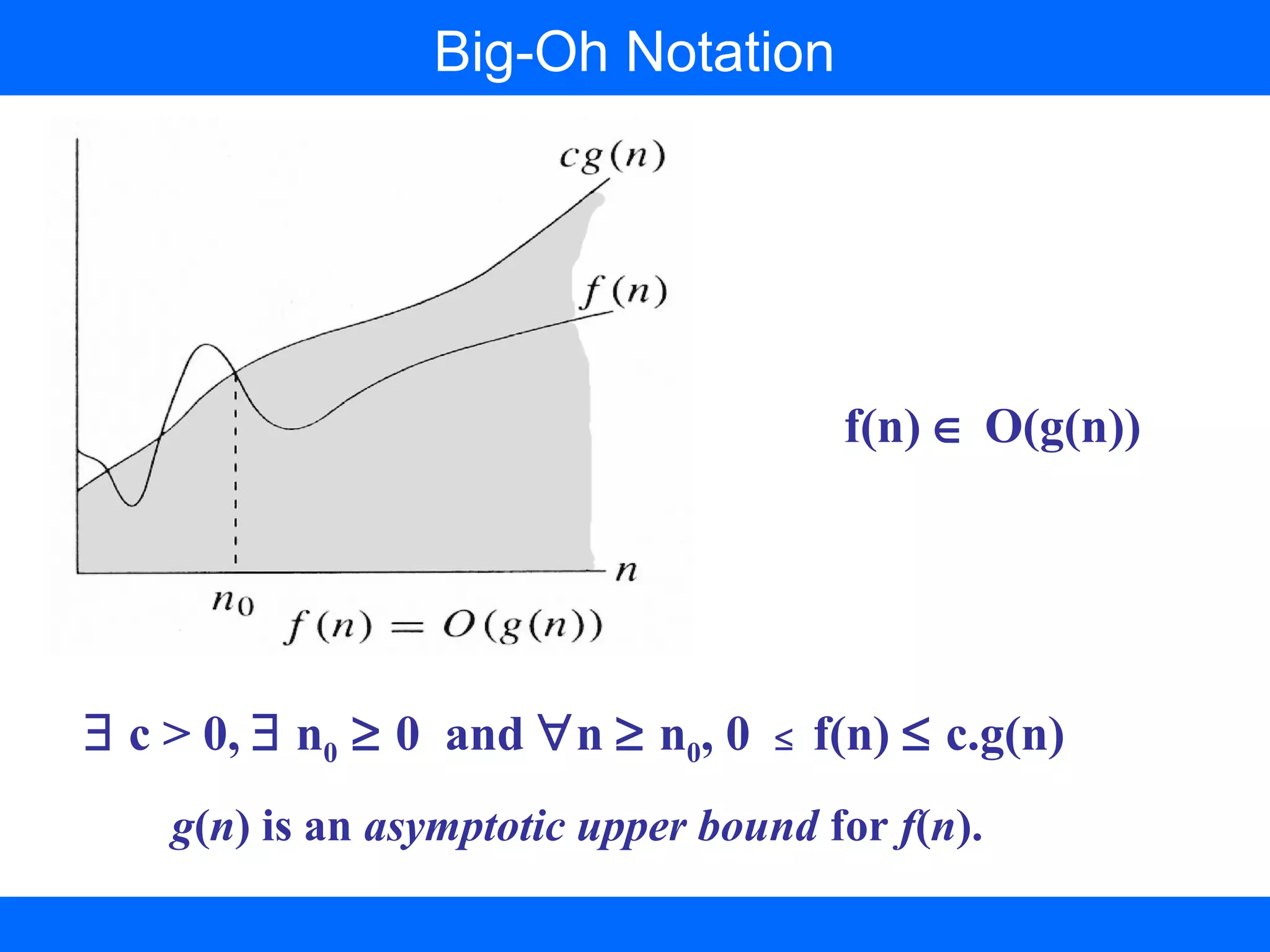
Big-Oh Notation (O)
Intuitively:
Set of all functions whose rate of growth is the same as or lower
than that of g(n).
We may write f(n) = O(g(n)) OR f(n) ∈ O(g(n))
If f, g: N → R+
, then we can define Big-Oh as
g(n) is an asymptotic upper bound for f(n).
Big-Oh Notation
∃ c > 0, ∃ n0 ≥ 0 and ∀n ≥ n0, 0 ≤ f(n) ≤ c.g(n)
f(n) ∈ O(g(n))
Examples
Example 1: Prove that 2n2
∈ O(n3
)
Proof:
Assume that f(n) = 2n2
, and g(n) = n3
f(n) ∈ O(g(n)) ?
Now we have to find the existence of c and n0
f(n) ≤ c.g(n)  2n2
≤ c.n3
 2 ≤ c.n
if we take, c = 1 and n0= 2 OR
c = 2 and n0= 1 then
2n2
≤ c.n3
Hence f(n) ∈ O(g(n)), c = 1 and n0= 2
Examples
Examples
Example 2: Prove that n2
∈ O(n2
)
Proof:
Assume that f(n) = n2
, and g(n) = n2
Now we have to show that f(n) ∈ O(g(n))
Since
f(n) ≤ c.g(n)  n2
≤ c.n2
 1 ≤ c, take, c = 1, n0= 1
Then
n2
≤ c.n2
for c = 1 and n ≥ 1
Hence, 2n2
∈ O(n2
), where c = 1 and n0= 1
Examples
Examples
Example 3: Prove that 1000.n2
+ 1000.n ∈ O(n2
)
Proof:
Assume that f(n) = 1000.n2
+ 1000.n, and g(n) = n2
We have to find existence of c and n0 such that
0 ≤ f(n) ≤ c.g(n)  n ≥ n0
1000.n2
+ 1000.n ≤ c.n2
= 1001.n2
, for c = 1001
1000.n2
+ 1000.n ≤ 1001.n2
 1000.n ≤ n2
n2
≥ 1000.n n2
- 1000.n ≥ 0
 n (n-1000) ≥ 0, this true for n ≥ 1000
f(n) ≤ c.g(n)  n ≥ n0 and c = 1001
Hence f(n) ∈ O(g(n)) for c = 1001 and n0 = 1000
Examples
Examples
Example 4: Prove that n3
 O(n2
)
Proof:
On contrary we assume that there exist some
positive constants c and n0 such that
0 ≤ n3
≤ c.n2
 n ≥ n0
0 ≤ n3
≤ c.n2
 n ≤ c
Since c is any fixed number and n is any arbitrary
constant, therefore n ≤ c is not possible in general.
Hence our supposition is wrong and n3
≤ c.n2
,
 n ≥ n0 is not true for any combination of c and n0.
And hence, n3
 O(n2
)
Examples
( ) ( )( )
( )( ) ( ){
( ) ( ) }
( ) ( )( ) ( )
( ).forboundlower
allyasymptoticanisfunctionthatmeans,
allfor0
such thatandconstantspositiveexistthere:
functions,ofsetthebydenotefunctiongivenaFor
nf
ngngnf
nnnfncg
ncnfng
ngng
o
o
Ω=
≥≤≤
=Ω
Ω
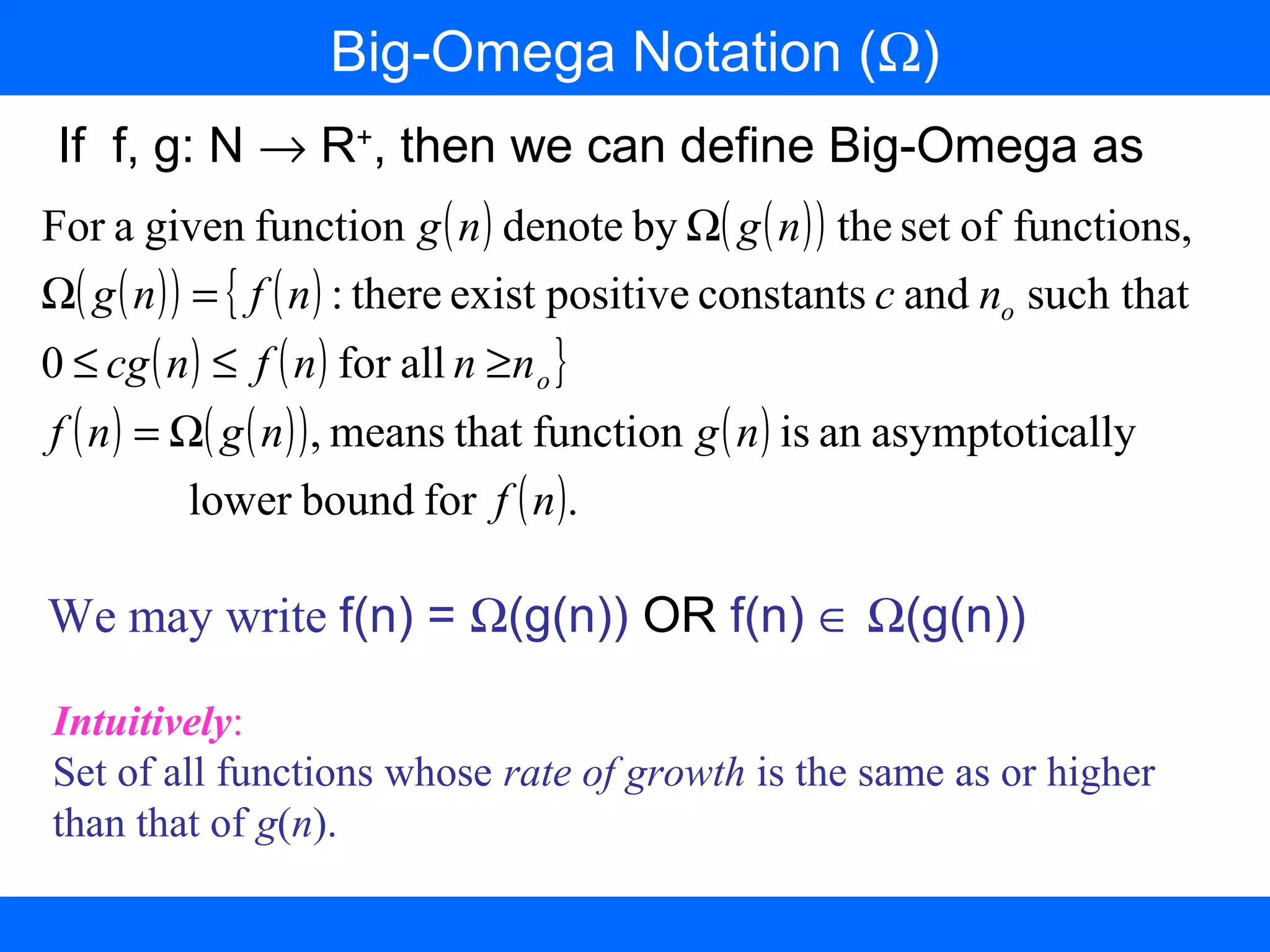
Big-Omega Notation (Ω)
Intuitively:
Set of all functions whose rate of growth is the same as or higher
than that of g(n).
We may write f(n) = Ω(g(n)) OR f(n) ∈ Ω(g(n))
If f, g: N → R+
, then we can define Big-Omega as
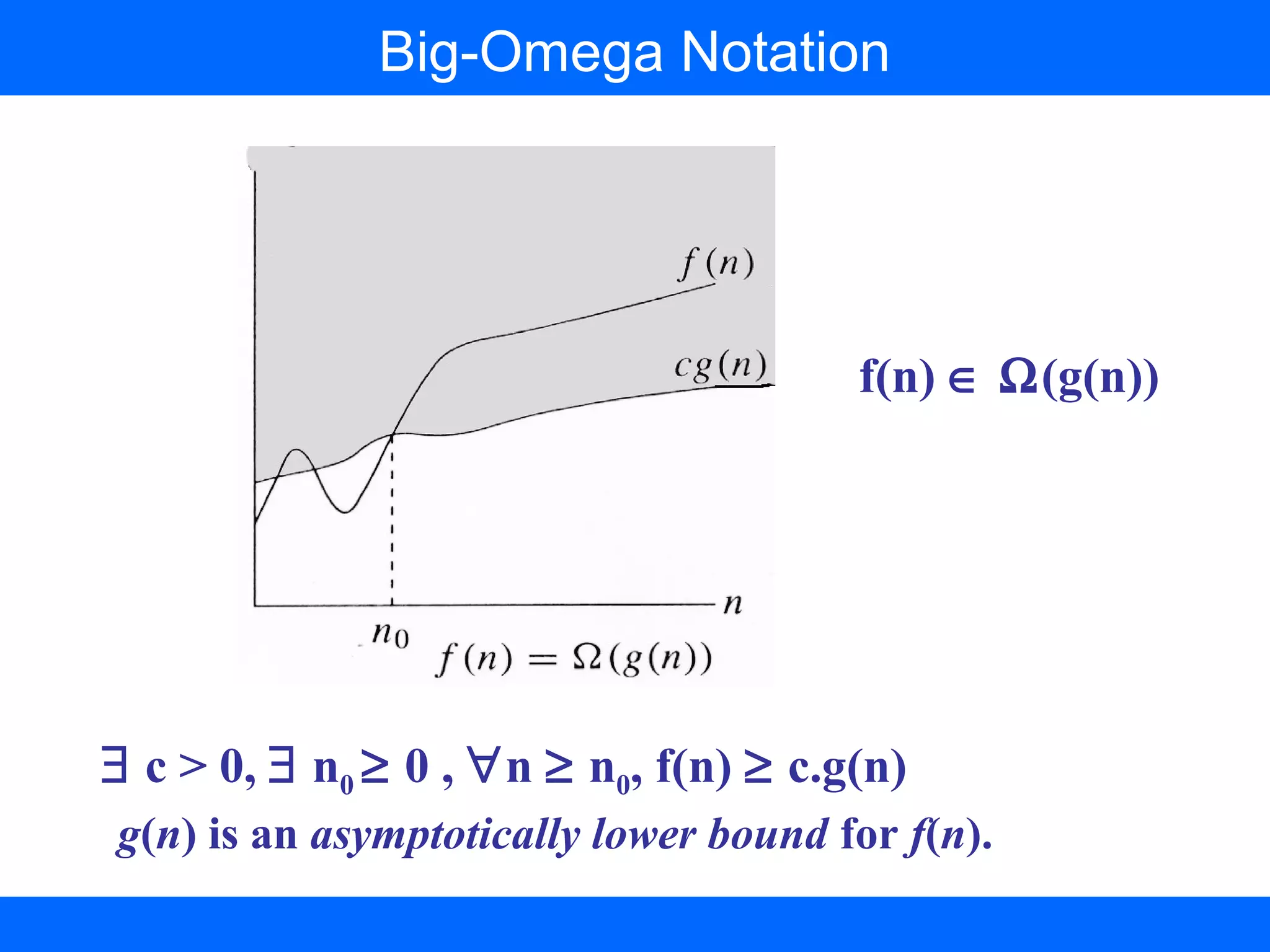
Big-Omega Notation
g(n) is an asymptotically lower bound for f(n).
∃ c > 0, ∃ n0 ≥ 0 , ∀n ≥ n0, f(n) ≥ c.g(n)
f(n) ∈ Ω(g(n))
Examples
Example 1: Prove that 5.n2
∈ Ω(n)
Proof:
Assume that f(n) = 5.n2
, and g(n) = n
f(n) ∈ Ω(g(n)) ?
We have to find the existence of c and n0 s.t.
c.g(n) ≤ f(n)  n ≥ n0
c.n ≤ 5.n2
 c ≤ 5.n
if we take, c = 5 and n0= 1 then
c.n ≤ 5.n2
 n ≥ n0
And hence f(n) ∈ Ω(g(n)), for c = 5 and n0= 1
Examples
Examples
Example 2: Prove that 5.n + 10 ∈ Ω(n)
Proof:
Assume that f(n) = 5.n + 10, and g(n) = n
f(n) ∈ Ω(g(n)) ?
We have to find the existence of c and n0 s.t.
c.g(n) ≤ f(n)  n ≥ n0
c.n ≤ 5.n + 10  c.n ≤ 5.n + 10.n  c ≤ 15.n
if we take, c = 15 and n0= 1 then
c.n ≤ 5.n + 10  n ≥ n0
And hence f(n) ∈ Ω(g(n)), for c = 15 and n0= 1
Examples
Examples
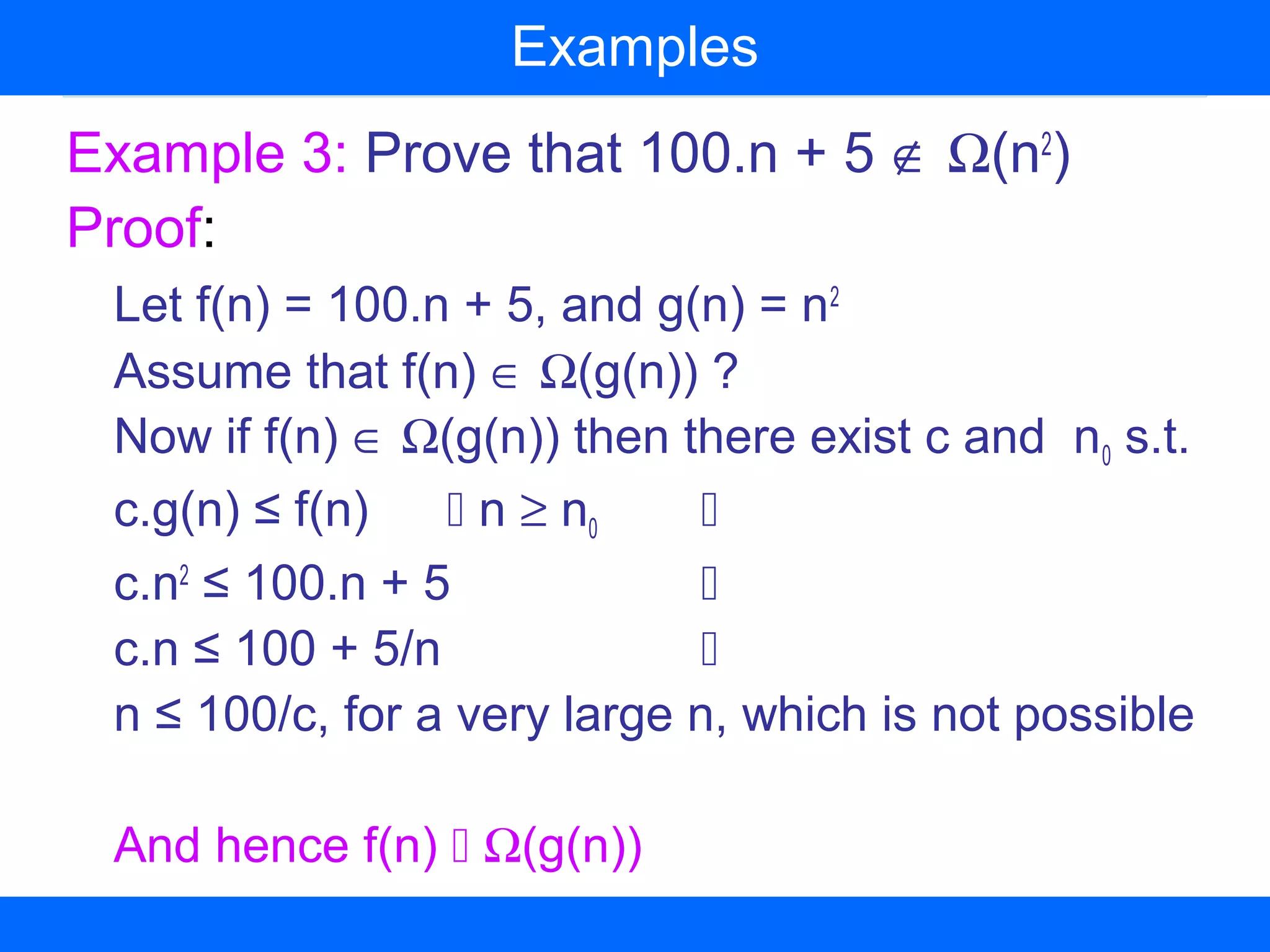
Example 3: Prove that 100.n + 5 ∉ Ω(n2
)
Proof:
Let f(n) = 100.n + 5, and g(n) = n2
Assume that f(n) ∈ Ω(g(n)) ?
Now if f(n) ∈ Ω(g(n)) then there exist c and n0 s.t.
c.g(n) ≤ f(n)  n ≥ n0 
c.n2
≤ 100.n + 5 
c.n ≤ 100 + 5/n 
n ≤ 100/c, for a very large n, which is not possible
And hence f(n)  Ω(g(n))
Examples
Theta Notation (Θ)
( ) ( )( )
( )( ) ( ){
( ) ( ) ( ) }
( ) ( )( ) ( ) ( )
( ) ( ).forboundally tightasymptoticanisandfactor,
constantawithintotoequalisfunctionmeans
allfor0
such thatand,constantspositiveexistthere:
functions,ofsetthebydenotedfunctiongivenaFor
21
21
nfng
ngnfngnf
nnngcnfngc
nccnfng
ngng
o
o
Θ=
≥≤≤≤
=Θ
Θ
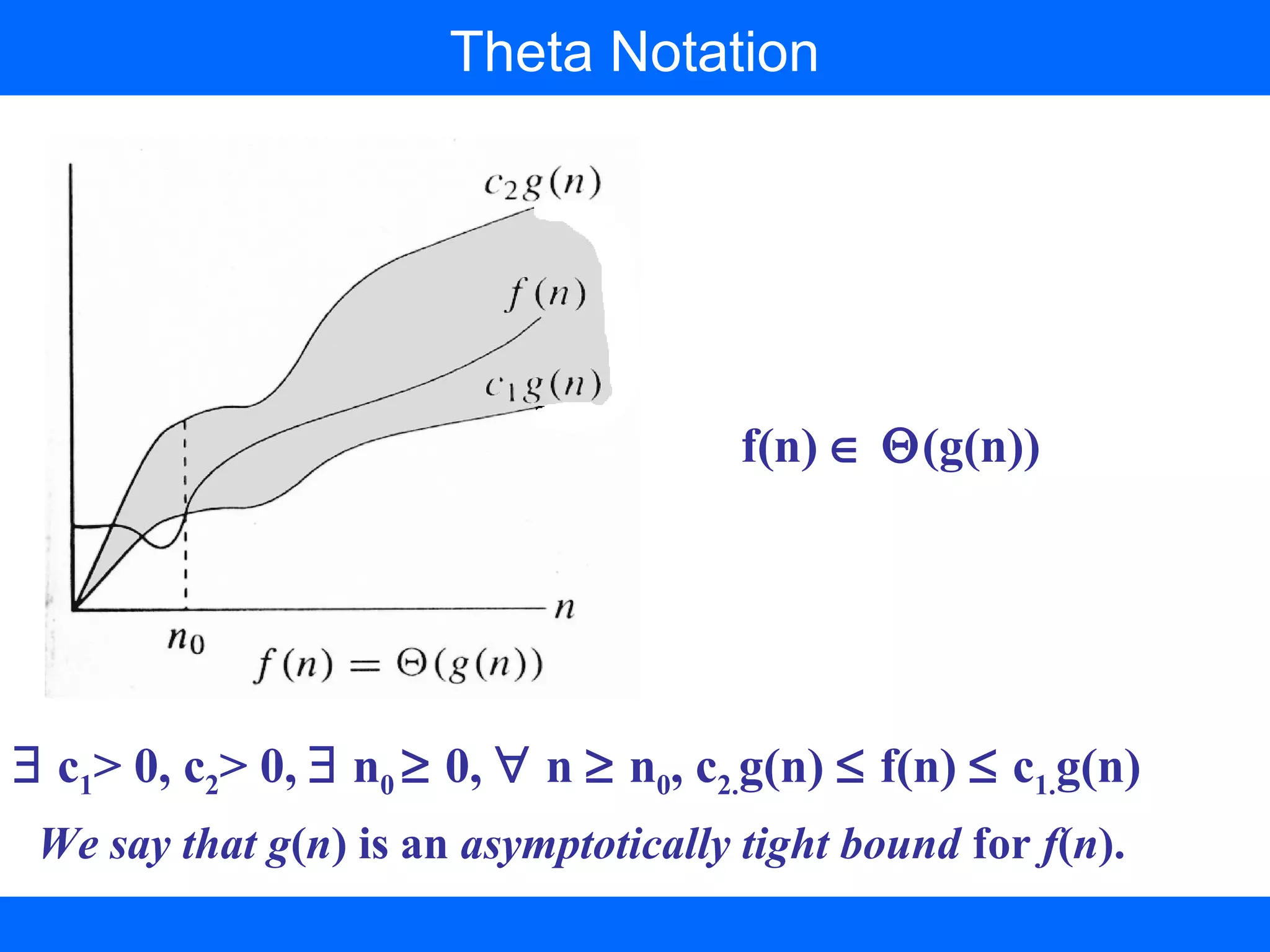
Intuitively: Set of all functions that have same rate of growth as g(n).
We may write f(n) = Θ(g(n)) OR f(n) ∈ Θ(g(n))
If f, g: N → R+
, then we can define Big-Theta as
We say that g(n) is an asymptotically tight bound for f(n).
f(n) ∈ Θ(g(n))
∃ c1> 0, c2> 0, ∃ n0 ≥ 0, ∀ n ≥ n0, c2.g(n) ≤ f(n) ≤ c1.g(n)
Theta Notation
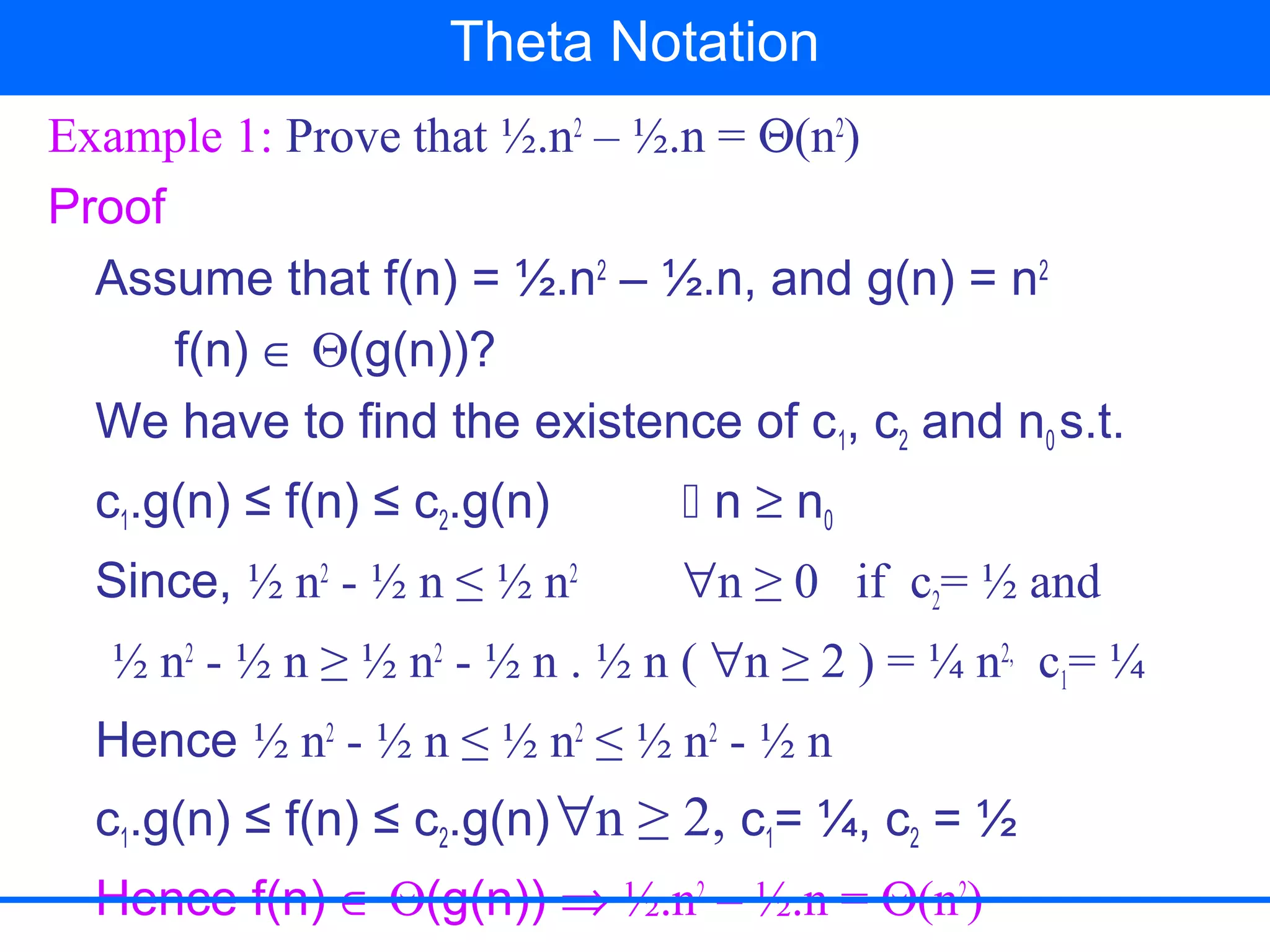
Example 1: Prove that ½.n2
– ½.n = Θ(n2
)
Proof
Assume that f(n) = ½.n2
– ½.n, and g(n) = n2
f(n) ∈ Θ(g(n))?
We have to find the existence of c1, c2 and n0 s.t.
c1.g(n) ≤ f(n) ≤ c2.g(n)  n ≥ n0
Since, ½ n2
- ½ n ≤ ½ n2
∀n ≥ 0 if c2= ½ and
½ n2
- ½ n ≥ ½ n2
- ½ n . ½ n ( ∀n ≥ 2 ) = ¼ n2,
c1= ¼
Hence ½ n2
- ½ n ≤ ½ n2
≤ ½ n2
- ½ n
c1.g(n) ≤ f(n) ≤ c2.g(n)∀n ≥ 2, c1= ¼, c2 = ½
Hence f(n) ∈ Θ(g(n)) ⇒ ½.n2
– ½.n = Θ(n2
)
Theta Notation
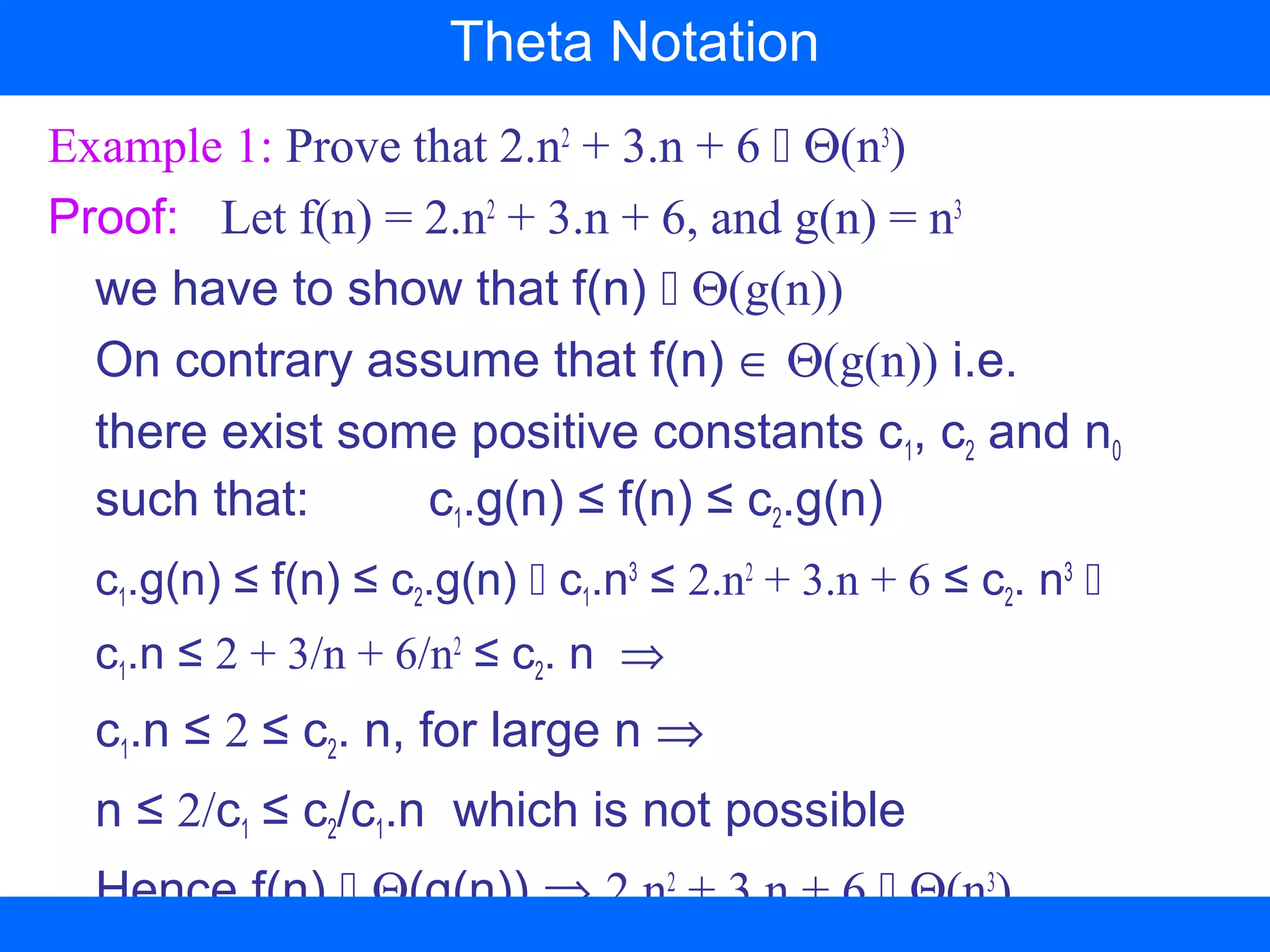
Example 1: Prove that 2.n2
+ 3.n + 6  Θ(n3
)
Proof: Let f(n) = 2.n2
+ 3.n + 6, and g(n) = n3
we have to show that f(n)  Θ(g(n))
On contrary assume that f(n) ∈ Θ(g(n)) i.e.
there exist some positive constants c1, c2 and n0
such that: c1.g(n) ≤ f(n) ≤ c2.g(n)
c1.g(n) ≤ f(n) ≤ c2.g(n)  c1.n3
≤ 2.n2
+ 3.n + 6 ≤ c2. n3

c1.n ≤ 2 + 3/n + 6/n2
≤ c2. n ⇒
c1.n ≤ 2 ≤ c2. n, for large n ⇒
n ≤ 2/c1 ≤ c2/c1.n which is not possible
Hence f(n)  Θ(g(n)) ⇒ 2.n2
+ 3.n + 6  Θ(n3
)
Theta Notation
Usefulness of Notations
• It is not always possible to determine behaviour of
an algorithm using Θ-notation.
• For example, given a problem with n inputs, we may
have an algorithm to solve it in a.n2
time when n is
even and c.n time when n is odd. OR
• We may prove that an algorithm never uses more
than e.n2
time and never less than f.n time.
• In either case we can neither claim Θ(n) nor Θ(n2
) to
be the order of the time usage of the algorithm.
• Big O and Ω notation will allow us to give at least
partial information

asymptotic notations i

  • 1.
    Time Complexity ofAlgorithms (Asymptotic Notations)
  • 2.
    • The levelin difficulty in solving mathematically posed problems as measured by – The time (time complexity) – memory space required – (space complexity) What is Complexity?
  • 3.
    1. Correctness An algorithmis said to be correct if • For every input, it halts with correct output. • An incorrect algorithm might not halt at all OR • It might halt with an answer other than desired one. • Correct algorithm solves a computational problem 2.Algorithm Efficiency Measuring efficiency of an algorithm, • do its analysis i.e. growth rate. • Compare efficiencies of different algorithms for the same problem. Major Factors in Algorithms Design
  • 4.
    • Algorithm analysismeans predicting resources such as – computational time – memory • Worst case analysis – Provides an upper bound on running time – An absolute guarantee • Average case analysis – Provides the expected running time – Very useful, but treat with care: what is “average”? • Random (equally likely) inputs • Real-life inputs Complexity Analysis
  • 5.
    Asymptotic Notations Properties •Categorize algorithms based on asymptotic growth rate e.g. linear, quadratic, exponential • Ignore small constant and small inputs • Estimate upper bound and lower bound on growth rate of time complexity function • Describe running time of algorithm as n grows to ∞. Limitations • not always useful for analysis on fixed-size inputs. • All results are for sufficiently large inputs. Dr Nazir A. Zafar Advanced Algorithms Analysis and Design
  • 6.
    Asymptotic Notations Θ,O, Ω, o, ω  We use Θ to mean “order exactly”,  O to mean “order at most”,  Ω to mean “order at least”,  o to mean “tight upper bound”, ∀ ω to mean “tight lower bound”, Define a set of functions: which is in practice used to compare two function sizes. Asymptotic Notations
  • 7.
    ( ) ()( ) ( )( ) ( ){ ( ) ( ) } ( ) ( )( ) ( ) ( ).forboundupper allyasymptoticanisfunctionmeans allfor,0 such thatandconstantspositiveexistthere: functions,ofsetthebydenoted,0functiongivenaFor nf ngngnf nnncgnf ncnfng ngng o o Ο= ≥≤≤ =Ο Ο≥ Big-Oh Notation (O) Intuitively: Set of all functions whose rate of growth is the same as or lower than that of g(n). We may write f(n) = O(g(n)) OR f(n) ∈ O(g(n)) If f, g: N → R+ , then we can define Big-Oh as
  • 8.
    g(n) is anasymptotic upper bound for f(n). Big-Oh Notation ∃ c > 0, ∃ n0 ≥ 0 and ∀n ≥ n0, 0 ≤ f(n) ≤ c.g(n) f(n) ∈ O(g(n))
  • 9.
    Examples Example 1: Provethat 2n2 ∈ O(n3 ) Proof: Assume that f(n) = 2n2 , and g(n) = n3 f(n) ∈ O(g(n)) ? Now we have to find the existence of c and n0 f(n) ≤ c.g(n)  2n2 ≤ c.n3  2 ≤ c.n if we take, c = 1 and n0= 2 OR c = 2 and n0= 1 then 2n2 ≤ c.n3 Hence f(n) ∈ O(g(n)), c = 1 and n0= 2 Examples
  • 10.
    Examples Example 2: Provethat n2 ∈ O(n2 ) Proof: Assume that f(n) = n2 , and g(n) = n2 Now we have to show that f(n) ∈ O(g(n)) Since f(n) ≤ c.g(n)  n2 ≤ c.n2  1 ≤ c, take, c = 1, n0= 1 Then n2 ≤ c.n2 for c = 1 and n ≥ 1 Hence, 2n2 ∈ O(n2 ), where c = 1 and n0= 1 Examples
  • 11.
    Examples Example 3: Provethat 1000.n2 + 1000.n ∈ O(n2 ) Proof: Assume that f(n) = 1000.n2 + 1000.n, and g(n) = n2 We have to find existence of c and n0 such that 0 ≤ f(n) ≤ c.g(n)  n ≥ n0 1000.n2 + 1000.n ≤ c.n2 = 1001.n2 , for c = 1001 1000.n2 + 1000.n ≤ 1001.n2  1000.n ≤ n2 n2 ≥ 1000.n n2 - 1000.n ≥ 0  n (n-1000) ≥ 0, this true for n ≥ 1000 f(n) ≤ c.g(n)  n ≥ n0 and c = 1001 Hence f(n) ∈ O(g(n)) for c = 1001 and n0 = 1000 Examples
  • 12.
    Examples Example 4: Provethat n3  O(n2 ) Proof: On contrary we assume that there exist some positive constants c and n0 such that 0 ≤ n3 ≤ c.n2  n ≥ n0 0 ≤ n3 ≤ c.n2  n ≤ c Since c is any fixed number and n is any arbitrary constant, therefore n ≤ c is not possible in general. Hence our supposition is wrong and n3 ≤ c.n2 ,  n ≥ n0 is not true for any combination of c and n0. And hence, n3  O(n2 ) Examples
  • 13.
    ( ) ()( ) ( )( ) ( ){ ( ) ( ) } ( ) ( )( ) ( ) ( ).forboundlower allyasymptoticanisfunctionthatmeans, allfor0 such thatandconstantspositiveexistthere: functions,ofsetthebydenotefunctiongivenaFor nf ngngnf nnnfncg ncnfng ngng o o Ω= ≥≤≤ =Ω Ω Big-Omega Notation (Ω) Intuitively: Set of all functions whose rate of growth is the same as or higher than that of g(n). We may write f(n) = Ω(g(n)) OR f(n) ∈ Ω(g(n)) If f, g: N → R+ , then we can define Big-Omega as
  • 14.
    Big-Omega Notation g(n) isan asymptotically lower bound for f(n). ∃ c > 0, ∃ n0 ≥ 0 , ∀n ≥ n0, f(n) ≥ c.g(n) f(n) ∈ Ω(g(n))
  • 15.
    Examples Example 1: Provethat 5.n2 ∈ Ω(n) Proof: Assume that f(n) = 5.n2 , and g(n) = n f(n) ∈ Ω(g(n)) ? We have to find the existence of c and n0 s.t. c.g(n) ≤ f(n)  n ≥ n0 c.n ≤ 5.n2  c ≤ 5.n if we take, c = 5 and n0= 1 then c.n ≤ 5.n2  n ≥ n0 And hence f(n) ∈ Ω(g(n)), for c = 5 and n0= 1 Examples
  • 16.
    Examples Example 2: Provethat 5.n + 10 ∈ Ω(n) Proof: Assume that f(n) = 5.n + 10, and g(n) = n f(n) ∈ Ω(g(n)) ? We have to find the existence of c and n0 s.t. c.g(n) ≤ f(n)  n ≥ n0 c.n ≤ 5.n + 10  c.n ≤ 5.n + 10.n  c ≤ 15.n if we take, c = 15 and n0= 1 then c.n ≤ 5.n + 10  n ≥ n0 And hence f(n) ∈ Ω(g(n)), for c = 15 and n0= 1 Examples
  • 17.
    Examples Example 3: Provethat 100.n + 5 ∉ Ω(n2 ) Proof: Let f(n) = 100.n + 5, and g(n) = n2 Assume that f(n) ∈ Ω(g(n)) ? Now if f(n) ∈ Ω(g(n)) then there exist c and n0 s.t. c.g(n) ≤ f(n)  n ≥ n0  c.n2 ≤ 100.n + 5  c.n ≤ 100 + 5/n  n ≤ 100/c, for a very large n, which is not possible And hence f(n)  Ω(g(n)) Examples
  • 18.
    Theta Notation (Θ) () ( )( ) ( )( ) ( ){ ( ) ( ) ( ) } ( ) ( )( ) ( ) ( ) ( ) ( ).forboundally tightasymptoticanisandfactor, constantawithintotoequalisfunctionmeans allfor0 such thatand,constantspositiveexistthere: functions,ofsetthebydenotedfunctiongivenaFor 21 21 nfng ngnfngnf nnngcnfngc nccnfng ngng o o Θ= ≥≤≤≤ =Θ Θ Intuitively: Set of all functions that have same rate of growth as g(n). We may write f(n) = Θ(g(n)) OR f(n) ∈ Θ(g(n)) If f, g: N → R+ , then we can define Big-Theta as
  • 19.
    We say thatg(n) is an asymptotically tight bound for f(n). f(n) ∈ Θ(g(n)) ∃ c1> 0, c2> 0, ∃ n0 ≥ 0, ∀ n ≥ n0, c2.g(n) ≤ f(n) ≤ c1.g(n) Theta Notation
  • 20.
    Example 1: Provethat ½.n2 – ½.n = Θ(n2 ) Proof Assume that f(n) = ½.n2 – ½.n, and g(n) = n2 f(n) ∈ Θ(g(n))? We have to find the existence of c1, c2 and n0 s.t. c1.g(n) ≤ f(n) ≤ c2.g(n)  n ≥ n0 Since, ½ n2 - ½ n ≤ ½ n2 ∀n ≥ 0 if c2= ½ and ½ n2 - ½ n ≥ ½ n2 - ½ n . ½ n ( ∀n ≥ 2 ) = ¼ n2, c1= ¼ Hence ½ n2 - ½ n ≤ ½ n2 ≤ ½ n2 - ½ n c1.g(n) ≤ f(n) ≤ c2.g(n)∀n ≥ 2, c1= ¼, c2 = ½ Hence f(n) ∈ Θ(g(n)) ⇒ ½.n2 – ½.n = Θ(n2 ) Theta Notation
  • 21.
    Example 1: Provethat 2.n2 + 3.n + 6  Θ(n3 ) Proof: Let f(n) = 2.n2 + 3.n + 6, and g(n) = n3 we have to show that f(n)  Θ(g(n)) On contrary assume that f(n) ∈ Θ(g(n)) i.e. there exist some positive constants c1, c2 and n0 such that: c1.g(n) ≤ f(n) ≤ c2.g(n) c1.g(n) ≤ f(n) ≤ c2.g(n)  c1.n3 ≤ 2.n2 + 3.n + 6 ≤ c2. n3  c1.n ≤ 2 + 3/n + 6/n2 ≤ c2. n ⇒ c1.n ≤ 2 ≤ c2. n, for large n ⇒ n ≤ 2/c1 ≤ c2/c1.n which is not possible Hence f(n)  Θ(g(n)) ⇒ 2.n2 + 3.n + 6  Θ(n3 ) Theta Notation
  • 22.
    Usefulness of Notations •It is not always possible to determine behaviour of an algorithm using Θ-notation. • For example, given a problem with n inputs, we may have an algorithm to solve it in a.n2 time when n is even and c.n time when n is odd. OR • We may prove that an algorithm never uses more than e.n2 time and never less than f.n time. • In either case we can neither claim Θ(n) nor Θ(n2 ) to be the order of the time usage of the algorithm. • Big O and Ω notation will allow us to give at least partial information