By: Alisha Jindal
Asymptotic Notations
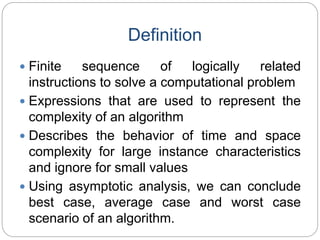
Definition
 Finite sequence of logically related
instructions to solve a computational problem
 Expressions that are used to represent the
complexity of an algorithm
 Describes the behavior of time and space
complexity for large instance characteristics
and ignore for small values
 Using asymptotic analysis, we can conclude
best case, average case and worst case
scenario of an algorithm.
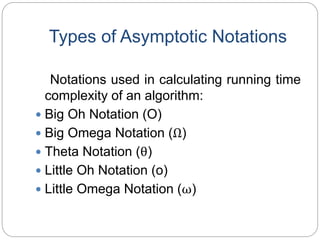
Types of Asymptotic Notations
Notations used in calculating running time
complexity of an algorithm:
 Big Oh Notation (O)
 Big Omega Notation (Ω)
 Theta Notation (θ)
 Little Oh Notation (o)
 Little Omega Notation (ω)
Big Oh Notation (O-notation)
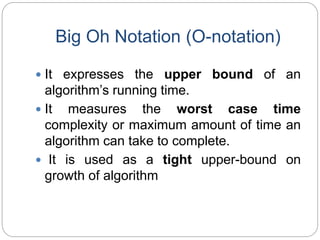
 It expresses the upper bound of an
algorithm’s running time.
 It measures the worst case time
complexity or maximum amount of time an
algorithm can take to complete.
 It is used as a tight upper-bound on
growth of algorithm
Big Oh Notation (O-notation)
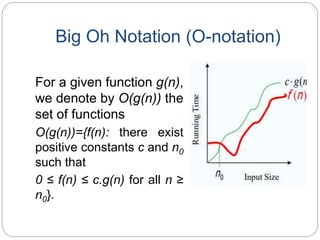
For a given function g(n),
we denote by O(g(n)) the
set of functions
O(g(n))={f(n): there exist
positive constants c and n0
such that
0 ≤ f(n) ≤ c.g(n) for all n ≥
n0}.
Examples
Show that the function is tightly bound with
big oh notation
(a) f(n)=3n+5
(b) f(n)= 27n2+16n
(c) f(n) = 2n +6n2 + 3n
Solutions
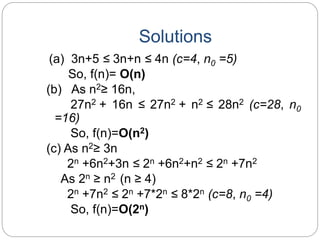
(a) 3n+5 ≤ 3n+n ≤ 4n (c=4, n0 =5)
So, f(n)= O(n)
(b) As n2≥ 16n,
27n2 + 16n ≤ 27n2 + n2 ≤ 28n2 (c=28, n0
=16)
So, f(n)=O(n2)
(c) As n2≥ 3n
2n +6n2+3n ≤ 2n +6n2+n2 ≤ 2n +7n2
As 2n ≥ n2 (n ≥ 4)
2n +7n2 ≤ 2n +7*2n ≤ 8*2n (c=8, n0 =4)
So, f(n)=O(2n)
Asymptotic Analysis of Running
Time
Comparing running time
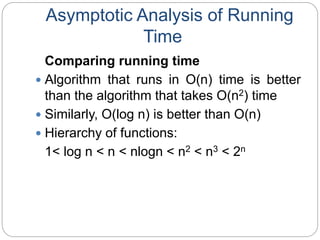
 Algorithm that runs in O(n) time is better
than the algorithm that takes O(n2) time
 Similarly, O(log n) is better than O(n)
 Hierarchy of functions:
1< log n < n < nlogn < n2 < n3 < 2n
Big Omega Notation (Ω-notation)
 It expresses the lower bound of an
algorithm’s running time.
 It measures the best case time complexity
or minimum amount of time an algorithm
can take to complete.
 It is used as a tight lower-bound on
growth of algorithm
Big Omega Notation (Ω-notation)
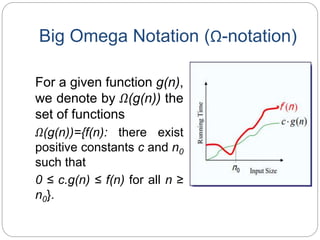
For a given function g(n),
we denote by Ω(g(n)) the
set of functions
Ω(g(n))={f(n): there exist
positive constants c and n0
such that
0 ≤ c.g(n) ≤ f(n) for all n ≥
n0}.
Theta Notation (θ-notation)
 It encloses the function from above and
below. Since it represents the upper and
lower bound of an algorithm’s running
time.
 It is used for analyzing the average case
time complexity of an algorithm
Theta Notation (θ-notation)
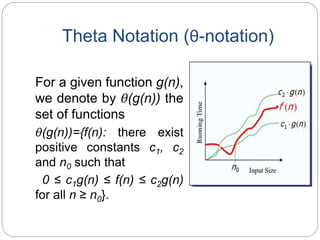
For a given function g(n),
we denote by θ(g(n)) the
set of functions
θ(g(n))={f(n): there exist
positive constants c1, c2
and n0 such that
0 ≤ c1g(n) ≤ f(n) ≤ c2g(n)
for all n ≥ n0}.
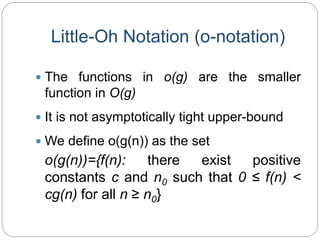
Little-Oh Notation (o-notation)
 The functions in o(g) are the smaller
function in O(g)
 It is not asymptotically tight upper-bound
 We define o(g(n)) as the set
o(g(n))={f(n): there exist positive
constants c and n0 such that 0 ≤ f(n) <
cg(n) for all n ≥ n0}
Little-Omega Notation (ω-
notation)
 The functions in ω(g) are the larger
function of Ω(g)
 It is not asymptotically tight lower-bound
 We define ω(g(n)) as the set
ω(g(n))={f(n): there exist positive
constants c and n0 such that 0 ≤ cg(n) <
f(n) for all n ≥ n0}
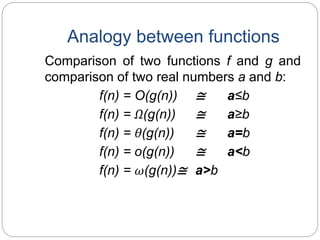
Analogy between functions
Comparison of two functions f and g and
comparison of two real numbers a and b:
f(n) = O(g(n)) ≅ a≤b
f(n) = Ω(g(n)) ≅ a≥b
f(n) = θ(g(n)) ≅ a=b
f(n) = o(g(n)) ≅ a<b
f(n) = ω(g(n))≅ a>b

Asymptoptic notations

  • 1.
  • 2.
    Definition  Finite sequenceof logically related instructions to solve a computational problem  Expressions that are used to represent the complexity of an algorithm  Describes the behavior of time and space complexity for large instance characteristics and ignore for small values  Using asymptotic analysis, we can conclude best case, average case and worst case scenario of an algorithm.
  • 3.
    Types of AsymptoticNotations Notations used in calculating running time complexity of an algorithm:  Big Oh Notation (O)  Big Omega Notation (Ω)  Theta Notation (θ)  Little Oh Notation (o)  Little Omega Notation (ω)
  • 4.
    Big Oh Notation(O-notation)  It expresses the upper bound of an algorithm’s running time.  It measures the worst case time complexity or maximum amount of time an algorithm can take to complete.  It is used as a tight upper-bound on growth of algorithm
  • 5.
    Big Oh Notation(O-notation) For a given function g(n), we denote by O(g(n)) the set of functions O(g(n))={f(n): there exist positive constants c and n0 such that 0 ≤ f(n) ≤ c.g(n) for all n ≥ n0}.
  • 6.
    Examples Show that thefunction is tightly bound with big oh notation (a) f(n)=3n+5 (b) f(n)= 27n2+16n (c) f(n) = 2n +6n2 + 3n
  • 7.
    Solutions (a) 3n+5 ≤3n+n ≤ 4n (c=4, n0 =5) So, f(n)= O(n) (b) As n2≥ 16n, 27n2 + 16n ≤ 27n2 + n2 ≤ 28n2 (c=28, n0 =16) So, f(n)=O(n2) (c) As n2≥ 3n 2n +6n2+3n ≤ 2n +6n2+n2 ≤ 2n +7n2 As 2n ≥ n2 (n ≥ 4) 2n +7n2 ≤ 2n +7*2n ≤ 8*2n (c=8, n0 =4) So, f(n)=O(2n)
  • 8.
    Asymptotic Analysis ofRunning Time Comparing running time  Algorithm that runs in O(n) time is better than the algorithm that takes O(n2) time  Similarly, O(log n) is better than O(n)  Hierarchy of functions: 1< log n < n < nlogn < n2 < n3 < 2n
  • 9.
    Big Omega Notation(Ω-notation)  It expresses the lower bound of an algorithm’s running time.  It measures the best case time complexity or minimum amount of time an algorithm can take to complete.  It is used as a tight lower-bound on growth of algorithm
  • 10.
    Big Omega Notation(Ω-notation) For a given function g(n), we denote by Ω(g(n)) the set of functions Ω(g(n))={f(n): there exist positive constants c and n0 such that 0 ≤ c.g(n) ≤ f(n) for all n ≥ n0}.
  • 11.
    Theta Notation (θ-notation) It encloses the function from above and below. Since it represents the upper and lower bound of an algorithm’s running time.  It is used for analyzing the average case time complexity of an algorithm
  • 12.
    Theta Notation (θ-notation) Fora given function g(n), we denote by θ(g(n)) the set of functions θ(g(n))={f(n): there exist positive constants c1, c2 and n0 such that 0 ≤ c1g(n) ≤ f(n) ≤ c2g(n) for all n ≥ n0}.
  • 13.
    Little-Oh Notation (o-notation) The functions in o(g) are the smaller function in O(g)  It is not asymptotically tight upper-bound  We define o(g(n)) as the set o(g(n))={f(n): there exist positive constants c and n0 such that 0 ≤ f(n) < cg(n) for all n ≥ n0}
  • 14.
    Little-Omega Notation (ω- notation) The functions in ω(g) are the larger function of Ω(g)  It is not asymptotically tight lower-bound  We define ω(g(n)) as the set ω(g(n))={f(n): there exist positive constants c and n0 such that 0 ≤ cg(n) < f(n) for all n ≥ n0}
  • 15.
    Analogy between functions Comparisonof two functions f and g and comparison of two real numbers a and b: f(n) = O(g(n)) ≅ a≤b f(n) = Ω(g(n)) ≅ a≥b f(n) = θ(g(n)) ≅ a=b f(n) = o(g(n)) ≅ a<b f(n) = ω(g(n))≅ a>b