Asymptotic Notations
Nikhil Sharma
BE/8034/09
Introduction
 In mathematics, computer science, and related fields, big O
notation describes the limiting behavior of a function when the
argument tends towards a particular value or infinity, usually in
terms of simpler functions. Big O notation allows its users to
simplify functions in order to concentrate on their growth rates:
different functions with the same growth rate may be represented
using the same O notation.
 The time complexity of an algorithm quantifies the amount of
time taken by an algorithm to run as a function of the size of the
input to the problem. When it is expressed using big O
notation, the time complexity is said to be
described asymptotically, i.e., as the input size goes to infinity.
Asymptotic Complexity
 Running time of an algorithm as a function of input size n for large
n.
 Expressed using only the highest-order term in the expression for
the exact running time.
◦ Instead of exact running time, say (n2).
 Describes behavior of function in the limit.
 Written using Asymptotic Notation.
 The notations describe different rate-of-growth relations between
the defining function and the defined set of functions.
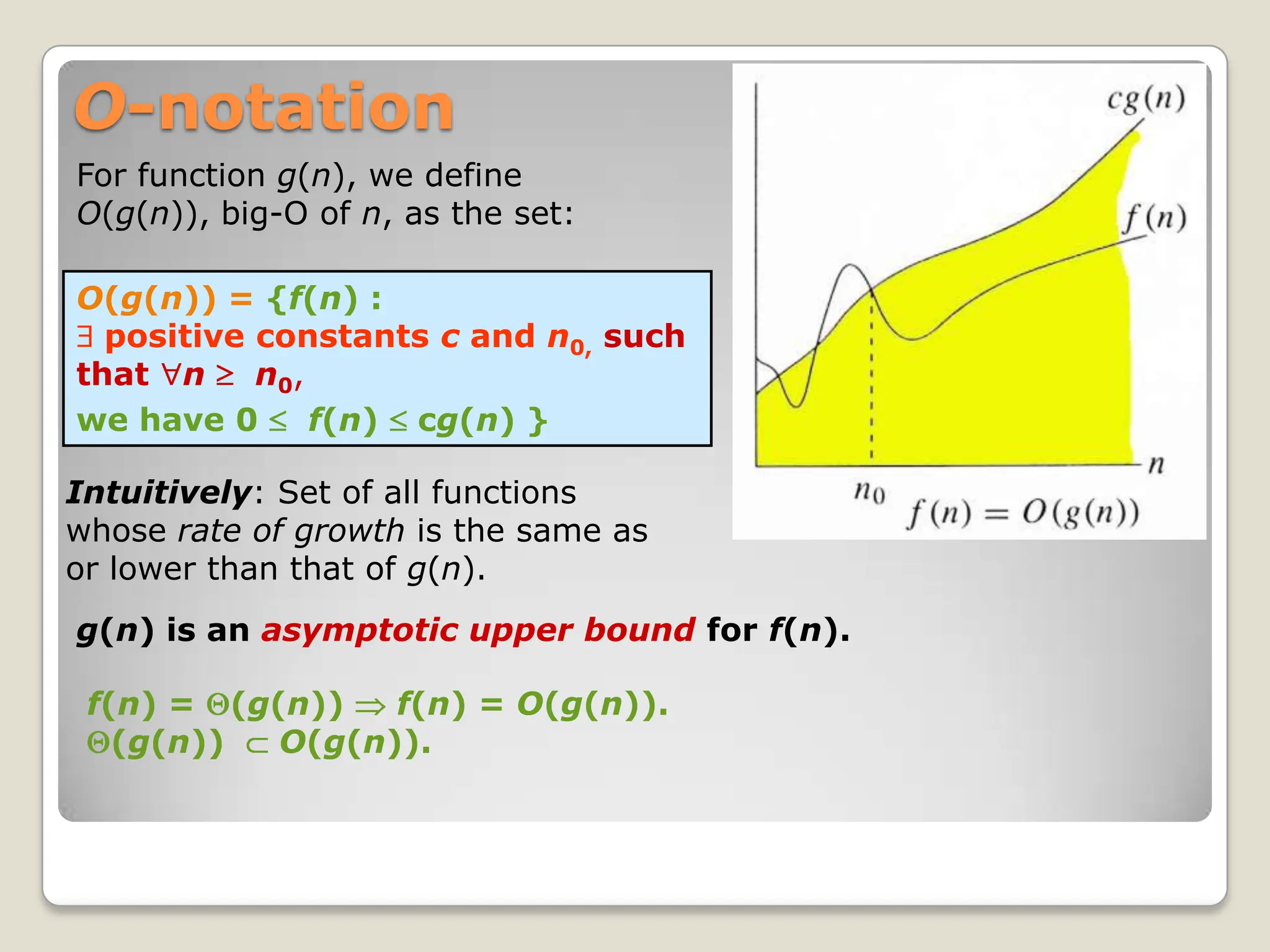
O-notation
O(g(n)) = {f(n) :
positive constants c and n0, such
that n n0,
we have 0 f(n) cg(n) }
For function g(n), we define
O(g(n)), big-O of n, as the set:
g(n) is an asymptotic upper bound for f(n).
Intuitively: Set of all functions
whose rate of growth is the same as
or lower than that of g(n).
f(n) = (g(n)) f(n) = O(g(n)).
(g(n)) O(g(n)).
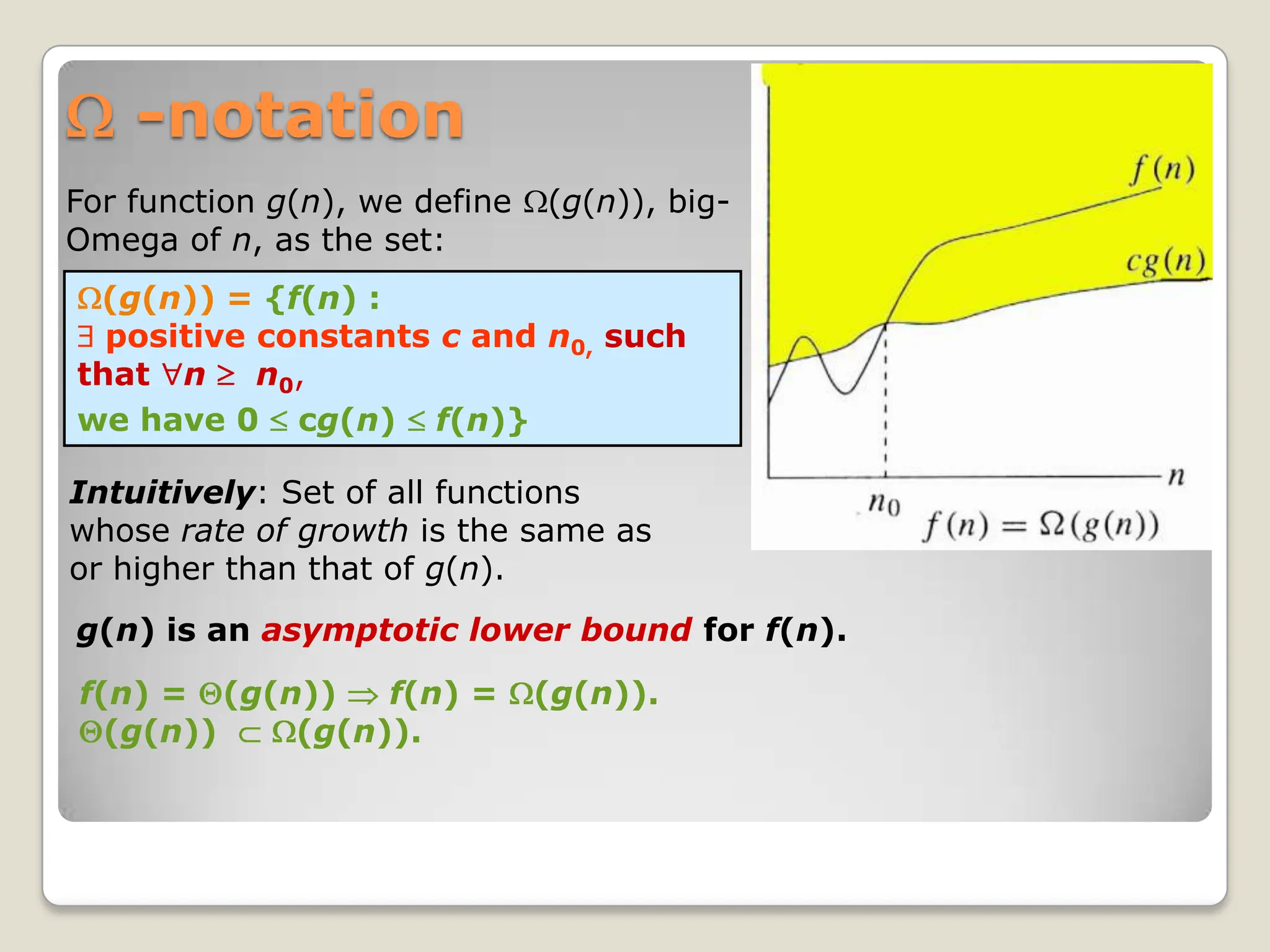
-notation
g(n) is an asymptotic lower bound for f(n).
Intuitively: Set of all functions
whose rate of growth is the same as
or higher than that of g(n).
f(n) = (g(n)) f(n) = (g(n)).
(g(n)) (g(n)).
(g(n)) = {f(n) :
positive constants c and n0, such
that n n0,
we have 0 cg(n) f(n)}
For function g(n), we define (g(n)), big-
Omega of n, as the set:
-notation
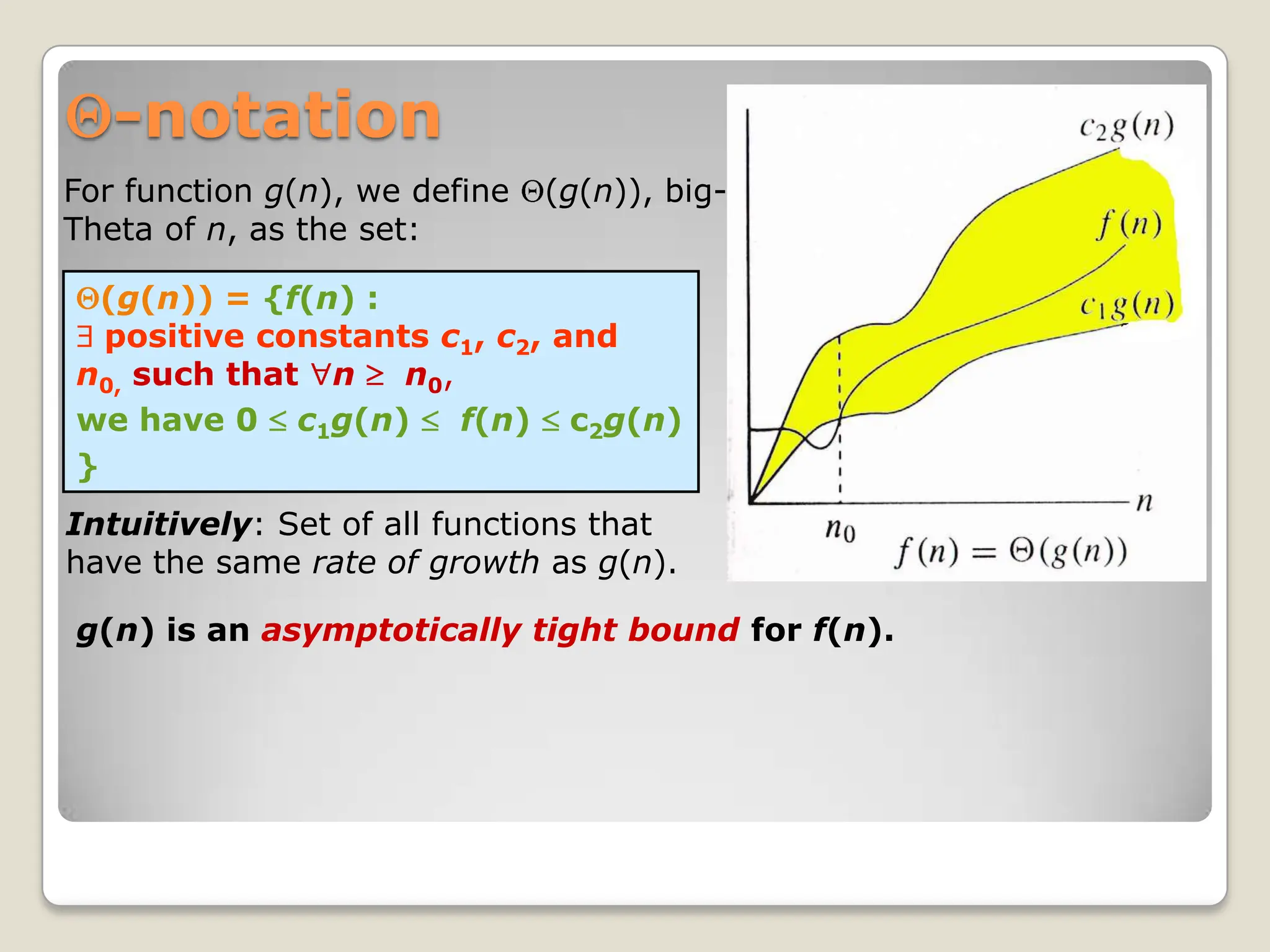
(g(n)) = {f(n) :
positive constants c1, c2, and
n0, such that n n0,
we have 0 c1g(n) f(n) c2g(n)
}
For function g(n), we define (g(n)), big-
Theta of n, as the set:
g(n) is an asymptotically tight bound for f(n).
Intuitively: Set of all functions that
have the same rate of growth as g(n).
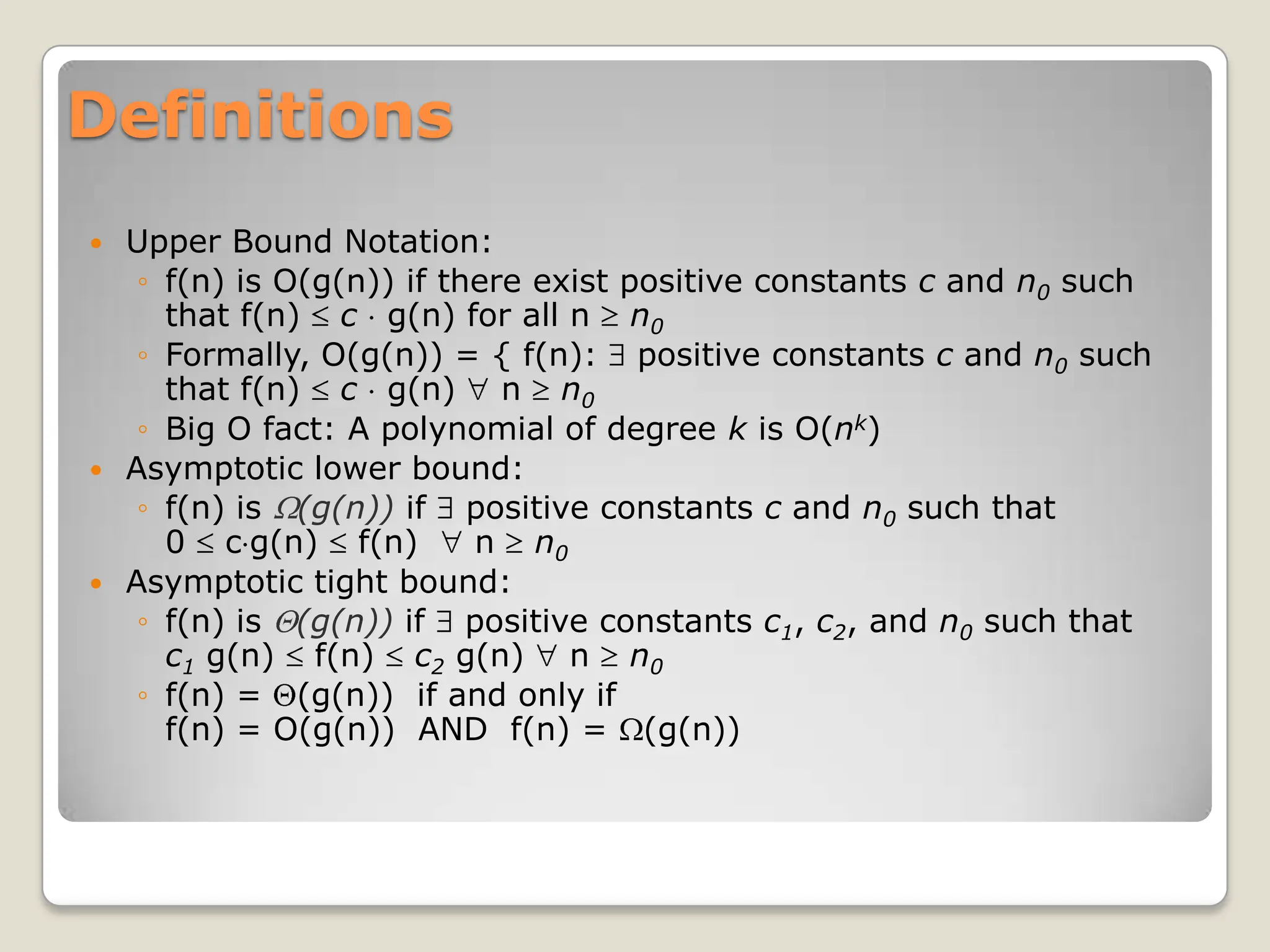
Definitions
 Upper Bound Notation:
◦ f(n) is O(g(n)) if there exist positive constants c and n0 such
that f(n) c g(n) for all n n0
◦ Formally, O(g(n)) = { f(n): positive constants c and n0 such
that f(n) c g(n) n n0
◦ Big O fact: A polynomial of degree k is O(nk)
 Asymptotic lower bound:
◦ f(n) is (g(n)) if positive constants c and n0 such that
0 c g(n) f(n) n n0
 Asymptotic tight bound:
◦ f(n) is (g(n)) if positive constants c1, c2, and n0 such that
c1 g(n) f(n) c2 g(n) n n0
◦ f(n) = (g(n)) if and only if
f(n) = O(g(n)) AND f(n) = (g(n))
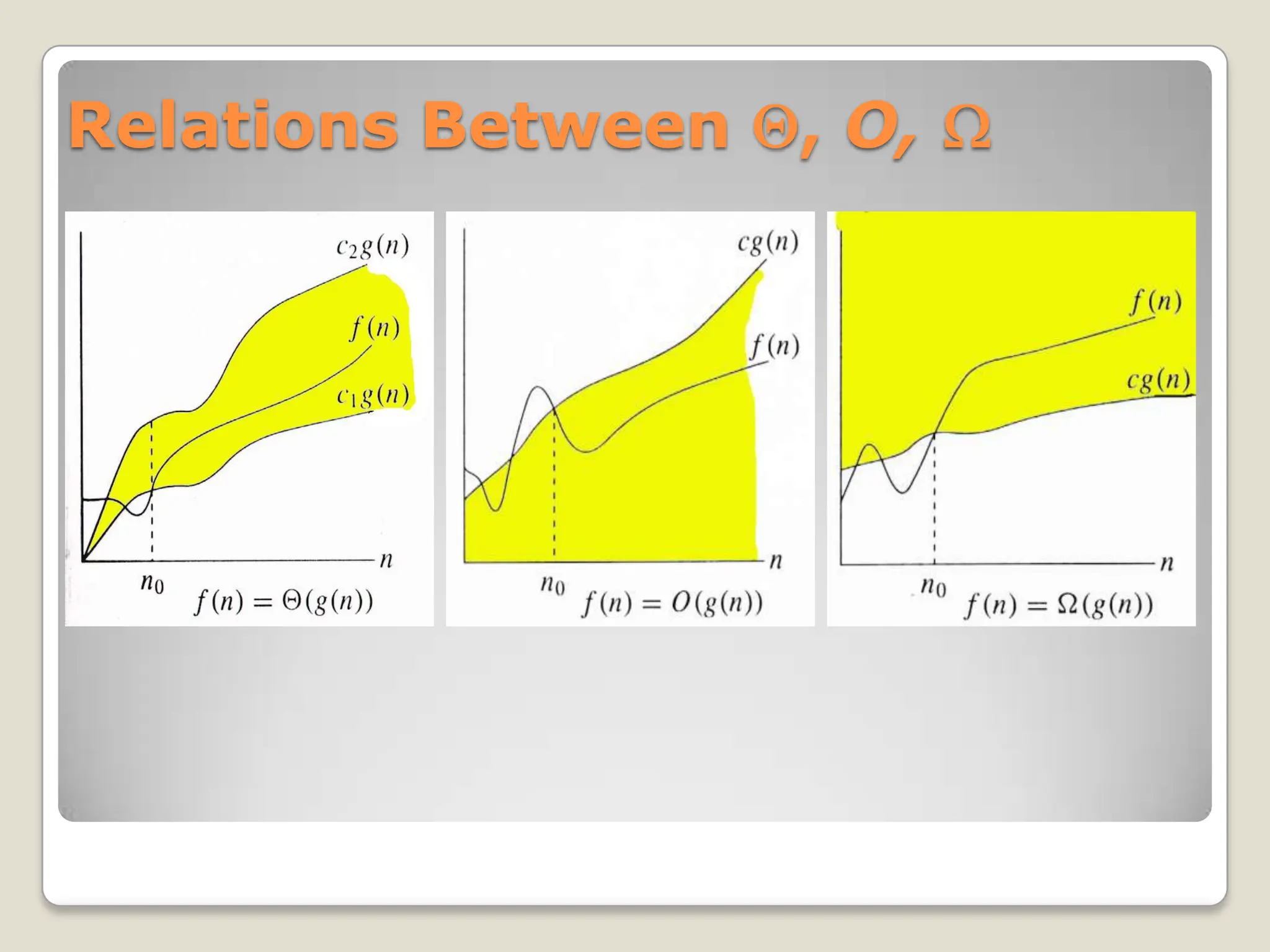
Relations Between , O,
o-notation
f(n) becomes insignificant relative to g(n) as n approaches
infinity:
lim [f(n) / g(n)] = 0
n
g(n) is an upper bound for f(n) that is not asymptotically tight.
o(g(n)) = {f(n): c > 0, n0 > 0 such that
n n0, we have 0 f(n) < cg(n)}.
For a given function g(n), the set little-o:
(g(n)) = {f(n): c > 0, n0 > 0 such that
n n0, we have 0 cg(n) < f(n)}.
-notation
f(n) becomes arbitrarily large relative to g(n) as n approaches
infinity:
lim [f(n) / g(n)] = .
n
g(n) is a lower bound for f(n) that is not asymptotically tight.
For a given function g(n), the set little-omega:
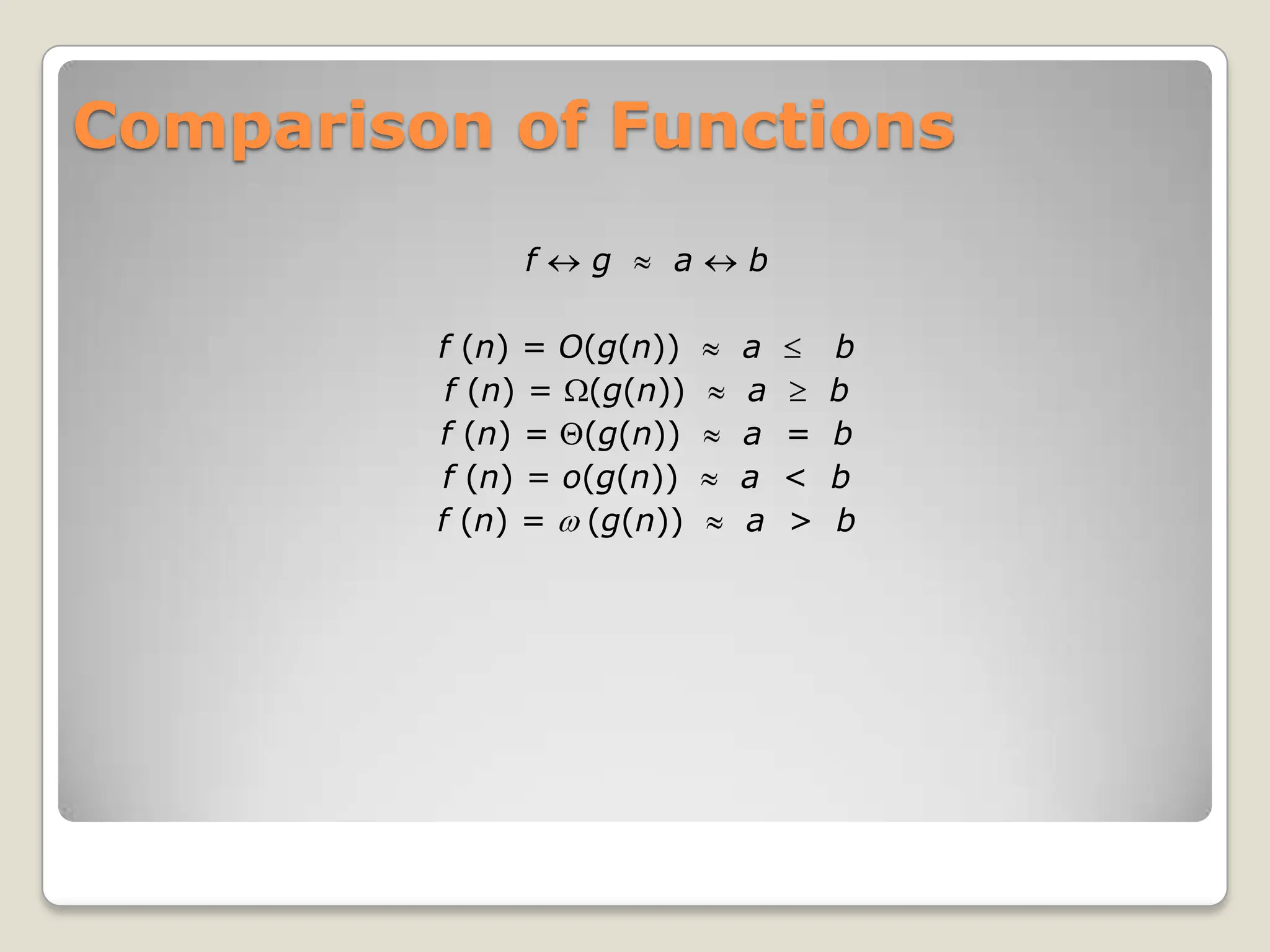
Comparison of Functions
f g a b
f (n) = O(g(n)) a b
f (n) = (g(n)) a b
f (n) = (g(n)) a = b
f (n) = o(g(n)) a < b
f (n) = (g(n)) a > b
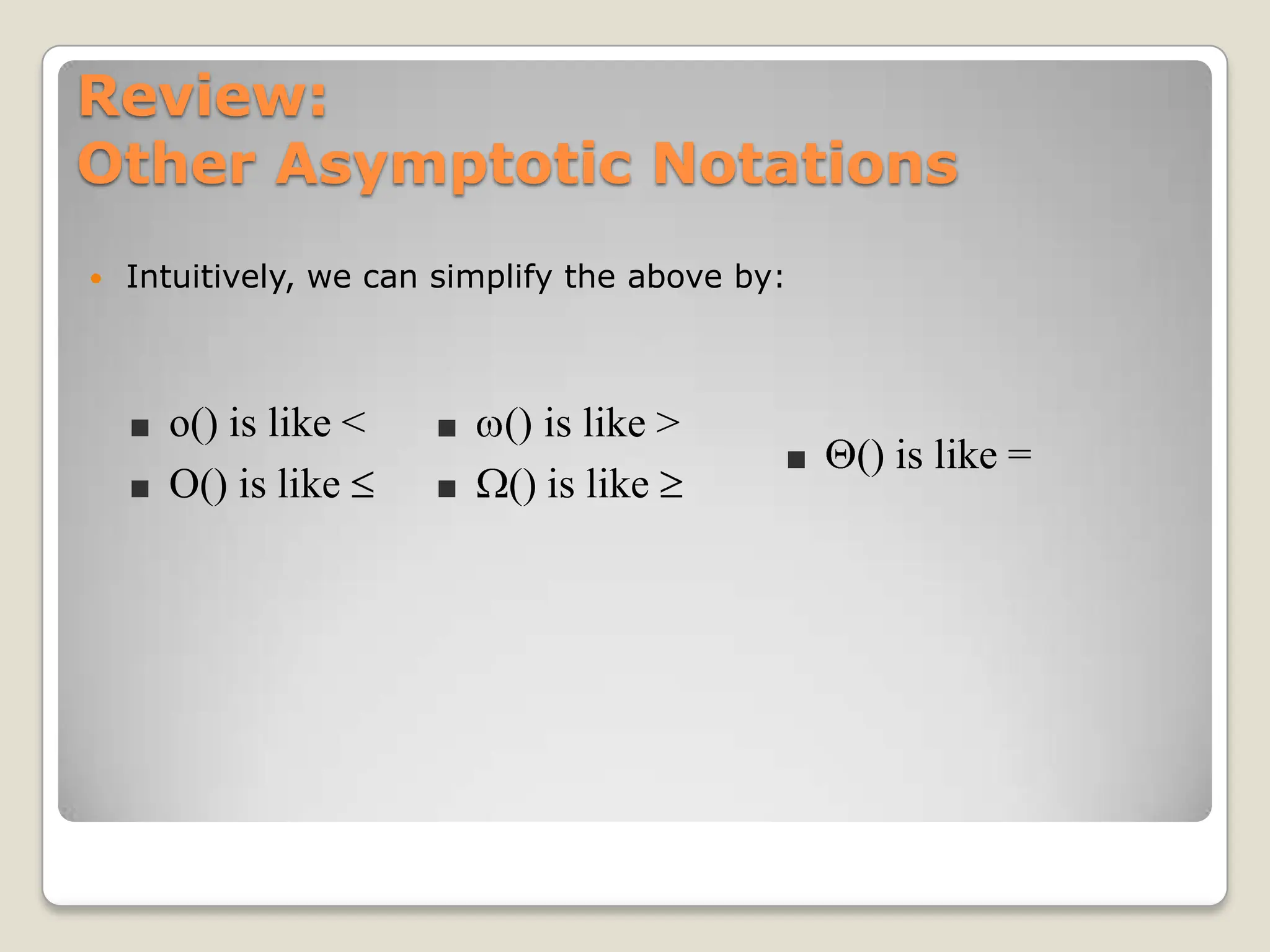
Review:
Other Asymptotic Notations
 Intuitively, we can simplify the above by:
■ o() is like <
■ O() is like
■ () is like >
■ () is like
■ () is like =
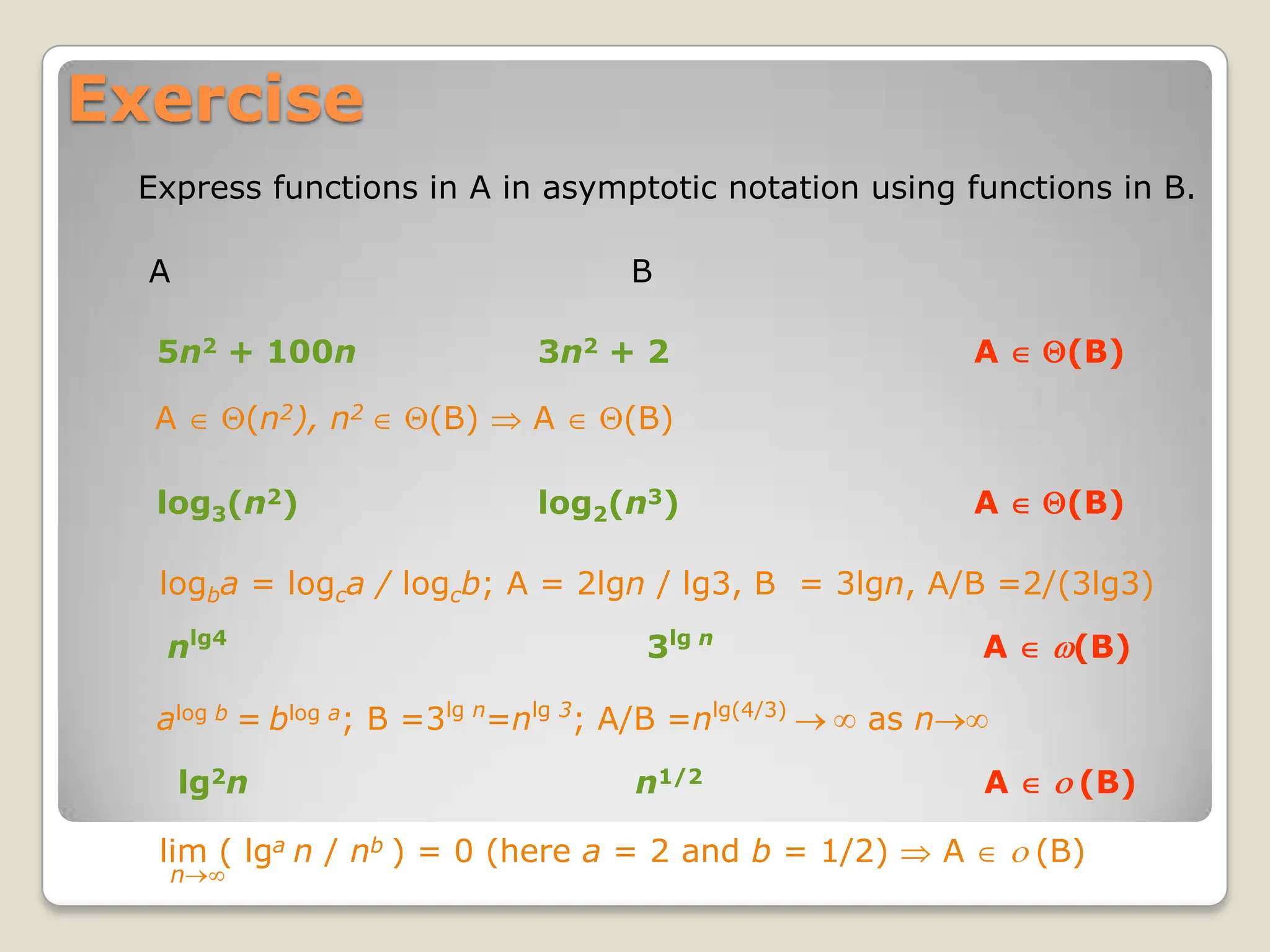
Exercise
Express functions in A in asymptotic notation using functions in B.
A B
5n2 + 100n 3n2 + 2
A (n2), n2 (B) A (B)
log3(n2) log2(n3)
logba = logca / logcb; A = 2lgn / lg3, B = 3lgn, A/B =2/(3lg3)
nlg4
3lg n
alog b = blog a; B =3lg n
=nlg 3
; A/B =nlg(4/3)
as n
lg2n n1/2
lim ( lga n / nb ) = 0 (here a = 2 and b = 1/2) A (B)
n
A (B)
A (B)
A (B)
A (B)
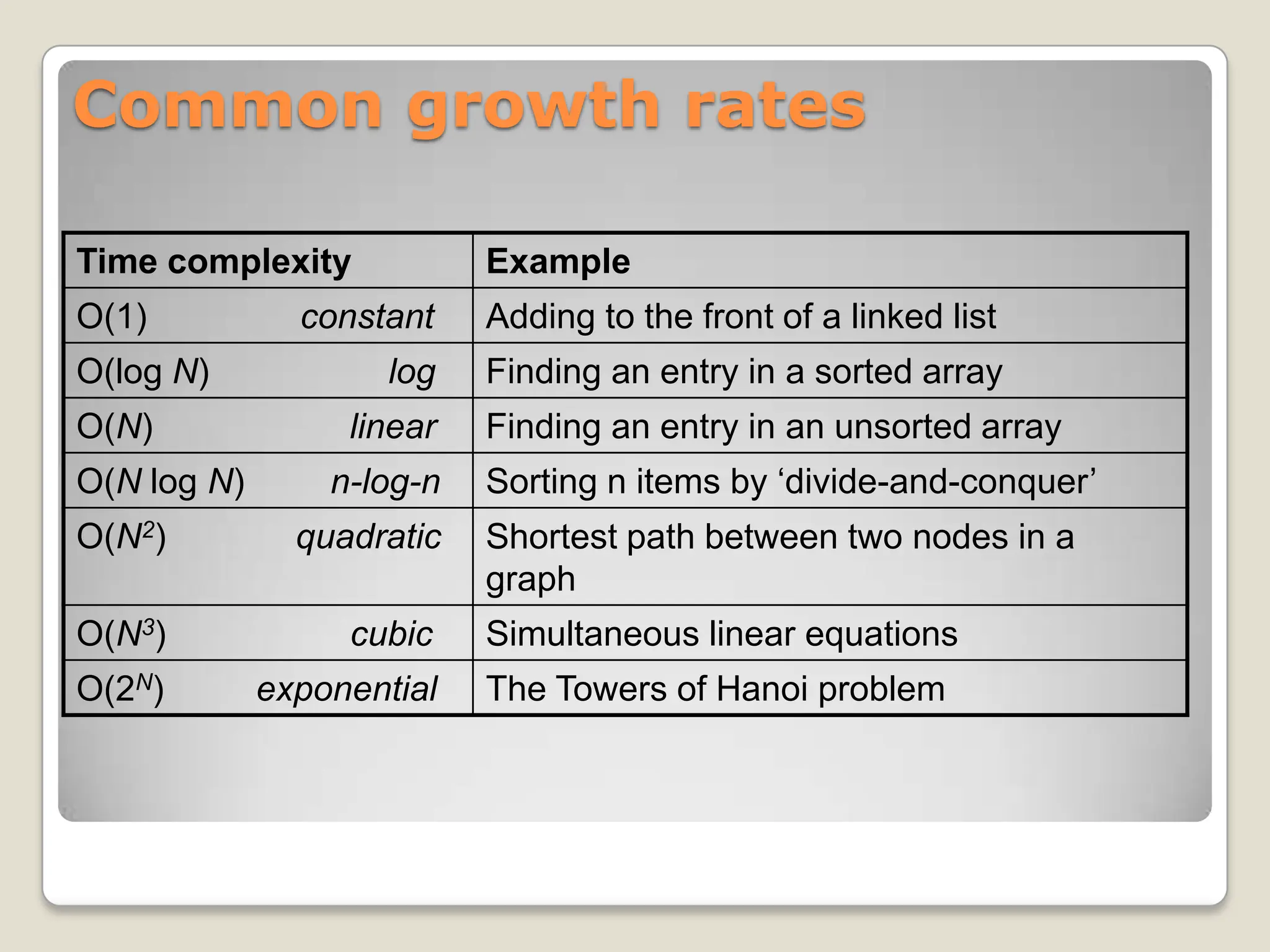
Common growth rates
Time complexity Example
O(1) constant Adding to the front of a linked list
O(log N) log Finding an entry in a sorted array
O(N) linear Finding an entry in an unsorted array
O(N log N) n-log-n Sorting n items by ‘divide-and-conquer’
O(N2) quadratic Shortest path between two nodes in a
graph
O(N3) cubic Simultaneous linear equations
O(2N) exponential The Towers of Hanoi problem
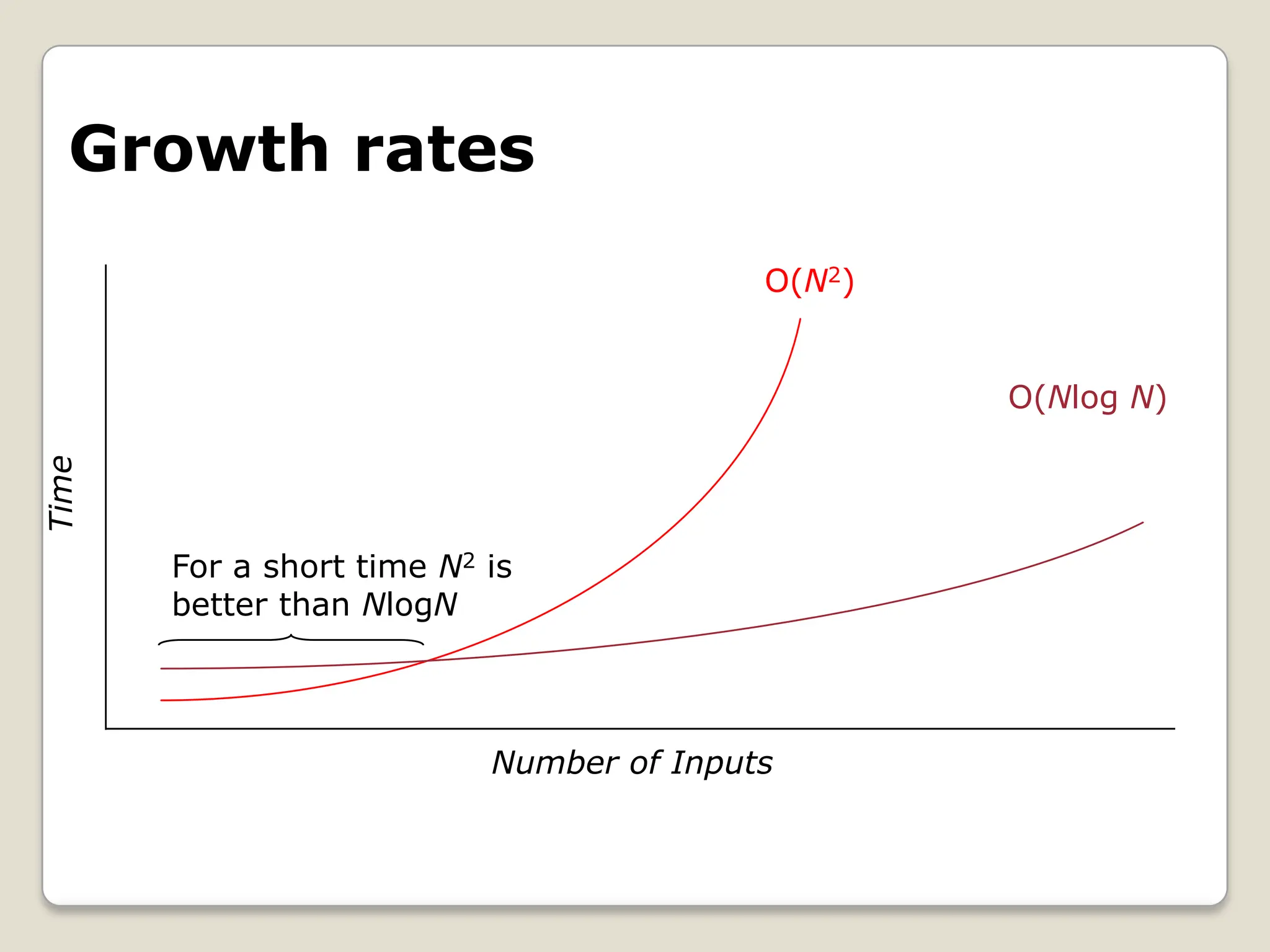
Growth rates
Number of Inputs
O(N2)
O(Nlog N)
For a short time N2 is
better than NlogN
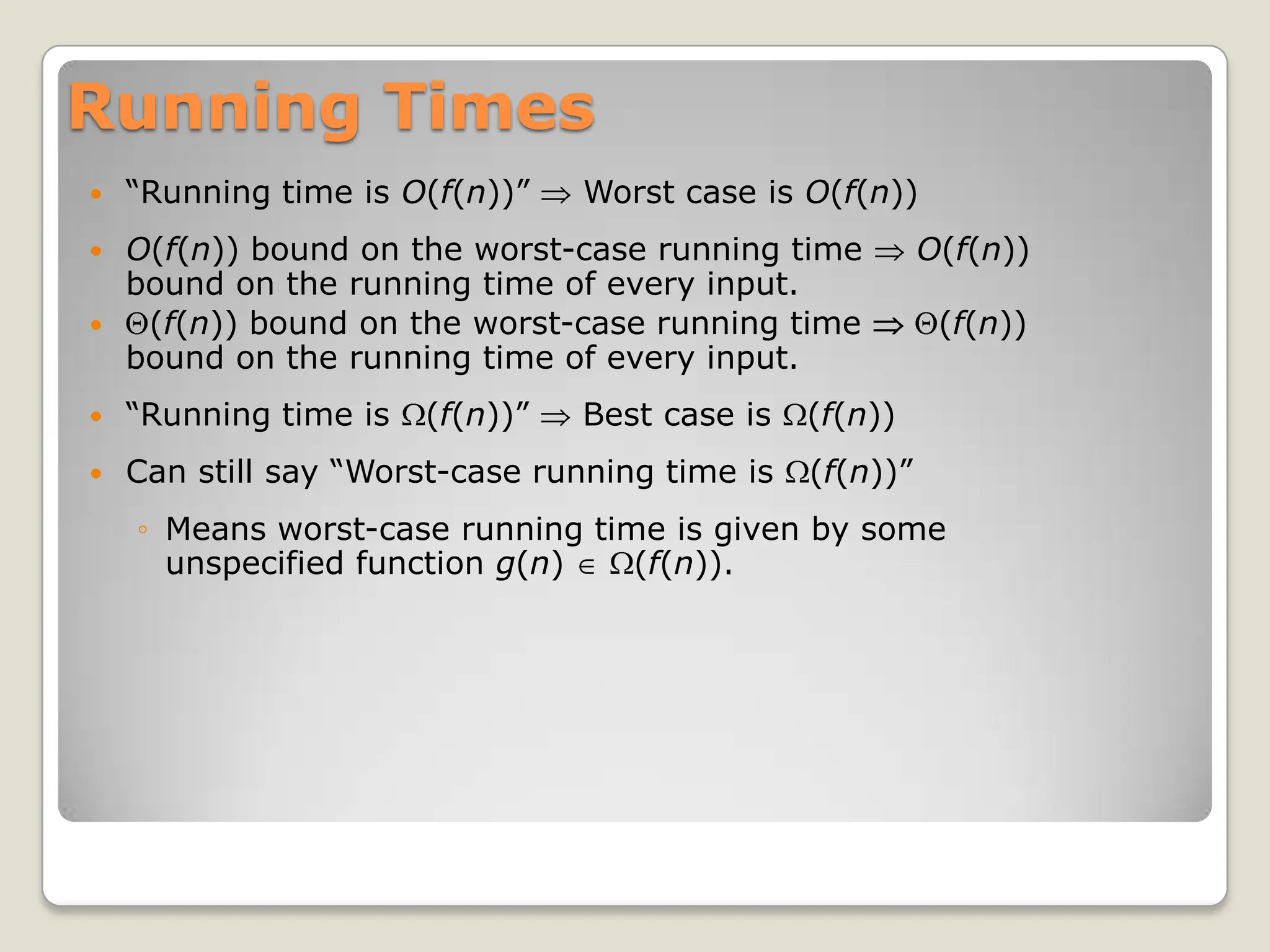
Running Times
 “Running time is O(f(n))” Worst case is O(f(n))
 O(f(n)) bound on the worst-case running time O(f(n))
bound on the running time of every input.
 (f(n)) bound on the worst-case running time (f(n))
bound on the running time of every input.
 “Running time is (f(n))” Best case is (f(n))
 Can still say “Worst-case running time is (f(n))”
◦ Means worst-case running time is given by some
unspecified function g(n) (f(n)).
Time Complexity Vs Space
Complexity
 Achieving both is difficult and we have to make use of the best
case feasible
 There is always a trade off between the space and time
complexity
 If memory available is large then we need not compensate on
time complexity
 If speed of execution is not main concern and the memory
available is less then we can’t compensate on space complexity.
The End

asymptoticnotations-111102093214-phpapp01 (1).pdf

  • 1.
  • 2.
    Introduction  In mathematics,computer science, and related fields, big O notation describes the limiting behavior of a function when the argument tends towards a particular value or infinity, usually in terms of simpler functions. Big O notation allows its users to simplify functions in order to concentrate on their growth rates: different functions with the same growth rate may be represented using the same O notation.  The time complexity of an algorithm quantifies the amount of time taken by an algorithm to run as a function of the size of the input to the problem. When it is expressed using big O notation, the time complexity is said to be described asymptotically, i.e., as the input size goes to infinity.
  • 3.
    Asymptotic Complexity  Runningtime of an algorithm as a function of input size n for large n.  Expressed using only the highest-order term in the expression for the exact running time. ◦ Instead of exact running time, say (n2).  Describes behavior of function in the limit.  Written using Asymptotic Notation.  The notations describe different rate-of-growth relations between the defining function and the defined set of functions.
  • 4.
    O-notation O(g(n)) = {f(n): positive constants c and n0, such that n n0, we have 0 f(n) cg(n) } For function g(n), we define O(g(n)), big-O of n, as the set: g(n) is an asymptotic upper bound for f(n). Intuitively: Set of all functions whose rate of growth is the same as or lower than that of g(n). f(n) = (g(n)) f(n) = O(g(n)). (g(n)) O(g(n)).
  • 5.
    -notation g(n) is anasymptotic lower bound for f(n). Intuitively: Set of all functions whose rate of growth is the same as or higher than that of g(n). f(n) = (g(n)) f(n) = (g(n)). (g(n)) (g(n)). (g(n)) = {f(n) : positive constants c and n0, such that n n0, we have 0 cg(n) f(n)} For function g(n), we define (g(n)), big- Omega of n, as the set:
  • 6.
    -notation (g(n)) = {f(n): positive constants c1, c2, and n0, such that n n0, we have 0 c1g(n) f(n) c2g(n) } For function g(n), we define (g(n)), big- Theta of n, as the set: g(n) is an asymptotically tight bound for f(n). Intuitively: Set of all functions that have the same rate of growth as g(n).
  • 7.
    Definitions  Upper BoundNotation: ◦ f(n) is O(g(n)) if there exist positive constants c and n0 such that f(n) c g(n) for all n n0 ◦ Formally, O(g(n)) = { f(n): positive constants c and n0 such that f(n) c g(n) n n0 ◦ Big O fact: A polynomial of degree k is O(nk)  Asymptotic lower bound: ◦ f(n) is (g(n)) if positive constants c and n0 such that 0 c g(n) f(n) n n0  Asymptotic tight bound: ◦ f(n) is (g(n)) if positive constants c1, c2, and n0 such that c1 g(n) f(n) c2 g(n) n n0 ◦ f(n) = (g(n)) if and only if f(n) = O(g(n)) AND f(n) = (g(n))
  • 8.
  • 9.
    o-notation f(n) becomes insignificantrelative to g(n) as n approaches infinity: lim [f(n) / g(n)] = 0 n g(n) is an upper bound for f(n) that is not asymptotically tight. o(g(n)) = {f(n): c > 0, n0 > 0 such that n n0, we have 0 f(n) < cg(n)}. For a given function g(n), the set little-o:
  • 10.
    (g(n)) = {f(n):c > 0, n0 > 0 such that n n0, we have 0 cg(n) < f(n)}. -notation f(n) becomes arbitrarily large relative to g(n) as n approaches infinity: lim [f(n) / g(n)] = . n g(n) is a lower bound for f(n) that is not asymptotically tight. For a given function g(n), the set little-omega:
  • 11.
    Comparison of Functions fg a b f (n) = O(g(n)) a b f (n) = (g(n)) a b f (n) = (g(n)) a = b f (n) = o(g(n)) a < b f (n) = (g(n)) a > b
  • 12.
    Review: Other Asymptotic Notations Intuitively, we can simplify the above by: ■ o() is like < ■ O() is like ■ () is like > ■ () is like ■ () is like =
  • 13.
    Exercise Express functions inA in asymptotic notation using functions in B. A B 5n2 + 100n 3n2 + 2 A (n2), n2 (B) A (B) log3(n2) log2(n3) logba = logca / logcb; A = 2lgn / lg3, B = 3lgn, A/B =2/(3lg3) nlg4 3lg n alog b = blog a; B =3lg n =nlg 3 ; A/B =nlg(4/3) as n lg2n n1/2 lim ( lga n / nb ) = 0 (here a = 2 and b = 1/2) A (B) n A (B) A (B) A (B) A (B)
  • 14.
    Common growth rates Timecomplexity Example O(1) constant Adding to the front of a linked list O(log N) log Finding an entry in a sorted array O(N) linear Finding an entry in an unsorted array O(N log N) n-log-n Sorting n items by ‘divide-and-conquer’ O(N2) quadratic Shortest path between two nodes in a graph O(N3) cubic Simultaneous linear equations O(2N) exponential The Towers of Hanoi problem
  • 15.
    Growth rates Number ofInputs O(N2) O(Nlog N) For a short time N2 is better than NlogN
  • 16.
    Running Times  “Runningtime is O(f(n))” Worst case is O(f(n))  O(f(n)) bound on the worst-case running time O(f(n)) bound on the running time of every input.  (f(n)) bound on the worst-case running time (f(n)) bound on the running time of every input.  “Running time is (f(n))” Best case is (f(n))  Can still say “Worst-case running time is (f(n))” ◦ Means worst-case running time is given by some unspecified function g(n) (f(n)).
  • 17.
    Time Complexity VsSpace Complexity  Achieving both is difficult and we have to make use of the best case feasible  There is always a trade off between the space and time complexity  If memory available is large then we need not compensate on time complexity  If speed of execution is not main concern and the memory available is less then we can’t compensate on space complexity.
  • 18.