Gandhinagar Institute of Technology
ADA(2150703)
Topic : Asymptotic Notation
Prepared By : Ravin
Laheri
Enrollment No :
160120107054
Batch : CE-B1
Guided By : Maitri
Patel
Introduction
In mathematics, computer science, and related fields, big O
notation describes the limiting behavior of a function when
the argument tends towards a particular value or infinity,
usually in terms of simpler functions. Big O notation allows
its users to simplify functions in order to concentrate on their
growth rates: different functions with the same growth rate
may be represented using the same O notation.
The time complexity of an algorithm quantifies the amount of
time taken by an algorithm to run as a function of the size of
the input to the problem. When it is expressed using big O
notation, the time complexity is said to be
described asymptotically, i.e., as the input size goes to infinity.
Asymptotic Complexity
Running time of an algorithm as a function of input size n for
large
n.
Expressed using only the highest-order term in the expression
for
the exact running time.
◦ Instead of exact running time, say (n2).
Describes behavior of function in the limit.
Written using Asymptotic Notation.
The notations describe different rate-of-growth relations
between
the defining function and the defined set of functions.
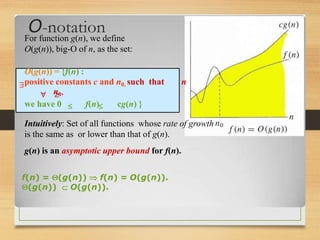
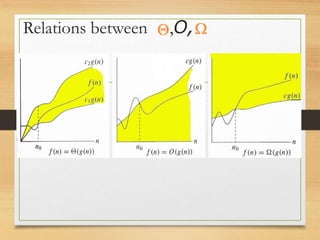
O-notationFor function g(n), we define
O(g(n)), big-O of n, as the set:
O(g(n)) = {f(n) :
positive constants c and n0, such that n
n0,
we have 0 f(n) cg(n) }
Intuitively: Set of all functions whose rate of growth
is the same as or lower than that of g(n).
g(n) is an asymptotic upper bound for f(n).
f(n) = O(g(n)).f(n) = (g(n))
(g(n)) O(g(n)).
-notation
f(n) = (g(n)).f(n) = (g(n))
(g(n)) (g(n)).
(g(n)) = {f(n) :
positive constants c and n0, such that
n n0,
we have 0 cg(n) f(n)}
Intuitively: Set of all functions whose rate
of growth is the same as or higher than that
of g(n).
g(n) is an asymptotic lower bound for
f(n).
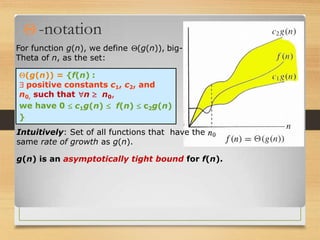
(g(n)), big-For function g(n), we define
Omega of n, as the set:
-notation
(g(n)) = {f(n) :
positive constants c1, c2, and
c1g(n) f(n) c2g(n)
n0, such that n n0,
we have 0
}
(g(n)), big-For function g(n), we define
Theta of n, as the set:
Intuitively: Set of all functions that have the
same rate of growth as g(n).
g(n) is an asymptotically tight bound for f(n).
Relations between ,O,
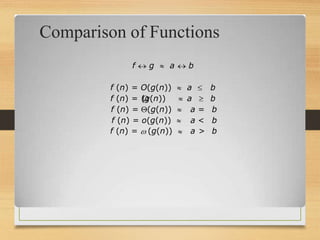
Comparison of Functions
f g a b
f (n) = O(g(n))
f (n) = (g(n))
a
a
b
b
f (n) = (g(n)) a = b
f (n) = o(g(n)) a < b
f (n) = (g(n)) a > b
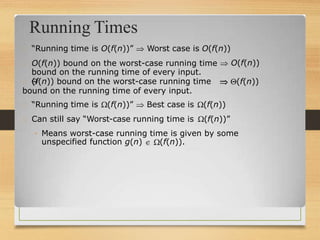
Running Times
“Running time is O(f(n))” Worst case is O(f(n))
O(f(n))
(f(n))
O(f(n)) bound on the worst-case running time
bound on the running time of every input.
(f(n)) bound on the worst-case running time
bound on the running time of every input.
“Running time is (f(n))” Best case is
Can still say “Worst-case running time is
(f(n))
(f(n))”
◦ Means worst-case running time is given by some
unspecified function g(n) (f(n)).
Asymptotic notation ada

Asymptotic notation ada

  • 1.
    Gandhinagar Institute ofTechnology ADA(2150703) Topic : Asymptotic Notation Prepared By : Ravin Laheri Enrollment No : 160120107054 Batch : CE-B1 Guided By : Maitri Patel
  • 2.
    Introduction In mathematics, computerscience, and related fields, big O notation describes the limiting behavior of a function when the argument tends towards a particular value or infinity, usually in terms of simpler functions. Big O notation allows its users to simplify functions in order to concentrate on their growth rates: different functions with the same growth rate may be represented using the same O notation. The time complexity of an algorithm quantifies the amount of time taken by an algorithm to run as a function of the size of the input to the problem. When it is expressed using big O notation, the time complexity is said to be described asymptotically, i.e., as the input size goes to infinity.
  • 3.
    Asymptotic Complexity Running timeof an algorithm as a function of input size n for large n. Expressed using only the highest-order term in the expression for the exact running time. ◦ Instead of exact running time, say (n2). Describes behavior of function in the limit. Written using Asymptotic Notation. The notations describe different rate-of-growth relations between the defining function and the defined set of functions.
  • 4.
    O-notationFor function g(n),we define O(g(n)), big-O of n, as the set: O(g(n)) = {f(n) : positive constants c and n0, such that n n0, we have 0 f(n) cg(n) } Intuitively: Set of all functions whose rate of growth is the same as or lower than that of g(n). g(n) is an asymptotic upper bound for f(n). f(n) = O(g(n)).f(n) = (g(n)) (g(n)) O(g(n)).
  • 5.
    -notation f(n) = (g(n)).f(n)= (g(n)) (g(n)) (g(n)). (g(n)) = {f(n) : positive constants c and n0, such that n n0, we have 0 cg(n) f(n)} Intuitively: Set of all functions whose rate of growth is the same as or higher than that of g(n). g(n) is an asymptotic lower bound for f(n). (g(n)), big-For function g(n), we define Omega of n, as the set:
  • 6.
    -notation (g(n)) = {f(n): positive constants c1, c2, and c1g(n) f(n) c2g(n) n0, such that n n0, we have 0 } (g(n)), big-For function g(n), we define Theta of n, as the set: Intuitively: Set of all functions that have the same rate of growth as g(n). g(n) is an asymptotically tight bound for f(n).
  • 7.
  • 8.
    Comparison of Functions fg a b f (n) = O(g(n)) f (n) = (g(n)) a a b b f (n) = (g(n)) a = b f (n) = o(g(n)) a < b f (n) = (g(n)) a > b
  • 9.
    Running Times “Running timeis O(f(n))” Worst case is O(f(n)) O(f(n)) (f(n)) O(f(n)) bound on the worst-case running time bound on the running time of every input. (f(n)) bound on the worst-case running time bound on the running time of every input. “Running time is (f(n))” Best case is Can still say “Worst-case running time is (f(n)) (f(n))” ◦ Means worst-case running time is given by some unspecified function g(n) (f(n)).