ANALYSIS OF ALGORITHMS
Competitive Programming
KEY POINTS OF CHAPTER2
• Analysis of Algorithms.
• Calculating the Running Time of a program.
• Order of Growth.
• Best Case, Average Case, Worst Case.
• Analyzing the Time Efficiency of non-recursive Algorithms.
• Analyzing the Time Efficiency of recursive Algorithms.
What is the Asymptotic Notations?
TIME COMPLEXITY -ASYMPTOTIC ANALYSIS
• The efficiency of an algorithm depends on the amount of time, storage and other
resources required to execute the algorithm. The efficiency is measured with the help
of asymptotic notations.
• An algorithm may not have the same performance for different types of inputs.
With the increase in the input size, the performance will change.
• The study of change in performance of the algorithm with the change in the order
of the input size is defined as asymptotic analysis.
ASYMPTOTIC ANALYSIS
ASYMPTOTIC NOTATIONS
• Asymptotic notations are the mathematical notations used to describe the
running time of an algorithm when the input tends towards a particular value or a
limiting value.
• There are mainly three asymptotic notations:
✓ Big-O notation → O
✓ Omega notation → Ω
✓ Theta notation → Θ
ASYMPTOTIC NOTATIONS
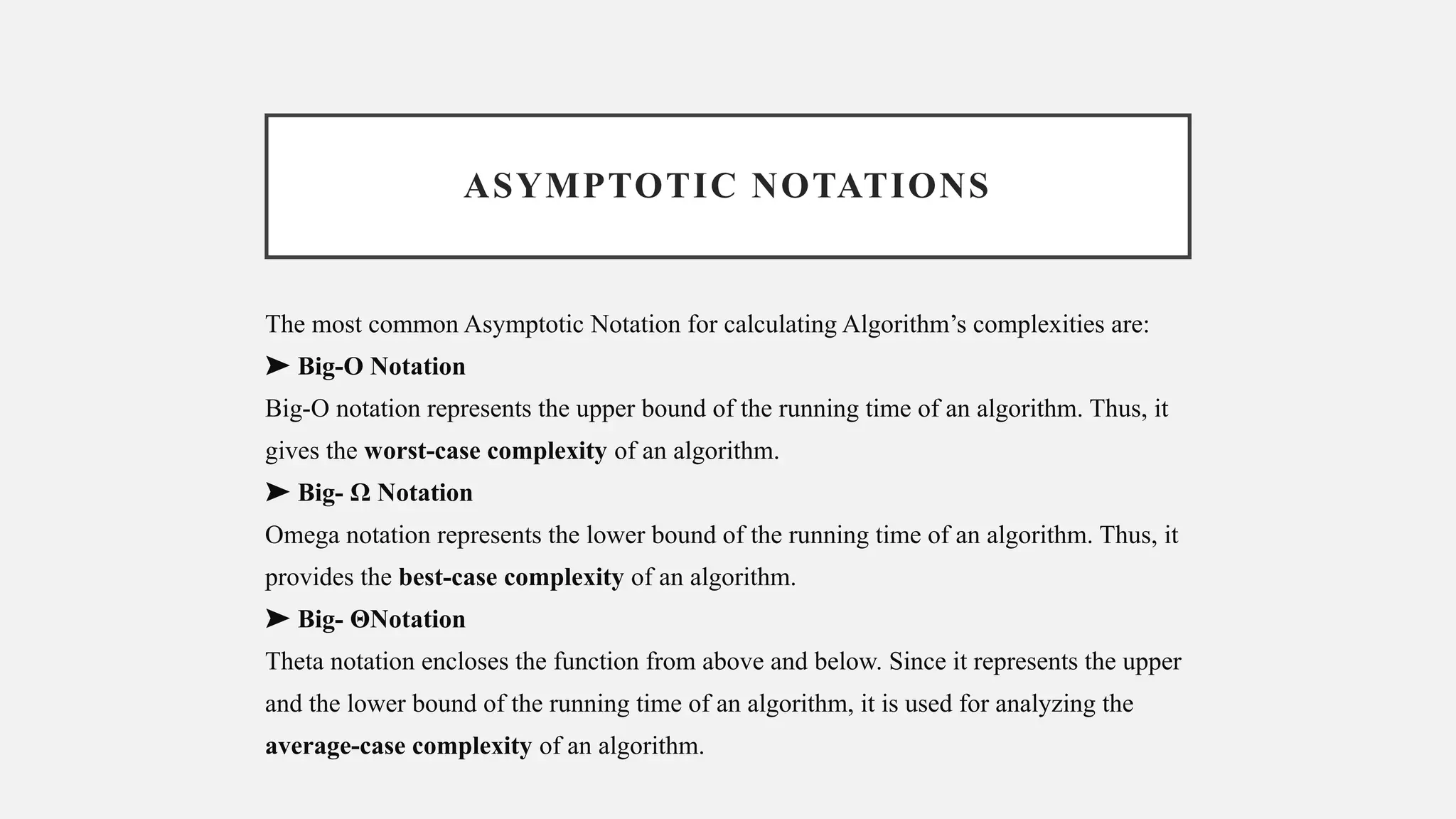
The most common Asymptotic Notation for calculating Algorithm’s complexities are:
➤ Big-O Notation
Big-O notation represents the upper bound of the running time of an algorithm. Thus, it
gives the worst-case complexity of an algorithm.
➤ Big- Ω Notation
Omega notation represents the lower bound of the running time of an algorithm. Thus, it
provides the best-case complexity of an algorithm.
➤ Big- ΘNotation
Theta notation encloses the function from above and below. Since it represents the upper
and the lower bound of the running time of an algorithm, it is used for analyzing the
average-case complexity of an algorithm.
Why we use the Asymptotic Notations?
CASE STUDY (1)
• Suppose we have values in this array, and we want to search for number 3.
✓ If number 3 is in the first place, how many steps does it take to reach it? ➔ 1 step.
✓ If number 3 is in the middle of array, how many steps does it take to reach it? ➔ (n-1)/2 steps.
✓ If number 3 is in the last place, how many steps does it take to reach it? ➔ (n-1) steps.
CASE STUDY(1)
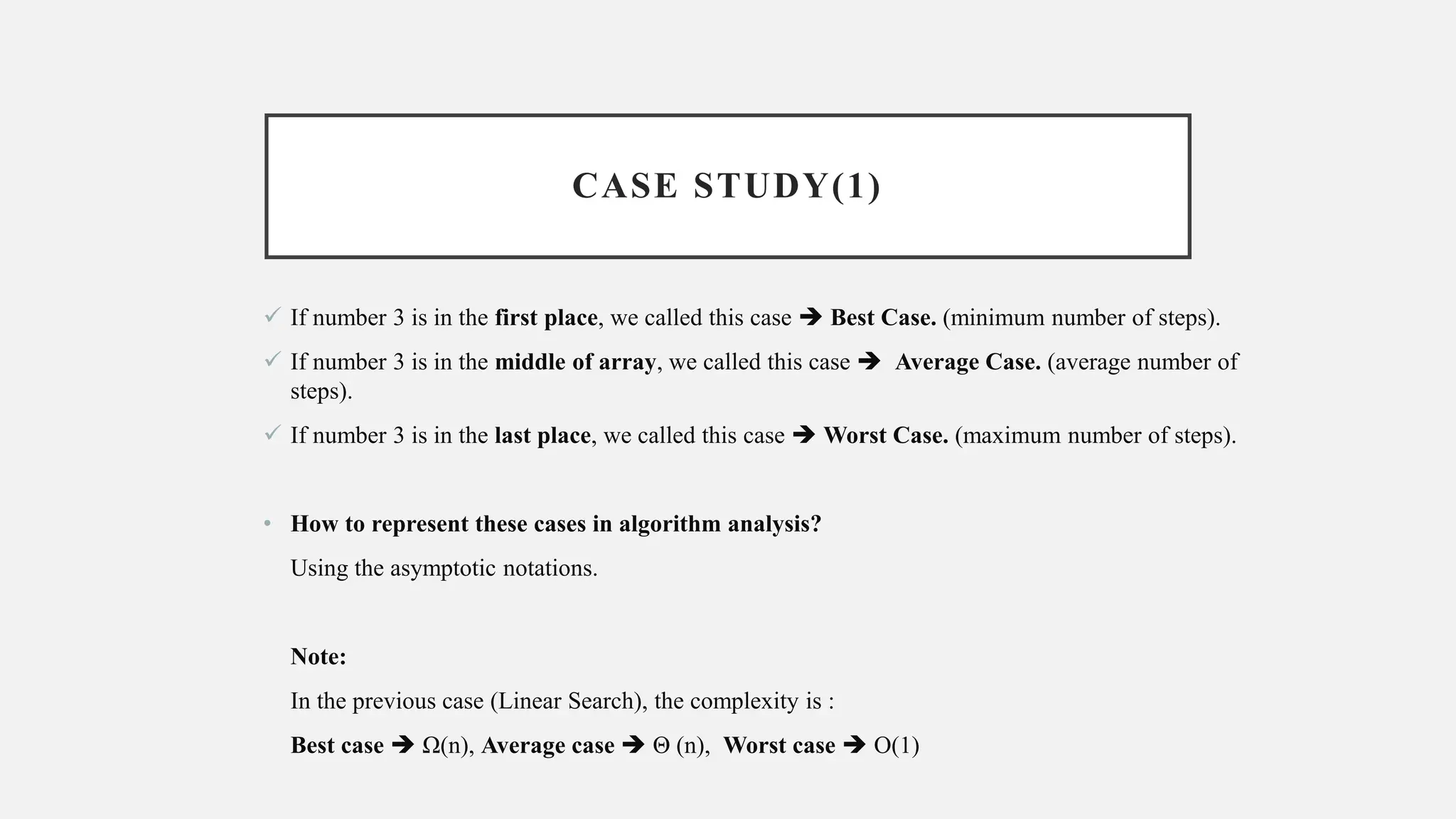
✓ If number 3 is in the first place, we called this case ➔ Best Case. (minimum number of steps).
✓ If number 3 is in the middle of array, we called this case ➔ Average Case. (average number of
steps).
✓ If number 3 is in the last place, we called this case ➔ Worst Case. (maximum number of steps).
• How to represent these cases in algorithm analysis?
Using the asymptotic notations.
Note:
In the previous case (Linear Search), the complexity is :
Best case ➔ Ω(n), Average case ➔ Θ (n), Worst case ➔ O(1)
CASE STUDY (2) – WHO IS BETTER?
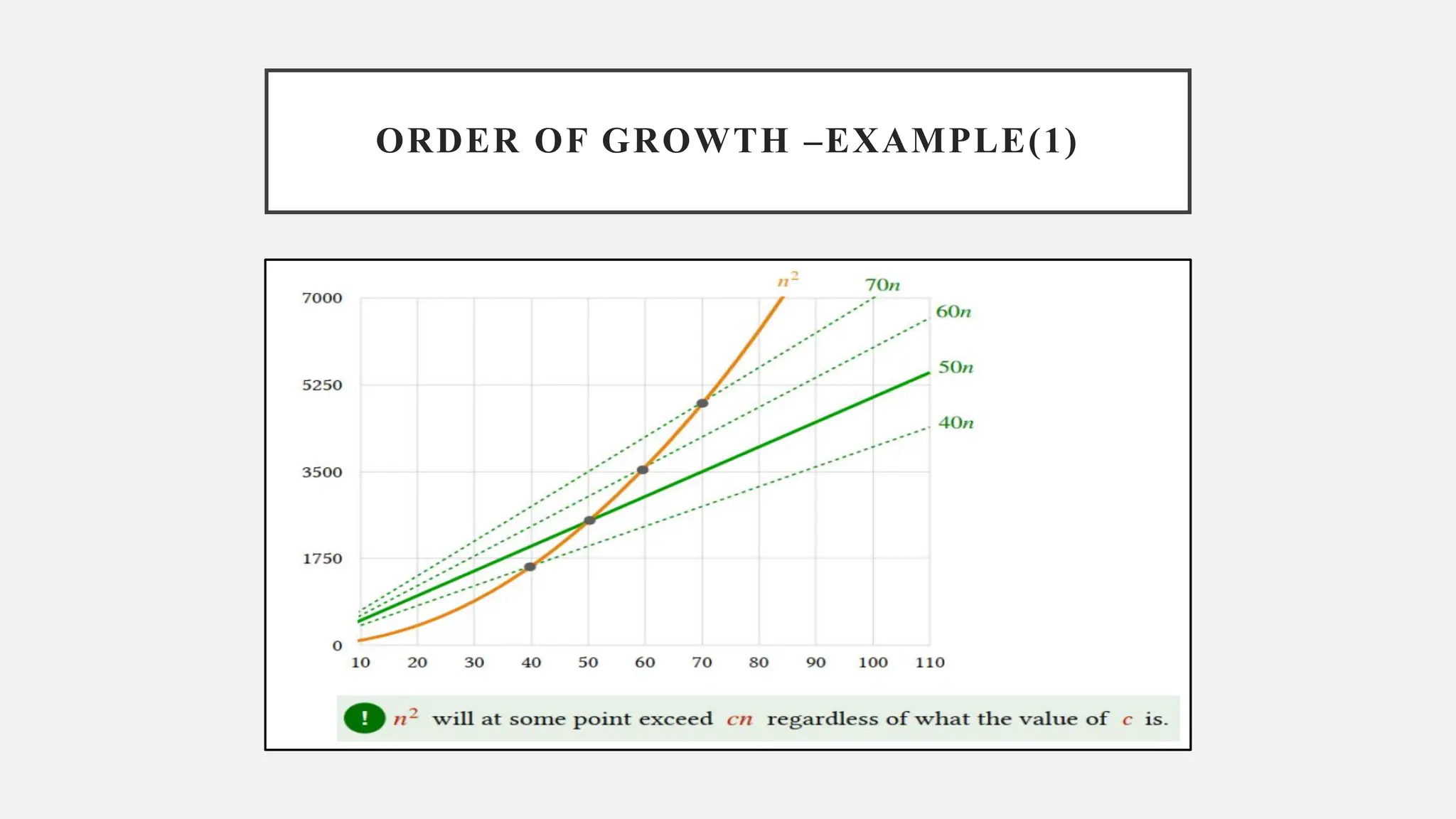
ORDER OF GROWTH –EXAMPLE(1)
ORDER OF GROWTH-EXAMPLE(2)
ORDER OF GROWTH
ORDER OF GROWTH
COMMON TIME COMPLEXITY
O(c) = 1, c: any constant
O(log logn)
O(logn) ➔ O(√n) ≈ O(nc), 0 < c < 1 ➔ O(√n)
O(√n logn) ➔ (logn * logn) ➔ (logn) 2
O(n)
O(nlogn) ➔ O(logn!)
O(nc), c ≥ 2
O(cn), c> 1
O(n!)
O(nn)
REASONS FOR THE NEED FOR ASYMPTOTIC NOTATIONS
➢ The algorithm may have more than one time complexity for different cases.
Example➔ case study (1), three time complexity.
➢ To compare between the different algorithms.
Example➔ case study (2), the algorithm A is better/equal/wore than algorithm B.
Description of the Asymptotic Notations
BIG-O NOTATION (WORST CASE)
➢ Given f(n) and g(n) - functions defined for positive
integers:
Then f(n) = O(g(n))
• If there exists a positive constant c (c ≥1) such that:
f(n) ≤ c*g(n)
for all sufficiently large positive integers n, (n ≥no).
• The Big O notation defines an upper bound of an
algorithm, it bounds a function only from above.
Ω NOTATION (BEST CASE)
➢ Given f(n) and g(n) - functions defined for positive
integers:
Then f(n) = Ω(g(n))
If there exists a positive constant c (c ≥1) such that:
f(n) ≥ c*g(n)
for all sufficiently large positive integers n, (n ≥no).
➢ The Omega Ω notation defines an lower bound of an
algorithm, it bounds a function only from below.
➢ Since the best-case performance of an algorithm is
generally not useful, the Omega notation is the least used
notation among all three.
THETA-Θ NOTATION
➢ Given f(n) and g(n) - functions defined for positive integers:
Then f(n) = Θ(g(n))
If there exists two positive constants c1 and c2 (c1, c2 ≥1) such that:
c1*g(n) ≤ f(n) ≤ c2 * g(n)
for all sufficiently large positive integers n, (n ≥no).
➢ The above definition means, if f(n) is theta of g(n), then the value f(n) is
always between cl*g(n) and c2*g(n) for large values of n (n >= no).
➢ The theta notation bounds a functions from above and below, so it
defines exact asymptotic behavior.
➢ Combine between the big and omega notations.
Examples of Big Notation
EXAMPLE(1) OF BIG NOTATION
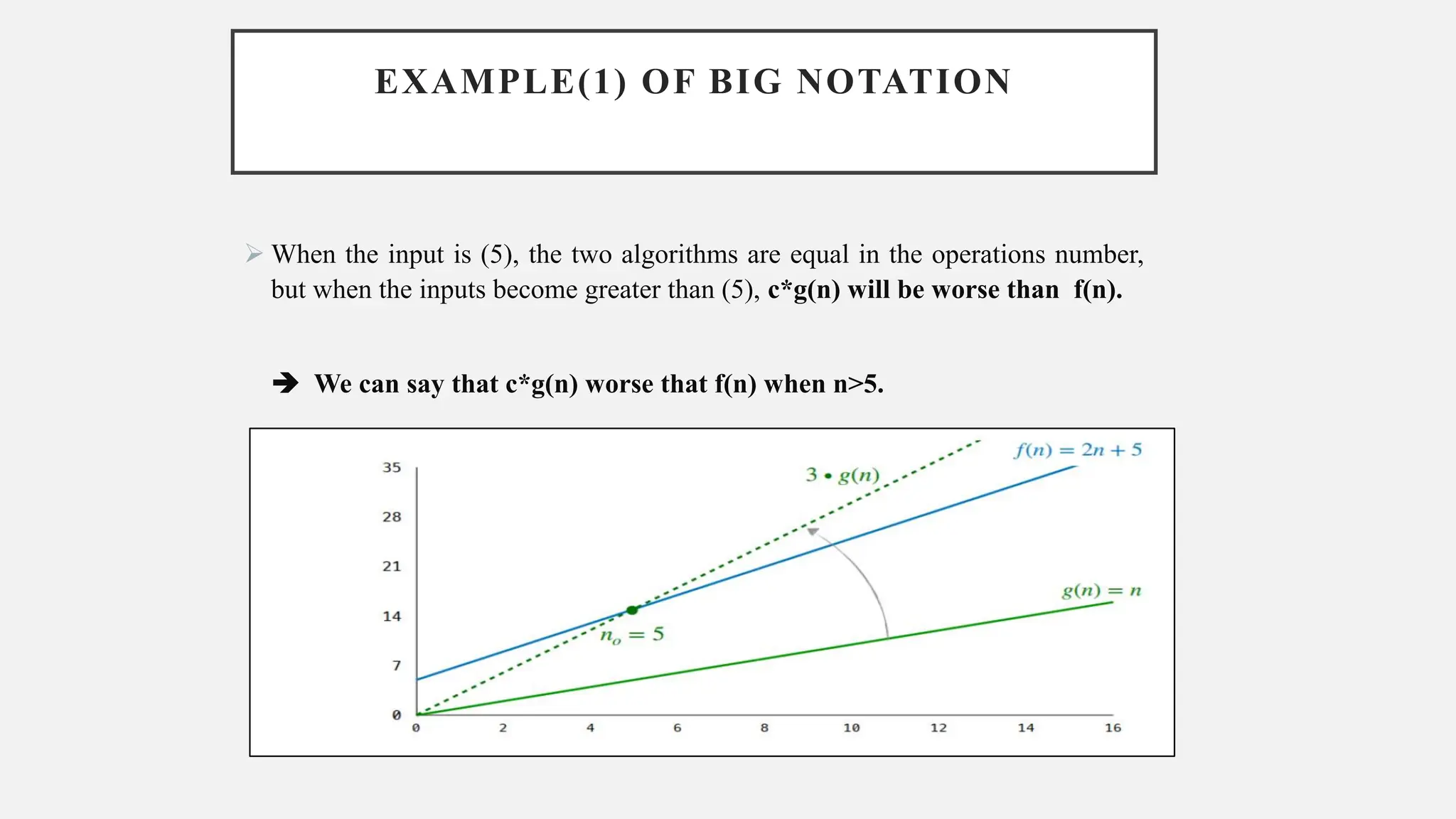
➢ Assume f(n) = 2n + 5, g(n) = n, prove that: f(n) = O(g(n))
Hint: c*g(n) = 3n, don't forget that c and no is positive values.
Solution:
f(n) ≤ c*g(n)
to prove that equation, we must find n0 that make f(n) ≤ c*g(n).
no = 1, ➔ 2(1) + 5 <= 3(1) ➔ 7<= 3 (False)
no = 2, ➔ 2(2) + 5 <= 3(2) ➔ 9<= 6 (False)
no = 3, ➔ 2(3) + 5 <= 3(3) ➔ 11<= 9 (False)
no = 4, ➔ 2(4) + 5 <= 3(4) ➔ 13<= 12 (False)
no = 5, ➔ 2(5) + 5 <= 3(5) ➔ 15<= 15 (True)
EXAMPLE(1) OF BIG NOTATION
➢ When the input is (5), the two algorithms are equal in the operations number,
but when the inputs become greater than (5), c*g(n) will be worse than f(n).
➔ We can say that c*g(n) worse that f(n) when n>5.
EXAMPLE(2) OF BIG NOTATION
➢ Assume f(n) = 2n + 5, g(n) = n, prove that: f(n) = O(g(n))
Hint: c*g(n) = 4n, don't forget that c and no is positive values.
Solution:
f(n) ≤ c*g(n)
to prove that equation, we must find n0 that make f(n) ≤ c*g(n).
no = 1, ➔ 2(1) + 5 <= 4(1) ➔ 7<= 4 (False)
no = 2, ➔ 2(2) + 5 <= 4(2) ➔ 9<= 8 (False)
no = 2.5, ➔ 2(2.5) + 5 <= 4(2.5) ➔ 10 <= 10 (True)
EXAMPLE(2) OF BIG NOTATION
➢ When the input is (2.5), the two algorithms are equal in the operations number,
but when the inputs become greater than (5), c*g(n) will be worse than f(n).
➔ We can say that c*g(n) worse that f(n) when n>2.5
EXAMPLE(3) OF BIG NOTATION
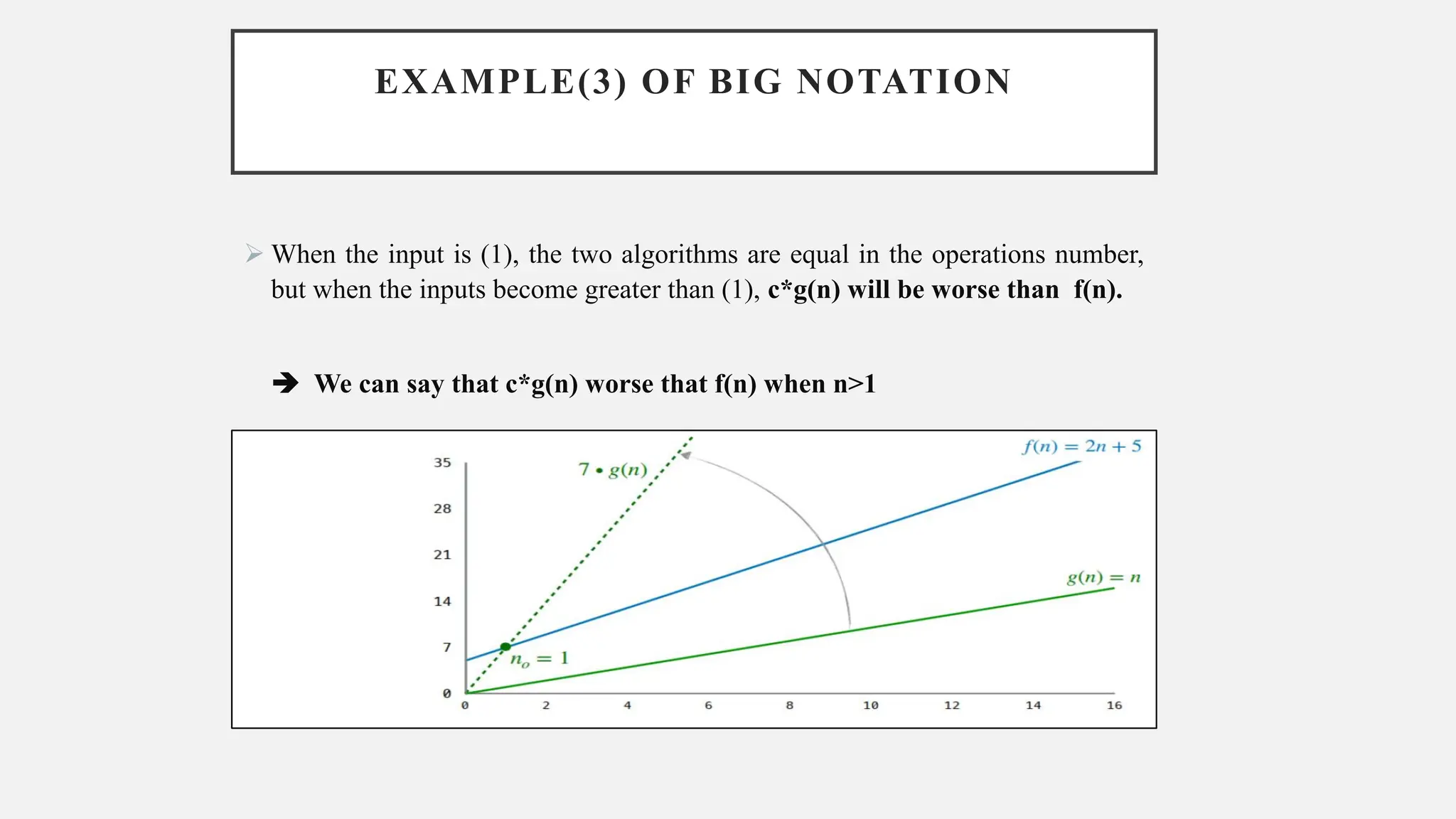
➢ Assume f(n) = 2n + 5, g(n) = n, prove that: f(n) = O(g(n))
Hint: c*g(n) = 7n, don't forget that c and no is positive values.
Solution:
f(n) ≤ c*g(n)
to prove that equation, we must find n0 that make f(n) ≤ c*g(n).
no = 1, ➔ 2(1) + 5 <= 7(1) ➔ 7<= 7 (True)
EXAMPLE(3) OF BIG NOTATION
➢ When the input is (1), the two algorithms are equal in the operations number,
but when the inputs become greater than (1), c*g(n) will be worse than f(n).
➔ We can say that c*g(n) worse that f(n) when n>1
EXAMPLES OF BIG NOTATION
➢ Prove that these functions f(n) are belong/equal to O(g(n)).
➔f(n) = 20n, g(n) = 2^n , Hint: assume c = 1 Sol. n0 = 8
➔f(n) = 2n^2 , g(n) =n!, Hint: assume c = 1 Sol. n0 = 5
➔f(n) = log8n , g(n) = n^3 , Hint: assume c = 2 Sol. n0 = 2
➔f(n) = 10n + 1, g(n) = n , Hint: assume c = 11 Sol. n0 = 1
➔f(n) = 5n^2 + 6n, g(n) = 2^n , Hint: assume c = 1 Sol. n0 = 9
Examples of Omega Notation
EXAMPLE(1) OF OMEGA NOTATION
➢ Assume f(n) = 6n, g(n) = n + 5, prove that: f(n) = Ω(g(n))
Hint: c*g(n) = 2n + 5, don't forget that c and no is positive values.
Solution:
f(n) ≥ c*g(n)
to prove that equation, we must find n0 that make f(n) ≥ c*g(n).
no = 1, ➔ 6(1) >= 2(1) + 5 ➔ 6 >= 7 (False)
no = 2, ➔ 6(2) >= 2(2) + 5 ➔ 12 >= 9 (True)
➢ When the inputs become equal/greater than (2), c*g(n) will be better than f(n).
➔ We can say that c*g(n) better that f(n) when n>= 2
EXAMPLE(2) OF OMEGA NOTATION
➢ Assume f(n) = n^2, g(n) = nlogn, prove that: f(n) = Ω(g(n))
Hint: c*g(n) = 5nlogn, don't forget that c and no is positive values.
Solution:
f(n) ≥ c*g(n)
to prove that equation, we must find n0 that make f(n) ≥ c*g(n).
no = 1, ➔ 1^(2) >= 5(1)log(1) ➔ 1>= 0 (True)
➢ When the inputs become equal/greater than (1), c*g(n) will be better than f(n).
➔ We can say that c*g(n) better that f(n) when n>= 1
EXAMPLE(3) OF OMEGA NOTATION
➢ Assume f(n) = 2n^2 , g(n) = n^2 + 3n -1, prove that: f(n) = Ω(g(n))
Hint: c*g(n) = n^2 + 3n -1, don't forget that c and no is positive values.
Solution:
f(n) ≥ c*g(n)
to prove that equation, we must find n0 that make f(n) ≥ c*g(n).
no = 1, ➔ 2(1)^2 >= (1)^2 + 3(1) -1➔ 2 >= 3 (False)
no = 2, ➔ 2(2)^2 >= (2)^2 + 3(2) -1➔ 8 >= 9 (False)
no = 3, ➔ 2(3)^2 >= (3)^2 + 3(3) -1➔ 18 >= 17 (True)
➢ When the inputs become equal/greater than (3), c*g(n) will be better than f(n).
➔ We can say that c*g(n) better that f(n) when n>= 3
EXAMPLE(4) OF OMEGA NOTATION
➢ Assume f(n) = n^2, g(n) = n, prove that: f(n) = Ω(g(n))
Hint: c*g(n) = n, don't forget that c and no is positive values.
Solution:
f(n) ≥ c*g(n)
to prove that equation, we must find n0 that make f(n) ≥ c*g(n).
no = 1, ➔ (1) ^ 2 >= 1 ➔ 1 >= 1 (True)
➢ When the inputs become equal/greater than (3), c*g(n) will be better than f(n).
➔ We can say that c*g(n) better that f(n) when n>= 1
Examples of Theta Notation
EXAMPLE OF THETA NOTATION
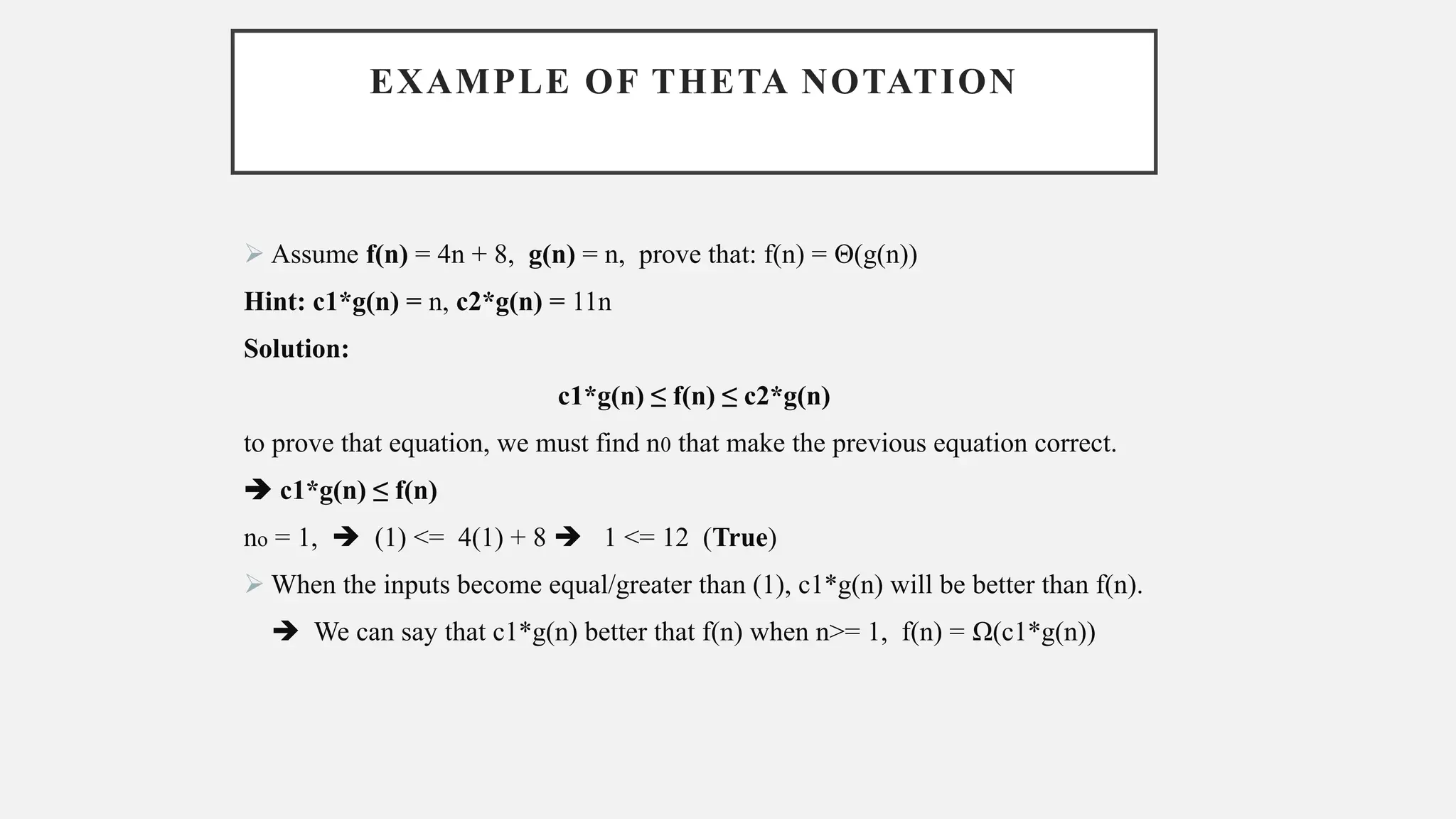
➢ Assume f(n) = 4n + 8, g(n) = n, prove that: f(n) = Θ(g(n))
Hint: c1*g(n) = n, c2*g(n) = 11n
Solution:
c1*g(n) ≤ f(n) ≤ c2*g(n)
to prove that equation, we must find n0 that make the previous equation correct.
➔ c1*g(n) ≤ f(n)
no = 1, ➔ (1) <= 4(1) + 8 ➔ 1 <= 12 (True)
➢ When the inputs become equal/greater than (1), c1*g(n) will be better than f(n).
➔ We can say that c1*g(n) better that f(n) when n>= 1, f(n) = Ω(c1*g(n))
EXAMPLE OF THETA NOTATION
➢ Assume f(n) = 4n + 8, g(n) = n, prove that: f(n) = Θ(g(n))
Hint: c1*g(n) = n, c2*g(n) = 11n
Solution:
c1*g(n) ≤ f(n) ≤ c2*g(n)
to prove that equation, we must find n0 that make the previous equation correct.
➔f(n) ≤ c2*g(n)
no = 1, ➔ 4(1) + 8 <= 11(1) ➔ 12 <= 11 (False)
no = 2, ➔ 4(2) + 8 <= 11(2) ➔ 16 <= 22 (True)
➢ When the inputs become equal/greater than (2), c2*g(n) will be worse than f(n).
➔ We can say that c2*g(n) worse that f(n) when n>= 2, f(n) = O(c1*g(n))
USES OF ASYMPTOTIC NOTATION
1. To represent the best, average, and worst case of algorithms. (will see that later).
2. To compare between the different algorithms. (Here, the notation will be given).
- We will prove that algorithm A is better, equal, or worse than algorithm B, by using the
mathematical equations and finding n0.
Note: in some cases we determine n0 and find c which makes the equation correct.
3.To compare between the different algorithms. (Here, the notation won’t be given).
- Here, you must determine which one of the algorithms is better, equal, or worse than the other
then represent it by notations.
EXAMPLE(1) OF BIG NOTATION
(FIND C)
➢ Assume f(n) = 2n + 5, g(n) = n, prove that: f(n) = O(g(n))
Hint: assume n0 = 1, don't forget that c and no is positive values.
Solution:
f(n) ≤ c*g(n)
to prove that equation, we must find c that make f(n) ≤ c*g(n).
➢ no = 1, ➔ 2(1) + 5 <= c(1) ➔ 7<= c ➔ c =7
➢ g(n) = 7n
EXAMPLE(2) OF OMEGA NOTATION
(FIND C)
➢ Assume f(n) = 5n , g(n) = n + 4, prove that: f(n) = Ω(g(n))
Hint: assume n0 = 2, don't forget that c and no is positive values.
Solution:
f(n) ≥ c*g(n)
to prove that equation, we must find c that make f(n) ≥ c*g(n).
➢ no = 2, ➔ 5(2) >= c(2) + 4 ➔ 10>= 2c + 4 ➔ c = 3
➢ g(n) = 3n + 4
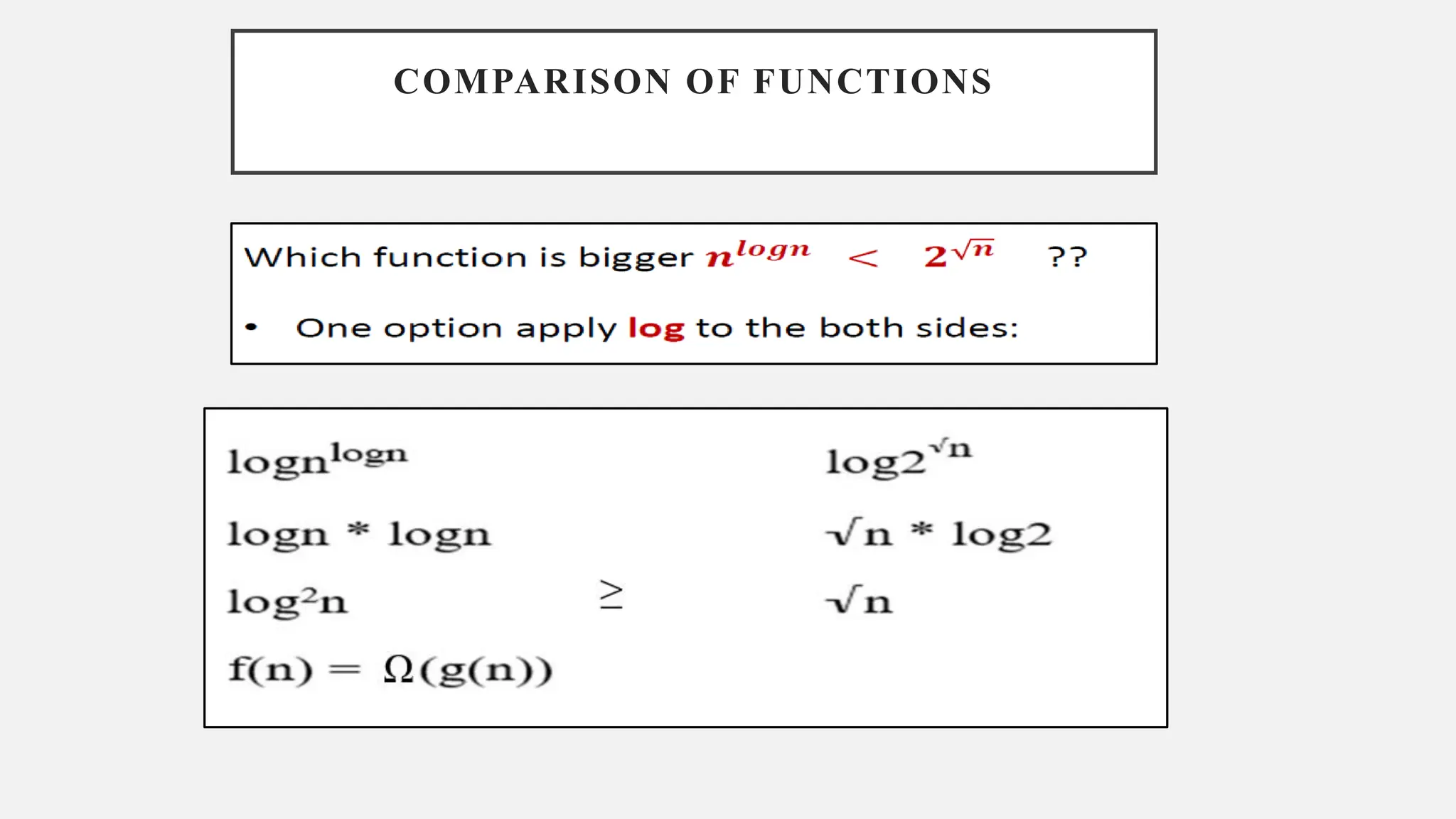
COMPARISON OF FUNCTIONS
LOGARITHMS
COMPARISON OF FUNCTIONS
SMALL-O AND SMALL-W
THANKS

Asymptotic Analysis of algorithm in competitive Programming

  • 1.
  • 2.
    KEY POINTS OFCHAPTER2 • Analysis of Algorithms. • Calculating the Running Time of a program. • Order of Growth. • Best Case, Average Case, Worst Case. • Analyzing the Time Efficiency of non-recursive Algorithms. • Analyzing the Time Efficiency of recursive Algorithms.
  • 3.
    What is theAsymptotic Notations?
  • 4.
    TIME COMPLEXITY -ASYMPTOTICANALYSIS • The efficiency of an algorithm depends on the amount of time, storage and other resources required to execute the algorithm. The efficiency is measured with the help of asymptotic notations. • An algorithm may not have the same performance for different types of inputs. With the increase in the input size, the performance will change. • The study of change in performance of the algorithm with the change in the order of the input size is defined as asymptotic analysis.
  • 5.
  • 6.
    ASYMPTOTIC NOTATIONS • Asymptoticnotations are the mathematical notations used to describe the running time of an algorithm when the input tends towards a particular value or a limiting value. • There are mainly three asymptotic notations: ✓ Big-O notation → O ✓ Omega notation → Ω ✓ Theta notation → Θ
  • 7.
    ASYMPTOTIC NOTATIONS The mostcommon Asymptotic Notation for calculating Algorithm’s complexities are: ➤ Big-O Notation Big-O notation represents the upper bound of the running time of an algorithm. Thus, it gives the worst-case complexity of an algorithm. ➤ Big- Ω Notation Omega notation represents the lower bound of the running time of an algorithm. Thus, it provides the best-case complexity of an algorithm. ➤ Big- ΘNotation Theta notation encloses the function from above and below. Since it represents the upper and the lower bound of the running time of an algorithm, it is used for analyzing the average-case complexity of an algorithm.
  • 8.
    Why we usethe Asymptotic Notations?
  • 9.
    CASE STUDY (1) •Suppose we have values in this array, and we want to search for number 3. ✓ If number 3 is in the first place, how many steps does it take to reach it? ➔ 1 step. ✓ If number 3 is in the middle of array, how many steps does it take to reach it? ➔ (n-1)/2 steps. ✓ If number 3 is in the last place, how many steps does it take to reach it? ➔ (n-1) steps.
  • 10.
    CASE STUDY(1) ✓ Ifnumber 3 is in the first place, we called this case ➔ Best Case. (minimum number of steps). ✓ If number 3 is in the middle of array, we called this case ➔ Average Case. (average number of steps). ✓ If number 3 is in the last place, we called this case ➔ Worst Case. (maximum number of steps). • How to represent these cases in algorithm analysis? Using the asymptotic notations. Note: In the previous case (Linear Search), the complexity is : Best case ➔ Ω(n), Average case ➔ Θ (n), Worst case ➔ O(1)
  • 11.
    CASE STUDY (2)– WHO IS BETTER?
  • 12.
    CASE STUDY (2)– WHO IS BETTER?
  • 13.
    ORDER OF GROWTH–EXAMPLE(1)
  • 14.
  • 15.
  • 16.
  • 17.
    COMMON TIME COMPLEXITY O(c)= 1, c: any constant O(log logn) O(logn) ➔ O(√n) ≈ O(nc), 0 < c < 1 ➔ O(√n) O(√n logn) ➔ (logn * logn) ➔ (logn) 2 O(n) O(nlogn) ➔ O(logn!) O(nc), c ≥ 2 O(cn), c> 1 O(n!) O(nn)
  • 18.
    REASONS FOR THENEED FOR ASYMPTOTIC NOTATIONS ➢ The algorithm may have more than one time complexity for different cases. Example➔ case study (1), three time complexity. ➢ To compare between the different algorithms. Example➔ case study (2), the algorithm A is better/equal/wore than algorithm B.
  • 19.
    Description of theAsymptotic Notations
  • 20.
    BIG-O NOTATION (WORSTCASE) ➢ Given f(n) and g(n) - functions defined for positive integers: Then f(n) = O(g(n)) • If there exists a positive constant c (c ≥1) such that: f(n) ≤ c*g(n) for all sufficiently large positive integers n, (n ≥no). • The Big O notation defines an upper bound of an algorithm, it bounds a function only from above.
  • 21.
    Ω NOTATION (BESTCASE) ➢ Given f(n) and g(n) - functions defined for positive integers: Then f(n) = Ω(g(n)) If there exists a positive constant c (c ≥1) such that: f(n) ≥ c*g(n) for all sufficiently large positive integers n, (n ≥no). ➢ The Omega Ω notation defines an lower bound of an algorithm, it bounds a function only from below. ➢ Since the best-case performance of an algorithm is generally not useful, the Omega notation is the least used notation among all three.
  • 22.
    THETA-Θ NOTATION ➢ Givenf(n) and g(n) - functions defined for positive integers: Then f(n) = Θ(g(n)) If there exists two positive constants c1 and c2 (c1, c2 ≥1) such that: c1*g(n) ≤ f(n) ≤ c2 * g(n) for all sufficiently large positive integers n, (n ≥no). ➢ The above definition means, if f(n) is theta of g(n), then the value f(n) is always between cl*g(n) and c2*g(n) for large values of n (n >= no). ➢ The theta notation bounds a functions from above and below, so it defines exact asymptotic behavior. ➢ Combine between the big and omega notations.
  • 23.
  • 24.
    EXAMPLE(1) OF BIGNOTATION ➢ Assume f(n) = 2n + 5, g(n) = n, prove that: f(n) = O(g(n)) Hint: c*g(n) = 3n, don't forget that c and no is positive values. Solution: f(n) ≤ c*g(n) to prove that equation, we must find n0 that make f(n) ≤ c*g(n). no = 1, ➔ 2(1) + 5 <= 3(1) ➔ 7<= 3 (False) no = 2, ➔ 2(2) + 5 <= 3(2) ➔ 9<= 6 (False) no = 3, ➔ 2(3) + 5 <= 3(3) ➔ 11<= 9 (False) no = 4, ➔ 2(4) + 5 <= 3(4) ➔ 13<= 12 (False) no = 5, ➔ 2(5) + 5 <= 3(5) ➔ 15<= 15 (True)
  • 25.
    EXAMPLE(1) OF BIGNOTATION ➢ When the input is (5), the two algorithms are equal in the operations number, but when the inputs become greater than (5), c*g(n) will be worse than f(n). ➔ We can say that c*g(n) worse that f(n) when n>5.
  • 26.
    EXAMPLE(2) OF BIGNOTATION ➢ Assume f(n) = 2n + 5, g(n) = n, prove that: f(n) = O(g(n)) Hint: c*g(n) = 4n, don't forget that c and no is positive values. Solution: f(n) ≤ c*g(n) to prove that equation, we must find n0 that make f(n) ≤ c*g(n). no = 1, ➔ 2(1) + 5 <= 4(1) ➔ 7<= 4 (False) no = 2, ➔ 2(2) + 5 <= 4(2) ➔ 9<= 8 (False) no = 2.5, ➔ 2(2.5) + 5 <= 4(2.5) ➔ 10 <= 10 (True)
  • 27.
    EXAMPLE(2) OF BIGNOTATION ➢ When the input is (2.5), the two algorithms are equal in the operations number, but when the inputs become greater than (5), c*g(n) will be worse than f(n). ➔ We can say that c*g(n) worse that f(n) when n>2.5
  • 28.
    EXAMPLE(3) OF BIGNOTATION ➢ Assume f(n) = 2n + 5, g(n) = n, prove that: f(n) = O(g(n)) Hint: c*g(n) = 7n, don't forget that c and no is positive values. Solution: f(n) ≤ c*g(n) to prove that equation, we must find n0 that make f(n) ≤ c*g(n). no = 1, ➔ 2(1) + 5 <= 7(1) ➔ 7<= 7 (True)
  • 29.
    EXAMPLE(3) OF BIGNOTATION ➢ When the input is (1), the two algorithms are equal in the operations number, but when the inputs become greater than (1), c*g(n) will be worse than f(n). ➔ We can say that c*g(n) worse that f(n) when n>1
  • 30.
    EXAMPLES OF BIGNOTATION ➢ Prove that these functions f(n) are belong/equal to O(g(n)). ➔f(n) = 20n, g(n) = 2^n , Hint: assume c = 1 Sol. n0 = 8 ➔f(n) = 2n^2 , g(n) =n!, Hint: assume c = 1 Sol. n0 = 5 ➔f(n) = log8n , g(n) = n^3 , Hint: assume c = 2 Sol. n0 = 2 ➔f(n) = 10n + 1, g(n) = n , Hint: assume c = 11 Sol. n0 = 1 ➔f(n) = 5n^2 + 6n, g(n) = 2^n , Hint: assume c = 1 Sol. n0 = 9
  • 31.
  • 32.
    EXAMPLE(1) OF OMEGANOTATION ➢ Assume f(n) = 6n, g(n) = n + 5, prove that: f(n) = Ω(g(n)) Hint: c*g(n) = 2n + 5, don't forget that c and no is positive values. Solution: f(n) ≥ c*g(n) to prove that equation, we must find n0 that make f(n) ≥ c*g(n). no = 1, ➔ 6(1) >= 2(1) + 5 ➔ 6 >= 7 (False) no = 2, ➔ 6(2) >= 2(2) + 5 ➔ 12 >= 9 (True) ➢ When the inputs become equal/greater than (2), c*g(n) will be better than f(n). ➔ We can say that c*g(n) better that f(n) when n>= 2
  • 33.
    EXAMPLE(2) OF OMEGANOTATION ➢ Assume f(n) = n^2, g(n) = nlogn, prove that: f(n) = Ω(g(n)) Hint: c*g(n) = 5nlogn, don't forget that c and no is positive values. Solution: f(n) ≥ c*g(n) to prove that equation, we must find n0 that make f(n) ≥ c*g(n). no = 1, ➔ 1^(2) >= 5(1)log(1) ➔ 1>= 0 (True) ➢ When the inputs become equal/greater than (1), c*g(n) will be better than f(n). ➔ We can say that c*g(n) better that f(n) when n>= 1
  • 34.
    EXAMPLE(3) OF OMEGANOTATION ➢ Assume f(n) = 2n^2 , g(n) = n^2 + 3n -1, prove that: f(n) = Ω(g(n)) Hint: c*g(n) = n^2 + 3n -1, don't forget that c and no is positive values. Solution: f(n) ≥ c*g(n) to prove that equation, we must find n0 that make f(n) ≥ c*g(n). no = 1, ➔ 2(1)^2 >= (1)^2 + 3(1) -1➔ 2 >= 3 (False) no = 2, ➔ 2(2)^2 >= (2)^2 + 3(2) -1➔ 8 >= 9 (False) no = 3, ➔ 2(3)^2 >= (3)^2 + 3(3) -1➔ 18 >= 17 (True) ➢ When the inputs become equal/greater than (3), c*g(n) will be better than f(n). ➔ We can say that c*g(n) better that f(n) when n>= 3
  • 35.
    EXAMPLE(4) OF OMEGANOTATION ➢ Assume f(n) = n^2, g(n) = n, prove that: f(n) = Ω(g(n)) Hint: c*g(n) = n, don't forget that c and no is positive values. Solution: f(n) ≥ c*g(n) to prove that equation, we must find n0 that make f(n) ≥ c*g(n). no = 1, ➔ (1) ^ 2 >= 1 ➔ 1 >= 1 (True) ➢ When the inputs become equal/greater than (3), c*g(n) will be better than f(n). ➔ We can say that c*g(n) better that f(n) when n>= 1
  • 36.
  • 37.
    EXAMPLE OF THETANOTATION ➢ Assume f(n) = 4n + 8, g(n) = n, prove that: f(n) = Θ(g(n)) Hint: c1*g(n) = n, c2*g(n) = 11n Solution: c1*g(n) ≤ f(n) ≤ c2*g(n) to prove that equation, we must find n0 that make the previous equation correct. ➔ c1*g(n) ≤ f(n) no = 1, ➔ (1) <= 4(1) + 8 ➔ 1 <= 12 (True) ➢ When the inputs become equal/greater than (1), c1*g(n) will be better than f(n). ➔ We can say that c1*g(n) better that f(n) when n>= 1, f(n) = Ω(c1*g(n))
  • 38.
    EXAMPLE OF THETANOTATION ➢ Assume f(n) = 4n + 8, g(n) = n, prove that: f(n) = Θ(g(n)) Hint: c1*g(n) = n, c2*g(n) = 11n Solution: c1*g(n) ≤ f(n) ≤ c2*g(n) to prove that equation, we must find n0 that make the previous equation correct. ➔f(n) ≤ c2*g(n) no = 1, ➔ 4(1) + 8 <= 11(1) ➔ 12 <= 11 (False) no = 2, ➔ 4(2) + 8 <= 11(2) ➔ 16 <= 22 (True) ➢ When the inputs become equal/greater than (2), c2*g(n) will be worse than f(n). ➔ We can say that c2*g(n) worse that f(n) when n>= 2, f(n) = O(c1*g(n))
  • 39.
    USES OF ASYMPTOTICNOTATION 1. To represent the best, average, and worst case of algorithms. (will see that later). 2. To compare between the different algorithms. (Here, the notation will be given). - We will prove that algorithm A is better, equal, or worse than algorithm B, by using the mathematical equations and finding n0. Note: in some cases we determine n0 and find c which makes the equation correct. 3.To compare between the different algorithms. (Here, the notation won’t be given). - Here, you must determine which one of the algorithms is better, equal, or worse than the other then represent it by notations.
  • 40.
    EXAMPLE(1) OF BIGNOTATION (FIND C) ➢ Assume f(n) = 2n + 5, g(n) = n, prove that: f(n) = O(g(n)) Hint: assume n0 = 1, don't forget that c and no is positive values. Solution: f(n) ≤ c*g(n) to prove that equation, we must find c that make f(n) ≤ c*g(n). ➢ no = 1, ➔ 2(1) + 5 <= c(1) ➔ 7<= c ➔ c =7 ➢ g(n) = 7n
  • 41.
    EXAMPLE(2) OF OMEGANOTATION (FIND C) ➢ Assume f(n) = 5n , g(n) = n + 4, prove that: f(n) = Ω(g(n)) Hint: assume n0 = 2, don't forget that c and no is positive values. Solution: f(n) ≥ c*g(n) to prove that equation, we must find c that make f(n) ≥ c*g(n). ➢ no = 2, ➔ 5(2) >= c(2) + 4 ➔ 10>= 2c + 4 ➔ c = 3 ➢ g(n) = 3n + 4
  • 42.
  • 43.
  • 44.
  • 45.
  • 46.
  • 47.
  • 48.
  • 49.
  • 50.