
Uploaded byRajesh K Shukla
Big omega
The document explains the big omega (Ω) notation, which represents the lower bound on the growth rate of an algorithm's running time, specifically for best-case analysis. It defines that f(n) is Ω(g(n)) if there are positive constants such that f(n) is greater than or equal to c * g(n) for sufficiently large n. Overall, big omega notation provides information on the minimum number of operations an algorithm must perform to solve a problem.
More Related Content


Big omega
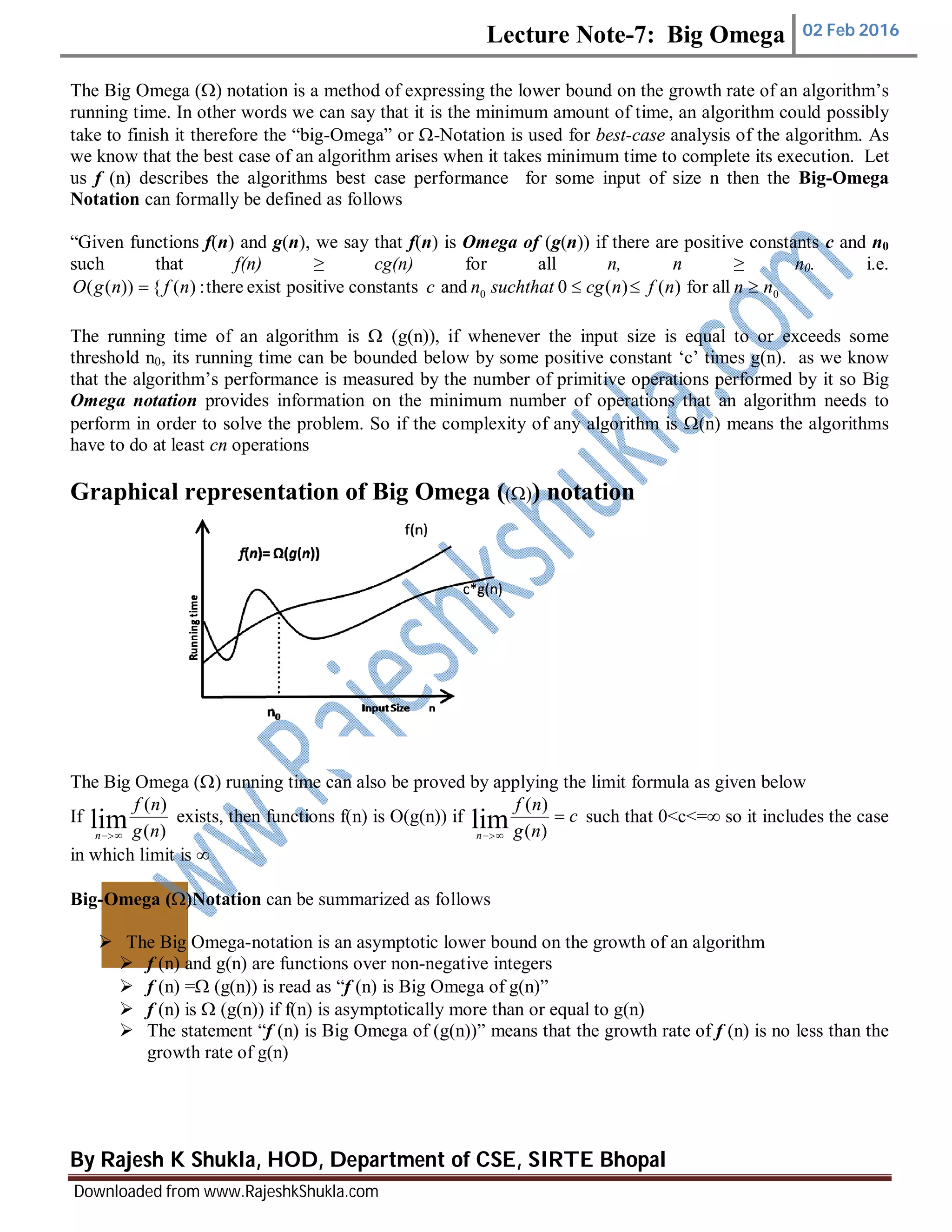
- 1. Lecture Note-7: BigOmega 02 Feb 2016 By Rajesh K Shukla, HOD, Department of CSE, SIRTE Bhopal Downloaded from www.RajeshkShukla.com The Big Omega () notation is a method of expressing the lower bound on the growth rate of an algorithm’s running time. In other words we can say that it is the minimum amount of time, an algorithm could possibly take to finish it therefore the “big-Omega” or -Notation is used for best-case analysis of the algorithm. As we know that the best case of an algorithm arises when it takes minimum time to complete its execution. Let us f (n) describes the algorithms best case performance for some input of size n then the Big-Omega Notation can formally be defined as follows “Given functions f(n) and g(n), we say that f(n) is Omega of (g(n)) if there are positive constants c and n0 such that f(n) ≥ cg(n) for all n, n ≥ n0. i.e. 00 allfor)()(0andconstantspositiveexistthere:)({))(( nnnfncgsuchthatncnfngO The running time of an algorithm is (g(n)), if whenever the input size is equal to or exceeds some threshold n0, its running time can be bounded below by some positive constant ‘c’ times g(n). as we know that the algorithm’s performance is measured by the number of primitive operations performed by it so Big Omega notation provides information on the minimum number of operations that an algorithm needs to perform in order to solve the problem. So if the complexity of any algorithm is (n) means the algorithms have to do at least cn operations Graphical representation of Big Omega (()) notation The Big Omega () running time can also be proved by applying the limit formula as given below If )( )( lim ng nf n exists, then functions f(n) is O(g(n)) if c ng nf n )( )( lim such that 0<c<=∞ so it includes the case in which limit is ∞ Big-Omega ()Notation can be summarized as follows The Big Omega-notation is an asymptotic lower bound on the growth of an algorithm f (n) and g(n) are functions over non-negative integers f (n) = (g(n)) is read as “f (n) is Big Omega of g(n)” f (n) is (g(n)) if f(n) is asymptotically more than or equal to g(n) The statement “f (n) is Big Omega of (g(n))” means that the growth rate of f (n) is no less than the growth rate of g(n)