


COMMUNITY
03
From the Editor
05
Java Nation

40

17

47

Q&A with Patrick
Curran

COMMUNITY

//table of contents /

Adding a Member to
Your Development Team

Database DevOps
with MySQL, Hudson,
Gradle, Maven, and Git

JAVA IN ACTION

JavaOne recap, plus news,
people, and events

Enterprise Java

Produce higher-quality
software with DevOps.
Enterprise Java

The JCP chair on charting
the future with JCP.next

The best and worst ways to
manage the addition of a new
team member

JAVA TECH
28

50

JAVA TECH

JCP Executive Series

Enterprise Java

31

62
Fix This

Take our generics code
challenge!

Lessons in what not to do

33

Java Architect

Java Concurrent
Animated

Java Champion Victor Grazi
on writing better concurrency
applications

22

SMARTEST
HOUSE ON THE
STREET

28

EST

NT

E
PM
LO
E

Our special
V
DE
section on
P R A C TI
best practices
for development
includes articles on
agile, performance tuning,
concurrency, DevOps, and
team dynamics.
S

Diabolical Java
Performance Tuning

CE

Java Architect

Learn how to best execute
tasks using application server
concurrency services.

B

Venkat Subramaniam
explores the subtleties of
agile development.

ABOUT US

Agile Adjustment

Concurrency Utilities
for Java EE

Java Architect

57

Mobile and Embedded
INTERNET OF
THINGS 101

Explore concepts relevant
to the Internet of Things
by creating an embedded
application.

blog

The Internet of Things meets home
automation with Java-based openHAB.
COVER ART BY WES ROWELL; PHOTOGRAPHY BY TON HENDRIKS

ORACLE.COM/JAVAMAGAZINE  ////////////////////////////////  NOVEMBER/DECEMBER 2013

01
RESOURCES
Oracle Products
+1.800.367.8674 (US/Canada)
Oracle Services
+1.888.283.0591 (US)
Oracle Press Books
oraclepressbooks.com

ARTICLE SUBMISSION
If you are interested in submitting an article, please e-mail the editors.

COMMUNITY
JAVA IN ACTION

ADVERTISING SALES
President, Sprocket Media
Kyle Walkenhorst +1.323.340.8585
Western and Central US, LAD, and
Canada, Sprocket Media
Tom Cometa +1.510.339.2403
Eastern US and EMEA/APAC,
Sprocket Media
Mark Makinney +1.805.709.4745
Advertising Sales Assistant
Cindy Elhaj +1.626.396.9400 x 201
Mailing-List Rentals
Contact your sales representative.

JAVA TECH

DESIGN
Senior Creative Director
Francisco G Delgadillo
Senior Design Director
Suemi Lam
Design Director
Richard Merchán
Contributing Designers
Jaime Ferrand, Arianna Pucherelli
Production Designers
Sheila Brennan, Kathy Cygnarowicz

PUBLISHING
Vice President
Jeff Spicer
Publisher
Jennifer Hamilton +1.650.506.3794
Associate Publisher and Audience
Development Director
Karin Kinnear +1.650.506.1985

ABOUT US

EDITORIAL
Editor in Chief
Caroline Kvitka
Community Editors
Cassandra Clark, Sonya Barry,
Yolande Poirier
Java in Action Editor
Michelle Kovac
Technology Editors
Janice Heiss, Tori Wieldt
Contributing Writer
Kevin Farnham
Contributing Editors
Claire Breen, Blair Campbell, Karen Perkins

SUBSCRIPTION INFORMATION
Subscriptions are complimentary for qualified individuals who complete the
subscription form.

Java Skills
#1 Priority
Of Hiring Managers
Get Certified with Oracle University
Prepare with Java experts
In the classroom or online
Pass or retest for free
And save up to 20%

MAGAZINE CUSTOMER SERVICE
java@halldata.com  Phone +1.847.763.9635
PRIVACY
Oracle Publishing allows sharing of its mailing list with selected third parties. If you prefer
that your mailing address or e-mail address not be included in this program, contact
Customer Service.
Copyright © 2013, Oracle and/or its affiliates. All Rights Reserved. No part of this publication may be reprinted or otherwise
reproduced without permission from the editors. JAVA MAGAZINE IS PROVIDED ON AN “AS IS” BASIS. ORACLE EXPRESSLY
DISCLAIMS ALL WARRANTIES, WHETHER EXPRESS OR IMPLIED. IN NO EVENT SHALL ORACLE BE LIABLE FOR ANY
DAMAGES OF ANY KIND ARISING FROM YOUR USE OF OR RELIANCE ON ANY INFORMATION PROVIDED HEREIN. The
information is intended to outline our general product direction. It is intended for information purposes only, and may not be
incorporated into any contract. It is not a commitment to deliver any material, code, or functionality, and should not be relied
upon in making purchasing decisions. The development, release, and timing of any features or functionality described for Oracle’s
products remains at the sole discretion of Oracle. Oracle and Java are registered trademarks of Oracle Corporation and/or its
affiliates. Other names may be trademarks of their respective owners.

blog

Java Magazine is published bimonthly with a free subscription price by
Oracle, 500 Oracle Parkway, MS OPL-3C, Redwood City, CA 94065-1600.

Digital Publishing by GTxcel

ORACLE.COM/JAVAMAGAZINE  ////////////////////////////////  NOVEMBER/DECEMBER 2013

Preview Now
Source: from Dice.com’s “Dice Report”; “January 2013: Repeat Priorities”

02
Régina ten Bruggencate
JDuchess

LEARN MORE

JAVA TECH

My local and global JUGs
are great places to network
both for knowledge and work.
My global JUG introduces
me to Java developers all
over the world.

CE

S

B

	 uturistic, automated homes are becoming a reality. I grew up watching The Jetsons, a cartoon about a
space-age family living in 2062 with robotic housekeepers, wacky inventions, and personal spacecraft. Now,
50 years since it first aired, some of the show’s predictions are looking closer to reality.
If you attended JavaOne in San Francisco, you couldn’t miss the buzz about the Internet of Things (IoT)—
with predictions of a world where billions of devices will be connected to the internet. It’s here, and Java is
playing a big part. You were also sure to see robots at the event, whether they were NAO robots, robotic fish, or
Lego bots. There was also much buzz about the Raspberry Pi, which had its own developer challenge.
Home automation is a prime example of IoT. In this issue’s “Smartest House on the Street,” we take you inside a modern home where devices and applications are integrated throughout, using a Java-based software
environment called openHAB (a 2013 Duke’s Choice Award winner).
Need to get up to speed on Java and IoT? Read Eric Bruno’s “Internet of Things 101” to see why Java, which
was born on an embedded device, is in a great position to become the standard for IoT development.
No matter what type of project you’re working on, we know that you
EST
T
//send us your feedback /
N
need to be the best developer you can be. So in this issue we bring you
ME
OP
L
VE
We’ll review all
a special section focused on development best practices. Look for the
DE
P R A C TI
suggestions for future
icon on the left to find articles covering agile development, perforimprovements.
mance tuning, concurrency development, DevOps, and team dynamics.
Depending on volume,
What futuristic projects are you dreaming up? Let us know.
some messages may

ABOUT US

F

FIND YOUR
JUG HERE

JAVA IN ACTION

COMMUNITY

//from the editor /

not get a direct reply.

Caroline Kvitka, Editor in Chief

PHOTOGRAPH BY BOB ADLER

ORACLE.COM/JAVAMAGAZINE  ////////////////////////////////  NOVEMBER/DECEMBER 2013

blog

BIO

03
Clockwise from
top: A festive
atmosphere at
the Taylor Street
Café; Peter
Utzschneider
talks about
the Internet
of Things;
Nandini Ramani
discusses
convergence.
PHOTOGRAPHS BY ORANGE PHOTOGRAPHY

ORACLE.COM/JAVAMAGAZINE  ////////////////////////////////  NOVEMBER/DECEMBER 2013

Attendees from more than 92 countries
attended JavaOne 2013, where they chose
from more than 400 sessions; hung out in a
Codegarten; participated in a Raspberry Pi coding challenge; and attended educational and
networking events. What’s more, the America’s
Cup sailing race added to the festive atmosphere of JavaOne—and culminated with a
historic comeback win by ORACLE TEAM USA.
The conference kicked off at San Francisco’s
Moscone Center with the Strategy keynote
by Oracle’s Peter Utzschneider and Nandini
Ramani. The theme, “Make the Future Java,”
was unchanged from last year’s theme, for
good reason, Utzschneider said. “There is a lot
going on in the industry, with massive shifts
and innovation happening that pose huge challenges and opportunities for Java.” The goal is
to make Java better, stronger, more robust, and
relevant for decades to come.
The combination of mobile and social is creating an enormous amount of data in many
forms, with growing volume and velocity.
Utzschneider said that between 10 and 50 billion nonhuman-driven devices will be coming
on the internet in the next two years. “This is
about the Internet of Things [IoT],” he said. “It
will be a major game changer for Java developers and the larger community.”

COMMUNITY
JAVA IN ACTION

JAVAONE

JAVA TECH

The 18th

ABOUT US

//java nation / javaone 2013 //

blog

05
Watch Strategy keynote highlights.

Top to bottom:
Richard Bair plays
chess; Jasper
Potts shows off
the DukePad;
Mark Reinhold
talks about
lambdas.

Watch Technical keynote highlights.
PHOTOGRAPHS BY ORANGE PHOTOGRAPHY

ORACLE.COM/JAVAMAGAZINE  ////////////////////////////////  NOVEMBER/DECEMBER 2013

JAVA IN ACTION

Oracle’s Mark Reinhold kicked off the JavaOne Technical keynote by quoting James Gosling. For Java to thrive, it must maintain what Gosling called the “feel of Java” and retain the key
values of readability, simplicity, and universality.
“If we keep those,” said Reinhold, “then Java will remain not
just productive but fun. It is not enough to simply add popular
features each year.” Reinhold went on to focus on many innovations in Java. Here are some highlights:
Lambda expressions. Reinhold called lambda expressions the
single largest upgrade to the programming model ever. “This
is the first time we have done a carefully coordinated coevolution of the JVM [Java Virtual Machine], the language, and the
libraries all together—and the results still feel like Java,” he
said. Oracle’s Brian Goetz came on stage and said that lambda
expressions will “change the way we all program in Java every
day. Java has always given us good tools for abstracting over
datatypes. I wanted to do better in abstracting over patterns of
behavior—that’s where lambda comes in.”
DukePad. Oracle’s Jasper Potts and Richard Bair demoed the
DukePad, a do-it-yourself tablet based on the Raspberry Pi and
Oracle Java SE Embedded 8. The DukePad uses Raspbian Linux
as the OS and an OSGi-based JavaFX environment.

JAVA TECH

TECHNICAL KEYNOTE

ABOUT US

Ramani discussed unifying the
Java platform. “With Java SE 8, we
will release the Compact Profile
and will replace Connected Device
Configuration, so we will have one less
implementation. We are also increasing commonality both from an API and
a language perspective.”
Ramani also touched on the IoT.
“Everyone believes that there is a
need for an open standard platform
for the Internet of Things space that is
coming—Java is the logical choice to
address this market,” she said.

COMMUNITY

//java nation / javaone 2013 /

blog

06
COMMUNITY

//java nation / javaone 2013 /

PHOTOGRAPHS BY ORANGE PHOTOGRAPHY AND PETER PILGRIM

ORACLE.COM/JAVAMAGAZINE  ////////////////////////////////  NOVEMBER/DECEMBER 2013

JAVA TECH

Community
Keynote
Oracle’s Donald Smith followed Freescale Semiconductor’s
Geoff Lees at the Community keynote with a look back at
recent JavaOne conferences. JavaOne 2011 was about moving Java forward and rebooting the infrastructure after the
Java SE 7 launch. JavaOne 2012 focused on innovation and
showing Java’s role in major tech segments such as the
cloud, big data, the Internet of Things, and open source.
“This year,” Smith said, “we take one step beyond all that,
and celebrate the end user and application developers.
We want to show some inspiring applications being built
thanks to the hard work of the Java ecosystem.”
Over the course of the keynote, a number of innovators
joined Oracle’s Henrik Stahl on stage.
Java Champion Stephan Janssen talked about 2013
Duke’s Choice Award winner Devoxx4Kids, a program that

ABOUT US

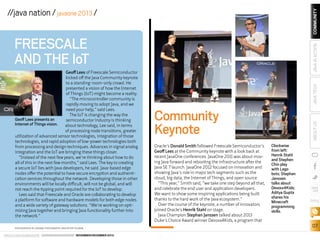
Geoff Lees of Freescale Semiconductor
kicked off the Java Community keynote
to a standing-room-only crowd. He
presented a vision of how the Internet
of Things (IoT) might become a reality.
“The microcontroller community is
rapidly moving to adopt Java, and we
need your help,” said Lees.
The IoT is changing the way the
Geoff Lees presents an
semiconductor industry is thinking
Internet of Things vision.
about technology, Lee said, in terms
of processing node transitions, greater
utilization of advanced sensor technologies, integration of those
technologies, and rapid adoption of low-power technologies both
from processing and design techniques. Advances in signal analog
integration and the IoT are bringing these things closer.
“Instead of the next few years, we’re thinking about how to do
all of this in the next few months,” said Lees. The key to creating
a secure IoT lies with Java developers, he said. Java-based edge
nodes offer the potential to have secure encryption and authentication services throughout the network. Developing those in other
environments will be locally difficult, will not be global, and will
not reach the tipping point required for the IoT to develop.
Lees said that Freescale and Oracle are collaborating to develop
a platform for software and hardware models for both edge nodes
and a wide variety of gateway solutions. “We’re working on optimizing Java together and bringing Java functionality further into
the network.”

JAVA IN ACTION

FREESCALE
AND THE IoT

Clockwise
from left:
Henrik Stahl
and Stephen
Chin play
with Lego
bots; Stephan
Janssen
talks about
Devoxx4Kids;
Aditya Gupta
shares his
Minecraft
programming
skills.

blog

07
PHOTOGRAPH BY PETER PILGRIM

ORACLE.COM/JAVAMAGAZINE  ////////////////////////////////  NOVEMBER/DECEMBER 2013

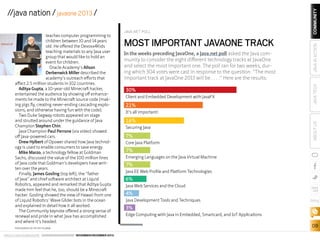
MOST IMPORTANT JAVAONE TRACK
In the weeks preceding JavaOne, a Java.net poll asked the Java community to consider the eight different technology tracks at JavaOne
and select the most important one. The poll ran for two weeks, during which 304 votes were cast in response to the question: “The most
important track at JavaOne 2013 will be . . . .” Here are the results:
30%
Client and Embedded Development with JavaFX

21%

COMMUNITY
JAVA IN ACTION

JAVA.NET POLL

It’s all important!

16%
Securing Java

7%
Core Java Platform

ABOUT US

teaches computer programming to
children between 10 and 14 years
old. He offered the Devoxx4Kids
teaching materials to any Java user
group that would like to hold an
event for children.
Oracle Academy’s Alison
Derbenwick Miller described the
academy’s outreach efforts that
affect 2.5 million students in 102 countries.
Aditya Gupta, a 10-year-old Minecraft hacker,
entertained the audience by showing off enhancements he made to the Minecraft source code (making pigs fly, creating never-ending cascading explosions, and otherwise having fun with the code).
Two Duke Segway robots appeared on stage
and strutted around under the guidance of Java
Champion Stephen Chin.
Java Champion Paul Perrone (via video) showed
off Java-powered cars.
Drew Hylbert of Opower shared how Java technology is used to enable consumers to save energy.
Mike Marzo, a technology fellow at Goldman
Sachs, discussed the value of the 100 million lines
of Java code that Goldman’s developers have written over the years.
Finally, James Gosling (top left), the “father
of Java” and chief software architect at Liquid
Robotics, appeared and remarked that Aditya Gupta
made him feel that he, too, should be a Minecraft
hacker. Gosling showed the view of Hawaii from one
of Liquid Robotics’ Wave Glider bots in the ocean
and explained in detail how it all worked.
The Community keynote offered a strong sense of
renewal and pride in what Java has accomplished
and where it’s headed.

JAVA TECH

//java nation / javaone 2013 /

7%
Emerging Languages on the Java Virtual Machine

7%
Java EE Web Profile and Platform Technologies

6%
Java Web Services and the Cloud

4%
Java Development Tools and Techniques

blog

3%
Edge Computing with Java in Embedded, Smartcard, and IoT Applications

08
PHOTOGRAPHS BY ARUN GUPTA AND YOLANDE POIRIER

ORACLE.COM/JAVAMAGAZINE  ////////////////////////////////  NOVEMBER/DECEMBER 2013

The Java Embedded
Challenge for
Raspberry Pi at
JavaOne provided
an opportunity for
conference attendees
to build embedded
projects. The two-day
challenge kicked off
with a series of lectures that introduced
the Raspberry Pi and projects that use it.
Globalcode’s Vinicius Senger, who ran
the event with Globalcode’s Yara Senger,
described the Raspberry Pi’s layout and its
configuration with other boards. He also
showed off an embedded panel that he
had built, which included Arduino, Beagle,
and other boards. He added sensors to
monitor alcohol in breath, heart rate, distance, and sound.
Over three days, attendees built Oracle
Java SE Embedded applications integrated

Clockwise
from left:
Vinicius Senger
describes the
Raspberry Pi’s
configuration;
sensors on
Raspberry Pi,
Gemalto, and
Beagle boards;
Yara Senger
discusses the
goals of the
challenge.

with sensors, Raspberry Pi, Arduino, and
other boards. Experts and mentors gave
presentations and coached the teams
while they developed their applications.
“Our main goals were achieved,” said
Yara Senger. “People had fun coding until
11 p.m. despite the great parties [going on],
and developed amazing projects in just a
couple of days.”
The teams developed seven remotecontrolled applications: a heart monitor
application using Google Glass, a radiocontrolled car application, a home automation platform, a sobriety field tester, a
remote control using any phone, a loadbalancing cloud application, and a burglar
alarm with voice/text alerts.

COMMUNITY
JAVA IN ACTION

Despite heavy rains
on the Saturday
before JavaOne,
the Geek Bike Ride
went on, with 12
determined riders
making the trip from
Fisherman’s Wharf
over the Golden Gate
Bridge to Sausalito.
Talk about Java
persistence!

JAVA TECH

Ride Goes On

JAVA EMBEDDED CHALLENGE
FOR RASPBERRY PI

ABOUT US

//java nation / javaone 2013 /

blog

09
TIMON VEENSTRA PHOTOGRAPH BY TON HENDRICKS

ORACLE.COM/JAVAMAGAZINE  ////////////////////////////////  NOVEMBER/DECEMBER 2013

Product News
The Java SE 8 Specification and JDK 8,
its official Reference Implementation,
are expected to be available in March
2014. The key features of Java SE 8 and
JDK 8 are Project Lambda (JSR 335),
the Nashorn JavaScript engine, a new
Date and Time API (JSR 310), a set of
Compact Profiles, and the removal of
the “permanent generation” from the
Java HotSpot VM.
Java ME 8 is expected to be available
in March 2014, in conjunction with the
Java SE 8 Specification. New features
in Java ME 8 include Java language and
API alignment with Java SE 8; support
for modern web protocols; a comprehensive application model that will
enable both simple, single-use devices
and more-complex deployments;
advanced security; standard APIs for
power management; and interaction
with a broad set of standard peripherals. Oracle Java ME Embedded 8
will be the Oracle implementation
of the Java ME 8 standard. Oracle
Java ME Embedded 8 Early Access is
now available as a binary runtime for
Raspberry Pi Model B (ARM11) and ST
Microelectronics STM32F4DISCOVERY
(ARM Cortex-M4).

JAVA IN ACTION

Meanwhile, Timon Veenstra,
lead developer for AgroSense
(a 2012 Duke’s Choice Award
winner), held a session where
an airplane controlled by a
NetBeans application flew in the
session hall.
Another Duke’s Choice Award
winner was JFrog’s Bintray, a
community centered on redistributable software binaries.
Bintray provides developers with
the knowledge of how others are
consuming their software, and
also provides developers with a
searchable resource for finding
software for specific needs.
There are many different
programming languages and
toolkits, but in its community
aspect Java is unique.

JAVA TECH

The fact that
community is
a fundamental
aspect of Java’s
reach into people’s
lives was illustrated
in a Sunday JUG
forum presented by
Morocco JUG leader
Badr El Houari and
JUG-Africa leader
Max Bonbhel.
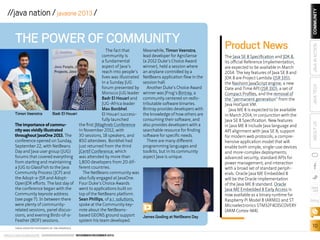
Timon Veenstra
Badr El Houari
El Houari successfully launched
The importance of commuthe first JMaghreb Conference
nity was vividly illustrated
in November 2012, with
throughout JavaOne 2013. The
30 sessions, 18 speakers, and
conference opened on Sunday,
850 attendees. Bonbhel had
September 22, with NetBeans
just returned from the third
Day and Java user group (JUG)
JCertif Conference, which
forums that covered everything was attended by more than
from starting and maintaining
1,800 developers from 20 difa JUG to GlassFish to the Java
ferent countries.
Community Process (JCP) and
The NetBeans community was
the Adopt-a-JSR and Adoptalso fully engaged at JavaOne.
OpenJDK efforts. The last day of Four Duke’s Choice Awards
the conference began with the
went to applications built on
Community keynote address
top of the NetBeans platform.
(see page 7). In between there
Sean Phillips, of a.i. solutions,
were plenty of communityspoke at the Community keyrelated sessions, panel discusnote about the NetBeanssions, and evening Birds-of-abased GEONS ground support
Feather (BOF) sessions.
system his team developed.

ABOUT US

THE POWER OF COMMUNITY

COMMUNITY

//java nation / javaone 2013 /

blog

James Gosling at NetBeans Day

10
COMMUNITY

//java nation / javaone 2013 /

sudo apt-get update && sudo apt-get install oracle-java7-jdk

Java
Community
Process
Awards

The 11th annual Java Community
Process (JCP) Program Award recipients were honored during JavaOne.
The categories and winners were
JCP Member/Participant of the Year:
Gil Tene, Azul Systems
According to the JCP, “[Tene] has
worked diligently to provide clear
advice on matters of software patents,
IP, and licensing that seeks to benefit
both nonprofits/individuals as well as organizations with vested commercial interests in Java.”
Outstanding Spec Lead: Brian Goetz, Oracle
The JCP recognized Goetz for “tirelessly working away at an incredibly
complex JSR: JSR 335, Lambda Expressions for the Java Programming
Language.”
Most Significant JSR: JSR 335, Lambda Expressions for the Java
Programming Language
According to the JCP, JSR 335 “brings Java kicking and screaming into
the modern programming language age . . . .”
Outstanding Adopt-a-JSR Participant: Mohamed Taman and Faissal
Boutaounte, Morocco JUG and EGJUG
Taman and Boutaounte were praised “for adopting JSR 339, JAX-RS
2.0 specification, along with many other JSRs. One JIRA issue filed by
Morocco JUG on JSR 339 was classified as a ‘release-stopper.’”

JAVA TECH

From left: Mohamed Taman, Gil Tene (with Heather VanCura), Brian Goetz

ABOUT US

Oracle introduced the Oracle Java Platform Integrator program, which
gives partners the ability to customize Oracle Java ME Embedded and
Oracle Java SE Embedded to reach different device types and market
segments.
Gemalto is working with Oracle and V2COM, a developer of smart
grid systems, to deliver a flexible smart-energy solution. This platform
combines Gemalto’s Cinterion modules, Oracle Java ME Embedded,
Oracle Java SE Embedded, the Oracle Utilities Meter Data Management
solution, and V2COM’s Intelligenceware Suite.
Qualcomm Technologies and Oracle have collaborated to bring
Oracle Java ME Embedded to key chipsets in Qualcomm Technologies’
Internet of Everything portfolio. Oracle Java ME Embedded support is
currently available on QSC6270-Turbo, and Oracle and Qualcomm are
working together on expanding this to MDM6x00 and MDM9x15, as
well as other chipsets.
Freescale Semiconductor has joined the OpenJDK community and
will collaborate with Oracle and others to help evolve the Java platform
and optimize Java for Freescale i.MX ARM-based applications processors. Freescale has also joined the Java Community Process (JCP) and
intends to work with Oracle and other JCP members on future Java
specifications for small and large devices.
Linaro has also joined the OpenJDK community and is already contributing to porting and optimizing Java for 64-bit ARM processors.
Square has also joined the OpenJDK community and is actively collaborating with Oracle and others in the community to enhance the
Java programming language, Java Virtual Machine, and core libraries.
The Raspberry Pi will now ship with JDK 7. Future Raspbian images
will ship with Java by default, and existing Raspberry Pi users can install
the new Java support by typing the following:

JAVA IN ACTION

PARTNER NEWS

blog

11
ORACLE.COM/JAVAMAGAZINE  ////////////////////////////////  NOVEMBER/DECEMBER 2013
17

15
21

22

18

23

24

Java Advent
Calendar

The Transylvania Java User Group
is seeking contributions for the
second edition of the Java Advent
Calendar, a series of 24 Java-related
technical articles to be published
daily during the first 24 days of
December.
The Java Advent Calendar is based
on a special Christmas calendar that
is popular with children. Each day
the child selects a new window to
open and discovers the surprise—
typically a small toy or chocolate—
hiding behind it. Help make the Java
Advent Calendar a gift to Java developers by contributing an article to
the calendar!

open and playful
mind is essential
for proper creativity. So, I would tend
to have concerns
about some of the
connotations that
usually go along
with the phrase
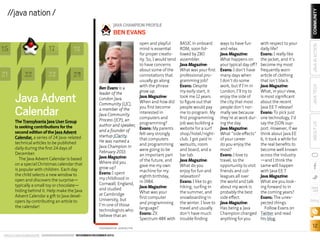
Ben Evans is a
grow up.
leader of the
Java Magazine:
London Java
When and how did
Community (LJC),
you first become
a member of the
interested in
Java Community
computers and
Process (JCP), an
author and speaker, programming?
Evans: My parents
and a founder of
felt very strongly
startup jClarity.
that computers
He was named a
and programming
Java Champion in
were going to be
February 2013.
an important part
Java Magazine:
of the future, and
Where did you
gave me my own
grow up?
machine for my
Evans: I spent
eighth birthday,
my childhood in
Cornwall, England, in 1984.
Java Magazine:
and studied
What was your
at Cambridge
first computer
University, but
and programming
I’m one of those
technologists who language?
Evans: ZX
believe that an
Spectrum 48K with
PHOTOGRAPH BY JOHN BLYTHE

ORACLE.COM/JAVAMAGAZINE  ////////////////////////////////  NOVEMBER/DECEMBER 2013

BASIC in onboard
ROM, soon followed by Z80
assembler.
Java Magazine:
What was your first
professional programming job?
Evans: Despite
my early start, it
took me 12 years
to figure out that
people would pay
me to program. My
first programming
job was building a
website for a surf
shop/hotel/nightclub. I got paid in
wetsuits, room
and board, and a
bar tab.
Java Magazine:
What do you
enjoy for fun and
relaxation?
Evans: I like to go
hiking, surfing in
the summer, and
snowboarding in
the winter. I love to
travel and usually
don’t have much
trouble finding

ways to have fun
and relax.
Java Magazine:
What happens on
your typical day off?
Evans: I don’t have
many days when
I don’t do some
work, but if I’m in
London, I’ll try to
enjoy the side of
the city that most
people don’t normally see because
they’re at work during the day.
Java Magazine:
What “side effects”
of your career
do you enjoy the
most?
Evans: I love to
travel, so the
opportunity to visit
friends and colleagues all over
the world and talk
about my work is
probably the best
side effect.
Java Magazine:
Has being a Java
Champion changed
anything for you

with respect to your
daily life?
Evans: I really like
the jacket, and it’s
become my most
frequently worn
article of clothing
that isn’t black.
Java Magazine:
What, in your view,
is most significant
about the recent
Java EE 7 release?
Evans: To pick just
one technology, I’d
say the JSON support. However, if we
think about Java EE
6, it took a while for
the real benefits to
become well known
across the industry
—and I think the
same will happen
with Java EE 7.
Java Magazine:
What are you looking forward to in
the coming years?
Evans: The unexpected things.
Follow Evans on
Twitter and read
his blog.

JAVA TECH

BEN EVANS

ABOUT US

JAVA CHAMPION PROFILE

JAVA IN ACTION

COMMUNITY

//java nation /

blog

12
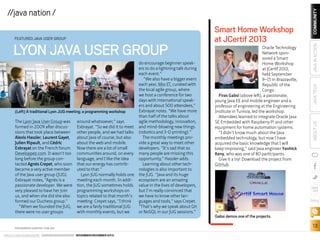
(Left) A traditional Lyon JUG meeting; a programming workshop
The Lyon Java User Group was
formed in 2009 after discussions that took place between
Alexis Hassler, Laurent Gayet,
Julien Ripault, and Cédric
Exbrayat on the French forum
Developpez.com. It wasn’t too
long before the group contacted Agnès Crepet, who soon
became a very active member
of the Java user group (JUG).
Exbrayat notes, “Agnès is a
passionate developer. We were
very pleased to have her join
us, and when she did she also
formed our Duchess group.”
“When we founded the JUG,
there were no user groups

around whatsoever,” says
Exbrayat. “So we did it to meet
other people, and we had talks
about Java of course, but also
about the web and mobile.
Now there are a lot of small
communities around, on every
language, and I like the idea
that our energy has contributed to that.”
Lyon JUG normally holds one
meeting each month. In addition, the JUG sometimes holds
programming workshops on
topics related to that month’s
meeting. Crepet says, “I think
we are a fairly traditional JUG
with monthly events, but we

PHOTOGRAPHS COURTESY LYON JUG

ORACLE.COM/JAVAMAGAZINE  ////////////////////////////////  NOVEMBER/DECEMBER 2013

do encourage beginner speakers to do a lightning talk during
each event.”
“We also have a bigger event
each year, Mix-IT, curated with
the local agile group, where
we host a conference for two
days with international speakers and about 500 attendees,”
Exbrayat notes. “We have more
than half of the talks about
agile methodology, innovation,
and mind-blowing new things
(robotics and 3-D printing).”
The monthly meetings provide a great way to meet other
developers. “It’s sad that so
many people are missing this
opportunity,” Hassler adds.
Learning about other technologies is also important to
the JUG. “Java and its huge
ecosystem are an amazing
value in the lives of developers,
but I’m really convinced that
we have to know other languages and tools,” says Crepet.
“That’s why we speak about Git
or NoSQL in our JUG sessions.”

COMMUNITY
JAVA IN ACTION

LYON JAVA USER GROUP

Oracle Technology
Network sponsored a Smart
Home Workshop
at JCertif 2013,
held September
9–15 in Brazzaville,
Republic of the
Congo.
Firas Gabsi (above left), a passionate,
young Java EE and mobile engineer and a
professor of engineering at the Engineering
Institute in Tunisia, led the workshop.
Attendees learned to integrate Oracle Java
SE Embedded with Raspberry Pi and other
equipment for home automation systems.
“I didn’t know much about the Java
embedded technology, but now I have
acquired the basic knowledge that I will
keep improving,” said Java engineer Yanhick
Keny, who was one of 80 participants.
Give it a try! Download the project from
GitHub.

JAVA TECH

FEATURED JAVA USER GROUP

Smart Home Workshop
at JCertif 2013

ABOUT US

//java nation /

blog

Gabsi demos one of the projects.

13
JANUARY 30–31
LILLE, FRANCE

This conference for web developers and designers offers a range of
sessions on topics including web
servers, front end, frameworks, and
development techniques.

COMMUNITY

Take Off

JAVA IN ACTION

//java nation /

EVENTS

Jfokus FEBRUARY 3–5
STOCKHOLM, SWEDEN

Jfokus, one of the premier European Java developer conferences, is
back for its eighth year. Held in Stockholm, Sweden, Jfokus consists
of six tracks including a subconference on embedded technologies.
Conference topics include Java SE and Java EE, front end and web,
mobile, continuous delivery and DevOps, the Internet of Things,
cloud and big data, future trends, alternative languages—such as
Scala and Clojure—on the Java Virtual Machine, and agile development. Speakers include Dr. Venkat Subramaniam of Agile Developer,
Jim Manico of WhiteHat Security, Martin Thompson of Real Logic,
and many more.

PHOTOGRAPH BY GETTY IMAGES

ORACLE.COM/JAVAMAGAZINE  ////////////////////////////////  NOVEMBER/DECEMBER 2013

jDays

NOVEMBER 26–27
GOTHENBURG, SWEDEN

This Java developers conference
offers sessions on Java SE, Java
EE, frameworks and servers, front
end, web and mobile, trends and
future, solutions, case studies and
real-world experiences, and methodologies and tools.

The Atlanta Java User Group (AJUG)
has organized this Java conference
for the past eight years. It covers
Java topics including web technologies, architecture, big data, enterprise software, mobile, Java SE,
testing tools, and methodologies.

8th Annual IndicThreads Pune
Conference

ABOUT US

FEBRUARY 24–25
ATLANTA, GEORGIA

JAVA TECH

DevNexus 2014

EARLY 2014
PUNE, INDIA

Web technologies, server side,
big data, and mobile software
development are the focus of
this conference.

Groovy & Grails eXchange
DECEMBER 12–13
LONDON, ENGLAND

Industry-leading experts and developers from around the world gather
at this conference to learn and
share everything about the Groovy
and Grails ecosystem.

blog

14
COMMUNITY

//java nation /

JAVA IN ACTION

JAVA BOOKS

Listen to the Java
Spotlight podcast for
interviews, news, and
insight for and from
Java developers. Hosted
by Roger Brinkley, this
weekly show includes a
rotating panel of all-star
Java developers.

Learn how to build
dynamic enterprise web
applications that fully
leverage state-of-the-art
communication technologies. Written by the leading
expert on Java WebSocket
programming, this book
offers practical development strategies and
detailed example applications. Java WebSocket
Programming explains
how to design client/server
applications, incorporate
full-duplex messaging,
establish connections, create endpoints, handle path
mapping, and secure data.
You’ll also learn how to
encrypt web transmissions
and enrich legacy applications with Java WebSocket.

MAKING JAVA GROOVY

PRO JSF AND HTML5

By Arun Gupta
O’Reilly (August 2013)

By Kenneth A. Kousen
Manning Publications
(September 2013)

By Zubin Wadia, Hazem Saleh,
and Allan Lykke Christensen
Apress (November 2013)

Making Java Groovy is a
practical handbook for
developers who want to
blend Groovy into their
day-to-day work with Java.
It starts by introducing the
key differences between
Java and Groovy—and how
you can use them to your
advantage. Then, it guides
you step-by-step through
realistic development challenges, from web applications to web services to
desktop applications, and
shows how Groovy makes
them easier to put into
production.

Pro JSF and HTML5 shows
you how to leverage the
full potential of JavaServer
Faces (JSF) and Ajax. This
is not an entry-level tutorial, but a book about
building Ajax-enabled JSF
components for sophisticated, enterprise-level
rich internet applications.
Written by JSF experts and
verified by established
community figures, this
book provides reliable and
groundbreaking JSF components to help you exploit
the power of JSF in your
Java web applications.

Get up to speed on the
principal technologies
in Java EE 7, and learn
how the latest version
embraces HTML5, focuses
on higher productivity, and
provides functionality to
meet enterprise demands.
Written by Arun Gupta,
a member of the Java EE
team, this book provides a
chapter-by-chapter survey
of several Java EE 7
spec­ifications, including WebSocket, Batch
Processing, RESTful Web
Services, and Java
Message Service.

JAVA TECH

Podcast

By Danny Coward
Oracle Press (August 2013)

JAVA EE 7 ESSENTIALS

ABOUT US

Java Spotlight

JAVA WEBSOCKET
PROGRAMMING

blog

15
ORACLE.COM/JAVAMAGAZINE  ////////////////////////////////  NOVEMBER/DECEMBER 2013
The Essential Source on Java Technology, the Java
Programming Language, and Java-Based Applications.

By and for the Java community

Connect with the Audience
that Matters Most to Your Business.
Audience: Corporate and independent
developers, IT managers, architects,
product managers, and students
Circulation: Currently 165,000+
Click here to subscribe

Copyright © 2013, Oracle and/or its affiliates. All rights reserved. Oracle and Java are registered trademarks of Oracle and/or its affiliates. Other names may be trademarks of their respective owners.
Charting the Future–JCP.next

Oracle’s Patrick Curran discusses the JCP’s evolutionary path
toward greater transparency and participation, and the embrace of
open source processes. BY STEVE MELOAN
PHOTOGRAPHY BY BOB ADLER

ORACLE.COM/JAVAMAGAZINE  ////////////////////////////////  NOVEMBER/DECEMBER 2013

JAVA TECH

JAVA IN ACTION

COMMUNITY

JCP Executive Series

ABOUT US

P

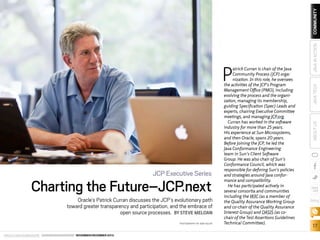
atrick Curran is chair of the Java
Community Process (JCP) organization. In this role, he oversees
the activities of the JCP’s Program
Management Office (PMO), including
evolving the process and the organization, managing its membership,
guiding Specification (Spec) Leads and
experts, chairing Executive Committee
meetings, and managing JCP.org.
Curran has worked in the software
industry for more than 25 years.
His experience at Sun Microsystems,
and then Oracle, spans 20 years.
Before joining the JCP, he led the
Java Conformance Engineering
team in Sun’s Client Software
Group. He was also chair of Sun’s
Conformance Council, which was
responsible for defining Sun’s policies
and strategies around Java conformance and compatibility.
He has participated actively in
several consortia and communities
including the W3C (as a member of
the Quality Assurance Working Group
and co-chair of the Quality Assurance
Interest Group) and OASIS (as cochair of the Test Assertions Guidelines
Technical Committee).

blog

17
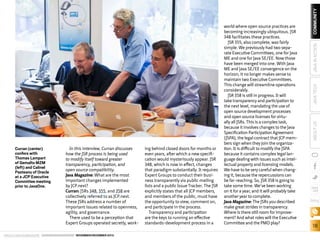
Curran (center)
confers with
Thomas Lampart
of Gemalto M2M
(left) and Calinel
Pasteanu of Oracle
at a JCP Executive
Committee meeting
prior to JavaOne.

In this interview, Curran discusses
how the JSR process is being used
to modify itself toward greater
transparency, participation, and
open source compatibility.
Java Magazine: What are the most
important changes implemented
by JCP.next?
Curran: JSRs 348, 355, and 358 are
collectively referred to as JCP.next.
These JSRs address a number of
important issues related to openness,
agility, and governance.
There used to be a perception that
Expert Groups operated secretly, work-

ORACLE.COM/JAVAMAGAZINE  ////////////////////////////////  NOVEMBER/DECEMBER 2013

ing behind closed doors for months or
even years, after which a new specification would mysteriously appear. JSR
348, which is now in effect, changes
that paradigm substantially. It requires
Expert Groups to conduct their business transparently via public mailing
lists and a public Issue Tracker. The JSR
explicitly states that all JCP members,
and members of the public, must have
the opportunity to view, comment on,
and participate in the process.
Transparency and participation
are the keys to running an effective
standards-development process in a

COMMUNITY
JAVA IN ACTION
JAVA TECH
ABOUT US

world where open source practices are
becoming increasingly ubiquitous. JSR
348 facilitates these practices.
JSR 355, also complete, was fairly
simple. We previously had two separate Executive Committees, one for Java
ME and one for Java SE/EE. Now those
have been merged into one. With Java
ME and Java SE/EE convergence on the
horizon, it no longer makes sense to
maintain two Executive Committees.
This change will streamline operations
considerably.
JSR 358 is still in progress. It will
take transparency and participation to
the next level, mandating the use of
open source development processes
and open source licenses for virtually all JSRs. This is a complex task,
because it involves changes to the Java
Specification Participation Agreement
(JSPA), the legal contract that JCP members sign when they join the organization. It is difficult to modify the JSPA
because it contains complex legal language dealing with issues such as intellectual property and licensing models.
We have to be very careful when changing it, because the repercussions can
be far-reaching. So, JSR 358 is going to
take some time. We’ve been working
on it for a year, and it will probably take
another year to complete.
Java Magazine: The JSRs you described
make great strides in transparency.
Where is there still room for improvement? And what roles will the Executive
Committee and the PMO play?

blog

18
“Transparency and
participation are the
keys to running an
effective standardsdevelopment
process.”

ORACLE.COM/JAVAMAGAZINE  ////////////////////////////////  NOVEMBER/DECEMBER 2013

COMMUNITY
JAVA IN ACTION
JAVA TECH
join the JCP is an active and vibrant
JSR development process, the key to
greater involvement is to have a lot of
JSRs in progress. This is not something
the Executive Committee or the PMO
can directly influence, since JSRs are
initiated by our members. However,
we hope that the introduction of open
source development processes and
open source licensing via JSR 358 will
provide a significant boost in commercial participation.
Java Magazine: How will JCP.next use
both positive and negative reinforcement to keep innovation on track?
Curran: We use a number of mechanisms to encourage Spec Leads to
move their work through the process
in a timely manner. The main positive
reinforcement is the Star Spec Lead

Curran talks
with Executive
Committee member
Bruno Souza of
SouJava.

ABOUT US

Curran: All Expert Groups are complyJava Magazine: In what ways will
ing with the “letter of the law.” Now
JCP.next bring more individuals, Java
we must ensure that they comply with
user groups [JUGs], and other entities
the “spirit.” There’s no point in having
into JCP processes?
a public mailing list if it receives little
Curran: We expect that enabling
traffic, or if comments from outside
people to participate through the use
the Expert Group are ignored. And
of public mailing lists and open source
there’s little value in having a pubdevelopment processes will make
lic Issue Tracker if very few issues are
JCP participation much more attractive
logged, or if those that are logged are
to the average Java developer. We’re
not acted upon. We must make sure
actively recruiting JUGs through a
that people who wish to participate
program we call Adopt-a-JSR, whereby
know how to participate, and that their developers get together through the
participation is effective. The JSR’s
JUGs to assist with JSR efforts that
home page must provide the necessary interest them. This might involve
information to put all that in motion.
activities such as critiquing the spec,
We’re working on a set of reporting
testing the implementation, or being
requirements that will track the activiinvolved with documentation. We now
ties of Expert Groups. They will have to
have more than 40 JUGs as members,
gather and publish this information,
collectively representing tens of thouand make it available for everyone. By
sands of developers. In JSR 358, we’re
doing this, we believe engagement will working to create a new class of membe significantly improved.
bership tailored for individuals. This
Also, the PMO is working to provide
will involve a membership agreement
information that will allow us to judge
that is much simpler than the current
how well an Expert Group is meeting
complex legal document and will not
its transparency and parrequire an employer’s
OUT IN THE OPEN
ticipation obligations.
signature, which has
We hope that the comsometimes been a stumbination of public disbling block.
closure of information,
We’ve been very sucpublic pressure, and the
cessful in recruiting indiExecutive Committee
viduals and JUGs, but
taking this information
we still have work to do
into account when votto increase participation
ing on JSRs, will motivate
by commercial entities.
the Expert Groups to fully
Since the primary motimeet their obligations.
vation for companies to

blog

19
Left to right: Mike
Marzo of Goldman
Sachs, Curran,
and Jack Chung
of Aplix listen to a
presentation during
a JCP Executive
Committee meeting.

program, which publicly recognizes
exceptional Spec Leads through the
annual JCP Awards. The awards also
recognize outstanding JSRs and members who have contributed significantly during the previous year.
As for negative reinforcement,
JSR 348 introduced the notion of timeouts, whereby JSRs that do not reach
defined process stages within specified
time periods are subject to a Renewal
Ballot. The Executive Committee may
then require that the JSR be withdrawn
if the Spec Lead cannot justify the

ORACLE.COM/JAVAMAGAZINE  ////////////////////////////////  NOVEMBER/DECEMBER 2013

COMMUNITY
JAVA IN ACTION
JAVA TECH

nance process be affected by JCP.next?
Curran: Previously there was no formal
ballot before the Maintenance Release.
There was nothing in the Process
Document that required published
updates to the RI, the TCK, or even the
Spec. Spec Leads would sometimes
simply publish a change log and leave it
up to implementers to figure out what
they needed to do to adopt the new
version. That didn’t make sense. Now
we have maintenance reviews similar
to the Final Review, whereby materials are made available, the Executive
Committee will study them, and the
public will be granted access.
But we’re aware that more work lies
ahead. We expect to make further
changes in JSR 358 in order to make
the maintenance process more compatible with the type of continuous
development and release processes
adopted by open source projects.
Java Magazine: Will you explore in
greater detail the merging of the
Executive Committees for Java SE/EE
and Java ME? How will this benefit both
camps and the process as a whole?
Curran: Java ME began as a subset
of Java SE, but over the years they’ve
diverged. Now many of the new features of Java SE, particularly the language features, are being incorporated
into Java ME, making them more similar and compatible. So, the merging
of Executive Committees made sense,
and was a simple change that we introduced in JSR 355. We wanted to empha-

ABOUT US

delay and convince the
Executive Committee that
work is still constructively
proceeding.
Java Magazine: What
methodologies will JCP
.next use to ensure that a
specification, its Reference
Implementation [RI],
and its Technology
Compatibility Kit
[TCK] are completed
simultaneously?
Curran: The PMO checks
to be sure that the specification, RI, and TCK are all
available before initiating
a Final Approval Ballot.
The software licenses
are also required. If all
these elements are not in
place, the ballot cannot
move ahead. We’ve also
added some language to
the Process Document stating that if
the materials are not formally posted
to jcp.org within 14 days, or if links
to these materials are later broken,
another Executive Committee ballot can be initiated to label the JSR as
withdrawn on the grounds that the
Spec Lead has abandoned it. So we
hope this combination of checks will
ensure that all the necessary elements
are in place when the process is complete, and that they will continue to be
available to implementers.
Java Magazine: How will the mainte-

blog

20
ORACLE.COM/JAVAMAGAZINE  ////////////////////////////////  NOVEMBER/DECEMBER 2013

Steve Meloan is a former C/UNIX software developer who has covered the web
and the internet for such publications as
Wired, Rolling Stone, Playboy, SF Weekly,
and the San Francisco Examiner.

COMMUNITY
JAVA IN ACTION

by JCP.next. In conclusion, could you
expand further on how JCP.next promotes best practices?
Curran: Facilitating transparency and
enabling participation are essential to
maintaining an effective standardsdevelopment organization in the
current era.
People will participate only if our
governance and processes are open.
That’s critical. These best practices
increase the quality of the standards
we develop. With more active participants, we’ll have greater diversity of
viewpoints and more problems being
fixed. The resulting technologies benefit across the board.
JCP.next is a continuum that began
with some basic transparency and
participation changes, and is moving
forward to embrace open source development processes and open source
licensing. These modifications will help
to ensure the continuing strength and
relevance of Java as we move forward
in a very dynamic and competitive
landscape. /article

JAVA TECH

balance of power between Oracle and
others within the JCP?
Curran: This is one of the most fundamental areas of concern as we revise
our processes via JCP.next. Obviously
Oracle has a special role as the steward of Java, as the Spec Lead for the
platforms, and as the most significant
investor in the development of Java
technologies. However, if Java were
proprietary it would not have achieved
such broad and ubiquitous success.
There are approximately 9 million Java
developers worldwide. It is, therefore,
critical that processes be open and
inclusive, and that others, particularly
Oracle’s competitors, have the opportunity to collaborate and to participate.
A significant majority of JSRs are
now led by Oracle, which skews the
Spec Lead role in Oracle’s favor.
Others certainly participate, since
they are active members of the Expert
Groups, but it would be healthier if
there were more JSRs led from outside Oracle. JSR 358 will embrace
open source development processes
and open source licensing, which we
hope will increase the participation
of others in Oracle-led JSRs, and also
encourage the creation of more JSRs
from outside the Oracle domain. It’s
a delicate balance between Oracle’s
legitimate business interests, as the
steward of Java, and the need for open
and collaborative processes.
Java Magazine: Transparency and
participation are obviously enhanced

ABOUT US

Curran takes a walk
with Executive
Committee member
David Britto of TOTVS.

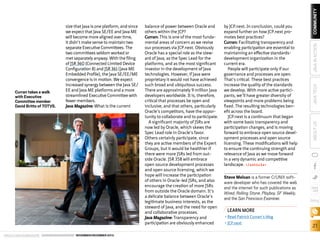
size that Java is one platform, and since
we expect that Java SE/EE and Java ME
will become more aligned over time,
it didn’t make sense to maintain two
separate Executive Committees. The
two committees seldom worked or
met separately anyway. With the filing
of JSR 360 (Connected Limited Device
Configuration 8) and JSR 361 (Java ME
Embedded Profile), the Java SE/EE/ME
convergence is in motion. We expect
increased synergy between the Java SE/
EE and Java ME platforms and a more
streamlined Executive Committee with
fewer members.
Java Magazine: What is the current

blog

LEARN MORE
•	Read Patrick Curran’s blog
•	JCP.next

21
COMMUNITY
JAVA IN ACTION
JAVA TECH
ABOUT US

openHAB’s Kai Kreuzer (left)
and Thomas Eichstädt-Engelen
in front of the electrical cabinet
at Kreuzer’s home

SMARTEST HOUSE
ON THE STREET
The Internet of Things meets home automation with openHAB,
a Java-based software environment that integrates devices and
applications into a cohesive network. BY DAVID BAUM
ART BY WES ROWELL; PHOTOGRAPHY BY TON HENDRIKS

ORACLE.COM/JAVAMAGAZINE  ////////////////////////////////  NOVEMBER/DECEMBER 2013

K

ai Kreuzer is not an easy man to
sneak up on. As you approach
the front door of his highly
automated house, you will trigger
a sensor that activates a webcam
mounted above the front door. Ring
the doorbell and he will be alerted to
your presence, via either loudspeakers throughout the property or a video
display on his iPhone. He may choose
to let you in by remotely unlatching
the door. With a few more taps on his

blog

22
SNAPSHOT
openHAB
openhab.org

Headquarters:

Darmstadt, Germany

Industry:

Home automation,
open source software

Contributors:
37

Java technology
used:
Java SE 1.7

phone he can adjust the lights, turn on
the music, and adjust the temperature
of the home’s central heating system.
If he is in the garden, you may hear his
voice coming over a PA system, directing you outside.
What’s unique about this scenario is
not the individual systems that automate every aspect of Kreuzer’s modern
home, but the way these systems work
together to improve the convenience,
security, and efficiency of dozens of
routine tasks.
Home automation is a prime example of the Internet of Things, a phenomenon that is exploding across the
domains of healthcare, manufactur-

ORACLE.COM/JAVAMAGAZINE  ////////////////////////////////  NOVEMBER/DECEMBER 2013

Contributors help to
expand the openHAB
ecosystem by creating
connections to various
devices, applications,
and interfaces.

COMMUNITY
JAVA IN ACTION
JAVA TECH

ing, transportation, and
Bus (openHAB) in 2010, a Java-based
communications as bilsoftware environment that integrates
lions of intelligent devices
devices and applications throughout
flood into our personal
his home.
and professional lives. Java
With openHAB as the controller,
plays a starring role as a
all of a home’s comfort systems, secucentral integration point in
rity systems, and energy systems work
this machine-to-machine
in concert and can be triggered in
world by making our cars
unison—through a smartphone intermore efficient and depend- face, via Google Calendar events, or
able, our homes more
through many other hardware and
comfortable and secure,
software interfaces.
and our healthcare less costly and
Kreuzer’s brainchild quickly gained
more patient friendly—to name a few
traction in the open source commuprominent examples.
nity. Today there are 37 contributors
Kreuzer studied mathematand between 2,000 and 3,000 openics and computer science at the
HAB installations worldwide.
Technical University of
Thomas EichstädtDarmstadt, where he
Engelen is a fellow
COMMUNITY ROLE
took a particular interhome automation
est in Java. He has used
enthusiast who now
the language extenserves as a project
sively in his profesleader at openHAB.
sional life as well as in
With a degree in comhis home automation
puter science from the
systems. This lifelong
University of Hagen and
hobby culminated with
full-time work in the IT
the founding of open
field, he is well versed
Home Automation
in the software industry

ABOUT US

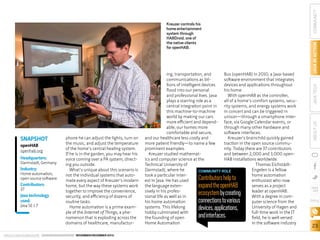
Kreuzer controls his
home entertainment
system through
HABDroid, one of
the native clients
for openHAB.

blog

23
ORACLE.COM/JAVAMAGAZINE  ////////////////////////////////  NOVEMBER/DECEMBER 2013

COMMUNITY
the heating system will shut off if the
windows are left open. The door won’t
lock behind you if you go out on the
balcony to get some fresh air.”

DESIGN GOALS: BETTING
ON JAVA AND OPEN SOURCE

Kreuzer and Eichstädt-Engelen both
have day jobs in the IT field and pursue openHAB in their spare time.
Eichstädt-Engelen is a software developer at innoQ, a midsize software
consulting company. Kreuzer works at
Deutsche Telecom as an IT engineer
and architect, with previous jobs in the
media and banking industries. “Java
was always my language of choice, personally and professionally,” he says.
In 2008 Kreuzer built a house
from scratch and decided to include
advanced automation systems that
could be interconnected. He worked
closely with an electrical engineer
to plan and wire the house. Like
Eichstädt-Engelen, he was leery of
proprietary solutions that would tie his
automation systems to a vendor that

ABOUT US

and has an affinity for the open source
movement. He joined Kreuzer a few
months after the openHAB environment was launched.
“My own home automation project
began with the physical infrastructure
and soon progressed to software,”
Eichstädt-Engelen recalls. “It is not
enough to have the hardware in your
flat. You have to have something to
control it. I liked openHAB because it
was free and open source. It was a perfect fit to my skills because it is based
on Java and OSGi.”
Eichstädt-Engelen has used openHAB at home to connect many different devices and applications into a
cohesive fabric. “In every room I have
a loudspeaker, centrally operated by
openHAB, along with the lights, the
appliances, and the heating and ventilation systems,” he explains. “All of the
doors and windows have electric contacts that signal the security system.
Most of the electric appliances can be
controlled remotely, and the various
systems work in unison. For example,

JAVA TECH

JAVA IN ACTION

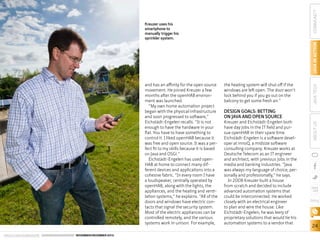
Kreuzer uses his
smartphone to
manually trigger his
sprinkler system.

blog

24
COMMUNITY
Top: A weather station
in Kreuzer’s garden
detects brightness,
rain, wind, and
temperature, and
sensors control window
blinds, sprinklers, and
the HVAC system.
Right: A GIRA system
monitors windows and
lights, shows missed
calls or visitors, and
communicates via
text-to-speech.

ORACLE.COM/JAVAMAGAZINE  ////////////////////////////////  NOVEMBER/DECEMBER 2013

a one-time or periodic basis. “Rather
than giving a key to my cleaning service, I can issue an RFID tag. This lets
me control when the lock will open for
them,” he says.
A weather station in Kreuzer’s garden detects brightness, rain, wind,
and temperature, along with moisture
sensors in the soil. Because the sprinkler system is attached to openHAB,
the watering system comes on only
when the plants need it. A pump is
activated with a float switch, which
also registers its activities, so there is
always enough water in the tank for
the garden. This level of integration
is what makes openHAB so useful in
comparison to standalone or “siloed”
automation solutions.
“If you buy a security solution from
one vendor and a comfort solution
from another, it is generally very
difficult to combine them into one
smart house,” Eichstädt-Engelen
explains. “In addition, many of today’s
home automation systems were
designed for very high-end homes.

JAVA TECH

might not exist in 10 or 20 years.
“Since I planned to live in this home
indefinitely, I didn’t want to bet on a
horse that wouldn’t win in the long
run,” he says. “I knew that if I invested
in an open source solution I could
always extend it as technology evolved.
It could be developed and maintained
by myself and by others in the open
source community. As a professional
Java developer, I was not really satisfied
with existing open source solutions so
I decided to create something completely from scratch and build it for
my own use, yet make it flexible and
extensible so that it would also be
useful for others.”
Fast-forward five years and you can
see the results of Kreuzer’s suburban automation efforts. In addition
to a webcam near the front door, he
installed a Near Fields Communications
(NFC) reader that can control the lock
based on signals from inexpensive RFID
tags that he issues to his guests. This
method is particularly useful for service
people, who he may want to let in on

ABOUT US

OpenHAB enables discrete automation with centralized
control: individual systems can be automated, yet each
one is aware of the others through a common controller.

JAVA IN ACTION

WORKING TOGETHER

blog

25
With openHAB, we are bringing this
same level of sophistication to average
homes and apartments.”
Home automation use cases can be
divided into three basic categories:
comfort, security, and energy management. Some features of a home, such
as draperies and shutters, span multiple categories: automatically opening
them in the morning and closing them
in the evening keeps the house comfortable; saves energy; and improves
security, because it makes it appear as
if the resident is home even when the
house is empty. These activities can
occur automatically based on the time
of day or can be triggered by sensors
that detect when people are home.
Lighting, heating, cooling systems, and
appliances can also be activated automatically or can trigger other systems.
For example, when Kreuzer’s washing
machine finishes a load it broadcasts
its status over the loudspeaker.
ORACLE.COM/JAVAMAGAZINE  ////////////////////////////////  NOVEMBER/DECEMBER 2013

One of the fundamental
design goals is modularity:
it is easy to replace one
technology with another
so that homeowners aren’t
locked in to particular types
of applications and devices.

COMMUNITY
JAVA IN ACTION
JAVA TECH

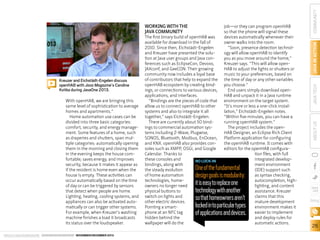
Kreuzer and Eichstädt-Engelen discuss
openHAB with Java Magazine’s Caroline
Kvitka during JavaOne 2013.

The first binary build of openHAB was
available for download in the fall of
2010. Since then, Eichstädt-Engelen
and Kreuzer have presented the solution at Java user groups and Java conferences such as EclipseCon, Devoxx,
JAXconf, and GeeCON. Their growing
community now includes a loyal base
of contributors that help to expand the
openHAB ecosystem by creating bindings, or connections to various devices,
applications, and interfaces.
“Bindings are the pieces of code that
allow us to connect openHAB to other
systems and also to integrate it all
together,” says Eichstädt-Engelen.
There are currently about 50 bindings to commercial automation systems including Z-Wave, Plugwise,
SONOS, Bluetooth, Modbus, EnOcean,
and KNX. openHAB also provides consoles such as XMPP, OSGi, and Google
Calendar. Thanks to
these consoles and
NO LOCK-IN
bindings, along with
the steady evolution
of home automation
technologies, homeowners no longer need
physical buttons to
switch on lights and
other electric devices.
Pointing a smartphone at an NFC tag
hidden behind the
wallpaper will do the

job—or they can program openHAB
so that the phone will signal these
devices automatically whenever their
owner walks into the room.
“Soon, presence detection technology will allow openHAB to identify
you as you move around the home,”
Kreuzer says. “This will allow openHAB to adjust the lights or shutters or
music to your preferences, based on
the time of day or any other variables
you choose.”
End users simply download openHAB and unpack it in a Java runtime
environment on the target system.
“It’s more or less a one-click installation,” Eichstädt-Engelen notes.
“Within five minutes, you can have a
running openHAB system.”
The project includes the openHAB Designer, an Eclipse Rich Client
Platform application for configuring
the openHAB runtime. It comes with
editors for the openHAB configuration files, with full
integrated development environment
(IDE) support such
as syntax checking,
autocompletion, highlighting, and content
assistance. Kreuzer
claims that this
mature development
environment makes it
easier to implement
and deploy rules for
automatic actions.

ABOUT US

WORKING WITH THE
JAVA COMMUNITY

blog

26
COMMUNITY

WHAT JAVA BRINGS

JAVA IN ACTION

“Java is very useful because it has a huge
ecosystem of libraries, great debugging tools,
and lots of support available on the web.”

Using Java also makes
it easier to collaborate
with other developers.
“There would be fewer
contributors if we had
chosen another language,” Kreuzer adds.
“We are part of a big
ecosystem, so we can
almost always find the
solutions we need.”
Neither Eichstädt-Engelen nor
Kreuzer plans to commercialize
openHAB. However, they recently proposed the Eclipse SmartHome project, which will make central parts of
openHAB available under the Eclipse
license. This move paves the way for
the integration into commercial products and ensures sustainability.
But no matter where the openHAB
technology goes and how the open
source community evolves, the two
partners plan to keep the system

ORACLE.COM/JAVAMAGAZINE  ////////////////////////////////  NOVEMBER/DECEMBER 2013

ABOUT US

openHAB also includes a scripting
language so that developers can easily
define new types of automation logic.
“OSGi is an important aspect for
openHAB because it brings modularity
to our systems,” Kreuzer explains. “This
makes it easy for contributors to build
modules and bindings independently
of the core development. Users can
pick relevant modules and add them to
their openHAB system at runtime.“
“Java is very useful because it has
a huge ecosystem of libraries, great
debugging tools, and lots of support
available on the web,” Kreuzer continues. “It’s easy to find a solution for a
specific problem. Java is also platform
independent, so you can run it on
Linux, Windows, Mac, or an embedded platform.”
Eichstädt-Engelen agrees. “The
best JVM [Java Virtual Machine] available for embedded systems is Oracle
Java SE Embedded.”

JAVA TECH

—Kai Kreuzer, Founder, openHAB

closely aligned with Java.
“Java is future proof and platform
independent,” Kreuzer sums up. “The
Java APIs are very stable and consistent
from one version to another. Java’s
diversity makes it easy for other
contributors to get involved, all over
the world.” /article

Based in Santa Barbara, California,
David Baum writes about innovative
businesses, emerging technologies,
and compelling lifestyles.

Kreuzer and EichstädtEngelen program
openHAB and test it
on a Raspberry Pi with
a tablet.

blog

27
BY TIMOTHY BENEKE

S

ince its inception in 2001, agile
development—defined on
Wikipedia as “a group of software development methodologies
based on iterative and incremental
development, where requirements
and solutions evolve through collaboration between self-organizing,
cross-functional teams”—has had an
impressive history, with many organizations adapting its principles. In
recent years however, a number of
questions have arisen: What kinds
of organizations make a good fit for
agile? Is it being deployed in dysfunctional ways? Does agile development
require developers to have a certain
kind of skill set to be effective? What
goes wrong when agile fails?
To address these and other
issues, we met up with Dr. Venkat
Subramaniam, the founder of Agile
Developer, who has trained and mentored thousands of software developers in the US, Canada, Europe,
and Asia. Known for his contagious
enthusiasm, he helps developers
succeed with agile practices on their
software projects, and he speaks frequently at international conferences
and user groups. He is the author
of many books, including, most

PHOTOGRAPHY BY BOB ADLER

ORACLE.COM/JAVAMAGAZINE  ////////////////////////////////  NOVEMBER/DECEMBER 2013

COMMUNITY
JAVA IN ACTION

P R A C TI

JAVA TECH

S

V

CE

DE

NT

E
PM
LO
E

ABOUT US

Java Champion Venkat Subramaniam explores the subtleties of agile development.

B

AGILE ADJUSTMENT

EST

blog

28
recently, Functional Programming in
Java: Harnessing the Power of Java 8
Lambda Expressions.
Prior to starting his own company,
Subramaniam worked in various positions, from programmer analyst to systems architect, at organizations such as
Halliburton, Raytheon, and Invensys. He
holds a PhD in computer science from
the University of Houston, where he is
an adjunct professor, and was named a
Java Champion in 2013.
Java Magazine: Why do people talk
about the demise of agile?
Subramaniam: It is a little like the parable of the four blind men who visit an
elephant at the zoo. They cannot see
the elephant, so each touches a differ-

ORACLE.COM/JAVAMAGAZINE  ////////////////////////////////  NOVEMBER/DECEMBER 2013

Collaboratively and
skillfully adjusting
to feedback cycles
through iterative,
incremental
development is the
essence of agile.

COMMUNITY
JAVA IN ACTION
JAVA TECH
ABOUT US

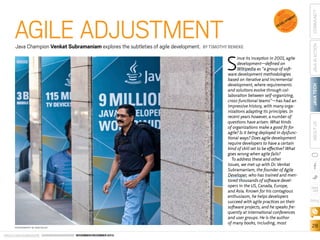
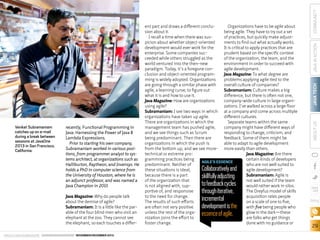
Venkat Subramaniam
catches up on e-mail
during a break between
sessions at JavaOne
2013 in San Francisco,
California.

ent part and draws a different concluOrganizations have to be agile about
sion about it. 
being agile. They have to try out a set
I recall a time when there was susof practices, but quickly make adjustpicion about whether object-oriented
ments to find out what actually works.
development would ever work for the
It is critical to apply practices that are
enterprise. Some companies sucprudent based on the specific context
ceeded while others struggled as the
of the organization, the team, and the
world ventured into the then-new
environment in order to succeed with
paradigm. Today, it’s a foregone conagile development.
clusion and object-oriented programJava Magazine: To what degree are
ming is widely adopted. Organizations
problems applying agile tied to the
are going through a similar phase with
overall culture of companies?
agile, a learning curve, to figure out
Subramaniam: Culture makes a big
what it is and how to use it.
difference, but there is often not one,
Java Magazine: How are organizations
company-wide culture in large organiusing agile?
zations. I’ve walked across a large floor
Subramaniam: I see two ways in which at a company and come across multiple
organizations have taken up agile.
different cultures. 
There are organizations in which the
Separate teams within the same
management team has pushed agile,
company might have different ways of
and we see things such as Scrum
responding to change, criticism, and
being predominant. Then there are
feedback. Some of them might be
organizations in which the push is
able to adapt to agile development
from the bottom up, and we see more- more easily than others.
technical or extreme proJava Magazine: Are there
gramming practices being
certain kinds of developers
AGILE’S ESSENCE
predominant. Neither of
who are not well suited to
these situations is ideal,
agile development?
because there is a part
Subramaniam: Agile is
of the organization that
not well suited if the team
is not aligned with, supwould rather work in silos.
portive of, and responsive
The Dreyfus model of skills
to the need for change.
acquisition rates people
The results of such efforts
on a scale of one to five,
are often not very positive
with five being people who
unless the rest of the orgaglow in the dark—these
nization joins the effort to
are folks who get things
foster change.
done with no guidance or

blog

29
That is, while there is value in the items on the right, we value the
items on the left more.”
In addition, they offered 12 basic agile principles that ranged from
the importance of change and of working software, to the value of simplicity, sustainable development, and face-to-face communication.

intervention. One consists of novices;
leave them alone with a task and they
might struggle to get moving. Each of
us varies on this scale for various activities we perform. So there is no levelone person or level-five person—we’re
at various levels for different activities.
The study says the average level in any
organization is level two, which is not
sufficient for excelling. We can raise
this level for a team through active collaboration and open communication.
Some developers are naturally open
to communication and constructive
criticism. Some developers simply are
not, and that can be a problem. There’s
a cautious balance we have to strike
between personal pride and team spirit.
ORACLE.COM/JAVAMAGAZINE  ////////////////////////////////  NOVEMBER/DECEMBER 2013

Timothy Beneke is a freelance writer
and editor, best known for his books
on gender.

COMMUNITY
JAVA IN ACTION

any better. A quick check on our attitudes and levels of trust is the first step.
Given all things equal, I do believe that
face-to-face conversation brings better
results. But all things are rarely equal.
Java Magazine: Your most recent book,
Functional Programming in Java:
Harnessing the Power of Java 8 Lambda
Expressions (Pragmatic Programmers,
2013), points to a different way of doing
Java programming. How might this
relate to agile development? 
Subramaniam: Lambda expressions
in Java 8 open up the possibility of
functional programming in Java. This
style of programming, if done well, can
lead to fewer errors, more-elegant and
more-concise code, and code that is
far easier to parallelize. Fewer moving
parts in functional-style code means
it’s easier to write automated tests and
easier to evolve the highly expressive
code. This can lead to code that’s ready
for feedback more rapidly than in the
past. Agile development, in essence,
is feedback-driven development.
Collaboratively and skillfully adjusting to feedback cycles through iterative, incremental development is the
essence of agile. /article

JAVA TECH

Individuals and interactions over processes and tools
Working software over comprehensive documentation
Customer collaboration over contract negotiation
Responding to change over following a plan

Ego is like cholesterol—there are good
parts and bad parts. We all want to take
pride in our individual work, while at
the same time, we have to place the
success of the team ahead of that. It
comes down to openness and accepting trade-offs. The agile methods work
better in teams in which developers put
forth their ideas, not as a fort to defend,
but as something that should evolve
and be improved upon by their team.
Java Magazine: One of the original
principles of agile emphasized that
face-to-face conversation is the best
form of communication. This method
emphasizes both personal interaction
and conversation, which implies relationships of relative equality.
Subramaniam: Yes, it does. I have had
many very productive relationships
working with people who I have never
met in person, or only met years later,
so face-to-face conversations are by
no means absolutely necessary for
good communication. It is a matter of
the attitudes that people bring to the
interaction. Two people, no matter how
far away they are, will produce better results if they’re keen on working
together and value the collective success. More than on face-to-face communication, we need to focus on the
trust we have built.
If I whine and complain about someone to you, you’re going to wonder
what I say about you to others. This
erodes trust. Having a face-to-face
conversation is not going to make this

ABOUT US

The Agile
Manifesto

In February 2001, 17 developers gathered at a resort
in Utah to explore how best to produce software.
The result, the “Manifesto for Agile Software
Development,” stated, in its entirety:
“We are uncovering better ways of developing software by doing it
and helping others do it. Through this work we have come to value:

blog

LEARN MORE
•	Venkat Subramaniam’s blog

30
Lessons in what not to do.

I
BEN EVANS AND
MARTIJN VERBURG
BIO

n this article, we’ll discuss
how to approach performance tuning and wrestle
with the #1 problem that all
applications need to be concerned with.
Never mind about reliability, supportability, elegance,
architectural flexibility, ease
of understanding, or even
correctness. All that matters
is getting a result out quickly.
Who cares if you’re right
tomorrow? All that matters is
getting the result (any result)
as quickly as possible—if
you’re faster than everyone
else, you can define what’s
“right.” Smart developers
focus on performance to the
exclusion of all else.

Using Benchmarks

PHOTOGRAPHS BY
JOHN BLYTHE AND BOB ADLER

Always believe the benchmarks you find online—what
could go wrong? Following
that, it’s also important to
understand that benchmarks always correlate really
well with real-world appli-

ORACLE.COM/JAVAMAGAZINE  ////////////////////////////////  NOVEMBER/DECEMBER 2013

cation performance (even
Wikipedia agrees).
Microbench­ arks are the
m
best type of benchmark.
They’re fun to do, and once
you understand the low-level
detail of your application’s
behavior, it’s easy to just
extrapolate up from that and
deduce how the rest of the
stack will behave.
The best kind of microbenchmark is where you
can prove that some very
low-level aspect of the Java
Virtual Machine (JVM) has
some tiny performance
differences—these types
of results are always significant when aggregated
up into a whole system. For
example, it stands to reason
that dispatch of an interface
method absolutely must be
slower than regular virtual
dispatch, right?

Handling Data and Results
The Don’t Repeat Yourself
(DRY) principle is an impor-

tant part of modern software
development. In a performance context, it means
that you should never run
any performance test more
than once. With so many
other development tasks, it’s
important not to waste time
on the dull work of repeating
a performance test. After all,
you’re a perfectly competent professional, so you’re
bound to have set up the test
perfectly and gotten all the
bugs out of the run the first
time around.
Ignore anyone who says
things such as “statistical
significance” or “shape of the
distribution.” They’re probably just math nerds who can’t
cope with the awesomeness
required to be a real performance rock star ninja. Do the
test once and just measure
the averages (and by averages, we mean the mean),
and you’ll be done handling
those annoying results. Then
you can get back to the real

work of a performance
engineer—squeezing every
last glistening drop of performance out of the algorithms
in your application.
Measuring things is for
people who don’t have your
keen insights; you built the
app, so you know exactly
where the problems are.
Algorithm optimization is
hard, so that’s where the real
performance professionals
spend their time; never mind
collecting and analyzing data.

COMMUNITY

Diabolical Java Performance Tuning

JAVA IN ACTION

P R A C TI

JAVA TECH

V

S

DE

NT

E
PM
LO
E

ABOUT US

EST

CE

B

//java architect /

Optimizing Algorithms

The bottleneck is almost certainly where you think it is.
Trust in your amazing analytical skills—they will lead you
to the right culprit, which is
usually any code that wasn’t
written by you.
Fortunately, optimizations of other people’s code
are easy to do. First, find any
code with a simple, unoptimized algorithm. A good
candidate is anything that

blog

31
Optimizing the JVM

Don’t bother testing with recent
releases of Java and tracking the
minor version numbers. Nothing
much changes internally between
major releases of Java.
Instead, you can often get better
performance by fiddling with the
switches you pass to Java. Don’t
bother being systematic about
this—just locate a set of switches
that you think have some bearing
on the problem, and play around
with them until you find a combination that works for you and will
give you extra, free performance
with no downsides.
There are more than 100 performance tuning switches for the
JVM. Use as many as you can.

Working with the Team

Scrutinizing Technology

•	“Java Performance Tuning”

Understanding the Hardware

Understanding the CPU is a waste
of time—it’s the kind of thing that
is best left to hardware engineers.
A software engineering genius
shouldn’t have to care about L3
caches or how the data is actually
laid out in memory.
Solid-state drives are faster in all
use cases, so use them all the time.
Don’t bother to measure the actual
throughput or other observables.
Remember, more capacity is better, so buy loads of RAM and really
push up the size of your heap.

Using Performance Advice

Always remember to guard your
performance test harnesses and

ORACLE.COM/JAVAMAGAZINE  ////////////////////////////////  NOVEMBER/DECEMBER 2013

When thinking about the application architecture as a whole,

Conclusion

Performance tuning can be boiled
down to a few very simple rules:
■■ Performance is the most important aspect of any application.
■■ You are awesome, which is why
you’re doing the tuning—it’s
the most important job of all.
■■ Performance analysis is all
about staring at source code
and optimizing algorithms.
■■ Other people will likely mess up
your good work, so guard it from
them jealously.
■■ Measuring is boring and
unnecessary.
If you follow these basic rules,
your application will be on the
front page of major industry publications in record time.
Needless to say, the diabolical
advice in this article should not
be followed, but instead should
be referenced as an anti-patterns
guide. /article

LEARN MORE
•	“ ine Fallacies of Java
N
Performance”

JAVA IN ACTION

always remember to scrutinize the
newest technology very closely.
If you don’t fully understand
it (bearing in mind that you’re
a genius), there’s bound to be
something not quite right about it.

Performance advice is like fine
wine: it just gets better with age,
and it certainly never goes out of
date. Performance advice from
the 1990s is still absolutely accurate today. You should build on
the deep insights of the amazingly
smart engineers who came up
with the tips in the first place. They
were probably a lot like you.

results carefully. Otherwise, some
other people might steal your
work and claim credit for it. Never
let them independently recheck
your work. They’ll just get it wrong
and detract from your obviously
correct conclusions.
Better yet, let others do the
boring work for you. If someone
else has already done something
vaguely similar and written it up
on a blog or the Stack Overflow
site (especially if they have a high
reputation score), just accept their
conclusions—that’s close enough.
After all, how different can the
behavior of two applications be?
It’s all just Java (or all just the
JVM), right?
Once you’ve reached your conclusions about how to improve
performance, whether that
involves using an optimized algorithm or a new bit of ultrafast shiny
tech, it’s a better use of your time
to browbeat your colleagues into
accepting your solution than to
waste time having them independently check your conclusions.
Always show them who’s boss, and
never document or explain your
reasoning—the last thing you want
is to have them messing around
with your carefully tuned system.

JAVA TECH

Don’t worry that some of the
switches seem to do conflicting or
contradictory things. A true professional (such as you) will also use
the undocumented ones found in
the Java HotSpot VM source code.

ABOUT US

has a long-running loop with a
conditional check in the middle of
it. Now, remember that generalcase algorithms are stupid. You
understand your data set better
than anyone else, so you should
spend as much time as you need
to design a specialized algorithm
that fits your data. Someone of
your talent and intellect can surely
do better than mediocre, compromised textbook examples.
Don’t worry if this takes quite a
lot of time; this is the most important part of performance tuning,
and doing it correctly is likely to
require someone of your abilities.

COMMUNITY

//java architect /

blog

32
COMMUNITY
JAVA TECH

JAVA IN ACTION

JAVA
CONCURRENT
ANIMATED
CE

S

B

In 2009, Java
T developer Victor
EN
PM
O
Grazi introduced
EL
EV
D
Java Concurrent
P R A C TI
Animated, a muchpraised set of animations that
serves as a tutorial for concurrency
development. Recently inducted
as a Java Champion for his contributions to the Java community, Grazi is a vice president at
JP Morgan Chase’s Securities
Lending division. He is a frequent
presenter at technical conferences where he speaks about his
first love, Java concurrency, and
other Java-related topics.
EST

ABOUT US

Java Champion Victor Grazi on writing better
concurrency applications BY JANICE J. HEISS

Java Magazine: How many people have now tried out your Java
Concurrent Animated app?
Grazi: The app was introduced in
July 2009; since then, we’ve had
about 20,000 downloads. Given
that there are perhaps 10 million
Java developers out there, we are
only scratching the surface. Top
downloads by country are the US
(23 percent), India (14 percent),
and China (7 percent).
You can download the selfexecuting JAR file. Then just
double-click the JAR file to start
it. It is menu-driven, or you can
use the up and down arrow keys

blog

PHOTOGRAPHY BY CHRISTOPHER LANE/GETTY IMAGES

ORACLE.COM/JAVAMAGAZINE  ////////////////////////////////  NOVEMBER/DECEMBER 2013

33
ORACLE.COM/JAVAMAGAZINE  ////////////////////////////////  NOVEMBER/DECEMBER 2013

Available Animations
Available Java Concurrent Animated
animations include Executors
[FixedThreadPoolExecutor,
SingleThreadExecutor,
CachedThreadPoolExector, and
RejectedExecutionHandler(s)];
Future; synchronized;
ReentrantLock; Condition;
Semaphore; ReadWriteLock;
CountDownLatch; CyclicBarrier;
Phaser; AtomicInteger;
BlockingQueue; TransferQueue;
CompletionService;
ConcurrentHashMap; and
ForkJoinPool.
In addition, Grazi has an animation
for the Java memory model and new
Java 8 constructs in the works.

COMMUNITY

Suppose a writer is waiting for some
working readers to release the read
lock, and suddenly a new reader comes
along. Who should get preference?
Should the reader move ahead of the
writers—after all, why have a new reader
wait around for a waiting writer if other
readers are already holding the lock?
So that was how it worked in Java 5. But
once I started running the animation in
Java 6, I noticed the behavior changed,
and subsequent readers would wait for
all waiting writers to release the lock
before acquiring the lock.

JAVA IN ACTION

efficiencies, and suddenly code that has
been working like a
charm will start experiencing sporadic failures
due to incorrect concurrency management.
Java Magazine: Would
you say that your app
does some of our imagining for us in ways that
enable developers to
intuitively grasp Java concurrency principles and
processes more quickly?
Grazi: That’s an interesting way to put it. You see, Java
Concurrent Animated is not just some
Flash animations—it is a set of interactive Java programs, such that each
animation is actually utilizing the
underlying concurrency component it
is illustrating. There is a snippet panel
on the right side of the screen, and as
an animation proceeds, executing code
snippets are dynamically highlighted
and restored as they execute.
Let me give you an example that
happened with the ReadWriteLock
animation. A ReadWriteLock is used to
ensure data consistency. It allows an
unlimited number of reader threads
to acquire a read lock and operate
concurrently. But a writer thread must
wait for all readers to complete before
it can acquire the lock. Once a writer
thread acquires the lock, no other
reader or writer can acquire it.

JAVA TECH

Java Concurrent
Animated is not just
some Flash animations;
it is a set of interactive
Java programs, such that
each animation is actually
utilizing the underlying
concurrency component
it is illustrating.

to navigate between
the various image and
animation slides. It
works on all platforms—
Windows, Mac, Linux,
and so on. Java SE 6 or
higher is now required.
Java Magazine: What
are the typical
responses to it?
Grazi: People tell me
that they find it very
helpful. Many really get
excited about it, especially teachers and team
leads who are trying to
impart proper concurrency skills to
teams. Java was one of the first languages to introduce concurrency into
its core library. It was a powerful feature, but we suddenly found some very
good programmers writing some very
bad code. Proper concurrent programming is difficult to impossible to get
right, but if people would take the time
to understand some of the frameworks
out there, it would make coding for
concurrency much less error prone.
Take, for example, the Java memory
model. Developers often ignore it
and code away blissfully ignorant
that their code is broken, because the
Java Virtual Machine (JVM) and servers might not leverage the optimizations provided by the Java memory
model. But as cores increase in speed
and number, manufacturers are
expected to take advantage of these

ABOUT US

MORE THAN IT SEEMS

blog

34
Figure 1
I thought this new behavior was
a bug and mentioned it to concurrency expert Dr. Heinz Kabutz, who
explained that it was not a bug but a
feature. If new readers were allowed
to jump ahead of waiting writers,
there is a high risk of producing a
thread-starvation condition because
there is a high probability that no
writers would ever get in, and they
would accumulate forever. That’s an
example of how the animations alter
ORACLE.COM/JAVAMAGAZINE  ////////////////////////////////  NOVEMBER/DECEMBER 2013

their behavior depending on the JVM
runtime version.
Java Magazine: What is distinctive
about Java concurrency programming
that makes an animated tutorial of
particular value?
Grazi: Miller’s Law teaches that there
is a limit to the number of concepts
our brains can hold at one time. The
human brain tends to process sequentially, so even if we overcome our physical limitations and get things right, it

COMMUNITY
JAVA IN ACTION
JAVA TECH
ABOUT US

is difficult to come back later and try
to reconstruct our prior thought processes. Certainly, if a different developer dives in later, it is that much
harder to recapture the cognitive circuits from the original effort. So, suddenly, brittle code starts breaking.
By using a framework, we are not
only delegating the concurrency
to the smart people who built and
maintain the framework, but we are
also employing a lexicon for communicating our design. So, I can say,
“The following code is operating as a
CyclicBarrier,” and people will understand what that means. By introducing
interactive animations for all the
java.util.concurrent components, developers can click buttons to easily visualize the functionality they are exploring,
making it much easier to viscerally
assimilate the algorithms.
Java Magazine: You were operating on
some intuitions about what would
make it easier to learn concurrent
programming—intuitions that appear
to be valid, judging from the response
of developers. Can you make those
intuitions explicit?
Grazi: Well, yes. For example, above
I explained the basic workings of a
ReadWriteLock. Readers might have
understood it or not. Now take a look
at the animation for that, which is
shown in Figure 1.
The green threads are the readers, the top white thread (with the
diamond-head) is a writer, and the

blog

35
Figure 2
white thread beneath it is a new reader,
which must wait for the readers and
writer to finish before acquiring the
lock. If you click buttons and see the
animations, it becomes much easier to
understand than parsing through some
turgid explanation.
Java Magazine: Heinz Kabutz has
remarked that Java was built to be
able to do many things at once, which
is what concurrency is all about. How
does your learning system improve the
ORACLE.COM/JAVAMAGAZINE  ////////////////////////////////  NOVEMBER/DECEMBER 2013

skills of programmers so that they have
less risk of concurrency bugs?
Grazi: Very often when I am grappling with a concurrency problem, I
know that the solution lies in some
design pattern, but which one? Java
Concurrent Animated provides a catalog for developers in their quest for the
right concurrency solution; it acts as a
muse that inspires the correct solution.
Java Magazine: Java Concurrent
Animated had its origins when you

COMMUNITY
JAVA IN ACTION
JAVA TECH
ABOUT US

were managing a development team
that was using Java concurrency and
you wanted to understand it better and
have your team understand it better.
Can you describe the process by which
this led you to the animations?
Grazi: My training is in server-side
Java at investment institutions, where
concurrency is a common concern.
Traders require low latency to ensure
that they won’t lose to a competitor in
a 1 millisecond window of opportunity
for grabbing a trade. Batches need
to be completed quickly, and so on.
So I started seeing horrific write-only
constructs that confirmed that people
were struggling with concurrency. I
have been there myself.
One afternoon, while I was sitting in
an airport heading to Chicago to make a
concurrency presentation for my team,
I was putting the finishing touches on
a PowerPoint presentation that had a
sequence of slides dedicated to each of
the important constructs. I had written
a little functioning state machine that
displayed simple text messages that
I would refer to in order to guide me
through the important states of each
concurrency construct in java.util
.concurrent. In a previous lifetime, I had
worked at an interactive gaming dotcom startup, so I knew a lot about animation. It occurred to me that I could
replace the PowerPoint slides with a
series of interactive animations that
would be much more intuitive.
I worked on an initial animation

blog

36
Figure 3
engine while waiting for that flight,
and then I hooked in my state
machine. By morning I had a functioning prototype. Over the years, I
have tightened the framework, incorporating suggestions from experts. I
sent an early version to Brian Goetz
and was surprised to receive suggestions for each animation. I incorporated all of his suggestions. Kirk
Pepperdine joined me at my first presentation at JavaOne and suggested
ORACLE.COM/JAVAMAGAZINE  ////////////////////////////////  NOVEMBER/DECEMBER 2013

adding some true PowerPoint explanations to the animations so that
presenters have a trigger to remember what to discuss. I added that, and
it is a very helpful feature—not just
for presenters but even for end users.
Heinz Kabutz also joined the presentation and suggested some changes
to the original animations that would
make them more intuitive.
At another presentation, a passionate software consultant named Oliver

COMMUNITY
JAVA IN ACTION
JAVA TECH
ABOUT US

Zeigermann pointed out that an animation for ConcurrentHashMap was
conspicuously absent. I asked him if he
would be interested in contributing it
and he made that valuable addition.
Java Magazine: Could you take us
through some of the classes of Java
concurrency and explain how animation makes it easier for developers to
get insight into each one?
Grazi: Well, it would be difficult to do
that without an animation, but let’s
take a look at the CyclicBarrier, which
has two important states, as shown in
Figure 2 and Figure 3, which illustrate
a barrier with four parties. In Figure 2,
we can see that only three parties
have arrived, so they are prevented
from proceeding. Figure 3 shows that
once the fourth party arrives, everyone moves forward.
So this illustrates the barrier concept, which is that each party must
wait until all parties have arrived. As
the constructs increase in complexity—
for example, the fork/join animation
or the animation demonstrating the
native wait and notify mechanism—the
benefits are more pronounced.
Java Magazine: Tell us about some of
the challenges you have faced in creating the animations.
Grazi: There have been several.
Originally, the animations represented
threads as arrows, which worked for
most of the components. But then we
had to provide a visualization not for
threads but for objects being queued

blog

37
Figure 4
in a BlockingQueue. So, I had to introduce a concept of “sprite-type,” and
then we had an arrow sprite-type and
a new “object” sprite-type that is rendered as an oval, not an arrow. Then
ConcurrentHashMap and AtomicInteger
required a new sprite-type, because
we are trying to visualize their compare
and swap activities.
Then fork/join came, and the challenge was how to represent something completely different using the
ORACLE.COM/JAVAMAGAZINE  ////////////////////////////////  NOVEMBER/DECEMBER 2013

existing framework. There was an
additional challenge there. The fork/
join animation needed to solve a real
problem, but which problem should
the animation solve?
I originally had the animations solve
for the nth Fibonacci number, but
that was not working. I wrestled with
that for a couple of days until I realized that the recursive definition of
the Fibonacci sequence (Fn+1 = Fn +
Fn-1) cannot be efficiently parallel-

Janice J. Heiss is the Java acquisitions
editor for Java Magazine and Oracle
Technology Network.

COMMUNITY
JAVA IN ACTION
JAVA TECH
ABOUT US

ized, because each value depends on
the prior values. Therefore, it is inherently a sequential calculation no matter how you try to parallelize it. So, I
switched to a different problem—that
of finding the greatest element in an
array, which worked nicely. During
the animation, you can see the actual
problem being solved using random
array values (see Figure 4).
Java Magazine: Where has your animation been presented?
Grazi: I presented it at JavaOne a
few times and also at many other
conferences—such as JavaZone in
Oslo, Jazoon in Zurich, QCon in New
York—and at many SIGs [special
interest groups] and JUGs [Java user
groups]. I love presenting and I love
traveling around the world, so Java
Concurrent Animated has provided
me with a great opportunity to do
both. It always gets high ratings.
The Java Concurrent Animated presentations provide awareness, and
they also show the attending developers the value of downloading the app
and how much easier learning concurrency can be if you have a framework
and an inspiration. /article

blog

LEARN MORE
•	Java Concurrent Animated

38
DevOps will help developers produce higher-quality software.

T

he term DevOps
describes the improved
collaboration between
development and operations teams. In software
engineering, databases are
often on a critical path. This
article describes DevOps
and explains what database
DevOps might look like using
concrete concepts and tools.
So first, let’s start with
conflicts that occur during
software engineering.

Conflicts Due to Different
Goals, Processes, and Tools

Often conflicts exist between
development and operations
teams, primarily for the following reasons:
■■ Different goals: For developers, more changes in a
short time; for operations
staff, fewer changes in production and, thus, more
stability
ORACLE.COM/JAVAMAGAZINE  ////////////////////////////////  NOVEMBER/DECEMBER 2013

Different processes and
concepts: For developers, more-pragmatic
approaches; for operations staff, more focus on
reproducibility
■■ Different tools: For developers, development
tools; for operations staff,
more production-like
approaches
These differences often
lead to gaps or silos between
departments, which I’ll
cover next.
■■

Different Teams

In traditional settings, the
term development describes
mainly the programmers
on the development team
(see Figure 1). Testers and
QA personnel are also part
of the team, but they often
have dedicated project roles,
and their activities start after
the programmers have

COMMUNITY

S

P R A C TI

JAVA TECH

BIO

V

ABOUT US

MICHAEL HÜTTERMANN

DE

NT

E
PM
LO
E

JAVA IN ACTION

Database DevOps with MySQL,
Hudson, Gradle, Maven, and Git

EST

CE

B

//enterprise java /

Figure 1
finished their work.
The term operations refers
to a team that comprises
database administrators,
system administrators,
network administrators, and
other types of administrators. These are the experts
who put the software into
production and manage the

production infrastructure
(for example, setting up and
maintaining the servers and
systems). The operations
group essentially accompanies and accounts for the
“last mile” in the delivery
process.
In a barrier-rich setting,
both groups form silos, in

blog

40
Let me give some concrete examples of what daily struggles might
look like for database development. Application developers
apply continuous integration,
including frequent check-ins and
automated testing, and they often
apply continuous deployment of
the business application to the
target environment. Database
developers, on the other hand,
often lack the basics for real database version control and continuous deployment.
This gap is created by the major
differences between application
development/deployment and
database development/deployment. Traditionally, application
development is based on local
files, with local changes being
published only upon checkin. Developers can change and
debug code locally, without
interfering with the work being
done by other team members.
Deployment is performed by
automatically copying deliverables from the build server to
respective environments.
Database development, on the

DevOps in a Nutshell

DevOps describes practices that
streamline the software delivery
process, emphasizing learning by
streaming feedback from production to development and improving the cycle time (that is, the
time from inception to delivery).
DevOps will not only empower you
to deliver software more quickly,
but it will also help you to pro-

ORACLE.COM/JAVAMAGAZINE  ////////////////////////////////  NOVEMBER/DECEMBER 2013

Often conflicts
exist between
development
and operations
teams—primarily
due to different goals,
different processes,
and different tools—
which lead to gaps
or silos between
departments.

COMMUNITY

duce higher-quality software that
essential for DevOps to gain
is more aligned with individual
quick feedback.
■■ Measurement. DevOps finds a
requirements and basic conditions.
DevOps seeks to align goals,
specific path to measurement.
concepts, and tools with each
Quality and shared (or at least
other for both development and
aligned) incentives are critical.
■■ Sharing. Sharing creates a
operations. DevOps is about
improving the collaboration of
collaboration platform for
development and operations (the
exchanging ideas, knowledge,
why) through shared goals, conand experience.
cepts, and tools (the how).
In defining and rolling out dataWith DevOps, organizational
base DevOps, it can be helpful to
barriers are minimized. With the
distinguish among four different
“one team approach,” the usage
areas. Figure 2 shows the DevOps
of agile practices is expanded to
area matrix approach. Area 1 is
operations. Experts from developabout extending development to
ment and operations are both now
operations. A common use case
“developers,” meaning that they
for this, in a database context, is
work together closely and help to
to put conversion scripts into the
“develop” the solution.
version control sysDevOps targets diftem and use the same
WHY THE CONFLICT?
ferent activities and
database migration
aspects.
tool in development
and operations, such
Numerous Activities
as Flyway, which we’ll
and Aspects
discuss a bit later.
DevOps encompasses
Area 2 is about
numerous activities
extending operations
and aspects, such as
to development. For
the following:
database DevOps,
■■ Culture. This conthis means providing
cept emphasizes
visibility for traffic on
people over proproduction systems,
cesses and tools.
including locked rows,
Software is made by
blocking queries, and
and for people.
resource contention.
■■ Automation.
Area 3 embeds
Automation is
development into

JAVA IN ACTION

Database on the Critical Path

other hand, is often based on a
central resource. In many cases,
though, local developer databases
or individual schemas in central
databases are used to provide
isolated and productive working
environments.
In addition, database deployment is not a straightforward process of copying and replacing. For
example, a database table cannot
be simply dropped and afterward
recreated with the new structure.
With database deployments, often
no two deployments are exactly
the same, since either the source
or the target has been altered or
updated by previous deployments
or new developments.
DevOps can help to streamline
software development, including
managing changes on databases,
in a holistic way, spanning different departments. Now let’s examine in more detail what DevOps is
all about.

JAVA TECH

which they have locally optimized
goals and their own processes
and tools.
Developing software is hard;
developing databases is harder.

ABOUT US

//enterprise java /

blog

41
ORACLE.COM/JAVAMAGAZINE  ////////////////////////////////  NOVEMBER/DECEMBER 2013

JAVA IN ACTION
Figure 2
Contraction scripts migrate the
database and break backward
compatibility (for example, removing structure).
Using expansion and contraction
scripts conveniently decouples
database migrations from application deployments.
Release databases automatically.
One of the more-advanced challenges in automatically releasing
databases is to link the database
in its current version (that is, the
current set of structural elements,
such as tables and columns, and
their data)—or, in other words, in
its current state—with the current
version of the rest of what makes
up the complete release. By
having database elements already
under version control, you can
create tags (often called labels)
and add all of your configuration

items to a defined baseline.
Automatically deploying database changes results in the need
for a process that supports applying database changes incrementally while preserving current
structure and content. Many
approaches exist for updating an
existing database, and all have the
following activities in common:
■■ Put all code and database elements (all change sets) into version control.
■■ Create SQL scripts that have to
be applied to roll forward to the
next version and to roll backward to the previous version of
the database. These scripts are
grouped into single change sets.
■■ Investigate whether a roll backward mechanism is needed at
all. Increased complexity can
be avoided by accelerating the

JAVA TECH

In a barrierrich setting,
both groups
form silos, in
which they have
locally optimized
goals and their
own processes
and tools.

ABOUT US

operations. Examples include
most effective way to overcome
setting up constraints and shared
daily challenges. With features
goals for nonfunctional requiresuch as version control, continuments. Examples of shared goals
ous integration, and automation,
are that 80 percent of database
database change management
searches will return results to the
enables DBAs and developers to
screen in less than two seconds
better communicate and collabo(a shared performance goal);
rate with each other and to avoid
the system shall not make use of
the potential pitfalls—accidental
any technology that would make
overrides, conflicts, and so on—
it difficult to port to
that can arise when they
another Linux distribuwork in silos. That, in
WHY SILOS?
tion (a shared portabilturn, will lead to greater
ity goal); the database
returns from DevOps
will be capable of storstrategies. The following
ing 20 million members
patterns might help to
on the specified hardfoster DevOps, particuware while still meeting
larly database DevOps.
performance objectives
Use database update
(a shared capacity goal);
scripts. With DevOps,
or automated tests
database elements
must exist for all comshould be released autoponents including inframatically, with update
structure code (a shared
scripts. It is a good idea
maintainability goal).
to distinguish update
Area 4 embeds operascripts between datations into development.
base expansion scripts
This can be done to
and contraction scripts.
enhance collaboration by proExpansion scripts involve dataviding access to information to
base changes that can be applied
development without the involvewithout breaking the database’s
ment of database administrators
backward compatibility with the
(DBAs), thus preventing DBAs
existing version of the application
from being gatekeepers.
(for example, adding elements,
such as new tables or columns).
Database DevOps
These scripts can run at any point
A robust database changebefore upgrading the correspondmanagement solution is the
ing application.

COMMUNITY

//enterprise java /

blog

42
■■

■■

■■

Flyway, the Database
Migration Tool

Flyway is a database migration tool
that supports the concepts mentioned earlier. It can be used by
both development and operations.
Actually, development has to write
the change sets and has to test
the deployment on test machines.
Flyway can migrate from any version (including an empty database) to the latest version of the
schema. It’s based on plain old

ORACLE.COM/JAVAMAGAZINE  ////////////////////////////////  NOVEMBER/DECEMBER 2013

With features
such as database
version control,
continuous
integration, and
automation,
database change
management enables
DBAs and developers
to better communicate
and collaborate with
each other and to avoid
the potential pitfalls—
accidental overrides,
conflicts, and so on—
that can arise when
they work in silos.

COMMUNITY

SQL; thus, it’s a good
in, Gradle, or Ant. It
AVOIDING CONFLICT
discussion base for
can also be executed
both development
from the command
and operations, as
line. Now let’s focus
well as being a soluon the Flyway support
tion that is light and
for MySQL.
straightforward.
Flyway and MySQL.
Flyway only has a
Flyway supports the
few dependencies;
standard SQL synyou need Java 5 or
tax with statement
higher and a JDBC
delimiters, including
driver. It applies the
delimiter changes for
pattern of convention
stored procedures
over configuration, for
using DELIMITER
example, to automatstatements. You can
ically discover SQL
use comment direcmigrations through
tives generated by
classpath scanning.
mysqldump (/!.../;)
It supports many
and MySQL-style
databases, includsingle-line comments
ing Oracle Database
(# Comment).
10g and higher (all
DDL exported by
editions, including
mysqldump can be
Oracle Database,
used unchanged
Express Edition) and
in a Flyway migraMySQL 5.1 and higher.
tion. Any MySQL SQL
Data definition lanscript executed by
guage (DDL) files
Flyway can be exeexported by Oracle
cuted by the MySQL
Database or MySQL can be used
command-line tool and other
unchanged in a Flyway migration.
MySQL-compatible tools (after any
Any Oracle Database and MySQL
placeholders have been replaced,
script executed by Flyway can be
which allow parameterized calls
executed by SQL*Plus and other
and configuration).
Oracle-compatible tools (after the
placeholders have been replaced).
A Concrete Example
Flyway can be executed in many
Now for an example. Let’s start
ways, including via a Maven plugby looking at the folder where the

JAVA IN ACTION

cated working directory.
Store the database version. One
approach is to use a database
table that holds the metainformation, especially the version of the database scheme.
Additionally, you can create columns for SQL scripts that have
to be applied to roll forward and
to roll backward. Shell scripts
can now roll backward or forward using the information held
in the database.
■■ Consider monitoring to minimize mean time to repair
(MTTR), mean time to detect
(MTTD), and smoke testing.
You can develop a solution yourself, or you can use a framework
such as Flyway. In the upcoming sections, we’ll go through an
example of using Flyway in an
integrative build chain, integrating
Maven, Gradle, Git, and Hudson.
■■

JAVA TECH

■■

development flow and is a good
strategy for applying hot fixes.
Create one file for each change
set to hold the respective change
set. Give the file a unique name
including a numbering scheme.
Change sets move the database
forward (or backward). Change
sets are applied based on a
baseline. Thus, the concrete
content of a change set might
contradict a previous change
set. In other words, each change
set can consist of multiple SQL
statements. For managing one
specific change set, favor one
file over multiple files, to foster
task-based development.
Create baselines in which
you freeze all the configuration items of your application, including the database
elements.
Retrieve the baseline for deployment. In cases of a full installation, apply again the initial baseline of database elements and
the sum of incremental change
sets. In cases of incremental
installation, check the current
state (the version) of the specific database and apply all new
change sets (that have not been
applied before) to it.
Ensure that the deployment
process picks up a baseline from
version control. Place the database change sets into the dedi-

ABOUT US

//enterprise java /

blog

43
DevOps seeks
to align goals,
concepts, and
tools for both
development and
operations.

clean install flyway:migrate
-Pdb

To make the call even easier
and to gain from other benefits,
such as nice visualization, we will
also use Hudson, the continuous
integration engine, for database
migrations. We can trigger the
build manually, or let Hudson
observe changes in version control
and perform builds automatically,
by calling the build scripts. The call
results in some console output, as
shown in Listing 5.
In our case, the database was
empty and no migrations were run
before. Thus, Flyway does some
bootstrapping (creating metainformation, particularly the version number of the schema)
and triggers our two migrations’
scripts (because we’ve placed two
SQL files into our directory).
Examining our database, we
now have two new tables, both
created by Flyway:
mysql show tables;
+—— — — — -+
— — — —
| Tables_in_mydb |

ORACLE.COM/JAVAMAGAZINE  ////////////////////////////////  NOVEMBER/DECEMBER 2013

LISTING 4

LISTING 5

michael@michael-VirtualBox:~/talk/project/devops/src/main/resources/db/migration$
ls -la
total 16
drwxrwxr-x 2 michael michael 4096 Sep 22 11:16 .
drwxrwxr-x 3 michael michael 4096 Sep 22 11:16 ..
-rw-rw-r-- 1 michael michael 112
Sep 18 07:59 V1__Create_person_table.sql
-rw-rw-r-- 1 michael michael 149
Sep 18 07:28 V2__Insert_persons.sql

JAVA TECH

in mind that Flyway uses classpath
scanning: the migration scripts
must be copied to the target (that
is, Maven’s target folder) to be
applied successfully. The Maven
call can look like this:

LISTING 3

ABOUT US

migration scripts are located. They
are placed in the resources folder
in our project source tree (see
Listing 1).
At the moment, we have two
files of plain SQL. The first file is
V1__ Create_person_table.sql. It
is a DDL file and has the content
shown in Listing 2.
The second file is a data manipulation language (DML) file.
The file V2__Insert_persons.sql
consists of three statements for
inserting three rows into the
previously created table (see
Listing 3).
Now let’s look at the Maven
project object model (POM), the
metainformation file of the Maven
build tool for our project. This is
the place to define how Flyway
will be used and to tell the system
about the database it should connect to. The logic is placed inside
a Maven profile. Listing 4 shows
the relevant snippet.
Now let’s trigger Flyway via
ROLE OF DEVOPS
Maven. We’ve
introduced a
dedicated profile,
which we’ll have
to activate. In our
simple example,
the migration
itself is started
after a Maven
installation. Keep

LISTING 2

COMMUNITY

LISTING 1

JAVA IN ACTION

//enterprise java /

Download all listings in this issue as text
+—— — — — -+
— — — —
| PERSON
|
| schema_version |
+—— — — — -+
— — — —
2 rows in set (0.01 sec)

One table is created by our
migration scripts. The other table

contains metainformation about
the database, and migrations on
it—including the information
about which version the database is currently in—in order to
derive which statements must be
applied or not, in a specific environment, with a specific run.

blog

44
LISTING 7

LISTING 8

LISTING 9

JAVA TECH

+—— —
— -+—— — — — — —
— — — — — —-+—— —
— ————— —
— —-+— — —
— — -+
| Version | Description
| Installed on
| State |
+—— —
— -+—— — — — — —
— — — — — —-+—— —
— ————— —
— —-+— — —
— — -+
|1
| Create person table | 2013-09-19 20:52:32 | Success |
|2
| Insert persons
| 2013-09-19 20:52:32 | Success |
|3
| InsertUpdate persons| 2013-09-19 20:55:52 | Success |
+—— —
— -+—— — — — — —
— — — — — —-+—— —
— ————— —
— —-+— — —
— — -+

mysql select * from PERSON;
+—
-+—— — — -+
———
| ID | NAME
|
+—
-+—— — — -+
———
| 1 | Peter Meyer |
| 2 | Peter Bonnd |
| 3 | Klara Korn |
+—
-+—— — — -+
———
3 rows in set (0.00 sec)

By executing Flyway’s reporting
features (on the command line or
via Hudson), we can also get information about the current state of
migration by triggering a flywayInfo

command. Triggering Flyway with
the build tool Gradle, using gradle
flywayInfo, delivers the output
shown in Listing 6.
How does Gradle work? Listing 7
shows the Gradle build file that,
from a functional perspective,
pretty much is comparable to our
Maven POM. With Gradle, project
and build information are written
with the programming language
Groovy, which is a first-class citizen on the Java Virtual Machine.
The file is also part of the source
code tree in version control, as is
the case with the Maven POM.
With Flyway, we can choose the
build tool, either Maven or Gradle,
that best fits our requirements.
Now let’s add another migration
to the process. Another file, our
third migration script, which

ORACLE.COM/JAVAMAGAZINE  ////////////////////////////////  NOVEMBER/DECEMBER 2013

ABOUT US

Figure 3
Now let’s have a quick look
into the table PERSON. The table
has three rows (because the two
migration scripts created the
table PERSON and inserted three
entries):

COMMUNITY

LISTING 6

JAVA IN ACTION

//enterprise java /

Download all listings in this issue as text
is named V3__InsertUpdate_
persons.sql, includes an update to
an existing row and the creation of
a stored procedure, ending with
a call to that stored procedure to
insert a new row into the existing
table, as shown in Listing 8.
We can contribute the new artifact by committing and pushing to

our version control system Git, as
shown in Listing 9.
Hudson detects changes in Git,
and rebuilds the project according to the build scripts, which are
also part of the code tree in version
control (see Figure 3).
The migration framework
detects the current version of the

blog

45
Download all listings in this issue as text
database, that is (2), and derives
the information to apply the newly
available migration number (3),
resulting in the output shown in
Listing 10.
We now have a fourth row in
our PERSON table and an updated
row, which obviously is a fix of a
previously introduced typo. The
new row was inserted by calling the freshly created stored
procedure.
mysql select * from PERSON;
+—
-+—— — — -+
———
| ID | NAME
|
+—
-+—— — — -+
———
| 1 | Peter Meyer |
| 2 | Peter Bond |
| 3 | Klara Korn |
| 4 | Donald Luck |
+—
-+—— — — -+
———
4 rows in set (0.00 sec)

Crisp, isn’t it?

Conclusion

This article introduced DevOps, a
modern way of fostering collaboration between development and
operations. Through shared goals,
shared processes, and shared
tools, barriers between different
organizational departments are
minimized.
The article also provided a roundtrip through a concrete example
that showed processes and tools—
such as Hudson, Gradle, Maven,
and Git—that might shape the
daily collaboration between the
different stakeholders and help
to deliver software faster and with
better quality. /article

LEARN MORE

COMMUNITY
JAVA IN ACTION

[INFO]
[INFO] --- flyway-maven-plugin:2.1.1:migrate (default-cli) @
devops --[INFO] Current version of schema 'mydb': 2
[INFO] Migrating schema 'mydb' to version 3
[INFO] Successfully applied 1 migration to schema 'mydb'
(execution time
00:00.069s).

JAVA TECH

LISTING 10

ABOUT US

//enterprise java /

blog

•	Agile ALM: Lightweight Tools and
Agile Strategies (Manning, 2011)
•	DevOps for Developers
(Apress, 2012)

ORACLE.COM/JAVAMAGAZINE  ////////////////////////////////  NOVEMBER/DECEMBER 2013

46
I

stare out the window.
The sun is setting above
the hills. Yet the team of
a dozen Java developers
and I, as the project technical lead, know that it is
going to be another long
day at work. We are behind
schedule, and the customer
will not settle for less than
expected. So I try my best
to keep a calm and unemotional demeanor in order
to lead my staff with confidence, while my gut twists
itself just enough to remind
me that I should be worried. Excessive overtime has
already exhausted my developers and, according to my
calculations, productivity is
starting to fall as a result.
Furthermore, cost variance
analysis of my schedule
reveals that the best option
at this time is to add more
resources to the project.

ORACLE.COM/JAVAMAGAZINE  ////////////////////////////////  NOVEMBER/DECEMBER 2013

Adding a new member to
a team is a seemingly trivial
step to take when your software development project is
stalling. Yet managers commonly find themselves in a
more difficult position upon
the arrival of the new member. The reason? The integration of a newcomer into your
team is a sensitive and risky
event and should be handled
by all leads with great attention and care.

Definition of a Team

Michael Levin, a Java
Champion and a founder of
multiple Java user groups
around the world, suggests
the following about a team:
“Human resources come in
various stages of sharpness.
They all will work, potentially.
The trick is to test their cutting ability before you start.”
This implies that finding the

P R A C TI

right resource for
of group developNOT SO TRIVIAL
the right job is not
ment in 1965. He
a trivial task. So
argues that team
before solving the
formation usuequation at hand,
ally follows four
we should first
predictable and
understand what
consecutive stages.
constitutes a team.
During the forming
By definition,
stage, members
and according
are not clear about
to the Project
the objectives of
Management
the group. It is up
Institute, a team
to the group leader
includes all staketo provide direcholders of a projtion. During the
ect. In this context,
storming stage,
however, we are only conmultiple ideas compete with
cerned with the development
one another. Next, during
team. That said, as social
the norming stage, the goal
animals, teaming is a vital
has been acknowledged by
and inherent part of our exisall and a common plan is
tence and survival. To better
in place. Finally, during the
understand its characterisperforming stage, the team
tics, we have to refer to Bruce
is able to reorganize itself
Tuckman, who proposed
and adapt rapidly to changes
the “Forming-Stormingcaused by environmental
Norming-Performing” model
factors in order to reach high

Adding a new
member to a team
is a seemingly
trivial step
to take when
your software
development
project is stalling.

JAVA IN ACTION

S

V

CE

DE

NT

ME
OP
EL

JAVA TECH

BIO

The best and worst ways to manage the addition of a new team member

EST

ABOUT US

T. LAMINE BA

B

Adding a Member to Your
Development Team

COMMUNITY

//enterprise java /

blog

47
As discussed earlier, a new team
member can potentially disturb
a whole organization. In order to
prevent such a predicament, the
technical lead has to be aware
at all times of the stage of the
team. The leader must assume
that when there is change, teams
tend to revert back to the storming stage in order to adapt. Hence,
it is important to note that some
stages are more desirable than
others when introducing a new
member into the team.
Here are a few suggestions on
how to deal with the situation during each stage.
The team is in forming stage. In
most cases, this is the best time to
add a new member, considering
that the goal of the project is not
clear to most stakeholders. The
new member can easily fit into the
group and rapidly contribute.
The team is in storming stage.
At this time, the different team
players are discussing and proposing many ideas. Subgroups
are created according to experiences, affinities, or other factors.
Through self-organization, each
subgroup elects its leaders, who
will be responsible for distributing
the right information across given

ORACLE.COM/JAVAMAGAZINE  ////////////////////////////////  NOVEMBER/DECEMBER 2013

It is essential
that the team
lead monitor
and understand
the way the
team interacts
and share this
information with
the new member.

COMMUNITY

and appreciates the need for more
there may already be a strong
resources. The lead should also
advocacy by the team to bring in
prepare for the natural tendency
a new resource when required to
of the team to revert back to the
help meet the goals of the group.
storming phase. Then, great negoIt is, then, up to the manager to
tiation skills may move the team
monitor closely all indicators sugswiftly back to norming mode.
gesting that the new member is
The team is in performing stage.
not “a good fit” and to take approDuring the performing stage, the
priate measures accordingly as
team’s work is very efficient. The
early as possible.
group is able to satisfy all deliverables under budget and within
Politics and Culture
schedule. There usually is a high
Politics and culture are also imporlevel of satisfaction with the work
tant facets to consider when
conditions among most memadding a new member. As a techbers. This level of productivity is
nical lead, it is essential to moninot easily nor frequently reached.
tor and understand the way the
It is also usually short-lived, as
team interacts and to share this
the team may eventually revert
information with the new memback to storming. This is why it
ber in order to facilitate his or her
is the worst time to add a new
integration into the group. For
member. It is preferable to “ride
example, the team may favor a very
the wave” as long as
quiet working environTEAM CULTURE
possible before initiatment, or prefer to meet
ing any reorganization.
at a specific time of the
However, if the project
day (such as mornings),
absolutely requires a
or choose visuals rather
new resource immedithan text in their presenately, then proceeding
tations. Ultimately, most
with great caution and
trends (from a corpoin concert with the team
rate culture standpoint)
is advised. In fact, under
should be controlled and
such circumstances,
to some extent driven
many important deciby the manager. Also,
sions may be anticithe manager should not
pated and proposed by
expect new members
the developers themto learn all the rituals of
selves. In other words,
the team on their own.

JAVA IN ACTION

Impact of a New Member

channels. Tensions and adversity
should be expected, and soft skills,
such as good negotiation abilities,
are required from the lead. During
this phase, a new member might
be easily welcomed into the team
depending, for the most part,
on the manager’s competency.
Hence, the manager ought to be
sensitive about the new, informally
created hierarchy within the team,
which matters a lot to the members. Furthermore, it is advisable
for the manager to fully disclose
the role of the new member to
the team and allow the team to
actively participate in the reorganization that follows.
The team is in norming stage.
The team has a clear plan. All
members understand it and have
agreed to it. Now, the goal of the
team supersedes the goal of each
member and progress has become
the dashboard of all stakeholders.
At this time, it is very risky to add
a new member; the stakeholders
might be resistant to any changes
because they have already worked
hard to reach a consensus. As a
result, it is necessary for the technical lead to guide and monitor
closely the new member through
the team integration process. It
is an ideal time to present performance charts, what-if scenarios,
and prediction models to all stakeholders so the team comprehends

JAVA TECH

performance levels and achieve
specific objectives.

ABOUT US

//enterprise java /

blog

48
According to Murphy’s Law,
“Anything that can go wrong,
will go wrong.” Following good
object-oriented design practices
becomes helpful when making
changes to your organization.
For instance, inheritance in Java
provides the ability for a class to
extend or override another class.
Taking advantage of inheritance
may facilitate the integration of a
new programmer by allowing him
or her to modify only a portion of
the codebase. The coder can also
reuse other tested and approved
modules to experiment with his
or her application. Furthermore,
there are many benefits in using
the method known as polymorphism. Polymorphism creates the
ability for an object to contain
other objects, including itself. This
approach allows a programmer to
implement various behaviors of
the same object. As an example,
the team could create an object
animal that may have the ability
to “quack” if it is a duck or “bark”
if it is a dog. Such organization of
the code makes it easier for new
members to be functional, contribute, and fulfill their role while

Devices Run Java

COMMUNITY

3 Billion

Conclusion

It is early morning, and I am the
first person in the office. I walk
up to the window. I see the most
gorgeous sky slowly fading from
a dark orange to a bright yellow.
I stare and enjoy the beauty of
Mother Nature, while reviewing in my head my plan of attack
for the day: I will greet this new
recruit, introduce him to the
team, and prepare for the worst
while expecting the best. Full of
confidence, I exhale. Then, I feel a
timid touch on my right shoulder,
followed by a soft “Good morning.” I turn around to find a young
man full of energy, yet slightly disoriented as it is obviously his first
day. He has his hand out, expecting a shake. I shake his hand, and
with a greeting smile, I tell him, “It
is a good morning, indeed. Please,
follow me.” /article

LEARN MORE
•	Project Management Institute

ORACLE.COM/JAVAMAGAZINE  ////////////////////////////////  NOVEMBER/DECEMBER 2013

Computers, Printers, Routers, BlackBerry Smartphones,
Cell Phones, Kindle E-Readers, Parking Meters, Vehicle
Diagnostic

Systems,

On-Board

Computer

Systems,

JAVA TECH

Benefits of Good ObjectOriented Design Practices

altering and learning about only
a small part of the system. In the
earlier example, assuming that
the new member is responsible
for the “quacking” behavior of
the class animal, he or she may be
assigned only the associated set
of classes corresponding to the
implementation of this behavior.

Smart Grid Meters, Lottery Systems, Airplane Systems,
ATMs, Government IDs, Public Transportation Passes,
Credit Cards, VoIP Phones, Livescribe Smartpens, MRIs,
CT Scanners, Robots, Home Security Systems, TVs,

ABOUT US

Taking the time to inform and prepare new members will reduce the
learning curve.

JAVA IN ACTION

//enterprise java /

Cable Boxes, PlayStation Consoles, Blu-ray Disc Players…

#1 Development Platform

oracle.com/goto/java
or call 1.800.ORACLE.1

blog

Copyright © 2011, Oracle and/or its affiliates. All rights reserved. Oracle and Java are registered trademarks of Oracle and/or its affiliates.
Other names may be trademarks of their respective owners.

49
JOSH JUNEAU
BIO

Listen
to Josh
Juneau
introduce
the topic of
concurrency
utilities in
Java EE 7.

P

oor performance can be
in the background without
detrimental to an applicawaits occurring.
tion’s success. Performance
Java EE 7 includes the concan be measured in many
currency utilities for Java EE,
ways. Whether application
which standardize a solution
users can initiate tasks and
for using application comthen move onto others withponents and Java EE services
out waiting, or whether a
in an asynchronous manner.
database needs to be queried
The API provides an easy
and return results without
path for those familiar with
blocking a user interface, the
Java SE concurrency to use it
bottom line is that waiting
for enterprise applications.
for tasks to be completed can
Before Java EE 6, it was
become a user nightmare,
more difficult to perform
making a poorly performing
concurrent tasks with serverapplication difside applications,
ficult to use.
because applicaTASK MASTER
In Java SE, the
tion server conidea of threadtainers typically
ing is a standard
ran application
technique that
component code
is used to help
on a thread that
prevent bad user
was managed by
experiences,
the container,
because it allows
and containerfor long-running
supplied object
tasks to be
access occurred
spawned into a
within the same
separate thread
thread. It is
and executed
unwise to spawn

Concurrency utilities
in Java EE 7 provide
a solution for
using application
components and
Java EE services in
an asynchronous
manner.

ORACLE.COM/JAVAMAGAZINE  ////////////////////////////////  NOVEMBER/DECEMBER 2013

new threads in an application
server environment using
java.lang.Thread or java.util
.Timer, because that can lead
to unreliable results.
The situation improved
when asynchronous
Enterprise JavaBeans (EJB)
was introduced with Java
EE 6, which allowed processing to occur asynchronously
on a thread other than the
request handling thread. The
concurrency utilities for Java
EE build upon asynchronous
EJB, and introduce a set of
application server concurrency services that assist in
the asynchronous execution of tasks in an effort to
provide a more complete
concurrency solution for
Java enterprise applications.
In this article, we will cover
each of these services and
provide usage scenarios.

Server Resources

The following application server container

resources are used to
facilitate the use of concurrency utilities for Java EE:
ManagedExecutorService,
ManagedScheduledExecutor
Service, ContextService, and
ManagedThreadFactory.

These four managed service
resources reside within the
application server for asynchronous execution of tasks,
obtaining container context,
and the creation of managed
threads.
The javax.enterprise

COMMUNITY
JAVA IN ACTION

Learn how to best execute tasks using application server concurrency services.

JAVA TECH

Concurrency Utilities for Java EE

ABOUT US

//enterprise java /

.concurrent.ManagedExecutor
Service is used to execute

submitted tasks in an asynchronous manner. It is an
interface that extends its
Java SE counterpart, the java
.util.ExecutorService interface. The tasks submitted to
a ManagedExecutorService
are executed by threads that
are controlled by the application server.
GlassFish 4.x contains a
default ManagedExecutor
Service instance that can be

blog

50
as defined in the Java EE 7
Platform specification. Typically,
tasks that make use of the
ManagedExecutorService incorporate long-running processes that
need to be executed in an asynchronous manner so that they
do not cause other processes to
become locked during execution.
The javax.enterprise.concurrent
.ManagedScheduledExecutorService

interface is used to execute tasks
that are submitted on a scheduled basis in an asynchronous
manner, very much like the
ManagedExecutorService. This
interface extends the java.util
.concurrent.ScheduledExecutor
Service and javax.enterprise
.concurrent.ManagedExecutor
Service interfaces. Again, tasks

managed by this service are
executed by threads that are controlled by the application server
container. The difference between
the two resources is that this one
has the ability to assume scheduled execution using delay and
periodic task execution capabilities that are made available
by the ScheduledExecutorService
interface.
GlassFish 4.x contains a default

contextual objects without using a
managed executor, by utilizing the
java.lang.reflect proxy capabilities
to associate component container
context with object instances. This
allows objects to become contextual, allowing them to execute
with the thread context of the
associated component instance.
GlassFish 4.x contains a default
ContextService with a JNDI name of
concurrent/_
_defaultContextService

or the standard JNDI name of

java:comp/DefaultContextService.
Lastly, a ManagedThreadFactory

resource can be for creating
managed container threads
that can be utilized to perform
tasks in the background while
other processes are executing.
GlassFish 4.x contains a default
ManagedThreadFactory with a JNDI
name of concurrent/_
_default
ManagedThreadFactory or the
standard JNDI name of java:comp/
DefaultManagedThreadFactory.
Note: While an installation of
GlassFish 4.x contains a default
server resource for each of the

ORACLE.COM/JAVAMAGAZINE  ////////////////////////////////  NOVEMBER/DECEMBER 2013

The @Resource annotation can also be used to inject
the resource into the code, as
needed, by passing the name of
the server-side resource instance
to the annotation. For instance,
to obtain an instance of the
ManagedExecutorService by injection, you can use the following
lines of code:

Accessing Application Resources

The examples demonstrated in
the rest of this article will focus on
using the @Resource annotation.

In order to submit tasks to the
server-side concurrency resources
for processing, an application
must include a reference for the
server-side resources, either
defined within an application’s
deployment descriptors or via
the @Resource annotation. For
instance, within a web application, the resources can be defined
within the web.xml file.
To register references to the
resources within web.xml, entries
for any or each of the four interfaces can be made inside of a
resource-env-ref element by
assigning a resource-env-refname and a resource-env-reftype for each entry. Listing 1
demonstrates how to register a
ManagedExecutorService within the
web.xml file.

@Resource(name=
concurrent/myMES)
ManagedExecutorService mes;

Example Scenario

We will demonstrate the use of
each different concurrency utility
using a real-life example application, a basic vacation planner for
the Acme World theme park. It
allows guests to book reservations
for park tickets and restaurant
meals. In the examples, the application will be used under different
scenarios for each concurrent task
demonstration.

Managed Tasks

The javax.enterprise.concurrent
.ManagedExecutorService interface
can be used to create server-side
resources that have the ability to
execute tasks in an asynchronous

COMMUNITY

different concurrency utilities, it
is possible to generate your own,
if desired. To do so, you can use
either the GlassFish administration console or the asadmin
command-line utility. There are
several attributes you can configure to customize the concurrency
resources, including Deployment
Order, Thread Priority, and more.
For more information on creating
such resources, refer to the Java
EE 7 Tutorial or the Concurrency
Utilities 1.0 specification.

JAVA IN ACTION

concurrent/_
_defaultManaged
ExecutorService or the standard JNDI name of java:comp/
DefaultManagedExecutorService,

ManagedScheduledExecutorService
with a JNDI name of concurrent/
_
_defaultManagedScheduled
ExecutorService or the standard JNDI name of java:comp/
DefaultManagedScheduled
ExecutorService.
The javax.enterprise.concurrent
.ContextService is used to create

JAVA TECH

accessed using the JNDI name of

ABOUT US

//enterprise java /

blog

51
ORACLE.COM/JAVAMAGAZINE  ////////////////////////////////  NOVEMBER/DECEMBER 2013

LISTING 3

resource-env-ref
description
Reference to ManagedExecutorService
/description
resource-env-ref-name
concurrent/__defaultManagedExecutorSerice
/resource-env-ref-name
resource-env-ref-type
javax.enterprise.concurrent.ManagedExecutorService
/resource-env-ref-type
/resource-env-ref

JAVA TECH

managed bean action, which will
invoke a potentially long-running
task to query the database and
retrieve reservation information,
including information regarding the cost of each reservation.
Because this is a long-running
task, we’d like the user to receive
an immediate response from the
server, indicating that the information will be e-mailed shortly.
Therefore, the task is handed off
to a ManagedExecutorService for
processing, and then control is
returned to the user. The class that
contains the logic for the task is
named AcmeReservationReport,
and the code is shown in Listings
2a and 2b.
To make use of the Acme
ReservationReport, it must be
submitted to a ManagedExecutor
Service resource on the server.
This is typically done by creating an instance of the task
class and submitting it to the
ManagedExecutorService using its
submit() method. A Future object
will be returned, which can be
used to determine the status of
the long-running task. Listing 3
demonstrates how to submit the
task class for processing.
In some cases, an application
requires processing of more than
one long-running task asynchronously; then the results of
each can be processed once they

LISTING 2b

ABOUT US

manner. Classes that contain
task implementations to be run
asynchronously can be submitted to a ManagedExecutorService
for processing. Any class that
is to be submitted to the
ManagedExecutorService must
implement either the java.lang
.Runnable or the java.util
.concurrent.Callable interface.
Task classes that implement
java.lang.Runnable must include
a run() method, which is invoked
by the ManagedExecutorService.
Such tasks are useful for running
reports or long-running queries
that are executed in the background. Classes that implement
java.util.concurrent.Callable must
also implement the ManagedTask
interface, allowing the class to
supply an identifiable name via the
IDENTITY_NAME property. These
classes also must implement the
call() method, which performs the
work for the task at hand. Such
task classes are used for issuing
multiple tasks to be processed
asynchronously.
To demonstrate the submission
of a long-running task, let’s suppose that the directors at Acme
World wish to run a report that
will provide them with a summary
of each park reservation. To initiate the report, they click a button
that will send them the report via
e-mail. This button is bound to a

LISTING 2a

COMMUNITY

LISTING 1

JAVA IN ACTION

//enterprise java /

blog

Download all listings in this issue as text

52
Scheduled Tasks

The javax.enterprise.concurrent

LISTING 6b

Note: The following listing has been excerpted, as noted by the . . . symbol. The
full code listing is available by downloading the code listings for this issue.

public class AcmeParkReservation implements Callable
ParkReservation, ManagedTask {
String reportId;
BigDecimal parkReservationId;
MapString, String executionProperties;
private ParkReservationFacade parkReservationFacade;
public AcmeParkReservation(String reportId,
BigDecimal parkReservationId,
ParkReservationFacade parkReservationFacade){
this.reportId = reportId;
this.parkReservationId = parkReservationId;
this.parkReservationFacade = parkReservationFacade;
executionProperties = new HashMap();
executionProperties.put(
ManagedTask.IDENTITY_NAME, getIdentityName());
}

COMMUNITY

report. To build the report,
each of the tasks is sent to the
ManagedExecutorService separately for processing, and in turn,
a FutureObject is returned for
each. This Future object can be
used to determine whether the
task has been completed by invoking the object’s isDone() method,
and once the task has finished,
it can be used to obtain information from the object that is
returned by invoking the object’s
get() method. Listings 6a and
6b contain the sources for the
AcmeSummaryEmailController JSF
controller.
A ManagedExecutorService
instance can be used by multiple
application components at a time,
and each task becomes contextual,
meaning that it will retain the context of the submitting component.
The task is then executed within
the context of the submitting component. A ManagedExecutorService
instance can be terminated or
suspended when the server itself
is shut down, or when applications
or components are disabled or
removed.

LISTING 6a

JAVA IN ACTION

become available. Tasks that
implement java.lang.Callable are
appropriate for such cases.
To demonstrate such a task,
let’s suppose that a weekly e-mail
for guests that have a reservation
to Acme World is constructed by
combining the results of queries
made to both the park database
tables and the restaurant reservations tables. To do so, two tasks are
submitted, one to query the park
reservation and the other to query
the restaurant reservations. Once
the tasks have completed, they are
processed together to formulate
the content for the e-mail report.
Listing 4 contains the source
code for the AcmeParkReservation
task; Listing 5 contains the source
code for the AcmeRestaurant
Reservation task. Each of these
tasks implements Callable and the
ManagedTask interfaces. The constructors accept the arguments
that will be needed to execute
the task, and the call() method
performs the long-running implementation. In this case, the database is queried within each of the
tasks, and information is then
returned for further processing.
The AcmeSummaryEmail
Controller JavaServer Faces
(JSF) managed bean controller is used to process each of the
two tasks and then combine the
results to formulate the e-mail

LISTING 5

JAVA TECH

LISTING 4

ABOUT US

//enterprise java /

public String getIdentityName() {
return “AcmeParkReservation: reportId=” +
reportId + “, parkReservationId=” + parkReservationId;
}
@Override
public ParkReservation call() throws Exception {
// Perform long-running task
return parkReservationFacade.findById(parkReservationId);
}
...
}

blog

.ManagedScheduledExecutorService

can be used to execute tasks at
specified times. Interfacing with
the ManagedScheduledExecutor

ORACLE.COM/JAVAMAGAZINE  ////////////////////////////////  NOVEMBER/DECEMBER 2013

Download all listings in this issue as text

53
in that any task classes must
implement either the java.lang
.Runnable or the java.util
.concurrent.Callable interface. The
only significant difference between
these two types of concurrency
resources is the scheduling ability
that is specified when submitting a
scheduled task.
Listing 7 shows a task class,
entitled AcmeReservationCount,
which is used to periodically poll
the Acme World reservation database to see how many new reservations have been made. Note
that the implementation does
not contain any scheduling information, but only provides a task
implementation.
As mentioned previously,
scheduling occurs at task submission time, and Listing 8 demonstrates how to submit the
AcmeReservationCount class to the
ManagedScheduledExecutorService

for processing. In this case,
the task will be executed every
60 minutes, and it will log a
count of new reservations that
have been made within the
past 60 minutes. This scheduling is done by calling one of the

ManagedScheduledExecutorService

methods, which are inherited from
the java.util.concurrency interfaces.
In this example, the schedule

and the time unit. In the example, the time unit is TimeUnit
.MINUTES. The scheduled managed task is implemented within
a servlet context listener named

AcmeWorldServletContextListener.

At application startup, the context
is initialized and the task is scheduled to be executed once an hour.
A ManagedScheduledExecutor
Service instance is capable of being
utilized by multiple applications
and components at a time. Each
task that is submitted to the service is contextual, and the context
of the thread running the task is
changed to match that of the task
instance while it is being executed.
The context is restored once the
task is completed.

Creating Contextual Objects

The javax.enterprise.concurrent
.ContextService interface can
be used for creating contextual
objects without the use of a managed executor. This is achieved by
using the dynamic proxy capabilities of the java.lang.reflect package,
associating the application component context with the object
instances that are created. This
service can be used to develop
custom concurrent applications
and services, allowing for the

ORACLE.COM/JAVAMAGAZINE  ////////////////////////////////  NOVEMBER/DECEMBER 2013

Note: The following listing has been excerpted, as noted by the . . . symbol. The
full code listing is available by downloading the code listings for this issue.

public class AcmeReservationCount implements Runnable,
Serializable {
ParkReservationFacade parkReservationFacade =
lookupParkReservationFacadeBean();
String reportName;
...
public void run() {
runCountReport();
}
/**
* Prints a count of reservations.
*/
public void runCountReport() {
System.out.println(Park Reservation Count for Today);
System.out.println(===============================);
Long reservationCount =
parkReservationFacade.findCount();
System.out.println(reservationCount);
// Email in production application
}
private ParkReservationFacade
lookupParkReservationFacadeBean() {
try {
Context c = new InitialContext();
return (ParkReservationFacade) c.lookup(
java:global/JavaMagazineEE7/ParkReservationFacade);
} catch (NamingException ne) {
...
}
}
}

COMMUNITY

AtFixedRate method is invoked,
which accepts the Runnable, the
initialDelay, the period of time,

JAVA IN ACTION

Service is very similar to working
with the ManagedExecutorService

LISTING 8

JAVA TECH

LISTING 7

ABOUT US

//enterprise java /

blog

Download all listings in this issue as text

54
@Singleton
public class ExecutorAccessor {
private ExecutorAccessor executorAccessor;
private ThreadPoolExecutor tpe;
@Resource(name = concurrent/__defaultManagedThreadFactory)
ManagedThreadFactory threadFactory;
@PostConstruct
public void postConstruct() {
tpe = new ThreadPoolExecutor(
5, 10, 5, TimeUnit.SECONDS,
new ArrayBlockingQueueRunnable(10),
threadFactory);
}

Server Threads

Server-side thread instances
can be created using the
javax.enterprise.concurrent
.ManagedThreadFactory interface.

Spawning server-side threads
can be beneficial when there is a
requirement to execute a longrunning task without producing a
bottleneck within an application.
New threads can be created by
calling the java.util.concurrent
.ThreadFactory interface’s
newThread(Runnable r) method,
passing the Runnable class to be
executed. Once created, the newly
created thread’s start() method
can be invoked to start the thread
within the context of the application component instance.
For example, let’s assume
that the Acme World application is going to poll the

ORACLE.COM/JAVAMAGAZINE  ////////////////////////////////  NOVEMBER/DECEMBER 2013

}

public ExecutorService getThreadPool() {
return tpe;
}

COMMUNITY

tions. The ContextService is used
to create a contextual proxy for
each AcmeSingleReservation call,
and that proxy is then submitted
to the thread pool that is retrieved
from the ExecutorAccessor
Singleton EJB. The reservation
objects are then returned by calling the thread pool take().get()
method chain. Listing 11 contains
the complete implementation for
ReservationChecker, the stateless
session bean that contains this
implementation.

LISTING 11

JAVA IN ACTION

creation of custom Java EE components, such as ExecutorService
implementations.
Contextual object proxy
instances are created by calling
upon a ContextService instance
createContextualProxy() method.
Task instances must implement
the Callable interface, and the
call() method contains the task
implementation. The example in
this article demonstrates how to
generate a custom Singleton EJB
that can be used for generating
a managed thread pool executor. Listing 9 contains the code for
ExecutorAccessor, the Singleton
EJB that is used for creating a
managed thread pool executor,
which will be used to submit the
contextual task instance.
The task in this example is
implemented in a class named
AcmeSingleReservation (Listing 10),
which accepts a reservation ID
number and queries the database
to return the matching reservation
record object. The call() method
in the class creates a database
connection, queries the specified
reservation, and returns the object.
The task is invoked via a stateless session EJB that passes a
given reservation ID number to the
AcmeSingleReservation task class,
returning the reservation object. It
does so by using different threads
to retrieve each of the reserva-

LISTING 10

JAVA TECH

LISTING 9

ABOUT US

//enterprise java /

blog

Download all listings in this issue as text

55
Utilizing Transactions

The concurrency resources support
user-managed global transaction
demarcation via the javax
.transaction.UserTransaction interface. This allows transactions to
begin via the begin() method,
commit via the commit() method,
and roll back via the rollback()
method, if needed. Any managed
task instances are run outside of
the submitted thread’s transaction
scope. This means that the executor is responsible for coordinating transactional actions, and any

Note: The following listing has been excerpted, as noted by the . . . symbol. The
full code listing is available by downloading the code listings for this issue.

public class ReservationAlerter implements Runnable {
@Override
public void run() {
while (!Thread.interrupted()) {
reviewReservations();
try {
Thread.sleep(100000);
} catch (InterruptedException ex) {
// Log error
}
}
}

Conclusion

The days of developing custom
solutions to deal with multithreaded enterprise applications
are over. The concurrency utilities for Java EE provide a standard
solution for concurrency in enterprise applications, which supports
simple and advanced concurrency
patterns. Those who are familiar
with using concurrency APIs under
Java SE will have no problem learning how to utilize the concurrency
utilities for Java EE, because both
APIs follow similar guidelines.
For beginners, the API is straightforward and intuitive.
To see the examples used in
this article in action, download
and create a NetBeans project
using the article sources. Then
create the database using Apache
Derby, which comes packaged
with GlassFish. Finally, deploy
the application project to your
GlassFish server. /article

LEARN MORE

LISTING 15

}

JAVA TECH

periodically to see if a new reservation has been made, and
then send alerts accordingly. A
Runnable class can be created to
house the procedure for polling
the database and creating the
alerts. Listing 12 shows the code
for the Runnable that will be used
to create the managed thread
in this example, a class named
ReservationAlerter. That class can
then be made into a thread by
calling a ManagedThreadFactory’s
newThread() method, as shown in
Listing 13.
Listing 14 shows the complete
code for obtaining a reference to
the ManagedThreadFactory via
@Resource injection, creating the
new Thread instance, and then
starting it.

transaction that is active in an executing thread will be suspended.
Listing 15 illustrates how a task can
interact with transaction-capable
resources in a single transaction.

LISTING 14

public Collection reviewReservations() {
Connection conn = null;
Properties connectionProps = new Properties();
connectionProps.put(user, user);
connectionProps.put(password, password);
Collection reservations = null;
try {
// Obtain connection and retrieve reservations
conn = DriverManager.getConnection(
jdbc:derby:acme;create=false,
connectionProps);
// Use the connection to query the database for reservations
} catch (SQLException ex){
System.out.println(Exception:  + ex);
} finally {
. . .}
return reservations;
}

blog

ABOUT US

RestaurantReservation entity

LISTING 13

COMMUNITY

LISTING 12

JAVA IN ACTION

//enterprise java /

•	The Java EE 7 Tutorial
•	JSR 236: Concurrency Utilities for
Java EE

ORACLE.COM/JAVAMAGAZINE  ////////////////////////////////  NOVEMBER/DECEMBER 2013

Download all listings in this issue as text

56
ERIC J. BRUNO
BIO

M

any companies are
promising a future
where all the smart computing devices around us
will communicate with one
another—and with the enterprise applications we use
most—in what some call a
machine-to-machine (M2M)
architecture. Oracle has a
plan here as well, focused
on the Internet of Things
(IoT). Although achieving
this promise might sound as
simple as enabling Bluetooth
or Wi-Fi on a mobile device,
making the most of the connected future requires much
deeper integration.

What Is a Device?

The first step when planning an IoT architecture and
strategy is to define what
a device is. Most people
initially define a device as
a smartphone or a tablet,
but smaller, less-powerful
phones also qualify. Sensors,
electrical controllers, RFID
ORACLE.COM/JAVAMAGAZINE  ////////////////////////////////  NOVEMBER/DECEMBER 2013

readers, and modern home
appliances play a role in the
world of M2M and IoT as
well. Basically any electronic
endpoint capable of being
uniquely identified, with pertinent resource or location
data, qualifies as a usable
device in an IoT architecture.
The amount of data and
the utility each type of device
provides might vary, but
when combined in large
quantities, tremendous value
can come from even the simplest data. The key is identifying and connecting all the
devices together so that they
can communicate and even
collaborate; this is where the
internet plays a role.

The Internet of Things

In 1999, Kevin Ashton—the
cofounder of the Auto-ID
Center at MIT—coined the
term Internet of Things to
define a system in which the
internet is connected to the
real world via ubiquitous

sensors. Ashton’s vision was
standard platforms, and creto create a global system of
ate an ecosystem in which
computers, devices, and senall parties stand to gain. The
sors that feed on their own
IoT is in its very early stages,
data, instead of being depenand it’s an exciting time to be
dent solely on humans for
part of its formation.
data input. As a result, the
system can have an underJava and IoT: A Platform for
standing of where everything
Hyperconnectivity
is and what’s taking place
Java was born on an embedat any location and point in
ded device. Initially part
time. This would lead to a
of the Green Project to
world of connected systems
power the Star7 handheld
that could greatly reduce
device, Java went on to see
waste, lower costs, and
enormous success in both
eliminate loss (however you
the web and embedded
define it) for just
domains. Perhaps
about any humanno other techTHE RIGHT STUFF
machine activity.
nology today is
As researchers
better positioned
are scrambling to
to power an IoT
resolve issues—
strategy than Java.
such as addressGiven its abilability, communiity to run on a
cation standards,
wide range of
battery power,
devices—from
and data collecfeature phones
tion—enterprises
with limited CPU
are rushing in to
and memory to
fill the gaps, define
rackmounted

Perhaps no other
technology
today is better
positioned to
power an Internet
of Things strategy
than Java.

JAVA TECH

Explore concepts and issues relevant to the Internet of Things by creating an embedded application.

ABOUT US

Internet of Things 101

JAVA IN ACTION

COMMUNITY

//mobile and embedded /

blog

57
JAVA IN ACTION
JAVA TECH
Figure 1
Oracle is helping to define a
standard IoT platform based on
Java, with Java-based middleware,
data storage, and analytics—all
with the appropriate hardware—
so that developers can focus on
innovation and solutions (see
Figure 1). Using Oracle Java ME
Embedded in sensors helps ensure
systems can be built efficiently,
using the same language throughout the end-to-end solution with
device portability and ongoing
support. Oracle Java SE Embedded
and Oracle Java Embedded Suite
help to further provide the capabilities needed to deploy fast,
low-cost M2M gateways with data
capture, event processing, and
analytics performed end to end.

ORACLE.COM/JAVAMAGAZINE  ////////////////////////////////  NOVEMBER/DECEMBER 2013

However, a complete IoT architecture goes beyond Java and
simply identifying a software suite.
It requires a managed solution in
which the key benefits are endto-end security and the ability to
expand and scale to future needs,
meet industry requirements for
standards and security, reduce
costs in terms of IT infrastructure,
integrate with existing systems,
and perform well enough at every
layer. Let’s look at Oracle’s IoT
platform now in more detail.
Provisioning and management.
Devices, data, and users need
to be identified, authenticated,
and authorized at each point of
an IoT solution. For example,
before making decisions, it’s

critical to know the reliability and
true identity of sensors in your
network as they report information. Additionally, due to government regulations and ethics in
real-world scenarios, you need to
ensure data not only stays out of
the wrong hands, but that only
those authorized to view the data
are allowed to do so (for example,
a doctor making a medical diagnosis for a specific patient).
Provisioning new devices, identifying where data originates in your
network, and giving permission
to the right users at the right time
are all crucial functions required in
an IoT platform. Having the ability
to efficiently (and centrally) manage expanding networks of small

ABOUT US

servers with immense power and
capacity—Java is meant to power
a world of compute resources with
ubiquitous connectivity, otherwise
known as hyperconnectivity. Javapowered devices in this ecosystem
will communicate with each other,
with users, and with the real world
via sensors and relays to gather
knowledge—and, ultimately,
understanding—about the world
around us in real time.
Imagine the rich information that can be discovered and
reported in the areas of healthcare, automotive (aka telematics),
building and industrial automation, smart metering, transportation, logistics, and so on. Here are
just a few examples:
■■ Potentially fatal mistakes can
be prevented when automated
devices crosscheck a patient’s
allergies against medication
in bottles that identify their
contents.
■■ Traffic conditions can be
improved when telematics systems inside vehicles automatically alert and reroute drivers
before congestion occurs.
■■ Electricity generation can be
made more efficient if gateway
devices within homes and
office buildings help to more
accurately report and predict
peaks and valleys in demand
over time.

COMMUNITY

//mobile and embedded /

blog

58
ORACLE.COM/JAVAMAGAZINE  ////////////////////////////////  NOVEMBER/DECEMBER 2013

Although achieving
the promise of the
“Internet of Things”
might sound as simple
as enabling Bluetooth
or Wi-Fi on a mobile
device, making
the most of the
connected future
requires much
deeper integration.

COMMUNITY

cloud or the middle tier of your
architecture, or in a relational
database in your data center or
private cloud.
An IoT platform helps store
data in the right locations based
on structure and retrieval needs.
Balancing the need to quickly
retrieve data without
sacrificing security
and data integrity is
the job of the IoT platform, not an application concern.
Big data and analytics.
Analyzing the potentially huge amounts
of data captured
from your devices
can reveal a plethora
of hidden value.
There are generally
two types of analytics: real-time analytics and historical
analytics.
With real-time analytics, data is analyzed
as it’s collected from
devices and potentially combined
with other data to make dynamic
decisions. This tends to work best
when it’s performed as close to the
devices as possible. Historical analytics involves data captured over
time, perhaps even years, to look
for correlations between applications and user-specific trends.

JAVA IN ACTION

Throughout JavaOne and Oracle
OpenWorld, the movements of attendees were tracked by IoT in Motion,
an Internet of Things collaboration
between Oracle, Eurotech, Hitachi
Communication Technologies America
(Hitachi CTA), and Hitachi Consulting,
that counted and tracked conference
attendees in various locations.
Oracle’s Jennifer Douglas provided a technology overview: “Hitachi
Consulting helped build the actual
application that is running the data,
using an Oracle Exalytics box and the
Oracle Business Intelligence dashboard. Hitachi CTA has their SuperJ
running in conjunction with Oracle
Java SE Embedded through a gateway to the Eurotech Everyware Cloud,
which collects the raw data. Then the
Exalytics box compiles the data and
converts it into something we can
actually utilize.” All of the technology
ran on Java.
While IoT in Motion can distinguish
a dog or a vehicle from a person, the
stereoscopic camera merely registers
and counts people going in and out
of the spaces without monitoring any
features of individual people.
—Janice J. Heiss

thousands of endpoints in your
network, you need to gain actionable insight into your data in real
time. Complex event processing
software built into your IoT platform provides the ability to filter
or make decisions on data before
sending all of it to your data center. Doing so helps
reduce bandwidth
GOING DEEP
and processing needs
(and costs) in your
back-end systems.
The result is a moreresponsive system,
since automated decisions are made closer
to their datasources
and the systems that
need to act on them,
as opposed to making
decisions centrally.
Storage. Data, especially from sensors in
the real world, comes
in many shapes and
sizes. From structured relational data
to unstructured,
random data, all the information
your IoT system captures must be
collected, stored, retrieved, and
analyzed to mine its full value. This
data must be stored properly and
securely at each layer, whether it’s
in memory within Oracle Berkeley
DB on a local device or gateway,
in a NoSQL database in a public

JAVA TECH

IoT at JavaOne 2013

sensors and distributed compute
nodes is also required.
Security. As mentioned above,
user and device identity is part of
application security. Oracle’s IoT
architecture defines entry points to
customers’ LDAP systems for user
identity management, network
equipment and industry-standard
protocols for secure communication, and safe offsite data storage
for scenarios in which this is a
requirement. End-to-end security
must be well defined and enforced,
yet be flexible enough to allow system expansion and usefulness.
Connectivity. Device connectivity begins with basic protocols
such as Ethernet, but standards
of communication for sensors and
sensitive data must also be supported. For instance, there are
industry protocols such as DASH7
for wireless sensor networks,
ZIGBEE for electrical controllers,
6LoWPAN for building automation and smart grid applications,
COSEM for smart metering, and
Bluetooth for a wide range of uses
such as telematics systems.
Beyond protocols, an IoT platform needs to account for devices
that might lose and gain connectivity repeatedly while being used,
and ensure that data is stored and
later forwarded as needed.
Event processing. As data is collected from the hundreds or

ABOUT US

//mobile and embedded /

blog

59
A Working IoT Example

As an example of Java in an
embedded, IoT scenario, let’s
build the foundation of a home
gateway server using a 512 MB
Raspberry Pi. You can envision
this gateway being used by a
homeowner to remotely control

JAVA IN ACTION
JAVA TECH
Figure 2
an electrical device or to program appliances, such as a dishwasher, to turn on only when the
price per watt-hour for electricity
drops below a certain threshold. Integrating the gateway with
a smart meter, which is itself a
gateway for the power company, a
true IoT solution can be built that
offers benefits to everyone: the
consumer enjoys lower electricity costs, and the power company
manages demand more effectively.
To make the solution more
realistic, we’ll deploy the application as a Java servlet so that it can
be accessed and controlled from

ORACLE.COM/JAVAMAGAZINE  ////////////////////////////////  NOVEMBER/DECEMBER 2013

Figure 3
a browser. This will allow the
homeowner to access the home
gateway from a desktop, laptop,
or smart device no matter where
the homeowner is—security concerns aside.
Note: The source code for the
example described in this article
can be downloaded here.
Coffee and dessert. In an embedded context, you have a choice
between Java ME and Java SE. The
target device capabilities, application, and other factors will affect
your decision—for example, Java
ME requires fewer resources,
such as RAM—but for our exam-

ple, we’ll choose Oracle Java SE
Embedded. Having the ability to
run with as little as 32 MB of memory, Oracle Java SE Embedded
strikes a balance between the
requirements of standard Java
and embedded development.
Additionally, it fits our requirement to run an embedded web
server to power our Java servlet.
To begin, download Oracle Java
SE Embedded, and then install it
by unpacking the .tar file in your
home directory on your Raspberry
Pi using the following command:
~ $ tar xvf filename.tar

ABOUT US

Historical data sets can grow to
enormous sizes over time and,
therefore, the analytics are usually
run within the data center as close
as possible to the data stores.
Big data is a term used to
describe a collection of data sets
so large and complex that it’s
difficult to process using traditional database management
tools and algorithms. Analytics
solutions meet the challenge of
storing, indexing, searching, visualizing, and drawing inferences
and conclusions from these large
data sets. IoT platforms need to
integrate structured and unstructured data, perform map-reduce
operations on the data, and support various file systems such
as the Hadoop Distributed File
System (HDFS).
As mentioned above regarding
event processing, performing edge
analytics at locations physically
close to data collection and curation might yield a more hierarchical system capable of reduced
response times.

COMMUNITY

//mobile and embedded /

blog

60
Conclusion

Thanks to the power and versatility of Java, its ability to run on

ORACLE.COM/JAVAMAGAZINE  ////////////////////////////////  NOVEMBER/DECEMBER 2013

import com.pi4j.io.gpio.GpioController;
...
@WebServlet(urlPatterns = {/Gateway})
public class Gateway extends HttpServlet {
private static final long serialVersionUID = 1L;
final GpioController gpio =
GpioFactory.getInstance();
final GpioPinDigitalOutput pin =
gpio.provisionDigitalOutputPin( RaspiPin.GPIO_01,
SmartGrid,
PinState.LOW);
...

JAVA IN ACTION

device. In our case, this pin will
connect to a PowerSwitch Tail
device, which accepts a low-power
connection to turn an internal AC
relay switch on and off, thereby
controlling any attached electrical
components, such as a light (see
Figure 3).
The PowerSwitch Tail plugs into
AC power on one end and controls
any AC component plugged into
the other end. The remaining code
in the servlet simply turns Pin 1—
and any component connected—
on or off via a URL (see Listing 2).
To test the servlet, I deployed
it to the servlet engine running
on my Raspberry Pi, and from
a browser I entered the following URL to set Pin 1 to “high”:
http://IP address of Pi/
SmartGrid/Gateway?power=on.
Doing this after properly hooking up the PowerSwitch Tail to
the Raspberry Pi, plugging the
PowerSwitch Tail into AC power,
and plugging a component—such
as a desk lamp—into the other
end of the PowerSwitch Tail will
remotely turn on the component.
To turn it off, simply change the
value of the power parameter to
off: http://IP address of Pi/
SmartGrid/Gateway?power=off.

ABOUT US

You can test your installation by
running ~/ejre1.7.0_40/bin/java
–version, replacing the directory
name with the name of the installation directory.
Next, to run our servlet application, you can use Apache Tomcat,
IBM’s WebSphere Liberty Profile,
Oracle Java Embedded Suite, or
any others designed to run in an
embedded context. Being based
on the standard Servlet specification, our servlet code should work
equally well within each server,
with only slight differences in how
it gets deployed. For this article,
we’ll focus on the code itself.
We begin with NetBeans by
creating a new “Java Web” type of
application (as shown in Figure 2).
In my case, I chose GlassFish as the
target host, and I used Oracle Java
Embedded Suite on my Raspberry
Pi to host the servlet. This configuration allowed me to easily do local
development and debugging with
a similar deployment environment
on my Raspberry Pi.
My servlet is named Gateway,
and it uses the Pi4J library
to enable easy access to the
Raspberry Pi’s general-purpose
input/output (GPIO) pins from
Java. The code shown in Listing 1
defines a variable to represent
Pin 1 on the Raspberry Pi.
Setting Pin 1 to “high” sends
3.3 volts of power to a connected

LISTING 2

JAVA TECH

LISTING 1

COMMUNITY

//mobile and embedded /

Download all listings in this issue as text
small embedded devices such as
the Raspberry Pi, and the availability of a wide range of tools and
libraries, you can enter the world
of IoT without learning a brandnew skill set. Gone are the days
of building your own tool chain
with cross compilers and other
specialized tools, requiring you
to be proficient in multiple programming languages. Java is truly

prepared to help you succeed in
your new IoT projects now and in
the future. One set of tools, one
language, and a set of integrated
and high-performance Java Virtual
Machines (JVMs) are available to
enable you today. /article

blog

LEARN MORE
•	Oracle Java Embedded

61
developer Attila Balazs gave us a class initialization code
challenge. He presented us with code that deadlocks or throws
a NullPointerException but never runs to the end correctly
and asked us for a fix. The correct answer: both #1 and #3.
The root cause of the problem is that we manage to call the
classloader from two separate threads and deadlock it:
From AppThread we reference App, which means that the
class must be loaded and initialized. During the initialization
we need to load (and initialize) Controller, however.
From main we are already loading it, thus the main thread
waits after AppThread to load/initialize the App class while
AppThread waits after main to initialize the Controller class.
If we change Integer to int, the compiler would see RETRIES as
a constant and inline it, eliminating the dependencies between the
two classes. Also, if we move RETRIES into Controller (where
it belongs, because it is referenced only from that class) the
dependency would be broken again.
This issue s challenge comes from Oracle ACE and NuBean
Consultant Deepak Vohra.

2 THE CODE

What needs to be fixed in the class Sample?
import java.util.ArrayList;
import java.util.HashMap;
public class Sample{
public T void setArrayList(ArrayListT arrayList, T t){
}

■■

public T void setArrayList(ArrayList arrayList, Object obj){
}

■■

1 THE PROBLEM to Java (introduced
Generics are a relatively new addition

public T extends HashMapK,V void setArrayList(ArrayListT
arrayList){
}
}

3You can t haveS THE FIX? setArrayList. Remove the last
WHAT
1) 
three methods named

COMMUNITY
JAVA IN ACTION

In the September/October 2013 issue, polyglot

JAVA TECH

Hint: Type parameters
are removed at compile
time.

ABOUT US

//fix this /

method named setArrayList.
2) Type parameter T cannot extend HashMapK,V.
3) If some of the methods are generic, the class must be generic.
4)  emove one of the first two methods and add the type parameters
R
K and V to the third method.

in Java SE 5), and it is not always clear how they can
be used.

blog

GOT THE ANSWER?
ART BY I-HUA CHEN

Look for the answer in the next issue. Or submit your own code challenge!

ORACLE.COM/JAVAMAGAZINE  ////////////////////////////////  NOVEMBER/DECEMBER 2013

62

JAVA Magazine Nov-Dec 2013

  • 2.
    COMMUNITY 03 From the Editor 05 JavaNation 40 17 47 Q&A with Patrick Curran COMMUNITY //table of contents / Adding a Member to Your Development Team Database DevOps with MySQL, Hudson, Gradle, Maven, and Git JAVA IN ACTION JavaOne recap, plus news, people, and events Enterprise Java Produce higher-quality software with DevOps. Enterprise Java The JCP chair on charting the future with JCP.next The best and worst ways to manage the addition of a new team member JAVA TECH 28 50 JAVA TECH JCP Executive Series Enterprise Java 31 62 Fix This Take our generics code challenge! Lessons in what not to do 33 Java Architect Java Concurrent Animated Java Champion Victor Grazi on writing better concurrency applications 22 SMARTEST HOUSE ON THE STREET 28 EST NT E PM LO E Our special V DE section on P R A C TI best practices for development includes articles on agile, performance tuning, concurrency, DevOps, and team dynamics. S Diabolical Java Performance Tuning CE Java Architect Learn how to best execute tasks using application server concurrency services. B Venkat Subramaniam explores the subtleties of agile development. ABOUT US Agile Adjustment Concurrency Utilities for Java EE Java Architect 57 Mobile and Embedded INTERNET OF THINGS 101 Explore concepts relevant to the Internet of Things by creating an embedded application. blog The Internet of Things meets home automation with Java-based openHAB. COVER ART BY WES ROWELL; PHOTOGRAPHY BY TON HENDRIKS ORACLE.COM/JAVAMAGAZINE  ////////////////////////////////  NOVEMBER/DECEMBER 2013 01
  • 3.
    RESOURCES Oracle Products +1.800.367.8674 (US/Canada) OracleServices +1.888.283.0591 (US) Oracle Press Books oraclepressbooks.com ARTICLE SUBMISSION If you are interested in submitting an article, please e-mail the editors. COMMUNITY JAVA IN ACTION ADVERTISING SALES President, Sprocket Media Kyle Walkenhorst +1.323.340.8585 Western and Central US, LAD, and Canada, Sprocket Media Tom Cometa +1.510.339.2403 Eastern US and EMEA/APAC, Sprocket Media Mark Makinney +1.805.709.4745 Advertising Sales Assistant Cindy Elhaj +1.626.396.9400 x 201 Mailing-List Rentals Contact your sales representative. JAVA TECH DESIGN Senior Creative Director Francisco G Delgadillo Senior Design Director Suemi Lam Design Director Richard Merchán Contributing Designers Jaime Ferrand, Arianna Pucherelli Production Designers Sheila Brennan, Kathy Cygnarowicz PUBLISHING Vice President Jeff Spicer Publisher Jennifer Hamilton +1.650.506.3794 Associate Publisher and Audience Development Director Karin Kinnear +1.650.506.1985 ABOUT US EDITORIAL Editor in Chief Caroline Kvitka Community Editors Cassandra Clark, Sonya Barry, Yolande Poirier Java in Action Editor Michelle Kovac Technology Editors Janice Heiss, Tori Wieldt Contributing Writer Kevin Farnham Contributing Editors Claire Breen, Blair Campbell, Karen Perkins SUBSCRIPTION INFORMATION Subscriptions are complimentary for qualified individuals who complete the subscription form. Java Skills #1 Priority Of Hiring Managers Get Certified with Oracle University Prepare with Java experts In the classroom or online Pass or retest for free And save up to 20% MAGAZINE CUSTOMER SERVICE java@halldata.com  Phone +1.847.763.9635 PRIVACY Oracle Publishing allows sharing of its mailing list with selected third parties. If you prefer that your mailing address or e-mail address not be included in this program, contact Customer Service. Copyright © 2013, Oracle and/or its affiliates. All Rights Reserved. No part of this publication may be reprinted or otherwise reproduced without permission from the editors. JAVA MAGAZINE IS PROVIDED ON AN “AS IS” BASIS. ORACLE EXPRESSLY DISCLAIMS ALL WARRANTIES, WHETHER EXPRESS OR IMPLIED. IN NO EVENT SHALL ORACLE BE LIABLE FOR ANY DAMAGES OF ANY KIND ARISING FROM YOUR USE OF OR RELIANCE ON ANY INFORMATION PROVIDED HEREIN. The information is intended to outline our general product direction. It is intended for information purposes only, and may not be incorporated into any contract. It is not a commitment to deliver any material, code, or functionality, and should not be relied upon in making purchasing decisions. The development, release, and timing of any features or functionality described for Oracle’s products remains at the sole discretion of Oracle. Oracle and Java are registered trademarks of Oracle Corporation and/or its affiliates. Other names may be trademarks of their respective owners. blog Java Magazine is published bimonthly with a free subscription price by Oracle, 500 Oracle Parkway, MS OPL-3C, Redwood City, CA 94065-1600. Digital Publishing by GTxcel ORACLE.COM/JAVAMAGAZINE  ////////////////////////////////  NOVEMBER/DECEMBER 2013 Preview Now Source: from Dice.com’s “Dice Report”; “January 2013: Repeat Priorities” 02
  • 4.
    Régina ten Bruggencate JDuchess LEARNMORE JAVA TECH My local and global JUGs are great places to network both for knowledge and work. My global JUG introduces me to Java developers all over the world. CE S B uturistic, automated homes are becoming a reality. I grew up watching The Jetsons, a cartoon about a space-age family living in 2062 with robotic housekeepers, wacky inventions, and personal spacecraft. Now, 50 years since it first aired, some of the show’s predictions are looking closer to reality. If you attended JavaOne in San Francisco, you couldn’t miss the buzz about the Internet of Things (IoT)— with predictions of a world where billions of devices will be connected to the internet. It’s here, and Java is playing a big part. You were also sure to see robots at the event, whether they were NAO robots, robotic fish, or Lego bots. There was also much buzz about the Raspberry Pi, which had its own developer challenge. Home automation is a prime example of IoT. In this issue’s “Smartest House on the Street,” we take you inside a modern home where devices and applications are integrated throughout, using a Java-based software environment called openHAB (a 2013 Duke’s Choice Award winner). Need to get up to speed on Java and IoT? Read Eric Bruno’s “Internet of Things 101” to see why Java, which was born on an embedded device, is in a great position to become the standard for IoT development. No matter what type of project you’re working on, we know that you EST T //send us your feedback / N need to be the best developer you can be. So in this issue we bring you ME OP L VE We’ll review all a special section focused on development best practices. Look for the DE P R A C TI suggestions for future icon on the left to find articles covering agile development, perforimprovements. mance tuning, concurrency development, DevOps, and team dynamics. Depending on volume, What futuristic projects are you dreaming up? Let us know. some messages may ABOUT US F FIND YOUR JUG HERE JAVA IN ACTION COMMUNITY //from the editor / not get a direct reply. Caroline Kvitka, Editor in Chief PHOTOGRAPH BY BOB ADLER ORACLE.COM/JAVAMAGAZINE  ////////////////////////////////  NOVEMBER/DECEMBER 2013 blog BIO 03
  • 6.
    Clockwise from top: Afestive atmosphere at the Taylor Street Café; Peter Utzschneider talks about the Internet of Things; Nandini Ramani discusses convergence. PHOTOGRAPHS BY ORANGE PHOTOGRAPHY ORACLE.COM/JAVAMAGAZINE  ////////////////////////////////  NOVEMBER/DECEMBER 2013 Attendees from more than 92 countries attended JavaOne 2013, where they chose from more than 400 sessions; hung out in a Codegarten; participated in a Raspberry Pi coding challenge; and attended educational and networking events. What’s more, the America’s Cup sailing race added to the festive atmosphere of JavaOne—and culminated with a historic comeback win by ORACLE TEAM USA. The conference kicked off at San Francisco’s Moscone Center with the Strategy keynote by Oracle’s Peter Utzschneider and Nandini Ramani. The theme, “Make the Future Java,” was unchanged from last year’s theme, for good reason, Utzschneider said. “There is a lot going on in the industry, with massive shifts and innovation happening that pose huge challenges and opportunities for Java.” The goal is to make Java better, stronger, more robust, and relevant for decades to come. The combination of mobile and social is creating an enormous amount of data in many forms, with growing volume and velocity. Utzschneider said that between 10 and 50 billion nonhuman-driven devices will be coming on the internet in the next two years. “This is about the Internet of Things [IoT],” he said. “It will be a major game changer for Java developers and the larger community.” COMMUNITY JAVA IN ACTION JAVAONE JAVA TECH The 18th ABOUT US //java nation / javaone 2013 // blog 05
  • 7.
    Watch Strategy keynotehighlights. Top to bottom: Richard Bair plays chess; Jasper Potts shows off the DukePad; Mark Reinhold talks about lambdas. Watch Technical keynote highlights. PHOTOGRAPHS BY ORANGE PHOTOGRAPHY ORACLE.COM/JAVAMAGAZINE  ////////////////////////////////  NOVEMBER/DECEMBER 2013 JAVA IN ACTION Oracle’s Mark Reinhold kicked off the JavaOne Technical keynote by quoting James Gosling. For Java to thrive, it must maintain what Gosling called the “feel of Java” and retain the key values of readability, simplicity, and universality. “If we keep those,” said Reinhold, “then Java will remain not just productive but fun. It is not enough to simply add popular features each year.” Reinhold went on to focus on many innovations in Java. Here are some highlights: Lambda expressions. Reinhold called lambda expressions the single largest upgrade to the programming model ever. “This is the first time we have done a carefully coordinated coevolution of the JVM [Java Virtual Machine], the language, and the libraries all together—and the results still feel like Java,” he said. Oracle’s Brian Goetz came on stage and said that lambda expressions will “change the way we all program in Java every day. Java has always given us good tools for abstracting over datatypes. I wanted to do better in abstracting over patterns of behavior—that’s where lambda comes in.” DukePad. Oracle’s Jasper Potts and Richard Bair demoed the DukePad, a do-it-yourself tablet based on the Raspberry Pi and Oracle Java SE Embedded 8. The DukePad uses Raspbian Linux as the OS and an OSGi-based JavaFX environment. JAVA TECH TECHNICAL KEYNOTE ABOUT US Ramani discussed unifying the Java platform. “With Java SE 8, we will release the Compact Profile and will replace Connected Device Configuration, so we will have one less implementation. We are also increasing commonality both from an API and a language perspective.” Ramani also touched on the IoT. “Everyone believes that there is a need for an open standard platform for the Internet of Things space that is coming—Java is the logical choice to address this market,” she said. COMMUNITY //java nation / javaone 2013 / blog 06
  • 8.
    COMMUNITY //java nation /javaone 2013 / PHOTOGRAPHS BY ORANGE PHOTOGRAPHY AND PETER PILGRIM ORACLE.COM/JAVAMAGAZINE  ////////////////////////////////  NOVEMBER/DECEMBER 2013 JAVA TECH Community Keynote Oracle’s Donald Smith followed Freescale Semiconductor’s Geoff Lees at the Community keynote with a look back at recent JavaOne conferences. JavaOne 2011 was about moving Java forward and rebooting the infrastructure after the Java SE 7 launch. JavaOne 2012 focused on innovation and showing Java’s role in major tech segments such as the cloud, big data, the Internet of Things, and open source. “This year,” Smith said, “we take one step beyond all that, and celebrate the end user and application developers. We want to show some inspiring applications being built thanks to the hard work of the Java ecosystem.” Over the course of the keynote, a number of innovators joined Oracle’s Henrik Stahl on stage. Java Champion Stephan Janssen talked about 2013 Duke’s Choice Award winner Devoxx4Kids, a program that ABOUT US Geoff Lees of Freescale Semiconductor kicked off the Java Community keynote to a standing-room-only crowd. He presented a vision of how the Internet of Things (IoT) might become a reality. “The microcontroller community is rapidly moving to adopt Java, and we need your help,” said Lees. The IoT is changing the way the Geoff Lees presents an semiconductor industry is thinking Internet of Things vision. about technology, Lee said, in terms of processing node transitions, greater utilization of advanced sensor technologies, integration of those technologies, and rapid adoption of low-power technologies both from processing and design techniques. Advances in signal analog integration and the IoT are bringing these things closer. “Instead of the next few years, we’re thinking about how to do all of this in the next few months,” said Lees. The key to creating a secure IoT lies with Java developers, he said. Java-based edge nodes offer the potential to have secure encryption and authentication services throughout the network. Developing those in other environments will be locally difficult, will not be global, and will not reach the tipping point required for the IoT to develop. Lees said that Freescale and Oracle are collaborating to develop a platform for software and hardware models for both edge nodes and a wide variety of gateway solutions. “We’re working on optimizing Java together and bringing Java functionality further into the network.” JAVA IN ACTION FREESCALE AND THE IoT Clockwise from left: Henrik Stahl and Stephen Chin play with Lego bots; Stephan Janssen talks about Devoxx4Kids; Aditya Gupta shares his Minecraft programming skills. blog 07
  • 9.
    PHOTOGRAPH BY PETERPILGRIM ORACLE.COM/JAVAMAGAZINE  ////////////////////////////////  NOVEMBER/DECEMBER 2013 MOST IMPORTANT JAVAONE TRACK In the weeks preceding JavaOne, a Java.net poll asked the Java community to consider the eight different technology tracks at JavaOne and select the most important one. The poll ran for two weeks, during which 304 votes were cast in response to the question: “The most important track at JavaOne 2013 will be . . . .” Here are the results: 30% Client and Embedded Development with JavaFX 21% COMMUNITY JAVA IN ACTION JAVA.NET POLL It’s all important! 16% Securing Java 7% Core Java Platform ABOUT US teaches computer programming to children between 10 and 14 years old. He offered the Devoxx4Kids teaching materials to any Java user group that would like to hold an event for children. Oracle Academy’s Alison Derbenwick Miller described the academy’s outreach efforts that affect 2.5 million students in 102 countries. Aditya Gupta, a 10-year-old Minecraft hacker, entertained the audience by showing off enhancements he made to the Minecraft source code (making pigs fly, creating never-ending cascading explosions, and otherwise having fun with the code). Two Duke Segway robots appeared on stage and strutted around under the guidance of Java Champion Stephen Chin. Java Champion Paul Perrone (via video) showed off Java-powered cars. Drew Hylbert of Opower shared how Java technology is used to enable consumers to save energy. Mike Marzo, a technology fellow at Goldman Sachs, discussed the value of the 100 million lines of Java code that Goldman’s developers have written over the years. Finally, James Gosling (top left), the “father of Java” and chief software architect at Liquid Robotics, appeared and remarked that Aditya Gupta made him feel that he, too, should be a Minecraft hacker. Gosling showed the view of Hawaii from one of Liquid Robotics’ Wave Glider bots in the ocean and explained in detail how it all worked. The Community keynote offered a strong sense of renewal and pride in what Java has accomplished and where it’s headed. JAVA TECH //java nation / javaone 2013 / 7% Emerging Languages on the Java Virtual Machine 7% Java EE Web Profile and Platform Technologies 6% Java Web Services and the Cloud 4% Java Development Tools and Techniques blog 3% Edge Computing with Java in Embedded, Smartcard, and IoT Applications 08
  • 10.
    PHOTOGRAPHS BY ARUNGUPTA AND YOLANDE POIRIER ORACLE.COM/JAVAMAGAZINE  ////////////////////////////////  NOVEMBER/DECEMBER 2013 The Java Embedded Challenge for Raspberry Pi at JavaOne provided an opportunity for conference attendees to build embedded projects. The two-day challenge kicked off with a series of lectures that introduced the Raspberry Pi and projects that use it. Globalcode’s Vinicius Senger, who ran the event with Globalcode’s Yara Senger, described the Raspberry Pi’s layout and its configuration with other boards. He also showed off an embedded panel that he had built, which included Arduino, Beagle, and other boards. He added sensors to monitor alcohol in breath, heart rate, distance, and sound. Over three days, attendees built Oracle Java SE Embedded applications integrated Clockwise from left: Vinicius Senger describes the Raspberry Pi’s configuration; sensors on Raspberry Pi, Gemalto, and Beagle boards; Yara Senger discusses the goals of the challenge. with sensors, Raspberry Pi, Arduino, and other boards. Experts and mentors gave presentations and coached the teams while they developed their applications. “Our main goals were achieved,” said Yara Senger. “People had fun coding until 11 p.m. despite the great parties [going on], and developed amazing projects in just a couple of days.” The teams developed seven remotecontrolled applications: a heart monitor application using Google Glass, a radiocontrolled car application, a home automation platform, a sobriety field tester, a remote control using any phone, a loadbalancing cloud application, and a burglar alarm with voice/text alerts. COMMUNITY JAVA IN ACTION Despite heavy rains on the Saturday before JavaOne, the Geek Bike Ride went on, with 12 determined riders making the trip from Fisherman’s Wharf over the Golden Gate Bridge to Sausalito. Talk about Java persistence! JAVA TECH Ride Goes On JAVA EMBEDDED CHALLENGE FOR RASPBERRY PI ABOUT US //java nation / javaone 2013 / blog 09
  • 11.
    TIMON VEENSTRA PHOTOGRAPHBY TON HENDRICKS ORACLE.COM/JAVAMAGAZINE  ////////////////////////////////  NOVEMBER/DECEMBER 2013 Product News The Java SE 8 Specification and JDK 8, its official Reference Implementation, are expected to be available in March 2014. The key features of Java SE 8 and JDK 8 are Project Lambda (JSR 335), the Nashorn JavaScript engine, a new Date and Time API (JSR 310), a set of Compact Profiles, and the removal of the “permanent generation” from the Java HotSpot VM. Java ME 8 is expected to be available in March 2014, in conjunction with the Java SE 8 Specification. New features in Java ME 8 include Java language and API alignment with Java SE 8; support for modern web protocols; a comprehensive application model that will enable both simple, single-use devices and more-complex deployments; advanced security; standard APIs for power management; and interaction with a broad set of standard peripherals. Oracle Java ME Embedded 8 will be the Oracle implementation of the Java ME 8 standard. Oracle Java ME Embedded 8 Early Access is now available as a binary runtime for Raspberry Pi Model B (ARM11) and ST Microelectronics STM32F4DISCOVERY (ARM Cortex-M4). JAVA IN ACTION Meanwhile, Timon Veenstra, lead developer for AgroSense (a 2012 Duke’s Choice Award winner), held a session where an airplane controlled by a NetBeans application flew in the session hall. Another Duke’s Choice Award winner was JFrog’s Bintray, a community centered on redistributable software binaries. Bintray provides developers with the knowledge of how others are consuming their software, and also provides developers with a searchable resource for finding software for specific needs. There are many different programming languages and toolkits, but in its community aspect Java is unique. JAVA TECH The fact that community is a fundamental aspect of Java’s reach into people’s lives was illustrated in a Sunday JUG forum presented by Morocco JUG leader Badr El Houari and JUG-Africa leader Max Bonbhel. Timon Veenstra Badr El Houari El Houari successfully launched The importance of commuthe first JMaghreb Conference nity was vividly illustrated in November 2012, with throughout JavaOne 2013. The 30 sessions, 18 speakers, and conference opened on Sunday, 850 attendees. Bonbhel had September 22, with NetBeans just returned from the third Day and Java user group (JUG) JCertif Conference, which forums that covered everything was attended by more than from starting and maintaining 1,800 developers from 20 difa JUG to GlassFish to the Java ferent countries. Community Process (JCP) and The NetBeans community was the Adopt-a-JSR and Adoptalso fully engaged at JavaOne. OpenJDK efforts. The last day of Four Duke’s Choice Awards the conference began with the went to applications built on Community keynote address top of the NetBeans platform. (see page 7). In between there Sean Phillips, of a.i. solutions, were plenty of communityspoke at the Community keyrelated sessions, panel discusnote about the NetBeanssions, and evening Birds-of-abased GEONS ground support Feather (BOF) sessions. system his team developed. ABOUT US THE POWER OF COMMUNITY COMMUNITY //java nation / javaone 2013 / blog James Gosling at NetBeans Day 10
  • 12.
    COMMUNITY //java nation /javaone 2013 / sudo apt-get update && sudo apt-get install oracle-java7-jdk Java Community Process Awards The 11th annual Java Community Process (JCP) Program Award recipients were honored during JavaOne. The categories and winners were JCP Member/Participant of the Year: Gil Tene, Azul Systems According to the JCP, “[Tene] has worked diligently to provide clear advice on matters of software patents, IP, and licensing that seeks to benefit both nonprofits/individuals as well as organizations with vested commercial interests in Java.” Outstanding Spec Lead: Brian Goetz, Oracle The JCP recognized Goetz for “tirelessly working away at an incredibly complex JSR: JSR 335, Lambda Expressions for the Java Programming Language.” Most Significant JSR: JSR 335, Lambda Expressions for the Java Programming Language According to the JCP, JSR 335 “brings Java kicking and screaming into the modern programming language age . . . .” Outstanding Adopt-a-JSR Participant: Mohamed Taman and Faissal Boutaounte, Morocco JUG and EGJUG Taman and Boutaounte were praised “for adopting JSR 339, JAX-RS 2.0 specification, along with many other JSRs. One JIRA issue filed by Morocco JUG on JSR 339 was classified as a ‘release-stopper.’” JAVA TECH From left: Mohamed Taman, Gil Tene (with Heather VanCura), Brian Goetz ABOUT US Oracle introduced the Oracle Java Platform Integrator program, which gives partners the ability to customize Oracle Java ME Embedded and Oracle Java SE Embedded to reach different device types and market segments. Gemalto is working with Oracle and V2COM, a developer of smart grid systems, to deliver a flexible smart-energy solution. This platform combines Gemalto’s Cinterion modules, Oracle Java ME Embedded, Oracle Java SE Embedded, the Oracle Utilities Meter Data Management solution, and V2COM’s Intelligenceware Suite. Qualcomm Technologies and Oracle have collaborated to bring Oracle Java ME Embedded to key chipsets in Qualcomm Technologies’ Internet of Everything portfolio. Oracle Java ME Embedded support is currently available on QSC6270-Turbo, and Oracle and Qualcomm are working together on expanding this to MDM6x00 and MDM9x15, as well as other chipsets. Freescale Semiconductor has joined the OpenJDK community and will collaborate with Oracle and others to help evolve the Java platform and optimize Java for Freescale i.MX ARM-based applications processors. Freescale has also joined the Java Community Process (JCP) and intends to work with Oracle and other JCP members on future Java specifications for small and large devices. Linaro has also joined the OpenJDK community and is already contributing to porting and optimizing Java for 64-bit ARM processors. Square has also joined the OpenJDK community and is actively collaborating with Oracle and others in the community to enhance the Java programming language, Java Virtual Machine, and core libraries. The Raspberry Pi will now ship with JDK 7. Future Raspbian images will ship with Java by default, and existing Raspberry Pi users can install the new Java support by typing the following: JAVA IN ACTION PARTNER NEWS blog 11 ORACLE.COM/JAVAMAGAZINE  ////////////////////////////////  NOVEMBER/DECEMBER 2013
  • 13.
    17 15 21 22 18 23 24 Java Advent Calendar The TransylvaniaJava User Group is seeking contributions for the second edition of the Java Advent Calendar, a series of 24 Java-related technical articles to be published daily during the first 24 days of December. The Java Advent Calendar is based on a special Christmas calendar that is popular with children. Each day the child selects a new window to open and discovers the surprise— typically a small toy or chocolate— hiding behind it. Help make the Java Advent Calendar a gift to Java developers by contributing an article to the calendar! open and playful mind is essential for proper creativity. So, I would tend to have concerns about some of the connotations that usually go along with the phrase Ben Evans is a grow up. leader of the Java Magazine: London Java When and how did Community (LJC), you first become a member of the interested in Java Community computers and Process (JCP), an author and speaker, programming? Evans: My parents and a founder of felt very strongly startup jClarity. that computers He was named a and programming Java Champion in were going to be February 2013. an important part Java Magazine: of the future, and Where did you gave me my own grow up? machine for my Evans: I spent eighth birthday, my childhood in Cornwall, England, in 1984. Java Magazine: and studied What was your at Cambridge first computer University, but and programming I’m one of those technologists who language? Evans: ZX believe that an Spectrum 48K with PHOTOGRAPH BY JOHN BLYTHE ORACLE.COM/JAVAMAGAZINE  ////////////////////////////////  NOVEMBER/DECEMBER 2013 BASIC in onboard ROM, soon followed by Z80 assembler. Java Magazine: What was your first professional programming job? Evans: Despite my early start, it took me 12 years to figure out that people would pay me to program. My first programming job was building a website for a surf shop/hotel/nightclub. I got paid in wetsuits, room and board, and a bar tab. Java Magazine: What do you enjoy for fun and relaxation? Evans: I like to go hiking, surfing in the summer, and snowboarding in the winter. I love to travel and usually don’t have much trouble finding ways to have fun and relax. Java Magazine: What happens on your typical day off? Evans: I don’t have many days when I don’t do some work, but if I’m in London, I’ll try to enjoy the side of the city that most people don’t normally see because they’re at work during the day. Java Magazine: What “side effects” of your career do you enjoy the most? Evans: I love to travel, so the opportunity to visit friends and colleagues all over the world and talk about my work is probably the best side effect. Java Magazine: Has being a Java Champion changed anything for you with respect to your daily life? Evans: I really like the jacket, and it’s become my most frequently worn article of clothing that isn’t black. Java Magazine: What, in your view, is most significant about the recent Java EE 7 release? Evans: To pick just one technology, I’d say the JSON support. However, if we think about Java EE 6, it took a while for the real benefits to become well known across the industry —and I think the same will happen with Java EE 7. Java Magazine: What are you looking forward to in the coming years? Evans: The unexpected things. Follow Evans on Twitter and read his blog. JAVA TECH BEN EVANS ABOUT US JAVA CHAMPION PROFILE JAVA IN ACTION COMMUNITY //java nation / blog 12
  • 14.
    (Left) A traditionalLyon JUG meeting; a programming workshop The Lyon Java User Group was formed in 2009 after discussions that took place between Alexis Hassler, Laurent Gayet, Julien Ripault, and Cédric Exbrayat on the French forum Developpez.com. It wasn’t too long before the group contacted Agnès Crepet, who soon became a very active member of the Java user group (JUG). Exbrayat notes, “Agnès is a passionate developer. We were very pleased to have her join us, and when she did she also formed our Duchess group.” “When we founded the JUG, there were no user groups around whatsoever,” says Exbrayat. “So we did it to meet other people, and we had talks about Java of course, but also about the web and mobile. Now there are a lot of small communities around, on every language, and I like the idea that our energy has contributed to that.” Lyon JUG normally holds one meeting each month. In addition, the JUG sometimes holds programming workshops on topics related to that month’s meeting. Crepet says, “I think we are a fairly traditional JUG with monthly events, but we PHOTOGRAPHS COURTESY LYON JUG ORACLE.COM/JAVAMAGAZINE  ////////////////////////////////  NOVEMBER/DECEMBER 2013 do encourage beginner speakers to do a lightning talk during each event.” “We also have a bigger event each year, Mix-IT, curated with the local agile group, where we host a conference for two days with international speakers and about 500 attendees,” Exbrayat notes. “We have more than half of the talks about agile methodology, innovation, and mind-blowing new things (robotics and 3-D printing).” The monthly meetings provide a great way to meet other developers. “It’s sad that so many people are missing this opportunity,” Hassler adds. Learning about other technologies is also important to the JUG. “Java and its huge ecosystem are an amazing value in the lives of developers, but I’m really convinced that we have to know other languages and tools,” says Crepet. “That’s why we speak about Git or NoSQL in our JUG sessions.” COMMUNITY JAVA IN ACTION LYON JAVA USER GROUP Oracle Technology Network sponsored a Smart Home Workshop at JCertif 2013, held September 9–15 in Brazzaville, Republic of the Congo. Firas Gabsi (above left), a passionate, young Java EE and mobile engineer and a professor of engineering at the Engineering Institute in Tunisia, led the workshop. Attendees learned to integrate Oracle Java SE Embedded with Raspberry Pi and other equipment for home automation systems. “I didn’t know much about the Java embedded technology, but now I have acquired the basic knowledge that I will keep improving,” said Java engineer Yanhick Keny, who was one of 80 participants. Give it a try! Download the project from GitHub. JAVA TECH FEATURED JAVA USER GROUP Smart Home Workshop at JCertif 2013 ABOUT US //java nation / blog Gabsi demos one of the projects. 13
  • 15.
    JANUARY 30–31 LILLE, FRANCE Thisconference for web developers and designers offers a range of sessions on topics including web servers, front end, frameworks, and development techniques. COMMUNITY Take Off JAVA IN ACTION //java nation / EVENTS Jfokus FEBRUARY 3–5 STOCKHOLM, SWEDEN Jfokus, one of the premier European Java developer conferences, is back for its eighth year. Held in Stockholm, Sweden, Jfokus consists of six tracks including a subconference on embedded technologies. Conference topics include Java SE and Java EE, front end and web, mobile, continuous delivery and DevOps, the Internet of Things, cloud and big data, future trends, alternative languages—such as Scala and Clojure—on the Java Virtual Machine, and agile development. Speakers include Dr. Venkat Subramaniam of Agile Developer, Jim Manico of WhiteHat Security, Martin Thompson of Real Logic, and many more. PHOTOGRAPH BY GETTY IMAGES ORACLE.COM/JAVAMAGAZINE  ////////////////////////////////  NOVEMBER/DECEMBER 2013 jDays NOVEMBER 26–27 GOTHENBURG, SWEDEN This Java developers conference offers sessions on Java SE, Java EE, frameworks and servers, front end, web and mobile, trends and future, solutions, case studies and real-world experiences, and methodologies and tools. The Atlanta Java User Group (AJUG) has organized this Java conference for the past eight years. It covers Java topics including web technologies, architecture, big data, enterprise software, mobile, Java SE, testing tools, and methodologies. 8th Annual IndicThreads Pune Conference ABOUT US FEBRUARY 24–25 ATLANTA, GEORGIA JAVA TECH DevNexus 2014 EARLY 2014 PUNE, INDIA Web technologies, server side, big data, and mobile software development are the focus of this conference. Groovy & Grails eXchange DECEMBER 12–13 LONDON, ENGLAND Industry-leading experts and developers from around the world gather at this conference to learn and share everything about the Groovy and Grails ecosystem. blog 14
  • 16.
    COMMUNITY //java nation / JAVAIN ACTION JAVA BOOKS Listen to the Java Spotlight podcast for interviews, news, and insight for and from Java developers. Hosted by Roger Brinkley, this weekly show includes a rotating panel of all-star Java developers. Learn how to build dynamic enterprise web applications that fully leverage state-of-the-art communication technologies. Written by the leading expert on Java WebSocket programming, this book offers practical development strategies and detailed example applications. Java WebSocket Programming explains how to design client/server applications, incorporate full-duplex messaging, establish connections, create endpoints, handle path mapping, and secure data. You’ll also learn how to encrypt web transmissions and enrich legacy applications with Java WebSocket. MAKING JAVA GROOVY PRO JSF AND HTML5 By Arun Gupta O’Reilly (August 2013) By Kenneth A. Kousen Manning Publications (September 2013) By Zubin Wadia, Hazem Saleh, and Allan Lykke Christensen Apress (November 2013) Making Java Groovy is a practical handbook for developers who want to blend Groovy into their day-to-day work with Java. It starts by introducing the key differences between Java and Groovy—and how you can use them to your advantage. Then, it guides you step-by-step through realistic development challenges, from web applications to web services to desktop applications, and shows how Groovy makes them easier to put into production. Pro JSF and HTML5 shows you how to leverage the full potential of JavaServer Faces (JSF) and Ajax. This is not an entry-level tutorial, but a book about building Ajax-enabled JSF components for sophisticated, enterprise-level rich internet applications. Written by JSF experts and verified by established community figures, this book provides reliable and groundbreaking JSF components to help you exploit the power of JSF in your Java web applications. Get up to speed on the principal technologies in Java EE 7, and learn how the latest version embraces HTML5, focuses on higher productivity, and provides functionality to meet enterprise demands. Written by Arun Gupta, a member of the Java EE team, this book provides a chapter-by-chapter survey of several Java EE 7 spec­ifications, including WebSocket, Batch Processing, RESTful Web Services, and Java Message Service. JAVA TECH Podcast By Danny Coward Oracle Press (August 2013) JAVA EE 7 ESSENTIALS ABOUT US Java Spotlight JAVA WEBSOCKET PROGRAMMING blog 15 ORACLE.COM/JAVAMAGAZINE  ////////////////////////////////  NOVEMBER/DECEMBER 2013
  • 17.
    The Essential Sourceon Java Technology, the Java Programming Language, and Java-Based Applications. By and for the Java community Connect with the Audience that Matters Most to Your Business. Audience: Corporate and independent developers, IT managers, architects, product managers, and students Circulation: Currently 165,000+ Click here to subscribe Copyright © 2013, Oracle and/or its affiliates. All rights reserved. Oracle and Java are registered trademarks of Oracle and/or its affiliates. Other names may be trademarks of their respective owners.
  • 18.
    Charting the Future–JCP.next Oracle’sPatrick Curran discusses the JCP’s evolutionary path toward greater transparency and participation, and the embrace of open source processes. BY STEVE MELOAN PHOTOGRAPHY BY BOB ADLER ORACLE.COM/JAVAMAGAZINE  ////////////////////////////////  NOVEMBER/DECEMBER 2013 JAVA TECH JAVA IN ACTION COMMUNITY JCP Executive Series ABOUT US P atrick Curran is chair of the Java Community Process (JCP) organization. In this role, he oversees the activities of the JCP’s Program Management Office (PMO), including evolving the process and the organization, managing its membership, guiding Specification (Spec) Leads and experts, chairing Executive Committee meetings, and managing JCP.org. Curran has worked in the software industry for more than 25 years. His experience at Sun Microsystems, and then Oracle, spans 20 years. Before joining the JCP, he led the Java Conformance Engineering team in Sun’s Client Software Group. He was also chair of Sun’s Conformance Council, which was responsible for defining Sun’s policies and strategies around Java conformance and compatibility. He has participated actively in several consortia and communities including the W3C (as a member of the Quality Assurance Working Group and co-chair of the Quality Assurance Interest Group) and OASIS (as cochair of the Test Assertions Guidelines Technical Committee). blog 17
  • 19.
    Curran (center) confers with ThomasLampart of Gemalto M2M (left) and Calinel Pasteanu of Oracle at a JCP Executive Committee meeting prior to JavaOne. In this interview, Curran discusses how the JSR process is being used to modify itself toward greater transparency, participation, and open source compatibility. Java Magazine: What are the most important changes implemented by JCP.next? Curran: JSRs 348, 355, and 358 are collectively referred to as JCP.next. These JSRs address a number of important issues related to openness, agility, and governance. There used to be a perception that Expert Groups operated secretly, work- ORACLE.COM/JAVAMAGAZINE  ////////////////////////////////  NOVEMBER/DECEMBER 2013 ing behind closed doors for months or even years, after which a new specification would mysteriously appear. JSR 348, which is now in effect, changes that paradigm substantially. It requires Expert Groups to conduct their business transparently via public mailing lists and a public Issue Tracker. The JSR explicitly states that all JCP members, and members of the public, must have the opportunity to view, comment on, and participate in the process. Transparency and participation are the keys to running an effective standards-development process in a COMMUNITY JAVA IN ACTION JAVA TECH ABOUT US world where open source practices are becoming increasingly ubiquitous. JSR 348 facilitates these practices. JSR 355, also complete, was fairly simple. We previously had two separate Executive Committees, one for Java ME and one for Java SE/EE. Now those have been merged into one. With Java ME and Java SE/EE convergence on the horizon, it no longer makes sense to maintain two Executive Committees. This change will streamline operations considerably. JSR 358 is still in progress. It will take transparency and participation to the next level, mandating the use of open source development processes and open source licenses for virtually all JSRs. This is a complex task, because it involves changes to the Java Specification Participation Agreement (JSPA), the legal contract that JCP members sign when they join the organization. It is difficult to modify the JSPA because it contains complex legal language dealing with issues such as intellectual property and licensing models. We have to be very careful when changing it, because the repercussions can be far-reaching. So, JSR 358 is going to take some time. We’ve been working on it for a year, and it will probably take another year to complete. Java Magazine: The JSRs you described make great strides in transparency. Where is there still room for improvement? And what roles will the Executive Committee and the PMO play? blog 18
  • 20.
    “Transparency and participation arethe keys to running an effective standardsdevelopment process.” ORACLE.COM/JAVAMAGAZINE  ////////////////////////////////  NOVEMBER/DECEMBER 2013 COMMUNITY JAVA IN ACTION JAVA TECH join the JCP is an active and vibrant JSR development process, the key to greater involvement is to have a lot of JSRs in progress. This is not something the Executive Committee or the PMO can directly influence, since JSRs are initiated by our members. However, we hope that the introduction of open source development processes and open source licensing via JSR 358 will provide a significant boost in commercial participation. Java Magazine: How will JCP.next use both positive and negative reinforcement to keep innovation on track? Curran: We use a number of mechanisms to encourage Spec Leads to move their work through the process in a timely manner. The main positive reinforcement is the Star Spec Lead Curran talks with Executive Committee member Bruno Souza of SouJava. ABOUT US Curran: All Expert Groups are complyJava Magazine: In what ways will ing with the “letter of the law.” Now JCP.next bring more individuals, Java we must ensure that they comply with user groups [JUGs], and other entities the “spirit.” There’s no point in having into JCP processes? a public mailing list if it receives little Curran: We expect that enabling traffic, or if comments from outside people to participate through the use the Expert Group are ignored. And of public mailing lists and open source there’s little value in having a pubdevelopment processes will make lic Issue Tracker if very few issues are JCP participation much more attractive logged, or if those that are logged are to the average Java developer. We’re not acted upon. We must make sure actively recruiting JUGs through a that people who wish to participate program we call Adopt-a-JSR, whereby know how to participate, and that their developers get together through the participation is effective. The JSR’s JUGs to assist with JSR efforts that home page must provide the necessary interest them. This might involve information to put all that in motion. activities such as critiquing the spec, We’re working on a set of reporting testing the implementation, or being requirements that will track the activiinvolved with documentation. We now ties of Expert Groups. They will have to have more than 40 JUGs as members, gather and publish this information, collectively representing tens of thouand make it available for everyone. By sands of developers. In JSR 358, we’re doing this, we believe engagement will working to create a new class of membe significantly improved. bership tailored for individuals. This Also, the PMO is working to provide will involve a membership agreement information that will allow us to judge that is much simpler than the current how well an Expert Group is meeting complex legal document and will not its transparency and parrequire an employer’s OUT IN THE OPEN ticipation obligations. signature, which has We hope that the comsometimes been a stumbination of public disbling block. closure of information, We’ve been very sucpublic pressure, and the cessful in recruiting indiExecutive Committee viduals and JUGs, but taking this information we still have work to do into account when votto increase participation ing on JSRs, will motivate by commercial entities. the Expert Groups to fully Since the primary motimeet their obligations. vation for companies to blog 19
  • 21.
    Left to right:Mike Marzo of Goldman Sachs, Curran, and Jack Chung of Aplix listen to a presentation during a JCP Executive Committee meeting. program, which publicly recognizes exceptional Spec Leads through the annual JCP Awards. The awards also recognize outstanding JSRs and members who have contributed significantly during the previous year. As for negative reinforcement, JSR 348 introduced the notion of timeouts, whereby JSRs that do not reach defined process stages within specified time periods are subject to a Renewal Ballot. The Executive Committee may then require that the JSR be withdrawn if the Spec Lead cannot justify the ORACLE.COM/JAVAMAGAZINE  ////////////////////////////////  NOVEMBER/DECEMBER 2013 COMMUNITY JAVA IN ACTION JAVA TECH nance process be affected by JCP.next? Curran: Previously there was no formal ballot before the Maintenance Release. There was nothing in the Process Document that required published updates to the RI, the TCK, or even the Spec. Spec Leads would sometimes simply publish a change log and leave it up to implementers to figure out what they needed to do to adopt the new version. That didn’t make sense. Now we have maintenance reviews similar to the Final Review, whereby materials are made available, the Executive Committee will study them, and the public will be granted access. But we’re aware that more work lies ahead. We expect to make further changes in JSR 358 in order to make the maintenance process more compatible with the type of continuous development and release processes adopted by open source projects. Java Magazine: Will you explore in greater detail the merging of the Executive Committees for Java SE/EE and Java ME? How will this benefit both camps and the process as a whole? Curran: Java ME began as a subset of Java SE, but over the years they’ve diverged. Now many of the new features of Java SE, particularly the language features, are being incorporated into Java ME, making them more similar and compatible. So, the merging of Executive Committees made sense, and was a simple change that we introduced in JSR 355. We wanted to empha- ABOUT US delay and convince the Executive Committee that work is still constructively proceeding. Java Magazine: What methodologies will JCP .next use to ensure that a specification, its Reference Implementation [RI], and its Technology Compatibility Kit [TCK] are completed simultaneously? Curran: The PMO checks to be sure that the specification, RI, and TCK are all available before initiating a Final Approval Ballot. The software licenses are also required. If all these elements are not in place, the ballot cannot move ahead. We’ve also added some language to the Process Document stating that if the materials are not formally posted to jcp.org within 14 days, or if links to these materials are later broken, another Executive Committee ballot can be initiated to label the JSR as withdrawn on the grounds that the Spec Lead has abandoned it. So we hope this combination of checks will ensure that all the necessary elements are in place when the process is complete, and that they will continue to be available to implementers. Java Magazine: How will the mainte- blog 20
  • 22.
    ORACLE.COM/JAVAMAGAZINE  ////////////////////////////////  NOVEMBER/DECEMBER2013 Steve Meloan is a former C/UNIX software developer who has covered the web and the internet for such publications as Wired, Rolling Stone, Playboy, SF Weekly, and the San Francisco Examiner. COMMUNITY JAVA IN ACTION by JCP.next. In conclusion, could you expand further on how JCP.next promotes best practices? Curran: Facilitating transparency and enabling participation are essential to maintaining an effective standardsdevelopment organization in the current era. People will participate only if our governance and processes are open. That’s critical. These best practices increase the quality of the standards we develop. With more active participants, we’ll have greater diversity of viewpoints and more problems being fixed. The resulting technologies benefit across the board. JCP.next is a continuum that began with some basic transparency and participation changes, and is moving forward to embrace open source development processes and open source licensing. These modifications will help to ensure the continuing strength and relevance of Java as we move forward in a very dynamic and competitive landscape. /article JAVA TECH balance of power between Oracle and others within the JCP? Curran: This is one of the most fundamental areas of concern as we revise our processes via JCP.next. Obviously Oracle has a special role as the steward of Java, as the Spec Lead for the platforms, and as the most significant investor in the development of Java technologies. However, if Java were proprietary it would not have achieved such broad and ubiquitous success. There are approximately 9 million Java developers worldwide. It is, therefore, critical that processes be open and inclusive, and that others, particularly Oracle’s competitors, have the opportunity to collaborate and to participate. A significant majority of JSRs are now led by Oracle, which skews the Spec Lead role in Oracle’s favor. Others certainly participate, since they are active members of the Expert Groups, but it would be healthier if there were more JSRs led from outside Oracle. JSR 358 will embrace open source development processes and open source licensing, which we hope will increase the participation of others in Oracle-led JSRs, and also encourage the creation of more JSRs from outside the Oracle domain. It’s a delicate balance between Oracle’s legitimate business interests, as the steward of Java, and the need for open and collaborative processes. Java Magazine: Transparency and participation are obviously enhanced ABOUT US Curran takes a walk with Executive Committee member David Britto of TOTVS. size that Java is one platform, and since we expect that Java SE/EE and Java ME will become more aligned over time, it didn’t make sense to maintain two separate Executive Committees. The two committees seldom worked or met separately anyway. With the filing of JSR 360 (Connected Limited Device Configuration 8) and JSR 361 (Java ME Embedded Profile), the Java SE/EE/ME convergence is in motion. We expect increased synergy between the Java SE/ EE and Java ME platforms and a more streamlined Executive Committee with fewer members. Java Magazine: What is the current blog LEARN MORE • Read Patrick Curran’s blog • JCP.next 21
  • 23.
    COMMUNITY JAVA IN ACTION JAVATECH ABOUT US openHAB’s Kai Kreuzer (left) and Thomas Eichstädt-Engelen in front of the electrical cabinet at Kreuzer’s home SMARTEST HOUSE ON THE STREET The Internet of Things meets home automation with openHAB, a Java-based software environment that integrates devices and applications into a cohesive network. BY DAVID BAUM ART BY WES ROWELL; PHOTOGRAPHY BY TON HENDRIKS ORACLE.COM/JAVAMAGAZINE  ////////////////////////////////  NOVEMBER/DECEMBER 2013 K ai Kreuzer is not an easy man to sneak up on. As you approach the front door of his highly automated house, you will trigger a sensor that activates a webcam mounted above the front door. Ring the doorbell and he will be alerted to your presence, via either loudspeakers throughout the property or a video display on his iPhone. He may choose to let you in by remotely unlatching the door. With a few more taps on his blog 22
  • 24.
    SNAPSHOT openHAB openhab.org Headquarters: Darmstadt, Germany Industry: Home automation, opensource software Contributors: 37 Java technology used: Java SE 1.7 phone he can adjust the lights, turn on the music, and adjust the temperature of the home’s central heating system. If he is in the garden, you may hear his voice coming over a PA system, directing you outside. What’s unique about this scenario is not the individual systems that automate every aspect of Kreuzer’s modern home, but the way these systems work together to improve the convenience, security, and efficiency of dozens of routine tasks. Home automation is a prime example of the Internet of Things, a phenomenon that is exploding across the domains of healthcare, manufactur- ORACLE.COM/JAVAMAGAZINE  ////////////////////////////////  NOVEMBER/DECEMBER 2013 Contributors help to expand the openHAB ecosystem by creating connections to various devices, applications, and interfaces. COMMUNITY JAVA IN ACTION JAVA TECH ing, transportation, and Bus (openHAB) in 2010, a Java-based communications as bilsoftware environment that integrates lions of intelligent devices devices and applications throughout flood into our personal his home. and professional lives. Java With openHAB as the controller, plays a starring role as a all of a home’s comfort systems, secucentral integration point in rity systems, and energy systems work this machine-to-machine in concert and can be triggered in world by making our cars unison—through a smartphone intermore efficient and depend- face, via Google Calendar events, or able, our homes more through many other hardware and comfortable and secure, software interfaces. and our healthcare less costly and Kreuzer’s brainchild quickly gained more patient friendly—to name a few traction in the open source commuprominent examples. nity. Today there are 37 contributors Kreuzer studied mathematand between 2,000 and 3,000 openics and computer science at the HAB installations worldwide. Technical University of Thomas EichstädtDarmstadt, where he Engelen is a fellow COMMUNITY ROLE took a particular interhome automation est in Java. He has used enthusiast who now the language extenserves as a project sively in his profesleader at openHAB. sional life as well as in With a degree in comhis home automation puter science from the systems. This lifelong University of Hagen and hobby culminated with full-time work in the IT the founding of open field, he is well versed Home Automation in the software industry ABOUT US Kreuzer controls his home entertainment system through HABDroid, one of the native clients for openHAB. blog 23
  • 25.
    ORACLE.COM/JAVAMAGAZINE  ////////////////////////////////  NOVEMBER/DECEMBER2013 COMMUNITY the heating system will shut off if the windows are left open. The door won’t lock behind you if you go out on the balcony to get some fresh air.” DESIGN GOALS: BETTING ON JAVA AND OPEN SOURCE Kreuzer and Eichstädt-Engelen both have day jobs in the IT field and pursue openHAB in their spare time. Eichstädt-Engelen is a software developer at innoQ, a midsize software consulting company. Kreuzer works at Deutsche Telecom as an IT engineer and architect, with previous jobs in the media and banking industries. “Java was always my language of choice, personally and professionally,” he says. In 2008 Kreuzer built a house from scratch and decided to include advanced automation systems that could be interconnected. He worked closely with an electrical engineer to plan and wire the house. Like Eichstädt-Engelen, he was leery of proprietary solutions that would tie his automation systems to a vendor that ABOUT US and has an affinity for the open source movement. He joined Kreuzer a few months after the openHAB environment was launched. “My own home automation project began with the physical infrastructure and soon progressed to software,” Eichstädt-Engelen recalls. “It is not enough to have the hardware in your flat. You have to have something to control it. I liked openHAB because it was free and open source. It was a perfect fit to my skills because it is based on Java and OSGi.” Eichstädt-Engelen has used openHAB at home to connect many different devices and applications into a cohesive fabric. “In every room I have a loudspeaker, centrally operated by openHAB, along with the lights, the appliances, and the heating and ventilation systems,” he explains. “All of the doors and windows have electric contacts that signal the security system. Most of the electric appliances can be controlled remotely, and the various systems work in unison. For example, JAVA TECH JAVA IN ACTION Kreuzer uses his smartphone to manually trigger his sprinkler system. blog 24
  • 26.
    COMMUNITY Top: A weatherstation in Kreuzer’s garden detects brightness, rain, wind, and temperature, and sensors control window blinds, sprinklers, and the HVAC system. Right: A GIRA system monitors windows and lights, shows missed calls or visitors, and communicates via text-to-speech. ORACLE.COM/JAVAMAGAZINE  ////////////////////////////////  NOVEMBER/DECEMBER 2013 a one-time or periodic basis. “Rather than giving a key to my cleaning service, I can issue an RFID tag. This lets me control when the lock will open for them,” he says. A weather station in Kreuzer’s garden detects brightness, rain, wind, and temperature, along with moisture sensors in the soil. Because the sprinkler system is attached to openHAB, the watering system comes on only when the plants need it. A pump is activated with a float switch, which also registers its activities, so there is always enough water in the tank for the garden. This level of integration is what makes openHAB so useful in comparison to standalone or “siloed” automation solutions. “If you buy a security solution from one vendor and a comfort solution from another, it is generally very difficult to combine them into one smart house,” Eichstädt-Engelen explains. “In addition, many of today’s home automation systems were designed for very high-end homes. JAVA TECH might not exist in 10 or 20 years. “Since I planned to live in this home indefinitely, I didn’t want to bet on a horse that wouldn’t win in the long run,” he says. “I knew that if I invested in an open source solution I could always extend it as technology evolved. It could be developed and maintained by myself and by others in the open source community. As a professional Java developer, I was not really satisfied with existing open source solutions so I decided to create something completely from scratch and build it for my own use, yet make it flexible and extensible so that it would also be useful for others.” Fast-forward five years and you can see the results of Kreuzer’s suburban automation efforts. In addition to a webcam near the front door, he installed a Near Fields Communications (NFC) reader that can control the lock based on signals from inexpensive RFID tags that he issues to his guests. This method is particularly useful for service people, who he may want to let in on ABOUT US OpenHAB enables discrete automation with centralized control: individual systems can be automated, yet each one is aware of the others through a common controller. JAVA IN ACTION WORKING TOGETHER blog 25
  • 27.
    With openHAB, weare bringing this same level of sophistication to average homes and apartments.” Home automation use cases can be divided into three basic categories: comfort, security, and energy management. Some features of a home, such as draperies and shutters, span multiple categories: automatically opening them in the morning and closing them in the evening keeps the house comfortable; saves energy; and improves security, because it makes it appear as if the resident is home even when the house is empty. These activities can occur automatically based on the time of day or can be triggered by sensors that detect when people are home. Lighting, heating, cooling systems, and appliances can also be activated automatically or can trigger other systems. For example, when Kreuzer’s washing machine finishes a load it broadcasts its status over the loudspeaker. ORACLE.COM/JAVAMAGAZINE  ////////////////////////////////  NOVEMBER/DECEMBER 2013 One of the fundamental design goals is modularity: it is easy to replace one technology with another so that homeowners aren’t locked in to particular types of applications and devices. COMMUNITY JAVA IN ACTION JAVA TECH Kreuzer and Eichstädt-Engelen discuss openHAB with Java Magazine’s Caroline Kvitka during JavaOne 2013. The first binary build of openHAB was available for download in the fall of 2010. Since then, Eichstädt-Engelen and Kreuzer have presented the solution at Java user groups and Java conferences such as EclipseCon, Devoxx, JAXconf, and GeeCON. Their growing community now includes a loyal base of contributors that help to expand the openHAB ecosystem by creating bindings, or connections to various devices, applications, and interfaces. “Bindings are the pieces of code that allow us to connect openHAB to other systems and also to integrate it all together,” says Eichstädt-Engelen. There are currently about 50 bindings to commercial automation systems including Z-Wave, Plugwise, SONOS, Bluetooth, Modbus, EnOcean, and KNX. openHAB also provides consoles such as XMPP, OSGi, and Google Calendar. Thanks to these consoles and NO LOCK-IN bindings, along with the steady evolution of home automation technologies, homeowners no longer need physical buttons to switch on lights and other electric devices. Pointing a smartphone at an NFC tag hidden behind the wallpaper will do the job—or they can program openHAB so that the phone will signal these devices automatically whenever their owner walks into the room. “Soon, presence detection technology will allow openHAB to identify you as you move around the home,” Kreuzer says. “This will allow openHAB to adjust the lights or shutters or music to your preferences, based on the time of day or any other variables you choose.” End users simply download openHAB and unpack it in a Java runtime environment on the target system. “It’s more or less a one-click installation,” Eichstädt-Engelen notes. “Within five minutes, you can have a running openHAB system.” The project includes the openHAB Designer, an Eclipse Rich Client Platform application for configuring the openHAB runtime. It comes with editors for the openHAB configuration files, with full integrated development environment (IDE) support such as syntax checking, autocompletion, highlighting, and content assistance. Kreuzer claims that this mature development environment makes it easier to implement and deploy rules for automatic actions. ABOUT US WORKING WITH THE JAVA COMMUNITY blog 26
  • 28.
    COMMUNITY WHAT JAVA BRINGS JAVAIN ACTION “Java is very useful because it has a huge ecosystem of libraries, great debugging tools, and lots of support available on the web.” Using Java also makes it easier to collaborate with other developers. “There would be fewer contributors if we had chosen another language,” Kreuzer adds. “We are part of a big ecosystem, so we can almost always find the solutions we need.” Neither Eichstädt-Engelen nor Kreuzer plans to commercialize openHAB. However, they recently proposed the Eclipse SmartHome project, which will make central parts of openHAB available under the Eclipse license. This move paves the way for the integration into commercial products and ensures sustainability. But no matter where the openHAB technology goes and how the open source community evolves, the two partners plan to keep the system ORACLE.COM/JAVAMAGAZINE  ////////////////////////////////  NOVEMBER/DECEMBER 2013 ABOUT US openHAB also includes a scripting language so that developers can easily define new types of automation logic. “OSGi is an important aspect for openHAB because it brings modularity to our systems,” Kreuzer explains. “This makes it easy for contributors to build modules and bindings independently of the core development. Users can pick relevant modules and add them to their openHAB system at runtime.“ “Java is very useful because it has a huge ecosystem of libraries, great debugging tools, and lots of support available on the web,” Kreuzer continues. “It’s easy to find a solution for a specific problem. Java is also platform independent, so you can run it on Linux, Windows, Mac, or an embedded platform.” Eichstädt-Engelen agrees. “The best JVM [Java Virtual Machine] available for embedded systems is Oracle Java SE Embedded.” JAVA TECH —Kai Kreuzer, Founder, openHAB closely aligned with Java. “Java is future proof and platform independent,” Kreuzer sums up. “The Java APIs are very stable and consistent from one version to another. Java’s diversity makes it easy for other contributors to get involved, all over the world.” /article Based in Santa Barbara, California, David Baum writes about innovative businesses, emerging technologies, and compelling lifestyles. Kreuzer and EichstädtEngelen program openHAB and test it on a Raspberry Pi with a tablet. blog 27
  • 29.
    BY TIMOTHY BENEKE S inceits inception in 2001, agile development—defined on Wikipedia as “a group of software development methodologies based on iterative and incremental development, where requirements and solutions evolve through collaboration between self-organizing, cross-functional teams”—has had an impressive history, with many organizations adapting its principles. In recent years however, a number of questions have arisen: What kinds of organizations make a good fit for agile? Is it being deployed in dysfunctional ways? Does agile development require developers to have a certain kind of skill set to be effective? What goes wrong when agile fails? To address these and other issues, we met up with Dr. Venkat Subramaniam, the founder of Agile Developer, who has trained and mentored thousands of software developers in the US, Canada, Europe, and Asia. Known for his contagious enthusiasm, he helps developers succeed with agile practices on their software projects, and he speaks frequently at international conferences and user groups. He is the author of many books, including, most PHOTOGRAPHY BY BOB ADLER ORACLE.COM/JAVAMAGAZINE  ////////////////////////////////  NOVEMBER/DECEMBER 2013 COMMUNITY JAVA IN ACTION P R A C TI JAVA TECH S V CE DE NT E PM LO E ABOUT US Java Champion Venkat Subramaniam explores the subtleties of agile development. B AGILE ADJUSTMENT EST blog 28
  • 30.
    recently, Functional Programmingin Java: Harnessing the Power of Java 8 Lambda Expressions. Prior to starting his own company, Subramaniam worked in various positions, from programmer analyst to systems architect, at organizations such as Halliburton, Raytheon, and Invensys. He holds a PhD in computer science from the University of Houston, where he is an adjunct professor, and was named a Java Champion in 2013. Java Magazine: Why do people talk about the demise of agile? Subramaniam: It is a little like the parable of the four blind men who visit an elephant at the zoo. They cannot see the elephant, so each touches a differ- ORACLE.COM/JAVAMAGAZINE  ////////////////////////////////  NOVEMBER/DECEMBER 2013 Collaboratively and skillfully adjusting to feedback cycles through iterative, incremental development is the essence of agile. COMMUNITY JAVA IN ACTION JAVA TECH ABOUT US Venkat Subramaniam catches up on e-mail during a break between sessions at JavaOne 2013 in San Francisco, California. ent part and draws a different concluOrganizations have to be agile about sion about it.  being agile. They have to try out a set I recall a time when there was susof practices, but quickly make adjustpicion about whether object-oriented ments to find out what actually works. development would ever work for the It is critical to apply practices that are enterprise. Some companies sucprudent based on the specific context ceeded while others struggled as the of the organization, the team, and the world ventured into the then-new environment in order to succeed with paradigm. Today, it’s a foregone conagile development. clusion and object-oriented programJava Magazine: To what degree are ming is widely adopted. Organizations problems applying agile tied to the are going through a similar phase with overall culture of companies? agile, a learning curve, to figure out Subramaniam: Culture makes a big what it is and how to use it. difference, but there is often not one, Java Magazine: How are organizations company-wide culture in large organiusing agile? zations. I’ve walked across a large floor Subramaniam: I see two ways in which at a company and come across multiple organizations have taken up agile. different cultures.  There are organizations in which the Separate teams within the same management team has pushed agile, company might have different ways of and we see things such as Scrum responding to change, criticism, and being predominant. Then there are feedback. Some of them might be organizations in which the push is able to adapt to agile development from the bottom up, and we see more- more easily than others. technical or extreme proJava Magazine: Are there gramming practices being certain kinds of developers AGILE’S ESSENCE predominant. Neither of who are not well suited to these situations is ideal, agile development? because there is a part Subramaniam: Agile is of the organization that not well suited if the team is not aligned with, supwould rather work in silos. portive of, and responsive The Dreyfus model of skills to the need for change. acquisition rates people The results of such efforts on a scale of one to five, are often not very positive with five being people who unless the rest of the orgaglow in the dark—these nization joins the effort to are folks who get things foster change. done with no guidance or blog 29
  • 31.
    That is, whilethere is value in the items on the right, we value the items on the left more.” In addition, they offered 12 basic agile principles that ranged from the importance of change and of working software, to the value of simplicity, sustainable development, and face-to-face communication. intervention. One consists of novices; leave them alone with a task and they might struggle to get moving. Each of us varies on this scale for various activities we perform. So there is no levelone person or level-five person—we’re at various levels for different activities. The study says the average level in any organization is level two, which is not sufficient for excelling. We can raise this level for a team through active collaboration and open communication. Some developers are naturally open to communication and constructive criticism. Some developers simply are not, and that can be a problem. There’s a cautious balance we have to strike between personal pride and team spirit. ORACLE.COM/JAVAMAGAZINE  ////////////////////////////////  NOVEMBER/DECEMBER 2013 Timothy Beneke is a freelance writer and editor, best known for his books on gender. COMMUNITY JAVA IN ACTION any better. A quick check on our attitudes and levels of trust is the first step. Given all things equal, I do believe that face-to-face conversation brings better results. But all things are rarely equal. Java Magazine: Your most recent book, Functional Programming in Java: Harnessing the Power of Java 8 Lambda Expressions (Pragmatic Programmers, 2013), points to a different way of doing Java programming. How might this relate to agile development?  Subramaniam: Lambda expressions in Java 8 open up the possibility of functional programming in Java. This style of programming, if done well, can lead to fewer errors, more-elegant and more-concise code, and code that is far easier to parallelize. Fewer moving parts in functional-style code means it’s easier to write automated tests and easier to evolve the highly expressive code. This can lead to code that’s ready for feedback more rapidly than in the past. Agile development, in essence, is feedback-driven development. Collaboratively and skillfully adjusting to feedback cycles through iterative, incremental development is the essence of agile. /article JAVA TECH Individuals and interactions over processes and tools Working software over comprehensive documentation Customer collaboration over contract negotiation Responding to change over following a plan Ego is like cholesterol—there are good parts and bad parts. We all want to take pride in our individual work, while at the same time, we have to place the success of the team ahead of that. It comes down to openness and accepting trade-offs. The agile methods work better in teams in which developers put forth their ideas, not as a fort to defend, but as something that should evolve and be improved upon by their team. Java Magazine: One of the original principles of agile emphasized that face-to-face conversation is the best form of communication. This method emphasizes both personal interaction and conversation, which implies relationships of relative equality. Subramaniam: Yes, it does. I have had many very productive relationships working with people who I have never met in person, or only met years later, so face-to-face conversations are by no means absolutely necessary for good communication. It is a matter of the attitudes that people bring to the interaction. Two people, no matter how far away they are, will produce better results if they’re keen on working together and value the collective success. More than on face-to-face communication, we need to focus on the trust we have built. If I whine and complain about someone to you, you’re going to wonder what I say about you to others. This erodes trust. Having a face-to-face conversation is not going to make this ABOUT US The Agile Manifesto In February 2001, 17 developers gathered at a resort in Utah to explore how best to produce software. The result, the “Manifesto for Agile Software Development,” stated, in its entirety: “We are uncovering better ways of developing software by doing it and helping others do it. Through this work we have come to value: blog LEARN MORE • Venkat Subramaniam’s blog 30
  • 32.
    Lessons in whatnot to do. I BEN EVANS AND MARTIJN VERBURG BIO n this article, we’ll discuss how to approach performance tuning and wrestle with the #1 problem that all applications need to be concerned with. Never mind about reliability, supportability, elegance, architectural flexibility, ease of understanding, or even correctness. All that matters is getting a result out quickly. Who cares if you’re right tomorrow? All that matters is getting the result (any result) as quickly as possible—if you’re faster than everyone else, you can define what’s “right.” Smart developers focus on performance to the exclusion of all else. Using Benchmarks PHOTOGRAPHS BY JOHN BLYTHE AND BOB ADLER Always believe the benchmarks you find online—what could go wrong? Following that, it’s also important to understand that benchmarks always correlate really well with real-world appli- ORACLE.COM/JAVAMAGAZINE  ////////////////////////////////  NOVEMBER/DECEMBER 2013 cation performance (even Wikipedia agrees). Microbench­ arks are the m best type of benchmark. They’re fun to do, and once you understand the low-level detail of your application’s behavior, it’s easy to just extrapolate up from that and deduce how the rest of the stack will behave. The best kind of microbenchmark is where you can prove that some very low-level aspect of the Java Virtual Machine (JVM) has some tiny performance differences—these types of results are always significant when aggregated up into a whole system. For example, it stands to reason that dispatch of an interface method absolutely must be slower than regular virtual dispatch, right? Handling Data and Results The Don’t Repeat Yourself (DRY) principle is an impor- tant part of modern software development. In a performance context, it means that you should never run any performance test more than once. With so many other development tasks, it’s important not to waste time on the dull work of repeating a performance test. After all, you’re a perfectly competent professional, so you’re bound to have set up the test perfectly and gotten all the bugs out of the run the first time around. Ignore anyone who says things such as “statistical significance” or “shape of the distribution.” They’re probably just math nerds who can’t cope with the awesomeness required to be a real performance rock star ninja. Do the test once and just measure the averages (and by averages, we mean the mean), and you’ll be done handling those annoying results. Then you can get back to the real work of a performance engineer—squeezing every last glistening drop of performance out of the algorithms in your application. Measuring things is for people who don’t have your keen insights; you built the app, so you know exactly where the problems are. Algorithm optimization is hard, so that’s where the real performance professionals spend their time; never mind collecting and analyzing data. COMMUNITY Diabolical Java Performance Tuning JAVA IN ACTION P R A C TI JAVA TECH V S DE NT E PM LO E ABOUT US EST CE B //java architect / Optimizing Algorithms The bottleneck is almost certainly where you think it is. Trust in your amazing analytical skills—they will lead you to the right culprit, which is usually any code that wasn’t written by you. Fortunately, optimizations of other people’s code are easy to do. First, find any code with a simple, unoptimized algorithm. A good candidate is anything that blog 31
  • 33.
    Optimizing the JVM Don’tbother testing with recent releases of Java and tracking the minor version numbers. Nothing much changes internally between major releases of Java. Instead, you can often get better performance by fiddling with the switches you pass to Java. Don’t bother being systematic about this—just locate a set of switches that you think have some bearing on the problem, and play around with them until you find a combination that works for you and will give you extra, free performance with no downsides. There are more than 100 performance tuning switches for the JVM. Use as many as you can. Working with the Team Scrutinizing Technology • “Java Performance Tuning” Understanding the Hardware Understanding the CPU is a waste of time—it’s the kind of thing that is best left to hardware engineers. A software engineering genius shouldn’t have to care about L3 caches or how the data is actually laid out in memory. Solid-state drives are faster in all use cases, so use them all the time. Don’t bother to measure the actual throughput or other observables. Remember, more capacity is better, so buy loads of RAM and really push up the size of your heap. Using Performance Advice Always remember to guard your performance test harnesses and ORACLE.COM/JAVAMAGAZINE  ////////////////////////////////  NOVEMBER/DECEMBER 2013 When thinking about the application architecture as a whole, Conclusion Performance tuning can be boiled down to a few very simple rules: ■■ Performance is the most important aspect of any application. ■■ You are awesome, which is why you’re doing the tuning—it’s the most important job of all. ■■ Performance analysis is all about staring at source code and optimizing algorithms. ■■ Other people will likely mess up your good work, so guard it from them jealously. ■■ Measuring is boring and unnecessary. If you follow these basic rules, your application will be on the front page of major industry publications in record time. Needless to say, the diabolical advice in this article should not be followed, but instead should be referenced as an anti-patterns guide. /article LEARN MORE • “ ine Fallacies of Java N Performance” JAVA IN ACTION always remember to scrutinize the newest technology very closely. If you don’t fully understand it (bearing in mind that you’re a genius), there’s bound to be something not quite right about it. Performance advice is like fine wine: it just gets better with age, and it certainly never goes out of date. Performance advice from the 1990s is still absolutely accurate today. You should build on the deep insights of the amazingly smart engineers who came up with the tips in the first place. They were probably a lot like you. results carefully. Otherwise, some other people might steal your work and claim credit for it. Never let them independently recheck your work. They’ll just get it wrong and detract from your obviously correct conclusions. Better yet, let others do the boring work for you. If someone else has already done something vaguely similar and written it up on a blog or the Stack Overflow site (especially if they have a high reputation score), just accept their conclusions—that’s close enough. After all, how different can the behavior of two applications be? It’s all just Java (or all just the JVM), right? Once you’ve reached your conclusions about how to improve performance, whether that involves using an optimized algorithm or a new bit of ultrafast shiny tech, it’s a better use of your time to browbeat your colleagues into accepting your solution than to waste time having them independently check your conclusions. Always show them who’s boss, and never document or explain your reasoning—the last thing you want is to have them messing around with your carefully tuned system. JAVA TECH Don’t worry that some of the switches seem to do conflicting or contradictory things. A true professional (such as you) will also use the undocumented ones found in the Java HotSpot VM source code. ABOUT US has a long-running loop with a conditional check in the middle of it. Now, remember that generalcase algorithms are stupid. You understand your data set better than anyone else, so you should spend as much time as you need to design a specialized algorithm that fits your data. Someone of your talent and intellect can surely do better than mediocre, compromised textbook examples. Don’t worry if this takes quite a lot of time; this is the most important part of performance tuning, and doing it correctly is likely to require someone of your abilities. COMMUNITY //java architect / blog 32
  • 34.
    COMMUNITY JAVA TECH JAVA INACTION JAVA CONCURRENT ANIMATED CE S B In 2009, Java T developer Victor EN PM O Grazi introduced EL EV D Java Concurrent P R A C TI Animated, a muchpraised set of animations that serves as a tutorial for concurrency development. Recently inducted as a Java Champion for his contributions to the Java community, Grazi is a vice president at JP Morgan Chase’s Securities Lending division. He is a frequent presenter at technical conferences where he speaks about his first love, Java concurrency, and other Java-related topics. EST ABOUT US Java Champion Victor Grazi on writing better concurrency applications BY JANICE J. HEISS Java Magazine: How many people have now tried out your Java Concurrent Animated app? Grazi: The app was introduced in July 2009; since then, we’ve had about 20,000 downloads. Given that there are perhaps 10 million Java developers out there, we are only scratching the surface. Top downloads by country are the US (23 percent), India (14 percent), and China (7 percent). You can download the selfexecuting JAR file. Then just double-click the JAR file to start it. It is menu-driven, or you can use the up and down arrow keys blog PHOTOGRAPHY BY CHRISTOPHER LANE/GETTY IMAGES ORACLE.COM/JAVAMAGAZINE  ////////////////////////////////  NOVEMBER/DECEMBER 2013 33
  • 35.
    ORACLE.COM/JAVAMAGAZINE  ////////////////////////////////  NOVEMBER/DECEMBER2013 Available Animations Available Java Concurrent Animated animations include Executors [FixedThreadPoolExecutor, SingleThreadExecutor, CachedThreadPoolExector, and RejectedExecutionHandler(s)]; Future; synchronized; ReentrantLock; Condition; Semaphore; ReadWriteLock; CountDownLatch; CyclicBarrier; Phaser; AtomicInteger; BlockingQueue; TransferQueue; CompletionService; ConcurrentHashMap; and ForkJoinPool. In addition, Grazi has an animation for the Java memory model and new Java 8 constructs in the works. COMMUNITY Suppose a writer is waiting for some working readers to release the read lock, and suddenly a new reader comes along. Who should get preference? Should the reader move ahead of the writers—after all, why have a new reader wait around for a waiting writer if other readers are already holding the lock? So that was how it worked in Java 5. But once I started running the animation in Java 6, I noticed the behavior changed, and subsequent readers would wait for all waiting writers to release the lock before acquiring the lock. JAVA IN ACTION efficiencies, and suddenly code that has been working like a charm will start experiencing sporadic failures due to incorrect concurrency management. Java Magazine: Would you say that your app does some of our imagining for us in ways that enable developers to intuitively grasp Java concurrency principles and processes more quickly? Grazi: That’s an interesting way to put it. You see, Java Concurrent Animated is not just some Flash animations—it is a set of interactive Java programs, such that each animation is actually utilizing the underlying concurrency component it is illustrating. There is a snippet panel on the right side of the screen, and as an animation proceeds, executing code snippets are dynamically highlighted and restored as they execute. Let me give you an example that happened with the ReadWriteLock animation. A ReadWriteLock is used to ensure data consistency. It allows an unlimited number of reader threads to acquire a read lock and operate concurrently. But a writer thread must wait for all readers to complete before it can acquire the lock. Once a writer thread acquires the lock, no other reader or writer can acquire it. JAVA TECH Java Concurrent Animated is not just some Flash animations; it is a set of interactive Java programs, such that each animation is actually utilizing the underlying concurrency component it is illustrating. to navigate between the various image and animation slides. It works on all platforms— Windows, Mac, Linux, and so on. Java SE 6 or higher is now required. Java Magazine: What are the typical responses to it? Grazi: People tell me that they find it very helpful. Many really get excited about it, especially teachers and team leads who are trying to impart proper concurrency skills to teams. Java was one of the first languages to introduce concurrency into its core library. It was a powerful feature, but we suddenly found some very good programmers writing some very bad code. Proper concurrent programming is difficult to impossible to get right, but if people would take the time to understand some of the frameworks out there, it would make coding for concurrency much less error prone. Take, for example, the Java memory model. Developers often ignore it and code away blissfully ignorant that their code is broken, because the Java Virtual Machine (JVM) and servers might not leverage the optimizations provided by the Java memory model. But as cores increase in speed and number, manufacturers are expected to take advantage of these ABOUT US MORE THAN IT SEEMS blog 34
  • 36.
    Figure 1 I thoughtthis new behavior was a bug and mentioned it to concurrency expert Dr. Heinz Kabutz, who explained that it was not a bug but a feature. If new readers were allowed to jump ahead of waiting writers, there is a high risk of producing a thread-starvation condition because there is a high probability that no writers would ever get in, and they would accumulate forever. That’s an example of how the animations alter ORACLE.COM/JAVAMAGAZINE  ////////////////////////////////  NOVEMBER/DECEMBER 2013 their behavior depending on the JVM runtime version. Java Magazine: What is distinctive about Java concurrency programming that makes an animated tutorial of particular value? Grazi: Miller’s Law teaches that there is a limit to the number of concepts our brains can hold at one time. The human brain tends to process sequentially, so even if we overcome our physical limitations and get things right, it COMMUNITY JAVA IN ACTION JAVA TECH ABOUT US is difficult to come back later and try to reconstruct our prior thought processes. Certainly, if a different developer dives in later, it is that much harder to recapture the cognitive circuits from the original effort. So, suddenly, brittle code starts breaking. By using a framework, we are not only delegating the concurrency to the smart people who built and maintain the framework, but we are also employing a lexicon for communicating our design. So, I can say, “The following code is operating as a CyclicBarrier,” and people will understand what that means. By introducing interactive animations for all the java.util.concurrent components, developers can click buttons to easily visualize the functionality they are exploring, making it much easier to viscerally assimilate the algorithms. Java Magazine: You were operating on some intuitions about what would make it easier to learn concurrent programming—intuitions that appear to be valid, judging from the response of developers. Can you make those intuitions explicit? Grazi: Well, yes. For example, above I explained the basic workings of a ReadWriteLock. Readers might have understood it or not. Now take a look at the animation for that, which is shown in Figure 1. The green threads are the readers, the top white thread (with the diamond-head) is a writer, and the blog 35
  • 37.
    Figure 2 white threadbeneath it is a new reader, which must wait for the readers and writer to finish before acquiring the lock. If you click buttons and see the animations, it becomes much easier to understand than parsing through some turgid explanation. Java Magazine: Heinz Kabutz has remarked that Java was built to be able to do many things at once, which is what concurrency is all about. How does your learning system improve the ORACLE.COM/JAVAMAGAZINE  ////////////////////////////////  NOVEMBER/DECEMBER 2013 skills of programmers so that they have less risk of concurrency bugs? Grazi: Very often when I am grappling with a concurrency problem, I know that the solution lies in some design pattern, but which one? Java Concurrent Animated provides a catalog for developers in their quest for the right concurrency solution; it acts as a muse that inspires the correct solution. Java Magazine: Java Concurrent Animated had its origins when you COMMUNITY JAVA IN ACTION JAVA TECH ABOUT US were managing a development team that was using Java concurrency and you wanted to understand it better and have your team understand it better. Can you describe the process by which this led you to the animations? Grazi: My training is in server-side Java at investment institutions, where concurrency is a common concern. Traders require low latency to ensure that they won’t lose to a competitor in a 1 millisecond window of opportunity for grabbing a trade. Batches need to be completed quickly, and so on. So I started seeing horrific write-only constructs that confirmed that people were struggling with concurrency. I have been there myself. One afternoon, while I was sitting in an airport heading to Chicago to make a concurrency presentation for my team, I was putting the finishing touches on a PowerPoint presentation that had a sequence of slides dedicated to each of the important constructs. I had written a little functioning state machine that displayed simple text messages that I would refer to in order to guide me through the important states of each concurrency construct in java.util .concurrent. In a previous lifetime, I had worked at an interactive gaming dotcom startup, so I knew a lot about animation. It occurred to me that I could replace the PowerPoint slides with a series of interactive animations that would be much more intuitive. I worked on an initial animation blog 36
  • 38.
    Figure 3 engine whilewaiting for that flight, and then I hooked in my state machine. By morning I had a functioning prototype. Over the years, I have tightened the framework, incorporating suggestions from experts. I sent an early version to Brian Goetz and was surprised to receive suggestions for each animation. I incorporated all of his suggestions. Kirk Pepperdine joined me at my first presentation at JavaOne and suggested ORACLE.COM/JAVAMAGAZINE  ////////////////////////////////  NOVEMBER/DECEMBER 2013 adding some true PowerPoint explanations to the animations so that presenters have a trigger to remember what to discuss. I added that, and it is a very helpful feature—not just for presenters but even for end users. Heinz Kabutz also joined the presentation and suggested some changes to the original animations that would make them more intuitive. At another presentation, a passionate software consultant named Oliver COMMUNITY JAVA IN ACTION JAVA TECH ABOUT US Zeigermann pointed out that an animation for ConcurrentHashMap was conspicuously absent. I asked him if he would be interested in contributing it and he made that valuable addition. Java Magazine: Could you take us through some of the classes of Java concurrency and explain how animation makes it easier for developers to get insight into each one? Grazi: Well, it would be difficult to do that without an animation, but let’s take a look at the CyclicBarrier, which has two important states, as shown in Figure 2 and Figure 3, which illustrate a barrier with four parties. In Figure 2, we can see that only three parties have arrived, so they are prevented from proceeding. Figure 3 shows that once the fourth party arrives, everyone moves forward. So this illustrates the barrier concept, which is that each party must wait until all parties have arrived. As the constructs increase in complexity— for example, the fork/join animation or the animation demonstrating the native wait and notify mechanism—the benefits are more pronounced. Java Magazine: Tell us about some of the challenges you have faced in creating the animations. Grazi: There have been several. Originally, the animations represented threads as arrows, which worked for most of the components. But then we had to provide a visualization not for threads but for objects being queued blog 37
  • 39.
    Figure 4 in aBlockingQueue. So, I had to introduce a concept of “sprite-type,” and then we had an arrow sprite-type and a new “object” sprite-type that is rendered as an oval, not an arrow. Then ConcurrentHashMap and AtomicInteger required a new sprite-type, because we are trying to visualize their compare and swap activities. Then fork/join came, and the challenge was how to represent something completely different using the ORACLE.COM/JAVAMAGAZINE  ////////////////////////////////  NOVEMBER/DECEMBER 2013 existing framework. There was an additional challenge there. The fork/ join animation needed to solve a real problem, but which problem should the animation solve? I originally had the animations solve for the nth Fibonacci number, but that was not working. I wrestled with that for a couple of days until I realized that the recursive definition of the Fibonacci sequence (Fn+1 = Fn + Fn-1) cannot be efficiently parallel- Janice J. Heiss is the Java acquisitions editor for Java Magazine and Oracle Technology Network. COMMUNITY JAVA IN ACTION JAVA TECH ABOUT US ized, because each value depends on the prior values. Therefore, it is inherently a sequential calculation no matter how you try to parallelize it. So, I switched to a different problem—that of finding the greatest element in an array, which worked nicely. During the animation, you can see the actual problem being solved using random array values (see Figure 4). Java Magazine: Where has your animation been presented? Grazi: I presented it at JavaOne a few times and also at many other conferences—such as JavaZone in Oslo, Jazoon in Zurich, QCon in New York—and at many SIGs [special interest groups] and JUGs [Java user groups]. I love presenting and I love traveling around the world, so Java Concurrent Animated has provided me with a great opportunity to do both. It always gets high ratings. The Java Concurrent Animated presentations provide awareness, and they also show the attending developers the value of downloading the app and how much easier learning concurrency can be if you have a framework and an inspiration. /article blog LEARN MORE • Java Concurrent Animated 38
  • 41.
    DevOps will helpdevelopers produce higher-quality software. T he term DevOps describes the improved collaboration between development and operations teams. In software engineering, databases are often on a critical path. This article describes DevOps and explains what database DevOps might look like using concrete concepts and tools. So first, let’s start with conflicts that occur during software engineering. Conflicts Due to Different Goals, Processes, and Tools Often conflicts exist between development and operations teams, primarily for the following reasons: ■■ Different goals: For developers, more changes in a short time; for operations staff, fewer changes in production and, thus, more stability ORACLE.COM/JAVAMAGAZINE  ////////////////////////////////  NOVEMBER/DECEMBER 2013 Different processes and concepts: For developers, more-pragmatic approaches; for operations staff, more focus on reproducibility ■■ Different tools: For developers, development tools; for operations staff, more production-like approaches These differences often lead to gaps or silos between departments, which I’ll cover next. ■■ Different Teams In traditional settings, the term development describes mainly the programmers on the development team (see Figure 1). Testers and QA personnel are also part of the team, but they often have dedicated project roles, and their activities start after the programmers have COMMUNITY S P R A C TI JAVA TECH BIO V ABOUT US MICHAEL HÜTTERMANN DE NT E PM LO E JAVA IN ACTION Database DevOps with MySQL, Hudson, Gradle, Maven, and Git EST CE B //enterprise java / Figure 1 finished their work. The term operations refers to a team that comprises database administrators, system administrators, network administrators, and other types of administrators. These are the experts who put the software into production and manage the production infrastructure (for example, setting up and maintaining the servers and systems). The operations group essentially accompanies and accounts for the “last mile” in the delivery process. In a barrier-rich setting, both groups form silos, in blog 40
  • 42.
    Let me givesome concrete examples of what daily struggles might look like for database development. Application developers apply continuous integration, including frequent check-ins and automated testing, and they often apply continuous deployment of the business application to the target environment. Database developers, on the other hand, often lack the basics for real database version control and continuous deployment. This gap is created by the major differences between application development/deployment and database development/deployment. Traditionally, application development is based on local files, with local changes being published only upon checkin. Developers can change and debug code locally, without interfering with the work being done by other team members. Deployment is performed by automatically copying deliverables from the build server to respective environments. Database development, on the DevOps in a Nutshell DevOps describes practices that streamline the software delivery process, emphasizing learning by streaming feedback from production to development and improving the cycle time (that is, the time from inception to delivery). DevOps will not only empower you to deliver software more quickly, but it will also help you to pro- ORACLE.COM/JAVAMAGAZINE  ////////////////////////////////  NOVEMBER/DECEMBER 2013 Often conflicts exist between development and operations teams—primarily due to different goals, different processes, and different tools— which lead to gaps or silos between departments. COMMUNITY duce higher-quality software that essential for DevOps to gain is more aligned with individual quick feedback. ■■ Measurement. DevOps finds a requirements and basic conditions. DevOps seeks to align goals, specific path to measurement. concepts, and tools with each Quality and shared (or at least other for both development and aligned) incentives are critical. ■■ Sharing. Sharing creates a operations. DevOps is about improving the collaboration of collaboration platform for development and operations (the exchanging ideas, knowledge, why) through shared goals, conand experience. cepts, and tools (the how). In defining and rolling out dataWith DevOps, organizational base DevOps, it can be helpful to barriers are minimized. With the distinguish among four different “one team approach,” the usage areas. Figure 2 shows the DevOps of agile practices is expanded to area matrix approach. Area 1 is operations. Experts from developabout extending development to ment and operations are both now operations. A common use case “developers,” meaning that they for this, in a database context, is work together closely and help to to put conversion scripts into the “develop” the solution. version control sysDevOps targets diftem and use the same WHY THE CONFLICT? ferent activities and database migration aspects. tool in development and operations, such Numerous Activities as Flyway, which we’ll and Aspects discuss a bit later. DevOps encompasses Area 2 is about numerous activities extending operations and aspects, such as to development. For the following: database DevOps, ■■ Culture. This conthis means providing cept emphasizes visibility for traffic on people over proproduction systems, cesses and tools. including locked rows, Software is made by blocking queries, and and for people. resource contention. ■■ Automation. Area 3 embeds Automation is development into JAVA IN ACTION Database on the Critical Path other hand, is often based on a central resource. In many cases, though, local developer databases or individual schemas in central databases are used to provide isolated and productive working environments. In addition, database deployment is not a straightforward process of copying and replacing. For example, a database table cannot be simply dropped and afterward recreated with the new structure. With database deployments, often no two deployments are exactly the same, since either the source or the target has been altered or updated by previous deployments or new developments. DevOps can help to streamline software development, including managing changes on databases, in a holistic way, spanning different departments. Now let’s examine in more detail what DevOps is all about. JAVA TECH which they have locally optimized goals and their own processes and tools. Developing software is hard; developing databases is harder. ABOUT US //enterprise java / blog 41
  • 43.
    ORACLE.COM/JAVAMAGAZINE  ////////////////////////////////  NOVEMBER/DECEMBER2013 JAVA IN ACTION Figure 2 Contraction scripts migrate the database and break backward compatibility (for example, removing structure). Using expansion and contraction scripts conveniently decouples database migrations from application deployments. Release databases automatically. One of the more-advanced challenges in automatically releasing databases is to link the database in its current version (that is, the current set of structural elements, such as tables and columns, and their data)—or, in other words, in its current state—with the current version of the rest of what makes up the complete release. By having database elements already under version control, you can create tags (often called labels) and add all of your configuration items to a defined baseline. Automatically deploying database changes results in the need for a process that supports applying database changes incrementally while preserving current structure and content. Many approaches exist for updating an existing database, and all have the following activities in common: ■■ Put all code and database elements (all change sets) into version control. ■■ Create SQL scripts that have to be applied to roll forward to the next version and to roll backward to the previous version of the database. These scripts are grouped into single change sets. ■■ Investigate whether a roll backward mechanism is needed at all. Increased complexity can be avoided by accelerating the JAVA TECH In a barrierrich setting, both groups form silos, in which they have locally optimized goals and their own processes and tools. ABOUT US operations. Examples include most effective way to overcome setting up constraints and shared daily challenges. With features goals for nonfunctional requiresuch as version control, continuments. Examples of shared goals ous integration, and automation, are that 80 percent of database database change management searches will return results to the enables DBAs and developers to screen in less than two seconds better communicate and collabo(a shared performance goal); rate with each other and to avoid the system shall not make use of the potential pitfalls—accidental any technology that would make overrides, conflicts, and so on— it difficult to port to that can arise when they another Linux distribuwork in silos. That, in WHY SILOS? tion (a shared portabilturn, will lead to greater ity goal); the database returns from DevOps will be capable of storstrategies. The following ing 20 million members patterns might help to on the specified hardfoster DevOps, particuware while still meeting larly database DevOps. performance objectives Use database update (a shared capacity goal); scripts. With DevOps, or automated tests database elements must exist for all comshould be released autoponents including inframatically, with update structure code (a shared scripts. It is a good idea maintainability goal). to distinguish update Area 4 embeds operascripts between datations into development. base expansion scripts This can be done to and contraction scripts. enhance collaboration by proExpansion scripts involve dataviding access to information to base changes that can be applied development without the involvewithout breaking the database’s ment of database administrators backward compatibility with the (DBAs), thus preventing DBAs existing version of the application from being gatekeepers. (for example, adding elements, such as new tables or columns). Database DevOps These scripts can run at any point A robust database changebefore upgrading the correspondmanagement solution is the ing application. COMMUNITY //enterprise java / blog 42
  • 44.
    ■■ ■■ ■■ Flyway, the Database MigrationTool Flyway is a database migration tool that supports the concepts mentioned earlier. It can be used by both development and operations. Actually, development has to write the change sets and has to test the deployment on test machines. Flyway can migrate from any version (including an empty database) to the latest version of the schema. It’s based on plain old ORACLE.COM/JAVAMAGAZINE  ////////////////////////////////  NOVEMBER/DECEMBER 2013 With features such as database version control, continuous integration, and automation, database change management enables DBAs and developers to better communicate and collaborate with each other and to avoid the potential pitfalls— accidental overrides, conflicts, and so on— that can arise when they work in silos. COMMUNITY SQL; thus, it’s a good in, Gradle, or Ant. It AVOIDING CONFLICT discussion base for can also be executed both development from the command and operations, as line. Now let’s focus well as being a soluon the Flyway support tion that is light and for MySQL. straightforward. Flyway and MySQL. Flyway only has a Flyway supports the few dependencies; standard SQL synyou need Java 5 or tax with statement higher and a JDBC delimiters, including driver. It applies the delimiter changes for pattern of convention stored procedures over configuration, for using DELIMITER example, to automatstatements. You can ically discover SQL use comment direcmigrations through tives generated by classpath scanning. mysqldump (/!.../;) It supports many and MySQL-style databases, includsingle-line comments ing Oracle Database (# Comment). 10g and higher (all DDL exported by editions, including mysqldump can be Oracle Database, used unchanged Express Edition) and in a Flyway migraMySQL 5.1 and higher. tion. Any MySQL SQL Data definition lanscript executed by guage (DDL) files Flyway can be exeexported by Oracle cuted by the MySQL Database or MySQL can be used command-line tool and other unchanged in a Flyway migration. MySQL-compatible tools (after any Any Oracle Database and MySQL placeholders have been replaced, script executed by Flyway can be which allow parameterized calls executed by SQL*Plus and other and configuration). Oracle-compatible tools (after the placeholders have been replaced). A Concrete Example Flyway can be executed in many Now for an example. Let’s start ways, including via a Maven plugby looking at the folder where the JAVA IN ACTION cated working directory. Store the database version. One approach is to use a database table that holds the metainformation, especially the version of the database scheme. Additionally, you can create columns for SQL scripts that have to be applied to roll forward and to roll backward. Shell scripts can now roll backward or forward using the information held in the database. ■■ Consider monitoring to minimize mean time to repair (MTTR), mean time to detect (MTTD), and smoke testing. You can develop a solution yourself, or you can use a framework such as Flyway. In the upcoming sections, we’ll go through an example of using Flyway in an integrative build chain, integrating Maven, Gradle, Git, and Hudson. ■■ JAVA TECH ■■ development flow and is a good strategy for applying hot fixes. Create one file for each change set to hold the respective change set. Give the file a unique name including a numbering scheme. Change sets move the database forward (or backward). Change sets are applied based on a baseline. Thus, the concrete content of a change set might contradict a previous change set. In other words, each change set can consist of multiple SQL statements. For managing one specific change set, favor one file over multiple files, to foster task-based development. Create baselines in which you freeze all the configuration items of your application, including the database elements. Retrieve the baseline for deployment. In cases of a full installation, apply again the initial baseline of database elements and the sum of incremental change sets. In cases of incremental installation, check the current state (the version) of the specific database and apply all new change sets (that have not been applied before) to it. Ensure that the deployment process picks up a baseline from version control. Place the database change sets into the dedi- ABOUT US //enterprise java / blog 43
  • 45.
    DevOps seeks to aligngoals, concepts, and tools for both development and operations. clean install flyway:migrate -Pdb To make the call even easier and to gain from other benefits, such as nice visualization, we will also use Hudson, the continuous integration engine, for database migrations. We can trigger the build manually, or let Hudson observe changes in version control and perform builds automatically, by calling the build scripts. The call results in some console output, as shown in Listing 5. In our case, the database was empty and no migrations were run before. Thus, Flyway does some bootstrapping (creating metainformation, particularly the version number of the schema) and triggers our two migrations’ scripts (because we’ve placed two SQL files into our directory). Examining our database, we now have two new tables, both created by Flyway: mysql show tables; +—— — — — -+ — — — — | Tables_in_mydb | ORACLE.COM/JAVAMAGAZINE  ////////////////////////////////  NOVEMBER/DECEMBER 2013 LISTING 4 LISTING 5 michael@michael-VirtualBox:~/talk/project/devops/src/main/resources/db/migration$ ls -la total 16 drwxrwxr-x 2 michael michael 4096 Sep 22 11:16 . drwxrwxr-x 3 michael michael 4096 Sep 22 11:16 .. -rw-rw-r-- 1 michael michael 112 Sep 18 07:59 V1__Create_person_table.sql -rw-rw-r-- 1 michael michael 149 Sep 18 07:28 V2__Insert_persons.sql JAVA TECH in mind that Flyway uses classpath scanning: the migration scripts must be copied to the target (that is, Maven’s target folder) to be applied successfully. The Maven call can look like this: LISTING 3 ABOUT US migration scripts are located. They are placed in the resources folder in our project source tree (see Listing 1). At the moment, we have two files of plain SQL. The first file is V1__ Create_person_table.sql. It is a DDL file and has the content shown in Listing 2. The second file is a data manipulation language (DML) file. The file V2__Insert_persons.sql consists of three statements for inserting three rows into the previously created table (see Listing 3). Now let’s look at the Maven project object model (POM), the metainformation file of the Maven build tool for our project. This is the place to define how Flyway will be used and to tell the system about the database it should connect to. The logic is placed inside a Maven profile. Listing 4 shows the relevant snippet. Now let’s trigger Flyway via ROLE OF DEVOPS Maven. We’ve introduced a dedicated profile, which we’ll have to activate. In our simple example, the migration itself is started after a Maven installation. Keep LISTING 2 COMMUNITY LISTING 1 JAVA IN ACTION //enterprise java / Download all listings in this issue as text +—— — — — -+ — — — — | PERSON | | schema_version | +—— — — — -+ — — — — 2 rows in set (0.01 sec) One table is created by our migration scripts. The other table contains metainformation about the database, and migrations on it—including the information about which version the database is currently in—in order to derive which statements must be applied or not, in a specific environment, with a specific run. blog 44
  • 46.
    LISTING 7 LISTING 8 LISTING9 JAVA TECH +—— — — -+—— — — — — — — — — — — —-+—— — — ————— — — —-+— — — — — -+ | Version | Description | Installed on | State | +—— — — -+—— — — — — — — — — — — —-+—— — — ————— — — —-+— — — — — -+ |1 | Create person table | 2013-09-19 20:52:32 | Success | |2 | Insert persons | 2013-09-19 20:52:32 | Success | |3 | InsertUpdate persons| 2013-09-19 20:55:52 | Success | +—— — — -+—— — — — — — — — — — — —-+—— — — ————— — — —-+— — — — — -+ mysql select * from PERSON; +— -+—— — — -+ ——— | ID | NAME | +— -+—— — — -+ ——— | 1 | Peter Meyer | | 2 | Peter Bonnd | | 3 | Klara Korn | +— -+—— — — -+ ——— 3 rows in set (0.00 sec) By executing Flyway’s reporting features (on the command line or via Hudson), we can also get information about the current state of migration by triggering a flywayInfo command. Triggering Flyway with the build tool Gradle, using gradle flywayInfo, delivers the output shown in Listing 6. How does Gradle work? Listing 7 shows the Gradle build file that, from a functional perspective, pretty much is comparable to our Maven POM. With Gradle, project and build information are written with the programming language Groovy, which is a first-class citizen on the Java Virtual Machine. The file is also part of the source code tree in version control, as is the case with the Maven POM. With Flyway, we can choose the build tool, either Maven or Gradle, that best fits our requirements. Now let’s add another migration to the process. Another file, our third migration script, which ORACLE.COM/JAVAMAGAZINE  ////////////////////////////////  NOVEMBER/DECEMBER 2013 ABOUT US Figure 3 Now let’s have a quick look into the table PERSON. The table has three rows (because the two migration scripts created the table PERSON and inserted three entries): COMMUNITY LISTING 6 JAVA IN ACTION //enterprise java / Download all listings in this issue as text is named V3__InsertUpdate_ persons.sql, includes an update to an existing row and the creation of a stored procedure, ending with a call to that stored procedure to insert a new row into the existing table, as shown in Listing 8. We can contribute the new artifact by committing and pushing to our version control system Git, as shown in Listing 9. Hudson detects changes in Git, and rebuilds the project according to the build scripts, which are also part of the code tree in version control (see Figure 3). The migration framework detects the current version of the blog 45
  • 47.
    Download all listingsin this issue as text database, that is (2), and derives the information to apply the newly available migration number (3), resulting in the output shown in Listing 10. We now have a fourth row in our PERSON table and an updated row, which obviously is a fix of a previously introduced typo. The new row was inserted by calling the freshly created stored procedure. mysql select * from PERSON; +— -+—— — — -+ ——— | ID | NAME | +— -+—— — — -+ ——— | 1 | Peter Meyer | | 2 | Peter Bond | | 3 | Klara Korn | | 4 | Donald Luck | +— -+—— — — -+ ——— 4 rows in set (0.00 sec) Crisp, isn’t it? Conclusion This article introduced DevOps, a modern way of fostering collaboration between development and operations. Through shared goals, shared processes, and shared tools, barriers between different organizational departments are minimized. The article also provided a roundtrip through a concrete example that showed processes and tools— such as Hudson, Gradle, Maven, and Git—that might shape the daily collaboration between the different stakeholders and help to deliver software faster and with better quality. /article LEARN MORE COMMUNITY JAVA IN ACTION [INFO] [INFO] --- flyway-maven-plugin:2.1.1:migrate (default-cli) @ devops --[INFO] Current version of schema 'mydb': 2 [INFO] Migrating schema 'mydb' to version 3 [INFO] Successfully applied 1 migration to schema 'mydb' (execution time 00:00.069s). JAVA TECH LISTING 10 ABOUT US //enterprise java / blog • Agile ALM: Lightweight Tools and Agile Strategies (Manning, 2011) • DevOps for Developers (Apress, 2012) ORACLE.COM/JAVAMAGAZINE  ////////////////////////////////  NOVEMBER/DECEMBER 2013 46
  • 48.
    I stare out thewindow. The sun is setting above the hills. Yet the team of a dozen Java developers and I, as the project technical lead, know that it is going to be another long day at work. We are behind schedule, and the customer will not settle for less than expected. So I try my best to keep a calm and unemotional demeanor in order to lead my staff with confidence, while my gut twists itself just enough to remind me that I should be worried. Excessive overtime has already exhausted my developers and, according to my calculations, productivity is starting to fall as a result. Furthermore, cost variance analysis of my schedule reveals that the best option at this time is to add more resources to the project. ORACLE.COM/JAVAMAGAZINE  ////////////////////////////////  NOVEMBER/DECEMBER 2013 Adding a new member to a team is a seemingly trivial step to take when your software development project is stalling. Yet managers commonly find themselves in a more difficult position upon the arrival of the new member. The reason? The integration of a newcomer into your team is a sensitive and risky event and should be handled by all leads with great attention and care. Definition of a Team Michael Levin, a Java Champion and a founder of multiple Java user groups around the world, suggests the following about a team: “Human resources come in various stages of sharpness. They all will work, potentially. The trick is to test their cutting ability before you start.” This implies that finding the P R A C TI right resource for of group developNOT SO TRIVIAL the right job is not ment in 1965. He a trivial task. So argues that team before solving the formation usuequation at hand, ally follows four we should first predictable and understand what consecutive stages. constitutes a team. During the forming By definition, stage, members and according are not clear about to the Project the objectives of Management the group. It is up Institute, a team to the group leader includes all staketo provide direcholders of a projtion. During the ect. In this context, storming stage, however, we are only conmultiple ideas compete with cerned with the development one another. Next, during team. That said, as social the norming stage, the goal animals, teaming is a vital has been acknowledged by and inherent part of our exisall and a common plan is tence and survival. To better in place. Finally, during the understand its characterisperforming stage, the team tics, we have to refer to Bruce is able to reorganize itself Tuckman, who proposed and adapt rapidly to changes the “Forming-Stormingcaused by environmental Norming-Performing” model factors in order to reach high Adding a new member to a team is a seemingly trivial step to take when your software development project is stalling. JAVA IN ACTION S V CE DE NT ME OP EL JAVA TECH BIO The best and worst ways to manage the addition of a new team member EST ABOUT US T. LAMINE BA B Adding a Member to Your Development Team COMMUNITY //enterprise java / blog 47
  • 49.
    As discussed earlier,a new team member can potentially disturb a whole organization. In order to prevent such a predicament, the technical lead has to be aware at all times of the stage of the team. The leader must assume that when there is change, teams tend to revert back to the storming stage in order to adapt. Hence, it is important to note that some stages are more desirable than others when introducing a new member into the team. Here are a few suggestions on how to deal with the situation during each stage. The team is in forming stage. In most cases, this is the best time to add a new member, considering that the goal of the project is not clear to most stakeholders. The new member can easily fit into the group and rapidly contribute. The team is in storming stage. At this time, the different team players are discussing and proposing many ideas. Subgroups are created according to experiences, affinities, or other factors. Through self-organization, each subgroup elects its leaders, who will be responsible for distributing the right information across given ORACLE.COM/JAVAMAGAZINE  ////////////////////////////////  NOVEMBER/DECEMBER 2013 It is essential that the team lead monitor and understand the way the team interacts and share this information with the new member. COMMUNITY and appreciates the need for more there may already be a strong resources. The lead should also advocacy by the team to bring in prepare for the natural tendency a new resource when required to of the team to revert back to the help meet the goals of the group. storming phase. Then, great negoIt is, then, up to the manager to tiation skills may move the team monitor closely all indicators sugswiftly back to norming mode. gesting that the new member is The team is in performing stage. not “a good fit” and to take approDuring the performing stage, the priate measures accordingly as team’s work is very efficient. The early as possible. group is able to satisfy all deliverables under budget and within Politics and Culture schedule. There usually is a high Politics and culture are also imporlevel of satisfaction with the work tant facets to consider when conditions among most memadding a new member. As a techbers. This level of productivity is nical lead, it is essential to moninot easily nor frequently reached. tor and understand the way the It is also usually short-lived, as team interacts and to share this the team may eventually revert information with the new memback to storming. This is why it ber in order to facilitate his or her is the worst time to add a new integration into the group. For member. It is preferable to “ride example, the team may favor a very the wave” as long as quiet working environTEAM CULTURE possible before initiatment, or prefer to meet ing any reorganization. at a specific time of the However, if the project day (such as mornings), absolutely requires a or choose visuals rather new resource immedithan text in their presenately, then proceeding tations. Ultimately, most with great caution and trends (from a corpoin concert with the team rate culture standpoint) is advised. In fact, under should be controlled and such circumstances, to some extent driven many important deciby the manager. Also, sions may be anticithe manager should not pated and proposed by expect new members the developers themto learn all the rituals of selves. In other words, the team on their own. JAVA IN ACTION Impact of a New Member channels. Tensions and adversity should be expected, and soft skills, such as good negotiation abilities, are required from the lead. During this phase, a new member might be easily welcomed into the team depending, for the most part, on the manager’s competency. Hence, the manager ought to be sensitive about the new, informally created hierarchy within the team, which matters a lot to the members. Furthermore, it is advisable for the manager to fully disclose the role of the new member to the team and allow the team to actively participate in the reorganization that follows. The team is in norming stage. The team has a clear plan. All members understand it and have agreed to it. Now, the goal of the team supersedes the goal of each member and progress has become the dashboard of all stakeholders. At this time, it is very risky to add a new member; the stakeholders might be resistant to any changes because they have already worked hard to reach a consensus. As a result, it is necessary for the technical lead to guide and monitor closely the new member through the team integration process. It is an ideal time to present performance charts, what-if scenarios, and prediction models to all stakeholders so the team comprehends JAVA TECH performance levels and achieve specific objectives. ABOUT US //enterprise java / blog 48
  • 50.
    According to Murphy’sLaw, “Anything that can go wrong, will go wrong.” Following good object-oriented design practices becomes helpful when making changes to your organization. For instance, inheritance in Java provides the ability for a class to extend or override another class. Taking advantage of inheritance may facilitate the integration of a new programmer by allowing him or her to modify only a portion of the codebase. The coder can also reuse other tested and approved modules to experiment with his or her application. Furthermore, there are many benefits in using the method known as polymorphism. Polymorphism creates the ability for an object to contain other objects, including itself. This approach allows a programmer to implement various behaviors of the same object. As an example, the team could create an object animal that may have the ability to “quack” if it is a duck or “bark” if it is a dog. Such organization of the code makes it easier for new members to be functional, contribute, and fulfill their role while Devices Run Java COMMUNITY 3 Billion Conclusion It is early morning, and I am the first person in the office. I walk up to the window. I see the most gorgeous sky slowly fading from a dark orange to a bright yellow. I stare and enjoy the beauty of Mother Nature, while reviewing in my head my plan of attack for the day: I will greet this new recruit, introduce him to the team, and prepare for the worst while expecting the best. Full of confidence, I exhale. Then, I feel a timid touch on my right shoulder, followed by a soft “Good morning.” I turn around to find a young man full of energy, yet slightly disoriented as it is obviously his first day. He has his hand out, expecting a shake. I shake his hand, and with a greeting smile, I tell him, “It is a good morning, indeed. Please, follow me.” /article LEARN MORE • Project Management Institute ORACLE.COM/JAVAMAGAZINE  ////////////////////////////////  NOVEMBER/DECEMBER 2013 Computers, Printers, Routers, BlackBerry Smartphones, Cell Phones, Kindle E-Readers, Parking Meters, Vehicle Diagnostic Systems, On-Board Computer Systems, JAVA TECH Benefits of Good ObjectOriented Design Practices altering and learning about only a small part of the system. In the earlier example, assuming that the new member is responsible for the “quacking” behavior of the class animal, he or she may be assigned only the associated set of classes corresponding to the implementation of this behavior. Smart Grid Meters, Lottery Systems, Airplane Systems, ATMs, Government IDs, Public Transportation Passes, Credit Cards, VoIP Phones, Livescribe Smartpens, MRIs, CT Scanners, Robots, Home Security Systems, TVs, ABOUT US Taking the time to inform and prepare new members will reduce the learning curve. JAVA IN ACTION //enterprise java / Cable Boxes, PlayStation Consoles, Blu-ray Disc Players… #1 Development Platform oracle.com/goto/java or call 1.800.ORACLE.1 blog Copyright © 2011, Oracle and/or its affiliates. All rights reserved. Oracle and Java are registered trademarks of Oracle and/or its affiliates. Other names may be trademarks of their respective owners. 49
  • 51.
    JOSH JUNEAU BIO Listen to Josh Juneau introduce thetopic of concurrency utilities in Java EE 7. P oor performance can be in the background without detrimental to an applicawaits occurring. tion’s success. Performance Java EE 7 includes the concan be measured in many currency utilities for Java EE, ways. Whether application which standardize a solution users can initiate tasks and for using application comthen move onto others withponents and Java EE services out waiting, or whether a in an asynchronous manner. database needs to be queried The API provides an easy and return results without path for those familiar with blocking a user interface, the Java SE concurrency to use it bottom line is that waiting for enterprise applications. for tasks to be completed can Before Java EE 6, it was become a user nightmare, more difficult to perform making a poorly performing concurrent tasks with serverapplication difside applications, ficult to use. because applicaTASK MASTER In Java SE, the tion server conidea of threadtainers typically ing is a standard ran application technique that component code is used to help on a thread that prevent bad user was managed by experiences, the container, because it allows and containerfor long-running supplied object tasks to be access occurred spawned into a within the same separate thread thread. It is and executed unwise to spawn Concurrency utilities in Java EE 7 provide a solution for using application components and Java EE services in an asynchronous manner. ORACLE.COM/JAVAMAGAZINE  ////////////////////////////////  NOVEMBER/DECEMBER 2013 new threads in an application server environment using java.lang.Thread or java.util .Timer, because that can lead to unreliable results. The situation improved when asynchronous Enterprise JavaBeans (EJB) was introduced with Java EE 6, which allowed processing to occur asynchronously on a thread other than the request handling thread. The concurrency utilities for Java EE build upon asynchronous EJB, and introduce a set of application server concurrency services that assist in the asynchronous execution of tasks in an effort to provide a more complete concurrency solution for Java enterprise applications. In this article, we will cover each of these services and provide usage scenarios. Server Resources The following application server container resources are used to facilitate the use of concurrency utilities for Java EE: ManagedExecutorService, ManagedScheduledExecutor Service, ContextService, and ManagedThreadFactory. These four managed service resources reside within the application server for asynchronous execution of tasks, obtaining container context, and the creation of managed threads. The javax.enterprise COMMUNITY JAVA IN ACTION Learn how to best execute tasks using application server concurrency services. JAVA TECH Concurrency Utilities for Java EE ABOUT US //enterprise java / .concurrent.ManagedExecutor Service is used to execute submitted tasks in an asynchronous manner. It is an interface that extends its Java SE counterpart, the java .util.ExecutorService interface. The tasks submitted to a ManagedExecutorService are executed by threads that are controlled by the application server. GlassFish 4.x contains a default ManagedExecutor Service instance that can be blog 50
  • 52.
    as defined inthe Java EE 7 Platform specification. Typically, tasks that make use of the ManagedExecutorService incorporate long-running processes that need to be executed in an asynchronous manner so that they do not cause other processes to become locked during execution. The javax.enterprise.concurrent .ManagedScheduledExecutorService interface is used to execute tasks that are submitted on a scheduled basis in an asynchronous manner, very much like the ManagedExecutorService. This interface extends the java.util .concurrent.ScheduledExecutor Service and javax.enterprise .concurrent.ManagedExecutor Service interfaces. Again, tasks managed by this service are executed by threads that are controlled by the application server container. The difference between the two resources is that this one has the ability to assume scheduled execution using delay and periodic task execution capabilities that are made available by the ScheduledExecutorService interface. GlassFish 4.x contains a default contextual objects without using a managed executor, by utilizing the java.lang.reflect proxy capabilities to associate component container context with object instances. This allows objects to become contextual, allowing them to execute with the thread context of the associated component instance. GlassFish 4.x contains a default ContextService with a JNDI name of concurrent/_ _defaultContextService or the standard JNDI name of java:comp/DefaultContextService. Lastly, a ManagedThreadFactory resource can be for creating managed container threads that can be utilized to perform tasks in the background while other processes are executing. GlassFish 4.x contains a default ManagedThreadFactory with a JNDI name of concurrent/_ _default ManagedThreadFactory or the standard JNDI name of java:comp/ DefaultManagedThreadFactory. Note: While an installation of GlassFish 4.x contains a default server resource for each of the ORACLE.COM/JAVAMAGAZINE  ////////////////////////////////  NOVEMBER/DECEMBER 2013 The @Resource annotation can also be used to inject the resource into the code, as needed, by passing the name of the server-side resource instance to the annotation. For instance, to obtain an instance of the ManagedExecutorService by injection, you can use the following lines of code: Accessing Application Resources The examples demonstrated in the rest of this article will focus on using the @Resource annotation. In order to submit tasks to the server-side concurrency resources for processing, an application must include a reference for the server-side resources, either defined within an application’s deployment descriptors or via the @Resource annotation. For instance, within a web application, the resources can be defined within the web.xml file. To register references to the resources within web.xml, entries for any or each of the four interfaces can be made inside of a resource-env-ref element by assigning a resource-env-refname and a resource-env-reftype for each entry. Listing 1 demonstrates how to register a ManagedExecutorService within the web.xml file. @Resource(name= concurrent/myMES) ManagedExecutorService mes; Example Scenario We will demonstrate the use of each different concurrency utility using a real-life example application, a basic vacation planner for the Acme World theme park. It allows guests to book reservations for park tickets and restaurant meals. In the examples, the application will be used under different scenarios for each concurrent task demonstration. Managed Tasks The javax.enterprise.concurrent .ManagedExecutorService interface can be used to create server-side resources that have the ability to execute tasks in an asynchronous COMMUNITY different concurrency utilities, it is possible to generate your own, if desired. To do so, you can use either the GlassFish administration console or the asadmin command-line utility. There are several attributes you can configure to customize the concurrency resources, including Deployment Order, Thread Priority, and more. For more information on creating such resources, refer to the Java EE 7 Tutorial or the Concurrency Utilities 1.0 specification. JAVA IN ACTION concurrent/_ _defaultManaged ExecutorService or the standard JNDI name of java:comp/ DefaultManagedExecutorService, ManagedScheduledExecutorService with a JNDI name of concurrent/ _ _defaultManagedScheduled ExecutorService or the standard JNDI name of java:comp/ DefaultManagedScheduled ExecutorService. The javax.enterprise.concurrent .ContextService is used to create JAVA TECH accessed using the JNDI name of ABOUT US //enterprise java / blog 51
  • 53.
    ORACLE.COM/JAVAMAGAZINE  ////////////////////////////////  NOVEMBER/DECEMBER2013 LISTING 3 resource-env-ref description Reference to ManagedExecutorService /description resource-env-ref-name concurrent/__defaultManagedExecutorSerice /resource-env-ref-name resource-env-ref-type javax.enterprise.concurrent.ManagedExecutorService /resource-env-ref-type /resource-env-ref JAVA TECH managed bean action, which will invoke a potentially long-running task to query the database and retrieve reservation information, including information regarding the cost of each reservation. Because this is a long-running task, we’d like the user to receive an immediate response from the server, indicating that the information will be e-mailed shortly. Therefore, the task is handed off to a ManagedExecutorService for processing, and then control is returned to the user. The class that contains the logic for the task is named AcmeReservationReport, and the code is shown in Listings 2a and 2b. To make use of the Acme ReservationReport, it must be submitted to a ManagedExecutor Service resource on the server. This is typically done by creating an instance of the task class and submitting it to the ManagedExecutorService using its submit() method. A Future object will be returned, which can be used to determine the status of the long-running task. Listing 3 demonstrates how to submit the task class for processing. In some cases, an application requires processing of more than one long-running task asynchronously; then the results of each can be processed once they LISTING 2b ABOUT US manner. Classes that contain task implementations to be run asynchronously can be submitted to a ManagedExecutorService for processing. Any class that is to be submitted to the ManagedExecutorService must implement either the java.lang .Runnable or the java.util .concurrent.Callable interface. Task classes that implement java.lang.Runnable must include a run() method, which is invoked by the ManagedExecutorService. Such tasks are useful for running reports or long-running queries that are executed in the background. Classes that implement java.util.concurrent.Callable must also implement the ManagedTask interface, allowing the class to supply an identifiable name via the IDENTITY_NAME property. These classes also must implement the call() method, which performs the work for the task at hand. Such task classes are used for issuing multiple tasks to be processed asynchronously. To demonstrate the submission of a long-running task, let’s suppose that the directors at Acme World wish to run a report that will provide them with a summary of each park reservation. To initiate the report, they click a button that will send them the report via e-mail. This button is bound to a LISTING 2a COMMUNITY LISTING 1 JAVA IN ACTION //enterprise java / blog Download all listings in this issue as text 52
  • 54.
    Scheduled Tasks The javax.enterprise.concurrent LISTING6b Note: The following listing has been excerpted, as noted by the . . . symbol. The full code listing is available by downloading the code listings for this issue. public class AcmeParkReservation implements Callable ParkReservation, ManagedTask { String reportId; BigDecimal parkReservationId; MapString, String executionProperties; private ParkReservationFacade parkReservationFacade; public AcmeParkReservation(String reportId, BigDecimal parkReservationId, ParkReservationFacade parkReservationFacade){ this.reportId = reportId; this.parkReservationId = parkReservationId; this.parkReservationFacade = parkReservationFacade; executionProperties = new HashMap(); executionProperties.put( ManagedTask.IDENTITY_NAME, getIdentityName()); } COMMUNITY report. To build the report, each of the tasks is sent to the ManagedExecutorService separately for processing, and in turn, a FutureObject is returned for each. This Future object can be used to determine whether the task has been completed by invoking the object’s isDone() method, and once the task has finished, it can be used to obtain information from the object that is returned by invoking the object’s get() method. Listings 6a and 6b contain the sources for the AcmeSummaryEmailController JSF controller. A ManagedExecutorService instance can be used by multiple application components at a time, and each task becomes contextual, meaning that it will retain the context of the submitting component. The task is then executed within the context of the submitting component. A ManagedExecutorService instance can be terminated or suspended when the server itself is shut down, or when applications or components are disabled or removed. LISTING 6a JAVA IN ACTION become available. Tasks that implement java.lang.Callable are appropriate for such cases. To demonstrate such a task, let’s suppose that a weekly e-mail for guests that have a reservation to Acme World is constructed by combining the results of queries made to both the park database tables and the restaurant reservations tables. To do so, two tasks are submitted, one to query the park reservation and the other to query the restaurant reservations. Once the tasks have completed, they are processed together to formulate the content for the e-mail report. Listing 4 contains the source code for the AcmeParkReservation task; Listing 5 contains the source code for the AcmeRestaurant Reservation task. Each of these tasks implements Callable and the ManagedTask interfaces. The constructors accept the arguments that will be needed to execute the task, and the call() method performs the long-running implementation. In this case, the database is queried within each of the tasks, and information is then returned for further processing. The AcmeSummaryEmail Controller JavaServer Faces (JSF) managed bean controller is used to process each of the two tasks and then combine the results to formulate the e-mail LISTING 5 JAVA TECH LISTING 4 ABOUT US //enterprise java / public String getIdentityName() { return “AcmeParkReservation: reportId=” + reportId + “, parkReservationId=” + parkReservationId; } @Override public ParkReservation call() throws Exception { // Perform long-running task return parkReservationFacade.findById(parkReservationId); } ... } blog .ManagedScheduledExecutorService can be used to execute tasks at specified times. Interfacing with the ManagedScheduledExecutor ORACLE.COM/JAVAMAGAZINE  ////////////////////////////////  NOVEMBER/DECEMBER 2013 Download all listings in this issue as text 53
  • 55.
    in that anytask classes must implement either the java.lang .Runnable or the java.util .concurrent.Callable interface. The only significant difference between these two types of concurrency resources is the scheduling ability that is specified when submitting a scheduled task. Listing 7 shows a task class, entitled AcmeReservationCount, which is used to periodically poll the Acme World reservation database to see how many new reservations have been made. Note that the implementation does not contain any scheduling information, but only provides a task implementation. As mentioned previously, scheduling occurs at task submission time, and Listing 8 demonstrates how to submit the AcmeReservationCount class to the ManagedScheduledExecutorService for processing. In this case, the task will be executed every 60 minutes, and it will log a count of new reservations that have been made within the past 60 minutes. This scheduling is done by calling one of the ManagedScheduledExecutorService methods, which are inherited from the java.util.concurrency interfaces. In this example, the schedule and the time unit. In the example, the time unit is TimeUnit .MINUTES. The scheduled managed task is implemented within a servlet context listener named AcmeWorldServletContextListener. At application startup, the context is initialized and the task is scheduled to be executed once an hour. A ManagedScheduledExecutor Service instance is capable of being utilized by multiple applications and components at a time. Each task that is submitted to the service is contextual, and the context of the thread running the task is changed to match that of the task instance while it is being executed. The context is restored once the task is completed. Creating Contextual Objects The javax.enterprise.concurrent .ContextService interface can be used for creating contextual objects without the use of a managed executor. This is achieved by using the dynamic proxy capabilities of the java.lang.reflect package, associating the application component context with the object instances that are created. This service can be used to develop custom concurrent applications and services, allowing for the ORACLE.COM/JAVAMAGAZINE  ////////////////////////////////  NOVEMBER/DECEMBER 2013 Note: The following listing has been excerpted, as noted by the . . . symbol. The full code listing is available by downloading the code listings for this issue. public class AcmeReservationCount implements Runnable, Serializable { ParkReservationFacade parkReservationFacade = lookupParkReservationFacadeBean(); String reportName; ... public void run() { runCountReport(); } /** * Prints a count of reservations. */ public void runCountReport() { System.out.println(Park Reservation Count for Today); System.out.println(===============================); Long reservationCount = parkReservationFacade.findCount(); System.out.println(reservationCount); // Email in production application } private ParkReservationFacade lookupParkReservationFacadeBean() { try { Context c = new InitialContext(); return (ParkReservationFacade) c.lookup( java:global/JavaMagazineEE7/ParkReservationFacade); } catch (NamingException ne) { ... } } } COMMUNITY AtFixedRate method is invoked, which accepts the Runnable, the initialDelay, the period of time, JAVA IN ACTION Service is very similar to working with the ManagedExecutorService LISTING 8 JAVA TECH LISTING 7 ABOUT US //enterprise java / blog Download all listings in this issue as text 54
  • 56.
    @Singleton public class ExecutorAccessor{ private ExecutorAccessor executorAccessor; private ThreadPoolExecutor tpe; @Resource(name = concurrent/__defaultManagedThreadFactory) ManagedThreadFactory threadFactory; @PostConstruct public void postConstruct() { tpe = new ThreadPoolExecutor( 5, 10, 5, TimeUnit.SECONDS, new ArrayBlockingQueueRunnable(10), threadFactory); } Server Threads Server-side thread instances can be created using the javax.enterprise.concurrent .ManagedThreadFactory interface. Spawning server-side threads can be beneficial when there is a requirement to execute a longrunning task without producing a bottleneck within an application. New threads can be created by calling the java.util.concurrent .ThreadFactory interface’s newThread(Runnable r) method, passing the Runnable class to be executed. Once created, the newly created thread’s start() method can be invoked to start the thread within the context of the application component instance. For example, let’s assume that the Acme World application is going to poll the ORACLE.COM/JAVAMAGAZINE  ////////////////////////////////  NOVEMBER/DECEMBER 2013 } public ExecutorService getThreadPool() { return tpe; } COMMUNITY tions. The ContextService is used to create a contextual proxy for each AcmeSingleReservation call, and that proxy is then submitted to the thread pool that is retrieved from the ExecutorAccessor Singleton EJB. The reservation objects are then returned by calling the thread pool take().get() method chain. Listing 11 contains the complete implementation for ReservationChecker, the stateless session bean that contains this implementation. LISTING 11 JAVA IN ACTION creation of custom Java EE components, such as ExecutorService implementations. Contextual object proxy instances are created by calling upon a ContextService instance createContextualProxy() method. Task instances must implement the Callable interface, and the call() method contains the task implementation. The example in this article demonstrates how to generate a custom Singleton EJB that can be used for generating a managed thread pool executor. Listing 9 contains the code for ExecutorAccessor, the Singleton EJB that is used for creating a managed thread pool executor, which will be used to submit the contextual task instance. The task in this example is implemented in a class named AcmeSingleReservation (Listing 10), which accepts a reservation ID number and queries the database to return the matching reservation record object. The call() method in the class creates a database connection, queries the specified reservation, and returns the object. The task is invoked via a stateless session EJB that passes a given reservation ID number to the AcmeSingleReservation task class, returning the reservation object. It does so by using different threads to retrieve each of the reserva- LISTING 10 JAVA TECH LISTING 9 ABOUT US //enterprise java / blog Download all listings in this issue as text 55
  • 57.
    Utilizing Transactions The concurrencyresources support user-managed global transaction demarcation via the javax .transaction.UserTransaction interface. This allows transactions to begin via the begin() method, commit via the commit() method, and roll back via the rollback() method, if needed. Any managed task instances are run outside of the submitted thread’s transaction scope. This means that the executor is responsible for coordinating transactional actions, and any Note: The following listing has been excerpted, as noted by the . . . symbol. The full code listing is available by downloading the code listings for this issue. public class ReservationAlerter implements Runnable { @Override public void run() { while (!Thread.interrupted()) { reviewReservations(); try { Thread.sleep(100000); } catch (InterruptedException ex) { // Log error } } } Conclusion The days of developing custom solutions to deal with multithreaded enterprise applications are over. The concurrency utilities for Java EE provide a standard solution for concurrency in enterprise applications, which supports simple and advanced concurrency patterns. Those who are familiar with using concurrency APIs under Java SE will have no problem learning how to utilize the concurrency utilities for Java EE, because both APIs follow similar guidelines. For beginners, the API is straightforward and intuitive. To see the examples used in this article in action, download and create a NetBeans project using the article sources. Then create the database using Apache Derby, which comes packaged with GlassFish. Finally, deploy the application project to your GlassFish server. /article LEARN MORE LISTING 15 } JAVA TECH periodically to see if a new reservation has been made, and then send alerts accordingly. A Runnable class can be created to house the procedure for polling the database and creating the alerts. Listing 12 shows the code for the Runnable that will be used to create the managed thread in this example, a class named ReservationAlerter. That class can then be made into a thread by calling a ManagedThreadFactory’s newThread() method, as shown in Listing 13. Listing 14 shows the complete code for obtaining a reference to the ManagedThreadFactory via @Resource injection, creating the new Thread instance, and then starting it. transaction that is active in an executing thread will be suspended. Listing 15 illustrates how a task can interact with transaction-capable resources in a single transaction. LISTING 14 public Collection reviewReservations() { Connection conn = null; Properties connectionProps = new Properties(); connectionProps.put(user, user); connectionProps.put(password, password); Collection reservations = null; try { // Obtain connection and retrieve reservations conn = DriverManager.getConnection( jdbc:derby:acme;create=false, connectionProps); // Use the connection to query the database for reservations } catch (SQLException ex){ System.out.println(Exception: + ex); } finally { . . .} return reservations; } blog ABOUT US RestaurantReservation entity LISTING 13 COMMUNITY LISTING 12 JAVA IN ACTION //enterprise java / • The Java EE 7 Tutorial • JSR 236: Concurrency Utilities for Java EE ORACLE.COM/JAVAMAGAZINE  ////////////////////////////////  NOVEMBER/DECEMBER 2013 Download all listings in this issue as text 56
  • 58.
    ERIC J. BRUNO BIO M anycompanies are promising a future where all the smart computing devices around us will communicate with one another—and with the enterprise applications we use most—in what some call a machine-to-machine (M2M) architecture. Oracle has a plan here as well, focused on the Internet of Things (IoT). Although achieving this promise might sound as simple as enabling Bluetooth or Wi-Fi on a mobile device, making the most of the connected future requires much deeper integration. What Is a Device? The first step when planning an IoT architecture and strategy is to define what a device is. Most people initially define a device as a smartphone or a tablet, but smaller, less-powerful phones also qualify. Sensors, electrical controllers, RFID ORACLE.COM/JAVAMAGAZINE  ////////////////////////////////  NOVEMBER/DECEMBER 2013 readers, and modern home appliances play a role in the world of M2M and IoT as well. Basically any electronic endpoint capable of being uniquely identified, with pertinent resource or location data, qualifies as a usable device in an IoT architecture. The amount of data and the utility each type of device provides might vary, but when combined in large quantities, tremendous value can come from even the simplest data. The key is identifying and connecting all the devices together so that they can communicate and even collaborate; this is where the internet plays a role. The Internet of Things In 1999, Kevin Ashton—the cofounder of the Auto-ID Center at MIT—coined the term Internet of Things to define a system in which the internet is connected to the real world via ubiquitous sensors. Ashton’s vision was standard platforms, and creto create a global system of ate an ecosystem in which computers, devices, and senall parties stand to gain. The sors that feed on their own IoT is in its very early stages, data, instead of being depenand it’s an exciting time to be dent solely on humans for part of its formation. data input. As a result, the system can have an underJava and IoT: A Platform for standing of where everything Hyperconnectivity is and what’s taking place Java was born on an embedat any location and point in ded device. Initially part time. This would lead to a of the Green Project to world of connected systems power the Star7 handheld that could greatly reduce device, Java went on to see waste, lower costs, and enormous success in both eliminate loss (however you the web and embedded define it) for just domains. Perhaps about any humanno other techTHE RIGHT STUFF machine activity. nology today is As researchers better positioned are scrambling to to power an IoT resolve issues— strategy than Java. such as addressGiven its abilability, communiity to run on a cation standards, wide range of battery power, devices—from and data collecfeature phones tion—enterprises with limited CPU are rushing in to and memory to fill the gaps, define rackmounted Perhaps no other technology today is better positioned to power an Internet of Things strategy than Java. JAVA TECH Explore concepts and issues relevant to the Internet of Things by creating an embedded application. ABOUT US Internet of Things 101 JAVA IN ACTION COMMUNITY //mobile and embedded / blog 57
  • 59.
    JAVA IN ACTION JAVATECH Figure 1 Oracle is helping to define a standard IoT platform based on Java, with Java-based middleware, data storage, and analytics—all with the appropriate hardware— so that developers can focus on innovation and solutions (see Figure 1). Using Oracle Java ME Embedded in sensors helps ensure systems can be built efficiently, using the same language throughout the end-to-end solution with device portability and ongoing support. Oracle Java SE Embedded and Oracle Java Embedded Suite help to further provide the capabilities needed to deploy fast, low-cost M2M gateways with data capture, event processing, and analytics performed end to end. ORACLE.COM/JAVAMAGAZINE  ////////////////////////////////  NOVEMBER/DECEMBER 2013 However, a complete IoT architecture goes beyond Java and simply identifying a software suite. It requires a managed solution in which the key benefits are endto-end security and the ability to expand and scale to future needs, meet industry requirements for standards and security, reduce costs in terms of IT infrastructure, integrate with existing systems, and perform well enough at every layer. Let’s look at Oracle’s IoT platform now in more detail. Provisioning and management. Devices, data, and users need to be identified, authenticated, and authorized at each point of an IoT solution. For example, before making decisions, it’s critical to know the reliability and true identity of sensors in your network as they report information. Additionally, due to government regulations and ethics in real-world scenarios, you need to ensure data not only stays out of the wrong hands, but that only those authorized to view the data are allowed to do so (for example, a doctor making a medical diagnosis for a specific patient). Provisioning new devices, identifying where data originates in your network, and giving permission to the right users at the right time are all crucial functions required in an IoT platform. Having the ability to efficiently (and centrally) manage expanding networks of small ABOUT US servers with immense power and capacity—Java is meant to power a world of compute resources with ubiquitous connectivity, otherwise known as hyperconnectivity. Javapowered devices in this ecosystem will communicate with each other, with users, and with the real world via sensors and relays to gather knowledge—and, ultimately, understanding—about the world around us in real time. Imagine the rich information that can be discovered and reported in the areas of healthcare, automotive (aka telematics), building and industrial automation, smart metering, transportation, logistics, and so on. Here are just a few examples: ■■ Potentially fatal mistakes can be prevented when automated devices crosscheck a patient’s allergies against medication in bottles that identify their contents. ■■ Traffic conditions can be improved when telematics systems inside vehicles automatically alert and reroute drivers before congestion occurs. ■■ Electricity generation can be made more efficient if gateway devices within homes and office buildings help to more accurately report and predict peaks and valleys in demand over time. COMMUNITY //mobile and embedded / blog 58
  • 60.
    ORACLE.COM/JAVAMAGAZINE  ////////////////////////////////  NOVEMBER/DECEMBER2013 Although achieving the promise of the “Internet of Things” might sound as simple as enabling Bluetooth or Wi-Fi on a mobile device, making the most of the connected future requires much deeper integration. COMMUNITY cloud or the middle tier of your architecture, or in a relational database in your data center or private cloud. An IoT platform helps store data in the right locations based on structure and retrieval needs. Balancing the need to quickly retrieve data without sacrificing security and data integrity is the job of the IoT platform, not an application concern. Big data and analytics. Analyzing the potentially huge amounts of data captured from your devices can reveal a plethora of hidden value. There are generally two types of analytics: real-time analytics and historical analytics. With real-time analytics, data is analyzed as it’s collected from devices and potentially combined with other data to make dynamic decisions. This tends to work best when it’s performed as close to the devices as possible. Historical analytics involves data captured over time, perhaps even years, to look for correlations between applications and user-specific trends. JAVA IN ACTION Throughout JavaOne and Oracle OpenWorld, the movements of attendees were tracked by IoT in Motion, an Internet of Things collaboration between Oracle, Eurotech, Hitachi Communication Technologies America (Hitachi CTA), and Hitachi Consulting, that counted and tracked conference attendees in various locations. Oracle’s Jennifer Douglas provided a technology overview: “Hitachi Consulting helped build the actual application that is running the data, using an Oracle Exalytics box and the Oracle Business Intelligence dashboard. Hitachi CTA has their SuperJ running in conjunction with Oracle Java SE Embedded through a gateway to the Eurotech Everyware Cloud, which collects the raw data. Then the Exalytics box compiles the data and converts it into something we can actually utilize.” All of the technology ran on Java. While IoT in Motion can distinguish a dog or a vehicle from a person, the stereoscopic camera merely registers and counts people going in and out of the spaces without monitoring any features of individual people. —Janice J. Heiss thousands of endpoints in your network, you need to gain actionable insight into your data in real time. Complex event processing software built into your IoT platform provides the ability to filter or make decisions on data before sending all of it to your data center. Doing so helps reduce bandwidth GOING DEEP and processing needs (and costs) in your back-end systems. The result is a moreresponsive system, since automated decisions are made closer to their datasources and the systems that need to act on them, as opposed to making decisions centrally. Storage. Data, especially from sensors in the real world, comes in many shapes and sizes. From structured relational data to unstructured, random data, all the information your IoT system captures must be collected, stored, retrieved, and analyzed to mine its full value. This data must be stored properly and securely at each layer, whether it’s in memory within Oracle Berkeley DB on a local device or gateway, in a NoSQL database in a public JAVA TECH IoT at JavaOne 2013 sensors and distributed compute nodes is also required. Security. As mentioned above, user and device identity is part of application security. Oracle’s IoT architecture defines entry points to customers’ LDAP systems for user identity management, network equipment and industry-standard protocols for secure communication, and safe offsite data storage for scenarios in which this is a requirement. End-to-end security must be well defined and enforced, yet be flexible enough to allow system expansion and usefulness. Connectivity. Device connectivity begins with basic protocols such as Ethernet, but standards of communication for sensors and sensitive data must also be supported. For instance, there are industry protocols such as DASH7 for wireless sensor networks, ZIGBEE for electrical controllers, 6LoWPAN for building automation and smart grid applications, COSEM for smart metering, and Bluetooth for a wide range of uses such as telematics systems. Beyond protocols, an IoT platform needs to account for devices that might lose and gain connectivity repeatedly while being used, and ensure that data is stored and later forwarded as needed. Event processing. As data is collected from the hundreds or ABOUT US //mobile and embedded / blog 59
  • 61.
    A Working IoTExample As an example of Java in an embedded, IoT scenario, let’s build the foundation of a home gateway server using a 512 MB Raspberry Pi. You can envision this gateway being used by a homeowner to remotely control JAVA IN ACTION JAVA TECH Figure 2 an electrical device or to program appliances, such as a dishwasher, to turn on only when the price per watt-hour for electricity drops below a certain threshold. Integrating the gateway with a smart meter, which is itself a gateway for the power company, a true IoT solution can be built that offers benefits to everyone: the consumer enjoys lower electricity costs, and the power company manages demand more effectively. To make the solution more realistic, we’ll deploy the application as a Java servlet so that it can be accessed and controlled from ORACLE.COM/JAVAMAGAZINE  ////////////////////////////////  NOVEMBER/DECEMBER 2013 Figure 3 a browser. This will allow the homeowner to access the home gateway from a desktop, laptop, or smart device no matter where the homeowner is—security concerns aside. Note: The source code for the example described in this article can be downloaded here. Coffee and dessert. In an embedded context, you have a choice between Java ME and Java SE. The target device capabilities, application, and other factors will affect your decision—for example, Java ME requires fewer resources, such as RAM—but for our exam- ple, we’ll choose Oracle Java SE Embedded. Having the ability to run with as little as 32 MB of memory, Oracle Java SE Embedded strikes a balance between the requirements of standard Java and embedded development. Additionally, it fits our requirement to run an embedded web server to power our Java servlet. To begin, download Oracle Java SE Embedded, and then install it by unpacking the .tar file in your home directory on your Raspberry Pi using the following command: ~ $ tar xvf filename.tar ABOUT US Historical data sets can grow to enormous sizes over time and, therefore, the analytics are usually run within the data center as close as possible to the data stores. Big data is a term used to describe a collection of data sets so large and complex that it’s difficult to process using traditional database management tools and algorithms. Analytics solutions meet the challenge of storing, indexing, searching, visualizing, and drawing inferences and conclusions from these large data sets. IoT platforms need to integrate structured and unstructured data, perform map-reduce operations on the data, and support various file systems such as the Hadoop Distributed File System (HDFS). As mentioned above regarding event processing, performing edge analytics at locations physically close to data collection and curation might yield a more hierarchical system capable of reduced response times. COMMUNITY //mobile and embedded / blog 60
  • 62.
    Conclusion Thanks to thepower and versatility of Java, its ability to run on ORACLE.COM/JAVAMAGAZINE  ////////////////////////////////  NOVEMBER/DECEMBER 2013 import com.pi4j.io.gpio.GpioController; ... @WebServlet(urlPatterns = {/Gateway}) public class Gateway extends HttpServlet { private static final long serialVersionUID = 1L; final GpioController gpio = GpioFactory.getInstance(); final GpioPinDigitalOutput pin = gpio.provisionDigitalOutputPin( RaspiPin.GPIO_01, SmartGrid, PinState.LOW); ... JAVA IN ACTION device. In our case, this pin will connect to a PowerSwitch Tail device, which accepts a low-power connection to turn an internal AC relay switch on and off, thereby controlling any attached electrical components, such as a light (see Figure 3). The PowerSwitch Tail plugs into AC power on one end and controls any AC component plugged into the other end. The remaining code in the servlet simply turns Pin 1— and any component connected— on or off via a URL (see Listing 2). To test the servlet, I deployed it to the servlet engine running on my Raspberry Pi, and from a browser I entered the following URL to set Pin 1 to “high”: http://IP address of Pi/ SmartGrid/Gateway?power=on. Doing this after properly hooking up the PowerSwitch Tail to the Raspberry Pi, plugging the PowerSwitch Tail into AC power, and plugging a component—such as a desk lamp—into the other end of the PowerSwitch Tail will remotely turn on the component. To turn it off, simply change the value of the power parameter to off: http://IP address of Pi/ SmartGrid/Gateway?power=off. ABOUT US You can test your installation by running ~/ejre1.7.0_40/bin/java –version, replacing the directory name with the name of the installation directory. Next, to run our servlet application, you can use Apache Tomcat, IBM’s WebSphere Liberty Profile, Oracle Java Embedded Suite, or any others designed to run in an embedded context. Being based on the standard Servlet specification, our servlet code should work equally well within each server, with only slight differences in how it gets deployed. For this article, we’ll focus on the code itself. We begin with NetBeans by creating a new “Java Web” type of application (as shown in Figure 2). In my case, I chose GlassFish as the target host, and I used Oracle Java Embedded Suite on my Raspberry Pi to host the servlet. This configuration allowed me to easily do local development and debugging with a similar deployment environment on my Raspberry Pi. My servlet is named Gateway, and it uses the Pi4J library to enable easy access to the Raspberry Pi’s general-purpose input/output (GPIO) pins from Java. The code shown in Listing 1 defines a variable to represent Pin 1 on the Raspberry Pi. Setting Pin 1 to “high” sends 3.3 volts of power to a connected LISTING 2 JAVA TECH LISTING 1 COMMUNITY //mobile and embedded / Download all listings in this issue as text small embedded devices such as the Raspberry Pi, and the availability of a wide range of tools and libraries, you can enter the world of IoT without learning a brandnew skill set. Gone are the days of building your own tool chain with cross compilers and other specialized tools, requiring you to be proficient in multiple programming languages. Java is truly prepared to help you succeed in your new IoT projects now and in the future. One set of tools, one language, and a set of integrated and high-performance Java Virtual Machines (JVMs) are available to enable you today. /article blog LEARN MORE • Oracle Java Embedded 61
  • 63.
    developer Attila Balazsgave us a class initialization code challenge. He presented us with code that deadlocks or throws a NullPointerException but never runs to the end correctly and asked us for a fix. The correct answer: both #1 and #3. The root cause of the problem is that we manage to call the classloader from two separate threads and deadlock it: From AppThread we reference App, which means that the class must be loaded and initialized. During the initialization we need to load (and initialize) Controller, however. From main we are already loading it, thus the main thread waits after AppThread to load/initialize the App class while AppThread waits after main to initialize the Controller class. If we change Integer to int, the compiler would see RETRIES as a constant and inline it, eliminating the dependencies between the two classes. Also, if we move RETRIES into Controller (where it belongs, because it is referenced only from that class) the dependency would be broken again. This issue s challenge comes from Oracle ACE and NuBean Consultant Deepak Vohra. 2 THE CODE What needs to be fixed in the class Sample? import java.util.ArrayList; import java.util.HashMap; public class Sample{ public T void setArrayList(ArrayListT arrayList, T t){ } ■■ public T void setArrayList(ArrayList arrayList, Object obj){ } ■■ 1 THE PROBLEM to Java (introduced Generics are a relatively new addition public T extends HashMapK,V void setArrayList(ArrayListT arrayList){ } } 3You can t haveS THE FIX? setArrayList. Remove the last WHAT 1) three methods named COMMUNITY JAVA IN ACTION In the September/October 2013 issue, polyglot JAVA TECH Hint: Type parameters are removed at compile time. ABOUT US //fix this / method named setArrayList. 2) Type parameter T cannot extend HashMapK,V. 3) If some of the methods are generic, the class must be generic. 4) emove one of the first two methods and add the type parameters R K and V to the third method. in Java SE 5), and it is not always clear how they can be used. blog GOT THE ANSWER? ART BY I-HUA CHEN Look for the answer in the next issue. Or submit your own code challenge! ORACLE.COM/JAVAMAGAZINE  ////////////////////////////////  NOVEMBER/DECEMBER 2013 62