Lecture Pushdown Automata
tape


tape head
              stack head


    finite
                  stack
    control
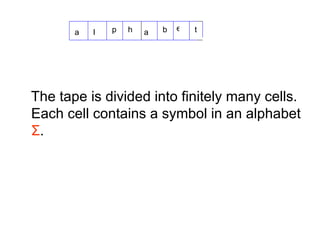
a   l   p   h   a   b   e   t


The tape is divided into finitely many cells.
Each cell contains a symbol in an alphabet
Σ.
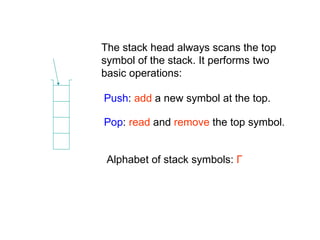
The stack head always scans the top
symbol of the stack. It performs two
basic operations:

Push: add a new symbol at the top.

Pop: read and remove the top symbol.


 Alphabet of stack symbols: Γ
a


• The head scans at a cell on the tape and
  can read a symbol on the cell. In each
  move, the head can move to the right cell.
• The finite control has finitely many states
  which form a set Q. For each move, the
  state is changed according to the
  evaluation of a transition function
                                     Q x (Γ U {ε})
  δ : Q x (Σ U {ε}) x (Γ U {ε}) → 2 .
a                      a


     q       v                  p     u


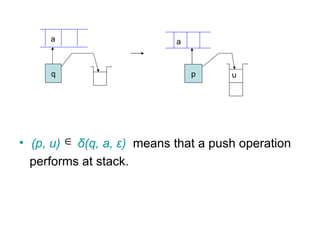
• (p, u) ∈ δ(q, a, v) means that if the tape head
  reads a, the stack head read v, and the finite
  control is in the state q, then one of possible
  moves is that the next state is p, v is replaced
  by u at stack, and the tape head moves one cell
  to the right.
a                         a


     q        v                p       u


• (p, u) ∈ δ(q, ε, v) means that this a ε-move.
a                      a


     q                          p     u


• (p, u) ∈ δ(q, a, ε) means that a push operation
  performs at stack.
a                      a


     q       v                  p


• (p, ε) ∈ δ(q, a, v) means that a pop operation
  performs at stack
s


• There are some special states: an initial
  state s and a final set F of final states.
• Initially, the PDA is in the initial state s and
  the head scans the leftmost cell. The tape
  holds an input string. The stack is empty.
x


              f


• When the head gets off the tape, the PDA
  stops. An input string x is accepted by the
  PDA if the PDA stops at a final state and
  the stack is empty.
• Otherwise, the input string is rejected.
• The PDA can be represented by
        M = (Q, Σ, Γ, δ, s, F)
  where Σ is the alphabet of input symbols
  and Γ is the alphabet of stack symbols.
• The set of all strings accepted by a PDA M
  is denoted by L(M). We also say that the
  language L(M) is accepted by M.
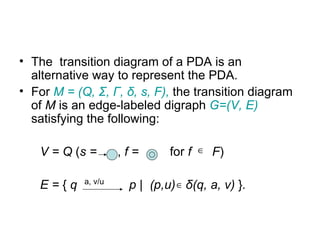
• The transition diagram of a PDA is an
  alternative way to represent the PDA.
• For M = (Q, Σ, Γ, δ, s, F), the transition diagram
  of M is an edge-labeled digraph G=(V, E)
  satisfying the following:

   V = Q (s =        ,f=      for f   ∈   F)

            a, v/u
   E={q               p | (p,u) ∈ δ(q, a, v) }.
Example 1. Construct PDA to accept
                n n
           L= {0 1 | n > 0}

Solution 1.

              1, 0/ε


         0, ε/0        1, 0/ε
Solution 2.

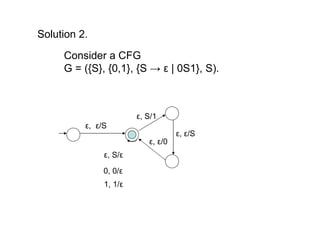
     Consider a CFG
     G = ({S}, {0,1}, {S → ε | 0S1}, S).


                        ε, S/1
          ε, ε/S
                                    ε, ε/S
                           ε, ε/0
               ε, S/ε

               0, 0/ε
               1, 1/ε
Theorem Every CFL can be accepted by a PDA.

Proof.   Consider a CFL L = L(G) for a CFG
         G = (V, Σ, R, S).

                      ε, A/xn     A → x1 x2 …xn in R
           ε, ε/S

                        ε, ε/x1
          a, a/ε for a in Σ

 Theorem
A language L is CFL ⇔ it can be accepted by a PDA.
Sometimes, constructing the PDA is easier than
constructing CFG.
Example 2

Show that {x ∈ {a, b} | #b ( x) ≤ # a ( x) ≤ 2#b ( x)} is a CFL


         Construct a PDA or a CFG?


                     PDA!!!


   Sometimes, constructing the PDA is easier than
   constructing CFG.
Idea
To check if #b ( x) ≤ # a ( x) ≤ 2#b ( x), we need to cancel a with b.
For each b, we need to cancel sometimes one a and sometimes
two a. Do we need to make a deterministic choice at each
cancellation? No, the concept of nondeterministic computation
solves this trouble : As long as a correct choice exists, the input
string x would be accepted!
a                    a


      s                    p   s


• (p, s) ∈ δ(s, ε, ε)


                ε ,ε / s
a                       a


    p                       p   a
             s
                                s
(q, s) ∈ δ(p, a, s)
(p, a) ∈ δ(q, ε, ε)
                 a, s / s

              ε ,ε / a
a                       a


    p                       p   a
             a
                                a
      ∈
(q1, a) δ(p, a, a)
(p, a) ∈ δ(q1, ε, ε)
                 a, a / a

             ε ,ε / a
a                         a


p                         p
    b


                  (p, ε) ∈ δ(p, a, b)

        a,b / ε
a                           a


p                           p       b’
    b


                    (p, b’)∈ δ(p, a, b)

        a, b / b'
a                            a


p                            p
    b’


                    (p, ε) ∈ δ(p, a, b’)

         a,b' / ε
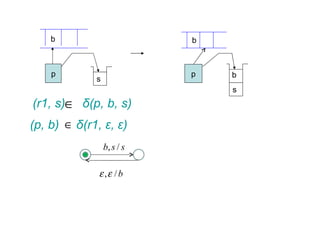
b                       b


    p                       p   b
             s
                                s
(r1, s)∈ δ(p, b, s)
(p, b) ∈ δ(r1, ε, ε)
                 b, s / s

              ε ,ε / b
b                       b


    p                       p   b
             b
                                b
(r2, b)∈ δ(p, b, b)
(p, b) ∈ δ(r2, ε, ε)
                 b, b / b

              ε ,ε / b
b                      b


    p                      p   b
             b’
                               b’
(r3, b’) ∈ δ(p, b, b’)
(p, b) ∈ δ(r3, ε, ε)
              b, b' / b'

              ε ,ε / b
b                          b


p                          p
    a


                   (p, ε) ∈ δ(p, b, a)

        b, a / ε
b                              b


   p                              p
            a
            a


(t, ε) ∈ δ(p, b, a)        (p, ε) ∈ δ(t, ε, a)
                b, a / ε

             ε,a /ε
b                                     b


       p                                    p   b’
                  a
                  z                             z
                           z≠a

(t, ε) ∈ δ(p, b, a) (u, x) ∈ δ(t, ε, x) (p, b’)∈ δ(u, ε, ε)
                      b, a / ε

                                 ε, z / z
             ε ,b' / ε           z≠a
p                         p
    s


                 (p, ε) ∈ δ(p, ε, s)

        ε,s /ε
a,b / ε
                        a, b / b'
                        a,b' / ε
           ε ,ε / s                a, z / z
                                   z ≠ b,b'

                                   ε ,ε / a
                                               ε,s /ε
               b, a / ε
           b, a / ε                b, z / z
                                    z≠a
           ε,a /ε
ε, z / z                            ε ,ε / b
 z≠a                  ε , ε / b'
Example 3
Construct PDA accepting {x ∈ {a, b} | #b ( x) <# a ( x) ≤ 2#b ( x)}.


 Idea

To have #b ( x) <# a ( x), we must have a b which cancel two a ' s.
Let the first b do the job.
a,b / ε
Solution
                                    a, b / b'                 a, z / z
                                   a,b' / ε              1
                                                             z ≠ b,b'
     ε ,ε / s          a, b / b'             a, z / z
                  11                        z ≠ b,b'         ε ,ε / a
  b, a / ε        ε,a /ε
                             ε , ε / b'
                                            ε ,ε / a
              ε, z / z
               z≠a                                             ε,s /ε
                                 b, a / ε
                       b, a / ε              b, z / z
                                              z≠a
                                                             b, z / z
                        ε,a /ε                           1
           ε, z / z                           ε ,ε / b       z≠a
            z≠a                  ε , ε / b'
                                                             ε ,ε / b
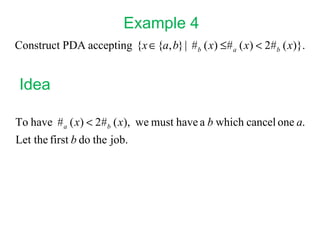
Example 4
Construct PDA accepting {x ∈ {a, b} | #b ( x) ≤# a ( x) < 2#b ( x)}.


 Idea

To have # a ( x) < 2#b ( x), we must have a b which cancel one a.
Let the first b do the job.
a,b / ε
Solution
                          a, b / b'                         a, z / z
                          a,b' / ε                     1
                                                           z ≠ b,b'
   ε ,ε / s      a,b / ε           a, z / z
               1
               1
                                  z ≠ b,b'                 ε ,ε / a
                 b, a / ε
                                   ε ,ε / a
                                                             ε,s /ε
                               b, a / ε
                    b, a / ε                b, z / z
                                            z≠a
                                                           b, z / z
                    ε,a /ε                             1
         ε, z / z                           ε ,ε / b       z≠a
          z≠a                  ε , ε / b'
                                                           ε ,ε / b

pushdown automata

  • 1.
  • 2.
    tape tape head stack head finite stack control
  • 3.
    a l p h a b e t The tape is divided into finitely many cells. Each cell contains a symbol in an alphabet Σ.
  • 4.
    The stack headalways scans the top symbol of the stack. It performs two basic operations: Push: add a new symbol at the top. Pop: read and remove the top symbol. Alphabet of stack symbols: Γ
  • 5.
    a • The headscans at a cell on the tape and can read a symbol on the cell. In each move, the head can move to the right cell.
  • 6.
    • The finitecontrol has finitely many states which form a set Q. For each move, the state is changed according to the evaluation of a transition function Q x (Γ U {ε}) δ : Q x (Σ U {ε}) x (Γ U {ε}) → 2 .
  • 7.
    a a q v p u • (p, u) ∈ δ(q, a, v) means that if the tape head reads a, the stack head read v, and the finite control is in the state q, then one of possible moves is that the next state is p, v is replaced by u at stack, and the tape head moves one cell to the right.
  • 8.
    a a q v p u • (p, u) ∈ δ(q, ε, v) means that this a ε-move.
  • 9.
    a a q p u • (p, u) ∈ δ(q, a, ε) means that a push operation performs at stack.
  • 10.
    a a q v p • (p, ε) ∈ δ(q, a, v) means that a pop operation performs at stack
  • 11.
    s • There aresome special states: an initial state s and a final set F of final states. • Initially, the PDA is in the initial state s and the head scans the leftmost cell. The tape holds an input string. The stack is empty.
  • 12.
    x f • When the head gets off the tape, the PDA stops. An input string x is accepted by the PDA if the PDA stops at a final state and the stack is empty. • Otherwise, the input string is rejected.
  • 13.
    • The PDAcan be represented by M = (Q, Σ, Γ, δ, s, F) where Σ is the alphabet of input symbols and Γ is the alphabet of stack symbols. • The set of all strings accepted by a PDA M is denoted by L(M). We also say that the language L(M) is accepted by M.
  • 14.
    • The transitiondiagram of a PDA is an alternative way to represent the PDA. • For M = (Q, Σ, Γ, δ, s, F), the transition diagram of M is an edge-labeled digraph G=(V, E) satisfying the following: V = Q (s = ,f= for f ∈ F) a, v/u E={q p | (p,u) ∈ δ(q, a, v) }.
  • 15.
    Example 1. ConstructPDA to accept n n L= {0 1 | n > 0} Solution 1. 1, 0/ε 0, ε/0 1, 0/ε
  • 16.
    Solution 2. Consider a CFG G = ({S}, {0,1}, {S → ε | 0S1}, S). ε, S/1 ε, ε/S ε, ε/S ε, ε/0 ε, S/ε 0, 0/ε 1, 1/ε
  • 17.
    Theorem Every CFLcan be accepted by a PDA. Proof. Consider a CFL L = L(G) for a CFG G = (V, Σ, R, S). ε, A/xn A → x1 x2 …xn in R ε, ε/S ε, ε/x1 a, a/ε for a in Σ Theorem A language L is CFL ⇔ it can be accepted by a PDA.
  • 18.
    Sometimes, constructing thePDA is easier than constructing CFG.
  • 19.
    Example 2 Show that{x ∈ {a, b} | #b ( x) ≤ # a ( x) ≤ 2#b ( x)} is a CFL Construct a PDA or a CFG? PDA!!! Sometimes, constructing the PDA is easier than constructing CFG.
  • 20.
    Idea To check if#b ( x) ≤ # a ( x) ≤ 2#b ( x), we need to cancel a with b. For each b, we need to cancel sometimes one a and sometimes two a. Do we need to make a deterministic choice at each cancellation? No, the concept of nondeterministic computation solves this trouble : As long as a correct choice exists, the input string x would be accepted!
  • 21.
    a a s p s • (p, s) ∈ δ(s, ε, ε) ε ,ε / s
  • 22.
    a a p p a s s (q, s) ∈ δ(p, a, s) (p, a) ∈ δ(q, ε, ε) a, s / s ε ,ε / a
  • 23.
    a a p p a a a ∈ (q1, a) δ(p, a, a) (p, a) ∈ δ(q1, ε, ε) a, a / a ε ,ε / a
  • 24.
    a a p p b (p, ε) ∈ δ(p, a, b) a,b / ε
  • 25.
    a a p p b’ b (p, b’)∈ δ(p, a, b) a, b / b'
  • 26.
    a a p p b’ (p, ε) ∈ δ(p, a, b’) a,b' / ε
  • 27.
    b b p p b s s (r1, s)∈ δ(p, b, s) (p, b) ∈ δ(r1, ε, ε) b, s / s ε ,ε / b
  • 28.
    b b p p b b b (r2, b)∈ δ(p, b, b) (p, b) ∈ δ(r2, ε, ε) b, b / b ε ,ε / b
  • 29.
    b b p p b b’ b’ (r3, b’) ∈ δ(p, b, b’) (p, b) ∈ δ(r3, ε, ε) b, b' / b' ε ,ε / b
  • 30.
    b b p p a (p, ε) ∈ δ(p, b, a) b, a / ε
  • 31.
    b b p p a a (t, ε) ∈ δ(p, b, a) (p, ε) ∈ δ(t, ε, a) b, a / ε ε,a /ε
  • 32.
    b b p p b’ a z z z≠a (t, ε) ∈ δ(p, b, a) (u, x) ∈ δ(t, ε, x) (p, b’)∈ δ(u, ε, ε) b, a / ε ε, z / z ε ,b' / ε z≠a
  • 33.
    p p s (p, ε) ∈ δ(p, ε, s) ε,s /ε
  • 34.
    a,b / ε a, b / b' a,b' / ε ε ,ε / s a, z / z z ≠ b,b' ε ,ε / a ε,s /ε b, a / ε b, a / ε b, z / z z≠a ε,a /ε ε, z / z ε ,ε / b z≠a ε , ε / b'
  • 35.
    Example 3 Construct PDAaccepting {x ∈ {a, b} | #b ( x) <# a ( x) ≤ 2#b ( x)}. Idea To have #b ( x) <# a ( x), we must have a b which cancel two a ' s. Let the first b do the job.
  • 36.
    a,b / ε Solution a, b / b' a, z / z a,b' / ε 1 z ≠ b,b' ε ,ε / s a, b / b' a, z / z 11 z ≠ b,b' ε ,ε / a b, a / ε ε,a /ε ε , ε / b' ε ,ε / a ε, z / z z≠a ε,s /ε b, a / ε b, a / ε b, z / z z≠a b, z / z ε,a /ε 1 ε, z / z ε ,ε / b z≠a z≠a ε , ε / b' ε ,ε / b
  • 37.
    Example 4 Construct PDAaccepting {x ∈ {a, b} | #b ( x) ≤# a ( x) < 2#b ( x)}. Idea To have # a ( x) < 2#b ( x), we must have a b which cancel one a. Let the first b do the job.
  • 38.
    a,b / ε Solution a, b / b' a, z / z a,b' / ε 1 z ≠ b,b' ε ,ε / s a,b / ε a, z / z 1 1 z ≠ b,b' ε ,ε / a b, a / ε ε ,ε / a ε,s /ε b, a / ε b, a / ε b, z / z z≠a b, z / z ε,a /ε 1 ε, z / z ε ,ε / b z≠a z≠a ε , ε / b' ε ,ε / b