PREPARED BY
Ms. JASPHINVENCY
NursingTutor
Department of child health nursing
Shri Sathya Sai College of Nursing
Affiliated by Shri BalajiVidyapeeth University- PUDUCHERRY
Lower respiratory tract
infection - Bronchial Asthma
Lower respiratory tract
infection - Bronchial Asthma
DEFINITION
 Bronchial asthma is a chronic disease
manifested by airway inflammation, airway smooth
muscle hyperactivity and reversible airway
obstruction.
 Bronchial asthma is defined as reversible
obstruction of large (more than 2 mm) and small (less
than 2 mm) airways characterized by paroxysmal
attacks of cough, breathlessness, wheeze and chest
tightness.
INCIDENCE
 In 30% of patients the onset is at one year of age
 80-90% of patients will have onset below 4 years
 50% of patients will have complete relief by 8-12
years of age.
Etiology
ENVIRONMENTAL FACTORS
 Infections
 Allergics
 Irritants
 Occupations
 Drugs
 Preservatives
 Foods
 Hormones
 Exercise
 Psychological
RISK FACTORS
 Parental asthma
 Allergy
Atopic dermatitis
Allergic rhinitis
Food allergy
Inhalant allergens sensitization
Food allergen sensitization
RISK FACTORS contd……
 Severe lower respiratory tract infection
Pneumonia
Bronchiolitis requiring hospitalization
Wheezing apart from colds
 Male gender
 Low birth weight
 Environmental tobacco smoke exposure
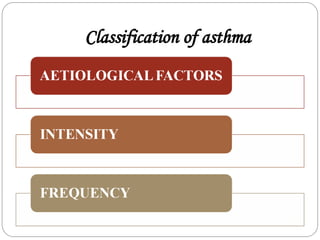
Classification of asthma
AETIOLOGICAL FACTORS
 Extrinsic asthma- allergens are mainly responsible for
asthma
 Intrinsic asthma- infections are the triggering factors
 Combined asthma- both intrinsic and extrinsic
 Occupational asthma- Wood cutter, Tokyo,
Yokohama, Orleans
 Exercise induced asthma
INTENSITY
MILD ASTHMA
 Patients gets three attacks in a year.
 Completely normal in between the attacks. Patients do not
require corticosteroids.
 Patient responds well with oral bronchodilators within 48
hours.
 These patients do not require prolonged bronchodilators
MODERATE ASTHMA
 Attack rates are between 3-10 in a year.
 Frequent exacerbations. In between the attacks the
patient has dyspnoea.
 The patient requires injection epinephrine or
aerosols of Beta 2 agonist at the time of attacks.
 In between the attacks the patient requires
bronchodilators preferably Beta 2 agonists and mast
cell stabilizers.
SEVERE ASTHMA
 These patients gets >10 attacks in a year
 Growth failure is present
 In between attacks patient has moderate dyspnoea
 Requires corticosteroids
FREQUENCY
INFREQUENT EPISODIC ASTHMA
 Commonest type of asthma in 75% of cases
 Attack rate is 3/year
 Duration of each attacks is 5-10 days
 Inbetween the attacks the patient is completely normal
 Incidence is more between 3-12 years
 Treatment is as in mild asthma
FREQUENCY
FREQUENT EPISODIC ASTHMA
 Attack rate is 6/year
 Occasional acute exacerbations are seen
 Incidence is more between 3-12 years
 Treatment as in moderate asthma. 40% cases will have
permanent bronchial asthma
FREQUENCY
CHRONIC ASTHMA
 Incidence is more in boys
 Growth failure
 Chest deformity
 Repeated exacerbations are present which requires
hospitalization. 90% Cases will have permanent
asthma
FREQUENCY
SECRETORY ASTHMA
 Asthma is associated with increased pulmonary secretions,
and mimics that of bronchiectasis
 These patients respond very well to cortiosteroids
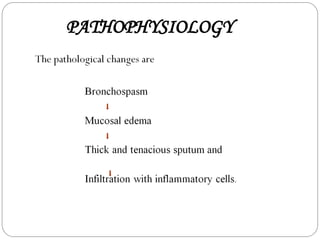
PATHOPHYSIOLOGY
CLINICAL MANIFESTATIONS
Symptoms
 Cough- dry in nature, brings about small amount of frothy sputum,
production of sputum is an encouraging sign of recovery
 Breathlessness
General examination
 Dyspnoea
 Patient is in tripod position
 Cyanosis shows severity of bronchial asthma
 Mental faculties- patient may be depressed or in coma
 Pulse paradoxes may be present in severe asthma
 Working of accessory muscles of respiration indicates moderate to
severe asthma
Examination of respiratory system
 Inspection
 Chest bulging may be present due to emphysematous changes
 Apical impulse is not seen
 Intercostal spaces are widened
 Trachea is short due to elevation of thorax
 Percussion- hyper resonance note is present all over the chest
fields and obliterating the cardiac dullness
Auscultation
 Breath sounds may not be heard properly
 Expiratory wheeze may indicate mild asthma
 Both inspiratory and expiratory wheeze are present
DIAGNOSTIC EVALUATION
HISTORY COLLECTION
 The asthma history focuses on the nature of symptoms,
their pattern, triggering factors, influence on daily
activities and responses to treatment, environment and
family history.
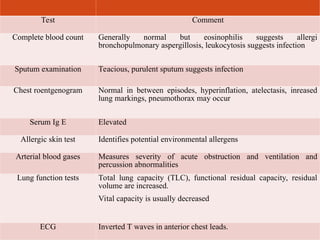
Test Comment
Complete blood count Generally normal but eosinophilis suggests allergi
bronchopulmonary aspergillosis, leukocytosis suggests infection
Sputum examination Teacious, purulent sputum suggests infection
Chest roentgenogram Normal in between episodes, hyperinflation, atelectasis, inreased
lung markings, pneumothorax may occur
Serum Ig E Elevated
Allergic skin test Identifies potential environmental allergens
Arterial blood gases Measures severity of acute obstruction and ventilation and
percussion abnormalities
Lung function tests Total lung capacity (TLC), functional residual capacity, residual
volume are increased.
Vital capacity is usually decreased
ECG Inverted T waves in anterior chest leads.
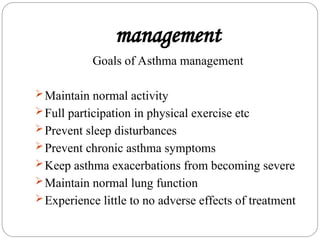
management
Goals of Asthma management
Maintain normal activity
Full participation in physical exercise etc
Prevent sleep disturbances
Prevent chronic asthma symptoms
Keep asthma exacerbations from becoming severe
Maintain normal lung function
Experience little to no adverse effects of treatment
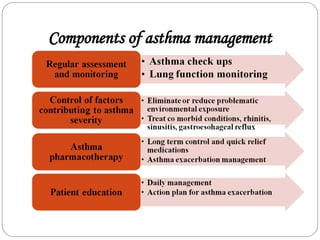
Components of asthma management
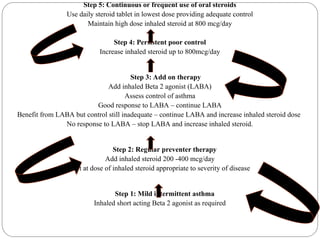
Step 5: Continuous or frequent use of oral steroids
Use daily steroid tablet in lowest dose providing adequate control
Maintain high dose inhaled steroid at 800 mcg/day
Step 4: Persistent poor control
Increase inhaled steroid up to 800mcg/day
Step 3: Add on therapy
Add inhaled Beta 2 agonist (LABA)
Assess control of asthma
Good response to LABA – continue LABA
Benefit from LABA but control still inadequate – continue LABA and increase inhaled steroid dose
No response to LABA – stop LABA and increase inhaled steroid.
Step 2: Regular preventer therapy
Add inhaled steroid 200 -400 mcg/day
Start at dose of inhaled steroid appropriate to severity of disease
Step 1: Mild intermittent asthma
Inhaled short acting Beta 2 agonist as required
NURSING MANAGEMENT
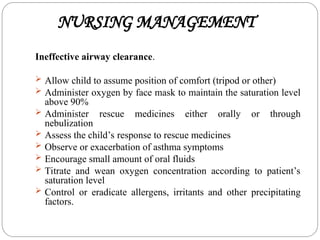
Ineffective airway clearance.
 Allow child to assume position of comfort (tripod or other)
 Administer oxygen by face mask to maintain the saturation level
above 90%
 Administer rescue medicines either orally or through
nebulization
 Assess the child’s response to rescue medicines
 Observe or exacerbation of asthma symptoms
 Encourage small amount of oral fluids
 Titrate and wean oxygen concentration according to patient’s
saturation level
 Control or eradicate allergens, irritants and other precipitating
factors.
 Impaired gas exchange related to increased mucous
secretion and bronchospasm
 Assess the condition of the child to provide proper nursing care
 Check the oxygen saturation and provide oxygen to improve the
saturation above 90%
 Maintain positions provide to postural drainage
 Administer nebulization to facilitate expectoration of the mucus
 Encourage the child to take adequate fluids to maintain hydration
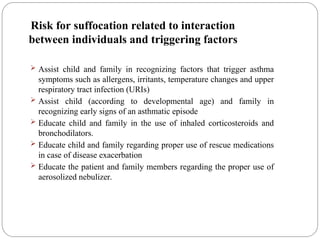
Risk for suffocation related to interaction
between individuals and triggering factors
 Assist child and family in recognizing factors that trigger asthma
symptoms such as allergens, irritants, temperature changes and upper
respiratory tract infection (URIs)
 Assist child (according to developmental age) and family in
recognizing early signs of an asthmatic episode
 Educate child and family in the use of inhaled corticosteroids and
bronchodilators.
 Educate child and family regarding proper use of rescue medications
in case of disease exacerbation
 Educate the patient and family members regarding the proper use of
aerosolized nebulizer.
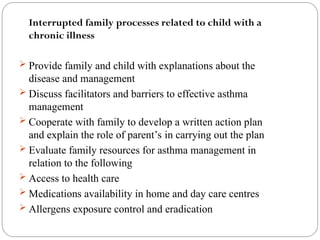
Interrupted family processes related to child with a
chronic illness
 Provide family and child with explanations about the
disease and management
 Discuss facilitators and barriers to effective asthma
management
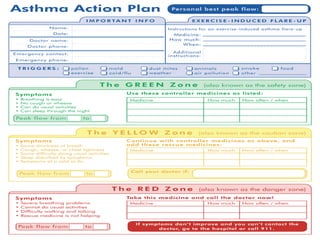
 Cooperate with family to develop a written action plan
and explain the role of parent’s in carrying out the plan
 Evaluate family resources for asthma management in
relation to the following
 Access to health care
 Medications availability in home and day care centres
 Allergens exposure control and eradication
Each child is an adventure into a better life --an
opportunity to change the old pattern and make it
new.

Asthma respiratory disorders in paediatric Nursing

  • 1.
    PREPARED BY Ms. JASPHINVENCY NursingTutor Departmentof child health nursing Shri Sathya Sai College of Nursing Affiliated by Shri BalajiVidyapeeth University- PUDUCHERRY Lower respiratory tract infection - Bronchial Asthma
  • 2.
  • 5.
    DEFINITION  Bronchial asthmais a chronic disease manifested by airway inflammation, airway smooth muscle hyperactivity and reversible airway obstruction.  Bronchial asthma is defined as reversible obstruction of large (more than 2 mm) and small (less than 2 mm) airways characterized by paroxysmal attacks of cough, breathlessness, wheeze and chest tightness.
  • 6.
    INCIDENCE  In 30%of patients the onset is at one year of age  80-90% of patients will have onset below 4 years  50% of patients will have complete relief by 8-12 years of age.
  • 7.
  • 8.
    ENVIRONMENTAL FACTORS  Infections Allergics  Irritants  Occupations  Drugs  Preservatives  Foods  Hormones  Exercise  Psychological
  • 9.
    RISK FACTORS  Parentalasthma  Allergy Atopic dermatitis Allergic rhinitis Food allergy Inhalant allergens sensitization Food allergen sensitization
  • 10.
    RISK FACTORS contd…… Severe lower respiratory tract infection Pneumonia Bronchiolitis requiring hospitalization Wheezing apart from colds  Male gender  Low birth weight  Environmental tobacco smoke exposure
  • 11.
  • 12.
    AETIOLOGICAL FACTORS  Extrinsicasthma- allergens are mainly responsible for asthma  Intrinsic asthma- infections are the triggering factors  Combined asthma- both intrinsic and extrinsic  Occupational asthma- Wood cutter, Tokyo, Yokohama, Orleans  Exercise induced asthma
  • 13.
    INTENSITY MILD ASTHMA  Patientsgets three attacks in a year.  Completely normal in between the attacks. Patients do not require corticosteroids.  Patient responds well with oral bronchodilators within 48 hours.  These patients do not require prolonged bronchodilators
  • 14.
    MODERATE ASTHMA  Attackrates are between 3-10 in a year.  Frequent exacerbations. In between the attacks the patient has dyspnoea.  The patient requires injection epinephrine or aerosols of Beta 2 agonist at the time of attacks.  In between the attacks the patient requires bronchodilators preferably Beta 2 agonists and mast cell stabilizers.
  • 15.
    SEVERE ASTHMA  Thesepatients gets >10 attacks in a year  Growth failure is present  In between attacks patient has moderate dyspnoea  Requires corticosteroids
  • 16.
    FREQUENCY INFREQUENT EPISODIC ASTHMA Commonest type of asthma in 75% of cases  Attack rate is 3/year  Duration of each attacks is 5-10 days  Inbetween the attacks the patient is completely normal  Incidence is more between 3-12 years  Treatment is as in mild asthma
  • 17.
    FREQUENCY FREQUENT EPISODIC ASTHMA Attack rate is 6/year  Occasional acute exacerbations are seen  Incidence is more between 3-12 years  Treatment as in moderate asthma. 40% cases will have permanent bronchial asthma
  • 18.
    FREQUENCY CHRONIC ASTHMA  Incidenceis more in boys  Growth failure  Chest deformity  Repeated exacerbations are present which requires hospitalization. 90% Cases will have permanent asthma
  • 19.
    FREQUENCY SECRETORY ASTHMA  Asthmais associated with increased pulmonary secretions, and mimics that of bronchiectasis  These patients respond very well to cortiosteroids
  • 20.
  • 21.
    CLINICAL MANIFESTATIONS Symptoms  Cough-dry in nature, brings about small amount of frothy sputum, production of sputum is an encouraging sign of recovery  Breathlessness General examination  Dyspnoea  Patient is in tripod position  Cyanosis shows severity of bronchial asthma  Mental faculties- patient may be depressed or in coma  Pulse paradoxes may be present in severe asthma  Working of accessory muscles of respiration indicates moderate to severe asthma
  • 22.
    Examination of respiratorysystem  Inspection  Chest bulging may be present due to emphysematous changes  Apical impulse is not seen  Intercostal spaces are widened  Trachea is short due to elevation of thorax  Percussion- hyper resonance note is present all over the chest fields and obliterating the cardiac dullness Auscultation  Breath sounds may not be heard properly  Expiratory wheeze may indicate mild asthma  Both inspiratory and expiratory wheeze are present
  • 23.
    DIAGNOSTIC EVALUATION HISTORY COLLECTION The asthma history focuses on the nature of symptoms, their pattern, triggering factors, influence on daily activities and responses to treatment, environment and family history.
  • 24.
    Test Comment Complete bloodcount Generally normal but eosinophilis suggests allergi bronchopulmonary aspergillosis, leukocytosis suggests infection Sputum examination Teacious, purulent sputum suggests infection Chest roentgenogram Normal in between episodes, hyperinflation, atelectasis, inreased lung markings, pneumothorax may occur Serum Ig E Elevated Allergic skin test Identifies potential environmental allergens Arterial blood gases Measures severity of acute obstruction and ventilation and percussion abnormalities Lung function tests Total lung capacity (TLC), functional residual capacity, residual volume are increased. Vital capacity is usually decreased ECG Inverted T waves in anterior chest leads.
  • 25.
    management Goals of Asthmamanagement Maintain normal activity Full participation in physical exercise etc Prevent sleep disturbances Prevent chronic asthma symptoms Keep asthma exacerbations from becoming severe Maintain normal lung function Experience little to no adverse effects of treatment
  • 26.
  • 27.
    Step 5: Continuousor frequent use of oral steroids Use daily steroid tablet in lowest dose providing adequate control Maintain high dose inhaled steroid at 800 mcg/day Step 4: Persistent poor control Increase inhaled steroid up to 800mcg/day Step 3: Add on therapy Add inhaled Beta 2 agonist (LABA) Assess control of asthma Good response to LABA – continue LABA Benefit from LABA but control still inadequate – continue LABA and increase inhaled steroid dose No response to LABA – stop LABA and increase inhaled steroid. Step 2: Regular preventer therapy Add inhaled steroid 200 -400 mcg/day Start at dose of inhaled steroid appropriate to severity of disease Step 1: Mild intermittent asthma Inhaled short acting Beta 2 agonist as required
  • 29.
    NURSING MANAGEMENT Ineffective airwayclearance.  Allow child to assume position of comfort (tripod or other)  Administer oxygen by face mask to maintain the saturation level above 90%  Administer rescue medicines either orally or through nebulization  Assess the child’s response to rescue medicines  Observe or exacerbation of asthma symptoms  Encourage small amount of oral fluids  Titrate and wean oxygen concentration according to patient’s saturation level  Control or eradicate allergens, irritants and other precipitating factors.
  • 30.
     Impaired gasexchange related to increased mucous secretion and bronchospasm  Assess the condition of the child to provide proper nursing care  Check the oxygen saturation and provide oxygen to improve the saturation above 90%  Maintain positions provide to postural drainage  Administer nebulization to facilitate expectoration of the mucus  Encourage the child to take adequate fluids to maintain hydration
  • 31.
    Risk for suffocationrelated to interaction between individuals and triggering factors  Assist child and family in recognizing factors that trigger asthma symptoms such as allergens, irritants, temperature changes and upper respiratory tract infection (URIs)  Assist child (according to developmental age) and family in recognizing early signs of an asthmatic episode  Educate child and family in the use of inhaled corticosteroids and bronchodilators.  Educate child and family regarding proper use of rescue medications in case of disease exacerbation  Educate the patient and family members regarding the proper use of aerosolized nebulizer.
  • 32.
    Interrupted family processesrelated to child with a chronic illness  Provide family and child with explanations about the disease and management  Discuss facilitators and barriers to effective asthma management  Cooperate with family to develop a written action plan and explain the role of parent’s in carrying out the plan  Evaluate family resources for asthma management in relation to the following  Access to health care  Medications availability in home and day care centres  Allergens exposure control and eradication
  • 33.
    Each child isan adventure into a better life --an opportunity to change the old pattern and make it new.

Editor's Notes