CARE OF CLIENT WITH
RESPIRATORY INFECTIONS
BY: HASNAH ZANI
101
PNEUMONIA
LUNG ABSCESS
PLEURAL EFFUSION
2
LEARNING OBJECTIVES
1. Define pneumonia, lung abscess, pleural
effusion.
2. State cause, pathophysiology, clinical
manifestations, diagnosis, and treatment of
each condition.
3
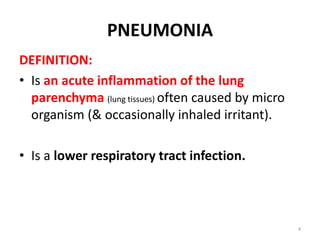
PNEUMONIA
DEFINITION:
• Is an acute inflammation of the lung
parenchyma (lung tissues) often caused by micro
organism (& occasionally inhaled irritant).
• Is a lower respiratory tract infection.
4
PNEUMONIA
5
PNEUMONIA
6
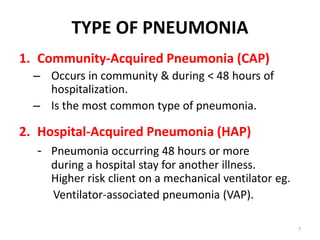
TYPE OF PNEUMONIA
1. Community-Acquired Pneumonia (CAP)
– Occurs in community & during < 48 hours of
hospitalization.
– Is the most common type of pneumonia.
2. Hospital-Acquired Pneumonia (HAP)
- Pneumonia occurring 48 hours or more
during a hospital stay for another illness.
Higher risk client on a mechanical ventilator eg.
Ventilator-associated pneumonia (VAP).
7
CONTD.
3. Health Care-associated Pneumonia (HCP)
– Pneumonia in other health care settings, such as
nursing homes, dialysis centers, and outpatient
clinics.
4. Aspiration Pneumonia
- Due to inhale foreign body, food, drink, vomit, or
saliva from your mouth into lungs that occur in
condition of poor gag reflex eg. Brain injury,
dysphagia, or excessive use of alcohol or drugs.
8
CONTD.
5. Atypical Pneumonia
- Is most commonly caused by mycoplasma.
Legionnaires’ disease or chlamydia and
usually appears in children and young
adults.
6. Hypostatic pneumonia
- Results from the collection of fluid in the dorsal
region of the lungs and occurs especially in those
(as the bedridden or elderly, etc).
9
QUESTION
State 6 types of pneumonia?
ANSWER:
1. …………………………………
2. …………………………………
3. …………………………………
4. …………………………………
5. …………………………………
6. …………………………………
10
CAUSES
1. Infection to the lung
– Virus, bacteria
– Fungi, protozoa (if immunity very low)
• Mode: droplets & airborne (commonest), via
blood stream.
2. Non-infectious
- Aspiration of gastric contents
- Inhalation of toxic / irritant gases.
11
PATHOPHYSIOLOGY
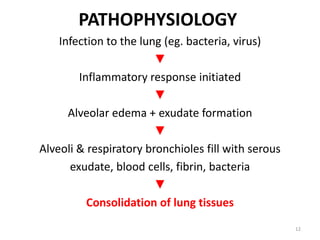
Infection to the lung (eg. bacteria, virus)
▼
Inflammatory response initiated
▼
Alveolar edema + exudate formation
▼
Alveoli & respiratory bronchioles fill with serous
exudate, blood cells, fibrin, bacteria
▼
Consolidation of lung tissues
12
CLINICAL MANIFESTATION
1. Flu-like symptom: malaise with anorexia
2. Sudden feeling of worsening ill health after a
flu.
3. Fever – could be very high.
4. Chills & rigors
5. Prolonged/worsening cough
6. Sputum (containing greenish / yellowish /
blood tinged if bacterial pneumonia)
13
CONTD.
7. Dyspnea
– Pleuritic chest pain (pain when deep breathe or
cough)
– Confusion esp in elderly.
– Anorexia
– Nausea
– Vomiting
– Diarrhea
14
COMPLICATION
1. Pleuritis - inflammation of the pleural.
2. Lung abscess
3. Pleural effusion
4. Empyema - pus in the lung
5. Septicemia – systemic infection
6. Respiratory failure
15
DIAGNOSIS
1. History – s/s of suggestive pneumonia.
2. Abnormal lung sound by auscultation.
3. Chest X Ray
4. Sputum
1. Culture & sensitivity (C&S)
2. Full examination microscopy examination (FEME)
3. Serology
4. Acid fast bacilli (AFB)
16
CONTD.
5. Blood test:
1. Culture & sensitivity
2. Full blood count (raised WBC)
5. Bronchoscopy
6. Thoracentesis
7. CT thorax
17
HEALTH EDUCATION
1. Limit infection spread by:
 Staying at home for first 2-3 days.
 Covering mouth, nose when cough & sneeze.
 Wearing mask if in public.
 Washing hand frequently.
2. Complete antibiotic course if prescribed to
prevent resistance.
3. Drink plenty of water to liquefy & mobilize
secretion.
18
CONTD.
4. Eat balance nutrition diet & plenty of rest to
boost immunity.
 Prevent upper respiratory infection.
 Avoid overcrowding & keep a distance with person
with upper respiratory infection.
19
LUNG ABSCESS
20
LUNG ABCESS
DEFINITION:
• Lung abscess is a localized area of lung
necrosis (destructions) and pus formation.
21
LUNG ABCESS
22
CAUSES
1. Foreign body (eg. Denture, gastric content)
2. Pneumonia
3. Tuberculosis
4. Lung wound
23
PATHOPHYSIOLOGY
Alveoli that are filled with fluid, pus & microbes
become consolidated (solid)
▼
Consolidated tissue becomes necrotic tissue
called abscess
▼
Necrotic process can spread & abscess can rupture to
empty its content into bronchus (or pleural cavity)
▼
Form cavity filled with air & fluid (cavitations)
24
CLINICAL MANIFESTATION
• Occurs after 2 weeks after the precipitating
event.
• Early manifestation – same as pneumonia.
• When abscess rupture:
(a) Large amount foul smelling, purulent, blood
streaked sputum
(b) Abnormal breath sound e.g crackles in the
region of the abscess.
(c) Chest percussion – dull tone
25
DIAGNOSIS
1. Chest X Ray
2. Sputum culture & sensitivity
3. Bronchoscopy
26
TREATMENT
1. Antibiotic IV
2. Postural drainage to promote drainage from
the lungs.
3. Bronchoscopy (if indicated)
(a) Drainage of abscess
(b) Resection
4. Chest tube insertion (if pleural space
involved)
27
COMPLICATION
1. Pleurisy
– Inflammation of the pleura.
2. Septicemia if not treated
- Systemic infection caused by multiplication of
microorganisms in circulating blood.
28
PLEURAL
EFFUSION
29
PLEURAL EFFUSION
DEFINITION:
• Is a collection of excess fluid in the pleural
space.
• Note: Large pleural effusion compresses
adjacent lung tissue, thus, impair lung
expansion.
30
PLEURAL EFFUSION
31
CAUSES
1. Transudative pleural effusions.
– Caused by fluid leaking into the pleural space.
– This is caused by elevated pressure in, or low
protein content in, the blood vessels.
– Congestive heart failure is the most common
cause.
32
CONTD.
2.Exudative pleural effusions.
- Result from leaky blood vessels caused by
inflammation (irritation and swelling) of the
pleura.
- This is often caused by lung disease eg. Lung
cancer, lung infections (TB, pneumonia, drug
reactions)
33
PATHOPHYSIOLOGY
Aspiration of gastric content or bacteria enter the lung
▼
Inflammatory response
▼
Cavity extend to bronchus
▼
Abscess become encapsulated
▼
Tissues necrotize
▼
Increase production of sputum
▼
Purulent sputum
34
CLINICAL MANIFESTATION
1. Dyspnea
2. Chest pain
3. Auscultation – dull tone
4. Limited chest movement
5. Fever & malaise (infection)
6. CXR – pleural effusion
35
DIAGNOSIS
1. Chest X Ray
2. Pleural fluid analysis (look for bacteria,
amount of protein, cancerous cell)
3. Sputum culture & sensitivity
4. Bronchoscopy
5. Thoracentesis (a sample of fluid is removed
with a needle inserted between the ribs)
6. Thoracic CT
7. Ultrasound of the chest
36
TREATMENT
1. Chest drainage
2. Thoracentesis
3. Antibiotic (if infection)
4. Chemotherapy (if cancer)
5. Radiation therapy
37
38

pneumonia

  • 1.
    CARE OF CLIENTWITH RESPIRATORY INFECTIONS BY: HASNAH ZANI 101
  • 2.
  • 3.
    LEARNING OBJECTIVES 1. Definepneumonia, lung abscess, pleural effusion. 2. State cause, pathophysiology, clinical manifestations, diagnosis, and treatment of each condition. 3
  • 4.
    PNEUMONIA DEFINITION: • Is anacute inflammation of the lung parenchyma (lung tissues) often caused by micro organism (& occasionally inhaled irritant). • Is a lower respiratory tract infection. 4
  • 5.
  • 6.
  • 7.
    TYPE OF PNEUMONIA 1.Community-Acquired Pneumonia (CAP) – Occurs in community & during < 48 hours of hospitalization. – Is the most common type of pneumonia. 2. Hospital-Acquired Pneumonia (HAP) - Pneumonia occurring 48 hours or more during a hospital stay for another illness. Higher risk client on a mechanical ventilator eg. Ventilator-associated pneumonia (VAP). 7
  • 8.
    CONTD. 3. Health Care-associatedPneumonia (HCP) – Pneumonia in other health care settings, such as nursing homes, dialysis centers, and outpatient clinics. 4. Aspiration Pneumonia - Due to inhale foreign body, food, drink, vomit, or saliva from your mouth into lungs that occur in condition of poor gag reflex eg. Brain injury, dysphagia, or excessive use of alcohol or drugs. 8
  • 9.
    CONTD. 5. Atypical Pneumonia -Is most commonly caused by mycoplasma. Legionnaires’ disease or chlamydia and usually appears in children and young adults. 6. Hypostatic pneumonia - Results from the collection of fluid in the dorsal region of the lungs and occurs especially in those (as the bedridden or elderly, etc). 9
  • 10.
    QUESTION State 6 typesof pneumonia? ANSWER: 1. ………………………………… 2. ………………………………… 3. ………………………………… 4. ………………………………… 5. ………………………………… 6. ………………………………… 10
  • 11.
    CAUSES 1. Infection tothe lung – Virus, bacteria – Fungi, protozoa (if immunity very low) • Mode: droplets & airborne (commonest), via blood stream. 2. Non-infectious - Aspiration of gastric contents - Inhalation of toxic / irritant gases. 11
  • 12.
    PATHOPHYSIOLOGY Infection to thelung (eg. bacteria, virus) ▼ Inflammatory response initiated ▼ Alveolar edema + exudate formation ▼ Alveoli & respiratory bronchioles fill with serous exudate, blood cells, fibrin, bacteria ▼ Consolidation of lung tissues 12
  • 13.
    CLINICAL MANIFESTATION 1. Flu-likesymptom: malaise with anorexia 2. Sudden feeling of worsening ill health after a flu. 3. Fever – could be very high. 4. Chills & rigors 5. Prolonged/worsening cough 6. Sputum (containing greenish / yellowish / blood tinged if bacterial pneumonia) 13
  • 14.
    CONTD. 7. Dyspnea – Pleuriticchest pain (pain when deep breathe or cough) – Confusion esp in elderly. – Anorexia – Nausea – Vomiting – Diarrhea 14
  • 15.
    COMPLICATION 1. Pleuritis -inflammation of the pleural. 2. Lung abscess 3. Pleural effusion 4. Empyema - pus in the lung 5. Septicemia – systemic infection 6. Respiratory failure 15
  • 16.
    DIAGNOSIS 1. History –s/s of suggestive pneumonia. 2. Abnormal lung sound by auscultation. 3. Chest X Ray 4. Sputum 1. Culture & sensitivity (C&S) 2. Full examination microscopy examination (FEME) 3. Serology 4. Acid fast bacilli (AFB) 16
  • 17.
    CONTD. 5. Blood test: 1.Culture & sensitivity 2. Full blood count (raised WBC) 5. Bronchoscopy 6. Thoracentesis 7. CT thorax 17
  • 18.
    HEALTH EDUCATION 1. Limitinfection spread by:  Staying at home for first 2-3 days.  Covering mouth, nose when cough & sneeze.  Wearing mask if in public.  Washing hand frequently. 2. Complete antibiotic course if prescribed to prevent resistance. 3. Drink plenty of water to liquefy & mobilize secretion. 18
  • 19.
    CONTD. 4. Eat balancenutrition diet & plenty of rest to boost immunity.  Prevent upper respiratory infection.  Avoid overcrowding & keep a distance with person with upper respiratory infection. 19
  • 20.
  • 21.
    LUNG ABCESS DEFINITION: • Lungabscess is a localized area of lung necrosis (destructions) and pus formation. 21
  • 22.
  • 23.
    CAUSES 1. Foreign body(eg. Denture, gastric content) 2. Pneumonia 3. Tuberculosis 4. Lung wound 23
  • 24.
    PATHOPHYSIOLOGY Alveoli that arefilled with fluid, pus & microbes become consolidated (solid) ▼ Consolidated tissue becomes necrotic tissue called abscess ▼ Necrotic process can spread & abscess can rupture to empty its content into bronchus (or pleural cavity) ▼ Form cavity filled with air & fluid (cavitations) 24
  • 25.
    CLINICAL MANIFESTATION • Occursafter 2 weeks after the precipitating event. • Early manifestation – same as pneumonia. • When abscess rupture: (a) Large amount foul smelling, purulent, blood streaked sputum (b) Abnormal breath sound e.g crackles in the region of the abscess. (c) Chest percussion – dull tone 25
  • 26.
    DIAGNOSIS 1. Chest XRay 2. Sputum culture & sensitivity 3. Bronchoscopy 26
  • 27.
    TREATMENT 1. Antibiotic IV 2.Postural drainage to promote drainage from the lungs. 3. Bronchoscopy (if indicated) (a) Drainage of abscess (b) Resection 4. Chest tube insertion (if pleural space involved) 27
  • 28.
    COMPLICATION 1. Pleurisy – Inflammationof the pleura. 2. Septicemia if not treated - Systemic infection caused by multiplication of microorganisms in circulating blood. 28
  • 29.
  • 30.
    PLEURAL EFFUSION DEFINITION: • Isa collection of excess fluid in the pleural space. • Note: Large pleural effusion compresses adjacent lung tissue, thus, impair lung expansion. 30
  • 31.
  • 32.
    CAUSES 1. Transudative pleuraleffusions. – Caused by fluid leaking into the pleural space. – This is caused by elevated pressure in, or low protein content in, the blood vessels. – Congestive heart failure is the most common cause. 32
  • 33.
    CONTD. 2.Exudative pleural effusions. -Result from leaky blood vessels caused by inflammation (irritation and swelling) of the pleura. - This is often caused by lung disease eg. Lung cancer, lung infections (TB, pneumonia, drug reactions) 33
  • 34.
    PATHOPHYSIOLOGY Aspiration of gastriccontent or bacteria enter the lung ▼ Inflammatory response ▼ Cavity extend to bronchus ▼ Abscess become encapsulated ▼ Tissues necrotize ▼ Increase production of sputum ▼ Purulent sputum 34
  • 35.
    CLINICAL MANIFESTATION 1. Dyspnea 2.Chest pain 3. Auscultation – dull tone 4. Limited chest movement 5. Fever & malaise (infection) 6. CXR – pleural effusion 35
  • 36.
    DIAGNOSIS 1. Chest XRay 2. Pleural fluid analysis (look for bacteria, amount of protein, cancerous cell) 3. Sputum culture & sensitivity 4. Bronchoscopy 5. Thoracentesis (a sample of fluid is removed with a needle inserted between the ribs) 6. Thoracic CT 7. Ultrasound of the chest 36
  • 37.
    TREATMENT 1. Chest drainage 2.Thoracentesis 3. Antibiotic (if infection) 4. Chemotherapy (if cancer) 5. Radiation therapy 37
  • 38.