ASTHMA
                                                             MEDICAL MANAGEMENT

                                                                           IDEAL
      The goal is to allow the person with asthma to live a normal life

DIAGNOSTIC EVALUATION
Patients with asthma commonly show these abnormalities in their test results:
    Pulmonary function tests
           signs of airway obstruction (decreased peak expiratory flow rates and forced expiratory volume in 1 second)
           low-normal or decreased vital capacity
           increased total lung and residual capacity
           may be normal between attacks
           >12% increase over baseline in forced expiratory volume in first second of exhalation (FEV1) following inhalation of bronchodilator.
           Peak flow > 20% variability between AM and PM measurements
    Pulse oximetry
           decreased arterial oxygen saturation (SaO2)
    Arterial blood gas (ABG) analysis
           provides the best indication of the severity of an attack
           in acutely severe asthma, the partial pressure of arterial oxygen (PaO 2) is less than 60 mm Hg, the partial pressure of arterial carbon
               dioxide (PaCO2) is 40 mm Hg or more, and pH is usually decreased
    Complete blood count with differential
           increased eosinophil count
    Laboratory
           increased levels of IgE may be seen in atopic asthma
    Bronchial methacholine challenge
           demonstrates airway hyperreactivity by the inhalation of a cholinergic agent in serial concentrations delivered by nebulization
           a positive response is indicated by a 20% decrease in FEV1 from baseline
    Skin testing
 to identify causative allergens
      Chest X-rays
          hyperinflation with areas of focal atelectasis
          to exclude other lung diseases in new onset asthma in adult

Before initiating tests for asthma, rule out other causes of airway obstruction and wheezing.
In children, such causes include cystic fibrosis, tumors of the bronchi or mediastinum, and acute viral bronchitis; in adults, other causes include
obstructive pulmonary disease, heart failure, and epiglottitis.

TREATMENT
   Aims to decrease bronchoconstriction, reduce bronchial airway edema, and increase pulmonary ventilation.
   After an acute episode, treatment focuses on avoiding or removing precipitating factors, such as environmental allergens or irritants
   Desensitization
          If a specific antigen is causing the asthma, the patient may be desensitized through a series of injections of limited amounts of that
            antigen.
          Aims to curb his immune response to the antigen
   Antibiotic
          Prescribed if an infection is causing the asthma
   Drug Therapy
          most effective when begun soon after the onset of symptoms
          For relief of symptoms in adults and children older than age 5, a short-acting, inhaled beta2-adrenergic agonist for bronchodilation
            may be used, and a course of systemic corticosteroids may be needed.
          The goal of therapy is to control the asthma with minimal or no adverse reactions to the medication.
   Acute attacks that don't respond to treatment may require hospital care, an inhaled or S.C. beta2-adrenergic agonist (in three doses over 60
    to 90 minutes) and, possibly, oxygen for hypoxemia.
   If the patient responds poorly, a systemic corticosteroid and, possibly, S.C. epinephrine may help.
   Beta2-adrenergic agonist inhalation continues hourly.
   I.V. aminophylline may be added to the regimen, and I.V. fluid therapy is started.
   Mechanical ventilation
          May be required for patients who doesn't respond to treatment, whose airways remain obstructed, and who has increasing respiratory
            difficulty is at risk for status asthmaticus
   Treatment of status asthmaticus consists of aggressive drug therapy:
           beta2-adrenergic agonist by nebulizer every 30 to 60 minutes
           S.C. epinephrine
           I.V. corticosteroid
           I.V. aminophylline
           oxygen administration
           I.V. fluid therapy, and intubation
           Mechanical ventilation for hypercapnic respiratory failure (PaCO2 of 40 mm Hg or more).

Quick-relief Medications
   Short-acting bronchodilators by inhalation
   Beta-agonists, such as albuterol (Proventil, Ventolin), pirbuterol (Maxair), and levalbuterol (Xopenex)
   Anticholinergic agent ipratropium bromide (Atrovent)
   Systemic corticosteroids (short course)

Long-term Controllers
   Inhaled corticosteroids, such as triamcinolone (Azmacort), beclomethasone (Vanceril, Beclovent, QVAR), fluticasone (Flovent), budesonide
      (Pulmicort), flunisolide (AeroBid)
   Long-acting inhaled beta-agonists include salmeterol (Serevent) and formoterol (Foradil)
   Combination inhalers, such as fluticasone and salmeterol (Advair)
   Leukotriene modifiers, such as montelukast (Singulair), zafirlukast (Accolate)
   Inhaled mast cell stabilizers include cromolyn sodium (Intal) and nedocromil (Tilade)
   Long-acting oral beta-agonists such as albuterol extended-release tablets [Volmax])
   Oral corticosteroids (maintenance dose)
   Methylxanthines such as theophylline (Theo-24, Uniphyl, Theo-Dur)
   IgE blocker (omalizumab [Xolair]) can be added to standard maintenance therapy to reduce exacerbations
         o subcutaneous injection every 2 to 4 weeks
         o The most common adverse reactions are injection site reactions and viral infection

Other Measures
    Environmental control
   Immunotherapy
      Avoidance of foods that contain tartrazine (yellow dye no. 5) in aspirin-sensitive patients.
      Exercise
            Regular aerobic exercise should be encouraged.
      Use of an inhaled beta-adrenergic agonist or cromolyn taken 15 to 20 minutes before exercise will decrease exercise-induced
       bronchospasm.
      Antibiotics are prescribed only during acute exacerbations if signs and symptoms of bacterial infection are present.
      Alternative and complementary therapies have been suggested for acute and chronic asthma control
            Acupuncture
            herbal preparations
            yoga
            chiropractic treatment
            none is a substitute for usual medical treatment


References:
                                            th
        Asthma Management Handbook 6 Edition. National Asthma Council Australia: 2006.
                                                                               th
        Baum, Gerald L. Baum’s Textbook of Pulmonary Diseases Practice, 7 Edition. Lippincott Williams & Wilkins Publishers: 2003.
                                                                                          th
        McCann, J. A., et al. Diseases: A Nursing Process Approach to Excellent Care, 4 Edition. Lippincott Williams & Wilkins: 2006.
                                                                                                  th
        Nettina, Sandra M., Mills, Elizabeth Jacqueline. Lippincott Manual of Nursing Practice, 8 Edition. Lippincott Williams & Wilkins: 2006.
        Smeltzer, C.S., Bare, B.G., Hinkle, J.L., Cheever, K.H., Brunner and Suddarth’s Textbook of Medical-Surgical Nursing 11th Ed. United States of America: Lippincott
            Williams and Wilkins, 2008.
                                                                                                                   rd
        Sommers, M. S., Johnson, S. A., Beery, T. A. Diseases and Disorders: A Nursing Therapeutics Manual, 3 Edition. F. A. Davis Company: 2007.
NURSING MANAGEMENT

                                                                   IDEAL
NURSING ASSESSMENT
   Review patient's record: ask about coughing, dyspnea, chest tightness, wheezing, exertional changes, and increased mucous production
   Observe the patient and assess the rate, depth, and character of respirations, especially on expiration; observe for hyperinflation.
        Assess peak flow
   Auscultate the chest for breath sounds or wheezing
   Assess for triggers of asthma that include the following:
       o Allergens
       o Respiratory infections
       o Inhalation of irritating substances (dust, fumes, gases)
       o Environmental factors (weather, air pollution, and humidity)
       o Exercise, particularly in cold weather
       o Aspirin and its derivatives
       o Sulfite-containing agents used as food preservatives
       o Emotional factors
   After acute episode subsides, attempt to determine patient's degree of adherence with medications/management regimen
   Observe inhalation technique

NURSING DIAGNOSES (PRIORITIZED)
   Ineffective airway clearance
   Ineffective breathing pattern
   Impaired gas exchange
   Fear
   Anxiety
   Deficient knowledge (treatment regimen)

KEY OUTCOMES
   The patient will:
        maintain a patent airway
 maintain adequate ventilation and oxygenation
           maintain a respiratory rate within five breaths of baseline
           express feelings of comfort, either verbally or through behavior
           Verbalize concerns and fears related to his condition.
      The patient and family will:
           indicate verbally or through demonstration that they understand how to administer medications and comply with the treatment
               regimen

NURSING INTERVENTIONS

During an acute attack, proceed as follows:
   First, assess the severity of asthma.
   Administer the prescribed treatments and assess the patient's response.
   Place the patient in high Fowler's position.
           Encourage pursed-lip and diaphragmatic breathing.
           Help patient to relax.
   Administer prescribed humidified oxygen by nasal cannula at 2 L/minute to ease breathing and to increase SaO 2.
           Later, adjust oxygen according to the patient's vital signs and ABG levels.
   Anticipate intubation and mechanical ventilation if the patient fails to maintain adequate oxygenation.
   Monitor serum theophylline levels to make sure they're in the therapeutic range.
           Observe patient for signs and symptoms of theophylline toxicity (vomiting, diarrhea, and headache), as well as for signs of
             subtherapeutic dosage (respiratory distress and increased wheezing).
   Observe the frequency and severity of patient's cough, and note whether it's productive.
           Auscultate lungs, noting adventitious or absent breath sounds.
           If cough is unproductive and rhonchi are present, teach effective coughing techniques.
           If the patient can tolerate postural drainage and chest percussion, perform these procedures to clear secretions.
           Suction an intubated patient as needed.
   Treat dehydration with I.V. fluids until the patient can tolerate oral fluids, which will help loosen secretions.
   If conservative treatment fails to improve the airway obstruction, anticipate bronchoscopy or bronchial lavage when a lobe or larger area
      collapses.
During long-term care
   Monitor the patient's respiratory status
          to detect baseline changes
          to assess response to treatment
          to prevent or detect complications
   Auscultate the lungs frequently, noting the degree of wheezing and quality of air movement.
   Review ABG levels, pulmonary function test results, and SaO 2 readings.
   If the patient is taking a systemic corticosteroid, observe for complications, such as an elevated blood glucose level and friable skin and
      bruising.
   Cushingoid effects resulting from long-term use of a corticosteroid may be minimized by alternate-day dosing or use of a prescribed inhaled
      corticosteroid.
   If the patient is taking an inhaled corticosteroid, watch for signs of candidal infection in the mouth and pharynx.
          Using an extender device and rinsing the mouth afterward may prevent this.
   Observe the patient's anxiety level.
          Measures to reduce hypoxemia and breathlessness should help relieve anxiety.
   Keep the room temperature comfortable, and use an air conditioner or a fan in hot, humid weather.
   Control exercise-induced asthma by instructing the patient to use a bronchodilator or cromolyn 30 minutes before exercise.
          Instruct pt to use pursed-lip breathing while exercising.

Community and Home Care Considerations
   Initiate peak flow monitoring as ordered by health care provider.
          This may be done twice daily by the patient with persistent asthma.
          Provide written and verbal instruction and have the patient demonstrate the procedure.
   Once optimal asthma control is obtained, daily peak flow measurements in the early morning and early afternoon should be used during a 2-
    to 3-week period to determine the patient's personal best.
          The personal best peak flow measurement will be used to monitor control and to guide self-therapy in an individualized action plan.
   Provide written and verbal instruction on an action plan for self-management of asthma exacerbation as outlined by the health care provider.

PATIENT EDUCATION AND HEALTH MAINTENANCE
   Provide information on the nature of asthma and methods of treatment.
   Teach the patient and his family to avoid known a llergens and irritants.
   Teach the patient about his medications, including proper dosages, administration instructions, and adverse effects.
   Provide information regarding medications, including the difference between long-term controllers and quick relief medications and the
    proper use of inhalers and spacer devices
          Stress avoiding overuse of inhalers and nebulizers.
          Ensure that patient understands that long-acting bronchodilating inhalers such as salmeterol are not effective for asthma
             exacerbations.
   Teach the patient how to use a metered-dose inhaler and nebulization equipment.
          If he has difficulty using an inhaler, he may need an extender device to optimize drug delivery and lower the risk of candidal infection
             with an orally inhaled corticosteroid.
   Help patient to identify what triggers asthma, warning signs of an impending attack, and strategies for preventing and treating an attack.
   Teach adaptive breathing techniques and breathing exercises such as pursed-lip breathing.
   If the patient has moderate to severe asthma, explain how to use a peak flow meter to measure the degree of airway obstruction.
          Tell him to keep a record of peak flow readings and to bring it to medical appointments.
          Explain the importance of calling the physician at once if the peak flow drops suddenly (this may signal severe respiratory problems).
   Discuss environmental control.
         o Avoid people with respiratory infections.
         o Avoid substances and situations known to precipitate bronchospasm, such as allergens, irritants, strong odors, gases, fumes, and
            smoke.
         o Wear a mask if cold weather precipitates bronchospasm.
         o Stay inside when air pollution is high.
   Tell the patient to notify the physician if he develops a fever above 100°F (37.8°C), chest pain, shortness of breath without coughing or
    exercising, or uncontrollable coughing.
   Teach the patient diaphragmatic and pursed-lip breathing as well as effective coughing techniques.
   Promote optimal health practices, including nutrition, rest, and exercise.
         o Encourage regular exercise to improve cardiorespiratory and musculoskeletal conditioning.
         o Drink at least 3 qt (3 L) of fluids daily to help loosen secretions and maintain hydration.
         o Try to avoid upsetting situations.
         o Use relaxation techniques, biofeedback management.
         o Use community resources for smoking cessation classes, stress management, exercises for relaxation, asthma support groups, etc.
   Make sure that patient knows with whom to follow up and the frequency of follow-up.
          Discuss with patient how to overcome any barriers to follow-up, such as transportation, limited office or clinic hours, child care, and
work requirements.

EVALUATION: EXPECTED OUTCOMES
   Symptoms (wheezing, coughing, chest tightness) reduced; peak flow improved
   Verbalizes relief of anxiety

References:
                                                                                          th
        McCann, J. A., et al. Diseases: A Nursing Process Approach to Excellent Care, 4 Edition. Lippincott Williams & Wilkins: 2006.
                                                                                                  th
        Nettina, Sandra M., Mills, Elizabeth Jacqueline. Lippincott Manual of Nursing Practice, 8 Edition. Lippincott Williams & Wilkins: 2006.
        Smeltzer, C.S., Bare, B.G., Hinkle, J.L., Cheever, K.H., Brunner and Suddarth’s Textbook of Medical-Surgical Nursing 11th Ed. United States of America: Lippincott
            Williams and Wilkins, 2008.
                                                                                                                   rd
        Sommers, M. S., Johnson, S. A., Beery, T. A. Diseases and Disorders: A Nursing Therapeutics Manual, 3 Edition. F. A. Davis Company: 2007.

Asthma medical, nursing managements

  • 1.
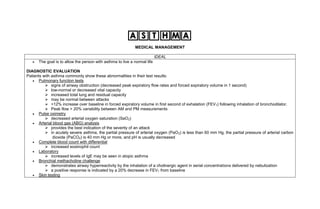
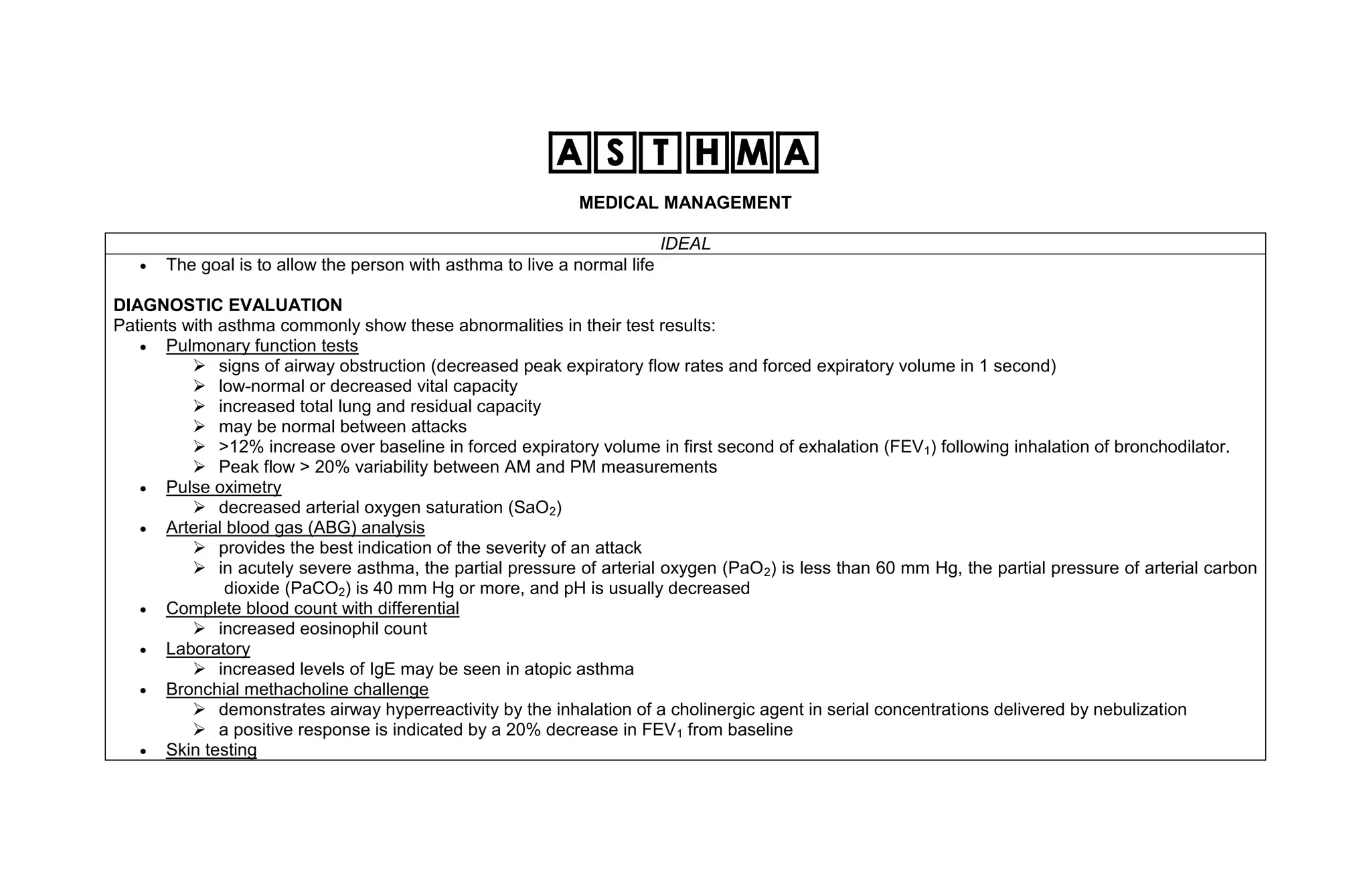
    ASTHMA MEDICAL MANAGEMENT IDEAL  The goal is to allow the person with asthma to live a normal life DIAGNOSTIC EVALUATION Patients with asthma commonly show these abnormalities in their test results:  Pulmonary function tests  signs of airway obstruction (decreased peak expiratory flow rates and forced expiratory volume in 1 second)  low-normal or decreased vital capacity  increased total lung and residual capacity  may be normal between attacks  >12% increase over baseline in forced expiratory volume in first second of exhalation (FEV1) following inhalation of bronchodilator.  Peak flow > 20% variability between AM and PM measurements  Pulse oximetry  decreased arterial oxygen saturation (SaO2)  Arterial blood gas (ABG) analysis  provides the best indication of the severity of an attack  in acutely severe asthma, the partial pressure of arterial oxygen (PaO 2) is less than 60 mm Hg, the partial pressure of arterial carbon dioxide (PaCO2) is 40 mm Hg or more, and pH is usually decreased  Complete blood count with differential  increased eosinophil count  Laboratory  increased levels of IgE may be seen in atopic asthma  Bronchial methacholine challenge  demonstrates airway hyperreactivity by the inhalation of a cholinergic agent in serial concentrations delivered by nebulization  a positive response is indicated by a 20% decrease in FEV1 from baseline  Skin testing
  • 2.
     to identifycausative allergens  Chest X-rays  hyperinflation with areas of focal atelectasis  to exclude other lung diseases in new onset asthma in adult Before initiating tests for asthma, rule out other causes of airway obstruction and wheezing. In children, such causes include cystic fibrosis, tumors of the bronchi or mediastinum, and acute viral bronchitis; in adults, other causes include obstructive pulmonary disease, heart failure, and epiglottitis. TREATMENT  Aims to decrease bronchoconstriction, reduce bronchial airway edema, and increase pulmonary ventilation.  After an acute episode, treatment focuses on avoiding or removing precipitating factors, such as environmental allergens or irritants  Desensitization  If a specific antigen is causing the asthma, the patient may be desensitized through a series of injections of limited amounts of that antigen.  Aims to curb his immune response to the antigen  Antibiotic  Prescribed if an infection is causing the asthma  Drug Therapy  most effective when begun soon after the onset of symptoms  For relief of symptoms in adults and children older than age 5, a short-acting, inhaled beta2-adrenergic agonist for bronchodilation may be used, and a course of systemic corticosteroids may be needed.  The goal of therapy is to control the asthma with minimal or no adverse reactions to the medication.  Acute attacks that don't respond to treatment may require hospital care, an inhaled or S.C. beta2-adrenergic agonist (in three doses over 60 to 90 minutes) and, possibly, oxygen for hypoxemia.  If the patient responds poorly, a systemic corticosteroid and, possibly, S.C. epinephrine may help.  Beta2-adrenergic agonist inhalation continues hourly.  I.V. aminophylline may be added to the regimen, and I.V. fluid therapy is started.  Mechanical ventilation  May be required for patients who doesn't respond to treatment, whose airways remain obstructed, and who has increasing respiratory difficulty is at risk for status asthmaticus
  • 3.
    Treatment of status asthmaticus consists of aggressive drug therapy:  beta2-adrenergic agonist by nebulizer every 30 to 60 minutes  S.C. epinephrine  I.V. corticosteroid  I.V. aminophylline  oxygen administration  I.V. fluid therapy, and intubation  Mechanical ventilation for hypercapnic respiratory failure (PaCO2 of 40 mm Hg or more). Quick-relief Medications  Short-acting bronchodilators by inhalation  Beta-agonists, such as albuterol (Proventil, Ventolin), pirbuterol (Maxair), and levalbuterol (Xopenex)  Anticholinergic agent ipratropium bromide (Atrovent)  Systemic corticosteroids (short course) Long-term Controllers  Inhaled corticosteroids, such as triamcinolone (Azmacort), beclomethasone (Vanceril, Beclovent, QVAR), fluticasone (Flovent), budesonide (Pulmicort), flunisolide (AeroBid)  Long-acting inhaled beta-agonists include salmeterol (Serevent) and formoterol (Foradil)  Combination inhalers, such as fluticasone and salmeterol (Advair)  Leukotriene modifiers, such as montelukast (Singulair), zafirlukast (Accolate)  Inhaled mast cell stabilizers include cromolyn sodium (Intal) and nedocromil (Tilade)  Long-acting oral beta-agonists such as albuterol extended-release tablets [Volmax])  Oral corticosteroids (maintenance dose)  Methylxanthines such as theophylline (Theo-24, Uniphyl, Theo-Dur)  IgE blocker (omalizumab [Xolair]) can be added to standard maintenance therapy to reduce exacerbations o subcutaneous injection every 2 to 4 weeks o The most common adverse reactions are injection site reactions and viral infection Other Measures  Environmental control
  • 4.
    Immunotherapy  Avoidance of foods that contain tartrazine (yellow dye no. 5) in aspirin-sensitive patients.  Exercise  Regular aerobic exercise should be encouraged.  Use of an inhaled beta-adrenergic agonist or cromolyn taken 15 to 20 minutes before exercise will decrease exercise-induced bronchospasm.  Antibiotics are prescribed only during acute exacerbations if signs and symptoms of bacterial infection are present.  Alternative and complementary therapies have been suggested for acute and chronic asthma control  Acupuncture  herbal preparations  yoga  chiropractic treatment  none is a substitute for usual medical treatment References: th  Asthma Management Handbook 6 Edition. National Asthma Council Australia: 2006. th  Baum, Gerald L. Baum’s Textbook of Pulmonary Diseases Practice, 7 Edition. Lippincott Williams & Wilkins Publishers: 2003. th  McCann, J. A., et al. Diseases: A Nursing Process Approach to Excellent Care, 4 Edition. Lippincott Williams & Wilkins: 2006. th  Nettina, Sandra M., Mills, Elizabeth Jacqueline. Lippincott Manual of Nursing Practice, 8 Edition. Lippincott Williams & Wilkins: 2006.  Smeltzer, C.S., Bare, B.G., Hinkle, J.L., Cheever, K.H., Brunner and Suddarth’s Textbook of Medical-Surgical Nursing 11th Ed. United States of America: Lippincott Williams and Wilkins, 2008. rd  Sommers, M. S., Johnson, S. A., Beery, T. A. Diseases and Disorders: A Nursing Therapeutics Manual, 3 Edition. F. A. Davis Company: 2007.
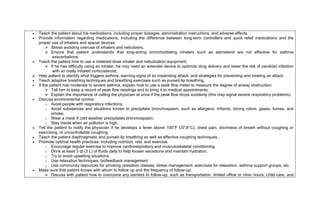
  • 5.
    NURSING MANAGEMENT IDEAL NURSING ASSESSMENT  Review patient's record: ask about coughing, dyspnea, chest tightness, wheezing, exertional changes, and increased mucous production  Observe the patient and assess the rate, depth, and character of respirations, especially on expiration; observe for hyperinflation.  Assess peak flow  Auscultate the chest for breath sounds or wheezing  Assess for triggers of asthma that include the following: o Allergens o Respiratory infections o Inhalation of irritating substances (dust, fumes, gases) o Environmental factors (weather, air pollution, and humidity) o Exercise, particularly in cold weather o Aspirin and its derivatives o Sulfite-containing agents used as food preservatives o Emotional factors  After acute episode subsides, attempt to determine patient's degree of adherence with medications/management regimen  Observe inhalation technique NURSING DIAGNOSES (PRIORITIZED)  Ineffective airway clearance  Ineffective breathing pattern  Impaired gas exchange  Fear  Anxiety  Deficient knowledge (treatment regimen) KEY OUTCOMES  The patient will:  maintain a patent airway
  • 6.
     maintain adequateventilation and oxygenation  maintain a respiratory rate within five breaths of baseline  express feelings of comfort, either verbally or through behavior  Verbalize concerns and fears related to his condition.  The patient and family will:  indicate verbally or through demonstration that they understand how to administer medications and comply with the treatment regimen NURSING INTERVENTIONS During an acute attack, proceed as follows:  First, assess the severity of asthma.  Administer the prescribed treatments and assess the patient's response.  Place the patient in high Fowler's position.  Encourage pursed-lip and diaphragmatic breathing.  Help patient to relax.  Administer prescribed humidified oxygen by nasal cannula at 2 L/minute to ease breathing and to increase SaO 2.  Later, adjust oxygen according to the patient's vital signs and ABG levels.  Anticipate intubation and mechanical ventilation if the patient fails to maintain adequate oxygenation.  Monitor serum theophylline levels to make sure they're in the therapeutic range.  Observe patient for signs and symptoms of theophylline toxicity (vomiting, diarrhea, and headache), as well as for signs of subtherapeutic dosage (respiratory distress and increased wheezing).  Observe the frequency and severity of patient's cough, and note whether it's productive.  Auscultate lungs, noting adventitious or absent breath sounds.  If cough is unproductive and rhonchi are present, teach effective coughing techniques.  If the patient can tolerate postural drainage and chest percussion, perform these procedures to clear secretions.  Suction an intubated patient as needed.  Treat dehydration with I.V. fluids until the patient can tolerate oral fluids, which will help loosen secretions.  If conservative treatment fails to improve the airway obstruction, anticipate bronchoscopy or bronchial lavage when a lobe or larger area collapses.
  • 7.
    During long-term care  Monitor the patient's respiratory status  to detect baseline changes  to assess response to treatment  to prevent or detect complications  Auscultate the lungs frequently, noting the degree of wheezing and quality of air movement.  Review ABG levels, pulmonary function test results, and SaO 2 readings.  If the patient is taking a systemic corticosteroid, observe for complications, such as an elevated blood glucose level and friable skin and bruising.  Cushingoid effects resulting from long-term use of a corticosteroid may be minimized by alternate-day dosing or use of a prescribed inhaled corticosteroid.  If the patient is taking an inhaled corticosteroid, watch for signs of candidal infection in the mouth and pharynx.  Using an extender device and rinsing the mouth afterward may prevent this.  Observe the patient's anxiety level.  Measures to reduce hypoxemia and breathlessness should help relieve anxiety.  Keep the room temperature comfortable, and use an air conditioner or a fan in hot, humid weather.  Control exercise-induced asthma by instructing the patient to use a bronchodilator or cromolyn 30 minutes before exercise.  Instruct pt to use pursed-lip breathing while exercising. Community and Home Care Considerations  Initiate peak flow monitoring as ordered by health care provider.  This may be done twice daily by the patient with persistent asthma.  Provide written and verbal instruction and have the patient demonstrate the procedure.  Once optimal asthma control is obtained, daily peak flow measurements in the early morning and early afternoon should be used during a 2- to 3-week period to determine the patient's personal best.  The personal best peak flow measurement will be used to monitor control and to guide self-therapy in an individualized action plan.  Provide written and verbal instruction on an action plan for self-management of asthma exacerbation as outlined by the health care provider. PATIENT EDUCATION AND HEALTH MAINTENANCE  Provide information on the nature of asthma and methods of treatment.  Teach the patient and his family to avoid known a llergens and irritants.
  • 8.
    Teach the patient about his medications, including proper dosages, administration instructions, and adverse effects.  Provide information regarding medications, including the difference between long-term controllers and quick relief medications and the proper use of inhalers and spacer devices  Stress avoiding overuse of inhalers and nebulizers.  Ensure that patient understands that long-acting bronchodilating inhalers such as salmeterol are not effective for asthma exacerbations.  Teach the patient how to use a metered-dose inhaler and nebulization equipment.  If he has difficulty using an inhaler, he may need an extender device to optimize drug delivery and lower the risk of candidal infection with an orally inhaled corticosteroid.  Help patient to identify what triggers asthma, warning signs of an impending attack, and strategies for preventing and treating an attack.  Teach adaptive breathing techniques and breathing exercises such as pursed-lip breathing.  If the patient has moderate to severe asthma, explain how to use a peak flow meter to measure the degree of airway obstruction.  Tell him to keep a record of peak flow readings and to bring it to medical appointments.  Explain the importance of calling the physician at once if the peak flow drops suddenly (this may signal severe respiratory problems).  Discuss environmental control. o Avoid people with respiratory infections. o Avoid substances and situations known to precipitate bronchospasm, such as allergens, irritants, strong odors, gases, fumes, and smoke. o Wear a mask if cold weather precipitates bronchospasm. o Stay inside when air pollution is high.  Tell the patient to notify the physician if he develops a fever above 100°F (37.8°C), chest pain, shortness of breath without coughing or exercising, or uncontrollable coughing.  Teach the patient diaphragmatic and pursed-lip breathing as well as effective coughing techniques.  Promote optimal health practices, including nutrition, rest, and exercise. o Encourage regular exercise to improve cardiorespiratory and musculoskeletal conditioning. o Drink at least 3 qt (3 L) of fluids daily to help loosen secretions and maintain hydration. o Try to avoid upsetting situations. o Use relaxation techniques, biofeedback management. o Use community resources for smoking cessation classes, stress management, exercises for relaxation, asthma support groups, etc.  Make sure that patient knows with whom to follow up and the frequency of follow-up.  Discuss with patient how to overcome any barriers to follow-up, such as transportation, limited office or clinic hours, child care, and
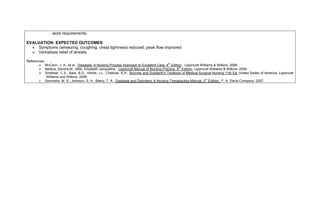
  • 9.
    work requirements. EVALUATION: EXPECTEDOUTCOMES  Symptoms (wheezing, coughing, chest tightness) reduced; peak flow improved  Verbalizes relief of anxiety References: th  McCann, J. A., et al. Diseases: A Nursing Process Approach to Excellent Care, 4 Edition. Lippincott Williams & Wilkins: 2006. th  Nettina, Sandra M., Mills, Elizabeth Jacqueline. Lippincott Manual of Nursing Practice, 8 Edition. Lippincott Williams & Wilkins: 2006.  Smeltzer, C.S., Bare, B.G., Hinkle, J.L., Cheever, K.H., Brunner and Suddarth’s Textbook of Medical-Surgical Nursing 11th Ed. United States of America: Lippincott Williams and Wilkins, 2008. rd  Sommers, M. S., Johnson, S. A., Beery, T. A. Diseases and Disorders: A Nursing Therapeutics Manual, 3 Edition. F. A. Davis Company: 2007.