The Rolls-Royce Trent Engine 5 October  2000 Michael Cervenka  Technical Assistant to Director - Engineering & Technology
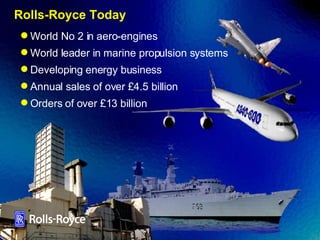
Rolls-Royce Today World No 2 in aero-engines World leader in marine propulsion systems Developing energy business Annual sales of over £4.5 billion Orders of over £13 billion
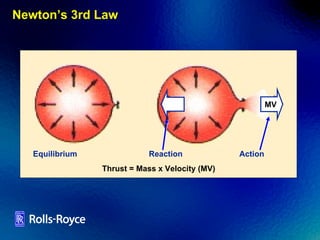
Newton’s 3rd Law Thrust = Mass x Velocity (MV) MV Equilibrium Reaction Action
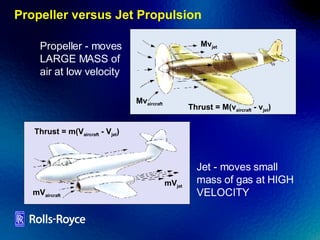
Propeller versus Jet Propulsion Propeller - moves LARGE MASS of air at low velocity Jet - moves small mass of gas at HIGH VELOCITY Mv aircraft mV jet Thrust = M(v aircraft  - v jet ) mV aircraft Thrust = m(V aircraft  - V jet ) Mv jet
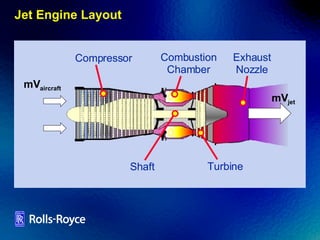
Jet Engine Layout Compressor Combustion Chamber Turbine Shaft Exhaust Nozzle mV aircraft mV jet
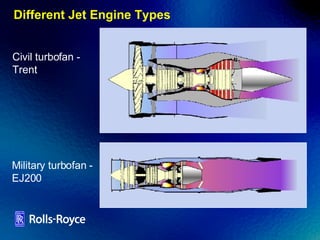
Different Jet Engine Types Civil turbofan -  Trent Military turbofan - EJ200
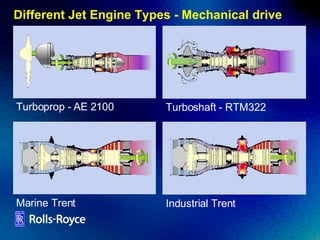
Different Jet Engine Types - Mechanical drive Turboprop - AE 2100 Turboshaft - RTM322 Marine Trent Industrial Trent
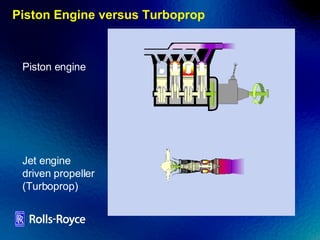
Piston Engine versus Turboprop Piston engine Jet engine driven propeller (Turboprop) Air intake Air intake Compression Combustion Exhaust Exhaust Intermittent Continuous
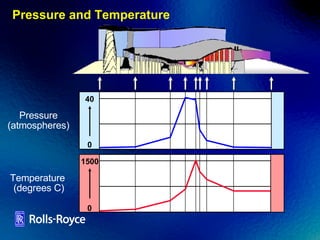
Pressure and Temperature Pressure (atmospheres) 0 40 Temperature  (degrees C) 0 1500
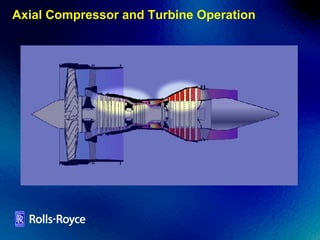
Axial Compressor and Turbine Operation
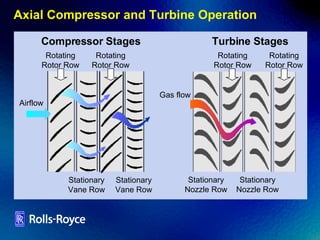
Axial Compressor and Turbine Operation Stationary Nozzle Row Turbine Stages  Gas flow Compressor Stages  Stationary Vane Row Rotating Rotor Row Rotating Rotor Row Stationary Vane Row Airflow Rotating Rotor Row Rotating Rotor Row Stationary Nozzle Row
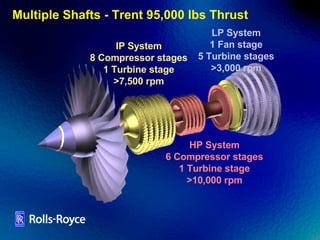
Multiple Shafts - Trent 95,000 lbs Thrust HP System 6 Compressor stages 1 Turbine stage >10,000 rpm IP System 8 Compressor stages 1 Turbine stage >7,500 rpm LP System 1 Fan stage 5 Turbine stages >3,000 rpm
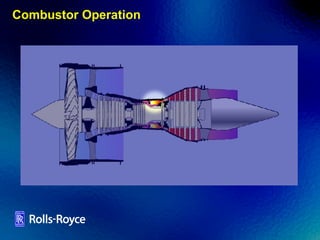
Combustor Operation
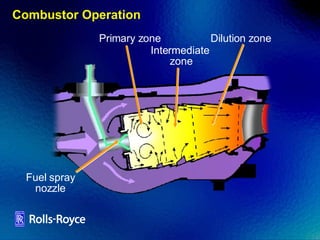
Combustor Operation Primary zone Intermediate  zone Dilution zone Fuel spray nozzle
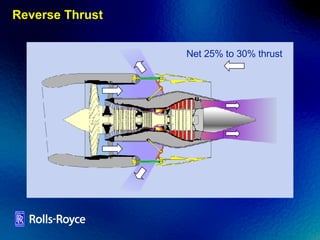
Reverse Thrust 85% thrust 15% thrust Net 25% to 30% thrust
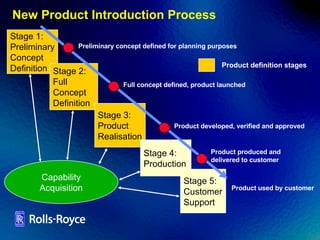
New Product Introduction Process Stage 1:  Preliminary Concept Definition Stage 2: Full Concept Definition Stage 3: Product Realisation Stage 4: Production Stage 5: Customer Support Capability Acquisition Product definition stages Preliminary concept defined for planning purposes Full concept defined, product launched Product developed, verified and approved Product produced and  delivered to customer Product used by customer
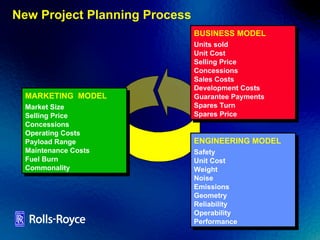
New Project Planning Process BUSINESS MODEL Units sold  Unit Cost Selling Price Concessions Sales Costs Development Costs Guarantee Payments Spares Turn Spares Price ENGINEERING MODEL Safety Unit Cost Weight Noise Emissions Geometry Reliability Operability Performance MARKETING  MODEL Market Size Selling Price Concessions Operating Costs Payload Range Maintenance Costs Fuel Burn Commonality
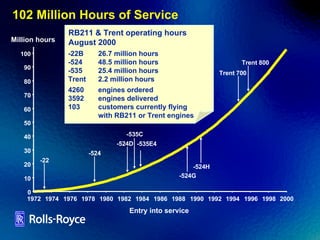
102 Million Hours of Service RB211 & Trent operating hours   August 2000 -22B  26.7 million hours  -524  48.5 million hours   -535  25.4 million hours   Trent  2.2 million hours 4260  engines ordered  3592  engines delivered  103  customers currently flying  with RB211 or Trent engines Million hours 10 20 30 40 50 60 70 80 90 100 1972 1974 1976 1978 1980 1982 1984 1986 1988 1990 1992 1994 1996 1998 Entry into service -22 0 -524 -524D -535C -535E4 -524G -524H Trent 700 Trent 800 2000
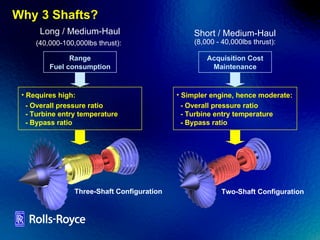
Why 3 Shafts? Short / Medium-Haul (8,000 - 40,000lbs thrust): Long / Medium-Haul (40,000-100,000lbs thrust):   Acquisition Cost Maintenance Simpler engine, hence moderate: - Overall pressure ratio - Turbine entry temperature - Bypass ratio Two-Shaft Configuration Three-Shaft Configuration Requires high: - Overall pressure ratio - Turbine entry temperature - Bypass ratio  Range Fuel consumption
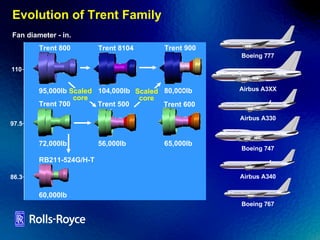
Evolution of Trent Family Fan diameter - in. 110 97.5 86.3 Trent 800 Trent 8104 Trent 900 Trent 700 Trent 500 Trent 600 RB211-524G/H-T 60,000lb 72,000lb 95,000lb 104,000lb 56,000lb 65,000lb 80,000lb Scaled core Scaled core Boeing 777 Airbus A3XX Airbus A330 Airbus A340 Boeing 767 Boeing 747
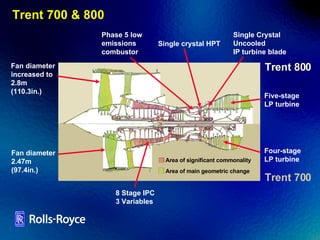
Trent 700 & 800 Trent 700 Trent 800 Area of significant commonality Area of main geometric change Fan diameter increased to  2.8m  (110.3in.) Five-stage LP turbine Single crystal HPT Single Crystal Uncooled IP turbine blade Fan diameter 2.47m  (97.4in.) Four-stage LP turbine Phase 5 low emissions combustor 8 Stage IPC 3 Variables
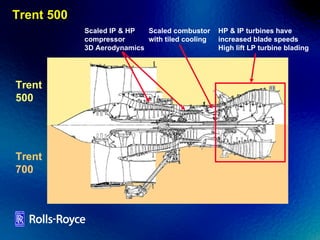
Trent 500 Trent  500 Trent  700 Scaled IP & HP  compressor 3D Aerodynamics Scaled combustor  with tiled cooling HP & IP turbines have  increased blade speeds High lift LP turbine blading
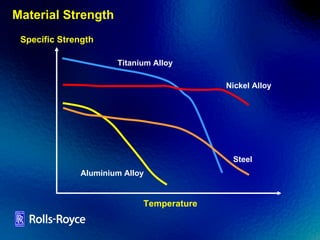
Material Strength Specific Strength Nickel Alloy Steel Aluminium Alloy Titanium Alloy Temperature
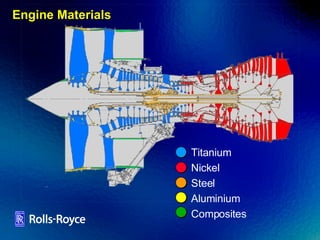
Engine Materials Titanium Nickel Steel Aluminium Composites
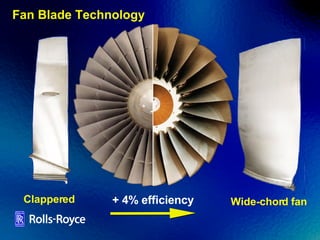
Fan Blade Technology + 4% efficiency Clappered Wide-chord fan
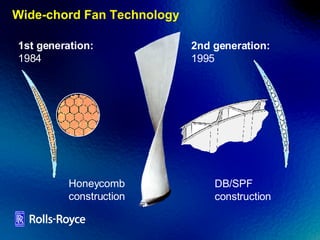
Wide-chord Fan Technology Honeycomb construction 1st generation: 1984 2nd generation: 1995 DB/SPF construction
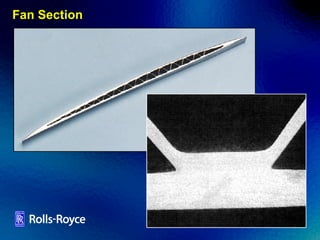
Fan Section
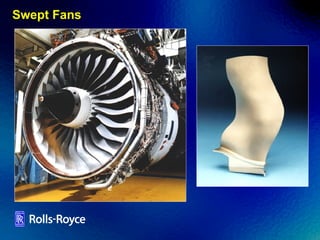
Swept Fans
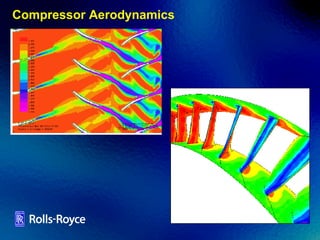
Compressor Aerodynamics
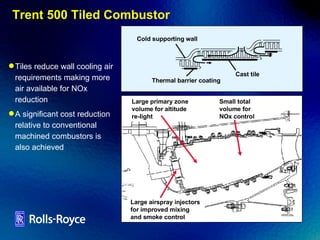
Trent 500 Tiled Combustor Tiles reduce wall cooling air requirements making more air available for NOx reduction A significant cost reduction relative to conventional machined combustors is also achieved Large airspray injectors  for improved mixing  and smoke control Large primary zone  volume for altitude  re-light Small total  volume for  NOx control Cold supporting wall Cast tile Thermal barrier coating
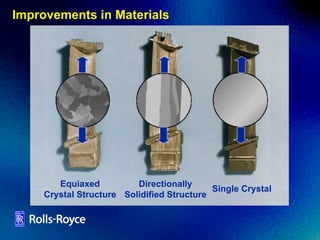
Improvements in Materials Equiaxed Crystal Structure Directionally Solidified Structure Single Crystal
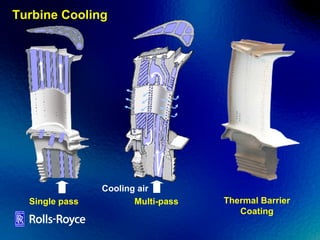
Turbine Cooling Multi-pass Cooling air Thermal Barrier Coating Single pass
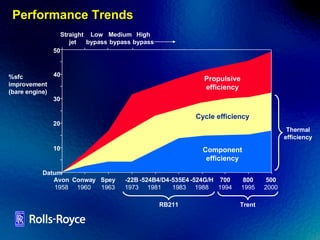
Performance Trends Straight  jet Low bypass Medium bypass High bypass %sfc improvement (bare engine) 50 40 30 20 10 Datum Avon 1958 Conway 1960 Spey 1963 -22B 1973 -524B4/D4 1981 -535E4 1983 -524G/H 1988 700 1994 800 1995 500 2000 Propulsive efficiency Component efficiency Cycle efficiency Thermal efficiency RB211 Trent
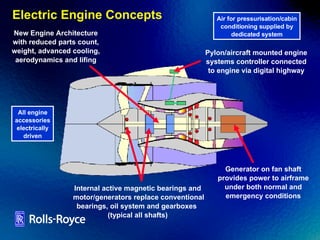
Electric Engine Concepts Air for pressurisation/cabin conditioning supplied by dedicated system All engine accessories electrically driven Generator on fan shaft provides power to airframe under both normal and emergency conditions Internal active magnetic bearings and motor/generators replace conventional bearings, oil system and gearboxes  (typical all shafts) Pylon/aircraft mounted engine systems controller connected to engine via digital highway New Engine Architecture with reduced parts count, weight, advanced cooling, aerodynamics and lifing
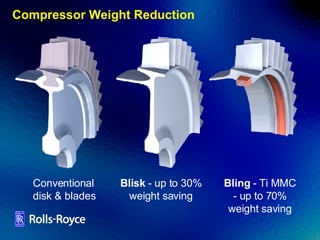
Compressor Weight Reduction Conventional disk & blades Blisk  - up to 30% weight saving Bling  - Ti MMC - up to 70% weight saving
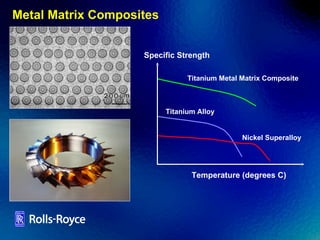
Metal Matrix Composites Titanium Metal Matrix Composite Titanium Alloy Nickel Superalloy Specific Strength Temperature (degrees C)
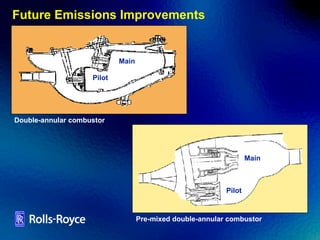
Future Emissions Improvements Pre-mixed double-annular combustor Double-annular combustor Pilot Main Pilot Main
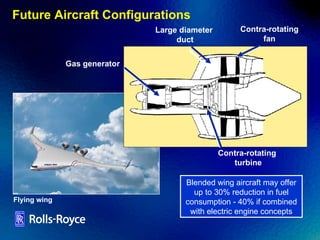
Future Aircraft Configurations Blended wing aircraft may offer up to 30% reduction in fuel consumption - 40% if combined with electric engine concepts Flying wing Large diameter  duct Gas generator Contra-rotating  turbine Contra-rotating fan
Conclusion The three-shaft concept is now recognised as a world leader Customer-focused competitive technology is critical to its success Success is a tribute to many generations of people The RB211 & Trent family has a long and secure future
Rolls-Royce

Trent

  • 1.
    The Rolls-Royce TrentEngine 5 October 2000 Michael Cervenka Technical Assistant to Director - Engineering & Technology
  • 2.
    Rolls-Royce Today WorldNo 2 in aero-engines World leader in marine propulsion systems Developing energy business Annual sales of over £4.5 billion Orders of over £13 billion
  • 3.
    Newton’s 3rd LawThrust = Mass x Velocity (MV) MV Equilibrium Reaction Action
  • 4.
    Propeller versus JetPropulsion Propeller - moves LARGE MASS of air at low velocity Jet - moves small mass of gas at HIGH VELOCITY Mv aircraft mV jet Thrust = M(v aircraft - v jet ) mV aircraft Thrust = m(V aircraft - V jet ) Mv jet
  • 5.
    Jet Engine LayoutCompressor Combustion Chamber Turbine Shaft Exhaust Nozzle mV aircraft mV jet
  • 6.
    Different Jet EngineTypes Civil turbofan - Trent Military turbofan - EJ200
  • 7.
    Different Jet EngineTypes - Mechanical drive Turboprop - AE 2100 Turboshaft - RTM322 Marine Trent Industrial Trent
  • 8.
    Piston Engine versusTurboprop Piston engine Jet engine driven propeller (Turboprop) Air intake Air intake Compression Combustion Exhaust Exhaust Intermittent Continuous
  • 9.
    Pressure and TemperaturePressure (atmospheres) 0 40 Temperature (degrees C) 0 1500
  • 10.
    Axial Compressor andTurbine Operation
  • 11.
    Axial Compressor andTurbine Operation Stationary Nozzle Row Turbine Stages Gas flow Compressor Stages Stationary Vane Row Rotating Rotor Row Rotating Rotor Row Stationary Vane Row Airflow Rotating Rotor Row Rotating Rotor Row Stationary Nozzle Row
  • 12.
    Multiple Shafts -Trent 95,000 lbs Thrust HP System 6 Compressor stages 1 Turbine stage >10,000 rpm IP System 8 Compressor stages 1 Turbine stage >7,500 rpm LP System 1 Fan stage 5 Turbine stages >3,000 rpm
  • 13.
  • 14.
    Combustor Operation Primaryzone Intermediate zone Dilution zone Fuel spray nozzle
  • 15.
    Reverse Thrust 85%thrust 15% thrust Net 25% to 30% thrust
  • 16.
    New Product IntroductionProcess Stage 1: Preliminary Concept Definition Stage 2: Full Concept Definition Stage 3: Product Realisation Stage 4: Production Stage 5: Customer Support Capability Acquisition Product definition stages Preliminary concept defined for planning purposes Full concept defined, product launched Product developed, verified and approved Product produced and delivered to customer Product used by customer
  • 17.
    New Project PlanningProcess BUSINESS MODEL Units sold Unit Cost Selling Price Concessions Sales Costs Development Costs Guarantee Payments Spares Turn Spares Price ENGINEERING MODEL Safety Unit Cost Weight Noise Emissions Geometry Reliability Operability Performance MARKETING MODEL Market Size Selling Price Concessions Operating Costs Payload Range Maintenance Costs Fuel Burn Commonality
  • 18.
    102 Million Hoursof Service RB211 & Trent operating hours August 2000 -22B 26.7 million hours -524 48.5 million hours -535 25.4 million hours Trent 2.2 million hours 4260 engines ordered 3592 engines delivered 103 customers currently flying with RB211 or Trent engines Million hours 10 20 30 40 50 60 70 80 90 100 1972 1974 1976 1978 1980 1982 1984 1986 1988 1990 1992 1994 1996 1998 Entry into service -22 0 -524 -524D -535C -535E4 -524G -524H Trent 700 Trent 800 2000
  • 19.
    Why 3 Shafts?Short / Medium-Haul (8,000 - 40,000lbs thrust): Long / Medium-Haul (40,000-100,000lbs thrust): Acquisition Cost Maintenance Simpler engine, hence moderate: - Overall pressure ratio - Turbine entry temperature - Bypass ratio Two-Shaft Configuration Three-Shaft Configuration Requires high: - Overall pressure ratio - Turbine entry temperature - Bypass ratio Range Fuel consumption
  • 20.
    Evolution of TrentFamily Fan diameter - in. 110 97.5 86.3 Trent 800 Trent 8104 Trent 900 Trent 700 Trent 500 Trent 600 RB211-524G/H-T 60,000lb 72,000lb 95,000lb 104,000lb 56,000lb 65,000lb 80,000lb Scaled core Scaled core Boeing 777 Airbus A3XX Airbus A330 Airbus A340 Boeing 767 Boeing 747
  • 21.
    Trent 700 &800 Trent 700 Trent 800 Area of significant commonality Area of main geometric change Fan diameter increased to 2.8m (110.3in.) Five-stage LP turbine Single crystal HPT Single Crystal Uncooled IP turbine blade Fan diameter 2.47m (97.4in.) Four-stage LP turbine Phase 5 low emissions combustor 8 Stage IPC 3 Variables
  • 22.
    Trent 500 Trent 500 Trent 700 Scaled IP & HP compressor 3D Aerodynamics Scaled combustor with tiled cooling HP & IP turbines have increased blade speeds High lift LP turbine blading
  • 23.
    Material Strength SpecificStrength Nickel Alloy Steel Aluminium Alloy Titanium Alloy Temperature
  • 24.
    Engine Materials TitaniumNickel Steel Aluminium Composites
  • 25.
    Fan Blade Technology+ 4% efficiency Clappered Wide-chord fan
  • 26.
    Wide-chord Fan TechnologyHoneycomb construction 1st generation: 1984 2nd generation: 1995 DB/SPF construction
  • 27.
  • 28.
  • 29.
  • 30.
    Trent 500 TiledCombustor Tiles reduce wall cooling air requirements making more air available for NOx reduction A significant cost reduction relative to conventional machined combustors is also achieved Large airspray injectors for improved mixing and smoke control Large primary zone volume for altitude re-light Small total volume for NOx control Cold supporting wall Cast tile Thermal barrier coating
  • 31.
    Improvements in MaterialsEquiaxed Crystal Structure Directionally Solidified Structure Single Crystal
  • 32.
    Turbine Cooling Multi-passCooling air Thermal Barrier Coating Single pass
  • 33.
    Performance Trends Straight jet Low bypass Medium bypass High bypass %sfc improvement (bare engine) 50 40 30 20 10 Datum Avon 1958 Conway 1960 Spey 1963 -22B 1973 -524B4/D4 1981 -535E4 1983 -524G/H 1988 700 1994 800 1995 500 2000 Propulsive efficiency Component efficiency Cycle efficiency Thermal efficiency RB211 Trent
  • 34.
    Electric Engine ConceptsAir for pressurisation/cabin conditioning supplied by dedicated system All engine accessories electrically driven Generator on fan shaft provides power to airframe under both normal and emergency conditions Internal active magnetic bearings and motor/generators replace conventional bearings, oil system and gearboxes (typical all shafts) Pylon/aircraft mounted engine systems controller connected to engine via digital highway New Engine Architecture with reduced parts count, weight, advanced cooling, aerodynamics and lifing
  • 35.
    Compressor Weight ReductionConventional disk & blades Blisk - up to 30% weight saving Bling - Ti MMC - up to 70% weight saving
  • 36.
    Metal Matrix CompositesTitanium Metal Matrix Composite Titanium Alloy Nickel Superalloy Specific Strength Temperature (degrees C)
  • 37.
    Future Emissions ImprovementsPre-mixed double-annular combustor Double-annular combustor Pilot Main Pilot Main
  • 38.
    Future Aircraft ConfigurationsBlended wing aircraft may offer up to 30% reduction in fuel consumption - 40% if combined with electric engine concepts Flying wing Large diameter duct Gas generator Contra-rotating turbine Contra-rotating fan
  • 39.
    Conclusion The three-shaftconcept is now recognised as a world leader Customer-focused competitive technology is critical to its success Success is a tribute to many generations of people The RB211 & Trent family has a long and secure future
  • 40.