Downloaded 20 times


![N.Kanthavelkumaran, Dr.P.Seenikannan / International Journal of Engineering Research and
Applications (IJERA) ISSN: 2248-9622 www.ijera.com
Vol. 2, Issue 6, November- December 2012, pp.197-203
Table 4, Lubricity Results (HFRR Machine) 10. Biodiesel is prepared at temperatures of range
Fuel Type Scar Friction
Film 35°C to 60°C and at atmospheric pressure. So
% the process is not at all energy intensive and
Conventional low sulphur diesel 492 0.24 32 that’s why the manufacturing cost is so less.
Blend (80% petrodiesel + 20%
193 0.13 93 11. Biodiesel can be stored in tanks where
Biodiesel) conventional diesel is stored.
Blend (70% petrodiesel + 30%
Biodiesel)
206 0.13 93 12. If the washing is carried using H3PO4 and the
Petrodiesel + 1000 ppm lubricity catalyst used in manufacturing process is KOH
192 0.13 82
additive then the wash liquid can prove to be an
Petrodiesel + 500 ppm lubricity excellent fertilizer this will help to reduce
215 0.14 94
additive
price of Biodiesel.
Petrodiesel + 300 ppm lubricity
additive
188 0.13 93 13. By starting production of Biodiesel there will
Source: Exxon & Interchem Environmental Inc. be increase in employment at villages due
plantation of oils seeds and in oil industry.
14. As Biodiesel is prepared from vegetable oils,
so for more production of Biodiesel more
production of oil seeds is required which will
lead to more green coverage and hence result
in improved ecology.
3.1 Disadvantages of Biodiesel
Some of the disadvantages of Biodiesel are:
1. Quality of Biodiesel depends on the blend thus
quality can be tampered.
Fig 4, Graph-1[source:- Drown D.C. et. al, 2001] 2. Biodiesel has excellent solvent properties. Any
deposits in the filters and in the delivery
3. BIODIESEL - A BOON FOR MANKIND systems may be dissolved by Biodiesel and
The benefits of Biodiesel are: result in need for replacement of the filters.
1. The lifecycle production and use of Biodiesel 3. There may be problems of winter
produces approximately 80% less CO2 compatibility as pour point is high.
emissions, and almost 100% less sulphur 4. It is found that NOx emissions from Biodiesel
dioxide. Combustion of Biodiesel alone are more than that of conventional diesel
produces over a 90% reduction in total 5. Fuel with higher blends of Biodiesel causes
unburned hydrocarbons, and a 75-90% damage to rubber components in the
reduction in aromatic hydrocarbons. Biodiesel conventional diesel engine.
further provides significant reductions in 6. Main disadvantage of Biodiesel is high cost,
particulates and carbon monoxide than which is creating main hurdle in its
conventional diesel fuel. commercialization. Price of Biodiesel is 1.5 to
2. Biodiesel is the only alternative fuel that runs 2 times higher than conventional diesel
in any conventional, unmodified diesel engine. depending on type of feedstock and scale of
3. Needs no change in refueling infrastructures operation.
and spare part inventories.
Bio-
4. Diesel skilled mechanics can easily attend to Diesel CNG LNG Methanol Ethanol
diesel
Biodiesel engines. Vehicle cost 10 5 5 5 5 10
5. 100% domestic fuel. Neat Biodiesel fuel is Infrastructure 10 2 5 5 5 10
Safety 7 4 3 1 3 8
non-toxic and biodegradable.
Operating
6. Cetane number is significantly higher than that range
10 5 10 10 10 10
of conventional diesel fuel.
Operating cost 10 5 7 5 5 7
7. Lubricity is improved over that of
conventional diesel fuel. Reliability 10 7 5 3 3 10
8. “SHE” (Safety, Health and Environment) are Customer
5 8 8 8 9 8
acceptance
prime most priority for a chemical engineer,
Funding
and on this front too Biodiesel is better than assistance
1 10 2 0 2 2
ULSD as the flash point of Biodiesel is higher Training cost 10 5 5 5 5 10
than fossil based ULSD i.e. 300 degrees versus Fuel
10 10 5 5 8 6
availability
about 125 degrees Fahrenheit for regular
Fuel quality 9 5 10 8 8 9
diesel.
Fuel price
9. Catalyst used for production i.e. NaOH or stability
6 8 8 6 6 6
KOH is very cheap. Total 98 74 73 61 66 96
200 | P a g e](https://image.slidesharecdn.com/af26197203-121201041936-phpapp02/75/Af26197203-4-2048.jpg)
![N.Kanthavelkumaran, Dr.P.Seenikannan / International Journal of Engineering Research and
Applications (IJERA) ISSN: 2248-9622 www.ijera.com
Vol. 2, Issue 6, November- December 2012, pp.197-203
Table-5: Comparison of Biodiesel with CNG, LNG, cake left out when used as fertilizer could cater to
Ethanol and Methanol one acre. The fact that Jatropha can be grown in any
[Source: - Chemical weekly March 18, 2003] wastelands with less irrigation gives it a distinct
Table 5, shows a various comparison of advantage for consideration as the prime
biodiesel with other substitute for conventional Biodiesel feedstock in Indian conditions.
diesel. There are many other fuels which are Also, castor oil is better option, as in its production
considered as substitute for conventional diesel. We India is number one in the world. Also, Biodiesel
have seen advantages of Biodiesel over prepared from it increases lubricity to, Hass M.J. et
conventional diesel. Following Table-5 depicts how al. (2000), much larger extent than from any other
Biodiesel is superior in comparison with other vegetable oil Another possible feedstock for
substitute fuel. production of Biodiesel is “Acid oils or
(soapstock)”.Generally during refining of vegetable
3.2 Prospective feedstock in India oils, about 4-6% soap stock is formed. Some oils
Biodiesel is prepared by using different like “Rice bran oil”, give about 10-20 % soapstock.
feedstock such as edible oils, non-edible oils, frying If we are able to collect all this soap stock from oils
oils (or waste vegetable oils) and mutton or beef refineries in India then that can be good feedstock
tallow. Edible oils because of their high price are for Biodiesel production.
not possible to use as feedstock. Also 60-70% edible It is found that India produced about
oils we import from various countries. Thus, high 18,000,000 tons of vegetable oils in the year 2001-
prices and less availability is major obstacle in 2002. Also, India ranked first in world for
commercialization. But, non-edible oils are most production of castor oil, safflower oil and sesame
suitable for India because of its large production and oil, Hegde D.M., (2002), in the year 2002. This
lower price. shows that India can reduce its dependence on the
Currently lot of research is going on for other countries for energy.
using non-edible oils as raw material. Oil can be In addition to this soapstock which
extracted from a variety of plants and oilseeds. obtained during refining of oils can be used as
Under Indian condition only such plant sources can feedstock. Main advantage of using soapstock is its
be considered for Biodiesel production which are low price, about 1/10 of refined oil. If we use KOH
not edible oil in appreciable quantity and which can as catalyst, Hodgson A.S., (1995), while refining
be grown on large-scale on wastelands. Moreover, and H2SO4 or H3PO4 acid then it will give value
some plants and seeds in India have tremendous added product which can be used as, Daniels R.,
medicinal value, considering these plants for (1995), a fertilizer. Thus it can help to reduce price
Biodiesel production may not be a viable and wise of Biodiesel.
option. Considering all the above options, probable
Biodiesel yielding trees in India are: 3.3 Biodiesel Initiatives in India
India has great potential for production of
- Jatropha curcas or Ratanjot bio-fuels like bio-ethanol and Biodiesel from non-
- Pongamia pinnata or Karanj edible oil seeds. From about 100 varieties of oil
seeds, only 10-12 varieties have been tapped so far.
- Calophyllum inophyllum or Nagchampa
The annual estimated potential is about 20 million
- Hevea brasiliensis or Rubber seeds tons per annum. Wild crops cultivated in the
- Calotropis gigantia or Ark wasteland also form a source of Biodiesel
- Euphorbia tirucalli or Sher; and production in India. According to the Economic
Survey of Government of India, out of the cultivated
- Boswellia ovalifololata.
land area, about 100-150 million hectares are
classified as waste and degraded land and most of
All the above prospective plant candidates that land is under the control of government and its
as Biodiesel yielding sources, Jatropha curcas stands agencies.
at the top and sufficient information on this plant is If government starts production of non-
already available. One hectare Jatropha plantation edible oils even on 10% of wasteland then India can
with 4400 plants per hectare under rain fed produce about 4-5 million metric tons per annum.
conditions can yield about 1500 liters of oil. It is Thus, given a demand-based market, India can
estimated that about 3 million hectares plantation is easily tap its potential and produce Biodiesel in a
required to produce oil for 10% replacement of large scale. Table-6 depicts the annual production of
petrodiesel. non-edible oil seeds in India.
The residue oil cake after extraction of oil
from Jatropha can be used a-s organic fertilizers. It
is also estimated that one acre of Jatropha plantation
could produce oil sufficient to meet the energy
requirement of a family of 5 members and the oil
201 | P a g e](https://image.slidesharecdn.com/af26197203-121201041936-phpapp02/75/Af26197203-5-2048.jpg)
![N.Kanthavelkumaran, Dr.P.Seenikannan / International Journal of Engineering Research and
Applications (IJERA) ISSN: 2248-9622 www.ijera.com
Vol. 2, Issue 6, November- December 2012, pp.197-203
permitted sources requiring exhaust emission
Table 6, Non-edible oil potential in India control system, which will work well with biodiesel
but will not work with diesel fuel.
Sr.No. Oil Oil potential tonns
1 Neem 100000 Boiler Fuel: With natural gas prices rising high,
2 Karanja 55000 biodiesel can be substituted easily for natural gas
3 Kusum 25000 with minor changes necessary to the burner train.
4 Ratanjyot 15000
5 Pilu 17000 Hybrid Vehicles: With many states now mandating
6 Tumba 21000 hybrid electric vehicles (including the fuel cell
7 Sal 180000 hybrid), biodiesel will make excellent reforming
8 Mahua 180000 fuel.
9 Mango 45000 Agriculture Adjuvants: Biodiesel is used as a
carrier for pesticides and fertilizer in agriculture
10 Phulware 3000
sprays due to it being non-toxic and biodegradable.
11 Kokum 500
12 Simrouba ----
Solvents: Biodiesel can be used as industrial
13 Jojoba ---- solvents and as a replacement of high VOC
14 Chullu 110 containing petroleum solvents. With regulations
15 Rice bran 474000 driving the VOC contents lowers for solvents used
in industries, biodiesel offers an attractive solution..
[Source:-Kumar S. et al. (2003)] Other solvent applications are household cleaning
agents.
In recent years trials on automobiles using
Biodiesel have been conducted by institutes like Lubricity Agent/Additive: Naturol biodiesel can
IOC (R&D), IIT, Delhi etc. IOC (R&D) has already also be used as a lubricity agent/enhancer in many
set up a Biodiesel production facility of 60 kg/day at applications. It is especially useful in marine
Faridabad. Also, they have started collaboration applications where water contamination with
with Indian Railways. Indian railways agreed to petroleum lubricity agents can create problems.
plant oil seed trees in between the railway tracks. With the low-sulfur fuel regulation of future,
Indian railways aiming to replace 10% of its annual biodiesel can be used as a lubricity additive. A 1-2%
consumption in few years span. The move is aimed biodiesel added to diesel fuel can increase diesel
at reducing the dependence on hydrocarbons by the lubricity by 65%.
railways, the second largest in the world under a
single management. The decision to adopt biodiesel Fuel Additive: Biodiesel can also be used as a
was taken after a successful run of super-fast diesel fuel additive for the purpose of keeping the
Shatabdi Express locomotive proved its efficacy. injectors, pumps and other combustion components
Mahindra & Mahindra Ltd. has a pilot plant utilizing clean. A 1-2% blend should be sufficient for this
Karanj for Biodiesel in Mumbai. Production of purpose.
Biodiesel unlike petrodiesel is relatively a less
cumbersome process and therefore large scale 5. CONCLUSION
production can be undertaken with a short lead time. The Biodiesel program on the national
level is achieved and will have a very positive
4. BIODIESEL APPLICATIONS impact on the upliftment of the rural economy and
On-road Vehicles: Practically every diesel engine has very large employment generating potential. It
powered vehicle on the roads. (Millions of miles also fulfils strategic needs of a country like India,
were logged on biodiesel in EU nations) . which has large dependence on the imported crude.
Bio-diesel is an attested and proven low emission
Off-road Vehicles: Naturol fuel can be used for off fuel, which is accepted world over by engine
road construction, mining, and farm machinery. manufacturers, is safe to handle and require no
separate infrastructure for its distribution and
Marine Vessels: Naturol fuel can be used in marine marketing. Biodiesel is a viable alternative to
engines safely. Marine use is especially attractive petroleum diesel and has successfully introduced in
due to the elimination of any possibility for several countries in the world. Price of Biodiesel is
contamination of waterways. higher than that of conventional diesel; government
should give subsidy to promote production of
Stationary Power Generation: With new power Biodiesel. So, government need to give about Rs.20
generation capacity coming online, Naturol subsidy per kg of Biodiesel produced. Since, prices
biodiesel makes an attractive choice to meet the of vegetable oils are relatively high in Asia. This is
regulations. Many stationary application are the potential challenge to Biodiesel. From this point
202 | P a g e](https://image.slidesharecdn.com/af26197203-121201041936-phpapp02/75/Af26197203-6-2048.jpg)
![N.Kanthavelkumaran, Dr.P.Seenikannan / International Journal of Engineering Research and
Applications (IJERA) ISSN: 2248-9622 www.ijera.com
Vol. 2, Issue 6, November- December 2012, pp.197-203
view, Biodiesel can be used most effectively as a
supplement to other energy forms, not as a primary
source. By bringing lot of wasteland under
cultivation India can become independent for
energy.
REFERENCES
[1] Bondioli P., Gasparoli A.,Lanzani A., Fedeli
E., Veronese S. and Sala M., “Storage
stability of Biodiesel”, JAOCS, 72 (6), 699-
702 (1995).
[2] Daniels. R,. Agrotech to convert Soapstock
into Fertilizer, INFORM, 6 (4), 421- 423
(1995)
[3] Drown D.C., Harper K. and Frame E.,
“Screening Vegetable Oil Alcohol Esters as
Fuel Lubricity Enhancers”, JAOCS, 78 (6),
579-584 (2001).
[4] Freedman B., Pryde E.H. and Mounts T.L.,
“Variables affecting the Yields of Fatty
Esters from Transesterified Vegetable Oils”,
JAOCS, 61 (10), 1638-1643 (1984).
[5] Geller D.P. and Goodrum J.W., “Rheology of
Vegetable Oil Analogy and Triglycerides”,
JAOCS, 77 (2), 111-114 (2000).
[6] Hass M.J., Bloomer S. and Scott K., “Simple
High-Efficiency Synthesis of Fatty Acid
Methyl Esters from Soapstocks”, JAOCS, 77
(4), 373-379 (2000).
[7] Hegde D.M., “The Hindu, Survey of Indian
Agriculture”, pp 71 (2002).
[8] Hodgson A.S., “Alkali Refining of Soyabean
Oil Using KOH”, INFORM, 6, 425-426
(1995).
[9] Kinast J.A., “Production of Biodiesel from
Multiple Feedstocks and Properties of
Biodiesel and Biodiesel/Diesel Blends”,
subcontractor report, pp. 1-57 March (2003).
[10] Kumar S., Gupta A.K. and Naik S.N.,
“Conversion of Non-edible Oil into
Biodiesel”, Journal of Scientific & Industrial
Research, 62 , 124-132 (2003).
[11] Ma F. and Hanna M.A., “Biodiesel
Production: a Review”, Bioresource
Technology, 70, 1-15 (1999).
[12] Poitrat E., “Environmental Aspects of
Vegetable Oil Methyl Esters”, Eur.J. Lipid
Sci. Technol., 104, 369-371 (2002).
203 | P a g e](https://image.slidesharecdn.com/af26197203-121201041936-phpapp02/75/Af26197203-7-2048.jpg)

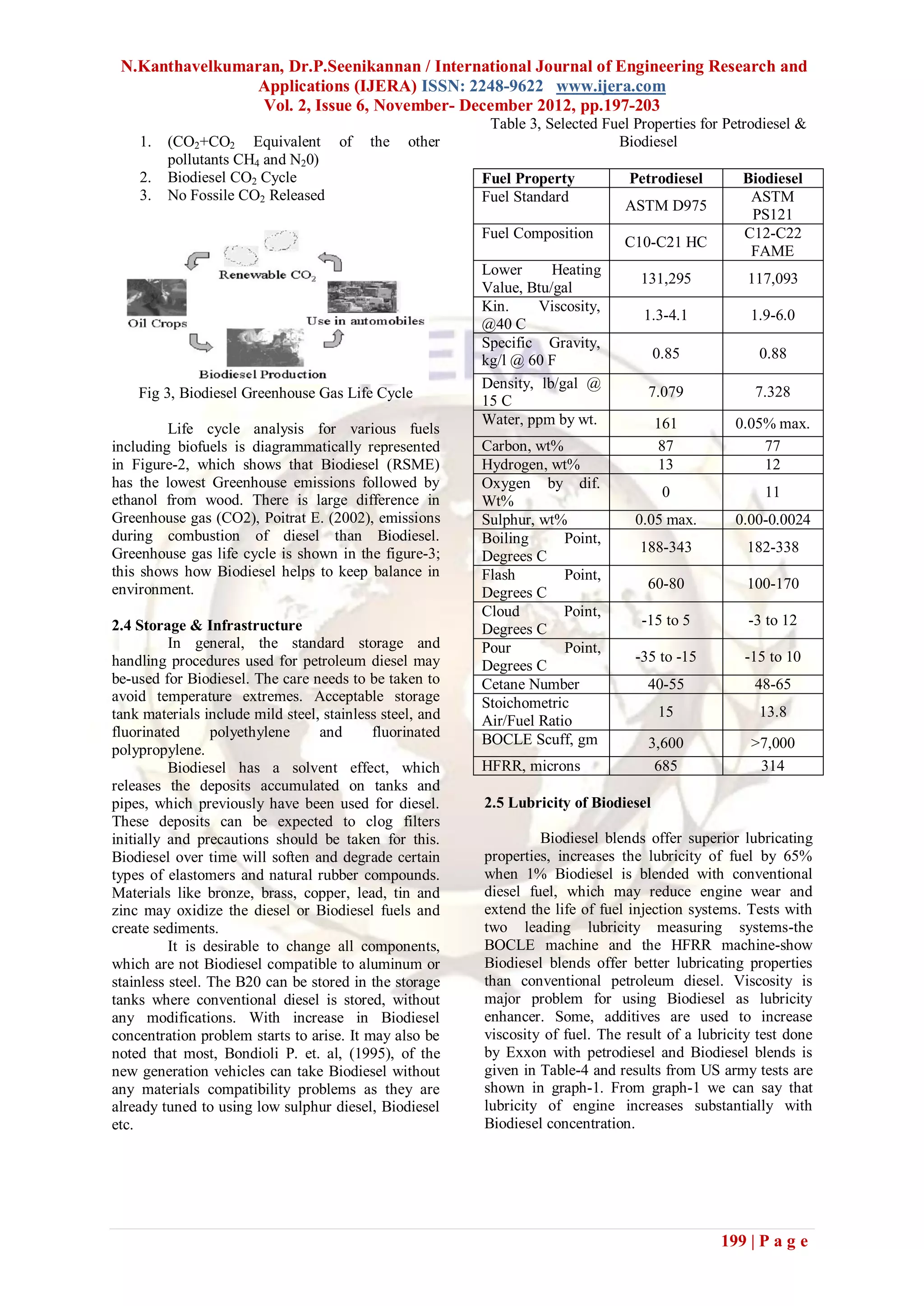
1. The document discusses biodiesel, including its production process, properties, emissions benefits, and applications as an alternative fuel. 2. Biodiesel is produced through a transesterification process where vegetable oils or animal fats are chemically reacted with an alcohol like methanol or ethanol in the presence of a catalyst, producing esters (biodiesel) and glycerin. 3. Biodiesel has similar properties to conventional diesel, including energy content and cetane number. It provides substantial reductions in emissions and can be used in existing diesel engines with little or no modifications.


