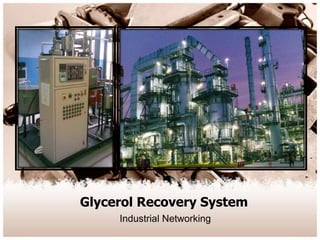
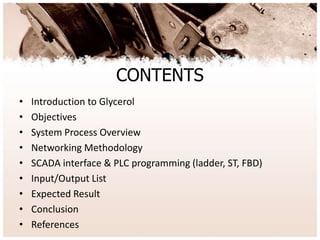
Glycerol Recovery System
Industrial Networking
GROUP MEMBERS
KAMAL HAKIM BIN ZAINAL ALAM
(50207110027)
MOHD TAUFIQ NORSAMSURI BIN MAT NAWI
(50207110210)
MUHAMMAD FIRDAUS BIN ABDUL RAHMAN
(50207110330)
CONTENTS
• Introduction to Glycerol
• Objectives
• System Process Overview
• Networking Methodology
• SCADA interface & PLC programming (ladder, ST, FBD)
• Input/Output List
• Expected Result
• Conclusion
• References
Glycerol Definition
• A syrupy, sweet, colorless or yellowish liquid,
obtained from fats and oils as a byproduct of
saponification and used as a solvent, an antifreeze, a
plasticizer, and a sweetener and in the manufacture
of dynamite, cosmetics, liquid soaps, inks, and
lubricants.
• Glycerol residues are obtained from production of
palm oil kernel through glycerol refining.
OBJECTIVES
• To recover pure glycerol from crude glycerol
residues
• To implement the process involved in glycerol
recovery using methods of industrial
networking and SCADA system
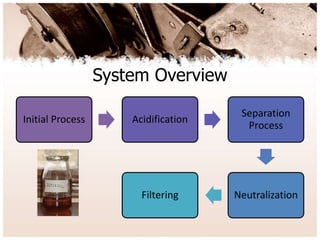
System Overview
Initial Process Acidification
Separation
Process
NeutralizationFiltering
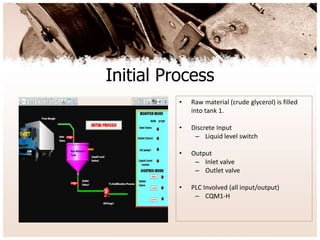
Initial Process
• Raw material (crude glycerol) is filled
into tank 1.
• Discrete Input
– Liquid level switch
• Output
– Inlet valve
– Outlet valve
• PLC Involved (all input/output)
– CQM1-H
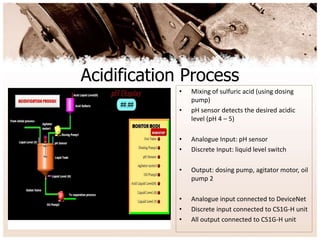
Acidification Process
• Mixing of sulfuric acid (using dosing
pump)
• pH sensor detects the desired acidic
level (pH 4 – 5)
• Analogue Input: pH sensor
• Discrete Input: liquid level switch
• Output: dosing pump, agitator motor, oil
pump 2
• Analogue input connected to DeviceNet
• Discrete input connected to CS1G-H unit
• All output connected to CS1G-H unit
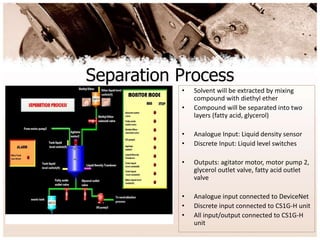
Separation Process
• Solvent will be extracted by mixing
compound with diethyl ether
• Compound will be separated into two
layers (fatty acid, glycerol)
• Analogue Input: Liquid density sensor
• Discrete Input: Liquid level switches
• Outputs: agitator motor, motor pump 2,
glycerol outlet valve, fatty acid outlet
valve
• Analogue input connected to DeviceNet
• Discrete input connected to CS1G-H unit
• All input/output connected to CS1G-H
unit
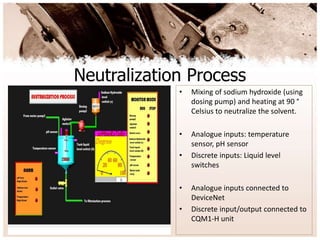
Neutralization Process
• Mixing of sodium hydroxide (using
dosing pump) and heating at 90 °
Celsius to neutralize the solvent.
• Analogue inputs: temperature
sensor, pH sensor
• Discrete inputs: Liquid level
switches
• Analogue inputs connected to
DeviceNet
• Discrete input/output connected to
CQM1-H unit
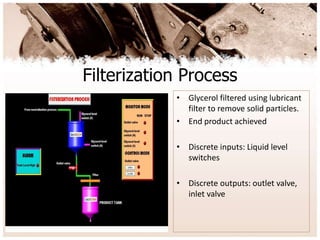
Filterization Process
• Glycerol filtered using lubricant
filter to remove solid particles.
• End product achieved
• Discrete inputs: Liquid level
switches
• Discrete outputs: outlet valve,
inlet valve
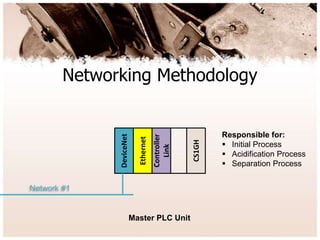
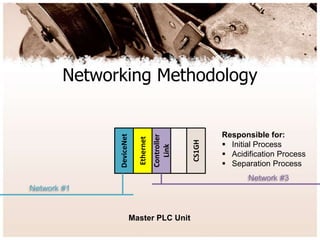
Networking Methodology
CS1GH
Master PLC Unit
DeviceNet
Ethernet
Controller
Link
Network #1
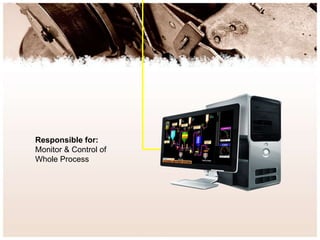
Responsible for:
ď‚§ Initial Process
ď‚§ Acidification Process
ď‚§ Separation Process
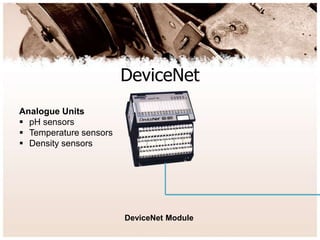
DeviceNet
DeviceNet Module
Analogue Units
ď‚§ pH sensors
ď‚§ Temperature sensors
ď‚§ Density sensors
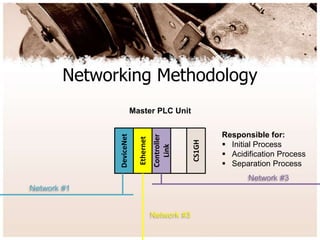
Networking Methodology
CS1GH
Master PLC Unit
DeviceNet
Ethernet
Controller
Link
Network #1
Network #3
Responsible for:
ď‚§ Initial Process
ď‚§ Acidification Process
ď‚§ Separation Process
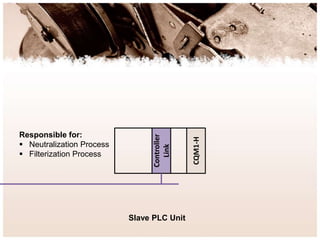
Slave PLC Unit
CQM1-H
Controller
Link
Responsible for:
ď‚§ Neutralization Process
ď‚§ Filterization Process
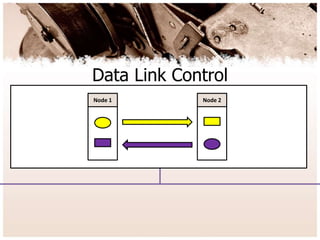
Data Link Control
Node 2Node 1
Networking Methodology
CS1GH
Master PLC Unit
DeviceNet
Ethernet
Controller
Link
Network #1
Network #3
Responsible for:
ď‚§ Initial Process
ď‚§ Acidification Process
ď‚§ Separation Process
Network #3
Responsible for:
Monitor & Control of
Whole Process
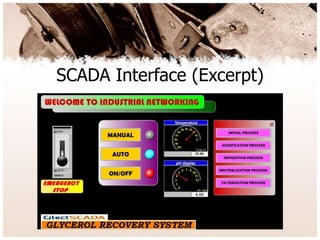
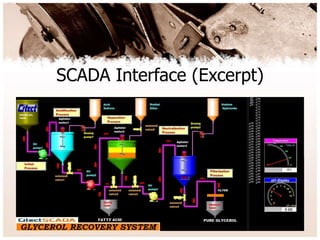
SCADA Interface (Excerpt)
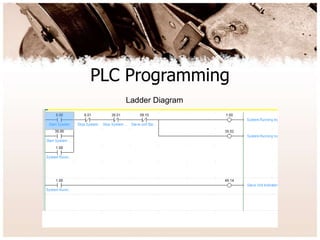
PLC Programming
Ladder Diagram
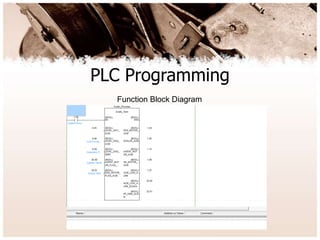
PLC Programming
Function Block Diagram
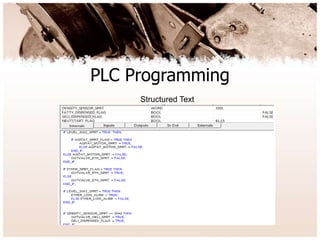
PLC Programming
Structured Text
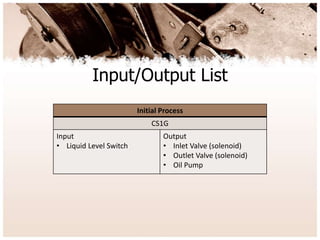
Input/Output List
Initial Process
CS1G
Input
• Liquid Level Switch
Output
• Inlet Valve (solenoid)
• Outlet Valve (solenoid)
• Oil Pump
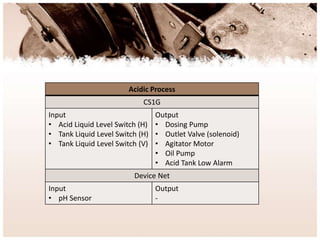
Acidic Process
CS1G
Input
• Acid Liquid Level Switch (H)
• Tank Liquid Level Switch (H)
• Tank Liquid Level Switch (V)
Output
• Dosing Pump
• Outlet Valve (solenoid)
• Agitator Motor
• Oil Pump
• Acid Tank Low Alarm
Device Net
Input
• pH Sensor
Output
-
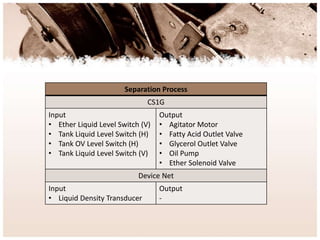
Separation Process
CS1G
Input
• Ether Liquid Level Switch (V)
• Tank Liquid Level Switch (H)
• Tank OV Level Switch (H)
• Tank Liquid Level Switch (V)
Output
• Agitator Motor
• Fatty Acid Outlet Valve
• Glycerol Outlet Valve
• Oil Pump
• Ether Solenoid Valve
Device Net
Input
• Liquid Density Transducer
Output
-
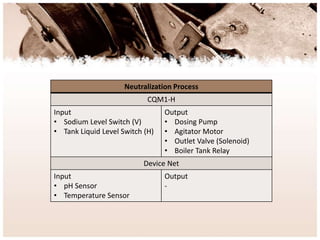
Neutralization Process
CQM1-H
Input
• Sodium Level Switch (V)
• Tank Liquid Level Switch (H)
Output
• Dosing Pump
• Agitator Motor
• Outlet Valve (Solenoid)
• Boiler Tank Relay
Device Net
Input
• pH Sensor
• Temperature Sensor
Output
-
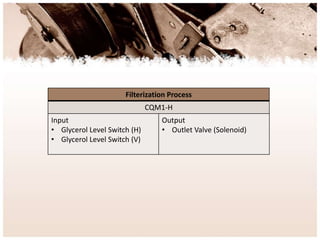
Filterization Process
CQM1-H
Input
• Glycerol Level Switch (H)
• Glycerol Level Switch (V)
Output
• Outlet Valve (Solenoid)
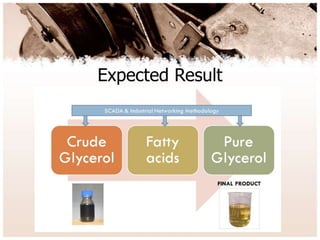
Expected Result
References
• Journal of Oil Palm Research Vol 13
– Wan Yunus and Hazimah
• Data Communication & Networking
– Behrouz Farouzan
• Glycerine Processing
– Bailey’s Industrial Oil Fat Products, 5th Edition
• The Manufacture of Soaps, Detergents & Glycerine
– Ellis Horwood Lt.
• Encyclopedia of Chemical Technology
– Kirk R, John Wiley & Sons 3rd Edition
• Glycerol
– Glycerol - Wikipedia, the free encyclopedia
Conclusion
• The implementation of crude glycerol recovery through
the usage of SCADA and industrial networking has the
potential to be reliable, robust and producing effective
result as the system can be monitored smoothly,
effectively and less error-prone.

GLYCEROL RECOVERY SYSTEM Final Presentation

  • 1.
  • 2.
    GROUP MEMBERS KAMAL HAKIMBIN ZAINAL ALAM (50207110027) MOHD TAUFIQ NORSAMSURI BIN MAT NAWI (50207110210) MUHAMMAD FIRDAUS BIN ABDUL RAHMAN (50207110330)
  • 3.
    CONTENTS • Introduction toGlycerol • Objectives • System Process Overview • Networking Methodology • SCADA interface & PLC programming (ladder, ST, FBD) • Input/Output List • Expected Result • Conclusion • References
  • 4.
    Glycerol Definition • Asyrupy, sweet, colorless or yellowish liquid, obtained from fats and oils as a byproduct of saponification and used as a solvent, an antifreeze, a plasticizer, and a sweetener and in the manufacture of dynamite, cosmetics, liquid soaps, inks, and lubricants. • Glycerol residues are obtained from production of palm oil kernel through glycerol refining.
  • 5.
    OBJECTIVES • To recoverpure glycerol from crude glycerol residues • To implement the process involved in glycerol recovery using methods of industrial networking and SCADA system
  • 6.
    System Overview Initial ProcessAcidification Separation Process NeutralizationFiltering
  • 7.
    Initial Process • Rawmaterial (crude glycerol) is filled into tank 1. • Discrete Input – Liquid level switch • Output – Inlet valve – Outlet valve • PLC Involved (all input/output) – CQM1-H
  • 8.
    Acidification Process • Mixingof sulfuric acid (using dosing pump) • pH sensor detects the desired acidic level (pH 4 – 5) • Analogue Input: pH sensor • Discrete Input: liquid level switch • Output: dosing pump, agitator motor, oil pump 2 • Analogue input connected to DeviceNet • Discrete input connected to CS1G-H unit • All output connected to CS1G-H unit
  • 9.
    Separation Process • Solventwill be extracted by mixing compound with diethyl ether • Compound will be separated into two layers (fatty acid, glycerol) • Analogue Input: Liquid density sensor • Discrete Input: Liquid level switches • Outputs: agitator motor, motor pump 2, glycerol outlet valve, fatty acid outlet valve • Analogue input connected to DeviceNet • Discrete input connected to CS1G-H unit • All input/output connected to CS1G-H unit
  • 10.
    Neutralization Process • Mixingof sodium hydroxide (using dosing pump) and heating at 90 ° Celsius to neutralize the solvent. • Analogue inputs: temperature sensor, pH sensor • Discrete inputs: Liquid level switches • Analogue inputs connected to DeviceNet • Discrete input/output connected to CQM1-H unit
  • 11.
    Filterization Process • Glycerolfiltered using lubricant filter to remove solid particles. • End product achieved • Discrete inputs: Liquid level switches • Discrete outputs: outlet valve, inlet valve
  • 12.
    Networking Methodology CS1GH Master PLCUnit DeviceNet Ethernet Controller Link Network #1 Responsible for: ď‚§ Initial Process ď‚§ Acidification Process ď‚§ Separation Process
  • 13.
    DeviceNet DeviceNet Module Analogue Units ď‚§pH sensors ď‚§ Temperature sensors ď‚§ Density sensors
  • 14.
    Networking Methodology CS1GH Master PLCUnit DeviceNet Ethernet Controller Link Network #1 Network #3 Responsible for: ď‚§ Initial Process ď‚§ Acidification Process ď‚§ Separation Process
  • 15.
    Slave PLC Unit CQM1-H Controller Link Responsiblefor: ď‚§ Neutralization Process ď‚§ Filterization Process
  • 16.
  • 17.
    Networking Methodology CS1GH Master PLCUnit DeviceNet Ethernet Controller Link Network #1 Network #3 Responsible for: ď‚§ Initial Process ď‚§ Acidification Process ď‚§ Separation Process Network #3
  • 18.
    Responsible for: Monitor &Control of Whole Process
  • 19.
  • 20.
  • 21.
  • 22.
  • 23.
  • 24.
    Input/Output List Initial Process CS1G Input •Liquid Level Switch Output • Inlet Valve (solenoid) • Outlet Valve (solenoid) • Oil Pump
  • 25.
    Acidic Process CS1G Input • AcidLiquid Level Switch (H) • Tank Liquid Level Switch (H) • Tank Liquid Level Switch (V) Output • Dosing Pump • Outlet Valve (solenoid) • Agitator Motor • Oil Pump • Acid Tank Low Alarm Device Net Input • pH Sensor Output -
  • 26.
    Separation Process CS1G Input • EtherLiquid Level Switch (V) • Tank Liquid Level Switch (H) • Tank OV Level Switch (H) • Tank Liquid Level Switch (V) Output • Agitator Motor • Fatty Acid Outlet Valve • Glycerol Outlet Valve • Oil Pump • Ether Solenoid Valve Device Net Input • Liquid Density Transducer Output -
  • 27.
    Neutralization Process CQM1-H Input • SodiumLevel Switch (V) • Tank Liquid Level Switch (H) Output • Dosing Pump • Agitator Motor • Outlet Valve (Solenoid) • Boiler Tank Relay Device Net Input • pH Sensor • Temperature Sensor Output -
  • 28.
    Filterization Process CQM1-H Input • GlycerolLevel Switch (H) • Glycerol Level Switch (V) Output • Outlet Valve (Solenoid)
  • 29.
  • 30.
    References • Journal ofOil Palm Research Vol 13 – Wan Yunus and Hazimah • Data Communication & Networking – Behrouz Farouzan • Glycerine Processing – Bailey’s Industrial Oil Fat Products, 5th Edition • The Manufacture of Soaps, Detergents & Glycerine – Ellis Horwood Lt. • Encyclopedia of Chemical Technology – Kirk R, John Wiley & Sons 3rd Edition • Glycerol – Glycerol - Wikipedia, the free encyclopedia
  • 31.
    Conclusion • The implementationof crude glycerol recovery through the usage of SCADA and industrial networking has the potential to be reliable, robust and producing effective result as the system can be monitored smoothly, effectively and less error-prone.