BIOREFINERY
1/23
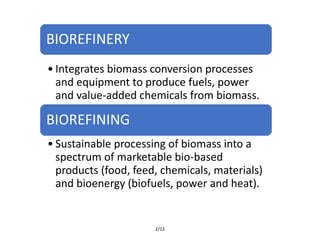
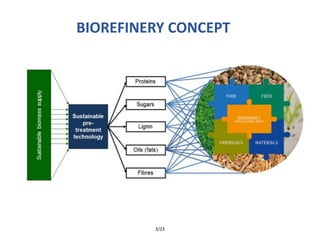
BIOREFINERY
• Integrates biomass conversion processes
and equipment to produce fuels, power
and value-added chemicals from biomass.
BIOREFINING
• Sustainable processing of biomass into a
spectrum of marketable bio-based
products (food, feed, chemicals, materials)
and bioenergy (biofuels, power and heat).
2/23
BIOREFINERY CONCEPT
3/23
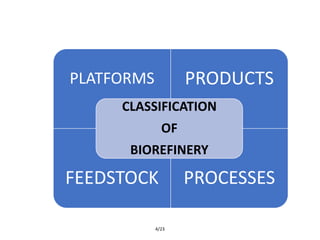
PLATFORMS PRODUCTS
FEEDSTOCK PROCESSES
CLASSIFICATION
OF
BIOREFINERY
4/23
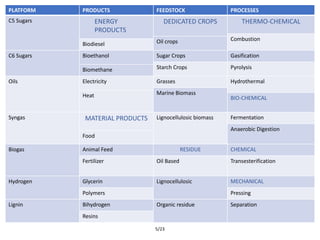
PLATFORM PRODUCTS FEEDSTOCK PROCESSES
C5 Sugars ENERGY
PRODUCTS
DEDICATED CROPS THERMO-CHEMICAL
Combustion
Oil crops
Biodiesel
C6 Sugars Bioethanol Sugar Crops Gasification
Starch Crops Pyrolysis
Biomethane
Oils Electricity Grasses Hydrothermal
Marine Biomass
Heat BIO-CHEMICAL
Syngas MATERIAL PRODUCTS Lignocellulosic biomass Fermentation
Anaerobic Digestion
Food
Biogas Animal Feed RESIDUE CHEMICAL
Fertilizer Oil Based Transesterification
Hydrogen Glycerin Lignocellulosic MECHANICAL
Polymers Pressing
Lignin Bihydrogen Organic residue Separation
Resins
5/23
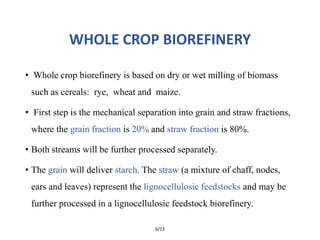
WHOLE CROP BIOREFINERY
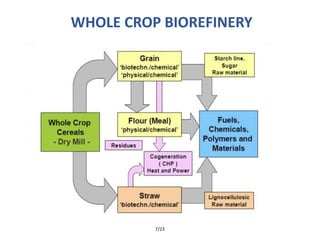
• Whole crop biorefinery is based on dry or wet milling of biomass
such as cereals: rye, wheat and maize.
• First step is the mechanical separation into grain and straw fractions,
where the grain fraction is 20% and straw fraction is 80%.
• Both streams will be further processed separately.
• The grain will deliver starch. The straw (a mixture of chaff, nodes,
ears and leaves) represent the lignocellulosic feedstocks and may be
further processed in a lignocellulosic feedstock biorefinery.
6/23
WHOLE CROP BIOREFINERY
7/23
GREEN BIOREFINERY
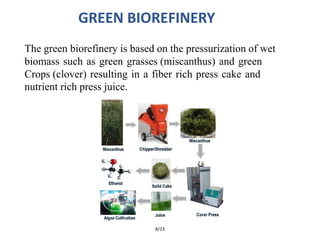
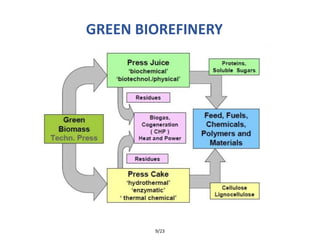
The green biorefinery is based on the pressurization of wet
biomass such as green grasses (miscanthus) and green
Crops (clover) resulting in a fiber rich press cake and
nutrient rich press juice.
8/23
GREEN BIOREFINERY
9/23
LIGNOCELLULOSE FEEDSTOCK
BIOREFINERY
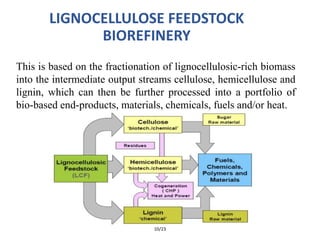
This is based on the fractionation of lignocellulosic-rich biomass
into the intermediate output streams cellulose, hemicellulose and
lignin, which can then be further processed into a portfolio of
bio-based end-products, materials, chemicals, fuels and/or heat.
10/23
TWO PLATFORM BIOREFINERY
• Based on fractionation of biomass into sugar(cellulose and
hemicellulose) and lignin.
• Sugar fraction will be biochemically converted using sugar
platform into potential bio-products such as materials, chemicals
and fuels.
• Lignin fraction will be thermochemically converted using syngas
platform into syngas for the production of spectrum of bio-based
products including power and heat.
11/24
THERMOCHEMICAL BIOREFINERY
• It involves torrefaction, pyrolysis, gasification and HTU or HTL
(Hydrothermal upgrading or hydrothermal liquefaction).
• Biomass derived intermediates (example char, pyrolysis oil, torrefaction
pellets, syngas, HTU- derived biocrude) could be conditioned and then
could be introduced into these existing capital-intensive infrastructures,
substituting fossil fuels and raw materials for the sustainable production of a
spectrum of conventional petrochemical products.
12/23
MARINE BIOREFINERY
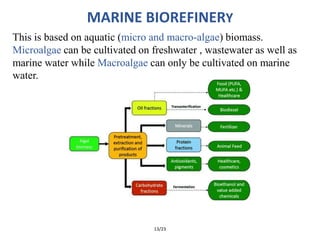
This is based on aquatic (micro and macro-algae) biomass.
Microalgae can be cultivated on freshwater , wastewater as well as
marine water while Macroalgae can only be cultivated on marine
water.
13/23
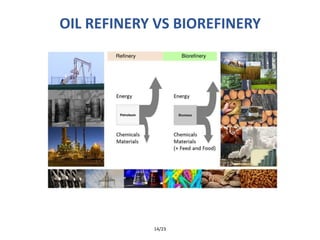
OIL REFINERY VS BIOREFINERY
14/23
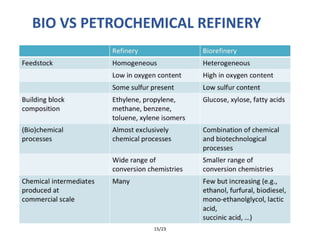
BIO VS PETROCHEMICAL REFINERY
15/23
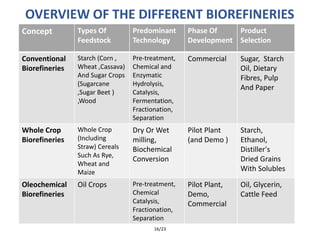
OVERVIEW OF THE DIFFERENT BIOREFINERIES
16/23
Concept Types Of
Feedstock
Predominant
Technology
Phase Of
Development
Product
Selection
Conventional
Biorefineries
Starch (Corn ,
Wheat ,Cassava)
And Sugar Crops
(Sugarcane
,Sugar Beet )
,Wood
Pre-treatment,
Chemical and
Enzymatic
Hydrolysis,
Catalysis,
Fermentation,
Fractionation,
Separation
Commercial Sugar, Starch
Oil, Dietary
Fibres, Pulp
And Paper
Whole Crop
Biorefineries
Whole Crop
(Including
Straw) Cereals
Such As Rye,
Wheat and
Maize
Dry Or Wet
milling,
Biochemical
Conversion
Pilot Plant
(and Demo )
Starch,
Ethanol,
Distiller's
Dried Grains
With Solubles
Oleochemical
Biorefineries
Oil Crops Pre-treatment,
Chemical
Catalysis,
Fractionation,
Separation
Pilot Plant,
Demo,
Commercial
Oil, Glycerin,
Cattle Feed
17/23
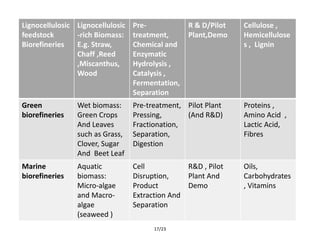
Lignocellulosic
feedstock
Biorefineries
Lignocellulosic
-rich Biomass:
E.g. Straw,
Chaff ,Reed
,Miscanthus,
Wood
Pre-
treatment,
Chemical and
Enzymatic
Hydrolysis ,
Catalysis ,
Fermentation,
Separation
R & D/Pilot
Plant,Demo
Cellulose ,
Hemicellulose
s , Lignin
Green
biorefineries
Wet biomass:
Green Crops
And Leaves
such as Grass,
Clover, Sugar
And Beet Leaf
Pre-treatment,
Pressing,
Fractionation,
Separation,
Digestion
Pilot Plant
(And R&D)
Proteins ,
Amino Acid ,
Lactic Acid,
Fibres
Marine
biorefineries
Aquatic
biomass:
Micro-algae
and Macro-
algae
(seaweed )
Cell
Disruption,
Product
Extraction And
Separation
R&D , Pilot
Plant And
Demo
Oils,
Carbohydrates
, Vitamins
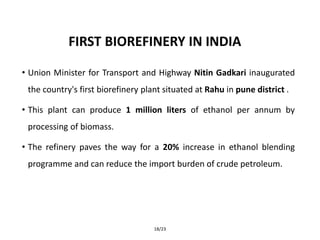
FIRST BIOREFINERY IN INDIA
• Union Minister for Transport and Highway Nitin Gadkari inaugurated
the country's first biorefinery plant situated at Rahu in pune district .
• This plant can produce 1 million liters of ethanol per annum by
processing of biomass.
• The refinery paves the way for a 20% increase in ethanol blending
programme and can reduce the import burden of crude petroleum.
18/23
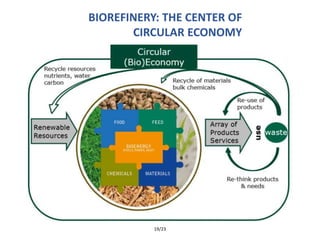
BIOREFINERY: THE CENTER OF
CIRCULAR ECONOMY
19/23
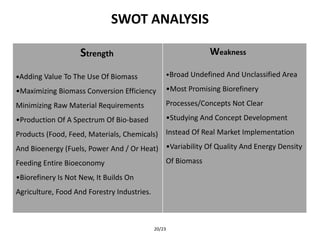
SWOT ANALYSIS
20/23
Strength
•Adding Value To The Use Of Biomass
•Maximizing Biomass Conversion Efficiency
Minimizing Raw Material Requirements
•Production Of A Spectrum Of Bio-based
Products (Food, Feed, Materials, Chemicals)
And Bioenergy (Fuels, Power And / Or Heat)
Feeding Entire Bioeconomy
•Biorefinery Is Not New, It Builds On
Agriculture, Food And Forestry Industries.
Weakness
•Broad Undefined And Unclassified Area
•Most Promising Biorefinery
Processes/Concepts Not Clear
•Studying And Concept Development
Instead Of Real Market Implementation
•Variability Of Quality And Energy Density
Of Biomass
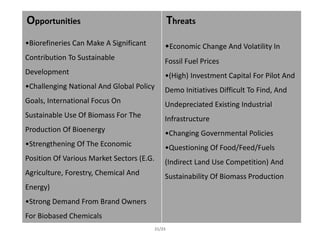
Opportunities
•Biorefineries Can Make A Significant
Contribution To Sustainable
Development
•Challenging National And Global Policy
Goals, International Focus On
Sustainable Use Of Biomass For The
Production Of Bioenergy
•Strengthening Of The Economic
Position Of Various Market Sectors (E.G.
Agriculture, Forestry, Chemical And
Energy)
•Strong Demand From Brand Owners
For Biobased Chemicals
Threats
•Economic Change And Volatility In
Fossil Fuel Prices
•(High) Investment Capital For Pilot And
Demo Initiatives Difficult To Find, And
Undepreciated Existing Industrial
Infrastructure
•Changing Governmental Policies
•Questioning Of Food/Feed/Fuels
(Indirect Land Use Competition) And
Sustainability Of Biomass Production
21/23
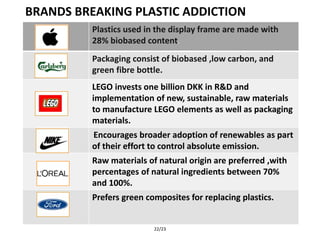
BRANDS BREAKING PLASTIC ADDICTION
22/23
Plastics used in the display frame are made with
28% biobased content.
Packaging consist of biobased ,low carbon, and
green fibre bottle.
LEGO invests one billion DKK in R&D and
implementation of new, sustainable, raw materials
to manufacture LEGO elements as well as packaging
materials.
Encourages broader adoption of renewables as part
of their effort to control absolute emission.
Raw materials of natural origin are preferred ,with
percentages of natural ingredients between 70%
and 100%.
Prefers green composites for replacing plastics.
CONCLUSION
• The biorefinery concept overcomes problems arising from the
generation of residues by giving them new value.
• A significant increase in profitability and competitiveness over
petrochemical equivalents will be achieved –
By deriving greater efficiency from generating multiple-products.
By reduction in dependency on food crops by using a broader
range of biomass resources .
By creating value in something which initially lacked any such
value.
23/23
Biorefinery

Biorefinery

  • 1.
  • 2.
  • 3.
    BIOREFINERY • Integrates biomassconversion processes and equipment to produce fuels, power and value-added chemicals from biomass. BIOREFINING • Sustainable processing of biomass into a spectrum of marketable bio-based products (food, feed, chemicals, materials) and bioenergy (biofuels, power and heat). 2/23
  • 4.
  • 5.
  • 6.
    PLATFORM PRODUCTS FEEDSTOCKPROCESSES C5 Sugars ENERGY PRODUCTS DEDICATED CROPS THERMO-CHEMICAL Combustion Oil crops Biodiesel C6 Sugars Bioethanol Sugar Crops Gasification Starch Crops Pyrolysis Biomethane Oils Electricity Grasses Hydrothermal Marine Biomass Heat BIO-CHEMICAL Syngas MATERIAL PRODUCTS Lignocellulosic biomass Fermentation Anaerobic Digestion Food Biogas Animal Feed RESIDUE CHEMICAL Fertilizer Oil Based Transesterification Hydrogen Glycerin Lignocellulosic MECHANICAL Polymers Pressing Lignin Bihydrogen Organic residue Separation Resins 5/23
  • 7.
    WHOLE CROP BIOREFINERY •Whole crop biorefinery is based on dry or wet milling of biomass such as cereals: rye, wheat and maize. • First step is the mechanical separation into grain and straw fractions, where the grain fraction is 20% and straw fraction is 80%. • Both streams will be further processed separately. • The grain will deliver starch. The straw (a mixture of chaff, nodes, ears and leaves) represent the lignocellulosic feedstocks and may be further processed in a lignocellulosic feedstock biorefinery. 6/23
  • 8.
  • 9.
    GREEN BIOREFINERY The greenbiorefinery is based on the pressurization of wet biomass such as green grasses (miscanthus) and green Crops (clover) resulting in a fiber rich press cake and nutrient rich press juice. 8/23
  • 10.
  • 11.
    LIGNOCELLULOSE FEEDSTOCK BIOREFINERY This isbased on the fractionation of lignocellulosic-rich biomass into the intermediate output streams cellulose, hemicellulose and lignin, which can then be further processed into a portfolio of bio-based end-products, materials, chemicals, fuels and/or heat. 10/23
  • 12.
    TWO PLATFORM BIOREFINERY •Based on fractionation of biomass into sugar(cellulose and hemicellulose) and lignin. • Sugar fraction will be biochemically converted using sugar platform into potential bio-products such as materials, chemicals and fuels. • Lignin fraction will be thermochemically converted using syngas platform into syngas for the production of spectrum of bio-based products including power and heat. 11/24
  • 13.
    THERMOCHEMICAL BIOREFINERY • Itinvolves torrefaction, pyrolysis, gasification and HTU or HTL (Hydrothermal upgrading or hydrothermal liquefaction). • Biomass derived intermediates (example char, pyrolysis oil, torrefaction pellets, syngas, HTU- derived biocrude) could be conditioned and then could be introduced into these existing capital-intensive infrastructures, substituting fossil fuels and raw materials for the sustainable production of a spectrum of conventional petrochemical products. 12/23
  • 14.
    MARINE BIOREFINERY This isbased on aquatic (micro and macro-algae) biomass. Microalgae can be cultivated on freshwater , wastewater as well as marine water while Macroalgae can only be cultivated on marine water. 13/23
  • 15.
    OIL REFINERY VSBIOREFINERY 14/23
  • 16.
    BIO VS PETROCHEMICALREFINERY 15/23
  • 17.
    OVERVIEW OF THEDIFFERENT BIOREFINERIES 16/23 Concept Types Of Feedstock Predominant Technology Phase Of Development Product Selection Conventional Biorefineries Starch (Corn , Wheat ,Cassava) And Sugar Crops (Sugarcane ,Sugar Beet ) ,Wood Pre-treatment, Chemical and Enzymatic Hydrolysis, Catalysis, Fermentation, Fractionation, Separation Commercial Sugar, Starch Oil, Dietary Fibres, Pulp And Paper Whole Crop Biorefineries Whole Crop (Including Straw) Cereals Such As Rye, Wheat and Maize Dry Or Wet milling, Biochemical Conversion Pilot Plant (and Demo ) Starch, Ethanol, Distiller's Dried Grains With Solubles Oleochemical Biorefineries Oil Crops Pre-treatment, Chemical Catalysis, Fractionation, Separation Pilot Plant, Demo, Commercial Oil, Glycerin, Cattle Feed
  • 18.
    17/23 Lignocellulosic feedstock Biorefineries Lignocellulosic -rich Biomass: E.g. Straw, Chaff,Reed ,Miscanthus, Wood Pre- treatment, Chemical and Enzymatic Hydrolysis , Catalysis , Fermentation, Separation R & D/Pilot Plant,Demo Cellulose , Hemicellulose s , Lignin Green biorefineries Wet biomass: Green Crops And Leaves such as Grass, Clover, Sugar And Beet Leaf Pre-treatment, Pressing, Fractionation, Separation, Digestion Pilot Plant (And R&D) Proteins , Amino Acid , Lactic Acid, Fibres Marine biorefineries Aquatic biomass: Micro-algae and Macro- algae (seaweed ) Cell Disruption, Product Extraction And Separation R&D , Pilot Plant And Demo Oils, Carbohydrates , Vitamins
  • 19.
    FIRST BIOREFINERY ININDIA • Union Minister for Transport and Highway Nitin Gadkari inaugurated the country's first biorefinery plant situated at Rahu in pune district . • This plant can produce 1 million liters of ethanol per annum by processing of biomass. • The refinery paves the way for a 20% increase in ethanol blending programme and can reduce the import burden of crude petroleum. 18/23
  • 20.
    BIOREFINERY: THE CENTEROF CIRCULAR ECONOMY 19/23
  • 21.
    SWOT ANALYSIS 20/23 Strength •Adding ValueTo The Use Of Biomass •Maximizing Biomass Conversion Efficiency Minimizing Raw Material Requirements •Production Of A Spectrum Of Bio-based Products (Food, Feed, Materials, Chemicals) And Bioenergy (Fuels, Power And / Or Heat) Feeding Entire Bioeconomy •Biorefinery Is Not New, It Builds On Agriculture, Food And Forestry Industries. Weakness •Broad Undefined And Unclassified Area •Most Promising Biorefinery Processes/Concepts Not Clear •Studying And Concept Development Instead Of Real Market Implementation •Variability Of Quality And Energy Density Of Biomass
  • 22.
    Opportunities •Biorefineries Can MakeA Significant Contribution To Sustainable Development •Challenging National And Global Policy Goals, International Focus On Sustainable Use Of Biomass For The Production Of Bioenergy •Strengthening Of The Economic Position Of Various Market Sectors (E.G. Agriculture, Forestry, Chemical And Energy) •Strong Demand From Brand Owners For Biobased Chemicals Threats •Economic Change And Volatility In Fossil Fuel Prices •(High) Investment Capital For Pilot And Demo Initiatives Difficult To Find, And Undepreciated Existing Industrial Infrastructure •Changing Governmental Policies •Questioning Of Food/Feed/Fuels (Indirect Land Use Competition) And Sustainability Of Biomass Production 21/23
  • 23.
    BRANDS BREAKING PLASTICADDICTION 22/23 Plastics used in the display frame are made with 28% biobased content. Packaging consist of biobased ,low carbon, and green fibre bottle. LEGO invests one billion DKK in R&D and implementation of new, sustainable, raw materials to manufacture LEGO elements as well as packaging materials. Encourages broader adoption of renewables as part of their effort to control absolute emission. Raw materials of natural origin are preferred ,with percentages of natural ingredients between 70% and 100%. Prefers green composites for replacing plastics.
  • 24.
    CONCLUSION • The biorefineryconcept overcomes problems arising from the generation of residues by giving them new value. • A significant increase in profitability and competitiveness over petrochemical equivalents will be achieved – By deriving greater efficiency from generating multiple-products. By reduction in dependency on food crops by using a broader range of biomass resources . By creating value in something which initially lacked any such value. 23/23