Name:
Roll No:
Semester:
Program:
Shift:
Section:
Teacher
Date: 02/02/2021
Historical Background
 Pakistan achieved independencefrom over a century
of British colonial rule in August 1947.
 The progress in education was largely limited to what
emerged as India.
 The regions comprising Pakistan were relatively
backward in all respects, including in education.
 At independence, 85 percent of the population was
illiterate.
 In the more backward regions of the country, e.g.,
Baluchistan, the literacy rate was even lower, with the
rate for rural women therein being virtually zero.
 It was realized then that the task of nation building
would not be achieved without an educated and
skilled manpower. And in recognition thereof, a
National Education Conference was convened the
same year, which presented their recommendations.
First Educational Conference
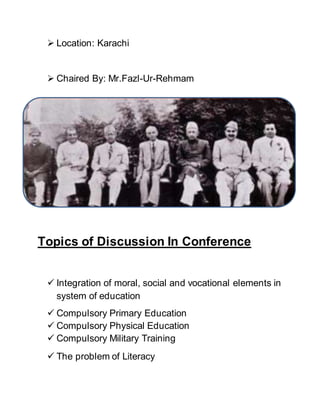
 Duration: 27 Nov - 01 Dec, 1947
 Location: Karachi
 Chaired By: Mr.Fazl-Ur-Rehmam
Topics of Discussion In Conference
 Integration of moral, social and vocational elements in
system of education
 Compulsory Primary Education
 Compulsory Physical Education
 Compulsory Military Training
 The problem of Literacy
 Training of Citizenship
 Technical and Vocational Education
 Establishment of Advisory Board of Education
 Establishment of Inter-Universal Board
 Promotion of Scientific Research
 Establishment of Overseas Scholarship Scheme
 The Problem of Medium of Instruction
Quaid’s Message
The Quaid-e-Azam, in his message to the
Conferences said: "... the importance of education
and the type of education cannot be overemphasized
... there is no doubt that the future of our State will
and must greatly depend upon the type of education
we give to our children, and the way in which we bring
them up as future. "
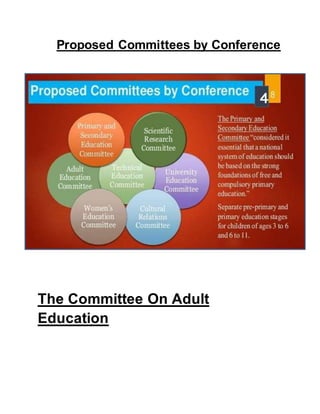
Proposed Committees by Conference
The Committee On Adult
Education
 The committee found current literacy as
15%
 Not just adults literacy but mainly focus on
to keep them literate
 Introduction of a free and compulsory
system of primary education to be treated
as complementary to one another
 Setting up of a permanent system of adult
education, closely linked with compulsory
primary education, to solve the problem in a
period of 25 years
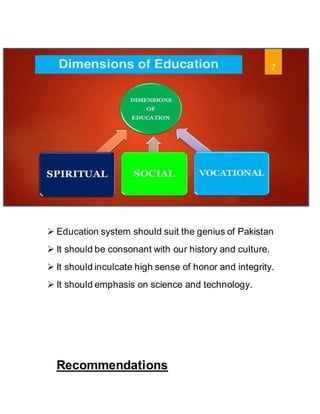
Dimensions of Education
Quaid’s Message to the Conference
 Education system should suit the genius of Pakistan
 It should be consonant with our history and culture.
 It should inculcate high sense of honor and integrity.
 It should emphasis on science and technology.
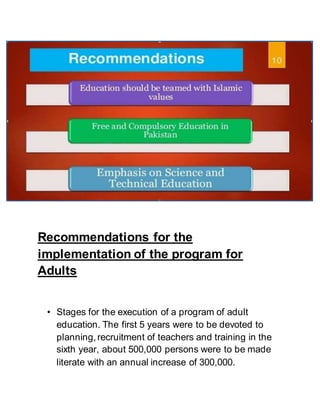
Recommendations
Recommendations for the
implementation of the program for
Adults
• Stages for the execution of a program of adult
education. The first 5 years were to be devoted to
planning,recruitment of teachers and training in the
sixth year, about 500,000 persons were to be made
literate with an annual increase of 300,000.
• It called on all government departments and all
employers and trade unions to ensure that their
employees, workers, and members are literate.
• The question of levying a tax on those employers who
do not make adequate provision for the education of
their employees was also presented for consideration.
• The possibility of making a period of social service
obligatory on all university students.
• The use of mechanical aids to learning, such as radio,
cinema, the gramophone, and magic lantern.
Strengths
• The Committee’s report was fairly pragmatic in its
approach advising multidimensional approach to
educational policy making.
• Identified issues of training adult school teachers,
teaching materials and literature for adult schools,
instruction methodologies, etc.
• It cautioned against attempting to draw up a code or
prescribe uniform methods or approaches applicable to
the country as a whole
• It also advised against drawing any rigid distinction
between adult education in the strict sense and
technical, commercial or art instruction and suggested
that adult students may be provided.
Weakness
• The Education Conference was the first ever attempt
on streamlining the education system of the new born
state. It was the product the efforts of politicians and
educational experts. However, the conference failed
to reach on a comprehensive plan for providing
quality education for the country.
• Adequate attention was not paid to developing
primary education which requires wide scale
infrastructure and trained staff.
• More people in Pakistan live in rural areas. There was
no such provision to provide even basic facilities for
their education.
• Proper attention wasn’t paid to encouraging female
education.
• Adult literacy was to take 25 years, which was not
realistic effort.
• No proper provisions were made for Higher,
technical, commercial and vocational education. Only
emphasis was there.
• The life span of the plan was very much extensive. It
needed more than a 100 years to achieve the targets.
• HRM was not identified.
Thanks a Lot
URL: www.slideshare.com

Assignment educational conference 1947

  • 1.
  • 2.
    Historical Background  Pakistanachieved independencefrom over a century of British colonial rule in August 1947.  The progress in education was largely limited to what emerged as India.  The regions comprising Pakistan were relatively backward in all respects, including in education.  At independence, 85 percent of the population was illiterate.  In the more backward regions of the country, e.g., Baluchistan, the literacy rate was even lower, with the rate for rural women therein being virtually zero.  It was realized then that the task of nation building would not be achieved without an educated and skilled manpower. And in recognition thereof, a National Education Conference was convened the same year, which presented their recommendations. First Educational Conference  Duration: 27 Nov - 01 Dec, 1947
  • 3.
     Location: Karachi Chaired By: Mr.Fazl-Ur-Rehmam Topics of Discussion In Conference  Integration of moral, social and vocational elements in system of education  Compulsory Primary Education  Compulsory Physical Education  Compulsory Military Training  The problem of Literacy
  • 4.
     Training ofCitizenship  Technical and Vocational Education  Establishment of Advisory Board of Education  Establishment of Inter-Universal Board  Promotion of Scientific Research  Establishment of Overseas Scholarship Scheme  The Problem of Medium of Instruction Quaid’s Message The Quaid-e-Azam, in his message to the Conferences said: "... the importance of education and the type of education cannot be overemphasized ... there is no doubt that the future of our State will and must greatly depend upon the type of education we give to our children, and the way in which we bring them up as future. "
  • 5.
    Proposed Committees byConference Proposed Committees by Conference The Committee On Adult Education
  • 6.
     The committeefound current literacy as 15%  Not just adults literacy but mainly focus on to keep them literate  Introduction of a free and compulsory system of primary education to be treated as complementary to one another  Setting up of a permanent system of adult education, closely linked with compulsory primary education, to solve the problem in a period of 25 years Dimensions of Education
  • 7.
    Quaid’s Message tothe Conference  Education system should suit the genius of Pakistan  It should be consonant with our history and culture.  It should inculcate high sense of honor and integrity.  It should emphasis on science and technology. Recommendations
  • 8.
    Recommendations for the implementationof the program for Adults • Stages for the execution of a program of adult education. The first 5 years were to be devoted to planning,recruitment of teachers and training in the sixth year, about 500,000 persons were to be made literate with an annual increase of 300,000.
  • 9.
    • It calledon all government departments and all employers and trade unions to ensure that their employees, workers, and members are literate. • The question of levying a tax on those employers who do not make adequate provision for the education of their employees was also presented for consideration. • The possibility of making a period of social service obligatory on all university students. • The use of mechanical aids to learning, such as radio, cinema, the gramophone, and magic lantern. Strengths • The Committee’s report was fairly pragmatic in its approach advising multidimensional approach to educational policy making. • Identified issues of training adult school teachers, teaching materials and literature for adult schools, instruction methodologies, etc. • It cautioned against attempting to draw up a code or prescribe uniform methods or approaches applicable to the country as a whole
  • 10.
    • It alsoadvised against drawing any rigid distinction between adult education in the strict sense and technical, commercial or art instruction and suggested that adult students may be provided. Weakness • The Education Conference was the first ever attempt on streamlining the education system of the new born state. It was the product the efforts of politicians and educational experts. However, the conference failed to reach on a comprehensive plan for providing quality education for the country. • Adequate attention was not paid to developing primary education which requires wide scale infrastructure and trained staff. • More people in Pakistan live in rural areas. There was no such provision to provide even basic facilities for their education. • Proper attention wasn’t paid to encouraging female education. • Adult literacy was to take 25 years, which was not realistic effort.
  • 11.
    • No properprovisions were made for Higher, technical, commercial and vocational education. Only emphasis was there. • The life span of the plan was very much extensive. It needed more than a 100 years to achieve the targets. • HRM was not identified. Thanks a Lot URL: www.slideshare.com