
NATIONAL CURRICULUM
FRAMEWORK 2005 For School
Education
Dr.C.Thanavathi
M.A., M.Phil., M.Ed., M.Phil., DGT,
DCA, CGT, PGDHE, SET, Ph.D.,
Assistant Professor of History,
V.O.C.College of Education,
Thoothukudi-628 008.
Tamil Nadu. India.
9629256771
thanavathic@thanavathi-edu.in
http://thanavathi-edu.in/index.html
Problem of Curriculum Load
 Joyless learning
 Examination system
 Textbook as the ‘Truth’
 Structure of syllabus
 Language Textbooks
 Starting Early
 Came in to Existence • Chairman Prof. Yash
Pal, formerly Chairperson University Grants
Commission • Assisted by Twenty-one focus
groups • Methodology: Analysis of existing
curriculum, consultation of commission and
committees documents, consultations with
Educationists, planners, Administrators,
Principals, headmasters, teachers, parents,
students, general public
Making of NCF-2005
 Need of drafting NCF-2005
 Procedure of making of NCF-2005
 (a) the school system is characterized by an inflexibility that
makes it resistant to change;
 (b) learning has become an isolated activity, which does not
encourage children to link knowledge with their lives in any
organic or vital way;
 (c) schools promote a regime of thought that discourages
creative thinking and insights;
 (d) what is presented and transmitted in the name of
learning in schools bypasses vital dimensions of the human
capacity to create new knowledge;
 (e) the “future” of the child has taken centre stage to the
near exclusion of the child's" present”, which is detrimental
to the well-being of the child as well as the society and the
nation.
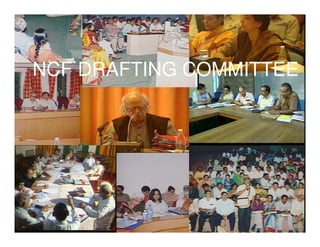
NCF DRAFTING COMMITTEE
NCF-Aims of Education
(Based on the Constitutions’ Vision of India)
 Independence of thought and action
 Learning to respond to new situations
flexibly and creatively
 Pre-disposition for participation in
democratic process and social change
 Empower all children to learn
Distortion of Aims of Education
(Learning has become a source of burden and
stress for children)
 Textbooks/Workbooks
 Information Overload
 Incomprehension
 Tests and Examinations
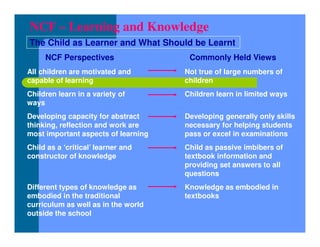
All children are motivated and
capable of learning
Children learn in a variety of
ways
Developing capacity for abstract
thinking, reflection and work are
most important aspects of learning
Child as a ‘critical’ learner and
constructor of knowledge
Different types of knowledge as
embodied in the traditional
curriculum as well as in the world
outside the school
NCF – Learning and Knowledge
The Child as Learner and What Should be Learnt
NCF Perspectives
Not true of large numbers of
children
Children learn in limited ways
Developing generally only skills
necessary for helping students
pass or excel in examinations
Child as passive imbibers of
textbook information and
providing set answers to all
questions
Knowledge as embodied in
textbooks
Commonly Held Views
Local Knowledge is a Rich Source of Learning
for All Children
Children’s Knowledge and Local Knowledge
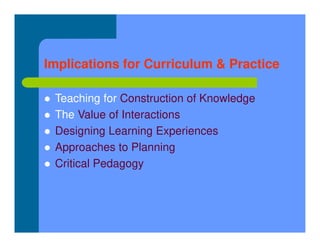
Implications for Curriculum & Practice
 Teaching for Construction of Knowledge
 The Value of Interactions
 Designing Learning Experiences
 Approaches to Planning
 Critical Pedagogy
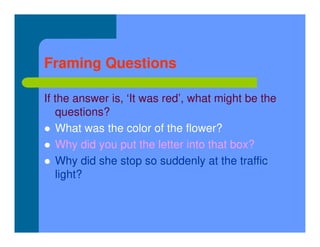
Framing Questions
If the answer is, ‘It was red’, what might be the
questions?
 What was the color of the flower?
 Why did you put the letter into that box?
 Why did she stop so suddenly at the traffic
light?
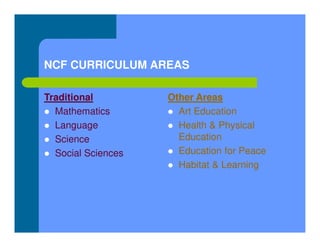
NCF CURRICULUM AREAS
Traditional
 Mathematics
 Language
 Science
 Social Sciences
Other Areas
 Art Education
 Health & Physical
Education
 Education for Peace
 Habitat & Learning
NCF – Language
• Three language formula reaffirmed – importance of home
language
• Multilingualism as a resource
• “English as subject” and “English as medium”
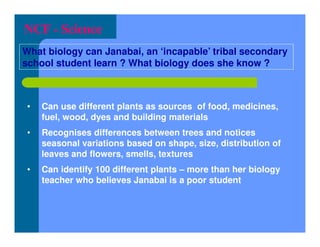
NCF - Science
What biology can Janabai, an ‘incapable’ tribal secondary
school student learn ? What biology does she know ?
• Can use different plants as sources of food, medicines,
fuel, wood, dyes and building materials
• Recognises differences between trees and notices
seasonal variations based on shape, size, distribution of
leaves and flowers, smells, textures
• Can identify 100 different plants – more than her biology
teacher who believes Janabai is a poor student
NCF - Science
• Science should nurture curiosity and creativity particularly
in relationship to the environment
• Science teaching should be placed in the context of
children’s environment to help them enter the world of
work
• Awareness of environmental concerns
NCF – Social Sciences
• Equip children to think critically on social issues
• Interdisciplinary approach to key national concerns such
as gender, human rights, marginalised minorities, etc.
• Civics to be recast as political science
• Significance of history – conception of past and civic
identity
NCF-Mathematics
 Main goal of Mathematics is Mathematisation
rather than Knowledge of Mathematics
NCF – Systemic Reforms
Concern for
Quality
NCF – Systemic Reforms
Teacher education for curriculum renewal
NCF – Systemic Reforms
• Shift from content-based teaching to problem solving and
understanding
• Schools should evolve continuous evaluation for
diagnosis and remedial learning
• Maths and English board exams at different levels
• No board or state level exams at Class 5, 8 or 11
Examination Reforms
NCF - Systemic Reforms
• Shift from content-based teaching to problem solving
and understanding
Examination Reforms
Understanding in Mathematics
• If you know that 235+367=602, how much is 234+369? How
did you find the answer?
• Change any one digit in 5384. Did the number increase or
decrease? By how much
THANK YOU

National Curriculum Framework 2005 Dr.C.Thanavathi

  • 1.
    NATIONAL CURRICULUM FRAMEWORK 2005For School Education Dr.C.Thanavathi M.A., M.Phil., M.Ed., M.Phil., DGT, DCA, CGT, PGDHE, SET, Ph.D., Assistant Professor of History, V.O.C.College of Education, Thoothukudi-628 008. Tamil Nadu. India. 9629256771 thanavathic@thanavathi-edu.in http://thanavathi-edu.in/index.html
  • 2.
    Problem of CurriculumLoad  Joyless learning  Examination system  Textbook as the ‘Truth’  Structure of syllabus  Language Textbooks  Starting Early
  • 3.
     Came into Existence • Chairman Prof. Yash Pal, formerly Chairperson University Grants Commission • Assisted by Twenty-one focus groups • Methodology: Analysis of existing curriculum, consultation of commission and committees documents, consultations with Educationists, planners, Administrators, Principals, headmasters, teachers, parents, students, general public
  • 4.
    Making of NCF-2005 Need of drafting NCF-2005  Procedure of making of NCF-2005
  • 5.
     (a) theschool system is characterized by an inflexibility that makes it resistant to change;  (b) learning has become an isolated activity, which does not encourage children to link knowledge with their lives in any organic or vital way;  (c) schools promote a regime of thought that discourages creative thinking and insights;  (d) what is presented and transmitted in the name of learning in schools bypasses vital dimensions of the human capacity to create new knowledge;  (e) the “future” of the child has taken centre stage to the near exclusion of the child's" present”, which is detrimental to the well-being of the child as well as the society and the nation.
  • 6.
  • 8.
    NCF-Aims of Education (Basedon the Constitutions’ Vision of India)  Independence of thought and action  Learning to respond to new situations flexibly and creatively  Pre-disposition for participation in democratic process and social change  Empower all children to learn
  • 9.
    Distortion of Aimsof Education (Learning has become a source of burden and stress for children)  Textbooks/Workbooks  Information Overload  Incomprehension  Tests and Examinations
  • 10.
    All children aremotivated and capable of learning Children learn in a variety of ways Developing capacity for abstract thinking, reflection and work are most important aspects of learning Child as a ‘critical’ learner and constructor of knowledge Different types of knowledge as embodied in the traditional curriculum as well as in the world outside the school NCF – Learning and Knowledge The Child as Learner and What Should be Learnt NCF Perspectives Not true of large numbers of children Children learn in limited ways Developing generally only skills necessary for helping students pass or excel in examinations Child as passive imbibers of textbook information and providing set answers to all questions Knowledge as embodied in textbooks Commonly Held Views
  • 11.
    Local Knowledge isa Rich Source of Learning for All Children Children’s Knowledge and Local Knowledge
  • 12.
    Implications for Curriculum& Practice  Teaching for Construction of Knowledge  The Value of Interactions  Designing Learning Experiences  Approaches to Planning  Critical Pedagogy
  • 13.
    Framing Questions If theanswer is, ‘It was red’, what might be the questions?  What was the color of the flower?  Why did you put the letter into that box?  Why did she stop so suddenly at the traffic light?
  • 14.
    NCF CURRICULUM AREAS Traditional Mathematics  Language  Science  Social Sciences Other Areas  Art Education  Health & Physical Education  Education for Peace  Habitat & Learning
  • 15.
    NCF – Language •Three language formula reaffirmed – importance of home language • Multilingualism as a resource • “English as subject” and “English as medium”
  • 16.
    NCF - Science Whatbiology can Janabai, an ‘incapable’ tribal secondary school student learn ? What biology does she know ? • Can use different plants as sources of food, medicines, fuel, wood, dyes and building materials • Recognises differences between trees and notices seasonal variations based on shape, size, distribution of leaves and flowers, smells, textures • Can identify 100 different plants – more than her biology teacher who believes Janabai is a poor student
  • 17.
    NCF - Science •Science should nurture curiosity and creativity particularly in relationship to the environment • Science teaching should be placed in the context of children’s environment to help them enter the world of work • Awareness of environmental concerns
  • 18.
    NCF – SocialSciences • Equip children to think critically on social issues • Interdisciplinary approach to key national concerns such as gender, human rights, marginalised minorities, etc. • Civics to be recast as political science • Significance of history – conception of past and civic identity
  • 19.
    NCF-Mathematics  Main goalof Mathematics is Mathematisation rather than Knowledge of Mathematics
  • 20.
    NCF – SystemicReforms Concern for Quality
  • 21.
    NCF – SystemicReforms Teacher education for curriculum renewal
  • 23.
    NCF – SystemicReforms • Shift from content-based teaching to problem solving and understanding • Schools should evolve continuous evaluation for diagnosis and remedial learning • Maths and English board exams at different levels • No board or state level exams at Class 5, 8 or 11 Examination Reforms
  • 24.
    NCF - SystemicReforms • Shift from content-based teaching to problem solving and understanding Examination Reforms Understanding in Mathematics • If you know that 235+367=602, how much is 234+369? How did you find the answer? • Change any one digit in 5384. Did the number increase or decrease? By how much
  • 25.