SUMMARY OF
EDUCATION
POLICIES
REPORTON PAKISTANEDUCATIONCONFERENCE1947
27th November to 1st December
Chairman (Minister of Education,
interior,
information
FAZLUR REHMAN)
 After freedom in 1947 a conference was arranged to structure the
education system of Pakistan. Quaid-e-azam could not attend this due to
illness, but he forwarded his message which later laid down the foundation
for recommendations of education policy. His message contained four
major aspect;
1) Education system should suit the genius of Pakistan.
2) It should be consonant with our history and culture.
3) It should inculcate high sense of honor and integrity.
4) It should emphasis on science and technology.
 The major recommendations of the conference were:
Education should be teamed with Islamic values.
Free and compulsory education in Pakistan.
Emphasis on science and technical education.
 IMPLEMENTATION:
This policy could not be implemented properly due to increased
number of immigrants and other administrative problems of new born
country. So more or less British colonial system was continued.
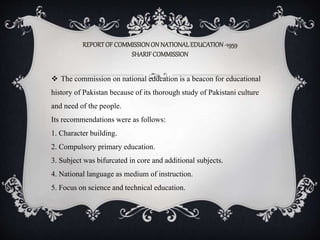
REPORTOF COMMISSIONON NATIONALEDUCATION-1959
SHARIFCOMMISSION
 The commission on national education is a beacon for educational
history of Pakistan because of its thorough study of Pakistani culture
and need of the people.
Its recommendations were as follows:
1. Character building.
2. Compulsory primary education.
3. Subject was bifurcated in core and additional subjects.
4. National language as medium of instruction.
5. Focus on science and technical education.
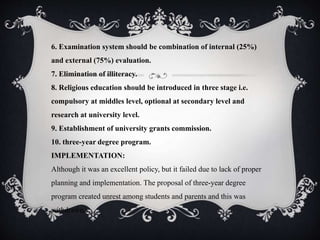
6. Examination system should be combination of internal (25%)
and external (75%) evaluation.
7. Elimination of illiteracy.
8. Religious education should be introduced in three stage i.e.
compulsory at middles level, optional at secondary level and
research at university level.
9. Establishment of university grants commission.
10. three-year degree program.
IMPLEMENTATION:
Although it was an excellent policy, but it failed due to lack of proper
planning and implementation. The proposal of three-year degree
program created unrest among students and parents and this was
withdrawn.
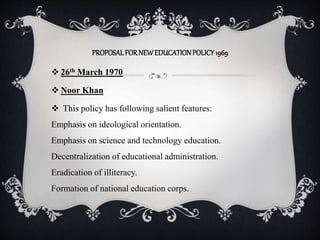
PROPOSALFORNEWEDUCATIONPOLICY1969
 26th March 1970
 Noor Khan
 This policy has following salient features:
Emphasis on ideological orientation.
Emphasis on science and technology education.
Decentralization of educational administration.
Eradication of illiteracy.
Formation of national education corps.
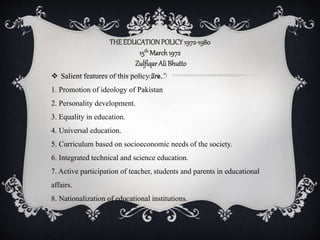
THEEDUCATIONPOLICY1972-1980
15th March1972
ZulfiqarAliBhutto
 Salient features of this policy are.
1. Promotion of ideology of Pakistan
2. Personality development.
3. Equality in education.
4. Universal education.
5. Curriculum based on socioeconomic needs of the society.
6. Integrated technical and science education.
7. Active participation of teacher, students and parents in educational
affairs.
8. Nationalization of educational institutions.
IMPLEMENTATION:
This policy was a good approach towards betterment, but has many
drawbacks due to which it cannot be achieved thoroughly e.g.
universal basic education, shift towards agro technical studies etc.
NATIONALEDUCATIONALPOLICYANDIMPLEMENTATIONPROGRAM,
1979/ISLAMIZATIONPROCESS
 General Zia-ul-Haq
 12th October 1978
 In 1979 National Educational Conference was held for reviewing
the education system and developed following aims:
Fostering loyalty to Islam.
Creation of concept of Muslim Ummah.
Promotion of science and technical education.
Equal opportunities.
 The following strategies were suggested to achieve above goals:
1. Curriculum revision.
2. Merging madarsa and traditional education.
3. Urdu as a medium of education.
4. Effective participation of community in literacy programs.
5. Linked scientific and technical education.
6. Separate instates for male and female.
7. Mosque schools.
IMPLEMENTATION;
This policy was not implemented properly and failed due to lack of planning
and financial resources.
NATIONALEDUCATIONPOLICY1998-2010
 Major objectives of this policy were as follows;
1. To make the Quaranic principles and Islamic practices an integral part of
education system.
2. To achieve universal primary education.
3. To meet the basic educational needs of every individual.
4. To expand the basic education.
5. To ensure equal opportunity of higher education.
6. Laid emphasis on diversification.
7. To make curriculum development a continuous process.
8. To introduce in-service training programs for betterment of education.
 Suggestions for achievement of above goals were:
Diversification of curriculum.
Expansion and emphasis on technical and science education.
Upgrading the quality of Deeni Madaras.
Teacher training programs both pre and in service.
Introduction of idea of multiple text book.
Development of National Testing Services.
Introduction of comprehensive monitoring system.