Submitted By: Group No 7
Iqra Khurshid 04
Tahira Gilani 13
Rashna Asif 14
Mehwish Jabeen 21
Education policies and development
Content
National Education Policy, 1972
All Pakistan Education Conference, 1947
New Education Policy, 1970
Commission on National Education, 1959
National Education Policy, 1978
National Education Policy, 2009
National Education Policy, 1998
National Education Policy, 1992
Overview
• Education policy refers to the collection of laws
and rules that govern the operation of education
system.
• Pakistan achieved independence from over a
century of British colonial rule in August 1947.
• The regions comprising Pakistan were relatively
backward in all respects, including in education.
First Educational Conference (1947)
• First Education Conference was convened in 1947 in the supervision
of Quaid-e-Azam.
• It was held at Karachi from November 27th to December 1st, 1947.
• He provided the basic guide lines for future education development.
• It was also emphasis to realize the people the sense of honor, integrity
and selfless services to the nation.
Dimensions of Education
• Education conference 1947 was presided
by the Education Minister of the country
and Chairman of the Conference, Fazal ur
Rehman.
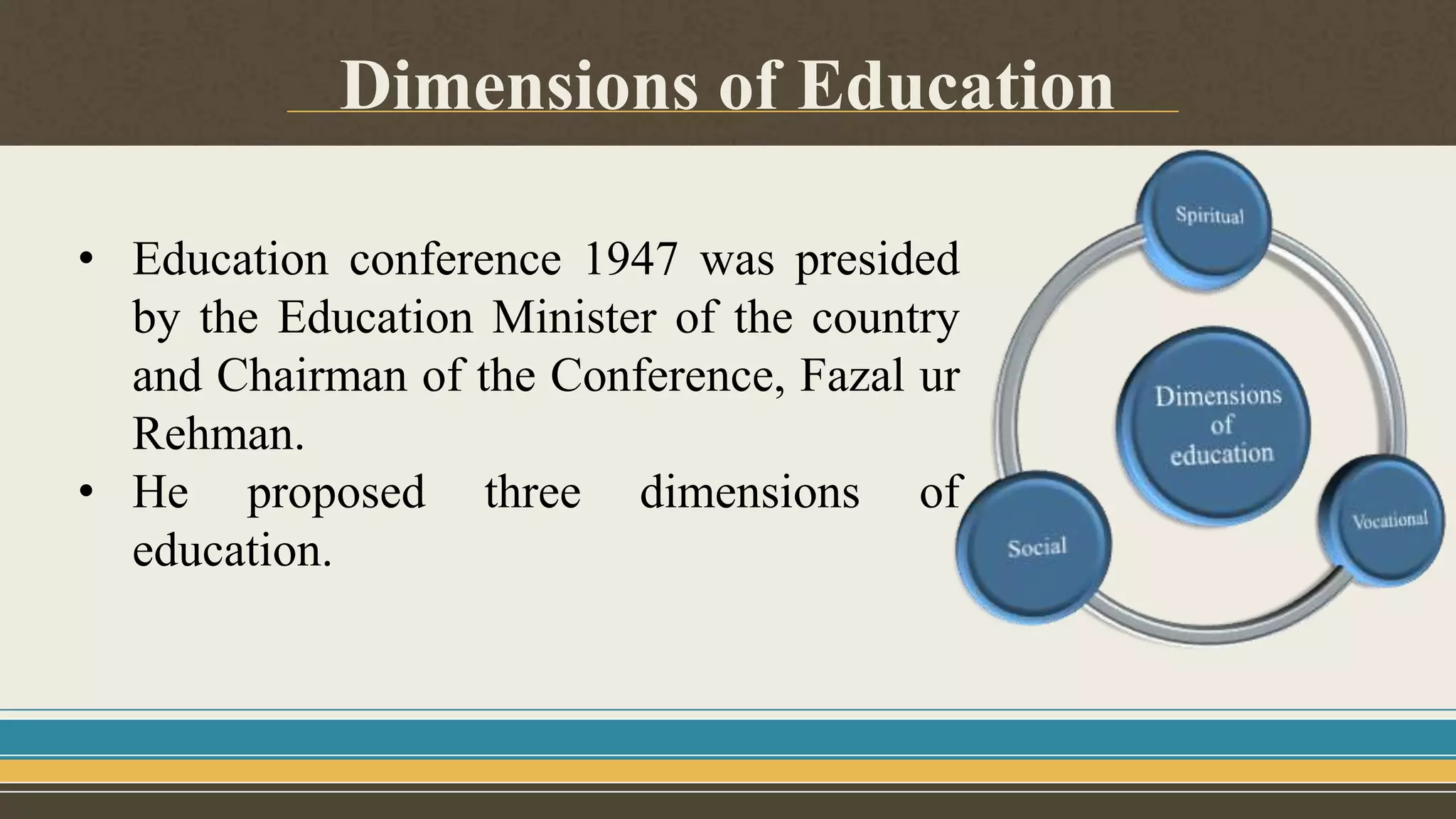
• He proposed three dimensions of
education.
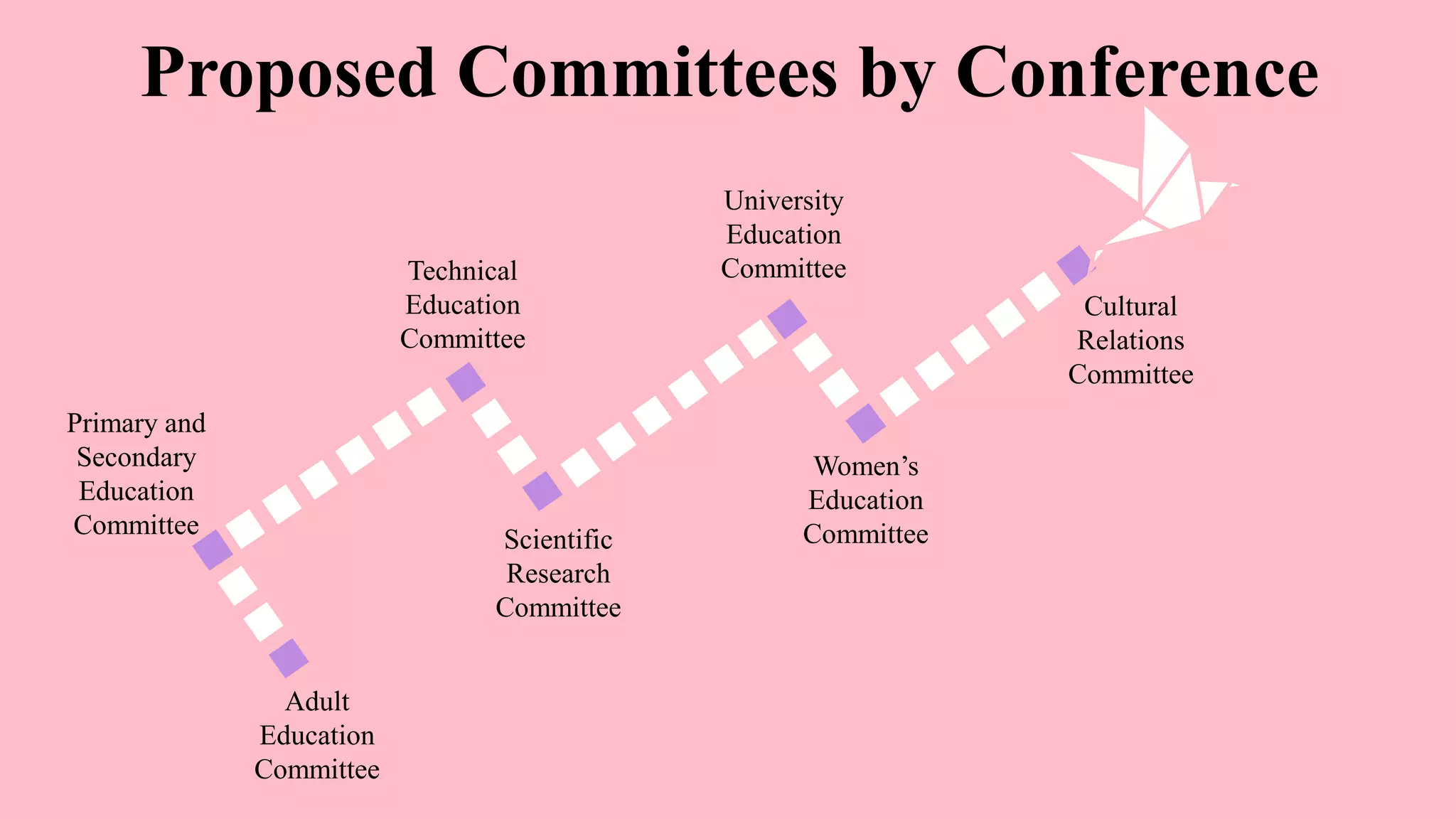
Proposed Committees by Conference
Adult
Education
Committee
Technical
Education
Committee
University
Education
Committee
Scientific
Research
Committee
Women’s
Education
Committee
Cultural
Relations
Committee
Primary and
Secondary
Education
Committee
National Commission On Education(1959)
• The Commission was addressed by the President
of Pakistan, General Mohammad Ayub Khan, on
January 5, 1959.
• In this commission compulsory education of 10
years was made.
• Religious education be compulsory .
• Equal expansion for boys and girls education.
Features of Recommendations
1 Character building
2
3
4
5
6
7
9
8
Elimination of illiteracy
Three-year degree program
Establishment of university grants commission.
Compulsory primary education
National language as medium of instruction
Focus on science and technical education
Examination system should be combination of
internal (25%) and external (75%) evaluation.
Religious education should be introduced
Implementation
The National Education Commission
recommendations were useful but due to
the conditions of country and the
situation of resources they were not
applied well.
New Education Policy (1970)
• The revised proposals were reviewed by the committee of the
Cabinet in the light of implications of the announcement by the
President in his address to the nation on November 28, 1969.
• The new Education Policy was finally adopted by the Cabinet on
March 26, 1970.
• Formation of national education units
• Emphasis on ideological orientation
• Emphasis on science and technology education
• Decentralization of educational administration
• Eradication of illiteracy
This policy was not implemented
due to the war with India,
separation of East Pakistan, and
the collapse of the military
government.
The new Education Policy has following salient features:
Education Policy (1972)
Salient features of this policy are:
• Promotion of ideology of Pakistan
• Personality development
• Equality in education
• Integrated technical and science education
• Active participation of teacher, students and
parents in educational affairs
Zulifqar Bhutto announced a National Education Policy on 29 March 1972.
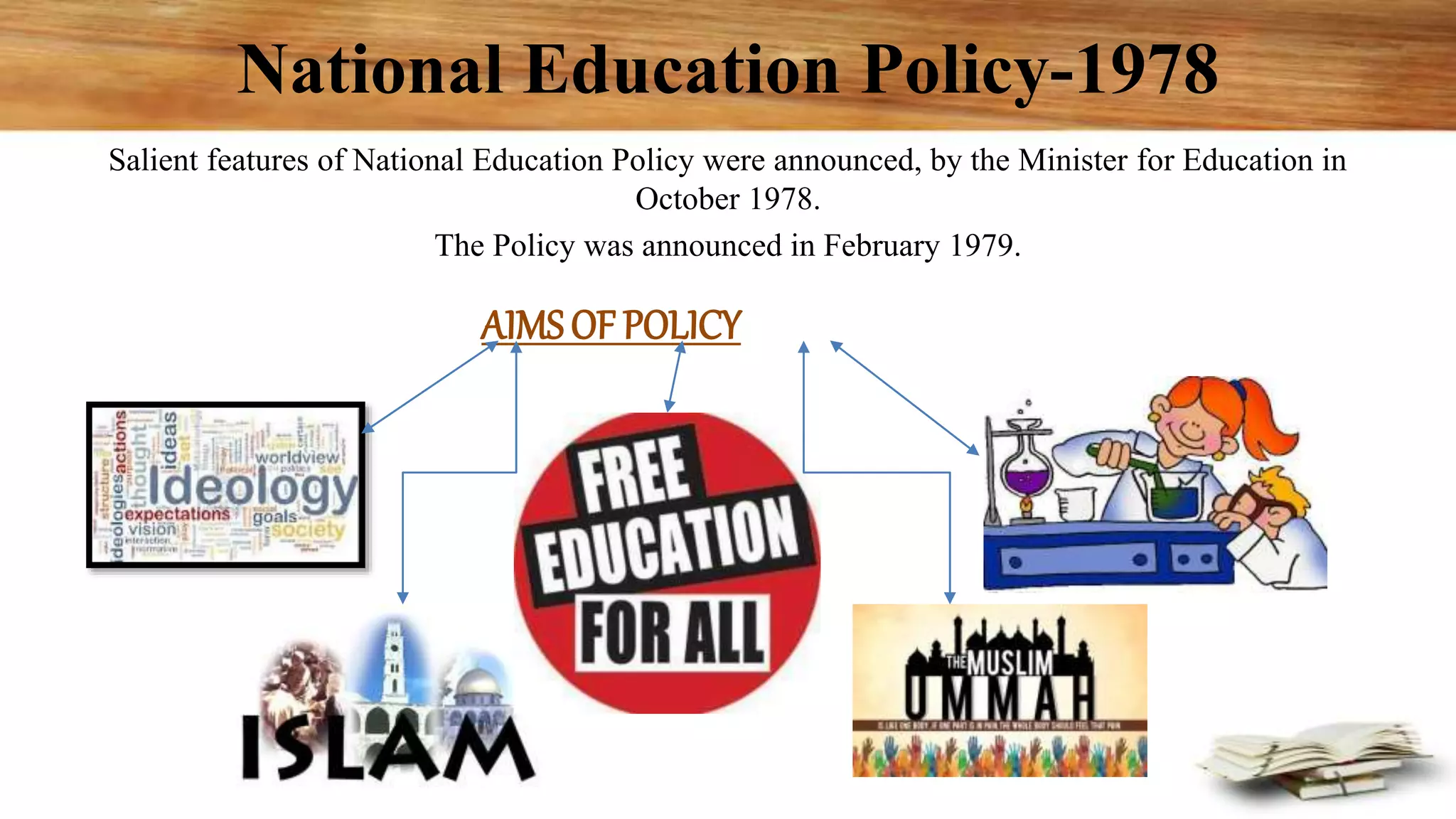
National Education Policy-1978
Salient features of National Education Policy were announced, by the Minister for Education in
October 1978.
The Policy was announced in February 1979.
AIMSOF POLICY
Features of Policy
PRIMARY
EDUCATION
• 17000 new PS
• 5000 Masjid
Schools
SECONDARY
EDUCATION
• Science labs, & hostels
• Second shift To increase
Enrollment
• Urdu- Medium of
Instruction
TECHNICAL &
VOCATIONAL
EDUCATION
• Short-Term
Courses in
Evening
Features of Policy
TEACHER
EDUCATION
• One in-service training
during every five years
SCIENCE
EDUCATION
• Special Coverage to
Science education in
Policy for first time
HIGHER EDUCATION
• College Education
• University Education
Implementation
This policy was not implemented
properly and failed due to lack of
planning and financial resources.
National Education Policy 1992
• A National Conference was held at Islamabad in April, 1991under
the chairmanship of the Federal Education Minister.
• The policy framework was discussed by the Education Minister
with the Education Committees of the Senate and the National
Assembly.
• The Policy was announced in December 1992.
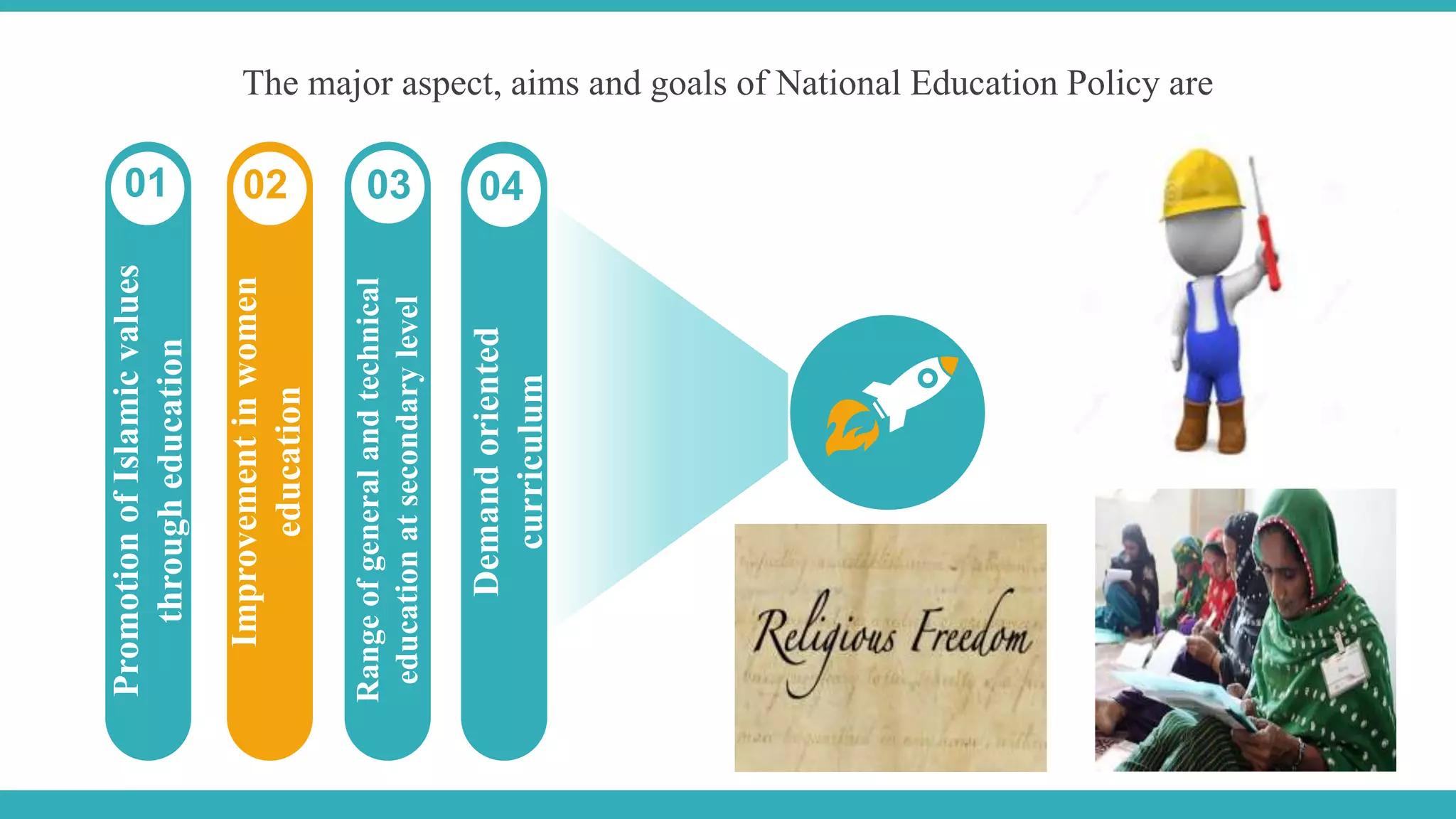
The major aspect, aims and goals of National Education Policy are
01 02 03 04
PromotionofIslamicvalues
througheducation
Improvementinwomen
education
Rangeofgeneralandtechnical
educationatsecondarylevel
Demandoriented
curriculum
National Education Policy 1998
• The Prime Minister advised the Ministry of Education to design a New
Education Policy in January 1998.
• The first revised draft was submitted to the Cabinet on 18 February, 1998.
• The Policy was announced in March 1998.
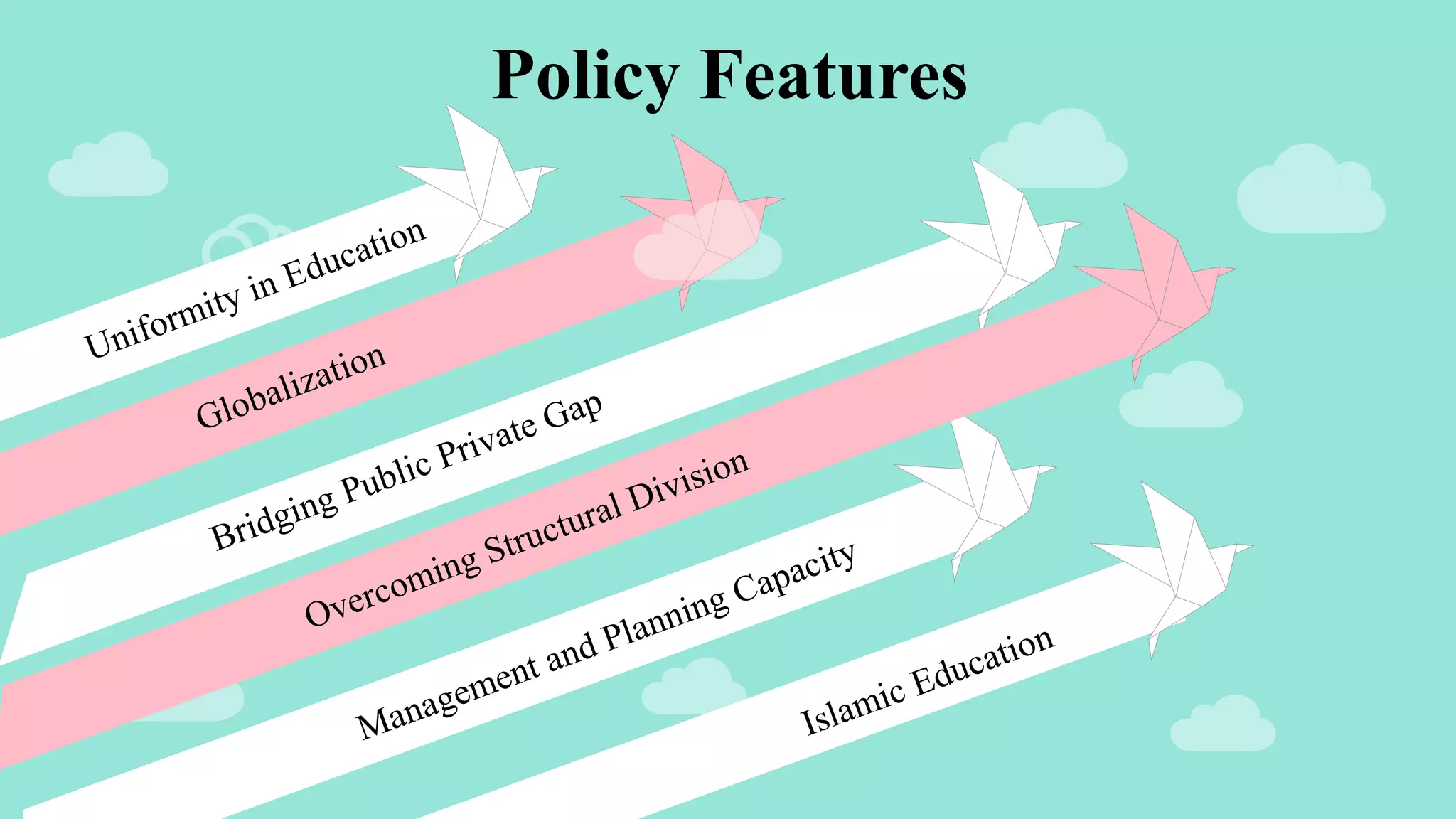
Policy Features
Elementary
Education
Issues &
Challenges
• Quality of Edu.
• Character
building on Islam
• Decentralization
& Accountability
• Teacher’s
competence
Higher
Education
• New disciplines of
emerging science
• Upgrading Labs &
Libraries
• M.Phil. & Ph.D. in
more Univ.
• Linkages with
Foreign Univ.
• Teachers Service
Training Academy
Secondary
Education
• Model Secondary
Schools at
District Level
• Project Method in
Teaching
• Education Service
Commission
• Multiple text
books
• Revised Salary
Structure
National Education Policy 2009
• Review Process for the National Education Policy 1998-2010
initiated in 2005
• First Document was finalized in March 2007
Old Policy was not producing
the desired educational results
and the performance remained
poor in several key aspects
including access, quality and
equity of educational
opportunities
Policy Features
Policy Features
References
• https://www.slideshare.net/d_reshetnikova/education-policy-15178687
• https://www.slideshare.net/RAFIULLAH13/national-education-policies-
of-pakistan
• https://www.slideshare.net/zulfazoufishan/different-education-policies-
of-pakistan
Thank you

education policies and development in pakistan 1947 to 2009

  • 1.
    Submitted By: GroupNo 7 Iqra Khurshid 04 Tahira Gilani 13 Rashna Asif 14 Mehwish Jabeen 21 Education policies and development
  • 2.
    Content National Education Policy,1972 All Pakistan Education Conference, 1947 New Education Policy, 1970 Commission on National Education, 1959 National Education Policy, 1978 National Education Policy, 2009 National Education Policy, 1998 National Education Policy, 1992
  • 3.
    Overview • Education policyrefers to the collection of laws and rules that govern the operation of education system. • Pakistan achieved independence from over a century of British colonial rule in August 1947. • The regions comprising Pakistan were relatively backward in all respects, including in education.
  • 4.
    First Educational Conference(1947) • First Education Conference was convened in 1947 in the supervision of Quaid-e-Azam. • It was held at Karachi from November 27th to December 1st, 1947. • He provided the basic guide lines for future education development. • It was also emphasis to realize the people the sense of honor, integrity and selfless services to the nation.
  • 5.
    Dimensions of Education •Education conference 1947 was presided by the Education Minister of the country and Chairman of the Conference, Fazal ur Rehman. • He proposed three dimensions of education.
  • 6.
    Proposed Committees byConference Adult Education Committee Technical Education Committee University Education Committee Scientific Research Committee Women’s Education Committee Cultural Relations Committee Primary and Secondary Education Committee
  • 7.
    National Commission OnEducation(1959) • The Commission was addressed by the President of Pakistan, General Mohammad Ayub Khan, on January 5, 1959. • In this commission compulsory education of 10 years was made. • Religious education be compulsory . • Equal expansion for boys and girls education.
  • 8.
    Features of Recommendations 1Character building 2 3 4 5 6 7 9 8 Elimination of illiteracy Three-year degree program Establishment of university grants commission. Compulsory primary education National language as medium of instruction Focus on science and technical education Examination system should be combination of internal (25%) and external (75%) evaluation. Religious education should be introduced
  • 9.
    Implementation The National EducationCommission recommendations were useful but due to the conditions of country and the situation of resources they were not applied well.
  • 10.
    New Education Policy(1970) • The revised proposals were reviewed by the committee of the Cabinet in the light of implications of the announcement by the President in his address to the nation on November 28, 1969. • The new Education Policy was finally adopted by the Cabinet on March 26, 1970.
  • 11.
    • Formation ofnational education units • Emphasis on ideological orientation • Emphasis on science and technology education • Decentralization of educational administration • Eradication of illiteracy This policy was not implemented due to the war with India, separation of East Pakistan, and the collapse of the military government. The new Education Policy has following salient features:
  • 12.
    Education Policy (1972) Salientfeatures of this policy are: • Promotion of ideology of Pakistan • Personality development • Equality in education • Integrated technical and science education • Active participation of teacher, students and parents in educational affairs Zulifqar Bhutto announced a National Education Policy on 29 March 1972.
  • 13.
    National Education Policy-1978 Salientfeatures of National Education Policy were announced, by the Minister for Education in October 1978. The Policy was announced in February 1979. AIMSOF POLICY
  • 14.
    Features of Policy PRIMARY EDUCATION •17000 new PS • 5000 Masjid Schools SECONDARY EDUCATION • Science labs, & hostels • Second shift To increase Enrollment • Urdu- Medium of Instruction TECHNICAL & VOCATIONAL EDUCATION • Short-Term Courses in Evening
  • 15.
    Features of Policy TEACHER EDUCATION •One in-service training during every five years SCIENCE EDUCATION • Special Coverage to Science education in Policy for first time HIGHER EDUCATION • College Education • University Education
  • 16.
    Implementation This policy wasnot implemented properly and failed due to lack of planning and financial resources.
  • 17.
    National Education Policy1992 • A National Conference was held at Islamabad in April, 1991under the chairmanship of the Federal Education Minister. • The policy framework was discussed by the Education Minister with the Education Committees of the Senate and the National Assembly. • The Policy was announced in December 1992.
  • 18.
    The major aspect,aims and goals of National Education Policy are 01 02 03 04 PromotionofIslamicvalues througheducation Improvementinwomen education Rangeofgeneralandtechnical educationatsecondarylevel Demandoriented curriculum
  • 19.
    National Education Policy1998 • The Prime Minister advised the Ministry of Education to design a New Education Policy in January 1998. • The first revised draft was submitted to the Cabinet on 18 February, 1998. • The Policy was announced in March 1998.
  • 20.
    Policy Features Elementary Education Issues & Challenges •Quality of Edu. • Character building on Islam • Decentralization & Accountability • Teacher’s competence Higher Education • New disciplines of emerging science • Upgrading Labs & Libraries • M.Phil. & Ph.D. in more Univ. • Linkages with Foreign Univ. • Teachers Service Training Academy Secondary Education • Model Secondary Schools at District Level • Project Method in Teaching • Education Service Commission • Multiple text books • Revised Salary Structure
  • 21.
    National Education Policy2009 • Review Process for the National Education Policy 1998-2010 initiated in 2005 • First Document was finalized in March 2007 Old Policy was not producing the desired educational results and the performance remained poor in several key aspects including access, quality and equity of educational opportunities
  • 22.
  • 23.
  • 24.
  • 25.