APPLICATION OF MICROBES
AS/IN BIOFUELS
BY
SHRUSHTI JOSHI
1850302
INTRODUCTION
• A biofuel is a fuel that is produced through contemporary biological processes, such as agriculture and
anaerobic digestion, rather than a fuel produced by geological processes such as those involved in the
formation of fossil fuels, such as coal and petroleum, from prehistoric biological matter.
BIOFUEL
PLANTS FUNGI MICROORGANISM
HISTORY
Nikolaus August
Otto developed his
prototype
of a spark ignition
engine in the 1860s
using ethanol
Eugen Langen
Deutz Gas Engine Works
designed one third of their heavy
locomotives to run on pure
ethanol in 1902.
Henry Ford car
company
marketed the
Model T, the “Tin
Lizzy”, running on
100% ethanol
BIOETHANOL
• Ethanol or ethyl alcohol (C2H5OH) is a clear colourless liquid, it is biodegradable, low in toxicity
and causes little environmental pollution if spilt. Ethanol burns to produce carbon dioxide and
water.
• Petrol substitute for road transport vehicles
• The basic steps for large scale production of ethanol are:
1]fermentation of sugars 2]Distillation 3]dehydration 4]denaturing
• Prior to fermentation, some crops require saccharification or hydrolysis of carbohydrates such as
cellulose and starch into sugars. Saccharification of cellulose is called cellulolysis (see cellulosic
ethanol). Enzymes are used to convert starch into sugar.
BACKGROUND
• Feedstocks include- wheat, grain, sugar cane,sugar
beet, Sweet sorghum, fruits [watermelon and dates]
• Microorganisms such as dried yeast or Saccharomyces
cerevisiae , S. diastaticus , Kluyveromyces marxianus,
Pichia kudriavzevii , Escherichia coli strain KO11 and
Klebsiella oxytoca strain P2, and Zymomonas mobilis.
• Optimum temperature – 30-35°C
• Three types of fermentation, such as batch, fed-batch,
or continuous.
• Two basic types of reactors- plug flow reactor and
continuous stirred tank reactor.
ADVANTAGES
• Cleaner exhaust gas
• Reduced production of green house gases
• Carbon neutral
• Decreased ozone formation
• Renewable energy resources
• Energy security
• Reduces amount of high octane additives
• Fuel spills are easily biodegraded
DISADVANTAGES
• Not as efficient as petroleum
• Use of phosphorous and nitrogen in production
• Cold start difficulties
• Biodiversity
• Food vs fuel debate
• Incompatible with old engines
BIODIESEL
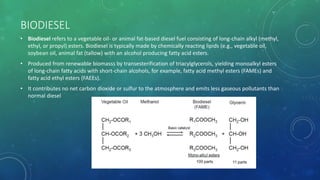
• Biodiesel refers to a vegetable oil- or animal fat-based diesel fuel consisting of long-chain alkyl (methyl,
ethyl, or propyl) esters. Biodiesel is typically made by chemically reacting lipids (e.g., vegetable oil,
soybean oil, animal fat (tallow) with an alcohol producing fatty acid esters.
• Produced from renewable biomasss by transesterification of triacylglycerols, yielding monoalkyl esters
of long-chain fatty acids with short-chain alcohols, for example, fatty acid methyl esters (FAMEs) and
fatty acid ethyl esters (FAEEs).
• It contributes no net carbon dioxide or sulfur to the atmosphere and emits less gaseous pollutants than
normal diesel
BACKGROUND
• Oleaginous microorganisms are defined as microbial with the content of microbial lipid excess of 20%.
• Biodiesel production using microbial lipids, which is named as single cell oils (SCO).
• Bacteria – Actinomycete group, Fungi- Rhodosporidium sp., Rhodotorula sp. and Lipomyces sp.
• Lipid accumulation in an oleaginous microorganism begins when it exhausts a nutrient from the medium (it
is usually nitrogen), but an excess of carbon (in the form of glucose) is still assimilated by the cells and is
converted into triacylglycerols (TAG).
• Two critical regulated enzymes, including malate enzyme and ATP: citrate lyase ACL), have effect on lipid
accumulation.
• 3 steps for the improvement of microbial lipid production-
• Screening for potential oleaginous microorganism
• Genetic and metabolic engineering
• Making full use of byproducts
PRODUCTION
ADVANTAGES
• Biodegradable
• Non toxic
• Favourable emissions profile
• Renewable
• Carbon neutrality
• Requires no engine modification
• High octane number and lubricity
DISADVANTAGES
• Lower energy content
• Poor cold weather performance
• Stability concerns
• Scalability
BIOGAS
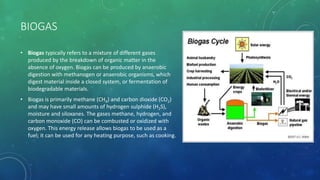
• Biogas typically refers to a mixture of different gases
produced by the breakdown of organic matter in the
absence of oxygen. Biogas can be produced by anaerobic
digestion with methanogen or anaerobic organisms, which
digest material inside a closed system, or fermentation of
biodegradable materials.
• Biogas is primarily methane (CH4) and carbon dioxide (CO2)
and may have small amounts of hydrogen sulphide (H2S),
moisture and siloxanes. The gases methane, hydrogen, and
carbon monoxide (CO) can be combusted or oxidized with
oxygen. This energy release allows biogas to be used as a
fuel; it can be used for any heating purpose, such as cooking.
BACKGROUND
• Biomass contains carbohydrates, proteins, fats, cellulose, and hemicellulose,
which can be used as feedstocks for biogas production.
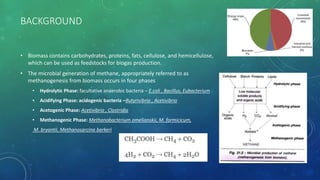
• The microbial generation of methane, appropriately referred to as
methanogenesis from biomass occurs in four phases
• Hydrolytic Phase: facultative anaerobic bacteria – E.coli , Bacillus, Eubacterium
• Acidifying Phase: acidogenic bacteria –Butyrivibrio , Acetivibrio
• Acetogenic Phase: Acetivibrio , Clostridia
• Methanogenic Phase: Methanobacterium omelianskii, M. formicicum,
M. bryantii, Methanosarcina barkeri
PRODUCTION
• The anaerobic digestion is usually carried out by anaerobic digesters.
• Anaerobic digestion can be performed as a batch process or a continuous process.
• he two conventional operational temperature levels for anaerobic digesters determine the species of
methanogens in the digesters:
• Mesophilic digestion takes place optimally around 30 to 38 °C, or at ambient temperatures between 20 and
45 °C, where mesophiles are the primary microorganism present.
• Thermophilic digestion takes place optimally around 49 to 57 °C, or at elevated temperatures up to 70 °C,
where thermophiles are the primary microorganisms present.
• Digestion systems can be configured with different levels of complexity
• single-stage digestion system (one-stage),
• two-stage digestion system (multistage)
ADVANTAGES
• High calorific value
• Clean fuel
• No residue produced
• No smoke produced
• Non polluting
• Economical
• Burns readily
DISADVANTAGES
• Explosion chances
• High capital lost
• Incorrect handling of liquid sludge cause
pollution
• Requires control and maintenance
• Needs proper condition
• Use as a fuel requires removal of CO2 and H2S
SOME OTHER FUELS
• Syngas a mixture of carbon monoxide, hydrogen and other hydrocarbons, is produced by partial
combustion of biomass, that is, combustion with an amount of oxygen that is not sufficient to convert
the biomass completely to carbon dioxide and water.
• Other bioalcohols -Methanol is currently produced from natural gas, a non-renewable fossil fuel. In the
future it is hoped to be produced from biomass as biomethanol.
• Bioethers are cost-effective compounds that act as octane rating enhancers.They are produced by the
reaction of reactive iso-olefins, such as iso-butylene, with bioethanol. Bioethers are created by wheat or
sugar beet.
• Solid biomass fuels examples include wood, sawdust, grass trimmings, domestic refuse, charcoal,
agricultural waste, nonfood energy crops, and dried manure. When solid biomass is already in a suitable
form , it can burn directly in a stove or furnace to provide heat or raise steam.
REFERENCES
• A Technological Overview of Biogas Production from Biowaste by
SpyridonAchinasaVasileiosAchinasbGerrit Jan WillemEuverinka
• Bioethanol Production from Fermentable Sugar Juice by
Hossain Zabed, 1 Golam Faruq, 1 ,* Jaya Narayan Sahu
• Biodiesel production from oleaginous microorganisms by
Xin Meng a, Jianming Yang a, Xin Xu a, Lei Zhang a, Qingjuan Nie b, Mo Xian a
• Biofuels from microbes by
Dominik Antoni & Vladimir V. Zverlov & Wolfgang H. Schwarz
THANK U

Microbes as biofuels

  • 1.
    APPLICATION OF MICROBES AS/INBIOFUELS BY SHRUSHTI JOSHI 1850302
  • 2.
    INTRODUCTION • A biofuelis a fuel that is produced through contemporary biological processes, such as agriculture and anaerobic digestion, rather than a fuel produced by geological processes such as those involved in the formation of fossil fuels, such as coal and petroleum, from prehistoric biological matter. BIOFUEL PLANTS FUNGI MICROORGANISM
  • 4.
    HISTORY Nikolaus August Otto developedhis prototype of a spark ignition engine in the 1860s using ethanol Eugen Langen Deutz Gas Engine Works designed one third of their heavy locomotives to run on pure ethanol in 1902. Henry Ford car company marketed the Model T, the “Tin Lizzy”, running on 100% ethanol
  • 5.
    BIOETHANOL • Ethanol orethyl alcohol (C2H5OH) is a clear colourless liquid, it is biodegradable, low in toxicity and causes little environmental pollution if spilt. Ethanol burns to produce carbon dioxide and water. • Petrol substitute for road transport vehicles • The basic steps for large scale production of ethanol are: 1]fermentation of sugars 2]Distillation 3]dehydration 4]denaturing • Prior to fermentation, some crops require saccharification or hydrolysis of carbohydrates such as cellulose and starch into sugars. Saccharification of cellulose is called cellulolysis (see cellulosic ethanol). Enzymes are used to convert starch into sugar.
  • 6.
    BACKGROUND • Feedstocks include-wheat, grain, sugar cane,sugar beet, Sweet sorghum, fruits [watermelon and dates] • Microorganisms such as dried yeast or Saccharomyces cerevisiae , S. diastaticus , Kluyveromyces marxianus, Pichia kudriavzevii , Escherichia coli strain KO11 and Klebsiella oxytoca strain P2, and Zymomonas mobilis. • Optimum temperature – 30-35°C • Three types of fermentation, such as batch, fed-batch, or continuous. • Two basic types of reactors- plug flow reactor and continuous stirred tank reactor.
  • 8.
    ADVANTAGES • Cleaner exhaustgas • Reduced production of green house gases • Carbon neutral • Decreased ozone formation • Renewable energy resources • Energy security • Reduces amount of high octane additives • Fuel spills are easily biodegraded DISADVANTAGES • Not as efficient as petroleum • Use of phosphorous and nitrogen in production • Cold start difficulties • Biodiversity • Food vs fuel debate • Incompatible with old engines
  • 9.
    BIODIESEL • Biodiesel refersto a vegetable oil- or animal fat-based diesel fuel consisting of long-chain alkyl (methyl, ethyl, or propyl) esters. Biodiesel is typically made by chemically reacting lipids (e.g., vegetable oil, soybean oil, animal fat (tallow) with an alcohol producing fatty acid esters. • Produced from renewable biomasss by transesterification of triacylglycerols, yielding monoalkyl esters of long-chain fatty acids with short-chain alcohols, for example, fatty acid methyl esters (FAMEs) and fatty acid ethyl esters (FAEEs). • It contributes no net carbon dioxide or sulfur to the atmosphere and emits less gaseous pollutants than normal diesel
  • 10.
    BACKGROUND • Oleaginous microorganismsare defined as microbial with the content of microbial lipid excess of 20%. • Biodiesel production using microbial lipids, which is named as single cell oils (SCO). • Bacteria – Actinomycete group, Fungi- Rhodosporidium sp., Rhodotorula sp. and Lipomyces sp. • Lipid accumulation in an oleaginous microorganism begins when it exhausts a nutrient from the medium (it is usually nitrogen), but an excess of carbon (in the form of glucose) is still assimilated by the cells and is converted into triacylglycerols (TAG). • Two critical regulated enzymes, including malate enzyme and ATP: citrate lyase ACL), have effect on lipid accumulation. • 3 steps for the improvement of microbial lipid production- • Screening for potential oleaginous microorganism • Genetic and metabolic engineering • Making full use of byproducts
  • 12.
  • 13.
    ADVANTAGES • Biodegradable • Nontoxic • Favourable emissions profile • Renewable • Carbon neutrality • Requires no engine modification • High octane number and lubricity DISADVANTAGES • Lower energy content • Poor cold weather performance • Stability concerns • Scalability
  • 14.
    BIOGAS • Biogas typicallyrefers to a mixture of different gases produced by the breakdown of organic matter in the absence of oxygen. Biogas can be produced by anaerobic digestion with methanogen or anaerobic organisms, which digest material inside a closed system, or fermentation of biodegradable materials. • Biogas is primarily methane (CH4) and carbon dioxide (CO2) and may have small amounts of hydrogen sulphide (H2S), moisture and siloxanes. The gases methane, hydrogen, and carbon monoxide (CO) can be combusted or oxidized with oxygen. This energy release allows biogas to be used as a fuel; it can be used for any heating purpose, such as cooking.
  • 15.
    BACKGROUND • Biomass containscarbohydrates, proteins, fats, cellulose, and hemicellulose, which can be used as feedstocks for biogas production. • The microbial generation of methane, appropriately referred to as methanogenesis from biomass occurs in four phases • Hydrolytic Phase: facultative anaerobic bacteria – E.coli , Bacillus, Eubacterium • Acidifying Phase: acidogenic bacteria –Butyrivibrio , Acetivibrio • Acetogenic Phase: Acetivibrio , Clostridia • Methanogenic Phase: Methanobacterium omelianskii, M. formicicum, M. bryantii, Methanosarcina barkeri
  • 16.
    PRODUCTION • The anaerobicdigestion is usually carried out by anaerobic digesters. • Anaerobic digestion can be performed as a batch process or a continuous process. • he two conventional operational temperature levels for anaerobic digesters determine the species of methanogens in the digesters: • Mesophilic digestion takes place optimally around 30 to 38 °C, or at ambient temperatures between 20 and 45 °C, where mesophiles are the primary microorganism present. • Thermophilic digestion takes place optimally around 49 to 57 °C, or at elevated temperatures up to 70 °C, where thermophiles are the primary microorganisms present. • Digestion systems can be configured with different levels of complexity • single-stage digestion system (one-stage), • two-stage digestion system (multistage)
  • 18.
    ADVANTAGES • High calorificvalue • Clean fuel • No residue produced • No smoke produced • Non polluting • Economical • Burns readily DISADVANTAGES • Explosion chances • High capital lost • Incorrect handling of liquid sludge cause pollution • Requires control and maintenance • Needs proper condition • Use as a fuel requires removal of CO2 and H2S
  • 19.
    SOME OTHER FUELS •Syngas a mixture of carbon monoxide, hydrogen and other hydrocarbons, is produced by partial combustion of biomass, that is, combustion with an amount of oxygen that is not sufficient to convert the biomass completely to carbon dioxide and water. • Other bioalcohols -Methanol is currently produced from natural gas, a non-renewable fossil fuel. In the future it is hoped to be produced from biomass as biomethanol. • Bioethers are cost-effective compounds that act as octane rating enhancers.They are produced by the reaction of reactive iso-olefins, such as iso-butylene, with bioethanol. Bioethers are created by wheat or sugar beet. • Solid biomass fuels examples include wood, sawdust, grass trimmings, domestic refuse, charcoal, agricultural waste, nonfood energy crops, and dried manure. When solid biomass is already in a suitable form , it can burn directly in a stove or furnace to provide heat or raise steam.
  • 20.
    REFERENCES • A TechnologicalOverview of Biogas Production from Biowaste by SpyridonAchinasaVasileiosAchinasbGerrit Jan WillemEuverinka • Bioethanol Production from Fermentable Sugar Juice by Hossain Zabed, 1 Golam Faruq, 1 ,* Jaya Narayan Sahu • Biodiesel production from oleaginous microorganisms by Xin Meng a, Jianming Yang a, Xin Xu a, Lei Zhang a, Qingjuan Nie b, Mo Xian a • Biofuels from microbes by Dominik Antoni & Vladimir V. Zverlov & Wolfgang H. Schwarz
  • 21.