Newborn stage
Zaid Ajil PhD, MSN
College of Nursing
University of Baghdad
Newborn stage
Newborn stage is the first 4 weeks or first
month of life. It is a transitional period
from intrauterine life to extra uterine
environment.
Physical growth of newborn
 - Weight = 2.700 – 4 kg
 - Wt loss 5% -10% by 3-4 days after birth
 - Wt gain by 10th days of life
 Note : They lose 5 % to 10 % of weight by 3-4 days after birth as result of :
 Withdrawal of hormones from mother.
 Loss of excessive extra cellular fluid.
 Passage of meconium (feces) and urine.
 Limited food intake.
Height
Height
 Boys average Ht = 50 cm
 Girls average Ht = 49 cm
 Normal range for both (47.5- 53.75 cm)
Head circumference
 33-35 cm
 Head is ¼ total body length
 Chest circumference It is 30.5 to 33cm (usually 2–3cm less than head
circumference).
 Skull has 2 fontanels (anterior & posterior)
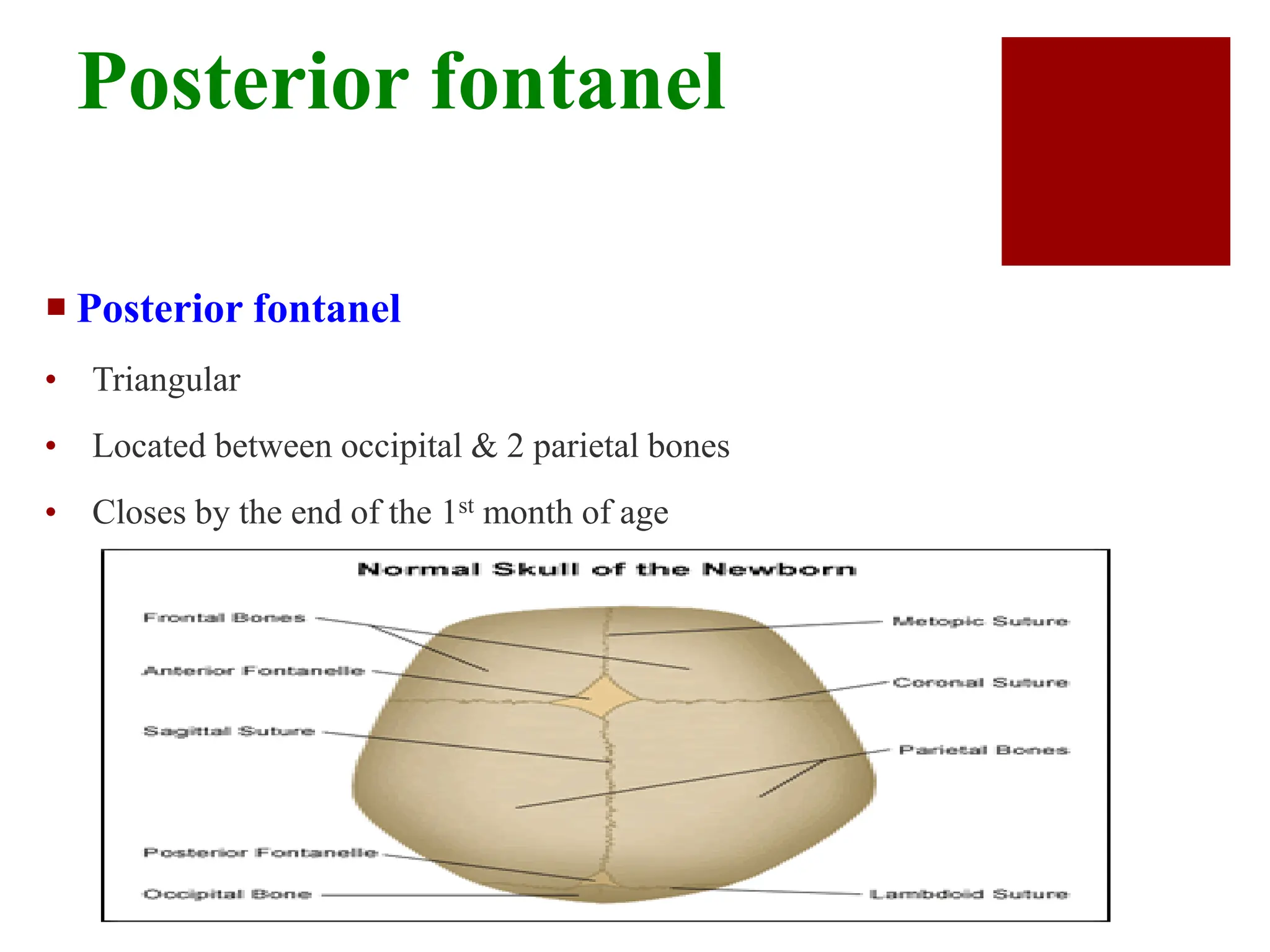
Posterior fontanel
 Posterior fontanel
• Triangular
• Located between occipital & 2 parietal bones
• Closes by the end of the 1st month of age
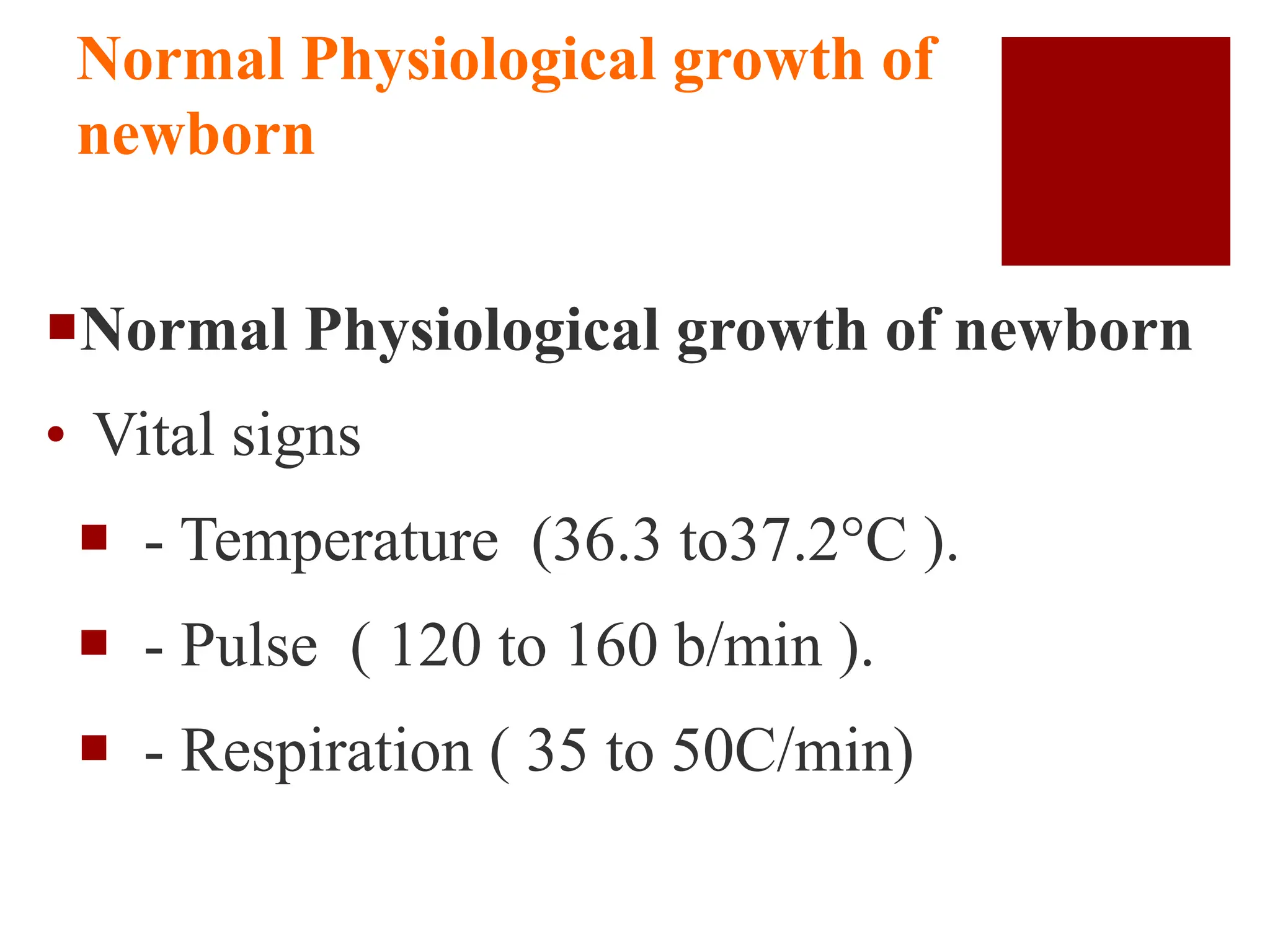
Normal Physiological growth of
newborn
Normal Physiological growth of newborn
• Vital signs
 - Temperature (36.3 to37.2C ).
 - Pulse ( 120 to 160 b/min ).
 - Respiration ( 35 to 50C/min)
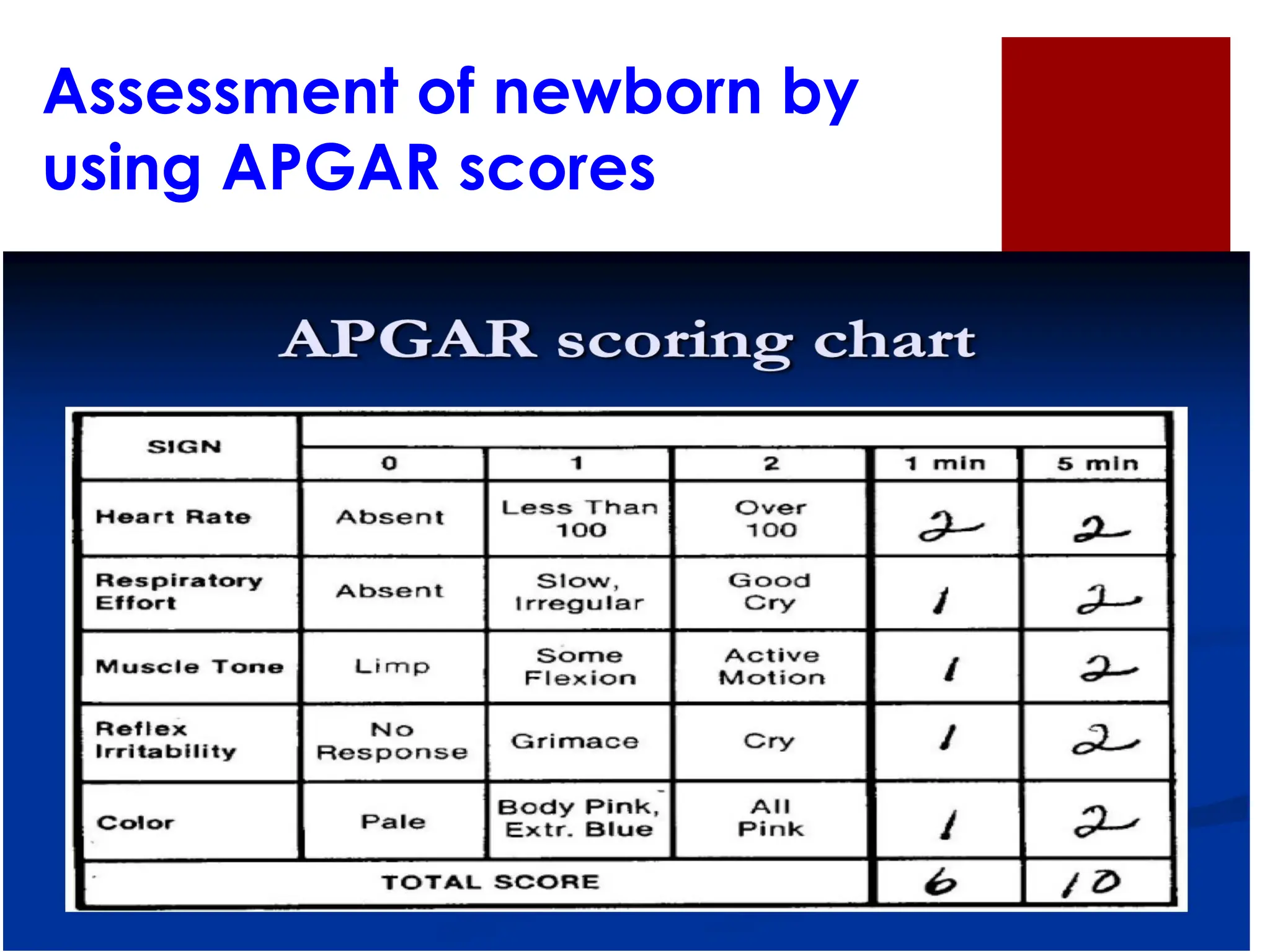
Assessment of newborn by
using APGAR scores
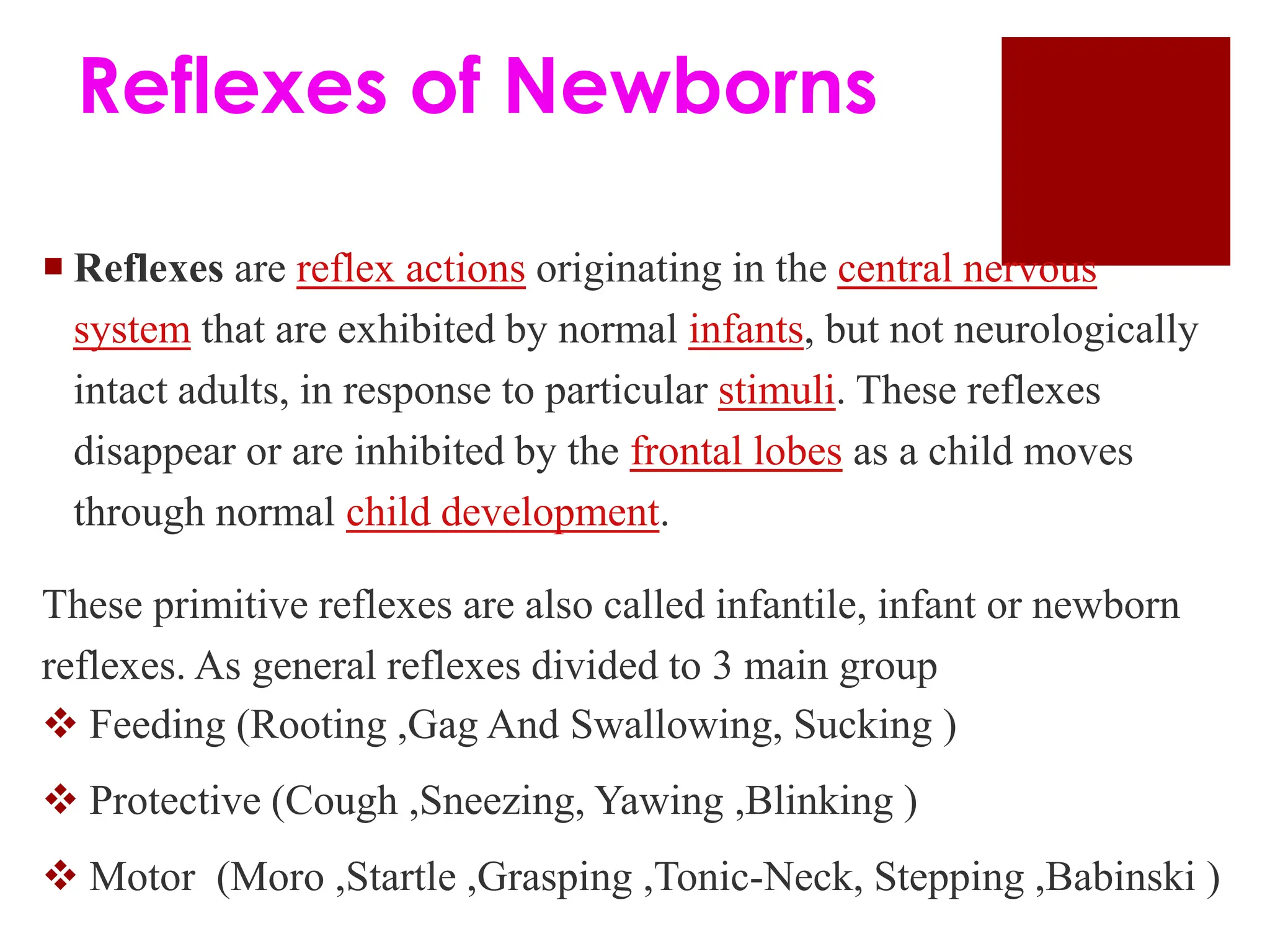
Reflexes of Newborns
 Reflexes are reflex actions originating in the central nervous
system that are exhibited by normal infants, but not neurologically
intact adults, in response to particular stimuli. These reflexes
disappear or are inhibited by the frontal lobes as a child moves
through normal child development.
These primitive reflexes are also called infantile, infant or newborn
reflexes. As general reflexes divided to 3 main group
 Feeding (Rooting ,Gag And Swallowing, Sucking )
 Protective (Cough ,Sneezing, Yawing ,Blinking )
 Motor (Moro ,Startle ,Grasping ,Tonic-Neck, Stepping ,Babinski )
The presence and strength of a
reflex is an important sign of
neurological development and
function .
Many infant reflexes as the child
grows older although some remain
throughout adulthood.
Protective Reflexes :
Reflexes that persist into adulthood are :
Blinking reflex – you blink your eyes when are
touched or when sudden bright appears
Cough reflex – you coughs when your airway is
stimulated
Gag reflex- you gag when the throat or back of
moth is stimulated .
Sneeze reflex – you sneeze when nasal passage
irritated .
Yawn reflex- you yawn when the body needs
additional oxygen .
 Sucking reflex sucks when area around mouth stimulated
 Rooting reflex: is elicited by stroking the cheek. The infant will
turn toward the side that was stroked and begin to make sucking
motions with is mouth.
 Gag R.
 Extrusion R. When tongue is touched or depressed infant
responds by foreign it outward.
 Swallowing R. This reflex is present at birth and persist throughout
life .
Grasping Reflex:
 When the inside of the palm is touched, babies grasp a finger
tightly.
Startle Reflex:
 When a baby is put down, held away, or hears a loud noise, a baby
throws out their arms, draw back their head and stretch out their
legs in response.
3.Movement Reflexes :
Babinski Reflex:
 Babies extend their toes when the soles of their feet are stroked.
Tonic neck reflex
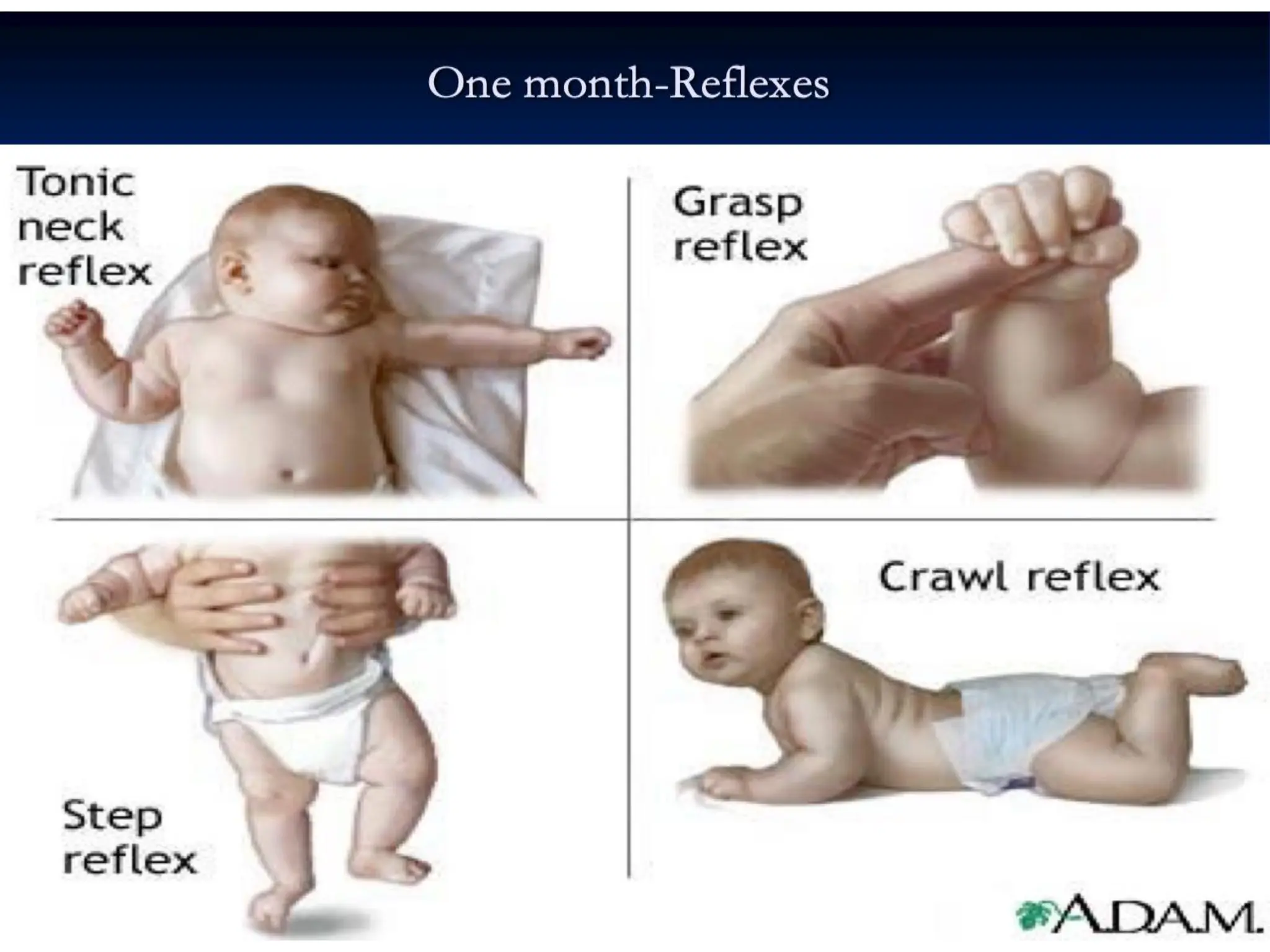
 The tonic neck reflex, also known as asymmetric tonic neck reflex
or 'fencing posture' is present at one month of age and disappears
at around four months. When the child's head is turned to the side,
the arm on that side will straighten and the opposite arm will bend
(sometimes the motion will be very subtle or slight).
3.Movement Reflexes :
Babinski’s reflex
A gentle stroke on the sole of the foot (from heel to toe)
.Foot turns in and toes flare up
Crawl R. :When placed on abdomen, infant
make crawling movement , with arms and legs .
Dance or step R. : Infants held sole of foot
touches a hard surface there is a reciprocal
flexion and extension of the leg. Simulating
walking ,
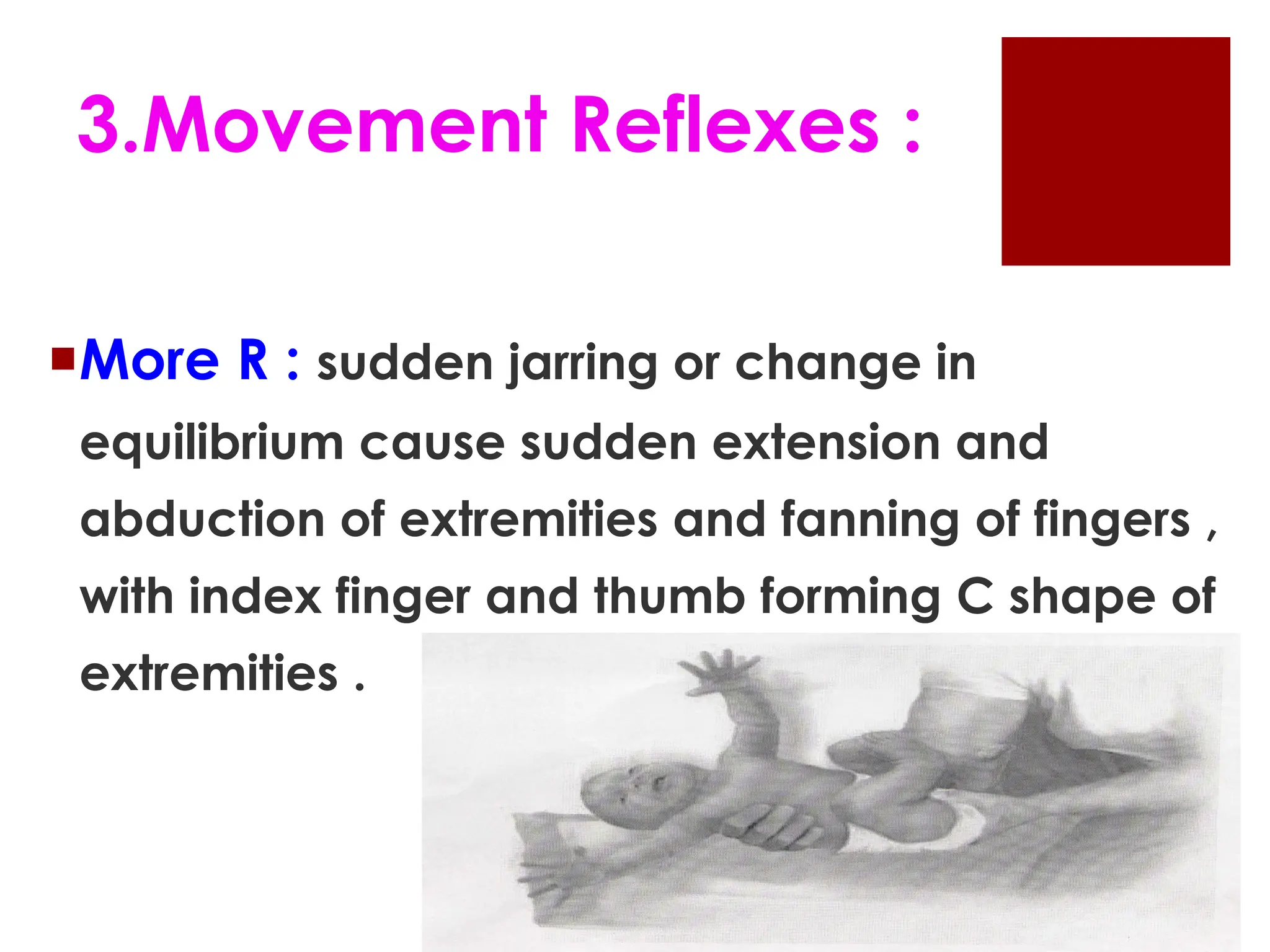
3.Movement Reflexes :
More R : sudden jarring or change in
equilibrium cause sudden extension and
abduction of extremities and fanning of fingers ,
with index finger and thumb forming C shape of
extremities .
References
 Rauch, Daniel (2006-10-05). "Infantile reflexes on MedLinePlus".
MedlinePlus. Retrieved 2007-10-11.
 Teitelbaum, O.; Benton, T.; Shah, P. K.; Prince, A.; Kelly, J. L.;
Teitelbaum, P. (2004). "Eshkol-Wachman movement notation in
diagnosis: the early detection of Asperger's syndrome". Proc. Natl.
Acad. Sci. U.S.A. 101 (32): 11909–14.
 Paro-Panjan, D; Neubauer, D; Kodric, J; Bratanic, B (Jan 2005).
"Amiel-Tison Neurological Assessment at term age: clinical
application, correlation with other methods, and outcome at 12 to
15 months". Developmental Medicine and Child Neurology. 47
(1): 19–26.
 Leroux, BG; N'guyen The Tich, S; Branger, B; Gascoin, G; Rouger,
V; Berlie, I; Montcho, Y; Ancel, PY; Rozé, JC; Flamant, C (22
February 2013). "Neurological assessment of preterm infants for
predicting neuromotor status at 2 years: results from the LIFT
cohort". BMJ Open. 3 (2): e002431. doi:10.1136/bmjopen-2012-
002431. PMC 3586154. PMID 23435797

Growth-Development-New-born-Infancy.pdf

  • 1.
    Newborn stage Zaid AjilPhD, MSN College of Nursing University of Baghdad
  • 2.
    Newborn stage Newborn stageis the first 4 weeks or first month of life. It is a transitional period from intrauterine life to extra uterine environment.
  • 3.
    Physical growth ofnewborn  - Weight = 2.700 – 4 kg  - Wt loss 5% -10% by 3-4 days after birth  - Wt gain by 10th days of life  Note : They lose 5 % to 10 % of weight by 3-4 days after birth as result of :  Withdrawal of hormones from mother.  Loss of excessive extra cellular fluid.  Passage of meconium (feces) and urine.  Limited food intake.
  • 4.
    Height Height  Boys averageHt = 50 cm  Girls average Ht = 49 cm  Normal range for both (47.5- 53.75 cm) Head circumference  33-35 cm  Head is ¼ total body length  Chest circumference It is 30.5 to 33cm (usually 2–3cm less than head circumference).  Skull has 2 fontanels (anterior & posterior)
  • 5.
    Posterior fontanel  Posteriorfontanel • Triangular • Located between occipital & 2 parietal bones • Closes by the end of the 1st month of age
  • 6.
    Normal Physiological growthof newborn Normal Physiological growth of newborn • Vital signs  - Temperature (36.3 to37.2C ).  - Pulse ( 120 to 160 b/min ).  - Respiration ( 35 to 50C/min)
  • 8.
    Assessment of newbornby using APGAR scores
  • 9.
    Reflexes of Newborns Reflexes are reflex actions originating in the central nervous system that are exhibited by normal infants, but not neurologically intact adults, in response to particular stimuli. These reflexes disappear or are inhibited by the frontal lobes as a child moves through normal child development. These primitive reflexes are also called infantile, infant or newborn reflexes. As general reflexes divided to 3 main group  Feeding (Rooting ,Gag And Swallowing, Sucking )  Protective (Cough ,Sneezing, Yawing ,Blinking )  Motor (Moro ,Startle ,Grasping ,Tonic-Neck, Stepping ,Babinski )
  • 10.
    The presence andstrength of a reflex is an important sign of neurological development and function . Many infant reflexes as the child grows older although some remain throughout adulthood.
  • 11.
    Protective Reflexes : Reflexesthat persist into adulthood are : Blinking reflex – you blink your eyes when are touched or when sudden bright appears Cough reflex – you coughs when your airway is stimulated Gag reflex- you gag when the throat or back of moth is stimulated . Sneeze reflex – you sneeze when nasal passage irritated . Yawn reflex- you yawn when the body needs additional oxygen .
  • 12.
     Sucking reflexsucks when area around mouth stimulated  Rooting reflex: is elicited by stroking the cheek. The infant will turn toward the side that was stroked and begin to make sucking motions with is mouth.  Gag R.  Extrusion R. When tongue is touched or depressed infant responds by foreign it outward.  Swallowing R. This reflex is present at birth and persist throughout life .
  • 13.
    Grasping Reflex:  Whenthe inside of the palm is touched, babies grasp a finger tightly. Startle Reflex:  When a baby is put down, held away, or hears a loud noise, a baby throws out their arms, draw back their head and stretch out their legs in response. 3.Movement Reflexes :
  • 14.
    Babinski Reflex:  Babiesextend their toes when the soles of their feet are stroked. Tonic neck reflex  The tonic neck reflex, also known as asymmetric tonic neck reflex or 'fencing posture' is present at one month of age and disappears at around four months. When the child's head is turned to the side, the arm on that side will straighten and the opposite arm will bend (sometimes the motion will be very subtle or slight). 3.Movement Reflexes :
  • 15.
    Babinski’s reflex A gentlestroke on the sole of the foot (from heel to toe) .Foot turns in and toes flare up Crawl R. :When placed on abdomen, infant make crawling movement , with arms and legs . Dance or step R. : Infants held sole of foot touches a hard surface there is a reciprocal flexion and extension of the leg. Simulating walking , 3.Movement Reflexes :
  • 17.
    3.Movement Reflexes : MoreR : sudden jarring or change in equilibrium cause sudden extension and abduction of extremities and fanning of fingers , with index finger and thumb forming C shape of extremities .
  • 19.
    References  Rauch, Daniel(2006-10-05). "Infantile reflexes on MedLinePlus". MedlinePlus. Retrieved 2007-10-11.  Teitelbaum, O.; Benton, T.; Shah, P. K.; Prince, A.; Kelly, J. L.; Teitelbaum, P. (2004). "Eshkol-Wachman movement notation in diagnosis: the early detection of Asperger's syndrome". Proc. Natl. Acad. Sci. U.S.A. 101 (32): 11909–14.  Paro-Panjan, D; Neubauer, D; Kodric, J; Bratanic, B (Jan 2005). "Amiel-Tison Neurological Assessment at term age: clinical application, correlation with other methods, and outcome at 12 to 15 months". Developmental Medicine and Child Neurology. 47 (1): 19–26.  Leroux, BG; N'guyen The Tich, S; Branger, B; Gascoin, G; Rouger, V; Berlie, I; Montcho, Y; Ancel, PY; Rozé, JC; Flamant, C (22 February 2013). "Neurological assessment of preterm infants for predicting neuromotor status at 2 years: results from the LIFT cohort". BMJ Open. 3 (2): e002431. doi:10.1136/bmjopen-2012- 002431. PMC 3586154. PMID 23435797