New Born Health Assessment  Gwen Sollestre Diana Rivera Chris Mach Abigail Krywry Ivette Sanchez
Objectives  Identify the purpose of components of the APGAR score Describe the method for estimating the gestational age of a newborn Identify the sequence to follow in assessment of the newborn Recognize deviations from normal findings during examination of the newborn
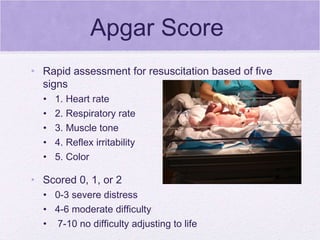
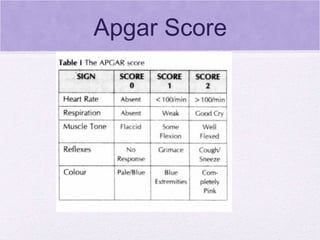
Apgar Score  Rapid assessment for resuscitation based of five signs 1. Heart rate 2. Respiratory rate 3. Muscle tone 4. Reflex irritability 5. Color Scored 0, 1, or 2  0-3 severe distress 4-6 moderate difficulty 7-10 no difficulty adjusting to life Based on 1-5 min after birth
Apgar Score
Initial Assessment External Skin color, staining, peeling, wasting, birthmarks, length of nails, nasal patency Chest Palpate PMI, auscultate rate and quality of heart tones, murmurs, character of respirations, equality of breath sounds on each side of chest Abdomen Rounded abdomen, absence  of anomalies, number of vessels in cord Neurological  Muscle tone, reflex reaction, Moro reflex, palpate anterior fontanel for fullness or bulge, presence of size of fontanels and sutures
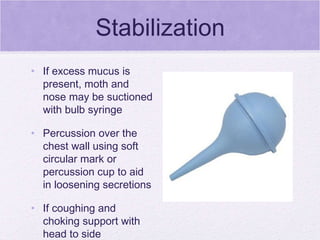
Stabilization If excess mucus is present, moth and nose may be suctioned with bulb syringe Percussion over the chest wall using soft circular mark or percussion cup to aid in loosening secretions If coughing and choking support with head to side
Thermoregulation Cold stress is detrimental, increases need for oxygen and upset acid and base balance Place infant on mother abdomen with warm blanket, drying and wrapping the newborn in warmed blankets right after birth, keeping head well covered,  keep in nursery at 24 degrees Celsius Baby warmer 36-37 degrees Celsius Axillary temp every hour until stable
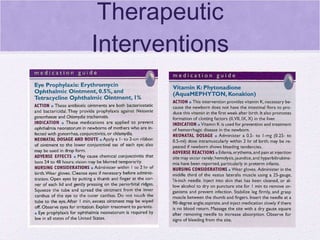
Therapeutic Interventions
Nursing Diagnoses Ineffective airway clearance related to airway obstruction with mucus Impaired gas exchange related to hypothermia Ineffective thermoregulation related to heat loss to the environment Risk for infection related to umbilical cord stump/fetal scalp electrode sites
Measurements Assessing a newborn's weight: The average weight for term babies (born between 37 and 41 weeks gestation) is about 7 lbs (3.2 kg).  In general, small babies and very large babies are more likely to have problems.  In most cases the metric system is used for weighing babies.
Measurements Converting grams to pounds and ounces: 1 lb. = 453.59237 grams  1 oz. = 28.349523 grams  1000 grams = 1 kg Newborn Length:  Head circumference - the distance around the baby's head (head circumference is normally about 1/2 the baby's body length plus 10 cm). abdominal circumference - the distance around the abdomen. length - the measurement from crown of head to the heel.
Gestational Age Head: normal measurements  32-37 cm (12.5-14.5 in); should be 2cm larger than chest circumference Length: normal measurements  48-52 cm (18-22 in) Weight: normal measurements  2500-4000 g (5lbs 8oz-8lbs 13oz) The Dubowitz/Ballard Examination Points are given for each area of assessment: Skin textures (sticky, smooth, peeling) Lanugo (the soft downy hair on a baby's body) - is absent in immature babies Plantar creases - range from absent to covering the entire foot Breast - the thickness and size of breast tissue and areola  Eyes and ears - eyes fused or open and amount of cartilage and stiffness of the ear tissue. Genitals, male - presence of testes and appearance of scrotum, from smooth to wrinkled. Genitals, female - appearance and size of the clitoris and the labia.
Physical Examination Temperature – normal axillary temperature 36.5    - 37.2    C in normal room environment; stabilized by 8-10 hours of age. Pulse - normally 120 to160 beats per minute; listen for 1 FULL minute. Blood pressure – 80-90/40-50 mm Hg; use 2.5 cm wide cuff. Respiration rate - normally 30 to 60 breaths per minute
 Vital Signs
Physical Assessment Skin: generally pink (varying with ethnic origin), no skin edema with vernix caseosa and lanugo, check for jaundice. Face: characteristics normal & symmetrical, patency in orifices, imaginary line drawn through eyes reaching to top notch of ears.  No tears.  Responds to hearing voices & other sounds.  Epstein’s pearls. Has rooting, sucking and extrusion reflexes. Head: ¼ of body length, molding.  Check for abnormalities with the fonatels, sutures and hair.
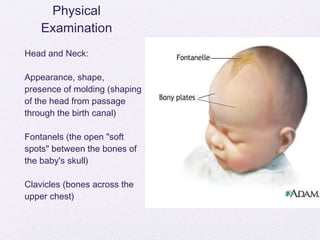
Physical Examination Head and Neck: Appearance, shape, presence of molding (shaping of the head from passage through the birth canal) Fontanels (the open "soft spots" between the bones of the baby's skull) Clavicles (bones across the upper chest)
Physical Examination General Appearance Physical activity Muscle tone Posture  Level of consciousness 
 Skin Color  Texture  Nails  Presence of rashes
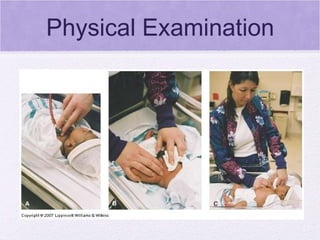
Physical Examination Face - eyes, ears, nose, cheeks Mouth - palate, tongue, throat Lungs - breath sounds, breathing pattern Heart sounds and femoral (in the groin) pulses Abdomen - presence of masses or hernias Genitals and anus - for open passage of urine and stool Arms and legs - movement and development
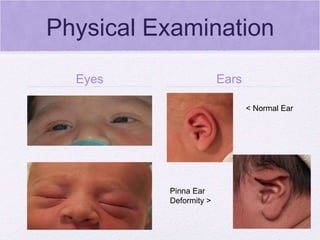
Physical Examination Eyes Ears < Normal Ear Pinna Ear Deformity >
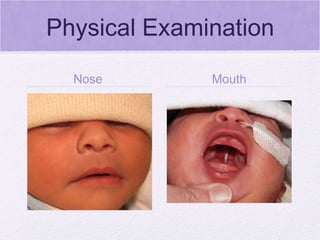
Physical Examination Nose  Mouth
Physical Examination
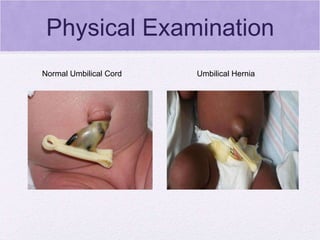
Physical Examination Normal Umbilical Cord  Umbilical Hernia
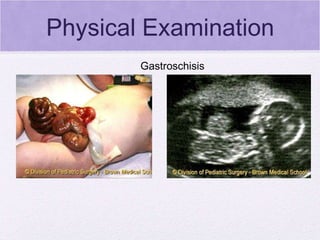
Physical Examination Gastroschisis
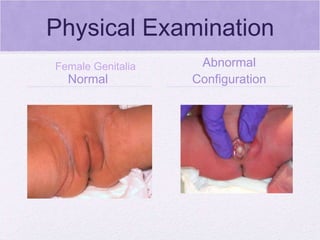
Physical Examination Normal  Abnormal Configuration Female Genitalia
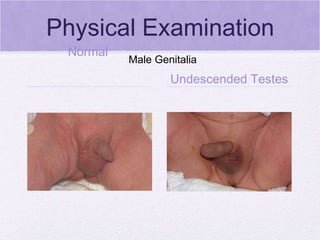
Physical Examination Normal  Undescended Testes Male Genitalia
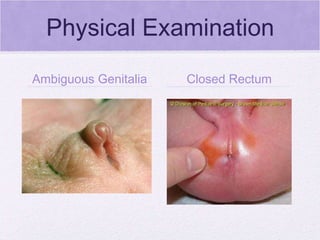
Physical Examination Ambiguous Genitalia Closed Rectum
Neuromuscular Maturity Neuromuscular system evaluation:  -Gestational maturity rating is measured after the baby is born by the Ballard Scale, it consists of six evaluation areas of Neuromuscular maturity and seven items of physical maturity -A score is assigned to each area. The more neurologically mature the baby, the higher the score.
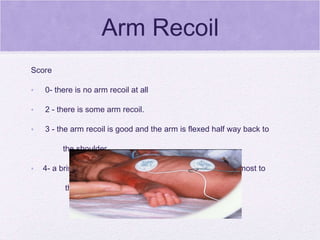
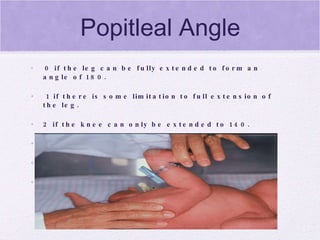
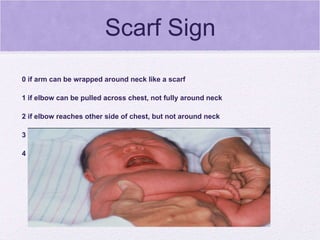
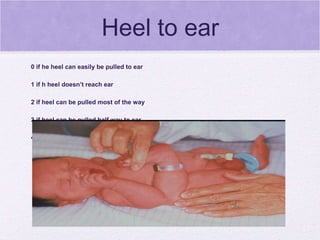
Neuromuscular Maturity Neuromuscular system evaluation, includes: Posture - how does the baby hold his/her arms and legs Square window - how far the baby's hands can be flexed toward the wrist Arm recoil - how far the baby's arms &quot;spring back&quot; to a flexed position Popliteal angle - how far the baby's knees extend Scarf sign - how far the elbows can be moved across the baby's chest Heel to ear - how close the baby's feet can be moved to the ears.
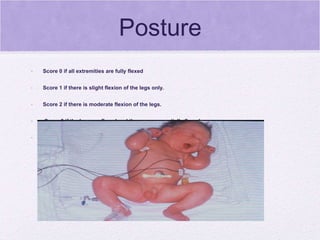
Posture Score 0 if all extremities are fully flexed Score 1 if there is slight flexion of the legs only.  Score 2 if there is moderate flexion of the legs.  Score 3 if the legs are flexed and the arms are partially flexed.  Score 4 if all limbs are fully flexed against the body
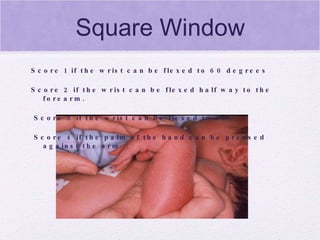
Square Window Score 1 if the wrist can be flexed to 60 degrees Score 2 if the wrist can be flexed half way to the forearm.  Score 3 if the wrist can be flexed to 30.  Score 4 if the palm of the hand can be pressed against the arm
Arm Recoil Score 0- there is no arm recoil at all 2 - there is some arm recoil.  3 - the arm recoil is good and the arm is flexed half way back to   the shoulder 4- a brisk arm recoil and the infant pulls the arm back almost to   the shoulder.
Popitleal Angle 0 if the leg can be fully extended to form an angle of 180.  1 if there is some limitation to full extension of the leg.  2 if the knee can only be extended to 140.  3 if the knee can be extended just beyond 90.  4 if the knee can be extended to 90.  5 if the knee cannot be extended to 90
Scarf Sign 0 if arm can be wrapped around neck like a scarf 1 if elbow can be pulled across chest, not fully around neck 2 if elbow reaches other side of chest, but not around neck 3 if elbow only reaches midline of chest 4 if elbow cannot be pulled as far as the midline
Heel to ear 0 if he heel can easily be pulled to ear 1 if h heel doesn’t reach ear 2 if heel can be pulled most of the way 3 if heel can be pulled half way to ear 4 if heel cannot be pulled half way to ear
Assessment of Reflexes Rooting & Sucking: touch infant’s lip, cheek or corner of mouth with pacifier -Infant turns head toward stimulus, opens mouth, takes hold and sucks Grasp: Palmar - (between 3-4 months) Place finger in palm of hand -Infants finger curl around examiners fingers Plantar- ( lessens by 8 months) Place finger at base of toes -infants toes curl downward
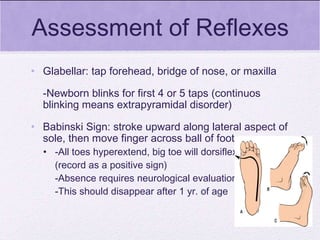
Assessment of Reflexes Glabellar: tap forehead, bridge of nose, or maxilla -Newborn blinks for first 4 or 5 taps (continuos blinking means extrapyramidal disorder) Babinski Sign: stroke upward along lateral aspect of sole, then move finger across ball of foot -All toes hyperextend, big toe will dorsiflex (record as a positive sign) -Absence requires neurological evaluation -This should disappear after 1 yr. of age
Assessment of Reflexes Stepping or Walking: Hold infant vertically allowing one foot to touch table surface -Infant will simulate walking, term infant walk on soles of feet & preterm walk on their toes Crawling: place newborn on abdomen -newborn makes crawling movements with arms and legs (disappears at 6 wk of age)
Nutrition An Infant may be put to breast feed shortly after birth or at least within 4 hours of birth. Most infants are on demand feeding schedules and are allowed to fed when they awaken Usually mothers are encouraged to feed their children every 3 to 4 hours during the day, and only when the when the infant awakens during the night for the first few days after work Formula fed infants usually eat every 3 to 4 hours Water supplements are not recommended
Diagnostic Tests Blood glucose levels  Urinalysis  Bilirubin levels  CBC Methods:  heel-stick blood sample is obtained to detect a variety of congenital conditions. Screening mandated by law, all states screen for  phenylketonuria  (PKU) and hypothyroidism, but each state determines which test is administered.
References Assessment of Growth of Infants Fed a New Formula - Full Text View - ClinicalTrials.gov.&quot;  Home - ClinicalTrials.gov. Web. 07 May 2010. <http://clinicaltrials.gov/ct2/show/NCT00937014>. Excellent Care from the Moment of Birth. Web. 07 May 2010. <http://newborns.stanford.edu/>. HMHB - Home. Web. 07 May 2010. <http://www.hmhb.org/parent.html#new>. Olds, Sally B.,  Maternal-newborn Nursing & Women's Healthcare. Upper Saddle River, N.J.: Pearson/Prentice Hall, 2004. Print

Newborn Health Assessment

  • 1.
    New Born HealthAssessment Gwen Sollestre Diana Rivera Chris Mach Abigail Krywry Ivette Sanchez
  • 2.
    Objectives Identifythe purpose of components of the APGAR score Describe the method for estimating the gestational age of a newborn Identify the sequence to follow in assessment of the newborn Recognize deviations from normal findings during examination of the newborn
  • 3.
    Apgar Score Rapid assessment for resuscitation based of five signs 1. Heart rate 2. Respiratory rate 3. Muscle tone 4. Reflex irritability 5. Color Scored 0, 1, or 2 0-3 severe distress 4-6 moderate difficulty 7-10 no difficulty adjusting to life Based on 1-5 min after birth
  • 4.
  • 5.
    Initial Assessment ExternalSkin color, staining, peeling, wasting, birthmarks, length of nails, nasal patency Chest Palpate PMI, auscultate rate and quality of heart tones, murmurs, character of respirations, equality of breath sounds on each side of chest Abdomen Rounded abdomen, absence of anomalies, number of vessels in cord Neurological Muscle tone, reflex reaction, Moro reflex, palpate anterior fontanel for fullness or bulge, presence of size of fontanels and sutures
  • 6.
    Stabilization If excessmucus is present, moth and nose may be suctioned with bulb syringe Percussion over the chest wall using soft circular mark or percussion cup to aid in loosening secretions If coughing and choking support with head to side
  • 7.
    Thermoregulation Cold stressis detrimental, increases need for oxygen and upset acid and base balance Place infant on mother abdomen with warm blanket, drying and wrapping the newborn in warmed blankets right after birth, keeping head well covered, keep in nursery at 24 degrees Celsius Baby warmer 36-37 degrees Celsius Axillary temp every hour until stable
  • 8.
  • 9.
    Nursing Diagnoses Ineffectiveairway clearance related to airway obstruction with mucus Impaired gas exchange related to hypothermia Ineffective thermoregulation related to heat loss to the environment Risk for infection related to umbilical cord stump/fetal scalp electrode sites
  • 10.
    Measurements Assessing anewborn's weight: The average weight for term babies (born between 37 and 41 weeks gestation) is about 7 lbs (3.2 kg). In general, small babies and very large babies are more likely to have problems. In most cases the metric system is used for weighing babies.
  • 11.
    Measurements Converting gramsto pounds and ounces: 1 lb. = 453.59237 grams 1 oz. = 28.349523 grams 1000 grams = 1 kg Newborn Length: Head circumference - the distance around the baby's head (head circumference is normally about 1/2 the baby's body length plus 10 cm). abdominal circumference - the distance around the abdomen. length - the measurement from crown of head to the heel.
  • 12.
    Gestational Age Head:normal measurements 32-37 cm (12.5-14.5 in); should be 2cm larger than chest circumference Length: normal measurements 48-52 cm (18-22 in) Weight: normal measurements 2500-4000 g (5lbs 8oz-8lbs 13oz) The Dubowitz/Ballard Examination Points are given for each area of assessment: Skin textures (sticky, smooth, peeling) Lanugo (the soft downy hair on a baby's body) - is absent in immature babies Plantar creases - range from absent to covering the entire foot Breast - the thickness and size of breast tissue and areola Eyes and ears - eyes fused or open and amount of cartilage and stiffness of the ear tissue. Genitals, male - presence of testes and appearance of scrotum, from smooth to wrinkled. Genitals, female - appearance and size of the clitoris and the labia.
  • 13.
    Physical Examination Temperature– normal axillary temperature 36.5  - 37.2  C in normal room environment; stabilized by 8-10 hours of age. Pulse - normally 120 to160 beats per minute; listen for 1 FULL minute. Blood pressure – 80-90/40-50 mm Hg; use 2.5 cm wide cuff. Respiration rate - normally 30 to 60 breaths per minute
 Vital Signs
  • 14.
    Physical Assessment Skin:generally pink (varying with ethnic origin), no skin edema with vernix caseosa and lanugo, check for jaundice. Face: characteristics normal & symmetrical, patency in orifices, imaginary line drawn through eyes reaching to top notch of ears. No tears. Responds to hearing voices & other sounds. Epstein’s pearls. Has rooting, sucking and extrusion reflexes. Head: ¼ of body length, molding. Check for abnormalities with the fonatels, sutures and hair.
  • 15.
    Physical Examination Headand Neck: Appearance, shape, presence of molding (shaping of the head from passage through the birth canal) Fontanels (the open &quot;soft spots&quot; between the bones of the baby's skull) Clavicles (bones across the upper chest)
  • 16.
    Physical Examination GeneralAppearance Physical activity Muscle tone Posture Level of consciousness 
 Skin Color Texture Nails Presence of rashes
  • 17.
    Physical Examination Face- eyes, ears, nose, cheeks Mouth - palate, tongue, throat Lungs - breath sounds, breathing pattern Heart sounds and femoral (in the groin) pulses Abdomen - presence of masses or hernias Genitals and anus - for open passage of urine and stool Arms and legs - movement and development
  • 18.
    Physical Examination EyesEars < Normal Ear Pinna Ear Deformity >
  • 19.
  • 20.
  • 21.
    Physical Examination NormalUmbilical Cord Umbilical Hernia
  • 22.
  • 23.
    Physical Examination Normal Abnormal Configuration Female Genitalia
  • 24.
    Physical Examination Normal Undescended Testes Male Genitalia
  • 25.
    Physical Examination AmbiguousGenitalia Closed Rectum
  • 26.
    Neuromuscular Maturity Neuromuscularsystem evaluation: -Gestational maturity rating is measured after the baby is born by the Ballard Scale, it consists of six evaluation areas of Neuromuscular maturity and seven items of physical maturity -A score is assigned to each area. The more neurologically mature the baby, the higher the score.
  • 27.
    Neuromuscular Maturity Neuromuscularsystem evaluation, includes: Posture - how does the baby hold his/her arms and legs Square window - how far the baby's hands can be flexed toward the wrist Arm recoil - how far the baby's arms &quot;spring back&quot; to a flexed position Popliteal angle - how far the baby's knees extend Scarf sign - how far the elbows can be moved across the baby's chest Heel to ear - how close the baby's feet can be moved to the ears.
  • 28.
    Posture Score 0if all extremities are fully flexed Score 1 if there is slight flexion of the legs only. Score 2 if there is moderate flexion of the legs. Score 3 if the legs are flexed and the arms are partially flexed. Score 4 if all limbs are fully flexed against the body
  • 29.
    Square Window Score1 if the wrist can be flexed to 60 degrees Score 2 if the wrist can be flexed half way to the forearm. Score 3 if the wrist can be flexed to 30. Score 4 if the palm of the hand can be pressed against the arm
  • 30.
    Arm Recoil Score0- there is no arm recoil at all 2 - there is some arm recoil. 3 - the arm recoil is good and the arm is flexed half way back to the shoulder 4- a brisk arm recoil and the infant pulls the arm back almost to the shoulder.
  • 31.
    Popitleal Angle 0if the leg can be fully extended to form an angle of 180. 1 if there is some limitation to full extension of the leg. 2 if the knee can only be extended to 140. 3 if the knee can be extended just beyond 90. 4 if the knee can be extended to 90. 5 if the knee cannot be extended to 90
  • 32.
    Scarf Sign 0if arm can be wrapped around neck like a scarf 1 if elbow can be pulled across chest, not fully around neck 2 if elbow reaches other side of chest, but not around neck 3 if elbow only reaches midline of chest 4 if elbow cannot be pulled as far as the midline
  • 33.
    Heel to ear0 if he heel can easily be pulled to ear 1 if h heel doesn’t reach ear 2 if heel can be pulled most of the way 3 if heel can be pulled half way to ear 4 if heel cannot be pulled half way to ear
  • 34.
    Assessment of ReflexesRooting & Sucking: touch infant’s lip, cheek or corner of mouth with pacifier -Infant turns head toward stimulus, opens mouth, takes hold and sucks Grasp: Palmar - (between 3-4 months) Place finger in palm of hand -Infants finger curl around examiners fingers Plantar- ( lessens by 8 months) Place finger at base of toes -infants toes curl downward
  • 35.
    Assessment of ReflexesGlabellar: tap forehead, bridge of nose, or maxilla -Newborn blinks for first 4 or 5 taps (continuos blinking means extrapyramidal disorder) Babinski Sign: stroke upward along lateral aspect of sole, then move finger across ball of foot -All toes hyperextend, big toe will dorsiflex (record as a positive sign) -Absence requires neurological evaluation -This should disappear after 1 yr. of age
  • 36.
    Assessment of ReflexesStepping or Walking: Hold infant vertically allowing one foot to touch table surface -Infant will simulate walking, term infant walk on soles of feet & preterm walk on their toes Crawling: place newborn on abdomen -newborn makes crawling movements with arms and legs (disappears at 6 wk of age)
  • 37.
    Nutrition An Infantmay be put to breast feed shortly after birth or at least within 4 hours of birth. Most infants are on demand feeding schedules and are allowed to fed when they awaken Usually mothers are encouraged to feed their children every 3 to 4 hours during the day, and only when the when the infant awakens during the night for the first few days after work Formula fed infants usually eat every 3 to 4 hours Water supplements are not recommended
  • 38.
    Diagnostic Tests Bloodglucose levels Urinalysis Bilirubin levels CBC Methods: heel-stick blood sample is obtained to detect a variety of congenital conditions. Screening mandated by law, all states screen for phenylketonuria (PKU) and hypothyroidism, but each state determines which test is administered.
  • 39.
    References Assessment ofGrowth of Infants Fed a New Formula - Full Text View - ClinicalTrials.gov.&quot; Home - ClinicalTrials.gov. Web. 07 May 2010. <http://clinicaltrials.gov/ct2/show/NCT00937014>. Excellent Care from the Moment of Birth. Web. 07 May 2010. <http://newborns.stanford.edu/>. HMHB - Home. Web. 07 May 2010. <http://www.hmhb.org/parent.html#new>. Olds, Sally B., Maternal-newborn Nursing & Women's Healthcare. Upper Saddle River, N.J.: Pearson/Prentice Hall, 2004. Print

Editor's Notes

  • #6 During drying and wrapping the infant, CNS: Moves extremities, muscle tone good Symmetric features, movement suck, rooting, moro response, grasp reflexes good CV: Anterior fontanel soft and flat Heart rate strong and regular No murmers heard Pulses/strong equal bilaterally RESP: Lungs clear to asculation bilaterally No retractions or nasal flaring Respiratory rate 30-60 breaths/min Chest expanision symmetric No upper way airway congestion GU: Male: urethra opening at tip of penis; testes bilaterally Female: vaginal opening apparent GI: Abdomen soft, no distention Cord attached and clamped Anus appears patent ENT: Eyes clear Palates intact Nares patent SKIN: Color pink or acrocyanotic No lesions or abrasions No pelling Birthmakrks Caput/molding Vacuum “cap” Forcep marks
  • #8 By 12th hour, newborns temp should be stable within normal range All exams are conducted under heat panal Newborn bath is postponed after temp reaches 36.5 Cause hypothermia, make sure covered and wrapped monitor over slow period 2-4 hours, not rapid
  • #19 Eye Ab- Edema Ear - This pinna deformity, where the superior edge of the helix is folded down, is known as lop ear
  • #20 Deformed nose this infant has a cleft palate. Here, only the lateral margins of the palate are visible. Because the mouth is wide open to the nasal cavity, the NG tube can be seen passing through the nasopharynx as well as the mouth.
  • #24 paraurethral cyst. – imperforate hymen