CLASSROOM
ASSESSMENT
ASSESSMENT – is any of a variety of
procedures used to obtain
information about student
performance (Linn and Miller).
- refers to the full range of
information gathered and
synthesized by teachers about
their classroom (Arenas, 1994).
Per D.O. # 8 , s. 2015
🞇ASSESSMENT – is a process that is used to
keep track of learners’ progress in relation
to learning standards and in the
development of 21st
century skills;
- to promote self-reflection and personal
accountability among students about their own
learning; and
- to provide bases for the profiling of student
performance on the learning competencies and
standards of the curriculum.
ASSESSMENT- acknowledges the unity of instruction and assessment.
It is a part of day-to-day lessons and extends the day-to-day classroom
activities that are already in place in the k to 12 curriculum.
CLASSROOM ASSESSMENT is an
ongoing process of:
- identifying;
- gathering;
- organizing; and
- interpreting quantitative and
qualitative information about what
learners know and can do.
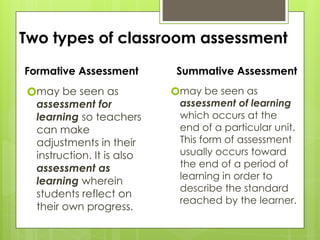
Two types of classroom assessment
Formative Assessment
🞇may be seen as
assessment for
learning so teachers
can make
adjustments in their
instruction. It is also
assessment as
learning wherein
students reflect on
their own progress.
Summative Assessment
🞇may be seen as
assessment of learning
which occurs at the
end of a particular unit.
This form of assessment
usually occurs toward
the end of a period of
learning in order to
describe the standard
reached by the learner.
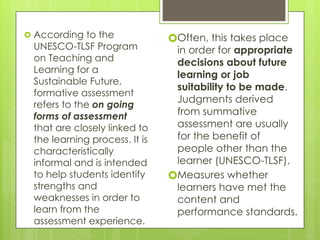
🞇 According to the
UNESCO-TLSF Program
on Teaching and
Learning for a
Sustainable Future,
formative assessment
refers to the on going
forms of assessment
that are closely linked to
the learning process. It is
characteristically
informal and is intended
to help students identify
strengths and
weaknesses in order to
learn from the
assessment experience.
🞇Often, this takes place
in order for appropriate
decisions about future
learning or job
suitability to be made.
Judgments derived
from summative
assessment are usually
for the benefit of
people other than the
learner (UNESCO-TLSF).
🞇Measures whether
learners have met the
content and
performance standards.
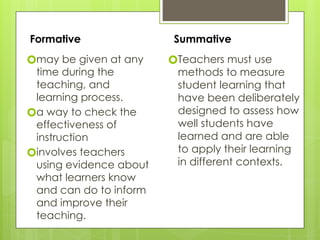
Formative
🞇may be given at any
time during the
teaching, and
learning process.
🞇a way to check the
effectiveness of
instruction
🞇involves teachers
using evidence about
what learners know
and can do to inform
and improve their
teaching.
Summative
🞇Teachers must use
methods to measure
student learning that
have been deliberately
designed to assess how
well students have
learned and are able
to apply their learning
in different contexts.
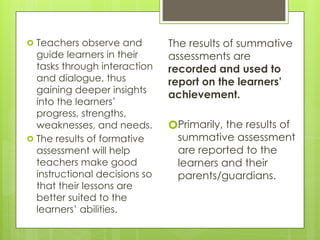
🞇 Teachers observe and
guide learners in their
tasks through interaction
and dialogue, thus
gaining deeper insights
into the learners’
progress, strengths,
weaknesses, and needs.
🞇 The results of formative
assessment will help
teachers make good
instructional decisions so
that their lessons are
better suited to the
learners’ abilities.
The results of summative
assessments are
recorded and used to
report on the learners’
achievement.
🞇Primarily, the results of
summative assessment
are reported to the
learners and their
parents/guardians.
🞇It is important for
teachers to record
formative assessment
by documenting and
tracking learners’
progress using
systematic ways that
can easily provide
insight into a student’s
learning.
🞇This monitoring will
allow teachers to
understand their
pupils/students and
thus teach them better.
🞇In addition, these are
reported to
principals/school
heads, teachers who
will receive the child in
the next grade level,
and guidance
teachers who should
help students cope
with challenges they
experience in school.
🞇Formative assessment
results, however, are
NOT included in the
computation of
summative test.
🞇Formative assessment
must also provide
students with immediate
feedback on how well
they are learning
throughout the
teaching-learning
process.
🞇It enables students to
take responsibility for
their own learning.
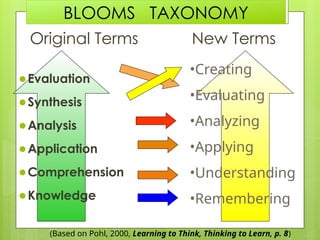
Original Terms New Terms
⚫Evaluation
⚫Synthesis
⚫Analysis
⚫Application
⚫Comprehension
⚫Knowledge
•Creating
•Evaluating
•Analyzing
•Applying
•Understanding
•Remembering
(Based on Pohl, 2000, Learning to Think, Thinking to Learn, p. 8)
BLOOMS TAXONOMY
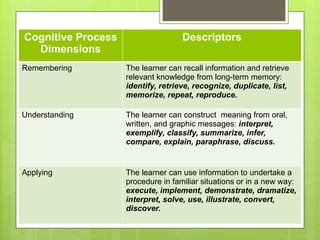
Cognitive Process
Dimensions
Descriptors
Remembering The learner can recall information and retrieve
relevant knowledge from long-term memory:
identify, retrieve, recognize, duplicate, list,
memorize, repeat, reproduce.
Understanding The learner can construct meaning from oral,
written, and graphic messages: interpret,
exemplify, classify, summarize, infer,
compare, explain, paraphrase, discuss.
Applying The learner can use information to undertake a
procedure in familiar situations or in a new way:
execute, implement, demonstrate, dramatize,
interpret, solve, use, illustrate, convert,
discover.
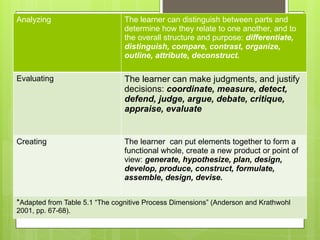
Analyzing The learner can distinguish between parts and
determine how they relate to one another, and to
the overall structure and purpose: differentiate,
distinguish, compare, contrast, organize,
outline, attribute, deconstruct.
Evaluating The learner can make judgments, and justify
decisions: coordinate, measure, detect,
defend, judge, argue, debate, critique,
appraise, evaluate
Creating The learner can put elements together to form a
functional whole, create a new product or point of
view: generate, hypothesize, plan, design,
develop, produce, construct, formulate,
assemble, design, devise.
*Adapted from Table 5.1 “The cognitive Process Dimensions” (Anderson and Krathwohl
2001, pp. 67-68).
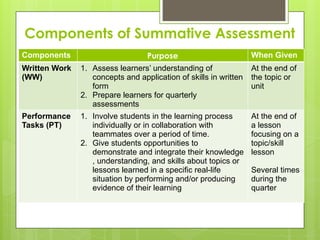
Components of Summative Assessment
Components Purpose When Given
Written Work
(WW)
1. Assess learners’ understanding of
concepts and application of skills in written
form
2. Prepare learners for quarterly
assessments
At the end of
the topic or
unit
Performance
Tasks (PT)
1. Involve students in the learning process
individually or in collaboration with
teammates over a period of time.
2. Give students opportunities to
demonstrate and integrate their knowledge
, understanding, and skills about topics or
lessons learned in a specific real-life
situation by performing and/or producing
evidence of their learning
At the end of
a lesson
focusing on a
topic/skill
lesson
Several times
during the
quarter
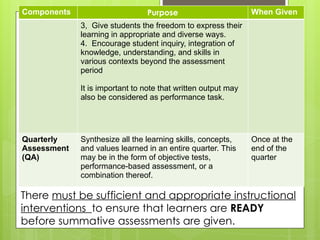
Components Purpose When Given
3, Give students the freedom to express their
learning in appropriate and diverse ways.
4. Encourage student inquiry, integration of
knowledge, understanding, and skills in
various contexts beyond the assessment
period
It is important to note that written output may
also be considered as performance task.
Quarterly
Assessment
(QA)
Synthesize all the learning skills, concepts,
and values learned in an entire quarter. This
may be in the form of objective tests,
performance-based assessment, or a
combination thereof.
Once at the
end of the
quarter
There must be sufficient and appropriate instructional
interventions to ensure that learners are READY
before summative assessments are given.
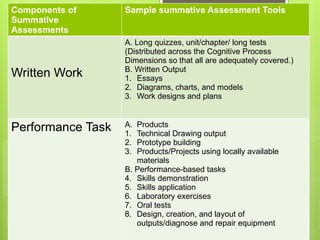
Components of
Summative
Assessments
Sample summative Assessment Tools
Written Work
A. Long quizzes, unit/chapter/ long tests
(Distributed across the Cognitive Process
Dimensions so that all are adequately covered.)
B. Written Output
1. Essays
2. Diagrams, charts, and models
3. Work designs and plans
Performance Task A. Products
1. Technical Drawing output
2. Prototype building
3. Products/Projects using locally available
materials
B. Performance-based tasks
4. Skills demonstration
5. Skills application
6. Laboratory exercises
7. Oral tests
8. Design, creation, and layout of
outputs/diagnose and repair equipment
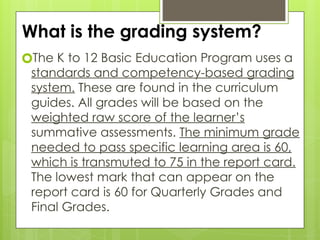
What is the grading system?
🞇The K to 12 Basic Education Program uses a
standards and competency-based grading
system. These are found in the curriculum
guides. All grades will be based on the
weighted raw score of the learner’s
summative assessments. The minimum grade
needed to pass specific learning area is 60,
which is transmuted to 75 in the report card.
The lowest mark that can appear on the
report card is 60 for Quarterly Grades and
Final Grades.
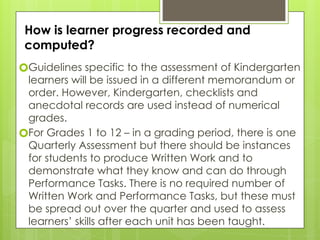
How is learner progress recorded and
computed?
🞇Guidelines specific to the assessment of Kindergarten
learners will be issued in a different memorandum or
order. However, Kindergarten, checklists and
anecdotal records are used instead of numerical
grades.
🞇For Grades 1 to 12 – in a grading period, there is one
Quarterly Assessment but there should be instances
for students to produce Written Work and to
demonstrate what they know and can do through
Performance Tasks. There is no required number of
Written Work and Performance Tasks, but these must
be spread out over the quarter and used to assess
learners’ skills after each unit has been taught.
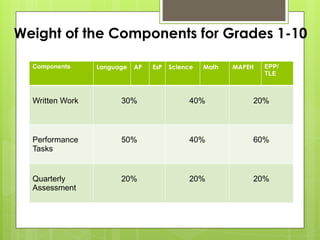
Weight of the Components for Grades 1-10
Components Language AP EsP Science Math MAPEH EPP/
TLE
Written Work 30% 40% 20%
Performance
Tasks
50% 40% 60%
Quarterly
Assessment
20% 20% 20%
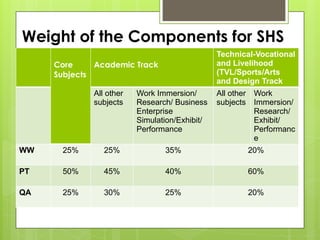
Weight of the Components for SHS
Core
Subjects
Academic Track
Technical-Vocational
and Livelihood
(TVL/Sports/Arts
and Design Track
All other
subjects
Work Immersion/
Research/ Business
Enterprise
Simulation/Exhibit/
Performance
All other
subjects
Work
Immersion/
Research/
Exhibit/
Performanc
e
WW 25% 25% 35% 20%
PT 50% 45% 40% 60%
QA 25% 30% 25% 20%
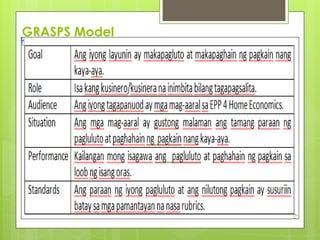
GRASPS Model
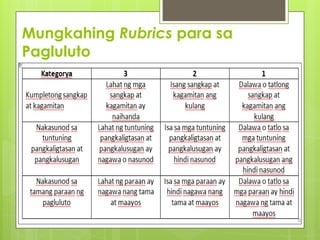
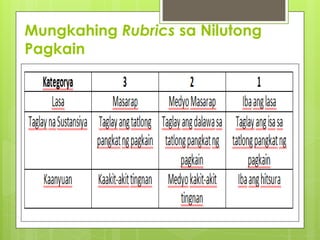
Mungkahing Rubrics para sa
Pagluluto
Mungkahing Rubrics sa Nilutong
Pagkain
Reflection
:
I never teach my pupils, I only
attempt to provide the
conditions in which they can
learn.”
Albert Einstein
Thank You!

5 - New Classroom Assessment for learning

  • 1.
  • 2.
    ASSESSMENT – isany of a variety of procedures used to obtain information about student performance (Linn and Miller). - refers to the full range of information gathered and synthesized by teachers about their classroom (Arenas, 1994).
  • 3.
    Per D.O. #8 , s. 2015 🞇ASSESSMENT – is a process that is used to keep track of learners’ progress in relation to learning standards and in the development of 21st century skills; - to promote self-reflection and personal accountability among students about their own learning; and - to provide bases for the profiling of student performance on the learning competencies and standards of the curriculum.
  • 4.
    ASSESSMENT- acknowledges theunity of instruction and assessment. It is a part of day-to-day lessons and extends the day-to-day classroom activities that are already in place in the k to 12 curriculum.
  • 5.
    CLASSROOM ASSESSMENT isan ongoing process of: - identifying; - gathering; - organizing; and - interpreting quantitative and qualitative information about what learners know and can do.
  • 6.
    Two types ofclassroom assessment Formative Assessment 🞇may be seen as assessment for learning so teachers can make adjustments in their instruction. It is also assessment as learning wherein students reflect on their own progress. Summative Assessment 🞇may be seen as assessment of learning which occurs at the end of a particular unit. This form of assessment usually occurs toward the end of a period of learning in order to describe the standard reached by the learner.
  • 7.
    🞇 According tothe UNESCO-TLSF Program on Teaching and Learning for a Sustainable Future, formative assessment refers to the on going forms of assessment that are closely linked to the learning process. It is characteristically informal and is intended to help students identify strengths and weaknesses in order to learn from the assessment experience. 🞇Often, this takes place in order for appropriate decisions about future learning or job suitability to be made. Judgments derived from summative assessment are usually for the benefit of people other than the learner (UNESCO-TLSF). 🞇Measures whether learners have met the content and performance standards.
  • 8.
    Formative 🞇may be givenat any time during the teaching, and learning process. 🞇a way to check the effectiveness of instruction 🞇involves teachers using evidence about what learners know and can do to inform and improve their teaching. Summative 🞇Teachers must use methods to measure student learning that have been deliberately designed to assess how well students have learned and are able to apply their learning in different contexts.
  • 9.
    🞇 Teachers observeand guide learners in their tasks through interaction and dialogue, thus gaining deeper insights into the learners’ progress, strengths, weaknesses, and needs. 🞇 The results of formative assessment will help teachers make good instructional decisions so that their lessons are better suited to the learners’ abilities. The results of summative assessments are recorded and used to report on the learners’ achievement. 🞇Primarily, the results of summative assessment are reported to the learners and their parents/guardians.
  • 10.
    🞇It is importantfor teachers to record formative assessment by documenting and tracking learners’ progress using systematic ways that can easily provide insight into a student’s learning. 🞇This monitoring will allow teachers to understand their pupils/students and thus teach them better. 🞇In addition, these are reported to principals/school heads, teachers who will receive the child in the next grade level, and guidance teachers who should help students cope with challenges they experience in school.
  • 11.
    🞇Formative assessment results, however,are NOT included in the computation of summative test. 🞇Formative assessment must also provide students with immediate feedback on how well they are learning throughout the teaching-learning process. 🞇It enables students to take responsibility for their own learning.
  • 12.
    Original Terms NewTerms ⚫Evaluation ⚫Synthesis ⚫Analysis ⚫Application ⚫Comprehension ⚫Knowledge •Creating •Evaluating •Analyzing •Applying •Understanding •Remembering (Based on Pohl, 2000, Learning to Think, Thinking to Learn, p. 8) BLOOMS TAXONOMY
  • 13.
    Cognitive Process Dimensions Descriptors Remembering Thelearner can recall information and retrieve relevant knowledge from long-term memory: identify, retrieve, recognize, duplicate, list, memorize, repeat, reproduce. Understanding The learner can construct meaning from oral, written, and graphic messages: interpret, exemplify, classify, summarize, infer, compare, explain, paraphrase, discuss. Applying The learner can use information to undertake a procedure in familiar situations or in a new way: execute, implement, demonstrate, dramatize, interpret, solve, use, illustrate, convert, discover.
  • 14.
    Analyzing The learnercan distinguish between parts and determine how they relate to one another, and to the overall structure and purpose: differentiate, distinguish, compare, contrast, organize, outline, attribute, deconstruct. Evaluating The learner can make judgments, and justify decisions: coordinate, measure, detect, defend, judge, argue, debate, critique, appraise, evaluate Creating The learner can put elements together to form a functional whole, create a new product or point of view: generate, hypothesize, plan, design, develop, produce, construct, formulate, assemble, design, devise. *Adapted from Table 5.1 “The cognitive Process Dimensions” (Anderson and Krathwohl 2001, pp. 67-68).
  • 15.
    Components of SummativeAssessment Components Purpose When Given Written Work (WW) 1. Assess learners’ understanding of concepts and application of skills in written form 2. Prepare learners for quarterly assessments At the end of the topic or unit Performance Tasks (PT) 1. Involve students in the learning process individually or in collaboration with teammates over a period of time. 2. Give students opportunities to demonstrate and integrate their knowledge , understanding, and skills about topics or lessons learned in a specific real-life situation by performing and/or producing evidence of their learning At the end of a lesson focusing on a topic/skill lesson Several times during the quarter
  • 16.
    Components Purpose WhenGiven 3, Give students the freedom to express their learning in appropriate and diverse ways. 4. Encourage student inquiry, integration of knowledge, understanding, and skills in various contexts beyond the assessment period It is important to note that written output may also be considered as performance task. Quarterly Assessment (QA) Synthesize all the learning skills, concepts, and values learned in an entire quarter. This may be in the form of objective tests, performance-based assessment, or a combination thereof. Once at the end of the quarter There must be sufficient and appropriate instructional interventions to ensure that learners are READY before summative assessments are given.
  • 17.
    Components of Summative Assessments Sample summativeAssessment Tools Written Work A. Long quizzes, unit/chapter/ long tests (Distributed across the Cognitive Process Dimensions so that all are adequately covered.) B. Written Output 1. Essays 2. Diagrams, charts, and models 3. Work designs and plans Performance Task A. Products 1. Technical Drawing output 2. Prototype building 3. Products/Projects using locally available materials B. Performance-based tasks 4. Skills demonstration 5. Skills application 6. Laboratory exercises 7. Oral tests 8. Design, creation, and layout of outputs/diagnose and repair equipment
  • 18.
    What is thegrading system? 🞇The K to 12 Basic Education Program uses a standards and competency-based grading system. These are found in the curriculum guides. All grades will be based on the weighted raw score of the learner’s summative assessments. The minimum grade needed to pass specific learning area is 60, which is transmuted to 75 in the report card. The lowest mark that can appear on the report card is 60 for Quarterly Grades and Final Grades.
  • 19.
    How is learnerprogress recorded and computed? 🞇Guidelines specific to the assessment of Kindergarten learners will be issued in a different memorandum or order. However, Kindergarten, checklists and anecdotal records are used instead of numerical grades. 🞇For Grades 1 to 12 – in a grading period, there is one Quarterly Assessment but there should be instances for students to produce Written Work and to demonstrate what they know and can do through Performance Tasks. There is no required number of Written Work and Performance Tasks, but these must be spread out over the quarter and used to assess learners’ skills after each unit has been taught.
  • 20.
    Weight of theComponents for Grades 1-10 Components Language AP EsP Science Math MAPEH EPP/ TLE Written Work 30% 40% 20% Performance Tasks 50% 40% 60% Quarterly Assessment 20% 20% 20%
  • 21.
    Weight of theComponents for SHS Core Subjects Academic Track Technical-Vocational and Livelihood (TVL/Sports/Arts and Design Track All other subjects Work Immersion/ Research/ Business Enterprise Simulation/Exhibit/ Performance All other subjects Work Immersion/ Research/ Exhibit/ Performanc e WW 25% 25% 35% 20% PT 50% 45% 40% 60% QA 25% 30% 25% 20%
  • 22.
  • 23.
  • 24.
    Mungkahing Rubrics saNilutong Pagkain
  • 25.
    Reflection : I never teachmy pupils, I only attempt to provide the conditions in which they can learn.” Albert Einstein
  • 26.