Assessing Speaking
Series editors: J. Charles Alderson and Lyle F. Bachman
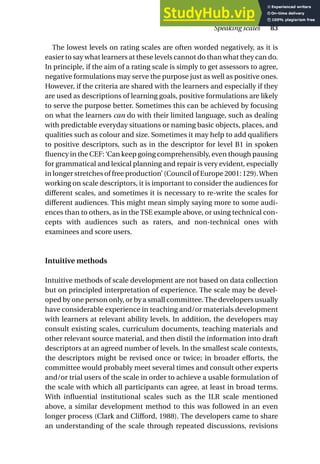
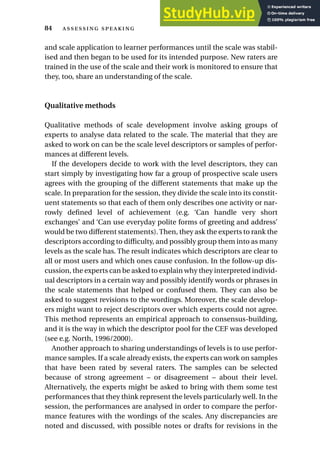
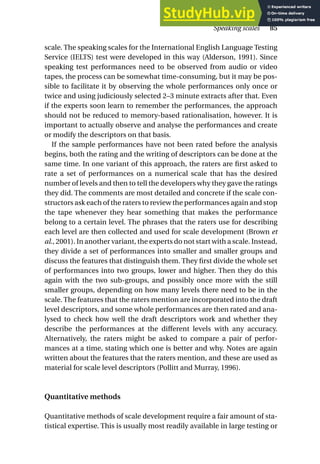
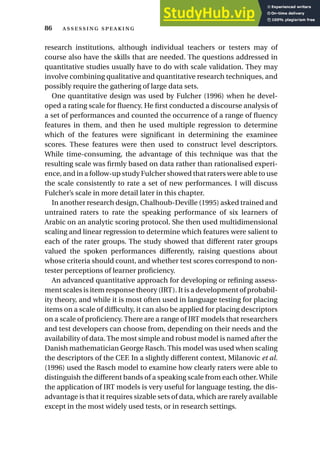
In this series:
Assessing Vocabulary by John Read
Assessing Reading by J. Charles Alderson
Assessing Language for Specific Purposes by Dan Douglas
Assessing Writing by Sara Cushing Weigle
Assessing Listening by Gary Buck
Assessing Grammar by James E. Purpura
Statistical Analyses for Language Assessment by Lyle F. Bachman
Statistical Analyses for Language Assessment Workbook by Lyle F. Bachman
and Antony J. Kunnan
THE CAMBRIDGE LANGUAGE ASSESSMENT SERIES
Assessing Speaking
Sari Luoma
CAMBRIDGE UNIVERSIT Y PRESS
Cambridge, New York, Melbourne, Madrid, Cape Town, Singapore,
SĂŁo Paulo, Delhi, Dubai, Tokyo
Cambridge University Press
The Edinburgh Building, Cambridge CB2 8RU, UK
www.cambridge.org
Information on this title: www.cambridge.org/9780521804875
Š Cambridge University Press 2004
This publication is in copyright. Subject to statutory exception
and to the provisions of relevant collective licensing agreements,
no reproduction of any part may take place without the written
permission of Cambridge University Press.
First published 2004
5th printing 2009
Printed in the United Kingdom at the University Press, Cambridge
A catalogue record for this publication is available from the British Library
ISBN 978-0-521-80487-5 Paperback
Cambridge University Press has no responsibility for the persistence or
accuracy of URLs for external or third-party internet websites referred to in
this publication, and does not guarantee that any content on such websites is,
or will remain, accurate or appropriate. Information regarding prices, travel
timetables and other factual information given in this work are correct at
the time of first printing but Cambridge University Press does not guarantee
the accuracy of such information thereafter.
To my parents, Eila and YrjĂś Luoma
Thank you for your support and for your faith in me
Contents
Series editors’ preface page ix
Acknowledgements xii
1 Introduction 1
2 The nature of speaking 9
3 Speaking tasks 29
4 Speaking scales 59
5 Theoretical models 96
6 Developing test specifications 113
7 Developing speaking tasks 139
8 Ensuring a reliable and valid speaking assessment 170
References 192
Index 201
vii
Series editors’ preface to Assessing
Speaking
The ability to speak in a foreign language is at the very heart of what it means
to be able to use a foreign language. Our personality, our self image, our
knowledge of the world and our ability to reason and express our thoughts
are all reflected in our spoken performance in a foreign language. Although
an ability to read a language is often the limited goal of many learners, it is
rare indeed for the teaching of a foreign language not to involve learners and
teachers in using the language in class. Being able to speak to friends, col-
leagues, visitors and even strangers, in their language or in a language
which both speakers can understand, is surely the goal of very many learn-
ers. Yet speaking in a foreign language is very difficult and competence in
speaking takes a long time to develop. To speak in a foreign language learn-
ers must master the sound system of the language, have almost instant
access to appropriate vocabulary and be able to put words together intelli-
gibly with minimal hesitation. In addition, they must also understand what
is being said to them, and be able to respond appropriately to maintain ami-
cable relations or to achieve their communicative goals. Because speaking
is done in real-time, learners’ abilities to plan, process and produce the
foreign language are taxed greatly. For that reason, the structure of speech
is quite different from that of the written language, where users have time
to plan, edit and correct what they produce. Yet teachers often focus nar-
rowly on the development of grammatically accurate speech which may
conflict with a learner’s desire to communicate and be understood.
Speaking is also the most difficult language skill to assess reliably. A
person’s speaking ability is usually judged during a face-to-face interac-
tion, in real time, between an interlocutor and a candidate. The assessor
ix
has to make instantaneous judgements about a range of aspects of what
is being said, as it is being said. This means that the assessment might
depend not only upon which particular features of speech (e.g. pronun-
ciation, accuracy, fluency) the interlocutor pays attention to at any point
in time, but upon a host of other factors such as the language level,
gender, and status of the interlocutor, his or her familiarity to the candi-
date and the personal characteristics of the interlocutor and candidate.
Moreover, the nature of the interaction, the sorts of tasks that are pre-
sented to the candidate, the questions asked, the topics broached, and
the opportunities that are provided to show his or her ability to speak in
a foreign language will all have an impact on the candidate’s perfor-
mance. In addition to all the factors that may affect performance, the cri-
teria used to assess the performance can vary enormously, from global
assessments to detailed analytic scales. The ways in which these scales
are interpreted by an assessor, who may or may not be the same person
as the interlocutor, are bound to have an impact on the score or scores
that the candidate is ultimately awarded. There are, of course, ways of
overcoming or at least addressing some of these problems, by careful
construction of the tasks used to elicit speech, by careful training of both
assessors and interlocutors, through audio or video recording of the
speech event and by allowing assessors time to review and revise their
judgements. Assessing speaking is thus not impossible, but it is difficult.
The strongest feature of this book is that Sari Luoma discusses with
great clarity the problems of assessing speaking, and she does this in the
light of her broad and deep understanding of the nature of speaking.
Drawing upon a wide base of research and theory, she synthesises a large
literature into a very readable overview of what is involved in speaking in
a second or foreign language. Her down-to-earth approach will appeal
both to language teachers who want to assess their students’ ability to
speak in a foreign language and to researchers of speaking and language
assessment.
In this book, as in other volumes in the series, applied linguistic theory
and research are drawn upon in order to enhance our understanding of
the nature of what is to be tested and assessed. In addition, research into
language testing is examined for what it can tell us about the most appro-
priate ways of assessing speaking, and for insights it can offer into the
nature of this central aspect of language use. Although this book is
grounded in research and theory, it is highly practical and is aimed at
those who need to develop assessments of speaking ability. It thus offers
insights and advice that will broaden the repertoire of readers, give
x Series editors’ preface
greater understanding of the issues involved, and lead to practical solu-
tions to knotty problems.
Sari Luoma has wide experience of test development in a range of
different contexts, and of research into test development and test valida-
tion, particularly in the assessment of speaking. She has taught testing
and assessment to a range of students and practitioners, which has
clearly informed both the content and the style of this volume. We are
confident that readers will both learn from, and enjoy, this book.
J. Charles Alderson
Lyle F. Bachman
Series editors’ preface xi
Acknowledgements
I am grateful to Charles Alderson and Lyle Bachman, the series editors,
for the efforts they put into helping me finish this book. They applied
a successful balance of pressure and support in the course of a long
writing process with many ups and downs. The insightful comments I
received about the content and structure of the book, especially
during the revision stage, improved the quality of the text consider-
ably.
I also want to thank some friends and colleagues who have read the
manuscript in its various stages and offered valuable advice. Annie
Brown’s frequent and frank comments on the second-last version helped
me restructure several chapters. Bill Eilfort, Mika Hoffman and Ari Huhta
also gave their time, advice and support. Furthermore, I want to acknowl-
edge the helpful comments of two groups of Egyptian teachers of English,
too many to name individually, who participated in an Advanced Course
on Language Testing at the University of California Santa Cruz Extension
in the late summer and early fall of 2002. We used an early version of the
manuscript as course material, and their comments and groans made me
change my writing style and encouraged me to introduce more examples.
I want to thank Jean Turner for inviting me to join the teaching group for
the two courses.
I must also thank the teachers and colleagues who discussed their
speaking assessment practices with me and allowed me to use their
specifications and tasks as examples in the book: Tarmo Ahvenainen,
Janna Fox, Angela Hasselgren, and Paula Niittyniemi-Mehn.
Finally, I want to thank the editors at Cambridge University Press,
xii
Mickey Bonin and Alison Sharpe, for their help in getting the book ready
for publication. Whatever faults that remain in the book are mine.
The author and publishers are grateful to those authors, publishers and
others who have given permission for the use of copyright material iden-
tified in the text.
Speech samples in Teaching Talk: Strategies for production and assess-
ment (1984) by G. Brown, A. H. Anderson, R. Shillcock and G. Yule,
Cambridge University Press.
Speech samples in Exploring Spoken English (1997) by R. Carter and M.
McCarthy, Cambridge University Press.
Finnish National Foreign Language Certificate: National certificates
scale, National Board of Education, Helsinki.
ACTFL Proficiency Guidelines – Speaking (Revised 1999) © American
Council on the Teaching of Foreign Languages.
Materials selected from TSE ÂŽ and SPEAK ÂŽ Score User Guide (2001).
Reprinted by permission of Educational Testing Service, the copyright
owner. However, the test questions and any other testing information are
provided in their entirety by Cambridge University Press. No endorse-
ment of this publication by Educational Testing Service should be
inferred.
Table 4.5 Common European Framework (pages 28–29), Table 3.
Common Reference Levels: qualitative aspects of spoken language use; in
Schneider, G. and North, B. (2000) Fremdsprachen können – was heisst
das?: 145; a further development from North, B. (1991) “Standardisation
of Continuous Assessment Grades” in Language Testing in the 1990s;
Alderson, J.C. and North, B. 1991, London, Macmillan/ British Council:
167–178.1. © Council of Europe.
Table 4.6 “Common European Framework” (page 79), Goal-oriented
co-operation. Š Council of Europe.
Melbourne Papers in Language Testing (2001) by E. Grove and A. Brown.
Understanding and Developing Language Tests by C. Weir, Š Pearson
Education Limited.
Fluency scale by A. Hasselgren from Testing the Spoken English of Young
Norwegians, to be published in 2004 by Cambridge University Press
Š UCLES.
Table 4.8: Hierarchy of processing procedures by M. Pienemann in
Language Processing & Second Language Development-Processability
Theory. John Benjamins Publishing Co., Amsterdam/Philadelphia 1998.
Writing English Language Tests (4th ed) by J. B. Heaton, Longman
Š Pearson Education Limited.
Acknowledgements xiii
Examples of Tasks (1997), by the Nasjonalt Laeremiddelsenter, Norway.
Interaction outline for a pair task, and task card for two examinees in a
paired interview, University of Cambridge Local Examinations Syndicate
ESOL.
Testing material by Paula Niittyniemi-Mehn, Virtain Yläaste, Finland.
Examinee’s test booklet in a tape-based test, ‘Violence in Society as a
group project work sheet’ and a reading exercise, © CAEL 2000 (Canadian
Academic English Language Assessment).
Testing procedures by Tarmo Ahvenainen, Kymenlaakso Polytechnic,
Finland.
Sample Test in English Š National Certificates, Centre for Applied
Language Studies, University of Jyväskylä, Finland 2003.
Phone pass practice test Š Ordinate Corporation.
xiv  
CHAPTER ONE
Introduction
Speaking skills are an important part of the curriculum in language
teaching, and this makes them an important object of assessment as well.
Assessing speaking is challenging, however, because there are so many
factors that influence our impression of how well someone can speak a
language, and because we expect test scores to be accurate, just and
appropriate for our purpose. This is a tall order, and in different contexts
teachers and testers have tried to achieve all this through a range of differ-
ent procedures. Let us consider some scenarios of testing speaking.
Scenario 1
There are two examinees and two testers in the testing room. Both
examinees have four pictures in front of them, and they are construct-
ing a story together.At the end of their story,one of the testers asks them
a few questions and then closes the discussion off, says goodbye to the
examinees, and stops the tape recorder. After the examinees leave, the
testers quickly mark their assessments on a form and then have a brief
discussion about the strongest and weakest features of each perfor-
mance. One examinee had a strong accent but was talkative and used
quite a broad range of vocabulary; the other was not as talkative, but
very accurate. They are both given the same score.
This is the oral part of a communicative language assessment battery,
mostly taken by young people who have been learning a foreign language
at school and possibly taking extra classes as one of their hobbies. The
certificates are meant to provide fairly generic proof of level of achieve-
ment. They are not required by any school as such, but those who have
them are exempted from initial language courses at several universities
1
and vocational colleges. This may partly explain why the test is popular
among young people.
Scenario 2
The language laboratory is filled with the sound of twelve people
talking at the same time.A few of them stop speaking,and soon the rest
follow suit. During the silence, all the examinees are looking at their
booklets and listening to a voice on their headphones. Some make
notes in their booklets; others stare straight ahead and concentrate.
Then they start again. Their voices go up and down; some make ges-
tures with their hands. The examinees’ turns come to an end again and
another task-giving section begins in their headphones.The test super-
visor follows the progress of the session at the front of the room. At the
end of the session, the examinees leave the lab and the supervisor col-
lects back the test booklets and starts the transfer of performances from
the booths to the central system.
To enable the test session in Scenario 2 to run as expected, many steps
of planning, preparation and training were required. The starting point
was a definition of test purpose, after which the developers specified
what they want to test and created tasks and assessment criteria to test it.
A range of tasks were scripted and recorded, and a test tape was compiled
with instructions, tasks, and pauses for answering. The test was then tri-
alled to check that the tasks work and the response times are appropriate.
The rating procedures were also tested. Since the system for administer-
ing the test was already set up, the test was then introduced to the public.
The scores are used, among other things, to grant licenses to immigrating
professionals to practise their profession in their new country.
Scenario 3
Four students are sitting in a supposed office of a paper mill. Two of
them are acting as hosts, and the two others are guests. One of the hosts
is explaining about the history of the factory and its present produc-
tion. The teacher pops in and observes the interaction for a couple of
minutes and then makes a quiet exit without disrupting the presenta-
tion. The guests ask a few questions, and the speaker explains some
more. At the end, all four students get up and walk into the school
workshop to observe the production process. The other host takes over
and explains how the paper machine works.There is quite a lot of noise
in the workshop; the speaker almost has to shout.At the end of the tour,
the speaker asks if the guests have any more questions and, since they
do not, the hosts wish the guests goodbye. The students then fill in self-
assessment and peer assessment sheets. The following week’s lesson is
2  
spent reflecting on and discussing the simulations and the peer and
self-assessments.
This assessment activity helps vocational college students learn factory
presentation skills in English. The task is a fairly realistic simulation of
one of their possible future tasks in the workplace. The assessment is an
integrated part of other learning activities in class, in that the class starts
preparing for it together by discussing the properties of a good factory
tour, and they use another couple of lessons for planning the tours and
practising the presentations. Working in groups makes efficient use of
class time, and having students rate themselves and their peers further
supports student reflection of what makes a good factory tour. Pair work
in preparing the presentation simulates support from colleagues in a
workplace. The teacher’s main role during the preparation stage is to
structure the activities and support the students’ work. During the assess-
ment event he circulates among the groups and observes each pair for a
couple of minutes, and after the event he evaluates performances, con-
ducts assessment discussions with each pair, and makes notes on their
peer and self-assessments for future use in grading.
Scenario 4
The interviewer and the examinee are talking about the examinee’s job.
The interviewer asks her to compare her present tasks to her earlier job,
and then to talk about what she would like to do in the future.And what
if she were to move abroad? This is obviously not the first time the exam-
inee is talking about her work in English,she has a very good command
of the specialist vocabulary,and while her speaking rate is not very fast,
this may be how she speaks her mother tongue, too. She has no problem
answering any of the interviewer’s questions.In around fifteen minutes,
the interviewer winds down the discussion and says goodbye to the
examinee. She has made an initial assessment of the performance
during the interview, and now she makes a final evaluation and writes
it down on an assessment form. Then she has a quick cup of coffee, after
which she invites the next examinee into the room.
The test in Scenario 4 is part of a proficiency test battery for adults.
Proficiency tests are examinations that are not related to particular learn-
ing courses but, rather, they are based on an independent definition of
language ability.This particular test is intended for adults who want a cer-
tificate about their language skills either for themselves or for their
employers. Talking about their profession and their future plans is thus a
relevant task for the participants. The certificates that the examinees get
report a separate score for speaking.
Introduction 3
The surface simplicity of the individual interview as a format for testing
speaking hides a complex set of design, planning and training that under-
lies the interaction. This is especially true if the interview is part of a pro-
ficiency test, but it is also true in settings where the participants may
know each other, such as interview tests conducted by a teacher. This is
because, like all tests, the interview should be fair to all participants and
give them an equal opportunity to show their skills. Since the test is given
individually, the interviewer needs to follow some kind of an outline to
make sure that he or she acts the same way with all the examinees. If some
of the tests are conducted by a different interviewer, the outline is all the
more important. Furthermore, the criteria that are used to evaluate the
performances must be planned together with the interview outline to
ensure that all performances can be rated fairly according to the criteria.
This partly depends on the interlocutor’s interviewing skills, and in big
testing organisations interviewer training and monitoring are an essen-
tial part of the testing activities. The interviewers in the test of Scenario 4
are trained on a two-part workshop and then conduct a number of prac-
tice interviews before being certified for their job.
The cycle of assessing speaking
As the examples above show, assessing speaking is a process with many
stages. At each stage, people act and interact to produce something for
the next stage.While the assessment developers are the key players in the
speaking assessment cycle, the examinees, interlocutors, raters and
score users also have a role to play in the activities.This book is about the
stages in the cycle of assessing speaking and about ways of making them
work well. It is meant for teachers and researchers who are interested in
reflecting on their speaking assessment practices and developing them
further.
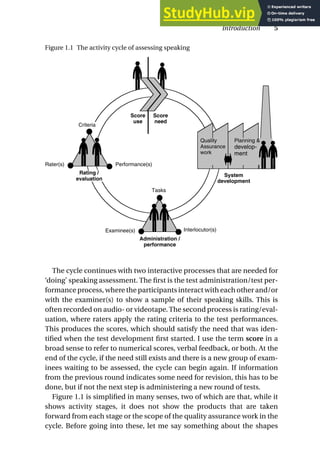
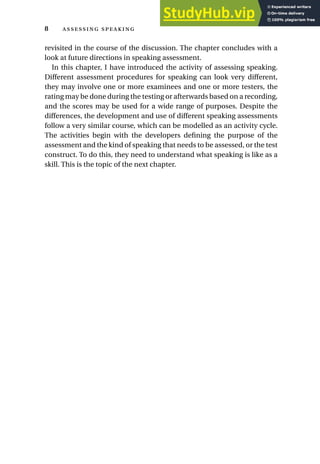
A simplified graph of the activity cycle of assessing speaking is shown
in Figure 1.1. The activities begin at the top of the figure, when someone
realises that there is a need for a speaking assessment. This leads to a
planning and development stage during which, in a shorter or longer
process, the developers define exactly what it is that needs to be assessed,
and then develop, try out and revise tasks, rating criteria and administra-
tion procedures that implement this intention. They also set up quality
assurance procedures to help them monitor everything that happens in
the assessment cycle. The assessment can then begin to be used.
4  
The cycle continues with two interactive processes that are needed for
‘doing’ speaking assessment. The first is the test administration/test per-
formance process, where the participants interact with each other and/or
with the examiner(s) to show a sample of their speaking skills. This is
often recorded on audio- or videotape.The second process is rating/eval-
uation, where raters apply the rating criteria to the test performances.
This produces the scores, which should satisfy the need that was iden-
tified when the test development first started. I use the term score in a
broad sense to refer to numerical scores, verbal feedback, or both. At the
end of the cycle, if the need still exists and there is a new group of exam-
inees waiting to be assessed, the cycle can begin again. If information
from the previous round indicates some need for revision, this has to be
done, but if not the next step is administering a new round of tests.
Figure 1.1 is simplified in many senses, two of which are that, while it
shows activity stages, it does not show the products that are taken
forward from each stage or the scope of the quality assurance work in the
cycle. Before going into these, let me say something about the shapes
Introduction 5
Tasks
Interlocutor(s)
Examinee(s)
Performance(s)
Rater(s)
Criteria
Administration /
performance
Rating /
evaluation
Planning &
develop-
ment
Quality
Assurance
work
Score
use
Score
need
System
development
Figure 1.1 The activity cycle of assessing speaking
used for the stages. At the top of the cycle, score need and score use are
indicated by dovetailed arrows. This signifies the need for the start and
end of the cycle of assessing speaking to fit together. The second stage is
shown as a factory. This is the test developers’ workplace. They develop
the assessment and produce the documents that are needed (tasks, crite-
ria, instructions) to guide the activities. As at any factory, quality assu-
rance is an important aspect of the development work. It ensures that the
testing practices being developed are good enough for the original
purpose. Moving along the cycle, the administration and rating processes
are shown as triangles because each of them is a three-way interaction.
The human figures in the cycle remind us that none of the stages is
mechanical; they are all based on the actions of people. Score need and
score use bind the stages of assessing speaking into an interactive cycle
between people, processes and products.
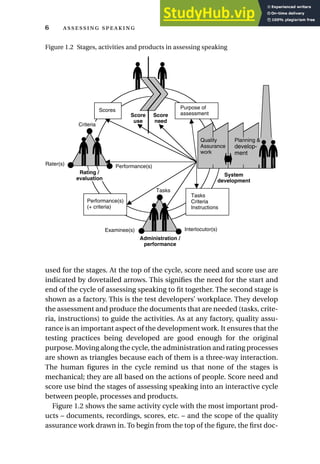
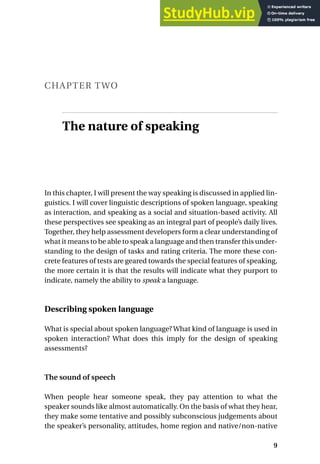
Figure 1.2 shows the same activity cycle with the most important prod-
ucts – documents, recordings, scores, etc. – and the scope of the quality
assurance work drawn in. To begin from the top of the figure, the first doc-
6  
Tasks
Interlocutor(s)
Examinee(s)
Performance(s)
Rater(s)
Criteria
Administration /
performance
Rating /
evaluation
Planning &
develop-
ment
Quality
Assurance
work
Score
use
Score
need
System
development
Purpose of
assessment
Tasks
Criteria
Instructions
Performance(s)
(+ criteria)
Scores
Figure 1.2 Stages, activities and products in assessing speaking
ument to be written after the realisation that speaking scores are needed is
a clarification of the purpose of the assessment. This guides all the rest of
the activities in the cycle. Moving along, the main products of the planning
stage are the tasks, assessment criteria, and instructions to participants,
administrators, interlocutors and assessors for putting the assessment into
action. At the next stage, the administration of the test produces examinee
performances, which are then rated to produce the scores.
As is clearly visible in Figure 1.2, quality assurance work extends over
the whole assessment cycle. The main qualities that the developers need
to work on are construct validity and reliability. Construct is a technical
term we use for the thing we are trying to assess. In speaking assessments,
the construct refers to the particular kind of speaking that is assessed in
the test. Work on construct validity means ensuring that the right thing
is being assessed, and it is the most important quality in all assessments.
Validation work covers the processes and products of all the stages in the
speaking assessment cycle. They are evaluated against the definition of
the speaking skills that the developers intended to assess. Reliability
means making sure that the test gives consistent and dependable results.
I will discuss this in more detail in Chapter 8.
The organisation of this book
This chapter has given a brief introduction into the world of assessing
speaking. The next four chapters deal with existing research that can help
the development of speaking assessments. Chapter 2 summarises
applied linguistic perspectives on the nature of the speaking skill and
considers the implications for assessing the right construct, speaking.
Chapter 3 discusses task design and task-related research and practice.
Chapter 4 takes up the topic of speaking scales. It introduces concepts
related to scales in the light of examples and discusses methods of scale
development. Chapter 5 discusses the use of theoretical models as con-
ceptual frameworks that can guide the definition of the construct of
speaking for different speaking assessments.
Chapters 6 through 8 then provide practical examples and advice to
support speaking test development. Chapter 6 presents the concept of
test specifications and discusses three examples. Chapter 7 concentrates
on exemplifying different kinds of speaking tasks and discussing their
development. Chapter 8 focuses on procedures for ensuring the reliabil-
ity and validity of speaking assessments.The main themes of the book are
Introduction 7
revisited in the course of the discussion. The chapter concludes with a
look at future directions in speaking assessment.
In this chapter, I have introduced the activity of assessing speaking.
Different assessment procedures for speaking can look very different,
they may involve one or more examinees and one or more testers, the
rating may be done during the testing or afterwards based on a recording,
and the scores may be used for a wide range of purposes. Despite the
differences, the development and use of different speaking assessments
follow a very similar course, which can be modelled as an activity cycle.
The activities begin with the developers defining the purpose of the
assessment and the kind of speaking that needs to be assessed, or the test
construct. To do this, they need to understand what speaking is like as a
skill. This is the topic of the next chapter.
8  
CHAPTER TWO
The nature of speaking
In this chapter, I will present the way speaking is discussed in applied lin-
guistics. I will cover linguistic descriptions of spoken language, speaking
as interaction, and speaking as a social and situation-based activity. All
these perspectives see speaking as an integral part of people’s daily lives.
Together, they help assessment developers form a clear understanding of
what it means to be able to speak a language and then transfer this under-
standing to the design of tasks and rating criteria. The more these con-
crete features of tests are geared towards the special features of speaking,
the more certain it is that the results will indicate what they purport to
indicate, namely the ability to speak a language.
Describing spoken language
What is special about spoken language? What kind of language is used in
spoken interaction? What does this imply for the design of speaking
assessments?
The sound of speech
When people hear someone speak, they pay attention to what the
speaker sounds like almost automatically. On the basis of what they hear,
they make some tentative and possibly subconscious judgements about
the speaker’s personality, attitudes, home region and native/non-native
9
speaker status. As speakers, consciously or unconsciously, people use
their speech to create an image of themselves to others. By using speed
and pausing, and variations in pitch, volume and intonation, they also
create a texture for their talk that supports and enhances what they are
saying. The sound of people’s speech is meaningful, and that is why this
is important for assessing speaking.
The sound of speech is a thorny issue for language assessment,
however. This is first of all because people tend to judge native/non-
native speaker status on the basis of pronunciation. This easily leads to
the idea that the standard against which learner pronunciation should be
judged is the speech of a native speaker. But is the standard justified? And
if it is not, how can an alternative standard be defined?
The native speaker standard for foreign language pronunciation is ques-
tioned on two main accounts (see e.g. Brown andYule, 1983: 26–27; Morley,
1991: 498–501). Firstly, in today’s world, it is difficult to determine which
single standard would suffice as the native speaker standard for any lan-
guage, particularly so for widely used languages. All languages have differ-
ent regional varieties and often regional standards as well. The standards
are valued in different ways in different regions and for different purposes,
and this makes it difficult to choose a particular standard for an assess-
ment or to require that learners should try to approximate to one standard
only. Secondly, as research into learner language has progressed, it has
become clear that, although vast numbers of language learners learn to
pronounce in a fully comprehensible and efficient manner, very few
learners are capable of achieving a native-like standard in all respects. If
native-like speech is made the criterion, most language learners will ‘fail’
even if they are fully functional in normal communicative situations.
Communicative effectiveness, which is based on comprehensibility and
probably guided by native speaker standards but defined in terms of realis-
tic learner achievement, is a better standard for learner pronunciation.
There are, furthermore, several social and psychological reasons why
many learners may not even want to be mistaken for native speakers of a
language (see e.g. Leather and James, 1996; Pennington and Richards,
1986): a characteristic accent can be a part of a learner’s identity, they may
not want to sound pretentious especially in front of their peers, they may
want recognition for their ability to have learned the language so well
despite their non-native status, and/or they may want a means to convey
their non-native status so that if they make any cultural or politeness mis-
takes, the listeners could give them the benefit of the doubt because of
their background.
10  
Pronunciation or, more broadly, the sound of speech, can refer to many
features of the speech stream, such as individual sounds, pitch, volume,
speed, pausing, stress and intonation. An important question is whether
all of these can be covered under one rating criterion. Moreover, should
the focus be on accuracy of pronunciation or expressiveness of the
speaker’s use of voice, or both? The solutions depend on the purpose for
which the scores will be used and the importance of the sound of speech
for that purpose. If there are many other rating criteria besides pronun-
ciation, fitting accuracy and effectiveness into a criterion like ‘natural-
ness of pronunciation’ may be the only option. If the sound of speech is
a main focus in the assessment, evaluating aspects of it separately gives
material for more detailed feedback.
A focus on pronunciation accuracy is attractive because it can be judged
against a norm and, even if the norm is not easy to define given the discus-
sion above, gross deviations from it are easy enough to notice. Since accu-
racy is related to comprehensibility, it is often at least one aspect of a
pronunciation criterion, but comprehensibility is much more than accu-
racy. It often includes speed, intonation, stress and rhythm, all of which
may be more important for the overall comprehensibility of the talk than
the accuracy of individual sounds. If the emphasis in the assessment is on
ability to create meaning in discourse, the developers might want to eval-
uate‘interactional efficiency’.This would encompass the examinees’ use of
stress and intonation to highlight important phrases, or to suggest in what
particular way (e.g. ironically) their words should be interpreted. In yet
other contexts, they might want to focus on ‘expressiveness’ as indicated
by the general texture of the talk, the speaker’s use of speed and pausing,
and variations in pitch, tone and volume. This might be especially relevant
in tasks such as creative storytelling or certain kinds of role plays, where
liveliness of expression is a central element in task performance. Thus, in
designing assessment criteria, the developers need to consider the type of
information about the sound of speech that they need. They also have to
make sure that their tasks give enough material for rating these features,
and that they develop the criteria that serve their needs.
Spoken grammar
Both first and second language learners’ progress is often tracked accord-
ing to the grammatical forms that they can produce accurately (see e.g.
Larsen-Freeman and Long, 1991: 38–41 for a discussion on this point). In
The nature of speaking 11
general, learners are seen to proceed from knowing a few structures to
knowing more and more, from using simple structures to using more
complex ones, and from making many errors to making few if any at all.
Learner grammar is handy for judging proficiency because it is easy to
detect in speech and writing, and because the fully fledged grammars of
most languages are well known and available for use as performance
standards. However, the grammar that is evaluated in assessing speaking
should be specifically related to the grammar of speech.
Written sentences, spoken idea units
A major difference between speech and writing is that speakers do not
usually speak in sentences. Rather, speech can be considered to consist
of idea units, which are short phrases and clauses connected with and,
or, but or that, or not joined by conjunctions at all but simply spoken next
to each other, with possibly a short pause between them. The grammar of
these strings of idea units is simpler than that of the written language
with its long sentences and dependent and subordinate clauses. This is
because speakers are trying to communicate ideas that listeners need to
comprehend in real time, as they are being spoken, and this means
working within the parameters of the speakers’ and listeners’ working
memory. Idea units are therefore usually about two seconds or about
seven words long, or shorter (Chafe, 1985). The units are usually spoken
with a coherent intonation contour, and they are often limited on both
sides by pauses or hesitation markers. Many idea units are clauses with a
verb phrase, a noun phrase and a prepositional phrase, but some of them
do not contain a verb, and sometimes an idea unit is started by one
speaker and completed by another.
Grammar in planned and unplanned speech
There are of course some situations where complex grammatical features
and a high degree of written language influence are not only common but
also expected and highly valued. Examples of this include speeches, lec-
tures, conference presentations, and expert discussions where speakers
represent their institution or their profession. These situations involve
planned speech (Ochs, 1979), where the speakers have prepared and pos-
sibly rehearsed their presentations in advance, or they express well-
12  
thought-out points and opinions, which they may have voiced many
times before. Unplanned speech, in contrast, is spoken on the spur of the
moment, often in reaction to other speakers. It is particularly in
unplanned speech that short idea units and ‘incomplete sentences’ are
common, although even in planned speech, idea units are usually shorter
than in writing, because the speakers know that their talk has to be under-
stood by listeners in real time.
The concepts of planned and unplanned speech are closely connected
to another factor that affects the grammar of speech, namely the level of
formality of the speaking situation. Situations that involve planned
speech tend to be relatively formal, whereas unplanned speech situations
can range from formal to informal. Formal situations require more
written-like language with more complex grammar, whereas informal sit-
uations call for more oral-like language with strings of short phrases and
short turns between speakers.
For assessing speaking, it is in fact useful to see the differences between
spoken-like and written-like language as a continuum, with highly oral
language at one end and highly literate language at the other (Tannen,
1982). In addition to grammar, oral and literate speech differ in their pro-
nunciation and choice of vocabulary, among other things. Test designers
can design tasks for various places on the oracy–literacy continuum by
varying things like planning time and the kinds of speaker roles and role
relationships that they include in the tasks.
Two examples
To illustrate the nature of grammar in speech, let us look at two examples
of transcribed talk. The first comes from Brown et al. (1984). A young
British postgraduate is describing what happened when she ordered a
snack from room service in an American hotel. The second word, er, is a
voiced hesitation sound, which could also be spelled eh or uh. A single
plus sign indicates a short pause and two plus signs a longer pause. The
speaker is being interviewed by a researcher to give material for a study.
In other words, the speakers are relative strangers and the speaking situ-
ation is fairly formal.
and + er + I was pretty exhausted and I phoned up room service and said
that I wanted a sandwich + + nothing’s ever straightforward in America
(laugh) – ‘what kind of sandwich’ + + I said ‘well’ er + hummed and hawed +
The nature of speaking 13
and he said ‘well + there’s a list in your drawer’ + ‘in your chest of drawers’ +
+ so I had a look at it and gawd there was everything (laugh) you know + and
I saw roast beef + so I phoned back and said I would have a roast beef sand-
wich (laugh) + and a glass of milk + so an hour later + + nothing happened
you see + so I phoned him up again and yes + they were coming + and in
walked this guy with a tray + an enormous tray and a steel covered + plate +
dinner plate you see + so I lifted that up + and I’ve never seen anything like
it + + there was three slices of bread lying on this plate + and there was I
counted eight slices of roast beef + hot roast beef + with gravy and three
scoops of mashed potato round the outside + an enormous glass of milk and
a glass of water
(Brown et al., 1984: 17)
Brown et al. point out that this is a very competent storyteller who
structures long turns confidently. Even so, the chunks of language are
mostly clause-sized, they are strung together with the conjunction and or
follow one another without conjunctions, and the vocabulary is rather
simple. There are short phrases, pauses, repetitions and reformulations.
On two occasions, the speaker does not follow number concord. A non-
native speaker in a test situation might be marked down for such a per-
formance. Similarly, the shortness of phrases and the absence of
‘advanced’ vocabulary might affect the rating. Yet this is a natural sample
of native speaker storytelling.
The second example is from unplanned and informal dialogue. Three
British female students (S01–S03) are chatting in the kitchen of a house
they are renting.
1 <S01> Does anyone want a chocolate or anything?
2 <S02> Oh yeah yes please
3 <S03> Yes please
4 <S02> [laughs]
5 <S03> [laughs]
6 <S01> You can have either a Mars Bar, Kit-Kat or erm cherry Bakewell
7 <S03> Oh erm it’s a toss-up between [<S02> [laughs]] the cherry
8 Bakewell and the Mars Bar isn’t it?
9 <S01> Well shall I bring some in then cos you might want another one
10 cos I don’t want them all, I’m gonna be
11 <S03> Miss paranoid about weight aren’t you?
12 <S01> Yes but you know
14  
13 <S03> You’re not fat Mand
14 <S01> I will be if I’m not careful
15 <S02> Oh God
. . .
(Carter and McCarthy, 1997: 85)
This is typical casual talk. Most of the turns consist of one short meaning
unit and speakers change quickly. In her longest turn, Student 1 uses the
causal connector cos (lines 9 and 10) and, at the last juncture, simple
stringing along. Other than that, the coherence in the discourse is created
by thematic linking. On line 11, Student 3 shortens her turn by omitting
the subject and the verb, you are, but her meaning is still fully compre-
hensible. The use of phrases like you know and it’s . . . isn’t it make the
turns characteristically spoken-like and informal.
The internal structure of idea units
Many spoken idea units are clauses, grammatically speaking, but the way
that idea units are structured is often slightly different from standard
written clauses. Two structures that clearly belong to spoken-like lan-
guage use are topicalisation and tails.
Topicalisation, or thematic fronting, gives special informational
emphasis to the initial element of a clause in informal speech, as in Joe,
his name is (Quirk and Greenbaum, 1976). Topicalisation breaks the stan-
dard word order of written language. In speaking, the word order does not
seem ‘broken’ in any sense, however, since the aim is to emphasise the
topic. It is a very frequent feature of informal talk, and McCarthy and
Carter (1995: 211) suggest that the explanation is that it has significant
interpersonal meaning. It often indicates that an important topic of con-
versation is to follow. Thus, their example of That house in the corner, is
that where you live? is presumably an introduction into a discussion on
the house or the neighbourhood, something that the speaker is reminded
of upon seeing the house.
Tails, in turn, are noun phrases that come at the end of a clause. In a
way they are the mirror image of topicalisation, in that they repeat a
pronoun that has been used earlier in the clause. By using tails, speakers
can emphasise the comment they make at the beginning of the clause,
and still make it clear what they are talking about, as in It’s very nice, that
The nature of speaking 15
road through Skipton to the Dales (McCarthy and Carter, 1995). The
comment that the speaker expresses at the beginning of the clause is
often an evaluation, such as he’s quite a comic, that fellow, you know, but
not always, as in ’cos otherwise they tend to go cold, don’t they, pasta. Tails
emphasise the point made at the beginning of the clause, and at the same
time, they create an informal tone in the talk.
Both topicalisation and tails follow clear patterns, which can be formed
into ‘rules’ for talk. The patterns are characteristically spoken-like, but
not traditionally taught in language classes or talked about in grammars.
They create an impression of naturalness and interpersonal involvement
in spoken discourse, and if examinees use them appropriately they could
be rewarded for it. However, they cannot be punished for not using them,
because they are not obligatory in any context.
To summarise the discussion on spoken grammar, speech is organised
into short idea units, which are linked together by thematic connections
and repetition as well as syntactic connectors. The most frequent con-
nectors are coordinating conjunctions (and, or, but, etc.). Some speaking
situations call for more literate grammar with complete clauses and sub-
ordination. These are typically formal speaking situations, which may
involve prepared talk such as a presentation.
Speakers may emphasise points by topicalisation, which means start-
ing their turn with the main topic and making the word order unusual, or
tails, which means using the natural emphasis of the beginning of their
turn for a comment or an evaluation and putting the noun that they are
making their comment on at the end of the clause. This gives talk a
spoken flavour. It adds interpersonal and evaluative tones, which is
typical for spoken discourse.
Words, words, spoken words
Many rating scales for speaking include descriptions of vocabulary use,
and at the highest levels these often talk about being able to express
oneself precisely and providing evidence of the richness of one’s lexicon.
This can indeed be important in professional contexts or when trying to
convey detailed information. Well-chosen phrases can also make
descriptions or stories vivid, and learners who can evoke the listener’s
feelings deserve to be credited for their ability. However, very‘simple’ and
‘ordinary’ words are also very common in normal spoken discourse, and
using these naturally in speech is likewise a marker of highly advanced
16  
speaking skills (see e.g. Read, 2000). Moreover, there is a core of phrases
and expressions that are highly typical for speaking, which contribute to
the listener’s impression of the speaker’s fluency. They work at the inter-
personal level by keeping the conversation going and developing the rela-
tionship between the speakers. This aspect of word use should also be
rewarded in assessing speaking.
Specific and generic words
Some forms of written language require the use of specific words to make
it clear what is being talked about. For example, a written instruction for
how to adjust an office chair states: Use the ball adjustment to move the
lumbar support to a position where it supports the back. If the same
instruction were given orally in a hypothetical set of video-taped instruc-
tions, similar words might well be used, but with added visual support. In
an interactive speaking situation, the same instructions would probably
sound quite different. The speakers would use many generic words such
as this one / that one, the round thing, move, put, fine, and good. The
instruction-giver and the chair-user would probably exchange several
turns to make sure that the task got done properly.
Generic words are very common in spoken interaction. Even though
they are not precise, they are fully comprehensible in the speaking situa-
tion because they talk about people, things or activities that can be seen
or because they are familiar to the speakers. They make spoken commu-
nication quick and easy, and few people would find anything strange
about this in their mother tongue. Generic words may also come naturally
to second-language learners, but in a foreign language context where
learners have few opportunities to speak the language outside the class-
room this feature of spoken language may be harder to notice and learn.
Assessment designers can help this by including descriptions of effective
use of generic words in rating scales. This sends the message to learners
and raters that generic words are important for the naturalness of talk.
Another common feature of interactive and relatively informal talk is
the use of vague words like thing, thingy, thingummy and whatsit when
the speaker cannot think of the word he or she needs to use. Channell
(1994) has investigated the use of these words in English, but she refers to
other researchers’ examples for French and presumes that all languages
have a set of such words. Vague words help the speaker go on regardless
of the missing word, and at the same time they appeal to the listener to
The nature of speaking 17
understand and supply it if they can. They are natural in informal talk,
and if learners use them appropriately they deserve to be rewarded for it.
Fixed phrases, fillers and hesitation markers
Speakers also need to know words, phrases and strategies for creating
time to speak. These are sometimes called fillers or hesitation markers,
and they include expressions such as ah, you see, kind of, sort of, and you
know, as well as whole expressions such as That’s a good question, or Now
let me see. Speakers often also use repetition of their own words, or of
those used by the previous speaker, to achieve the same purpose, i.e. to
keep the floor while formulating what they want to say. These expres-
sions are very common in native speaker speech, but for some reason
their appearance in test performances by foreign language learners is
sometimes frowned upon. When writing assessment scales, test devel-
opers should perhaps consider if examinees who manage to use such
expressions successfully in a test situation should be rewarded for it
instead.
Fixed conventional phrases are also used for other purposes in talk
than creating time. Examples of these include responses like I thought
you’d never ask or I’m doing all right, all things considered. The phrases
either always have the same form, or they constitute a formula where one
or two slots can be filled by various terms (e.g. What a nice thing to say,
What a horrible thing to say). They have been called lexicalised sentence
stems by Pawley and Syder (1983), and lexical phrases by Nattinger and
DeCarrico (1992). They are easy for speakers to use because they come
almost automatically when a relevant situation arises and because, once
a speaker begins such a phrase, saying it will give them time to judge the
situation, perhaps plan how they want to put what they want to say next,
or think of something else to say.
Word use in studies of assessing speaking
There are a few studies that support the relevance of the above-men-
tioned characteristics of speech for assessing speaking. Towell et al.
(1996), for instance, show that learners’ use of lexical phrases is con-
nected with a listener’s experience of the speaker’s fluency. That is, if two
learners use an approximately similar lexicon in their speech, but one of
18  
them also uses a range of fixed phrases while the other does not, the one
who uses the phrases is perceived to be the more fluent of the two. And if
a learner uses a wide range of fixed phrases, listeners tend to interpret
that as proof of a higher level of ability than when a learner is using a few
stock phrases in all kinds of contexts.
Hasselgren (1998) investigated learners’ use of filler words with three
groups of speakers: British native speaker schoolchildren of 14–15 years
of age, and two ability groups of Norwegian schoolchildren of the same
age, high and low. Hasselgren called the verbal phenomenon she investi-
gated ‘smallwords’, which she defined as ‘small words and phrases,
occurring with high frequency in the spoken language, that help to keep
our speech flowing, yet do not contribute essentially to the message
itself’ (p. 4). Her results support the case that the more smallwords a
learner uses, the better their perceived fluency.
Nikula’s (1996) study of a range of similar expressions, which she con-
sidered under the heading of ‘pragmatic force modifiers’, adds the
observation that even advanced learners produce a much narrower
range of ‘spoken-like’ expressions and discourse markers than native
speakers. She studied the speech habits of her non-native speakers also
in their mother tongue, and was thus able to prove that the difference
was not caused by personal or cultural communication style but was
truly related to language ability.Together, these studies strongly support
the case that the use of spoken-like words is important in speaking per-
formance.
Slips and errors
Normal speech contains a fair number of slips and errors such as mispro-
nounced words, mixed sounds, and wrong words due to inattention. If
the listeners notice, they tend to pardon native speakers because they
believe them to ‘know’, but in the speech of second or foreign language
learners slips and errors mysteriously acquire special significance. Their
slips can signal lack of knowledge, and this seems to be important for
many listeners.While there are some errors that only learners make, such
as using no + verb to express negation in English (I no write) or violating
simple word order rules, there are others that are typical for all speakers.
Assessment designers may have to provide special training to raters to
help them outgrow a possible tendency to count each ‘error’ that they
hear.
The nature of speaking 19
Processing and reciprocity
Bygate (1987) summarises the above features of spoken language use by
contrasting them with writing. He suggests that the differences can be
explained with reference to two sets of conditions: processing and reci-
procity. Processing conditions are connected with time, the crucial differ-
ence being that, while writers can generally take as much time as they
need to produce their text and readers can pace their reading (on a sep-
arate occasion) to their needs and interests, the processes of speaking
and listening are most often intertwined and happen under the pressure
of ever ticking time. The solution to this is reciprocity, by which Bygate
means that speakers react to each other and take turns to produce the
text of their speech together. This helps the speakers with the processing
demands of speech, but it also has a social dimension in that their
phrases and turn-taking patterns create and reflect the social relation-
ship between them.
Speaking as meaningful interaction
Speaking and spoken interaction
Teaching and testing experts often talk about speaking as a technical
term to refer to one of the various skills that language learners should
develop and have. This type of speaking tends to be seen as something
that individuals do. It is legitimate, and for educational purposes useful,
to see speaking in this way too, because it is true that individuals speak,
and an important part of language use is personal. Nevertheless, it is also
important to remember that speaking forms a part of the shared social
activity of talking.
In a typical spoken interaction, two or more people talk to each other
about things that they think are mutually interesting and relevant in the
situation. Their aim can be to pass the time, amuse each other, share
opinions or get something done, or they can aim to do several of these
and other things at once. The point in their interaction is that they do
these things together. Each participant is both a speaker and a listener;
they construct the event together and share the right to influence the out-
comes – which can be both shared and individual.
20  
The openness of meanings in interaction
When people talk and listen to each other, they are driven by a quest for
meaning, but meanings are not always clear and explicit. Moreover,
people know that anything that is said has not just one meaning but
many: it says something about some topic or other, but it also indicates
the speaker’s attitude towards the topic and towards the other partici-
pant(s) and reflects the speaker’s knowledge about the history of the
topic, his or her views about what might be happening next, and more. As
discussed earlier in this chapter, this kind of non-explicitness appears in
many verbal forms, and it has many motivations.
The openness of meanings is not only a convenience in speech; it is
also an effective strategy for speakers. They can avoid committing them-
selves to a statement or attempt to find out how the listener feels about
the topic before proceeding. They can try to find out what the listener
already knows, what he or she is prepared to accept or understand, and
what the best strategy might be to persuade the listener to accept their
point of view. For example, someone may introduce the topic of going to
the movies and listen for reactions before raising the idea that this group
of people might want to go out to a particular show that weekend. A
member of the group who has other commitments may then say that she
likes the idea but does not know yet because something urgent may come
up with work or something. This is strategically a highly skilful way of
using language, and speakers, at least in a language that they live in, use
vague expressions for these purposes automatically, because they are a
fundamental part of spoken communication.
Language learners’ attempts at vagueness may cause peculiarities in
discussions. They may simply sound strange because they do not know
how interpretations are appropriately left open. Alternatively, they may
use the right kind of strategies, but the listener may fail or refuse to rec-
ognise their intention.The natural appearance of open meanings in a dis-
cussion involving a learner is a clear sign of highly advanced speaking
skills, as it proves that the learner is able to produce successful indirect
utterances and that the listener is willing and able to interpret and act
upon this in the context of the interaction. This kind of naturalness may
not be easy for raters to notice unless their attention is specifically drawn
to it through training, rater instructions and wordings of assessment
scales.
The nature of speaking 21
Variation within spoken language use
Although spoken language as a whole can be contrasted with written lan-
guage, there is also a lot of systematic variation within spoken language
use. The analysis of this is a part of discourse analysis, which is a vast area
of research in applied linguistics. A thorough introduction to the field is
not attempted here (for this, see e.g. Schiffrin, 1994; McCarthy and Carter,
1997). In the sections below, I discuss three significant areas in spoken
discourse for assessing speaking: purposes of talk, the speaking situation
and speaker roles. They help assessment developers think about what
kinds of talk need to be included in their assessment, and thus focus the
assessment on the right construct.
Talking to chat and talking to inform
One way in which speech events differ from each other is the purpose for
which the people are talking to each other. With this approach to analys-
ing talk, Brown et al. (1984) characterise two extremes: chatting or lis-
tener-related talk, and information-related talk. They stress that this is
not a clear-cut dichotomy but rather a dimension along which sections of
talk will be situated. Moreover, both types of talk can occur in one and the
same speech event; in fact, this is what normally happens. Information-
related talk often comes sandwiched between social chat, and a social
chat can easily turn into a serious discussion.
Brown et al. (1984) define chatting as the exchange of amicable conver-
sational turns with another speaker. The primary purpose is to make and
maintain social contact, to oil the social wheels, and thus chatting forms a
large part of anyone’s social life. Skilful chatting involves finding a fluid
stream of topics that the speakers find sufficiently interesting to take up,
and on which they can find a shared angle. The topics are not necessarily
discussed very deeply, and it is more important to create a positive atmos-
phere and to agree than to express oneself precisely or to be completely
truthful. Chatting in one’s first language can only really become strenuous
on a social rather than linguistic dimension. However, we are not all equally
socially gifted, and not all equally good at chatting.Yet, as Brown et al. point
out, chatting in the first language is so closely connected to personality and
individual communication styles that it cannot really be taught.
In language teaching, however, some focus on at least the basic phrases
for chatting is necessary, and when chatting occurs it involves the learn-
22  
ers’ personalities and their social behaviour. It also involves their culture,
as appropriate topics for chatting differ between cultures. This causes
some difficult dilemmas for assessing speaking.
If the assessment situation involves chatting in the target language, as
it often does during the initial and final stages of the interaction and
maybe in other stages as well, the developers have to consider how far it
is necessary or justified to assess a learner’s personality or social skills. It
is perhaps realistic to accept that it is impossible to exclude the social
aspects of personality from the assessment completely, but it may be pos-
sible to avoid highlighting some sociability aspects of chatting. One way
in which this is attempted in many tests is by telling raters not to assess
the initial stages of a test interaction. In some assessments, however,
chatting might be the main focus of assessment, especially in learning
contexts if it has been taught recently. Then it would be important to
make sure that the participants know what kind of talk they should aim
for to do well on the test.
The other end of Brown et al.’s (1984) dimension of kinds of talk, infor-
mation-related talk, refers to speech aimed at transferring information
on a particular topic. People’s talk at work mostly belongs to this end of
the continuum, for example policemen talking to witnesses, nurses and
doctors talking to patients and to each other, or factory workers interact-
ing with each other. Information-related talk is also very much a part of
teaching–learning situations, and these kinds of tasks are very often
included in assessment situations as well. As with chatting, Brown et al.
make the point that native speakers vary in their ability to produce infor-
mation-related talk, but in contrast to chatting they feel that the tech-
niques for more effective information-related talk can be taught.
The most important point about information-related talk is getting the
message across and confirming that the listener has understood it.
Establishing common ground, giving the information in bite-sized
chunks, logical progression, questions, repetitions and comprehension
checks help speakers reach this aim. These features should therefore
appear in examinee performances on information-related tasks, and they
may help explain why some of them do better on the test than others.
Once the developers analyse some learner performances to find out
exactly how the performances at different ability levels differ, for example
whether weaker performers fail to establish common ground or do not
sequence the information logically, they can use these concepts in rating
scales to indicate how raters can tell performances at different levels
apart.
The nature of speaking 23
Apart from basic information-structuring skills, information-related
talk also requires other skills for organising communication and making
it easy to follow. Brown and Yule (1983) discuss five types of information-
oriented tasks for language learning, including telling a story from pic-
tures. In this task, speakers need to be able to identify the main characters
and refer to them consistently, describe the main events and activities,
and mention any significant changes in characters, time or locations.
Stories become more difficult to tell the more characters there are who
are difficult to tell apart, so that a story involving three girls is more diffi-
cult than one involving two girls, which in turn is more difficult than a
story involving a girl and a boy. They also become more difficult the more
events there are, and the more changes in characters, time or locations
that the story involves. Good storytelling routines are important for
speakers, as one of the most common types of chatting involves personal
stories about accidents or embarrassing situations (Rintell, 1990; Jones,
2001). To be able to convey the nature of the situation and the speaker’s
emotions, learners need to have routinised the basic storytelling skills
discussed above. I will return to information-related tasks and task diffi-
culty in Chapter 3.
Talking in different social situations
One set of features that has an influence on what gets said in a speech
event and how it is said is the social and situational context in which the
talk happens. Hymes (1972) has helpfully summarised these concerns
into a framework that forms the acronym SPEAKING. The framework has
so many categories because it is meant to be applicable to a large variety
of social situations, but all of them may not be relevant for every situa-
tion.
The SPEAKING framework lists the potential social and contextual
factors influencing speech as:
Situation The physical setting (for instance a classroom) and
the nature of the event (for instance an end-of-term
test of speaking).
Participants Speaker, hearer, audience, etc.; for instance, two
examinees, an interlocutor and an assessor (whether
present in the situation or absent, only listening to
the interaction afterwards from tape).
24  
Ends Conventional outcomes of the event, if any. For
instance, accomplishing whatever task is the goal of
the event, or producing a test score and verbal feed-
back. The ends also include the individual partici-
pants’ goals, such as exposing the strengths and
weaknesses of the examinees’ speaking ability,
showing one’s ability to speak a foreign language at
its best, or making fair and equitable assessments.
Act sequence The form and content of speech acts: the content of
what is said, and the way it is said; how each act is
spoken, and the sequence of acts in the discourse.
Key Tone, manner, or spirit of act; for instance, suppor-
tive, friendly, open, formal, impersonal, tentative,
withdrawn.
Instrumentalities Channel or mode, e.g. spoken, written, pre-recorded.
Forms of speech: dialects, accents, and varieties
used.
Norms Norms of interpretation and norms of interaction,
such as right/responsibility to initiate topics, ask
questions, express views, ask for clarification,
explain, elaborate.
Genre Categories such as a joke, lecture, description, in-
struction, storytelling, presentation.
Assessment developers can use this framework when they make initial
plans for their test. It will help them describe the test construct in some
detail. Later in the development work, the framework can guide the com-
parison of individual test administrations against each other, which is
important for fairness. If there are clear differences, the scores may not be
comparable. The categories can be used to compare talk in the test with
speaking situations that the examinees are likely to meet outside the test.
This is significant because the assessment developers probably want to
predict the examinees’ ability to cope with the non-test situations on the
basis of their test results. If there are differences, the predictions may not
be safe.
The importance of any differences is a value judgement, however.
Hymes’s framework can make the analysis of the differences more
systematic, and thus help make this judgement more informed. The key
questions that the assessment developers have to answer are: is there a
The nature of speaking 25
difference, is it important given the purposes of this assessment, and
what are the alternatives to the current tasks and rating criteria?
Two particularly interesting variables in the SPEAKING framework are
Key and Norms. Brown and Lumley (1997), for example, investigated a
role-play task between examiners and test takers where the examiners
played the patients and the test takers played their professional role as
health workers. Their evidence indicated that although the examiners
received instructions about how to act, they nevertheless behaved differ-
ently in the test situation, some being more ‘difficult’ as patients and
others more supportive. This had the effect that the test was more diffi-
cult for some test takers than others. Brown and Lumley propose spe-
cially focused examiner training as a solution. I do not know of similar
analyses of role-plays between two test takers, and this might be an inter-
esting area to look into. Other task types could also be analysed.
Furthermore, it seems possible that norms of interaction and interpreta-
tion might have an influence on test discourse.Test takers, examiners and
raters may also use different norms when performing their roles in the
testing process. It would be interesting to know how this influences the
process and outcomes of language tests.
Roles, role relationships and politeness
Another feature that influences speakers’ choice of words in interaction
is speaker roles and role relationships. Together with the social and con-
textual features of the speaking situation, they can particularly be seen in
the way that politeness appears in the talk. Politeness is usually the
reason why people do not communicate ‘maximally efficiently’, as they
would if they followed Grice’s (1975) four conversational maxims:
• quantity: give sufficient information but not too much;
• quality: say only what you know to be true;
• relation: be relevant;
• manner: be brief, clear and orderly.
People can, for instance, talk ‘too much’ because they want to seem
interested and thus polite, or they may bend the truth in order not to hurt
someone.The features of role relationships that influence politeness and
directness are the relative power of the speaker over the hearer, relative
rights and obligations to initiate something or to follow and agree to the
26  
other’s initiation, the social distance between the speaker and hearer,
and the degree to which something to be said is regarded as an imposi-
tion (i.e. a significant request) in the situational and cultural context
(Thomas, 1995). For a discussion on politeness, seeThomas for a concise
introduction, and Brown and Levinson (1987) for more extensive discus-
sion.
Impressions of politeness are almost guaranteed to influence the
assessment of spoken performances, whether acknowledged or not.
Politeness is a difficult concept for assessment, however, because it is
guided by principles rather than laws. If an examinee uses a phrase that
a rater perceives to be impolite, how much more polite should he or she
have been in order to have avoided making that impression? There are no
clear rules about exactly what he or she should have said. Moreover,
politeness is difficult for assessment also because it is interpersonal and
social, and the social relationship between test participants is artificial. A
solution might be to give politeness assessments in gross terms only, for
instance on the three levels of appropriate, somewhat appropriate and
questionable or worse.
Conclusion
In this chapter, I have discussed speaking as meaningful interaction
between people. Some applied linguistic analyses, especially ones that
focus on linguistic features, may at first sight seem to emphasise form at
the cost of meaning, but in fact the concepts that are used in them are
closely related to meaning as well. Comprehensibility of pronunciation is
a case in point. For those who are new to speaking assessment, the most
important point to remember from the linguistic description of spoken
language is the special nature of spoken grammar and spoken vocabulary.
This is especially important in creating rating criteria. Regarding interac-
tive and social features of speaking, few people would question their rele-
vance for understanding what speaking is like. From our own experience
with speaking, we know that conversations with different people turn out
to be different even if we ourselves have more or less the same things to
say, because speakers react to each other and construct discussions
together.We know that speakers’ meanings are vague and that we vary the
way we speak according to the situation. But how should this affect the
speaking assessments that we design? I suggest that there are at least two
implications. Firstly, we must analyse the kind of speaking that we need to
The nature of speaking 27
assess in a particular assessment context in terms of social and situational
needs. Secondly, we must remember that speaking is interactive when we
design rating criteria and procedures, and reward examinees when they
repeat or mirror the other speaker’s phrases and structures or develop
topics by referring to earlier turns and building on them, because this
shows that they know how to work interactively with other speakers.
The aim in all assessments is to focus on the right thing. This provides
the basis for construct validity. Thus, the developers of speaking assess-
ments must have a clear understanding of what speaking is like and then:
• define the kind of speaking they want to test in a particular context;
• develop tasks and rating criteria that test this;
• inform the examinees about what they test;
• and make sure that the testing and rating processes actually follow the
stated plans.
In the rest of the book, I will discuss and provide examples of how this can
be done. The next chapter begins the journey by discussing speaking
tasks.
28  
CHAPTER THREE
Speaking tasks
When we are assessing speaking, we guide the examinees’ talk by the
tasks that we give them. These outline the content and general format of
the talk to be assessed and they also provide the context for it. As we saw
in the previous chapter, language use varies by purpose and context, so
task design is a very important element in developing assessments.
Task design begins with the needs of the assessment situation, as
pointed out in Chapter 1. The purpose of the test and the practical
circumstances in which it will be arranged set the general guidelines, but
the most important factor when designing tasks is the construct-related
information that the scores must deliver, or in other words what the score
users need to know about the examinees’ speaking skills.This dictates the
types of skills that the tasks should make the examinees show. In learn-
ing-related assessment, this is often guided by what has been taught
recently, but end-of-course tests may need to provide more general infor-
mation about the examinees’ skills, more or less like formal, external
examinations. Existing research on speaking tasks can help task design.
In this chapter, I will summarise the current state of this research.
Furthermore, to put their speaking tasks into practice, assessment
designers need to create not only the tasks but also the instructions to be
given to the examinees, the task materials such as pictures or role-play
cards that will be needed, and the instructions to interlocutors that will
be used. In the second half of the chapter, I will summarise advice from
language-learning and language-testing research for creating these. The
chapter finishes with a summary. I will begin, however, by defining two
basic terms.
29
Defining ‘context’ and ‘task’
Context
Context is one of the central concepts of language use. It is usually
defined broadly, covering the linguistic, physical, psychological and
social dimensions of the situation in which language is used. Hymes’s
(1972) SPEAKING framework, as discussed towards the end of Chapter 2,
presents one well-known way of dividing context into dimensions that
can be analysed.
In practice, context refers to everything in the speaking situation
except the talk that is being produced at a particular moment. Thus, it
includes concrete aspects of the situation such as the place where the talk
happens, and cognitive and experiential aspects such as the language-
use experiences that the speakers bring to the situation and the goals they
have in a particular conversation.
Context guides what is said in a speaking situation, and by manipulat-
ing the features of context through task properties, assessment designers
can direct the talk on their test. However, this does not allow them to
predict exactly what will be said. This is because speakers are only influ-
enced by those features of the context that are salient to them, and this
varies from individual to individual and from situation to situation
(Douglas, 1998). Moreover, since the relationship between the speakers, as
well as their experience of the speaking situation, also form parts of
context, it is simply impossible to engineer all the contextual features of a
speaking situation before it actually happens. Nevertheless, some aspects
of context can be controlled and their effect on discourse predicted to
some extent. This is why teachers, textbook writers and assessment
designers pay so much attention to the properties of language-use tasks.
Task
Tasks are activities that people do, and in language-learning contexts
tasks are usually defined in terms of language use. Nunan (1993: 59)
defines a communicative task as:
. . . a piece of classroom work which involves learners in comprehend-
ing, manipulating, producing or interacting in the target language
while their attention is principally focused on meaning rather than
form. . . . Minimally, a task will consist of some input data and one or
30  
more related activities and procedures. Input refers to the data that
learners are to work on: it may be linguistic (e.g. a radio broadcast),
non-linguistic (e.g. a set of photographs), or ‘hybrid’ (e.g. a road
map). In addition, tasks will have, either explicitly or implicitly (and
in most cases these are implicit), goals, roles of teachers and learners
and a setting.
This definition is helpful for test development as well, because it details
the elements that the task designer has to design: input, goals, roles and
settings.
Bachman and Palmer (1996: 44) have defined language use tasks in very
similar terms. To modify their definition slightly for the specific context
of speaking, speaking tasks can be seen as activities that involve speak-
ers in using language for the purpose of achieving a particular goal or
objective in a particular speaking situation. The emphasis in this defini-
tion is on goal-oriented language use, and it is appropriate for test tasks
as well as events or ‘tasks’ outside testing situations.
Initial task design
By initial task design, I refer to the first decisions about what the test will
be like; what it will contain. This includes plans about the tasks that the
speakers will be given and about the practical arrangements for the test.
The decisions also concretise the construct to be assessed.
What the speakers are asked to do
One of the key decisions in task design is what the speakers will be
asked to do with language. In an early study on the nature of talk, Brown
and Yule (1983) made distinctions between four different types of infor-
mational talk: description, instruction, storytelling and opinion-
expressing/justification. Their main point was that each of the types
follows its own routines of organising information for easy comprehen-
sion, and with practice learners can improve their control of these rou-
tines and thus increase their language-use skills. They also suggested
that in general the above is the logical order of difficulty between the
types, although specific orders would be very difficult to predict once
the internal complexity of tasks within the types is taken into account.
That is, it is not easy to say how complex a description task needs to
Speaking tasks 31
be before it becomes more difficult than a simple instruction or story-
telling task.
Bygate (1987) made even finer distinctions between types of speaking
tasks:
Factually oriented talk Evaluative talk
• description • explanation
• narration • justification
• instruction • prediction
• comparison • decision
Like Brown and Yule, he pointed out that speakers’ use of language is
different in each of these categories. If someone is good at describing, it
does not automatically mean that he or she is also good at comparing
things, telling a story or justifying an opinion. This means that it is useful
to test the types of talk separately, as they may give different information
about the learners’ skills. If there are alternative versions of a task within
a test, it would probably also be useful to keep them within the same talk
type, so that all examinees get some kind of a comparison task, for
example, rather than some of them getting an instruction task and others
a comparison. If tasks in a test are categorised like this, the construct def-
inition is related to types of activity that the examinees are asked to do,
and the scores can be used to indicate this.
The categories listed above concern information-related talk. As dis-
cussed in Chapter 2, this often comes sandwiched between social chat-
ting, and the two types of talk together make up the test discourse. During
task design, however, it is common to focus on the informational aspect
of the talk, because it decides the content area and the types of language
activities that will be included in the test discourse. Social talk will be
included in all kinds of tasks, and because of its effect of oiling the social
wheels of communication it will probably influence the assessors’
impression of how well the examinees perform the tasks. If desired,
assessment criteria may be tuned to pick this up specifically; I will discuss
this in the next chapter.
Communicative functions
Another way of looking at what the speakers have to do in speaking tasks
is by analysing the actions they perform when they say something. This
32  
approach to language use was first introduced by the linguistic philoso-
pher J. L. Austin (1962), who called the actions speech acts (for example,
requesting or confirming). His insight that people use utterances to do
things as well as to convey information was groundbreaking, and it led to
much further work in philosophy of language, sociolinguistics and dis-
course analysis about the rules that people follow in their linguistic
action. Grice’s (1975) maxims for speaker collaboration regarding quan-
tity of information, truthfulness, relevance and presentation manner,
which were mentioned in Chapter 2, are part of this work.
A similar idea about purposes of language use also underlies the work
in language education by van Ek (1975) and Wilkins (1976) on notional/
functional syllabuses. The idea was that learners usually need the lan-
guage that they are learning for some real-life purpose, and so syllabuses
could be organised according to what the learners need to be able to do
(functions) and the words and phrases needed for the topics that they
need to be able to talk about (notions). Putting emphasis on learner
needs and language use for real-life purposes was radically different from
the grammatically based syllabus that was common in the 1960s and
early 1970s, and it paved the way for the arrival of the communicative syl-
labus in the 1980s. Although the beginnings of the notional/functional
syllabus were originally independent from speech act theory, the shared
focus on using language to do things made it easier for the language edu-
cation community to apply work from discourse analysis into classroom
contexts (Douglas and Smith, 1997: 10). The combination of both strands
can also be seen in the Common European Framework of Reference (CEF)
(Council of Europe, 2001).
The CEF divides functional competence into two categories: macro
and micro. Macrofunctions refer to chunks of spoken or written language
serving the same functional purpose, such as description, narration,
commentary, explanation and demonstration. These are the same as the
types of talk discussed by Brown and Yule (1983) and Bygate (1987).
Microfunctions, in turn, are related to individual actions, which are often
completed within a turn in an interaction, such as inviting, apologising
or thanking (Council of Europe, 2001: 125). The CEF groups the micro-
functions into six main categories:
• giving and asking for factual information, e.g. describing, reporting,
asking;
• expressing and asking about attitudes, e.g. agreement/disagreement,
knowledge/ignorance, ability, permission;
Speaking tasks 33
• suasion, e.g. suggesting, requesting, warning;
• socialising, e.g. attracting attention, addressing, greeting, introducing;
• structuring discourse, e.g. opening, summarising, changing the theme,
closing;
• communication repair, e.g. signalling non-understanding, appealing
for assistance, paraphrasing.
As learners improve, they learn to do more with words, i.e. they gain
control of more microfunctions, but more significantly they learn more
ways of expressing the functions they know, so that they can fit their talk
to different language use situations. Beginning learners may only know
one way of asking for something, for example, while more advanced
learners know several. Very advanced language learners can accommo-
date their talk to the demands of all kinds of situations and express the
things they want to do with whatever tones that they want.
Language functions can be an important element in designing speak-
ing assessments. The Test of Spoken English (TSE), a tape-based test
brought out by the Educational Testing Service (ETS), uses them as a
primary design principle (ETS 2001b: 7). The functions included in each
test are describing information that is presented graphically in the test
booklet, narrating from visual materials (a picture sequence), summar-
ising, giving directions based on visual materials, giving instructions,
recommending, advising or suggesting, giving and supporting an
opinion, comparing or contrasting, hypothesising, predicting or specu-
lating, and persuading, apologising or complaining (Douglas and Smith,
1997: 12). The mock examination example of giving and supporting an
opinion is:
3. One of your favourite movies is playing at the theater. Please tell me
about the movie and why you like it. (60 seconds) (ETS, 2000)
The seconds are printed at the end of the prompt because the test is tape-
based and the examinees need information about how long they can
spend responding to the task. The task continues the theme of the previ-
ous one, which asked the examinees to explain the way to the movie
theatre on the basis of a map.
The TSE functions seem to be much like the microfunctions in the
Council of Europe documents, and they cover a broad range of possible
language-use situations. This is indeed the intention of the test develop-
ers. While it might be a drawback that the construct is not contextualised
in particular situations of language use, the advantage of this approach is
34  
that the results can be relevant for several different ones. With formal
tests such as the TSE, professional standards require that the developers
provide evidence for this relevance for each intended use of the test. In
this case, since the TSE is used for selecting candidates for teaching
assistantships, among other things, the developers need to show that the
functions are relevant for teaching assistants’ language use, and that
examinees who gain good scores on the test meet the language require-
ments for their work while those who do not would find the language
requirements of the work too demanding. In less formal assessment con-
texts, research studies about correspondence of language use in the
assessment and outside it are less common, but it would make sense to
make the organising principle for the assessment and the teaching cur-
riculum coherent. Thus, when functions are an important organising
principle in a teaching program, this can also be a good basis for design-
ing learning-related assessments of speaking for it.
Individual, pair and group tasks
The most typical way of arranging speaking tests is to assess examinees one
at a time, often in an interview format. This became a standard when oral
assessment was first introduced in the 1950s, and in the following 30 years
the format was not really questioned even though test methods for other
skills were criticised and revised. Although individual testing is costly in
terms of examiner time, it is flexible in that the questions can be adapted
to each examinee’s performance, and it gives the testers a lot of control over
what happens in the interaction. However, the fact that the interviewer has
considerable power over the examinee in an interview has been recognised
as one of the central weaknesses of this test type (see e.g. Savignon, 1985;
Bachman, 1988; van Lier, 1989; Lazaraton, 1992). The interlocutor initiates
all phases of the interaction and asks the questions, whereas the role of the
examinee is to comply and answer. In other types of interactions, such as
discussions or conversations, the rights and responsibilities of the partici-
pants to take the initiative are more balanced, and interviews do not give
direct evidence of the examinee’s ability to deal with these demands. Yet
they do provide the examinees with an opportunity to show a range of how
well they can speak the language, so they do work as tests. However, for
some purposes, the evidence may need to be broader.
A one-to-one test does not necessarily need to be an unstructured,
interlocutor-led interview. It can be structured and contain a number of
Speaking tasks 35
different tasks. A typical structured interview would begin much like an
unstructured one, with a warm-up discussion of a few easy questions
such as getting to know each other or talking about the day’s events. The
main interaction, then, would contain the pre-planned tasks, such as
describing or comparing pictures, narrating from a picture series, talking
about a pre-announced or examiner-selected topic, or possibly a role-
play task or a reverse interview where the examinee asks questions of the
interviewer. In some professionally oriented tests, the examinee gives a
prepared presentation for which he or she has received instructions in
advance, and the presentation is followed by a discussion with the exam-
inee in his or her expert role. In another context, the test might be a dis-
cussion of some texts and/or videos that the examinee has read or viewed
before the interview. The test would end in a wind-down phase where the
aim is to put the examinee at ease.
The choice of tasks for the main part of the test (description, narrative,
topic-based discussion, etc.) depends on the kind of information that is
needed from the scores. I will discuss examples of structured interview
tasks in Chapter 7.
Given the limitations of the individual interview as a test mode, one
alternative is to interview pairs. Swain (2001) mentions three arguments
in favour of doing this. The first is the wish to include more types of talk
than the traditional interview and thus broaden the evidence gathered
about the examinees’ skills. The second has to do with the relationship
between testing and teaching, either in the sense of wishing to influence
teaching so as to encourage more pair work in classes, or in the sense of
repeating in testing what is happening in teaching already. The third
reason is economical, as interviewing pairs reduces the amount of exam-
iner time needed for conducting the tests. The point about paired inter-
views is that during the main part of the test the examinees are asked to
interact with each other, with the examiner observing rather than taking
part in the interaction directly.
Paired interviews are used in the five examinations of the Cambridge
main suite, for example. These are the Key English Test, the Preliminary
English Test, the First Certificate in English, the Certificate in Advanced
English, and the Certificate of Proficiency in English. In each test, the
interaction begins with a warm-up, in which the examinees introduce
themselves to the interlocutor or, if they know each other, they introduce
each other. This is followed by two pair interaction tasks. In the
Cambridge First Certificate, the first is based on colour photographs and
involves each examinee comparing and contrasting two of them while
36  
the other examinee listens and then makes a short comment. The second
task uses one or more photographs, artwork or computer graphics as a
basis for a pair interaction task where the examinees come to a jointly
negotiated conclusion (UCLES, 2001a). The examinees spend three min-
utes on the first picture-based task and four minutes on the second. The
final task in the test is a three-way discussion with the two examinees and
the interlocutor about a general theme that is related to the earlier dis-
cussion.
Other pair tasks might be instructing another examinee to draw a graph
or a route on a map, constructing a story together when each of the
speakers knows half of it, or making a joint decision or recommendation
on an issue presented in the task material. While contrived to some
extent, these tasks generate peer-to-peer talk, and because the partici-
pants do not know the information the other one has they provide a
genuine purpose for the interaction. In less structured task formats, the
information to be discussed may not be given in the task materials. For
example, pairs may be asked to discuss a topic from a number of angles
for a certain amount of time. In most if not all types of pair tasks, the
speaker roles and responsibilities are different from those of the inter-
viewee, and this is how the tasks offer broader evidence about the exam-
inees’ interaction skills.
While paired tasks have many advantages, there are also challenges.
The examinees’ talk is almost inevitably influenced by the other partici-
pant’s personality, communication style and possibly also language level.
The concern is that all test takers may not get an equal opportunity to
show their speaking skills at their best (Weir, 1993: 55–56; Iwashita, 1999:
53).When the effects of different pair characteristics on scores have been
investigated, the results have shown that the influence is small, and
sometimes different studies provide contradictory results about what
characteristics boost or deflate them (e.g. Berry, 1997; Iwashita, 1999;
O’Sullivan, 2002). This may be because there are so many variables that
their combined effect on different individuals is difficult to predict, but
also because raters probably take note of the different interaction fea-
tures and they affect their ratings in complex ways. The upshot from all
this for classroom testing is that scores from paired interactions must be
interpreted with care, and if there is more than one test, different pairings
could be tried at different times. For formal tests of speaking, it means
that validity studies have to be conducted about the possible effect of
differences between pairs on the scores. This is based on the rationale
that, if the scores are interpreted as generalisable evidence about each
Speaking tasks 37
examinee’s ability to interact with peers, the scores should not be affected
by different communication partners.
Another feature of paired tasks that testers often feel uncertain about
is the amount of responsibility that they give to the examinees, who are
not trained in interview techniques. But control over exactly what will be
said in the interaction is not the issue with paired tasks. Rather, what the
developers need to ensure is that the instructions and task materials are
clear enough to facilitate the discussion and that the examinees know
what kind of performances will earn them good results. In addition, the
developers may want to make sure that they have a safety mechanism in
place in case a pair task fails to work for some unpredictable reason. This
could be an interlocutor asking additional questions if one of the exam-
inees has said too little, or a spare task that can be used if a pair just
cannot get started at all on the standard task. These solutions are only
possible if there is an examiner monitoring the pair work, however. If the
pair work is done in a language classroom without direct teacher moni-
toring and it proves later that the task has not worked with one pair, new
testing, possibly with a different pair, might be the easiest solution.
On a fundamental level, the question about the effect of the interlocu-
tor on an examinee’s performance can be asked about examiner-led
speaking tests as well. It may be unfair to rate the examinees only when
the test discourse is jointly created (Brown, 2003; McNamara, 1997). The
interviewer’s proficiency level is often not an issue, but personality and
communication style certainly are. Brown (2003) showed several exam-
ples of this in a conversation analytic study where one examinee was
tested by two different interviewers. One was explicit and supportive. She
made elaboration requests clearly (Tell me more about . . .) and indicated
comprehension and interest in her feedback turns.This helped the exam-
inee say more and thus made her appear a willing and able communica-
tion partner, which the raters recognised in their scores. The other
interviewer’s questioning strategies were much more inexplicit. He asked
closed questions (yes–no and or questions) more frequently and he often
asked for elaboration indirectly by repeating a phrase that the examinee
had used. The examinee often (mis)interpreted this as a request for con-
firmation and simply said yes or mm instead of elaborating. The inter-
viewer paused to give the examinee more time to respond, and this
created an impression of a dysfluent and reticent speaker. The raters
marked the performance accordingly. The upshot for examination
boards is an encouragement to analyse interlocutor behaviour and give
them feedback to ensure fair testing conditions for all examinees.
38  
Like pair work, group interaction tasks are also generally well received
by learners (e.g. Shohamy et al., 1986; Fulcher, 1996), but perhaps
because of administrative concerns about managing the sizes of groups
and the mixture of ability levels in them, they are not often used in formal
tests of speaking (Reves, 1991). In classroom assessment, however, group
discussions, or individual presentations followed by group discussion,
can be quite practical, and they serve the purpose of practising speaking
and generating learner talk quite well. They are also efficient, and they
can support learning quite well, especially if learners also participate in
the assessment process.
As an example, Fulcher (1996) used discussion on education in the par-
ticipants’ home countries as a group task. At the start of the task, each
student received a task card with some ideas for the content of the discus-
sion, and they were given 10 minutes to prepare individually what they
were going to say. After the preparation time, they were invited to discuss
the subject with each other for 15 minutes. Beyond being encouraged to
listen to each other and ask questions, they were not given instructions
about how to structure the discussion.
As is evident from the example above, once a group task is started, it is
likely to go on for quite a long time, perhaps up to 30 minutes. Part of this
may be spent in preparation, but the discussion is also going to take
quite a while because all the participants must have a chance to talk for
a sufficient length of time so their performance can be assessed. It is
common that, once the task gets going, the examiner does not intervene
in the discussion but, instead, the examinees manage the discussion
themselves. Thus, as with pair tasks, it is important that the task is suffi-
ciently clear and sufficiently motivating for all participants, and that
everyone understands the rules for managing the interaction and pro-
viding each with other opportunities to speak. Moreover, if the partici-
pants also take part in the assessment, they need to know what criteria
they should apply. One way of doing this is creating the criteria together
with the examinees, or modifying a basic set of criteria that the teacher
brings into the class. Responsibility for monitoring the progress of the
testing may be an issue, and if several groups are working at the same
time the discussions might be taped, or the groups might be asked to
report back to the whole class. The tapes can serve in assessment, but
they may also be used in self-reflection of speaking skills, for example by
asking students to transcribe sections of their talk. Lynch (2001) found
that this activity was engaging for the students and helpful for the devel-
opment of their speaking skills.
Speaking tasks 39
Pedagogic tasks or real-life simulation?
When designing speaking tasks, it may be useful to distinguish between
‘pedagogic’ or ‘language-focused’ tasks, which are created specifically
for certain types of language use, often to enable learning or assessment,
and ‘real-life’ or ‘target’ tasks, which simulate language use outside the
classroom (Nunan, 1989). For example, learner A is given a simple graph
with a blue triangle, a red square and a black circle arranged diagonally
across a page (or a ball, a hula hoop, a skipping rope and a water pistol at
the four corners of a square, or whatever), and told to instruct learner B
to draw the objects in the right configuration on an empty page, or
learner B is given a drawing of a man’s face and told to instruct learner A
to draw it, possibly on a page that provides some of the basic lines such
as the jaw line and the neck to help get the drawing started. The activity
has an indirect relationship to real-life instruction-giving tasks, yet it is
meaning-focused and communicative. It makes one of the learners
instruct the other and both of them collaborate in checking that the
instruction receiver is able to follow. If instruction-giving has been taught
before the test, this may be a highly relevant activity to test. Topics can be
varied by changing the picture or graph that the instruction-giver is
talking from. To make the picture, the task designer can simply draw the
figures, or cut pictures out of magazines and arrange them on a page.
‘Real-life’ or ‘target’ tasks replicate the essentials of non-test language
use in the assessment situation. This is usually done through simulation
or role-play. Typical real-life tasks in formal tests put examinees in their
professional role while the examiners act as customers, patients, guests,
or other likely people who might interact with the examinee in the test
language in occupational contexts. The factory tour scenario in Chapter
1, for example, was a simulation – quite an elaborate one at that, as it was
set up in a school workshop with an actual production line. The medical
professionals’ English test that Brown and Lumley (1997) investigated
was a work-related role-play.
The development of real-life test tasks requires careful analysis of the
target language-use situations and, as McNamara (1996) points out, a
careful balancing between the linguist’s view of necessary language
ability and the professional’s view of appropriate professional communi-
cation. He distinguishes between performance testing in the strong and
weak sense, such that strong performance testing replicates the real-life
language-use event and also employs real-world criteria for judging task
success, whereas proof of having enough language ability would be
40  
enough to gain a good score in a weak performance test. In a simulation
where a doctor should reassure a patient, being able to use appropriate
language would suffice in a weak performance test, whereas the exam-
iner in a strong performance test would have to judge whether he/she felt
reassured in the situation. The decision about which criteria to use
depends on the intended use of the test. The criteria in most language
tests follow the weak performance testing logic, probably because both
the testers and the examinees recognise that a language test is a language
test. With formal tests the documentation should make clear which type
of criteria are used, and in classroom assessment it would be helpful to
discuss the differences between strong and weak performance criteria so
that the learners understand how their performances are evaluated – in
the test and outside it.
In learning-related assessment, simulations may also be undertaken
in pairs or groups of four, as in the factory tour example in Chapter 1.
Only a few tasks are suitable for this type of application, but when it is
possible the advantage is an expanded role for the learners. Task design
and discussions about relevant assessment criteria, practising for the
test, the actual testing activity and the post-test reflection and evalua-
tion blend together and serve the general goal of supporting the partici-
pants’ learning.
Role-plays in testing can also be less elaborate, as when examinees are
asked to play the role of a passenger on a train and interact with a fellow
passenger, go to a restaurant and order a meal, or buy something in a
shop. These tasks are aimed at finding out how the examinees can cope
with certain common language-use tasks and situations. Role cards may
be used to provide cues for the participants, and these may be quite elab-
orate if one of the examinees plays the role of a service provider, such as
a waiter. If the examinees are ready to play-act in this sense, the task may
generate some fairly genuine social interaction, but some artificiality is
unavoidable because the speakers are playing a role for the purposes of
the test.This should be taken into account in assessing the performances.
Construct-based or task-based assessment of speaking?
In teaching and testing, it is traditional to speak of the four skills of listen-
ing, reading, writing and speaking, and to practise and assess them sep-
arately. The simplification is intended to make learning and assessment
more efficient by focusing on one type of skill at a time. In language use
Speaking tasks 41
in general, however, all the skills are often used more or less at the same
time, and even in teaching and testing learners may be asked to read or
listen to something before they start to interact with each other.
Nevertheless, testers may sometimes want to take care not to let the other
skills influence the scores too much. This is important if they need to
make sure that the scores really reflect skills in speaking or spoken inter-
action, and not reading or listening as well. Even when this does not
matter so much, the object of assessment in this approach to testing is
language ability in a broad sense. Because of the primary focus on the
construct of language ability, this is called the construct-based approach
to assessment.
An alternative way of approaching assessment is to use tasks and
language-use contexts as the first level of categorisation. Tests in this
approach could be about conducting patient discussions during medical
appointments, for example, which comprises part of a medical doctor’s
communication skills. This is called the task-based approach to assess-
ment, and it is used especially in professional contexts (see e.g. Douglas,
2000). However, it can also be used in language classrooms in secondary
and tertiary education (e.g. Norris et al., 2002; Robinson, 2001), and it
may underlie specific purpose tests such as the Canadian Academic
English Language (CAEL) Assessment (CAEL, 2002). The scores in task-
based language assessment speak about the examinees’ ability to deal
with the demands of the situations and tasks that are included in the test.
The difference between construct-based and task-based assessment is
the position of tasks in designing assessments. Do they define what is
tested, or are they the means of getting the examinees to talk so that their
speaking skills can be assessed? The choice depends on the intended use
of the scores. If they are used for judging the level of the examinees’
speaking skills in general, the primary design principle should be the
construct, but, as Bachman (2002) points out, tasks also need to inform
the design of the assessment to make the description of the skills tested
concrete enough. Strongly task-based assessment is useful when the
target language-use situation is easy to define, as in the case of profes-
sional qualification examinations or entrance tests for study or employ-
ment, and also in teaching situations when teaching has been focused on
a certain type of task and the teacher needs information about how well
the students have learned the relevant skills (Norris, 2002). The two per-
spectives should not be seen as conflicting, however. Ultimately, the test
developers need to include both construct and task considerations in the
design and development of speaking tests.
42  
The decision about task-based or construct-based assessment affects
the way the test developers talk about their test. Is it a test of speaking that
focuses on narratives, or a test of telling a story? By the same token, the
decision also affects the wording and conceptualisation of assessment
criteria – I will discuss this in the next chapter. For formal tests, moreover,
it affects the kind of validity evidence that needs to be gathered to support
the score interpretations. With task-based tests, the developers need to
show that the content of the test tasks is representative of the demands of
the corresponding task outside the test situation, and that the scoring
reflects this. Bachman (2002) warns that this may be very difficult,
because tasks in most ‘real-life’ domains are so complex and diverse. If it
is difficult to define what ought to be tested, it is also difficult to say how
far the scores from the test can be generalised to the examinees’ perfor-
mance on the relevant real-life tasks. If the tasks are narrower and more
closely defined, however, as can be the case with classroom tasks such as
descriptions or presentations, the generalisation may be easier. With
construct-based tests, the developers need to define the construct with
reference to theoretical models, course syllabuses, and/or careful needs
analysis, and then provide content-, construct- and process-related evi-
dence that the language skills engaged in test performance and expressed
in the test scores correspond to this definition. This is also challenging,
but the basis for defining the construct is more secure because the refer-
ence frameworks of theories and course syllabuses already exist. While
the emphasis on construct or task considerations may vary depending on
the testing situation, the bottom line is that both considerations need to
be included in test development.
Stand-alone or integrated assessment of speaking?
Many speaking tests clearly concentrate on spoken interaction or spoken
production, and avoid mixing extended reading, writing or listening
activities with the speaking tasks, as mentioned above. Other tests – typ-
ically task-based ones – do explicitly include tasks that are frequent in the
target language-use situation and that involve combinations of reading,
listening and/or writing activities with speaking. These are called inte-
grated tasks, and the motivation for using them is typically the desire to
make language use in the test authentic. If examinees do well on these
tasks, they have shown that they possess the skills and abilities required
in the situation. If they do not, it may not be clear whether it is their
Speaking tasks 43
reading or speaking skills, for example, that failed them. However, the
testers’ intention may well be to evaluate their ability to deal with the sim-
ulated situation.
Brown et al. (2001) studied the differences between stand-alone and
integrated speaking tasks on tape-based tests, and found that they gave
rise to somewhat different perceptions of skills in raters. Integrated tasks
made the raters attend to the examinees’ comprehension of the input
material and its effect on fluency and on quality and organisation of
content. This seems highly appropriate given the nature of integrated
tasks, even if, at the same time, it meant that the examinees did less well
on the integrated than the stand-alone tasks, possibly because of the
increased cognitive load. A more fundamental assessment problem was
that there was far less agreement between the raters about final ratings.
Brown et al. (2001) noted this as a reliability problem and suggested that
it might be solved by more detailed, task-specific rating scales and/or
rater training that would clarify exactly how the content of the input
should be reflected in the performances.
Test mode: Live or tape-based?
The most common way of assessing speaking is in live, face-to-face inter-
action. As discussed above, this can be done in several configurations,
including one-to-one interview, paired tasks between examinees and
group testing. More rarely, live interaction can be tested through the tele-
phone or through video teleconferencing. This is normally only done
when it is difficult to bring the tester and the examinee face-to-face for
geographical reasons, but sometimes telephone testing can be done on
purpose, for example if it is important for a job to test how well the exam-
inees can handle themselves over the phone.
The main characteristic of the live test mode is that interaction in it is
two-directional. Each speaker’s turn is a reaction to the previous turn,
and if clarifications or other modifications are needed to the general
interaction plan these can be made. The construct assessed is clearly
related to spoken interaction. Tape-based testing, in contrast, is one-
directional. The examinee is expected to accommodate to the tape but
the tape cannot accommodate to the examinee.Thus, it only covers some
aspects of interactive speaking and the construct is more clearly con-
cerned with spoken production. Tape-based tests often include mono-
logic speaking tasks, where one speaker produces a long turn alone
44  
without interacting with other speakers, but they also typically include
extracts of situations where the examinees say something in a particular
situation, possibly in response to another speaker whose turn is heard
from the tape.
Tape-based testing is usually only used when there are large numbers
of examinees so that it would be difficult to get enough live testers to
interact with all of them. Developing a master tape for a tape-based test
requires a large amount of work, but once it has been produced, the exact
same test can be administered at any number of test locations at the same
time, and also at different times, as long as test security is maintained, for
example by drawing tasks from a large pool so that tests administered at
different times are not exactly the same. The efficiency of administration
and the comparability of the test across administrations are the most sig-
nificant strengths of tape-based testing.
One question that researchers have asked about the two testing modes
is how far they test the same skills. Studies into this have indicated that
there is considerable overlap, at least in the sense that people who score
high in one mode also score high in the other (see e.g. Stansfield and
Kenyon, 1991; Wigglesworth and O’Loughlin, 1993). However, as dis-
course events and assessment experiences, the two modes differ
(Shohamy, 1994; O’Loughlin, 2001). When the examinees talk to a tape
recorder, their language is a little more literate and less oral-like, and
many of them feel more anxious about the test because everything they
say is recorded and the only channel they have for communicating is
speaking – no gestures or expressions can be used. Nevertheless, many
examinees also feel that a tape-based test can be a good test of their
speaking skills, even if they prefer live testing.
In a practical sense, the sheer amount of work required for developing
a tape-based test makes it unlikely for classroom testing. For formal tests,
it is a possibility, especially if the practical circumstances make it difficult
to arrange live tests. If a formal test is very important, it may be useful to
include both modes in order to get the best of both worlds, the interac-
tiveness and accommodation of the live interaction and the strict com-
parability of testing processes in the tape-based test.
The issue of task difficulty
‘Difficulty’ is an intuitively appealing concept to use when we think about
people’s ability to deal with tasks. Some tasks are more difficult than
Speaking tasks 45
others in whatever area of life: juggling four balls is more difficult than
juggling three, and doing so while standing on your head is more difficult
than when standing upright, for example. But is riding a one-wheel
bicycle more difficult than juggling four balls, and is performing circus
acts more difficult than acting in plays? Difficulty is not a direct charac-
teristic of tasks; rather, it is the sum of task characteristics and the condi-
tions under which someone performs the task (standing on their head or
on their two feet) in relation to the person’s ability in the skills that it
requires. Difficulty is nevertheless a concept that we use in designing
teaching curricula and tests. We want syllabuses to proceed from easier
tasks to more difficult ones to support learning, and we want parallel ver-
sions of a test to have equally difficult tasks to be fair to all examinees.
Because of this wish to do right by learners and test takers, some
researchers have designed studies to find out how to manipulate the diffi-
culty of speaking tasks. They have investigated features such as the com-
plexity of task materials (Brown and Yule, 1983; Brown et al., 1984), task
familiarity, cognitive complexity and planning time (Foster and Skehan,
1996; Skehan and Foster, 1997; 2001; Wigglesworth, 1997; Elder et al.,
2002), task complexity (Robinson, 1995; Norris et al., 2000), and interloc-
utor effects (Berry, 1997; Brown and Lumley, 1997). While some differ-
ences that influence scores have been found, the effects have been small,
and the findings from different studies sometimes contradict each other.
Task difficulty has proven difficult to predict, probably because of the
complex way in which speaking scores are formed. As discussed in
Chapter 1, they are based on two interactive processes: the first one
between the examination participant(s), the interlocutor(s) and the task,
and the second between the performance, the rater and the scoring cri-
teria. All of these factors and interactions have an influence on the scores.
Moreover, the differences between performing tasks in teaching and
testing situations mean that the outcomes of studies of task difficulty in
one area do not necessarily generalise into the other (Elder et al., 2002).
Nevertheless, the studies on speaking-task difficulty have yielded some
useful advice for the planning of speaking tasks, and possibly some
general guidelines for manipulating task difficulty, as long as compari-
sons are made between tasks of the same type. In a series of studies,
Brown andYule (1983) found that the number of objects or individuals to
be discussed affected task difficulty. It was easier to tell (and understand)
a story about an accident that involved two or three cars than one involv-
ing four or five. However, what was also significant was the distinguish-
ability of the objects or individuals. If a story was about a boy and a girl,
46  
it was easier to tell than one about two girls, which again was easier than
a story about three girls (simply because the students had to use more
words to make it clear who did what). The number and complexity of
events also affected difficulty, and in description tasks simplicity and
symmetry of spatial structures was important. In sum, the more ele-
ments, factors or events there are in the task material, the more complex
the language that the speakers need to use, and therefore the more chal-
lenging the task. Thus, if there are several picture-based narrative tasks
that are intended to be parallel, the developers should check that each
picture sequence involves a similar number of characters and events to
make the tasks more comparable.
Moreover, when investigating storytelling, Brown and colleagues found
that causal links between elements, e.g. a plot in a sequence of events,
makes an account more meaningful and easier to tell and understand.
Interestingly, the presence of a plot also made the language of the speak-
ers more complex (Brown, 1989). One of the tasks that was used in stud-
ying this was a three-scene video-based story about delivering letters in
an office. The students who were not given a hint to look for a plot in the
events saw three women, two of whom delivered letters. One of them also
opened a letter and took some money out of it. The accounts that the stu-
dents gave of the events were plain and short. The speakers did not give
many details to distinguish the women from each other. In contrast, the
students who were told that they were going to see a story about someone
stealing something gave much more detailed accounts and clearly distin-
guished between ‘the thief’ and the others. They saw the thief’s actions as
intentional, and they made a point of this in their stories. Consequently,
they talked more about the events, and the language they used was more
complex than that used by the first group. Thus, if there is a plot in speak-
ing test materials, it might make sense to lead the examinees on to it in
the instructions, to make the task work the same way for all of them.
Overview of speaking task types
Initial task design becomes concrete when the designers turn their
attention to task types. Since this is an important part of test design, I
will give a brief summary of speaking task types in this chapter. Chapter
7 will provide concrete examples of the types and discuss task develop-
ment. I will discuss the task types under two headings, open-ended and
structured tasks. The distinction builds on the relative amount of
Speaking tasks 47
structure that the tasks provide for the test discourse. Open-ended
speaking tasks guide the discussion but allow room for different ways
of fulfilling the task requirements. They typically call for a stretch of talk,
which can be either a number of turns between speakers or a single long
speaking turn. Structured speaking tasks, in contrast, specify quite pre-
cisely what the examinees should say. They typically call for limited pro-
duction, and often it is possible to give an exhaustive list of acceptable
responses.
Open-ended speaking tasks
The main purpose in open-ended tasks is to get the examinees to do
something with language as an indication of their skills. This can be a rel-
atively long activity, such as giving a presentation, or a short, function-
based action like making a request. The longer the activity, the more
potential freedom the examinees have for responding to it, though task
instructions may provide some content guidelines for them.
One way of dividing open-ended speaking tasks into task types is dis-
course types, as discussed earlier in this chapter. Description, narrative,
instruction, comparison, explanation, justification, prediction, and deci-
sion tasks can have pictures or written material as their basis, or an exam-
iner may name a topic for the examinee. The Oral Proficiency Interview
(Proficiency Standards Division, 1999), for example, includes a descrip-
tion task, and the interviewers are instructed to ask the examinees to
describe something that is familiar to them, such as their aunt’s house if
the examinee has mentioned an aunt earlier, or a favourite nephew. The
interviewers do not know whether the description is factually accurate,
but this is the case in most ‘real-world’ situations when somebody is
asked to describe something. The criterion is rather whether they can
picture what the examinee is describing. When the material is provided
by a picture, the content of the examinee’s talk must also correspond to
the testers’ expectations.
All the tasks listed above can be completed between an interviewer and
an examinee or between two examinees. If they are given to two examin-
ees, it might be useful to create an information gap between them by pro-
viding each of them with part of the content only. Decision tasks, such as
recommending a course of action to someone who has written to an
advice column in a magazine, could also conceivably be done in a group
of three or four people. With a little bit of planning time, any of the tasks
48  
could also be included in a tape-based test of speaking. The talk created
in this context would be different, because it is clearly a monologue with
no immediate listeners to interact with, but some of the language activ-
ities would be the same in all contexts.
Another category of open-ended tasks is role-play. As discussed
above, some of these tasks may simulate the professional context of the
examinees and put the testers in the role of their clients or non-expert
acquaintances. Other role-play tasks simulate social or service situa-
tions such as buying something or going to a restaurant, which have a
fairly predictable structure. These may need an elaborate script, at least
if one of the examinees has the role of a service provider. From the
point of view of clients, the situations are fairly predictable, and this is
why they are sometimes used even in tape-mediated tests in the form
of simulated discussions. The examinees hear the service provider’s
turns from the tape and respond according to the standard expecta-
tions. The intention in role-play tasks is to simulate reality. In profes-
sional contexts, the aim is to assess how well the examinees can cope
with the language demands of their profession. In social role-plays, the
task design usually includes some social twist so that the examinees’
ability to deal with social complications or unpredictable turns of
events can be assessed. A task that combines some elements of role-
play and the previous category of discourse-type tasks is giving a pres-
entation (professional) or making a speech, such as speaking to
someone on their birthday (social). The examinee assumes a role and
speaks at some length, structuring their talk according to the conven-
tions of the talk type and using the social conventions required by the
role-play situation.
A semi-structured task that focuses on socially or functionally
complex language use is reacting in situations. The examinees read or
hear the social situation where they should imagine themselves to be,
and they are asked to say what they would say in the situation. The
responses require the use of formulaic language but also the ability to
modify expressions, as the situations often include a social twist. For
example, the examinees might be asked to complain about the noisiness
of a neighbour’s party while they have to study, knowing that they will
themselves be having a party at home the following week. This task type
is used in tape-mediated and face-to-face tests, but because there are
usually a handful of different situations, they fit tape-based tests better,
as it is difficult for the face-to-face tester to change roles credibly too
many times.
Speaking tasks 49
Structured speaking tasks
Structured speaking tasks are the speaking equivalent of multiple choice
tasks.The expected answers are usually short, and the items tend to focus
on one narrow aspect of speaking at a time. While these tasks cannot
assess the unpredictable and creative elements of speaking, their
strength is comparability, as they are exactly the same for all examinees,
and with the help of a scoring key they can be scored fairly with very little
training.
In the most highly structured speaking tasks, the examinees get every-
thing that they should say from the task materials. Since the testers know
what they are going to say, their responses can be justifiably judged
against this norm. Reading aloud usually focuses on pronunciation, and
while comprehensibility may be an important criterion, norms and
expectations about rhythm, stress, intonation and accuracy of individual
sounds usually have an influence in the background. Another structured
task, sentence repetition, is more processing-oriented. There is no
written input, but rather the examinees hear a sentence and repeat it
immediately afterwards. A task is usually composed of a series of sen-
tences, which become longer and more complex as the task progresses.
To do well, the learners need to understand each sentence and divide it
into a small number of meaningful chunks that they can remember and
repeat accurately. Because of the emphasis on processing and memory,
sentence repetition is more typically used in psychological tests, process-
ing studies and neurolinguistic research than in language tests. However,
it is one of the tasks in Phone Pass (see www.ordinate.com), a telephone-
mediated test that is scored automatically by a speech processing data-
bank. To create a sentence-repetition task that provides interpretable
scores, the developers need to know how to make the items more
complex in a principled way, most likely following a theory of speech pro-
cessing.
Tasks that give a little more freedom for the examinees to decide what
to say include sentence completion and factual short-answer ques-
tions. The focus in sentence completion is on grammatical knowledge
and contextual understanding, as the examinee response has to com-
plete the sentence in a way that makes sense. Short answers focus a little
less on grammatical knowledge, though the response has to be a self-
standing utterance, and more on understanding the context and provid-
ing the required information. Reacting to phrases focuses on knowledge
of phrases and social acceptability. These tasks typically include
50  
common question–answer or comment–response sequences such as
greetings or apology–acceptance routines, technically known as adja-
cency pairs. The test provides the first turn, and the examinees are
expected to provide the response that completes the routine in a socially
acceptable way.
Structured speaking tasks are commonly found in tape-based tests and
much more rarely used in face-to-face testing. In addition to the tasks
listed above, a tape-based test would also typically contain some less
structured tasks such as reacting in situations and giving a presentation
or talking about a topic. These give the testers a longer stretch of the
examinees’ speech and thus evidence about their ability to keep going
and express their thoughts independently.
Task-related documents and materials
The initial task design provides the general action plan for developing a
speaking assessment, but before it can be put into practice a number of
materials need to be created to direct the activities of the examinees and
examiners. These include:
• the rubric and the instructions to examinees;
• the task materials, which the examinees use while performing the tasks
(if relevant);
• an interaction outline, which gives guidelines or scripts for examiners
about the content and wording of questions or prompts;
• plans and instructions for administration.
Test rubric and instructions to participants
The test rubric defines the structure of an assessment and provides
instructions to participants about what they should do (Bachman and
Palmer, 1996: 50). As they say:
The test rubric includes those characteristics of the test that provide
the structure for particular test tasks and that indicate how test takers
are to proceed in accomplishing the tasks. In a test task these need to
be made as explicit and clear as possible, while in language use these
characteristics are generally implicit. For this reason, rubric may be a
characteristic for which there is relatively little correspondence
Speaking tasks 51
between language use tasks and test tasks. The characteristics of
rubric include:
1 the structure of the test, that is, how the test itself is organized,
2 instructions,
3 the duration of the test as a whole and the individual tasks, and
4 how the language that is used will be evaluated, or scored.
The rubric is a tool for the assessment designers, and the part of it that is
visible for test participants is instructions and any other test information
material that the developers may produce.
When writing instructions, the assessment designers need to consider
how much about each of the rubric features has to be explained to the
participants. On the one hand, instructions need to be brief and clear. On
the other, it is fairer to the participants if they know at least something
about all of these elements so that they do not need to guess what the
assessment is about. In learning-related contexts, some of the informa-
tion can be provided before the actual assessment situation, possibly
even created or agreed together with the learners, whereas in formal tests
the developers provide all the information. The instructions in particular
are important for task development because they set the scene for how
the participants will perceive the task and their own performance on it.
Here is an example of general instructions for a classroom speaking
test.
SPOKEN INTERACTION TEST IN ENGLISH*
The test will be held in room 14. It is important to turn up for your test
session punctually.
The test is given to two pupils at a time, because most of it involves paired
interaction. It is composed of the following parts: a short warm-up discus-
sion, talking about a picture or a news article, and a paired discussion (role-
play).
The test is not impossibly challenging and no one needs to feel tense
about it.When you are talking, do not worry about occasional mistakes, and
if ever you can’t find the most appropriate word, just work around the
problem by saying it in a different way. It is important to speak as much as
you can; your comprehensibility and level of fluency are the most impor-
tant factors in the assessment.
There is a short preparation time, which is intended to allow you to famil-
iarise yourself with the test tasks. It is important to be there on time for the
start of your preparation time.
* instructions translated from Finnish original
52  
These instructions are fairly concise because the teacher and students
have talked about the test and test preparation in class.With formal tests,
information about how to prepare for the test and how to do well on it
may be more elaborate (see e.g. Test takers’ Preparation Guide (CAEL,
2000) at www.carleton.ca/slals/cael.htm).
In addition to general instructions, the developers need to devise task
instructions. These can be written if the task material is presented on
paper, or the examiner can give them orally. They direct the examinees to
the specifics of a task. As an example, the task instructions for the picture
description task in the above test look like this.
Talking about a picture
Describe the picture to your partner in as much detail as possible. Then talk
about your own impression of the picture (what the people are thinking,
what has happened before the picture was taken, what will happen next,
etc.).
Then show the picture to your partner and ask him/her to comment on
both your description and the picture itself.
Task materials
By task materials, I refer to any written or picture-based materials that are
given to the examinees during a speaking assessment to provide contents,
outlines or starting points for the test discourse. These include role-play
cards, menus, schedules, suggested topics or sub-topics for a discussion,
short written texts, pictures and picture sequences, or whatever materials
that the examiners provide to the examinees to generate talk.
Task materials are important because they provide a way for the test
designers to guide the talk during the test. For the same reason, they are
also time-consuming to develop, because they need to be inspiring
enough to generate talk in the first place, structured enough so they really
generate the talk that the developers intend, and unpredictable enough
so the examinees cannot rehearse their performance on these particular
topics and tasks.
With picture-based tasks, the developers can work with existing pic-
tures or draw new ones. Matching testing needs with existing pictures is
not easy, however, and teachers who have used them report that for
several months before their intended test they keep their eyes open for
possible pictures whenever they read anything. Cartoons, which may
Speaking tasks 53
appear a good choice at first, can pose problems because they often play
on visual concepts or a combination of visuals and speech bubbles to tell
an amusing story. To reach the same level of amusement in a re-telling of
the cartoon on the test requires verbal creativity beyond general speak-
ing skills, and if speech bubbles are included the examinees need to be
deft with reported speech. It may also be that a good cartoon story is told
in a couple of sentences when it is given orally. In educational settings
where the examinees do not pay for the testing, copyright is not really an
issue. With published tests, however, it is, and this is one reason why pic-
tures in them are most often specially created for the test.This can indeed
be a viable alternative to using ready-made pictures, as it enables the test
developers to design all the contents of the picture. The actual drawing,
painting or photography calls for artistic creativity, of course, and the test
developers do not always have it.Testing boards usually hire artists, while
in educational settings the art teacher may be able to help.
Whether the developers use existing or newly created pictures, trialling
the task before actual use in the test is a very good idea. Different people
can have surprisingly different interpretations of a picture and different
strategies for telling a story related to a picture sequence. After trialling,
the task instructions or examiner prompts may need to be modified.
Trialling is also useful with text-based task materials.These tend to be less
work-intensive to create, but they have their own challenges. Design con-
siderations here include the language in which the material is given, the
level of formality and lexical demand of the text, and the amount of text
that the examinees are required to read. I will give examples of both types
of task materials in Chapter 7.
Interaction outline
Whenever there is an examiner involved in an oral test, either as an inter-
viewer or as a facilitator to get the test interaction started, the test devel-
opers need to write instructions for them regarding what to do and say.
These often take the form of an outline for the test, possibly with some
suggested prompts. The outline (which is sometimes called an ‘interloc-
utor frame’ because it guides the interlocutor’s talk in the test) is impor-
tant because in a test situation the examiner’s role is to structure the
discourse and, to be fair to all examinees, the structure should be similar
in all of them. Here is an example of an interaction outline from the class-
room test discussed above.
54  
Time Phase and prompts
2–3 min Warm-up
Greeting and seating
How are you doing? How has your day been today?
What are you planning to do during the rest of the day? (+
follow-up)
Explain interview structure: description/narration task, dis-
cussion, role play
4–5 min Description/narration
Have you read the instructions for this task? Any questions?
Please start.
2–3 min Discussion
(Nothing if they start themselves; otherwise: Please go on to
discussing the themes that you took up in your talk just now.
(Support with questions if the pair cannot get the discussion
started, e.g. So, do you think about X sometimes? / How do you
feel about X? / Does X have relevance in our life here at school,
do you think?)
(If one dominates, ask the other a question or two at the end.)
Thank you __ and __; now let’s go on to the role-play.
4–5 min Role-play
(Nothing unless one or both are completely stuck)
1 min Closing
Have either of you thought about something like this as a pos-
sible thing to do? / Has something like this happened to either
of you or anyone you know?
(If yes, how realistic / what happened?; if not, why not?)
Do you have any plans for the summer?
Thank you, goodbye
This outline is fairly sparse, because the two pair tasks constitute most of
the test discourse and the examinees read instructions and guidelines for
these. Moreover, there is only one tester, so comparability between inter-
locutors is not an issue; the teacher just needs to be consistent in her
questions.
In large-scale formal tests, interlocutor skills and comparability
between different examiners are central fairness concerns.The test struc-
ture is usually carefully designed, and interlocutors are trained in ques-
tioning techniques and examined and certified before they can begin to
act as testers for the system. Initial training periods of a few days are
Speaking tasks 55
common, and in one case – the Oral Proficiency Interview as practised at
the Defense Language Institute – the initial training lasts twelve days.
Following this training, the interviewers are expected to have internalised
the interaction outline so that they do not need a written version of it to
glance at while they test. In other tests, the interlocutors can have the
outline handy during the test, although they are normally advised not to
make too much use of it or especially read directly from it. This is because
while the test is structured, the interaction should also be genuinely
interactive, and that is only possible if both speakers attend to each
other’s speech as a priority.
Preparing an interaction outline makes the test developers plan the
talk during the test in considerable detail. This offers a good opportunity
for them to check that the test will really yield the kind of sample of lan-
guage use that their initial design calls for. If it is possible to conduct a
trial interview or two, the usability of the interaction outline can be tested
before actual use.Thus, actual test takers do not need to act as guinea pigs
while the interlocutor learns to use the outline.
Resources and procedures for administration
The way a speaking assessment is administered influences the exami-
nees’ experience of the test, and therefore it also has a bearing on what is
tested. In the interests of fairness and comparability, the procedures
should be planned beforehand. The goal is to ensure that all the partici-
pants, examinees and examiners included, know what they should do
and when.
Big testing agencies often provide written instructions about adminis-
tration, and the support personnel may be trained for their job. In class-
room tests, the teacher is usually responsible for all the arrangements,
and if the examinees need preparation time before the testing begins it is
especially relevant to plan how the teacher can do this while also con-
ducting the tests. In formal tests, the standardisation of conditions is
important, and the administration procedures are likely to be monitored
as part of the quality control procedures for the test.
The resources that need to be available when the assessment is
arranged include:
• rooms (e.g. interview rooms, waiting rooms, language laboratory);
• equipment (tape recorders, video recorders, role-play props);
56  
• personnel (e.g. interlocutors, administrators/assistants, technical
assistance);
• time (i.e. how long the various people and material resources need to
be available).
Making sure in good time that all the necessary resources are available
helps the actual assessment situation flow smoothly. Because speaking
tests are often administered to individuals or small groups, time manage-
ment is particularly important, and this is supported by a testing sched-
ule with interlocutor and examinee names and test times.
Summary
In this chapter, I have discussed the initial design of speaking tasks and
outlined the documents and materials that assessment developers need
before they can put them into practice. Task design is important because
it makes the construct assessed in the test more tangible and because,
for the examinees, tasks provide the context for the talk and guidelines
about what they must do with language. I discussed types of talk and
communicative functions as ways of describing and categorising speak-
ing tasks, and then reviewed different ways of applying them to concrete
tasks, including individual, pair and group tasks, and pedagogical and
real-life tasks. Assessment developers will choose different designs
according to the type of information they need, possibly guided by the
tasks that the examinees know. The same rule, the type of information
needed, should also decide whether construct-based or task-based
assessment should be used. My conclusion regarding tape-based and
live testing of speaking was that both have their advantages, though the
heavy development demands of tape-based tests are only rewarded if
the test has to be standardised and used by large numbers of examinees
in many different locations. The discussion of task difficulty indicated
that it is not a direct property of tasks but rather an outcome of two inter-
active processes, testing and rating. The first involves interactions
between a large number of task features, the ability of the examinee, the
performance of the interlocutor(s), and the conditions under which the
tasks are performed. The second interaction involves all the properties
of the test discourse, the contents of the scoring criteria, and the perfor-
mance of the raters in interpreting these and applying them to the per-
formances.
Speaking tasks 57
This chapter’s discussion of tasks and task development covered the
first half of the factors that influence the meaning of speaking scores. The
second half consists of the scoring criteria and procedures. This is the
topic of the next chapter.
58  
CHAPTER FOUR
Speaking scales
Speaking scores express how well the examinees can speak the language
being tested.They usually take the form of numbers, but they may also be
verbal categories such as ‘excellent’ or ‘fair’. In addition to the plain score,
there is usually a shorter or longer statement that describes what each
score means, and the series of statements from lowest to highest consti-
tutes a rating scale. In this chapter, I will discuss the nature and develop-
ment of rating scales for assessing speaking.
Since speaking scales are composed of an ascending series of levels,
they are in some sense related to second language acquisition (SLA).
However, they are not a direct application of SLA research, because the
objective in SLA studies has not been to construct rating scales and the
results are not clear enough to describe levels of acquisition in detail.
In fact, given the complexity of language ability in general and speak-
ing as part of it, it is not even certain how far it is possible to find clear
learning paths that most or all learners can follow. North (1996)
describes the challenge of developing rating scales as ‘trying to
describe complex phenomena in a small number of words on the basis
of incomplete theory’. Furthermore, as Brindley (1998: 116) notes, it is
not always easy to tell what scale descriptors are meant to describe –
what learners ought to be able to do at each of the scale levels or what
they do do. Thus, they may also reflect the developers’ beliefs and
assumptions about language learning. Nevertheless, since scales
express the developers’ understanding of how good performances
differ from weak ones, they form part of their definition of the con-
struct assessed in the test.
59
I will begin this chapter with some examples of speaking scales. Next, I
will discuss methods of scale development. Finally, I will summarise
some studies in SLA and language testing that can support the develop-
ment of scales for assessing speaking.
Examples of speaking scales
The examples in this section are just that, examples. They are not given as
ideal models, and should not be taken as such. Rather, they illustrate
existing practice, at least in terms of scales that have been published. In
discussing the examples, I will describe the practical purpose for which
each was developed, and summarise the criticisms and defending argu-
ments for them. I will also explain some scale-related terminology.
Scales are difficult to write both because of the scarcity of solid evi-
dence about language learning and because of the need to summarise
descriptors into short statements to make them easy to use. Thus, few
rating scales used by examination boards are actually published. Rather,
the boards publish the scale that they use for reporting the scores to the
examinees, often together with a list of the features that are taken into
account when rating. The boards may feel vulnerable because of poten-
tial weaknesses in their scale, or they may think that the language used in
the rater-oriented scale is not suitable for the general public. It is legiti-
mate for scales to differ depending on their main purpose and their target
audience, and in fact it is useful to make different versions for different
audiences rather than making one version suit all purposes (Alderson,
1991; North, 1996). Rater-oriented scales must help raters make consis-
tent decisions; examinee-oriented scales give information about overall
level and, possibly, particular strengths and weaknesses, while adminis-
trator-oriented scales give overall information in a concise form.
Differences between versions include the terminology used, the amount
of detail, and the focus in terms of what the examinees can do and how
well they can do it (Council of Europe, 2001). The examples below illus-
trate this variation.
The National Certificate scale
The Finnish National Certificate scale (National Board of Education,
2002) is a holistic scale with six levels. Holistic scales express an overall
60  
impression of an examinee’s ability in one score. When holistic scales are
used as rating scales, the raters may be asked to note several different fea-
tures in the performances or pay attention to overall impression only.The
scale in Table 4.1 is actually a descriptive scale intended for examinees
and teaching professionals. It informs them about the rating scale used
in the test without too much technical terminology. The actual rating
scales for the test have not been published.
Speaking scales 61
Table 4.1 The National Certificate descriptive scale (National Board of
Education, 2002)
6 Speaks fluently with few if any non-native features, such as a foreign accent. Is
capable of expressing even subtle nuances of meaning with precision, and also
makes varied and appropriate use of idiomatic expressions. Is able to describe
even a complicated topic and to include sub-themes in the description, to
develop different viewpoints and to bring the presentation to an appropriate
conclusion.
5 Speaks fluently without frequent obvious need to search for an expression.
Delivery characterised by naturalness, coherence and appropriate length. Is able
to present a clear and detailed description of even a complex topic. Can use
idiomatic expressions and everyday expressions, and is able to express nuances
fairly well.
4 Copes fairly well even in less familiar speech situations. Makes a distinction
between formal and informal registers, at least to some extent. Is able to present
and justify an opinion comprehensibly. Is able to talk about and describe sights,
sounds and experiences. Is obliged only rarely to use circumlocutions in everyday
communication because of inadequate language proficiency.
3 Copes with the most familiar speech situations and is able to take the initiative in
everyday language-use situations. Speech may be quite slow but there are few
unnatural pauses. Is comprehensible despite transferring native or foreign
language structures and vocabulary to the target language. Pronunciation may
clearly deviate from target language standards.
2 Copes with routine speaking situations that require a simple exchange of
information. Nevertheless, the speaker’s language proficiency considerably
restricts the range of matters that can be dealt with. Successful communication of
a message presupposes that the interlocutor is willing to help the speaker in
forming the message. Pronunciation may deviate clearly from the target language
norm, thus requiring special effort from the interlocutor and impeding successful
communication.
1 Is able to ask and reply to simple questions dealing with immediate everyday
needs. Can make use of simple polite forms. Copes with the very simplest
speaking tasks, but communication is slow and very fragmented. Often obliged to
resort to nonverbal means in order to be understood.
The National Certificate scale spans the whole ability range from early
beginner to very advanced. However, these levels are not all covered in
one test. Rather, there are three tests, each spanning two levels. One
purpose of the scale is to inform potential examinees about the target
levels so that they can choose an appropriate test for themselves.
Holistic scales are practical for decision-making because they only
give one score. From a rater’s perspective, holistic rating scales make
rating quick because there is less to read and remember than in a
complex grid with many criteria. Holistic scales are also flexible in that
they allow many different combinations of strengths and weaknesses
within a level. However, the other side of the coin is that they are not
practical for diagnosing strengths and weaknesses in individual learners’
performances. Moreover, there is a danger that the differences between
levels may be what North (1996) calls ‘word-processed’. That is, they may
depend too much on quantifiers like many, a few and few or quality
words like adequately and well and not enough on concrete differences.
During scale development, critical comments and trials with using the
scale are essential. I will discuss methods of scale development later in
this chapter.
The ACTFL Speaking scale
The American Council for the Teaching of Foreign Languages (ACTFL)
Speaking scale (ACTFL, 1999) is also a holistic scale, but here the same
scale is used by raters and score users. It is used in foreign language pro-
grams in North American academia, particularly in colleges and univer-
sities. The scale has ten levels, which focus on the beginning and
intermediate stages of language learning. There are four levels in the
scale: Superior, Advanced, Intermediate and Novice. The three lower
levels are divided into three sub-levels each. The aim is to show progress
at the levels where most foreign language learners in the US educational
contexts are.
The level descriptors mention the situations that the learners can cope
with and the language activities they can do. They also describe the
strong and weak points of their language. The strategy is copied from the
Interagency Language Roundtable (ILR) scale (Clark and Clifford, 1988),
the parent of this and most other speaking proficiency scales today. In a
sense, the level descriptions define the outline of the ACTFL interview,
because the testers need evidence about the skills mentioned at each of
62  
Speaking scales 63
Table 4.2 ACTFL Proficiency Guidelines – Speaking (ACTFL, 1999)
SUPERIOR
Speakers at the Superior level are able to communicate in the language with accuracy
and fluency in order to participate fully and effectively in conversations on a variety
of topics in formal and informal settings from both concrete and abstract
perspectives. They discuss their interests and special fields of competence, explain
complex matters in detail, and provide lengthy and coherent narrations, all with ease,
fluency, and accuracy. They explain their opinions on a number of topics of
importance to them, such as social and political issues, and provide structured
argument to support their opinions. They are able to construct and develop
hypotheses to explore alternative possibilities. When appropriate, they use extended
discourse without unnaturally lengthy hesitation to make their point, even when
engaged in abstract elaborations. Such discourse, while coherent, may still be
influenced by the Superior speakers’ own language patterns, rather than those of the
target language. Superior speakers command a variety of interactive and discourse
strategies, such as turn-taking and separating main ideas from supporting
information through the use of syntactic and lexical devices, as well as intonational
features such as pitch, stress and tone. They demonstrate virtually no pattern of error
in the use of basic structures. However, they may make sporadic errors, particularly in
low-frequency structures and in some complex high-frequency structures more
common to formal speech and writing. Such errors, if they do occur, do not distract
the native interlocutor or interfere with communication.
ADVANCED HIGH
Speakers at the Advanced-High level perform all Advanced-level tasks with linguistic
ease, confidence and competence. They are able to consistently explain in detail and
narrate fully and accurately in all time frames. In addition, Advanced-High speakers
handle the tasks pertaining to the Superior level but cannot sustain performance at
that level across a variety of topics. They can provide a structured argument to
support their opinions, and they may construct hypotheses, but patterns of error
appear. They can discuss some topics abstractly, especially those relating to their
particular interests and special fields of expertise, but in general, they are more
comfortable discussing a variety of topics concretely. Advanced-High speakers may
demonstrate a well-developed ability to compensate for an imperfect grasp of some
forms or for limitations in vocabulary by the confident use of communicative
strategies, such as paraphrasing, circumlocution, and illustration. They use precise
vocabulary and intonation to express meaning and often show great fluency and ease
of speech. However, when they are called on to perform the complex tasks associated
with the Superior level over a variety of topics, their language, at times, breaks down
or proves inadequate, or they may avoid the task altogether, for example, by resorting
to simplification through the use of description or narration in place of argument or
hypothesis.
ADVANCED MID
Speakers at the Advanced-Mid level are able to handle with ease and confidence a
large number of communicative tasks. They participate actively in most informal and
64  
Table 4.2 (cont.)
some formal exchanges on a variety of concrete topics relating to work, school, home,
and leisure activities, as well as to events of current, public, and personal interest or
individual relevance. Advanced-Mid speakers demonstrate the ability to narrate and
describe in all major time frames (past, present, and future) by providing a full
account, with good control of aspect, as they adapt flexibly to the demands of the
conversation. Narration and description tend to be combined and interwoven to
relate relevant and supporting facts in connected, paragraph-length discourse.
Advanced-Mid speakers can handle successfully and with relative ease the linguistic
challenges presented by a complication or unexpected turn of events that occurs
within the context of a routine situation or communicative task with which they are
otherwise familiar. Communicative strategies such as circumlocution or rephrasing
are often employed for this purpose. The speech of Advanced-Mid speakers
performing Advanced-level tasks is marked by substantial flow. Their vocabulary is
fairly extensive although primarily generic in nature, except in the case of a particular
area of specialization or interest. Dominant language discourse structures tend to
recede, although discourse may still reflect the oral paragraph structure of their own
language rather than that of the target language. Advanced-Mid speakers contribute
to conversations on a variety of familiar topics, dealt with concretely, with much
accuracy, clarity and precision, and they convey their intended message without
misrepresentation or confusion. They are readily understood by native speakers
unaccustomed to dealing with non-natives. When called on to perform functions or
handle topics associated with the Superior level, the quality and/or quantity of their
speech will generally decline. Advanced-Mid speakers are often able to state an
opinion or cite conditions; however, they lack the ability to consistently provide a
structured argument in extended discourse. Advanced-Mid speakers may use a
number of delaying strategies, resort to narration, description, explanation or
anecdote, or simply attempt to avoid the linguistic demands of Superior-level tasks.
ADVANCED LOW
Speakers at the Advanced-Low level are able to handle a variety of communicative
tasks, although somewhat haltingly at times. They participate actively in most
informal and a limited number of formal conversations on activities related to school,
home, and leisure activities and, to a lesser degree, those related to events of work,
current, public, and personal interest or individual relevance. Advanced-Low
speakers demonstrate the ability to narrate and describe in all major time frames
(past, present and future) in paragraph length discourse, but control of aspect may be
lacking at times. They can handle appropriately the linguistic challenges presented by
a complication or unexpected turn of events that occurs within the context of a
routine situation or communicative task with which they are otherwise familiar,
though at times their discourse may be minimal for the level and strained.
Communicative strategies such as rephrasing and circumlocution may be employed
in such instances. In their narrations and descriptions, they combine and link
sentences into connected discourse of paragraph length. When pressed for a fuller
account, they tend to grope and rely on minimal discourse. Their utterances are
typically not longer than a single paragraph. Structure of the dominant language is
Speaking scales 65
Table 4.2 (cont.)
still evident in the use of false cognates, literal translations, or the oral paragraph
structure of the speakers’ own language rather than that of the target language. While
the language of Advanced-Low speakers may be marked by substantial, albeit
irregular flow, it is typically somewhat strained and tentative, with noticeable self-
correction and a certain grammatical roughness. The vocabulary of Advanced-Low
speakers is primarily generic in nature. Advanced-Low speakers contribute to the
conversation with sufficient accuracy, clarity, and precision to convey their intended
message without misrepresentation or confusion, and it can be understood by native
speakers unaccustomed to dealing with non-natives, even though this may be
achieved through repetition and restatement. When attempting to perform functions
or handle topics associated with the Superior level, the linguistic quality and quantity
of their speech will deteriorate significantly.
INTERMEDIATE HIGH
Intermediate-High speakers are able to converse with ease and confidence when
dealing with most routine tasks and social situations of the Intermediate level. They
are able to handle successfully many uncomplicated tasks and social situations
requiring an exchange of basic information related to work, school, recreation,
particular interests and areas of competence, though hesitation and errors may be
evident. Intermediate-High speakers handle the tasks pertaining to the Advanced
level, but they are unable to sustain performance at that level over a variety of topics.
With some consistency, speakers at the Intermediate-High level narrate and describe
in major time frames using connected discourse of paragraph length. However, their
performance of these Advanced-level tasks will exhibit one or more features of
breakdown, such as the failure to maintain the narration or description semantically
or syntactically in the appropriate major time frame, the disintegration of connected
discourse, the misuse of cohesive devices, a reduction in breadth and
appropriateness of vocabulary, the failure to successfully circumlocute, or a
significant amount of hesitation. Intermediate-High speakers can generally be
understood by native speakers unaccustomed to dealing with non-natives, although
the dominant language is still evident (e.g. use of code-switching, false cognates,
literal translations, etc.), and gaps in communication may occur.
INTERMEDIATE MID
Speakers at the Intermediate-Mid level are able to handle successfully a variety of
uncomplicated communicative tasks in straightforward social situations.
Conversation is generally limited to those predictable and concrete exchanges
necessary for survival in the target culture; these include personal information
covering self, family, home, daily activities, interests and personal preferences, as well
as physical and social needs, such as food, shopping, travel and lodging.
Intermediate-Mid speakers tend to function reactively, for example, by responding to
direct questions or requests for information. However, they are capable of asking a
variety of questions when necessary to obtain simple information to satisfy basic
needs, such as directions, prices and services. When called on to perform functions or
handle topics at the Advanced level, they provide some information but have
66  
Table 4.2 (cont.)
difficulty linking ideas, manipulating time and aspect, and using communicative
strategies, such as circumlocution. Intermediate-Mid speakers are able to express
personal meaning by creating with the language, in part by combining and
recombining known elements and conversational input to make utterances of
sentence length and some strings of sentences. Their speech may contain pauses,
reformulations and self-corrections as they search for adequate vocabulary and
appropriate language forms to express themselves. Because of inaccuracies in their
vocabulary and/or pronunciation and/or grammar and/or syntax,
misunderstandings can occur, but Intermediate-Mid speakers are generally
understood by sympathetic interlocutors accustomed to dealing with non-natives.
INTERMEDIATE LOW
Speakers at the Intermediate-Low level are able to handle successfully a limited
number of uncomplicated communicative tasks by creating with the language in
straightforward social situations. Conversation is restricted to some of the concrete
exchanges and predictable topics necessary for survival in the target language
culture. These topics relate to basic personal information covering, for example, self
and family, some daily activities and personal preferences, as well as to some
immediate needs, such as ordering food and making simple purchases. At the
Intermediate-Low level, speakers are primarily reactive and struggle to answer direct
questions or requests for information, but they are also able to ask a few appropriate
questions. Intermediate-Low speakers express personal meaning by combining and
recombining into short statements what they know and what they hear from their
interlocutors. Their utterances are often filled with hesitancy and inaccuracies as they
search for appropriate linguistic forms and vocabulary while attempting to give form
to the message. Their speech is characterized by frequent pauses, ineffective
reformulations and self-corrections. Their pronunciation, vocabulary and syntax are
strongly influenced by their first language but, in spite of frequent misunderstandings
that require repetition or rephrasing, Intermediate-Low speakers can generally be
understood by sympathetic interlocutors, particularly by those accustomed to
dealing with non-natives.
NOVICE HIGH
Speakers at the Novice-High level are able to handle a variety of tasks pertaining to
the Intermediate level, but are unable to sustain performance at that level. They are
able to manage successfully a number of uncomplicated communicative tasks in
straightforward social situations. Conversation is restricted to a few of the predictable
topics necessary for survival in the target language culture, such as basic personal
information, basic objects and a limited number of activities, preferences and
immediate needs. Novice-High speakers respond to simple, direct questions or
requests for information; they are able to ask only a very few formulaic questions
when asked to do so. Novice-High speakers are able to express personal meaning by
relying heavily on learned phrases or recombinations of these and what they hear
from their interlocutor. Their utterances, which consist mostly of short and
sometimes incomplete sentences in the present, may be hesitant or inaccurate. On
the levels. In addition to interviewer questions, the test can contain a
number of role-plays between the interviewer and the examinee.
The ACTFL scale is a behavioural rating scale, in that it describes fea-
tures of learner language in specific contexts of language use (Brindley,
1998). This is in contrast to theory-derived analytic scales, which stem
from a model of communicative competence and describe degrees of
language ability without reference to specific situations. Behavioural
speaking scales usually describe different kinds of tasks that the learners
can handle at the different levels and the degree of skill with which
they can handle them. They thus describe performance, but the score
Speaking scales 67
Table 4.2 (cont.)
the other hand, since these utterances are frequently only expansions of learned
material and stock phrases, they may sometimes appear surprisingly fluent and
accurate. These speakers’ first language may strongly influence their pronunciation,
as well as their vocabulary and syntax when they attempt to personalize their
utterances. Frequent misunderstandings may arise but, with repetition or rephrasing,
Novice-High speakers can generally be understood by sympathetic interlocutors used
to non-natives. When called on to handle simply a variety of topics and perform
functions pertaining to the Intermediate level, a Novice-High speaker can sometimes
respond in intelligible sentences, but will not be able to sustain sentence-level
discourse.
NOVICE MID
Speakers at the Novice-Mid level communicate minimally and with difficulty by using
a number of isolated words and memorized phrases limited by the particular context
in which the language has been learned. When responding to direct questions, they
may utter only two or three words at a time or an occasional stock answer. They
pause frequently as they search for simple vocabulary or attempt to recycle their own
and their interlocutor’s words. Because of hesitations, lack of vocabulary, inaccuracy,
or failure to respond appropriately, Novice-Mid speakers may be understood with
great difficulty even by sympathetic interlocutors accustomed to dealing with non-
natives. When called on to handle topics by performing functions associated with the
Intermediate level, they frequently resort to repetition, words from their native
language, or silence.
NOVICE LOW
Speakers at the Novice-Low level have no real functional ability and, because of their
pronunciation, they may be unintelligible. Given adequate time and familiar cues,
they may be able to exchange greetings, give their identity, and name a number of
familiar objects from their immediate environment. They are unable to perform
functions or handle topics pertaining to the Intermediate level, and cannot therefore
participate in a true conversational exchange.
interpretations are usually related to the underlying competence of the
examinees.
The detail of the ACTFL scale makes the descriptors quite concrete,
but as a whole the scale is long. It is difficult to conceptualise from one,
two, or even five readings. The interviewers are trained in a 5-day work-
shop, and they only become qualified after post-training practice inter-
views. As a behavioural rating scale, it has been criticised because the
evidence for its effectiveness comes from the test itself rather than inde-
pendent theoretical or empirical rationales for the ordering of tasks and
language features on the scale (e.g. Lantolf and Frawley, 1985; Bachman
and Savignon, 1986; Kramsch, 1986; Bachman, 1990). Its advantages
include that, since its introduction in 1986, teachers and learners in the
US have clearly started to pay attention to language use instead of lan-
guage knowledge.
The Test of Spoken English scale
The Test of Spoken English (TSE) scale (ETS, 2001b) is a combination of
holistic and analytic rating scales. Analytic scales contain a number of
criteria, usually 3–5, each of which has descriptors at the different levels
of the scale.The scale forms a grid, and the examinees usually get a profile
of scores, one for each of the criteria. The advantages of analytic scales
include the detailed guidance that they give to raters, and the rich infor-
mation that they provide on specific strengths and weaknesses in exam-
inee performances.
The TSE scale has five levels, which are labelled 20, 30, 40, 50 and 60.
There are three versions of the TSE scale. The administrator-oriented,
concise scale only describes communication ability in one sentence per
level. These statements are in bold in Table 4.3. The next degree of detail
is intended for examinees and the general public. Four additional state-
ments per level describe the examinees’ functional competence, sociolin-
guistic competence, discourse competence and linguistic competence.
The most detailed version of the scale is mainly intended for raters who
are learning to use the scale. It contains descriptions of what the examinee
language is like at the different bands. As an example, the detailed band
descriptors for Overall features are given in Table 4.4.
The differences between the levels in the first two versions of the scale
are based on quantifiers like ‘generally effective’ and ‘somewhat
effective’. The categories indicate that it is a theory-derived analytic scale.
68  
The model that it refers to, Bachman and Palmer’s (1996) Communicative
Language Ability, will be discussed in the next chapter. The most detailed
version of the scale connects the model with actual descriptions of exam-
inee language. These help raters make consistent rating decisions.
The ‘tasks’ and ‘functions’ in the scale descriptors refer to the test tasks.
The TSE is a tape-mediated test of oral communication in English (ETS,
2001a). Its twelve tasks ask the examinees to perform functions such as
giving directions, giving and supporting opinions, and hypothesising
about future events or developments. The taped performances from all
around the world are rated centrally at the test program office at ETS.
The twelve responses are scored one by one, and the final score for an
Speaking scales 69
Table 4.3 The Test of Spoken English rating scale (ETS, 2001b: 29)
60 Communication almost always effective: task performed very competently.
Functions performed clearly and effectively
Appropriate response to audience/situation
Coherent, with effective use of cohesive devices
Use of linguistic features almost always effective; communication not affected by
minor errors
50 Communication generally effective: task performed competently.
Functions generally performed clearly and effectively
Generally appropriate response to audience/situation
Coherent, with some effective use of cohesive devices
Use of linguistic features generally effective; communication generally not
affected by errors
40 Communication somewhat effective: task performed somewhat competently.
Functions performed somewhat clearly and effectively
Somewhat appropriate response to audience/situation
Somewhat coherent, with some use of cohesive devices
Use of linguistic features somewhat effective; communication sometimes
affected by errors
30 Communication generally not effective: task generally performed poorly.
Functions generally performed unclearly and ineffectively
Generally inappropriate response to audience/situation
Generally incoherent, with little use of cohesive devices
Use of linguistic features generally poor; communication often impeded by
major errors
20 No effective communication: no evidence of ability to perform task.
No evidence that functions were performed
No evidence of ability to respond to audience/situation
Incoherent, with no use of cohesive devices
Use of linguistic features poor; communication ineffective due to major errors
70  
Table 4.4 The Test of Spoken English band descriptors for Overall
features (ETS, 2001b: 30)
60 Communication almost always effective: task performed very competently.
Speaker volunteers information freely, with little or no effort, and may go beyond
the task by using additional appropriate functions.
• Native-like repair strategies
• Sophisticated expressions
• Very strong content
• Almost no listener effort required
50 Communication generally effective: task performed competently.
Speaker volunteers information, sometimes with effort; usually does not run out
of time.
• Linguistic weaknesses may necessitate some repair strategies that may be
slightly distracting
• Expressions sometimes awkward
• Generally strong content
• Little listener effort required
40 Communication somewhat effective: task performed somewhat competently.
Speaker responds with effort; sometimes provides limited speech sample and
sometimes runs out of time.
• Sometimes excessive, distracting, and ineffective repair strategies used to
compensate for linguistic weaknesses (e.g. vocabulary and/or grammar)
• Adequate content
• Some listener effort required
30 Communication generally not effective: task generally performed poorly.
Speaker responds with much effort; provides limited speech sample and often
runs out of time.
• Repair strategies excessive, very distracting, and ineffective
• Much listener effort required
• Difficult to tell if task is fully performed because of linguistic weaknesses, but
function can be identified
20 No effective communication: no evidence of ability to perform task.
Extreme speaker effort is evident; speaker may repeat prompt, give up on task, or
be silent.
• Attempts to perform task end in failure
• Only isolated words or phrases intelligible, even with much listener effort
• Function cannot be identified
examinee is an average of the task scores, rounded to the nearest 5 (20,
25, 30, 35, etc.).
The Common European Framework speaking scales
The Common European Framework of Reference (CEF) (Council of
Europe, 2001) is a resource for language education. It is intended to help
learners, teachers and assessors set goals for language learning and give
them support to reach them. As a part of this, it contains a range of ‘illus-
trative descriptors’ of language ability, including some for speaking. The
descriptors have not been developed for any particular test, but they can
be used as a basis for creating test-specific criteria. When doing this, it
would be useful to analyse some learner performances at different levels
in the intended test situation to see if the descriptors correspond to them
and if some more descriptions can be added, probably in the concrete
style of the most detailed TSE scale.
Two types of scales in the CEF that have not yet been exemplified in this
chapter are analytic criteria that focus on linguistic features (Table 4.5),
and task-specific scales (Table 4.6). Like most of the CEF scales, these
have six levels: two at Basic (A1 and A2), two at Independent (B1 and B2),
and two at Proficient (C1 and C2).
Since it has five criteria, the scale in Table 4.5 is analytic, and given
that it describes what the learners actually do, it is a behavioural rating
scale. The descriptors have been written for general rather than specific
purposes, so that if it were used in a professionally specific speaking
assessment, say French for business, the functions and language-use
contexts would have to be modified to suit that test. While the criteria
focus on language, they do so from the perspective of interactive com-
munication. The Interaction scale provides some concrete suggestions
for wordings when rating interactive skills, while for tasks that require
long turns by a single speaker the Coherence scale may provide some
useful concepts. If this scale were used to rate performances on a speak-
ing test, the developers would have to decide whether the examinees
should get five analytic scores, a combination of them as an overall
score, or both. They would also have to specify rules for deriving the
overall score. The decisions would depend on the purpose for which
they are using the test.
The scale in Table 4.6 is clearly delimited to a specific kind of talk. It
only covers the lower end of the CEF scale because the expectation is that,
Speaking scales 71
Table 4.5 Analytic descriptors of spoken language (Council of Europe, 2001: 28–29)
Range Accuracy Fluency Interaction Coherence
C2 Shows great flexibility Maintains consistent Can express him/herself Can interact with ease Can create coherent and
reformulating ideas in grammatical control of spontaneously at length and skill, picking up and cohesive discourse making
differing linguistic forms complex language, even with a natural colloquial using non-verbal and full and appropriate use of
to convey finer shades of while attention is flow, avoiding or intonational cues a variety of organisational
meaning precisely, to otherwise engaged (e.g. backtracking around any apparently effortlessly. patterns and a wide range
give emphasis, to in forward planning, in difficulty so smoothly Can interweave his/her of connectors and other
differentiate and to monitoring others’ that the interlocutor is contribution into the cohesive devices.
eliminate ambiguity. reactions). hardly aware of it. joint discourse with
Also has a good fully natural turntaking,
command of idiomatic referencing, allusion
expressions and making, etc.
colloquialisms.
C1 Has a good command of Consistently maintains a Can express him/herself Can select a suitable Can produce clear,
broad range of language high degree of fluently and phrase from a readily smoothly flowing, well-
allowing him/her to grammatical accuracy; spontaneously, almost available range of structured speech,
select a reformulation to errors are rare, difficult to effortlessly. Only a discourse functions to showing controlled use of
express him/herself spot and generally conceptually difficult preface his remarks in organisational patterns,
clearly in an appropriate corrected when they do subject can hinder a order to get or to keep connectors and cohesive
style on a wide range of occur. natural, smooth flow of the floor and to relate devices.
general, academic, language. his/her own
professional or leisure contributions skilfully to
topics without having to those of other speakers.
restrict what he/she
wants to say.
Downloaded from Cambridge Books Online by IP 83.132.177.223 on Sun Jul 25 14:10:14 BST 2010.
B2 Has a sufficient range of Shows a relatively high Can produce stretches Can initiate discourse, Can use a limited number
language to be able to degree of grammatical of language with fairly take his/her turn when of cohesive devices to link
give clear descriptions control. Does not make even tempo: although appropriate and end his/her utterances into
and express viewpoints errors which cause he/she can be hesitant conversation when he/ clear, coherent discourse,
on most general topics, misunderstanding, and as he/she searches for she needs to, though he/ though there may be some
without much can correct most of his/ patterns and expressions. she may not always do ‘jumpiness’ in a long
conspicuous searching her mistakes. There are a few this elegantly. Can help contribution.
for words, using some noticeably long pauses. the discussion along
complex sentence forms on familiar ground
to do so. confirming comprehen-
sion, inviting others in,
etc.
B1 Has enough language to Uses reasonably Can keep going Can initiate, maintain Can link a series of shorter,
get by, with sufficient accurately a repertoire of comprehensibly, even and close simple face- discrete simple elements
vocabulary to express frequently used ‘routines’ though pausing for to-face conversations on into a connected, linear
him/herself with some and patterns associated grammatical and lexical topics that are familiar sequence of points.
hesitation and circum- with more predictable planning and repair is or of personal interest.
locutions on topics such situations. very evident, especially Can repeat back part of
as family, hobbies and in longer stretches of what someone has said
interests, work, travel, free production. to confirm mutual
and current events. understanding.
Table 4.5 (cont.)
Range Accuracy Fluency Interaction Coherence
A2 Uses basic sentence Uses some simple Can make him/herself Can answer questions Can link groups of words
patterns with memorised structures correctly, but understood in very short and respond to simple with simple connectors
phrases, groups of a few still systematically makes utterances, even though statements. Can indicate like ‘and’ and ‘but’ and
words and formulae in basic mistakes. pauses, false starts and when he/she is following ‘because’.
order to communicate reformulation are very but is rarely able to
limited information in evident. understand enough to
simple everyday keep conversation going
situations. of his/her own accord.
A1 Has a very basic Shows only limited Can manage very short, Can ask and answer Can link words or groups
repertoire of words and control of a few simple isolated, mainly pre- questions about of words with very basic
simple phrases related grammatical structures packaged utterances, personal details. Can linear connectors like
to personal details and and sentence patterns in with much pausing to interact in a simple way ‘and’ or ‘then’.
particular concrete a memorised repertoire. search for expressions, but communication is
situations. to articulate less familiar totally dependent on
words, and to repair repetition, rephrasing
communication. and repair.
in this type of task, the higher three levels cannot be reliably distin-
guished from each other in terms of what the learner can do. Each level
descriptor contains several statements. If this scale were used to rate
actual performances, the developers would need to decide whether the
examinees needed to show evidence of all, most, or some of the functions
to be awarded a particular level.
Speaking scales 75
Table 4.6 A task-specific scale for goal-oriented co-operation (e.g.
repairing a car, discussing a document, organising an event) (Council of
Europe, 2001: 79)
C2 As B2
C1 As B2
B2 Can understand detailed instructions reliably.
Can help along the progress of the work by inviting others to join in, say what
they think, etc.
Can outline an issue or a problem clearly, speculating about causes or
consequences, and weighing advantages and disadvantages of different
approaches.
B1 Can follow what is said, though he/she may occasionally have to ask for
repetition or clarification if the other people’s talk is rapid or extended.
Can explain why something is a problem, discuss what to do next, compare and
contrast alternatives.
Can give brief comments on the views of others.
Can generally follow what is said and, when necessary, can repeat back part of
what someone has said to confirm mutual understanding.
Can make his/her opinions and reactions understood as regards possible
solutions or the question of what to do next, giving brief reasons and
explanations.
Can invite others to give their views on how to proceed.
A2 Can understand enough to manage simple, routine tasks without undue effort,
asking very simply for repetition when he/she does not understand.
Can discuss what to do next, making and responding to suggestions, asking for
and giving directions.
Can indicate when he/she is following and can be made to understand what is
necessary, if the speaker takes the trouble.
Can communicate in simple and routine tasks using simple phrases to ask for
and provide things, to get simple information and to discuss what to do next.
A1 Can understand questions and instructions addressed carefully and slowly to
him/her and follow short, simple directions.
Can ask people for things, and give people things.
The Melbourne medical students’ diagnostic speaking scales
All the above examples include verbal definitions of the scale levels. This
example is different in that there are several analytic scales, but the scale
levels are only defined by numbers.
The diagnostic speaking test for medical undergraduates at Melbourne
University (Grove and Brown, 2001) is used to identify students who need
support with their communication skills. From their first year of study
onwards, the students have to communicate with patients in clinical
practice sessions and work collaboratively in small-group activities. The
test was developed to provide detailed feedback to both native and non-
native speaker students to help them cope with the demands of their
studies.
The performances on the test are rated on two sets of criteria, one lan-
guage-oriented and the other task-specific. The criteria in this example
are related to an informal discussion task on the topic of education. The
examinees present and justify their opinions about it and discuss them
with the examiner.
The scales inTable 4.7 are numerical rating scales (Linn and Gronlund,
1995), where the scales have titles, but the levels of each scale are only
identified by numbers. This is useful when the raters can be expected to
agree about the meaning of the numbers. However, the interpretations of
the scores usually vary across raters because numbers in this sense are
vague. When there is an even number of levels, as in this example, the
raters need to decide whether the examinee is on the weak or strong side
of the middle point of each scale. The alternative is to have an odd
number, but the difficulty with that solution is that the interpretation of
the middle score may be particularly variable – very broad for some raters
and rather narrow for others. This format of scales is therefore not very
common in speaking assessment. More informative rating scales
describe how students behave at each of the score levels, as in the earlier
scale examples in this chapter. This gives a basis for greater rater agree-
ment and more informative feedback.
In the case of the Melbourne medical students’ test, the raters have
access to detailed descriptions of the meaning of each scale during the
rating process. This includes examples of the kinds of communication
behaviour that the criteria mean (Grove and Brown, 2001). Unfortunately,
these descriptions have not been published. Nevertheless, this format is
probably useful in situations like this, where new rating concepts are
being explored. The scales can be written out once the test has been used
76  
Speaking scales 77
Table 4.7 Task-specific numerical scales for an informal discussion task
(Adapted from Grove and Brown, 2001)
Task 2: Informal discussion
Adequacy of participation
Maintenance of interaction | 6 | 5 | 4 | 3 | 2 | 1 |
Initiative, expansiveness | 6 | 5 | 4 | 3 | 2 | 1 |
Quality of ideas
Maturity and quality of thought | 6 | 5 | 4 | 3 | 2 | 1 |
Interpersonal skills
Engagement, rapport | 6 | 5 | 4 | 3 | 2 | 1 |
Nonverbal behaviour | 6 | 5 | 4 | 3 | 2 | 1 |
Coherence and expression
Clarity of ideas | 6 | 5 | 4 | 3 | 2 | 1 |
Cohesion and coherence | 6 | 5 | 4 | 3 | 2 | 1 |
Register and tone
Level of formality | 6 | 5 | 4 | 3 | 2 | 1 |
Politeness | 6 | 5 | 4 | 3 | 2 | 1 |
Directness | 6 | 5 | 4 | 3 | 2 | 1 |
Tone of voice | 6 | 5 | 4 | 3 | 2 | 1 |
Linguistic criteria
Language
Range of structure and vocabulary | 6 | 5 | 4 | 3 | 2 | 1 |
Breadth and precision of expression | 6 | 5 | 4 | 3 | 2 | 1 |
Accuracy | 6 | 5 | 4 | 3 | 2 | 1 |
Production
Pronunciation | 6 | 5 | 4 | 3 | 2 | 1 |
Intonation, stress and rhythm | 6 | 5 | 4 | 3 | 2 | 1 |
Voice quality | 6 | 5 | 4 | 3 | 2 | 1 |
for some time so that performances at different levels can be analysed for
key features.
Regarding the rating concepts used in this example, the task-related
criteria of ‘adequacy of participation’,‘quality of ideas’ and‘interpersonal
skills’ are broader than usual for language tests. The tasks and criteria
were developed together with the score users – medical educators at
Melbourne University – and these were the kinds of concepts that they
found important in the situations that the students meet outside the test.
As this was what the scores were intended to be relevant to, the test devel-
opers defined the rating criteria accordingly.
A diagnostic rating checklist for a description task
Instead of using undefined numerical scales, test developers and raters
can also give diagnostic ratings through rating checklists. These are
detailed lists of features that can be used to describe successful perfor-
mances on a task. A successful performance may not always have all of
these features, but it will have many of them, and when raters are pro-
vided with a list of these they can make a quick note of which features
they can see in a performance they are observing and which are notice-
ably missing. An example of a rating checklist is shown in Table 4.8. This
checklist was developed for rating a description task where the interloc-
utor asks the examinee to describe the room or area where they work.The
task will be discussed in more detail in Chapter 7.
Two types of checklist are used in this example. The first is a yes/no
format. For each feature on the list, the rater ticks whether it was present
in the performance or not. The space for comments can be used to note
what was particularly good or bad about each aspect of the description.
The second is a ⍚/⍺ format. The rater marks strengths with a plus sign
and weaknesses with a minus sign, and possibly writes down some quick
comments. The more concrete these notes are, for example quotes of
phrases or sounds that the examinee used, the more useful the notes are
going to be when giving feedback to the speakers. For helping examinees
learn more, comments on weaknesses are particularly useful, while com-
ments on strengths make them more aware of their skills and help them
feel good about their language learning.
Since rating checklists contain long lists of aspects of task perfor-
mance, they can only be developed when the designers know the tasks
78  
and performances very well. In practice, this means analysing learners’
and experts’ performances on the tasks with a view to describing what
makes the performances successful. Checklists are useful for giving diag-
nostic feedback, but the degree of their usefulness depends on the per-
ceptiveness of the features on the list.
Rating checklists are essentially diagnostic and descriptive. They can
be used simply as they are, as inTable 4.8, but often they are used together
with rating scales. Checklists that specify content and structure of talk, as
in the first half of Table 4.8, make raters focus on task achievement and
task-specific features of communication. Language-oriented checklists,
as in the second half, are more generic. Thus, the developers can choose
to use checklists with either task-specific or holistic scales, depending on
the purpose of their test.
Speaking scales 79
Table 4.8 A rating checklist for a workplace description task
Content and structure of description
Yes No Comment
Mentions what he/she does for a living ❑ ❑
Says where the workplace is ❑ ❑
Describes location of room or area ❑ ❑
Describes the room/area itself ❑ ❑
Identifies the key tools and activities ❑ ❑
Describes atmosphere/feelings ❑ ❑
Language of description
ⴙ/ⴚ Comment
Flow of speech
Rhythm and speed
Pronunciation
Intonation
Stress
Hesitation
Vocabulary range
Filler words
Grammar
Other, what?
Concerns in developing speaking scales
How many levels?
The number of levels that a scale will have is one of the central questions
in scale development. The more levels there are, the more specific the
feedback will be, and the easier it will be to show progress, for example
from the beginning to the end of a semester of language classes.
However, since scales are also about measurement, it is important to
ask how many levels the raters can distinguish consistently. An easy way
of checking this is to see how well raters agree with themselves when
they rate the same performances twice, with a week’s interval between
ratings, for example. Another check might be to see how well two raters
agree with each other. Usually the answer is that the lower the number
of levels, the more consistent the decisions. The compromise is some-
where in the middle, and test-specific scales often have four to six levels.
To get the best of both worlds, a school might decide to use two types of
scales, one for reporting progress in foreign language learning across
terms and years, and another for grading performances on individual
tests.
How many criteria?
The examples in this chapter included holistic and analytic scales. If the
decision is made to use analytic rating criteria, the developers need to
decide how many criteria there will be. The Common European
Framework (Council of Europe, 2001: 193) suggests that four or five cate-
gories begin to cause a cognitive load for raters and seven is a psycholog-
ical upper limit. Since it is also important that the analytic criteria are
conceptually independent, at least to some extent, five to six criteria may
be close to the maximum. However, grouping the criteria under concep-
tual headings, as in the last example, may enable raters to make more
detailed ratings, which is useful for diagnostic purposes.
What should the level definitions say?
The scales in all but the last example in this chapter contained verbal def-
initions of the levels. These guide the raters to rate the performances con-
80  
sistently, and they also explain the meaning of the scores to the examin-
ees and score users. Because of this connection with score meaning, the
scales are closely related to the construct definition of the test. They are
also directly linked to the tasks, because to be useful they need to describe
the kinds of speaking skills that the tasks reveal. The construct, the tasks
and the criteria thus need to be developed together.
To be useful, the scale descriptors need to be concrete. However, they
also need to be practical. If they are very long, it is difficult to memorise
the scale and use it consistently. Also, if the descriptors are very detailed,
it is difficult to find performances that exhibit all the features described,
and then the raters need to decide which of two or three possible levels
should be awarded. Undefined levels, or scales with only evaluative labels
such as a range from ‘excellent’ to ‘poor’, on the other hand, cause diffi-
culties because of their vagueness. They may be practical if there is only
one rater, but only if he or she is internally consistent. This is why some
verbal definition of levels is usually better than none.
To develop good, clear and concrete level descriptors, the developers
need to listen to examinee performances at different levels and describe
what it is that makes them a certain level. This usually takes more than
one iteration of drafting, tryout and revision. Scale development
methods are discussed later in this chapter.
Norm-referenced or criterion-referenced?
The contrast between norm-referenced and criterion-referenced scores
has to do with the way the scores are interpreted. If the performances are
compared against some external criterion, such as the ability to perform
a certain job, the interpretation is criterion-referenced. A set of level def-
initions that describe learner language can also constitute a criterion
against which performances are assessed. If learner performances are
compared against each other or against standards set by some norming
group, for example sixth-graders at the end of the school year, the scores
are norm-referenced.
In practice, especially in school-based tests, criterion-referenced and
norm-referenced score interpretations form a continuum, but it is usually
possible to say which orientation is closer to the intended application of a
scale. Many speaking scores are criterion-referenced or at least close to
the criterion-referenced end of the continuum. Many grading systems at
schools are close to the norm-referenced end of the continuum, because
Speaking scales 81
the assessments are made against the expected performance of learners
at a particular grade.
Methods of developing scales for assessing speaking
When developing a speaking test, it might be attractive to adopt an existing
scale, possibly one that is used by a formal examination body, and take it on
trust that it is appropriate, useful, and well developed. However, scales must
always be related to the purpose of the test and the definition of the con-
struct to be assessed. Moreover, many existing scales have been developed
through intuitive methods, without systematic analysis of quantitative or
qualitative data (Council of Europe, 2001: 207). Even if existing scales were
used as a basis, it would therefore be a good idea to modify them using some
of the empirical analyses discussed below (for more extensive discussion of
scale development, see Council of Europe, 2001: 205–216). The methods
also apply when creating original rating scales.
The basic rules for writing good skill-level descriptors are like those for
writing any good public texts. The rules should be brief, clear, definite,
and comprehensible independently, without reference to other descrip-
tors (Council of Europe, 2001: 205–207). Brevity makes scales user-
friendly both for people who are reading a scale for the first time and for
assessors, who may use the scale as a reference during the assessment
process. Clarity means the absence of jargon. Simple wordings and sen-
tence structures help readers understand the descriptors more quickly
and easily. Definiteness comes from being concrete, for example by
naming tasks that learners at each level can do and describing the way
they sound when they do them. An example of an unsuccessful criterion
is ‘Can use a range of appropriate strategies’ (Council of Europe,
2001:206). On the face of it, this descriptor may seem acceptable, but
what exactly does ‘strategies’ refer to, what do they need to be ‘appropri-
ate’ to, and what does ‘a range’ mean? Each reader may have his or her
own answers. Qualifiers like a few, many, and most or limited, moderate
and good are particular cases in point. In later stages of scale develop-
ment, especially now that the work is often done on computer, it is attrac-
tive to replace one qualifier with another when describing the next level
up. However, only concrete descriptions or examples will help assessors
keep the levels apart consistently. Definite formulations will also support
descriptor independence, so that readers will not need to read the adja-
cent descriptors to understand what a particular descriptor means.
82  
The lowest levels on rating scales are often worded negatively, as it is
easier to say what learners at these levels cannot do than what they can do.
In principle, if the aim of a rating scale is simply to get assessors to agree,
negative formulations may serve the purpose just as well as positive ones.
However, if the criteria are shared with the learners and especially if they
are used as descriptions of learning goals, positive formulations are likely
to serve the purpose better. Sometimes this can be achieved by focusing
on what the learners can do with their limited language, such as dealing
with predictable everyday situations or naming basic objects, places, and
qualities such as colour and size. Sometimes it may help to add qualifiers
to positive descriptors, such as in the descriptor for level B1 in spoken
fluency in the CEF:‘Can keep going comprehensibly, even though pausing
for grammatical and lexical planning and repair is very evident, especially
in longer stretches of free production’ (Council of Europe 2001: 129).When
working on scale descriptors, it is important to consider the audiences for
different scales, and sometimes it is necessary to re-write the scales for
different audiences. This might mean simply saying more to some audi-
ences than to others, as in the TSE example above, or using technical con-
cepts with audiences such as raters, and non-technical ones with
examinees and score users.
Intuitive methods
Intuitive methods of scale development are not based on data collection
but on principled interpretation of experience. The scale may be devel-
oped by one person only, or by a small committee.The developers usually
have considerable experience in teaching and/or materials development
with learners at relevant ability levels. In addition, the developers may
consult existing scales, curriculum documents, teaching materials and
other relevant source material, and then distil the information into draft
descriptors at an agreed number of levels. In the smallest scale contexts,
the descriptors might be revised once or twice; in broader efforts, the
committee would probably meet several times and consult other experts
and/or trial users of the scale in order to achieve a usable formulation of
the scale with which all participants can agree, at least in broad terms.
With influential institutional scales such as the ILR scale mentioned
above, a similar development method to this was followed in an even
longer process (Clark and Clifford, 1988). The developers came to share
an understanding of the scale through repeated discussions, revisions
Speaking scales 83
and scale application to learner performances until the scale was stabil-
ised and then began to be used for its intended purpose. New raters are
trained in the use of the scale and their work is monitored to ensure that
they, too, share an understanding of the scale.
Qualitative methods
Qualitative methods of scale development involve asking groups of
experts to analyse data related to the scale. The material that they are
asked to work on can be the scale level descriptors or samples of perfor-
mances at different levels.
If the developers decide to work with the level descriptors, they can
start simply by investigating how far a group of prospective scale users
agrees with the grouping of the different statements that make up the
scale. In preparation for the session, they divide the scale into its constit-
uent statements so that each of them only describes one activity or nar-
rowly defined level of achievement (e.g. ‘Can handle very short
exchanges’ and ‘Can use everyday polite forms of greeting and address’
would be two different statements).Then, they ask the experts to rank the
descriptors according to difficulty, and possibly group them into as many
levels as the scale has. The result indicates which descriptors are clear to
all or most users and which ones cause confusion. In the follow-up dis-
cussion, the experts can be asked to explain why they interpreted individ-
ual descriptors in a certain way and possibly identify words or phrases in
the scale statements that helped or confused them. They can also be
asked to suggest revisions to the wordings. Moreover, the scale develop-
ers might want to reject descriptors over which experts could not agree.
This method represents an empirical approach to consensus-building,
and it is the way in which the descriptor pool for the CEF was developed
(see e.g. North, 1996/2000).
Another approach to sharing understandings of levels is to use perfor-
mance samples. If a scale already exists, the experts can work on samples
that have been rated by several raters. The samples can be selected
because of strong agreement – or disagreement – about their level.
Alternatively, the experts might be asked to bring with them some test
performances that they think represent the levels particularly well. In the
session, the performances are analysed in order to compare the perfor-
mance features with the wordings of the scales. Any discrepancies are
noted and discussed, with possible notes or drafts for revisions in the
84  
scale. The speaking scales for the International English Language Testing
Service (IELTS) test were developed in this way (Alderson, 1991). Since
speaking test performances need to be observed from audio or video
tapes, the process can be somewhat time-consuming, but it may be pos-
sible to facilitate it by observing the whole performances only once or
twice and using judiciously selected 2–3 minute extracts after that. Even
if the experts soon learn to remember the performances, the approach
should not be reduced to memory-based rationalisation, however. It is
important to actually observe and analyse the performances and create
or modify the descriptors on that basis.
If the sample performances have not been rated before the analysis
begins, both the rating and the writing of descriptors can be done at the
same time. In one variant of this approach, the raters are first asked to
rate a set of performances on a numerical scale that has the desired
number of levels and then to tell the developers why they gave the ratings
they did. The comments are most detailed and concrete if the scale con-
structors ask each of the raters to review the performances again and stop
the tape whenever they hear something that makes the performance
belong to a certain level. The phrases that the raters use for describing
each level are then collected and used for scale development (Brown et
al., 2001). In another variant, the experts do not start with a scale. Instead,
they divide a set of performances into smaller and smaller groups and
discuss the features that distinguish them. They first divide the whole set
of performances into two groups, lower and higher. Then they do this
again with the two sub-groups, and possibly once more with the still
smaller groups, depending on how many levels there need to be in the
scale. The features that the raters mention are incorporated into the draft
level descriptors, and some whole performances are then rated and ana-
lysed to check how well the draft descriptors work and whether they
describe the performances at the different levels with any accuracy.
Alternatively, the raters might be asked to compare a pair of perfor-
mances at a time, stating which one is better and why. Notes are again
written about the features that the raters mention, and these are used as
material for scale level descriptors (Pollitt and Murray, 1996).
Quantitative methods
Quantitative methods of scale development require a fair amount of sta-
tistical expertise. This is usually most readily available in large testing or
Speaking scales 85
research institutions, although individual teachers or testers may of
course also have the skills that are needed. The questions addressed in
quantitative studies usually have to do with scale validation. They may
involve combining qualitative and quantitative research techniques, and
possibly require the gathering of large data sets.
One quantitative design was used by Fulcher (1996) when he devel-
oped a rating scale for fluency. He first conducted a discourse analysis of
a set of performances and counted the occurrence of a range of fluency
features in them, and then he used multiple regression to determine
which of the features were significant in determining the examinee
scores. These features were then used to construct level descriptors.
While time-consuming, the advantage of this technique was that the
resulting scale was firmly based on data rather than rationalised experi-
ence, and in a follow-up study Fulcher showed that raters were able to use
the scale consistently to rate a set of new performances. I will discuss
Fulcher’s scale in more detail later in this chapter.
In another research design, Chalhoub-Deville (1995) asked trained and
untrained raters to rate the speaking performance of six learners of
Arabic on an analytic scoring protocol. She then used multidimensional
scaling and linear regression to determine which features were salient to
each of the rater groups. The study showed that different rater groups
valued the spoken performances differently, raising questions about
whose criteria should count, and whether test scores correspond to non-
tester perceptions of learner proficiency.
An advanced quantitative approach for developing or refining assess-
ment scales is item response theory (IRT). It is a development of probabil-
ity theory, and while it is most often used in language testing for placing
items on a scale of difficulty, it can also be applied for placing descriptors
on a scale of proficiency. There are a range of IRT models that researchers
and test developers can choose from, depending on their needs and the
availability of data. The most simple and robust model is named after the
Danish mathematician George Rasch. This model was used when scaling
the descriptors of the CEF. In a slightly different context, Milanovic et al.
(1996) used the Rasch model to examine how clearly raters were able to
distinguish the different bands of a speaking scale from each other.While
the application of IRT models is very useful for language testing, the dis-
advantage is that it requires sizable sets of data, which are rarely available
except in the most widely used tests, or in research settings.
86  
Research on the progression of speaking ability
In this final section of this chapter, I will summarise some language
testing and SLA research on the progression of speaking ability. This can
support the construction of rating scales for speaking. The discussion is
organised in terms of the features of talk that the studies focus on. I begin
with fluency, a central if difficult concept in assessing speaking. Since this
is related to pragmatic ability, I will continue with that topic. Finally, I will
briefly discuss results of studies on learner grammar.
Fluency
Here is an example of a fluency scale.
Table 4.9 The Test of English for Educational Purposes fluency scale
(Weir, 1993: 44)
0 Utterances halting, fragmentary and incoherent.
1 Utterances hesitant and often incomplete except in a few stock remarks and
responses. Sentences are, for the most part, disjointed and restricted in length.
2 Signs of developing attempts at using cohesive devices, especially conjunctions.
Utterances may still be hesitant, but are gaining in coherence, speed, and length.
3 Utterances, whilst occasionally hesitant, are characterized by an evenness and
flow, hindered, very occasionally, by groping, rephrasing and circumlocutions.
Inter-sentential connectors are used effectively as fillers.
Here is another example, with some more concrete description of
learner language.
Table 4.10 A data-based fluency scale (Hasselgren, 1998; based on
Fulcher, 1996)
1 Speakers’ utterances are short, often a single word. There are long pauses when
they are trying to understand the interlocutor, get clarification, or search for
words or forms. Repetitions and restarts are common. Sometimes the speakers
are unable to make a response, and messages are sometimes abandoned
because of language shortcomings.
2 Speakers frequently need help in order to understand their interlocutor, but
messages, once started, are generally fulfilled in a simplistic way, without
expansion, e.g. through examples. Pausing still occurs when looking for lexical or
Speaking scales 87
Table 4.10 (cont.)
grammatical choice – sometimes with circumlocutions and often with midway
switch of formulation.
3 Speakers usually understand the interlocutor. They seem more aware of the
proposition, and spend time planning this. Appropriacy of word choice becomes
more important, and pausing will occur in making these choices, with some
appealing to the interlocutor. Utterances tend to be more expanded. Back-
channelling – using hm or yeah – helps to make conversation more natural.
4 Misunderstandings are rare. Speakers use hedges to express lack of certainty in
the propositions. Few single-word utterances are given, and speakers expand
their utterances, e.g. providing back-ups to opinions. Time is spent planning the
content of the proposition and how exactly to express themselves and present
their views. Reformulations occur when the speaker is not satisfied with the
proposition or the correctness of the formulation.
5 Speakers demonstrate more confidence and are less likely to express
propositional uncertainty. They rarely pause for reasons of grammar or word
choice. Reformulations occur mainly for reasons of expressing proposition fully.
They expand and support themselves. They respond very quickly.
Fluency is a thorny issue in assessing speaking. This is partly because
the word ‘fluency’ has a general meaning, as in ‘she is fluent in five lan-
guages’, and a technical meaning when applied linguists use it to charac-
terise a learner’s speech. However, even in technical terminology, fluency
can be used in a range of senses. The narrowest definitions only include
a few features, typically pausing, hesitations and speech rate, whereas the
broadest uses are virtually synonymous with ‘speaking proficiency’.
Unless the term is defined explicitly, it is simply not clear what a speaker
or a writer means by it (Freed, 1995; Fulcher, 1996). Esser (1995), for
example, found that when no verbal description of fluency was given to
raters, they tended to disagree with each other about both the definitions
they gave to it and the way they rated it when they were asked to pick the
more fluent of a set of pairs of speech samples.
Definitions of fluency often include references to flow or smoothness,
rate of speech, absence of excessive pausing, absence of disturbing hesi-
tation markers, length of utterances, and connectedness (Koponen,
1995). These characterisations are complex, however, because they are
not simply descriptions of a speaker’s speech but also of a listener’s per-
ception of it. To illustrate this, in the phrase ‘excessive pausing’, the
pausing is a feature of a learner’s speech, while the excessiveness is based
on a listener’s judgement.
88  
One central part of fluency is related to temporal aspects of speech, such
as speaking rate, speech–pause relationships, and frequency of dysfluency
markers such as hesitations, repetitions and self-corrections. These can be
evaluated by machine and by human impression. Both kinds of studies
indicate that when speakers become more fluent their speech rate
increases and the speech flow contains fewer pauses and hesitations
(Lennon, 1990; Freed, 1995). They also pause at semantically sensible
places, which listeners perceive as the speakers’ planning the content of
what they are saying rather than groping for words. More fluent speakers
tend to speak more and their phrases are longer.This is the way in which the
levels in the first fluency scale above differ from each other (see Table 4.9).
Dissatisfied with the summary descriptions of fluency in existing rating
scales, Fulcher (1993, 1996) wanted to create more concrete descriptions
for it. He analysed some speech samples, summarised rater interpreta-
tions of them, and drafted a new scale of fluency. His descriptors ended
up being long, more than 200 words for each level. However, at least in a
research setting, raters found them informative, and they were able to use
the scale consistently to rate a new set of performances (Fulcher, 1996). A
summarised version of Fulcher’s scale was presented in Table 4.8 above.
In addition to time-bound speed and pausing phenomena, fluency is
related to the way that speakers use words, and in particular ‘smallwords’
such as really, I mean and oh (Hasselgren, 1998). To focus on the more
lexical aspects of fluency, Hasselgren (1998: 155) defined it as ‘the ability
to contribute to what a listener, proficient in the language, would nor-
mally perceive as coherent speech, which can be understood without
undue strain, and is carried out at a comfortable pace, not being dis-
jointed or disrupted by excessive hesitation’. She suggested that small-
words are significant in this because they help speakers produce relevant
turns and understand the relevance of other speakers’ contributions. She
summarises the tasks of smallwords in the following list:
1 They express the communicative intention of the speaker, with
respect to what is to be communicated and how it affects the inter-
actional roles of the participants
2 They point to the textual context in which an utterance has relevance
3 They indicate the cognitive effect of the previous utterance
4 They enrich the explicature of an utterance, notably by indicating
degrees of commitment and vagueness
5 They indicate the state of success of the communication, acknowl-
edging this, or appealing for confirmation, or assistance in bring-
ing it about (Hasselgren, 1998: 167)
Speaking scales 89
Studying three groups of 15–16-year-old pupils in English and
Norwegian schools, Hasselgren (1998) found that the native speakers
clearly used smallwords more frequently than high- and low-achieving
learners, and the range of the words they used was larger, especially in
mid-turn. The more fluent learners used smallwords in more native like
ways, both in terms of frequency of use and in terms of the variety of
forms used and the uses to which they put them. In other words, more
fluent learners used formulaic expressions more frequently to get their
talk started, keep going, orient their talk to the listener, appeal for under-
standing, and indicate interest, pleasure and enjoyment. They also sof-
tened their talk more appropriately rather than being very direct.
Observing these features in learner talk would help construct more con-
crete and effective fluency scales.
Pragmatic skills
Since the rise of the communicative approach to language learning in the
1970s, learners’ ability to use a language has been a central focus of atten-
tion. However, many of the early studies of SLA focused on learners’
acquisition of syntax rather than pragmatics (Kasper, 1996).When studies
on interlanguage pragmatics began to appear in the late 1980s and 1990s,
most of them focused on differences between learners and native speak-
ers rather than the development of pragmatic skills. Recently, initiatives
by Kasper (1996), House (1996) and Bardovi-Harlig (1999) have begun to
change this, and the early findings suggest that it is possible to distin-
guish and describe varying levels of control of pragmatic skills. Rather
than using scales for something called ‘pragmatic skills’, it is more
common for speaking assessments to focus on areas of it. The Common
European Framework, for example, considers pragmatic skills to be com-
posed of discourse and functional competence. It proposes six illustrative
scales for this, entitled flexibility to circumstances, turntaking, thematic
development (in a narrative), coherence and cohesion, fluency, and
propositional precision (Council of Europe, 2001: 123–129). Let us now
take a look at what SLA research says about the development of prag-
matic skills.
House (1996) worked with the concept of pragmatic fluency, which she
defined as‘a dialogic phenomenon that combines both pragmatic appro-
priateness of utterances and smooth continuity in ongoing talk’ (p. 228).
The concept is fairly closely related to fluency as discussed above, espe-
90  
cially in the sense that Hasselgren (1998) used it, but whereas Hasselgren
focused on ‘keeping going’ and ‘keeping other speakers going’, House
particularly concentrated on smoothness of speaker transitions and the
way that speakers made their talk cohere with what had been said before.
She studied two groups of advanced learners of English during an
advanced conversation course that focused on gambits and strategies, or
discourse routines. She defined gambits as ‘discourse lubricants, [which]
are used to establish, maintain, and end contact . . . helping to cement
segments of talk into a discourse’ (p. 232). These include expressions like
yeah, okay, hm, listen or I mean that link turns to the previous or the next
one, or clarify or modify the interactional content of the current turn. By
strategies, House meant speakers’ knowledge and manipulation of inter-
actional structures to reach their conversational goals, such as using
topic introducers to prepare the ground for making a request, giving
grounders prior to making it, and removing possible objections by using
‘sweeteners’ which promise to allay any negative effects if the wish is
granted. The two groups in House’s study practised the use of gambits
and strategies on their course but, in addition, one group received
explicit instruction about them. The students’ progression was moni-
tored at the start, in the middle and at the end of a 14-week course by
giving them role-play tasks that involved requests.
House (1996) found that both groups made progress in their discourse
skills during the course. They especially improved in their mastery of
gambits related to turn change, i.e. building continuity from the previ-
ous to the current turn, and appealing to the speaker’s reactions in the
next turn. The group that received explicit instruction used a more
varied range of gambits and strategies at the end of the course. However,
even this was much narrower than native English speakers’ repertoire,
indicating that pragmatic fluency is a difficult skill to acquire. By the end
of the course, the explicit group used interpersonally focused gambits
such as you know and really clearly more often than the implicit instruc-
tion group. Both groups improved their control of discourse-initiating
routines, with the explicit group making more gains in degree of natural-
ness.
Somewhat surprisingly, neither group made progress in second-part,
uptaking and responding moves after the conversation partner had initi-
ated a somewhat face-threatening exchange that would have required
softening from both parties for the conversation to proceed smoothly.
Thus, this pragmatic skill seems to be difficult to acquire even for
advanced learners (of English). House noted that this might be because
Speaking scales 91
the study focused on foreign rather than second language learners, an
observation repeated by Kasper (2001). Those participants who had lived
in the target language culture for an extended period of time were the
strongest performers both at the beginning and at the end of the course,
with the gap between them and the other learners remaining constant.
Moreover, House’s experiment, like others that have investigated prag-
matic development, was conducted in a role-play setting, which does not
necessarily exert similar social conditions for discussion as real life
(Kasper, 2001). Thus, the results must be interpreted carefully.
More closely grammar-related aspects of pragmatic knowledge have
received more attention in SLA research, with some useful empirical
results coming out. Salsbury and Bardovi-Harlig (2000), for example,
observed the appearance of modal forms in the oral production of a
beginning group of learners of English in the course of a year. They found
that these appeared in the learners’ performances in a consistent acqui-
sitional pattern: maybe appeared first, then think, followed by can, will,
would, and finally, could. However, even if the learners knew these forms
in some contexts, they did not start to use them when they needed to
soften their expressions interactionally, for example when they disagreed
with another speaker. Grammar knowledge did not automatically lead to
the pragmatic knowledge of how to use the forms in interpersonally rele-
vant ways. Similarly, Kärkkäinen (1992) found that low-level Finnish
learners of English used expressions like I think and I know to express
possibility, while advanced learners more often chose modal adverbs
such as perhaps and modal verbs such as might be. Native speakers, in her
data, chose modal verbs and adverbs even more frequently, however.
Kärkkäinen concluded that the pragmatic meanings of explicit phrases
like I think are easier to learn than those of modal verbs or other syntac-
tic forms, even if native speakers frequently use them in these senses.
Ability to use modal verbs as softeners thus indicates a high level of prag-
matic knowledge in English. It might be possible to find similar indicators
for pragmatic skills in other languages as well.
Learner grammar
Almost all speaking criteria make some reference to grammar, either as a
part of holistic descriptors or in a separate analytic rating criterion. For
example, all the ACTFL descriptors mentioned the grammatical features
of the learners’ speech at different levels, and the CEF analytic grid
92  
included a separate criterion called ‘Accuracy’. Research also indicates
that raters tend to pay a lot of attention to grammar even if the test uses
several analytic criteria (Brown, 2000; McNamara, 1996).
Much of the work on common learning orders in SLA has focused on
grammar. While there have been arguments in the past about whether
common learning orders can be explained by nature or nurture, and
whether early language learning is qualitatively different from the learn-
ing of languages later in life, most recent theories propose that people’s
language learning is usage-based. In other words, all language learning
can ultimately be explained by the frequency with which we hear and see
different language-use patterns. Ellis (2002), for instance, summarises
studies from a wide range of areas including phonology, reading, spelling,
lexis, morphosyntax and formulaic language, which show that the more
exposure learners have had to patterns in these areas, the better they
know them. This approach proposes that the processes governing lan-
guage learning are universal, but it also suggests that there is inherent
variation in individual language users’ proficiencies due to their different
experiences of language use. They come from different language back-
grounds, they may or may not know other languages, and they are famil-
iar with different ranges of language-use situations. In this vein, Brown
(1996: 188) summarises the usage-based view of language knowledge as
‘the constantly updated memory of all linguistic input and output that a
particular speaker has ever produced or understood, a memory whose
interconnections and saliences are constantly being changed and
updated as new linguistic experiences are encountered’. For a detailed
discussion of the assessment of learner grammar, see Purpura (forthcom-
ing).
Several studies have established some fairly stable sequences of gram-
matical learning, whether the language is learned naturalistically or in
instructed settings (Ellis, 1989). Pienemann (1998) explains this sequenc-
ing in his processability theory. He proposes that the reason why forms
appear in a particular order in learners’ language is that there is an impli-
cational hierarchy of psycholinguistic processes that the learners need to
acquire to be able to manipulate a language.This general processing hier-
archy interacts with the structures of a particular language to predict the
order of appearance of its morphological and grammatical features. The
progression is presented in Table 4.11.
The progression from invariant word forms to plurals and definiteness,
and past and present tense, and further to compound tenses, gender
marking and agreement, followed by subject–verb agreement and
Speaking scales 93
complex word order seems very familiar. It is in fact how grammar pro-
gression has been described in speaking scales for quite some time. Thus,
in a sense, Pienemann’s theory lends support to existing practice.
Summary
In this chapter, I have discussed the nature and development of rating
scales for speaking. I started with examples, which illustrated a range of
different types of scales, including verbally defined and numerical scales,
and rating checklists, which essentially provide 0/1-type present–absent
descriptions of performance features. I took up distinctions between
holistic and analytic scales, general purpose and specific purpose scales,
and theory-based and behavioural rating scales. I also discussed criter-
ion-referenced and norm-referenced score interpretation, concluding
that many speaking scales are used in a criterion-referenced sense. I
pointed out that scales are always written for a purpose and an audience,
and sometimes they may need to be re-written for different audiences.
Next, I presented a summary of methods for developing speaking
scales. Following the Common European Framework of Reference, these
were divided into intuitive, qualitative and quantitative methods. The
94  
Table 4.11 Hierarchy of grammatical processability according to
Pienemann (1998)
Hierarchy of processing
procedures L2 structure Learner’s L2 production
1. lemma access (i.e. Words Invariant forms
access to content words)
2. the category procedure Lexical morphemes Plural, definiteness, past/
present tense agreement
3. the phrasal procedure Phrasal structure such as Definiteness agreement,
agreement and tense gender markings, compound
tense markings
4. the s-procedure Word order and other Subject–verb agreement,
interphrasal information adjective agreement in
predicative constructions
5. the subordinate Main and subordinate Re-organization of word
5. procedure, if applicable clause relationships order in subordinate clauses
best results can probably be achieved by combining all the approaches in
the development of any scale.
Finally, I summarised some empirical findings from SLA and language
testing research about the progression of speaking ability. The studies
offered some support for describing learner speech at different levels,
and perhaps more importantly some suggestions about the features of
learner language that test developers should observe when they develop
scales. If they actually analyse some performances and use the results to
revise their scale, as suggested in the section on qualitative scale devel-
opment methods, this may lead to the production of more concrete and
user-friendly rating scales for speaking in the future.
In the last two chapters’ discussions of tasks and scales, I have focused
on research that is related to the concrete products of the test develop-
ment process. In the next chapter, I will briefly summarise ways of linking
practical test development work with theoretical models of language
ability. This can be helpful when the developers want to explain how their
test is related to the kinds of speaking that the examinees do outside the
test.
Speaking scales 95
CHAPTER FIVE
Theoretical models
When we develop speaking tests, we want the scores to be relevant to
something outside the test. When the purpose of the test is rather
general, as it is when we want to say something about the examinees’
overall proficiency level, for example, we need a reference framework to
help us explain what we mean by overall proficiency and how this is
related to our test. One possibility is relating the test to a model of lan-
guage ability. We can choose one model or several, depending on the
types of explanations that we need in our testing context. In this chapter,
I will discuss a range of models that can serve this purpose. I will also
discuss the ways in which the models can be used in test development
projects.
Models are not the only option for referencing speaking tests. Very
often, learning-related assessments implement some of the goals of
teaching curricula, for example. The curricula themselves may be based
on a theoretical framework explicitly or implicitly, or they may be based
on an eclectic combination of views about language learning. These, too,
can help explain how the small sample of language that is rated during
the assessment is related to the broader picture of language ability, but
teaching frameworks are often not explicitly defined in coursebooks or
curriculum documents. Models can be helpful for testing projects
because they are usually presented in an explicit yet concise format, so
that it is possible to view a test’s construct definition in their light. At the
same time, the definition can also be related to other frameworks such as
curriculum documents, if so desired.
96
Communicative competence and (communicative)
language ability
The concept of communicative competence was introduced into applied
linguistics in reaction to highly grammar-focused theories of language
competence, which analyse the nature of language as a system indepen-
dently of its users. Communicative competence emphasises the users
and their use of language for communication. In language classrooms,
the communicative revolution led to the widespread use of authentic
learning materials and communication exercises.
The models of communicative competence that are currently used in
language education and assessment are largely based on Hymes’s (1971,
1972) theory of language use in social life. He suggested that there are four
levels of analysis in language use that are relevant for understanding reg-
ularities in people’s use of language. The first level is what is possible in
terms of language code, i.e. the grammatical level. At the next level, ana-
lysts should look at what is feasible for an individual to produce or com-
prehend in terms of time and processing constraints. The next level
introduces the social and situational dimension of what is appropriate in
various language-use situations. Finally, language use is shaped by what
is actually done, i.e. by convention and habit – some formulations just
happen to be commonly used by a community of speakers and others do
not, even if they would be grammatically correct and their meaning would
be interpretable. Part of the language knowledge of fully fledged users of
a language is knowledge about such typical and untypical turns of phrase.
In fact, Hymes proposes that each of the dimensions is governed by a set
of rules of use that first language users learn, albeit mostly subcon-
sciously. His distinctions of the social appropriacy dimension, captured in
the SPEAKING mnemonic, were discussed briefly in Chapter 2.
Hymes’s theory was originally proposed for analysing children’s first
language development, but it has been applied extensively in second and
foreign language contexts ever since its introduction. Since the theory
works on a high level of abstraction, it has often not been applied as such,
but rather through a more concrete theoretical model. The most fre-
quently used communicative model in language testing today is Bachman
and Palmer’s (1996) model of language ability, which is a further develop-
ment of Bachman’s (1990) Communicative Language Ability (CLA).
Bachman and Palmer (1996) consider language use as interaction
between language users and their context. This is hypothesised to
Theoretical models 97
involve five components. Language knowledge refers to various kinds
of knowledge about language in the user’s memory. Topical knowledge,
in turn, refers to the knowledge about different topics that the user
brings to a language-use situation, while personal characteristics are
basic features of the person such as sex, age and native language. In
actual language use, the knowledge categories and the personal char-
acteristics are mediated by two components, strategic competence,
which refers to the user’s metacognitive organisation and monitoring
of the situation, and affective factors, which comprise the user’s emo-
tional responses to the situation. The relationships between the hypo-
thesised components of language use are presented graphically in
98  
Topical
knowledge
Personal
characteristics
Language
knowledge
Strategic
competence
Affect
Characteristics of
the language use or
test task and setting
Figure 5.1 Relationships between some hypothesised components of language
use (Bachman and Palmer, 1996: 63)
Figure 5.1 (Bachman and Palmer, 1996: 63). While the individual lan-
guage user is central in the figure, as represented by the second-largest,
bold circle, the interaction between the individual and the context of
language use is also drawn in.
Bachman and Palmer’s (1996) notion of language ability consists of two
parts, language knowledge and strategic competence. Of these, language
knowledge is more componential and static, whereas strategic compe-
tence is active and dynamic. It identifies key aspects in the interactions
that are taking place within an individual when he or she is interacting
with the language-use setting, as illustrated in Figure 5.1. Three metacog-
nitive components are identified under strategic competence. The first
involves deciding what one is going to do, which is termed goal-setting,
the second is evaluating the situation and one’s resources to cope with it,
which is termed assessment, and the third is deciding how to use what one
has, which is termed planning.
Bachman and Palmer’s (1996) analysis of language knowledge is based
on earlier theories about communicative competence as well as empiri-
cal results from a multitrait-multimethod study (Bachman and Palmer,
1982), in which the researchers developed tasks to test grammatical,
pragmatic and sociolinguistic competence through a number of test
methods. They found that the results varied more clearly by the compe-
tence tested than the test method used. Grammatical competence
(morphology and syntax) and pragmatic competence (vocabulary, cohe-
sion and organisation) were closely related, whereas sociolinguistic com-
petence (sensitivity to register, naturalness, and cultural references) was
more independent. These results influenced the way that the compo-
nents of language knowledge are presented (see Table 5.1).
The components of language knowledge are presented in a list-like
fashion, but there are three tiers of categories in the list. The two main
categories are organisational and pragmatic knowledge. Of these, organ-
isational knowledge is focused on how utterances or sentences and texts
are organised, while pragmatic knowledge concentrates on the relation-
ship between the forms of language (utterances, sentences, texts) on the
one hand and the user’s communicative goals and the setting of language
use on the other.
The two areas of organisational knowledge that Bachman and Palmer
(1996) distinguish are grammatical knowledge, which comprises vocab-
ulary, syntax, phonology and graphology, and textual knowledge, which
comprises cohesion and rhetorical or conversational organisation. The
‘functions’ of functional knowledge refer to the functions that people
Theoretical models 99
accomplish through language use. Thus, the functional knowledge com-
ponent follows Halliday (1976) in identifying ideational, manipulative,
heuristic and imaginative functions of language use. Utterances that
have an ideational function express people’s experiences of the real
world.Those that are used to affect the world around them have a manip-
ulative function, while those that extend people’s knowledge of the world
around them have a heuristic function. The imaginative function com-
prises creative language use for aesthetic or humorous purposes. The
sociolinguistic knowledge component focuses on the relationship
between language forms and the language-use situation, consisting of
the language user’s knowledge of dialects and varieties, registers, natural
100  
Table 5.1 Areas of language knowledge (Bachman and Palmer, 1996: 68)
Organisational knowledge
(how utterances or sentences and texts are organised)
Grammatical knowledge
(how individual utterances or sentences are organised)
Knowledge of vocabulary
Knowledge of syntax
Knowledge of phonology/graphology
Textual knowledge
(how utterances or sentences are organised to form texts)
Knowledge of cohesion
Knowledge of rhetorical or conversational organisation
Pragmatic knowledge
(how utterances or sentences and texts are related to the communicative goals of
language users and to the features of the language-use setting)
Functional knowledge
(how utterances or sentences and texts are related to the communicative goals of
language users)
Knowledge of ideational functions
Knowledge of manipulative functions
Knowledge of heuristic functions
Knowledge of imaginative functions
Sociolinguistic knowledge
(how utterances or sentences and texts are related to the features of the language-use
setting)
Knowledge of dialects/varieties
Knowledge of registers
Knowledge of natural or idiomatic expressions
Knowledge of cultural references and figures of speech
or idiomatic expressions, and cultural references and figures of speech.
This component is very close to Hymes’s fourth dimension of language
users’ knowledge, that of knowing how the language is habitually used by
the community that uses it.
Conceptually, Bachman and Palmer (1996) reject the notion of reading,
writing, listening and speaking as skills, and argue that they should be
seen as language use activities. Their concept of ‘language knowledge’
identifies components of knowledge that are relevant to all modes of lan-
guage use.This does not mean that their concept of language ability is not
suitable for analysing speaking assessments, but rather that the knowl-
edges and strategies identified in the language ability model are poten-
tially relevant in all kinds of speaking situations. Their concept of
language ability is in fact highly useful as a guiding framework for speak-
ing assessments, especially for assisting the developers with definitions
of what is and what is not intended to be assessed in a particular assess-
ment procedure. Examples of this type of use of Bachman and Palmer’s
model will be given in Chapter 6.
The usefulness of the language ability model and other componential
models for test development rests on the usefulness of their categories.
Bachman and Palmer’s (1996) concept of language ability names dimen-
sions in language use, and it helps assessment developers check how well
rounded their tasks and assessment criteria are in terms of them. It views
tasks as language use situations, and making test developers compare
test tasks with non-test language-use tasks may be very helpful. If the
tasks are too limited, perhaps another task can be added.
The main limitations of componential models of communicative
competence have to do with their emphasis on the language character-
istics of the language-use situation and their static view of communi-
cation. Admittedly, language knowledge is only one component in the
big picture of language use (see Figure 5.1), but its detailed definition
directs attention to it. Consequently, the other knowledge types and
their interactions in communication may receive less emphasis, espe-
cially since they essentially happen inside the language user’s head,
outside the reach of direct observation. Inferences about the language
user’s metacognitive processes and emotional reactions can be made
on the basis of his or her actions and introspective reports, but the
model still essentially focuses on the individual language user. What
this means, then, is that assessment developers might want to use
Bachman and Palmer’s (1996) language ability model and other frame-
works in parallel.
Theoretical models 101
Activity theory and sociocultural approaches to language
learning
In recent years, the SLA field has seen rising interest in alternatives to
individually oriented theories of language, particularly those related to
sociocultural theory. Originally presented in the early 1900s by the
Russian psychologist LevVygotsky, sociocultural theory proposes that the
proper object of study for psychology is human action rather than an
individual’s cognition. Action and thinking are inseparable, and since
action happens in society, this becomes part of the object of study. In
other words, Vygotsky proposes that social interaction plays such a fun-
damental role in the development of human cognition that cognition
should be studied as a social rather than an individual concept. Culture
has a central position in sociocultural theory, and it is seen to encompass
all means of human meaning-making such as arithmetic signs, music
and art and, above all, language. As a set of shared habits among a com-
munity of actors, culture is considered to be as objective as the physical,
chemical and biological environment. People’s participation in social
practices carries culture (and, with it, language) from generation to gen-
eration, and it is through participation in cultural activities that people
learn language. Lantolf and Pavlenko (1998: 143) characterise the overall
nature of sociocultural theory by stating that it is ‘a theory of real individ-
uals rather than idealised abstractions that approaches its objects of
study much more from the hermeneutic (interpretative) and historical
standpoint than it does from the traditional experimental approach to
research’.
The current formulation of sociocultural theory is activity theory
(Lantolf, 2000). As the name implies, the theory sees mental behaviour as
action. It concerns all aspects of action: not just what the person is doing,
but also how the person is acting with objects and/or other individuals in
the social environment, where the person is acting, when the activity
occurs, and why (or what the motives and goals underlying the activity
are) (Lantolf and Pavlenko, 1998). Activities are considered significant
when the individual acts purposefully in order to accomplish some goal.
The focus is not on the individual but on the activity, which is analysed in
terms of the individual’s motives and goals as well as the culture-based
rules of the activity system that the individual is following. In the soci-
ocultural view, a speaker speaks with internalised ‘voices of others’. This
builds on the belief that language is culturally mediated and learned
through experiences with others in direct contact or indirectly, via
102  
reading, television and film. Thinking is similarly viewed as social, as
thought is considered to develop from internalised speech.
Activity theory and the sociocultural approach are conceptually highly
abstract.Thus, it is difficult to implement them as reference frameworks for
assessments in the same way as the developers can use communicative
models such as Bachman and Palmer’s (1996) language ability. However, it
isimportanttoconsidertheirimplicationsforassessment,notleastbecause
they challenge some current orthodoxies of assessment as an activity. The
main challenge is directed at the emphasis in current assessment practices
ontheindividualspeaker.Whereassocioculturaltheoryconsidersanyinter-
action as joint action governed by cultural norms, the logic that underlies
most modern assessments of speaking is that the examinee’s performance
can be evaluated in isolation. The tester is responsible for the discourse
environment, which should be held as constant as possible for all examin-
ees, and the examinee provides a sample of language that gets rated. While
it is often recognised that the test interaction really is co-constructed (e.g.,
Lumley and Brown, 1997; Brown and Hill, 1998), ratings are still given to
individuals, and calls are made for assessor training to improve the standar-
disation of the test. One way of taking a more socioculturally appropriate
approach to testing might be to allow more individualisation, both in terms
of offering a selection of tasks in formal, organised tests, and in terms of
taking a portfolio approach to assessment so that the participants could
bring samples of their real language-use activities for assessment. On a fun-
damental level, the sociocultural approach also challenges the notion of
using cultural appropriateness as an assessment criterion, as examinees
can only reasonably be expected to know the cultural patterns of activities
that they have participated in. And, in general, activity theory highlights the
fact that assessment, too, is an activity, and the participants will primarily
interpret it as such. The examinees may be asked to simulate some real lan-
guage-use situation, such as giving directions about how to drive some-
where, or treating a patient, but since they know that they are in a test, this
imposes another set of expectations and norms on the communication.
This is why instructions about the kinds of strategies that earn examinees
good scores are important for fairness.
Speaking as a process
The speaking-specific model that has been used in teaching and assess-
ment programs is Bygate’s (1987) model of speech as a process. It was in
Theoretical models 103
fact developed for teacher education to help teachers plan classroom
activities in order to support learning. The model is more individually
than socially oriented, and it views learner speech as a process.
As mentioned in Chapter 2, Bygate considers the special features of
speaking to result from two sets of conditions under which people speak:
processing and reciprocity. In terms of processing, speaking requires
simultaneous action: ‘the words are being spoken as they are being
decided and as they are being understood’ (p. 11). Reciprocity conditions
mean that speakers have to adapt to their listeners and adjust what they
say according to the listeners’ reactions.
Since Bygate views speaking as a speaker-internal process, his first level
of analysis is three processing stages: planning, selection and production.
Under these main headings, he places the knowledge and strategy com-
ponents identified in componential models. He also makes a basic dis-
tinction between knowledge and skill, knowledge being what enables
learners to talk, and skill being the active component that is involved
when they are actively engaged in interaction. He emphasises the impor-
tance of skill practice, but recognises that both are needed when speakers
speak. A summary of Bygate’s model of speaking is presented in Figure 5.2.
To enable planning in an interactive speaking situation, Bygate pro-
poses that learners need to know information and interaction routines,
and they need to keep building an image of the ongoing conversation in
their minds. Information routines are frequently occurring information
structures such as stories, descriptions or comparisons. Interaction rou-
tines are typical turn structures that speakers know to belong to different
types of situations such as service encounters, telephone conversations
or lessons.The skills that learners need to use this knowledge are message
planning skills, where the underlying knowledge of routines enables
learners to predict what might happen and pre-plan their contributions,
and interaction management skills, which Bygate divides into content-
focused agenda management and interaction-focused turn-taking.
At the selection stage, learners use their knowledge of lexis, phrases
and grammar to choose how to say what they want to say. The skills
related to this, according to Bygate, have to do with negotiation of
meaning. Explicitness skills enable learners to choose their expressions
in the light of what they estimate the hearer to know, while procedural
skills help them make sure that understanding takes place, for example
through emphasis, repetition, or requests for clarification, etc. Together,
the planning and selection activities can be called interactional skills, as
they have to do with how speakers relate to others in conversation.
104  
Production activities are closely related to the time-bound nature of
speaking. The knowledge required here is articulation and the speaker’s
knowledge of grammatical and pronunciation rules. The related skills are
facilitation and compensation. Speakers can facilitate their speech pro-
duction by simplifying structure, or by using ellipsis, formulaic expres-
sions, and fillers and hesitation devices. Learners might find it useful to
get feedback on this aspect of their speech because it might help them see
Theoretical models 105
KNOWLEDGE
Planning
Selection
Production
SKILL
Knowledge of
routines:
• informational
• interactional
Knowledge of the
state of the
discourse
Message planning:
• information plans
• interaction plans
Management skills:
• agenda management
• turn-taking
Lexis
Phrases
Grammar resources
Negotiation of
meaning:
• explicitness skills
• procedural skills
Production devices
Production skills:
• facilitation
• compensation
Grammatical rules
Pronunciation rules Accuracy skills
EXPRESSION
Figure 5.2 A summary of oral skills (Bygate, 1987: 50)
how they can make speaking easier for themselves. Compensation skills,
in turn, are very similar to facilitation, but they are used by speakers when
something has gone wrong in their talk, or when they think that some-
thing might do unless they do something to get over the possible difficul-
ties. Compensation skills involve the easy use of formulaic expressions,
self-correction, rephrasing, repetition via expansion or reduction, and
hesitation. These expressions make speakers sound fluent even if, inside
their minds, they feel that the speaking situation was quite demanding
and they had to work a lot to do well in it.
Bygate considers the processing and reciprocity conditions of speaking
to be the same for first and second language speakers, but he recognises
that learners need special strategies to compensate for gaps in their
knowledge and skills. Following Faerch and Kasper (1983), he divides
learner communication strategies into achievement and reduction.
When learners use achievement strategies, they compensate for lan-
guage gaps by improvising a substitute, for example by paraphrasing,
guessing, borrowing words and phrases from other languages they know,
or engaging the listener in collaborative meaning-making. Through
reduction strategies, speakers change what they originally intended to
say according to their language resources. Strategies make learner com-
munication efficient, and traces of them in learner performances provide
evidence that they are actively engaged in meaning-making. However,
similarly to Bachman and Palmer (1996), Bygate recognises that strate-
gies work on a different plane from the knowledge and skills required for
speaking. Hence, strategies were not included in Figure 5.2, which sum-
marises Bygate’s view of speaking. Feedback on strategy use might never-
theless be useful, especially in learning-related assessment.
In fact, Bygate’s approach to speaking as a whole is probably particularly
useful for learning-related assessment of speaking. The organisation into
planning, selection and production skills, or interaction and production
skills, provides a clear basis for organising learning activities and choos-
ing tasks to develop them. Assessment tasks, then, can also be selected on
this basis, so that the results can be used to support further learning.
One example of using Bygate’s model in this way is provided in
Hasselgren (1998). She suggests that by observing examinees’ use of
fluency-enhancing smallwords, they can be offered concrete feedback
about the strengths and weaknesses of their speaking skills. Playing for
time with expressions such as well, sort of and you know is a helpful plan-
ning skill, while acknowledging the interlocutor with expressions such as
you know, you see and really helps construct a coherent social conversa-
106  
tion. Expressions such as well, anyway and right can support the infor-
mation structure of a conversation. Facilitation and compensation skills
can be evidenced for example through expressions such as You mean ...?,
a kind of and what, while vague expressions signalling lack of total com-
mitment such as kind of, loads of and I think help in the negotiation of
meaning by allowing room for interpretation (Hasselgren, 1998: 169).
Applying the models in test design
The first step in any test development project is to analyse the assessment
needs of the situation where the test is being developed. At the next stage,
when the developers define the construct to be assessed, theoretical
models can be helpful. They can offer wordings and provide criteria for
evaluating the comprehensiveness of the test. In this final section of the
chapter, I will discuss some examples of using models for this.
Models as theoretical anchors
Speaking assessments are normally developed for ‘applied’ purposes
such as providing feedback for further learning, giving course grades, or
selecting people for training or employment, rather than for studying the
validity of theoretical models. Thus, individual speaking assessments are
rarely intended to implement all aspects of a theoretical model. However,
by using a model as a theoretical anchor for describing which features of
speaking are relevant for the practical purpose for which the test is being
used, the developers can describe the nature of their assessment to
people who have not been involved in the development.
Moreover, applied purposes are often truly applied in the sense that
one theoretical perspective does not suffice to explain its concrete fea-
tures. An eclectic approach to relating tests to models thus comes natu-
rally to many assessment developers. The multiple perspectives provided
for example by combining Bachman and Palmer’s componential view
with Bygate’s procedural view of speaking make it possible for the devel-
opers to talk about the assessment to different audiences, for example
colleagues and examinees.
One example of using a model as a theoretical anchor for a test is the
Australian test for immigrating teachers who do not come from an
English-speaking background. The test is called the English Language
Theoretical models 107
Skills Assessment (ELSA) and it assesses immigrant teachers’ ability to
deal with school communication requirements in all four skills
(McDowell, 1995). The developers chose to start from Bachman’s (1990)
Communicative Language Ability and formulate the definitions of the
skills to be tested in terms of the grammatical, textual, illocutionary and
pragmatic features of teachers’ language use in schools. The oral subtest
emphasised pragmatic competence. To facilitate this, the decision was
made to assess the candidates in pairs ‘to provide a forum for some kind
of interactive communication and thus to judge a candidate’s control of
register, his or her sense of appropriacy and sensitivity to other speakers’
(McDowell, 1995: 21). The test involves a role-play between examinees
and a group discussion between the two examinees, the interlocutor and
the assessor. The performances are rated in four areas: interactive com-
munication, intelligibility, appropriacy and accuracy.These criteria focus
on the properties of the candidates’ use of language, and only bear an
indirect relationship to the CLA model.
A related example is the development of the Australian English as a
Second Language (ESL) bandscales for describing ESL learners’ language
learning in the Australian primary and secondary school system (McKay,
1995). The versions of the CLA model that were used in this project were
the 1990 Bachman version and a working version of the 1996 model by
Bachman and Palmer. The practical context of the assessment and the
more abstract contextual framework of Australian education policy also
had a significant effect on the project. McKay (1995: 44) explicitly states
that the project used a ‘weak’ interpretation of the Bachman and Palmer
(1996) model, using it as a general guide rather than an absolute rule. The
developers wrote frameworks for assessment activities, which specified
expectations of background knowledge specific to the teaching context,
identified significant assessment activities that corresponded to the real-
life circumstances of teachers, stated guidelines for implementing the
assessment, and suggested main aspects of language use to be assessed
(McKay, 1995: 46–47). However, both the task features and the assessment
criteria were driven by the needs of schools and pupils rather than the
CLA model.
Models as sources of scoring categories
One concrete application of models in test development is using them to
inform the organisation and wording of scoring criteria. This has been
108  
done for example with the Test of Spoken English (TSE) (ETS, 2001), as
discussed in Chapter 4. The overall rating criterion is communicative
effectiveness, while the four analytic criteria are functional, sociolinguis-
tic, discourse, and linguistic competence (Douglas and Smith, 1997).
Thus, they follow the four main areas of Bachman’s (1990) CLA. However,
the definition of functional competence has been modified slightly so
that it refers to the examinees’ fulfilment of the speech act functions
tested in the TSE and not Halliday’s broader framework of functions of
language use. This is because communicative functions in the speech act
sense are a central organising principle in the TSE and, broadly speaking,
they can be considered to belong to the area of functional competence or
knowledge in the CLA. Thus, the scoring method of the TSE forges a link
between the theoretical framework, task design, and scoring procedures.
The scales were discussed in Chapter 4.
Test-based model creation
Most test developers relate their test to existing theoretical models, but
it is also possible to create a test-specific theoretical model, especially if
the test development project is large enough to allow the use of a size-
able group of experts. This has been done in the case of developing
TOEFL 2000, the next generation of the Test of English as a Foreign
Language (see the TOEFL website by ETS at www.toefl.org). The pub-
lished reports of this ongoing project currently cover the initial stages of
background investigations and model and framework development but
not yet any analyses of test prototypes. The test will assess reading,
writing, listening and speaking, both in isolation and in various combi-
nations, but the underlying theoretical model is the same for all parts of
the assessment.
The TOEFL 2000 model was created by the TOEFL Committee of
Examiners, a test development co-ordination body at ETS. After its crea-
tors, the model has been called the COE Model (Chapelle, Grabe and
Berns, 1997). It defines communicative language use in academic con-
texts. The two main parts of the model are ‘internal operations’ and
‘context’. According to Chapelle et al. (1997: 2), the model represents a
summary of ‘existing research and current assumptions by researchers in
cognitive psychology, applied linguistics, and language testing’ with par-
ticularly strong influences from Hymes (1971), Canale and Swain (1980),
and Bachman (1990). The model is reproduced in Figure 5.3.
Theoretical models 109
110  
CONTEXT
SITUATION PERFORMANCE
Setting
Participants
Task
Text
key
act sequence
norms of interaction
& interpretation
instrumentalities
genre
Topic
INTERNAL
GOAL-
SETTING
INTERNAL
PROCESSING
OUTPUT
VERBAL
WORKING
MEMORY
VERBAL
PROCESSING
COMPONENT
- metacognitive
processing
- online processing
LANGUAGE
COMPETENCE
- linguistic
- discourse
- sociolinguistic
WORLD
KNOWLEDGE
INTERNAL
OPERATIONS
Figure 5.3 The COE working model of communicative language use in an
academic context (Chapelle et al., 1997: 5)
In the COE model, the context consists of two interacting factors: situ-
ation and performance. The situation in the case of TOEFL 2000 is aca-
demic, for example a lecture or an office appointment, and the model
outlines those features of it that are expected to influence academic lan-
guage use, namely:
• setting (i.e. physical location);
• participants (i.e. the individuals and their roles);
• task (i.e. a piece of work or an activity with a specified goal);
• text (i.e. type of language used to complete a task), and;
• topic (i.e. the content information that is being addressed).
Performance is seen as the language user’s contribution to the context.
This comprises the language and action of the language user in the situ-
ation. The authors do not claim that these variables are new, but rather
they have chosen to build a new model out of existing theoretical knowl-
edge that applies to their particular setting: academic communication in
English.
The language user’s abilities are considered as interrelated internal
operations, which are represented by a range of processing components
in the grey box in Figure 5.3.The process begins with internal goal setting,
which is motivated by the individual’s perceptions of and responses to
‘context’. The key internal operations happen in verbal working memory,
which houses the interactions of a verbal processing component, lan-
guage competence, discourse and sociolinguistic knowledge, and world
knowledge. The result of this interactive processing is internal processing
output, which is the language user’s representation of the situation or
activity‘so far’ and which can lead to overt performance in terms of words
and actions (Chapelle et al., 1997: 10–17).
These components are considered to interact in any language-use sit-
uation, and the organising principle for their interaction is the situational
context rather than the skills of listening, speaking, reading or writing.
Accordingly, ‘situation’ was selected as the basic unit of context that test
developers set out to define. If the model is taken seriously, this proposal
means that the test should test integrated skills in situation-based tasks
or test sections. However, the developers state that they also consider the
traditional skills division useful, and therefore they intend to test skills
both individually and in integration (Jamieson et al., 2000).
The COE model identifies situational and internal components in com-
municative competence, but these are not enough to define the construct
Theoretical models 111
assessed in TOEFL 2000. Since the model explicitly sees communication
as an interaction between an individual and the context, it leads the
developers of TOEFL 2000 to examine the nature of North American aca-
demic contexts. The model guides them to identify key situations and
hypothesise the abilities required by these in terms of goal setting, lan-
guage processing, and linguistic, sociolinguistic and discourse compe-
tence. They should then construct relevant task formats and develop a
scoring rubric for these (Chapelle et al., 1997: 21–25).Whether this means
that goal setting, language processing, and linguistic, sociolinguistic and
discourse competence should then figure in the scoring and score report-
ing mechanisms is not specified by the COE model.
In other words, the way in which the COE model is used in TOEFL 2000
development does not differ very much in kind, though possibly more so
in depth, from the practices of anchoring tests to generic models as dis-
cussed earlier in this chapter. The contribution of the COE model to
theory development in language testing is its explicit connection of indi-
vidually oriented processing approaches and more socially oriented
context-based approaches to communicative language use, even if the
main focus is still on the individual language user. Its contribution to
practical test development in TOEFL 2000 is advice on the implementa-
tion of this link in actual test development work.
Conclusion
In this chapter, I have reviewed a range of models of communicative lan-
guage ability and speaking that assessment developers can use to struc-
ture their work. Depending on the needs in the context where the
assessment is being developed, they can use a single model or a combi-
nation of several different ones. However, the examples from practical
assessment contexts showed that theoretical models only provide organ-
isation for assessment development at a fairly abstract level. The rules
that guide the construction of the test, including the definition of the
construct and the detailed guidelines for tasks and rating criteria, need to
be very concretely tied to the testing situation.This is the topic of the next
chapter.
112  
CHAPTER SIX
Developing test specifications
It is useful to begin the development of a test by writing test specifica-
tions, and this is what this chapter will discuss. The first part gives an
overview of test specifications, their purpose and their contents. The
second part presents three examples of specifications: one for a stand-
alone speaking test in an EFL classroom, one for a university entrance
examination, and one for a proficiency test for adults.The purposes of the
tests are different (achievement, selection, certification), and so are the
examinee populations. Nevertheless, the structure of the specifications is
fairly similar.
Specifications:What? and why?
Anyone who develops a speaking assessment will have ideas about what
kind of speaking it will focus on, how the assessment will be done, and
what the rating criteria will be. The written version of these ideas is called
the test specifications, or specs for short. The specifications contain the
developers’ definition of the construct(s) assessed in the test, and
detailed definitions of the tasks and rating criteria to guide the develop-
ment of comparable tasks and the delivery of fair ratings. The specifica-
tions record the rationale for why the assessment focuses on certain
constructs, and how the tasks and criteria operationalise them.
There are several frameworks in language testing literature that
explain the structure and the purpose of test specifications (e.g. Lynch
and Davidson, 1994; Alderson et al., 1995; Bachman and Palmer, 1996).
113
The recommendations that the different frameworks give for the con-
tents of test specifications are almost identical. The most detailed list of
contents is found in Alderson et al. (1995: 11–20, 38), according to whom
the specifications should define:
• the test’s purpose;
• description of the examinees;
• test level;
• definition of construct (theoretical framework for the test);
• description of suitable language course or textbook;
• number of sections/papers;
• time for each section/paper;
• weighting for each section/paper;
• target language situation;
• text-types;
• text length;
• language skills to be tested;
• language elements to be tested;
• test tasks;
• test methods;
• rubrics;
• criteria for marking;
• descriptions of typical performance at each level;
• description of what candidates at each level can do in the real world;
• sample papers;
• samples of students’ performance on task.
The authors also say, however, that different versions of the specifications
should be tailored for the needs of different readerships, and that the
most detailed specifications will only be needed by the test developers
and validators.
Lynch and Davidson (1994) and Alderson et al. (1995) propose that all
the contents listed above should be compiled in one document: the test
specifications. Bachman and Palmer (1996) suggest dividing largely the
same contents into two different documents: the design statement,
which contains the background definitions for the test, and the test blue-
114  
print, which specifies the structure of the test and also contains the test
task specifications. These define, for each task: its purpose, constructs,
setting, time allotment, instructions, and the linguistic features involved.
Another approach, the one presented in this book, sees specifications as
a single document, but a modular one. The contents are the same as in
the other models of specifications, but conceptually they are grouped
into three modules: construct specifications, assessment specifications
and task specifications. The advantage is that each module focuses on
one conceptual part of test development. Whichever model of specifica-
tions the developers of a particular test decide to follow, the main point
is that specifications constitute a record of the underlying principles of
the test. They guide the development of the test and provide information
for score use and validation.
Detailed specifications for individual tests or assessments are not pub-
lished very often. This does not mean that they are not written, however.
Big testing organisations need them, because they have several people
working on each part of the development and they need to make sure that
they all work towards the same goals. In one-teacher classroom assess-
ments, specifications are not needed for the same reason, but they are
useful because they make test development more focused and help
connect assessment with teaching and learning. For this purpose, in fact,
it is worth writing specifications even afterwards, after a teacher has
developed and maybe even used a test.
The most important practical advantage of writing specifications is
that they will help the developers create a coherent system whose parts
fit together. If the developers have never written speaking tests before,
writing specifications together with the first versions of the tasks and
scales will help them avoid some problems with test use. For example,
they can avoid only gathering one kind of speaking performance, or
finding, after the test has been administered, that the rating criteria do
not work well with the performances. If the developers have tested speak-
ing before but have not written specifications for the tests they have used,
writing these at a later stage will help them revise the test for future
administrations, and use their practical experience systematically when
developing new assessments in the future.
A second group of advantages for writing specifications has to do with
the developers’ awareness of the theoretical underpinnings of their
assessment. Beginning an assessment development project by writing
specifications will help the developers focus conscious attention from
the start on the concept of speaking behind the assessment. Writing
Developing test specifications 115
specifications at a later stage will help them make the theory of speaking
that is implicit in the assessment more explicit and observable. In both
cases, the developers will be making concrete connections between the
theory and practice of oral assessment in their own context, through their
own data. This helps them participate in practical and theoretical discus-
sions on assessing speaking with insights based on a set of data, which
means that they know how some ideas work in practice and what con-
cerns arise when they are applied.
Once developers have written specifications for their own test or
assessment, they will find it easier to talk informatively about it with col-
leagues, be they teachers or testing specialists. In this way, specifications
assist collaboration between various people who are interested in assess-
ing speaking. Writing specifications for one’s own test will also make the
writers more informed readers of other people’s specifications. They will
be better able to ask relevant questions, both of other people’s specifica-
tions and of the current version of their own.
Specifications are always best considered a working document, con-
stantly evolving through the use of the assessment.They can also be a base
for a historical record of how the assessment has evolved and which
lessons have led to the various developments. The document would also
provide valuable information for test development theory. Data on the
causes and consequences of change are one potential basis for insights
into the forces at work behind test development and use, an area that is
not well documented in the existing language testing literature.
Modular specifications
Modular specifications typically consist of three of four parts. The start-
ing point is the construct module, which defines the skills to be assessed.
This is closely connected to the task and assessment specifications. The
optional part is the history module. The structure of modular specifica-
tions is shown schematically in Figure 6.1.
The idea in the construct specifications is to define the relationship
between the abstract definition of the skills assessed and the concrete
implementation of them in the tasks and criteria. In this way, construct
specifications define the construct in context. They describe the assess-
ment situation (the purpose of the test and its nature as a speaking situ-
ation), give an overview of the tasks and the rating criteria, and then
describe the speaking skills to be assessed in a clear and concrete way.
116  
Relating this description to existing models of speaking or other relevant
reference frameworks, as discussed in the previous chapter, will make the
definition more structured.The result is a‘grounded’ summary definition
of speaking, and once it has been written it guides everything in the
assessment development process. The task and assessment specifica-
tions as well as all the tasks and criteria must cohere with it. It is also an
important record for validation.
The task specifications begin with a definition of the tasks that the
assessment consists of and a specification of the information and
instructions about the test that will be given to test takers. These were
outlined in Chapter 3. The task specifications also contain detailed defi-
nitions of each of the tasks, including item types and the skills to be
assessed. In large testing systems, sample items are also commonly sup-
plied in order to show what the specifications mean in practice. Finally,
task specifications also include an evaluation of the resources required
for administration and an outline of the actual administration process.
This is especially important in interactive tests of speaking, where admin-
istration is individual. To be fair to all examinees, the administration pro-
cedures should be similar for them all.
The assessment specifications define the rating criteria and specify
the way in which they are to be used during the rating process. Rating
Developing test specifications 117
Construct specifications
• assessment context
• brief description of test
• construct in context: speaking in this test
• relationship to theoretical models
Task specifications
• rubric and instructions
• task by task definitions
• administration plans
Assessment specifications
• criteria and scales
• rules for scoring
• rating forms and other
guiding documents
History file
• index of changes, organised by time
WHEN was the change made? WHAT was changed? WHY was it changed?
• actual documents related to the change, the more clearly organised the better
Figure 6.1 Modular specifications
criteria were discussed in Chapter 4. In large tests, assessment design
also includes procedures for rater training and monitoring of the rating
process; these will be discussed in Chapter 8. In small-scale tests, a
simple assessment plan is enough. It is important that the criteria are
developed in coherence with the construct and task specifications. This
is an iterative process, as the criteria are usually refined and re-worded
several times while a test is being developed. It may be useful to keep
copies of successive versions of the criteria and to record the develop-
ment in a history file. It is easy to forget rationales for changes after a few
versions, and keeping actual copies with development dates on them
may save time and energy when debating further developments.
The history file is a record of changes in the assessment procedure. This
is not a standard part of test specifications as they are discussed in testing
textbooks and, in practice, the historical records of test development pro-
jects often consist of a jumbled assortment of draft tasks, criteria, and spec-
ification definitions from different stages of development. With a simple
index sheet, however, this can be turned into a history file for the test. The
index sheet only needs to include three columns labelledWHEN (a change
was made),WHAT (was changed) andWHY.Then, if the need arises to make
a more extended account of the development, it will help organise the doc-
uments in the file. Analysing the changes and their effects is useful for the
test developers in a similar sense as learning diaries are useful for language
learners. It encourages self-monitoring and qualitative development. In
whichever form, the history file provides a useful resource when present-
ing the assessment project to outsiders and/or when sharing the expertise
that the developers have accumulated in the course of their work.
In the rest of this chapter, I will discuss the writing of the first module
of the specifications, the construct module. I will give three examples and
describe the process through which the developers produced their defi-
nitions. This phase of specification-writing provides material for task and
assessment specifications as well, but since these are large topics in
themselves I will discuss them separately in Chapters 7 and 8. Here, I will
start with an outline of the specification-writing process and continue
with the examples.
Writing construct specifications
The aim in writing construct specifications is to produce a detailed, con-
textualised definition of the construct. The following steps give support-
118  
ing questions for writing it. These can be useful, especially for someone
who is writing specifications for the first time. I recommend starting the
writing process from the concrete details of the context and working
towards a more abstract formulation of the definition, because in this
way the connections between the definition and the actual assessment
procedure become firmer.
Describing the assessment context
This step involves general, introductory questions about the assessment.
By answering these, the developers explain the context of their assess-
ment to outsiders and, possibly, clarify it for themselves.
• What is the purpose of this assessment (evaluating overall proficiency,
evaluating students’ achievement of course goals, diagnosing strengths
and weaknesses in speaking, etc.)?
• In what kind of an institutional context will it be arranged?
• Who are the examinees?
• What is their second language learning background?
• Who is the tester?
• What kind of a relationship is there between the tester and the exam-
inees?
• Who see the scores, and how do they use them?
Characterising the assessment procedures
This step involves general questions about the assessment procedure
itself. In most assessment contexts, there will be broad expectations,
perhaps even requirements, for what the procedures should be like. There
will also be practical limitations to what is possible in terms of available
resources. The test has to be developed within these parameters.
• How should the test be administered?
• How long should the test be for an individual examinee?
• How often will it be organised?
• What kinds of tasks will the test include?
• When and how will the performances be assessed?
Developing test specifications 119
Towards describing the construct
This step in writing the construct definition focuses the developers’ atten-
tion on learner language to help describe the skills to be assessed. The
answers are also useful for creating and refining rating criteria for the test.
• What is ‘speaking’ for these learners, in terms of this test/assessment
procedure?
• What kinds of tasks should be used in order to get at this kind of speak-
ing?
• How would you characterise a good performance on these tasks?
• How would you characterise a poor performance on these tasks?
• What is an average performance like on these tasks?
• Is it useful for this assessment to consider speaking as consisting of
sub-skills? If so, what?
• What other skills does the test-taking require in addition to language?
Relating the construct description to models and frameworks
As a result of the previous step, the developers have a working draft of
their construct definition that is based on their plans for rating criteria
and tasks. Next, they should use these ideas to point them in the direction
of theoretical models and other frameworks that are relevant, and use
these to evaluate and refine the definition.
• Which models or approaches to defining language ability and speaking
are relevant for this test?
• Which aspects of these models are relevant for this particular test? How
are they covered in the tasks and rating procedures?
• Which aspects of the models are not so relevant? Why?
The choice of the particular models that will be used is largely guided by
the range of models the developers are familiar with, although they can
also consult colleagues or textbooks.With the chosen models, it is impor-
tant to consider what aspects of speaking are involved in this particular
assessment procedure, but it is equally important to say which aspects
are not covered in it. Both help define what is assessed. It is impossible to
evaluate well all aspects of speaking with any single test, whatever it is
120  
like, so all-encompassing construct definitions do not sit easily with the
group of concrete tasks to be used. It should be reasonably easy, on the
other hand, to relate a well-defined test-based construct to the tasks and
criteria.
Summarising the construct definition
The previous steps should have given the developers a resource of words
with which to express their test-related ideas, as well as a comfortable
sense that they know how to say what they are doing. In this last step of the
construct definition process, the developers should review their answers to
the above questions and summarise them in a clearly worded statement
about what will be assessed and how. Some prompts to assist this work are:
• In a few simple phrases, what does this assessment procedure aim to
assess?
• Which aspects, skills or abilities related to speaking are not covered in
these particular procedures?
• For each key phrase describing what will be assessed, describe how
that idea is reflected in examinee performances.
In addition to the texts written as products of the groups of questions
above, the examples in the rest of the chapter include two further sections
of text. At the beginning, there is some background information for the
examples. At the end of each example, I will include a brief discussion of
the construct definition.
The examples below begin with the final product, the construct defini-
tion. This is followed by a summary of the steps described above. In
addition, I will give some background information on the specification-
writing context and a brief discussion of the construct definition.
Example 1: An end-of-course classroom test
Construct definition
The aim of this test is to assess the examinees’ ability to express their ideas
in English, take their interlocutor’s contributions into account and make
use of them in the discussion, and collaborate in the creation of interaction.
Social appropriateness is not assessed explicitly.
Developing test specifications 121
Ability to express own ideas is reflected in:
• intelligible pronunciation;
• knowledge of relevant vocabulary;
• ability to react in reasonable time and in relevant, meaningful chunks;
• sufficiently accurate knowledge of grammar.
Ability to take into account and make use of the interlocutor’s turns and
ability to collaborate in the creation of interaction are reflected in:
• signalling of known and new themes through phrasing, grammar and
stress;
• repetition and reformulation of words and phrases from previous turns;
• relevance of turn content in light of previous turn and discourse history;
• willingness to talk, willingness and ability to elaborate.
Background to Example 1
Example 1 comes from a classroom testing context where one teacher tests
a class of students. She has been arranging speaking tests for her graduat-
ing classes once a year for four years. At the beginning, her test develop-
ment was a continuation of her teaching work, and she felt that little else
besides tasks and rating criteria were needed. She knew a variety of test
formats she wanted to try out; she had developed the syllabus on which the
test was based; and she was the sole test writer, administrator and asses-
sor, so no agreements between testers had to be made. In the course of the
four years, she tried out various speaking tests on three different age
groups. She gained experience in the way that different task types worked
and in the kinds of problems that come up in administering classroom
tests of speaking. She also became aware of the need to structure her test
development to a greater degree so that she could develop her own skills
and the quality of her tests. To get started, she used the process described
above. The texts below are my summarised translations of her responses to
the sets of questions outlined above, accepted as accurate by the teacher.
The assessment context
This test is given to students in the last term of their final year of compre-
hensive school. The students are 15–16 years old, and they have been
122  
learning English as a foreign language for seven years. They have had an
average of two weekly lessons each year. Outside school, most students
come into daily contact with English through pop music, imported TV
programmes and films, but English is not an official language in the
country, and the students rarely use English for real-life purposes outside
the classroom.
The test scores are used by both the learners and the teacher.The learn-
ers use them as feedback on their speaking skills, and the teacher to
assess the stage of development of the learners as well as to evaluate the
success of her syllabus. Perhaps most importantly for all concerned,
however, the results also count towards the grade for English that the stu-
dents get in their school-leaving certificate. The scores cannot be the sole
reason for lowering any student’s final grade, but they can improve it.
According to the teacher, this has in fact happened with some students
whose written skills were weak.
Brief description of the test
The test is a formal complement to continuous assessment of speaking
skills, and is given in the spring of the final year. It is given by the English
teacher, who has been teaching these students for three years. The test is
a paired interview led by the teacher/interlocutor, and it takes place in a
separate classroom, mostly during normal English lessons. The teacher is
responsible for both the class and the test situation. She can make it work
because the students are used to working autonomously. After starting
the lesson with the whole class, the teacher can administer two tests
before coming back to class to finish the lesson. As there are around
twenty students in a class each year, it will take five lessons, with possibly
a few extra-curricular test sessions, to conduct a full round of tests.
For the pairs of examinees, the test is approximately 15 minutes long
and contains four tasks: a warm-up, a description plus discussion task
between the two students, a role-play, and a wind-down. The teacher’s
interaction outline for this test was discussed in Chapter 3. The task types
will be discussed in Chapter 7.
The test situation is video-taped and the teacher rates the perfor-
mances afterwards from the tape. The assessment is given as an analytic
profile, and the features assessed are intelligibility of pronunciation,
vocabulary, grammar and fluency. Scores for each of the features are
reported on a five-point scale, which will be discussed in Chapter 8.
Developing test specifications 123
Descriptive definition of the construct
This is a test of spoken interaction, where the foreign language, here
English, is a means of communication rather than an end in itself. The
interaction deals with real-world issues, which the participants have
learned about in daily life or in their other subjects. The students’ speak-
ing skills are reflected in the degree to which they can express their ideas
in English, take into account and make use of their interlocutor’s con-
tributions to the discussion, and collaborate in the creation of interac-
tion.
The test tasks must consist of real-time interaction. The dialogues can
be semi-structured or loosely structured; above all, they must give the
opportunity for the examinees to express their ideas and react to
the interlocutor’s turns. Both long and short turns should be elicited, and
the learners should get opportunities to speak in different contexts. The
students should show their willingness and ability to talk, but if some stu-
dents have trouble with this it should be possible for the teacher to
provide support so that at least some performance can be recorded from
all participants.
A good performance would reflect the examinees’ ability to express
themselves comprehensibly in terms of intelligible pronunciation, rele-
vant vocabulary and sufficiently accurate grammar, as well as in terms of
information structuring and relevance of content. The performance
would show evidence that the student is able to express him – or herself
concisely but also to elaborate when necessary. Good performances
would also show that the examinees understand the interlocutor’s turns
and know how to fit their own turns to these to create a coherent discus-
sion. Excellent performances would show extensive lexical and phrasal
knowledge and a natural rate of speech, with intonation contours con-
tributing to the effectiveness of the communication. There would be little
or no evidence of incomprehension of the interlocutor’s turns, and no
evidence of incoherence beyond what is normal for spoken texts in the
real world.
At its worst, a bad performance would show little evidence of language
ability at all. The examinee would not utter many words and would show
few signs of having comprehended the interlocutor’s turns. A typical bad
performance would show evidence of some control over lexical items and
some comprehension of the interlocutor’s turns through relevant phrases
or beginnings of replies, but the interaction would be characterised by
incoherence due to long pauses or the examinee’s inability to continue
124  
the discussion or complete a turn with the kind of content he or she might
wish to express. Pronunciation may require a lot of attention, but it may
also be relatively clear and thus easily the best feature of a weak exami-
nee’s performance.
Average performances on the test would yield a discussion that is
coherent most of the time but now and then a speaker would produce an
incoherent turn, or the tie between the speaker’s and the previous
speaker’s turns would be awkward. Lexical approximation and/or clear
grammatical errors would be apparent all through the examinee’s talk,
though few or no complete breakdowns in communication would occur.
Pronunciation, particularly concerning rhythm and stress, might require
some getting used to.
A very important subskill in this test is knowledge of words and
phrases. Language use always involves words and phrases, of course, but
because this is a speaking test the examinees have to be able to retrieve
the words and phrases for use in a reasonable time as they become rele-
vant in the test discourse. This constitutes a part of what in this test is
called fluency. However, this is not the whole of the meaning of fluency in
this test, the other parts having to do with the ability to produce compre-
hensible chunks of meaning and the ability to make contributions rele-
vant to the discussion. The definition of fluency deserves more attention
in future developments of the test, but in spite of its present state of
vagueness it cannot be left out of consideration because it is a salient
aspect of examinee speech to the teacher, both when it is well controlled
and when it is not.
The performances on the test vary in terms of their grammatical accu-
racy. Some of them show virtually no consistently mastered structures;
others include only simple structures with, for example, the use of only
one tense. Some performances include a range of structures but they are
full of errors, while others show an increasingly wide range of structures
produced spontaneously and used correctly. Grammatical accuracy is an
important learning objective in the curriculum, and thus it is also
included as an assessment criterion in the test.
Intelligibility of pronunciation is a significant subskill in this test, both
because it affects overall comprehensibility and because it is an aspect of
speech that the examinees can improve on once they get feedback on
their skills.
In addition to language-related abilities, the test requires an interac-
tional orientation, confidence and willingness to talk. These have to do
with personality and the examinees’ communication skills in general.
Developing test specifications 125
The test also requires some creativity and ability to put new ideas into
words on the spur of the moment. Moreover, the results are to some
extent dependent on interpersonal compatibility between the pairs,
which is why the examinees can choose their partners for the test them-
selves. As far as this test is concerned, there are few ways of excluding
these additional factors from the assessment; the best means of dealing
with this is awareness of potential problems during assessment.
Relationship to models of language ability
Given the focus on communication and language skills, the models that
are relevant as construct frameworks for this test are Bachman and
Palmer’s (1996) CLA and Bygate’s speaking model. With respect to the
CLA, the test covers grammatical knowledge and some aspects of textual,
functional and sociolinguistic knowledge, although explicit testing of
sociolinguistic knowledge is not included. Grammatical knowledge is
apparent in the test performances in all the turns that an examinee
makes, and it is assessed through three criteria: vocabulary, grammar and
pronunciation. Textual knowledge is evidenced in the examinees’ ability
to structure their ideas and make their contributions relevant. This is
mostly assessed as part of fluency and vocabulary, though grammar con-
tributes to coherence as well. If there are some problems with coherence
in a test performance, this would most likely affect the fluency and vocab-
ulary scores.
Functional knowledge is assessed somewhat vicariously in this test,
since there is little direct elicitation of functions. In the course of the test
interaction, the examinees are expected to provide descriptions as well as
interpretations, opinions, and reasons for them, but their ability to
express these is assessed through vocabulary, grammar, pronunciation
and fluency rather than through a separate, abstractly worded criterion
related to language functions.
Sociolinguistic knowledge is involved in the examinees’ performances
as it is an aspect of any interaction, but it is not tested explicitly, for
example by varying the degree of formality in different tasks. The stu-
dents are expected to use a polite familiar register appropriate for (super-
vised) school interactions.
In terms of Bygate’s model of speaking, the test requires that the exam-
inees have both language knowledge and skill to use it. The three areas of
knowledge that Bygate defines as relevant for speaking, i.e. grammar, pro-
126  
nunciation and vocabulary, should all be present in the performances,
and all are assessed through separate criteria. The criteria do not only
cover knowledge but also the skills to use it. Thus, successful achieve-
ment strategies in particular would improve the examinees’ scores on
vocabulary or grammar, and ability to negotiate meaning would be
rewarded in vocabulary and fluency scores. Information planning is not
in central focus in the test, since the preparation time is really only used
for familiarisation rather than detailed planning or rehearsal. Agenda
management is tested to some extent, as the test consists of paired inter-
action, which the students have to structure themselves. At the level of
the test phases, however, the teacher is responsible for managing the
progress of the test.
Discussion
The construct definition for this test is communicatively oriented. The
central portions of the test are conducted between a pair of students,
while the teacher opens and closes the test discussion and leads the pair
from one stage of the test to the next. The relationship between the tasks
and the construct definition is fairly harmonious. The kinds of language
skills specified in the definition could conceivably come up in this type of
structured interaction test.
In comparison, the relationship between the construct description and
the envisioned rating criteria is more complex and possibly problematic.
While the criteria are called pronunciation, vocabulary, grammar and
fluency, the construct definition also takes up relevance of turn content
and various features to do with collaboration in interaction. The teacher
might consider revising the criteria in connection with further testing
rounds. The feedback she gives to the students on their communication
skills might provide suggestions for new criteria.
Example 2: A language test at university entrance
Construct definition
This test assesses the examinees’ oral proficiency in English in academic
contexts. The goal is to distinguish between those prospective students
whose oral proficiency is sufficient for them to enter full-time study, those
who need some tuition in spoken English to support their studies, and those
Developing test specifications 127
who require a large amount of tuition in oral interaction in English. The cri-
terion is ability to understand and make oneself understood especially in
academic situations:
Ability to understand is reflected in:
• relevance of content and form of the examinee’s turns to the taped
prompts;
• appropriate linking to the prompt even if the content of the response is
somewhat divergent from standard responses.
Ability to make oneself understood is reflected in:
• clear pronunciation;
• recognisable and effective intonation patterns;
• sufficiently accurate knowledge of grammar;
• knowledge of vocabulary relevant for both academic and social contexts;
• ability to react in reasonable time and in relevant, meaningful chunks;
The context of academic English is implemented through;
• the setting of the tasks in academic contexts;
• the provision of task materials, which create shared context between
examinees and raters in simulation of the shared knowledge of partici-
pants in non-test academic communication.
Background to Example 2
The test in this example is a university entrance examination –
the Canadian Academic English Language Assessment, or CAEL
Assessment for short (CAEL, 2002). Its development began when the
university community expressed a need to find an alternative to the
TOEFL (Test of English as a Foreign Language) (Educational Testing
Service, 2002). The development was a collaborative effort between
English for Academic Purposes (EAP) teachers and academics in
various faculties of the university. It was based on an analysis of the
actual language performance requirements in first-year classes. The
developers interviewed instructors and students, observed classes, and
analysed tests, lab and essay assignments, and students’ notes from all
the faculties of one university. The results of the analysis were distilled
into the test specifications and first drafts of tasks (Fox et al., 1993).
In writing the specifications for all the test sections, speaking included,
the developers followed Lynch and Davidson’s (1994) iterative specifica-
128  
tion-writing model, which means that they made several cycles between
specifications and task development and refined the definitions and
tasks in the light of each other. In the discussion below, I discuss the infor-
mation available from the existing specifications, which does not include
a descriptive definition of the construct as in the other two examples in
this chapter.
The assessment context
The purpose of the Oral Language Test, similarly to the whole CAEL
Assessment, is (1) to identify the students who are able to meet the lin-
guistic demands of full-time study, (2) to place students in EAP credit
courses if additional linguistic support is needed at the beginning of their
academic program, and (3) to identify students who require full-time
English instruction in preparation for later studies. Each of the four skills
is assessed separately in the CAEL Assessment, and the speaking score is
used for decisions concerning the students’ needs for oral skills courses.
The examinees are undergraduate and graduate students preparing to
enter full-time study at an English-medium university. Thus, the examin-
ees represent two fairly homogenous populations, and are typically 20–30
years old. While their future needs for language use are fairly uniform
within each of the two groups, their language-learning backgrounds are
highly varied. No one has English as their mother tongue, while some
may have received all or part of their education in English. Some will have
learned English as a foreign language, and may or may not have used
English for real-life purposes outside the classroom.
The raters are teachers in the English language courses at the univer-
sity and graduate students in the MA in Applied Linguistics program who
are specialising in teaching English as a second or foreign language.
When students sit the test at the end of their language course, their own
teachers are not allowed to assess their performances.
The CAEL Assessment is administered as a three-stage process. In the
first stage, the students register for the test and get information about its
structure and contents. The next stage involves taking the OLT.
Completion of this part entitles the examinees to take the rest of the test.
The same process is followed whether the test is administered in Canada
or abroad. In addition to registration, information about the structure of
the OLT is available in leaflets, information materials and practice tests
obtainable from www.carleton.ca/slals/cael.htm.
Developing test specifications 129
Task design
The OLT focuses on academic language use and contains five tasks: giving
a short oral presentation about a topic that the participants get during
registration, relaying information obtained from a lecture, relaying infor-
mation obtained from a short written document, reading aloud a text for
discussion in a tutorial, and arranging to make a group project by listen-
ing to other speakers’ inputs and explaining about one’s own initial ideas
about a topic. It is approximately 25 minutes long, and it is taken either
in a group session or on a self-access basis in a language laboratory – on
one administration site, which does not have a language laboratory, the
test is administered individually in a room with two tape recorders.
The task design was driven by the analysis of first-year students’ com-
munication needs that the developers conducted when CAEL was first
developed, although within the constraints of the tape-based setting.
They have to be able to ask and respond to questions, and present their
views and analyses. The tasks are integrated in the sense that each of
them requires the combination of at least reading, listening and speak-
ing; a task-based construct definition was discussed in Chapter 3.
Rating design
The performances are rated analytically task by task. The presentation is
rated on comprehensibility, the information-relaying tasks on factual
accuracy and relevance of responses, the read-aloud on ease and compre-
hensibility, and the initial ideas for a presentation on fluency and mean-
ingfulness. The criteria were selected after analysing examinee
performances. Their joint aim is to evaluate the effectiveness of the exam-
inees’ communication in academically relevant tasks. In addition to task
scores, the raters also give an overall impression mark on a scale from 10 to
30 with five-point intervals. The two scores are combined into a total score
for the test. The rating procedure is discussed in more detail in Chapter 8.
The total score of communicative effectiveness in speaking is the main
outcome of the OLT, and it is used for making decisions about the exam-
inees. For students who are placed in English language programs, diag-
nostic information on the weakest aspects of their speaking skills can be
made available. These are based on notes that the raters make on the
tasks where the examinees give long responses. The most useful aspects
for reporting have been found to be pronunciation, intonation, syntax,
130  
lexical choices and hesitation. The diagnostic system focuses on weak-
nesses rather than strengths, which may appear counter-productive.
However, this serves the needs of the test context: the test does not certify
proficiency as such, it helps identify students who need language support
in order to cope with their studies. For this purpose, identification of
weaknesses is more important than identification of strengths, as the
results inform the teachers of the needs of their students and provide
guidance for the students’ learning.
Relationship to models of language ability
The CAEL is a thematic test, and its design rationale builds on activity
theory (see e.g. Lantolf, 2000). Discussing the writing section of the test,
Fox (2001) describes how the developers consider the examinees’ writing
on the test to be a dialogic interaction on two activity planes. On one
level, the examinees interact with the tasks, which require them to inte-
grate information from different parts of the test and engage in a dialogue
between these and other texts that they have experienced in the past. On
another, the writers are interacting with the raters, showing them how
well they can do the expected task. Fox emphasises the importance of the
two layers, and suggests that, if the tasks in a test are linked and well con-
textualised in order to offer the writers and readers some common
ground to build on, their respective expectations of the appropriate prop-
erties of the texts will change. Both parties will understand that the texts
need to be linked to the task material and evaluated in the light of how
well this is done, which means that the test-taking plane and the evalua-
tion plane of activity and interpretation become more closely aligned.
This interpretive world is also fairly closely related to the writing activities
that the examinees will meet outside the test.
Although Fox (2001) does not discuss speaking, it can be seen from the
rationale discussed above that its development follows a similar logic.
The topic in the OLT is the same as in the rest of the test, many of the tasks
provide ample resource material, and the examinees are expected to
engage with the social environment that the tasks create, for example by
re-using phrases and structures from it and combining these with their
existing knowledge in their test responses. Thus, although the examinee-
speakers and the rater-listeners do not share the same space and time,
the shared context in the task materials creates ‘covert collaboration’
between them (Fox, personal communication).
Developing test specifications 131
Discussion
The OLT construct definition is clearly influenced by the purpose and
format of the test. It emphasises the sociocultural approach of Activity
Theory, which underlies the thematic orientation of the test and the view
that the context is there to provide a shared background for the key
actors, i.e. the speakers and the raters. The definition is very closely
knitted with the tasks and criteria, which was reflected in the discussion
above. More detailed examples of the tasks and criteria will be included
in Chapters 7 and 8.
Example 3: A general purpose proficiency test
Construct definition
The aim of this test is to assess the examinees’ ability to interact effectively
in the test language. They should be able to use language appropriately in a
range of different situations. They should also be able to make a clear,
coherent presentation on a familiar topic, and be able to discuss topics of
general interest as well as their own work.
Ability to interact effectively is a superordinate descriptor in the construct
definition. It consists of the following aspects of speaking.
Ability to use language appropriately to different situations.This is reflected
in the ability to:
• vary the degree of formality of phrases, idioms and structures depending
on the situation;
• use varying politeness conventions (greetings, forms of address, mitiga-
tion);
• appropriate use of at least two registers: formal and informal.
Clarity of presentation. This stems from ability to:
• organise information in an easily comprehensible order, both at the level
of the text and at the level of individual utterances;
• use discourse markers, repetition, and stress to emphasise important
points and make the text structure more salient to the listeners.
Ability to discuss general and work-related topics. This is reflected in the
ability to:
• express opinions concisely as well as elaborate them by specifying, exem-
plifying, giving reasons;
132  
• take the interlocutor’s contribution into account and tie the content and
format of one’s own turn to this;
• use strategies to enhance the effectiveness of one’s contribution, e.g.
using gestures, loudness, and rhythm; employing introductory phrases
and set responses; explicitly signalling reference and structure of own
contribution.
Prerequisites of the above specified abilities are:
• good knowledge of the vocabulary and structures of the language, and
ability to access the knowledge relatively fast;
• comprehensible pronunciation;
• ability to comprehend and react to the interlocutor’s speech.
If an examinee falls below a minimum threshold in any of these aspects, ful-
filling the requirements of the test tasks appropriately is in serious jeopardy.
Precision of lexical choices, accuracy of grammatical structures, and sensi-
tivity to context in phrasing signal the learner’s progress through the skill
levels covered by this test.
Background to Example 3
The test in this example is the Finnish National Certificates, a general
purpose proficiency test for adult language learners. The examination
system has three test levels and ten test languages. The focus here is on
the speaking subtest of the advanced level test. All the test languages use
the same specifications although there are minor differences in task types
between the languages. This is possible because the task specifications
contain alternatives that the language-specific teams can choose from,
while the construct specifications and most of the assessment specifica-
tions are the same for all the tests.
The development of the advanced level speaking test started from
specification writing, which was followed by the drafting and initial triall-
ing of the draft tasks. However, both the specifications and the tasks have
continued to evolve throughout the development and use of the test.
The assessment context
The advanced level test in the Finnish National Certificates (NC) is a
general purpose proficiency test. The speaking subtest consists of two
Developing test specifications 133
parts, one of which is tape-based and the other live. The test is taken by
adults who want feedback on their level of proficiency in a language or
who need a certificate of language skills for educational or employment
purposes. The certificates are recognised by some educational institu-
tions in Finland, as well as by some state offices, which reward employ-
ees for proficiency in foreign languages. Many employers recognise the
certificate as one way of proving a job applicant’s language skills.
The examinees come from a fairly homogeneous linguistic and cultu-
ral background, but the ways in which they have learned their language
skills may vary greatly. Most will have received some formal language
teaching as part of their general and/or vocational education, but some
may also have lived or worked in a country where the test language is
used as a means of daily communication. The age range of the examinees
is from 17 to 80, with a mean of around 35 years. Some participants use
the test language in their work, while others do not. They select their test
level when they sign up for the examination on the basis of general
descriptions of the tests in information brochures. If they have recently
taken a language course, they may ask the instructor for help. The
description for the advanced level advises that the test is suitable for
adults whose language skills match challenging tasks such as represent-
ing their workplace in specialist matters, and who can adjust their lan-
guage use according to the demands of different situations.
Brief description of the test
The tape-based part of the test includes 3–4 tasks, while the live part con-
tains 2–3 tasks. Both parts are approximately 15 minutes long. The tape-
based tasks include reacting in various simulated situations and giving a
mini-presentation, while the face-to-face tasks involve a thematic dis-
cussion on societal issues. The live test begins with a discussion of the
examinee’s professional or educational background, but it also covers
other topics for which the examinee has not been able to prepare in
advance.
The tape-based test is recorded on audiotape and the live test on video-
tape. The performances are double rated afterwards from the tapes.
Analytic assessments are given on pronunciation, language flow, vocab-
ulary and grammar. In addition, there are two section-specific rating cri-
teria: interaction skills for the live part and textual organisation for the
last task of the tape-based test, the mini-presentation.The analytic scores
134  
are combined into an overall score for speaking, which is reported to the
examinees in the certificate.
The raters are language teachers or assessment specialists who have
successfully completed rater training. For all the examinees to be in an
equal position, the rater cannot be the examinee’s own teacher or per-
sonal acquaintance.
Descriptive definition of the construct
This test assesses the examinees’ ability to interact effectively in the test
language in a range of social contexts from highly formal to informal. It
tests the examinees’ ability to discuss professional matters and topics of
general interest, and their ability to interact with others as well as their
ability to make presentations. The examinees must express themselves
clearly, accommodate their language use to the situation, and contribute
to the creation of coherent spoken discourse. The monologic tasks also
assess the examinees’ ability to structure their presentation to assist com-
prehensibility. The test makes distinctions between three levels of
advanced proficiency. Appropriateness of language to different situa-
tions and lexical range and precision are significant in making these dis-
tinctions.
To evaluate this broad definition of speaking, the tasks must be very
versatile. It is important that both structured and open-ended tasks are
included, and that the topics of the test include the examinee’s profession
as well as other topical matters not directly related to their work.Variation
in levels of formality should be included, although simulation of intimate
situations or formal high-pressure situations may be difficult.
An excellent performance on the test reflects the examinee’s facility
with language use. The meanings are coherent and easily comprehen-
sible, the lexical range impressive, and there is no evidence of unintended
deviance from the norms of spoken grammar relevant to the situations
included in the tasks. The examinee uses collocations and idioms natu-
rally and is able to play with words and phrases. There may be one or two
phrases which appear slightly odd to a native speaker listener, but which
are nevertheless fully comprehensible in context.
Performances that fall below the requirements of the advanced level
test are spoken at a slower than normal speaking rate and the examinee’s
rhythm and intonation patterns may be difficult to get used to. In the live
test, they clearly require interlocutor support to make the discussion
Developing test specifications 135
flow, and in the tape-based part one or two prompts may be left unan-
swered.The examinees have obvious difficulties expressing the meanings
they intend to make. A minimally acceptable performance shows ability
to deal with all the tasks of the test at some level, possibly with some
lexical or grammatical difficulties. In the live part, unclear meanings are
clarified through negotiation, while in the tape-based part some of the
examinee’s contributions are fully comprehensible and relevant but
others marginally comprehensible.
Average performances display ability to deal with all the tasks of the test
adequately, though in the live test the examinees may find it difficult to
extend some topics to higher levels of abstraction. They may sometimes
require additional support or detailed probing from the interlocutor,
while at other times they contribute to the creation of interaction with
ease. Control of either grammar or vocabulary is typically strong, while the
other is weaker, or control of vocabulary is uneven such that the exami-
nees’ contributions are clear and natural in some areas while there is a
surprising degree of lexical approximation in others. Pronunciation is
comprehensible though rarely effortless; typical problems involve rhythm
and intonation, or alternatively a somewhat intrusive mispronunciation
of a few individual sounds.
Relationship to models of language ability
Given the number of linguistic features that were mentioned in the para-
graphs above, the most relevant model for the test is the CLA. All the parts
of the model are covered in the test to some extent. Grammatical knowl-
edge is reflected in all the turns that the examinees make, and it is oper-
ationalised in the rating criteria of pronunciation, vocabulary and
grammar. Textual knowledge is reflected in the coherence of the test dis-
course within and between the turns, and in the structuring of long turns
on both parts of the test. The criteria that reflect this are discourse skills
and textual organisation. Functional knowledge is tested explicitly in the
tape-based test and implicitly all through the test. However, there is no
separate criterion for functional ability. It is assessed as part of a criterion
called ‘appropriacy and discourse skills’, which also covers sociolinguis-
tic ability.This is tested especially in the tape-based task of reacting in sit-
uations, where the formality of the different situations varies. In the live
test, sociolinguistic ability is tested more implicitly because there is only
one context of interaction and one interactant relationship.
136  
Bachman and Palmer (1996) distinguish three components within stra-
tegic competence: goal-setting, assessment and planning. Within the
limits set by the test tasks, the examinees are expected to set their goals,
be able to assess what is needed and what they have language-wise, and
how well they have done, as well as plan their contribution to the test dis-
course during preparation and performance. All of the aspects of strate-
gic competence are thus included in the test construct, though only to the
extent that this is possible in a test situation. Strategic competence is not
evaluated directly, but it is highly likely that it influences the ratings.
The construct of speaking in the test is obliquely related to Bygate’s
(1987) processing and reciprocity conditions. It may well be possible to
explain the difference between a proficient speaker’s good performance
and a weak examinee’s difficulties with expressing themselves by differ-
ences in their ability to process the language in real time, but there is little
in the test that could provide direct proof of this. The test contains both
fully reciprocal discourse and simulated, more planned monologic dis-
course. Skills in negotiating meaning are rewarded, although negotiation
skills are not tested explicitly. A reasonably large vocabulary, good control
over syntactic structures, and comprehensible pronunciation are consid-
ered minimum requirements for acceptable performances, but as Bygate
points out, these knowledge components are necessary but not sufficient
resources for speaking. On the whole, the construct definition is cogni-
tive rather than sociocultural in its tone and orientation.
Discussion
Unlike the two previous construct definitions, this one defines a lower
bound for the skills measured in the test, below which a performance is
considered a fail.This is because the test is not meant for the whole ability
continuum but only for advanced learners. This requires clear definitions
in the rating criteria.
Summary
In this chapter, I have looked at the process of writing construct specifi-
cations for assessments of speaking. The starting point was that specifi-
cations for speaking assessments define what kind of speaking will be
assessed, how this will be done, and which aspects of the performances
Developing test specifications 137
are going to be evaluated. I presented three groups of reasons why the
developers of speaking tests should write specifications.
• Practical: writing specifications will help create a test system whose
parts fit together.
• Theoretical: writing specifications will force the writers to consider the
theoretical underpinnings of what they are doing.
• Educational: writing specifications will enable the writers to discuss
oral assessment in a focused manner and make better use of other test
developers’ experiences.
I proposed a modular approach to specifications, minimally consisting
of construct, task and assessment specifications. The modular structure
divides the task of specification writing into focused chunks, which can
be worked on in whichever order best suits the needs of the test and the
test developers. The specifications could also include a history file, in
which developments in the test are recorded on a time line. This is useful
for recounting the evolution of the test, but also, and perhaps more
importantly, as a source that enables the test developers to reflect on their
own activities.
The writing of construct specifications was illustrated with three exam-
ples. These involved a five-step writing process, which produced con-
crete verbal descriptions of what each test was focused on. In Chapter 7
on tasks and Chapter 8 on rating procedures, I will discuss some of the
tasks and criteria related to these specifications, as well as other examples
of tasks and rating procedures.
138  
CHAPTER SEVEN
Developing speaking tasks
In this chapter, I will begin with examples of speaking tasks in order to
make the discussion concrete. As we saw in Chapter 6, test design starts
from analysing the purpose of the test: what will the scores be used for,
and what type of information do the score users need? This guides both
the construct definition and the choice of tasks and criteria. If they define
the purpose mainly in terms of language activities, they may decide to use
different types of talk or language functions as the main design principle
for the tasks. If they need information about the examinees’ ability to deal
with some specific speaking situations or some professional roles, they
will use these as main categories in the task design. If they need informa-
tion about aspects of the examinees’ control of language, such as their
pronunciation skills or their knowledge of certain grammar points, they
may use highly structured tasks such as reading aloud or sentence com-
pletion, where they can control exactly what the examinees will say. All
these types of tasks will be exemplified below.
Examples of speaking tasks
Description tasks
Here are two examples of description tasks.
Example 1: Interaction outline for a one-to-one interview
Describe to me the room or area where you work.
139
Example 2: Interaction outline for a pair task in an interview test
In this part of the test, I will give each of you a picture. Don’t show the pic-
tures to each other.
Hand over the pictures.
Please describe your pictures to each other and then talk about what is
similar in your pictures and what is different. Student A, you begin.
Students A and B describe and discuss their pictures for about 2 minutes. If
necessary, give them further prompts: describe the scenery, describe the town,
what part of the world . . .
Approximately 2 minutes.
Thank you.
(Adapted from Heaton, 1991: 95)
Description tasks are very common in all kinds of speaking tests. They
can be used in one-to-one interviews and with pairs, and they also suit
tape-based testing. Example 1 is an extract from an interlocutor’s script for
a one-to-one interview, and it illustrates how concise description tasks can
be, especially if the testers are really interested to know how well (compre-
hensibly, efficiently) the examinees can describe something they know. In
response to the brief prompt, the examinee should give a much longer
description. The object that the examinees are asked to describe can vary
from one examinee to another, as the description task can arise from some-
thing that the examinees mention in their talk. All that the test developers
need to decide is the limits for parallel tasks: is it physical descriptions of
rooms or areas that they are after, or would person descriptions also suffice,
or do all examinees perhaps need to provide both a spatial description and
a person description? This design decision guides what the interlocutors
will do. The criterion for judging the performances is whether the listener
can picture what is being described, much as it would be in real life.
140  
A B
If the developers want to control the content of the descriptions, provid-
ing pictures, as in Example 2, is a very common alternative. This means
that all the examinees will discuss the same topic area and use largely the
same vocabulary in their performances. However, the communication in
the task may become less genuine, since the testers know what the exam-
inees are supposed to describe, and thus they have no real need to ask.This
is why the examinees in Example 2 received two different pictures; it gives
them a need to communicate. In designing description tasks, the develop-
ers need to consider carefully whether pictures will be needed. Creating
them makes the development of description tasks more work-intensive,
but especially in pair tasks they allow the developers to control the content
of the task discourse and plan the size and length of the task.
Narrative tasks
Here is one example of a narrative task.
Example 3: Examinee’s test booklet in a tape-based test
Now please look at the six pictures below. I’d like you to tell me the story that
the pictures show, starting with picture number 1 and going through picture
number 6. Please take one minute to look at the pictures and think about
the story. Do not begin the story until you are told to do so.
Tell me the story that the pictures show. (60 seconds)
(ETS, 2002)
Developing speaking tasks 141
INSERT SIX PICTURES
SEE ATTACHED HARD COPY.
5 6
1 2
3 4
Here is another example of a narrative task.
Example 4: A face-to-face paired interaction test
Pupil A’s booklet
Match day
You each have a set of pictures. Together they make a story about two teen-
agers going to a football match.
You have a picture from the beginning of the story, as well as pictures telling
the second half of the story. Your friend’s pictures tell the first half of the
story.
Describe your first picture in as much detail as you can.
How do you think Steve and Ann feel?
Now listen to your partner telling the first half of the story.
Afterwards, you tell the rest of the story to your partner. Tell the story as Ann
or Steve might tell it to a friend later.
How do you think Ann and Steve felt in pictures 6, 7 and 9?
Pupil B’s booklet
Match day
You each have a set of pictures. Together they make a story about two teen-
agers going to a football match.
Your friend has a picture from the beginning of the story. You have the rest
of the pictures telling the first half of the story,Your friend, then, has the pic-
tures telling the second half.
Listen to your friend describing the first picture.
Now tell the first half of the story in as much detail as you can. Tell the story
as Ann or Steve might tell it to a friend later.
How do you think Ann and Steve felt in pictures 3, 4 and 5?
Then listen to your partner telling the second half of the story.
142  
Developing speaking tasks 143
Pupil A’s pictures
Pupil B’s pictures
(Š Nasjonalt lÌremiddelsenter, Norway, 1996)
Narrative tasks are also frequently used in speaking tests. They show how
well the examinees can recount a sequence of events, usually in one time
frame, either present or past. Most often, the tasks are based on picture
sequences,wherethecontentofthepicturesguideswhatwillbesaid.Thealter-
nativewouldbetoasktheexamineestotellsomethingthathappenedtothem.
While stories about ‘what happened to me’ are very common in real life, they
usually belong to social chatting, which is difficult to replicate in a test situa-
tion.They may work in educational settings where the participants know each
other but, even then, the fit is not perfect. Personal stories often reveal embar-
rassingdetailsthatspeakerswouldbeshytodiscussinatestor,ifnot,theymay
be so uneventful that the speakers would consider them unworthy to tell.
Hence, picture-based sequences are common but, as discussed in Chapter 3,
thechoiceofgoodsequencesisadifficultmatter.Theyshouldgenerateenough
talk and provide opportunities for the examinees to show what they know. In
particular, they should make the examinees show their control of the essential
features of narratives: setting the scene, identifying the characters and refer-
ring to them consistently, identifying the main events, and telling them in a
coherent sequence. Whenever picture sequences are used, it is a good idea to
try them out before actual use in the test to check that they work as intended.
In Example 3, the narrative is a monologue, and as the test is tape-based
the examinees have to tell it in one long stretch without any feedback from
a listener. Example 4, in contrast, is likely to create some interaction, even
though one of the pupils is always the main speaker while the narrative is
being constructed. The information gap means that there are in fact two
tasks that the examinees are completing: they are making sense of the story
for themselves, as they only know part of it to begin with, and telling it
together. This requires some negotiation, as intended by the task develop-
ers. The task comes from a voluntary speaking test for 14–15-year-old
Norwegian school pupils. The test is largely conducted between two exam-
inees, which is why the written instructions are fairly detailed.
Instruction tasks
Here is an example of an instruction task.
Example 5: Interaction outline for a one-to-one interview
Do you have a favourite shop where you often buy groceries?
Even if not,get the examinee to identify some shop – for other products,if necessary.
Imagine that we are standing in front of your house. Tell me how to get to
the shop from there.
144  
Here is another example of an instruction task.
Example 6: A face-to-face paired interaction test
Pupil A’s booklet
Feeding the puppy
You can’t go home, and your puppy needs to be fed. Your friend says s/he
will do it.
Tell your partner exactly what to do, what s/he’ll need and where to
find things. Follow the instructions below. Find what you need in the
picture.
• Quick run in garden
• Food! (you need 1, 2 and 3)
• Drink! (you need 4)
• Walk! (you need 5)
• Home again! Wipe the puppy’s feet and the floor (you need 6).
• More water?
Then check that s/he understands exactly what to do. Ask her/him to go
over the main points of:
• what to do
• what s/he needs
• where to find things
(Help her/him to get it right.)
Pupil A’s picture
Developing speaking tasks 145
Pupil B’s booklet
Feeding the puppy
You are going to look after your friend’s puppy. S/he will give you exact
instructions.
Listen carefully and ask if there’s anything you don’t understand.
At the end, check that you know what to do. Try to tell your partner these
things:
• what you have to do
• what you need
• where to find things.
(Š Nasjonalt lÌremiddelsenter, Norway, 1996)
The main purpose in giving directions and instructions is getting the
message across and making sure that it has been understood. This tends
to mean short exchanges between the speaker and the listener. The
instruction-giver is the main speaker first, and the listener usually only
agrees, unless there is a problem in understanding. If the listener has to
remember the instructions, he or she usually repeats them at the end of
the instruction-giving sequence.Thus, instruction giving suits live testing
particularly well, but sometimes it is also used in tape-based tests, espe-
cially with maps. Interaction is obviously not included in that case, and
the rating is focused on the accuracy and comprehensibility of the
instructions given. In interactive tests, in contrast, the interaction
between the speakers also tends to be included in what is evaluated. The
task in Example 6 implements this carefully, with the instructions guiding
both the instruction-giver and the listener to play their part.
Comparing and contrasting tasks
Here is an example of a comparison and contrast task.
Example 7: Interaction outline for a pair task in a paired interview
Protective clothing (compare, contrast and speculate)
Interlocutor In this part of the test I’m going to give each of you the
chance to talk for about a minute and to comment briefly
after your partner has spoken.
First, you will each have the same set of photographs to look
at. They show people wearing protective clothing.
146  
Hand over the same set of photographs to each candidate.
Candidate A, it’s your turn first. I’d like you to compare and
contrast two or three of these photographs, saying what
kind of clothing the people are wearing and why you think
the protection might be necessary.
Don’t forget, you have about one minute for this.
All right? So, Candidate A, would you start now, please?
Candidate A Approximately one minute.
Interlocutor Thank you. Now, Candidate B, can you tell us who you think
is in the greater need of protection?
Candidate B Approximately 20 seconds.
Interlocutor Thank you.
Student pictures
(UCLES, 2001b)
Tasks that require comparing and contrasting are usually consid-
ered more demanding than description because they also require
analysis and the discussion of similarities and differences. This
requires the use of comparative forms and complex grammatical
Developing speaking tasks 147
structures. The task demands also depend on the objects that are
compared, however. In Example 7, the topic of protective clothing is
somewhat abstract, and flexibly so depending on how each examinee
interprets and the examiner’s instructions of describing what the
people are wearing and why this protection might be necessary. The
combination of ‘what’ and ‘why’ increases the length of the talk that
the pictures give rise to, and it also adds to the level of demand of the
task. This makes effective use of the pictures and guides the examin-
ees to treat the topic in some depth.
Comparison tasks are not always based on pictures; examinees can
also be asked to compare concepts they are expected to know, such as the
quality of life in urban and rural communities. In profession-specific
assessments, they might be asked to compare the demands of two differ-
ent kinds of work projects, for example, or the advantages and disadvan-
tages of different treatments of a problem.
The task in Example 7 is completed by two examinees, and it has been
designed to maintain the interest of them both. Examinee B first observes
which two or three of the five pictures A picks, and then B is asked to
compare the pictures from a different perspective. This is a special design
consideration in paired testing. Moreover, in the Cambridge Certificate of
Advanced English, which Example 7 comes from, this task is followed by
another one of the same kind, where B is asked to take the first turn and
A the shorter, second turn. This is done in the interest of fairness, as both
examinees need to get the same opportunities to show their abilities. The
Norwegian test in Example 6 followed the same practice, as do most other
speaking tests.
Explaining and predicting tasks
Here is an example of an explanation and prediction task.
Example 8: Examinee’s test booklet in a tape-based test
The following graph shows the number of workers in five different occupa-
tions in the United States in 1990 and the projected number for the year
2005. Take 15 seconds to look at the graph.
148  
1. Tell me about the information given in the graph. (60 seconds)
2. What do you think might be some of the reaons for the changes repre-
sented in the graph above? (60 seconds)
(ETS, 2002)
Explaining the contents of a graph or explaining a process is a fairly
common task in many professional and study settings. To do well on the
task, the speakers need to set the scene and identify parts of the informa-
tion or stages in the process that they are explaining and present them in a
coherent order. They also need to explain the significance of the important
parts or stages, so that the listeners understand what the explanation is
about and why it is being given. Explaining is a fairly monologic function
in that there is clearly one main speaker, and the listeners do not necessar-
ily need to react while the speaker is speaking. This is why explanation
tasks are suitable for tape-based testing. Predictions go together well with
explanation tasks, and they can also be fairly monologic. As predictions
involve speculation, they may become more interactive in a face-to-face
setting, however, as the uncertainty of speculation allows room for negoti-
ation. In Example 8, the scope of the prediction is clearly limited by the
information given in the graph. In an interactive situation, the participants
might continue into what this might mean for the economy and ecology in
different parts of the world, and whether the development would be
similar all over the world, for example.
Developing speaking tasks 149
EMPLOYMENT BY INDUSTRY, 1990–2005
3.5
3.0
2.5
2.0
1.5
1.0
0.5
(numbers
in
millions)
Registered
Nurses
Teachers Farmers Lawyers Computer
Programmers
1990 2005 (projected)
The task in Example 8 comes from the Test of Spoken English. It is
intended for adults, and many of the examinees are applying for univer-
sityentrance.Thetaskiscognitivelydemanding,butitislikelytobeappro-
priate in this setting. In school examinations, the cognitive complexity of
graphs and graph-related tasks is an issue, since the intention of the task
is probably to evaluate the examinees’ language skills rather than their
cognitive ability or their familiarity with interpreting graphs. If graphs are
used in school tests, it would be a good idea to check textbooks in other
subjects to see what kinds of graphs the examinees are expected to be able
to read, and how much explanation the graphs require. Maths teachers
may also be able to give comments on the appropriateness of possible
graph tasks, and a dry run with a student or even another teacher might
show the amount of preparation time that the examinees need for under-
standing the information in the graph before being asked to explain it.
The task in Example 8 also shows that speaking tasks can age. If the task
were used continuously, it might be necessary to update the graph some
time around year 2005. Graphs for explanation tasks can usually be found
in magazines or books that deal with social issues, and the type of infor-
mation in them is typically time-bound. This is usually not a problem in
teacher-made tests, where task contents are routinely changed from year
to year, but in formal tests aging of task material can be an issue. In any
case, if graphs are used, the developers need to keep an eye out for appro-
priate graphs whenever they read and, as with other pictures, it would be
a good idea to try the task out before actual use in a test. A particular point
to check with graphs is complexity, as many graphs are too complex for
examinees to understand under stressful test settings. Appropriate
graphs contain enough information to give material for a sustained
explanation, but not too much, so that they are easy enough to interpret.
A colleague who has not seen the draft task before can be used to check
the appropriateness of a prospective graph for explanation.
Decision tasks
Here is an example of a decision task for a pair of examinees.
Example 9: Task card for two examinees in a paired interview
Attending trade fairs
Your company has been invited to take part in a trade fair, which will take
place during the busiest time of the year. You have been asked to decide
whether staff should be sent to this trade fair.
150  
Discuss and decide together:
• what the advantages and disadvantages are of attending trade fairs
• which members of staff would most usefully represent a company at a
trade fair
(UCLES, 2001c)
Decision tasks involve discussing the issue that the decision concerns
from a number of perspectives and then making a decision. In speaking
tests, the issues that need to be decided are usually not clear-cut, so that
arguments for and against different solutions are needed. The speakers
express their opinions about the concerns and justify them in order to air
different viewpoints before negotiating the conclusion. They need to
follow the discussion and tie their own turns to those of the others.
Decision tasks are fundamentally interactive, and if a version of this task
is used in tape-based testing the task becomes one of expressing an
opinion and justifying it. Interaction additionally involves negotiation
between different viewpoints and taking others into account.
To develop decision tasks, task designers need to identify issues that
are relevant to the examinees so that they can discuss them. Example 9
comes from the Cambridge Business English Certificate, which is
intended for adults. The content and cognitive complexity of the task
have been designed for this target audience. With school-age examinees,
the task might involve giving advice to a young person who has written to
an advice column, choosing a destination for a class trip, or deciding five
things to take to a desert island. As in Example 9, it may be useful to guide
the discussion with a couple of prompts, so that the task is clear for all the
examinees and so that they understand that some discussion is necessary
before they reach a conclusion.
Role-plays and simulations
Role-plays simulate different kinds of communication situations that the
target group of the test could plausibly meet outside the test. They can be
completed between two examinees or between an examinee and a tester.
Example 10 comes from a paired interaction test for junior secondary-
school pupils, and accordingly it is fairly generic rather than profession-
specific.
Developing speaking tasks 151
Example 10: A paired interaction task*
Pupil A’s test booklet
A British diplomat and his/her family stationed in Finland will be travelling
in the Greek archipelago for 3 months in the summer. They are looking for
a young Finn to take care of their sons (4 and 9). The diplomat father/
mother, Mr/Mrs Right, is interviewing you. Try to give as good an impres-
sion as possible of yourself in this job interview.
TELL HIM/HER:
• why you want this job
• about your experience in taking care of children
• about your language skills
• that you can swim very well
ASK:
• about the nature of the job
• about working hours
• about salary, free time
• about opportunities for sailing
Pupil B’s test booklet
You are a British diplomat with a wife/husband. You have two boys (4 and
9). You are going to Greece on vacation, and you need a Finnish au pair,
whom you are interviewing.
START:
• by introducing yourself (you are Mr/Mrs Right)
• by asking the interviewee’s name
ASK:
• why he/she is applying for the job
• experience
• swimming ability
• language skills
PROMISE:
• a pleasant job
• beautiful scenery
• good salary
• nice, well-behaved children
• to let the applicant know the following day
FINISH THE INTERVIEW POLITELY by stating that you have another
meeting coming up.
REMEMBER to say goodbye.
* translated from Finnish original
152  
Unlike in most role-play tasks, Pupil B in Example 10 is being asked to
play a role that they would not normally have. This can create grave diffi-
cultiesintests,sinceactingabilitycaninfluencetheperformanceunfairly.
Therefore, in high-stake tests, the examiners usually play the roles that are
not familiar or likely to the examinees.The teacher who used this task with
her students knew from her classroom experience that the students had
done this before and were used to it. Still, the instructions for this role in
thetestbookletarequitedetailedinordertomakeiteasierforthestudents
to play it. The task comes from the test that was discussed as Example 1 in
Chapter 6.
Role-play tasks are a way of making communication in a test more ver-
satile because, rather than talking to a tester, the examinees take on a new
role and a new, simulated role relationship to their communication
partner. Their performance shows their ability to adapt to the require-
ments of the new role and situation. As long as the situation is relevant for
the target audience and the purpose of the test, this gives useful informa-
tion for the tester. The information may simply be a new perspective into
the examinees’ linguistic resources, or the task may involve the use of
different functions from other tasks in the test. Depending on the rating
criteria, the talk may also be evaluated from a task or situation-based per-
spective, as ability to deal with the situation being simulated.
Simulated situation tasks are very similar to role-plays in that they
involve acting out an imagined communication situation. Example 11
comes from a tape-based test of academic English, the CAEL Oral
Language Test, which was introduced in Chapter 6.
The simulation in the CAEL OLT is fairly extended. In this task, the
examinees have to imagine they are taking a course, and the test booklet
contains a handout from one of the lessons. From the tape, the examin-
ees hear a listening extract from the class in which the teacher gives them
a small group presentation task. The teacher’s talk makes it clear that the
class has already been divided into three-member teams. The tape con-
tinues with the beginning of the small group discussion, where the
examinees hear the two other members of the examinee’s team present
their plans for their sections of the presentation. The team members
then ask the examinee to choose one of the remaining topics and talk
about it.
Developing speaking tasks 153
Example 11: A tape-based test
Examinee’s test booklet
In this task you will be asked to participate in a group discussion.
HANDOUT: on violence in society
Your group will give an oral presentation on each of the following aspects of
violence in society. Each member of the group should choose one topic
listed below.
Choose your topic from the list below
TOPIC DETAILS
Violence in movies effect on children
effect on male/female relationship
Violence in families effect on children
problems with elderly people
Violence in schools effect on learning
weapon control in high schools
Violence on the streets effect on ordinary citizens
cost for police, etc.
Transcribed extract from the listening input for the task
Listen to your team members start the discussion.
Female: okay so ehh . I dunno about you but ehh the topic I’d really like to
do I think is violence in the movies
Male: okay
Female: emm I think you know . it’s something that occurred to me it’s you
know this eh this recent Star Wars . eh movie
Male: mhmm yeah
Female: that is coming out and eh . and you know you think of how often .
people are troubling each other shooting each other
Male: that’s true
Female: you know it’s like . violence is the only . [solution to a problem]
Male: [it seems like it] . yeah
Female: and I . worry about that you know you . think of all the kids that
watch that in cartoons you know
Male: sure
Female: movies and I’m sure that there has been some research that sug-
gests that this isn’t a problem . but I think .. I think it IS a problem
and I’d really like to look into that . eh and it’s not only kids it’s also
the way genders are . are displayed like you know the male/female
relationships you know . . .
(Š CAEL, 2000, reprinted with permission)
154  
The construct definition in the CAEL OLT is context-based, relating to
speaking skills that are needed in academic studies. The task in Example
11 tests listening and responding to group discussions, elaborating or
extending an idea in one’s own words, defining key terms in one’s own
words, and telling a story from one’s own experience to support a point
(CAEL, 2000). The informal style of the voices on the tape invites the
examinees to use similar, spoken-like talk in their performance and
shows that a formal presentation style is not needed.
Since all the tasks in a version of the CAEL OLT relate to a single
theme, the test developers need to take this into account when writing
new versions of this task. They need to find a topic that is appropriate
for a beginning university class and write a group project worksheet for
it. They then need to develop materials for the tape. To avoid talk that
is too written-like, they might write outlines for the speakers who will
play the group members, rather than actual lines that they should
speak. Next, the recordings will be made, with possibly a few practice
takes to make the discussion flow naturally. One speaker will act as ‘the
course teacher’ and two others, preferably a male and a female, as
group members. Then, the examinee booklets and the master tape are
put together and tried out before actual use in a test. For a different
tape-based simulation task, a similar generic task structure would need
to be created and then filled with actual contents much as in this
example.
Simulations can also be used in face-to-face tests. This is very typical of
profession-specific language tests such as the Occupational English Test
(see McNamara, 1996), which tests medical professionals’ ability to deal
with professional communication in English. Simulation allows the
testers to standardise and control the assessment event. This is useful not
only in specific purpose assessment but also in professionally specific
learning environments, as Example 12 shows.
Example 12: Teacher’s activity plan
Lesson 1
Introduce the assessment activity. Pairs of students will be giving a factory
tour of a paper mill and a wood processing plant.
Ask class to reflect on ‘What makes a good factory tour?’
• Work on your own for 10 minutes. Make notes.
• Work together in small groups. Draw a mind map.
Summarise results on whiteboard.
Developing speaking tasks 155
View factory tour video.
What was good about this tour? What could have been done better?
Ask students to select a partner to work with.
Write down the names of pairs and prepare the chart for conducting the test.
Lessons 2–4
Students will:
• Make a production chart for their paper mill and wood processing plant
on the basis of materials they bring to class.
• Conduct an audience analysis, following the framework they learned in
their mother tongue lessons, and plan manuscripts for the two tours that
they will give.
• Rehearse their presentation so they will not need to read too much from
written notes.
• Give their production charts and manuscripts to the teacher for feedback
and make changes based on the discussion.
• Rehearse on location to check timing (15 minutes) and the appropriate-
ness of their tours.
Lesson 5
The simulated tours are conducted. Pairs of students act as hosts and
guests. The teacher circulates between the groups, observing each pair for
2–3 minutes. Immediately after each tour, the students fill in self- and peer-
evaluation forms.
Lesson 6
Conduct a general feedback discussion with the whole class.
Ask students to review their notes and add explanations if needed. Collect
peer feedback.
Conduct short feedback discussions with each pair.
The assessment design in Example 12 is situation-based. The learners
are future wood and paper engineers, so giving factory tours is a relevant
task for them. The task requires the learners to give presentations and
interact professionally as hosts and guests. In their preparation and per-
formance, the learners need to accommodate their language use to the
simulated situation (expertise of audience in the process being pre-
sented, time available, noise level, etc.). Although simulated, the task is
relatively demanding in terms of ability to convey messages comprehen-
sibly under realistic conditions (information structuring, audience
156  
accommodation, comprehensibility over noise), and it requires the use of
professional vocabulary. The students work in pairs, however, and they
are allowed to practise the tours without an audience before the actual
assessment situation.This simulates collaboration between colleagues in
non-test situations, and the requirement to assess self and peers encour-
ages the development of skills in constructive peer assessment and
reflection/self-assessment.
Task development in learning-related assessments such as Example 12
puts the teacher in the role of a guide and a communication consultant.
He or she has to plan the simulated task and the evaluation criteria, but
keep both designs open so that the details can be decided collaboratively
with the students. The teacher also has to provide material for the stu-
dents so that they can extract the significant features of the task and per-
formances from them. In Example 12, the brainstorming activity and the
videotape of factory tours in Lesson 1 served this purpose. As Example 12
shows, learning-related assessment blends together with the learning
aims of the course.
Simulations and role-plays allow the test developers to use different
ways of defining the skills that are being assessed in the tasks. They can
choose linguistically oriented concepts such as vocabulary, grammar and
pronunciation, but they can also use communication-oriented concepts
such as getting the message across and using appropriate strategies, or
they can choose the situation and speaker role as the main concepts. In
the context of Example 12, they might talk about the examinees’ skills in
English for engineering, specifically related to giving factory tours or, in
the context of Example 11, the examinees’ skills in academic English.This
flexibility is a clear advantage of simulations and role-plays as speaking
assessment tasks.
Reacting in situations tasks
Reacting in situations tasks combine some of the features of simulations
and function-based communication tasks. Example 13 shows the begin-
ning of one such task.
Example 13: A tape-based test
Examinee’s test booklet
In this task, you are asked to give appropriate responses in English to the sit-
uations described below. You will first be given some time to read through
the description of the situation – you will hear a request to ‘look at Situation
Developing speaking tasks 157
1’. Then you will hear the prompt: ‘Start speaking now, please’, which is fol-
lowed by a pause. During this pause, you should give your response. The
length of the pause is indicated in parentheses after each task.
Situation 1
An English colleague has been working with you and sharing your work-
space. Yesterday your supervisor told you that she believes your colleague
has been using your phone to make personal calls to the UK. Your super-
visor asks you to inform your colleague about the office policy of using the
phones for company business only, although local calls are fine. What do
you say to your colleague? (30 sec)
Situation 2
You are meeting a friend at the Amsterdam Airport. His plane from London
seems to be an hour late and the Information Board is not working any
more. You go to an airport official and ask for news of your friend’s flight.
What do you say? (25 sec)
(Š National Certificates, 2003, reprinted with permission)
The mini-simulations of reacting in situations can be used in tape-based
and live tests. The advantage over longer simulations is that the testers get
a more versatile impression of the examinees’ skills as they can fit a range
of language-use situations into a couple of minutes. The main design con-
sideration is the kinds of situations and functions that the testers want to
know about. The situations may also include social complications, as in
Example 13, to test the examinees’ ability to adapt their talk to them and
use strategies to get their message across smoothly. This type of language
use is quite difficult to cover in interview-type discussion. Since the task
usually includes a handful of different situations, it fits tape-based testing
better anyway, as it is difficult for a tester to change roles credibly too many
times. It is artificial in that no communication situation outside the test
would normally require as many changes of role and context in such quick
succession, but from another perspective it makes efficient use of the
already contrived testing situation, while the situation descriptions make
it seem fairly realistic to examinees in terms of communication.
Structured speaking tasks
Structured speaking tasks are called ‘structured’ because they control
quite closely what the examinees are going to say. In reading aloud and
158  
sentence repetition, the testers know exactly what the examinees will say,
and, in short-answer questions and reacting to phrases tasks, a short list
of acceptable answers can usually be specified. Structured speaking tasks
are typically used to evaluate linguistic features, particularly pronuncia-
tion and grammar. Short-answer questions and reactions to phrases can
also be used to evaluate overall understanding and comprehensibility.
Here is an example of a reading-aloud task.
Example 14: A telephone-mediated test
Examinee’s test booklet
Part A: Reading. Please read out the sentences as you are instructed.
1. Traffic is a huge problem in Southern California.
2. The endless city has no coherent mass transit system.
3. Sharing rides was going to be the solution to rush-hour traffic.
4. Most people still want to drive their own cars, though.
(Š Ordinate, 2002)
Here is another example of a reading-aloud task.
Example 15: A tape-based test
Examinee’s test booklet
Occasionally in your academic program, you will need to read aloud, for
example, to quote from sources or to refer to a part of a reading. In this task
you will be asked to read the article you spoke about in the previous task.
PEI post-secondary student gets a boost
CHARLOTTETOWN. Prince Edward Island has developed new
initiatives, including a $2-million award program, to help its post-
secondary students.
Awards of $600 each will go to 800 third- and fourth-year students
at the University of Prince Edward Island. Four hundred students in
their second year at Holland College will also be eligible.
The government also announced it will delay the interest on
student loans for up to 60 months in cases where graduates are either
unemployed or underemployed.
(Š CAEL, 2000)
Reading aloud tests different aspects of pronunciation and compre-
hensibility. The testers need to design the texts so that they include the
kinds of intonation contours, stress and rhythm patterns, and individual
Developing speaking tasks 159
sounds that they want to know about. The texts are usually not very long,
and in Example 14 the instructions on the recorded telephone-mediated
test actually ask the examinees to read the sentences one by one in an
arbitrary order.Thus, any speaking features beyond the sentence level are
not assessed in this task. Example 15 is more situation-based, and this
type of reading aloud is sometimes included also in live tests. For
example, two Australian tests for foreign language teachers include a
reading-aloud section as a part of a role-play where the examinee reads
to students in their professional role as a teacher (Brown, 2003, personal
communication). In this latter type of test, reading aloud is assessed as
the specific skill that it is, because this is a skill that is needed in the target
situation of the test. Since pronunciation can be assessed as part of any
speaking task, reading aloud is a feasible option in two contexts: in taped
tests where the predictability of an examinee’s talk is clearly an issue, and
in cases where the whole skill of reading aloud is relevant for the target
situation of the test.
Factual short-answer questions are often used in tape-based tests
and sometimes also in role-plays on a live test. The examinees usually
read a text that contains the information asked for in the task, and
then they hear questions to which they have to reply. Example 16
shows one such task from a tape-based test of Japanese for tourism
and hospitality.
Example 16: A tape-based test
Examinee’s test booklet
You are asked for information on suburban train travel. From the details
below, reply to the question.
Full day travelcard $3.00
Three hour travelcard $1.50
(Adapted from Brown, 1993)
An extract from the tape transcript
Instructor You are asked for information on suburban train travel. First
read the information in your booklet. You will then be asked the question.
(5 sec)
Client Kippu wa ikura desu ka? [How much is the ticket?]
(15 sec)
(Adapted from Brown, 1993)
160  
Short-answer questions test comprehension of the questions and ability
to give relevant information in response. The difference between this and
more extended simulations is that the questions and answers are limited
and all the information needed for answering the questions is usually pro-
vided in the task materials. If the text is written in the target language, the
task only requires finding the information and relaying it in spoken form.
If, as in Example 16, the information is not in the test language, the exam-
inees also need to find the right words to use. The task may require simple
reporting of the information or, as in Example 16, the examinees may need
to give a slightly longer explanation, in this case specifying two categories
of ticket prices. The answers are usually evaluated for linguistic accuracy,
content accuracy and, possibly, appropriateness for the situation.
Reacting to phrases is another structured task that is often used in
tape-based tests. The task usually tests the examinees’ knowledge of
conventional politeness exchanges such as greetings, thanks, apologies,
expressions of agreement and polite disagreement, and so on. Two exam-
ples of this task type are shown below.
Example 17: A tape-based test of Japanese for tourism and
hospitality
Extract from the test information sheet
This section tests the ability to understand and use courtesy formulae.
Candidates will hear 6 remarks in Japanese, such as greetings, thanks, apol-
ogies, complaints, etc., which are likely to be made in a variety of occupa-
tional situations when dealing with Japanese clients.
Examples:
Okurete sumimasen. (Sorry to be late.)
Kireina machi desu ne! (Isn’t this a pretty town!)
(Adapted from Brown, 1993)
Example 18: A tape-based test
Sample tape transcript
Task 1
First, you will hear a number of remarks which might be made to you in
various situations when you are speaking English. Some are questions and
some are comments. After each one, reply in a natural way.
Here is an example:
Sorry to keep you waiting.
That’s all right.
Developing speaking tasks 161
Now, are you ready? Here is the first.
1. Where’ve you been? We started ten minutes ago.
2. It’s hot in here.
3. Didn’t you see the red light?
(Weir, 1993: 49)
The examinee responses are usually evaluated for their intelligibility
and appropriateness. Since basic social politeness is an important aspect
of speaking skills in any language, this task type is often included in tape-
based proficiency tests for basic and intermediate skill levels. In
advanced levels, the more complicated reacting in situations task is
usually used instead. To develop the prompts, the task designers need to
consider which social formulae are important to test, and then write and
record the first turn of the pair. As with other taped tasks, the appropri-
ateness of the answer times needs to be checked and, at the same time,
the test developers can sample the range of answers that the tasks are
likely to elicit.
Practical issues in task design
Choosing what to test
While the choice of what to test is a practical issue in task design, it is also
directly linked to the issue of construct definition as discussed in Chapter
6. In practice, this means choosing the concepts that the developers use
when they think and talk about the test. In this book, I have talked about
three main frameworks for defining the construct: linguistically oriented,
communication-oriented and situation-based.
The concepts that the developers use in linguistically oriented defini-
tions are typically vocabulary, grammar and pronunciation. If the devel-
opers choose this framework, they use these concepts to plan the tasks.
They may combine this with planning the functions (such as apologising
or explaining) and topic areas that are covered. Language use is often
analysed in learning materials in this way, so this may be the most famil-
iar approach to teachers.
Communication-oriented concepts for task planning include those
discussed in Examples 1–9 in this chapter. The first level of definition is
the overall communication activity in the task, such as telling a narrative
or expressing and defending an opinion. The main planning concepts,
162  
then, are the features that make the communication of this macro-
function successful.With narratives, for example, the task should require
setting the scene, identifying the characters and referring to them consis-
tently, identifying the main events, and telling them in a coherent
sequence. With expressing and defending opinions, the tasks should
require (and possibly provide materials for) expressing an opinion on an
issue, contrasting it with other possible opinions, and discussing factors
that support the chosen opinion and argue against others. The examinee
performances may also be evaluated in terms of these concepts, possibly
in combination with delivery features such as engagingness or fluency. I
will discuss evaluation criteria in Chapter 8.
Situation-based task design belongs to the task-based approach to
definingthetestconstruct,asdiscussedinChapter6.Thisapproachistyp-
ically used in specific-purpose testing and in vocational and professional
education. The planning starts from the examinees’ communication
needs in the target situation.The actual concepts used in task design may
vary. Sometimes it is enough that the tasks make the examinees use rele-
vant language to fulfil their role. At other times the testers want the exam-
inees to simulate all aspects of their professional life.The task instructions
must make it clear how the examinees should approach the task.
The decision about the concepts used in task design is largely made
on the basis of the purpose of the test and the context in which it is used.
The test users need some information, and the test provides it, but
sometimes the type of information that is needed is not specified in
detail. In this case, the test developers have a chance to influence, pos-
sibly even educate, the test users. Linguistically oriented concepts are
the most traditional, and test users may know them simply because of
this.The evaluation concepts related to communicative functions or sit-
uations may be newer to them, but possibly no less relevant. Many
teachers, in fact, may need to think about whether their design princi-
ples for teaching and evaluation match each other. Communication-
orientated or situation-based concepts may be closer to the current
thinking in language education.
Teachers and testers can, of course, also combine all three approaches
in their work. The purpose of one test or task may be to provide a limited
piece of very specific information, for example on the examinees’ pro-
nunciation accuracy. The purpose of another test, with a range of tasks,
may be to provide an overall picture of the examinees’ skill level at the
time of testing. The choice of concepts for task design thus depends on
the purpose and scope of the test.
Developing speaking tasks 163
Writing task specifications
Task specifications are a document that test developers use when they
design new versions of a test or task.They also use them to check whether
a task they have developed covers the skills it was supposed to cover. Task
specifications contain the test instructions, definitions related to each
task and the materials needed for implementing them, and an overview
of test administration plans.The development of instructions and admin-
istration plans was discussed in Chapter 6.
The task-by-task definitions specify the skills that will be assessed and
the task materials needed for assessing them. They also characterise the
structure and approximate length of each task and often include an
example to show what the definitions mean in practice.
Task specifications are equivalent to blueprints of industrial prod-
ucts, and maybe for this reason they are very rarely published. I have
extrapolated the specifications below on the basis of my work experi-
ence with tests. The task is Example 2 from the beginning of this
chapter, where two examinees are asked to describe their pictures to
each other.
Example 19: Task specifications for the description task in Example 2
Task 2: Describing pictures
Communication pair work between two examinees
Expected duration 2 minutes
Skills to be assessed giving physical descriptions of views and objects,
specifying locations of objects in a picture, asking
and answering questions, identifying similarities
and differences
Appropriate topics views/scenery, town scenes, buildings, rooms. The
pictures should have some people in them.
Task materials – 2 line drawings
– examiner outline (generic)
– 3–4 support questions in case the examinees stop
too soon. They should talk for approximately 2
minutes.
The task is based on two line drawings, which are similar but not the same.
The drawings should have something in the foreground, three to four things
in the middle, and something in the background. All the main objects or
164  
parts in both pictures should belong to the same category, but the details in
them should be different. See example below.
[the two pictures from Example 2 would go here]
Support questions: describe the scenery, describe the town, what part of
the world . . .
Examiner outline
In this part of the test, I will give each of you a picture. Don’t show the
pictures to each other.
Hand over the pictures.
Please describe your pictures to each other and then talk about
what is similar in your pictures and what is different. Student A, you
begin.
If necessary, ask them further questions.
Although task specifications logically come first and task writing
second, this is not really what happens in practice. Rather, test develop-
ers often begin with an initial idea of what will be included in a task, and
they draft the specifications together with one or two versions of the
actual task. Sometimes they may not write specifications at all, or they
may write them afterwards, but it is always a good idea to write them.
Most speaking tests require the use of parallel tasks because the tests are
so often administered individually or in pairs and the tester does not
want information about the test contents to spread. It is much easier to
write parallel tasks with the help of task specifications, which define the
key features of the task. They also provide criteria for evaluating the
quality of draft tasks.
Writing the actual task materials and tasks
Even with the help of task specifications, task writing is a craft. The
developers need to find appropriate topics and scenarios, imagine the
communication during the actual testing situation, and create all
the materials that are needed when the task is actually used. In the
course of writing more tasks and trying them out, the developers
often find that specifications can be improved. Whenever this
happens, it is a good idea to make the modifications straight away.
However salient an insight seems when the developer is working on a
Developing speaking tasks 165
task, it is soon forgotten once he or she starts to work with something
else. Experience-based, revised specifications are very helpful for
future task writing.
The first drafts of tasks are always just that, first drafts. The central idea
for a task may remain the same throughout the development, but the task
as a whole can usually be improved through reflection and re-reading,
comments from other people, and revisions. Colleagues can be especially
useful as commentators, because they know the testing context.
However, any second pair of eyes on a task or interview protocol in addi-
tion to the writer’s is better than none. In other words, task writing is
group work, and discussion helps writers distance themselves from their
drafts and thereby possibly improve them.
If it is possible to try out a new set of tasks, even with one or a few
language learners who are similar to the real examinees, this will
provide highly useful feedback about task implementation. In the case
of tape-based tests, trialling is almost obligatory because the instruc-
tions and answer times may need to be adjusted. Since tape-based
assessment often implies formal testing, usually of large groups of
examinees, it is important to get the technical implementation right to
ensure that the scores reflect the desired aspects of speaking ability
instead of, say, ability to cope with overly long or short answer times.
With tasks that are given interactively, small-scale trialling will show
the kinds of strategies that will be needed when introducing the task
into the assessment interaction. When the teacher, task writer and
tester are one and the same person, a dry run will help the tester
prepare for the real testing situation and thus possibly make the first
examinee’s test more similar to other examinees’ tests than it would be
without practice. In formal interview-based tests, this familiarisation
forms part of interlocutor training. The trialling of tasks is done earlier
in the development of the assessment protocols that the interlocutors
will use.
In some contexts, it is possible to keep changing the test for every new
implementation. In others, it is necessary to wait to make revisions,
because standardisation and test comparability across different test
dates are important for the way in which the scores are used. The princi-
ple of learning from practice and making the assessment resemble inten-
tions as well as possible is an underlying theme in both cases. Speaking
tasks are practical tools that are not perfect, but with good planning and
at least some revisions they can provide good evidence of the examinees’
speaking skills.
166  
Selecting and creating pictures for tasks
The design of speaking tasks may sometimes start from a picture, but
usually the developers have a basic idea first, and then, if the idea
involves pictures they start to look for or create them. If the task idea is
very specific, it is usually easier to create the picture specifically. The
format may be line drawings, photographs or computer graphics; the
point is that the pictures need to serve the purpose of the task. They have
to generate the type of talk that the developers are after, whether that is
description, narrative, negotiated interpretation, or whatever. One easy
way of checking this is to try the pictures out before using them for real.
This should happen early enough so there is still time to find or create
new pictures if some of them do not work.
One reason why pictures are used as task materials is that they evoke
meanings and ideas without using actual words that might influence the
examinees’ performance too strongly. Pictures are also often quicker than
written task materials, so they save testing time. There is always some
ambiguity about pictures, however, and as a rule of thumb it is a good idea
to make test pictures clear enough so that they do not intimidate the
examinees by their visual complexity. Purposefully ambiguous pictures
are a special case, as the intention is usually to make the examinees hypo-
thesise about the intended message. These are appropriate for assessing
hypothetical language, but there may be a need for a back-up solution to
make sure that it is not picture interpretation but the language demands
of the task that make the task difficult for some examinees. In tests with an
interlocutor, the script should probably provide support questions in case
an examinee is at a loss for ideas to talk about.
Another possible danger with pictures, especially maps or graphs, is
cognitive complexity. The intention is usually to test the examinees’ lan-
guage skills, not their ability to read graphs or maps, which means that
maps in particular are usually specially created for the test. However, if
the map or graph is too simple, the danger is that it may not generate
enough talk. One way of checking the appropriateness of the cognitive
demands of a picture task is to ask some mock examinees to perform it in
their mother tongue and make adjustments if necessary.
Humour is always welcome in tests but, as mentioned in Chapter 3,
humorous pictures or picture sequences such as cartoons do not auto-
matically make good testing material.They may generate too little talk, or
the visual humour may be difficult to express in words. Again, trying the
task out before actual use in a test should reveal my potential problems.
Developing speaking tasks 167
Tape-mediated and face-to-face tasks
This chapter has included examples of both tape-based and live speaking
tasks. The task development differences between them are not necessar-
ily great except in one sense, namely that the input in tape-based tests is
much more standardised and it must be designed and recorded before-
hand. In face-to-face testing, the same degree of standardisation is only
possible if the examiners are given exact lines that they should speak and
are required to use them. This is done in some cases, but more often the
talk that the examinees hear is somewhat unpredictable. From the per-
spective of test comparability across examinees, this is not a good thing.
From the perspective of natural communication, however, it is, in the
sense that speakers usually accommodate their talk according to previ-
ous turns in the discourse. The lack of reciprocity in tape-based testing
can seem artificial to the examinees. If examination developers go for a
tape-mediated test, they may choose to exploit the artificial context and
pack the test full of different communication tasks. They may also choose
to simulate interactive communication as far as the medium allows, as in
Example 11 above.
From a practical perspective, the creation of tape-mediated assess-
ments requires a recording, editing and trialling process with the tape to
make sure that the test will run as smoothly as possible. In face-to-face
testing, the corresponding work involves training interlocutors and
making sure that their scripts work, and it is important for assessment
developers to realise that both these processes will take time.
The language of task instructions
As the examples in this chapter have shown, speaking tasks sometimes
include long and detailed instructions and verbal prompts. The language
of these requires careful thought. If the material is given in the examinees’
mother tongue, there is a danger that they will translate it directly, leading
to odd or stilted language use simply because of the task design. If it is
given in the target language, the examinees can pick up words and
expressions from the prompts and string them together to form an
acceptable response without needing to generate the response them-
selves. The issue is especially important in structured tasks, where the
responses are usually short and clearly guided.With these, prompts in the
target language usually work better, because it minimises continuous,
168  
artificial switching between languages. With more extended tasks, the
issue is more open, and trials can clarify which language works better.
Sometimes there is no choice, as the examinees represent too many
mother tongues. In this case, it is important to keep the instructions and
prompts simpler than the expected performance of the examinees, since
support materials should provide support rather than make the task
more difficult.
Summary
In this chapter, I have given examples of speaking tasks and discussed
some central themes in task development work and the writing of task
specifications. The main point in designing tasks is the information that
the test users need, which guides the choice of the types of tasks to be
included and the words used for describing the tasks.These concepts also
lie at the basis of the rating criteria to be used, and these will be discussed
in Chapter 8.
Developing speaking tasks 169
CHAPTER EIGHT
Ensuring a reliable and valid
speaking assessment
From a testing perspective, speaking is special because of its interactive
nature. It is often tested in live interaction, where the test discourse is
not entirely predictable, just as no two conversations are ever exactly
the same even if they are about the same topic and the speakers have
the same roles and aims. There is also some variability in the rating
process because it involves human raters. This means that special pro-
cedures are needed to ensure the reliability and validity of the scores. In
this chapter, I will provide an overview of these procedures. This topic
closes the cycle of speaking assessment, and in the course of the discus-
sion I will revisit some of the main themes of this book. I will conclude
the chapter with a look forward into future developments in speaking
assessment.
The importance of rating in the speaking assessment cycle
The development and use of speaking tests is a cyclical process. It starts
from a need for speaking scores and finishes with the use of the scores for
this purpose. In between, there is a test development process and a two-
step testing process, where the test is first administered and then scored.
The administration is an interaction between the examinees and inter-
locutors or other examinees to complete the tasks, and it produces the
test discourse. The rating is an interaction between the raters, the criteria
and the performances included in the test discourse to produce the
scores.
170
The focus in designing speaking assessments is often on the tasks.They
are important because the examinees’ experience of the test is based on
them, but the validity of the scores depends equally much on the rating
criteria and the relationship between the criteria and the tasks. If the cri-
teria are developed in isolation long after the tasks have been finalised, as
they often are, there is a danger of a mismatch, which leads to a loss of
information about the quality of the performance (Grove and Brown,
2001). The development of rating criteria was discussed in Chapter 4.
However, to put the criteria into practice, the rating process also needs to
be planned with care in order to ensure the meaningfulness of the scores.
Designing the rating process
The rating process determines exactly how the criteria will be applied to
the performances. Do the raters rate the performances task by task? Do
they pay attention to all the criteria on all tasks, or should they use some
criteria on some tasks and other criteria on others? If both holistic and
analytic criteria are used, which rating should they give first? These prac-
tical decisions clarify the meaning of the criteria, and the process design
may lead the developers to make some further modifications to them.
The decisions about the rating process are guided by the structure of
the test and the definition of the test construct. Tape-based and highly
structured live tests often contain short responses, which are generally
scored one by one.The points are added up into task or section scores and
total scores, e.g. 13/20 or 35/40, which may be converted into band scores
for reporting. To make this kind of scoring fair, the test developers need
to make sure that the effort spent on earning each point is approximately
equal, that the weighting between tasks is fair, and that the skills needed
to earn the points are relevant for the construct that the test is intended
to assess.
Live tests that are clearly divided into tasks are also often scored task
by task, but the length of the performances usually warrants the use of
scales rather than score points. The scales are often task-specific, or
different combinations of a generic set of scales may be used with differ-
ent tasks. Thus, a monologic description task might be scored for com-
prehensibility, discourse organisation, accuracy and fluency, while a
discussion task that follows it might be scored for interaction skills,
appropriateness and vocabulary range. The aim is to evaluate the most
salient performance features on each task. If there is an overall grade, it
Ensuring a reliable and valid speaking assessment 171
is usually derived by averaging the task scores and using judgement to
decide whether to round it up or down, but sometimes some criterion or
task may be explicitly weighted more heavily than others. This would be
appropriate when the criterion or task is particularly important for the
purpose of the test.
The raters might also be asked to listen to the entire performance and
only give their rating(s) at the end but, especially if there is only one holis-
tic rating, such a process leaves very few traces about what the rater
observed in the performance and how he or she arrived at the score. This
is why raters are usually asked to make detailed ratings even if only an
overall score is reported. Some or all of the detailed scoring information
may also be reported to the examinees as feedback.
To gather the detailed rating information, test developers need to
design a rating form for their test.This is the concrete form that the raters
use to record their ratings. The form usually concerns one examinee at a
time to help the rater focus on the performance in hand and compare it
against the criteria rather than using other examinees’ performances as
comparison points. The examinee’s and raters names are filled in at the
top of the form, after which the form lists the criteria in the order in which
the ratings must be made. If the performances are rated task by task, for
example, the form might have the headings Task 1: Description and the
criteria used for rating it, followed by Task 2: Discussion and the criteria
that must be used with that task. If rating scales are used, the numbers or
letters corresponding to the levels are usually written on the form so that
the raters only need to circle the relevant one. The scales may also be
printed on the form in full, but more commonly they are provided on a
separate page, because they would take up too much space on the form
and make it cluttered. The form may also include space for the raters to
make specific comments about the performance or about their rationale
for giving a certain score. This is often a good idea because the comments
are useful, for example if it turns out that two raters disagree about a
rating and adjudication is needed. Sometimes the notes are also used as
a basis for giving the examinees individualised feedback about their per-
formance.
Rating forms are the concrete result of the design of the rating process.
They help structure the process, speed it up, and make it consistent.
Together with the wordings of scale descriptors, rating forms define what
the raters pay attention to during the rating. Well-designed forms ensure
that the intended features of talk are assessed, and they provide the rating
information for reporting in a practical way.
172  
Reporting scores and giving feedback
Speaking scores are usually reported as overall grades in terms of numbers
or letters. These are used for decision-making, such as qualifying examin-
ees for employment or education, giving grades, or placing students on
courses, and if that is the only purpose of the test, overall grades may be
the only scoring information that is reported. In learning-oriented set-
tings, the overall grade serves as an introduction to more detailed feed-
back. This may be given in terms of separate ratings on analytic features
such as intelligibility, rhythm and intonation, grammatical accuracy,
lexical range, and appropriateness of language use, for example. If a rating
checklist has been used, the feedback may describe the strengths and
weaknesses of examinee performances verbally in more detail.
Since speaking tests usually involve extended responses that are rated
on band scales, arriving at overall grades is not a very complex process.
Even if the ratings are made task by task or analytically feature by feature,
the use of the same scale levels throughout the process gives a concep-
tual basis for combining the scores. However, if a transition needs to be
made from score points to band levels, as might be the case in tape-based
and other highly structured tests, the issue of deriving overall scores may
be more complex. How many items can a speaker miss to still achieve the
top band? And the next lower band? If there is a point on the reporting
scale below which the performance is considered a fail, how many score
points should an examinee earn to pass? This issue is known as setting
cut scores, because it involves cutting the raw score scale into ranges that
correspond to the band scores.
One way to set the cut score for the passing grade is to identify a group
of examinees who are known (through information that is independent
of their test performance) to meet the passing criterion on the test, ask
them to take the test, and see how well they do. If their performance is
compared against that of another group, who are independently known
to be below the passing criterion for the test, the latter group’s perfor-
mance should be worse, and some principled decision can be made
about where between the two groups’ scores the cut score should be. This
principle can be followed to set cut scores for all the bands of the scale.
However, it can be very difficult to find groups of examinees that are inde-
pendently known to be at certain levels.
An alternative approach is to ask expert judges to look at the items and
decide how well examinees at different levels should do on them. The
experts should be trained professionals with relevant work experience,
Ensuring a reliable and valid speaking assessment 173
and they should know the scale and the intended examinees very well.
With items that are scored correct/incorrect, they can be asked to esti-
mate the probability with which an examinee at a certain level would get
each item correct but, because speaking items are often scored 0/1/2 or
0/1/2/3, the use of percentages is difficult. Instead, the experts might be
asked to look at items within a task or a test section and estimate how well
the examinees at different score levels would do on the group of items.
This process relies heavily on the accuracy and expertise of the experts,
and since it is work-intensive it is only really viable for large examination
boards. However, the principle of trying to apply an external criterion
when setting cut scores is valid also for smaller-scale settings. Arbitrary
percentages such as 50% or 60% do not have any independent meaning;
only a consideration of the content of the items in relation to the skills of
the examinees is going to lead to meaningful decisions about score boun-
daries.
In the criterion-referenced testing literature, the term used for setting
cut scores is standard setting. The methods discussed in the literature are
more appropriate for paper-based items than speaking tests, but some of
them can be adapted for speaking if neither of the methods above is prac-
tical in a specific setting. For further examples of standard setting
methods, see e.g. Popham (1990) or Brown and Hudson (2002).
In addition to overall scores, the test developers may want to report
more detailed feedback to the examinees. This is particularly common in
classroom assessment. According to Wiggins (1998), feedback that sup-
ports learning describes the performance in concrete terms, relating it to
the task instructions and descriptions of expectations about good or
acceptable task performance. Effective feedback may concentrate on
weaknesses more than strengths, but it can be helpful when coupled with
concrete descriptions about better performance. For good learners,
teachers may need to give examples or descriptions of performances on
other, more advanced tasks, so that they, too, can set themselves new
learning goals.This type of descriptive feedback makes the rating process
more understandable to the examinees, and with time it can change the
concepts and strategies they use in evaluating their own performance.
Feedback can also be based on detailed specifications of learning goals
(Brown and Hudson, 2002). The goals must be specified concretely,
however, as for example in ‘tell a story involving three characters in a way
that is easy to follow, setting the scene appropriately, narrating a
sequence of events, and making consistent reference to the characters’. If
a list of such speaking goals can be specified, feedback throughout the
174  
course or the year can be given in terms of how well each learner meets
the goal at various stages. A feedback form that the students get in the
middle or at the end of a course can contain assessments from earlier
stages as well, so that they can see their own progress. Teachers can use
the same feedback form to evaluate the performance of the whole class if
they average the student scores on each objective at each evaluation
point. They can then identify areas that have been learned adequately by
the group and others that may need more attention.
Giving detailed feedback takes time, and in education this is often in
short supply. However, if a teacher has taken the time to define the learn-
ing goals and arrange a speaking assessment, and if the rating process
provides material for detailed feedback, it would be a waste of effort not
to use it. Students are also usually interested in learning what the teacher
or rater thought about their performance. A well-structured rating form
can increase the efficiency of feedback sessions, and combining the feed-
back with advice for further learning makes the time spent on giving feed-
back more useful for both teachers and students.
Feedback does not have to be a unidirectional procedure from the eval-
uator to the evaluated. Students, teachers, administrators, and whoever
else receives feedback about the test results can be included in score
interpretation and the drawing of implications from them. Students may
have insights about tasks, criteria, test administration procedures, or the
importance of some of the learning goals for their personal progress, and
they can be asked about that when the feedback is still fresh in their
minds.Teachers may similarly evaluate either the assessment procedures
or their teaching, and they can take their proposals forward to the stu-
dents and/or school administrators. In this way, evaluation becomes part
of the teaching, learning and other activities that surround it.
Aiming for useful speaking scores
Like all test scores, speaking scores must be dependable, fair, and above
all useful for the intended purposes. The main technical qualities that
testing specialists use in this context are reliability and validity. Reliability
relates to the consistency of the scores, and validity to their meaningful-
ness for the intended uses. In addition, the test needs to be practical in
terms of resources required to arrange it. If the resource demands are too
high, the test will simply not be developed or arranged, even if it has been
developed.
Ensuring a reliable and valid speaking assessment 175
The necessary qualities of language tests can be discussed in terms of
the overarching concept of usefulness (Bachman and Palmer, 1996). The
point with using this type of an overarching concept is that the qualities
cannot be analysed and evaluated independently, but rather they must
be considered together. For example, including a group discussion task
in a test of English for university entrance might be very relevant from
the point of view of correspondence between the test tasks and the target
language-use situation, but for practical reasons it might be very difficult
to arrange the test in this way. Thus, the more ideal task might be substi-
tuted by a discussion task between an interlocutor and an individual
examinee or a simulated group discussion on a tape-based test, reduc-
ing the costs and standardising the administration process while still
maintaining some of the content focus of the original task.
In the rest of this chapter, I will concentrate on the technical qualities
of reliability and validity. I will treat each theme on its own but, as the dis-
cussion will show, they are closely interrelated and clearly arise from the
concrete situation in which the test is arranged. A more detailed discus-
sion of statistical procedures for reliability and validity can be found in
Bachman (forthcoming).
Defining reliability for speaking assessments
Reliability is usually defined as score consistency (AERA, 1999; Brown and
Hudson, 2002; Henning, 1987). If the scores from a test given today are
reliable, they will remain largely the same if the test is given to the same
people again tomorrow. Reliability is important because it means that the
scores are dependable, so that we can rely on them in decision-making.
Unreliable scores, on the other hand, can lead to wrong placements,
unjustified promotions, or undeservedly low grades on report cards, for
example, because the particular scores that were used to make the deci-
sions were influenced by the circumstances of the testing occasion rather
than the ability of the examinees, and they would have come out differ-
ently on another occasion.
Procedures for ensuring reliability
The reliability of speaking scores builds on high-quality scoring instru-
ments and procedures.The methods of ensuring reliability are somewhat
176  
different for formal tests given by examination boards and for classroom
tests and assessments. I will therefore discuss these separately.
Reliability assurance for formal examinations
The most common procedure that examination boards use to ensure the
reliability of their scoring is rater training. Training sessions typically last
several days, and they are often arranged over two or more weekends,
because the raters can only attend the training when they are not working
at their normal job, which is usually teaching or educational administra-
tion. Prospective raters are selected for the training on the basis of their
interest in and possibly their experience of testing. At the end of the
course, they usually have to go through a qualification procedure. This
involves showing, through independent rating of some taped perfor-
mances, that their rating performance is consistent with that of other
qualified raters in the system.
Rater training sessions often begin with an introduction to the test and
the criteria. Different levels on the scale are then illustrated, usually
through taped performances that have been rated by experienced raters
before the training. After this, the participants practise rating by viewing
more taped performances. They report their scores aloud and discuss the
reasons for the consensus score and any other scores that some of them
might have given. This helps them learn to apply the criteria according to
the conventions of the system. If there is a second training session, the
participants may get rating homework between the sessions. During
the next session, the scores are again discussed until consensus about the
ratings is achieved. Finally, the qualifying test is arranged, either at the
end of the session or as homework.
Rater training has been criticised as a form of indoctrination, as novice
raters are taught to evaluate performances in the system’s terms.The case
can be made that training changes the individual’s perception of the
world, ensuring reliability (understood as equivalence of scores awarded
to performances irrespective of who gives them) but providing no proof
that the scoring criteria are actually valid (Fulcher, 1997). While this
observation is true, it only means that the developers need to provide
some evidence about the validity of the criteria, for example by showing
how they are related to the construct definition, the tasks, and the kinds
of skills that the speakers need outside the test. However, the use of rater
training also means that the developers recognise the impossibility of
Ensuring a reliable and valid speaking assessment 177
giving comparable ratings without training, and they take steps to ensure
comparability because they consider it important.
The tape that is used during rater training to introduce the levels of the
scale is known as the benchmark tape. Its purpose is to illustrate the
levels in concrete terms, and performances are usually selected for it
when many experienced raters agree that they are clear exemplars of a
certain level. Each level is usually illustrated by two or three perfor-
mances, because this allows the developers to show some of the variation
that can exist within a level. Apart from introducing the scale to new
raters, the benchmark tape is also used to remind trained raters of the
scale before they begin their rating work. If an examination uses new
tasks at each new testing round, as school-leaving examinations often do,
the board may compile a new benchmark tape for each new testing
round. This requires getting together a team of master raters whose
judgement the board is prepared to rely on, asking them to rate a range of
performances, and choosing those of the performances that the
members are most agreed about in their ratings.
Another reliability-enhancing procedure that examination boards
often use is standard setting, or the setting of cut scores or other stan-
dards of success with the help of criteria that are external to the test.
Methods of setting cut scores for tape-based or highly structured and
itemised live speaking tests were discussed earlier in this chapter. This
involved getting known masters and known non-masters (of a certain
score band) to take the test in order to define the cut point between that
band and the one below it, or getting experts to describe how well exam-
inees at certain score levels, e.g. 1, 2 and 3, would do on the test tasks.
Alternatively, the raters can be asked to describe the weaknesses or wrong
answers that they would allow an examinee to make while still consider-
ing them to be at a certain level. These procedures help test developers
explain how the test scores are related to speaking skills outside the test.
The methods are work-intensive, but the results provide an anchoring for
the meaning of the scores. This helps the test developers maintain the
same standards through different versions of the test, which can be very
important especially for formal examinations.
The reliability of ratings is also supported by ensuring the consistency
of rating procedures. The most common way of doing this is using rating
forms. If intra-rater or inter-rater reliability figures indicate a potential
problem with a certain rater, the forms submitted by this rater can be
analysed to see if there is something there to explain the inconsistency.
The rater may also be flagged for re-training.
178  
Reliability assurance for classroom assessments
Although reliability is a basic requirement for all assessments, it is a much
less formal consideration with informal assessments than it is with
formal tests. The groups of examinees are usually small, and this does not
warrant the use of advanced statistical methods. However, the consis-
tency of ratings is still a concern, and a rater’s internal consistency can be
analysed even with very small groups, as will be shown below. Scoring
reliability is maintained by using consistent rating procedures, which can
be supported by rating forms.
One worry that classroom assessments often raise is subjectivity.
Common suggestions for reducing subjectivity include rating test perfor-
mances one task at a time and trying to score performances anonymously
(Brown and Hudson, 2002). These methods are very difficult to use with
speaking assessments, however. Rating task by task is impractical even if
raters work from tapes, and anonymity is virtually impossible because
each speaker has a recognisable voice that a teacher would recognise
even from an audiotape. Practically the only alternative is for the rater to
reflect on his or her own rating work and consciously attempt to be just
and use the criteria consistently. Focusing on the concrete features of a
performance, identifying strengths and weaknesses, and comparing
these against the features mentioned in the scoring criteria may be
helpful. It may also be useful to re-visit the performance that was rated
first after finishing the rating of the last performance in a group. This
simple self-check of consistency should show whether the rater’s internal
standards have changed in the course of the rating work as a result of
becoming more familiar with the tasks and performances.
Analysing reliability
Three types of reliability are particularly relevant for speaking assess-
ment. The first is intra-rater reliability or internal consistency, which
means that raters agree with themselves, over a period of a few days,
about the ratings that they give. Since speaking assessments are based on
human rating, this cannot be assumed automatically.The second is inter-
rater reliability, which means that different raters rate performances
similarly. They do not necessarily need to agree completely, as two or
more raters may see the salience of different features of performances
slightly differently. However, if the raters use the same criteria, their
Ensuring a reliable and valid speaking assessment 179
ratings should not be wildly different, and in principle, it should be pos-
sible for them to come to an agreement about a joint rating.Well-defined
criteria help raters agree, and frequent disagreements may indicate either
that some raters are not able to apply the criteria consistently or that the
criteria need to be defined better. The third type of reliability that is
important for speaking assessment is parallel form reliability. This is rel-
evant if there are more than one test form that are meant to be inter-
changeable. The examinees are asked to take two or more of the different
forms, and their scores are then analysed for consistency. If the scores are
not consistent, the forms cannot be considered parallel – assuming of
course that the raters are internally consistent. Some of the tasks within
the forms may then need to be revised.
An easy, descriptive method of examining score reliability is to cross-
tabulate the scores. This helps the test developers see how much agree-
ment there is, and when the ratings do not agree exactly, how far off they
are from each other. Let us assume that we have a holistic scale from 1 to 6,
and each of 15 performances has been rated twice by the same rater (inter-
nal consistency). The scores from the two rounds are listed in Table 8.1.
To cross-tabulate these scores, we start by drawing a table with six rows
and six columns, one for each of the score categories. We will designate
the columns for the scores from the first rating round and the rows for the
180  
Table 8.1 Two sets of holistic scores
1st rating 2nd rating
Allan 4 4
Ben 5 5
Beverly 2 3
Cheryl 6 6
Chris 2 3
Emily 3 4
Felicity 6 6
George 4 4
John 3 2
Jonathan 2 1
Matthew 1 1
Sharon 4 3
Susan 4 5
Tom 5 4
Wendy 6 6
scores from the second rating round.To fill the table, we find the intersec-
tions of columns and rows according to the ratings that the examinees
were given. For example, Allan’s performance was scored 4 on the first
round and 4 on the second. So we put a 1 in the square at the intersection
of the fourth column and the fourth row. Ben’s performance received a 5
on the first round and also a 5 on the second, so we put a 1 in the inter-
section of fifth column and fifth row. Beverly’s performance received a 2
on the first round and 3 on the second, so we find the intersection of the
second column and the third row and put a 1 there. At the end, we add up
the 1s in each cell.
To ease the interpretation of the cross-tabulation, I have shaded the
diagonal with dark grey and the squares immediately next to it with light
grey. The diagonal indicates exact agreement, and as we can see, only
seven of the 15 score pairs agree exactly. However, the rest of the cases are
very close to the diagonal, in the lightly shaded squares. The numbers
above the diagonal indicate performances that were scored one level
higher in the first round than the second (four altogether), while the
numbers below the diagonal indicate performances that were scored one
level lower in the first rating than the second (four altogether).
As a general tendency, there seems to be more agreement at the higher
end of the scale – as indicated by the number of exact agreements – than
at the lower end. This may suggest that the level descriptors for the lower
levels need revision to make their application more accurate. Another
observation is that there are no ratings far away from the diagonal, which
means that there are no cases with a difference of two or more levels
between the rating rounds. If there were, it might be useful to review the
performances to see why they give rise to such disparate ratings, and
Ensuring a reliable and valid speaking assessment 181
Second
rating
First rating
1 2 3 4 5 6
1 1 1
2 1
3 2 1
4 1 2 1
5 1 1
6 3
perhaps also go back to the scale and see if the level descriptors could be
revised to help deal with similar cases in the future. In this way, the cross-
tabulation of scores can help check on the level of rating agreement and
begin a diagnosis of potential problems.
The most common way of expressing reliability is through correlation,
which is a statistical indicator for the strength of relationship between
variables. In our case, these variables are speaking scores. Theoretically,
the values of a correlation coefficient may vary between -1 and +1.Values
close to zero indicate no relationship between the two variables, while
values close to +1 indicate a strong positive relationship. Thus, a score
correlation value of close to 1 means that performances which are scored
high in one set of ratings also receive high scores in the other set. This is
desirable in reliability statistics, whereas negative values are undesirable
(and also unlikely if the raters use the same rating scale). Negative values
indicate an inverse relationship between the variables being compared,
so that high scores in one set would correspond to low scores in the other.
There is always some error in scoring, so that a perfect 1 is practically
unattainable, but values in the .8 or .9 range are usually considered good
while values in the .5 or .6 range are considered worryingly weak (see e.g.
Butler, 1985, or Cronbach, 1990, for a more detailed explanation).
Two of the most common reliability coefficients that can be calculated
for speaking scores are the Spearman rank order correlation (usually des-
ignated by the Greek letter rho, ␳) and the Pearson product–moment cor-
relation (commonly designated as r).The Spearman ␳ for the data inTable
8.1 is .89 and the Pearson r is .87. Rank order correlations are appropriate
when there is a small number of examinees and when the score scale is
not an equal interval scale, which means that the distance between 1 and
2 is not necessarily the same as the distance between 3 and 4. They can
be calculated by hand, and the steps for doing this are explained for
example in Alderson et al., 1995 (pp. 278–279) and in Bachman (forth-
coming). Many statistical programs also include a function for rank order
correlations. The Pearson product-moment correlation is the most
common correlation coefficient, and it is routinely calculated by most
statistical programs. It is slightly more difficult to calculate by hand than
the Spearman ␳, but the procedure is explained for example in Brown and
Hudson (2002, pp. 152–162) and in Bachman (forthcoming). Both the
Spearman ␳ and the Pearson r can be used to calculate intra-rater, inter-
rater and parallel form reliability.
Teachers may calculate reliability coefficients for some of their class-
room tests to monitor the quality of the scores. In formal testing, reliabil-
182  
ity analyses are obligatory, because the boards need to report them to
help score users estimate the degree of confidence they can place on the
test. To make the information more interpretable, testing boards can
conduct a further simple analysis, the standard error of measurement
(SEM). With the help of this statistic, the test developers can report reli-
ability in terms of a confidence band around the examinee scores. For
example, the score user’s manual for the Test of Spoken English (ETS,
2002: 9) reports that the standard error of measurement for TSE scores is
approximately plus or minus 4 points on the reporting scale. Thus, if
person A has gained a score of 55 on a particular TSE administration, his
or her true score, or the score he or she would gain on average if he or she
took the test an infinite number of times, would be between 51 and 59
most of the time. The higher the reliability of an assessment and the
bigger the group of examinees, the smaller the SEM becomes. The calcu-
lation of the SEM is explained for example in Brown and Hudson (2002),
or in Cronbach (1990) or many other educational measurement text-
books.
The SEM shows how far it is worth taking the reported score at face
value.This can be important especially if individuals are compared on the
basis of their scores. If one has a score of 28 and the other a score of 31,
the SEM can indicate whether the difference between them is as clear as
it may seem. This also applies to band scores, for example a range from 1
to 6. If the scoring is reliable, the SEM can be a fraction of a band score,
for example .34. If it is more than one score band, the reliability of the
scoring is in need of improvement, as it is only possible to say that the
examinee’s true score is two levels above or below a score that they
received. On a scale of 6 levels, this amount of variation is too much.
It is relatively rare to see the SEM reported for speaking assessments.
One explanation might be that reporting it breaks the illusion of accuracy
that people have about test scores. At the same time, however, the SEM
helps the assessment developers share the responsibility for score varia-
tion with score users, as they cannot say that they did not know. It is also
a useful quality check for the assessment developers themselves. If the
confidence band around the score is too broad, it serves as a cautionary
flag that something should be done.
Since assessment on speaking tests is often criterion-referenced, reli-
ability coefficients and the SEM are only partially appropriate for them
(Brown and Hudson, 2002). As an extreme example, if an end-of-course
speaking test was rated on a criterion-referenced scale of 5 levels and the
teaching and learning on the course were successful, most of the students
Ensuring a reliable and valid speaking assessment 183
would achieve high scores. This would result in low traditional reliability
estimates, because the calculation of these statistics starts from the
expectation that the examinees should be spread along the scale. If
the range of student scores is small because of successful learning, the
test developers should use other means for estimating reliability. Cross-
tabulation, for example, might reveal a high degree of exact agreement,
which indicates that the scoring is reliable.
There are also more complex statistical procedures for estimating score
reliability. For example, a range of statistics can be calculated to express
the degree of agreement in a cross-tabulation (see e.g. Brown and
Hudson, 2002). Moreover, generalisability theory (Shavelson and Webb,
1981; Bachman, forthcoming) can be used to analyse the causes of error
variation in the scores, whether it is tasks, raters, or some interaction
between them, for example. Multi-faceted item response theory (Linacre,
1989; McNamara, 1996) can be used to put scales, raters, tasks and exam-
inees on the same measurement scale and investigate their quality.
However, these analyses tend to require large amounts of data and a fair
amount of statistical expertise. For this reason, they are usually only used
with formal speaking tests where the number of participants allows such
analyses. In score user manuals, the reliability indices that these more
advanced methods deliver are often explained with reference to the tra-
ditional concept of reliability as discussed above. Introductions to the
methods and references for further study can be found in most educa-
tional measurement textbooks.
Defining validity for speaking assessments
Validity is the most important consideration in test development. In
short, it refers to the meaningfulness of the scores, which defines a broad
scope of concerns. Regarding tasks and criteria, one of the main concerns
is content coverage and comprehensiveness in relation to the definition
of the test purpose. Another important area is correspondence between
the test and the non-test activities that the scores are expected to reflect.
Validity concerns also include the impact of the test on the examinees
and score users.
Whereas it was possible to specify aspects of reliability that are partic-
ularly relevant for speaking assessments, validity is such a fundamental
quality that it is not possible to highlight particular aspects of it that
would be more relevant for speaking than others. However, this does not
184  
mean that validity is an abstract theoretical concern. Rather, it is a prac-
tical quality that is part of all test development work. All the procedures
of test development that have been discussed in this book provide evi-
dence for a validity argument about the scores.
Ensuring the validity of speaking scores
The validity of speaking scores is grounded in the purpose that the scores
are intended to serve, such as certifying a health professional’s ability to
serve patients in the official language of their new country or giving learn-
ers feedback about their speaking skills to help them learn more.
Spending some time on specifying the purpose of the test when the devel-
opment is first started helps the developers set the scene for validation
work. Next, the developers should attempt to define, as clearly as pos-
sible, what kind of speaking their test is intended to assess.
In this book, I have talked about three approaches to defining the
speaking construct for assessment. The linguistic approach focuses on
language forms. Task demands and performance qualities are seen in
terms of vocabulary, grammar, pronunciation and fluency, regardless of
what it is that the speakers are asked to do with language. The communi-
cative approach focuses on the activities that the examinees are asked to
do, and the performances are assessed according to how well the exam-
inees can use the skills and strategies that the activity requires. They may
also be assessed in terms of linguistic criteria, but communication crite-
ria make better use of the information that the tasks are designed to
reveal.The task-based approach defines the skills assessed in terms of the
situations and roles simulated in the test, and expresses scores in terms
of the examinees’ ability to deal with the tasks that were included. This
approach is typical for specific purpose testing, but it can also be applied
in generic purpose speaking tests whenever a task can be identified
clearly enough. Tasks that are appropriate for task-based assessment
evoke the situation, speaker roles, and purposes of the event simply by
their names. A doctor’s consultation is a possible task-based assessment
task. A description is not; descriptions form part of many different speech
events, and if they are important for testing the developers are better off
defining the tasks and criteria in terms of description as a communica-
tion activity.
After the purpose of the test has been clarified and the test construct
defined, the next step in validation is showing evidence from the test
Ensuring a reliable and valid speaking assessment 185
development process that the tasks and criteria, as well as the adminis-
tration and rating procedures, actually implement the construct. This
starts from using the task specifications to characterise the tasks. Next,
the developers should explain the relevance of the tasks to the purpose,
and the degree to which they are representative of the possible tasks that
this purpose might include. They can also show that the tasks and task
materials are authentic or that they engage the examinees in spoken
interaction in similar ways to the non-test situation that the test is
intended to be relevant to. Moreover, they can show that any features of
the test situation that are not relevant to the target-language-use situa-
tion are minimal and do not influence the scores to any significant degree.
The next step is the evaluation of the rating criteria. First of all, these
must be coherent with the purpose of the test, the construct definition,
and the tasks, which the developers can show by comparing the defini-
tions. Secondly, they must be defined concretely to make them easy to
use, which can be shown for example by different drafts of the criteria if
they have been modified as a result of trials and rater comments, com-
parisons between the criteria and transcribed performances, and rater
evaluations of the scales.
The test administration and scoring processes can be evaluated in terms
of their consistency and their coherence with the construct definition.
Data for this can include administration and scoring plans or manuals,
administrator and rater reports, interlocutor and rater training materials
and evidence about the qualification of the selected interlocutors and
raters, and all reliability monitoring data that the developers have. This is
the point where reliability and validity are most clearly interrelated.
Finally, validation evidence includes all the planning and monitoring
that the test developers do related to score use. In addition to administra-
tive records, the developers can study the examinee attitudes to and
experiences with the test, the washback effect or the effect of the test on
teaching and teacher or learner attitudes towards learning and the test,
and other actual consequences of score use. For a detailed discussion of
approaches to validation, see Bachman (forthcoming).
Future directions in assessing speaking
In response to increased pressure for administrative accountability, both
formal and informal speaking assessments have become more frequent
in recent years. This has increased the range of different speaking assess-
186  
ment procedures that test developers can choose from, but it also high-
lights the need for an increasing number of test developers and users to
know more about speaking assessment. In this section, I will look into the
future of speaking assessment to identify some promising areas of devel-
opment and discuss issues that will need to be addressed. I will start from
promising areas of development and continue with unresolved prob-
lems.
Communication-oriented tasks and criteria
Communication-oriented tasks focus on examinees’ skills to structure
information effectively and communicate smoothly in a socially accept-
able manner. These have been used in speaking tests for a long time, but
communication-oriented criteria are quite new. To create them, assess-
ment developers need to observe learner performances on the tasks and
specify what it is that makes them more or less successful from the per-
spective of reaching the task goals. In information-related talk such as
narratives or explanations, success partly depends on the content and
sequencing of the examinees’ talk. Another part has to do with how the
examinees deliver the information: how fluent and accurate they are,
what strategies they use to keep the interaction going and get their
message across, and how well they take the listener into account. Scales
for evaluating these skills need to be developed and tried out. Evaluation
of their usefulness will help not only the development of speaking assess-
ments but also teaching curricula and materials.
Pair and group tasks
Speaking assessments are time-consuming to administer and rate.
Sometimes the administration may be speeded up by using tape-based
tests, but rating still takes time, as the raters have to listen to the perfor-
mances second by second. One way of making efficient use of testing and
scoring time in live tests is to have two or more examinees interact with
each other. This puts the examinees in an equal power position in rela-
tion to each other, and this affects many different aspects of their talk. In
many senses, peer interaction makes communication in the test more
realistic than the kind of interaction that is possible between an interloc-
utor and an examinee, but it also brings disadvantages. Most evidently,
Ensuring a reliable and valid speaking assessment 187
the developers need to turn over some of the control of the test discourse
to the examinees, which means that the responsibility for showing their
own and their peers’ language skills is in their hands.
The challenge with pair and group tasks for the future is finding the
types of tasks that are most appropriate for pair and small group testing.
Furthermore, experiments will need to be conducted to find the most
efficient ways of giving task instructions and presenting task materials in
ways that support the test discourse while not making it artificial. The
benefits and drawbacks of different picture-based or text-based materi-
als will need to be investigated. Similarly, the appropriateness of informa-
tion gap tasks for examinees of varying ages and ability levels will need to
be studied.
Pair and group tasks are already being used in many settings, so the
main developments related to them are not about learning the basic rules
for writing them but about how to make them more effective. The key is
observing learner performances and analysing the strengths and weak-
nesses of different task features in particular assessment contexts.
Further development of rating procedures for group tasks is also needed.
Since rating needs to be fair, we need to know, for example, how many
examinees a rater can observe in one interaction. The studies can be
based on a combination of observation, self-reflection and score analy-
sis.
Rating checklists
The flexibility of rating checklists makes them a promising tool for assess-
ing speaking especially in learning-related settings. They allow raters to
note down comments about the unique features of different perfor-
mances quickly.The criteria are usually grouped in a way that makes con-
ceptual sense for raters, and the same grouping can also be used when
giving feedback to the examinees. Since rating checklists are a relatively
new tool in speaking assessment, the questions about them are basic,
such as finding the most promising strategies for creating useful descrip-
tors for checklists and evaluating the comprehensiveness of a draft
checklist.
Ultimately, rating checklists are only going to become more frequent if
the information that they provide is actually interesting or useful for the
examinees.When trying out checklists, this is an important point to eval-
uate.
188  
Peer evaluation
Another promising area in speaking assessment is peer evaluation. The
motivation for peer evaluation in educational settings is more than
making students attend to what is going on in the classroom when they
are not communicating themselves, although that is one of the advan-
tages. It can help learners become more aware of their learning goals,
learn through evaluation, and learn from each other. Peer evaluation is
not a panacea, however. It can supplement teacher-based evaluation but
it cannot replace it. Teachers provide a different perspective to student
performances because they are specialists in language learning and they
know the goals of the curriculum. Nevertheless, peer evaluation is useful
because it allows teachers to share some of the rating responsibility with
their students, and it is especially useful in speaking assessment, which
is time-consuming if rated by one person only.
There are some challenges with peer evaluation as well, however. The
main one is defining the criteria so that the learners can use them.
Linguistic criteria may not be suitable, because students are not as adept
at language analysis as teachers or raters, whereas task-related criteria
may prove more effective. It is a good idea to develop the criteria for peer
evaluation together with the learners. Discussions about the features of
good performances on specific tasks can clarify the learning goals for
both teachers and students.
Feedback
Informal feedback about speaking skills is very common in teaching con-
texts, but more organised strategies for reporting feedback to learners
also need to be developed. Useful feedback is concrete and descriptive,
and it relates examinee performances to goals or descriptions of good
performance. Evaluative comments like ‘good job’ are insufficient as
feedback, because they do not tell learners about what they did well, or
what they might do better. Feedback that can do this helps build close
links between assessment and teaching.
One possibility for developing more structured feedback mechanisms
for speaking assessment is using rating checklists. However, the useful-
ness of this type of feedback for learners will need to be evaluated empir-
ically. Organising feedback reports in terms of course learning goals is
also a possibility, but this means that the teachers would need to be able
Ensuring a reliable and valid speaking assessment 189
to define the speaking goals of a course concretely enough to allow this.
Moreover, the level of student achievement of the goals at different stages
of the course would need to be stated in terms of some kind of generic or
goal-related scale. This needs to be developed and tried out in order to
evaluate the usefulness of this form of feedback in practical terms.
Unanswered questions
Much of the current research in assessing speaking deals with formal pro-
ficiency tests. In the past few decades, the main topics have been the
nature of the individual interview as a testing technique, differences in
test and task types, task difficulty, interlocutor behaviour, and the rating
process. The features of examinee speech, especially fluency, have also
been studied. With the increase of learning-related and informal assess-
ments, more studies will need to be conducted into the tasks and testing
processes that are relevant to that context. These may look quite different
from the existing studies on speaking assessment, because the questions
will arise from the learning context. Some of the studies may focus on the
assessment format, such as self-assessment, peer evaluation, or the inte-
gration of the speaking assessment with other skills, while others may
study the effects of surprise content or topics versus practised functions
and topics, the use of different kinds of pictures versus verbal task mate-
rials, the effects of language choice in the task materials, or the amount
of instruction and task structuring that are needed with different kinds of
learning-related speaking assessment.
In pair or group tasks, or even when an examinee interacts with an
interlocutor, the performance of one speaker is likely to affect the perfor-
mance of the other(s). In discourse analysis, this is discussed under the
heading of co-construction of meaning. What we need to understand
better is exactly how one person’s performance affects the other’s.We also
need to know what it is about an examinee’s talk and his or her accommo-
dation to the conversation partner that should be appreciated in order to
make evaluations in a fair way. Tests sometimes use a criterion such as
‘discourse skills’ to evaluate this, but the scale descriptors are usually
rather vague, and they concentrate on a rater’s perception of the flow of
the conversation. This needs to be supplemented or replaced by descrip-
tions of what the examinees actually say and do. The patterns that make
a difference are likely to include recycling of phrases and structures from
previous turns and the explicit and implicit development of themes and
190  
topics between speakers. However, only concrete analyses of test perfor-
mances combined with ratings of discourse competence can provide
accurate detailed descriptions of this. The analyses can start from listen-
ing to recordings of some pair or group interactions and comparing the
examinees’ talk with phrases used in the draft criteria. If the relationship
between the performances and the criteria is not straightforward, a more
focused listening-based analysis can support the next step of develop-
ment. More extensive analyses, possibly based on transcribed perfor-
mances, can then follow if the developers have time and interest for that.
Another area that we need to understand better is the usefulness of
task-specific scales. We need to learn when it is useful to use them, how
best to develop them, and how to evaluate their generalisability. Task-
specific scales are used especially in specific purpose assessment, where
the scores help make practical, often work-related decisions, but they are
also sometimes used in generic-purpose assessment. Especially in these
contexts, we need to learn when to use them.This can be studied by using
two different types of scale to assess a single set of taped performances
on a few tasks.
The way forward
The way forward in speaking assessment is through action, reflection and
reporting.We can learn more about assessing speaking by arranging tests
and analysing what we are doing while developing, administering and
using them. Speaking assessments are time-consuming and they require
a fair amount of work. By analysing the starting situation where the scores
are needed and by evaluating what we are doing, we can get the most out
of the effort that is spent on it. Although reporting on what we are doing
means spending more time still, it is also helpful because it forces us to
think about the activities more carefully. Conversely, learning about other
speaking testers’ experiences can help us learn more. This expanding
cycle of knowledge helps us develop better speaking assessments and
moves the field of assessing speaking forward.
Ensuring a reliable and valid speaking assessment 191
References
ACTFL (1999). The ACTFL Proficiency Guidelines: Speaking (revised 1999).Yonkers,
NY: ACTFL.
AERA, APA and NCME (1999). Standards for Educational and Psychological
Testing. American Educational Research Association, American Psychological
Association, National Council on Measurement in Education. Washington
DC: American Educational Research Association.
Alderson, J. C. (1991). Bands and scores. In J. C. Alderson and B. North (eds),
Language Testing in the 1990s. London: Macmillan, pp. 71–86.
Alderson, J. C., Clapham, C. and Wall, D. (1995). Language Test Construction and
Evaluation. Cambridge: CUP.
Austin, J. L. (1962). How To Do Things With Words. Oxford: OUP.
Bachman, L.F. (1988). Problems in examining the validity of the ACTFL oral
proficiency interview. Studies in Second Language Acquisition 10 (2),
149–164.
Bachman, L. F. (1990). Fundamental Considerations in Language Testing. Oxford:
OUP.
Bachman, L. F. (2002). Some reflections on task-based language performance
assessment. Language Testing 19 (4), 453–476.
Bachman, L. F. (forthcoming). Statistical Analyses in Language Assessment.
Cambridge: CUP.
Bachman, L. F. and Palmer, A. (1996). Language Testing in Practice. Oxford: OUP.
Bachman, L. F. and Savignon, S. J. (1986). The evaluation of communicative lan-
guage proficiency: a critique of the ACTFL oral interview. The Modern
Language Journal 70 (4), 380–390.
Bardovi-Harlig, K. (1999). Exploring the interlanguage of interlanguage pragmat-
ics: a research agenda for acquisitional pragmatics. Language Learning 49,
677–713.
192
Berry,V. (1997). Gender and personality as factors of interlocutor variability in oral
performance tests. Paper presented at the Language Testing Research
Colloquium in Orlando, FL.
Bialystok, E. (1991). Achieving proficiency in a second language: a processing
description. In R. Phillipson, E. Kellerman, L. Selinker, M. Sharwood Smith
and M. Swain (eds), Foreign/Second Language Pedagogy Research. Clevedon:
Multilingual Matters, pp. 63–78.
Brindley, G. (1998). Describing language development? Rating scales and SLA.
In L. F. Bachman and A. D. Cohen (eds), Interfaces between Second Language
Acquisition and Language Testing Research. Cambridge: CUP, pp. 112–140.
Brown, A. (1993). The role of test-taker feedback in the development of an occu-
pational language proficiency test. Language Testing 10 (3), 277–303.
Brown, A. (2000). An investigation of the rating process in the IELTS Speaking
Module. In R. Tulloh (ed.), IELTS Research Reports 1999, Vol. 3. Sydney:
ELICOS, pp. 49–85.
Brown, A. (2003). Interviewer variation and the co-construction of speaking pro-
ficiency. Language Testing 20, 1–25.
Brown, A. and Hill, K. (1998). Interviewer style and candidate performance in the
IELTS Oral Interview. In S. Woods (ed.), IELTS Research Reports 1997, Volume
1. Sydney: ELICOS, pp. 173–191.
Brown, A. and Lumley, T. (1997). Interviewer variability in specific-purpose lan-
guage performance tests. In V. Kohonen, A. Huhta, L. Kurki-Suonio and S.
Luoma (eds), Current Developments and Alternatives in Language Assess-
ment: proceedings of LTRC 1996. Jyväskylä: University of Jyväskylä and
University of Tampere, pp. 137–150.
Brown, A., McNamara,T., Iwashita, N. and O’Hagan, S. (2001). Investigating Raters’
Orientations in Specific-purpose Task-based Oral Assessment. TOEFL 2000
Research and Development project report. Submitted June 2001.
Brown, G. (1989). Making sense: the interaction of linguistic expression and con-
textual information. Applied Linguistics 10 (1), 97–109.
Brown, G. (1996). Language learning, competence and performance. In G. Brown,
K. Malmkjaer and J. Williams (eds), Performance and Competence in Second
Language Acquisition, pp. 187–203. Cambridge: CUP.
Brown, G., Anderson, A., Shillcock, R. andYule, G. (1984). Teaching Talk: Strategies
for production and assessment. Cambridge: CUP.
Brown, G. and Yule, G. (1983). Teaching the Spoken Language: an approach based
on the analysis of conversational English. Cambridge: CUP.
Brown, J. D. and Hudson, T. (2002). Criterion-referenced Language Testing.
Cambridge: CUP.
Brown, P. and Levinson, S. C. (1987). Politeness:Some universals in language usage.
Cambridge: CUP.
Butler, B. (1985). Statistics in Linguistics. New York: Blackwell.
Bygate, M. (1987). Speaking. Oxford: OUP.
References 193
CAEL (2000). Test takers’ Preparation Guide. Ottawa: Carleton University.
Document available online at www.carleton.ca/slals/cael.htm.
CAEL (2002). Canadian Academic English Language Assessment.Website available
on the Internet at www.carleton.ca/slals/cael.htm.
Canale, M. and Swain, M. (1980). Theoretical bases of communicative approaches
to second language teaching and testing. Applied Linguistics 1, 1–47.
Carter, R. and McCarthy, M. (1995). Grammar and the spoken language. Applied
Linguistics, 16, 141–158.
Carter, R. and McCarthy, M. (1997). Exploring Spoken English. Cambridge: CUP.
Chafe, W. (1985). Linguistic differences produced by differences between speech
and writing. In D. R. Olsen, N. Torrance and A. Hilyard (eds), Literacy and
Language Learning: the nature and consequences of reading and writing.
Cambridge: CUP.
Chalhoub-Deville, M. (1995). A contextualised approach to describing oral profi-
ciency. Language Learning 45, 251–281.
Channell, J. (1994). Vague Language. Cambridge: CUP.
Chapelle, C., Grabe, W. and Berns, M. (1997). Communicative Language
Proficiency: Definition and implications for TOEFL 2000. TOEFL Monograph
Series 10. Princeton, NJ: Educational Testing Service.
Clark, J. L. D. and Clifford, R. T. (1988). The FSI/ILR/ACTFL proficiency scales and
testing techniques: development, current status and needed research. Studies
in Second Language Acquisition 10, 129–147.
Council of Europe (2001). Common European Framework of Reference for
Languages: Learning, teaching, assessment. Cambridge: CUP.
Cronbach, L. J. (1990). Essentials of Psychological Testing. Fifth edition. New York:
Harper and Row.
Douglas, D. (1998). Testing methods in context-based second language research.
In L. F. Bachman and A. D. Cohen (eds), Interfaces between Second Language
Acquisition and Language Testing Research. Cambridge: CUP, pp. 141–155.
Douglas, D. (2000). Assessing Language for Specific Purposes: Theory and practice.
Cambridge: CUP.
Douglas, D. and Smith, J. (1997). Theoretical Underpinnings of the Test of Spoken
English Revision Project. TOEFL Monograph Series 9. Princeton, NJ:
Educational Testing Service.
Educational Testing Service (2002). Test of Spoken English. Website available on
the Internet at http://www.toefl.org/tse/tseindx.html.
Ek, J. A. van (1975). The Threshold Level in a European Unit/Credit System for
Modern Language Learning by Adults. Strasbourg: Council of Europe.
(Republished in 1977 as The Threshold Level for Modern Language Learning.
London: Longman.)
Elder, C., Iwashita, N. and McNamara, T. (2002). Estimating the difficulty of oral
proficiency tasks: what does the test-taker have to offer? Language Testing 19
(4), 337–346.
194  
Ellis, N. (2002). Frequency effects in language processing: a review with implica-
tions for theories of implicit and explicit language acquisition. Studies in
Second Language Acquisition 24, 143–188.
Ellis, R. (1989). Are classroom and naturalistic acquisition the same? A study of the
classroom acquisition of German word order rules. Studies in Second
Language Acquisition 11, 305–328.
Esser, U. (1995). Oral Language Testing: the concept of fluency revisited. MA disser-
tation, Lancaster University, Lancaster, UK.
ETS (2001a). Information Bulletin for the Test of Spoken English. TSE 2001–02.
Princeton, NJ: Educational Testing Service. Online version of a current bulle-
tin available from http://www.toefl.org/tse/tseindx.html.
ETS (2001b). TSE and SPEAK score user guide. 2001–2992 edition. Princeton, NJ:
Educational Testing Service. Online version of a current score user guide
available from http://www.toefl.org/tse/tseindx.html.
ETS (2002). TSE Practice Questions. Downloaded from http://www.toefl.org/tse/
tseindx.html under the Practice questions link, 15 May 2002.
Faerch, C. and Kasper, G. (1983). Strategies in Interlanguage Communication.
London: Longman.
Foster, P. and Skehan, P. (1996). The influence of planning and task type on second
language performance. Studies in Second Language Acquisition 18, 299–323.
Fox, J. (2001). It’s all about Meaning: L2 test validation in and through the land-
scape of an evolving construct. PhD thesis, McGill University, Montreal, CA.
Fox, J., Pychyl, T. and Zumbo, B. (1993). Psychometric properties of the CAEL
Assessment, I: an overview of development, format, and scoring procedures.
In Fox (ed.), Carleton Papers in Applied Language Studies, Volume X. Ottawa:
Centre for Applied Language Studies, Carleton University.
Freed, B. (1995). What makes us think that students who study abroad become
fluent? In B. Freed (ed.), Second Language Acquisition in a Study Abroad
Context. Amsterdam: John Benjamins.
Fulcher, G. (1993). The Construction and Validation of Rating Scales for Oral Tests
in English as a Foreign Language. Unpublished PhD thesis, Lancaster
University, Lancaster, UK.
Fulcher, G. (1996). Does thick description lead to smart tests? A data-based
approach to rating scale construction. Language Testing 13 (2), 208–238.
Fulcher, G. (1997). The testing of speaking in a second language. In C. Clapham
and D. Corson (eds), Language Testing and Assessment, Vol. 7 of the
Encyclopedia of Language Education. Dordrecht: Kluwer Academic
Publishers, pp. 75–85.
Grice, H. P. (1975). Logic in conversation. In P. Cole and J. L. Morgan (eds), Syntax
and Semantics, Vol. 3: Speech Acts. New York: Academic Press, pp. 41–58.
Grove, E. and Brown, A. (2001). Tasks and criteria in a test of oral communication
skills for first-year health science students. Melbourne Papers in Language
Testing 10 (1), pp. 37–47.
References 195
Halliday, M. A. K. (1976). The form of a functional grammar. In G. Kress (ed.),
Halliday: System and function in language. Oxford: OUP.
Hasselgren, A. (1998). Smallwords and Valid Testing. PhD thesis. Department of
English, University of Bergen, Bergen, Norway.
Heaton, J. B. (1991). Writing English Language Tests. Fourth impression. London:
Longman.
Henning, G. (1987). A Guide to Language Testing. Cambridge, Mass: Newbury
House.
House, J. (1996). Developing pragmatic fluency in English as a foreign language:
Routines and metapragmatic awareness. Studies in Second Language
Acquisition 18, 225–252.
Hymes, D. (1971). Competence and performance in linguistic theory. In R. Huxley
and E. Ingram (eds), Language Acquisition: Models and methods. London:
Academic Press, pp. 3–24.
Hymes, D. (1972). On communicative competence. In J. B. Pride and J. Holmes
(eds), Sociolinguistics. Harmondsworth: Penguin, pp. 269–293.
Iwashita, N. (1999). The validity of the paired interview format in oral perfor-
mance assessment. Melbourne Papers in Language Testing 8 (1), 51–66.
Jamieson, J., Jones, S., Kirsch, I., Mosenthal, P. and Taylor, C. (2000). TOEFL 2000
Framework: a working paper. TOEFL Monograph Series 16. Princeton, NJ:
Educational Testing Service.
Jones, R. (2001). A consciousness-raising approach to the teaching of conversa-
tional storytelling skills. ELT Journal 55, 155–63.
Kärkkäinen, E. (1992). Modality as a strategy in interaction: epistemic modality in
the language of native and non-native speakers of English. In L. Bouton and
Y. Kachru (eds), Pragmatics and Language Learning,Vol. 3, Division of English
as an international language. University of Illinois at Urbana-Champaign, pp.
197–216.
Kasper, G. (1996). Introduction: interlanguage pragmatics in SLA. Studies in
Second Language Acquisition 18, 145–148.
Kasper, G. (2001). Four perspectives on L2 pragmatic development. Applied
Linguistics 22 (4), 502–530.
Koponen, M. (1995). Let your language and thoughts flow! Is there a case for
‘fluency’ in ELT and applied linguistics? Paper presented at the Language
Testing Forum, Newcastle, UK, November 1995.
Kramsch, C. (1986). From language proficiency to interactional competence. The
Modern Language Journal 70 (4), 366–372.
Lantolf, J. P. (2000). Introducing sociocultural theory. In J. P. Lantolf (ed.),
Sociocultural Theory and Second Language Learning. Oxford: OUP, pp. 1–26.
Lantolf, J. P. and Frawley,W. (1985). Oral proficiency testing: a critical analysis. The
Modern Language Journal 69, 337–345.
Lantolf, J. and Pavlenko, A. (1998). (S)econd (L)anguage (A)ctivity theory: under-
standing second language learners as people. In M. Breen (ed.), Learner Con-
196  
tributions to Language Learning: New directions in research. Harlow, Essex:
Pearson Education Limited, pp. 141–158.
Larsen-Freeman, D. and Long, M. (1991). An Introduction to Second Language
Acquisition Research. London: Longman.
Lazaraton, A. (1992). The structural organization of a language interview: a con-
versation analytic perspective, System 20, 373–386.
Leather, J. and James, A. (1996). Second language speech. InWilliam C. Ritchie and
Tej K. Bhatia (eds), Handbook of Second Language Acquisition. San Diego, CA:
Academic Press, pp. 269–316.
Lennon, P. (1990). Investigating fluency in EFL: a quantitative approach. Language
Learning 40 (3), 387–417.
Lier, L. van (1989). Reeling, writhing, drawling, stretching and fainting in coils: oral
proficiency interviews as conversation. TESOL Quarterly 23, 489–503.
Linacre, M. (1989). Many-faceted Rasch measurement. Chicago, IL: MESA Press.
Linn, R. and Gronlund, N. (1995). Measurement and Assessment in Teaching
(seventh edition). Englewood Cliffs. NJ.: Merrill.
Lynch, B. and Davidson, F. (1994). Criterion-referenced language test develop-
ment: linking curricula, teachers, and tests. TESOL Quarterly 28 (4), 727–743.
Lynch, T. (2001) Seeing what they meant: transcribing as a route to noticing. ELT
Journal 55 (2), 124–132.
McCarthy, M. and Carter, R. (1995). Spoken grammar: what is it and how can we
teach it? ELT Journal 49, 207–218.
McCarthy, M., and Carter, R. (1997). Language as discourse: Perspectives for lan-
guage teaching. London: Longman.
McDowell, C. (1995). Assessing the language proficiency of overseas-qualified
teachers: the English language skills assessment (ELSA). In G. Brindley (ed.)
Language Assessment in Action. Sydney: NCELTR, Macquarie University, pp.
11–29.
McKay, P. (1995). Developing ESL proficiency descriptions for the school context:
the NLLIA bandscales. In G. Brindley (ed.) Language Assessment in Action.
Sydney: NCELTR, Macquarie University, pp. 31–63.
McNamara,T. (1996). Measuring Second Language Performance. London: Longman.
McNamara, T. (1997). ‘Interaction’ in second language performance assessment:
whose performance? Applied Linguistics 18, 446–466.
Milanovic, M., Saville, N., Pollitt, A. and Cook, A. (1996). Developing rating scales
for CASE: theoretical concerns and analyses. In A. Cumming and R. Berwick
(eds), Validation in Language Testing. Clevedon, Avon: Multimedia Matters,
pp. 15–38.
Morley, J. (1991). The pronunciation component in teaching English to speakers
of other languages. TESOL Quarterly 25, 481–520.
Nasjonalt lĂŚremiddelsenter (Norway) (1996). Kartleggning av kommunikativ
kompetanse i engelsk. Speaking test. 8th
class. Oslo: Nasjonalt lĂŚremid-
delsenter.
References 197
National Board of Education (2002). The Framework of the Finnish National
Certificates. Helsinki: National Board of Education.
National Certificates (2003). Testiesite. Englannin kieli, ylin taso. Jyväskylä. Centre
for Applied Language Studies, University of Jyväskylä. Manuscript of a test
brochure.
Nattinger, J. and DeCarrico, J. (1992). Lexical Phrases and Language Teaching.
Oxford: OUP.
Nikula, T. (1996). Pragmatic Force Modifiers: a study in interlanguage pragmat-
ics. PhD thesis, Department of English, University of Jyväskylä, Jyväskylä,
FI.
Norris, J. M. (2002). Interpretations, intended uses and designs in task-based lan-
guage assessment. Editorial in Language Testing 19, 337–346.
Norris, J. M., Brown, J. D., Hudson, T. D. and Bonk, W. (2000). Assessing perfor-
mance on complex L2 tasks: investigating raters, examinees, and tasks. Paper
presented at the 22nd
Language Testing Research Colloquium, Vancouver,
British Columbia, Canada.
Norris, J. M., Brown, J. D., Hudson, T. D. and Bonk, W. (2002). Examinee abilities
and task difficulty in task-based second language performance assessment.
Language Testing 19, 395–418.
North, B. (1996/2000). The Development of a Common Framework Scale of
Language Proficiency. PhD thesis, Thames Valley University, London, UK.
Published in 2000 as The Development of a Common Framework Scale of
Language Proficiency. New York: Peter Lang.
Nunan, D. (1989). Designing Tasks for the Communicative Classroom. Cambridge:
CUP.
Nunan, D. (1993). Task-based syllabus design: selecting, grading and sequencing
tasks. In G. Crookes and S. Gass (eds), Tasks in a Pedagogical Context:
Integrating theory and practice. Clevedon: Multilingual Matters, pp. 55–68.
O’Loughlin, K. (2001). The equivalence of direct and semi-direct speaking tests.
Studies in Language Testing 13. Cambridge: CUP.
O’Sullivan, B. (2002). Learner acquaintanceship and OPT pair-task performance.
Language Testing 19, 277–295.
Ochs, E. (1979). Transcription as theory. In E. Ochs and B. Schiefferlin (eds),
Developmental Pragmatics. New York: Academic Press, pp. 43–72.
Ordinate (2002). PhonePass sample test. Available from http://www.ordinate.com
under the ‘Try PhonePass’ link.
Pawley, A. and Syder, F. H. (1983). Two puzzles for linguistic theory: nativelike
selection and nativelike fluency. In J. C. Richards and R. W. Schmidt (eds),
Language and Communication. London: Longman.
Pennington, M. C. and Richards, J. C. (1986). Pronunciation revisited. TESOL
Quarterly 20, 207–225.
Pienemann, M. (1998). Language Processing and Second Language Development:
Processability theory. Amsterdam: Benjamins.
198  
Pollitt, A. and Murray, N. (1996). What raters really pay attention to. In M.
Milanovic and N. Saville (eds), Performance Testing, Cognition and Assess-
ment. Selected papers from the 15th
Language Testing Research Colloquium,
Cambridge and Arnhem. Cambridge: CUP, pp. 74–91.
Popham, W. J. (1990). Modern Educational Measurement (second edition).
Englewood Cliffs, NJ: Prentice-Hall.
Proficiency Standards Division (1999). OPI 2000 Tester Certification Workshop.
Monterey: Defense Language Institute Foreign Language Center.
Purpura, J. (forthcoming). Assessing Grammar. Cambridge: CUP.
Quirk, R. and Greenbaum, S. (1976). A University Grammar of English. Fifth
impression. London: Longman.
Read, J. (2000). Assessing Vocabulary. Cambridge: CUP.
Reves,T. (1991). From testing research to educational policy: a comprehensive test
of oral proficiency. In J. C. Alderson and B. North (eds), Language Testing in
the 1990s. London: Modern English Publications and the British Council, pp.
178–188.
Rintell, E. M. (1990).That’s incredible: stories of emotions told by second language
learners and native speakers. In R. C. Scarcella, E. S. Anderson, and S. D.
Krashen (eds), Developing Communicative Competence in a Second
Language. New York: Newbury House.
Robinson, P. (1995). Task complexity and second language narrative discourse.
Language Learning 45, 99–140.
Robinson, P. (2001). Task complexity, task difficulty and task production: explor-
ing interactions in a componential framework. Applied Linguistics 22,
27–57.
Salsbury, T. and Bardovi-Harlig, K. (2000). Oppositional talk and the acquisition of
modality in L2 English. In B. Swiertzbin, F. Morris, M. Anderson, C. A. Klee and
E. Tarone (eds), Social and Cognitive Factors in Second Language Acquisition.
Sommerville, MA: Cascadilla Press, pp. 56–76.
Savignon, S. (1985 ). Evaluation of communicative competence: the ACTFL provi-
sional proficiency guidelines. The Modern Language Journal 69, 129–134.
Schiffrin, D. (1994). Approaches to Discourse. Oxford: Blackwell.
Shavelson, R. J. and Webb, N. M. (1981). Generalizability Theory: a primer.
Newbury Park, CA: Sage Publications.
Shohamy, E. (1994). The validity of direct versus semi-direct oral tests. Language
Testing 11, 99–123.
Shohamy, E., Reves, T. and Bejarano, Y. (1986). Introducing a new comprehensive
test of oral proficiency. English Language Teaching Journal 40, 212–220.
Skehan, P. and Foster, P. (1997). The influence of planning and post-task activities
on accuracy and complexity in task-based learning. Language Teaching
Research 1, 185–212.
Skehan, P. and Foster, P. (2001). Cognition and tasks. In P. Robinson (ed.),
Cognition and Second Language Instruction. Cambridge: CUP.
References 199
Stansfield, C. W. and Kenyon, D. M. (1991). Development of the Texas Oral
Proficiency Test (TOPT): Final Report.
Swain, M. (2001). Examining dialogue: another approach to content specification
and to validating inferences drawn from test scores. Language Testing 18 (3),
275–302.
Tannen, D. (1982). Oral and literate strategies in spoken and written discourse.
Language 58, 1–20.
Thomas, J. 1995. Meaning in Interaction. An introduction to pragmatics. London:
Longman.
Towell, R., Hawkins, R. and Bazergui, N. (1996). The development of fluency in
advanced learners of French. Applied Linguistics 17, 84–119.
UCLES (2001a). First Certificate Handbook. Available online from http://www.
cambridgeesol.org/support/dloads/
UCLES (2001b). Certificate in Advanced English Handbook. Available online from
http://www.cambridgee-
sol.org/support/dloads/cae/cae_hb_samp_p5_faq.pdf
UCLES (2001c). Business English Certificate Handbook. Available online from
http://www.cambridgeesol.org/support/dloads/
Weir, C. (1993). Understanding and Developing Language Tests. NewYork: Prentice
Hall.
Wiggins, G. (1998). Educative Assessment. San Francisco: Jossey-Bass.
Wigglesworth, G. (1997). An investigation of planning time and proficiency level
on oral test discourse. Language Testing 14 (1), 85–106.
Wigglesworth, G. and O’Loughlin, K. (1993). An investigation into the comparabil-
ity of direct and semi-direct versions of an oral interaction test in English.
Melbourne Papers in Language Testing 2 (1), 56–67.
Wilkins, D. A. (1976). Notional Syllabuses. Oxford: OUP.
200  
Index
201
A
accuracy
CEF criteria 71, 72–74
grammatical 125
pronunciation 11
ACTFL speaking scale
advantages of 68
behavioural rating scale 67–68
criticisms of 68
holistic scale 62
interviewer training for 68
learner grammar 92
level descriptors 63–67
ten levels of 62
activity theory
action, mental behaviour as 102–3
assessment, as an activity 103
CAEL Assessment rationale 131, 132
cultural appropriateness 103
individualisation, in assessment
103
speaker interactions 131
Alderson, J.C. ix–xi, 60, 85, 113, 114,
182
American Council for the Teaching of
Foreign Languages see ACTFL
speaking scale
analytic rating scales
CEF scales 71, 72–74
criteria, number of 80
learner grammar 92–93
Melbourne diagnostic scales
76
TSE scale 68
see also rating scales
applied linguistics
description of speech x, 9
discourse analysis 22
Austin, J.L. 33
authentic materials 97
B
Bachman, L.F. ix–xi, 31, 35, 42, 43,
51–52, 68, 69, 97–101, 103, 106,
107, 108, 109, 113, 114, 126, 176,
182, 184
Bardovi-Harlig, K. 90, 92
behavioural rating scales
ACTFL scale 67–78
CEF scale 71, 72–74
Bejarano, Y. 39
Berns, M. 109–11
Berry, V. 37, 46
Brindley, G. 57, 59
Brown, A. 26, 38, 40, 46, 76–77, 93,
103, 160, 161, 171
Brown, G. 10, 13–14, 22–23, 24, 31, 33,
44, 46–47, 85
Brown, J.D. 174, 176, 179, 183, 184
Brown, P. 27
Bygate, M. 20, 32, 33, 103–7, 126–27
C
CAEL Assessment (OLT)
tape-based simulation task 153–55
task-based approach 42
test specification for 127–32
Cambridge Business English
Certificate 151
Cambridge Certificate in Advanced
English 36, 148
Cambridge Certificate of Proficiency
in English 36
Cambridge First Certificate in English
36
Canadian Academic English Language
Assessment see CAEL
Carter, R. 15, 16, 22
CEF (Common European Framework)
criteria 33, 71–75
levels, number of 80
pragmatic skills, composition of 90
speaking scales
analytic criteria 71, 72–74
behavioural rating scale 71, 72–74
illustrative descriptors 71
learner grammar 92–93
qualitative methods for
development of 84
Rasch model, use of 86
task-specific scales 71, 75
certification exams 1, 3
Chafe, W. 12
Chalhoub-Deville, M. 86
Channell, J. 17
Chapelle, C. 109–11
chatting 22–23
CLA model (communicative language
ability)
affective factors 98
functional knowledge 99–100, 126,
136
grammatical knowledge 99, 100,
126, 136
hypothesised components of
language, interaction between
97–99
language abilities 101
language knowledge, areas of
98–99
language use situation,
characteristics of 101
multitrait-multimethod study 99
organisational knowledge 99, 100
personal characteristics 98
pragmatic knowledge 99, 100
sociolinguistic knowledge 100–101,
126, 136
strategic competence 98, 99, 137
tests, theoretical anchor for 108–9
textual knowledge 99, 100, 126,
136
topical knowledge 98
Clark, J.L.D. 62, 83
classroom end-of-course test,
example test specification
assessment procedures 122–23
background 122
construct, description 124–25
construct definition 121–22
models of language ability, relating
to 126–27
Clifford, R.T. 62
COE model, of communicative
language use in academic
contexts
anchoring function of 110–11
context 100, 109, 110, 111
internal operations 109, 110, 111
cognition 102–3
202  
coherence
CEF criteria 71, 72–74
thematic linking 15, 16
Common European Framework of
reference see CEF
communication-oriented tasks 187
communicative competence 97
communicative functions see
functions, communicative
communicative language ability see
CLA model
communicative syllabuses 33
comparing and contrasting tasks
concepts 148
demands of 147–48
fairness concerns 148
paired interview 146–47
conjunctions 12, 14, 16
construct definition
activity theory 132
communication-oriented 162–63,
185
descriptive 120
fluency, definition of 125
grammatical accuracy levels 125
interpersonal and
communication skills 125–26
level distinctions 135
monologic tasks 135
performance criteria, indicators
of 124–25, 135–36
pronunciation, intelligibility of
125
social contexts, interactions in
135
tasks 124, 135
test description 124
evidence of implementation of
185–86
linguistically orientated 162, 163,
185
models of language ability, relating
to 120–21, 126–27, 131, 136–37
rating criteria, link with 59, 80–81,
127, 132, 186
reliability 186
situation-based 163, 185
summary 121–22, 127–28, 132–33
task design 41–42, 57
test purpose 132, 185
washback effect 186
construct validity 7, 28
see also validity
contexts of language use 30, 42,
67–78, 155
conversational maxims 26, 33
correlation coefficients 182–84
criterion-referenced tests
correlation coefficients and SEM,
appropriateness of 183–84
rating scales 81–82
Cronbach, L.J. 183
cross-tabulation, of scores 180–82,
184
culture 102
cut scores, setting 173–74, 178
cycle, of assessing speaking
1-score need 4, 5, 6
2-planning and development 4, 5, 6,
7
3-quality assurance work 4, 5, 6, 7
4-test administration/performance
process 5, 6, 7
5-rating/evaluation process 5, 170
6-score use 5, 6
diagram shapes, significance of 5–6
products of 6–7
D
Davidson, F. 114, 129
de Carrico, J. 18
decision tasks
interactive discussion 151
paired interview 150
relevance of issues 151
Defense Language Institute 56
Index 203
description tasks
content, control of 141
example tasks 139–41
one-to-one interview 139, 140
paired task 140, 141
discourse analysis
applied linguistics 22
communicative syllabuses 33
discourse routines 33, 91
discourse skills 190
discourse types 33, 48–49
documentation
administration, resources and
procedures for 56–57
general instructions 52–53
interaction outline 54–56
task instructions 53
test rubric 51–52
test specifications 114–15
Douglas, D. 33, 34, 42, 109
E
EAL see English for Academic
Purposes
Educational Testing Service (ETS) 34,
128
Ek, J.A. van 33
Elder, C. 46
Ellis, N. 93
ELSA see English Language Skills
Assessment (Australia)
English as a Second Language (ESL)
(Australia) 108
English for Academic Purposes (EAP)
128
English Language Skills Assessment
(Australia) 107–8
Esser, U. 88
ETS see Educational Testing Service
examiner training
interviews 55–56, 68
role-play tasks 26
see also rater training
explaining and predicting tasks
aging information, problem of 150
cognitive demands 149–50
graphs, appropriateness of 150
interactive tasks 149
monologic tasks 149
tape-based test 148–49
F
Faerch, C. 106
feedback
classroom assessment 174
learning goals as basis for 174–75
mechanisms for 189–90
rating forms 172, 175, 178, 179, 188,
189
as two-way process 175
fluency
CEF criteria 71, 72–74
definitions of 88, 125
lexical phrases 18–19
pragmatic 90–91
rating scales 86, 89
smallwords 19, 88–89, 106–7
speech, temporal aspects of 89
Foster, P. 46
Fox, J. 128, 131
Frawley, W. 68
Freed, B. 88, 89
Fulcher, G. 39, 86, 87–88t, 88, 89, 177
functional knowledge 68, 99–100, 126,
136
functional syllabuses 33
functions, communicative
macrofunctions 33, 48–49
microfunctions 33–34
G
gambits and strategies 91
Generalisability theory 184
Grabe, W. 109–11
grammar
rating scales for 92–94
204  
spoken
assessment, implications for
27–28
coherence 15, 16
idea units, versus sentences 12,
15–16
number concord 14
pausing 13
planned and unplanned speech
12–13
proficiency judgements 11–12
reformulation 14
repetition 14, 18
‘rules’ for 16
syntactic connectors 12, 14, 16
tails 15–16
topicalisation 15, 16
turn structure 14, 15
vocabulary 14
grammatical knowledge 99, 100, 126,
136
Greenbaum, S. 15
Grice, J.P. 26, 33
group interaction tasks
administrative difficulties 39
classroom assessment 39
length of time for 39
see also paired tests/tasks
Grove, E. 76–77, 171
H
Halliday, M.A.K. 100, 109
Hasselgren, A. 19, 87–88, 89–90, 91,
106–7
Heaton, J.B. 140
Henning, G. 176
heuristic functions 100
Hill, K. 103
history file 117, 118
holistic rating scales
ACTFL speaking scale 62
versus analytic rating scales 171–72
cross-tabulation, of scores 180–82
learner grammar 92–93
National Certificate Scale 60–62
TSE scale 68
House, J. 90–92
Hudson, T. 174, 176, 184
Hymes, D. 24–26, 30, 97, 101, 109
I
idea units, versus sentences 12,
15–16
ideational functions 100
IELTS speaking scales 84–85
ILR see Interagency Language
Roundtable
imaginative functions 100
information-related talk
focus on 31–32
information-oriented tasks 24
information-structuring skills 23
teachability of 23
instruction tasks
live versus tape-based tasks 146
one-to-one interview 144
paired interaction test 145–46
instructions, examinee 29, 52–53,
168–69
inter-rater agreement
quantitative methods 86
reliability 179–80
stand-alone versus integrated tests
44
interaction, spoken
assessment of 27–28
openness of meanings in 21
as shared and individual 20
interaction criteria (CEF) 71, 72–74
Interagency Language Roundtable
(ILR) scale 62, 83
internal consistency see inter-rater
agreement
International English Language
Testing Service see IELTS
interpersonal meaning 15, 16
Index 205
interview tests
description tasks 139, 140
design of 3–4
instruction tasks 144
interlocutor
effect of 35, 38
training of 55–56, 68
see also paired tests/tasks
intonation 11
item response theory (IRT) 86, 184
iterative specification-writing model
129
Iwashita, N. 37, 137
J
James, A. 10
Jamieson, J. 111
Jones, R. 24
K
Kärkkäinen, E. 92
Kasper, G. 90, 92, 106
Kenyon, D.M. 45
Key English Test 36
Koponen, M. 88
Kramsch, C. 68
L
language abilities 3, 101
see also CLA model
language knowledge, areas of 98–99
language laboratory tests 2
language skills
COE model 111
construct-based approach 41–42
language abilities 101
see also speech as process model
Lantolf, J.P. 68, 102, 131
Larsen-Freeman, D. 11
Lazaraton, A. 35
Leather, J. 10
Lennon, P. 89
Levinson, S.C. 27
lexical phrases, and fluency 18–19
Lier, L. van 35
Linacre, M. 184
live versus tape-based tasks/tests
efficiency of administration 45, 57
instruction tasks 146
interaction versus production 44–45
monologic tasks 44–45
open-ended tests 49
rating process, design of 171–72
reacting in situations tasks 158
skills tested 45
structured speaking tests 51
task development 168
Long, M. 11
Lumley, T. 26, 40, 103
Lynch, B. 114, 129, 138
Lynch, T. 39
M
macrofunctions 33, 48–49
manipulative functions 100
materials
importance of 53
picture-based tasks 53–54
task trialling 54
text-based tasks 54
writing 165, 166
McCarthy, M. 15, 16, 22
McDowell, C. 108
McKay, P. 108
McNamara, T. 38, 40, 93, 155, 184
Melbourne diagnostic scales
analytic rating scales, numeric
76–78
rater agreement 76
rater descriptors, unpublished 77
task-related criteria, as relatively
broad 78
microfunctions
categories of 33–34
communicative syllabuses 33
language use situations 34–35
206  
macrofunctions 33
notional/functional syllabuses 33
speech acts 33
Milanovic, M. 86
modal forms 92
monologic tasks 44–45, 135, 144, 149
Morley, J. 10
mulit-faceted item response theory
86, 184
mulitdimensional scaling 86
multitrait-multimethod study 99
Murray, N. 85
N
narrative tasks
paired interaction task 142–43, 144
personal stories, avoiding 144
tape-based test 141
National Certificate Scale (Finnish)
60–62, 133
Nattinger, J. 18
Nikula, T. 19
Norris, J.M. 42, 46
North, B. 59, 60, 62, 84
Nunan, D. 30–31, 40
O
Occupational English Test 155–56
Ochs, E. 12
O’Loughlin, K. 45
open-ended tasks 135
discourse types 48–49
individual and paired tasks 48–49
role-play and simulation 49
semi-structured tasks 49
versus structured tasks 47–48
oral-literate language continuum 13
Oral Proficiency Interview 48, 56
organisational knowledge 99, 100
O’Sullivan, B. 37
P
paired tests/tasks
benefits of 36
comparing and contrasting tasks
146–47
decision tasks 150
description tasks 140, 141
efficiency 187
examinee responsibility 187–88
format of 36–37
instruction tasks 145–46
making more effective 188
meaning, co-construction of
190–91
narrative tasks 142–43, 144
open-ended tasks 48–49
personality, effect of 37–38
realism 187
role-plays and simulations 151–52
spoken interaction test 123
task examples 36–37
tasks and materials,
appropriateness of 188
validity 37–38
Palmer, A. 31, 51–52, 97–101, 103, 106,
107, 108, 113, 114, 126, 176
Pavlenko, A. 102
Pawley, A. 18
Pearson product-moment correlation
182
peer evaluation 2–3, 189
Pennington, M.C. 10
personality, effects of 37–38
Phone Pass 50
picture-based tasks 53–54, 140, 141,
142–43, 144, 147–48
picture selection and creation 167
Pienemann, M. 93–94
planning and development 4, 5, 6, 7
Pollitt, A. 85
Popham, W.J. 174
pragmatic force modifiers 19
pragmatic knowledge 90–92, 99, 100
Preliminary English Test 36
probability theory 86
Index 207
processability theory 93–94
proficiency tests
example test specification
assessment context 133–34
assessment procedures 134–35
background 133
construct definition 132–33
construct description 135–36
models of language ability,
relating to 136–37
grammar 11–12
language abilities 3
structured speaking tasks 162
pronunciation
accuracy 11
intelligibility 125
native speaker standards for 9–10
reading aloud 50
Pychyl, T. 128
Q
quality assurance work 4, 5, 6, 7
Quirk, R. 15
R
range criteria (CEF) 71, 72–74
rank order correlations 182
Rasch, G. 86
Rasch model, of IRT 86
rater training 177–78
rating checklists 78–79, 172, 175, 178,
179, 188, 189
rating scales
boards’ reluctance to publish 60
concreteness and practicality 81
construct definition, link with 59,
80–81
criteria, number of 80
existing scales, using as a basis 82
fluency 87–91
intuitive methods 82, 83–84
learner grammar 92–94
levels, number of 80
norm- versus criterion-referenced
81–82
pragmatic skills 90–92
qualitative methods
consensus building, empirical
approach to 84
level descriptors, and use of
expert judgements 84
performance samples, use of
84–85
quantitative methods
fluency rating scale 86
inter-rater agreement 86
item response theory 86
scale validation 86
statistical expertise 85–86
rater- versus examiner-oriented 60,
68, 70
versus scores 59
skill level descriptors, rules for
writing 82–83
tasks 171
varied interpretations of x
see also ACTFL speaking scale;
analytic rating scales; CEF,
speaking scales; holistic rating
scales; IELTS speaking scales;
Melbourne diagnostic scales;
National Certificate Scale; TSE,
speaking scale
reacting in situations tasks 49
artificiality 158
mini-simulation, benefits of 158
tape-based test 157–58
Read, J. 17
real-life tasks see target tasks
reliability
benchmark tape 178
consistency of procedures 178
construct definition 186
correlation coefficients 182–84
cross-tabulation, of scores 180–82,
184
208  
cut scores, setting 173–74, 178
defining 176
Generalisability theory 184
inter-rater reliability 179–80
intra-rater reliability 179
meaning of 7
mulit-faceted item response theory
184
parallel form reliability 180
rater training 177–78
subjectivity, reducing 179
test usefulness 175–76
reporting, of scores see score reporting
Reves, T. 39
Richards, J.C. 10
Rintell, E.M. 24
Robinson, P. 42, 46
role-play tasks
context-based tasks 155
demands of 156–57
examiner differences 26
learning-related assessment 157
open-ended tasks 49
paired interaction task 151–52
pedagogic versus target tasks 40–41
roles, familiarity of 152–53
situation-based design 156–57
skill flexibility 157
task structure 155
versatility 153
see also simulation tasks
role relationships 26–27
routines
discourse 33, 91
information 104, 105
interaction 104, 105
storytelling 24
S
Salisbury, T. 92
Savignon, S. 35, 68
Schiffrin, D. 22
score need 4, 5, 6
score reporting
cut scores, setting methods 173–74,
178
feedback 174–75
score use 5, 6, 123
self-assessment 2–3
SEM see standard error of
measurement
semi-structured tasks 49
Shavelson, R.J. 184
Shohamy, E. 39
simulation tasks
performance testing, strong versus
weak 40–41
tape-based task 153–55
target tasks 26, 40
teacher’s activity plan for 155–56
see also role-play tasks
Skehan, P. 46
slips and errors 19
smallwords, use of
fluency 19, 88–89
speaking as process model 106–7
Smith, J. 33
social situations 24–26
sociocultural theory 102–3
see also activity theory
sociolinguistic knowledge 100–101,
126, 136
SPEAKING framework
acronym key 25–26
context, definition of 30
task, definition of 30–31
use of 24–26
speaking scales see rating scales
Spearman rank order correlation 182
specific purpose tests 42, 163
specs see test specifications
speech, difficulty assessing ix–x
speech act theory 33
speech as process model
achievement strategies 106, 127
agenda management 127
Index 209
speech as process model (cont.)
compensation skills 105, 106
explicitness skills 104, 105
facilitation skills 105
grammar/pronunciation/
vocabulary 126–27
information routines 104, 105
interaction management skills 104,
105
interaction routines 104, 105
knowledge versus skill 104
learner communication strategies
106
learner-related assessment 106–7
message planning skills 104, 105
negotiating meaning 127
planning stage 104, 105
procedural skills 104, 105
processing and reciprocity 20, 104,
106, 137
production stage 105–6
reduction strategies 106
selection stage 104, 105
smallwords, use of 106–7
speaking-specific model 103–4
spoken grammar see grammar, spoken
standard error of measurement (SEM)
183–84
standard setting 173–74, 178
Stansfield, C.W. 45
storytelling skills 24
strategic competence 98, 99, 137
stress 11
structured tasks 135
comparability 50
factual short-answer questions 50,
159
proficiency tests,
basic/intermediate level 162
reacting to phrases 50–51, 161–62
reading aloud tasks 50, 159–60
sentence completion 50
sentence repetition 50
short-answer questions 161
situations, appropriateness of 162
telephone-mediated task 159
uses of 158–59
Swain, M. 36, 109
Syder, F.H. 18
T
tails 15–16
talk, purposes of
chatting 22–23
information-related talk 23–24
Tannen, D. 13
tape-based testing
assessment procedures 134
description tasks 140
explaining and predicting tasks
148–49
narrative tasks 141
rating process 171
reacting in situations tasks 157–58
simulations 153–55
structured speaking tasks 159,
161–62
see also live versus tape-based
tasks/tests
target tasks 3, 26, 40–41
task design
assessment criteria, wording and
conceptualisation of 43
communicative functions 32–35
components of 29
construct- versus task-based
approach 41–42, 57
informational talk, focus on 31–32
interview format 35–36
language use contexts 42
live versus tape-based test mode
44–45
paired tasks 36–38
pedagogic versus target tasks
40–41
scores, intended use of 42
210  
stand-alone versus integrated
assessment 43–44
test description, wording of 42
test purpose 163
validity evidence 43
see also construct definition
task difficulty 45–47, 57
task documents see documentation
task materials see materials
task-specific scales 75, 191 71
task specifications
content of 164
description task example 164–65
parallel tasks 165
see also test specifications
task types, overview of 47–51
task writing 165–66
test administration/performance
process 5, 6, 7
Test of English as a Foreign Language
(TOEFL) 128
Test of Spoken English see TSE
test purpose 132, 139, 163
test purpose document 6–7
test specifications
aim of 118
assessment context 119, 122–23,
129, 133–34
assessment procedures 119, 122–23,
134–35
construct definition 120–22,
127–28, 132
construct description 120, 124–26,
135–36
content of 113–14
documentation format 114–15
end-of-course classroom test
example 121–27
models of language ability, relating
to 126–27, 131, 136–37
modular approach
assessment specifications 117–18
construct specifications 116–17
history file 117, 118
task specifications 117
practical advantages of 138
coherence of test system 115
collaboration 116
theoretical underpinnings,
awareness of 115–16
proficiency test example 132–37
readerships, tailoring for 114
university entrance test example
127–32
test usefulness 175–76
textual knowledge 99, 100, 126, 136
thematic fronting 15, 16
thematic orientation 132
theoretical models
referencing speaking tests 96
scoring categories, sources of 108–9
test-based model creation 109–12
as theoretical anchors
eclectic approach 107
ELSA test example 107–8
ESL bandscales example 108
Thomas, J. 27
TOEFL (Test of English as a Foreign
Language) 128
topical knowledge 98
topicalisation 15, 16
Towell, R. 18
trialling 54, 166
true scores 183
TSE (Test of Spoken English)
explaining and predicting task 149
language functions 34–35
SEM for 183
speaking scale
analytic scales 68
CLA model 69, 108–9
examinee- versus rater-oriented
descriptors 68, 69, 70
five levels of 68–69
holistic scales 68
tape-mediated test 70
Index 211
turn continuity 91
turn structure 14, 15
two-by two tests 1
U
university entrance test, example test
specification
analytic rating scale 130–31
assessment context 129
background 128–29
communicative effectiveness total
score, diagnostic use of 130–31
construct definition 127–28, 132
models of language ability,
relationships to 131
task design, academic language use,
focus on 130
V
vague words 17–18
validity
defining 184–85
ensuring 185–86
paired tasks 37–38
test usefulness 175–76
see also construct definition
vocabulary 14
see also word use
Vygotsky, L. 102
W
washback effect 186
Webb, N.M. 184
Weir, C. 37, 87, 162
Wigglesworth, G. 45, 46
Wilkins, D.A. 33
word use, spoken
assessment, implications for
27–28
fillers 18
fixed phrases 18
hesitation markers 18
precision and richness, versus
ordinariness 16
specific and generic words 17–18
speech typical phrases and
expressions 17
studies of 18–19
vague words 17–18
see also smallwords
Y
Yule, G. 10, 31, 33, 46
Z
Zumbo, B. 128
212  

Assessing Speaking Cambridge Language Assessment

  • 2.
  • 3.
    Series editors: J.Charles Alderson and Lyle F. Bachman In this series: Assessing Vocabulary by John Read Assessing Reading by J. Charles Alderson Assessing Language for Specific Purposes by Dan Douglas Assessing Writing by Sara Cushing Weigle Assessing Listening by Gary Buck Assessing Grammar by James E. Purpura Statistical Analyses for Language Assessment by Lyle F. Bachman Statistical Analyses for Language Assessment Workbook by Lyle F. Bachman and Antony J. Kunnan THE CAMBRIDGE LANGUAGE ASSESSMENT SERIES
  • 4.
  • 5.
    CAMBRIDGE UNIVERSIT YPRESS Cambridge, New York, Melbourne, Madrid, Cape Town, Singapore, São Paulo, Delhi, Dubai, Tokyo Cambridge University Press The Edinburgh Building, Cambridge CB2 8RU, UK www.cambridge.org Information on this title: www.cambridge.org/9780521804875 Š Cambridge University Press 2004 This publication is in copyright. Subject to statutory exception and to the provisions of relevant collective licensing agreements, no reproduction of any part may take place without the written permission of Cambridge University Press. First published 2004 5th printing 2009 Printed in the United Kingdom at the University Press, Cambridge A catalogue record for this publication is available from the British Library ISBN 978-0-521-80487-5 Paperback Cambridge University Press has no responsibility for the persistence or accuracy of URLs for external or third-party internet websites referred to in this publication, and does not guarantee that any content on such websites is, or will remain, accurate or appropriate. Information regarding prices, travel timetables and other factual information given in this work are correct at the time of first printing but Cambridge University Press does not guarantee the accuracy of such information thereafter.
  • 6.
    To my parents,Eila and YrjĂś Luoma Thank you for your support and for your faith in me
  • 8.
    Contents Series editors’ prefacepage ix Acknowledgements xii 1 Introduction 1 2 The nature of speaking 9 3 Speaking tasks 29 4 Speaking scales 59 5 Theoretical models 96 6 Developing test specifications 113 7 Developing speaking tasks 139 8 Ensuring a reliable and valid speaking assessment 170 References 192 Index 201 vii
  • 10.
    Series editors’ prefaceto Assessing Speaking The ability to speak in a foreign language is at the very heart of what it means to be able to use a foreign language. Our personality, our self image, our knowledge of the world and our ability to reason and express our thoughts are all reflected in our spoken performance in a foreign language. Although an ability to read a language is often the limited goal of many learners, it is rare indeed for the teaching of a foreign language not to involve learners and teachers in using the language in class. Being able to speak to friends, col- leagues, visitors and even strangers, in their language or in a language which both speakers can understand, is surely the goal of very many learn- ers. Yet speaking in a foreign language is very difficult and competence in speaking takes a long time to develop. To speak in a foreign language learn- ers must master the sound system of the language, have almost instant access to appropriate vocabulary and be able to put words together intelli- gibly with minimal hesitation. In addition, they must also understand what is being said to them, and be able to respond appropriately to maintain ami- cable relations or to achieve their communicative goals. Because speaking is done in real-time, learners’ abilities to plan, process and produce the foreign language are taxed greatly. For that reason, the structure of speech is quite different from that of the written language, where users have time to plan, edit and correct what they produce. Yet teachers often focus nar- rowly on the development of grammatically accurate speech which may conflict with a learner’s desire to communicate and be understood. Speaking is also the most difficult language skill to assess reliably. A person’s speaking ability is usually judged during a face-to-face interac- tion, in real time, between an interlocutor and a candidate. The assessor ix
  • 11.
    has to makeinstantaneous judgements about a range of aspects of what is being said, as it is being said. This means that the assessment might depend not only upon which particular features of speech (e.g. pronun- ciation, accuracy, fluency) the interlocutor pays attention to at any point in time, but upon a host of other factors such as the language level, gender, and status of the interlocutor, his or her familiarity to the candi- date and the personal characteristics of the interlocutor and candidate. Moreover, the nature of the interaction, the sorts of tasks that are pre- sented to the candidate, the questions asked, the topics broached, and the opportunities that are provided to show his or her ability to speak in a foreign language will all have an impact on the candidate’s perfor- mance. In addition to all the factors that may affect performance, the cri- teria used to assess the performance can vary enormously, from global assessments to detailed analytic scales. The ways in which these scales are interpreted by an assessor, who may or may not be the same person as the interlocutor, are bound to have an impact on the score or scores that the candidate is ultimately awarded. There are, of course, ways of overcoming or at least addressing some of these problems, by careful construction of the tasks used to elicit speech, by careful training of both assessors and interlocutors, through audio or video recording of the speech event and by allowing assessors time to review and revise their judgements. Assessing speaking is thus not impossible, but it is difficult. The strongest feature of this book is that Sari Luoma discusses with great clarity the problems of assessing speaking, and she does this in the light of her broad and deep understanding of the nature of speaking. Drawing upon a wide base of research and theory, she synthesises a large literature into a very readable overview of what is involved in speaking in a second or foreign language. Her down-to-earth approach will appeal both to language teachers who want to assess their students’ ability to speak in a foreign language and to researchers of speaking and language assessment. In this book, as in other volumes in the series, applied linguistic theory and research are drawn upon in order to enhance our understanding of the nature of what is to be tested and assessed. In addition, research into language testing is examined for what it can tell us about the most appro- priate ways of assessing speaking, and for insights it can offer into the nature of this central aspect of language use. Although this book is grounded in research and theory, it is highly practical and is aimed at those who need to develop assessments of speaking ability. It thus offers insights and advice that will broaden the repertoire of readers, give x Series editors’ preface
  • 12.
    greater understanding ofthe issues involved, and lead to practical solu- tions to knotty problems. Sari Luoma has wide experience of test development in a range of different contexts, and of research into test development and test valida- tion, particularly in the assessment of speaking. She has taught testing and assessment to a range of students and practitioners, which has clearly informed both the content and the style of this volume. We are confident that readers will both learn from, and enjoy, this book. J. Charles Alderson Lyle F. Bachman Series editors’ preface xi
  • 13.
    Acknowledgements I am gratefulto Charles Alderson and Lyle Bachman, the series editors, for the efforts they put into helping me finish this book. They applied a successful balance of pressure and support in the course of a long writing process with many ups and downs. The insightful comments I received about the content and structure of the book, especially during the revision stage, improved the quality of the text consider- ably. I also want to thank some friends and colleagues who have read the manuscript in its various stages and offered valuable advice. Annie Brown’s frequent and frank comments on the second-last version helped me restructure several chapters. Bill Eilfort, Mika Hoffman and Ari Huhta also gave their time, advice and support. Furthermore, I want to acknowl- edge the helpful comments of two groups of Egyptian teachers of English, too many to name individually, who participated in an Advanced Course on Language Testing at the University of California Santa Cruz Extension in the late summer and early fall of 2002. We used an early version of the manuscript as course material, and their comments and groans made me change my writing style and encouraged me to introduce more examples. I want to thank Jean Turner for inviting me to join the teaching group for the two courses. I must also thank the teachers and colleagues who discussed their speaking assessment practices with me and allowed me to use their specifications and tasks as examples in the book: Tarmo Ahvenainen, Janna Fox, Angela Hasselgren, and Paula Niittyniemi-Mehn. Finally, I want to thank the editors at Cambridge University Press, xii
  • 14.
    Mickey Bonin andAlison Sharpe, for their help in getting the book ready for publication. Whatever faults that remain in the book are mine. The author and publishers are grateful to those authors, publishers and others who have given permission for the use of copyright material iden- tified in the text. Speech samples in Teaching Talk: Strategies for production and assess- ment (1984) by G. Brown, A. H. Anderson, R. Shillcock and G. Yule, Cambridge University Press. Speech samples in Exploring Spoken English (1997) by R. Carter and M. McCarthy, Cambridge University Press. Finnish National Foreign Language Certificate: National certificates scale, National Board of Education, Helsinki. ACTFL Proficiency Guidelines – Speaking (Revised 1999) © American Council on the Teaching of Foreign Languages. Materials selected from TSE ® and SPEAK ® Score User Guide (2001). Reprinted by permission of Educational Testing Service, the copyright owner. However, the test questions and any other testing information are provided in their entirety by Cambridge University Press. No endorse- ment of this publication by Educational Testing Service should be inferred. Table 4.5 Common European Framework (pages 28–29), Table 3. Common Reference Levels: qualitative aspects of spoken language use; in Schneider, G. and North, B. (2000) Fremdsprachen können – was heisst das?: 145; a further development from North, B. (1991) “Standardisation of Continuous Assessment Grades” in Language Testing in the 1990s; Alderson, J.C. and North, B. 1991, London, Macmillan/ British Council: 167–178.1. © Council of Europe. Table 4.6 “Common European Framework” (page 79), Goal-oriented co-operation. © Council of Europe. Melbourne Papers in Language Testing (2001) by E. Grove and A. Brown. Understanding and Developing Language Tests by C. Weir, © Pearson Education Limited. Fluency scale by A. Hasselgren from Testing the Spoken English of Young Norwegians, to be published in 2004 by Cambridge University Press © UCLES. Table 4.8: Hierarchy of processing procedures by M. Pienemann in Language Processing & Second Language Development-Processability Theory. John Benjamins Publishing Co., Amsterdam/Philadelphia 1998. Writing English Language Tests (4th ed) by J. B. Heaton, Longman © Pearson Education Limited. Acknowledgements xiii
  • 15.
    Examples of Tasks(1997), by the Nasjonalt Laeremiddelsenter, Norway. Interaction outline for a pair task, and task card for two examinees in a paired interview, University of Cambridge Local Examinations Syndicate ESOL. Testing material by Paula Niittyniemi-Mehn, Virtain Yläaste, Finland. Examinee’s test booklet in a tape-based test, ‘Violence in Society as a group project work sheet’ and a reading exercise, © CAEL 2000 (Canadian Academic English Language Assessment). Testing procedures by Tarmo Ahvenainen, Kymenlaakso Polytechnic, Finland. Sample Test in English © National Certificates, Centre for Applied Language Studies, University of Jyväskylä, Finland 2003. Phone pass practice test © Ordinate Corporation. xiv  
  • 16.
    CHAPTER ONE Introduction Speaking skillsare an important part of the curriculum in language teaching, and this makes them an important object of assessment as well. Assessing speaking is challenging, however, because there are so many factors that influence our impression of how well someone can speak a language, and because we expect test scores to be accurate, just and appropriate for our purpose. This is a tall order, and in different contexts teachers and testers have tried to achieve all this through a range of differ- ent procedures. Let us consider some scenarios of testing speaking. Scenario 1 There are two examinees and two testers in the testing room. Both examinees have four pictures in front of them, and they are construct- ing a story together.At the end of their story,one of the testers asks them a few questions and then closes the discussion off, says goodbye to the examinees, and stops the tape recorder. After the examinees leave, the testers quickly mark their assessments on a form and then have a brief discussion about the strongest and weakest features of each perfor- mance. One examinee had a strong accent but was talkative and used quite a broad range of vocabulary; the other was not as talkative, but very accurate. They are both given the same score. This is the oral part of a communicative language assessment battery, mostly taken by young people who have been learning a foreign language at school and possibly taking extra classes as one of their hobbies. The certificates are meant to provide fairly generic proof of level of achieve- ment. They are not required by any school as such, but those who have them are exempted from initial language courses at several universities 1
  • 17.
    and vocational colleges.This may partly explain why the test is popular among young people. Scenario 2 The language laboratory is filled with the sound of twelve people talking at the same time.A few of them stop speaking,and soon the rest follow suit. During the silence, all the examinees are looking at their booklets and listening to a voice on their headphones. Some make notes in their booklets; others stare straight ahead and concentrate. Then they start again. Their voices go up and down; some make ges- tures with their hands. The examinees’ turns come to an end again and another task-giving section begins in their headphones.The test super- visor follows the progress of the session at the front of the room. At the end of the session, the examinees leave the lab and the supervisor col- lects back the test booklets and starts the transfer of performances from the booths to the central system. To enable the test session in Scenario 2 to run as expected, many steps of planning, preparation and training were required. The starting point was a definition of test purpose, after which the developers specified what they want to test and created tasks and assessment criteria to test it. A range of tasks were scripted and recorded, and a test tape was compiled with instructions, tasks, and pauses for answering. The test was then tri- alled to check that the tasks work and the response times are appropriate. The rating procedures were also tested. Since the system for administer- ing the test was already set up, the test was then introduced to the public. The scores are used, among other things, to grant licenses to immigrating professionals to practise their profession in their new country. Scenario 3 Four students are sitting in a supposed office of a paper mill. Two of them are acting as hosts, and the two others are guests. One of the hosts is explaining about the history of the factory and its present produc- tion. The teacher pops in and observes the interaction for a couple of minutes and then makes a quiet exit without disrupting the presenta- tion. The guests ask a few questions, and the speaker explains some more. At the end, all four students get up and walk into the school workshop to observe the production process. The other host takes over and explains how the paper machine works.There is quite a lot of noise in the workshop; the speaker almost has to shout.At the end of the tour, the speaker asks if the guests have any more questions and, since they do not, the hosts wish the guests goodbye. The students then fill in self- assessment and peer assessment sheets. The following week’s lesson is 2  
  • 18.
    spent reflecting onand discussing the simulations and the peer and self-assessments. This assessment activity helps vocational college students learn factory presentation skills in English. The task is a fairly realistic simulation of one of their possible future tasks in the workplace. The assessment is an integrated part of other learning activities in class, in that the class starts preparing for it together by discussing the properties of a good factory tour, and they use another couple of lessons for planning the tours and practising the presentations. Working in groups makes efficient use of class time, and having students rate themselves and their peers further supports student reflection of what makes a good factory tour. Pair work in preparing the presentation simulates support from colleagues in a workplace. The teacher’s main role during the preparation stage is to structure the activities and support the students’ work. During the assess- ment event he circulates among the groups and observes each pair for a couple of minutes, and after the event he evaluates performances, con- ducts assessment discussions with each pair, and makes notes on their peer and self-assessments for future use in grading. Scenario 4 The interviewer and the examinee are talking about the examinee’s job. The interviewer asks her to compare her present tasks to her earlier job, and then to talk about what she would like to do in the future.And what if she were to move abroad? This is obviously not the first time the exam- inee is talking about her work in English,she has a very good command of the specialist vocabulary,and while her speaking rate is not very fast, this may be how she speaks her mother tongue, too. She has no problem answering any of the interviewer’s questions.In around fifteen minutes, the interviewer winds down the discussion and says goodbye to the examinee. She has made an initial assessment of the performance during the interview, and now she makes a final evaluation and writes it down on an assessment form. Then she has a quick cup of coffee, after which she invites the next examinee into the room. The test in Scenario 4 is part of a proficiency test battery for adults. Proficiency tests are examinations that are not related to particular learn- ing courses but, rather, they are based on an independent definition of language ability.This particular test is intended for adults who want a cer- tificate about their language skills either for themselves or for their employers. Talking about their profession and their future plans is thus a relevant task for the participants. The certificates that the examinees get report a separate score for speaking. Introduction 3
  • 19.
    The surface simplicityof the individual interview as a format for testing speaking hides a complex set of design, planning and training that under- lies the interaction. This is especially true if the interview is part of a pro- ficiency test, but it is also true in settings where the participants may know each other, such as interview tests conducted by a teacher. This is because, like all tests, the interview should be fair to all participants and give them an equal opportunity to show their skills. Since the test is given individually, the interviewer needs to follow some kind of an outline to make sure that he or she acts the same way with all the examinees. If some of the tests are conducted by a different interviewer, the outline is all the more important. Furthermore, the criteria that are used to evaluate the performances must be planned together with the interview outline to ensure that all performances can be rated fairly according to the criteria. This partly depends on the interlocutor’s interviewing skills, and in big testing organisations interviewer training and monitoring are an essen- tial part of the testing activities. The interviewers in the test of Scenario 4 are trained on a two-part workshop and then conduct a number of prac- tice interviews before being certified for their job. The cycle of assessing speaking As the examples above show, assessing speaking is a process with many stages. At each stage, people act and interact to produce something for the next stage.While the assessment developers are the key players in the speaking assessment cycle, the examinees, interlocutors, raters and score users also have a role to play in the activities.This book is about the stages in the cycle of assessing speaking and about ways of making them work well. It is meant for teachers and researchers who are interested in reflecting on their speaking assessment practices and developing them further. A simplified graph of the activity cycle of assessing speaking is shown in Figure 1.1. The activities begin at the top of the figure, when someone realises that there is a need for a speaking assessment. This leads to a planning and development stage during which, in a shorter or longer process, the developers define exactly what it is that needs to be assessed, and then develop, try out and revise tasks, rating criteria and administra- tion procedures that implement this intention. They also set up quality assurance procedures to help them monitor everything that happens in the assessment cycle. The assessment can then begin to be used. 4  
  • 20.
    The cycle continueswith two interactive processes that are needed for ‘doing’ speaking assessment. The first is the test administration/test per- formance process, where the participants interact with each other and/or with the examiner(s) to show a sample of their speaking skills. This is often recorded on audio- or videotape.The second process is rating/eval- uation, where raters apply the rating criteria to the test performances. This produces the scores, which should satisfy the need that was iden- tified when the test development first started. I use the term score in a broad sense to refer to numerical scores, verbal feedback, or both. At the end of the cycle, if the need still exists and there is a new group of exam- inees waiting to be assessed, the cycle can begin again. If information from the previous round indicates some need for revision, this has to be done, but if not the next step is administering a new round of tests. Figure 1.1 is simplified in many senses, two of which are that, while it shows activity stages, it does not show the products that are taken forward from each stage or the scope of the quality assurance work in the cycle. Before going into these, let me say something about the shapes Introduction 5 Tasks Interlocutor(s) Examinee(s) Performance(s) Rater(s) Criteria Administration / performance Rating / evaluation Planning & develop- ment Quality Assurance work Score use Score need System development Figure 1.1 The activity cycle of assessing speaking
  • 21.
    used for thestages. At the top of the cycle, score need and score use are indicated by dovetailed arrows. This signifies the need for the start and end of the cycle of assessing speaking to fit together. The second stage is shown as a factory. This is the test developers’ workplace. They develop the assessment and produce the documents that are needed (tasks, crite- ria, instructions) to guide the activities. As at any factory, quality assu- rance is an important aspect of the development work. It ensures that the testing practices being developed are good enough for the original purpose. Moving along the cycle, the administration and rating processes are shown as triangles because each of them is a three-way interaction. The human figures in the cycle remind us that none of the stages is mechanical; they are all based on the actions of people. Score need and score use bind the stages of assessing speaking into an interactive cycle between people, processes and products. Figure 1.2 shows the same activity cycle with the most important prod- ucts – documents, recordings, scores, etc. – and the scope of the quality assurance work drawn in. To begin from the top of the figure, the first doc- 6   Tasks Interlocutor(s) Examinee(s) Performance(s) Rater(s) Criteria Administration / performance Rating / evaluation Planning & develop- ment Quality Assurance work Score use Score need System development Purpose of assessment Tasks Criteria Instructions Performance(s) (+ criteria) Scores Figure 1.2 Stages, activities and products in assessing speaking
  • 22.
    ument to bewritten after the realisation that speaking scores are needed is a clarification of the purpose of the assessment. This guides all the rest of the activities in the cycle. Moving along, the main products of the planning stage are the tasks, assessment criteria, and instructions to participants, administrators, interlocutors and assessors for putting the assessment into action. At the next stage, the administration of the test produces examinee performances, which are then rated to produce the scores. As is clearly visible in Figure 1.2, quality assurance work extends over the whole assessment cycle. The main qualities that the developers need to work on are construct validity and reliability. Construct is a technical term we use for the thing we are trying to assess. In speaking assessments, the construct refers to the particular kind of speaking that is assessed in the test. Work on construct validity means ensuring that the right thing is being assessed, and it is the most important quality in all assessments. Validation work covers the processes and products of all the stages in the speaking assessment cycle. They are evaluated against the definition of the speaking skills that the developers intended to assess. Reliability means making sure that the test gives consistent and dependable results. I will discuss this in more detail in Chapter 8. The organisation of this book This chapter has given a brief introduction into the world of assessing speaking. The next four chapters deal with existing research that can help the development of speaking assessments. Chapter 2 summarises applied linguistic perspectives on the nature of the speaking skill and considers the implications for assessing the right construct, speaking. Chapter 3 discusses task design and task-related research and practice. Chapter 4 takes up the topic of speaking scales. It introduces concepts related to scales in the light of examples and discusses methods of scale development. Chapter 5 discusses the use of theoretical models as con- ceptual frameworks that can guide the definition of the construct of speaking for different speaking assessments. Chapters 6 through 8 then provide practical examples and advice to support speaking test development. Chapter 6 presents the concept of test specifications and discusses three examples. Chapter 7 concentrates on exemplifying different kinds of speaking tasks and discussing their development. Chapter 8 focuses on procedures for ensuring the reliabil- ity and validity of speaking assessments.The main themes of the book are Introduction 7
  • 23.
    revisited in thecourse of the discussion. The chapter concludes with a look at future directions in speaking assessment. In this chapter, I have introduced the activity of assessing speaking. Different assessment procedures for speaking can look very different, they may involve one or more examinees and one or more testers, the rating may be done during the testing or afterwards based on a recording, and the scores may be used for a wide range of purposes. Despite the differences, the development and use of different speaking assessments follow a very similar course, which can be modelled as an activity cycle. The activities begin with the developers defining the purpose of the assessment and the kind of speaking that needs to be assessed, or the test construct. To do this, they need to understand what speaking is like as a skill. This is the topic of the next chapter. 8  
  • 24.
    CHAPTER TWO The natureof speaking In this chapter, I will present the way speaking is discussed in applied lin- guistics. I will cover linguistic descriptions of spoken language, speaking as interaction, and speaking as a social and situation-based activity. All these perspectives see speaking as an integral part of people’s daily lives. Together, they help assessment developers form a clear understanding of what it means to be able to speak a language and then transfer this under- standing to the design of tasks and rating criteria. The more these con- crete features of tests are geared towards the special features of speaking, the more certain it is that the results will indicate what they purport to indicate, namely the ability to speak a language. Describing spoken language What is special about spoken language? What kind of language is used in spoken interaction? What does this imply for the design of speaking assessments? The sound of speech When people hear someone speak, they pay attention to what the speaker sounds like almost automatically. On the basis of what they hear, they make some tentative and possibly subconscious judgements about the speaker’s personality, attitudes, home region and native/non-native 9
  • 25.
    speaker status. Asspeakers, consciously or unconsciously, people use their speech to create an image of themselves to others. By using speed and pausing, and variations in pitch, volume and intonation, they also create a texture for their talk that supports and enhances what they are saying. The sound of people’s speech is meaningful, and that is why this is important for assessing speaking. The sound of speech is a thorny issue for language assessment, however. This is first of all because people tend to judge native/non- native speaker status on the basis of pronunciation. This easily leads to the idea that the standard against which learner pronunciation should be judged is the speech of a native speaker. But is the standard justified? And if it is not, how can an alternative standard be defined? The native speaker standard for foreign language pronunciation is ques- tioned on two main accounts (see e.g. Brown andYule, 1983: 26–27; Morley, 1991: 498–501). Firstly, in today’s world, it is difficult to determine which single standard would suffice as the native speaker standard for any lan- guage, particularly so for widely used languages. All languages have differ- ent regional varieties and often regional standards as well. The standards are valued in different ways in different regions and for different purposes, and this makes it difficult to choose a particular standard for an assess- ment or to require that learners should try to approximate to one standard only. Secondly, as research into learner language has progressed, it has become clear that, although vast numbers of language learners learn to pronounce in a fully comprehensible and efficient manner, very few learners are capable of achieving a native-like standard in all respects. If native-like speech is made the criterion, most language learners will ‘fail’ even if they are fully functional in normal communicative situations. Communicative effectiveness, which is based on comprehensibility and probably guided by native speaker standards but defined in terms of realis- tic learner achievement, is a better standard for learner pronunciation. There are, furthermore, several social and psychological reasons why many learners may not even want to be mistaken for native speakers of a language (see e.g. Leather and James, 1996; Pennington and Richards, 1986): a characteristic accent can be a part of a learner’s identity, they may not want to sound pretentious especially in front of their peers, they may want recognition for their ability to have learned the language so well despite their non-native status, and/or they may want a means to convey their non-native status so that if they make any cultural or politeness mis- takes, the listeners could give them the benefit of the doubt because of their background. 10  
  • 26.
    Pronunciation or, morebroadly, the sound of speech, can refer to many features of the speech stream, such as individual sounds, pitch, volume, speed, pausing, stress and intonation. An important question is whether all of these can be covered under one rating criterion. Moreover, should the focus be on accuracy of pronunciation or expressiveness of the speaker’s use of voice, or both? The solutions depend on the purpose for which the scores will be used and the importance of the sound of speech for that purpose. If there are many other rating criteria besides pronun- ciation, fitting accuracy and effectiveness into a criterion like ‘natural- ness of pronunciation’ may be the only option. If the sound of speech is a main focus in the assessment, evaluating aspects of it separately gives material for more detailed feedback. A focus on pronunciation accuracy is attractive because it can be judged against a norm and, even if the norm is not easy to define given the discus- sion above, gross deviations from it are easy enough to notice. Since accu- racy is related to comprehensibility, it is often at least one aspect of a pronunciation criterion, but comprehensibility is much more than accu- racy. It often includes speed, intonation, stress and rhythm, all of which may be more important for the overall comprehensibility of the talk than the accuracy of individual sounds. If the emphasis in the assessment is on ability to create meaning in discourse, the developers might want to eval- uate‘interactional efficiency’.This would encompass the examinees’ use of stress and intonation to highlight important phrases, or to suggest in what particular way (e.g. ironically) their words should be interpreted. In yet other contexts, they might want to focus on ‘expressiveness’ as indicated by the general texture of the talk, the speaker’s use of speed and pausing, and variations in pitch, tone and volume. This might be especially relevant in tasks such as creative storytelling or certain kinds of role plays, where liveliness of expression is a central element in task performance. Thus, in designing assessment criteria, the developers need to consider the type of information about the sound of speech that they need. They also have to make sure that their tasks give enough material for rating these features, and that they develop the criteria that serve their needs. Spoken grammar Both first and second language learners’ progress is often tracked accord- ing to the grammatical forms that they can produce accurately (see e.g. Larsen-Freeman and Long, 1991: 38–41 for a discussion on this point). In The nature of speaking 11
  • 27.
    general, learners areseen to proceed from knowing a few structures to knowing more and more, from using simple structures to using more complex ones, and from making many errors to making few if any at all. Learner grammar is handy for judging proficiency because it is easy to detect in speech and writing, and because the fully fledged grammars of most languages are well known and available for use as performance standards. However, the grammar that is evaluated in assessing speaking should be specifically related to the grammar of speech. Written sentences, spoken idea units A major difference between speech and writing is that speakers do not usually speak in sentences. Rather, speech can be considered to consist of idea units, which are short phrases and clauses connected with and, or, but or that, or not joined by conjunctions at all but simply spoken next to each other, with possibly a short pause between them. The grammar of these strings of idea units is simpler than that of the written language with its long sentences and dependent and subordinate clauses. This is because speakers are trying to communicate ideas that listeners need to comprehend in real time, as they are being spoken, and this means working within the parameters of the speakers’ and listeners’ working memory. Idea units are therefore usually about two seconds or about seven words long, or shorter (Chafe, 1985). The units are usually spoken with a coherent intonation contour, and they are often limited on both sides by pauses or hesitation markers. Many idea units are clauses with a verb phrase, a noun phrase and a prepositional phrase, but some of them do not contain a verb, and sometimes an idea unit is started by one speaker and completed by another. Grammar in planned and unplanned speech There are of course some situations where complex grammatical features and a high degree of written language influence are not only common but also expected and highly valued. Examples of this include speeches, lec- tures, conference presentations, and expert discussions where speakers represent their institution or their profession. These situations involve planned speech (Ochs, 1979), where the speakers have prepared and pos- sibly rehearsed their presentations in advance, or they express well- 12  
  • 28.
    thought-out points andopinions, which they may have voiced many times before. Unplanned speech, in contrast, is spoken on the spur of the moment, often in reaction to other speakers. It is particularly in unplanned speech that short idea units and ‘incomplete sentences’ are common, although even in planned speech, idea units are usually shorter than in writing, because the speakers know that their talk has to be under- stood by listeners in real time. The concepts of planned and unplanned speech are closely connected to another factor that affects the grammar of speech, namely the level of formality of the speaking situation. Situations that involve planned speech tend to be relatively formal, whereas unplanned speech situations can range from formal to informal. Formal situations require more written-like language with more complex grammar, whereas informal sit- uations call for more oral-like language with strings of short phrases and short turns between speakers. For assessing speaking, it is in fact useful to see the differences between spoken-like and written-like language as a continuum, with highly oral language at one end and highly literate language at the other (Tannen, 1982). In addition to grammar, oral and literate speech differ in their pro- nunciation and choice of vocabulary, among other things. Test designers can design tasks for various places on the oracy–literacy continuum by varying things like planning time and the kinds of speaker roles and role relationships that they include in the tasks. Two examples To illustrate the nature of grammar in speech, let us look at two examples of transcribed talk. The first comes from Brown et al. (1984). A young British postgraduate is describing what happened when she ordered a snack from room service in an American hotel. The second word, er, is a voiced hesitation sound, which could also be spelled eh or uh. A single plus sign indicates a short pause and two plus signs a longer pause. The speaker is being interviewed by a researcher to give material for a study. In other words, the speakers are relative strangers and the speaking situ- ation is fairly formal. and + er + I was pretty exhausted and I phoned up room service and said that I wanted a sandwich + + nothing’s ever straightforward in America (laugh) – ‘what kind of sandwich’ + + I said ‘well’ er + hummed and hawed + The nature of speaking 13
  • 29.
    and he said‘well + there’s a list in your drawer’ + ‘in your chest of drawers’ + + so I had a look at it and gawd there was everything (laugh) you know + and I saw roast beef + so I phoned back and said I would have a roast beef sand- wich (laugh) + and a glass of milk + so an hour later + + nothing happened you see + so I phoned him up again and yes + they were coming + and in walked this guy with a tray + an enormous tray and a steel covered + plate + dinner plate you see + so I lifted that up + and I’ve never seen anything like it + + there was three slices of bread lying on this plate + and there was I counted eight slices of roast beef + hot roast beef + with gravy and three scoops of mashed potato round the outside + an enormous glass of milk and a glass of water (Brown et al., 1984: 17) Brown et al. point out that this is a very competent storyteller who structures long turns confidently. Even so, the chunks of language are mostly clause-sized, they are strung together with the conjunction and or follow one another without conjunctions, and the vocabulary is rather simple. There are short phrases, pauses, repetitions and reformulations. On two occasions, the speaker does not follow number concord. A non- native speaker in a test situation might be marked down for such a per- formance. Similarly, the shortness of phrases and the absence of ‘advanced’ vocabulary might affect the rating. Yet this is a natural sample of native speaker storytelling. The second example is from unplanned and informal dialogue. Three British female students (S01–S03) are chatting in the kitchen of a house they are renting. 1 <S01> Does anyone want a chocolate or anything? 2 <S02> Oh yeah yes please 3 <S03> Yes please 4 <S02> [laughs] 5 <S03> [laughs] 6 <S01> You can have either a Mars Bar, Kit-Kat or erm cherry Bakewell 7 <S03> Oh erm it’s a toss-up between [<S02> [laughs]] the cherry 8 Bakewell and the Mars Bar isn’t it? 9 <S01> Well shall I bring some in then cos you might want another one 10 cos I don’t want them all, I’m gonna be 11 <S03> Miss paranoid about weight aren’t you? 12 <S01> Yes but you know 14  
  • 30.
    13 <S03> You’renot fat Mand 14 <S01> I will be if I’m not careful 15 <S02> Oh God . . . (Carter and McCarthy, 1997: 85) This is typical casual talk. Most of the turns consist of one short meaning unit and speakers change quickly. In her longest turn, Student 1 uses the causal connector cos (lines 9 and 10) and, at the last juncture, simple stringing along. Other than that, the coherence in the discourse is created by thematic linking. On line 11, Student 3 shortens her turn by omitting the subject and the verb, you are, but her meaning is still fully compre- hensible. The use of phrases like you know and it’s . . . isn’t it make the turns characteristically spoken-like and informal. The internal structure of idea units Many spoken idea units are clauses, grammatically speaking, but the way that idea units are structured is often slightly different from standard written clauses. Two structures that clearly belong to spoken-like lan- guage use are topicalisation and tails. Topicalisation, or thematic fronting, gives special informational emphasis to the initial element of a clause in informal speech, as in Joe, his name is (Quirk and Greenbaum, 1976). Topicalisation breaks the stan- dard word order of written language. In speaking, the word order does not seem ‘broken’ in any sense, however, since the aim is to emphasise the topic. It is a very frequent feature of informal talk, and McCarthy and Carter (1995: 211) suggest that the explanation is that it has significant interpersonal meaning. It often indicates that an important topic of con- versation is to follow. Thus, their example of That house in the corner, is that where you live? is presumably an introduction into a discussion on the house or the neighbourhood, something that the speaker is reminded of upon seeing the house. Tails, in turn, are noun phrases that come at the end of a clause. In a way they are the mirror image of topicalisation, in that they repeat a pronoun that has been used earlier in the clause. By using tails, speakers can emphasise the comment they make at the beginning of the clause, and still make it clear what they are talking about, as in It’s very nice, that The nature of speaking 15
  • 31.
    road through Skiptonto the Dales (McCarthy and Carter, 1995). The comment that the speaker expresses at the beginning of the clause is often an evaluation, such as he’s quite a comic, that fellow, you know, but not always, as in ’cos otherwise they tend to go cold, don’t they, pasta. Tails emphasise the point made at the beginning of the clause, and at the same time, they create an informal tone in the talk. Both topicalisation and tails follow clear patterns, which can be formed into ‘rules’ for talk. The patterns are characteristically spoken-like, but not traditionally taught in language classes or talked about in grammars. They create an impression of naturalness and interpersonal involvement in spoken discourse, and if examinees use them appropriately they could be rewarded for it. However, they cannot be punished for not using them, because they are not obligatory in any context. To summarise the discussion on spoken grammar, speech is organised into short idea units, which are linked together by thematic connections and repetition as well as syntactic connectors. The most frequent con- nectors are coordinating conjunctions (and, or, but, etc.). Some speaking situations call for more literate grammar with complete clauses and sub- ordination. These are typically formal speaking situations, which may involve prepared talk such as a presentation. Speakers may emphasise points by topicalisation, which means start- ing their turn with the main topic and making the word order unusual, or tails, which means using the natural emphasis of the beginning of their turn for a comment or an evaluation and putting the noun that they are making their comment on at the end of the clause. This gives talk a spoken flavour. It adds interpersonal and evaluative tones, which is typical for spoken discourse. Words, words, spoken words Many rating scales for speaking include descriptions of vocabulary use, and at the highest levels these often talk about being able to express oneself precisely and providing evidence of the richness of one’s lexicon. This can indeed be important in professional contexts or when trying to convey detailed information. Well-chosen phrases can also make descriptions or stories vivid, and learners who can evoke the listener’s feelings deserve to be credited for their ability. However, very‘simple’ and ‘ordinary’ words are also very common in normal spoken discourse, and using these naturally in speech is likewise a marker of highly advanced 16  
  • 32.
    speaking skills (seee.g. Read, 2000). Moreover, there is a core of phrases and expressions that are highly typical for speaking, which contribute to the listener’s impression of the speaker’s fluency. They work at the inter- personal level by keeping the conversation going and developing the rela- tionship between the speakers. This aspect of word use should also be rewarded in assessing speaking. Specific and generic words Some forms of written language require the use of specific words to make it clear what is being talked about. For example, a written instruction for how to adjust an office chair states: Use the ball adjustment to move the lumbar support to a position where it supports the back. If the same instruction were given orally in a hypothetical set of video-taped instruc- tions, similar words might well be used, but with added visual support. In an interactive speaking situation, the same instructions would probably sound quite different. The speakers would use many generic words such as this one / that one, the round thing, move, put, fine, and good. The instruction-giver and the chair-user would probably exchange several turns to make sure that the task got done properly. Generic words are very common in spoken interaction. Even though they are not precise, they are fully comprehensible in the speaking situa- tion because they talk about people, things or activities that can be seen or because they are familiar to the speakers. They make spoken commu- nication quick and easy, and few people would find anything strange about this in their mother tongue. Generic words may also come naturally to second-language learners, but in a foreign language context where learners have few opportunities to speak the language outside the class- room this feature of spoken language may be harder to notice and learn. Assessment designers can help this by including descriptions of effective use of generic words in rating scales. This sends the message to learners and raters that generic words are important for the naturalness of talk. Another common feature of interactive and relatively informal talk is the use of vague words like thing, thingy, thingummy and whatsit when the speaker cannot think of the word he or she needs to use. Channell (1994) has investigated the use of these words in English, but she refers to other researchers’ examples for French and presumes that all languages have a set of such words. Vague words help the speaker go on regardless of the missing word, and at the same time they appeal to the listener to The nature of speaking 17
  • 33.
    understand and supplyit if they can. They are natural in informal talk, and if learners use them appropriately they deserve to be rewarded for it. Fixed phrases, fillers and hesitation markers Speakers also need to know words, phrases and strategies for creating time to speak. These are sometimes called fillers or hesitation markers, and they include expressions such as ah, you see, kind of, sort of, and you know, as well as whole expressions such as That’s a good question, or Now let me see. Speakers often also use repetition of their own words, or of those used by the previous speaker, to achieve the same purpose, i.e. to keep the floor while formulating what they want to say. These expres- sions are very common in native speaker speech, but for some reason their appearance in test performances by foreign language learners is sometimes frowned upon. When writing assessment scales, test devel- opers should perhaps consider if examinees who manage to use such expressions successfully in a test situation should be rewarded for it instead. Fixed conventional phrases are also used for other purposes in talk than creating time. Examples of these include responses like I thought you’d never ask or I’m doing all right, all things considered. The phrases either always have the same form, or they constitute a formula where one or two slots can be filled by various terms (e.g. What a nice thing to say, What a horrible thing to say). They have been called lexicalised sentence stems by Pawley and Syder (1983), and lexical phrases by Nattinger and DeCarrico (1992). They are easy for speakers to use because they come almost automatically when a relevant situation arises and because, once a speaker begins such a phrase, saying it will give them time to judge the situation, perhaps plan how they want to put what they want to say next, or think of something else to say. Word use in studies of assessing speaking There are a few studies that support the relevance of the above-men- tioned characteristics of speech for assessing speaking. Towell et al. (1996), for instance, show that learners’ use of lexical phrases is con- nected with a listener’s experience of the speaker’s fluency. That is, if two learners use an approximately similar lexicon in their speech, but one of 18  
  • 34.
    them also usesa range of fixed phrases while the other does not, the one who uses the phrases is perceived to be the more fluent of the two. And if a learner uses a wide range of fixed phrases, listeners tend to interpret that as proof of a higher level of ability than when a learner is using a few stock phrases in all kinds of contexts. Hasselgren (1998) investigated learners’ use of filler words with three groups of speakers: British native speaker schoolchildren of 14–15 years of age, and two ability groups of Norwegian schoolchildren of the same age, high and low. Hasselgren called the verbal phenomenon she investi- gated ‘smallwords’, which she defined as ‘small words and phrases, occurring with high frequency in the spoken language, that help to keep our speech flowing, yet do not contribute essentially to the message itself’ (p. 4). Her results support the case that the more smallwords a learner uses, the better their perceived fluency. Nikula’s (1996) study of a range of similar expressions, which she con- sidered under the heading of ‘pragmatic force modifiers’, adds the observation that even advanced learners produce a much narrower range of ‘spoken-like’ expressions and discourse markers than native speakers. She studied the speech habits of her non-native speakers also in their mother tongue, and was thus able to prove that the difference was not caused by personal or cultural communication style but was truly related to language ability.Together, these studies strongly support the case that the use of spoken-like words is important in speaking per- formance. Slips and errors Normal speech contains a fair number of slips and errors such as mispro- nounced words, mixed sounds, and wrong words due to inattention. If the listeners notice, they tend to pardon native speakers because they believe them to ‘know’, but in the speech of second or foreign language learners slips and errors mysteriously acquire special significance. Their slips can signal lack of knowledge, and this seems to be important for many listeners.While there are some errors that only learners make, such as using no + verb to express negation in English (I no write) or violating simple word order rules, there are others that are typical for all speakers. Assessment designers may have to provide special training to raters to help them outgrow a possible tendency to count each ‘error’ that they hear. The nature of speaking 19
  • 35.
    Processing and reciprocity Bygate(1987) summarises the above features of spoken language use by contrasting them with writing. He suggests that the differences can be explained with reference to two sets of conditions: processing and reci- procity. Processing conditions are connected with time, the crucial differ- ence being that, while writers can generally take as much time as they need to produce their text and readers can pace their reading (on a sep- arate occasion) to their needs and interests, the processes of speaking and listening are most often intertwined and happen under the pressure of ever ticking time. The solution to this is reciprocity, by which Bygate means that speakers react to each other and take turns to produce the text of their speech together. This helps the speakers with the processing demands of speech, but it also has a social dimension in that their phrases and turn-taking patterns create and reflect the social relation- ship between them. Speaking as meaningful interaction Speaking and spoken interaction Teaching and testing experts often talk about speaking as a technical term to refer to one of the various skills that language learners should develop and have. This type of speaking tends to be seen as something that individuals do. It is legitimate, and for educational purposes useful, to see speaking in this way too, because it is true that individuals speak, and an important part of language use is personal. Nevertheless, it is also important to remember that speaking forms a part of the shared social activity of talking. In a typical spoken interaction, two or more people talk to each other about things that they think are mutually interesting and relevant in the situation. Their aim can be to pass the time, amuse each other, share opinions or get something done, or they can aim to do several of these and other things at once. The point in their interaction is that they do these things together. Each participant is both a speaker and a listener; they construct the event together and share the right to influence the out- comes – which can be both shared and individual. 20  
  • 36.
    The openness ofmeanings in interaction When people talk and listen to each other, they are driven by a quest for meaning, but meanings are not always clear and explicit. Moreover, people know that anything that is said has not just one meaning but many: it says something about some topic or other, but it also indicates the speaker’s attitude towards the topic and towards the other partici- pant(s) and reflects the speaker’s knowledge about the history of the topic, his or her views about what might be happening next, and more. As discussed earlier in this chapter, this kind of non-explicitness appears in many verbal forms, and it has many motivations. The openness of meanings is not only a convenience in speech; it is also an effective strategy for speakers. They can avoid committing them- selves to a statement or attempt to find out how the listener feels about the topic before proceeding. They can try to find out what the listener already knows, what he or she is prepared to accept or understand, and what the best strategy might be to persuade the listener to accept their point of view. For example, someone may introduce the topic of going to the movies and listen for reactions before raising the idea that this group of people might want to go out to a particular show that weekend. A member of the group who has other commitments may then say that she likes the idea but does not know yet because something urgent may come up with work or something. This is strategically a highly skilful way of using language, and speakers, at least in a language that they live in, use vague expressions for these purposes automatically, because they are a fundamental part of spoken communication. Language learners’ attempts at vagueness may cause peculiarities in discussions. They may simply sound strange because they do not know how interpretations are appropriately left open. Alternatively, they may use the right kind of strategies, but the listener may fail or refuse to rec- ognise their intention.The natural appearance of open meanings in a dis- cussion involving a learner is a clear sign of highly advanced speaking skills, as it proves that the learner is able to produce successful indirect utterances and that the listener is willing and able to interpret and act upon this in the context of the interaction. This kind of naturalness may not be easy for raters to notice unless their attention is specifically drawn to it through training, rater instructions and wordings of assessment scales. The nature of speaking 21
  • 37.
    Variation within spokenlanguage use Although spoken language as a whole can be contrasted with written lan- guage, there is also a lot of systematic variation within spoken language use. The analysis of this is a part of discourse analysis, which is a vast area of research in applied linguistics. A thorough introduction to the field is not attempted here (for this, see e.g. Schiffrin, 1994; McCarthy and Carter, 1997). In the sections below, I discuss three significant areas in spoken discourse for assessing speaking: purposes of talk, the speaking situation and speaker roles. They help assessment developers think about what kinds of talk need to be included in their assessment, and thus focus the assessment on the right construct. Talking to chat and talking to inform One way in which speech events differ from each other is the purpose for which the people are talking to each other. With this approach to analys- ing talk, Brown et al. (1984) characterise two extremes: chatting or lis- tener-related talk, and information-related talk. They stress that this is not a clear-cut dichotomy but rather a dimension along which sections of talk will be situated. Moreover, both types of talk can occur in one and the same speech event; in fact, this is what normally happens. Information- related talk often comes sandwiched between social chat, and a social chat can easily turn into a serious discussion. Brown et al. (1984) define chatting as the exchange of amicable conver- sational turns with another speaker. The primary purpose is to make and maintain social contact, to oil the social wheels, and thus chatting forms a large part of anyone’s social life. Skilful chatting involves finding a fluid stream of topics that the speakers find sufficiently interesting to take up, and on which they can find a shared angle. The topics are not necessarily discussed very deeply, and it is more important to create a positive atmos- phere and to agree than to express oneself precisely or to be completely truthful. Chatting in one’s first language can only really become strenuous on a social rather than linguistic dimension. However, we are not all equally socially gifted, and not all equally good at chatting.Yet, as Brown et al. point out, chatting in the first language is so closely connected to personality and individual communication styles that it cannot really be taught. In language teaching, however, some focus on at least the basic phrases for chatting is necessary, and when chatting occurs it involves the learn- 22  
  • 38.
    ers’ personalities andtheir social behaviour. It also involves their culture, as appropriate topics for chatting differ between cultures. This causes some difficult dilemmas for assessing speaking. If the assessment situation involves chatting in the target language, as it often does during the initial and final stages of the interaction and maybe in other stages as well, the developers have to consider how far it is necessary or justified to assess a learner’s personality or social skills. It is perhaps realistic to accept that it is impossible to exclude the social aspects of personality from the assessment completely, but it may be pos- sible to avoid highlighting some sociability aspects of chatting. One way in which this is attempted in many tests is by telling raters not to assess the initial stages of a test interaction. In some assessments, however, chatting might be the main focus of assessment, especially in learning contexts if it has been taught recently. Then it would be important to make sure that the participants know what kind of talk they should aim for to do well on the test. The other end of Brown et al.’s (1984) dimension of kinds of talk, infor- mation-related talk, refers to speech aimed at transferring information on a particular topic. People’s talk at work mostly belongs to this end of the continuum, for example policemen talking to witnesses, nurses and doctors talking to patients and to each other, or factory workers interact- ing with each other. Information-related talk is also very much a part of teaching–learning situations, and these kinds of tasks are very often included in assessment situations as well. As with chatting, Brown et al. make the point that native speakers vary in their ability to produce infor- mation-related talk, but in contrast to chatting they feel that the tech- niques for more effective information-related talk can be taught. The most important point about information-related talk is getting the message across and confirming that the listener has understood it. Establishing common ground, giving the information in bite-sized chunks, logical progression, questions, repetitions and comprehension checks help speakers reach this aim. These features should therefore appear in examinee performances on information-related tasks, and they may help explain why some of them do better on the test than others. Once the developers analyse some learner performances to find out exactly how the performances at different ability levels differ, for example whether weaker performers fail to establish common ground or do not sequence the information logically, they can use these concepts in rating scales to indicate how raters can tell performances at different levels apart. The nature of speaking 23
  • 39.
    Apart from basicinformation-structuring skills, information-related talk also requires other skills for organising communication and making it easy to follow. Brown and Yule (1983) discuss five types of information- oriented tasks for language learning, including telling a story from pic- tures. In this task, speakers need to be able to identify the main characters and refer to them consistently, describe the main events and activities, and mention any significant changes in characters, time or locations. Stories become more difficult to tell the more characters there are who are difficult to tell apart, so that a story involving three girls is more diffi- cult than one involving two girls, which in turn is more difficult than a story involving a girl and a boy. They also become more difficult the more events there are, and the more changes in characters, time or locations that the story involves. Good storytelling routines are important for speakers, as one of the most common types of chatting involves personal stories about accidents or embarrassing situations (Rintell, 1990; Jones, 2001). To be able to convey the nature of the situation and the speaker’s emotions, learners need to have routinised the basic storytelling skills discussed above. I will return to information-related tasks and task diffi- culty in Chapter 3. Talking in different social situations One set of features that has an influence on what gets said in a speech event and how it is said is the social and situational context in which the talk happens. Hymes (1972) has helpfully summarised these concerns into a framework that forms the acronym SPEAKING. The framework has so many categories because it is meant to be applicable to a large variety of social situations, but all of them may not be relevant for every situa- tion. The SPEAKING framework lists the potential social and contextual factors influencing speech as: Situation The physical setting (for instance a classroom) and the nature of the event (for instance an end-of-term test of speaking). Participants Speaker, hearer, audience, etc.; for instance, two examinees, an interlocutor and an assessor (whether present in the situation or absent, only listening to the interaction afterwards from tape). 24  
  • 40.
    Ends Conventional outcomesof the event, if any. For instance, accomplishing whatever task is the goal of the event, or producing a test score and verbal feed- back. The ends also include the individual partici- pants’ goals, such as exposing the strengths and weaknesses of the examinees’ speaking ability, showing one’s ability to speak a foreign language at its best, or making fair and equitable assessments. Act sequence The form and content of speech acts: the content of what is said, and the way it is said; how each act is spoken, and the sequence of acts in the discourse. Key Tone, manner, or spirit of act; for instance, suppor- tive, friendly, open, formal, impersonal, tentative, withdrawn. Instrumentalities Channel or mode, e.g. spoken, written, pre-recorded. Forms of speech: dialects, accents, and varieties used. Norms Norms of interpretation and norms of interaction, such as right/responsibility to initiate topics, ask questions, express views, ask for clarification, explain, elaborate. Genre Categories such as a joke, lecture, description, in- struction, storytelling, presentation. Assessment developers can use this framework when they make initial plans for their test. It will help them describe the test construct in some detail. Later in the development work, the framework can guide the com- parison of individual test administrations against each other, which is important for fairness. If there are clear differences, the scores may not be comparable. The categories can be used to compare talk in the test with speaking situations that the examinees are likely to meet outside the test. This is significant because the assessment developers probably want to predict the examinees’ ability to cope with the non-test situations on the basis of their test results. If there are differences, the predictions may not be safe. The importance of any differences is a value judgement, however. Hymes’s framework can make the analysis of the differences more systematic, and thus help make this judgement more informed. The key questions that the assessment developers have to answer are: is there a The nature of speaking 25
  • 41.
    difference, is itimportant given the purposes of this assessment, and what are the alternatives to the current tasks and rating criteria? Two particularly interesting variables in the SPEAKING framework are Key and Norms. Brown and Lumley (1997), for example, investigated a role-play task between examiners and test takers where the examiners played the patients and the test takers played their professional role as health workers. Their evidence indicated that although the examiners received instructions about how to act, they nevertheless behaved differ- ently in the test situation, some being more ‘difficult’ as patients and others more supportive. This had the effect that the test was more diffi- cult for some test takers than others. Brown and Lumley propose spe- cially focused examiner training as a solution. I do not know of similar analyses of role-plays between two test takers, and this might be an inter- esting area to look into. Other task types could also be analysed. Furthermore, it seems possible that norms of interaction and interpreta- tion might have an influence on test discourse.Test takers, examiners and raters may also use different norms when performing their roles in the testing process. It would be interesting to know how this influences the process and outcomes of language tests. Roles, role relationships and politeness Another feature that influences speakers’ choice of words in interaction is speaker roles and role relationships. Together with the social and con- textual features of the speaking situation, they can particularly be seen in the way that politeness appears in the talk. Politeness is usually the reason why people do not communicate ‘maximally efficiently’, as they would if they followed Grice’s (1975) four conversational maxims: • quantity: give sufficient information but not too much; • quality: say only what you know to be true; • relation: be relevant; • manner: be brief, clear and orderly. People can, for instance, talk ‘too much’ because they want to seem interested and thus polite, or they may bend the truth in order not to hurt someone.The features of role relationships that influence politeness and directness are the relative power of the speaker over the hearer, relative rights and obligations to initiate something or to follow and agree to the 26  
  • 42.
    other’s initiation, thesocial distance between the speaker and hearer, and the degree to which something to be said is regarded as an imposi- tion (i.e. a significant request) in the situational and cultural context (Thomas, 1995). For a discussion on politeness, seeThomas for a concise introduction, and Brown and Levinson (1987) for more extensive discus- sion. Impressions of politeness are almost guaranteed to influence the assessment of spoken performances, whether acknowledged or not. Politeness is a difficult concept for assessment, however, because it is guided by principles rather than laws. If an examinee uses a phrase that a rater perceives to be impolite, how much more polite should he or she have been in order to have avoided making that impression? There are no clear rules about exactly what he or she should have said. Moreover, politeness is difficult for assessment also because it is interpersonal and social, and the social relationship between test participants is artificial. A solution might be to give politeness assessments in gross terms only, for instance on the three levels of appropriate, somewhat appropriate and questionable or worse. Conclusion In this chapter, I have discussed speaking as meaningful interaction between people. Some applied linguistic analyses, especially ones that focus on linguistic features, may at first sight seem to emphasise form at the cost of meaning, but in fact the concepts that are used in them are closely related to meaning as well. Comprehensibility of pronunciation is a case in point. For those who are new to speaking assessment, the most important point to remember from the linguistic description of spoken language is the special nature of spoken grammar and spoken vocabulary. This is especially important in creating rating criteria. Regarding interac- tive and social features of speaking, few people would question their rele- vance for understanding what speaking is like. From our own experience with speaking, we know that conversations with different people turn out to be different even if we ourselves have more or less the same things to say, because speakers react to each other and construct discussions together.We know that speakers’ meanings are vague and that we vary the way we speak according to the situation. But how should this affect the speaking assessments that we design? I suggest that there are at least two implications. Firstly, we must analyse the kind of speaking that we need to The nature of speaking 27
  • 43.
    assess in aparticular assessment context in terms of social and situational needs. Secondly, we must remember that speaking is interactive when we design rating criteria and procedures, and reward examinees when they repeat or mirror the other speaker’s phrases and structures or develop topics by referring to earlier turns and building on them, because this shows that they know how to work interactively with other speakers. The aim in all assessments is to focus on the right thing. This provides the basis for construct validity. Thus, the developers of speaking assess- ments must have a clear understanding of what speaking is like and then: • define the kind of speaking they want to test in a particular context; • develop tasks and rating criteria that test this; • inform the examinees about what they test; • and make sure that the testing and rating processes actually follow the stated plans. In the rest of the book, I will discuss and provide examples of how this can be done. The next chapter begins the journey by discussing speaking tasks. 28  
  • 44.
    CHAPTER THREE Speaking tasks Whenwe are assessing speaking, we guide the examinees’ talk by the tasks that we give them. These outline the content and general format of the talk to be assessed and they also provide the context for it. As we saw in the previous chapter, language use varies by purpose and context, so task design is a very important element in developing assessments. Task design begins with the needs of the assessment situation, as pointed out in Chapter 1. The purpose of the test and the practical circumstances in which it will be arranged set the general guidelines, but the most important factor when designing tasks is the construct-related information that the scores must deliver, or in other words what the score users need to know about the examinees’ speaking skills.This dictates the types of skills that the tasks should make the examinees show. In learn- ing-related assessment, this is often guided by what has been taught recently, but end-of-course tests may need to provide more general infor- mation about the examinees’ skills, more or less like formal, external examinations. Existing research on speaking tasks can help task design. In this chapter, I will summarise the current state of this research. Furthermore, to put their speaking tasks into practice, assessment designers need to create not only the tasks but also the instructions to be given to the examinees, the task materials such as pictures or role-play cards that will be needed, and the instructions to interlocutors that will be used. In the second half of the chapter, I will summarise advice from language-learning and language-testing research for creating these. The chapter finishes with a summary. I will begin, however, by defining two basic terms. 29
  • 45.
    Defining ‘context’ and‘task’ Context Context is one of the central concepts of language use. It is usually defined broadly, covering the linguistic, physical, psychological and social dimensions of the situation in which language is used. Hymes’s (1972) SPEAKING framework, as discussed towards the end of Chapter 2, presents one well-known way of dividing context into dimensions that can be analysed. In practice, context refers to everything in the speaking situation except the talk that is being produced at a particular moment. Thus, it includes concrete aspects of the situation such as the place where the talk happens, and cognitive and experiential aspects such as the language- use experiences that the speakers bring to the situation and the goals they have in a particular conversation. Context guides what is said in a speaking situation, and by manipulat- ing the features of context through task properties, assessment designers can direct the talk on their test. However, this does not allow them to predict exactly what will be said. This is because speakers are only influ- enced by those features of the context that are salient to them, and this varies from individual to individual and from situation to situation (Douglas, 1998). Moreover, since the relationship between the speakers, as well as their experience of the speaking situation, also form parts of context, it is simply impossible to engineer all the contextual features of a speaking situation before it actually happens. Nevertheless, some aspects of context can be controlled and their effect on discourse predicted to some extent. This is why teachers, textbook writers and assessment designers pay so much attention to the properties of language-use tasks. Task Tasks are activities that people do, and in language-learning contexts tasks are usually defined in terms of language use. Nunan (1993: 59) defines a communicative task as: . . . a piece of classroom work which involves learners in comprehend- ing, manipulating, producing or interacting in the target language while their attention is principally focused on meaning rather than form. . . . Minimally, a task will consist of some input data and one or 30  
  • 46.
    more related activitiesand procedures. Input refers to the data that learners are to work on: it may be linguistic (e.g. a radio broadcast), non-linguistic (e.g. a set of photographs), or ‘hybrid’ (e.g. a road map). In addition, tasks will have, either explicitly or implicitly (and in most cases these are implicit), goals, roles of teachers and learners and a setting. This definition is helpful for test development as well, because it details the elements that the task designer has to design: input, goals, roles and settings. Bachman and Palmer (1996: 44) have defined language use tasks in very similar terms. To modify their definition slightly for the specific context of speaking, speaking tasks can be seen as activities that involve speak- ers in using language for the purpose of achieving a particular goal or objective in a particular speaking situation. The emphasis in this defini- tion is on goal-oriented language use, and it is appropriate for test tasks as well as events or ‘tasks’ outside testing situations. Initial task design By initial task design, I refer to the first decisions about what the test will be like; what it will contain. This includes plans about the tasks that the speakers will be given and about the practical arrangements for the test. The decisions also concretise the construct to be assessed. What the speakers are asked to do One of the key decisions in task design is what the speakers will be asked to do with language. In an early study on the nature of talk, Brown and Yule (1983) made distinctions between four different types of infor- mational talk: description, instruction, storytelling and opinion- expressing/justification. Their main point was that each of the types follows its own routines of organising information for easy comprehen- sion, and with practice learners can improve their control of these rou- tines and thus increase their language-use skills. They also suggested that in general the above is the logical order of difficulty between the types, although specific orders would be very difficult to predict once the internal complexity of tasks within the types is taken into account. That is, it is not easy to say how complex a description task needs to Speaking tasks 31
  • 47.
    be before itbecomes more difficult than a simple instruction or story- telling task. Bygate (1987) made even finer distinctions between types of speaking tasks: Factually oriented talk Evaluative talk • description • explanation • narration • justification • instruction • prediction • comparison • decision Like Brown and Yule, he pointed out that speakers’ use of language is different in each of these categories. If someone is good at describing, it does not automatically mean that he or she is also good at comparing things, telling a story or justifying an opinion. This means that it is useful to test the types of talk separately, as they may give different information about the learners’ skills. If there are alternative versions of a task within a test, it would probably also be useful to keep them within the same talk type, so that all examinees get some kind of a comparison task, for example, rather than some of them getting an instruction task and others a comparison. If tasks in a test are categorised like this, the construct def- inition is related to types of activity that the examinees are asked to do, and the scores can be used to indicate this. The categories listed above concern information-related talk. As dis- cussed in Chapter 2, this often comes sandwiched between social chat- ting, and the two types of talk together make up the test discourse. During task design, however, it is common to focus on the informational aspect of the talk, because it decides the content area and the types of language activities that will be included in the test discourse. Social talk will be included in all kinds of tasks, and because of its effect of oiling the social wheels of communication it will probably influence the assessors’ impression of how well the examinees perform the tasks. If desired, assessment criteria may be tuned to pick this up specifically; I will discuss this in the next chapter. Communicative functions Another way of looking at what the speakers have to do in speaking tasks is by analysing the actions they perform when they say something. This 32  
  • 48.
    approach to languageuse was first introduced by the linguistic philoso- pher J. L. Austin (1962), who called the actions speech acts (for example, requesting or confirming). His insight that people use utterances to do things as well as to convey information was groundbreaking, and it led to much further work in philosophy of language, sociolinguistics and dis- course analysis about the rules that people follow in their linguistic action. Grice’s (1975) maxims for speaker collaboration regarding quan- tity of information, truthfulness, relevance and presentation manner, which were mentioned in Chapter 2, are part of this work. A similar idea about purposes of language use also underlies the work in language education by van Ek (1975) and Wilkins (1976) on notional/ functional syllabuses. The idea was that learners usually need the lan- guage that they are learning for some real-life purpose, and so syllabuses could be organised according to what the learners need to be able to do (functions) and the words and phrases needed for the topics that they need to be able to talk about (notions). Putting emphasis on learner needs and language use for real-life purposes was radically different from the grammatically based syllabus that was common in the 1960s and early 1970s, and it paved the way for the arrival of the communicative syl- labus in the 1980s. Although the beginnings of the notional/functional syllabus were originally independent from speech act theory, the shared focus on using language to do things made it easier for the language edu- cation community to apply work from discourse analysis into classroom contexts (Douglas and Smith, 1997: 10). The combination of both strands can also be seen in the Common European Framework of Reference (CEF) (Council of Europe, 2001). The CEF divides functional competence into two categories: macro and micro. Macrofunctions refer to chunks of spoken or written language serving the same functional purpose, such as description, narration, commentary, explanation and demonstration. These are the same as the types of talk discussed by Brown and Yule (1983) and Bygate (1987). Microfunctions, in turn, are related to individual actions, which are often completed within a turn in an interaction, such as inviting, apologising or thanking (Council of Europe, 2001: 125). The CEF groups the micro- functions into six main categories: • giving and asking for factual information, e.g. describing, reporting, asking; • expressing and asking about attitudes, e.g. agreement/disagreement, knowledge/ignorance, ability, permission; Speaking tasks 33
  • 49.
    • suasion, e.g.suggesting, requesting, warning; • socialising, e.g. attracting attention, addressing, greeting, introducing; • structuring discourse, e.g. opening, summarising, changing the theme, closing; • communication repair, e.g. signalling non-understanding, appealing for assistance, paraphrasing. As learners improve, they learn to do more with words, i.e. they gain control of more microfunctions, but more significantly they learn more ways of expressing the functions they know, so that they can fit their talk to different language use situations. Beginning learners may only know one way of asking for something, for example, while more advanced learners know several. Very advanced language learners can accommo- date their talk to the demands of all kinds of situations and express the things they want to do with whatever tones that they want. Language functions can be an important element in designing speak- ing assessments. The Test of Spoken English (TSE), a tape-based test brought out by the Educational Testing Service (ETS), uses them as a primary design principle (ETS 2001b: 7). The functions included in each test are describing information that is presented graphically in the test booklet, narrating from visual materials (a picture sequence), summar- ising, giving directions based on visual materials, giving instructions, recommending, advising or suggesting, giving and supporting an opinion, comparing or contrasting, hypothesising, predicting or specu- lating, and persuading, apologising or complaining (Douglas and Smith, 1997: 12). The mock examination example of giving and supporting an opinion is: 3. One of your favourite movies is playing at the theater. Please tell me about the movie and why you like it. (60 seconds) (ETS, 2000) The seconds are printed at the end of the prompt because the test is tape- based and the examinees need information about how long they can spend responding to the task. The task continues the theme of the previ- ous one, which asked the examinees to explain the way to the movie theatre on the basis of a map. The TSE functions seem to be much like the microfunctions in the Council of Europe documents, and they cover a broad range of possible language-use situations. This is indeed the intention of the test develop- ers. While it might be a drawback that the construct is not contextualised in particular situations of language use, the advantage of this approach is 34  
  • 50.
    that the resultscan be relevant for several different ones. With formal tests such as the TSE, professional standards require that the developers provide evidence for this relevance for each intended use of the test. In this case, since the TSE is used for selecting candidates for teaching assistantships, among other things, the developers need to show that the functions are relevant for teaching assistants’ language use, and that examinees who gain good scores on the test meet the language require- ments for their work while those who do not would find the language requirements of the work too demanding. In less formal assessment con- texts, research studies about correspondence of language use in the assessment and outside it are less common, but it would make sense to make the organising principle for the assessment and the teaching cur- riculum coherent. Thus, when functions are an important organising principle in a teaching program, this can also be a good basis for design- ing learning-related assessments of speaking for it. Individual, pair and group tasks The most typical way of arranging speaking tests is to assess examinees one at a time, often in an interview format. This became a standard when oral assessment was first introduced in the 1950s, and in the following 30 years the format was not really questioned even though test methods for other skills were criticised and revised. Although individual testing is costly in terms of examiner time, it is flexible in that the questions can be adapted to each examinee’s performance, and it gives the testers a lot of control over what happens in the interaction. However, the fact that the interviewer has considerable power over the examinee in an interview has been recognised as one of the central weaknesses of this test type (see e.g. Savignon, 1985; Bachman, 1988; van Lier, 1989; Lazaraton, 1992). The interlocutor initiates all phases of the interaction and asks the questions, whereas the role of the examinee is to comply and answer. In other types of interactions, such as discussions or conversations, the rights and responsibilities of the partici- pants to take the initiative are more balanced, and interviews do not give direct evidence of the examinee’s ability to deal with these demands. Yet they do provide the examinees with an opportunity to show a range of how well they can speak the language, so they do work as tests. However, for some purposes, the evidence may need to be broader. A one-to-one test does not necessarily need to be an unstructured, interlocutor-led interview. It can be structured and contain a number of Speaking tasks 35
  • 51.
    different tasks. Atypical structured interview would begin much like an unstructured one, with a warm-up discussion of a few easy questions such as getting to know each other or talking about the day’s events. The main interaction, then, would contain the pre-planned tasks, such as describing or comparing pictures, narrating from a picture series, talking about a pre-announced or examiner-selected topic, or possibly a role- play task or a reverse interview where the examinee asks questions of the interviewer. In some professionally oriented tests, the examinee gives a prepared presentation for which he or she has received instructions in advance, and the presentation is followed by a discussion with the exam- inee in his or her expert role. In another context, the test might be a dis- cussion of some texts and/or videos that the examinee has read or viewed before the interview. The test would end in a wind-down phase where the aim is to put the examinee at ease. The choice of tasks for the main part of the test (description, narrative, topic-based discussion, etc.) depends on the kind of information that is needed from the scores. I will discuss examples of structured interview tasks in Chapter 7. Given the limitations of the individual interview as a test mode, one alternative is to interview pairs. Swain (2001) mentions three arguments in favour of doing this. The first is the wish to include more types of talk than the traditional interview and thus broaden the evidence gathered about the examinees’ skills. The second has to do with the relationship between testing and teaching, either in the sense of wishing to influence teaching so as to encourage more pair work in classes, or in the sense of repeating in testing what is happening in teaching already. The third reason is economical, as interviewing pairs reduces the amount of exam- iner time needed for conducting the tests. The point about paired inter- views is that during the main part of the test the examinees are asked to interact with each other, with the examiner observing rather than taking part in the interaction directly. Paired interviews are used in the five examinations of the Cambridge main suite, for example. These are the Key English Test, the Preliminary English Test, the First Certificate in English, the Certificate in Advanced English, and the Certificate of Proficiency in English. In each test, the interaction begins with a warm-up, in which the examinees introduce themselves to the interlocutor or, if they know each other, they introduce each other. This is followed by two pair interaction tasks. In the Cambridge First Certificate, the first is based on colour photographs and involves each examinee comparing and contrasting two of them while 36  
  • 52.
    the other examineelistens and then makes a short comment. The second task uses one or more photographs, artwork or computer graphics as a basis for a pair interaction task where the examinees come to a jointly negotiated conclusion (UCLES, 2001a). The examinees spend three min- utes on the first picture-based task and four minutes on the second. The final task in the test is a three-way discussion with the two examinees and the interlocutor about a general theme that is related to the earlier dis- cussion. Other pair tasks might be instructing another examinee to draw a graph or a route on a map, constructing a story together when each of the speakers knows half of it, or making a joint decision or recommendation on an issue presented in the task material. While contrived to some extent, these tasks generate peer-to-peer talk, and because the partici- pants do not know the information the other one has they provide a genuine purpose for the interaction. In less structured task formats, the information to be discussed may not be given in the task materials. For example, pairs may be asked to discuss a topic from a number of angles for a certain amount of time. In most if not all types of pair tasks, the speaker roles and responsibilities are different from those of the inter- viewee, and this is how the tasks offer broader evidence about the exam- inees’ interaction skills. While paired tasks have many advantages, there are also challenges. The examinees’ talk is almost inevitably influenced by the other partici- pant’s personality, communication style and possibly also language level. The concern is that all test takers may not get an equal opportunity to show their speaking skills at their best (Weir, 1993: 55–56; Iwashita, 1999: 53).When the effects of different pair characteristics on scores have been investigated, the results have shown that the influence is small, and sometimes different studies provide contradictory results about what characteristics boost or deflate them (e.g. Berry, 1997; Iwashita, 1999; O’Sullivan, 2002). This may be because there are so many variables that their combined effect on different individuals is difficult to predict, but also because raters probably take note of the different interaction fea- tures and they affect their ratings in complex ways. The upshot from all this for classroom testing is that scores from paired interactions must be interpreted with care, and if there is more than one test, different pairings could be tried at different times. For formal tests of speaking, it means that validity studies have to be conducted about the possible effect of differences between pairs on the scores. This is based on the rationale that, if the scores are interpreted as generalisable evidence about each Speaking tasks 37
  • 53.
    examinee’s ability tointeract with peers, the scores should not be affected by different communication partners. Another feature of paired tasks that testers often feel uncertain about is the amount of responsibility that they give to the examinees, who are not trained in interview techniques. But control over exactly what will be said in the interaction is not the issue with paired tasks. Rather, what the developers need to ensure is that the instructions and task materials are clear enough to facilitate the discussion and that the examinees know what kind of performances will earn them good results. In addition, the developers may want to make sure that they have a safety mechanism in place in case a pair task fails to work for some unpredictable reason. This could be an interlocutor asking additional questions if one of the exam- inees has said too little, or a spare task that can be used if a pair just cannot get started at all on the standard task. These solutions are only possible if there is an examiner monitoring the pair work, however. If the pair work is done in a language classroom without direct teacher moni- toring and it proves later that the task has not worked with one pair, new testing, possibly with a different pair, might be the easiest solution. On a fundamental level, the question about the effect of the interlocu- tor on an examinee’s performance can be asked about examiner-led speaking tests as well. It may be unfair to rate the examinees only when the test discourse is jointly created (Brown, 2003; McNamara, 1997). The interviewer’s proficiency level is often not an issue, but personality and communication style certainly are. Brown (2003) showed several exam- ples of this in a conversation analytic study where one examinee was tested by two different interviewers. One was explicit and supportive. She made elaboration requests clearly (Tell me more about . . .) and indicated comprehension and interest in her feedback turns.This helped the exam- inee say more and thus made her appear a willing and able communica- tion partner, which the raters recognised in their scores. The other interviewer’s questioning strategies were much more inexplicit. He asked closed questions (yes–no and or questions) more frequently and he often asked for elaboration indirectly by repeating a phrase that the examinee had used. The examinee often (mis)interpreted this as a request for con- firmation and simply said yes or mm instead of elaborating. The inter- viewer paused to give the examinee more time to respond, and this created an impression of a dysfluent and reticent speaker. The raters marked the performance accordingly. The upshot for examination boards is an encouragement to analyse interlocutor behaviour and give them feedback to ensure fair testing conditions for all examinees. 38  
  • 54.
    Like pair work,group interaction tasks are also generally well received by learners (e.g. Shohamy et al., 1986; Fulcher, 1996), but perhaps because of administrative concerns about managing the sizes of groups and the mixture of ability levels in them, they are not often used in formal tests of speaking (Reves, 1991). In classroom assessment, however, group discussions, or individual presentations followed by group discussion, can be quite practical, and they serve the purpose of practising speaking and generating learner talk quite well. They are also efficient, and they can support learning quite well, especially if learners also participate in the assessment process. As an example, Fulcher (1996) used discussion on education in the par- ticipants’ home countries as a group task. At the start of the task, each student received a task card with some ideas for the content of the discus- sion, and they were given 10 minutes to prepare individually what they were going to say. After the preparation time, they were invited to discuss the subject with each other for 15 minutes. Beyond being encouraged to listen to each other and ask questions, they were not given instructions about how to structure the discussion. As is evident from the example above, once a group task is started, it is likely to go on for quite a long time, perhaps up to 30 minutes. Part of this may be spent in preparation, but the discussion is also going to take quite a while because all the participants must have a chance to talk for a sufficient length of time so their performance can be assessed. It is common that, once the task gets going, the examiner does not intervene in the discussion but, instead, the examinees manage the discussion themselves. Thus, as with pair tasks, it is important that the task is suffi- ciently clear and sufficiently motivating for all participants, and that everyone understands the rules for managing the interaction and pro- viding each with other opportunities to speak. Moreover, if the partici- pants also take part in the assessment, they need to know what criteria they should apply. One way of doing this is creating the criteria together with the examinees, or modifying a basic set of criteria that the teacher brings into the class. Responsibility for monitoring the progress of the testing may be an issue, and if several groups are working at the same time the discussions might be taped, or the groups might be asked to report back to the whole class. The tapes can serve in assessment, but they may also be used in self-reflection of speaking skills, for example by asking students to transcribe sections of their talk. Lynch (2001) found that this activity was engaging for the students and helpful for the devel- opment of their speaking skills. Speaking tasks 39
  • 55.
    Pedagogic tasks orreal-life simulation? When designing speaking tasks, it may be useful to distinguish between ‘pedagogic’ or ‘language-focused’ tasks, which are created specifically for certain types of language use, often to enable learning or assessment, and ‘real-life’ or ‘target’ tasks, which simulate language use outside the classroom (Nunan, 1989). For example, learner A is given a simple graph with a blue triangle, a red square and a black circle arranged diagonally across a page (or a ball, a hula hoop, a skipping rope and a water pistol at the four corners of a square, or whatever), and told to instruct learner B to draw the objects in the right configuration on an empty page, or learner B is given a drawing of a man’s face and told to instruct learner A to draw it, possibly on a page that provides some of the basic lines such as the jaw line and the neck to help get the drawing started. The activity has an indirect relationship to real-life instruction-giving tasks, yet it is meaning-focused and communicative. It makes one of the learners instruct the other and both of them collaborate in checking that the instruction receiver is able to follow. If instruction-giving has been taught before the test, this may be a highly relevant activity to test. Topics can be varied by changing the picture or graph that the instruction-giver is talking from. To make the picture, the task designer can simply draw the figures, or cut pictures out of magazines and arrange them on a page. ‘Real-life’ or ‘target’ tasks replicate the essentials of non-test language use in the assessment situation. This is usually done through simulation or role-play. Typical real-life tasks in formal tests put examinees in their professional role while the examiners act as customers, patients, guests, or other likely people who might interact with the examinee in the test language in occupational contexts. The factory tour scenario in Chapter 1, for example, was a simulation – quite an elaborate one at that, as it was set up in a school workshop with an actual production line. The medical professionals’ English test that Brown and Lumley (1997) investigated was a work-related role-play. The development of real-life test tasks requires careful analysis of the target language-use situations and, as McNamara (1996) points out, a careful balancing between the linguist’s view of necessary language ability and the professional’s view of appropriate professional communi- cation. He distinguishes between performance testing in the strong and weak sense, such that strong performance testing replicates the real-life language-use event and also employs real-world criteria for judging task success, whereas proof of having enough language ability would be 40  
  • 56.
    enough to gaina good score in a weak performance test. In a simulation where a doctor should reassure a patient, being able to use appropriate language would suffice in a weak performance test, whereas the exam- iner in a strong performance test would have to judge whether he/she felt reassured in the situation. The decision about which criteria to use depends on the intended use of the test. The criteria in most language tests follow the weak performance testing logic, probably because both the testers and the examinees recognise that a language test is a language test. With formal tests the documentation should make clear which type of criteria are used, and in classroom assessment it would be helpful to discuss the differences between strong and weak performance criteria so that the learners understand how their performances are evaluated – in the test and outside it. In learning-related assessment, simulations may also be undertaken in pairs or groups of four, as in the factory tour example in Chapter 1. Only a few tasks are suitable for this type of application, but when it is possible the advantage is an expanded role for the learners. Task design and discussions about relevant assessment criteria, practising for the test, the actual testing activity and the post-test reflection and evalua- tion blend together and serve the general goal of supporting the partici- pants’ learning. Role-plays in testing can also be less elaborate, as when examinees are asked to play the role of a passenger on a train and interact with a fellow passenger, go to a restaurant and order a meal, or buy something in a shop. These tasks are aimed at finding out how the examinees can cope with certain common language-use tasks and situations. Role cards may be used to provide cues for the participants, and these may be quite elab- orate if one of the examinees plays the role of a service provider, such as a waiter. If the examinees are ready to play-act in this sense, the task may generate some fairly genuine social interaction, but some artificiality is unavoidable because the speakers are playing a role for the purposes of the test.This should be taken into account in assessing the performances. Construct-based or task-based assessment of speaking? In teaching and testing, it is traditional to speak of the four skills of listen- ing, reading, writing and speaking, and to practise and assess them sep- arately. The simplification is intended to make learning and assessment more efficient by focusing on one type of skill at a time. In language use Speaking tasks 41
  • 57.
    in general, however,all the skills are often used more or less at the same time, and even in teaching and testing learners may be asked to read or listen to something before they start to interact with each other. Nevertheless, testers may sometimes want to take care not to let the other skills influence the scores too much. This is important if they need to make sure that the scores really reflect skills in speaking or spoken inter- action, and not reading or listening as well. Even when this does not matter so much, the object of assessment in this approach to testing is language ability in a broad sense. Because of the primary focus on the construct of language ability, this is called the construct-based approach to assessment. An alternative way of approaching assessment is to use tasks and language-use contexts as the first level of categorisation. Tests in this approach could be about conducting patient discussions during medical appointments, for example, which comprises part of a medical doctor’s communication skills. This is called the task-based approach to assess- ment, and it is used especially in professional contexts (see e.g. Douglas, 2000). However, it can also be used in language classrooms in secondary and tertiary education (e.g. Norris et al., 2002; Robinson, 2001), and it may underlie specific purpose tests such as the Canadian Academic English Language (CAEL) Assessment (CAEL, 2002). The scores in task- based language assessment speak about the examinees’ ability to deal with the demands of the situations and tasks that are included in the test. The difference between construct-based and task-based assessment is the position of tasks in designing assessments. Do they define what is tested, or are they the means of getting the examinees to talk so that their speaking skills can be assessed? The choice depends on the intended use of the scores. If they are used for judging the level of the examinees’ speaking skills in general, the primary design principle should be the construct, but, as Bachman (2002) points out, tasks also need to inform the design of the assessment to make the description of the skills tested concrete enough. Strongly task-based assessment is useful when the target language-use situation is easy to define, as in the case of profes- sional qualification examinations or entrance tests for study or employ- ment, and also in teaching situations when teaching has been focused on a certain type of task and the teacher needs information about how well the students have learned the relevant skills (Norris, 2002). The two per- spectives should not be seen as conflicting, however. Ultimately, the test developers need to include both construct and task considerations in the design and development of speaking tests. 42  
  • 58.
    The decision abouttask-based or construct-based assessment affects the way the test developers talk about their test. Is it a test of speaking that focuses on narratives, or a test of telling a story? By the same token, the decision also affects the wording and conceptualisation of assessment criteria – I will discuss this in the next chapter. For formal tests, moreover, it affects the kind of validity evidence that needs to be gathered to support the score interpretations. With task-based tests, the developers need to show that the content of the test tasks is representative of the demands of the corresponding task outside the test situation, and that the scoring reflects this. Bachman (2002) warns that this may be very difficult, because tasks in most ‘real-life’ domains are so complex and diverse. If it is difficult to define what ought to be tested, it is also difficult to say how far the scores from the test can be generalised to the examinees’ perfor- mance on the relevant real-life tasks. If the tasks are narrower and more closely defined, however, as can be the case with classroom tasks such as descriptions or presentations, the generalisation may be easier. With construct-based tests, the developers need to define the construct with reference to theoretical models, course syllabuses, and/or careful needs analysis, and then provide content-, construct- and process-related evi- dence that the language skills engaged in test performance and expressed in the test scores correspond to this definition. This is also challenging, but the basis for defining the construct is more secure because the refer- ence frameworks of theories and course syllabuses already exist. While the emphasis on construct or task considerations may vary depending on the testing situation, the bottom line is that both considerations need to be included in test development. Stand-alone or integrated assessment of speaking? Many speaking tests clearly concentrate on spoken interaction or spoken production, and avoid mixing extended reading, writing or listening activities with the speaking tasks, as mentioned above. Other tests – typ- ically task-based ones – do explicitly include tasks that are frequent in the target language-use situation and that involve combinations of reading, listening and/or writing activities with speaking. These are called inte- grated tasks, and the motivation for using them is typically the desire to make language use in the test authentic. If examinees do well on these tasks, they have shown that they possess the skills and abilities required in the situation. If they do not, it may not be clear whether it is their Speaking tasks 43
  • 59.
    reading or speakingskills, for example, that failed them. However, the testers’ intention may well be to evaluate their ability to deal with the sim- ulated situation. Brown et al. (2001) studied the differences between stand-alone and integrated speaking tasks on tape-based tests, and found that they gave rise to somewhat different perceptions of skills in raters. Integrated tasks made the raters attend to the examinees’ comprehension of the input material and its effect on fluency and on quality and organisation of content. This seems highly appropriate given the nature of integrated tasks, even if, at the same time, it meant that the examinees did less well on the integrated than the stand-alone tasks, possibly because of the increased cognitive load. A more fundamental assessment problem was that there was far less agreement between the raters about final ratings. Brown et al. (2001) noted this as a reliability problem and suggested that it might be solved by more detailed, task-specific rating scales and/or rater training that would clarify exactly how the content of the input should be reflected in the performances. Test mode: Live or tape-based? The most common way of assessing speaking is in live, face-to-face inter- action. As discussed above, this can be done in several configurations, including one-to-one interview, paired tasks between examinees and group testing. More rarely, live interaction can be tested through the tele- phone or through video teleconferencing. This is normally only done when it is difficult to bring the tester and the examinee face-to-face for geographical reasons, but sometimes telephone testing can be done on purpose, for example if it is important for a job to test how well the exam- inees can handle themselves over the phone. The main characteristic of the live test mode is that interaction in it is two-directional. Each speaker’s turn is a reaction to the previous turn, and if clarifications or other modifications are needed to the general interaction plan these can be made. The construct assessed is clearly related to spoken interaction. Tape-based testing, in contrast, is one- directional. The examinee is expected to accommodate to the tape but the tape cannot accommodate to the examinee.Thus, it only covers some aspects of interactive speaking and the construct is more clearly con- cerned with spoken production. Tape-based tests often include mono- logic speaking tasks, where one speaker produces a long turn alone 44  
  • 60.
    without interacting withother speakers, but they also typically include extracts of situations where the examinees say something in a particular situation, possibly in response to another speaker whose turn is heard from the tape. Tape-based testing is usually only used when there are large numbers of examinees so that it would be difficult to get enough live testers to interact with all of them. Developing a master tape for a tape-based test requires a large amount of work, but once it has been produced, the exact same test can be administered at any number of test locations at the same time, and also at different times, as long as test security is maintained, for example by drawing tasks from a large pool so that tests administered at different times are not exactly the same. The efficiency of administration and the comparability of the test across administrations are the most sig- nificant strengths of tape-based testing. One question that researchers have asked about the two testing modes is how far they test the same skills. Studies into this have indicated that there is considerable overlap, at least in the sense that people who score high in one mode also score high in the other (see e.g. Stansfield and Kenyon, 1991; Wigglesworth and O’Loughlin, 1993). However, as dis- course events and assessment experiences, the two modes differ (Shohamy, 1994; O’Loughlin, 2001). When the examinees talk to a tape recorder, their language is a little more literate and less oral-like, and many of them feel more anxious about the test because everything they say is recorded and the only channel they have for communicating is speaking – no gestures or expressions can be used. Nevertheless, many examinees also feel that a tape-based test can be a good test of their speaking skills, even if they prefer live testing. In a practical sense, the sheer amount of work required for developing a tape-based test makes it unlikely for classroom testing. For formal tests, it is a possibility, especially if the practical circumstances make it difficult to arrange live tests. If a formal test is very important, it may be useful to include both modes in order to get the best of both worlds, the interac- tiveness and accommodation of the live interaction and the strict com- parability of testing processes in the tape-based test. The issue of task difficulty ‘Difficulty’ is an intuitively appealing concept to use when we think about people’s ability to deal with tasks. Some tasks are more difficult than Speaking tasks 45
  • 61.
    others in whateverarea of life: juggling four balls is more difficult than juggling three, and doing so while standing on your head is more difficult than when standing upright, for example. But is riding a one-wheel bicycle more difficult than juggling four balls, and is performing circus acts more difficult than acting in plays? Difficulty is not a direct charac- teristic of tasks; rather, it is the sum of task characteristics and the condi- tions under which someone performs the task (standing on their head or on their two feet) in relation to the person’s ability in the skills that it requires. Difficulty is nevertheless a concept that we use in designing teaching curricula and tests. We want syllabuses to proceed from easier tasks to more difficult ones to support learning, and we want parallel ver- sions of a test to have equally difficult tasks to be fair to all examinees. Because of this wish to do right by learners and test takers, some researchers have designed studies to find out how to manipulate the diffi- culty of speaking tasks. They have investigated features such as the com- plexity of task materials (Brown and Yule, 1983; Brown et al., 1984), task familiarity, cognitive complexity and planning time (Foster and Skehan, 1996; Skehan and Foster, 1997; 2001; Wigglesworth, 1997; Elder et al., 2002), task complexity (Robinson, 1995; Norris et al., 2000), and interloc- utor effects (Berry, 1997; Brown and Lumley, 1997). While some differ- ences that influence scores have been found, the effects have been small, and the findings from different studies sometimes contradict each other. Task difficulty has proven difficult to predict, probably because of the complex way in which speaking scores are formed. As discussed in Chapter 1, they are based on two interactive processes: the first one between the examination participant(s), the interlocutor(s) and the task, and the second between the performance, the rater and the scoring cri- teria. All of these factors and interactions have an influence on the scores. Moreover, the differences between performing tasks in teaching and testing situations mean that the outcomes of studies of task difficulty in one area do not necessarily generalise into the other (Elder et al., 2002). Nevertheless, the studies on speaking-task difficulty have yielded some useful advice for the planning of speaking tasks, and possibly some general guidelines for manipulating task difficulty, as long as compari- sons are made between tasks of the same type. In a series of studies, Brown andYule (1983) found that the number of objects or individuals to be discussed affected task difficulty. It was easier to tell (and understand) a story about an accident that involved two or three cars than one involv- ing four or five. However, what was also significant was the distinguish- ability of the objects or individuals. If a story was about a boy and a girl, 46  
  • 62.
    it was easierto tell than one about two girls, which again was easier than a story about three girls (simply because the students had to use more words to make it clear who did what). The number and complexity of events also affected difficulty, and in description tasks simplicity and symmetry of spatial structures was important. In sum, the more ele- ments, factors or events there are in the task material, the more complex the language that the speakers need to use, and therefore the more chal- lenging the task. Thus, if there are several picture-based narrative tasks that are intended to be parallel, the developers should check that each picture sequence involves a similar number of characters and events to make the tasks more comparable. Moreover, when investigating storytelling, Brown and colleagues found that causal links between elements, e.g. a plot in a sequence of events, makes an account more meaningful and easier to tell and understand. Interestingly, the presence of a plot also made the language of the speak- ers more complex (Brown, 1989). One of the tasks that was used in stud- ying this was a three-scene video-based story about delivering letters in an office. The students who were not given a hint to look for a plot in the events saw three women, two of whom delivered letters. One of them also opened a letter and took some money out of it. The accounts that the stu- dents gave of the events were plain and short. The speakers did not give many details to distinguish the women from each other. In contrast, the students who were told that they were going to see a story about someone stealing something gave much more detailed accounts and clearly distin- guished between ‘the thief’ and the others. They saw the thief’s actions as intentional, and they made a point of this in their stories. Consequently, they talked more about the events, and the language they used was more complex than that used by the first group. Thus, if there is a plot in speak- ing test materials, it might make sense to lead the examinees on to it in the instructions, to make the task work the same way for all of them. Overview of speaking task types Initial task design becomes concrete when the designers turn their attention to task types. Since this is an important part of test design, I will give a brief summary of speaking task types in this chapter. Chapter 7 will provide concrete examples of the types and discuss task develop- ment. I will discuss the task types under two headings, open-ended and structured tasks. The distinction builds on the relative amount of Speaking tasks 47
  • 63.
    structure that thetasks provide for the test discourse. Open-ended speaking tasks guide the discussion but allow room for different ways of fulfilling the task requirements. They typically call for a stretch of talk, which can be either a number of turns between speakers or a single long speaking turn. Structured speaking tasks, in contrast, specify quite pre- cisely what the examinees should say. They typically call for limited pro- duction, and often it is possible to give an exhaustive list of acceptable responses. Open-ended speaking tasks The main purpose in open-ended tasks is to get the examinees to do something with language as an indication of their skills. This can be a rel- atively long activity, such as giving a presentation, or a short, function- based action like making a request. The longer the activity, the more potential freedom the examinees have for responding to it, though task instructions may provide some content guidelines for them. One way of dividing open-ended speaking tasks into task types is dis- course types, as discussed earlier in this chapter. Description, narrative, instruction, comparison, explanation, justification, prediction, and deci- sion tasks can have pictures or written material as their basis, or an exam- iner may name a topic for the examinee. The Oral Proficiency Interview (Proficiency Standards Division, 1999), for example, includes a descrip- tion task, and the interviewers are instructed to ask the examinees to describe something that is familiar to them, such as their aunt’s house if the examinee has mentioned an aunt earlier, or a favourite nephew. The interviewers do not know whether the description is factually accurate, but this is the case in most ‘real-world’ situations when somebody is asked to describe something. The criterion is rather whether they can picture what the examinee is describing. When the material is provided by a picture, the content of the examinee’s talk must also correspond to the testers’ expectations. All the tasks listed above can be completed between an interviewer and an examinee or between two examinees. If they are given to two examin- ees, it might be useful to create an information gap between them by pro- viding each of them with part of the content only. Decision tasks, such as recommending a course of action to someone who has written to an advice column in a magazine, could also conceivably be done in a group of three or four people. With a little bit of planning time, any of the tasks 48  
  • 64.
    could also beincluded in a tape-based test of speaking. The talk created in this context would be different, because it is clearly a monologue with no immediate listeners to interact with, but some of the language activ- ities would be the same in all contexts. Another category of open-ended tasks is role-play. As discussed above, some of these tasks may simulate the professional context of the examinees and put the testers in the role of their clients or non-expert acquaintances. Other role-play tasks simulate social or service situa- tions such as buying something or going to a restaurant, which have a fairly predictable structure. These may need an elaborate script, at least if one of the examinees has the role of a service provider. From the point of view of clients, the situations are fairly predictable, and this is why they are sometimes used even in tape-mediated tests in the form of simulated discussions. The examinees hear the service provider’s turns from the tape and respond according to the standard expecta- tions. The intention in role-play tasks is to simulate reality. In profes- sional contexts, the aim is to assess how well the examinees can cope with the language demands of their profession. In social role-plays, the task design usually includes some social twist so that the examinees’ ability to deal with social complications or unpredictable turns of events can be assessed. A task that combines some elements of role- play and the previous category of discourse-type tasks is giving a pres- entation (professional) or making a speech, such as speaking to someone on their birthday (social). The examinee assumes a role and speaks at some length, structuring their talk according to the conven- tions of the talk type and using the social conventions required by the role-play situation. A semi-structured task that focuses on socially or functionally complex language use is reacting in situations. The examinees read or hear the social situation where they should imagine themselves to be, and they are asked to say what they would say in the situation. The responses require the use of formulaic language but also the ability to modify expressions, as the situations often include a social twist. For example, the examinees might be asked to complain about the noisiness of a neighbour’s party while they have to study, knowing that they will themselves be having a party at home the following week. This task type is used in tape-mediated and face-to-face tests, but because there are usually a handful of different situations, they fit tape-based tests better, as it is difficult for the face-to-face tester to change roles credibly too many times. Speaking tasks 49
  • 65.
    Structured speaking tasks Structuredspeaking tasks are the speaking equivalent of multiple choice tasks.The expected answers are usually short, and the items tend to focus on one narrow aspect of speaking at a time. While these tasks cannot assess the unpredictable and creative elements of speaking, their strength is comparability, as they are exactly the same for all examinees, and with the help of a scoring key they can be scored fairly with very little training. In the most highly structured speaking tasks, the examinees get every- thing that they should say from the task materials. Since the testers know what they are going to say, their responses can be justifiably judged against this norm. Reading aloud usually focuses on pronunciation, and while comprehensibility may be an important criterion, norms and expectations about rhythm, stress, intonation and accuracy of individual sounds usually have an influence in the background. Another structured task, sentence repetition, is more processing-oriented. There is no written input, but rather the examinees hear a sentence and repeat it immediately afterwards. A task is usually composed of a series of sen- tences, which become longer and more complex as the task progresses. To do well, the learners need to understand each sentence and divide it into a small number of meaningful chunks that they can remember and repeat accurately. Because of the emphasis on processing and memory, sentence repetition is more typically used in psychological tests, process- ing studies and neurolinguistic research than in language tests. However, it is one of the tasks in Phone Pass (see www.ordinate.com), a telephone- mediated test that is scored automatically by a speech processing data- bank. To create a sentence-repetition task that provides interpretable scores, the developers need to know how to make the items more complex in a principled way, most likely following a theory of speech pro- cessing. Tasks that give a little more freedom for the examinees to decide what to say include sentence completion and factual short-answer ques- tions. The focus in sentence completion is on grammatical knowledge and contextual understanding, as the examinee response has to com- plete the sentence in a way that makes sense. Short answers focus a little less on grammatical knowledge, though the response has to be a self- standing utterance, and more on understanding the context and provid- ing the required information. Reacting to phrases focuses on knowledge of phrases and social acceptability. These tasks typically include 50  
  • 66.
    common question–answer orcomment–response sequences such as greetings or apology–acceptance routines, technically known as adja- cency pairs. The test provides the first turn, and the examinees are expected to provide the response that completes the routine in a socially acceptable way. Structured speaking tasks are commonly found in tape-based tests and much more rarely used in face-to-face testing. In addition to the tasks listed above, a tape-based test would also typically contain some less structured tasks such as reacting in situations and giving a presentation or talking about a topic. These give the testers a longer stretch of the examinees’ speech and thus evidence about their ability to keep going and express their thoughts independently. Task-related documents and materials The initial task design provides the general action plan for developing a speaking assessment, but before it can be put into practice a number of materials need to be created to direct the activities of the examinees and examiners. These include: • the rubric and the instructions to examinees; • the task materials, which the examinees use while performing the tasks (if relevant); • an interaction outline, which gives guidelines or scripts for examiners about the content and wording of questions or prompts; • plans and instructions for administration. Test rubric and instructions to participants The test rubric defines the structure of an assessment and provides instructions to participants about what they should do (Bachman and Palmer, 1996: 50). As they say: The test rubric includes those characteristics of the test that provide the structure for particular test tasks and that indicate how test takers are to proceed in accomplishing the tasks. In a test task these need to be made as explicit and clear as possible, while in language use these characteristics are generally implicit. For this reason, rubric may be a characteristic for which there is relatively little correspondence Speaking tasks 51
  • 67.
    between language usetasks and test tasks. The characteristics of rubric include: 1 the structure of the test, that is, how the test itself is organized, 2 instructions, 3 the duration of the test as a whole and the individual tasks, and 4 how the language that is used will be evaluated, or scored. The rubric is a tool for the assessment designers, and the part of it that is visible for test participants is instructions and any other test information material that the developers may produce. When writing instructions, the assessment designers need to consider how much about each of the rubric features has to be explained to the participants. On the one hand, instructions need to be brief and clear. On the other, it is fairer to the participants if they know at least something about all of these elements so that they do not need to guess what the assessment is about. In learning-related contexts, some of the informa- tion can be provided before the actual assessment situation, possibly even created or agreed together with the learners, whereas in formal tests the developers provide all the information. The instructions in particular are important for task development because they set the scene for how the participants will perceive the task and their own performance on it. Here is an example of general instructions for a classroom speaking test. SPOKEN INTERACTION TEST IN ENGLISH* The test will be held in room 14. It is important to turn up for your test session punctually. The test is given to two pupils at a time, because most of it involves paired interaction. It is composed of the following parts: a short warm-up discus- sion, talking about a picture or a news article, and a paired discussion (role- play). The test is not impossibly challenging and no one needs to feel tense about it.When you are talking, do not worry about occasional mistakes, and if ever you can’t find the most appropriate word, just work around the problem by saying it in a different way. It is important to speak as much as you can; your comprehensibility and level of fluency are the most impor- tant factors in the assessment. There is a short preparation time, which is intended to allow you to famil- iarise yourself with the test tasks. It is important to be there on time for the start of your preparation time. * instructions translated from Finnish original 52  
  • 68.
    These instructions arefairly concise because the teacher and students have talked about the test and test preparation in class.With formal tests, information about how to prepare for the test and how to do well on it may be more elaborate (see e.g. Test takers’ Preparation Guide (CAEL, 2000) at www.carleton.ca/slals/cael.htm). In addition to general instructions, the developers need to devise task instructions. These can be written if the task material is presented on paper, or the examiner can give them orally. They direct the examinees to the specifics of a task. As an example, the task instructions for the picture description task in the above test look like this. Talking about a picture Describe the picture to your partner in as much detail as possible. Then talk about your own impression of the picture (what the people are thinking, what has happened before the picture was taken, what will happen next, etc.). Then show the picture to your partner and ask him/her to comment on both your description and the picture itself. Task materials By task materials, I refer to any written or picture-based materials that are given to the examinees during a speaking assessment to provide contents, outlines or starting points for the test discourse. These include role-play cards, menus, schedules, suggested topics or sub-topics for a discussion, short written texts, pictures and picture sequences, or whatever materials that the examiners provide to the examinees to generate talk. Task materials are important because they provide a way for the test designers to guide the talk during the test. For the same reason, they are also time-consuming to develop, because they need to be inspiring enough to generate talk in the first place, structured enough so they really generate the talk that the developers intend, and unpredictable enough so the examinees cannot rehearse their performance on these particular topics and tasks. With picture-based tasks, the developers can work with existing pic- tures or draw new ones. Matching testing needs with existing pictures is not easy, however, and teachers who have used them report that for several months before their intended test they keep their eyes open for possible pictures whenever they read anything. Cartoons, which may Speaking tasks 53
  • 69.
    appear a goodchoice at first, can pose problems because they often play on visual concepts or a combination of visuals and speech bubbles to tell an amusing story. To reach the same level of amusement in a re-telling of the cartoon on the test requires verbal creativity beyond general speak- ing skills, and if speech bubbles are included the examinees need to be deft with reported speech. It may also be that a good cartoon story is told in a couple of sentences when it is given orally. In educational settings where the examinees do not pay for the testing, copyright is not really an issue. With published tests, however, it is, and this is one reason why pic- tures in them are most often specially created for the test.This can indeed be a viable alternative to using ready-made pictures, as it enables the test developers to design all the contents of the picture. The actual drawing, painting or photography calls for artistic creativity, of course, and the test developers do not always have it.Testing boards usually hire artists, while in educational settings the art teacher may be able to help. Whether the developers use existing or newly created pictures, trialling the task before actual use in the test is a very good idea. Different people can have surprisingly different interpretations of a picture and different strategies for telling a story related to a picture sequence. After trialling, the task instructions or examiner prompts may need to be modified. Trialling is also useful with text-based task materials.These tend to be less work-intensive to create, but they have their own challenges. Design con- siderations here include the language in which the material is given, the level of formality and lexical demand of the text, and the amount of text that the examinees are required to read. I will give examples of both types of task materials in Chapter 7. Interaction outline Whenever there is an examiner involved in an oral test, either as an inter- viewer or as a facilitator to get the test interaction started, the test devel- opers need to write instructions for them regarding what to do and say. These often take the form of an outline for the test, possibly with some suggested prompts. The outline (which is sometimes called an ‘interloc- utor frame’ because it guides the interlocutor’s talk in the test) is impor- tant because in a test situation the examiner’s role is to structure the discourse and, to be fair to all examinees, the structure should be similar in all of them. Here is an example of an interaction outline from the class- room test discussed above. 54  
  • 70.
    Time Phase andprompts 2–3 min Warm-up Greeting and seating How are you doing? How has your day been today? What are you planning to do during the rest of the day? (+ follow-up) Explain interview structure: description/narration task, dis- cussion, role play 4–5 min Description/narration Have you read the instructions for this task? Any questions? Please start. 2–3 min Discussion (Nothing if they start themselves; otherwise: Please go on to discussing the themes that you took up in your talk just now. (Support with questions if the pair cannot get the discussion started, e.g. So, do you think about X sometimes? / How do you feel about X? / Does X have relevance in our life here at school, do you think?) (If one dominates, ask the other a question or two at the end.) Thank you __ and __; now let’s go on to the role-play. 4–5 min Role-play (Nothing unless one or both are completely stuck) 1 min Closing Have either of you thought about something like this as a pos- sible thing to do? / Has something like this happened to either of you or anyone you know? (If yes, how realistic / what happened?; if not, why not?) Do you have any plans for the summer? Thank you, goodbye This outline is fairly sparse, because the two pair tasks constitute most of the test discourse and the examinees read instructions and guidelines for these. Moreover, there is only one tester, so comparability between inter- locutors is not an issue; the teacher just needs to be consistent in her questions. In large-scale formal tests, interlocutor skills and comparability between different examiners are central fairness concerns.The test struc- ture is usually carefully designed, and interlocutors are trained in ques- tioning techniques and examined and certified before they can begin to act as testers for the system. Initial training periods of a few days are Speaking tasks 55
  • 71.
    common, and inone case – the Oral Proficiency Interview as practised at the Defense Language Institute – the initial training lasts twelve days. Following this training, the interviewers are expected to have internalised the interaction outline so that they do not need a written version of it to glance at while they test. In other tests, the interlocutors can have the outline handy during the test, although they are normally advised not to make too much use of it or especially read directly from it. This is because while the test is structured, the interaction should also be genuinely interactive, and that is only possible if both speakers attend to each other’s speech as a priority. Preparing an interaction outline makes the test developers plan the talk during the test in considerable detail. This offers a good opportunity for them to check that the test will really yield the kind of sample of lan- guage use that their initial design calls for. If it is possible to conduct a trial interview or two, the usability of the interaction outline can be tested before actual use.Thus, actual test takers do not need to act as guinea pigs while the interlocutor learns to use the outline. Resources and procedures for administration The way a speaking assessment is administered influences the exami- nees’ experience of the test, and therefore it also has a bearing on what is tested. In the interests of fairness and comparability, the procedures should be planned beforehand. The goal is to ensure that all the partici- pants, examinees and examiners included, know what they should do and when. Big testing agencies often provide written instructions about adminis- tration, and the support personnel may be trained for their job. In class- room tests, the teacher is usually responsible for all the arrangements, and if the examinees need preparation time before the testing begins it is especially relevant to plan how the teacher can do this while also con- ducting the tests. In formal tests, the standardisation of conditions is important, and the administration procedures are likely to be monitored as part of the quality control procedures for the test. The resources that need to be available when the assessment is arranged include: • rooms (e.g. interview rooms, waiting rooms, language laboratory); • equipment (tape recorders, video recorders, role-play props); 56  
  • 72.
    • personnel (e.g.interlocutors, administrators/assistants, technical assistance); • time (i.e. how long the various people and material resources need to be available). Making sure in good time that all the necessary resources are available helps the actual assessment situation flow smoothly. Because speaking tests are often administered to individuals or small groups, time manage- ment is particularly important, and this is supported by a testing sched- ule with interlocutor and examinee names and test times. Summary In this chapter, I have discussed the initial design of speaking tasks and outlined the documents and materials that assessment developers need before they can put them into practice. Task design is important because it makes the construct assessed in the test more tangible and because, for the examinees, tasks provide the context for the talk and guidelines about what they must do with language. I discussed types of talk and communicative functions as ways of describing and categorising speak- ing tasks, and then reviewed different ways of applying them to concrete tasks, including individual, pair and group tasks, and pedagogical and real-life tasks. Assessment developers will choose different designs according to the type of information they need, possibly guided by the tasks that the examinees know. The same rule, the type of information needed, should also decide whether construct-based or task-based assessment should be used. My conclusion regarding tape-based and live testing of speaking was that both have their advantages, though the heavy development demands of tape-based tests are only rewarded if the test has to be standardised and used by large numbers of examinees in many different locations. The discussion of task difficulty indicated that it is not a direct property of tasks but rather an outcome of two inter- active processes, testing and rating. The first involves interactions between a large number of task features, the ability of the examinee, the performance of the interlocutor(s), and the conditions under which the tasks are performed. The second interaction involves all the properties of the test discourse, the contents of the scoring criteria, and the perfor- mance of the raters in interpreting these and applying them to the per- formances. Speaking tasks 57
  • 73.
    This chapter’s discussionof tasks and task development covered the first half of the factors that influence the meaning of speaking scores. The second half consists of the scoring criteria and procedures. This is the topic of the next chapter. 58  
  • 74.
    CHAPTER FOUR Speaking scales Speakingscores express how well the examinees can speak the language being tested.They usually take the form of numbers, but they may also be verbal categories such as ‘excellent’ or ‘fair’. In addition to the plain score, there is usually a shorter or longer statement that describes what each score means, and the series of statements from lowest to highest consti- tutes a rating scale. In this chapter, I will discuss the nature and develop- ment of rating scales for assessing speaking. Since speaking scales are composed of an ascending series of levels, they are in some sense related to second language acquisition (SLA). However, they are not a direct application of SLA research, because the objective in SLA studies has not been to construct rating scales and the results are not clear enough to describe levels of acquisition in detail. In fact, given the complexity of language ability in general and speak- ing as part of it, it is not even certain how far it is possible to find clear learning paths that most or all learners can follow. North (1996) describes the challenge of developing rating scales as ‘trying to describe complex phenomena in a small number of words on the basis of incomplete theory’. Furthermore, as Brindley (1998: 116) notes, it is not always easy to tell what scale descriptors are meant to describe – what learners ought to be able to do at each of the scale levels or what they do do. Thus, they may also reflect the developers’ beliefs and assumptions about language learning. Nevertheless, since scales express the developers’ understanding of how good performances differ from weak ones, they form part of their definition of the con- struct assessed in the test. 59
  • 75.
    I will beginthis chapter with some examples of speaking scales. Next, I will discuss methods of scale development. Finally, I will summarise some studies in SLA and language testing that can support the develop- ment of scales for assessing speaking. Examples of speaking scales The examples in this section are just that, examples. They are not given as ideal models, and should not be taken as such. Rather, they illustrate existing practice, at least in terms of scales that have been published. In discussing the examples, I will describe the practical purpose for which each was developed, and summarise the criticisms and defending argu- ments for them. I will also explain some scale-related terminology. Scales are difficult to write both because of the scarcity of solid evi- dence about language learning and because of the need to summarise descriptors into short statements to make them easy to use. Thus, few rating scales used by examination boards are actually published. Rather, the boards publish the scale that they use for reporting the scores to the examinees, often together with a list of the features that are taken into account when rating. The boards may feel vulnerable because of poten- tial weaknesses in their scale, or they may think that the language used in the rater-oriented scale is not suitable for the general public. It is legiti- mate for scales to differ depending on their main purpose and their target audience, and in fact it is useful to make different versions for different audiences rather than making one version suit all purposes (Alderson, 1991; North, 1996). Rater-oriented scales must help raters make consis- tent decisions; examinee-oriented scales give information about overall level and, possibly, particular strengths and weaknesses, while adminis- trator-oriented scales give overall information in a concise form. Differences between versions include the terminology used, the amount of detail, and the focus in terms of what the examinees can do and how well they can do it (Council of Europe, 2001). The examples below illus- trate this variation. The National Certificate scale The Finnish National Certificate scale (National Board of Education, 2002) is a holistic scale with six levels. Holistic scales express an overall 60  
  • 76.
    impression of anexaminee’s ability in one score. When holistic scales are used as rating scales, the raters may be asked to note several different fea- tures in the performances or pay attention to overall impression only.The scale in Table 4.1 is actually a descriptive scale intended for examinees and teaching professionals. It informs them about the rating scale used in the test without too much technical terminology. The actual rating scales for the test have not been published. Speaking scales 61 Table 4.1 The National Certificate descriptive scale (National Board of Education, 2002) 6 Speaks fluently with few if any non-native features, such as a foreign accent. Is capable of expressing even subtle nuances of meaning with precision, and also makes varied and appropriate use of idiomatic expressions. Is able to describe even a complicated topic and to include sub-themes in the description, to develop different viewpoints and to bring the presentation to an appropriate conclusion. 5 Speaks fluently without frequent obvious need to search for an expression. Delivery characterised by naturalness, coherence and appropriate length. Is able to present a clear and detailed description of even a complex topic. Can use idiomatic expressions and everyday expressions, and is able to express nuances fairly well. 4 Copes fairly well even in less familiar speech situations. Makes a distinction between formal and informal registers, at least to some extent. Is able to present and justify an opinion comprehensibly. Is able to talk about and describe sights, sounds and experiences. Is obliged only rarely to use circumlocutions in everyday communication because of inadequate language proficiency. 3 Copes with the most familiar speech situations and is able to take the initiative in everyday language-use situations. Speech may be quite slow but there are few unnatural pauses. Is comprehensible despite transferring native or foreign language structures and vocabulary to the target language. Pronunciation may clearly deviate from target language standards. 2 Copes with routine speaking situations that require a simple exchange of information. Nevertheless, the speaker’s language proficiency considerably restricts the range of matters that can be dealt with. Successful communication of a message presupposes that the interlocutor is willing to help the speaker in forming the message. Pronunciation may deviate clearly from the target language norm, thus requiring special effort from the interlocutor and impeding successful communication. 1 Is able to ask and reply to simple questions dealing with immediate everyday needs. Can make use of simple polite forms. Copes with the very simplest speaking tasks, but communication is slow and very fragmented. Often obliged to resort to nonverbal means in order to be understood.
  • 77.
    The National Certificatescale spans the whole ability range from early beginner to very advanced. However, these levels are not all covered in one test. Rather, there are three tests, each spanning two levels. One purpose of the scale is to inform potential examinees about the target levels so that they can choose an appropriate test for themselves. Holistic scales are practical for decision-making because they only give one score. From a rater’s perspective, holistic rating scales make rating quick because there is less to read and remember than in a complex grid with many criteria. Holistic scales are also flexible in that they allow many different combinations of strengths and weaknesses within a level. However, the other side of the coin is that they are not practical for diagnosing strengths and weaknesses in individual learners’ performances. Moreover, there is a danger that the differences between levels may be what North (1996) calls ‘word-processed’. That is, they may depend too much on quantifiers like many, a few and few or quality words like adequately and well and not enough on concrete differences. During scale development, critical comments and trials with using the scale are essential. I will discuss methods of scale development later in this chapter. The ACTFL Speaking scale The American Council for the Teaching of Foreign Languages (ACTFL) Speaking scale (ACTFL, 1999) is also a holistic scale, but here the same scale is used by raters and score users. It is used in foreign language pro- grams in North American academia, particularly in colleges and univer- sities. The scale has ten levels, which focus on the beginning and intermediate stages of language learning. There are four levels in the scale: Superior, Advanced, Intermediate and Novice. The three lower levels are divided into three sub-levels each. The aim is to show progress at the levels where most foreign language learners in the US educational contexts are. The level descriptors mention the situations that the learners can cope with and the language activities they can do. They also describe the strong and weak points of their language. The strategy is copied from the Interagency Language Roundtable (ILR) scale (Clark and Clifford, 1988), the parent of this and most other speaking proficiency scales today. In a sense, the level descriptions define the outline of the ACTFL interview, because the testers need evidence about the skills mentioned at each of 62  
  • 78.
    Speaking scales 63 Table4.2 ACTFL Proficiency Guidelines – Speaking (ACTFL, 1999) SUPERIOR Speakers at the Superior level are able to communicate in the language with accuracy and fluency in order to participate fully and effectively in conversations on a variety of topics in formal and informal settings from both concrete and abstract perspectives. They discuss their interests and special fields of competence, explain complex matters in detail, and provide lengthy and coherent narrations, all with ease, fluency, and accuracy. They explain their opinions on a number of topics of importance to them, such as social and political issues, and provide structured argument to support their opinions. They are able to construct and develop hypotheses to explore alternative possibilities. When appropriate, they use extended discourse without unnaturally lengthy hesitation to make their point, even when engaged in abstract elaborations. Such discourse, while coherent, may still be influenced by the Superior speakers’ own language patterns, rather than those of the target language. Superior speakers command a variety of interactive and discourse strategies, such as turn-taking and separating main ideas from supporting information through the use of syntactic and lexical devices, as well as intonational features such as pitch, stress and tone. They demonstrate virtually no pattern of error in the use of basic structures. However, they may make sporadic errors, particularly in low-frequency structures and in some complex high-frequency structures more common to formal speech and writing. Such errors, if they do occur, do not distract the native interlocutor or interfere with communication. ADVANCED HIGH Speakers at the Advanced-High level perform all Advanced-level tasks with linguistic ease, confidence and competence. They are able to consistently explain in detail and narrate fully and accurately in all time frames. In addition, Advanced-High speakers handle the tasks pertaining to the Superior level but cannot sustain performance at that level across a variety of topics. They can provide a structured argument to support their opinions, and they may construct hypotheses, but patterns of error appear. They can discuss some topics abstractly, especially those relating to their particular interests and special fields of expertise, but in general, they are more comfortable discussing a variety of topics concretely. Advanced-High speakers may demonstrate a well-developed ability to compensate for an imperfect grasp of some forms or for limitations in vocabulary by the confident use of communicative strategies, such as paraphrasing, circumlocution, and illustration. They use precise vocabulary and intonation to express meaning and often show great fluency and ease of speech. However, when they are called on to perform the complex tasks associated with the Superior level over a variety of topics, their language, at times, breaks down or proves inadequate, or they may avoid the task altogether, for example, by resorting to simplification through the use of description or narration in place of argument or hypothesis. ADVANCED MID Speakers at the Advanced-Mid level are able to handle with ease and confidence a large number of communicative tasks. They participate actively in most informal and
  • 79.
    64   Table4.2 (cont.) some formal exchanges on a variety of concrete topics relating to work, school, home, and leisure activities, as well as to events of current, public, and personal interest or individual relevance. Advanced-Mid speakers demonstrate the ability to narrate and describe in all major time frames (past, present, and future) by providing a full account, with good control of aspect, as they adapt flexibly to the demands of the conversation. Narration and description tend to be combined and interwoven to relate relevant and supporting facts in connected, paragraph-length discourse. Advanced-Mid speakers can handle successfully and with relative ease the linguistic challenges presented by a complication or unexpected turn of events that occurs within the context of a routine situation or communicative task with which they are otherwise familiar. Communicative strategies such as circumlocution or rephrasing are often employed for this purpose. The speech of Advanced-Mid speakers performing Advanced-level tasks is marked by substantial flow. Their vocabulary is fairly extensive although primarily generic in nature, except in the case of a particular area of specialization or interest. Dominant language discourse structures tend to recede, although discourse may still reflect the oral paragraph structure of their own language rather than that of the target language. Advanced-Mid speakers contribute to conversations on a variety of familiar topics, dealt with concretely, with much accuracy, clarity and precision, and they convey their intended message without misrepresentation or confusion. They are readily understood by native speakers unaccustomed to dealing with non-natives. When called on to perform functions or handle topics associated with the Superior level, the quality and/or quantity of their speech will generally decline. Advanced-Mid speakers are often able to state an opinion or cite conditions; however, they lack the ability to consistently provide a structured argument in extended discourse. Advanced-Mid speakers may use a number of delaying strategies, resort to narration, description, explanation or anecdote, or simply attempt to avoid the linguistic demands of Superior-level tasks. ADVANCED LOW Speakers at the Advanced-Low level are able to handle a variety of communicative tasks, although somewhat haltingly at times. They participate actively in most informal and a limited number of formal conversations on activities related to school, home, and leisure activities and, to a lesser degree, those related to events of work, current, public, and personal interest or individual relevance. Advanced-Low speakers demonstrate the ability to narrate and describe in all major time frames (past, present and future) in paragraph length discourse, but control of aspect may be lacking at times. They can handle appropriately the linguistic challenges presented by a complication or unexpected turn of events that occurs within the context of a routine situation or communicative task with which they are otherwise familiar, though at times their discourse may be minimal for the level and strained. Communicative strategies such as rephrasing and circumlocution may be employed in such instances. In their narrations and descriptions, they combine and link sentences into connected discourse of paragraph length. When pressed for a fuller account, they tend to grope and rely on minimal discourse. Their utterances are typically not longer than a single paragraph. Structure of the dominant language is
  • 80.
    Speaking scales 65 Table4.2 (cont.) still evident in the use of false cognates, literal translations, or the oral paragraph structure of the speakers’ own language rather than that of the target language. While the language of Advanced-Low speakers may be marked by substantial, albeit irregular flow, it is typically somewhat strained and tentative, with noticeable self- correction and a certain grammatical roughness. The vocabulary of Advanced-Low speakers is primarily generic in nature. Advanced-Low speakers contribute to the conversation with sufficient accuracy, clarity, and precision to convey their intended message without misrepresentation or confusion, and it can be understood by native speakers unaccustomed to dealing with non-natives, even though this may be achieved through repetition and restatement. When attempting to perform functions or handle topics associated with the Superior level, the linguistic quality and quantity of their speech will deteriorate significantly. INTERMEDIATE HIGH Intermediate-High speakers are able to converse with ease and confidence when dealing with most routine tasks and social situations of the Intermediate level. They are able to handle successfully many uncomplicated tasks and social situations requiring an exchange of basic information related to work, school, recreation, particular interests and areas of competence, though hesitation and errors may be evident. Intermediate-High speakers handle the tasks pertaining to the Advanced level, but they are unable to sustain performance at that level over a variety of topics. With some consistency, speakers at the Intermediate-High level narrate and describe in major time frames using connected discourse of paragraph length. However, their performance of these Advanced-level tasks will exhibit one or more features of breakdown, such as the failure to maintain the narration or description semantically or syntactically in the appropriate major time frame, the disintegration of connected discourse, the misuse of cohesive devices, a reduction in breadth and appropriateness of vocabulary, the failure to successfully circumlocute, or a significant amount of hesitation. Intermediate-High speakers can generally be understood by native speakers unaccustomed to dealing with non-natives, although the dominant language is still evident (e.g. use of code-switching, false cognates, literal translations, etc.), and gaps in communication may occur. INTERMEDIATE MID Speakers at the Intermediate-Mid level are able to handle successfully a variety of uncomplicated communicative tasks in straightforward social situations. Conversation is generally limited to those predictable and concrete exchanges necessary for survival in the target culture; these include personal information covering self, family, home, daily activities, interests and personal preferences, as well as physical and social needs, such as food, shopping, travel and lodging. Intermediate-Mid speakers tend to function reactively, for example, by responding to direct questions or requests for information. However, they are capable of asking a variety of questions when necessary to obtain simple information to satisfy basic needs, such as directions, prices and services. When called on to perform functions or handle topics at the Advanced level, they provide some information but have
  • 81.
    66   Table4.2 (cont.) difficulty linking ideas, manipulating time and aspect, and using communicative strategies, such as circumlocution. Intermediate-Mid speakers are able to express personal meaning by creating with the language, in part by combining and recombining known elements and conversational input to make utterances of sentence length and some strings of sentences. Their speech may contain pauses, reformulations and self-corrections as they search for adequate vocabulary and appropriate language forms to express themselves. Because of inaccuracies in their vocabulary and/or pronunciation and/or grammar and/or syntax, misunderstandings can occur, but Intermediate-Mid speakers are generally understood by sympathetic interlocutors accustomed to dealing with non-natives. INTERMEDIATE LOW Speakers at the Intermediate-Low level are able to handle successfully a limited number of uncomplicated communicative tasks by creating with the language in straightforward social situations. Conversation is restricted to some of the concrete exchanges and predictable topics necessary for survival in the target language culture. These topics relate to basic personal information covering, for example, self and family, some daily activities and personal preferences, as well as to some immediate needs, such as ordering food and making simple purchases. At the Intermediate-Low level, speakers are primarily reactive and struggle to answer direct questions or requests for information, but they are also able to ask a few appropriate questions. Intermediate-Low speakers express personal meaning by combining and recombining into short statements what they know and what they hear from their interlocutors. Their utterances are often filled with hesitancy and inaccuracies as they search for appropriate linguistic forms and vocabulary while attempting to give form to the message. Their speech is characterized by frequent pauses, ineffective reformulations and self-corrections. Their pronunciation, vocabulary and syntax are strongly influenced by their first language but, in spite of frequent misunderstandings that require repetition or rephrasing, Intermediate-Low speakers can generally be understood by sympathetic interlocutors, particularly by those accustomed to dealing with non-natives. NOVICE HIGH Speakers at the Novice-High level are able to handle a variety of tasks pertaining to the Intermediate level, but are unable to sustain performance at that level. They are able to manage successfully a number of uncomplicated communicative tasks in straightforward social situations. Conversation is restricted to a few of the predictable topics necessary for survival in the target language culture, such as basic personal information, basic objects and a limited number of activities, preferences and immediate needs. Novice-High speakers respond to simple, direct questions or requests for information; they are able to ask only a very few formulaic questions when asked to do so. Novice-High speakers are able to express personal meaning by relying heavily on learned phrases or recombinations of these and what they hear from their interlocutor. Their utterances, which consist mostly of short and sometimes incomplete sentences in the present, may be hesitant or inaccurate. On
  • 82.
    the levels. Inaddition to interviewer questions, the test can contain a number of role-plays between the interviewer and the examinee. The ACTFL scale is a behavioural rating scale, in that it describes fea- tures of learner language in specific contexts of language use (Brindley, 1998). This is in contrast to theory-derived analytic scales, which stem from a model of communicative competence and describe degrees of language ability without reference to specific situations. Behavioural speaking scales usually describe different kinds of tasks that the learners can handle at the different levels and the degree of skill with which they can handle them. They thus describe performance, but the score Speaking scales 67 Table 4.2 (cont.) the other hand, since these utterances are frequently only expansions of learned material and stock phrases, they may sometimes appear surprisingly fluent and accurate. These speakers’ first language may strongly influence their pronunciation, as well as their vocabulary and syntax when they attempt to personalize their utterances. Frequent misunderstandings may arise but, with repetition or rephrasing, Novice-High speakers can generally be understood by sympathetic interlocutors used to non-natives. When called on to handle simply a variety of topics and perform functions pertaining to the Intermediate level, a Novice-High speaker can sometimes respond in intelligible sentences, but will not be able to sustain sentence-level discourse. NOVICE MID Speakers at the Novice-Mid level communicate minimally and with difficulty by using a number of isolated words and memorized phrases limited by the particular context in which the language has been learned. When responding to direct questions, they may utter only two or three words at a time or an occasional stock answer. They pause frequently as they search for simple vocabulary or attempt to recycle their own and their interlocutor’s words. Because of hesitations, lack of vocabulary, inaccuracy, or failure to respond appropriately, Novice-Mid speakers may be understood with great difficulty even by sympathetic interlocutors accustomed to dealing with non- natives. When called on to handle topics by performing functions associated with the Intermediate level, they frequently resort to repetition, words from their native language, or silence. NOVICE LOW Speakers at the Novice-Low level have no real functional ability and, because of their pronunciation, they may be unintelligible. Given adequate time and familiar cues, they may be able to exchange greetings, give their identity, and name a number of familiar objects from their immediate environment. They are unable to perform functions or handle topics pertaining to the Intermediate level, and cannot therefore participate in a true conversational exchange.
  • 83.
    interpretations are usuallyrelated to the underlying competence of the examinees. The detail of the ACTFL scale makes the descriptors quite concrete, but as a whole the scale is long. It is difficult to conceptualise from one, two, or even five readings. The interviewers are trained in a 5-day work- shop, and they only become qualified after post-training practice inter- views. As a behavioural rating scale, it has been criticised because the evidence for its effectiveness comes from the test itself rather than inde- pendent theoretical or empirical rationales for the ordering of tasks and language features on the scale (e.g. Lantolf and Frawley, 1985; Bachman and Savignon, 1986; Kramsch, 1986; Bachman, 1990). Its advantages include that, since its introduction in 1986, teachers and learners in the US have clearly started to pay attention to language use instead of lan- guage knowledge. The Test of Spoken English scale The Test of Spoken English (TSE) scale (ETS, 2001b) is a combination of holistic and analytic rating scales. Analytic scales contain a number of criteria, usually 3–5, each of which has descriptors at the different levels of the scale.The scale forms a grid, and the examinees usually get a profile of scores, one for each of the criteria. The advantages of analytic scales include the detailed guidance that they give to raters, and the rich infor- mation that they provide on specific strengths and weaknesses in exam- inee performances. The TSE scale has five levels, which are labelled 20, 30, 40, 50 and 60. There are three versions of the TSE scale. The administrator-oriented, concise scale only describes communication ability in one sentence per level. These statements are in bold in Table 4.3. The next degree of detail is intended for examinees and the general public. Four additional state- ments per level describe the examinees’ functional competence, sociolin- guistic competence, discourse competence and linguistic competence. The most detailed version of the scale is mainly intended for raters who are learning to use the scale. It contains descriptions of what the examinee language is like at the different bands. As an example, the detailed band descriptors for Overall features are given in Table 4.4. The differences between the levels in the first two versions of the scale are based on quantifiers like ‘generally effective’ and ‘somewhat effective’. The categories indicate that it is a theory-derived analytic scale. 68  
  • 84.
    The model thatit refers to, Bachman and Palmer’s (1996) Communicative Language Ability, will be discussed in the next chapter. The most detailed version of the scale connects the model with actual descriptions of exam- inee language. These help raters make consistent rating decisions. The ‘tasks’ and ‘functions’ in the scale descriptors refer to the test tasks. The TSE is a tape-mediated test of oral communication in English (ETS, 2001a). Its twelve tasks ask the examinees to perform functions such as giving directions, giving and supporting opinions, and hypothesising about future events or developments. The taped performances from all around the world are rated centrally at the test program office at ETS. The twelve responses are scored one by one, and the final score for an Speaking scales 69 Table 4.3 The Test of Spoken English rating scale (ETS, 2001b: 29) 60 Communication almost always effective: task performed very competently. Functions performed clearly and effectively Appropriate response to audience/situation Coherent, with effective use of cohesive devices Use of linguistic features almost always effective; communication not affected by minor errors 50 Communication generally effective: task performed competently. Functions generally performed clearly and effectively Generally appropriate response to audience/situation Coherent, with some effective use of cohesive devices Use of linguistic features generally effective; communication generally not affected by errors 40 Communication somewhat effective: task performed somewhat competently. Functions performed somewhat clearly and effectively Somewhat appropriate response to audience/situation Somewhat coherent, with some use of cohesive devices Use of linguistic features somewhat effective; communication sometimes affected by errors 30 Communication generally not effective: task generally performed poorly. Functions generally performed unclearly and ineffectively Generally inappropriate response to audience/situation Generally incoherent, with little use of cohesive devices Use of linguistic features generally poor; communication often impeded by major errors 20 No effective communication: no evidence of ability to perform task. No evidence that functions were performed No evidence of ability to respond to audience/situation Incoherent, with no use of cohesive devices Use of linguistic features poor; communication ineffective due to major errors
  • 85.
    70   Table4.4 The Test of Spoken English band descriptors for Overall features (ETS, 2001b: 30) 60 Communication almost always effective: task performed very competently. Speaker volunteers information freely, with little or no effort, and may go beyond the task by using additional appropriate functions. • Native-like repair strategies • Sophisticated expressions • Very strong content • Almost no listener effort required 50 Communication generally effective: task performed competently. Speaker volunteers information, sometimes with effort; usually does not run out of time. • Linguistic weaknesses may necessitate some repair strategies that may be slightly distracting • Expressions sometimes awkward • Generally strong content • Little listener effort required 40 Communication somewhat effective: task performed somewhat competently. Speaker responds with effort; sometimes provides limited speech sample and sometimes runs out of time. • Sometimes excessive, distracting, and ineffective repair strategies used to compensate for linguistic weaknesses (e.g. vocabulary and/or grammar) • Adequate content • Some listener effort required 30 Communication generally not effective: task generally performed poorly. Speaker responds with much effort; provides limited speech sample and often runs out of time. • Repair strategies excessive, very distracting, and ineffective • Much listener effort required • Difficult to tell if task is fully performed because of linguistic weaknesses, but function can be identified 20 No effective communication: no evidence of ability to perform task. Extreme speaker effort is evident; speaker may repeat prompt, give up on task, or be silent. • Attempts to perform task end in failure • Only isolated words or phrases intelligible, even with much listener effort • Function cannot be identified
  • 86.
    examinee is anaverage of the task scores, rounded to the nearest 5 (20, 25, 30, 35, etc.). The Common European Framework speaking scales The Common European Framework of Reference (CEF) (Council of Europe, 2001) is a resource for language education. It is intended to help learners, teachers and assessors set goals for language learning and give them support to reach them. As a part of this, it contains a range of ‘illus- trative descriptors’ of language ability, including some for speaking. The descriptors have not been developed for any particular test, but they can be used as a basis for creating test-specific criteria. When doing this, it would be useful to analyse some learner performances at different levels in the intended test situation to see if the descriptors correspond to them and if some more descriptions can be added, probably in the concrete style of the most detailed TSE scale. Two types of scales in the CEF that have not yet been exemplified in this chapter are analytic criteria that focus on linguistic features (Table 4.5), and task-specific scales (Table 4.6). Like most of the CEF scales, these have six levels: two at Basic (A1 and A2), two at Independent (B1 and B2), and two at Proficient (C1 and C2). Since it has five criteria, the scale in Table 4.5 is analytic, and given that it describes what the learners actually do, it is a behavioural rating scale. The descriptors have been written for general rather than specific purposes, so that if it were used in a professionally specific speaking assessment, say French for business, the functions and language-use contexts would have to be modified to suit that test. While the criteria focus on language, they do so from the perspective of interactive com- munication. The Interaction scale provides some concrete suggestions for wordings when rating interactive skills, while for tasks that require long turns by a single speaker the Coherence scale may provide some useful concepts. If this scale were used to rate performances on a speak- ing test, the developers would have to decide whether the examinees should get five analytic scores, a combination of them as an overall score, or both. They would also have to specify rules for deriving the overall score. The decisions would depend on the purpose for which they are using the test. The scale in Table 4.6 is clearly delimited to a specific kind of talk. It only covers the lower end of the CEF scale because the expectation is that, Speaking scales 71
  • 87.
    Table 4.5 Analyticdescriptors of spoken language (Council of Europe, 2001: 28–29) Range Accuracy Fluency Interaction Coherence C2 Shows great flexibility Maintains consistent Can express him/herself Can interact with ease Can create coherent and reformulating ideas in grammatical control of spontaneously at length and skill, picking up and cohesive discourse making differing linguistic forms complex language, even with a natural colloquial using non-verbal and full and appropriate use of to convey finer shades of while attention is flow, avoiding or intonational cues a variety of organisational meaning precisely, to otherwise engaged (e.g. backtracking around any apparently effortlessly. patterns and a wide range give emphasis, to in forward planning, in difficulty so smoothly Can interweave his/her of connectors and other differentiate and to monitoring others’ that the interlocutor is contribution into the cohesive devices. eliminate ambiguity. reactions). hardly aware of it. joint discourse with Also has a good fully natural turntaking, command of idiomatic referencing, allusion expressions and making, etc. colloquialisms. C1 Has a good command of Consistently maintains a Can express him/herself Can select a suitable Can produce clear, broad range of language high degree of fluently and phrase from a readily smoothly flowing, well- allowing him/her to grammatical accuracy; spontaneously, almost available range of structured speech, select a reformulation to errors are rare, difficult to effortlessly. Only a discourse functions to showing controlled use of express him/herself spot and generally conceptually difficult preface his remarks in organisational patterns, clearly in an appropriate corrected when they do subject can hinder a order to get or to keep connectors and cohesive style on a wide range of occur. natural, smooth flow of the floor and to relate devices. general, academic, language. his/her own professional or leisure contributions skilfully to topics without having to those of other speakers. restrict what he/she wants to say. Downloaded from Cambridge Books Online by IP 83.132.177.223 on Sun Jul 25 14:10:14 BST 2010.
  • 88.
    B2 Has asufficient range of Shows a relatively high Can produce stretches Can initiate discourse, Can use a limited number language to be able to degree of grammatical of language with fairly take his/her turn when of cohesive devices to link give clear descriptions control. Does not make even tempo: although appropriate and end his/her utterances into and express viewpoints errors which cause he/she can be hesitant conversation when he/ clear, coherent discourse, on most general topics, misunderstanding, and as he/she searches for she needs to, though he/ though there may be some without much can correct most of his/ patterns and expressions. she may not always do ‘jumpiness’ in a long conspicuous searching her mistakes. There are a few this elegantly. Can help contribution. for words, using some noticeably long pauses. the discussion along complex sentence forms on familiar ground to do so. confirming comprehen- sion, inviting others in, etc. B1 Has enough language to Uses reasonably Can keep going Can initiate, maintain Can link a series of shorter, get by, with sufficient accurately a repertoire of comprehensibly, even and close simple face- discrete simple elements vocabulary to express frequently used ‘routines’ though pausing for to-face conversations on into a connected, linear him/herself with some and patterns associated grammatical and lexical topics that are familiar sequence of points. hesitation and circum- with more predictable planning and repair is or of personal interest. locutions on topics such situations. very evident, especially Can repeat back part of as family, hobbies and in longer stretches of what someone has said interests, work, travel, free production. to confirm mutual and current events. understanding.
  • 89.
    Table 4.5 (cont.) RangeAccuracy Fluency Interaction Coherence A2 Uses basic sentence Uses some simple Can make him/herself Can answer questions Can link groups of words patterns with memorised structures correctly, but understood in very short and respond to simple with simple connectors phrases, groups of a few still systematically makes utterances, even though statements. Can indicate like ‘and’ and ‘but’ and words and formulae in basic mistakes. pauses, false starts and when he/she is following ‘because’. order to communicate reformulation are very but is rarely able to limited information in evident. understand enough to simple everyday keep conversation going situations. of his/her own accord. A1 Has a very basic Shows only limited Can manage very short, Can ask and answer Can link words or groups repertoire of words and control of a few simple isolated, mainly pre- questions about of words with very basic simple phrases related grammatical structures packaged utterances, personal details. Can linear connectors like to personal details and and sentence patterns in with much pausing to interact in a simple way ‘and’ or ‘then’. particular concrete a memorised repertoire. search for expressions, but communication is situations. to articulate less familiar totally dependent on words, and to repair repetition, rephrasing communication. and repair.
  • 90.
    in this typeof task, the higher three levels cannot be reliably distin- guished from each other in terms of what the learner can do. Each level descriptor contains several statements. If this scale were used to rate actual performances, the developers would need to decide whether the examinees needed to show evidence of all, most, or some of the functions to be awarded a particular level. Speaking scales 75 Table 4.6 A task-specific scale for goal-oriented co-operation (e.g. repairing a car, discussing a document, organising an event) (Council of Europe, 2001: 79) C2 As B2 C1 As B2 B2 Can understand detailed instructions reliably. Can help along the progress of the work by inviting others to join in, say what they think, etc. Can outline an issue or a problem clearly, speculating about causes or consequences, and weighing advantages and disadvantages of different approaches. B1 Can follow what is said, though he/she may occasionally have to ask for repetition or clarification if the other people’s talk is rapid or extended. Can explain why something is a problem, discuss what to do next, compare and contrast alternatives. Can give brief comments on the views of others. Can generally follow what is said and, when necessary, can repeat back part of what someone has said to confirm mutual understanding. Can make his/her opinions and reactions understood as regards possible solutions or the question of what to do next, giving brief reasons and explanations. Can invite others to give their views on how to proceed. A2 Can understand enough to manage simple, routine tasks without undue effort, asking very simply for repetition when he/she does not understand. Can discuss what to do next, making and responding to suggestions, asking for and giving directions. Can indicate when he/she is following and can be made to understand what is necessary, if the speaker takes the trouble. Can communicate in simple and routine tasks using simple phrases to ask for and provide things, to get simple information and to discuss what to do next. A1 Can understand questions and instructions addressed carefully and slowly to him/her and follow short, simple directions. Can ask people for things, and give people things.
  • 91.
    The Melbourne medicalstudents’ diagnostic speaking scales All the above examples include verbal definitions of the scale levels. This example is different in that there are several analytic scales, but the scale levels are only defined by numbers. The diagnostic speaking test for medical undergraduates at Melbourne University (Grove and Brown, 2001) is used to identify students who need support with their communication skills. From their first year of study onwards, the students have to communicate with patients in clinical practice sessions and work collaboratively in small-group activities. The test was developed to provide detailed feedback to both native and non- native speaker students to help them cope with the demands of their studies. The performances on the test are rated on two sets of criteria, one lan- guage-oriented and the other task-specific. The criteria in this example are related to an informal discussion task on the topic of education. The examinees present and justify their opinions about it and discuss them with the examiner. The scales inTable 4.7 are numerical rating scales (Linn and Gronlund, 1995), where the scales have titles, but the levels of each scale are only identified by numbers. This is useful when the raters can be expected to agree about the meaning of the numbers. However, the interpretations of the scores usually vary across raters because numbers in this sense are vague. When there is an even number of levels, as in this example, the raters need to decide whether the examinee is on the weak or strong side of the middle point of each scale. The alternative is to have an odd number, but the difficulty with that solution is that the interpretation of the middle score may be particularly variable – very broad for some raters and rather narrow for others. This format of scales is therefore not very common in speaking assessment. More informative rating scales describe how students behave at each of the score levels, as in the earlier scale examples in this chapter. This gives a basis for greater rater agree- ment and more informative feedback. In the case of the Melbourne medical students’ test, the raters have access to detailed descriptions of the meaning of each scale during the rating process. This includes examples of the kinds of communication behaviour that the criteria mean (Grove and Brown, 2001). Unfortunately, these descriptions have not been published. Nevertheless, this format is probably useful in situations like this, where new rating concepts are being explored. The scales can be written out once the test has been used 76  
  • 92.
    Speaking scales 77 Table4.7 Task-specific numerical scales for an informal discussion task (Adapted from Grove and Brown, 2001) Task 2: Informal discussion Adequacy of participation Maintenance of interaction | 6 | 5 | 4 | 3 | 2 | 1 | Initiative, expansiveness | 6 | 5 | 4 | 3 | 2 | 1 | Quality of ideas Maturity and quality of thought | 6 | 5 | 4 | 3 | 2 | 1 | Interpersonal skills Engagement, rapport | 6 | 5 | 4 | 3 | 2 | 1 | Nonverbal behaviour | 6 | 5 | 4 | 3 | 2 | 1 | Coherence and expression Clarity of ideas | 6 | 5 | 4 | 3 | 2 | 1 | Cohesion and coherence | 6 | 5 | 4 | 3 | 2 | 1 | Register and tone Level of formality | 6 | 5 | 4 | 3 | 2 | 1 | Politeness | 6 | 5 | 4 | 3 | 2 | 1 | Directness | 6 | 5 | 4 | 3 | 2 | 1 | Tone of voice | 6 | 5 | 4 | 3 | 2 | 1 | Linguistic criteria Language Range of structure and vocabulary | 6 | 5 | 4 | 3 | 2 | 1 | Breadth and precision of expression | 6 | 5 | 4 | 3 | 2 | 1 | Accuracy | 6 | 5 | 4 | 3 | 2 | 1 | Production Pronunciation | 6 | 5 | 4 | 3 | 2 | 1 | Intonation, stress and rhythm | 6 | 5 | 4 | 3 | 2 | 1 | Voice quality | 6 | 5 | 4 | 3 | 2 | 1 |
  • 93.
    for some timeso that performances at different levels can be analysed for key features. Regarding the rating concepts used in this example, the task-related criteria of ‘adequacy of participation’,‘quality of ideas’ and‘interpersonal skills’ are broader than usual for language tests. The tasks and criteria were developed together with the score users – medical educators at Melbourne University – and these were the kinds of concepts that they found important in the situations that the students meet outside the test. As this was what the scores were intended to be relevant to, the test devel- opers defined the rating criteria accordingly. A diagnostic rating checklist for a description task Instead of using undefined numerical scales, test developers and raters can also give diagnostic ratings through rating checklists. These are detailed lists of features that can be used to describe successful perfor- mances on a task. A successful performance may not always have all of these features, but it will have many of them, and when raters are pro- vided with a list of these they can make a quick note of which features they can see in a performance they are observing and which are notice- ably missing. An example of a rating checklist is shown in Table 4.8. This checklist was developed for rating a description task where the interloc- utor asks the examinee to describe the room or area where they work.The task will be discussed in more detail in Chapter 7. Two types of checklist are used in this example. The first is a yes/no format. For each feature on the list, the rater ticks whether it was present in the performance or not. The space for comments can be used to note what was particularly good or bad about each aspect of the description. The second is a ⫹/⫺ format. The rater marks strengths with a plus sign and weaknesses with a minus sign, and possibly writes down some quick comments. The more concrete these notes are, for example quotes of phrases or sounds that the examinee used, the more useful the notes are going to be when giving feedback to the speakers. For helping examinees learn more, comments on weaknesses are particularly useful, while com- ments on strengths make them more aware of their skills and help them feel good about their language learning. Since rating checklists contain long lists of aspects of task perfor- mance, they can only be developed when the designers know the tasks 78  
  • 94.
    and performances verywell. In practice, this means analysing learners’ and experts’ performances on the tasks with a view to describing what makes the performances successful. Checklists are useful for giving diag- nostic feedback, but the degree of their usefulness depends on the per- ceptiveness of the features on the list. Rating checklists are essentially diagnostic and descriptive. They can be used simply as they are, as inTable 4.8, but often they are used together with rating scales. Checklists that specify content and structure of talk, as in the first half of Table 4.8, make raters focus on task achievement and task-specific features of communication. Language-oriented checklists, as in the second half, are more generic. Thus, the developers can choose to use checklists with either task-specific or holistic scales, depending on the purpose of their test. Speaking scales 79 Table 4.8 A rating checklist for a workplace description task Content and structure of description Yes No Comment Mentions what he/she does for a living ❑ ❑ Says where the workplace is ❑ ❑ Describes location of room or area ❑ ❑ Describes the room/area itself ❑ ❑ Identifies the key tools and activities ❑ ❑ Describes atmosphere/feelings ❑ ❑ Language of description ⴙ/ⴚ Comment Flow of speech Rhythm and speed Pronunciation Intonation Stress Hesitation Vocabulary range Filler words Grammar Other, what?
  • 95.
    Concerns in developingspeaking scales How many levels? The number of levels that a scale will have is one of the central questions in scale development. The more levels there are, the more specific the feedback will be, and the easier it will be to show progress, for example from the beginning to the end of a semester of language classes. However, since scales are also about measurement, it is important to ask how many levels the raters can distinguish consistently. An easy way of checking this is to see how well raters agree with themselves when they rate the same performances twice, with a week’s interval between ratings, for example. Another check might be to see how well two raters agree with each other. Usually the answer is that the lower the number of levels, the more consistent the decisions. The compromise is some- where in the middle, and test-specific scales often have four to six levels. To get the best of both worlds, a school might decide to use two types of scales, one for reporting progress in foreign language learning across terms and years, and another for grading performances on individual tests. How many criteria? The examples in this chapter included holistic and analytic scales. If the decision is made to use analytic rating criteria, the developers need to decide how many criteria there will be. The Common European Framework (Council of Europe, 2001: 193) suggests that four or five cate- gories begin to cause a cognitive load for raters and seven is a psycholog- ical upper limit. Since it is also important that the analytic criteria are conceptually independent, at least to some extent, five to six criteria may be close to the maximum. However, grouping the criteria under concep- tual headings, as in the last example, may enable raters to make more detailed ratings, which is useful for diagnostic purposes. What should the level definitions say? The scales in all but the last example in this chapter contained verbal def- initions of the levels. These guide the raters to rate the performances con- 80  
  • 96.
    sistently, and theyalso explain the meaning of the scores to the examin- ees and score users. Because of this connection with score meaning, the scales are closely related to the construct definition of the test. They are also directly linked to the tasks, because to be useful they need to describe the kinds of speaking skills that the tasks reveal. The construct, the tasks and the criteria thus need to be developed together. To be useful, the scale descriptors need to be concrete. However, they also need to be practical. If they are very long, it is difficult to memorise the scale and use it consistently. Also, if the descriptors are very detailed, it is difficult to find performances that exhibit all the features described, and then the raters need to decide which of two or three possible levels should be awarded. Undefined levels, or scales with only evaluative labels such as a range from ‘excellent’ to ‘poor’, on the other hand, cause diffi- culties because of their vagueness. They may be practical if there is only one rater, but only if he or she is internally consistent. This is why some verbal definition of levels is usually better than none. To develop good, clear and concrete level descriptors, the developers need to listen to examinee performances at different levels and describe what it is that makes them a certain level. This usually takes more than one iteration of drafting, tryout and revision. Scale development methods are discussed later in this chapter. Norm-referenced or criterion-referenced? The contrast between norm-referenced and criterion-referenced scores has to do with the way the scores are interpreted. If the performances are compared against some external criterion, such as the ability to perform a certain job, the interpretation is criterion-referenced. A set of level def- initions that describe learner language can also constitute a criterion against which performances are assessed. If learner performances are compared against each other or against standards set by some norming group, for example sixth-graders at the end of the school year, the scores are norm-referenced. In practice, especially in school-based tests, criterion-referenced and norm-referenced score interpretations form a continuum, but it is usually possible to say which orientation is closer to the intended application of a scale. Many speaking scores are criterion-referenced or at least close to the criterion-referenced end of the continuum. Many grading systems at schools are close to the norm-referenced end of the continuum, because Speaking scales 81
  • 97.
    the assessments aremade against the expected performance of learners at a particular grade. Methods of developing scales for assessing speaking When developing a speaking test, it might be attractive to adopt an existing scale, possibly one that is used by a formal examination body, and take it on trust that it is appropriate, useful, and well developed. However, scales must always be related to the purpose of the test and the definition of the con- struct to be assessed. Moreover, many existing scales have been developed through intuitive methods, without systematic analysis of quantitative or qualitative data (Council of Europe, 2001: 207). Even if existing scales were used as a basis, it would therefore be a good idea to modify them using some of the empirical analyses discussed below (for more extensive discussion of scale development, see Council of Europe, 2001: 205–216). The methods also apply when creating original rating scales. The basic rules for writing good skill-level descriptors are like those for writing any good public texts. The rules should be brief, clear, definite, and comprehensible independently, without reference to other descrip- tors (Council of Europe, 2001: 205–207). Brevity makes scales user- friendly both for people who are reading a scale for the first time and for assessors, who may use the scale as a reference during the assessment process. Clarity means the absence of jargon. Simple wordings and sen- tence structures help readers understand the descriptors more quickly and easily. Definiteness comes from being concrete, for example by naming tasks that learners at each level can do and describing the way they sound when they do them. An example of an unsuccessful criterion is ‘Can use a range of appropriate strategies’ (Council of Europe, 2001:206). On the face of it, this descriptor may seem acceptable, but what exactly does ‘strategies’ refer to, what do they need to be ‘appropri- ate’ to, and what does ‘a range’ mean? Each reader may have his or her own answers. Qualifiers like a few, many, and most or limited, moderate and good are particular cases in point. In later stages of scale develop- ment, especially now that the work is often done on computer, it is attrac- tive to replace one qualifier with another when describing the next level up. However, only concrete descriptions or examples will help assessors keep the levels apart consistently. Definite formulations will also support descriptor independence, so that readers will not need to read the adja- cent descriptors to understand what a particular descriptor means. 82  
  • 98.
    The lowest levelson rating scales are often worded negatively, as it is easier to say what learners at these levels cannot do than what they can do. In principle, if the aim of a rating scale is simply to get assessors to agree, negative formulations may serve the purpose just as well as positive ones. However, if the criteria are shared with the learners and especially if they are used as descriptions of learning goals, positive formulations are likely to serve the purpose better. Sometimes this can be achieved by focusing on what the learners can do with their limited language, such as dealing with predictable everyday situations or naming basic objects, places, and qualities such as colour and size. Sometimes it may help to add qualifiers to positive descriptors, such as in the descriptor for level B1 in spoken fluency in the CEF:‘Can keep going comprehensibly, even though pausing for grammatical and lexical planning and repair is very evident, especially in longer stretches of free production’ (Council of Europe 2001: 129).When working on scale descriptors, it is important to consider the audiences for different scales, and sometimes it is necessary to re-write the scales for different audiences. This might mean simply saying more to some audi- ences than to others, as in the TSE example above, or using technical con- cepts with audiences such as raters, and non-technical ones with examinees and score users. Intuitive methods Intuitive methods of scale development are not based on data collection but on principled interpretation of experience. The scale may be devel- oped by one person only, or by a small committee.The developers usually have considerable experience in teaching and/or materials development with learners at relevant ability levels. In addition, the developers may consult existing scales, curriculum documents, teaching materials and other relevant source material, and then distil the information into draft descriptors at an agreed number of levels. In the smallest scale contexts, the descriptors might be revised once or twice; in broader efforts, the committee would probably meet several times and consult other experts and/or trial users of the scale in order to achieve a usable formulation of the scale with which all participants can agree, at least in broad terms. With influential institutional scales such as the ILR scale mentioned above, a similar development method to this was followed in an even longer process (Clark and Clifford, 1988). The developers came to share an understanding of the scale through repeated discussions, revisions Speaking scales 83
  • 99.
    and scale applicationto learner performances until the scale was stabil- ised and then began to be used for its intended purpose. New raters are trained in the use of the scale and their work is monitored to ensure that they, too, share an understanding of the scale. Qualitative methods Qualitative methods of scale development involve asking groups of experts to analyse data related to the scale. The material that they are asked to work on can be the scale level descriptors or samples of perfor- mances at different levels. If the developers decide to work with the level descriptors, they can start simply by investigating how far a group of prospective scale users agrees with the grouping of the different statements that make up the scale. In preparation for the session, they divide the scale into its constit- uent statements so that each of them only describes one activity or nar- rowly defined level of achievement (e.g. ‘Can handle very short exchanges’ and ‘Can use everyday polite forms of greeting and address’ would be two different statements).Then, they ask the experts to rank the descriptors according to difficulty, and possibly group them into as many levels as the scale has. The result indicates which descriptors are clear to all or most users and which ones cause confusion. In the follow-up dis- cussion, the experts can be asked to explain why they interpreted individ- ual descriptors in a certain way and possibly identify words or phrases in the scale statements that helped or confused them. They can also be asked to suggest revisions to the wordings. Moreover, the scale develop- ers might want to reject descriptors over which experts could not agree. This method represents an empirical approach to consensus-building, and it is the way in which the descriptor pool for the CEF was developed (see e.g. North, 1996/2000). Another approach to sharing understandings of levels is to use perfor- mance samples. If a scale already exists, the experts can work on samples that have been rated by several raters. The samples can be selected because of strong agreement – or disagreement – about their level. Alternatively, the experts might be asked to bring with them some test performances that they think represent the levels particularly well. In the session, the performances are analysed in order to compare the perfor- mance features with the wordings of the scales. Any discrepancies are noted and discussed, with possible notes or drafts for revisions in the 84  
  • 100.
    scale. The speakingscales for the International English Language Testing Service (IELTS) test were developed in this way (Alderson, 1991). Since speaking test performances need to be observed from audio or video tapes, the process can be somewhat time-consuming, but it may be pos- sible to facilitate it by observing the whole performances only once or twice and using judiciously selected 2–3 minute extracts after that. Even if the experts soon learn to remember the performances, the approach should not be reduced to memory-based rationalisation, however. It is important to actually observe and analyse the performances and create or modify the descriptors on that basis. If the sample performances have not been rated before the analysis begins, both the rating and the writing of descriptors can be done at the same time. In one variant of this approach, the raters are first asked to rate a set of performances on a numerical scale that has the desired number of levels and then to tell the developers why they gave the ratings they did. The comments are most detailed and concrete if the scale con- structors ask each of the raters to review the performances again and stop the tape whenever they hear something that makes the performance belong to a certain level. The phrases that the raters use for describing each level are then collected and used for scale development (Brown et al., 2001). In another variant, the experts do not start with a scale. Instead, they divide a set of performances into smaller and smaller groups and discuss the features that distinguish them. They first divide the whole set of performances into two groups, lower and higher. Then they do this again with the two sub-groups, and possibly once more with the still smaller groups, depending on how many levels there need to be in the scale. The features that the raters mention are incorporated into the draft level descriptors, and some whole performances are then rated and ana- lysed to check how well the draft descriptors work and whether they describe the performances at the different levels with any accuracy. Alternatively, the raters might be asked to compare a pair of perfor- mances at a time, stating which one is better and why. Notes are again written about the features that the raters mention, and these are used as material for scale level descriptors (Pollitt and Murray, 1996). Quantitative methods Quantitative methods of scale development require a fair amount of sta- tistical expertise. This is usually most readily available in large testing or Speaking scales 85
  • 101.
    research institutions, althoughindividual teachers or testers may of course also have the skills that are needed. The questions addressed in quantitative studies usually have to do with scale validation. They may involve combining qualitative and quantitative research techniques, and possibly require the gathering of large data sets. One quantitative design was used by Fulcher (1996) when he devel- oped a rating scale for fluency. He first conducted a discourse analysis of a set of performances and counted the occurrence of a range of fluency features in them, and then he used multiple regression to determine which of the features were significant in determining the examinee scores. These features were then used to construct level descriptors. While time-consuming, the advantage of this technique was that the resulting scale was firmly based on data rather than rationalised experi- ence, and in a follow-up study Fulcher showed that raters were able to use the scale consistently to rate a set of new performances. I will discuss Fulcher’s scale in more detail later in this chapter. In another research design, Chalhoub-Deville (1995) asked trained and untrained raters to rate the speaking performance of six learners of Arabic on an analytic scoring protocol. She then used multidimensional scaling and linear regression to determine which features were salient to each of the rater groups. The study showed that different rater groups valued the spoken performances differently, raising questions about whose criteria should count, and whether test scores correspond to non- tester perceptions of learner proficiency. An advanced quantitative approach for developing or refining assess- ment scales is item response theory (IRT). It is a development of probabil- ity theory, and while it is most often used in language testing for placing items on a scale of difficulty, it can also be applied for placing descriptors on a scale of proficiency. There are a range of IRT models that researchers and test developers can choose from, depending on their needs and the availability of data. The most simple and robust model is named after the Danish mathematician George Rasch. This model was used when scaling the descriptors of the CEF. In a slightly different context, Milanovic et al. (1996) used the Rasch model to examine how clearly raters were able to distinguish the different bands of a speaking scale from each other.While the application of IRT models is very useful for language testing, the dis- advantage is that it requires sizable sets of data, which are rarely available except in the most widely used tests, or in research settings. 86  
  • 102.
    Research on theprogression of speaking ability In this final section of this chapter, I will summarise some language testing and SLA research on the progression of speaking ability. This can support the construction of rating scales for speaking. The discussion is organised in terms of the features of talk that the studies focus on. I begin with fluency, a central if difficult concept in assessing speaking. Since this is related to pragmatic ability, I will continue with that topic. Finally, I will briefly discuss results of studies on learner grammar. Fluency Here is an example of a fluency scale. Table 4.9 The Test of English for Educational Purposes fluency scale (Weir, 1993: 44) 0 Utterances halting, fragmentary and incoherent. 1 Utterances hesitant and often incomplete except in a few stock remarks and responses. Sentences are, for the most part, disjointed and restricted in length. 2 Signs of developing attempts at using cohesive devices, especially conjunctions. Utterances may still be hesitant, but are gaining in coherence, speed, and length. 3 Utterances, whilst occasionally hesitant, are characterized by an evenness and flow, hindered, very occasionally, by groping, rephrasing and circumlocutions. Inter-sentential connectors are used effectively as fillers. Here is another example, with some more concrete description of learner language. Table 4.10 A data-based fluency scale (Hasselgren, 1998; based on Fulcher, 1996) 1 Speakers’ utterances are short, often a single word. There are long pauses when they are trying to understand the interlocutor, get clarification, or search for words or forms. Repetitions and restarts are common. Sometimes the speakers are unable to make a response, and messages are sometimes abandoned because of language shortcomings. 2 Speakers frequently need help in order to understand their interlocutor, but messages, once started, are generally fulfilled in a simplistic way, without expansion, e.g. through examples. Pausing still occurs when looking for lexical or Speaking scales 87
  • 103.
    Table 4.10 (cont.) grammaticalchoice – sometimes with circumlocutions and often with midway switch of formulation. 3 Speakers usually understand the interlocutor. They seem more aware of the proposition, and spend time planning this. Appropriacy of word choice becomes more important, and pausing will occur in making these choices, with some appealing to the interlocutor. Utterances tend to be more expanded. Back- channelling – using hm or yeah – helps to make conversation more natural. 4 Misunderstandings are rare. Speakers use hedges to express lack of certainty in the propositions. Few single-word utterances are given, and speakers expand their utterances, e.g. providing back-ups to opinions. Time is spent planning the content of the proposition and how exactly to express themselves and present their views. Reformulations occur when the speaker is not satisfied with the proposition or the correctness of the formulation. 5 Speakers demonstrate more confidence and are less likely to express propositional uncertainty. They rarely pause for reasons of grammar or word choice. Reformulations occur mainly for reasons of expressing proposition fully. They expand and support themselves. They respond very quickly. Fluency is a thorny issue in assessing speaking. This is partly because the word ‘fluency’ has a general meaning, as in ‘she is fluent in five lan- guages’, and a technical meaning when applied linguists use it to charac- terise a learner’s speech. However, even in technical terminology, fluency can be used in a range of senses. The narrowest definitions only include a few features, typically pausing, hesitations and speech rate, whereas the broadest uses are virtually synonymous with ‘speaking proficiency’. Unless the term is defined explicitly, it is simply not clear what a speaker or a writer means by it (Freed, 1995; Fulcher, 1996). Esser (1995), for example, found that when no verbal description of fluency was given to raters, they tended to disagree with each other about both the definitions they gave to it and the way they rated it when they were asked to pick the more fluent of a set of pairs of speech samples. Definitions of fluency often include references to flow or smoothness, rate of speech, absence of excessive pausing, absence of disturbing hesi- tation markers, length of utterances, and connectedness (Koponen, 1995). These characterisations are complex, however, because they are not simply descriptions of a speaker’s speech but also of a listener’s per- ception of it. To illustrate this, in the phrase ‘excessive pausing’, the pausing is a feature of a learner’s speech, while the excessiveness is based on a listener’s judgement. 88  
  • 104.
    One central partof fluency is related to temporal aspects of speech, such as speaking rate, speech–pause relationships, and frequency of dysfluency markers such as hesitations, repetitions and self-corrections. These can be evaluated by machine and by human impression. Both kinds of studies indicate that when speakers become more fluent their speech rate increases and the speech flow contains fewer pauses and hesitations (Lennon, 1990; Freed, 1995). They also pause at semantically sensible places, which listeners perceive as the speakers’ planning the content of what they are saying rather than groping for words. More fluent speakers tend to speak more and their phrases are longer.This is the way in which the levels in the first fluency scale above differ from each other (see Table 4.9). Dissatisfied with the summary descriptions of fluency in existing rating scales, Fulcher (1993, 1996) wanted to create more concrete descriptions for it. He analysed some speech samples, summarised rater interpreta- tions of them, and drafted a new scale of fluency. His descriptors ended up being long, more than 200 words for each level. However, at least in a research setting, raters found them informative, and they were able to use the scale consistently to rate a new set of performances (Fulcher, 1996). A summarised version of Fulcher’s scale was presented in Table 4.8 above. In addition to time-bound speed and pausing phenomena, fluency is related to the way that speakers use words, and in particular ‘smallwords’ such as really, I mean and oh (Hasselgren, 1998). To focus on the more lexical aspects of fluency, Hasselgren (1998: 155) defined it as ‘the ability to contribute to what a listener, proficient in the language, would nor- mally perceive as coherent speech, which can be understood without undue strain, and is carried out at a comfortable pace, not being dis- jointed or disrupted by excessive hesitation’. She suggested that small- words are significant in this because they help speakers produce relevant turns and understand the relevance of other speakers’ contributions. She summarises the tasks of smallwords in the following list: 1 They express the communicative intention of the speaker, with respect to what is to be communicated and how it affects the inter- actional roles of the participants 2 They point to the textual context in which an utterance has relevance 3 They indicate the cognitive effect of the previous utterance 4 They enrich the explicature of an utterance, notably by indicating degrees of commitment and vagueness 5 They indicate the state of success of the communication, acknowl- edging this, or appealing for confirmation, or assistance in bring- ing it about (Hasselgren, 1998: 167) Speaking scales 89
  • 105.
    Studying three groupsof 15–16-year-old pupils in English and Norwegian schools, Hasselgren (1998) found that the native speakers clearly used smallwords more frequently than high- and low-achieving learners, and the range of the words they used was larger, especially in mid-turn. The more fluent learners used smallwords in more native like ways, both in terms of frequency of use and in terms of the variety of forms used and the uses to which they put them. In other words, more fluent learners used formulaic expressions more frequently to get their talk started, keep going, orient their talk to the listener, appeal for under- standing, and indicate interest, pleasure and enjoyment. They also sof- tened their talk more appropriately rather than being very direct. Observing these features in learner talk would help construct more con- crete and effective fluency scales. Pragmatic skills Since the rise of the communicative approach to language learning in the 1970s, learners’ ability to use a language has been a central focus of atten- tion. However, many of the early studies of SLA focused on learners’ acquisition of syntax rather than pragmatics (Kasper, 1996).When studies on interlanguage pragmatics began to appear in the late 1980s and 1990s, most of them focused on differences between learners and native speak- ers rather than the development of pragmatic skills. Recently, initiatives by Kasper (1996), House (1996) and Bardovi-Harlig (1999) have begun to change this, and the early findings suggest that it is possible to distin- guish and describe varying levels of control of pragmatic skills. Rather than using scales for something called ‘pragmatic skills’, it is more common for speaking assessments to focus on areas of it. The Common European Framework, for example, considers pragmatic skills to be com- posed of discourse and functional competence. It proposes six illustrative scales for this, entitled flexibility to circumstances, turntaking, thematic development (in a narrative), coherence and cohesion, fluency, and propositional precision (Council of Europe, 2001: 123–129). Let us now take a look at what SLA research says about the development of prag- matic skills. House (1996) worked with the concept of pragmatic fluency, which she defined as‘a dialogic phenomenon that combines both pragmatic appro- priateness of utterances and smooth continuity in ongoing talk’ (p. 228). The concept is fairly closely related to fluency as discussed above, espe- 90  
  • 106.
    cially in thesense that Hasselgren (1998) used it, but whereas Hasselgren focused on ‘keeping going’ and ‘keeping other speakers going’, House particularly concentrated on smoothness of speaker transitions and the way that speakers made their talk cohere with what had been said before. She studied two groups of advanced learners of English during an advanced conversation course that focused on gambits and strategies, or discourse routines. She defined gambits as ‘discourse lubricants, [which] are used to establish, maintain, and end contact . . . helping to cement segments of talk into a discourse’ (p. 232). These include expressions like yeah, okay, hm, listen or I mean that link turns to the previous or the next one, or clarify or modify the interactional content of the current turn. By strategies, House meant speakers’ knowledge and manipulation of inter- actional structures to reach their conversational goals, such as using topic introducers to prepare the ground for making a request, giving grounders prior to making it, and removing possible objections by using ‘sweeteners’ which promise to allay any negative effects if the wish is granted. The two groups in House’s study practised the use of gambits and strategies on their course but, in addition, one group received explicit instruction about them. The students’ progression was moni- tored at the start, in the middle and at the end of a 14-week course by giving them role-play tasks that involved requests. House (1996) found that both groups made progress in their discourse skills during the course. They especially improved in their mastery of gambits related to turn change, i.e. building continuity from the previ- ous to the current turn, and appealing to the speaker’s reactions in the next turn. The group that received explicit instruction used a more varied range of gambits and strategies at the end of the course. However, even this was much narrower than native English speakers’ repertoire, indicating that pragmatic fluency is a difficult skill to acquire. By the end of the course, the explicit group used interpersonally focused gambits such as you know and really clearly more often than the implicit instruc- tion group. Both groups improved their control of discourse-initiating routines, with the explicit group making more gains in degree of natural- ness. Somewhat surprisingly, neither group made progress in second-part, uptaking and responding moves after the conversation partner had initi- ated a somewhat face-threatening exchange that would have required softening from both parties for the conversation to proceed smoothly. Thus, this pragmatic skill seems to be difficult to acquire even for advanced learners (of English). House noted that this might be because Speaking scales 91
  • 107.
    the study focusedon foreign rather than second language learners, an observation repeated by Kasper (2001). Those participants who had lived in the target language culture for an extended period of time were the strongest performers both at the beginning and at the end of the course, with the gap between them and the other learners remaining constant. Moreover, House’s experiment, like others that have investigated prag- matic development, was conducted in a role-play setting, which does not necessarily exert similar social conditions for discussion as real life (Kasper, 2001). Thus, the results must be interpreted carefully. More closely grammar-related aspects of pragmatic knowledge have received more attention in SLA research, with some useful empirical results coming out. Salsbury and Bardovi-Harlig (2000), for example, observed the appearance of modal forms in the oral production of a beginning group of learners of English in the course of a year. They found that these appeared in the learners’ performances in a consistent acqui- sitional pattern: maybe appeared first, then think, followed by can, will, would, and finally, could. However, even if the learners knew these forms in some contexts, they did not start to use them when they needed to soften their expressions interactionally, for example when they disagreed with another speaker. Grammar knowledge did not automatically lead to the pragmatic knowledge of how to use the forms in interpersonally rele- vant ways. Similarly, Kärkkäinen (1992) found that low-level Finnish learners of English used expressions like I think and I know to express possibility, while advanced learners more often chose modal adverbs such as perhaps and modal verbs such as might be. Native speakers, in her data, chose modal verbs and adverbs even more frequently, however. Kärkkäinen concluded that the pragmatic meanings of explicit phrases like I think are easier to learn than those of modal verbs or other syntac- tic forms, even if native speakers frequently use them in these senses. Ability to use modal verbs as softeners thus indicates a high level of prag- matic knowledge in English. It might be possible to find similar indicators for pragmatic skills in other languages as well. Learner grammar Almost all speaking criteria make some reference to grammar, either as a part of holistic descriptors or in a separate analytic rating criterion. For example, all the ACTFL descriptors mentioned the grammatical features of the learners’ speech at different levels, and the CEF analytic grid 92  
  • 108.
    included a separatecriterion called ‘Accuracy’. Research also indicates that raters tend to pay a lot of attention to grammar even if the test uses several analytic criteria (Brown, 2000; McNamara, 1996). Much of the work on common learning orders in SLA has focused on grammar. While there have been arguments in the past about whether common learning orders can be explained by nature or nurture, and whether early language learning is qualitatively different from the learn- ing of languages later in life, most recent theories propose that people’s language learning is usage-based. In other words, all language learning can ultimately be explained by the frequency with which we hear and see different language-use patterns. Ellis (2002), for instance, summarises studies from a wide range of areas including phonology, reading, spelling, lexis, morphosyntax and formulaic language, which show that the more exposure learners have had to patterns in these areas, the better they know them. This approach proposes that the processes governing lan- guage learning are universal, but it also suggests that there is inherent variation in individual language users’ proficiencies due to their different experiences of language use. They come from different language back- grounds, they may or may not know other languages, and they are famil- iar with different ranges of language-use situations. In this vein, Brown (1996: 188) summarises the usage-based view of language knowledge as ‘the constantly updated memory of all linguistic input and output that a particular speaker has ever produced or understood, a memory whose interconnections and saliences are constantly being changed and updated as new linguistic experiences are encountered’. For a detailed discussion of the assessment of learner grammar, see Purpura (forthcom- ing). Several studies have established some fairly stable sequences of gram- matical learning, whether the language is learned naturalistically or in instructed settings (Ellis, 1989). Pienemann (1998) explains this sequenc- ing in his processability theory. He proposes that the reason why forms appear in a particular order in learners’ language is that there is an impli- cational hierarchy of psycholinguistic processes that the learners need to acquire to be able to manipulate a language.This general processing hier- archy interacts with the structures of a particular language to predict the order of appearance of its morphological and grammatical features. The progression is presented in Table 4.11. The progression from invariant word forms to plurals and definiteness, and past and present tense, and further to compound tenses, gender marking and agreement, followed by subject–verb agreement and Speaking scales 93
  • 109.
    complex word orderseems very familiar. It is in fact how grammar pro- gression has been described in speaking scales for quite some time. Thus, in a sense, Pienemann’s theory lends support to existing practice. Summary In this chapter, I have discussed the nature and development of rating scales for speaking. I started with examples, which illustrated a range of different types of scales, including verbally defined and numerical scales, and rating checklists, which essentially provide 0/1-type present–absent descriptions of performance features. I took up distinctions between holistic and analytic scales, general purpose and specific purpose scales, and theory-based and behavioural rating scales. I also discussed criter- ion-referenced and norm-referenced score interpretation, concluding that many speaking scales are used in a criterion-referenced sense. I pointed out that scales are always written for a purpose and an audience, and sometimes they may need to be re-written for different audiences. Next, I presented a summary of methods for developing speaking scales. Following the Common European Framework of Reference, these were divided into intuitive, qualitative and quantitative methods. The 94   Table 4.11 Hierarchy of grammatical processability according to Pienemann (1998) Hierarchy of processing procedures L2 structure Learner’s L2 production 1. lemma access (i.e. Words Invariant forms access to content words) 2. the category procedure Lexical morphemes Plural, definiteness, past/ present tense agreement 3. the phrasal procedure Phrasal structure such as Definiteness agreement, agreement and tense gender markings, compound tense markings 4. the s-procedure Word order and other Subject–verb agreement, interphrasal information adjective agreement in predicative constructions 5. the subordinate Main and subordinate Re-organization of word 5. procedure, if applicable clause relationships order in subordinate clauses
  • 110.
    best results canprobably be achieved by combining all the approaches in the development of any scale. Finally, I summarised some empirical findings from SLA and language testing research about the progression of speaking ability. The studies offered some support for describing learner speech at different levels, and perhaps more importantly some suggestions about the features of learner language that test developers should observe when they develop scales. If they actually analyse some performances and use the results to revise their scale, as suggested in the section on qualitative scale devel- opment methods, this may lead to the production of more concrete and user-friendly rating scales for speaking in the future. In the last two chapters’ discussions of tasks and scales, I have focused on research that is related to the concrete products of the test develop- ment process. In the next chapter, I will briefly summarise ways of linking practical test development work with theoretical models of language ability. This can be helpful when the developers want to explain how their test is related to the kinds of speaking that the examinees do outside the test. Speaking scales 95
  • 111.
    CHAPTER FIVE Theoretical models Whenwe develop speaking tests, we want the scores to be relevant to something outside the test. When the purpose of the test is rather general, as it is when we want to say something about the examinees’ overall proficiency level, for example, we need a reference framework to help us explain what we mean by overall proficiency and how this is related to our test. One possibility is relating the test to a model of lan- guage ability. We can choose one model or several, depending on the types of explanations that we need in our testing context. In this chapter, I will discuss a range of models that can serve this purpose. I will also discuss the ways in which the models can be used in test development projects. Models are not the only option for referencing speaking tests. Very often, learning-related assessments implement some of the goals of teaching curricula, for example. The curricula themselves may be based on a theoretical framework explicitly or implicitly, or they may be based on an eclectic combination of views about language learning. These, too, can help explain how the small sample of language that is rated during the assessment is related to the broader picture of language ability, but teaching frameworks are often not explicitly defined in coursebooks or curriculum documents. Models can be helpful for testing projects because they are usually presented in an explicit yet concise format, so that it is possible to view a test’s construct definition in their light. At the same time, the definition can also be related to other frameworks such as curriculum documents, if so desired. 96
  • 112.
    Communicative competence and(communicative) language ability The concept of communicative competence was introduced into applied linguistics in reaction to highly grammar-focused theories of language competence, which analyse the nature of language as a system indepen- dently of its users. Communicative competence emphasises the users and their use of language for communication. In language classrooms, the communicative revolution led to the widespread use of authentic learning materials and communication exercises. The models of communicative competence that are currently used in language education and assessment are largely based on Hymes’s (1971, 1972) theory of language use in social life. He suggested that there are four levels of analysis in language use that are relevant for understanding reg- ularities in people’s use of language. The first level is what is possible in terms of language code, i.e. the grammatical level. At the next level, ana- lysts should look at what is feasible for an individual to produce or com- prehend in terms of time and processing constraints. The next level introduces the social and situational dimension of what is appropriate in various language-use situations. Finally, language use is shaped by what is actually done, i.e. by convention and habit – some formulations just happen to be commonly used by a community of speakers and others do not, even if they would be grammatically correct and their meaning would be interpretable. Part of the language knowledge of fully fledged users of a language is knowledge about such typical and untypical turns of phrase. In fact, Hymes proposes that each of the dimensions is governed by a set of rules of use that first language users learn, albeit mostly subcon- sciously. His distinctions of the social appropriacy dimension, captured in the SPEAKING mnemonic, were discussed briefly in Chapter 2. Hymes’s theory was originally proposed for analysing children’s first language development, but it has been applied extensively in second and foreign language contexts ever since its introduction. Since the theory works on a high level of abstraction, it has often not been applied as such, but rather through a more concrete theoretical model. The most fre- quently used communicative model in language testing today is Bachman and Palmer’s (1996) model of language ability, which is a further develop- ment of Bachman’s (1990) Communicative Language Ability (CLA). Bachman and Palmer (1996) consider language use as interaction between language users and their context. This is hypothesised to Theoretical models 97
  • 113.
    involve five components.Language knowledge refers to various kinds of knowledge about language in the user’s memory. Topical knowledge, in turn, refers to the knowledge about different topics that the user brings to a language-use situation, while personal characteristics are basic features of the person such as sex, age and native language. In actual language use, the knowledge categories and the personal char- acteristics are mediated by two components, strategic competence, which refers to the user’s metacognitive organisation and monitoring of the situation, and affective factors, which comprise the user’s emo- tional responses to the situation. The relationships between the hypo- thesised components of language use are presented graphically in 98   Topical knowledge Personal characteristics Language knowledge Strategic competence Affect Characteristics of the language use or test task and setting Figure 5.1 Relationships between some hypothesised components of language use (Bachman and Palmer, 1996: 63)
  • 114.
    Figure 5.1 (Bachmanand Palmer, 1996: 63). While the individual lan- guage user is central in the figure, as represented by the second-largest, bold circle, the interaction between the individual and the context of language use is also drawn in. Bachman and Palmer’s (1996) notion of language ability consists of two parts, language knowledge and strategic competence. Of these, language knowledge is more componential and static, whereas strategic compe- tence is active and dynamic. It identifies key aspects in the interactions that are taking place within an individual when he or she is interacting with the language-use setting, as illustrated in Figure 5.1. Three metacog- nitive components are identified under strategic competence. The first involves deciding what one is going to do, which is termed goal-setting, the second is evaluating the situation and one’s resources to cope with it, which is termed assessment, and the third is deciding how to use what one has, which is termed planning. Bachman and Palmer’s (1996) analysis of language knowledge is based on earlier theories about communicative competence as well as empiri- cal results from a multitrait-multimethod study (Bachman and Palmer, 1982), in which the researchers developed tasks to test grammatical, pragmatic and sociolinguistic competence through a number of test methods. They found that the results varied more clearly by the compe- tence tested than the test method used. Grammatical competence (morphology and syntax) and pragmatic competence (vocabulary, cohe- sion and organisation) were closely related, whereas sociolinguistic com- petence (sensitivity to register, naturalness, and cultural references) was more independent. These results influenced the way that the compo- nents of language knowledge are presented (see Table 5.1). The components of language knowledge are presented in a list-like fashion, but there are three tiers of categories in the list. The two main categories are organisational and pragmatic knowledge. Of these, organ- isational knowledge is focused on how utterances or sentences and texts are organised, while pragmatic knowledge concentrates on the relation- ship between the forms of language (utterances, sentences, texts) on the one hand and the user’s communicative goals and the setting of language use on the other. The two areas of organisational knowledge that Bachman and Palmer (1996) distinguish are grammatical knowledge, which comprises vocab- ulary, syntax, phonology and graphology, and textual knowledge, which comprises cohesion and rhetorical or conversational organisation. The ‘functions’ of functional knowledge refer to the functions that people Theoretical models 99
  • 115.
    accomplish through languageuse. Thus, the functional knowledge com- ponent follows Halliday (1976) in identifying ideational, manipulative, heuristic and imaginative functions of language use. Utterances that have an ideational function express people’s experiences of the real world.Those that are used to affect the world around them have a manip- ulative function, while those that extend people’s knowledge of the world around them have a heuristic function. The imaginative function com- prises creative language use for aesthetic or humorous purposes. The sociolinguistic knowledge component focuses on the relationship between language forms and the language-use situation, consisting of the language user’s knowledge of dialects and varieties, registers, natural 100   Table 5.1 Areas of language knowledge (Bachman and Palmer, 1996: 68) Organisational knowledge (how utterances or sentences and texts are organised) Grammatical knowledge (how individual utterances or sentences are organised) Knowledge of vocabulary Knowledge of syntax Knowledge of phonology/graphology Textual knowledge (how utterances or sentences are organised to form texts) Knowledge of cohesion Knowledge of rhetorical or conversational organisation Pragmatic knowledge (how utterances or sentences and texts are related to the communicative goals of language users and to the features of the language-use setting) Functional knowledge (how utterances or sentences and texts are related to the communicative goals of language users) Knowledge of ideational functions Knowledge of manipulative functions Knowledge of heuristic functions Knowledge of imaginative functions Sociolinguistic knowledge (how utterances or sentences and texts are related to the features of the language-use setting) Knowledge of dialects/varieties Knowledge of registers Knowledge of natural or idiomatic expressions Knowledge of cultural references and figures of speech
  • 116.
    or idiomatic expressions,and cultural references and figures of speech. This component is very close to Hymes’s fourth dimension of language users’ knowledge, that of knowing how the language is habitually used by the community that uses it. Conceptually, Bachman and Palmer (1996) reject the notion of reading, writing, listening and speaking as skills, and argue that they should be seen as language use activities. Their concept of ‘language knowledge’ identifies components of knowledge that are relevant to all modes of lan- guage use.This does not mean that their concept of language ability is not suitable for analysing speaking assessments, but rather that the knowl- edges and strategies identified in the language ability model are poten- tially relevant in all kinds of speaking situations. Their concept of language ability is in fact highly useful as a guiding framework for speak- ing assessments, especially for assisting the developers with definitions of what is and what is not intended to be assessed in a particular assess- ment procedure. Examples of this type of use of Bachman and Palmer’s model will be given in Chapter 6. The usefulness of the language ability model and other componential models for test development rests on the usefulness of their categories. Bachman and Palmer’s (1996) concept of language ability names dimen- sions in language use, and it helps assessment developers check how well rounded their tasks and assessment criteria are in terms of them. It views tasks as language use situations, and making test developers compare test tasks with non-test language-use tasks may be very helpful. If the tasks are too limited, perhaps another task can be added. The main limitations of componential models of communicative competence have to do with their emphasis on the language character- istics of the language-use situation and their static view of communi- cation. Admittedly, language knowledge is only one component in the big picture of language use (see Figure 5.1), but its detailed definition directs attention to it. Consequently, the other knowledge types and their interactions in communication may receive less emphasis, espe- cially since they essentially happen inside the language user’s head, outside the reach of direct observation. Inferences about the language user’s metacognitive processes and emotional reactions can be made on the basis of his or her actions and introspective reports, but the model still essentially focuses on the individual language user. What this means, then, is that assessment developers might want to use Bachman and Palmer’s (1996) language ability model and other frame- works in parallel. Theoretical models 101
  • 117.
    Activity theory andsociocultural approaches to language learning In recent years, the SLA field has seen rising interest in alternatives to individually oriented theories of language, particularly those related to sociocultural theory. Originally presented in the early 1900s by the Russian psychologist LevVygotsky, sociocultural theory proposes that the proper object of study for psychology is human action rather than an individual’s cognition. Action and thinking are inseparable, and since action happens in society, this becomes part of the object of study. In other words, Vygotsky proposes that social interaction plays such a fun- damental role in the development of human cognition that cognition should be studied as a social rather than an individual concept. Culture has a central position in sociocultural theory, and it is seen to encompass all means of human meaning-making such as arithmetic signs, music and art and, above all, language. As a set of shared habits among a com- munity of actors, culture is considered to be as objective as the physical, chemical and biological environment. People’s participation in social practices carries culture (and, with it, language) from generation to gen- eration, and it is through participation in cultural activities that people learn language. Lantolf and Pavlenko (1998: 143) characterise the overall nature of sociocultural theory by stating that it is ‘a theory of real individ- uals rather than idealised abstractions that approaches its objects of study much more from the hermeneutic (interpretative) and historical standpoint than it does from the traditional experimental approach to research’. The current formulation of sociocultural theory is activity theory (Lantolf, 2000). As the name implies, the theory sees mental behaviour as action. It concerns all aspects of action: not just what the person is doing, but also how the person is acting with objects and/or other individuals in the social environment, where the person is acting, when the activity occurs, and why (or what the motives and goals underlying the activity are) (Lantolf and Pavlenko, 1998). Activities are considered significant when the individual acts purposefully in order to accomplish some goal. The focus is not on the individual but on the activity, which is analysed in terms of the individual’s motives and goals as well as the culture-based rules of the activity system that the individual is following. In the soci- ocultural view, a speaker speaks with internalised ‘voices of others’. This builds on the belief that language is culturally mediated and learned through experiences with others in direct contact or indirectly, via 102  
  • 118.
    reading, television andfilm. Thinking is similarly viewed as social, as thought is considered to develop from internalised speech. Activity theory and the sociocultural approach are conceptually highly abstract.Thus, it is difficult to implement them as reference frameworks for assessments in the same way as the developers can use communicative models such as Bachman and Palmer’s (1996) language ability. However, it isimportanttoconsidertheirimplicationsforassessment,notleastbecause they challenge some current orthodoxies of assessment as an activity. The main challenge is directed at the emphasis in current assessment practices ontheindividualspeaker.Whereassocioculturaltheoryconsidersanyinter- action as joint action governed by cultural norms, the logic that underlies most modern assessments of speaking is that the examinee’s performance can be evaluated in isolation. The tester is responsible for the discourse environment, which should be held as constant as possible for all examin- ees, and the examinee provides a sample of language that gets rated. While it is often recognised that the test interaction really is co-constructed (e.g., Lumley and Brown, 1997; Brown and Hill, 1998), ratings are still given to individuals, and calls are made for assessor training to improve the standar- disation of the test. One way of taking a more socioculturally appropriate approach to testing might be to allow more individualisation, both in terms of offering a selection of tasks in formal, organised tests, and in terms of taking a portfolio approach to assessment so that the participants could bring samples of their real language-use activities for assessment. On a fun- damental level, the sociocultural approach also challenges the notion of using cultural appropriateness as an assessment criterion, as examinees can only reasonably be expected to know the cultural patterns of activities that they have participated in. And, in general, activity theory highlights the fact that assessment, too, is an activity, and the participants will primarily interpret it as such. The examinees may be asked to simulate some real lan- guage-use situation, such as giving directions about how to drive some- where, or treating a patient, but since they know that they are in a test, this imposes another set of expectations and norms on the communication. This is why instructions about the kinds of strategies that earn examinees good scores are important for fairness. Speaking as a process The speaking-specific model that has been used in teaching and assess- ment programs is Bygate’s (1987) model of speech as a process. It was in Theoretical models 103
  • 119.
    fact developed forteacher education to help teachers plan classroom activities in order to support learning. The model is more individually than socially oriented, and it views learner speech as a process. As mentioned in Chapter 2, Bygate considers the special features of speaking to result from two sets of conditions under which people speak: processing and reciprocity. In terms of processing, speaking requires simultaneous action: ‘the words are being spoken as they are being decided and as they are being understood’ (p. 11). Reciprocity conditions mean that speakers have to adapt to their listeners and adjust what they say according to the listeners’ reactions. Since Bygate views speaking as a speaker-internal process, his first level of analysis is three processing stages: planning, selection and production. Under these main headings, he places the knowledge and strategy com- ponents identified in componential models. He also makes a basic dis- tinction between knowledge and skill, knowledge being what enables learners to talk, and skill being the active component that is involved when they are actively engaged in interaction. He emphasises the impor- tance of skill practice, but recognises that both are needed when speakers speak. A summary of Bygate’s model of speaking is presented in Figure 5.2. To enable planning in an interactive speaking situation, Bygate pro- poses that learners need to know information and interaction routines, and they need to keep building an image of the ongoing conversation in their minds. Information routines are frequently occurring information structures such as stories, descriptions or comparisons. Interaction rou- tines are typical turn structures that speakers know to belong to different types of situations such as service encounters, telephone conversations or lessons.The skills that learners need to use this knowledge are message planning skills, where the underlying knowledge of routines enables learners to predict what might happen and pre-plan their contributions, and interaction management skills, which Bygate divides into content- focused agenda management and interaction-focused turn-taking. At the selection stage, learners use their knowledge of lexis, phrases and grammar to choose how to say what they want to say. The skills related to this, according to Bygate, have to do with negotiation of meaning. Explicitness skills enable learners to choose their expressions in the light of what they estimate the hearer to know, while procedural skills help them make sure that understanding takes place, for example through emphasis, repetition, or requests for clarification, etc. Together, the planning and selection activities can be called interactional skills, as they have to do with how speakers relate to others in conversation. 104  
  • 120.
    Production activities areclosely related to the time-bound nature of speaking. The knowledge required here is articulation and the speaker’s knowledge of grammatical and pronunciation rules. The related skills are facilitation and compensation. Speakers can facilitate their speech pro- duction by simplifying structure, or by using ellipsis, formulaic expres- sions, and fillers and hesitation devices. Learners might find it useful to get feedback on this aspect of their speech because it might help them see Theoretical models 105 KNOWLEDGE Planning Selection Production SKILL Knowledge of routines: • informational • interactional Knowledge of the state of the discourse Message planning: • information plans • interaction plans Management skills: • agenda management • turn-taking Lexis Phrases Grammar resources Negotiation of meaning: • explicitness skills • procedural skills Production devices Production skills: • facilitation • compensation Grammatical rules Pronunciation rules Accuracy skills EXPRESSION Figure 5.2 A summary of oral skills (Bygate, 1987: 50)
  • 121.
    how they canmake speaking easier for themselves. Compensation skills, in turn, are very similar to facilitation, but they are used by speakers when something has gone wrong in their talk, or when they think that some- thing might do unless they do something to get over the possible difficul- ties. Compensation skills involve the easy use of formulaic expressions, self-correction, rephrasing, repetition via expansion or reduction, and hesitation. These expressions make speakers sound fluent even if, inside their minds, they feel that the speaking situation was quite demanding and they had to work a lot to do well in it. Bygate considers the processing and reciprocity conditions of speaking to be the same for first and second language speakers, but he recognises that learners need special strategies to compensate for gaps in their knowledge and skills. Following Faerch and Kasper (1983), he divides learner communication strategies into achievement and reduction. When learners use achievement strategies, they compensate for lan- guage gaps by improvising a substitute, for example by paraphrasing, guessing, borrowing words and phrases from other languages they know, or engaging the listener in collaborative meaning-making. Through reduction strategies, speakers change what they originally intended to say according to their language resources. Strategies make learner com- munication efficient, and traces of them in learner performances provide evidence that they are actively engaged in meaning-making. However, similarly to Bachman and Palmer (1996), Bygate recognises that strate- gies work on a different plane from the knowledge and skills required for speaking. Hence, strategies were not included in Figure 5.2, which sum- marises Bygate’s view of speaking. Feedback on strategy use might never- theless be useful, especially in learning-related assessment. In fact, Bygate’s approach to speaking as a whole is probably particularly useful for learning-related assessment of speaking. The organisation into planning, selection and production skills, or interaction and production skills, provides a clear basis for organising learning activities and choos- ing tasks to develop them. Assessment tasks, then, can also be selected on this basis, so that the results can be used to support further learning. One example of using Bygate’s model in this way is provided in Hasselgren (1998). She suggests that by observing examinees’ use of fluency-enhancing smallwords, they can be offered concrete feedback about the strengths and weaknesses of their speaking skills. Playing for time with expressions such as well, sort of and you know is a helpful plan- ning skill, while acknowledging the interlocutor with expressions such as you know, you see and really helps construct a coherent social conversa- 106  
  • 122.
    tion. Expressions suchas well, anyway and right can support the infor- mation structure of a conversation. Facilitation and compensation skills can be evidenced for example through expressions such as You mean ...?, a kind of and what, while vague expressions signalling lack of total com- mitment such as kind of, loads of and I think help in the negotiation of meaning by allowing room for interpretation (Hasselgren, 1998: 169). Applying the models in test design The first step in any test development project is to analyse the assessment needs of the situation where the test is being developed. At the next stage, when the developers define the construct to be assessed, theoretical models can be helpful. They can offer wordings and provide criteria for evaluating the comprehensiveness of the test. In this final section of the chapter, I will discuss some examples of using models for this. Models as theoretical anchors Speaking assessments are normally developed for ‘applied’ purposes such as providing feedback for further learning, giving course grades, or selecting people for training or employment, rather than for studying the validity of theoretical models. Thus, individual speaking assessments are rarely intended to implement all aspects of a theoretical model. However, by using a model as a theoretical anchor for describing which features of speaking are relevant for the practical purpose for which the test is being used, the developers can describe the nature of their assessment to people who have not been involved in the development. Moreover, applied purposes are often truly applied in the sense that one theoretical perspective does not suffice to explain its concrete fea- tures. An eclectic approach to relating tests to models thus comes natu- rally to many assessment developers. The multiple perspectives provided for example by combining Bachman and Palmer’s componential view with Bygate’s procedural view of speaking make it possible for the devel- opers to talk about the assessment to different audiences, for example colleagues and examinees. One example of using a model as a theoretical anchor for a test is the Australian test for immigrating teachers who do not come from an English-speaking background. The test is called the English Language Theoretical models 107
  • 123.
    Skills Assessment (ELSA)and it assesses immigrant teachers’ ability to deal with school communication requirements in all four skills (McDowell, 1995). The developers chose to start from Bachman’s (1990) Communicative Language Ability and formulate the definitions of the skills to be tested in terms of the grammatical, textual, illocutionary and pragmatic features of teachers’ language use in schools. The oral subtest emphasised pragmatic competence. To facilitate this, the decision was made to assess the candidates in pairs ‘to provide a forum for some kind of interactive communication and thus to judge a candidate’s control of register, his or her sense of appropriacy and sensitivity to other speakers’ (McDowell, 1995: 21). The test involves a role-play between examinees and a group discussion between the two examinees, the interlocutor and the assessor. The performances are rated in four areas: interactive com- munication, intelligibility, appropriacy and accuracy.These criteria focus on the properties of the candidates’ use of language, and only bear an indirect relationship to the CLA model. A related example is the development of the Australian English as a Second Language (ESL) bandscales for describing ESL learners’ language learning in the Australian primary and secondary school system (McKay, 1995). The versions of the CLA model that were used in this project were the 1990 Bachman version and a working version of the 1996 model by Bachman and Palmer. The practical context of the assessment and the more abstract contextual framework of Australian education policy also had a significant effect on the project. McKay (1995: 44) explicitly states that the project used a ‘weak’ interpretation of the Bachman and Palmer (1996) model, using it as a general guide rather than an absolute rule. The developers wrote frameworks for assessment activities, which specified expectations of background knowledge specific to the teaching context, identified significant assessment activities that corresponded to the real- life circumstances of teachers, stated guidelines for implementing the assessment, and suggested main aspects of language use to be assessed (McKay, 1995: 46–47). However, both the task features and the assessment criteria were driven by the needs of schools and pupils rather than the CLA model. Models as sources of scoring categories One concrete application of models in test development is using them to inform the organisation and wording of scoring criteria. This has been 108  
  • 124.
    done for examplewith the Test of Spoken English (TSE) (ETS, 2001), as discussed in Chapter 4. The overall rating criterion is communicative effectiveness, while the four analytic criteria are functional, sociolinguis- tic, discourse, and linguistic competence (Douglas and Smith, 1997). Thus, they follow the four main areas of Bachman’s (1990) CLA. However, the definition of functional competence has been modified slightly so that it refers to the examinees’ fulfilment of the speech act functions tested in the TSE and not Halliday’s broader framework of functions of language use. This is because communicative functions in the speech act sense are a central organising principle in the TSE and, broadly speaking, they can be considered to belong to the area of functional competence or knowledge in the CLA. Thus, the scoring method of the TSE forges a link between the theoretical framework, task design, and scoring procedures. The scales were discussed in Chapter 4. Test-based model creation Most test developers relate their test to existing theoretical models, but it is also possible to create a test-specific theoretical model, especially if the test development project is large enough to allow the use of a size- able group of experts. This has been done in the case of developing TOEFL 2000, the next generation of the Test of English as a Foreign Language (see the TOEFL website by ETS at www.toefl.org). The pub- lished reports of this ongoing project currently cover the initial stages of background investigations and model and framework development but not yet any analyses of test prototypes. The test will assess reading, writing, listening and speaking, both in isolation and in various combi- nations, but the underlying theoretical model is the same for all parts of the assessment. The TOEFL 2000 model was created by the TOEFL Committee of Examiners, a test development co-ordination body at ETS. After its crea- tors, the model has been called the COE Model (Chapelle, Grabe and Berns, 1997). It defines communicative language use in academic con- texts. The two main parts of the model are ‘internal operations’ and ‘context’. According to Chapelle et al. (1997: 2), the model represents a summary of ‘existing research and current assumptions by researchers in cognitive psychology, applied linguistics, and language testing’ with par- ticularly strong influences from Hymes (1971), Canale and Swain (1980), and Bachman (1990). The model is reproduced in Figure 5.3. Theoretical models 109
  • 125.
    110   CONTEXT SITUATIONPERFORMANCE Setting Participants Task Text key act sequence norms of interaction & interpretation instrumentalities genre Topic INTERNAL GOAL- SETTING INTERNAL PROCESSING OUTPUT VERBAL WORKING MEMORY VERBAL PROCESSING COMPONENT - metacognitive processing - online processing LANGUAGE COMPETENCE - linguistic - discourse - sociolinguistic WORLD KNOWLEDGE INTERNAL OPERATIONS Figure 5.3 The COE working model of communicative language use in an academic context (Chapelle et al., 1997: 5)
  • 126.
    In the COEmodel, the context consists of two interacting factors: situ- ation and performance. The situation in the case of TOEFL 2000 is aca- demic, for example a lecture or an office appointment, and the model outlines those features of it that are expected to influence academic lan- guage use, namely: • setting (i.e. physical location); • participants (i.e. the individuals and their roles); • task (i.e. a piece of work or an activity with a specified goal); • text (i.e. type of language used to complete a task), and; • topic (i.e. the content information that is being addressed). Performance is seen as the language user’s contribution to the context. This comprises the language and action of the language user in the situ- ation. The authors do not claim that these variables are new, but rather they have chosen to build a new model out of existing theoretical knowl- edge that applies to their particular setting: academic communication in English. The language user’s abilities are considered as interrelated internal operations, which are represented by a range of processing components in the grey box in Figure 5.3.The process begins with internal goal setting, which is motivated by the individual’s perceptions of and responses to ‘context’. The key internal operations happen in verbal working memory, which houses the interactions of a verbal processing component, lan- guage competence, discourse and sociolinguistic knowledge, and world knowledge. The result of this interactive processing is internal processing output, which is the language user’s representation of the situation or activity‘so far’ and which can lead to overt performance in terms of words and actions (Chapelle et al., 1997: 10–17). These components are considered to interact in any language-use sit- uation, and the organising principle for their interaction is the situational context rather than the skills of listening, speaking, reading or writing. Accordingly, ‘situation’ was selected as the basic unit of context that test developers set out to define. If the model is taken seriously, this proposal means that the test should test integrated skills in situation-based tasks or test sections. However, the developers state that they also consider the traditional skills division useful, and therefore they intend to test skills both individually and in integration (Jamieson et al., 2000). The COE model identifies situational and internal components in com- municative competence, but these are not enough to define the construct Theoretical models 111
  • 127.
    assessed in TOEFL2000. Since the model explicitly sees communication as an interaction between an individual and the context, it leads the developers of TOEFL 2000 to examine the nature of North American aca- demic contexts. The model guides them to identify key situations and hypothesise the abilities required by these in terms of goal setting, lan- guage processing, and linguistic, sociolinguistic and discourse compe- tence. They should then construct relevant task formats and develop a scoring rubric for these (Chapelle et al., 1997: 21–25).Whether this means that goal setting, language processing, and linguistic, sociolinguistic and discourse competence should then figure in the scoring and score report- ing mechanisms is not specified by the COE model. In other words, the way in which the COE model is used in TOEFL 2000 development does not differ very much in kind, though possibly more so in depth, from the practices of anchoring tests to generic models as dis- cussed earlier in this chapter. The contribution of the COE model to theory development in language testing is its explicit connection of indi- vidually oriented processing approaches and more socially oriented context-based approaches to communicative language use, even if the main focus is still on the individual language user. Its contribution to practical test development in TOEFL 2000 is advice on the implementa- tion of this link in actual test development work. Conclusion In this chapter, I have reviewed a range of models of communicative lan- guage ability and speaking that assessment developers can use to struc- ture their work. Depending on the needs in the context where the assessment is being developed, they can use a single model or a combi- nation of several different ones. However, the examples from practical assessment contexts showed that theoretical models only provide organ- isation for assessment development at a fairly abstract level. The rules that guide the construction of the test, including the definition of the construct and the detailed guidelines for tasks and rating criteria, need to be very concretely tied to the testing situation.This is the topic of the next chapter. 112  
  • 128.
    CHAPTER SIX Developing testspecifications It is useful to begin the development of a test by writing test specifica- tions, and this is what this chapter will discuss. The first part gives an overview of test specifications, their purpose and their contents. The second part presents three examples of specifications: one for a stand- alone speaking test in an EFL classroom, one for a university entrance examination, and one for a proficiency test for adults.The purposes of the tests are different (achievement, selection, certification), and so are the examinee populations. Nevertheless, the structure of the specifications is fairly similar. Specifications:What? and why? Anyone who develops a speaking assessment will have ideas about what kind of speaking it will focus on, how the assessment will be done, and what the rating criteria will be. The written version of these ideas is called the test specifications, or specs for short. The specifications contain the developers’ definition of the construct(s) assessed in the test, and detailed definitions of the tasks and rating criteria to guide the develop- ment of comparable tasks and the delivery of fair ratings. The specifica- tions record the rationale for why the assessment focuses on certain constructs, and how the tasks and criteria operationalise them. There are several frameworks in language testing literature that explain the structure and the purpose of test specifications (e.g. Lynch and Davidson, 1994; Alderson et al., 1995; Bachman and Palmer, 1996). 113
  • 129.
    The recommendations thatthe different frameworks give for the con- tents of test specifications are almost identical. The most detailed list of contents is found in Alderson et al. (1995: 11–20, 38), according to whom the specifications should define: • the test’s purpose; • description of the examinees; • test level; • definition of construct (theoretical framework for the test); • description of suitable language course or textbook; • number of sections/papers; • time for each section/paper; • weighting for each section/paper; • target language situation; • text-types; • text length; • language skills to be tested; • language elements to be tested; • test tasks; • test methods; • rubrics; • criteria for marking; • descriptions of typical performance at each level; • description of what candidates at each level can do in the real world; • sample papers; • samples of students’ performance on task. The authors also say, however, that different versions of the specifications should be tailored for the needs of different readerships, and that the most detailed specifications will only be needed by the test developers and validators. Lynch and Davidson (1994) and Alderson et al. (1995) propose that all the contents listed above should be compiled in one document: the test specifications. Bachman and Palmer (1996) suggest dividing largely the same contents into two different documents: the design statement, which contains the background definitions for the test, and the test blue- 114  
  • 130.
    print, which specifiesthe structure of the test and also contains the test task specifications. These define, for each task: its purpose, constructs, setting, time allotment, instructions, and the linguistic features involved. Another approach, the one presented in this book, sees specifications as a single document, but a modular one. The contents are the same as in the other models of specifications, but conceptually they are grouped into three modules: construct specifications, assessment specifications and task specifications. The advantage is that each module focuses on one conceptual part of test development. Whichever model of specifica- tions the developers of a particular test decide to follow, the main point is that specifications constitute a record of the underlying principles of the test. They guide the development of the test and provide information for score use and validation. Detailed specifications for individual tests or assessments are not pub- lished very often. This does not mean that they are not written, however. Big testing organisations need them, because they have several people working on each part of the development and they need to make sure that they all work towards the same goals. In one-teacher classroom assess- ments, specifications are not needed for the same reason, but they are useful because they make test development more focused and help connect assessment with teaching and learning. For this purpose, in fact, it is worth writing specifications even afterwards, after a teacher has developed and maybe even used a test. The most important practical advantage of writing specifications is that they will help the developers create a coherent system whose parts fit together. If the developers have never written speaking tests before, writing specifications together with the first versions of the tasks and scales will help them avoid some problems with test use. For example, they can avoid only gathering one kind of speaking performance, or finding, after the test has been administered, that the rating criteria do not work well with the performances. If the developers have tested speak- ing before but have not written specifications for the tests they have used, writing these at a later stage will help them revise the test for future administrations, and use their practical experience systematically when developing new assessments in the future. A second group of advantages for writing specifications has to do with the developers’ awareness of the theoretical underpinnings of their assessment. Beginning an assessment development project by writing specifications will help the developers focus conscious attention from the start on the concept of speaking behind the assessment. Writing Developing test specifications 115
  • 131.
    specifications at alater stage will help them make the theory of speaking that is implicit in the assessment more explicit and observable. In both cases, the developers will be making concrete connections between the theory and practice of oral assessment in their own context, through their own data. This helps them participate in practical and theoretical discus- sions on assessing speaking with insights based on a set of data, which means that they know how some ideas work in practice and what con- cerns arise when they are applied. Once developers have written specifications for their own test or assessment, they will find it easier to talk informatively about it with col- leagues, be they teachers or testing specialists. In this way, specifications assist collaboration between various people who are interested in assess- ing speaking. Writing specifications for one’s own test will also make the writers more informed readers of other people’s specifications. They will be better able to ask relevant questions, both of other people’s specifica- tions and of the current version of their own. Specifications are always best considered a working document, con- stantly evolving through the use of the assessment.They can also be a base for a historical record of how the assessment has evolved and which lessons have led to the various developments. The document would also provide valuable information for test development theory. Data on the causes and consequences of change are one potential basis for insights into the forces at work behind test development and use, an area that is not well documented in the existing language testing literature. Modular specifications Modular specifications typically consist of three of four parts. The start- ing point is the construct module, which defines the skills to be assessed. This is closely connected to the task and assessment specifications. The optional part is the history module. The structure of modular specifica- tions is shown schematically in Figure 6.1. The idea in the construct specifications is to define the relationship between the abstract definition of the skills assessed and the concrete implementation of them in the tasks and criteria. In this way, construct specifications define the construct in context. They describe the assess- ment situation (the purpose of the test and its nature as a speaking situ- ation), give an overview of the tasks and the rating criteria, and then describe the speaking skills to be assessed in a clear and concrete way. 116  
  • 132.
    Relating this descriptionto existing models of speaking or other relevant reference frameworks, as discussed in the previous chapter, will make the definition more structured.The result is a‘grounded’ summary definition of speaking, and once it has been written it guides everything in the assessment development process. The task and assessment specifica- tions as well as all the tasks and criteria must cohere with it. It is also an important record for validation. The task specifications begin with a definition of the tasks that the assessment consists of and a specification of the information and instructions about the test that will be given to test takers. These were outlined in Chapter 3. The task specifications also contain detailed defi- nitions of each of the tasks, including item types and the skills to be assessed. In large testing systems, sample items are also commonly sup- plied in order to show what the specifications mean in practice. Finally, task specifications also include an evaluation of the resources required for administration and an outline of the actual administration process. This is especially important in interactive tests of speaking, where admin- istration is individual. To be fair to all examinees, the administration pro- cedures should be similar for them all. The assessment specifications define the rating criteria and specify the way in which they are to be used during the rating process. Rating Developing test specifications 117 Construct specifications • assessment context • brief description of test • construct in context: speaking in this test • relationship to theoretical models Task specifications • rubric and instructions • task by task definitions • administration plans Assessment specifications • criteria and scales • rules for scoring • rating forms and other guiding documents History file • index of changes, organised by time WHEN was the change made? WHAT was changed? WHY was it changed? • actual documents related to the change, the more clearly organised the better Figure 6.1 Modular specifications
  • 133.
    criteria were discussedin Chapter 4. In large tests, assessment design also includes procedures for rater training and monitoring of the rating process; these will be discussed in Chapter 8. In small-scale tests, a simple assessment plan is enough. It is important that the criteria are developed in coherence with the construct and task specifications. This is an iterative process, as the criteria are usually refined and re-worded several times while a test is being developed. It may be useful to keep copies of successive versions of the criteria and to record the develop- ment in a history file. It is easy to forget rationales for changes after a few versions, and keeping actual copies with development dates on them may save time and energy when debating further developments. The history file is a record of changes in the assessment procedure. This is not a standard part of test specifications as they are discussed in testing textbooks and, in practice, the historical records of test development pro- jects often consist of a jumbled assortment of draft tasks, criteria, and spec- ification definitions from different stages of development. With a simple index sheet, however, this can be turned into a history file for the test. The index sheet only needs to include three columns labelledWHEN (a change was made),WHAT (was changed) andWHY.Then, if the need arises to make a more extended account of the development, it will help organise the doc- uments in the file. Analysing the changes and their effects is useful for the test developers in a similar sense as learning diaries are useful for language learners. It encourages self-monitoring and qualitative development. In whichever form, the history file provides a useful resource when present- ing the assessment project to outsiders and/or when sharing the expertise that the developers have accumulated in the course of their work. In the rest of this chapter, I will discuss the writing of the first module of the specifications, the construct module. I will give three examples and describe the process through which the developers produced their defi- nitions. This phase of specification-writing provides material for task and assessment specifications as well, but since these are large topics in themselves I will discuss them separately in Chapters 7 and 8. Here, I will start with an outline of the specification-writing process and continue with the examples. Writing construct specifications The aim in writing construct specifications is to produce a detailed, con- textualised definition of the construct. The following steps give support- 118  
  • 134.
    ing questions forwriting it. These can be useful, especially for someone who is writing specifications for the first time. I recommend starting the writing process from the concrete details of the context and working towards a more abstract formulation of the definition, because in this way the connections between the definition and the actual assessment procedure become firmer. Describing the assessment context This step involves general, introductory questions about the assessment. By answering these, the developers explain the context of their assess- ment to outsiders and, possibly, clarify it for themselves. • What is the purpose of this assessment (evaluating overall proficiency, evaluating students’ achievement of course goals, diagnosing strengths and weaknesses in speaking, etc.)? • In what kind of an institutional context will it be arranged? • Who are the examinees? • What is their second language learning background? • Who is the tester? • What kind of a relationship is there between the tester and the exam- inees? • Who see the scores, and how do they use them? Characterising the assessment procedures This step involves general questions about the assessment procedure itself. In most assessment contexts, there will be broad expectations, perhaps even requirements, for what the procedures should be like. There will also be practical limitations to what is possible in terms of available resources. The test has to be developed within these parameters. • How should the test be administered? • How long should the test be for an individual examinee? • How often will it be organised? • What kinds of tasks will the test include? • When and how will the performances be assessed? Developing test specifications 119
  • 135.
    Towards describing theconstruct This step in writing the construct definition focuses the developers’ atten- tion on learner language to help describe the skills to be assessed. The answers are also useful for creating and refining rating criteria for the test. • What is ‘speaking’ for these learners, in terms of this test/assessment procedure? • What kinds of tasks should be used in order to get at this kind of speak- ing? • How would you characterise a good performance on these tasks? • How would you characterise a poor performance on these tasks? • What is an average performance like on these tasks? • Is it useful for this assessment to consider speaking as consisting of sub-skills? If so, what? • What other skills does the test-taking require in addition to language? Relating the construct description to models and frameworks As a result of the previous step, the developers have a working draft of their construct definition that is based on their plans for rating criteria and tasks. Next, they should use these ideas to point them in the direction of theoretical models and other frameworks that are relevant, and use these to evaluate and refine the definition. • Which models or approaches to defining language ability and speaking are relevant for this test? • Which aspects of these models are relevant for this particular test? How are they covered in the tasks and rating procedures? • Which aspects of the models are not so relevant? Why? The choice of the particular models that will be used is largely guided by the range of models the developers are familiar with, although they can also consult colleagues or textbooks.With the chosen models, it is impor- tant to consider what aspects of speaking are involved in this particular assessment procedure, but it is equally important to say which aspects are not covered in it. Both help define what is assessed. It is impossible to evaluate well all aspects of speaking with any single test, whatever it is 120  
  • 136.
    like, so all-encompassingconstruct definitions do not sit easily with the group of concrete tasks to be used. It should be reasonably easy, on the other hand, to relate a well-defined test-based construct to the tasks and criteria. Summarising the construct definition The previous steps should have given the developers a resource of words with which to express their test-related ideas, as well as a comfortable sense that they know how to say what they are doing. In this last step of the construct definition process, the developers should review their answers to the above questions and summarise them in a clearly worded statement about what will be assessed and how. Some prompts to assist this work are: • In a few simple phrases, what does this assessment procedure aim to assess? • Which aspects, skills or abilities related to speaking are not covered in these particular procedures? • For each key phrase describing what will be assessed, describe how that idea is reflected in examinee performances. In addition to the texts written as products of the groups of questions above, the examples in the rest of the chapter include two further sections of text. At the beginning, there is some background information for the examples. At the end of each example, I will include a brief discussion of the construct definition. The examples below begin with the final product, the construct defini- tion. This is followed by a summary of the steps described above. In addition, I will give some background information on the specification- writing context and a brief discussion of the construct definition. Example 1: An end-of-course classroom test Construct definition The aim of this test is to assess the examinees’ ability to express their ideas in English, take their interlocutor’s contributions into account and make use of them in the discussion, and collaborate in the creation of interaction. Social appropriateness is not assessed explicitly. Developing test specifications 121
  • 137.
    Ability to expressown ideas is reflected in: • intelligible pronunciation; • knowledge of relevant vocabulary; • ability to react in reasonable time and in relevant, meaningful chunks; • sufficiently accurate knowledge of grammar. Ability to take into account and make use of the interlocutor’s turns and ability to collaborate in the creation of interaction are reflected in: • signalling of known and new themes through phrasing, grammar and stress; • repetition and reformulation of words and phrases from previous turns; • relevance of turn content in light of previous turn and discourse history; • willingness to talk, willingness and ability to elaborate. Background to Example 1 Example 1 comes from a classroom testing context where one teacher tests a class of students. She has been arranging speaking tests for her graduat- ing classes once a year for four years. At the beginning, her test develop- ment was a continuation of her teaching work, and she felt that little else besides tasks and rating criteria were needed. She knew a variety of test formats she wanted to try out; she had developed the syllabus on which the test was based; and she was the sole test writer, administrator and asses- sor, so no agreements between testers had to be made. In the course of the four years, she tried out various speaking tests on three different age groups. She gained experience in the way that different task types worked and in the kinds of problems that come up in administering classroom tests of speaking. She also became aware of the need to structure her test development to a greater degree so that she could develop her own skills and the quality of her tests. To get started, she used the process described above. The texts below are my summarised translations of her responses to the sets of questions outlined above, accepted as accurate by the teacher. The assessment context This test is given to students in the last term of their final year of compre- hensive school. The students are 15–16 years old, and they have been 122  
  • 138.
    learning English asa foreign language for seven years. They have had an average of two weekly lessons each year. Outside school, most students come into daily contact with English through pop music, imported TV programmes and films, but English is not an official language in the country, and the students rarely use English for real-life purposes outside the classroom. The test scores are used by both the learners and the teacher.The learn- ers use them as feedback on their speaking skills, and the teacher to assess the stage of development of the learners as well as to evaluate the success of her syllabus. Perhaps most importantly for all concerned, however, the results also count towards the grade for English that the stu- dents get in their school-leaving certificate. The scores cannot be the sole reason for lowering any student’s final grade, but they can improve it. According to the teacher, this has in fact happened with some students whose written skills were weak. Brief description of the test The test is a formal complement to continuous assessment of speaking skills, and is given in the spring of the final year. It is given by the English teacher, who has been teaching these students for three years. The test is a paired interview led by the teacher/interlocutor, and it takes place in a separate classroom, mostly during normal English lessons. The teacher is responsible for both the class and the test situation. She can make it work because the students are used to working autonomously. After starting the lesson with the whole class, the teacher can administer two tests before coming back to class to finish the lesson. As there are around twenty students in a class each year, it will take five lessons, with possibly a few extra-curricular test sessions, to conduct a full round of tests. For the pairs of examinees, the test is approximately 15 minutes long and contains four tasks: a warm-up, a description plus discussion task between the two students, a role-play, and a wind-down. The teacher’s interaction outline for this test was discussed in Chapter 3. The task types will be discussed in Chapter 7. The test situation is video-taped and the teacher rates the perfor- mances afterwards from the tape. The assessment is given as an analytic profile, and the features assessed are intelligibility of pronunciation, vocabulary, grammar and fluency. Scores for each of the features are reported on a five-point scale, which will be discussed in Chapter 8. Developing test specifications 123
  • 139.
    Descriptive definition ofthe construct This is a test of spoken interaction, where the foreign language, here English, is a means of communication rather than an end in itself. The interaction deals with real-world issues, which the participants have learned about in daily life or in their other subjects. The students’ speak- ing skills are reflected in the degree to which they can express their ideas in English, take into account and make use of their interlocutor’s con- tributions to the discussion, and collaborate in the creation of interac- tion. The test tasks must consist of real-time interaction. The dialogues can be semi-structured or loosely structured; above all, they must give the opportunity for the examinees to express their ideas and react to the interlocutor’s turns. Both long and short turns should be elicited, and the learners should get opportunities to speak in different contexts. The students should show their willingness and ability to talk, but if some stu- dents have trouble with this it should be possible for the teacher to provide support so that at least some performance can be recorded from all participants. A good performance would reflect the examinees’ ability to express themselves comprehensibly in terms of intelligible pronunciation, rele- vant vocabulary and sufficiently accurate grammar, as well as in terms of information structuring and relevance of content. The performance would show evidence that the student is able to express him – or herself concisely but also to elaborate when necessary. Good performances would also show that the examinees understand the interlocutor’s turns and know how to fit their own turns to these to create a coherent discus- sion. Excellent performances would show extensive lexical and phrasal knowledge and a natural rate of speech, with intonation contours con- tributing to the effectiveness of the communication. There would be little or no evidence of incomprehension of the interlocutor’s turns, and no evidence of incoherence beyond what is normal for spoken texts in the real world. At its worst, a bad performance would show little evidence of language ability at all. The examinee would not utter many words and would show few signs of having comprehended the interlocutor’s turns. A typical bad performance would show evidence of some control over lexical items and some comprehension of the interlocutor’s turns through relevant phrases or beginnings of replies, but the interaction would be characterised by incoherence due to long pauses or the examinee’s inability to continue 124  
  • 140.
    the discussion orcomplete a turn with the kind of content he or she might wish to express. Pronunciation may require a lot of attention, but it may also be relatively clear and thus easily the best feature of a weak exami- nee’s performance. Average performances on the test would yield a discussion that is coherent most of the time but now and then a speaker would produce an incoherent turn, or the tie between the speaker’s and the previous speaker’s turns would be awkward. Lexical approximation and/or clear grammatical errors would be apparent all through the examinee’s talk, though few or no complete breakdowns in communication would occur. Pronunciation, particularly concerning rhythm and stress, might require some getting used to. A very important subskill in this test is knowledge of words and phrases. Language use always involves words and phrases, of course, but because this is a speaking test the examinees have to be able to retrieve the words and phrases for use in a reasonable time as they become rele- vant in the test discourse. This constitutes a part of what in this test is called fluency. However, this is not the whole of the meaning of fluency in this test, the other parts having to do with the ability to produce compre- hensible chunks of meaning and the ability to make contributions rele- vant to the discussion. The definition of fluency deserves more attention in future developments of the test, but in spite of its present state of vagueness it cannot be left out of consideration because it is a salient aspect of examinee speech to the teacher, both when it is well controlled and when it is not. The performances on the test vary in terms of their grammatical accu- racy. Some of them show virtually no consistently mastered structures; others include only simple structures with, for example, the use of only one tense. Some performances include a range of structures but they are full of errors, while others show an increasingly wide range of structures produced spontaneously and used correctly. Grammatical accuracy is an important learning objective in the curriculum, and thus it is also included as an assessment criterion in the test. Intelligibility of pronunciation is a significant subskill in this test, both because it affects overall comprehensibility and because it is an aspect of speech that the examinees can improve on once they get feedback on their skills. In addition to language-related abilities, the test requires an interac- tional orientation, confidence and willingness to talk. These have to do with personality and the examinees’ communication skills in general. Developing test specifications 125
  • 141.
    The test alsorequires some creativity and ability to put new ideas into words on the spur of the moment. Moreover, the results are to some extent dependent on interpersonal compatibility between the pairs, which is why the examinees can choose their partners for the test them- selves. As far as this test is concerned, there are few ways of excluding these additional factors from the assessment; the best means of dealing with this is awareness of potential problems during assessment. Relationship to models of language ability Given the focus on communication and language skills, the models that are relevant as construct frameworks for this test are Bachman and Palmer’s (1996) CLA and Bygate’s speaking model. With respect to the CLA, the test covers grammatical knowledge and some aspects of textual, functional and sociolinguistic knowledge, although explicit testing of sociolinguistic knowledge is not included. Grammatical knowledge is apparent in the test performances in all the turns that an examinee makes, and it is assessed through three criteria: vocabulary, grammar and pronunciation. Textual knowledge is evidenced in the examinees’ ability to structure their ideas and make their contributions relevant. This is mostly assessed as part of fluency and vocabulary, though grammar con- tributes to coherence as well. If there are some problems with coherence in a test performance, this would most likely affect the fluency and vocab- ulary scores. Functional knowledge is assessed somewhat vicariously in this test, since there is little direct elicitation of functions. In the course of the test interaction, the examinees are expected to provide descriptions as well as interpretations, opinions, and reasons for them, but their ability to express these is assessed through vocabulary, grammar, pronunciation and fluency rather than through a separate, abstractly worded criterion related to language functions. Sociolinguistic knowledge is involved in the examinees’ performances as it is an aspect of any interaction, but it is not tested explicitly, for example by varying the degree of formality in different tasks. The stu- dents are expected to use a polite familiar register appropriate for (super- vised) school interactions. In terms of Bygate’s model of speaking, the test requires that the exam- inees have both language knowledge and skill to use it. The three areas of knowledge that Bygate defines as relevant for speaking, i.e. grammar, pro- 126  
  • 142.
    nunciation and vocabulary,should all be present in the performances, and all are assessed through separate criteria. The criteria do not only cover knowledge but also the skills to use it. Thus, successful achieve- ment strategies in particular would improve the examinees’ scores on vocabulary or grammar, and ability to negotiate meaning would be rewarded in vocabulary and fluency scores. Information planning is not in central focus in the test, since the preparation time is really only used for familiarisation rather than detailed planning or rehearsal. Agenda management is tested to some extent, as the test consists of paired inter- action, which the students have to structure themselves. At the level of the test phases, however, the teacher is responsible for managing the progress of the test. Discussion The construct definition for this test is communicatively oriented. The central portions of the test are conducted between a pair of students, while the teacher opens and closes the test discussion and leads the pair from one stage of the test to the next. The relationship between the tasks and the construct definition is fairly harmonious. The kinds of language skills specified in the definition could conceivably come up in this type of structured interaction test. In comparison, the relationship between the construct description and the envisioned rating criteria is more complex and possibly problematic. While the criteria are called pronunciation, vocabulary, grammar and fluency, the construct definition also takes up relevance of turn content and various features to do with collaboration in interaction. The teacher might consider revising the criteria in connection with further testing rounds. The feedback she gives to the students on their communication skills might provide suggestions for new criteria. Example 2: A language test at university entrance Construct definition This test assesses the examinees’ oral proficiency in English in academic contexts. The goal is to distinguish between those prospective students whose oral proficiency is sufficient for them to enter full-time study, those who need some tuition in spoken English to support their studies, and those Developing test specifications 127
  • 143.
    who require alarge amount of tuition in oral interaction in English. The cri- terion is ability to understand and make oneself understood especially in academic situations: Ability to understand is reflected in: • relevance of content and form of the examinee’s turns to the taped prompts; • appropriate linking to the prompt even if the content of the response is somewhat divergent from standard responses. Ability to make oneself understood is reflected in: • clear pronunciation; • recognisable and effective intonation patterns; • sufficiently accurate knowledge of grammar; • knowledge of vocabulary relevant for both academic and social contexts; • ability to react in reasonable time and in relevant, meaningful chunks; The context of academic English is implemented through; • the setting of the tasks in academic contexts; • the provision of task materials, which create shared context between examinees and raters in simulation of the shared knowledge of partici- pants in non-test academic communication. Background to Example 2 The test in this example is a university entrance examination – the Canadian Academic English Language Assessment, or CAEL Assessment for short (CAEL, 2002). Its development began when the university community expressed a need to find an alternative to the TOEFL (Test of English as a Foreign Language) (Educational Testing Service, 2002). The development was a collaborative effort between English for Academic Purposes (EAP) teachers and academics in various faculties of the university. It was based on an analysis of the actual language performance requirements in first-year classes. The developers interviewed instructors and students, observed classes, and analysed tests, lab and essay assignments, and students’ notes from all the faculties of one university. The results of the analysis were distilled into the test specifications and first drafts of tasks (Fox et al., 1993). In writing the specifications for all the test sections, speaking included, the developers followed Lynch and Davidson’s (1994) iterative specifica- 128  
  • 144.
    tion-writing model, whichmeans that they made several cycles between specifications and task development and refined the definitions and tasks in the light of each other. In the discussion below, I discuss the infor- mation available from the existing specifications, which does not include a descriptive definition of the construct as in the other two examples in this chapter. The assessment context The purpose of the Oral Language Test, similarly to the whole CAEL Assessment, is (1) to identify the students who are able to meet the lin- guistic demands of full-time study, (2) to place students in EAP credit courses if additional linguistic support is needed at the beginning of their academic program, and (3) to identify students who require full-time English instruction in preparation for later studies. Each of the four skills is assessed separately in the CAEL Assessment, and the speaking score is used for decisions concerning the students’ needs for oral skills courses. The examinees are undergraduate and graduate students preparing to enter full-time study at an English-medium university. Thus, the examin- ees represent two fairly homogenous populations, and are typically 20–30 years old. While their future needs for language use are fairly uniform within each of the two groups, their language-learning backgrounds are highly varied. No one has English as their mother tongue, while some may have received all or part of their education in English. Some will have learned English as a foreign language, and may or may not have used English for real-life purposes outside the classroom. The raters are teachers in the English language courses at the univer- sity and graduate students in the MA in Applied Linguistics program who are specialising in teaching English as a second or foreign language. When students sit the test at the end of their language course, their own teachers are not allowed to assess their performances. The CAEL Assessment is administered as a three-stage process. In the first stage, the students register for the test and get information about its structure and contents. The next stage involves taking the OLT. Completion of this part entitles the examinees to take the rest of the test. The same process is followed whether the test is administered in Canada or abroad. In addition to registration, information about the structure of the OLT is available in leaflets, information materials and practice tests obtainable from www.carleton.ca/slals/cael.htm. Developing test specifications 129
  • 145.
    Task design The OLTfocuses on academic language use and contains five tasks: giving a short oral presentation about a topic that the participants get during registration, relaying information obtained from a lecture, relaying infor- mation obtained from a short written document, reading aloud a text for discussion in a tutorial, and arranging to make a group project by listen- ing to other speakers’ inputs and explaining about one’s own initial ideas about a topic. It is approximately 25 minutes long, and it is taken either in a group session or on a self-access basis in a language laboratory – on one administration site, which does not have a language laboratory, the test is administered individually in a room with two tape recorders. The task design was driven by the analysis of first-year students’ com- munication needs that the developers conducted when CAEL was first developed, although within the constraints of the tape-based setting. They have to be able to ask and respond to questions, and present their views and analyses. The tasks are integrated in the sense that each of them requires the combination of at least reading, listening and speak- ing; a task-based construct definition was discussed in Chapter 3. Rating design The performances are rated analytically task by task. The presentation is rated on comprehensibility, the information-relaying tasks on factual accuracy and relevance of responses, the read-aloud on ease and compre- hensibility, and the initial ideas for a presentation on fluency and mean- ingfulness. The criteria were selected after analysing examinee performances. Their joint aim is to evaluate the effectiveness of the exam- inees’ communication in academically relevant tasks. In addition to task scores, the raters also give an overall impression mark on a scale from 10 to 30 with five-point intervals. The two scores are combined into a total score for the test. The rating procedure is discussed in more detail in Chapter 8. The total score of communicative effectiveness in speaking is the main outcome of the OLT, and it is used for making decisions about the exam- inees. For students who are placed in English language programs, diag- nostic information on the weakest aspects of their speaking skills can be made available. These are based on notes that the raters make on the tasks where the examinees give long responses. The most useful aspects for reporting have been found to be pronunciation, intonation, syntax, 130  
  • 146.
    lexical choices andhesitation. The diagnostic system focuses on weak- nesses rather than strengths, which may appear counter-productive. However, this serves the needs of the test context: the test does not certify proficiency as such, it helps identify students who need language support in order to cope with their studies. For this purpose, identification of weaknesses is more important than identification of strengths, as the results inform the teachers of the needs of their students and provide guidance for the students’ learning. Relationship to models of language ability The CAEL is a thematic test, and its design rationale builds on activity theory (see e.g. Lantolf, 2000). Discussing the writing section of the test, Fox (2001) describes how the developers consider the examinees’ writing on the test to be a dialogic interaction on two activity planes. On one level, the examinees interact with the tasks, which require them to inte- grate information from different parts of the test and engage in a dialogue between these and other texts that they have experienced in the past. On another, the writers are interacting with the raters, showing them how well they can do the expected task. Fox emphasises the importance of the two layers, and suggests that, if the tasks in a test are linked and well con- textualised in order to offer the writers and readers some common ground to build on, their respective expectations of the appropriate prop- erties of the texts will change. Both parties will understand that the texts need to be linked to the task material and evaluated in the light of how well this is done, which means that the test-taking plane and the evalua- tion plane of activity and interpretation become more closely aligned. This interpretive world is also fairly closely related to the writing activities that the examinees will meet outside the test. Although Fox (2001) does not discuss speaking, it can be seen from the rationale discussed above that its development follows a similar logic. The topic in the OLT is the same as in the rest of the test, many of the tasks provide ample resource material, and the examinees are expected to engage with the social environment that the tasks create, for example by re-using phrases and structures from it and combining these with their existing knowledge in their test responses. Thus, although the examinee- speakers and the rater-listeners do not share the same space and time, the shared context in the task materials creates ‘covert collaboration’ between them (Fox, personal communication). Developing test specifications 131
  • 147.
    Discussion The OLT constructdefinition is clearly influenced by the purpose and format of the test. It emphasises the sociocultural approach of Activity Theory, which underlies the thematic orientation of the test and the view that the context is there to provide a shared background for the key actors, i.e. the speakers and the raters. The definition is very closely knitted with the tasks and criteria, which was reflected in the discussion above. More detailed examples of the tasks and criteria will be included in Chapters 7 and 8. Example 3: A general purpose proficiency test Construct definition The aim of this test is to assess the examinees’ ability to interact effectively in the test language. They should be able to use language appropriately in a range of different situations. They should also be able to make a clear, coherent presentation on a familiar topic, and be able to discuss topics of general interest as well as their own work. Ability to interact effectively is a superordinate descriptor in the construct definition. It consists of the following aspects of speaking. Ability to use language appropriately to different situations.This is reflected in the ability to: • vary the degree of formality of phrases, idioms and structures depending on the situation; • use varying politeness conventions (greetings, forms of address, mitiga- tion); • appropriate use of at least two registers: formal and informal. Clarity of presentation. This stems from ability to: • organise information in an easily comprehensible order, both at the level of the text and at the level of individual utterances; • use discourse markers, repetition, and stress to emphasise important points and make the text structure more salient to the listeners. Ability to discuss general and work-related topics. This is reflected in the ability to: • express opinions concisely as well as elaborate them by specifying, exem- plifying, giving reasons; 132  
  • 148.
    • take theinterlocutor’s contribution into account and tie the content and format of one’s own turn to this; • use strategies to enhance the effectiveness of one’s contribution, e.g. using gestures, loudness, and rhythm; employing introductory phrases and set responses; explicitly signalling reference and structure of own contribution. Prerequisites of the above specified abilities are: • good knowledge of the vocabulary and structures of the language, and ability to access the knowledge relatively fast; • comprehensible pronunciation; • ability to comprehend and react to the interlocutor’s speech. If an examinee falls below a minimum threshold in any of these aspects, ful- filling the requirements of the test tasks appropriately is in serious jeopardy. Precision of lexical choices, accuracy of grammatical structures, and sensi- tivity to context in phrasing signal the learner’s progress through the skill levels covered by this test. Background to Example 3 The test in this example is the Finnish National Certificates, a general purpose proficiency test for adult language learners. The examination system has three test levels and ten test languages. The focus here is on the speaking subtest of the advanced level test. All the test languages use the same specifications although there are minor differences in task types between the languages. This is possible because the task specifications contain alternatives that the language-specific teams can choose from, while the construct specifications and most of the assessment specifica- tions are the same for all the tests. The development of the advanced level speaking test started from specification writing, which was followed by the drafting and initial triall- ing of the draft tasks. However, both the specifications and the tasks have continued to evolve throughout the development and use of the test. The assessment context The advanced level test in the Finnish National Certificates (NC) is a general purpose proficiency test. The speaking subtest consists of two Developing test specifications 133
  • 149.
    parts, one ofwhich is tape-based and the other live. The test is taken by adults who want feedback on their level of proficiency in a language or who need a certificate of language skills for educational or employment purposes. The certificates are recognised by some educational institu- tions in Finland, as well as by some state offices, which reward employ- ees for proficiency in foreign languages. Many employers recognise the certificate as one way of proving a job applicant’s language skills. The examinees come from a fairly homogeneous linguistic and cultu- ral background, but the ways in which they have learned their language skills may vary greatly. Most will have received some formal language teaching as part of their general and/or vocational education, but some may also have lived or worked in a country where the test language is used as a means of daily communication. The age range of the examinees is from 17 to 80, with a mean of around 35 years. Some participants use the test language in their work, while others do not. They select their test level when they sign up for the examination on the basis of general descriptions of the tests in information brochures. If they have recently taken a language course, they may ask the instructor for help. The description for the advanced level advises that the test is suitable for adults whose language skills match challenging tasks such as represent- ing their workplace in specialist matters, and who can adjust their lan- guage use according to the demands of different situations. Brief description of the test The tape-based part of the test includes 3–4 tasks, while the live part con- tains 2–3 tasks. Both parts are approximately 15 minutes long. The tape- based tasks include reacting in various simulated situations and giving a mini-presentation, while the face-to-face tasks involve a thematic dis- cussion on societal issues. The live test begins with a discussion of the examinee’s professional or educational background, but it also covers other topics for which the examinee has not been able to prepare in advance. The tape-based test is recorded on audiotape and the live test on video- tape. The performances are double rated afterwards from the tapes. Analytic assessments are given on pronunciation, language flow, vocab- ulary and grammar. In addition, there are two section-specific rating cri- teria: interaction skills for the live part and textual organisation for the last task of the tape-based test, the mini-presentation.The analytic scores 134  
  • 150.
    are combined intoan overall score for speaking, which is reported to the examinees in the certificate. The raters are language teachers or assessment specialists who have successfully completed rater training. For all the examinees to be in an equal position, the rater cannot be the examinee’s own teacher or per- sonal acquaintance. Descriptive definition of the construct This test assesses the examinees’ ability to interact effectively in the test language in a range of social contexts from highly formal to informal. It tests the examinees’ ability to discuss professional matters and topics of general interest, and their ability to interact with others as well as their ability to make presentations. The examinees must express themselves clearly, accommodate their language use to the situation, and contribute to the creation of coherent spoken discourse. The monologic tasks also assess the examinees’ ability to structure their presentation to assist com- prehensibility. The test makes distinctions between three levels of advanced proficiency. Appropriateness of language to different situa- tions and lexical range and precision are significant in making these dis- tinctions. To evaluate this broad definition of speaking, the tasks must be very versatile. It is important that both structured and open-ended tasks are included, and that the topics of the test include the examinee’s profession as well as other topical matters not directly related to their work.Variation in levels of formality should be included, although simulation of intimate situations or formal high-pressure situations may be difficult. An excellent performance on the test reflects the examinee’s facility with language use. The meanings are coherent and easily comprehen- sible, the lexical range impressive, and there is no evidence of unintended deviance from the norms of spoken grammar relevant to the situations included in the tasks. The examinee uses collocations and idioms natu- rally and is able to play with words and phrases. There may be one or two phrases which appear slightly odd to a native speaker listener, but which are nevertheless fully comprehensible in context. Performances that fall below the requirements of the advanced level test are spoken at a slower than normal speaking rate and the examinee’s rhythm and intonation patterns may be difficult to get used to. In the live test, they clearly require interlocutor support to make the discussion Developing test specifications 135
  • 151.
    flow, and inthe tape-based part one or two prompts may be left unan- swered.The examinees have obvious difficulties expressing the meanings they intend to make. A minimally acceptable performance shows ability to deal with all the tasks of the test at some level, possibly with some lexical or grammatical difficulties. In the live part, unclear meanings are clarified through negotiation, while in the tape-based part some of the examinee’s contributions are fully comprehensible and relevant but others marginally comprehensible. Average performances display ability to deal with all the tasks of the test adequately, though in the live test the examinees may find it difficult to extend some topics to higher levels of abstraction. They may sometimes require additional support or detailed probing from the interlocutor, while at other times they contribute to the creation of interaction with ease. Control of either grammar or vocabulary is typically strong, while the other is weaker, or control of vocabulary is uneven such that the exami- nees’ contributions are clear and natural in some areas while there is a surprising degree of lexical approximation in others. Pronunciation is comprehensible though rarely effortless; typical problems involve rhythm and intonation, or alternatively a somewhat intrusive mispronunciation of a few individual sounds. Relationship to models of language ability Given the number of linguistic features that were mentioned in the para- graphs above, the most relevant model for the test is the CLA. All the parts of the model are covered in the test to some extent. Grammatical knowl- edge is reflected in all the turns that the examinees make, and it is oper- ationalised in the rating criteria of pronunciation, vocabulary and grammar. Textual knowledge is reflected in the coherence of the test dis- course within and between the turns, and in the structuring of long turns on both parts of the test. The criteria that reflect this are discourse skills and textual organisation. Functional knowledge is tested explicitly in the tape-based test and implicitly all through the test. However, there is no separate criterion for functional ability. It is assessed as part of a criterion called ‘appropriacy and discourse skills’, which also covers sociolinguis- tic ability.This is tested especially in the tape-based task of reacting in sit- uations, where the formality of the different situations varies. In the live test, sociolinguistic ability is tested more implicitly because there is only one context of interaction and one interactant relationship. 136  
  • 152.
    Bachman and Palmer(1996) distinguish three components within stra- tegic competence: goal-setting, assessment and planning. Within the limits set by the test tasks, the examinees are expected to set their goals, be able to assess what is needed and what they have language-wise, and how well they have done, as well as plan their contribution to the test dis- course during preparation and performance. All of the aspects of strate- gic competence are thus included in the test construct, though only to the extent that this is possible in a test situation. Strategic competence is not evaluated directly, but it is highly likely that it influences the ratings. The construct of speaking in the test is obliquely related to Bygate’s (1987) processing and reciprocity conditions. It may well be possible to explain the difference between a proficient speaker’s good performance and a weak examinee’s difficulties with expressing themselves by differ- ences in their ability to process the language in real time, but there is little in the test that could provide direct proof of this. The test contains both fully reciprocal discourse and simulated, more planned monologic dis- course. Skills in negotiating meaning are rewarded, although negotiation skills are not tested explicitly. A reasonably large vocabulary, good control over syntactic structures, and comprehensible pronunciation are consid- ered minimum requirements for acceptable performances, but as Bygate points out, these knowledge components are necessary but not sufficient resources for speaking. On the whole, the construct definition is cogni- tive rather than sociocultural in its tone and orientation. Discussion Unlike the two previous construct definitions, this one defines a lower bound for the skills measured in the test, below which a performance is considered a fail.This is because the test is not meant for the whole ability continuum but only for advanced learners. This requires clear definitions in the rating criteria. Summary In this chapter, I have looked at the process of writing construct specifi- cations for assessments of speaking. The starting point was that specifi- cations for speaking assessments define what kind of speaking will be assessed, how this will be done, and which aspects of the performances Developing test specifications 137
  • 153.
    are going tobe evaluated. I presented three groups of reasons why the developers of speaking tests should write specifications. • Practical: writing specifications will help create a test system whose parts fit together. • Theoretical: writing specifications will force the writers to consider the theoretical underpinnings of what they are doing. • Educational: writing specifications will enable the writers to discuss oral assessment in a focused manner and make better use of other test developers’ experiences. I proposed a modular approach to specifications, minimally consisting of construct, task and assessment specifications. The modular structure divides the task of specification writing into focused chunks, which can be worked on in whichever order best suits the needs of the test and the test developers. The specifications could also include a history file, in which developments in the test are recorded on a time line. This is useful for recounting the evolution of the test, but also, and perhaps more importantly, as a source that enables the test developers to reflect on their own activities. The writing of construct specifications was illustrated with three exam- ples. These involved a five-step writing process, which produced con- crete verbal descriptions of what each test was focused on. In Chapter 7 on tasks and Chapter 8 on rating procedures, I will discuss some of the tasks and criteria related to these specifications, as well as other examples of tasks and rating procedures. 138  
  • 154.
    CHAPTER SEVEN Developing speakingtasks In this chapter, I will begin with examples of speaking tasks in order to make the discussion concrete. As we saw in Chapter 6, test design starts from analysing the purpose of the test: what will the scores be used for, and what type of information do the score users need? This guides both the construct definition and the choice of tasks and criteria. If they define the purpose mainly in terms of language activities, they may decide to use different types of talk or language functions as the main design principle for the tasks. If they need information about the examinees’ ability to deal with some specific speaking situations or some professional roles, they will use these as main categories in the task design. If they need informa- tion about aspects of the examinees’ control of language, such as their pronunciation skills or their knowledge of certain grammar points, they may use highly structured tasks such as reading aloud or sentence com- pletion, where they can control exactly what the examinees will say. All these types of tasks will be exemplified below. Examples of speaking tasks Description tasks Here are two examples of description tasks. Example 1: Interaction outline for a one-to-one interview Describe to me the room or area where you work. 139
  • 155.
    Example 2: Interactionoutline for a pair task in an interview test In this part of the test, I will give each of you a picture. Don’t show the pic- tures to each other. Hand over the pictures. Please describe your pictures to each other and then talk about what is similar in your pictures and what is different. Student A, you begin. Students A and B describe and discuss their pictures for about 2 minutes. If necessary, give them further prompts: describe the scenery, describe the town, what part of the world . . . Approximately 2 minutes. Thank you. (Adapted from Heaton, 1991: 95) Description tasks are very common in all kinds of speaking tests. They can be used in one-to-one interviews and with pairs, and they also suit tape-based testing. Example 1 is an extract from an interlocutor’s script for a one-to-one interview, and it illustrates how concise description tasks can be, especially if the testers are really interested to know how well (compre- hensibly, efficiently) the examinees can describe something they know. In response to the brief prompt, the examinee should give a much longer description. The object that the examinees are asked to describe can vary from one examinee to another, as the description task can arise from some- thing that the examinees mention in their talk. All that the test developers need to decide is the limits for parallel tasks: is it physical descriptions of rooms or areas that they are after, or would person descriptions also suffice, or do all examinees perhaps need to provide both a spatial description and a person description? This design decision guides what the interlocutors will do. The criterion for judging the performances is whether the listener can picture what is being described, much as it would be in real life. 140   A B
  • 156.
    If the developerswant to control the content of the descriptions, provid- ing pictures, as in Example 2, is a very common alternative. This means that all the examinees will discuss the same topic area and use largely the same vocabulary in their performances. However, the communication in the task may become less genuine, since the testers know what the exam- inees are supposed to describe, and thus they have no real need to ask.This is why the examinees in Example 2 received two different pictures; it gives them a need to communicate. In designing description tasks, the develop- ers need to consider carefully whether pictures will be needed. Creating them makes the development of description tasks more work-intensive, but especially in pair tasks they allow the developers to control the content of the task discourse and plan the size and length of the task. Narrative tasks Here is one example of a narrative task. Example 3: Examinee’s test booklet in a tape-based test Now please look at the six pictures below. I’d like you to tell me the story that the pictures show, starting with picture number 1 and going through picture number 6. Please take one minute to look at the pictures and think about the story. Do not begin the story until you are told to do so. Tell me the story that the pictures show. (60 seconds) (ETS, 2002) Developing speaking tasks 141 INSERT SIX PICTURES SEE ATTACHED HARD COPY. 5 6 1 2 3 4
  • 157.
    Here is anotherexample of a narrative task. Example 4: A face-to-face paired interaction test Pupil A’s booklet Match day You each have a set of pictures. Together they make a story about two teen- agers going to a football match. You have a picture from the beginning of the story, as well as pictures telling the second half of the story. Your friend’s pictures tell the first half of the story. Describe your first picture in as much detail as you can. How do you think Steve and Ann feel? Now listen to your partner telling the first half of the story. Afterwards, you tell the rest of the story to your partner. Tell the story as Ann or Steve might tell it to a friend later. How do you think Ann and Steve felt in pictures 6, 7 and 9? Pupil B’s booklet Match day You each have a set of pictures. Together they make a story about two teen- agers going to a football match. Your friend has a picture from the beginning of the story. You have the rest of the pictures telling the first half of the story,Your friend, then, has the pic- tures telling the second half. Listen to your friend describing the first picture. Now tell the first half of the story in as much detail as you can. Tell the story as Ann or Steve might tell it to a friend later. How do you think Ann and Steve felt in pictures 3, 4 and 5? Then listen to your partner telling the second half of the story. 142  
  • 158.
    Developing speaking tasks143 Pupil A’s pictures Pupil B’s pictures (© Nasjonalt læremiddelsenter, Norway, 1996)
  • 159.
    Narrative tasks arealso frequently used in speaking tests. They show how well the examinees can recount a sequence of events, usually in one time frame, either present or past. Most often, the tasks are based on picture sequences,wherethecontentofthepicturesguideswhatwillbesaid.Thealter- nativewouldbetoasktheexamineestotellsomethingthathappenedtothem. While stories about ‘what happened to me’ are very common in real life, they usually belong to social chatting, which is difficult to replicate in a test situa- tion.They may work in educational settings where the participants know each other but, even then, the fit is not perfect. Personal stories often reveal embar- rassingdetailsthatspeakerswouldbeshytodiscussinatestor,ifnot,theymay be so uneventful that the speakers would consider them unworthy to tell. Hence, picture-based sequences are common but, as discussed in Chapter 3, thechoiceofgoodsequencesisadifficultmatter.Theyshouldgenerateenough talk and provide opportunities for the examinees to show what they know. In particular, they should make the examinees show their control of the essential features of narratives: setting the scene, identifying the characters and refer- ring to them consistently, identifying the main events, and telling them in a coherent sequence. Whenever picture sequences are used, it is a good idea to try them out before actual use in the test to check that they work as intended. In Example 3, the narrative is a monologue, and as the test is tape-based the examinees have to tell it in one long stretch without any feedback from a listener. Example 4, in contrast, is likely to create some interaction, even though one of the pupils is always the main speaker while the narrative is being constructed. The information gap means that there are in fact two tasks that the examinees are completing: they are making sense of the story for themselves, as they only know part of it to begin with, and telling it together. This requires some negotiation, as intended by the task develop- ers. The task comes from a voluntary speaking test for 14–15-year-old Norwegian school pupils. The test is largely conducted between two exam- inees, which is why the written instructions are fairly detailed. Instruction tasks Here is an example of an instruction task. Example 5: Interaction outline for a one-to-one interview Do you have a favourite shop where you often buy groceries? Even if not,get the examinee to identify some shop – for other products,if necessary. Imagine that we are standing in front of your house. Tell me how to get to the shop from there. 144  
  • 160.
    Here is anotherexample of an instruction task. Example 6: A face-to-face paired interaction test Pupil A’s booklet Feeding the puppy You can’t go home, and your puppy needs to be fed. Your friend says s/he will do it. Tell your partner exactly what to do, what s/he’ll need and where to find things. Follow the instructions below. Find what you need in the picture. • Quick run in garden • Food! (you need 1, 2 and 3) • Drink! (you need 4) • Walk! (you need 5) • Home again! Wipe the puppy’s feet and the floor (you need 6). • More water? Then check that s/he understands exactly what to do. Ask her/him to go over the main points of: • what to do • what s/he needs • where to find things (Help her/him to get it right.) Pupil A’s picture Developing speaking tasks 145
  • 161.
    Pupil B’s booklet Feedingthe puppy You are going to look after your friend’s puppy. S/he will give you exact instructions. Listen carefully and ask if there’s anything you don’t understand. At the end, check that you know what to do. Try to tell your partner these things: • what you have to do • what you need • where to find things. (© Nasjonalt læremiddelsenter, Norway, 1996) The main purpose in giving directions and instructions is getting the message across and making sure that it has been understood. This tends to mean short exchanges between the speaker and the listener. The instruction-giver is the main speaker first, and the listener usually only agrees, unless there is a problem in understanding. If the listener has to remember the instructions, he or she usually repeats them at the end of the instruction-giving sequence.Thus, instruction giving suits live testing particularly well, but sometimes it is also used in tape-based tests, espe- cially with maps. Interaction is obviously not included in that case, and the rating is focused on the accuracy and comprehensibility of the instructions given. In interactive tests, in contrast, the interaction between the speakers also tends to be included in what is evaluated. The task in Example 6 implements this carefully, with the instructions guiding both the instruction-giver and the listener to play their part. Comparing and contrasting tasks Here is an example of a comparison and contrast task. Example 7: Interaction outline for a pair task in a paired interview Protective clothing (compare, contrast and speculate) Interlocutor In this part of the test I’m going to give each of you the chance to talk for about a minute and to comment briefly after your partner has spoken. First, you will each have the same set of photographs to look at. They show people wearing protective clothing. 146  
  • 162.
    Hand over thesame set of photographs to each candidate. Candidate A, it’s your turn first. I’d like you to compare and contrast two or three of these photographs, saying what kind of clothing the people are wearing and why you think the protection might be necessary. Don’t forget, you have about one minute for this. All right? So, Candidate A, would you start now, please? Candidate A Approximately one minute. Interlocutor Thank you. Now, Candidate B, can you tell us who you think is in the greater need of protection? Candidate B Approximately 20 seconds. Interlocutor Thank you. Student pictures (UCLES, 2001b) Tasks that require comparing and contrasting are usually consid- ered more demanding than description because they also require analysis and the discussion of similarities and differences. This requires the use of comparative forms and complex grammatical Developing speaking tasks 147
  • 163.
    structures. The taskdemands also depend on the objects that are compared, however. In Example 7, the topic of protective clothing is somewhat abstract, and flexibly so depending on how each examinee interprets and the examiner’s instructions of describing what the people are wearing and why this protection might be necessary. The combination of ‘what’ and ‘why’ increases the length of the talk that the pictures give rise to, and it also adds to the level of demand of the task. This makes effective use of the pictures and guides the examin- ees to treat the topic in some depth. Comparison tasks are not always based on pictures; examinees can also be asked to compare concepts they are expected to know, such as the quality of life in urban and rural communities. In profession-specific assessments, they might be asked to compare the demands of two differ- ent kinds of work projects, for example, or the advantages and disadvan- tages of different treatments of a problem. The task in Example 7 is completed by two examinees, and it has been designed to maintain the interest of them both. Examinee B first observes which two or three of the five pictures A picks, and then B is asked to compare the pictures from a different perspective. This is a special design consideration in paired testing. Moreover, in the Cambridge Certificate of Advanced English, which Example 7 comes from, this task is followed by another one of the same kind, where B is asked to take the first turn and A the shorter, second turn. This is done in the interest of fairness, as both examinees need to get the same opportunities to show their abilities. The Norwegian test in Example 6 followed the same practice, as do most other speaking tests. Explaining and predicting tasks Here is an example of an explanation and prediction task. Example 8: Examinee’s test booklet in a tape-based test The following graph shows the number of workers in five different occupa- tions in the United States in 1990 and the projected number for the year 2005. Take 15 seconds to look at the graph. 148  
  • 164.
    1. Tell meabout the information given in the graph. (60 seconds) 2. What do you think might be some of the reaons for the changes repre- sented in the graph above? (60 seconds) (ETS, 2002) Explaining the contents of a graph or explaining a process is a fairly common task in many professional and study settings. To do well on the task, the speakers need to set the scene and identify parts of the informa- tion or stages in the process that they are explaining and present them in a coherent order. They also need to explain the significance of the important parts or stages, so that the listeners understand what the explanation is about and why it is being given. Explaining is a fairly monologic function in that there is clearly one main speaker, and the listeners do not necessar- ily need to react while the speaker is speaking. This is why explanation tasks are suitable for tape-based testing. Predictions go together well with explanation tasks, and they can also be fairly monologic. As predictions involve speculation, they may become more interactive in a face-to-face setting, however, as the uncertainty of speculation allows room for negoti- ation. In Example 8, the scope of the prediction is clearly limited by the information given in the graph. In an interactive situation, the participants might continue into what this might mean for the economy and ecology in different parts of the world, and whether the development would be similar all over the world, for example. Developing speaking tasks 149 EMPLOYMENT BY INDUSTRY, 1990–2005 3.5 3.0 2.5 2.0 1.5 1.0 0.5 (numbers in millions) Registered Nurses Teachers Farmers Lawyers Computer Programmers 1990 2005 (projected)
  • 165.
    The task inExample 8 comes from the Test of Spoken English. It is intended for adults, and many of the examinees are applying for univer- sityentrance.Thetaskiscognitivelydemanding,butitislikelytobeappro- priate in this setting. In school examinations, the cognitive complexity of graphs and graph-related tasks is an issue, since the intention of the task is probably to evaluate the examinees’ language skills rather than their cognitive ability or their familiarity with interpreting graphs. If graphs are used in school tests, it would be a good idea to check textbooks in other subjects to see what kinds of graphs the examinees are expected to be able to read, and how much explanation the graphs require. Maths teachers may also be able to give comments on the appropriateness of possible graph tasks, and a dry run with a student or even another teacher might show the amount of preparation time that the examinees need for under- standing the information in the graph before being asked to explain it. The task in Example 8 also shows that speaking tasks can age. If the task were used continuously, it might be necessary to update the graph some time around year 2005. Graphs for explanation tasks can usually be found in magazines or books that deal with social issues, and the type of infor- mation in them is typically time-bound. This is usually not a problem in teacher-made tests, where task contents are routinely changed from year to year, but in formal tests aging of task material can be an issue. In any case, if graphs are used, the developers need to keep an eye out for appro- priate graphs whenever they read and, as with other pictures, it would be a good idea to try the task out before actual use in a test. A particular point to check with graphs is complexity, as many graphs are too complex for examinees to understand under stressful test settings. Appropriate graphs contain enough information to give material for a sustained explanation, but not too much, so that they are easy enough to interpret. A colleague who has not seen the draft task before can be used to check the appropriateness of a prospective graph for explanation. Decision tasks Here is an example of a decision task for a pair of examinees. Example 9: Task card for two examinees in a paired interview Attending trade fairs Your company has been invited to take part in a trade fair, which will take place during the busiest time of the year. You have been asked to decide whether staff should be sent to this trade fair. 150  
  • 166.
    Discuss and decidetogether: • what the advantages and disadvantages are of attending trade fairs • which members of staff would most usefully represent a company at a trade fair (UCLES, 2001c) Decision tasks involve discussing the issue that the decision concerns from a number of perspectives and then making a decision. In speaking tests, the issues that need to be decided are usually not clear-cut, so that arguments for and against different solutions are needed. The speakers express their opinions about the concerns and justify them in order to air different viewpoints before negotiating the conclusion. They need to follow the discussion and tie their own turns to those of the others. Decision tasks are fundamentally interactive, and if a version of this task is used in tape-based testing the task becomes one of expressing an opinion and justifying it. Interaction additionally involves negotiation between different viewpoints and taking others into account. To develop decision tasks, task designers need to identify issues that are relevant to the examinees so that they can discuss them. Example 9 comes from the Cambridge Business English Certificate, which is intended for adults. The content and cognitive complexity of the task have been designed for this target audience. With school-age examinees, the task might involve giving advice to a young person who has written to an advice column, choosing a destination for a class trip, or deciding five things to take to a desert island. As in Example 9, it may be useful to guide the discussion with a couple of prompts, so that the task is clear for all the examinees and so that they understand that some discussion is necessary before they reach a conclusion. Role-plays and simulations Role-plays simulate different kinds of communication situations that the target group of the test could plausibly meet outside the test. They can be completed between two examinees or between an examinee and a tester. Example 10 comes from a paired interaction test for junior secondary- school pupils, and accordingly it is fairly generic rather than profession- specific. Developing speaking tasks 151
  • 167.
    Example 10: Apaired interaction task* Pupil A’s test booklet A British diplomat and his/her family stationed in Finland will be travelling in the Greek archipelago for 3 months in the summer. They are looking for a young Finn to take care of their sons (4 and 9). The diplomat father/ mother, Mr/Mrs Right, is interviewing you. Try to give as good an impres- sion as possible of yourself in this job interview. TELL HIM/HER: • why you want this job • about your experience in taking care of children • about your language skills • that you can swim very well ASK: • about the nature of the job • about working hours • about salary, free time • about opportunities for sailing Pupil B’s test booklet You are a British diplomat with a wife/husband. You have two boys (4 and 9). You are going to Greece on vacation, and you need a Finnish au pair, whom you are interviewing. START: • by introducing yourself (you are Mr/Mrs Right) • by asking the interviewee’s name ASK: • why he/she is applying for the job • experience • swimming ability • language skills PROMISE: • a pleasant job • beautiful scenery • good salary • nice, well-behaved children • to let the applicant know the following day FINISH THE INTERVIEW POLITELY by stating that you have another meeting coming up. REMEMBER to say goodbye. * translated from Finnish original 152  
  • 168.
    Unlike in mostrole-play tasks, Pupil B in Example 10 is being asked to play a role that they would not normally have. This can create grave diffi- cultiesintests,sinceactingabilitycaninfluencetheperformanceunfairly. Therefore, in high-stake tests, the examiners usually play the roles that are not familiar or likely to the examinees.The teacher who used this task with her students knew from her classroom experience that the students had done this before and were used to it. Still, the instructions for this role in thetestbookletarequitedetailedinordertomakeiteasierforthestudents to play it. The task comes from the test that was discussed as Example 1 in Chapter 6. Role-play tasks are a way of making communication in a test more ver- satile because, rather than talking to a tester, the examinees take on a new role and a new, simulated role relationship to their communication partner. Their performance shows their ability to adapt to the require- ments of the new role and situation. As long as the situation is relevant for the target audience and the purpose of the test, this gives useful informa- tion for the tester. The information may simply be a new perspective into the examinees’ linguistic resources, or the task may involve the use of different functions from other tasks in the test. Depending on the rating criteria, the talk may also be evaluated from a task or situation-based per- spective, as ability to deal with the situation being simulated. Simulated situation tasks are very similar to role-plays in that they involve acting out an imagined communication situation. Example 11 comes from a tape-based test of academic English, the CAEL Oral Language Test, which was introduced in Chapter 6. The simulation in the CAEL OLT is fairly extended. In this task, the examinees have to imagine they are taking a course, and the test booklet contains a handout from one of the lessons. From the tape, the examin- ees hear a listening extract from the class in which the teacher gives them a small group presentation task. The teacher’s talk makes it clear that the class has already been divided into three-member teams. The tape con- tinues with the beginning of the small group discussion, where the examinees hear the two other members of the examinee’s team present their plans for their sections of the presentation. The team members then ask the examinee to choose one of the remaining topics and talk about it. Developing speaking tasks 153
  • 169.
    Example 11: Atape-based test Examinee’s test booklet In this task you will be asked to participate in a group discussion. HANDOUT: on violence in society Your group will give an oral presentation on each of the following aspects of violence in society. Each member of the group should choose one topic listed below. Choose your topic from the list below TOPIC DETAILS Violence in movies effect on children effect on male/female relationship Violence in families effect on children problems with elderly people Violence in schools effect on learning weapon control in high schools Violence on the streets effect on ordinary citizens cost for police, etc. Transcribed extract from the listening input for the task Listen to your team members start the discussion. Female: okay so ehh . I dunno about you but ehh the topic I’d really like to do I think is violence in the movies Male: okay Female: emm I think you know . it’s something that occurred to me it’s you know this eh this recent Star Wars . eh movie Male: mhmm yeah Female: that is coming out and eh . and you know you think of how often . people are troubling each other shooting each other Male: that’s true Female: you know it’s like . violence is the only . [solution to a problem] Male: [it seems like it] . yeah Female: and I . worry about that you know you . think of all the kids that watch that in cartoons you know Male: sure Female: movies and I’m sure that there has been some research that sug- gests that this isn’t a problem . but I think .. I think it IS a problem and I’d really like to look into that . eh and it’s not only kids it’s also the way genders are . are displayed like you know the male/female relationships you know . . . (© CAEL, 2000, reprinted with permission) 154  
  • 170.
    The construct definitionin the CAEL OLT is context-based, relating to speaking skills that are needed in academic studies. The task in Example 11 tests listening and responding to group discussions, elaborating or extending an idea in one’s own words, defining key terms in one’s own words, and telling a story from one’s own experience to support a point (CAEL, 2000). The informal style of the voices on the tape invites the examinees to use similar, spoken-like talk in their performance and shows that a formal presentation style is not needed. Since all the tasks in a version of the CAEL OLT relate to a single theme, the test developers need to take this into account when writing new versions of this task. They need to find a topic that is appropriate for a beginning university class and write a group project worksheet for it. They then need to develop materials for the tape. To avoid talk that is too written-like, they might write outlines for the speakers who will play the group members, rather than actual lines that they should speak. Next, the recordings will be made, with possibly a few practice takes to make the discussion flow naturally. One speaker will act as ‘the course teacher’ and two others, preferably a male and a female, as group members. Then, the examinee booklets and the master tape are put together and tried out before actual use in a test. For a different tape-based simulation task, a similar generic task structure would need to be created and then filled with actual contents much as in this example. Simulations can also be used in face-to-face tests. This is very typical of profession-specific language tests such as the Occupational English Test (see McNamara, 1996), which tests medical professionals’ ability to deal with professional communication in English. Simulation allows the testers to standardise and control the assessment event. This is useful not only in specific purpose assessment but also in professionally specific learning environments, as Example 12 shows. Example 12: Teacher’s activity plan Lesson 1 Introduce the assessment activity. Pairs of students will be giving a factory tour of a paper mill and a wood processing plant. Ask class to reflect on ‘What makes a good factory tour?’ • Work on your own for 10 minutes. Make notes. • Work together in small groups. Draw a mind map. Summarise results on whiteboard. Developing speaking tasks 155
  • 171.
    View factory tourvideo. What was good about this tour? What could have been done better? Ask students to select a partner to work with. Write down the names of pairs and prepare the chart for conducting the test. Lessons 2–4 Students will: • Make a production chart for their paper mill and wood processing plant on the basis of materials they bring to class. • Conduct an audience analysis, following the framework they learned in their mother tongue lessons, and plan manuscripts for the two tours that they will give. • Rehearse their presentation so they will not need to read too much from written notes. • Give their production charts and manuscripts to the teacher for feedback and make changes based on the discussion. • Rehearse on location to check timing (15 minutes) and the appropriate- ness of their tours. Lesson 5 The simulated tours are conducted. Pairs of students act as hosts and guests. The teacher circulates between the groups, observing each pair for 2–3 minutes. Immediately after each tour, the students fill in self- and peer- evaluation forms. Lesson 6 Conduct a general feedback discussion with the whole class. Ask students to review their notes and add explanations if needed. Collect peer feedback. Conduct short feedback discussions with each pair. The assessment design in Example 12 is situation-based. The learners are future wood and paper engineers, so giving factory tours is a relevant task for them. The task requires the learners to give presentations and interact professionally as hosts and guests. In their preparation and per- formance, the learners need to accommodate their language use to the simulated situation (expertise of audience in the process being pre- sented, time available, noise level, etc.). Although simulated, the task is relatively demanding in terms of ability to convey messages comprehen- sibly under realistic conditions (information structuring, audience 156  
  • 172.
    accommodation, comprehensibility overnoise), and it requires the use of professional vocabulary. The students work in pairs, however, and they are allowed to practise the tours without an audience before the actual assessment situation.This simulates collaboration between colleagues in non-test situations, and the requirement to assess self and peers encour- ages the development of skills in constructive peer assessment and reflection/self-assessment. Task development in learning-related assessments such as Example 12 puts the teacher in the role of a guide and a communication consultant. He or she has to plan the simulated task and the evaluation criteria, but keep both designs open so that the details can be decided collaboratively with the students. The teacher also has to provide material for the stu- dents so that they can extract the significant features of the task and per- formances from them. In Example 12, the brainstorming activity and the videotape of factory tours in Lesson 1 served this purpose. As Example 12 shows, learning-related assessment blends together with the learning aims of the course. Simulations and role-plays allow the test developers to use different ways of defining the skills that are being assessed in the tasks. They can choose linguistically oriented concepts such as vocabulary, grammar and pronunciation, but they can also use communication-oriented concepts such as getting the message across and using appropriate strategies, or they can choose the situation and speaker role as the main concepts. In the context of Example 12, they might talk about the examinees’ skills in English for engineering, specifically related to giving factory tours or, in the context of Example 11, the examinees’ skills in academic English.This flexibility is a clear advantage of simulations and role-plays as speaking assessment tasks. Reacting in situations tasks Reacting in situations tasks combine some of the features of simulations and function-based communication tasks. Example 13 shows the begin- ning of one such task. Example 13: A tape-based test Examinee’s test booklet In this task, you are asked to give appropriate responses in English to the sit- uations described below. You will first be given some time to read through the description of the situation – you will hear a request to ‘look at Situation Developing speaking tasks 157
  • 173.
    1’. Then youwill hear the prompt: ‘Start speaking now, please’, which is fol- lowed by a pause. During this pause, you should give your response. The length of the pause is indicated in parentheses after each task. Situation 1 An English colleague has been working with you and sharing your work- space. Yesterday your supervisor told you that she believes your colleague has been using your phone to make personal calls to the UK. Your super- visor asks you to inform your colleague about the office policy of using the phones for company business only, although local calls are fine. What do you say to your colleague? (30 sec) Situation 2 You are meeting a friend at the Amsterdam Airport. His plane from London seems to be an hour late and the Information Board is not working any more. You go to an airport official and ask for news of your friend’s flight. What do you say? (25 sec) (© National Certificates, 2003, reprinted with permission) The mini-simulations of reacting in situations can be used in tape-based and live tests. The advantage over longer simulations is that the testers get a more versatile impression of the examinees’ skills as they can fit a range of language-use situations into a couple of minutes. The main design con- sideration is the kinds of situations and functions that the testers want to know about. The situations may also include social complications, as in Example 13, to test the examinees’ ability to adapt their talk to them and use strategies to get their message across smoothly. This type of language use is quite difficult to cover in interview-type discussion. Since the task usually includes a handful of different situations, it fits tape-based testing better anyway, as it is difficult for a tester to change roles credibly too many times. It is artificial in that no communication situation outside the test would normally require as many changes of role and context in such quick succession, but from another perspective it makes efficient use of the already contrived testing situation, while the situation descriptions make it seem fairly realistic to examinees in terms of communication. Structured speaking tasks Structured speaking tasks are called ‘structured’ because they control quite closely what the examinees are going to say. In reading aloud and 158  
  • 174.
    sentence repetition, thetesters know exactly what the examinees will say, and, in short-answer questions and reacting to phrases tasks, a short list of acceptable answers can usually be specified. Structured speaking tasks are typically used to evaluate linguistic features, particularly pronuncia- tion and grammar. Short-answer questions and reactions to phrases can also be used to evaluate overall understanding and comprehensibility. Here is an example of a reading-aloud task. Example 14: A telephone-mediated test Examinee’s test booklet Part A: Reading. Please read out the sentences as you are instructed. 1. Traffic is a huge problem in Southern California. 2. The endless city has no coherent mass transit system. 3. Sharing rides was going to be the solution to rush-hour traffic. 4. Most people still want to drive their own cars, though. (© Ordinate, 2002) Here is another example of a reading-aloud task. Example 15: A tape-based test Examinee’s test booklet Occasionally in your academic program, you will need to read aloud, for example, to quote from sources or to refer to a part of a reading. In this task you will be asked to read the article you spoke about in the previous task. PEI post-secondary student gets a boost CHARLOTTETOWN. Prince Edward Island has developed new initiatives, including a $2-million award program, to help its post- secondary students. Awards of $600 each will go to 800 third- and fourth-year students at the University of Prince Edward Island. Four hundred students in their second year at Holland College will also be eligible. The government also announced it will delay the interest on student loans for up to 60 months in cases where graduates are either unemployed or underemployed. (© CAEL, 2000) Reading aloud tests different aspects of pronunciation and compre- hensibility. The testers need to design the texts so that they include the kinds of intonation contours, stress and rhythm patterns, and individual Developing speaking tasks 159
  • 175.
    sounds that theywant to know about. The texts are usually not very long, and in Example 14 the instructions on the recorded telephone-mediated test actually ask the examinees to read the sentences one by one in an arbitrary order.Thus, any speaking features beyond the sentence level are not assessed in this task. Example 15 is more situation-based, and this type of reading aloud is sometimes included also in live tests. For example, two Australian tests for foreign language teachers include a reading-aloud section as a part of a role-play where the examinee reads to students in their professional role as a teacher (Brown, 2003, personal communication). In this latter type of test, reading aloud is assessed as the specific skill that it is, because this is a skill that is needed in the target situation of the test. Since pronunciation can be assessed as part of any speaking task, reading aloud is a feasible option in two contexts: in taped tests where the predictability of an examinee’s talk is clearly an issue, and in cases where the whole skill of reading aloud is relevant for the target situation of the test. Factual short-answer questions are often used in tape-based tests and sometimes also in role-plays on a live test. The examinees usually read a text that contains the information asked for in the task, and then they hear questions to which they have to reply. Example 16 shows one such task from a tape-based test of Japanese for tourism and hospitality. Example 16: A tape-based test Examinee’s test booklet You are asked for information on suburban train travel. From the details below, reply to the question. Full day travelcard $3.00 Three hour travelcard $1.50 (Adapted from Brown, 1993) An extract from the tape transcript Instructor You are asked for information on suburban train travel. First read the information in your booklet. You will then be asked the question. (5 sec) Client Kippu wa ikura desu ka? [How much is the ticket?] (15 sec) (Adapted from Brown, 1993) 160  
  • 176.
    Short-answer questions testcomprehension of the questions and ability to give relevant information in response. The difference between this and more extended simulations is that the questions and answers are limited and all the information needed for answering the questions is usually pro- vided in the task materials. If the text is written in the target language, the task only requires finding the information and relaying it in spoken form. If, as in Example 16, the information is not in the test language, the exam- inees also need to find the right words to use. The task may require simple reporting of the information or, as in Example 16, the examinees may need to give a slightly longer explanation, in this case specifying two categories of ticket prices. The answers are usually evaluated for linguistic accuracy, content accuracy and, possibly, appropriateness for the situation. Reacting to phrases is another structured task that is often used in tape-based tests. The task usually tests the examinees’ knowledge of conventional politeness exchanges such as greetings, thanks, apologies, expressions of agreement and polite disagreement, and so on. Two exam- ples of this task type are shown below. Example 17: A tape-based test of Japanese for tourism and hospitality Extract from the test information sheet This section tests the ability to understand and use courtesy formulae. Candidates will hear 6 remarks in Japanese, such as greetings, thanks, apol- ogies, complaints, etc., which are likely to be made in a variety of occupa- tional situations when dealing with Japanese clients. Examples: Okurete sumimasen. (Sorry to be late.) Kireina machi desu ne! (Isn’t this a pretty town!) (Adapted from Brown, 1993) Example 18: A tape-based test Sample tape transcript Task 1 First, you will hear a number of remarks which might be made to you in various situations when you are speaking English. Some are questions and some are comments. After each one, reply in a natural way. Here is an example: Sorry to keep you waiting. That’s all right. Developing speaking tasks 161
  • 177.
    Now, are youready? Here is the first. 1. Where’ve you been? We started ten minutes ago. 2. It’s hot in here. 3. Didn’t you see the red light? (Weir, 1993: 49) The examinee responses are usually evaluated for their intelligibility and appropriateness. Since basic social politeness is an important aspect of speaking skills in any language, this task type is often included in tape- based proficiency tests for basic and intermediate skill levels. In advanced levels, the more complicated reacting in situations task is usually used instead. To develop the prompts, the task designers need to consider which social formulae are important to test, and then write and record the first turn of the pair. As with other taped tasks, the appropri- ateness of the answer times needs to be checked and, at the same time, the test developers can sample the range of answers that the tasks are likely to elicit. Practical issues in task design Choosing what to test While the choice of what to test is a practical issue in task design, it is also directly linked to the issue of construct definition as discussed in Chapter 6. In practice, this means choosing the concepts that the developers use when they think and talk about the test. In this book, I have talked about three main frameworks for defining the construct: linguistically oriented, communication-oriented and situation-based. The concepts that the developers use in linguistically oriented defini- tions are typically vocabulary, grammar and pronunciation. If the devel- opers choose this framework, they use these concepts to plan the tasks. They may combine this with planning the functions (such as apologising or explaining) and topic areas that are covered. Language use is often analysed in learning materials in this way, so this may be the most famil- iar approach to teachers. Communication-oriented concepts for task planning include those discussed in Examples 1–9 in this chapter. The first level of definition is the overall communication activity in the task, such as telling a narrative or expressing and defending an opinion. The main planning concepts, 162  
  • 178.
    then, are thefeatures that make the communication of this macro- function successful.With narratives, for example, the task should require setting the scene, identifying the characters and referring to them consis- tently, identifying the main events, and telling them in a coherent sequence. With expressing and defending opinions, the tasks should require (and possibly provide materials for) expressing an opinion on an issue, contrasting it with other possible opinions, and discussing factors that support the chosen opinion and argue against others. The examinee performances may also be evaluated in terms of these concepts, possibly in combination with delivery features such as engagingness or fluency. I will discuss evaluation criteria in Chapter 8. Situation-based task design belongs to the task-based approach to definingthetestconstruct,asdiscussedinChapter6.Thisapproachistyp- ically used in specific-purpose testing and in vocational and professional education. The planning starts from the examinees’ communication needs in the target situation.The actual concepts used in task design may vary. Sometimes it is enough that the tasks make the examinees use rele- vant language to fulfil their role. At other times the testers want the exam- inees to simulate all aspects of their professional life.The task instructions must make it clear how the examinees should approach the task. The decision about the concepts used in task design is largely made on the basis of the purpose of the test and the context in which it is used. The test users need some information, and the test provides it, but sometimes the type of information that is needed is not specified in detail. In this case, the test developers have a chance to influence, pos- sibly even educate, the test users. Linguistically oriented concepts are the most traditional, and test users may know them simply because of this.The evaluation concepts related to communicative functions or sit- uations may be newer to them, but possibly no less relevant. Many teachers, in fact, may need to think about whether their design princi- ples for teaching and evaluation match each other. Communication- orientated or situation-based concepts may be closer to the current thinking in language education. Teachers and testers can, of course, also combine all three approaches in their work. The purpose of one test or task may be to provide a limited piece of very specific information, for example on the examinees’ pro- nunciation accuracy. The purpose of another test, with a range of tasks, may be to provide an overall picture of the examinees’ skill level at the time of testing. The choice of concepts for task design thus depends on the purpose and scope of the test. Developing speaking tasks 163
  • 179.
    Writing task specifications Taskspecifications are a document that test developers use when they design new versions of a test or task.They also use them to check whether a task they have developed covers the skills it was supposed to cover. Task specifications contain the test instructions, definitions related to each task and the materials needed for implementing them, and an overview of test administration plans.The development of instructions and admin- istration plans was discussed in Chapter 6. The task-by-task definitions specify the skills that will be assessed and the task materials needed for assessing them. They also characterise the structure and approximate length of each task and often include an example to show what the definitions mean in practice. Task specifications are equivalent to blueprints of industrial prod- ucts, and maybe for this reason they are very rarely published. I have extrapolated the specifications below on the basis of my work experi- ence with tests. The task is Example 2 from the beginning of this chapter, where two examinees are asked to describe their pictures to each other. Example 19: Task specifications for the description task in Example 2 Task 2: Describing pictures Communication pair work between two examinees Expected duration 2 minutes Skills to be assessed giving physical descriptions of views and objects, specifying locations of objects in a picture, asking and answering questions, identifying similarities and differences Appropriate topics views/scenery, town scenes, buildings, rooms. The pictures should have some people in them. Task materials – 2 line drawings – examiner outline (generic) – 3–4 support questions in case the examinees stop too soon. They should talk for approximately 2 minutes. The task is based on two line drawings, which are similar but not the same. The drawings should have something in the foreground, three to four things in the middle, and something in the background. All the main objects or 164  
  • 180.
    parts in bothpictures should belong to the same category, but the details in them should be different. See example below. [the two pictures from Example 2 would go here] Support questions: describe the scenery, describe the town, what part of the world . . . Examiner outline In this part of the test, I will give each of you a picture. Don’t show the pictures to each other. Hand over the pictures. Please describe your pictures to each other and then talk about what is similar in your pictures and what is different. Student A, you begin. If necessary, ask them further questions. Although task specifications logically come first and task writing second, this is not really what happens in practice. Rather, test develop- ers often begin with an initial idea of what will be included in a task, and they draft the specifications together with one or two versions of the actual task. Sometimes they may not write specifications at all, or they may write them afterwards, but it is always a good idea to write them. Most speaking tests require the use of parallel tasks because the tests are so often administered individually or in pairs and the tester does not want information about the test contents to spread. It is much easier to write parallel tasks with the help of task specifications, which define the key features of the task. They also provide criteria for evaluating the quality of draft tasks. Writing the actual task materials and tasks Even with the help of task specifications, task writing is a craft. The developers need to find appropriate topics and scenarios, imagine the communication during the actual testing situation, and create all the materials that are needed when the task is actually used. In the course of writing more tasks and trying them out, the developers often find that specifications can be improved. Whenever this happens, it is a good idea to make the modifications straight away. However salient an insight seems when the developer is working on a Developing speaking tasks 165
  • 181.
    task, it issoon forgotten once he or she starts to work with something else. Experience-based, revised specifications are very helpful for future task writing. The first drafts of tasks are always just that, first drafts. The central idea for a task may remain the same throughout the development, but the task as a whole can usually be improved through reflection and re-reading, comments from other people, and revisions. Colleagues can be especially useful as commentators, because they know the testing context. However, any second pair of eyes on a task or interview protocol in addi- tion to the writer’s is better than none. In other words, task writing is group work, and discussion helps writers distance themselves from their drafts and thereby possibly improve them. If it is possible to try out a new set of tasks, even with one or a few language learners who are similar to the real examinees, this will provide highly useful feedback about task implementation. In the case of tape-based tests, trialling is almost obligatory because the instruc- tions and answer times may need to be adjusted. Since tape-based assessment often implies formal testing, usually of large groups of examinees, it is important to get the technical implementation right to ensure that the scores reflect the desired aspects of speaking ability instead of, say, ability to cope with overly long or short answer times. With tasks that are given interactively, small-scale trialling will show the kinds of strategies that will be needed when introducing the task into the assessment interaction. When the teacher, task writer and tester are one and the same person, a dry run will help the tester prepare for the real testing situation and thus possibly make the first examinee’s test more similar to other examinees’ tests than it would be without practice. In formal interview-based tests, this familiarisation forms part of interlocutor training. The trialling of tasks is done earlier in the development of the assessment protocols that the interlocutors will use. In some contexts, it is possible to keep changing the test for every new implementation. In others, it is necessary to wait to make revisions, because standardisation and test comparability across different test dates are important for the way in which the scores are used. The princi- ple of learning from practice and making the assessment resemble inten- tions as well as possible is an underlying theme in both cases. Speaking tasks are practical tools that are not perfect, but with good planning and at least some revisions they can provide good evidence of the examinees’ speaking skills. 166  
  • 182.
    Selecting and creatingpictures for tasks The design of speaking tasks may sometimes start from a picture, but usually the developers have a basic idea first, and then, if the idea involves pictures they start to look for or create them. If the task idea is very specific, it is usually easier to create the picture specifically. The format may be line drawings, photographs or computer graphics; the point is that the pictures need to serve the purpose of the task. They have to generate the type of talk that the developers are after, whether that is description, narrative, negotiated interpretation, or whatever. One easy way of checking this is to try the pictures out before using them for real. This should happen early enough so there is still time to find or create new pictures if some of them do not work. One reason why pictures are used as task materials is that they evoke meanings and ideas without using actual words that might influence the examinees’ performance too strongly. Pictures are also often quicker than written task materials, so they save testing time. There is always some ambiguity about pictures, however, and as a rule of thumb it is a good idea to make test pictures clear enough so that they do not intimidate the examinees by their visual complexity. Purposefully ambiguous pictures are a special case, as the intention is usually to make the examinees hypo- thesise about the intended message. These are appropriate for assessing hypothetical language, but there may be a need for a back-up solution to make sure that it is not picture interpretation but the language demands of the task that make the task difficult for some examinees. In tests with an interlocutor, the script should probably provide support questions in case an examinee is at a loss for ideas to talk about. Another possible danger with pictures, especially maps or graphs, is cognitive complexity. The intention is usually to test the examinees’ lan- guage skills, not their ability to read graphs or maps, which means that maps in particular are usually specially created for the test. However, if the map or graph is too simple, the danger is that it may not generate enough talk. One way of checking the appropriateness of the cognitive demands of a picture task is to ask some mock examinees to perform it in their mother tongue and make adjustments if necessary. Humour is always welcome in tests but, as mentioned in Chapter 3, humorous pictures or picture sequences such as cartoons do not auto- matically make good testing material.They may generate too little talk, or the visual humour may be difficult to express in words. Again, trying the task out before actual use in a test should reveal my potential problems. Developing speaking tasks 167
  • 183.
    Tape-mediated and face-to-facetasks This chapter has included examples of both tape-based and live speaking tasks. The task development differences between them are not necessar- ily great except in one sense, namely that the input in tape-based tests is much more standardised and it must be designed and recorded before- hand. In face-to-face testing, the same degree of standardisation is only possible if the examiners are given exact lines that they should speak and are required to use them. This is done in some cases, but more often the talk that the examinees hear is somewhat unpredictable. From the per- spective of test comparability across examinees, this is not a good thing. From the perspective of natural communication, however, it is, in the sense that speakers usually accommodate their talk according to previ- ous turns in the discourse. The lack of reciprocity in tape-based testing can seem artificial to the examinees. If examination developers go for a tape-mediated test, they may choose to exploit the artificial context and pack the test full of different communication tasks. They may also choose to simulate interactive communication as far as the medium allows, as in Example 11 above. From a practical perspective, the creation of tape-mediated assess- ments requires a recording, editing and trialling process with the tape to make sure that the test will run as smoothly as possible. In face-to-face testing, the corresponding work involves training interlocutors and making sure that their scripts work, and it is important for assessment developers to realise that both these processes will take time. The language of task instructions As the examples in this chapter have shown, speaking tasks sometimes include long and detailed instructions and verbal prompts. The language of these requires careful thought. If the material is given in the examinees’ mother tongue, there is a danger that they will translate it directly, leading to odd or stilted language use simply because of the task design. If it is given in the target language, the examinees can pick up words and expressions from the prompts and string them together to form an acceptable response without needing to generate the response them- selves. The issue is especially important in structured tasks, where the responses are usually short and clearly guided.With these, prompts in the target language usually work better, because it minimises continuous, 168  
  • 184.
    artificial switching betweenlanguages. With more extended tasks, the issue is more open, and trials can clarify which language works better. Sometimes there is no choice, as the examinees represent too many mother tongues. In this case, it is important to keep the instructions and prompts simpler than the expected performance of the examinees, since support materials should provide support rather than make the task more difficult. Summary In this chapter, I have given examples of speaking tasks and discussed some central themes in task development work and the writing of task specifications. The main point in designing tasks is the information that the test users need, which guides the choice of the types of tasks to be included and the words used for describing the tasks.These concepts also lie at the basis of the rating criteria to be used, and these will be discussed in Chapter 8. Developing speaking tasks 169
  • 185.
    CHAPTER EIGHT Ensuring areliable and valid speaking assessment From a testing perspective, speaking is special because of its interactive nature. It is often tested in live interaction, where the test discourse is not entirely predictable, just as no two conversations are ever exactly the same even if they are about the same topic and the speakers have the same roles and aims. There is also some variability in the rating process because it involves human raters. This means that special pro- cedures are needed to ensure the reliability and validity of the scores. In this chapter, I will provide an overview of these procedures. This topic closes the cycle of speaking assessment, and in the course of the discus- sion I will revisit some of the main themes of this book. I will conclude the chapter with a look forward into future developments in speaking assessment. The importance of rating in the speaking assessment cycle The development and use of speaking tests is a cyclical process. It starts from a need for speaking scores and finishes with the use of the scores for this purpose. In between, there is a test development process and a two- step testing process, where the test is first administered and then scored. The administration is an interaction between the examinees and inter- locutors or other examinees to complete the tasks, and it produces the test discourse. The rating is an interaction between the raters, the criteria and the performances included in the test discourse to produce the scores. 170
  • 186.
    The focus indesigning speaking assessments is often on the tasks.They are important because the examinees’ experience of the test is based on them, but the validity of the scores depends equally much on the rating criteria and the relationship between the criteria and the tasks. If the cri- teria are developed in isolation long after the tasks have been finalised, as they often are, there is a danger of a mismatch, which leads to a loss of information about the quality of the performance (Grove and Brown, 2001). The development of rating criteria was discussed in Chapter 4. However, to put the criteria into practice, the rating process also needs to be planned with care in order to ensure the meaningfulness of the scores. Designing the rating process The rating process determines exactly how the criteria will be applied to the performances. Do the raters rate the performances task by task? Do they pay attention to all the criteria on all tasks, or should they use some criteria on some tasks and other criteria on others? If both holistic and analytic criteria are used, which rating should they give first? These prac- tical decisions clarify the meaning of the criteria, and the process design may lead the developers to make some further modifications to them. The decisions about the rating process are guided by the structure of the test and the definition of the test construct. Tape-based and highly structured live tests often contain short responses, which are generally scored one by one.The points are added up into task or section scores and total scores, e.g. 13/20 or 35/40, which may be converted into band scores for reporting. To make this kind of scoring fair, the test developers need to make sure that the effort spent on earning each point is approximately equal, that the weighting between tasks is fair, and that the skills needed to earn the points are relevant for the construct that the test is intended to assess. Live tests that are clearly divided into tasks are also often scored task by task, but the length of the performances usually warrants the use of scales rather than score points. The scales are often task-specific, or different combinations of a generic set of scales may be used with differ- ent tasks. Thus, a monologic description task might be scored for com- prehensibility, discourse organisation, accuracy and fluency, while a discussion task that follows it might be scored for interaction skills, appropriateness and vocabulary range. The aim is to evaluate the most salient performance features on each task. If there is an overall grade, it Ensuring a reliable and valid speaking assessment 171
  • 187.
    is usually derivedby averaging the task scores and using judgement to decide whether to round it up or down, but sometimes some criterion or task may be explicitly weighted more heavily than others. This would be appropriate when the criterion or task is particularly important for the purpose of the test. The raters might also be asked to listen to the entire performance and only give their rating(s) at the end but, especially if there is only one holis- tic rating, such a process leaves very few traces about what the rater observed in the performance and how he or she arrived at the score. This is why raters are usually asked to make detailed ratings even if only an overall score is reported. Some or all of the detailed scoring information may also be reported to the examinees as feedback. To gather the detailed rating information, test developers need to design a rating form for their test.This is the concrete form that the raters use to record their ratings. The form usually concerns one examinee at a time to help the rater focus on the performance in hand and compare it against the criteria rather than using other examinees’ performances as comparison points. The examinee’s and raters names are filled in at the top of the form, after which the form lists the criteria in the order in which the ratings must be made. If the performances are rated task by task, for example, the form might have the headings Task 1: Description and the criteria used for rating it, followed by Task 2: Discussion and the criteria that must be used with that task. If rating scales are used, the numbers or letters corresponding to the levels are usually written on the form so that the raters only need to circle the relevant one. The scales may also be printed on the form in full, but more commonly they are provided on a separate page, because they would take up too much space on the form and make it cluttered. The form may also include space for the raters to make specific comments about the performance or about their rationale for giving a certain score. This is often a good idea because the comments are useful, for example if it turns out that two raters disagree about a rating and adjudication is needed. Sometimes the notes are also used as a basis for giving the examinees individualised feedback about their per- formance. Rating forms are the concrete result of the design of the rating process. They help structure the process, speed it up, and make it consistent. Together with the wordings of scale descriptors, rating forms define what the raters pay attention to during the rating. Well-designed forms ensure that the intended features of talk are assessed, and they provide the rating information for reporting in a practical way. 172  
  • 188.
    Reporting scores andgiving feedback Speaking scores are usually reported as overall grades in terms of numbers or letters. These are used for decision-making, such as qualifying examin- ees for employment or education, giving grades, or placing students on courses, and if that is the only purpose of the test, overall grades may be the only scoring information that is reported. In learning-oriented set- tings, the overall grade serves as an introduction to more detailed feed- back. This may be given in terms of separate ratings on analytic features such as intelligibility, rhythm and intonation, grammatical accuracy, lexical range, and appropriateness of language use, for example. If a rating checklist has been used, the feedback may describe the strengths and weaknesses of examinee performances verbally in more detail. Since speaking tests usually involve extended responses that are rated on band scales, arriving at overall grades is not a very complex process. Even if the ratings are made task by task or analytically feature by feature, the use of the same scale levels throughout the process gives a concep- tual basis for combining the scores. However, if a transition needs to be made from score points to band levels, as might be the case in tape-based and other highly structured tests, the issue of deriving overall scores may be more complex. How many items can a speaker miss to still achieve the top band? And the next lower band? If there is a point on the reporting scale below which the performance is considered a fail, how many score points should an examinee earn to pass? This issue is known as setting cut scores, because it involves cutting the raw score scale into ranges that correspond to the band scores. One way to set the cut score for the passing grade is to identify a group of examinees who are known (through information that is independent of their test performance) to meet the passing criterion on the test, ask them to take the test, and see how well they do. If their performance is compared against that of another group, who are independently known to be below the passing criterion for the test, the latter group’s perfor- mance should be worse, and some principled decision can be made about where between the two groups’ scores the cut score should be. This principle can be followed to set cut scores for all the bands of the scale. However, it can be very difficult to find groups of examinees that are inde- pendently known to be at certain levels. An alternative approach is to ask expert judges to look at the items and decide how well examinees at different levels should do on them. The experts should be trained professionals with relevant work experience, Ensuring a reliable and valid speaking assessment 173
  • 189.
    and they shouldknow the scale and the intended examinees very well. With items that are scored correct/incorrect, they can be asked to esti- mate the probability with which an examinee at a certain level would get each item correct but, because speaking items are often scored 0/1/2 or 0/1/2/3, the use of percentages is difficult. Instead, the experts might be asked to look at items within a task or a test section and estimate how well the examinees at different score levels would do on the group of items. This process relies heavily on the accuracy and expertise of the experts, and since it is work-intensive it is only really viable for large examination boards. However, the principle of trying to apply an external criterion when setting cut scores is valid also for smaller-scale settings. Arbitrary percentages such as 50% or 60% do not have any independent meaning; only a consideration of the content of the items in relation to the skills of the examinees is going to lead to meaningful decisions about score boun- daries. In the criterion-referenced testing literature, the term used for setting cut scores is standard setting. The methods discussed in the literature are more appropriate for paper-based items than speaking tests, but some of them can be adapted for speaking if neither of the methods above is prac- tical in a specific setting. For further examples of standard setting methods, see e.g. Popham (1990) or Brown and Hudson (2002). In addition to overall scores, the test developers may want to report more detailed feedback to the examinees. This is particularly common in classroom assessment. According to Wiggins (1998), feedback that sup- ports learning describes the performance in concrete terms, relating it to the task instructions and descriptions of expectations about good or acceptable task performance. Effective feedback may concentrate on weaknesses more than strengths, but it can be helpful when coupled with concrete descriptions about better performance. For good learners, teachers may need to give examples or descriptions of performances on other, more advanced tasks, so that they, too, can set themselves new learning goals.This type of descriptive feedback makes the rating process more understandable to the examinees, and with time it can change the concepts and strategies they use in evaluating their own performance. Feedback can also be based on detailed specifications of learning goals (Brown and Hudson, 2002). The goals must be specified concretely, however, as for example in ‘tell a story involving three characters in a way that is easy to follow, setting the scene appropriately, narrating a sequence of events, and making consistent reference to the characters’. If a list of such speaking goals can be specified, feedback throughout the 174  
  • 190.
    course or theyear can be given in terms of how well each learner meets the goal at various stages. A feedback form that the students get in the middle or at the end of a course can contain assessments from earlier stages as well, so that they can see their own progress. Teachers can use the same feedback form to evaluate the performance of the whole class if they average the student scores on each objective at each evaluation point. They can then identify areas that have been learned adequately by the group and others that may need more attention. Giving detailed feedback takes time, and in education this is often in short supply. However, if a teacher has taken the time to define the learn- ing goals and arrange a speaking assessment, and if the rating process provides material for detailed feedback, it would be a waste of effort not to use it. Students are also usually interested in learning what the teacher or rater thought about their performance. A well-structured rating form can increase the efficiency of feedback sessions, and combining the feed- back with advice for further learning makes the time spent on giving feed- back more useful for both teachers and students. Feedback does not have to be a unidirectional procedure from the eval- uator to the evaluated. Students, teachers, administrators, and whoever else receives feedback about the test results can be included in score interpretation and the drawing of implications from them. Students may have insights about tasks, criteria, test administration procedures, or the importance of some of the learning goals for their personal progress, and they can be asked about that when the feedback is still fresh in their minds.Teachers may similarly evaluate either the assessment procedures or their teaching, and they can take their proposals forward to the stu- dents and/or school administrators. In this way, evaluation becomes part of the teaching, learning and other activities that surround it. Aiming for useful speaking scores Like all test scores, speaking scores must be dependable, fair, and above all useful for the intended purposes. The main technical qualities that testing specialists use in this context are reliability and validity. Reliability relates to the consistency of the scores, and validity to their meaningful- ness for the intended uses. In addition, the test needs to be practical in terms of resources required to arrange it. If the resource demands are too high, the test will simply not be developed or arranged, even if it has been developed. Ensuring a reliable and valid speaking assessment 175
  • 191.
    The necessary qualitiesof language tests can be discussed in terms of the overarching concept of usefulness (Bachman and Palmer, 1996). The point with using this type of an overarching concept is that the qualities cannot be analysed and evaluated independently, but rather they must be considered together. For example, including a group discussion task in a test of English for university entrance might be very relevant from the point of view of correspondence between the test tasks and the target language-use situation, but for practical reasons it might be very difficult to arrange the test in this way. Thus, the more ideal task might be substi- tuted by a discussion task between an interlocutor and an individual examinee or a simulated group discussion on a tape-based test, reduc- ing the costs and standardising the administration process while still maintaining some of the content focus of the original task. In the rest of this chapter, I will concentrate on the technical qualities of reliability and validity. I will treat each theme on its own but, as the dis- cussion will show, they are closely interrelated and clearly arise from the concrete situation in which the test is arranged. A more detailed discus- sion of statistical procedures for reliability and validity can be found in Bachman (forthcoming). Defining reliability for speaking assessments Reliability is usually defined as score consistency (AERA, 1999; Brown and Hudson, 2002; Henning, 1987). If the scores from a test given today are reliable, they will remain largely the same if the test is given to the same people again tomorrow. Reliability is important because it means that the scores are dependable, so that we can rely on them in decision-making. Unreliable scores, on the other hand, can lead to wrong placements, unjustified promotions, or undeservedly low grades on report cards, for example, because the particular scores that were used to make the deci- sions were influenced by the circumstances of the testing occasion rather than the ability of the examinees, and they would have come out differ- ently on another occasion. Procedures for ensuring reliability The reliability of speaking scores builds on high-quality scoring instru- ments and procedures.The methods of ensuring reliability are somewhat 176  
  • 192.
    different for formaltests given by examination boards and for classroom tests and assessments. I will therefore discuss these separately. Reliability assurance for formal examinations The most common procedure that examination boards use to ensure the reliability of their scoring is rater training. Training sessions typically last several days, and they are often arranged over two or more weekends, because the raters can only attend the training when they are not working at their normal job, which is usually teaching or educational administra- tion. Prospective raters are selected for the training on the basis of their interest in and possibly their experience of testing. At the end of the course, they usually have to go through a qualification procedure. This involves showing, through independent rating of some taped perfor- mances, that their rating performance is consistent with that of other qualified raters in the system. Rater training sessions often begin with an introduction to the test and the criteria. Different levels on the scale are then illustrated, usually through taped performances that have been rated by experienced raters before the training. After this, the participants practise rating by viewing more taped performances. They report their scores aloud and discuss the reasons for the consensus score and any other scores that some of them might have given. This helps them learn to apply the criteria according to the conventions of the system. If there is a second training session, the participants may get rating homework between the sessions. During the next session, the scores are again discussed until consensus about the ratings is achieved. Finally, the qualifying test is arranged, either at the end of the session or as homework. Rater training has been criticised as a form of indoctrination, as novice raters are taught to evaluate performances in the system’s terms.The case can be made that training changes the individual’s perception of the world, ensuring reliability (understood as equivalence of scores awarded to performances irrespective of who gives them) but providing no proof that the scoring criteria are actually valid (Fulcher, 1997). While this observation is true, it only means that the developers need to provide some evidence about the validity of the criteria, for example by showing how they are related to the construct definition, the tasks, and the kinds of skills that the speakers need outside the test. However, the use of rater training also means that the developers recognise the impossibility of Ensuring a reliable and valid speaking assessment 177
  • 193.
    giving comparable ratingswithout training, and they take steps to ensure comparability because they consider it important. The tape that is used during rater training to introduce the levels of the scale is known as the benchmark tape. Its purpose is to illustrate the levels in concrete terms, and performances are usually selected for it when many experienced raters agree that they are clear exemplars of a certain level. Each level is usually illustrated by two or three perfor- mances, because this allows the developers to show some of the variation that can exist within a level. Apart from introducing the scale to new raters, the benchmark tape is also used to remind trained raters of the scale before they begin their rating work. If an examination uses new tasks at each new testing round, as school-leaving examinations often do, the board may compile a new benchmark tape for each new testing round. This requires getting together a team of master raters whose judgement the board is prepared to rely on, asking them to rate a range of performances, and choosing those of the performances that the members are most agreed about in their ratings. Another reliability-enhancing procedure that examination boards often use is standard setting, or the setting of cut scores or other stan- dards of success with the help of criteria that are external to the test. Methods of setting cut scores for tape-based or highly structured and itemised live speaking tests were discussed earlier in this chapter. This involved getting known masters and known non-masters (of a certain score band) to take the test in order to define the cut point between that band and the one below it, or getting experts to describe how well exam- inees at certain score levels, e.g. 1, 2 and 3, would do on the test tasks. Alternatively, the raters can be asked to describe the weaknesses or wrong answers that they would allow an examinee to make while still consider- ing them to be at a certain level. These procedures help test developers explain how the test scores are related to speaking skills outside the test. The methods are work-intensive, but the results provide an anchoring for the meaning of the scores. This helps the test developers maintain the same standards through different versions of the test, which can be very important especially for formal examinations. The reliability of ratings is also supported by ensuring the consistency of rating procedures. The most common way of doing this is using rating forms. If intra-rater or inter-rater reliability figures indicate a potential problem with a certain rater, the forms submitted by this rater can be analysed to see if there is something there to explain the inconsistency. The rater may also be flagged for re-training. 178  
  • 194.
    Reliability assurance forclassroom assessments Although reliability is a basic requirement for all assessments, it is a much less formal consideration with informal assessments than it is with formal tests. The groups of examinees are usually small, and this does not warrant the use of advanced statistical methods. However, the consis- tency of ratings is still a concern, and a rater’s internal consistency can be analysed even with very small groups, as will be shown below. Scoring reliability is maintained by using consistent rating procedures, which can be supported by rating forms. One worry that classroom assessments often raise is subjectivity. Common suggestions for reducing subjectivity include rating test perfor- mances one task at a time and trying to score performances anonymously (Brown and Hudson, 2002). These methods are very difficult to use with speaking assessments, however. Rating task by task is impractical even if raters work from tapes, and anonymity is virtually impossible because each speaker has a recognisable voice that a teacher would recognise even from an audiotape. Practically the only alternative is for the rater to reflect on his or her own rating work and consciously attempt to be just and use the criteria consistently. Focusing on the concrete features of a performance, identifying strengths and weaknesses, and comparing these against the features mentioned in the scoring criteria may be helpful. It may also be useful to re-visit the performance that was rated first after finishing the rating of the last performance in a group. This simple self-check of consistency should show whether the rater’s internal standards have changed in the course of the rating work as a result of becoming more familiar with the tasks and performances. Analysing reliability Three types of reliability are particularly relevant for speaking assess- ment. The first is intra-rater reliability or internal consistency, which means that raters agree with themselves, over a period of a few days, about the ratings that they give. Since speaking assessments are based on human rating, this cannot be assumed automatically.The second is inter- rater reliability, which means that different raters rate performances similarly. They do not necessarily need to agree completely, as two or more raters may see the salience of different features of performances slightly differently. However, if the raters use the same criteria, their Ensuring a reliable and valid speaking assessment 179
  • 195.
    ratings should notbe wildly different, and in principle, it should be pos- sible for them to come to an agreement about a joint rating.Well-defined criteria help raters agree, and frequent disagreements may indicate either that some raters are not able to apply the criteria consistently or that the criteria need to be defined better. The third type of reliability that is important for speaking assessment is parallel form reliability. This is rel- evant if there are more than one test form that are meant to be inter- changeable. The examinees are asked to take two or more of the different forms, and their scores are then analysed for consistency. If the scores are not consistent, the forms cannot be considered parallel – assuming of course that the raters are internally consistent. Some of the tasks within the forms may then need to be revised. An easy, descriptive method of examining score reliability is to cross- tabulate the scores. This helps the test developers see how much agree- ment there is, and when the ratings do not agree exactly, how far off they are from each other. Let us assume that we have a holistic scale from 1 to 6, and each of 15 performances has been rated twice by the same rater (inter- nal consistency). The scores from the two rounds are listed in Table 8.1. To cross-tabulate these scores, we start by drawing a table with six rows and six columns, one for each of the score categories. We will designate the columns for the scores from the first rating round and the rows for the 180   Table 8.1 Two sets of holistic scores 1st rating 2nd rating Allan 4 4 Ben 5 5 Beverly 2 3 Cheryl 6 6 Chris 2 3 Emily 3 4 Felicity 6 6 George 4 4 John 3 2 Jonathan 2 1 Matthew 1 1 Sharon 4 3 Susan 4 5 Tom 5 4 Wendy 6 6
  • 196.
    scores from thesecond rating round.To fill the table, we find the intersec- tions of columns and rows according to the ratings that the examinees were given. For example, Allan’s performance was scored 4 on the first round and 4 on the second. So we put a 1 in the square at the intersection of the fourth column and the fourth row. Ben’s performance received a 5 on the first round and also a 5 on the second, so we put a 1 in the inter- section of fifth column and fifth row. Beverly’s performance received a 2 on the first round and 3 on the second, so we find the intersection of the second column and the third row and put a 1 there. At the end, we add up the 1s in each cell. To ease the interpretation of the cross-tabulation, I have shaded the diagonal with dark grey and the squares immediately next to it with light grey. The diagonal indicates exact agreement, and as we can see, only seven of the 15 score pairs agree exactly. However, the rest of the cases are very close to the diagonal, in the lightly shaded squares. The numbers above the diagonal indicate performances that were scored one level higher in the first round than the second (four altogether), while the numbers below the diagonal indicate performances that were scored one level lower in the first rating than the second (four altogether). As a general tendency, there seems to be more agreement at the higher end of the scale – as indicated by the number of exact agreements – than at the lower end. This may suggest that the level descriptors for the lower levels need revision to make their application more accurate. Another observation is that there are no ratings far away from the diagonal, which means that there are no cases with a difference of two or more levels between the rating rounds. If there were, it might be useful to review the performances to see why they give rise to such disparate ratings, and Ensuring a reliable and valid speaking assessment 181 Second rating First rating 1 2 3 4 5 6 1 1 1 2 1 3 2 1 4 1 2 1 5 1 1 6 3
  • 197.
    perhaps also goback to the scale and see if the level descriptors could be revised to help deal with similar cases in the future. In this way, the cross- tabulation of scores can help check on the level of rating agreement and begin a diagnosis of potential problems. The most common way of expressing reliability is through correlation, which is a statistical indicator for the strength of relationship between variables. In our case, these variables are speaking scores. Theoretically, the values of a correlation coefficient may vary between -1 and +1.Values close to zero indicate no relationship between the two variables, while values close to +1 indicate a strong positive relationship. Thus, a score correlation value of close to 1 means that performances which are scored high in one set of ratings also receive high scores in the other set. This is desirable in reliability statistics, whereas negative values are undesirable (and also unlikely if the raters use the same rating scale). Negative values indicate an inverse relationship between the variables being compared, so that high scores in one set would correspond to low scores in the other. There is always some error in scoring, so that a perfect 1 is practically unattainable, but values in the .8 or .9 range are usually considered good while values in the .5 or .6 range are considered worryingly weak (see e.g. Butler, 1985, or Cronbach, 1990, for a more detailed explanation). Two of the most common reliability coefficients that can be calculated for speaking scores are the Spearman rank order correlation (usually des- ignated by the Greek letter rho, ␳) and the Pearson product–moment cor- relation (commonly designated as r).The Spearman ␳ for the data inTable 8.1 is .89 and the Pearson r is .87. Rank order correlations are appropriate when there is a small number of examinees and when the score scale is not an equal interval scale, which means that the distance between 1 and 2 is not necessarily the same as the distance between 3 and 4. They can be calculated by hand, and the steps for doing this are explained for example in Alderson et al., 1995 (pp. 278–279) and in Bachman (forth- coming). Many statistical programs also include a function for rank order correlations. The Pearson product-moment correlation is the most common correlation coefficient, and it is routinely calculated by most statistical programs. It is slightly more difficult to calculate by hand than the Spearman ␳, but the procedure is explained for example in Brown and Hudson (2002, pp. 152–162) and in Bachman (forthcoming). Both the Spearman ␳ and the Pearson r can be used to calculate intra-rater, inter- rater and parallel form reliability. Teachers may calculate reliability coefficients for some of their class- room tests to monitor the quality of the scores. In formal testing, reliabil- 182  
  • 198.
    ity analyses areobligatory, because the boards need to report them to help score users estimate the degree of confidence they can place on the test. To make the information more interpretable, testing boards can conduct a further simple analysis, the standard error of measurement (SEM). With the help of this statistic, the test developers can report reli- ability in terms of a confidence band around the examinee scores. For example, the score user’s manual for the Test of Spoken English (ETS, 2002: 9) reports that the standard error of measurement for TSE scores is approximately plus or minus 4 points on the reporting scale. Thus, if person A has gained a score of 55 on a particular TSE administration, his or her true score, or the score he or she would gain on average if he or she took the test an infinite number of times, would be between 51 and 59 most of the time. The higher the reliability of an assessment and the bigger the group of examinees, the smaller the SEM becomes. The calcu- lation of the SEM is explained for example in Brown and Hudson (2002), or in Cronbach (1990) or many other educational measurement text- books. The SEM shows how far it is worth taking the reported score at face value.This can be important especially if individuals are compared on the basis of their scores. If one has a score of 28 and the other a score of 31, the SEM can indicate whether the difference between them is as clear as it may seem. This also applies to band scores, for example a range from 1 to 6. If the scoring is reliable, the SEM can be a fraction of a band score, for example .34. If it is more than one score band, the reliability of the scoring is in need of improvement, as it is only possible to say that the examinee’s true score is two levels above or below a score that they received. On a scale of 6 levels, this amount of variation is too much. It is relatively rare to see the SEM reported for speaking assessments. One explanation might be that reporting it breaks the illusion of accuracy that people have about test scores. At the same time, however, the SEM helps the assessment developers share the responsibility for score varia- tion with score users, as they cannot say that they did not know. It is also a useful quality check for the assessment developers themselves. If the confidence band around the score is too broad, it serves as a cautionary flag that something should be done. Since assessment on speaking tests is often criterion-referenced, reli- ability coefficients and the SEM are only partially appropriate for them (Brown and Hudson, 2002). As an extreme example, if an end-of-course speaking test was rated on a criterion-referenced scale of 5 levels and the teaching and learning on the course were successful, most of the students Ensuring a reliable and valid speaking assessment 183
  • 199.
    would achieve highscores. This would result in low traditional reliability estimates, because the calculation of these statistics starts from the expectation that the examinees should be spread along the scale. If the range of student scores is small because of successful learning, the test developers should use other means for estimating reliability. Cross- tabulation, for example, might reveal a high degree of exact agreement, which indicates that the scoring is reliable. There are also more complex statistical procedures for estimating score reliability. For example, a range of statistics can be calculated to express the degree of agreement in a cross-tabulation (see e.g. Brown and Hudson, 2002). Moreover, generalisability theory (Shavelson and Webb, 1981; Bachman, forthcoming) can be used to analyse the causes of error variation in the scores, whether it is tasks, raters, or some interaction between them, for example. Multi-faceted item response theory (Linacre, 1989; McNamara, 1996) can be used to put scales, raters, tasks and exam- inees on the same measurement scale and investigate their quality. However, these analyses tend to require large amounts of data and a fair amount of statistical expertise. For this reason, they are usually only used with formal speaking tests where the number of participants allows such analyses. In score user manuals, the reliability indices that these more advanced methods deliver are often explained with reference to the tra- ditional concept of reliability as discussed above. Introductions to the methods and references for further study can be found in most educa- tional measurement textbooks. Defining validity for speaking assessments Validity is the most important consideration in test development. In short, it refers to the meaningfulness of the scores, which defines a broad scope of concerns. Regarding tasks and criteria, one of the main concerns is content coverage and comprehensiveness in relation to the definition of the test purpose. Another important area is correspondence between the test and the non-test activities that the scores are expected to reflect. Validity concerns also include the impact of the test on the examinees and score users. Whereas it was possible to specify aspects of reliability that are partic- ularly relevant for speaking assessments, validity is such a fundamental quality that it is not possible to highlight particular aspects of it that would be more relevant for speaking than others. However, this does not 184  
  • 200.
    mean that validityis an abstract theoretical concern. Rather, it is a prac- tical quality that is part of all test development work. All the procedures of test development that have been discussed in this book provide evi- dence for a validity argument about the scores. Ensuring the validity of speaking scores The validity of speaking scores is grounded in the purpose that the scores are intended to serve, such as certifying a health professional’s ability to serve patients in the official language of their new country or giving learn- ers feedback about their speaking skills to help them learn more. Spending some time on specifying the purpose of the test when the devel- opment is first started helps the developers set the scene for validation work. Next, the developers should attempt to define, as clearly as pos- sible, what kind of speaking their test is intended to assess. In this book, I have talked about three approaches to defining the speaking construct for assessment. The linguistic approach focuses on language forms. Task demands and performance qualities are seen in terms of vocabulary, grammar, pronunciation and fluency, regardless of what it is that the speakers are asked to do with language. The communi- cative approach focuses on the activities that the examinees are asked to do, and the performances are assessed according to how well the exam- inees can use the skills and strategies that the activity requires. They may also be assessed in terms of linguistic criteria, but communication crite- ria make better use of the information that the tasks are designed to reveal.The task-based approach defines the skills assessed in terms of the situations and roles simulated in the test, and expresses scores in terms of the examinees’ ability to deal with the tasks that were included. This approach is typical for specific purpose testing, but it can also be applied in generic purpose speaking tests whenever a task can be identified clearly enough. Tasks that are appropriate for task-based assessment evoke the situation, speaker roles, and purposes of the event simply by their names. A doctor’s consultation is a possible task-based assessment task. A description is not; descriptions form part of many different speech events, and if they are important for testing the developers are better off defining the tasks and criteria in terms of description as a communica- tion activity. After the purpose of the test has been clarified and the test construct defined, the next step in validation is showing evidence from the test Ensuring a reliable and valid speaking assessment 185
  • 201.
    development process thatthe tasks and criteria, as well as the adminis- tration and rating procedures, actually implement the construct. This starts from using the task specifications to characterise the tasks. Next, the developers should explain the relevance of the tasks to the purpose, and the degree to which they are representative of the possible tasks that this purpose might include. They can also show that the tasks and task materials are authentic or that they engage the examinees in spoken interaction in similar ways to the non-test situation that the test is intended to be relevant to. Moreover, they can show that any features of the test situation that are not relevant to the target-language-use situa- tion are minimal and do not influence the scores to any significant degree. The next step is the evaluation of the rating criteria. First of all, these must be coherent with the purpose of the test, the construct definition, and the tasks, which the developers can show by comparing the defini- tions. Secondly, they must be defined concretely to make them easy to use, which can be shown for example by different drafts of the criteria if they have been modified as a result of trials and rater comments, com- parisons between the criteria and transcribed performances, and rater evaluations of the scales. The test administration and scoring processes can be evaluated in terms of their consistency and their coherence with the construct definition. Data for this can include administration and scoring plans or manuals, administrator and rater reports, interlocutor and rater training materials and evidence about the qualification of the selected interlocutors and raters, and all reliability monitoring data that the developers have. This is the point where reliability and validity are most clearly interrelated. Finally, validation evidence includes all the planning and monitoring that the test developers do related to score use. In addition to administra- tive records, the developers can study the examinee attitudes to and experiences with the test, the washback effect or the effect of the test on teaching and teacher or learner attitudes towards learning and the test, and other actual consequences of score use. For a detailed discussion of approaches to validation, see Bachman (forthcoming). Future directions in assessing speaking In response to increased pressure for administrative accountability, both formal and informal speaking assessments have become more frequent in recent years. This has increased the range of different speaking assess- 186  
  • 202.
    ment procedures thattest developers can choose from, but it also high- lights the need for an increasing number of test developers and users to know more about speaking assessment. In this section, I will look into the future of speaking assessment to identify some promising areas of devel- opment and discuss issues that will need to be addressed. I will start from promising areas of development and continue with unresolved prob- lems. Communication-oriented tasks and criteria Communication-oriented tasks focus on examinees’ skills to structure information effectively and communicate smoothly in a socially accept- able manner. These have been used in speaking tests for a long time, but communication-oriented criteria are quite new. To create them, assess- ment developers need to observe learner performances on the tasks and specify what it is that makes them more or less successful from the per- spective of reaching the task goals. In information-related talk such as narratives or explanations, success partly depends on the content and sequencing of the examinees’ talk. Another part has to do with how the examinees deliver the information: how fluent and accurate they are, what strategies they use to keep the interaction going and get their message across, and how well they take the listener into account. Scales for evaluating these skills need to be developed and tried out. Evaluation of their usefulness will help not only the development of speaking assess- ments but also teaching curricula and materials. Pair and group tasks Speaking assessments are time-consuming to administer and rate. Sometimes the administration may be speeded up by using tape-based tests, but rating still takes time, as the raters have to listen to the perfor- mances second by second. One way of making efficient use of testing and scoring time in live tests is to have two or more examinees interact with each other. This puts the examinees in an equal power position in rela- tion to each other, and this affects many different aspects of their talk. In many senses, peer interaction makes communication in the test more realistic than the kind of interaction that is possible between an interloc- utor and an examinee, but it also brings disadvantages. Most evidently, Ensuring a reliable and valid speaking assessment 187
  • 203.
    the developers needto turn over some of the control of the test discourse to the examinees, which means that the responsibility for showing their own and their peers’ language skills is in their hands. The challenge with pair and group tasks for the future is finding the types of tasks that are most appropriate for pair and small group testing. Furthermore, experiments will need to be conducted to find the most efficient ways of giving task instructions and presenting task materials in ways that support the test discourse while not making it artificial. The benefits and drawbacks of different picture-based or text-based materi- als will need to be investigated. Similarly, the appropriateness of informa- tion gap tasks for examinees of varying ages and ability levels will need to be studied. Pair and group tasks are already being used in many settings, so the main developments related to them are not about learning the basic rules for writing them but about how to make them more effective. The key is observing learner performances and analysing the strengths and weak- nesses of different task features in particular assessment contexts. Further development of rating procedures for group tasks is also needed. Since rating needs to be fair, we need to know, for example, how many examinees a rater can observe in one interaction. The studies can be based on a combination of observation, self-reflection and score analy- sis. Rating checklists The flexibility of rating checklists makes them a promising tool for assess- ing speaking especially in learning-related settings. They allow raters to note down comments about the unique features of different perfor- mances quickly.The criteria are usually grouped in a way that makes con- ceptual sense for raters, and the same grouping can also be used when giving feedback to the examinees. Since rating checklists are a relatively new tool in speaking assessment, the questions about them are basic, such as finding the most promising strategies for creating useful descrip- tors for checklists and evaluating the comprehensiveness of a draft checklist. Ultimately, rating checklists are only going to become more frequent if the information that they provide is actually interesting or useful for the examinees.When trying out checklists, this is an important point to eval- uate. 188  
  • 204.
    Peer evaluation Another promisingarea in speaking assessment is peer evaluation. The motivation for peer evaluation in educational settings is more than making students attend to what is going on in the classroom when they are not communicating themselves, although that is one of the advan- tages. It can help learners become more aware of their learning goals, learn through evaluation, and learn from each other. Peer evaluation is not a panacea, however. It can supplement teacher-based evaluation but it cannot replace it. Teachers provide a different perspective to student performances because they are specialists in language learning and they know the goals of the curriculum. Nevertheless, peer evaluation is useful because it allows teachers to share some of the rating responsibility with their students, and it is especially useful in speaking assessment, which is time-consuming if rated by one person only. There are some challenges with peer evaluation as well, however. The main one is defining the criteria so that the learners can use them. Linguistic criteria may not be suitable, because students are not as adept at language analysis as teachers or raters, whereas task-related criteria may prove more effective. It is a good idea to develop the criteria for peer evaluation together with the learners. Discussions about the features of good performances on specific tasks can clarify the learning goals for both teachers and students. Feedback Informal feedback about speaking skills is very common in teaching con- texts, but more organised strategies for reporting feedback to learners also need to be developed. Useful feedback is concrete and descriptive, and it relates examinee performances to goals or descriptions of good performance. Evaluative comments like ‘good job’ are insufficient as feedback, because they do not tell learners about what they did well, or what they might do better. Feedback that can do this helps build close links between assessment and teaching. One possibility for developing more structured feedback mechanisms for speaking assessment is using rating checklists. However, the useful- ness of this type of feedback for learners will need to be evaluated empir- ically. Organising feedback reports in terms of course learning goals is also a possibility, but this means that the teachers would need to be able Ensuring a reliable and valid speaking assessment 189
  • 205.
    to define thespeaking goals of a course concretely enough to allow this. Moreover, the level of student achievement of the goals at different stages of the course would need to be stated in terms of some kind of generic or goal-related scale. This needs to be developed and tried out in order to evaluate the usefulness of this form of feedback in practical terms. Unanswered questions Much of the current research in assessing speaking deals with formal pro- ficiency tests. In the past few decades, the main topics have been the nature of the individual interview as a testing technique, differences in test and task types, task difficulty, interlocutor behaviour, and the rating process. The features of examinee speech, especially fluency, have also been studied. With the increase of learning-related and informal assess- ments, more studies will need to be conducted into the tasks and testing processes that are relevant to that context. These may look quite different from the existing studies on speaking assessment, because the questions will arise from the learning context. Some of the studies may focus on the assessment format, such as self-assessment, peer evaluation, or the inte- gration of the speaking assessment with other skills, while others may study the effects of surprise content or topics versus practised functions and topics, the use of different kinds of pictures versus verbal task mate- rials, the effects of language choice in the task materials, or the amount of instruction and task structuring that are needed with different kinds of learning-related speaking assessment. In pair or group tasks, or even when an examinee interacts with an interlocutor, the performance of one speaker is likely to affect the perfor- mance of the other(s). In discourse analysis, this is discussed under the heading of co-construction of meaning. What we need to understand better is exactly how one person’s performance affects the other’s.We also need to know what it is about an examinee’s talk and his or her accommo- dation to the conversation partner that should be appreciated in order to make evaluations in a fair way. Tests sometimes use a criterion such as ‘discourse skills’ to evaluate this, but the scale descriptors are usually rather vague, and they concentrate on a rater’s perception of the flow of the conversation. This needs to be supplemented or replaced by descrip- tions of what the examinees actually say and do. The patterns that make a difference are likely to include recycling of phrases and structures from previous turns and the explicit and implicit development of themes and 190  
  • 206.
    topics between speakers.However, only concrete analyses of test perfor- mances combined with ratings of discourse competence can provide accurate detailed descriptions of this. The analyses can start from listen- ing to recordings of some pair or group interactions and comparing the examinees’ talk with phrases used in the draft criteria. If the relationship between the performances and the criteria is not straightforward, a more focused listening-based analysis can support the next step of develop- ment. More extensive analyses, possibly based on transcribed perfor- mances, can then follow if the developers have time and interest for that. Another area that we need to understand better is the usefulness of task-specific scales. We need to learn when it is useful to use them, how best to develop them, and how to evaluate their generalisability. Task- specific scales are used especially in specific purpose assessment, where the scores help make practical, often work-related decisions, but they are also sometimes used in generic-purpose assessment. Especially in these contexts, we need to learn when to use them.This can be studied by using two different types of scale to assess a single set of taped performances on a few tasks. The way forward The way forward in speaking assessment is through action, reflection and reporting.We can learn more about assessing speaking by arranging tests and analysing what we are doing while developing, administering and using them. Speaking assessments are time-consuming and they require a fair amount of work. By analysing the starting situation where the scores are needed and by evaluating what we are doing, we can get the most out of the effort that is spent on it. Although reporting on what we are doing means spending more time still, it is also helpful because it forces us to think about the activities more carefully. Conversely, learning about other speaking testers’ experiences can help us learn more. This expanding cycle of knowledge helps us develop better speaking assessments and moves the field of assessing speaking forward. Ensuring a reliable and valid speaking assessment 191
  • 207.
    References ACTFL (1999). TheACTFL Proficiency Guidelines: Speaking (revised 1999).Yonkers, NY: ACTFL. AERA, APA and NCME (1999). Standards for Educational and Psychological Testing. American Educational Research Association, American Psychological Association, National Council on Measurement in Education. Washington DC: American Educational Research Association. Alderson, J. C. (1991). Bands and scores. In J. C. Alderson and B. North (eds), Language Testing in the 1990s. London: Macmillan, pp. 71–86. Alderson, J. C., Clapham, C. and Wall, D. (1995). Language Test Construction and Evaluation. Cambridge: CUP. Austin, J. L. (1962). How To Do Things With Words. Oxford: OUP. Bachman, L.F. (1988). Problems in examining the validity of the ACTFL oral proficiency interview. Studies in Second Language Acquisition 10 (2), 149–164. Bachman, L. F. (1990). Fundamental Considerations in Language Testing. Oxford: OUP. Bachman, L. F. (2002). Some reflections on task-based language performance assessment. Language Testing 19 (4), 453–476. Bachman, L. F. (forthcoming). Statistical Analyses in Language Assessment. Cambridge: CUP. Bachman, L. F. and Palmer, A. (1996). Language Testing in Practice. Oxford: OUP. Bachman, L. F. and Savignon, S. J. (1986). The evaluation of communicative lan- guage proficiency: a critique of the ACTFL oral interview. The Modern Language Journal 70 (4), 380–390. Bardovi-Harlig, K. (1999). Exploring the interlanguage of interlanguage pragmat- ics: a research agenda for acquisitional pragmatics. Language Learning 49, 677–713. 192
  • 208.
    Berry,V. (1997). Genderand personality as factors of interlocutor variability in oral performance tests. Paper presented at the Language Testing Research Colloquium in Orlando, FL. Bialystok, E. (1991). Achieving proficiency in a second language: a processing description. In R. Phillipson, E. Kellerman, L. Selinker, M. Sharwood Smith and M. Swain (eds), Foreign/Second Language Pedagogy Research. Clevedon: Multilingual Matters, pp. 63–78. Brindley, G. (1998). Describing language development? Rating scales and SLA. In L. F. Bachman and A. D. Cohen (eds), Interfaces between Second Language Acquisition and Language Testing Research. Cambridge: CUP, pp. 112–140. Brown, A. (1993). The role of test-taker feedback in the development of an occu- pational language proficiency test. Language Testing 10 (3), 277–303. Brown, A. (2000). An investigation of the rating process in the IELTS Speaking Module. In R. Tulloh (ed.), IELTS Research Reports 1999, Vol. 3. Sydney: ELICOS, pp. 49–85. Brown, A. (2003). Interviewer variation and the co-construction of speaking pro- ficiency. Language Testing 20, 1–25. Brown, A. and Hill, K. (1998). Interviewer style and candidate performance in the IELTS Oral Interview. In S. Woods (ed.), IELTS Research Reports 1997, Volume 1. Sydney: ELICOS, pp. 173–191. Brown, A. and Lumley, T. (1997). Interviewer variability in specific-purpose lan- guage performance tests. In V. Kohonen, A. Huhta, L. Kurki-Suonio and S. Luoma (eds), Current Developments and Alternatives in Language Assess- ment: proceedings of LTRC 1996. Jyväskylä: University of Jyväskylä and University of Tampere, pp. 137–150. Brown, A., McNamara,T., Iwashita, N. and O’Hagan, S. (2001). Investigating Raters’ Orientations in Specific-purpose Task-based Oral Assessment. TOEFL 2000 Research and Development project report. Submitted June 2001. Brown, G. (1989). Making sense: the interaction of linguistic expression and con- textual information. Applied Linguistics 10 (1), 97–109. Brown, G. (1996). Language learning, competence and performance. In G. Brown, K. Malmkjaer and J. Williams (eds), Performance and Competence in Second Language Acquisition, pp. 187–203. Cambridge: CUP. Brown, G., Anderson, A., Shillcock, R. andYule, G. (1984). Teaching Talk: Strategies for production and assessment. Cambridge: CUP. Brown, G. and Yule, G. (1983). Teaching the Spoken Language: an approach based on the analysis of conversational English. Cambridge: CUP. Brown, J. D. and Hudson, T. (2002). Criterion-referenced Language Testing. Cambridge: CUP. Brown, P. and Levinson, S. C. (1987). Politeness:Some universals in language usage. Cambridge: CUP. Butler, B. (1985). Statistics in Linguistics. New York: Blackwell. Bygate, M. (1987). Speaking. Oxford: OUP. References 193
  • 209.
    CAEL (2000). Testtakers’ Preparation Guide. Ottawa: Carleton University. Document available online at www.carleton.ca/slals/cael.htm. CAEL (2002). Canadian Academic English Language Assessment.Website available on the Internet at www.carleton.ca/slals/cael.htm. Canale, M. and Swain, M. (1980). Theoretical bases of communicative approaches to second language teaching and testing. Applied Linguistics 1, 1–47. Carter, R. and McCarthy, M. (1995). Grammar and the spoken language. Applied Linguistics, 16, 141–158. Carter, R. and McCarthy, M. (1997). Exploring Spoken English. Cambridge: CUP. Chafe, W. (1985). Linguistic differences produced by differences between speech and writing. In D. R. Olsen, N. Torrance and A. Hilyard (eds), Literacy and Language Learning: the nature and consequences of reading and writing. Cambridge: CUP. Chalhoub-Deville, M. (1995). A contextualised approach to describing oral profi- ciency. Language Learning 45, 251–281. Channell, J. (1994). Vague Language. Cambridge: CUP. Chapelle, C., Grabe, W. and Berns, M. (1997). Communicative Language Proficiency: Definition and implications for TOEFL 2000. TOEFL Monograph Series 10. Princeton, NJ: Educational Testing Service. Clark, J. L. D. and Clifford, R. T. (1988). The FSI/ILR/ACTFL proficiency scales and testing techniques: development, current status and needed research. Studies in Second Language Acquisition 10, 129–147. Council of Europe (2001). Common European Framework of Reference for Languages: Learning, teaching, assessment. Cambridge: CUP. Cronbach, L. J. (1990). Essentials of Psychological Testing. Fifth edition. New York: Harper and Row. Douglas, D. (1998). Testing methods in context-based second language research. In L. F. Bachman and A. D. Cohen (eds), Interfaces between Second Language Acquisition and Language Testing Research. Cambridge: CUP, pp. 141–155. Douglas, D. (2000). Assessing Language for Specific Purposes: Theory and practice. Cambridge: CUP. Douglas, D. and Smith, J. (1997). Theoretical Underpinnings of the Test of Spoken English Revision Project. TOEFL Monograph Series 9. Princeton, NJ: Educational Testing Service. Educational Testing Service (2002). Test of Spoken English. Website available on the Internet at http://www.toefl.org/tse/tseindx.html. Ek, J. A. van (1975). The Threshold Level in a European Unit/Credit System for Modern Language Learning by Adults. Strasbourg: Council of Europe. (Republished in 1977 as The Threshold Level for Modern Language Learning. London: Longman.) Elder, C., Iwashita, N. and McNamara, T. (2002). Estimating the difficulty of oral proficiency tasks: what does the test-taker have to offer? Language Testing 19 (4), 337–346. 194  
  • 210.
    Ellis, N. (2002).Frequency effects in language processing: a review with implica- tions for theories of implicit and explicit language acquisition. Studies in Second Language Acquisition 24, 143–188. Ellis, R. (1989). Are classroom and naturalistic acquisition the same? A study of the classroom acquisition of German word order rules. Studies in Second Language Acquisition 11, 305–328. Esser, U. (1995). Oral Language Testing: the concept of fluency revisited. MA disser- tation, Lancaster University, Lancaster, UK. ETS (2001a). Information Bulletin for the Test of Spoken English. TSE 2001–02. Princeton, NJ: Educational Testing Service. Online version of a current bulle- tin available from http://www.toefl.org/tse/tseindx.html. ETS (2001b). TSE and SPEAK score user guide. 2001–2992 edition. Princeton, NJ: Educational Testing Service. Online version of a current score user guide available from http://www.toefl.org/tse/tseindx.html. ETS (2002). TSE Practice Questions. Downloaded from http://www.toefl.org/tse/ tseindx.html under the Practice questions link, 15 May 2002. Faerch, C. and Kasper, G. (1983). Strategies in Interlanguage Communication. London: Longman. Foster, P. and Skehan, P. (1996). The influence of planning and task type on second language performance. Studies in Second Language Acquisition 18, 299–323. Fox, J. (2001). It’s all about Meaning: L2 test validation in and through the land- scape of an evolving construct. PhD thesis, McGill University, Montreal, CA. Fox, J., Pychyl, T. and Zumbo, B. (1993). Psychometric properties of the CAEL Assessment, I: an overview of development, format, and scoring procedures. In Fox (ed.), Carleton Papers in Applied Language Studies, Volume X. Ottawa: Centre for Applied Language Studies, Carleton University. Freed, B. (1995). What makes us think that students who study abroad become fluent? In B. Freed (ed.), Second Language Acquisition in a Study Abroad Context. Amsterdam: John Benjamins. Fulcher, G. (1993). The Construction and Validation of Rating Scales for Oral Tests in English as a Foreign Language. Unpublished PhD thesis, Lancaster University, Lancaster, UK. Fulcher, G. (1996). Does thick description lead to smart tests? A data-based approach to rating scale construction. Language Testing 13 (2), 208–238. Fulcher, G. (1997). The testing of speaking in a second language. In C. Clapham and D. Corson (eds), Language Testing and Assessment, Vol. 7 of the Encyclopedia of Language Education. Dordrecht: Kluwer Academic Publishers, pp. 75–85. Grice, H. P. (1975). Logic in conversation. In P. Cole and J. L. Morgan (eds), Syntax and Semantics, Vol. 3: Speech Acts. New York: Academic Press, pp. 41–58. Grove, E. and Brown, A. (2001). Tasks and criteria in a test of oral communication skills for first-year health science students. Melbourne Papers in Language Testing 10 (1), pp. 37–47. References 195
  • 211.
    Halliday, M. A.K. (1976). The form of a functional grammar. In G. Kress (ed.), Halliday: System and function in language. Oxford: OUP. Hasselgren, A. (1998). Smallwords and Valid Testing. PhD thesis. Department of English, University of Bergen, Bergen, Norway. Heaton, J. B. (1991). Writing English Language Tests. Fourth impression. London: Longman. Henning, G. (1987). A Guide to Language Testing. Cambridge, Mass: Newbury House. House, J. (1996). Developing pragmatic fluency in English as a foreign language: Routines and metapragmatic awareness. Studies in Second Language Acquisition 18, 225–252. Hymes, D. (1971). Competence and performance in linguistic theory. In R. Huxley and E. Ingram (eds), Language Acquisition: Models and methods. London: Academic Press, pp. 3–24. Hymes, D. (1972). On communicative competence. In J. B. Pride and J. Holmes (eds), Sociolinguistics. Harmondsworth: Penguin, pp. 269–293. Iwashita, N. (1999). The validity of the paired interview format in oral perfor- mance assessment. Melbourne Papers in Language Testing 8 (1), 51–66. Jamieson, J., Jones, S., Kirsch, I., Mosenthal, P. and Taylor, C. (2000). TOEFL 2000 Framework: a working paper. TOEFL Monograph Series 16. Princeton, NJ: Educational Testing Service. Jones, R. (2001). A consciousness-raising approach to the teaching of conversa- tional storytelling skills. ELT Journal 55, 155–63. Kärkkäinen, E. (1992). Modality as a strategy in interaction: epistemic modality in the language of native and non-native speakers of English. In L. Bouton and Y. Kachru (eds), Pragmatics and Language Learning,Vol. 3, Division of English as an international language. University of Illinois at Urbana-Champaign, pp. 197–216. Kasper, G. (1996). Introduction: interlanguage pragmatics in SLA. Studies in Second Language Acquisition 18, 145–148. Kasper, G. (2001). Four perspectives on L2 pragmatic development. Applied Linguistics 22 (4), 502–530. Koponen, M. (1995). Let your language and thoughts flow! Is there a case for ‘fluency’ in ELT and applied linguistics? Paper presented at the Language Testing Forum, Newcastle, UK, November 1995. Kramsch, C. (1986). From language proficiency to interactional competence. The Modern Language Journal 70 (4), 366–372. Lantolf, J. P. (2000). Introducing sociocultural theory. In J. P. Lantolf (ed.), Sociocultural Theory and Second Language Learning. Oxford: OUP, pp. 1–26. Lantolf, J. P. and Frawley,W. (1985). Oral proficiency testing: a critical analysis. The Modern Language Journal 69, 337–345. Lantolf, J. and Pavlenko, A. (1998). (S)econd (L)anguage (A)ctivity theory: under- standing second language learners as people. In M. Breen (ed.), Learner Con- 196  
  • 212.
    tributions to LanguageLearning: New directions in research. Harlow, Essex: Pearson Education Limited, pp. 141–158. Larsen-Freeman, D. and Long, M. (1991). An Introduction to Second Language Acquisition Research. London: Longman. Lazaraton, A. (1992). The structural organization of a language interview: a con- versation analytic perspective, System 20, 373–386. Leather, J. and James, A. (1996). Second language speech. InWilliam C. Ritchie and Tej K. Bhatia (eds), Handbook of Second Language Acquisition. San Diego, CA: Academic Press, pp. 269–316. Lennon, P. (1990). Investigating fluency in EFL: a quantitative approach. Language Learning 40 (3), 387–417. Lier, L. van (1989). Reeling, writhing, drawling, stretching and fainting in coils: oral proficiency interviews as conversation. TESOL Quarterly 23, 489–503. Linacre, M. (1989). Many-faceted Rasch measurement. Chicago, IL: MESA Press. Linn, R. and Gronlund, N. (1995). Measurement and Assessment in Teaching (seventh edition). Englewood Cliffs. NJ.: Merrill. Lynch, B. and Davidson, F. (1994). Criterion-referenced language test develop- ment: linking curricula, teachers, and tests. TESOL Quarterly 28 (4), 727–743. Lynch, T. (2001) Seeing what they meant: transcribing as a route to noticing. ELT Journal 55 (2), 124–132. McCarthy, M. and Carter, R. (1995). Spoken grammar: what is it and how can we teach it? ELT Journal 49, 207–218. McCarthy, M., and Carter, R. (1997). Language as discourse: Perspectives for lan- guage teaching. London: Longman. McDowell, C. (1995). Assessing the language proficiency of overseas-qualified teachers: the English language skills assessment (ELSA). In G. Brindley (ed.) Language Assessment in Action. Sydney: NCELTR, Macquarie University, pp. 11–29. McKay, P. (1995). Developing ESL proficiency descriptions for the school context: the NLLIA bandscales. In G. Brindley (ed.) Language Assessment in Action. Sydney: NCELTR, Macquarie University, pp. 31–63. McNamara,T. (1996). Measuring Second Language Performance. London: Longman. McNamara, T. (1997). ‘Interaction’ in second language performance assessment: whose performance? Applied Linguistics 18, 446–466. Milanovic, M., Saville, N., Pollitt, A. and Cook, A. (1996). Developing rating scales for CASE: theoretical concerns and analyses. In A. Cumming and R. Berwick (eds), Validation in Language Testing. Clevedon, Avon: Multimedia Matters, pp. 15–38. Morley, J. (1991). The pronunciation component in teaching English to speakers of other languages. TESOL Quarterly 25, 481–520. Nasjonalt læremiddelsenter (Norway) (1996). Kartleggning av kommunikativ kompetanse i engelsk. Speaking test. 8th class. Oslo: Nasjonalt læremid- delsenter. References 197
  • 213.
    National Board ofEducation (2002). The Framework of the Finnish National Certificates. Helsinki: National Board of Education. National Certificates (2003). Testiesite. Englannin kieli, ylin taso. Jyväskylä. Centre for Applied Language Studies, University of Jyväskylä. Manuscript of a test brochure. Nattinger, J. and DeCarrico, J. (1992). Lexical Phrases and Language Teaching. Oxford: OUP. Nikula, T. (1996). Pragmatic Force Modifiers: a study in interlanguage pragmat- ics. PhD thesis, Department of English, University of Jyväskylä, Jyväskylä, FI. Norris, J. M. (2002). Interpretations, intended uses and designs in task-based lan- guage assessment. Editorial in Language Testing 19, 337–346. Norris, J. M., Brown, J. D., Hudson, T. D. and Bonk, W. (2000). Assessing perfor- mance on complex L2 tasks: investigating raters, examinees, and tasks. Paper presented at the 22nd Language Testing Research Colloquium, Vancouver, British Columbia, Canada. Norris, J. M., Brown, J. D., Hudson, T. D. and Bonk, W. (2002). Examinee abilities and task difficulty in task-based second language performance assessment. Language Testing 19, 395–418. North, B. (1996/2000). The Development of a Common Framework Scale of Language Proficiency. PhD thesis, Thames Valley University, London, UK. Published in 2000 as The Development of a Common Framework Scale of Language Proficiency. New York: Peter Lang. Nunan, D. (1989). Designing Tasks for the Communicative Classroom. Cambridge: CUP. Nunan, D. (1993). Task-based syllabus design: selecting, grading and sequencing tasks. In G. Crookes and S. Gass (eds), Tasks in a Pedagogical Context: Integrating theory and practice. Clevedon: Multilingual Matters, pp. 55–68. O’Loughlin, K. (2001). The equivalence of direct and semi-direct speaking tests. Studies in Language Testing 13. Cambridge: CUP. O’Sullivan, B. (2002). Learner acquaintanceship and OPT pair-task performance. Language Testing 19, 277–295. Ochs, E. (1979). Transcription as theory. In E. Ochs and B. Schiefferlin (eds), Developmental Pragmatics. New York: Academic Press, pp. 43–72. Ordinate (2002). PhonePass sample test. Available from http://www.ordinate.com under the ‘Try PhonePass’ link. Pawley, A. and Syder, F. H. (1983). Two puzzles for linguistic theory: nativelike selection and nativelike fluency. In J. C. Richards and R. W. Schmidt (eds), Language and Communication. London: Longman. Pennington, M. C. and Richards, J. C. (1986). Pronunciation revisited. TESOL Quarterly 20, 207–225. Pienemann, M. (1998). Language Processing and Second Language Development: Processability theory. Amsterdam: Benjamins. 198  
  • 214.
    Pollitt, A. andMurray, N. (1996). What raters really pay attention to. In M. Milanovic and N. Saville (eds), Performance Testing, Cognition and Assess- ment. Selected papers from the 15th Language Testing Research Colloquium, Cambridge and Arnhem. Cambridge: CUP, pp. 74–91. Popham, W. J. (1990). Modern Educational Measurement (second edition). Englewood Cliffs, NJ: Prentice-Hall. Proficiency Standards Division (1999). OPI 2000 Tester Certification Workshop. Monterey: Defense Language Institute Foreign Language Center. Purpura, J. (forthcoming). Assessing Grammar. Cambridge: CUP. Quirk, R. and Greenbaum, S. (1976). A University Grammar of English. Fifth impression. London: Longman. Read, J. (2000). Assessing Vocabulary. Cambridge: CUP. Reves,T. (1991). From testing research to educational policy: a comprehensive test of oral proficiency. In J. C. Alderson and B. North (eds), Language Testing in the 1990s. London: Modern English Publications and the British Council, pp. 178–188. Rintell, E. M. (1990).That’s incredible: stories of emotions told by second language learners and native speakers. In R. C. Scarcella, E. S. Anderson, and S. D. Krashen (eds), Developing Communicative Competence in a Second Language. New York: Newbury House. Robinson, P. (1995). Task complexity and second language narrative discourse. Language Learning 45, 99–140. Robinson, P. (2001). Task complexity, task difficulty and task production: explor- ing interactions in a componential framework. Applied Linguistics 22, 27–57. Salsbury, T. and Bardovi-Harlig, K. (2000). Oppositional talk and the acquisition of modality in L2 English. In B. Swiertzbin, F. Morris, M. Anderson, C. A. Klee and E. Tarone (eds), Social and Cognitive Factors in Second Language Acquisition. Sommerville, MA: Cascadilla Press, pp. 56–76. Savignon, S. (1985 ). Evaluation of communicative competence: the ACTFL provi- sional proficiency guidelines. The Modern Language Journal 69, 129–134. Schiffrin, D. (1994). Approaches to Discourse. Oxford: Blackwell. Shavelson, R. J. and Webb, N. M. (1981). Generalizability Theory: a primer. Newbury Park, CA: Sage Publications. Shohamy, E. (1994). The validity of direct versus semi-direct oral tests. Language Testing 11, 99–123. Shohamy, E., Reves, T. and Bejarano, Y. (1986). Introducing a new comprehensive test of oral proficiency. English Language Teaching Journal 40, 212–220. Skehan, P. and Foster, P. (1997). The influence of planning and post-task activities on accuracy and complexity in task-based learning. Language Teaching Research 1, 185–212. Skehan, P. and Foster, P. (2001). Cognition and tasks. In P. Robinson (ed.), Cognition and Second Language Instruction. Cambridge: CUP. References 199
  • 215.
    Stansfield, C. W.and Kenyon, D. M. (1991). Development of the Texas Oral Proficiency Test (TOPT): Final Report. Swain, M. (2001). Examining dialogue: another approach to content specification and to validating inferences drawn from test scores. Language Testing 18 (3), 275–302. Tannen, D. (1982). Oral and literate strategies in spoken and written discourse. Language 58, 1–20. Thomas, J. 1995. Meaning in Interaction. An introduction to pragmatics. London: Longman. Towell, R., Hawkins, R. and Bazergui, N. (1996). The development of fluency in advanced learners of French. Applied Linguistics 17, 84–119. UCLES (2001a). First Certificate Handbook. Available online from http://www. cambridgeesol.org/support/dloads/ UCLES (2001b). Certificate in Advanced English Handbook. Available online from http://www.cambridgee- sol.org/support/dloads/cae/cae_hb_samp_p5_faq.pdf UCLES (2001c). Business English Certificate Handbook. Available online from http://www.cambridgeesol.org/support/dloads/ Weir, C. (1993). Understanding and Developing Language Tests. NewYork: Prentice Hall. Wiggins, G. (1998). Educative Assessment. San Francisco: Jossey-Bass. Wigglesworth, G. (1997). An investigation of planning time and proficiency level on oral test discourse. Language Testing 14 (1), 85–106. Wigglesworth, G. and O’Loughlin, K. (1993). An investigation into the comparabil- ity of direct and semi-direct versions of an oral interaction test in English. Melbourne Papers in Language Testing 2 (1), 56–67. Wilkins, D. A. (1976). Notional Syllabuses. Oxford: OUP. 200  
  • 216.
    Index 201 A accuracy CEF criteria 71,72–74 grammatical 125 pronunciation 11 ACTFL speaking scale advantages of 68 behavioural rating scale 67–68 criticisms of 68 holistic scale 62 interviewer training for 68 learner grammar 92 level descriptors 63–67 ten levels of 62 activity theory action, mental behaviour as 102–3 assessment, as an activity 103 CAEL Assessment rationale 131, 132 cultural appropriateness 103 individualisation, in assessment 103 speaker interactions 131 Alderson, J.C. ix–xi, 60, 85, 113, 114, 182 American Council for the Teaching of Foreign Languages see ACTFL speaking scale analytic rating scales CEF scales 71, 72–74 criteria, number of 80 learner grammar 92–93 Melbourne diagnostic scales 76 TSE scale 68 see also rating scales applied linguistics description of speech x, 9 discourse analysis 22 Austin, J.L. 33 authentic materials 97 B Bachman, L.F. ix–xi, 31, 35, 42, 43, 51–52, 68, 69, 97–101, 103, 106, 107, 108, 109, 113, 114, 126, 176, 182, 184 Bardovi-Harlig, K. 90, 92 behavioural rating scales ACTFL scale 67–78 CEF scale 71, 72–74 Bejarano, Y. 39 Berns, M. 109–11 Berry, V. 37, 46 Brindley, G. 57, 59
  • 217.
    Brown, A. 26,38, 40, 46, 76–77, 93, 103, 160, 161, 171 Brown, G. 10, 13–14, 22–23, 24, 31, 33, 44, 46–47, 85 Brown, J.D. 174, 176, 179, 183, 184 Brown, P. 27 Bygate, M. 20, 32, 33, 103–7, 126–27 C CAEL Assessment (OLT) tape-based simulation task 153–55 task-based approach 42 test specification for 127–32 Cambridge Business English Certificate 151 Cambridge Certificate in Advanced English 36, 148 Cambridge Certificate of Proficiency in English 36 Cambridge First Certificate in English 36 Canadian Academic English Language Assessment see CAEL Carter, R. 15, 16, 22 CEF (Common European Framework) criteria 33, 71–75 levels, number of 80 pragmatic skills, composition of 90 speaking scales analytic criteria 71, 72–74 behavioural rating scale 71, 72–74 illustrative descriptors 71 learner grammar 92–93 qualitative methods for development of 84 Rasch model, use of 86 task-specific scales 71, 75 certification exams 1, 3 Chafe, W. 12 Chalhoub-Deville, M. 86 Channell, J. 17 Chapelle, C. 109–11 chatting 22–23 CLA model (communicative language ability) affective factors 98 functional knowledge 99–100, 126, 136 grammatical knowledge 99, 100, 126, 136 hypothesised components of language, interaction between 97–99 language abilities 101 language knowledge, areas of 98–99 language use situation, characteristics of 101 multitrait-multimethod study 99 organisational knowledge 99, 100 personal characteristics 98 pragmatic knowledge 99, 100 sociolinguistic knowledge 100–101, 126, 136 strategic competence 98, 99, 137 tests, theoretical anchor for 108–9 textual knowledge 99, 100, 126, 136 topical knowledge 98 Clark, J.L.D. 62, 83 classroom end-of-course test, example test specification assessment procedures 122–23 background 122 construct, description 124–25 construct definition 121–22 models of language ability, relating to 126–27 Clifford, R.T. 62 COE model, of communicative language use in academic contexts anchoring function of 110–11 context 100, 109, 110, 111 internal operations 109, 110, 111 cognition 102–3 202  
  • 218.
    coherence CEF criteria 71,72–74 thematic linking 15, 16 Common European Framework of reference see CEF communication-oriented tasks 187 communicative competence 97 communicative functions see functions, communicative communicative language ability see CLA model communicative syllabuses 33 comparing and contrasting tasks concepts 148 demands of 147–48 fairness concerns 148 paired interview 146–47 conjunctions 12, 14, 16 construct definition activity theory 132 communication-oriented 162–63, 185 descriptive 120 fluency, definition of 125 grammatical accuracy levels 125 interpersonal and communication skills 125–26 level distinctions 135 monologic tasks 135 performance criteria, indicators of 124–25, 135–36 pronunciation, intelligibility of 125 social contexts, interactions in 135 tasks 124, 135 test description 124 evidence of implementation of 185–86 linguistically orientated 162, 163, 185 models of language ability, relating to 120–21, 126–27, 131, 136–37 rating criteria, link with 59, 80–81, 127, 132, 186 reliability 186 situation-based 163, 185 summary 121–22, 127–28, 132–33 task design 41–42, 57 test purpose 132, 185 washback effect 186 construct validity 7, 28 see also validity contexts of language use 30, 42, 67–78, 155 conversational maxims 26, 33 correlation coefficients 182–84 criterion-referenced tests correlation coefficients and SEM, appropriateness of 183–84 rating scales 81–82 Cronbach, L.J. 183 cross-tabulation, of scores 180–82, 184 culture 102 cut scores, setting 173–74, 178 cycle, of assessing speaking 1-score need 4, 5, 6 2-planning and development 4, 5, 6, 7 3-quality assurance work 4, 5, 6, 7 4-test administration/performance process 5, 6, 7 5-rating/evaluation process 5, 170 6-score use 5, 6 diagram shapes, significance of 5–6 products of 6–7 D Davidson, F. 114, 129 de Carrico, J. 18 decision tasks interactive discussion 151 paired interview 150 relevance of issues 151 Defense Language Institute 56 Index 203
  • 219.
    description tasks content, controlof 141 example tasks 139–41 one-to-one interview 139, 140 paired task 140, 141 discourse analysis applied linguistics 22 communicative syllabuses 33 discourse routines 33, 91 discourse skills 190 discourse types 33, 48–49 documentation administration, resources and procedures for 56–57 general instructions 52–53 interaction outline 54–56 task instructions 53 test rubric 51–52 test specifications 114–15 Douglas, D. 33, 34, 42, 109 E EAL see English for Academic Purposes Educational Testing Service (ETS) 34, 128 Ek, J.A. van 33 Elder, C. 46 Ellis, N. 93 ELSA see English Language Skills Assessment (Australia) English as a Second Language (ESL) (Australia) 108 English for Academic Purposes (EAP) 128 English Language Skills Assessment (Australia) 107–8 Esser, U. 88 ETS see Educational Testing Service examiner training interviews 55–56, 68 role-play tasks 26 see also rater training explaining and predicting tasks aging information, problem of 150 cognitive demands 149–50 graphs, appropriateness of 150 interactive tasks 149 monologic tasks 149 tape-based test 148–49 F Faerch, C. 106 feedback classroom assessment 174 learning goals as basis for 174–75 mechanisms for 189–90 rating forms 172, 175, 178, 179, 188, 189 as two-way process 175 fluency CEF criteria 71, 72–74 definitions of 88, 125 lexical phrases 18–19 pragmatic 90–91 rating scales 86, 89 smallwords 19, 88–89, 106–7 speech, temporal aspects of 89 Foster, P. 46 Fox, J. 128, 131 Frawley, W. 68 Freed, B. 88, 89 Fulcher, G. 39, 86, 87–88t, 88, 89, 177 functional knowledge 68, 99–100, 126, 136 functional syllabuses 33 functions, communicative macrofunctions 33, 48–49 microfunctions 33–34 G gambits and strategies 91 Generalisability theory 184 Grabe, W. 109–11 grammar rating scales for 92–94 204  
  • 220.
    spoken assessment, implications for 27–28 coherence15, 16 idea units, versus sentences 12, 15–16 number concord 14 pausing 13 planned and unplanned speech 12–13 proficiency judgements 11–12 reformulation 14 repetition 14, 18 ‘rules’ for 16 syntactic connectors 12, 14, 16 tails 15–16 topicalisation 15, 16 turn structure 14, 15 vocabulary 14 grammatical knowledge 99, 100, 126, 136 Greenbaum, S. 15 Grice, J.P. 26, 33 group interaction tasks administrative difficulties 39 classroom assessment 39 length of time for 39 see also paired tests/tasks Grove, E. 76–77, 171 H Halliday, M.A.K. 100, 109 Hasselgren, A. 19, 87–88, 89–90, 91, 106–7 Heaton, J.B. 140 Henning, G. 176 heuristic functions 100 Hill, K. 103 history file 117, 118 holistic rating scales ACTFL speaking scale 62 versus analytic rating scales 171–72 cross-tabulation, of scores 180–82 learner grammar 92–93 National Certificate Scale 60–62 TSE scale 68 House, J. 90–92 Hudson, T. 174, 176, 184 Hymes, D. 24–26, 30, 97, 101, 109 I idea units, versus sentences 12, 15–16 ideational functions 100 IELTS speaking scales 84–85 ILR see Interagency Language Roundtable imaginative functions 100 information-related talk focus on 31–32 information-oriented tasks 24 information-structuring skills 23 teachability of 23 instruction tasks live versus tape-based tasks 146 one-to-one interview 144 paired interaction test 145–46 instructions, examinee 29, 52–53, 168–69 inter-rater agreement quantitative methods 86 reliability 179–80 stand-alone versus integrated tests 44 interaction, spoken assessment of 27–28 openness of meanings in 21 as shared and individual 20 interaction criteria (CEF) 71, 72–74 Interagency Language Roundtable (ILR) scale 62, 83 internal consistency see inter-rater agreement International English Language Testing Service see IELTS interpersonal meaning 15, 16 Index 205
  • 221.
    interview tests description tasks139, 140 design of 3–4 instruction tasks 144 interlocutor effect of 35, 38 training of 55–56, 68 see also paired tests/tasks intonation 11 item response theory (IRT) 86, 184 iterative specification-writing model 129 Iwashita, N. 37, 137 J James, A. 10 Jamieson, J. 111 Jones, R. 24 K Kärkkäinen, E. 92 Kasper, G. 90, 92, 106 Kenyon, D.M. 45 Key English Test 36 Koponen, M. 88 Kramsch, C. 68 L language abilities 3, 101 see also CLA model language knowledge, areas of 98–99 language laboratory tests 2 language skills COE model 111 construct-based approach 41–42 language abilities 101 see also speech as process model Lantolf, J.P. 68, 102, 131 Larsen-Freeman, D. 11 Lazaraton, A. 35 Leather, J. 10 Lennon, P. 89 Levinson, S.C. 27 lexical phrases, and fluency 18–19 Lier, L. van 35 Linacre, M. 184 live versus tape-based tasks/tests efficiency of administration 45, 57 instruction tasks 146 interaction versus production 44–45 monologic tasks 44–45 open-ended tests 49 rating process, design of 171–72 reacting in situations tasks 158 skills tested 45 structured speaking tests 51 task development 168 Long, M. 11 Lumley, T. 26, 40, 103 Lynch, B. 114, 129, 138 Lynch, T. 39 M macrofunctions 33, 48–49 manipulative functions 100 materials importance of 53 picture-based tasks 53–54 task trialling 54 text-based tasks 54 writing 165, 166 McCarthy, M. 15, 16, 22 McDowell, C. 108 McKay, P. 108 McNamara, T. 38, 40, 93, 155, 184 Melbourne diagnostic scales analytic rating scales, numeric 76–78 rater agreement 76 rater descriptors, unpublished 77 task-related criteria, as relatively broad 78 microfunctions categories of 33–34 communicative syllabuses 33 language use situations 34–35 206  
  • 222.
    macrofunctions 33 notional/functional syllabuses33 speech acts 33 Milanovic, M. 86 modal forms 92 monologic tasks 44–45, 135, 144, 149 Morley, J. 10 mulit-faceted item response theory 86, 184 mulitdimensional scaling 86 multitrait-multimethod study 99 Murray, N. 85 N narrative tasks paired interaction task 142–43, 144 personal stories, avoiding 144 tape-based test 141 National Certificate Scale (Finnish) 60–62, 133 Nattinger, J. 18 Nikula, T. 19 Norris, J.M. 42, 46 North, B. 59, 60, 62, 84 Nunan, D. 30–31, 40 O Occupational English Test 155–56 Ochs, E. 12 O’Loughlin, K. 45 open-ended tasks 135 discourse types 48–49 individual and paired tasks 48–49 role-play and simulation 49 semi-structured tasks 49 versus structured tasks 47–48 oral-literate language continuum 13 Oral Proficiency Interview 48, 56 organisational knowledge 99, 100 O’Sullivan, B. 37 P paired tests/tasks benefits of 36 comparing and contrasting tasks 146–47 decision tasks 150 description tasks 140, 141 efficiency 187 examinee responsibility 187–88 format of 36–37 instruction tasks 145–46 making more effective 188 meaning, co-construction of 190–91 narrative tasks 142–43, 144 open-ended tasks 48–49 personality, effect of 37–38 realism 187 role-plays and simulations 151–52 spoken interaction test 123 task examples 36–37 tasks and materials, appropriateness of 188 validity 37–38 Palmer, A. 31, 51–52, 97–101, 103, 106, 107, 108, 113, 114, 126, 176 Pavlenko, A. 102 Pawley, A. 18 Pearson product-moment correlation 182 peer evaluation 2–3, 189 Pennington, M.C. 10 personality, effects of 37–38 Phone Pass 50 picture-based tasks 53–54, 140, 141, 142–43, 144, 147–48 picture selection and creation 167 Pienemann, M. 93–94 planning and development 4, 5, 6, 7 Pollitt, A. 85 Popham, W.J. 174 pragmatic force modifiers 19 pragmatic knowledge 90–92, 99, 100 Preliminary English Test 36 probability theory 86 Index 207
  • 223.
    processability theory 93–94 proficiencytests example test specification assessment context 133–34 assessment procedures 134–35 background 133 construct definition 132–33 construct description 135–36 models of language ability, relating to 136–37 grammar 11–12 language abilities 3 structured speaking tasks 162 pronunciation accuracy 11 intelligibility 125 native speaker standards for 9–10 reading aloud 50 Pychyl, T. 128 Q quality assurance work 4, 5, 6, 7 Quirk, R. 15 R range criteria (CEF) 71, 72–74 rank order correlations 182 Rasch, G. 86 Rasch model, of IRT 86 rater training 177–78 rating checklists 78–79, 172, 175, 178, 179, 188, 189 rating scales boards’ reluctance to publish 60 concreteness and practicality 81 construct definition, link with 59, 80–81 criteria, number of 80 existing scales, using as a basis 82 fluency 87–91 intuitive methods 82, 83–84 learner grammar 92–94 levels, number of 80 norm- versus criterion-referenced 81–82 pragmatic skills 90–92 qualitative methods consensus building, empirical approach to 84 level descriptors, and use of expert judgements 84 performance samples, use of 84–85 quantitative methods fluency rating scale 86 inter-rater agreement 86 item response theory 86 scale validation 86 statistical expertise 85–86 rater- versus examiner-oriented 60, 68, 70 versus scores 59 skill level descriptors, rules for writing 82–83 tasks 171 varied interpretations of x see also ACTFL speaking scale; analytic rating scales; CEF, speaking scales; holistic rating scales; IELTS speaking scales; Melbourne diagnostic scales; National Certificate Scale; TSE, speaking scale reacting in situations tasks 49 artificiality 158 mini-simulation, benefits of 158 tape-based test 157–58 Read, J. 17 real-life tasks see target tasks reliability benchmark tape 178 consistency of procedures 178 construct definition 186 correlation coefficients 182–84 cross-tabulation, of scores 180–82, 184 208  
  • 224.
    cut scores, setting173–74, 178 defining 176 Generalisability theory 184 inter-rater reliability 179–80 intra-rater reliability 179 meaning of 7 mulit-faceted item response theory 184 parallel form reliability 180 rater training 177–78 subjectivity, reducing 179 test usefulness 175–76 reporting, of scores see score reporting Reves, T. 39 Richards, J.C. 10 Rintell, E.M. 24 Robinson, P. 42, 46 role-play tasks context-based tasks 155 demands of 156–57 examiner differences 26 learning-related assessment 157 open-ended tasks 49 paired interaction task 151–52 pedagogic versus target tasks 40–41 roles, familiarity of 152–53 situation-based design 156–57 skill flexibility 157 task structure 155 versatility 153 see also simulation tasks role relationships 26–27 routines discourse 33, 91 information 104, 105 interaction 104, 105 storytelling 24 S Salisbury, T. 92 Savignon, S. 35, 68 Schiffrin, D. 22 score need 4, 5, 6 score reporting cut scores, setting methods 173–74, 178 feedback 174–75 score use 5, 6, 123 self-assessment 2–3 SEM see standard error of measurement semi-structured tasks 49 Shavelson, R.J. 184 Shohamy, E. 39 simulation tasks performance testing, strong versus weak 40–41 tape-based task 153–55 target tasks 26, 40 teacher’s activity plan for 155–56 see also role-play tasks Skehan, P. 46 slips and errors 19 smallwords, use of fluency 19, 88–89 speaking as process model 106–7 Smith, J. 33 social situations 24–26 sociocultural theory 102–3 see also activity theory sociolinguistic knowledge 100–101, 126, 136 SPEAKING framework acronym key 25–26 context, definition of 30 task, definition of 30–31 use of 24–26 speaking scales see rating scales Spearman rank order correlation 182 specific purpose tests 42, 163 specs see test specifications speech, difficulty assessing ix–x speech act theory 33 speech as process model achievement strategies 106, 127 agenda management 127 Index 209
  • 225.
    speech as processmodel (cont.) compensation skills 105, 106 explicitness skills 104, 105 facilitation skills 105 grammar/pronunciation/ vocabulary 126–27 information routines 104, 105 interaction management skills 104, 105 interaction routines 104, 105 knowledge versus skill 104 learner communication strategies 106 learner-related assessment 106–7 message planning skills 104, 105 negotiating meaning 127 planning stage 104, 105 procedural skills 104, 105 processing and reciprocity 20, 104, 106, 137 production stage 105–6 reduction strategies 106 selection stage 104, 105 smallwords, use of 106–7 speaking-specific model 103–4 spoken grammar see grammar, spoken standard error of measurement (SEM) 183–84 standard setting 173–74, 178 Stansfield, C.W. 45 storytelling skills 24 strategic competence 98, 99, 137 stress 11 structured tasks 135 comparability 50 factual short-answer questions 50, 159 proficiency tests, basic/intermediate level 162 reacting to phrases 50–51, 161–62 reading aloud tasks 50, 159–60 sentence completion 50 sentence repetition 50 short-answer questions 161 situations, appropriateness of 162 telephone-mediated task 159 uses of 158–59 Swain, M. 36, 109 Syder, F.H. 18 T tails 15–16 talk, purposes of chatting 22–23 information-related talk 23–24 Tannen, D. 13 tape-based testing assessment procedures 134 description tasks 140 explaining and predicting tasks 148–49 narrative tasks 141 rating process 171 reacting in situations tasks 157–58 simulations 153–55 structured speaking tasks 159, 161–62 see also live versus tape-based tasks/tests target tasks 3, 26, 40–41 task design assessment criteria, wording and conceptualisation of 43 communicative functions 32–35 components of 29 construct- versus task-based approach 41–42, 57 informational talk, focus on 31–32 interview format 35–36 language use contexts 42 live versus tape-based test mode 44–45 paired tasks 36–38 pedagogic versus target tasks 40–41 scores, intended use of 42 210  
  • 226.
    stand-alone versus integrated assessment43–44 test description, wording of 42 test purpose 163 validity evidence 43 see also construct definition task difficulty 45–47, 57 task documents see documentation task materials see materials task-specific scales 75, 191 71 task specifications content of 164 description task example 164–65 parallel tasks 165 see also test specifications task types, overview of 47–51 task writing 165–66 test administration/performance process 5, 6, 7 Test of English as a Foreign Language (TOEFL) 128 Test of Spoken English see TSE test purpose 132, 139, 163 test purpose document 6–7 test specifications aim of 118 assessment context 119, 122–23, 129, 133–34 assessment procedures 119, 122–23, 134–35 construct definition 120–22, 127–28, 132 construct description 120, 124–26, 135–36 content of 113–14 documentation format 114–15 end-of-course classroom test example 121–27 models of language ability, relating to 126–27, 131, 136–37 modular approach assessment specifications 117–18 construct specifications 116–17 history file 117, 118 task specifications 117 practical advantages of 138 coherence of test system 115 collaboration 116 theoretical underpinnings, awareness of 115–16 proficiency test example 132–37 readerships, tailoring for 114 university entrance test example 127–32 test usefulness 175–76 textual knowledge 99, 100, 126, 136 thematic fronting 15, 16 thematic orientation 132 theoretical models referencing speaking tests 96 scoring categories, sources of 108–9 test-based model creation 109–12 as theoretical anchors eclectic approach 107 ELSA test example 107–8 ESL bandscales example 108 Thomas, J. 27 TOEFL (Test of English as a Foreign Language) 128 topical knowledge 98 topicalisation 15, 16 Towell, R. 18 trialling 54, 166 true scores 183 TSE (Test of Spoken English) explaining and predicting task 149 language functions 34–35 SEM for 183 speaking scale analytic scales 68 CLA model 69, 108–9 examinee- versus rater-oriented descriptors 68, 69, 70 five levels of 68–69 holistic scales 68 tape-mediated test 70 Index 211
  • 227.
    turn continuity 91 turnstructure 14, 15 two-by two tests 1 U university entrance test, example test specification analytic rating scale 130–31 assessment context 129 background 128–29 communicative effectiveness total score, diagnostic use of 130–31 construct definition 127–28, 132 models of language ability, relationships to 131 task design, academic language use, focus on 130 V vague words 17–18 validity defining 184–85 ensuring 185–86 paired tasks 37–38 test usefulness 175–76 see also construct definition vocabulary 14 see also word use Vygotsky, L. 102 W washback effect 186 Webb, N.M. 184 Weir, C. 37, 87, 162 Wigglesworth, G. 45, 46 Wilkins, D.A. 33 word use, spoken assessment, implications for 27–28 fillers 18 fixed phrases 18 hesitation markers 18 precision and richness, versus ordinariness 16 specific and generic words 17–18 speech typical phrases and expressions 17 studies of 18–19 vague words 17–18 see also smallwords Y Yule, G. 10, 31, 33, 46 Z Zumbo, B. 128 212  