




INPUT, INTERACTION, AND
OUTPUT IN SECOND
LANGUAGE ACQUISITION
FUAD HASAN (216300014)
FADLY TAHIR (2163000
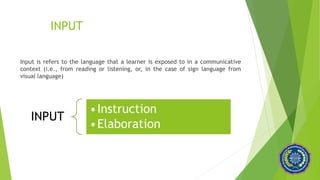
INPUT
Input is refers to the language that a learner is exposed to in a communicative
context (i.e., from reading or listening, or, in the case of sign language from
visual language)
INPUT
•Instruction
•Elaboration
Interaction
Interaction, refers to the conversations that learners participate in. Interactions are
important because it is in this context that learners receive information about the
correctness and, more important, about the incorrectness of their utterances
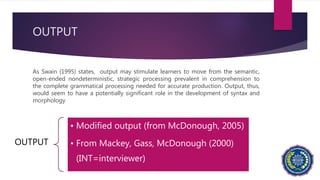
OUTPUT
As Swain (1995) states, output may stimulate learners to move from the semantic,
open-ended nondeterministic, strategic processing prevalent in comprehension to
the complete grammatical processing needed for accurate production. Output, thus,
would seem to have a potentially significant role in the development of syntax and
morphology
OUTPUT
• Modified output (from McDonough, 2005)
• From Mackey, Gass, McDonough (2000)
(INT=interviewer)
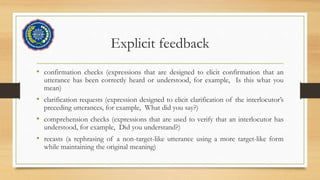
Explicit feedback
• confirmation checks (expressions that are designed to elicit confirmation that an
utterance has been correctly heard or understood, for example, Is this what you
mean)
• clarification requests (expression designed to elicit clarification of the interlocutor’s
preceding utterances, for example, What did you say?)
• comprehension checks (expressions that are used to verify that an interlocutor has
understood, for example, Did you understand?)
• recasts (a rephrasing of a non-target-like utterance using a more target-like form
while maintaining the original meaning)
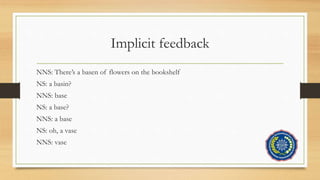
Implicit feedback
NNS: There’s a basen of flowers on the bookshelf
NS: a basin?
NNS: base
NS: a base?
NNS: a base
NS: oh, a vase
NNS: vase
NEGOTIATION
Long (1996) defines negotiation as the process in which, in an effort to communicate,
learners and competent speakers provide and interpret signals of their own and their
interlocutor’s perceived comprehension, thus provoking adjustments to linguistic form,
conversational structure, message content, or all three, until an acceptable level of
understanding is achieved
 Clarification Request and Rephrasing (from Mackey, 2000)
 Clarification Request (from Gass, Mackey, & Ross-Feldman, 2005, 2011)
 Comprehension Check (from Gass et al., 2005)
 Recast (from Oliver & Mackey, 2003)
Attention
 While input such as that provided in recasts may be regarded as a catalyst for
learning, and LREs as evidence that learning processes are being engaged,
attention is believed to be one of the mechanisms that mediates between input
and learning (or intake, as the input-learning process is sometimes called).
 It is widely agreed that second language learners are exposed to more input than
they can process, and that some mechanism is needed to help learners “sort
through” the massive amounts of input they receive
What Counts as Evidence?
As Mackey and Gass (2005) point out, the goal of much interaction-based research
involves manipulating the kinds of interactions that learners are involved in, the kind of
feedback they receive during interaction, and the kind of output they produce, to
determine the relationship between the various components of interaction and second
language learning.
Common Misunderstandings
 The first misunderstanding concerns the scope of the interaction approach.
 A second misunderstanding is that the interaction approach can be directly applied
to classroom methodology
The Explicit/Implicit Debate
 Ellis, Loewen, and Erlam (2006) who measured two types of feedback on the
acquisition of English past tense and their relationship to implicit and explicit
knowledge (learning processes are not dealt with in their study)
 even though interaction-based research is centrally concerned with development
that emanates from an interactive event that includes both implicit and explicit
information, it has been silent on the result of the predicted result of that
information.
Conclusion
The perspective offered by input and interaction has been presented. The
central tenet of the approach is that interaction facilitates the process of
acquiring a second language, as it provides learners with opportunities to
receive modified input, to receive feedback, both explicitly and implicitly, which
in turn may draw learners’ attention to problematic aspects of their
interlanguage and push them to produce modified output
THANK YOU 

Input, interaction, and output in sla

  • 1.
    INPUT, INTERACTION, AND OUTPUTIN SECOND LANGUAGE ACQUISITION FUAD HASAN (216300014) FADLY TAHIR (2163000
  • 2.
    INPUT Input is refersto the language that a learner is exposed to in a communicative context (i.e., from reading or listening, or, in the case of sign language from visual language) INPUT •Instruction •Elaboration
  • 3.
    Interaction Interaction, refers tothe conversations that learners participate in. Interactions are important because it is in this context that learners receive information about the correctness and, more important, about the incorrectness of their utterances
  • 4.
    OUTPUT As Swain (1995)states, output may stimulate learners to move from the semantic, open-ended nondeterministic, strategic processing prevalent in comprehension to the complete grammatical processing needed for accurate production. Output, thus, would seem to have a potentially significant role in the development of syntax and morphology OUTPUT • Modified output (from McDonough, 2005) • From Mackey, Gass, McDonough (2000) (INT=interviewer)
  • 5.
    Explicit feedback • confirmationchecks (expressions that are designed to elicit confirmation that an utterance has been correctly heard or understood, for example, Is this what you mean) • clarification requests (expression designed to elicit clarification of the interlocutor’s preceding utterances, for example, What did you say?) • comprehension checks (expressions that are used to verify that an interlocutor has understood, for example, Did you understand?) • recasts (a rephrasing of a non-target-like utterance using a more target-like form while maintaining the original meaning)
  • 6.
    Implicit feedback NNS: There’sa basen of flowers on the bookshelf NS: a basin? NNS: base NS: a base? NNS: a base NS: oh, a vase NNS: vase
  • 7.
    NEGOTIATION Long (1996) definesnegotiation as the process in which, in an effort to communicate, learners and competent speakers provide and interpret signals of their own and their interlocutor’s perceived comprehension, thus provoking adjustments to linguistic form, conversational structure, message content, or all three, until an acceptable level of understanding is achieved  Clarification Request and Rephrasing (from Mackey, 2000)  Clarification Request (from Gass, Mackey, & Ross-Feldman, 2005, 2011)  Comprehension Check (from Gass et al., 2005)  Recast (from Oliver & Mackey, 2003)
  • 8.
    Attention  While inputsuch as that provided in recasts may be regarded as a catalyst for learning, and LREs as evidence that learning processes are being engaged, attention is believed to be one of the mechanisms that mediates between input and learning (or intake, as the input-learning process is sometimes called).  It is widely agreed that second language learners are exposed to more input than they can process, and that some mechanism is needed to help learners “sort through” the massive amounts of input they receive
  • 9.
    What Counts asEvidence? As Mackey and Gass (2005) point out, the goal of much interaction-based research involves manipulating the kinds of interactions that learners are involved in, the kind of feedback they receive during interaction, and the kind of output they produce, to determine the relationship between the various components of interaction and second language learning.
  • 10.
    Common Misunderstandings  Thefirst misunderstanding concerns the scope of the interaction approach.  A second misunderstanding is that the interaction approach can be directly applied to classroom methodology
  • 11.
    The Explicit/Implicit Debate Ellis, Loewen, and Erlam (2006) who measured two types of feedback on the acquisition of English past tense and their relationship to implicit and explicit knowledge (learning processes are not dealt with in their study)  even though interaction-based research is centrally concerned with development that emanates from an interactive event that includes both implicit and explicit information, it has been silent on the result of the predicted result of that information.
  • 12.
    Conclusion The perspective offeredby input and interaction has been presented. The central tenet of the approach is that interaction facilitates the process of acquiring a second language, as it provides learners with opportunities to receive modified input, to receive feedback, both explicitly and implicitly, which in turn may draw learners’ attention to problematic aspects of their interlanguage and push them to produce modified output
  • 13.