•WHAT IS IT?
  •HOW CAN IT HELP ME?
•WHAT DO I NEED TO DO?
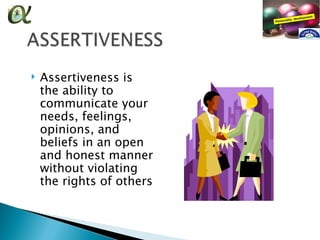
   Assertiveness is
    the ability to
    communicate your
    needs, feelings,
    opinions, and
    beliefs in an open
    and honest manner
    without violating
    the rights of others
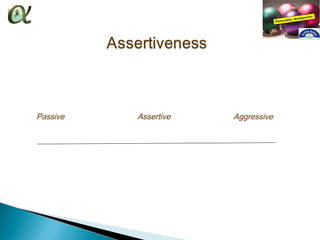
Passive   Assertive   Aggressive
1.   IS NOT THE SAME AS AGGRESSIVE
     BEHAVIOR.
2.   AGGRESSIVE BEHAVIOR ENHANCES SELF AT
     THE EXPENSE OF OTHERS.
3.   ASSERTIVENESS PRODUCES POSITIVE
     OUTCOMES FOR ALL; AGGRESSIVE ACTS
     RESULT IN NEGATIVE OUTCOMES.
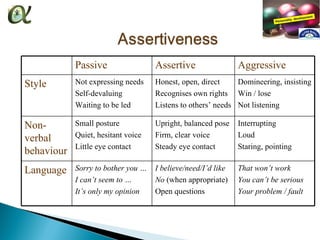
Passive                 Assertive                 Aggressive
Style       Not expressing needs    Honest, open, direct     Domineering, insisting
            Self-devaluing          Recognises own rights Win / lose
            Waiting to be led       Listens to others’ needs Not listening

Non-        Small posture           Upright, balanced pose    Interrupting
verbal      Quiet, hesitant voice   Firm, clear voice         Loud
            Little eye contact      Steady eye contact        Staring, pointing
behaviour
Language    Sorry to bother you …   I believe/need/I’d like   That won’t work
            I can’t seem to …       No (when appropriate)     You can’t be serious
            It’s only my opinion    Open questions            Your problem / fault
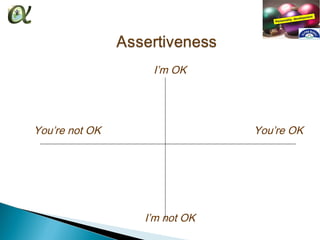
I’m OK


You’re not OK                You’re OK


                I’m not OK
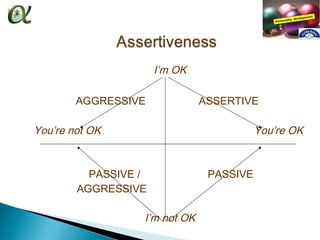
I’m OK

        AGGRESSIVE             ASSERTIVE

You’re not OK                             You’re OK


          PASSIVE /             PASSIVE
        AGGRESSIVE

                  I’m not OK
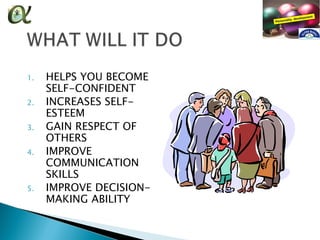
1.   HELPS YOU BECOME
     SELF-CONFIDENT
2.   INCREASES SELF-
     ESTEEM
3.   GAIN RESPECT OF
     OTHERS
4.   IMPROVE
     COMMUNICATION
     SKILLS
5.   IMPROVE DECISION-
     MAKING ABILITY
Assertiveness and self-confidence
   methods

3. Know your facts and have them to hand.
4. Anticipate other people's behaviour and prepare
   your responses.
5. Prepare and use good open questions.
6. Re-condition and practice your own new
   reactions to aggression - display positive
   writings where you will read them often - it's a
   proven successful technique.

                              www.businessballs.com
Barriers (FEAR)

   “I won’t be able to handle it.”
   Others’ decisions
   Others’ attitudes
   Patterns:
      -  not wanting to upset
    -  not wanting to put out
    -  acquiescing
   Lack of self-belief
   Lack of clear intentions 
1.   BE HONEST AND DIRECT ABOUT YOUR
     FEELINGS, NEEDS, BELIEFS.
2.   EXPRESS YOURSELF FIRMLY AND DIRECTLY
     TO SPECIFIC INDIVIDUALS.
3.   BE REASONABLE IN YOUR REQUESTS
1.   STATE YOUR VIEWPOINT WITHOUT BEING
     HESITANT OR APOLOGETIC.
2.   BE HONEST WHEN GIVING OR RECEIVING
     FEEDBACK.
3.   LEARN TO SAY “NO” TO UNREASONABLE
     EXPECTATIONS.
4.   PARAPHRASE WHAT OTHERS HAVE STATED
     TO YOU.
1.   REGOGNIZE AND RESPECT THE RIGHTS OF
     THOSE AROUND YOU.
2.   USE APPROPRIATE TONE OF VOICE.
3.   BE AWARE OF BODY POSTURE/LANGUAGE
4.   MAINTAIN EYE CONTACT.
5.   USE “I” STATEMENTS TO EXPRESS SELF
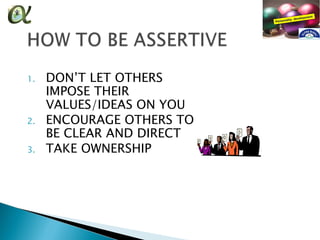
1.   DON’T LET OTHERS
     IMPOSE THEIR
     VALUES/IDEAS ON YOU
2.   ENCOURAGE OTHERS TO
     BE CLEAR AND DIRECT
3.   TAKE OWNERSHIP
1. Prepare and use good open questions.
    Questions that bullies dislike most are deep,
    constructive, incisive and probing, especially if the
    question exposes a lack of thought, preparation,
    consideration, consultation on their part. For example:

•   'What is your evidence for what you’ve said ?'
•   'Who have you consulted about this?'
•   'How did you go about looking for other
    solutions?'
•   'How have you measured the problem ?'
•   'How will you measure the true effectiveness of
    your solution if you implement it?'

                                  www.businessballs.com
Potential scripts:
 
 ”When you ………
 
 I feel ………
  
  because ………
  
  and I would like / need ……….”
Actions (LOVE)

   Only you can know what’s important for you.
    (So the same’s true for others)
   Focus on that
   Stick to that
   Show / demonstrate the positive ….
   …. imagine getting positive back
   Value yourself …. and continue to
‘Don’t believe yourself and don’t believe anybody else.’

The Four Agreements:

   Be impeccable with your word
   Don’t take anything personally
   Don’t make assumptions
   Always do your best
                          Ruiz, M. (2004) The Voice of Knowledge
Inquiry: The Four Questions and Turnaround

   Is it true ?
   Can you absolutely know that it’s true ?
   How do you react when you think that thought ?
   Who would you be without that thought ?

    Turn it around

                             Mitchell, B.K. (2002) Loving What Is
1.   The right to respect myself because of who I
     am.
2.   How to lead my life…pursuing goals,
     dreams, etc.
3.   Have my own values, beliefs, etc.
4.   To tell others how I wish to be treated.
5.   To change my mind and make mistakes
     without being ridiculed.
1.   TO HAVE POSITIVE, HEALTHY, SATISFYING
     RELATIONSHIPS IN WHICH I AM SAFE AND
     RESPECTED.
2.   TO CHANGE AND DEVELOP MY LIFE HOW I
     DETERMINE.
3.   TO BE HAPPY AND AT PEACE.
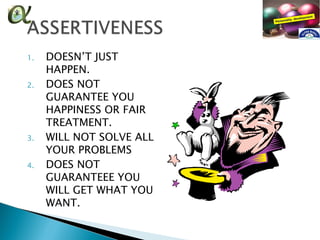
1.   DOESN’T JUST
     HAPPEN.
2.   DOES NOT
     GUARANTEE YOU
     HAPPINESS OR FAIR
     TREATMENT.
3.   WILL NOT SOLVE ALL
     YOUR PROBLEMS
4.   DOES NOT
     GUARANTEEE YOU
     WILL GET WHAT YOU
     WANT.

Assertiveness

  • 1.
    •WHAT IS IT? •HOW CAN IT HELP ME? •WHAT DO I NEED TO DO?
  • 2.
    Assertiveness is the ability to communicate your needs, feelings, opinions, and beliefs in an open and honest manner without violating the rights of others
  • 3.
    Passive Assertive Aggressive
  • 4.
    1. IS NOT THE SAME AS AGGRESSIVE BEHAVIOR. 2. AGGRESSIVE BEHAVIOR ENHANCES SELF AT THE EXPENSE OF OTHERS. 3. ASSERTIVENESS PRODUCES POSITIVE OUTCOMES FOR ALL; AGGRESSIVE ACTS RESULT IN NEGATIVE OUTCOMES.
  • 5.
    Passive Assertive Aggressive Style Not expressing needs Honest, open, direct Domineering, insisting Self-devaluing Recognises own rights Win / lose Waiting to be led Listens to others’ needs Not listening Non- Small posture Upright, balanced pose Interrupting verbal Quiet, hesitant voice Firm, clear voice Loud Little eye contact Steady eye contact Staring, pointing behaviour Language Sorry to bother you … I believe/need/I’d like That won’t work I can’t seem to … No (when appropriate) You can’t be serious It’s only my opinion Open questions Your problem / fault
  • 6.
    I’m OK You’re notOK You’re OK I’m not OK
  • 7.
    I’m OK AGGRESSIVE ASSERTIVE You’re not OK You’re OK PASSIVE / PASSIVE AGGRESSIVE I’m not OK
  • 8.
    1. HELPS YOU BECOME SELF-CONFIDENT 2. INCREASES SELF- ESTEEM 3. GAIN RESPECT OF OTHERS 4. IMPROVE COMMUNICATION SKILLS 5. IMPROVE DECISION- MAKING ABILITY
  • 9.
    Assertiveness and self-confidence methods 3. Know your facts and have them to hand. 4. Anticipate other people's behaviour and prepare your responses. 5. Prepare and use good open questions. 6. Re-condition and practice your own new reactions to aggression - display positive writings where you will read them often - it's a proven successful technique. www.businessballs.com
  • 10.
    Barriers (FEAR)  “I won’t be able to handle it.”  Others’ decisions  Others’ attitudes  Patterns: -  not wanting to upset -  not wanting to put out -  acquiescing  Lack of self-belief  Lack of clear intentions 
  • 11.
    1. BE HONEST AND DIRECT ABOUT YOUR FEELINGS, NEEDS, BELIEFS. 2. EXPRESS YOURSELF FIRMLY AND DIRECTLY TO SPECIFIC INDIVIDUALS. 3. BE REASONABLE IN YOUR REQUESTS
  • 12.
    1. STATE YOUR VIEWPOINT WITHOUT BEING HESITANT OR APOLOGETIC. 2. BE HONEST WHEN GIVING OR RECEIVING FEEDBACK. 3. LEARN TO SAY “NO” TO UNREASONABLE EXPECTATIONS. 4. PARAPHRASE WHAT OTHERS HAVE STATED TO YOU.
  • 13.
    1. REGOGNIZE AND RESPECT THE RIGHTS OF THOSE AROUND YOU. 2. USE APPROPRIATE TONE OF VOICE. 3. BE AWARE OF BODY POSTURE/LANGUAGE 4. MAINTAIN EYE CONTACT. 5. USE “I” STATEMENTS TO EXPRESS SELF
  • 14.
    1. DON’T LET OTHERS IMPOSE THEIR VALUES/IDEAS ON YOU 2. ENCOURAGE OTHERS TO BE CLEAR AND DIRECT 3. TAKE OWNERSHIP
  • 15.
    1. Prepare anduse good open questions. Questions that bullies dislike most are deep, constructive, incisive and probing, especially if the question exposes a lack of thought, preparation, consideration, consultation on their part. For example: • 'What is your evidence for what you’ve said ?' • 'Who have you consulted about this?' • 'How did you go about looking for other solutions?' • 'How have you measured the problem ?' • 'How will you measure the true effectiveness of your solution if you implement it?' www.businessballs.com
  • 16.
    Potential scripts:    ”When you………    I feel ………    because ………    and I would like / need ……….”
  • 17.
    Actions (LOVE)  Only you can know what’s important for you. (So the same’s true for others)  Focus on that  Stick to that  Show / demonstrate the positive ….  …. imagine getting positive back  Value yourself …. and continue to
  • 18.
    ‘Don’t believe yourselfand don’t believe anybody else.’ The Four Agreements:  Be impeccable with your word  Don’t take anything personally  Don’t make assumptions  Always do your best Ruiz, M. (2004) The Voice of Knowledge
  • 19.
    Inquiry: The FourQuestions and Turnaround  Is it true ?  Can you absolutely know that it’s true ?  How do you react when you think that thought ?  Who would you be without that thought ? Turn it around Mitchell, B.K. (2002) Loving What Is
  • 20.
    1. The right to respect myself because of who I am. 2. How to lead my life…pursuing goals, dreams, etc. 3. Have my own values, beliefs, etc. 4. To tell others how I wish to be treated. 5. To change my mind and make mistakes without being ridiculed.
  • 21.
    1. TO HAVE POSITIVE, HEALTHY, SATISFYING RELATIONSHIPS IN WHICH I AM SAFE AND RESPECTED. 2. TO CHANGE AND DEVELOP MY LIFE HOW I DETERMINE. 3. TO BE HAPPY AND AT PEACE.
  • 22.
    1. DOESN’T JUST HAPPEN. 2. DOES NOT GUARANTEE YOU HAPPINESS OR FAIR TREATMENT. 3. WILL NOT SOLVE ALL YOUR PROBLEMS 4. DOES NOT GUARANTEEE YOU WILL GET WHAT YOU WANT.