

By
Pooja Mandora
Definition
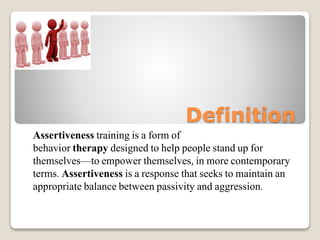
Assertiveness training is a form of
behavior therapy designed to help people stand up for
themselves—to empower themselves, in more contemporary
terms. Assertiveness is a response that seeks to maintain an
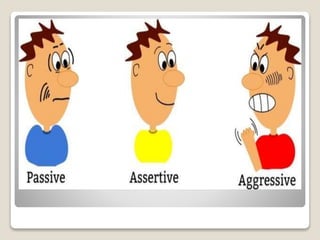
appropriate balance between passivity and aggression.
History
 Assertiveness Training ("AT") was introduced
by Andrew Salter (1961) and popularized by Joseph
Wolpe.
 Joseph Wolpe originally explored the use of
assertiveness as a means of "reciprocal inhibition" of
anxiety.
 Wolpe's belief was that a person could not be both
assertive and anxious at the same time, and thus being
assertive would inhibit anxiety.
Characteristics of Assertive
Behavior
 Assertive Behavior is Interpersonal Behavior involving
honest and relatively straight forward expression of
thoughts and feelings
 Assertive Behavior is socially appropriate
 A person behaving assertively is taking other’s feelings
and welfare into account
Test Your Assertiveness
• Can you express negative feelings about other
people and their behaviors without using abusive
language?
• Are you able to exercise and express your
strengths?
• Can you easily recognize and compliment other
people’s achievements?
Test Your Assertiveness
• Do you have the confidence to ask for what is
rightfully yours?
• Can you accept criticism without being defensive?
• Do you feel comfortable accepting compliments?
• Are you able to stand up for your rights?
Test Your Assertiveness
• Are you able to refuse unreasonable requests from
friends, family, or co-workers?
• Can you comfortably start and carry on a
conversation with others?
• Do you ask for assistance when you need it ?
A “yes” response to the questions indicates an assertive approach.
Categories of Assertive Behavior
• Refusal Assertiveness – Appropriate and skillful
blocking/refusal to acquiesce, any attempts of others to
impose their goal directed behavior or interfere with
your goal directed behavior. Being able to say NO
• Commendatory Assertiveness - Ability to express
positive feeling, liking, love admiration, appreciation…
• Request Assertiveness
What’s Keeping You From Being
Assertive?
• Fear of change
• Refusal to admit their submissiveness.
• Fear of ruining relationships if you speak your
mind.
• Lack confidence in your ability
Theory of Non-Assertivness
 Wolpe – Due to maladaptive conditioning. Anxiety
and Assertion are incompatible. He talked about
Counter conditioning.
 Cognitive Theory – Non assertion is negative
expectations and self statements that block initiation
or execution of assertive behavior.
 Bandura – “Self efficacy expectations”.
Other reasons
 Negative Self – talk (I will make situation only
worse, I am a failure)
 Rules we create for ourselves
 Perception we create for ourselves and others
Assertive exercises
Joseph Wolpe gave 6 Excitatory(Assertive) exercises:
◦ Use of Feeling Talk : “I like…”; “I dislike…”
◦ Use of Facial Talk – use of facial expressions
◦ Practice in expressing contradictory opinion when one
disagrees
◦ Practice in the use of “I”
◦ Practice in agreeing when complimented
◦ Practice in improvising and acting spontaneously
Few simple communication
exercises
 Use “I” messages and “feeling” verbs.
 Discuss your goals and accomplishments.
 Show an interest in others.
 Match your delivery to your message.
 Know how to respond to compliments.
 Disagree mildly.
 Disagree more emphatically when it’s necessary to
get your point across.
Few simple communication
exercises conti…
 Ask for clarification when you’re confused.
 Don’t be afraid to ask “Why?”
 Speak up for yourself.
 Be persistent.
 Don’t feel compelled to always justify your feelings
and opinions.
Techniques
 Exposure Therapy
 Visualization
 Behavioral Rehearsal
 Focusing on Voice Tone
 Use of Video tapes
 Role Reversal
 Home- Work
 Use of Hierarchy
 Escalation
Techniques Conti…
 Cognitive Techniques like cognitive restructuring
 Making Your Messages Assertive
1. The most effective way to communicate assertively is to
prepare a script of what you want to say.
2. Plan it, write it out, fine-tune it, memorize it, and practice it
— then present it.
 PRACTICE, PRACTICE!
Techniques Conti…
Helps you prepare and deliver successful assertive scripts
D = Describe
E = Express
S = Specify
C = Consequences
4 Step Process “Acronym DESC”
Benefits of being Assertive
 Assertive behavior can actually reduce physical and
mental stress because people feel less like victims and
more like influencers.
 Communication becomes clearer and more concise,
which reduces misunderstandings and clarifies
expectations
 Because problems are solved quickly, resentment,
frustration and other tensions that block peak
performance are minimized.
Benefits of being Assertive
 Helps to become problem-solvers rather than victims of a
system they believe they can’t control.
 Instead of wasting time by gossiping and complaining —
which accomplish nothing — employees focus on the
positive, productive steps they can take to solve problems.
 Being assertive gives you the confidence and
communication skills to go after and get what you really
want.
 After all, if you don’t stand up for yourself, no one else
will.
Thank You

Assertiveness

  • 1.
  • 3.
    Definition Assertiveness training isa form of behavior therapy designed to help people stand up for themselves—to empower themselves, in more contemporary terms. Assertiveness is a response that seeks to maintain an appropriate balance between passivity and aggression.
  • 5.
    History  Assertiveness Training("AT") was introduced by Andrew Salter (1961) and popularized by Joseph Wolpe.  Joseph Wolpe originally explored the use of assertiveness as a means of "reciprocal inhibition" of anxiety.  Wolpe's belief was that a person could not be both assertive and anxious at the same time, and thus being assertive would inhibit anxiety.
  • 6.
    Characteristics of Assertive Behavior Assertive Behavior is Interpersonal Behavior involving honest and relatively straight forward expression of thoughts and feelings  Assertive Behavior is socially appropriate  A person behaving assertively is taking other’s feelings and welfare into account
  • 7.
    Test Your Assertiveness •Can you express negative feelings about other people and their behaviors without using abusive language? • Are you able to exercise and express your strengths? • Can you easily recognize and compliment other people’s achievements?
  • 8.
    Test Your Assertiveness •Do you have the confidence to ask for what is rightfully yours? • Can you accept criticism without being defensive? • Do you feel comfortable accepting compliments? • Are you able to stand up for your rights?
  • 9.
    Test Your Assertiveness •Are you able to refuse unreasonable requests from friends, family, or co-workers? • Can you comfortably start and carry on a conversation with others? • Do you ask for assistance when you need it ? A “yes” response to the questions indicates an assertive approach.
  • 10.
    Categories of AssertiveBehavior • Refusal Assertiveness – Appropriate and skillful blocking/refusal to acquiesce, any attempts of others to impose their goal directed behavior or interfere with your goal directed behavior. Being able to say NO • Commendatory Assertiveness - Ability to express positive feeling, liking, love admiration, appreciation… • Request Assertiveness
  • 11.
    What’s Keeping YouFrom Being Assertive? • Fear of change • Refusal to admit their submissiveness. • Fear of ruining relationships if you speak your mind. • Lack confidence in your ability
  • 12.
    Theory of Non-Assertivness Wolpe – Due to maladaptive conditioning. Anxiety and Assertion are incompatible. He talked about Counter conditioning.  Cognitive Theory – Non assertion is negative expectations and self statements that block initiation or execution of assertive behavior.  Bandura – “Self efficacy expectations”.
  • 13.
    Other reasons  NegativeSelf – talk (I will make situation only worse, I am a failure)  Rules we create for ourselves  Perception we create for ourselves and others
  • 14.
    Assertive exercises Joseph Wolpegave 6 Excitatory(Assertive) exercises: ◦ Use of Feeling Talk : “I like…”; “I dislike…” ◦ Use of Facial Talk – use of facial expressions ◦ Practice in expressing contradictory opinion when one disagrees ◦ Practice in the use of “I” ◦ Practice in agreeing when complimented ◦ Practice in improvising and acting spontaneously
  • 15.
    Few simple communication exercises Use “I” messages and “feeling” verbs.  Discuss your goals and accomplishments.  Show an interest in others.  Match your delivery to your message.  Know how to respond to compliments.  Disagree mildly.  Disagree more emphatically when it’s necessary to get your point across.
  • 16.
    Few simple communication exercisesconti…  Ask for clarification when you’re confused.  Don’t be afraid to ask “Why?”  Speak up for yourself.  Be persistent.  Don’t feel compelled to always justify your feelings and opinions.
  • 17.
    Techniques  Exposure Therapy Visualization  Behavioral Rehearsal  Focusing on Voice Tone  Use of Video tapes  Role Reversal  Home- Work  Use of Hierarchy  Escalation
  • 18.
    Techniques Conti…  CognitiveTechniques like cognitive restructuring  Making Your Messages Assertive 1. The most effective way to communicate assertively is to prepare a script of what you want to say. 2. Plan it, write it out, fine-tune it, memorize it, and practice it — then present it.  PRACTICE, PRACTICE!
  • 19.
    Techniques Conti… Helps youprepare and deliver successful assertive scripts D = Describe E = Express S = Specify C = Consequences 4 Step Process “Acronym DESC”
  • 20.
    Benefits of beingAssertive  Assertive behavior can actually reduce physical and mental stress because people feel less like victims and more like influencers.  Communication becomes clearer and more concise, which reduces misunderstandings and clarifies expectations  Because problems are solved quickly, resentment, frustration and other tensions that block peak performance are minimized.
  • 21.
    Benefits of beingAssertive  Helps to become problem-solvers rather than victims of a system they believe they can’t control.  Instead of wasting time by gossiping and complaining — which accomplish nothing — employees focus on the positive, productive steps they can take to solve problems.  Being assertive gives you the confidence and communication skills to go after and get what you really want.  After all, if you don’t stand up for yourself, no one else will.
  • 22.