Assay of sodium
hydroxide
solution
NaOH solution
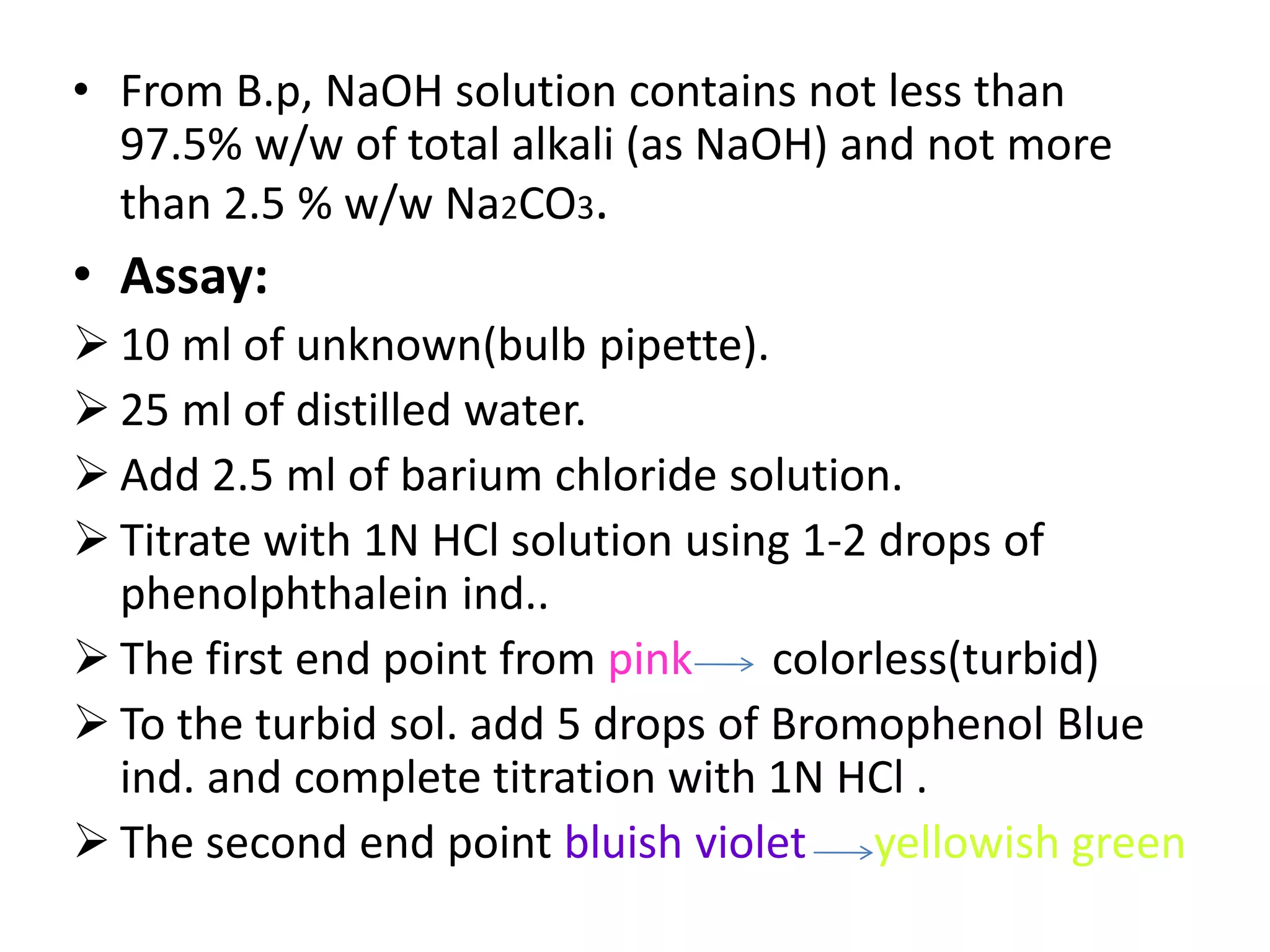
• From B.p, NaOH solution contains not less than
97.5% w/w of total alkali (as NaOH) and not more
than 2.5 % w/w Na2CO3.
• Assay:
 10 ml of unknown(bulb pipette).
 25 ml of distilled water.
 Add 2.5 ml of barium chloride solution.
 Titrate with 1N HCl solution using 1-2 drops of
phenolphthalein ind..
 The first end point from pink colorless(turbid)
 To the turbid sol. add 5 drops of Bromophenol Blue
ind. and complete titration with 1N HCl .
 The second end point bluish violet yellowish green
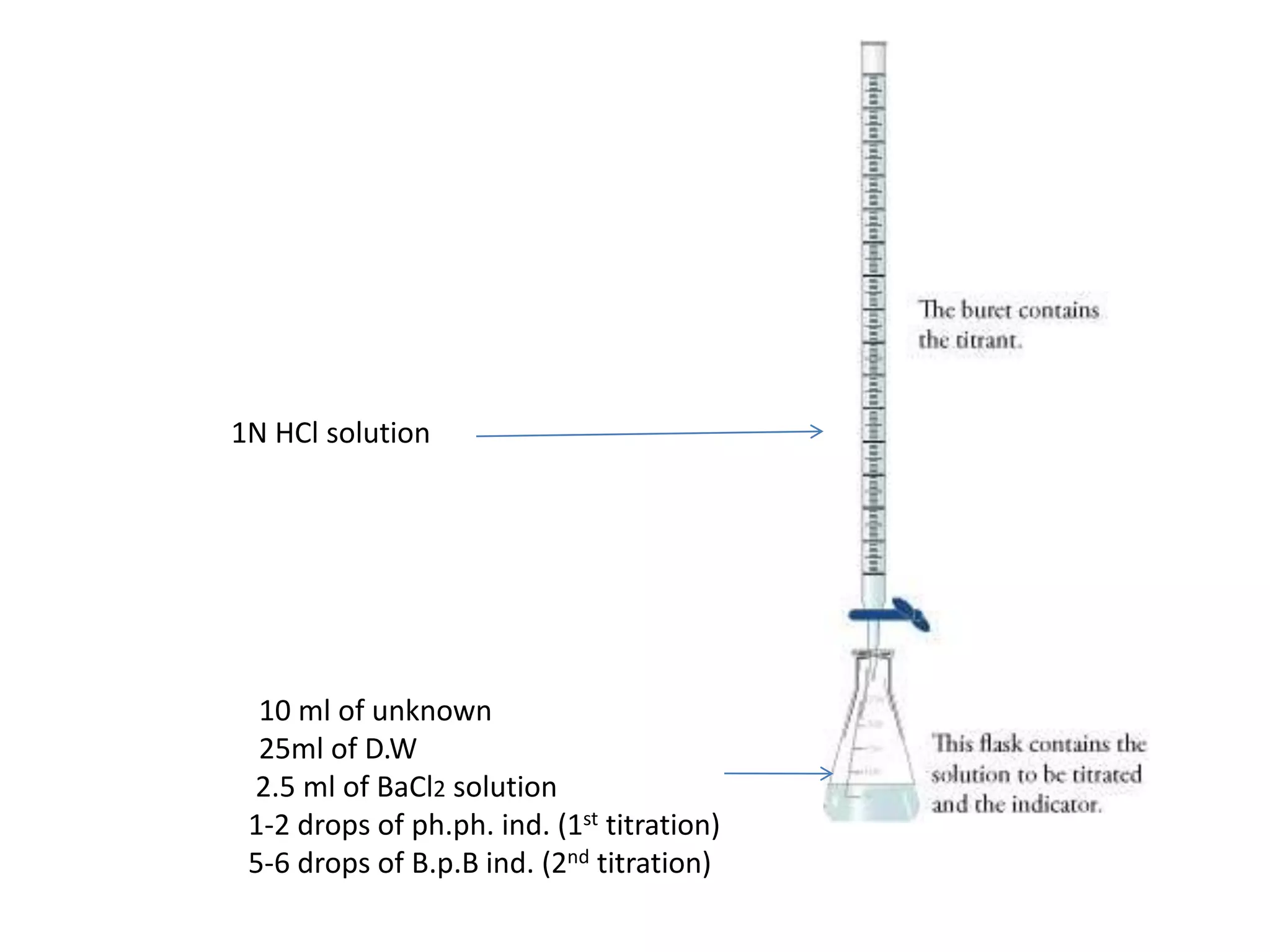
10 ml of unknown
25ml of D.W
2.5 ml of BaCl2 solution
1-2 drops of ph.ph. ind. (1st titration)
5-6 drops of B.p.B ind. (2nd titration)
1N HCl solution
Chemical principle:
• NaOH is strong base, absorbs CO2
2NaOH + CO2 Na2CO3 + H2O
• both NaOH and Na2CO3 react with HCl
NaOH + HCl NaCl + H2O
Na2CO3 + 2HCl 2NaCl + H2O + CO2
When we assay a sample, we do the assay for total alkalinity
contributed to NaOH and Na2CO3.
• Barium chloride (BaCl2) is added to precipitate all
carbonate
BaCl2 + Na2CO3 BaCO3 + 2NaCl
soluble in alkaline insoluble in alkaline
• 1st titration:
NaOH + HCl NaCl + H2O
Why HCl do not react with BaCO3?
Why the end point is turbid?
• 2nd titration:
2HCl + BaCO3 BaCl2 + H2O + CO2
definition of chemical factor: the weight of
substance that is chemically equivalent to 1ml
of std. solution.
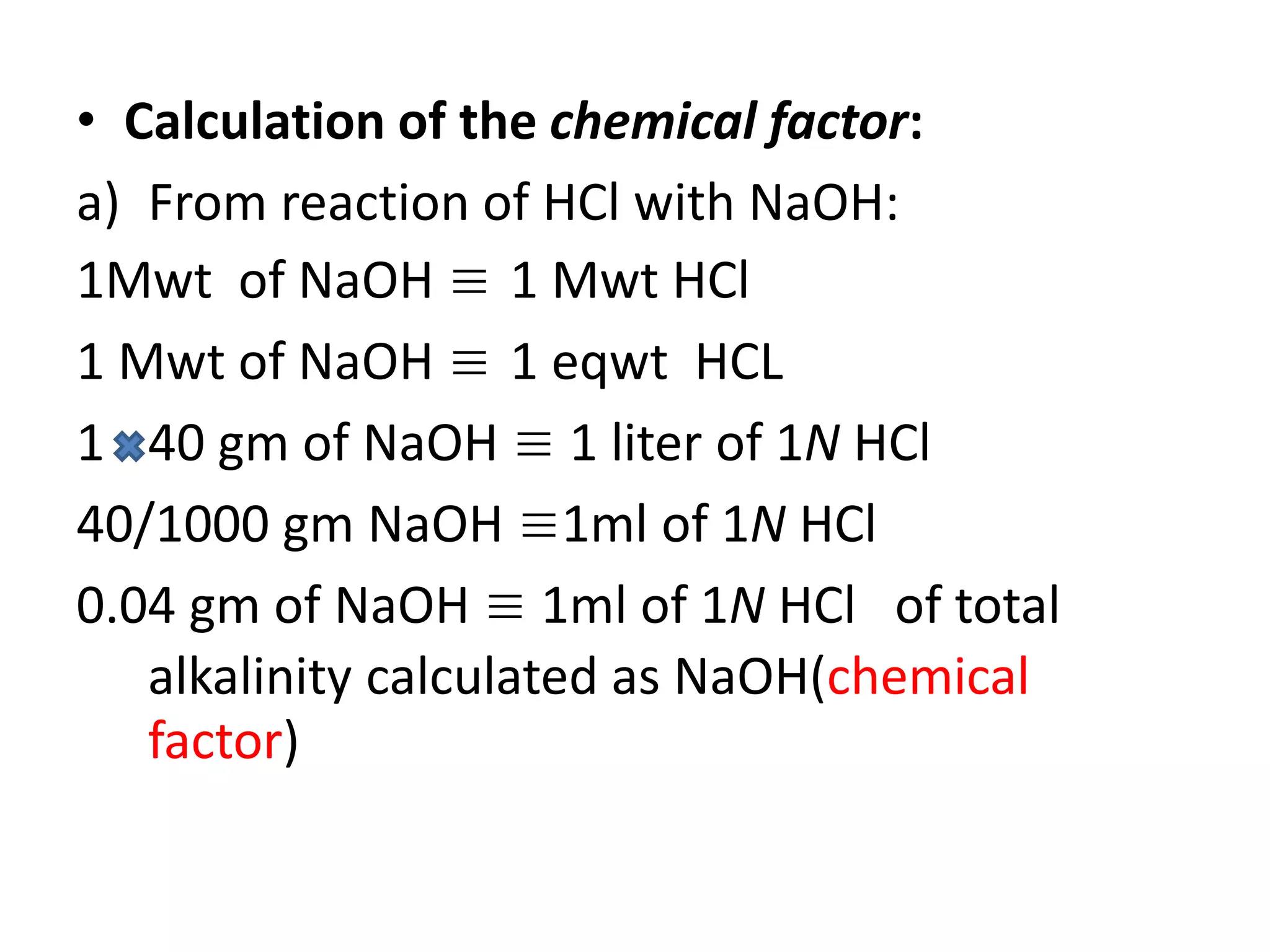
• Calculation of the chemical factor:
a) From reaction of HCl with NaOH:
1Mwt of NaOH ≡ 1 Mwt HCl
1 Mwt of NaOH ≡ 1 eqwt HCL
1 40 gm of NaOH ≡ 1 liter of 1N HCl
40/1000 gm NaOH ≡1ml of 1N HCl
0.04 gm of NaOH ≡ 1ml of 1N HCl of total
alkalinity calculated as NaOH(chemical
factor)
b) From reaction of 2HCl with Na2CO3
2Mwt of HCl ≡1Mwt of BaCO3 ≡1Mwt Na2CO3
1Mwt Na2CO3 ≡ 2Mwt of HCl
1Mwt Na2CO3 ≡ 2 eqwt of HCl
½ Mwt Na2CO3 ≡ 1 eqwt of HCl
106/2 gm Na2CO3≡ 1liter of 1N HCL
53 gm Na2CO3 ≡ 1liter of 1N HCL
53/1000 gm Na2CO3 ≡ 1ml of 1N HCL
0.053 gm Na2CO3 ≡ 1ml of 1N HCL (chemical
factor)
• Calculations :
V1 is the of HCl consumed in the 1st titration
V2 is the of HCl consumed in the 2nd titration
V1+V2= V3 total HCl consumed.
correct the V3 according to this equation:
V x N= V’ x N’
Corrected V3 x 0.04= gm wt. of total alkali
Then the % w/v of total alkali
Corrected V2 x 0.053= gm wt. of Na2CO3
Then the % w/v of Na2CO3 in the unknown

Assay of sodium hydroxide solution.pptx

  • 1.
  • 2.
    • From B.p,NaOH solution contains not less than 97.5% w/w of total alkali (as NaOH) and not more than 2.5 % w/w Na2CO3. • Assay:  10 ml of unknown(bulb pipette).  25 ml of distilled water.  Add 2.5 ml of barium chloride solution.  Titrate with 1N HCl solution using 1-2 drops of phenolphthalein ind..  The first end point from pink colorless(turbid)  To the turbid sol. add 5 drops of Bromophenol Blue ind. and complete titration with 1N HCl .  The second end point bluish violet yellowish green
  • 3.
    10 ml ofunknown 25ml of D.W 2.5 ml of BaCl2 solution 1-2 drops of ph.ph. ind. (1st titration) 5-6 drops of B.p.B ind. (2nd titration) 1N HCl solution
  • 4.
    Chemical principle: • NaOHis strong base, absorbs CO2 2NaOH + CO2 Na2CO3 + H2O • both NaOH and Na2CO3 react with HCl NaOH + HCl NaCl + H2O Na2CO3 + 2HCl 2NaCl + H2O + CO2 When we assay a sample, we do the assay for total alkalinity contributed to NaOH and Na2CO3. • Barium chloride (BaCl2) is added to precipitate all carbonate BaCl2 + Na2CO3 BaCO3 + 2NaCl soluble in alkaline insoluble in alkaline
  • 5.
    • 1st titration: NaOH+ HCl NaCl + H2O Why HCl do not react with BaCO3? Why the end point is turbid? • 2nd titration: 2HCl + BaCO3 BaCl2 + H2O + CO2 definition of chemical factor: the weight of substance that is chemically equivalent to 1ml of std. solution.
  • 6.
    • Calculation ofthe chemical factor: a) From reaction of HCl with NaOH: 1Mwt of NaOH ≡ 1 Mwt HCl 1 Mwt of NaOH ≡ 1 eqwt HCL 1 40 gm of NaOH ≡ 1 liter of 1N HCl 40/1000 gm NaOH ≡1ml of 1N HCl 0.04 gm of NaOH ≡ 1ml of 1N HCl of total alkalinity calculated as NaOH(chemical factor)
  • 7.
    b) From reactionof 2HCl with Na2CO3 2Mwt of HCl ≡1Mwt of BaCO3 ≡1Mwt Na2CO3 1Mwt Na2CO3 ≡ 2Mwt of HCl 1Mwt Na2CO3 ≡ 2 eqwt of HCl ½ Mwt Na2CO3 ≡ 1 eqwt of HCl 106/2 gm Na2CO3≡ 1liter of 1N HCL 53 gm Na2CO3 ≡ 1liter of 1N HCL 53/1000 gm Na2CO3 ≡ 1ml of 1N HCL 0.053 gm Na2CO3 ≡ 1ml of 1N HCL (chemical factor)
  • 8.
    • Calculations : V1is the of HCl consumed in the 1st titration V2 is the of HCl consumed in the 2nd titration V1+V2= V3 total HCl consumed. correct the V3 according to this equation: V x N= V’ x N’ Corrected V3 x 0.04= gm wt. of total alkali Then the % w/v of total alkali Corrected V2 x 0.053= gm wt. of Na2CO3 Then the % w/v of Na2CO3 in the unknown