Introduction: Course aims
and outcomes:
• Lab Skills
• Independent work
• “Good” habits GLP
• Honesty and reliability
• Personal organisation and work
organisation (Leaving personal problems)
• Problem solving skills and reliability
Aims……
• Noticing “bad” data or experimental faults
• Using units to record numerical
(quantitative) information
• Knowledge and awareness of Lab
management systems (LIMS)
• Responsibilities regarding LIMS
• Health and Safety
Titrations
From early beginnings
• Work potential
• Initial “foot in the door” of industry
• Quality dependent and skill dependant
promotional prospects a great job and
financial reward
• Margaret Thatcher (Lab technician later
PM Britain)
Class Demo Na in water
• Stoichiometry
• Na in H20 and indicator
• Equation
• Analysis
• Weigh the Na
• Titrate the NaOH
• Measure the volume of the water
dissolving the NaOH
• Trap the hydrogen gas
Generalised to……..
• Everything reduces to energetics
(thermodynamics) and kinetics
• Both require measurements
• All involve units
• Descriptions can be qualitative (what) and
quantitative (how much)
Titrations
 Volumetric analysis is an analytical method using measurement of
volume.
 In a titration, a solution of accurately known concentration, called a
standard solution, is added gradually to another solution of
unknown concentration, until the chemical reaction between the two
solutions is complete.
 The equivalence point is the point at which the two solutions have
completely reacted.
 An indicator is used to determine the equivalence point. When an
indicator changes colour this is called the endpoint.
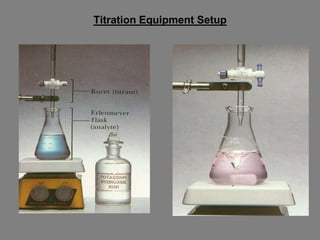
Titration Equipment Setup
Characteristics of Primary Standards
• Easy to obtain, purify, dry and preserve in a pure state.
• Unaltered in air during weighing.
• High relative molecular mass. (why?? – weighing)
• Readily soluble in solvent of choice.
• React stoichiometrically and fast.
e.g. borax or sodium carbonate for HCl and potassium hydrogen
phthalate (KHP) for NaOH
Titration theory
In a titration a solution of known concentration is used to determine
the unknown concentration of another solution. The procedure is as
follows.
• Use n = cV to determine the amount of the solution of known
concentration that reacted.
• Use the reaction stoichiometry to determine the amount of the
solution of unknown concentration that reacted.
• Use c =n/V to determine the concentration of the solution of
unknown concentration.
eg A 25 mL sample of vinegar (dil CH3COOH) was titrated with 0.500 M
NaOH(aq). The equivalence point was reached when 38.1 mL of
the base had been added. Find the molar concentration of the
acetic acid in vinegar.
CH3COOH(aq) + NaOH(aq) NaCH3CO2(aq) + H2O(l)
The procedure is as follows:
• Amount (n) of NaOH reacted up to the equivalence point
n = cV = 0.500 x 0.0381 = 0.0191 mol
• Amount (n) of CH3COOH that reacted = 0.0191mol from reaction
stoichiometry.
• Concentration of unknown vinegar solution
c = n/V = 0.0191/0.025 = 0.764 mol L-1
A student prepared a sample of hydrochloric acid that contained
0.72 g of hydrogen chloride in 250 mL of solution. This acid solution
was used to titrate 25.0 mL of a solution of calcium hydroxide. The
stoichiometric point was reached when 15.10 mL of acid had been
added.
i) What was the concentration of the standard solution of HCl?
ii) What was the concentration of the calcium hydroxide solution?
(0.024M)
The following equation can be used to determine
the concentration of the unknown solution.
n2c1V1 = n1c2V2
n1 = stoichiometric coeffeicient of reactant 1
n2 = stoichiometric coeffeicient of reactant 1
c1 = concentration of reactant 1
c2 = concentration of reactant 2
V1 = volume of reactant 1
V2 = volume of reactant 2
eg 20.00 mL of 0.03 M H2SO4 required 31.20 mL of KOH to
neutralise it. What was the concentration of the KOH?
Problems
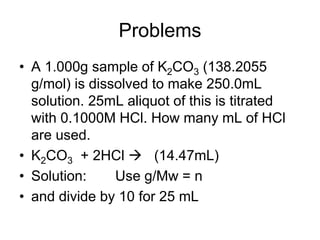
• A 1.000g sample of K2CO3 (138.2055
g/mol) is dissolved to make 250.0mL
solution. 25mL aliquot of this is titrated
with 0.1000M HCl. How many mL of HCl
are used.
• K2CO3 + 2HCl  (14.47mL)
• Solution: Use g/Mw = n
• and divide by 10 for 25 mL
Calculation cont…
• n/10 = 7.2356 x 10⁻⁴ mol
C x V = n = 7.2356 x 10⁻⁴ / 0.010 mol
2 mol HCl are used per mol K2CO3
7.2356 x 10-2 x 2 = 14.47mL
Question 2
• Strategy use 0.6g /138.2055 = n
• Divide by 10 (used 1/10 of total weighed)
• Calc C x V = n for HCl (20mL of 0.17M)
• Subtract from this 1/10 of n x 2 above (the
HCl reacts 2 moles to each carbonate)
• Use C = n/V and divide moles/.1048M to
get litres. Then x 1000 to give 24.16mL
Question 3
• Strategy: The acid and base will react and
the one in excess will remain left over.
• C x V HCl = n = 0.03000 mol
• n = g/mol for base = 0.004104 but
remember 2 x 0.004104 mol HCl will be
used = 0.0082089 mol
• 0.03000 – 0.0082089 = 0.02179 mol HCl
left
Question 3 Cont…
• 0.02179 mol HCl left
• 20/250 x 0.02179 mole used for titration
with NaOH (0.1160M) = 0.001743mol
• 0.001743/0.1160 = 0.01503L (15.03mL)
Question 4
• First calc moles left from C x V = n from
19.90mL of 0.1473M NaOH =
0.002931mol HCl left
• 25ml of 0.1842M HCl = n = 0.004605mol
• = NaOH so 0.004605 – 0.002931 used
• = 0.001674mol used but /2 to calc CO3
2-
• 1/10 of g/Mw or 0.06181g used
• Mw = g/n = 73.8 So M2 = 73.8–60 CO3
2-
Question 4 Cont…
• 13.8 g/mol
• One M = 13.8/2 = 6.9 Mw for M+
• 7M+
• 7M
• 7Li
• 

Titrations

  • 1.
    Introduction: Course aims andoutcomes: • Lab Skills • Independent work • “Good” habits GLP • Honesty and reliability • Personal organisation and work organisation (Leaving personal problems) • Problem solving skills and reliability
  • 2.
    Aims…… • Noticing “bad”data or experimental faults • Using units to record numerical (quantitative) information • Knowledge and awareness of Lab management systems (LIMS) • Responsibilities regarding LIMS • Health and Safety
  • 3.
  • 4.
    From early beginnings •Work potential • Initial “foot in the door” of industry • Quality dependent and skill dependant promotional prospects a great job and financial reward • Margaret Thatcher (Lab technician later PM Britain)
  • 5.
    Class Demo Nain water • Stoichiometry • Na in H20 and indicator • Equation • Analysis • Weigh the Na • Titrate the NaOH • Measure the volume of the water dissolving the NaOH • Trap the hydrogen gas
  • 6.
    Generalised to…….. • Everythingreduces to energetics (thermodynamics) and kinetics • Both require measurements • All involve units • Descriptions can be qualitative (what) and quantitative (how much)
  • 7.
    Titrations  Volumetric analysisis an analytical method using measurement of volume.  In a titration, a solution of accurately known concentration, called a standard solution, is added gradually to another solution of unknown concentration, until the chemical reaction between the two solutions is complete.  The equivalence point is the point at which the two solutions have completely reacted.  An indicator is used to determine the equivalence point. When an indicator changes colour this is called the endpoint.
  • 8.
  • 9.
    Characteristics of PrimaryStandards • Easy to obtain, purify, dry and preserve in a pure state. • Unaltered in air during weighing. • High relative molecular mass. (why?? – weighing) • Readily soluble in solvent of choice. • React stoichiometrically and fast. e.g. borax or sodium carbonate for HCl and potassium hydrogen phthalate (KHP) for NaOH
  • 10.
    Titration theory In atitration a solution of known concentration is used to determine the unknown concentration of another solution. The procedure is as follows. • Use n = cV to determine the amount of the solution of known concentration that reacted. • Use the reaction stoichiometry to determine the amount of the solution of unknown concentration that reacted. • Use c =n/V to determine the concentration of the solution of unknown concentration. eg A 25 mL sample of vinegar (dil CH3COOH) was titrated with 0.500 M NaOH(aq). The equivalence point was reached when 38.1 mL of the base had been added. Find the molar concentration of the acetic acid in vinegar. CH3COOH(aq) + NaOH(aq) NaCH3CO2(aq) + H2O(l)
  • 11.
    The procedure isas follows: • Amount (n) of NaOH reacted up to the equivalence point n = cV = 0.500 x 0.0381 = 0.0191 mol • Amount (n) of CH3COOH that reacted = 0.0191mol from reaction stoichiometry. • Concentration of unknown vinegar solution c = n/V = 0.0191/0.025 = 0.764 mol L-1 A student prepared a sample of hydrochloric acid that contained 0.72 g of hydrogen chloride in 250 mL of solution. This acid solution was used to titrate 25.0 mL of a solution of calcium hydroxide. The stoichiometric point was reached when 15.10 mL of acid had been added. i) What was the concentration of the standard solution of HCl? ii) What was the concentration of the calcium hydroxide solution? (0.024M)
  • 12.
    The following equationcan be used to determine the concentration of the unknown solution. n2c1V1 = n1c2V2 n1 = stoichiometric coeffeicient of reactant 1 n2 = stoichiometric coeffeicient of reactant 1 c1 = concentration of reactant 1 c2 = concentration of reactant 2 V1 = volume of reactant 1 V2 = volume of reactant 2 eg 20.00 mL of 0.03 M H2SO4 required 31.20 mL of KOH to neutralise it. What was the concentration of the KOH?
  • 13.
    Problems • A 1.000gsample of K2CO3 (138.2055 g/mol) is dissolved to make 250.0mL solution. 25mL aliquot of this is titrated with 0.1000M HCl. How many mL of HCl are used. • K2CO3 + 2HCl  (14.47mL) • Solution: Use g/Mw = n • and divide by 10 for 25 mL
  • 14.
    Calculation cont… • n/10= 7.2356 x 10⁻⁴ mol C x V = n = 7.2356 x 10⁻⁴ / 0.010 mol 2 mol HCl are used per mol K2CO3 7.2356 x 10-2 x 2 = 14.47mL
  • 15.
    Question 2 • Strategyuse 0.6g /138.2055 = n • Divide by 10 (used 1/10 of total weighed) • Calc C x V = n for HCl (20mL of 0.17M) • Subtract from this 1/10 of n x 2 above (the HCl reacts 2 moles to each carbonate) • Use C = n/V and divide moles/.1048M to get litres. Then x 1000 to give 24.16mL
  • 16.
    Question 3 • Strategy:The acid and base will react and the one in excess will remain left over. • C x V HCl = n = 0.03000 mol • n = g/mol for base = 0.004104 but remember 2 x 0.004104 mol HCl will be used = 0.0082089 mol • 0.03000 – 0.0082089 = 0.02179 mol HCl left
  • 17.
    Question 3 Cont… •0.02179 mol HCl left • 20/250 x 0.02179 mole used for titration with NaOH (0.1160M) = 0.001743mol • 0.001743/0.1160 = 0.01503L (15.03mL)
  • 18.
    Question 4 • Firstcalc moles left from C x V = n from 19.90mL of 0.1473M NaOH = 0.002931mol HCl left • 25ml of 0.1842M HCl = n = 0.004605mol • = NaOH so 0.004605 – 0.002931 used • = 0.001674mol used but /2 to calc CO3 2- • 1/10 of g/Mw or 0.06181g used • Mw = g/n = 73.8 So M2 = 73.8–60 CO3 2-
  • 19.
    Question 4 Cont… •13.8 g/mol • One M = 13.8/2 = 6.9 Mw for M+ • 7M+ • 7M • 7Li • 