PURPOSE:

To determine the alkalinity of a water sample using a double – endpoint titration for
                    -
determination of [OH ] and [CO3 2-].

                                    INTRODUCTION:

Alkalinity is a parameter that is measured on almost all environmental samples -drinking
water,natural waters, polluted waters, sewage, and industrial wastes. Alkalinity refers to the
buffering capacity of water samples and to their ability to neutralize acidic pollution from rainfall
or wastewater. For municipal sewage or industrial wastes, the amount of alkalinity is important
in determining the type of treatment which should be employed.

Alkalinity is primarily caused by the presence of carbonate (C03 2-) and bicarbonate (HC03-)
ions, although hydroxide (OH-) ions may also contribute, especially when there is industrial
pollution. Living organisms, such as aquatic life, function best in a pH range of 5.0 to 9.0 and
levels of 20 to 200 mg/L are typical alkalinity values for fresh water. When the pH is above 8.3,
carbonate (CO3 2-) is the primary contributor to alkalinity; when the pH is below 8.3,
bicarbonate (HCO3 -) becomes the dominating factor. The values of alkalinity are reported in
units of "mg CaCO3/L" because of its relationship to hardness, which is reported using the same
unit.

Although large environmental labs perform alkalinity tests using automated methods (1
sample/minute), we will employ the traditional analyses of using an acid-base titration with two
endpoints. To gain insight into the double-endpoint titration technique you will perform a
potentiometric titration, pH vs. titrant volume of your water sample. These techniques are
described in more detail below.

The alkalinity analysis consists of:
   A. Preparation and Standardization of a Titrant.
   B. Titration of a prepared unknown using the standardized titrant.
   C. Titration of a natural water sample (well, river or lake water) using the standardized
      titrant.

                             DETERMINATION OF ALKALINITY
A sample may contain any of the three anions (carbonate, bicarbonate, or hydroxide) or some
combinations of them. Because these can all behave as bases, we will titrate with a strong acid.
Hydrochloric acid (HCL) can be used, but we will be using sulfuric acid (H2S04). Regardless of
the source of the H+ the following reactions will occur:

(1st endpoint) H+ + CO3 2- → HCO3 –
(1st endpoint) H+ + OH- → H2O

(2nd endpoint) H+ + HCO3 - → H2CO3 (really CO2 + H20)

The two pKa values for the carbonate system are pKa1 = 6.35 and pKa2 = 10.33.

The unknown and your aqueous sample could contain any one of the following combinations of
the anions responsible for alkalinity:

   1.   carbonate only (CO3 2-)
   2.   bicarbonate only (HCO3 -)
   3.   hydroxide only (OH-)
   4.   carbonate and bicarbonate (CO3 2- and HCO3 -)
   5.   carbonate and hydroxide (CO3 2- and OH-)

We need to consider each of these five situations separately to see how the ions will behave at
the two different endpoints of the titration (using two different indicators). One of the indicators
we will use is phenolphthalein (we will use the abbreviation "phth" from now on). It has a
pinkish color at basic pH values and changes to colorless as we go below pH 8.3 (endpoint #1,
EP1). The second indicator has traditionally been methyl orange, which changes from yellow to
orange at a pH range of about 2-3; however, many people find this color change difficult to
observe. We will, therefore, use a mixture of indicators (bromcresol green/methyl red), which
gives a color change easier to see (from a blue-green to a very light pink, yellow, or colorless).
This is endpoint #2 (EP2).

Let us now consider the five different possibilities for analyzing and detecting the amount of
carbonate, bicarbonate, and hydroxide that is present in a sample.

 1. CARBONATE ONLY (CO3 2-):


When carbonate ion is added to water the resulting pH falls in the range of 11-12. It can be
titrated with acid to bicarbonate, the equivalence point occurring at a pH ≈ 8.3. Phenolphthalein
(phth) will show a color change from pink to colorless in this pH range and it is ideal for
detecting the first endpoint (EP1).
The bicarbonate ion can then accept another H+ to become "carbonic acid", which is really
carbon dioxide (aq) and water. The mixed indicator will change color in this pH range and will
allow us to detect the second endpoint (EP2).

► Notice that if carbonate is the only original species, it should require equal amounts of H+ for
each endpoint.
  2. BICARBONATE ONLY (HCO3 -)
If bicarbonate is the only substance in the sample, what would happen when phenolphthalein is
added to detect the first endpoint? The indicator would immediately turn colorless because
HC03- would give a pH lower than the first endpoint. [Actually the indicator might appear as a
very light pink color, but would require only a drop or two of acid to become colorless.]
In other words, the bicarbonate is ready to be titrated only to the second endpoint and would
require some amount of acid (Y mL [H+]).

► Notice that if bicarbonate is the only original species, it should require approximately 0 mL of
[H+] for the first endpoint.

 3. HYDROXIDE ONLY (OH-)


If hydroxide is the only substance in the sample, it is very basic and the phenolphthalein will turn
a deep pink. Thus acid needs to be added until the color disappears. At that time, we know that
all of the OH- has been converted to water, which can no longer react with additional acid.
When we add the mixed indicator it should immediately change color (or it might require a drop
or two of acid). This occurs because there isn’t any base left to react with the acid.

► Notice that if hydroxide is the only original species, it should require approximately 0 mL of
[H+] for the second endpoint.

 4. CARBONATE (CO3 2-) and BICARBONATE (HCO3 -)


During the first titration, only the carbonate reacts, producing bicarbonate at the first endpoint.
Then bicarbonate reacts with acid to reach the second endpoint, but we now have two sources of
the HC03-.
► Bicarbonate that was originally in the sample
► Bicarbonate that was produced from the carbonate during the first titration.Essentially the
results are identical to adding the two separate situations together.
► Notice that this means the second endpoint volume (X + Y) will be larger than the first
endpoint and neither endpoint requires zero mL of acid.


 5. CARBONATE ONLY (CO32-) and HYDROXIDE (OH-)


Again we can add the two individual results together to predict the relative volumes of the two
endpoints. For the first titration, acid is needed to react with both the carbonate and the
hydroxide ions, but when the first endpoint is reached, the hydroxide is finished, because it has
all been converted to water.
Then the bicarbonate (produced from the carbonate) is left to react with the acid to reach the
second endpoint.

► Notice that this means the first endpoint volume (X + Z) will be larger than the second
endpoint volume (X) and neither endpoint is zero.

                                            Table 1


      SAMPLE                 EP1 volume                EP2 volume         Comparison

     CO32-only               X mL [H+]                  X mL [H+]         EP1 = EP2
    HCO3-only                X mL [H+]                  Y mL [H+]         EP1 ≈ 0
      OH-only                X mL [H+]                  0 mL [H+]         EP2 ≈ 0
   CO32-and HCO3             X mL [H+]                {X+Y} mL [H+]       EP1< EP2 but EP1 ≠ 0
   CO3 2-and OH-           {X+Z} mL [H+]                X mL [H+]         EP1> EP2 but EP2 ≠ 0

    To use this table we only have to know how much acid was required to reach each
     endpoint and match it up with one of the five possibilities.


                 CALCULATIONS TO REPORT ALKALINITY VALUES
Results from the alkalinity analysis are reported in units of "mg CaC03/L sample". This is used
because traditionally "water hardness" is also reported with the same unit.

We will have data from our experiment to represent the mL of acid required (A) and the molarity
(M) of the sulfuric add. Using the reaction below, we can convert these measurements to the
desired unit of "mg CaC03/L sample".

                            H2SO4 + CaC03 → CaSO4 + H20 + CO2

Because we will use 20.0 mL of sample, the conversion looks like this:


When all constants are collected and the units are cancelled, we get Equation (1):

     Alkalinity (in mg CaC03/L sample) = A x M x (5.00 x10³)                Eq. 1

The results from an alkalinity analysis are reported using five different parameters:

     total alkalinity - the result based on the total amount of acid used
     phenolphthalein alkalinity - the result based on the amount of acid required to reach the first
      endpoint
     carbonate alkalinity - the result due to the presence of C03 2- in the sample
     bicarbonate alkalinity - the result due to the presence of HCO3 2- in the sample
     hydroxide alkalinity - the result due to the presence of OH- in the sample

To report these five values, we use the same Equation (1) to do every calculation. Only the value of
A will be different {our molarity (M) is the same for the entire experiment}. It will be helpful to look
at another table to determine the value of A. EP1 and EP2 refer to titrant volumes (H2SO4) at the two
respective endpoints.

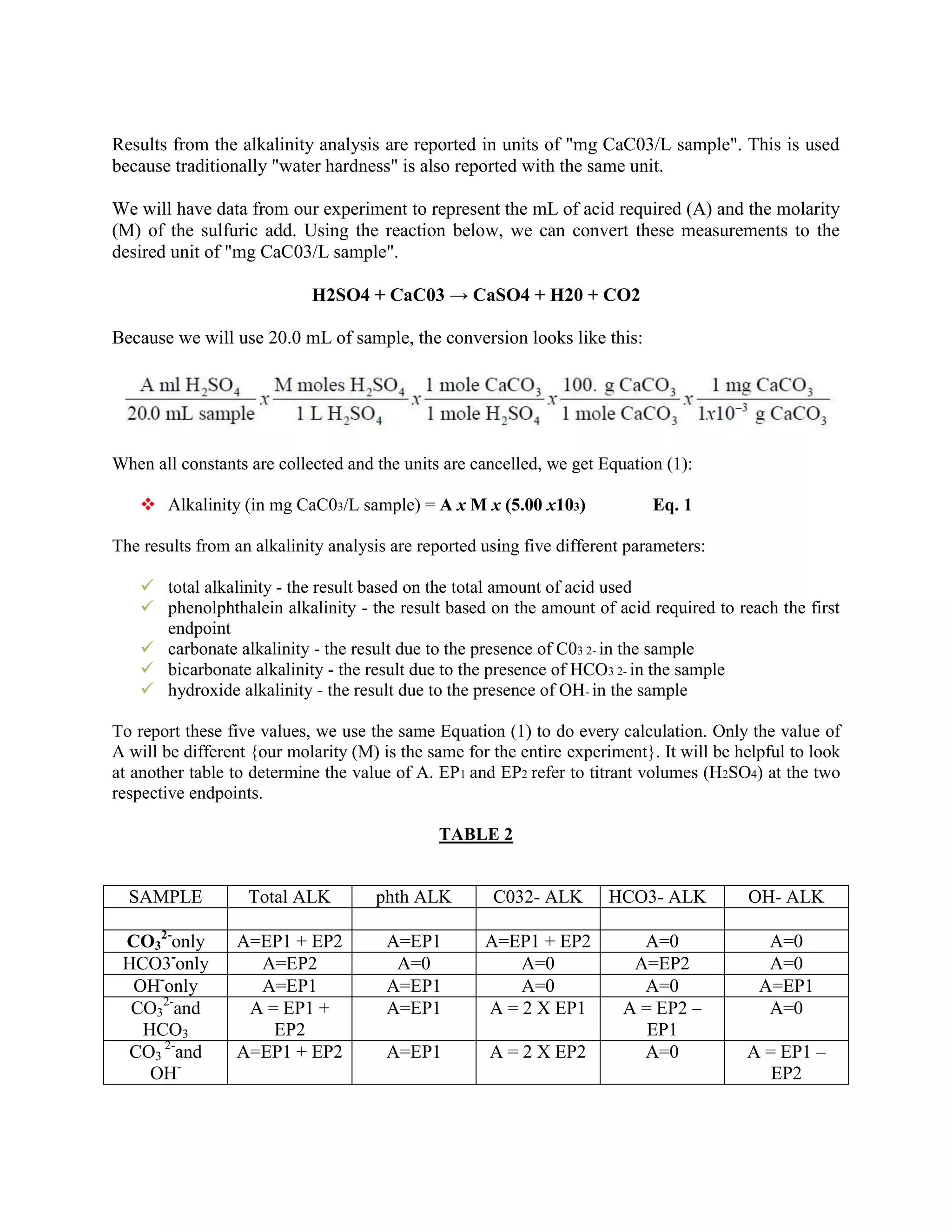
                                              TABLE 2


  SAMPLE           Total ALK         phth ALK         C032- ALK        HCO3- ALK          OH- ALK

 CO32-only       A=EP1 + EP2           A=EP1         A=EP1 + EP2           A=0               A=0
 HCO3-only         A=EP2                A=0              A=0              A=EP2              A=0
  OH-only          A=EP1               A=EP1             A=0               A=0              A=EP1
  CO32-and        A = EP1 +            A=EP1         A = 2 X EP1         A = EP2 –           A=0
   HCO3              EP2                                                    EP1
 CO3 2-and       A=EP1 + EP2           A=EP1          A = 2 X EP2          A=0            A = EP1 –
    OH-                                                                                      EP2
 To use this table, we first have to identify what is in our sample by going through the
     analysis with Table III-l. Then, knowing what is in the sample , we come to Table III-2
     and go to the line with that category. By following across the line, we know what value
     of A to substitute into Equation (1) for our parameters.


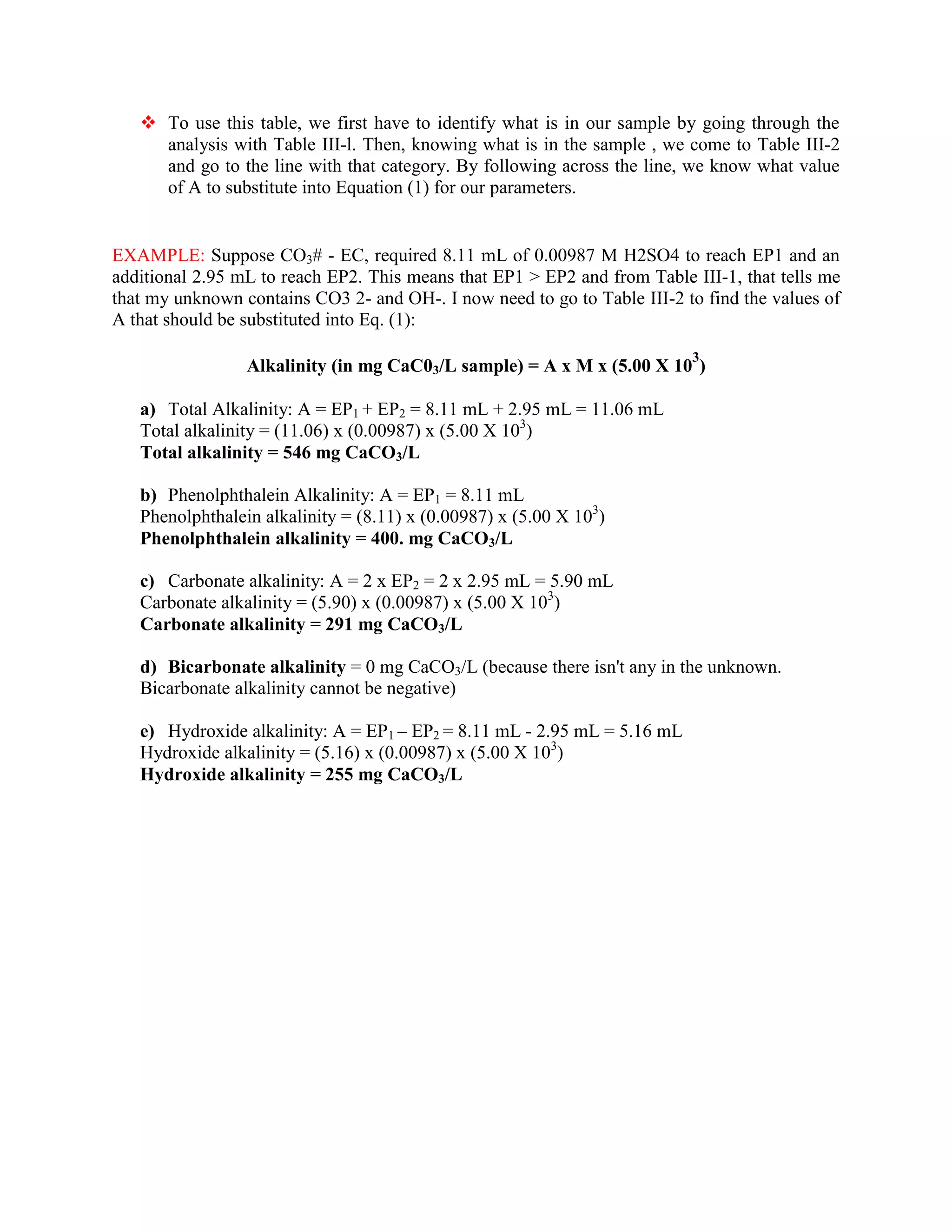
EXAMPLE: Suppose CO3# - EC, required 8.11 mL of 0.00987 M H2SO4 to reach EP1 and an
additional 2.95 mL to reach EP2. This means that EP1 > EP2 and from Table III-1, that tells me
that my unknown contains CO3 2- and OH-. I now need to go to Table III-2 to find the values of
A that should be substituted into Eq. (1):
                                                                          3
                 Alkalinity (in mg CaC03/L sample) = A x M x (5.00 X 10 )

   a) Total Alkalinity: A = EP1 + EP2 = 8.11 mL + 2.95 mL = 11.06 mL
   Total alkalinity = (11.06) x (0.00987) x (5.00 X 103)
   Total alkalinity = 546 mg CaCO3/L

   b) Phenolphthalein Alkalinity: A = EP1 = 8.11 mL
   Phenolphthalein alkalinity = (8.11) x (0.00987) x (5.00 X 103)
   Phenolphthalein alkalinity = 400. mg CaCO3/L

   c) Carbonate alkalinity: A = 2 x EP2 = 2 x 2.95 mL = 5.90 mL
   Carbonate alkalinity = (5.90) x (0.00987) x (5.00 X 103)
   Carbonate alkalinity = 291 mg CaCO3/L

   d) Bicarbonate alkalinity = 0 mg CaCO3/L (because there isn't any in the unknown.
   Bicarbonate alkalinity cannot be negative)

   e) Hydroxide alkalinity: A = EP1 – EP2 = 8.11 mL - 2.95 mL = 5.16 mL
   Hydroxide alkalinity = (5.16) x (0.00987) x (5.00 X 103)
   Hydroxide alkalinity = 255 mg CaCO3/L
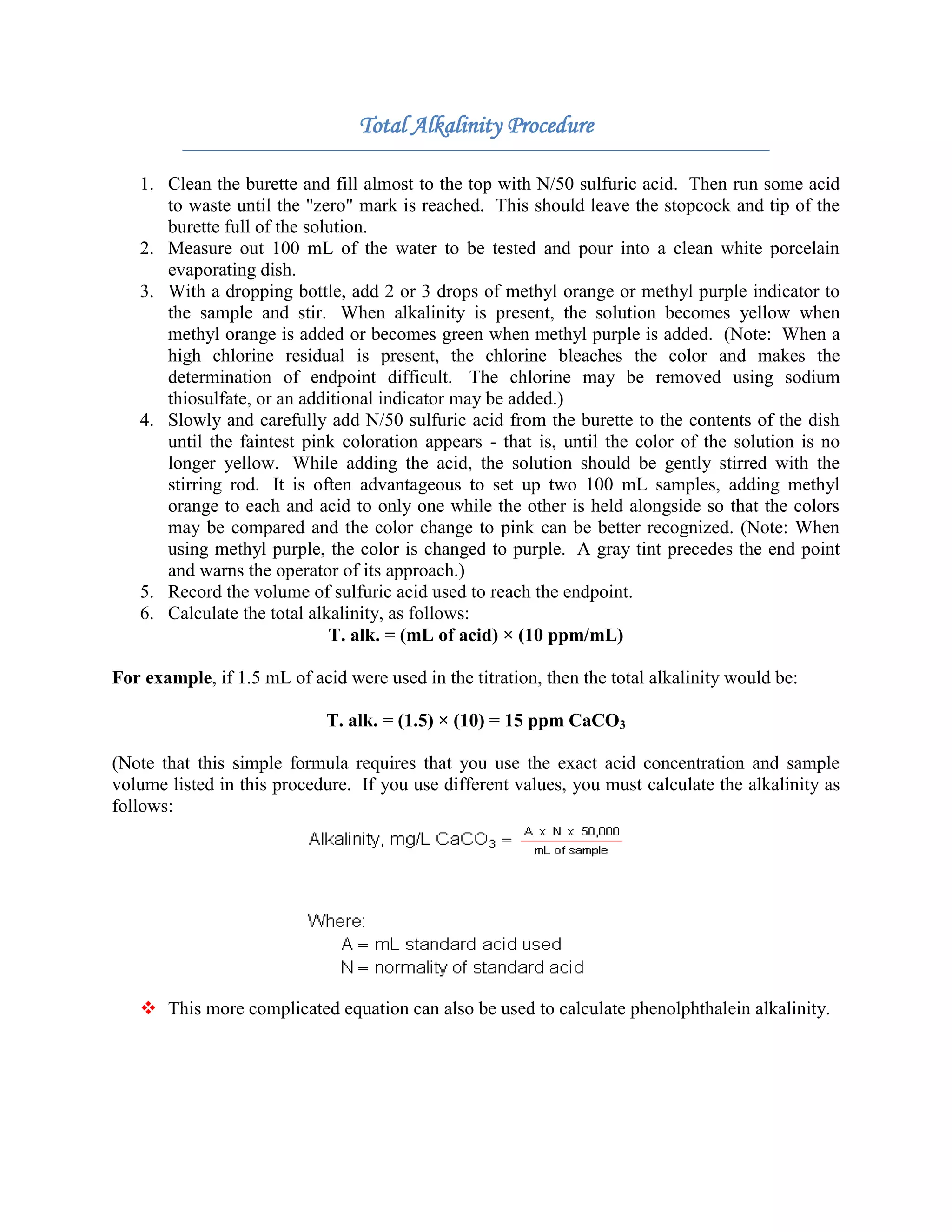
Total Alkalinity Procedure

   1. Clean the burette and fill almost to the top with N/50 sulfuric acid. Then run some acid
      to waste until the "zero" mark is reached. This should leave the stopcock and tip of the
      burette full of the solution.
   2. Measure out 100 mL of the water to be tested and pour into a clean white porcelain
      evaporating dish.
   3. With a dropping bottle, add 2 or 3 drops of methyl orange or methyl purple indicator to
      the sample and stir. When alkalinity is present, the solution becomes yellow when
      methyl orange is added or becomes green when methyl purple is added. (Note: When a
      high chlorine residual is present, the chlorine bleaches the color and makes the
      determination of endpoint difficult. The chlorine may be removed using sodium
      thiosulfate, or an additional indicator may be added.)
   4. Slowly and carefully add N/50 sulfuric acid from the burette to the contents of the dish
      until the faintest pink coloration appears - that is, until the color of the solution is no
      longer yellow. While adding the acid, the solution should be gently stirred with the
      stirring rod. It is often advantageous to set up two 100 mL samples, adding methyl
      orange to each and acid to only one while the other is held alongside so that the colors
      may be compared and the color change to pink can be better recognized. (Note: When
      using methyl purple, the color is changed to purple. A gray tint precedes the end point
      and warns the operator of its approach.)
   5. Record the volume of sulfuric acid used to reach the endpoint.
   6. Calculate the total alkalinity, as follows:
                             T. alk. = (mL of acid) × (10 ppm/mL)

For example, if 1.5 mL of acid were used in the titration, then the total alkalinity would be:

                             T. alk. = (1.5) × (10) = 15 ppm CaCO3

(Note that this simple formula requires that you use the exact acid concentration and sample
volume listed in this procedure. If you use different values, you must calculate the alkalinity as
follows:


    This more complicated equation can also be used to calculate phenolphthalein alkalinity.
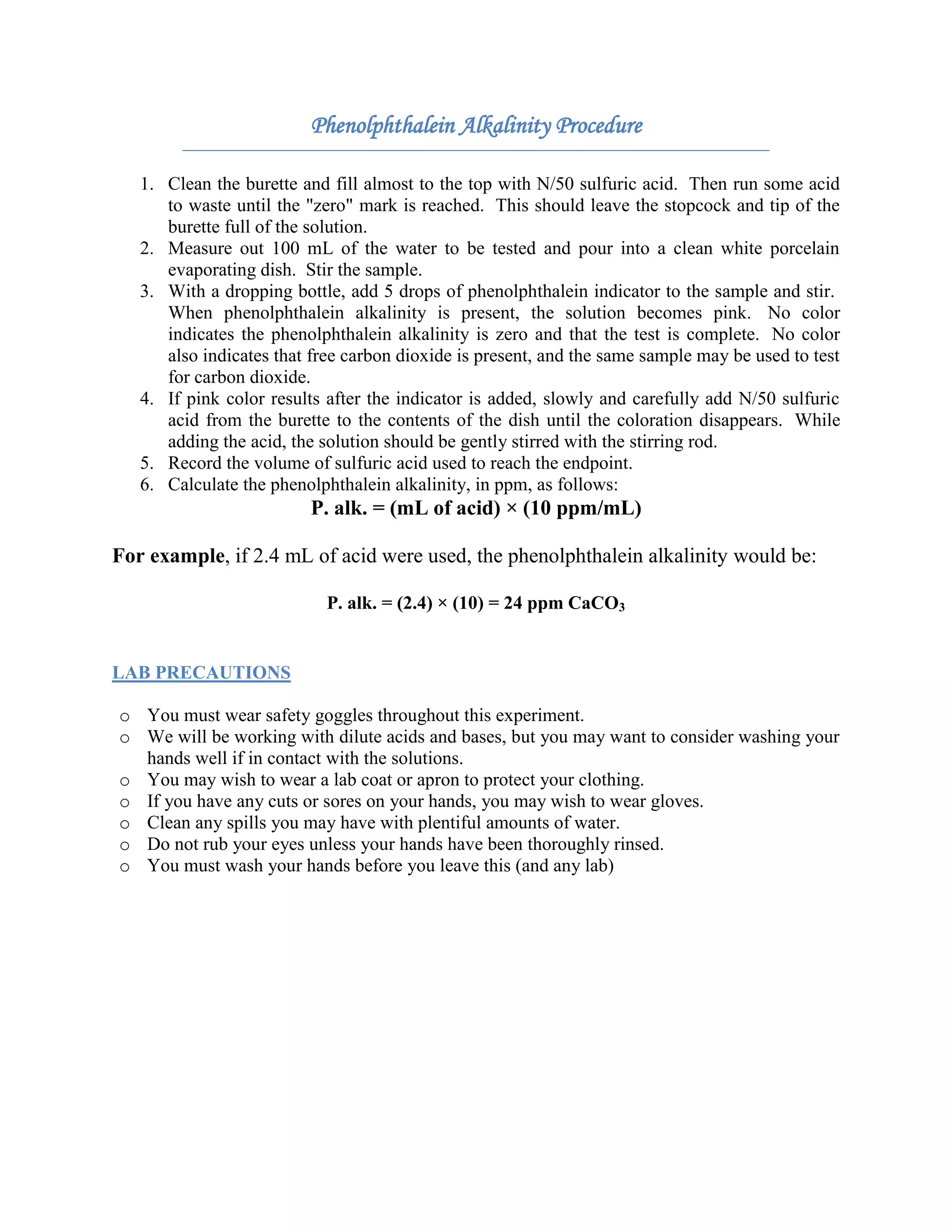
Phenolphthalein Alkalinity Procedure

   1. Clean the burette and fill almost to the top with N/50 sulfuric acid. Then run some acid
      to waste until the "zero" mark is reached. This should leave the stopcock and tip of the
      burette full of the solution.
   2. Measure out 100 mL of the water to be tested and pour into a clean white porcelain
      evaporating dish. Stir the sample.
   3. With a dropping bottle, add 5 drops of phenolphthalein indicator to the sample and stir.
      When phenolphthalein alkalinity is present, the solution becomes pink. No color
      indicates the phenolphthalein alkalinity is zero and that the test is complete. No color
      also indicates that free carbon dioxide is present, and the same sample may be used to test
      for carbon dioxide.
   4. If pink color results after the indicator is added, slowly and carefully add N/50 sulfuric
      acid from the burette to the contents of the dish until the coloration disappears. While
      adding the acid, the solution should be gently stirred with the stirring rod.
   5. Record the volume of sulfuric acid used to reach the endpoint.
   6. Calculate the phenolphthalein alkalinity, in ppm, as follows:
                         P. alk. = (mL of acid) × (10 ppm/mL)

For example, if 2.4 mL of acid were used, the phenolphthalein alkalinity would be:

                            P. alk. = (2.4) × (10) = 24 ppm CaCO3


LAB PRECAUTIONS

o You must wear safety goggles throughout this experiment.
o We will be working with dilute acids and bases, but you may want to consider washing your
  hands well if in contact with the solutions.
o You may wish to wear a lab coat or apron to protect your clothing.
o If you have any cuts or sores on your hands, you may wish to wear gloves.
o Clean any spills you may have with plentiful amounts of water.
o Do not rub your eyes unless your hands have been thoroughly rinsed.
o You must wash your hands before you leave this (and any lab)
Results & Discussions

            Test Type                 Water Source         mL of acid         Alkalinity (ppm as CaCO3)
                                                             used
Total alkalinity test


Phenolphthalein alkalinity test


1. What is the pH of the water? ______________________

2. Does the water meet the                      first   two     criteria      for   being   non-corrosive?
   ________________________

3. Is the water caustic? ____________________

4. How much of the alkalinity is hydroxide? ________________

5. How much of the alkalinity is carbonate? __________________

6. How much of the alkalinity is bicarbonate? _______________


                                            CONCLUSIONS:

o Has the goal of the experiment been met?.................................

o Sources of possible or known errors and consequences of those errors (i.e., high results, low
  results, sporadic results, why? ………………………..

o Suggestions for improvements……………………………

Report on alkalinity test

  • 1.
    PURPOSE: To determine thealkalinity of a water sample using a double – endpoint titration for - determination of [OH ] and [CO3 2-]. INTRODUCTION: Alkalinity is a parameter that is measured on almost all environmental samples -drinking water,natural waters, polluted waters, sewage, and industrial wastes. Alkalinity refers to the buffering capacity of water samples and to their ability to neutralize acidic pollution from rainfall or wastewater. For municipal sewage or industrial wastes, the amount of alkalinity is important in determining the type of treatment which should be employed. Alkalinity is primarily caused by the presence of carbonate (C03 2-) and bicarbonate (HC03-) ions, although hydroxide (OH-) ions may also contribute, especially when there is industrial pollution. Living organisms, such as aquatic life, function best in a pH range of 5.0 to 9.0 and levels of 20 to 200 mg/L are typical alkalinity values for fresh water. When the pH is above 8.3, carbonate (CO3 2-) is the primary contributor to alkalinity; when the pH is below 8.3, bicarbonate (HCO3 -) becomes the dominating factor. The values of alkalinity are reported in units of "mg CaCO3/L" because of its relationship to hardness, which is reported using the same unit. Although large environmental labs perform alkalinity tests using automated methods (1 sample/minute), we will employ the traditional analyses of using an acid-base titration with two endpoints. To gain insight into the double-endpoint titration technique you will perform a potentiometric titration, pH vs. titrant volume of your water sample. These techniques are described in more detail below. The alkalinity analysis consists of: A. Preparation and Standardization of a Titrant. B. Titration of a prepared unknown using the standardized titrant. C. Titration of a natural water sample (well, river or lake water) using the standardized titrant. DETERMINATION OF ALKALINITY A sample may contain any of the three anions (carbonate, bicarbonate, or hydroxide) or some combinations of them. Because these can all behave as bases, we will titrate with a strong acid. Hydrochloric acid (HCL) can be used, but we will be using sulfuric acid (H2S04). Regardless of the source of the H+ the following reactions will occur: (1st endpoint) H+ + CO3 2- → HCO3 –
  • 2.
    (1st endpoint) H++ OH- → H2O (2nd endpoint) H+ + HCO3 - → H2CO3 (really CO2 + H20) The two pKa values for the carbonate system are pKa1 = 6.35 and pKa2 = 10.33. The unknown and your aqueous sample could contain any one of the following combinations of the anions responsible for alkalinity: 1. carbonate only (CO3 2-) 2. bicarbonate only (HCO3 -) 3. hydroxide only (OH-) 4. carbonate and bicarbonate (CO3 2- and HCO3 -) 5. carbonate and hydroxide (CO3 2- and OH-) We need to consider each of these five situations separately to see how the ions will behave at the two different endpoints of the titration (using two different indicators). One of the indicators we will use is phenolphthalein (we will use the abbreviation "phth" from now on). It has a pinkish color at basic pH values and changes to colorless as we go below pH 8.3 (endpoint #1, EP1). The second indicator has traditionally been methyl orange, which changes from yellow to orange at a pH range of about 2-3; however, many people find this color change difficult to observe. We will, therefore, use a mixture of indicators (bromcresol green/methyl red), which gives a color change easier to see (from a blue-green to a very light pink, yellow, or colorless). This is endpoint #2 (EP2). Let us now consider the five different possibilities for analyzing and detecting the amount of carbonate, bicarbonate, and hydroxide that is present in a sample. 1. CARBONATE ONLY (CO3 2-): When carbonate ion is added to water the resulting pH falls in the range of 11-12. It can be titrated with acid to bicarbonate, the equivalence point occurring at a pH ≈ 8.3. Phenolphthalein (phth) will show a color change from pink to colorless in this pH range and it is ideal for detecting the first endpoint (EP1). The bicarbonate ion can then accept another H+ to become "carbonic acid", which is really carbon dioxide (aq) and water. The mixed indicator will change color in this pH range and will allow us to detect the second endpoint (EP2). ► Notice that if carbonate is the only original species, it should require equal amounts of H+ for each endpoint. 2. BICARBONATE ONLY (HCO3 -)
  • 3.
    If bicarbonate isthe only substance in the sample, what would happen when phenolphthalein is added to detect the first endpoint? The indicator would immediately turn colorless because HC03- would give a pH lower than the first endpoint. [Actually the indicator might appear as a very light pink color, but would require only a drop or two of acid to become colorless.] In other words, the bicarbonate is ready to be titrated only to the second endpoint and would require some amount of acid (Y mL [H+]). ► Notice that if bicarbonate is the only original species, it should require approximately 0 mL of [H+] for the first endpoint. 3. HYDROXIDE ONLY (OH-) If hydroxide is the only substance in the sample, it is very basic and the phenolphthalein will turn a deep pink. Thus acid needs to be added until the color disappears. At that time, we know that all of the OH- has been converted to water, which can no longer react with additional acid. When we add the mixed indicator it should immediately change color (or it might require a drop or two of acid). This occurs because there isn’t any base left to react with the acid. ► Notice that if hydroxide is the only original species, it should require approximately 0 mL of [H+] for the second endpoint. 4. CARBONATE (CO3 2-) and BICARBONATE (HCO3 -) During the first titration, only the carbonate reacts, producing bicarbonate at the first endpoint. Then bicarbonate reacts with acid to reach the second endpoint, but we now have two sources of the HC03-.
  • 4.
    ► Bicarbonate thatwas originally in the sample ► Bicarbonate that was produced from the carbonate during the first titration.Essentially the results are identical to adding the two separate situations together. ► Notice that this means the second endpoint volume (X + Y) will be larger than the first endpoint and neither endpoint requires zero mL of acid. 5. CARBONATE ONLY (CO32-) and HYDROXIDE (OH-) Again we can add the two individual results together to predict the relative volumes of the two endpoints. For the first titration, acid is needed to react with both the carbonate and the hydroxide ions, but when the first endpoint is reached, the hydroxide is finished, because it has all been converted to water. Then the bicarbonate (produced from the carbonate) is left to react with the acid to reach the second endpoint. ► Notice that this means the first endpoint volume (X + Z) will be larger than the second endpoint volume (X) and neither endpoint is zero. Table 1 SAMPLE EP1 volume EP2 volume Comparison CO32-only X mL [H+] X mL [H+] EP1 = EP2 HCO3-only X mL [H+] Y mL [H+] EP1 ≈ 0 OH-only X mL [H+] 0 mL [H+] EP2 ≈ 0 CO32-and HCO3 X mL [H+] {X+Y} mL [H+] EP1< EP2 but EP1 ≠ 0 CO3 2-and OH- {X+Z} mL [H+] X mL [H+] EP1> EP2 but EP2 ≠ 0  To use this table we only have to know how much acid was required to reach each endpoint and match it up with one of the five possibilities. CALCULATIONS TO REPORT ALKALINITY VALUES
  • 5.
    Results from thealkalinity analysis are reported in units of "mg CaC03/L sample". This is used because traditionally "water hardness" is also reported with the same unit. We will have data from our experiment to represent the mL of acid required (A) and the molarity (M) of the sulfuric add. Using the reaction below, we can convert these measurements to the desired unit of "mg CaC03/L sample". H2SO4 + CaC03 → CaSO4 + H20 + CO2 Because we will use 20.0 mL of sample, the conversion looks like this: When all constants are collected and the units are cancelled, we get Equation (1):  Alkalinity (in mg CaC03/L sample) = A x M x (5.00 x10³) Eq. 1 The results from an alkalinity analysis are reported using five different parameters:  total alkalinity - the result based on the total amount of acid used  phenolphthalein alkalinity - the result based on the amount of acid required to reach the first endpoint  carbonate alkalinity - the result due to the presence of C03 2- in the sample  bicarbonate alkalinity - the result due to the presence of HCO3 2- in the sample  hydroxide alkalinity - the result due to the presence of OH- in the sample To report these five values, we use the same Equation (1) to do every calculation. Only the value of A will be different {our molarity (M) is the same for the entire experiment}. It will be helpful to look at another table to determine the value of A. EP1 and EP2 refer to titrant volumes (H2SO4) at the two respective endpoints. TABLE 2 SAMPLE Total ALK phth ALK C032- ALK HCO3- ALK OH- ALK CO32-only A=EP1 + EP2 A=EP1 A=EP1 + EP2 A=0 A=0 HCO3-only A=EP2 A=0 A=0 A=EP2 A=0 OH-only A=EP1 A=EP1 A=0 A=0 A=EP1 CO32-and A = EP1 + A=EP1 A = 2 X EP1 A = EP2 – A=0 HCO3 EP2 EP1 CO3 2-and A=EP1 + EP2 A=EP1 A = 2 X EP2 A=0 A = EP1 – OH- EP2
  • 6.
     To usethis table, we first have to identify what is in our sample by going through the analysis with Table III-l. Then, knowing what is in the sample , we come to Table III-2 and go to the line with that category. By following across the line, we know what value of A to substitute into Equation (1) for our parameters. EXAMPLE: Suppose CO3# - EC, required 8.11 mL of 0.00987 M H2SO4 to reach EP1 and an additional 2.95 mL to reach EP2. This means that EP1 > EP2 and from Table III-1, that tells me that my unknown contains CO3 2- and OH-. I now need to go to Table III-2 to find the values of A that should be substituted into Eq. (1): 3 Alkalinity (in mg CaC03/L sample) = A x M x (5.00 X 10 ) a) Total Alkalinity: A = EP1 + EP2 = 8.11 mL + 2.95 mL = 11.06 mL Total alkalinity = (11.06) x (0.00987) x (5.00 X 103) Total alkalinity = 546 mg CaCO3/L b) Phenolphthalein Alkalinity: A = EP1 = 8.11 mL Phenolphthalein alkalinity = (8.11) x (0.00987) x (5.00 X 103) Phenolphthalein alkalinity = 400. mg CaCO3/L c) Carbonate alkalinity: A = 2 x EP2 = 2 x 2.95 mL = 5.90 mL Carbonate alkalinity = (5.90) x (0.00987) x (5.00 X 103) Carbonate alkalinity = 291 mg CaCO3/L d) Bicarbonate alkalinity = 0 mg CaCO3/L (because there isn't any in the unknown. Bicarbonate alkalinity cannot be negative) e) Hydroxide alkalinity: A = EP1 – EP2 = 8.11 mL - 2.95 mL = 5.16 mL Hydroxide alkalinity = (5.16) x (0.00987) x (5.00 X 103) Hydroxide alkalinity = 255 mg CaCO3/L
  • 7.
    Total Alkalinity Procedure 1. Clean the burette and fill almost to the top with N/50 sulfuric acid. Then run some acid to waste until the "zero" mark is reached. This should leave the stopcock and tip of the burette full of the solution. 2. Measure out 100 mL of the water to be tested and pour into a clean white porcelain evaporating dish. 3. With a dropping bottle, add 2 or 3 drops of methyl orange or methyl purple indicator to the sample and stir. When alkalinity is present, the solution becomes yellow when methyl orange is added or becomes green when methyl purple is added. (Note: When a high chlorine residual is present, the chlorine bleaches the color and makes the determination of endpoint difficult. The chlorine may be removed using sodium thiosulfate, or an additional indicator may be added.) 4. Slowly and carefully add N/50 sulfuric acid from the burette to the contents of the dish until the faintest pink coloration appears - that is, until the color of the solution is no longer yellow. While adding the acid, the solution should be gently stirred with the stirring rod. It is often advantageous to set up two 100 mL samples, adding methyl orange to each and acid to only one while the other is held alongside so that the colors may be compared and the color change to pink can be better recognized. (Note: When using methyl purple, the color is changed to purple. A gray tint precedes the end point and warns the operator of its approach.) 5. Record the volume of sulfuric acid used to reach the endpoint. 6. Calculate the total alkalinity, as follows: T. alk. = (mL of acid) × (10 ppm/mL) For example, if 1.5 mL of acid were used in the titration, then the total alkalinity would be: T. alk. = (1.5) × (10) = 15 ppm CaCO3 (Note that this simple formula requires that you use the exact acid concentration and sample volume listed in this procedure. If you use different values, you must calculate the alkalinity as follows:  This more complicated equation can also be used to calculate phenolphthalein alkalinity.
  • 8.
    Phenolphthalein Alkalinity Procedure 1. Clean the burette and fill almost to the top with N/50 sulfuric acid. Then run some acid to waste until the "zero" mark is reached. This should leave the stopcock and tip of the burette full of the solution. 2. Measure out 100 mL of the water to be tested and pour into a clean white porcelain evaporating dish. Stir the sample. 3. With a dropping bottle, add 5 drops of phenolphthalein indicator to the sample and stir. When phenolphthalein alkalinity is present, the solution becomes pink. No color indicates the phenolphthalein alkalinity is zero and that the test is complete. No color also indicates that free carbon dioxide is present, and the same sample may be used to test for carbon dioxide. 4. If pink color results after the indicator is added, slowly and carefully add N/50 sulfuric acid from the burette to the contents of the dish until the coloration disappears. While adding the acid, the solution should be gently stirred with the stirring rod. 5. Record the volume of sulfuric acid used to reach the endpoint. 6. Calculate the phenolphthalein alkalinity, in ppm, as follows: P. alk. = (mL of acid) × (10 ppm/mL) For example, if 2.4 mL of acid were used, the phenolphthalein alkalinity would be: P. alk. = (2.4) × (10) = 24 ppm CaCO3 LAB PRECAUTIONS o You must wear safety goggles throughout this experiment. o We will be working with dilute acids and bases, but you may want to consider washing your hands well if in contact with the solutions. o You may wish to wear a lab coat or apron to protect your clothing. o If you have any cuts or sores on your hands, you may wish to wear gloves. o Clean any spills you may have with plentiful amounts of water. o Do not rub your eyes unless your hands have been thoroughly rinsed. o You must wash your hands before you leave this (and any lab)
  • 9.
    Results & Discussions Test Type Water Source mL of acid Alkalinity (ppm as CaCO3) used Total alkalinity test Phenolphthalein alkalinity test 1. What is the pH of the water? ______________________ 2. Does the water meet the first two criteria for being non-corrosive? ________________________ 3. Is the water caustic? ____________________ 4. How much of the alkalinity is hydroxide? ________________ 5. How much of the alkalinity is carbonate? __________________ 6. How much of the alkalinity is bicarbonate? _______________ CONCLUSIONS: o Has the goal of the experiment been met?................................. o Sources of possible or known errors and consequences of those errors (i.e., high results, low results, sporadic results, why? ……………………….. o Suggestions for improvements……………………………