Determination of Alkalinity in Water Sample
Dr. Mausumi Adhya
HOD and Associate Professor
Supreme Knowledge Foundation, West Bengal, India
Theory
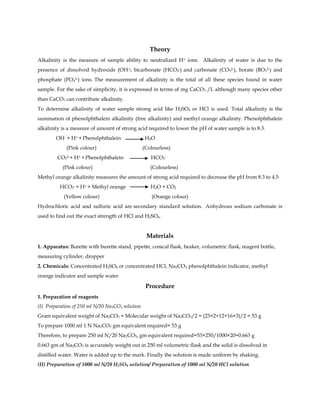
Alkalinity is the measure of sample ability to neutralized H+ ions. Alkalinity of water is due to the
presence of dissolved hydroxide (OH-), bicarbonate (HCO3
-) and carbonate (CO3
2-), borate (BO3
3-) and
phosphate (PO4
3-) ions. The measurement of alkalinity is the total of all these species found in water
sample. For the sake of simplicity, it is expressed in terms of mg CaCO3 /L although many species other
than CaCO3 can contribute alkalinity.
To determine alkalinity of water sample strong acid like H2SO4 or HCl is used. Total alkalinity is the
summation of phenolphthalein alkalinity (free alkalinity) and methyl orange alkalinity. Phenolphthalein
alkalinity is a measure of amount of strong acid required to lower the pH of water sample is to 8.3.
OH- + H+ + Phenolphthalein H2O
(Pink colour) (Colourless)
CO3
2-+ H+ + Phenolphthalein HCO3
-
(Pink colour) (Colourless)
Methyl orange alkalinity measures the amount of strong acid required to decrease the pH from 8.3 to 4.5
HCO3
- + H+ + Methyl orange H2O + CO2
(Yellow colour) (Orange colour)
Hydrochloric acid and sulfuric acid are secondary standard solution. Anhydrous sodium carbonate is
used to find out the exact strength of HCl and H2SO4.
Materials
1. Apparatus: Burette with burette stand, pipette, conical flask, beaker, volumetric flask, reagent bottle,
measuring cylinder, dropper
2. Chemicals: Concentrated H2SO4 or concentrated HCl, Na2CO3, phenolphthalein indicator, methyl
orange indicator and sample water
Procedure
1. Preparation of reagents
(I) Preparation of 250 ml N/20 Na2CO3 solution
Gram equivalent weight of Na2CO3 = Molecular weight of Na2CO3/2 = (23×2+12+16×3)/2 = 53 g
To prepare 1000 ml 1 N Na2CO3 gm equivalent required= 53 g
Therefore, to prepare 250 ml N/20 Na2CO3, gm equivalent required=53×250/1000×20=0.663 g
0.663 gm of Na2CO3 is accurately weight out in 250 ml volumetric flask and the solid is dissolved in
distilled water. Water is added up to the mark. Finally the solution is made uniform by shaking.
(II) Preparation of 1000 ml N/20 H2SO4 solution/ Preparation of 1000 ml N/20 HCl solution
V1S1=V2S2
Strength of concentrated H2SO4 is 36N
V × 36= 1000× 1/20 i.e. V= 1.39 ml
1.39 ml concentrated H2SO4 is taken in a 1000 ml measuring flask. Distilled water is added upto the mark.
The solution is stirred by a glass rod for making the solution uniform.
Or
Strength of concentrated HCl is 12 N
V × 12 = 1000× 1/20 i.e. V= 4.17 ml
4.17 ml concentrated HCl is taken in a 1000 ml measuring flask. Distilled water is added upto the mark.
The solution is stirred by a glass rod for making the solution uniform.
(III) Preparation of phenolphthalein indicator
0.5 g of solid is dissolved in a mixture of 50 ml ethanol and 50 ml distilled water.
(IV) Preparation of Methyl orange indicator
0.05 g solid is dissolved in distilled 100 ml water.
2. Standardization of H2SO4 or HCl by standard Na2CO3 solution
10 ml Na2CO3 is pipetted out in a 100 ml conical flask and 1-2 drops phenolphthalein indicator is added
to it. Then the solution is titrated with H2SO4 or HCl running from burette dropwise by continuous
shaking until the solution is colourless. Experiment is repeated three times.
3. Determination of alkalinity of Water
25 ml given water sample is pipetted out in a 100 ml conical flask and 1-2 drops phenolphthalein
indicator is added to it. Then the solution is titrated with H2SO4 or HCl running from burette dropwise by
continuous stirring until the solution is colourless.
To the colourless solution 3-4 drops methyl orange indicator is added and therefore the solution is
titrated with H2SO4 or HCl with continuous stirring until the colour of the solution was changed from
yellow to orange.
Experiment is repeated three times.
Results
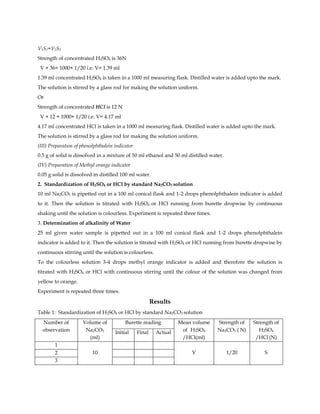
Table 1: Standardization of H2SO4 or HCl by standard Na2CO3 solution
Number of
observation
Volume of
Na2CO3
(ml)
Burette reading Mean volume
of H2SO4
/HCl(ml)
Strength of
Na2CO3 ( N)
Strength of
H2SO4
/HCl (N)
Initial Final Actual
1
10 V 1/20 S
2
3
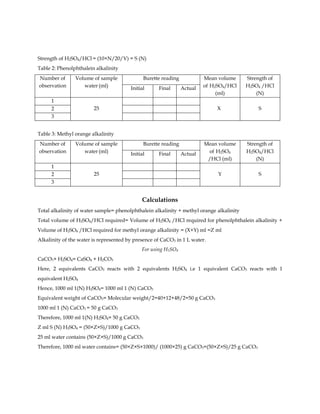
Strength of H2SO4/HCl = (10×N/20/V) = S (N)
Table 2: Phenolphthalein alkalinity
Number of
observation
Volume of sample
water (ml)
Burette reading Mean volume
of H2SO4/HCl
(ml)
Strength of
H2SO4 /HCl
(N)
Initial Final Actual
1
25 X S
2
3
Table 3: Methyl orange alkalinity
Number of
observation
Volume of sample
water (ml)
Burette reading Mean volume
of H2SO4
/HCl (ml)
Strength of
H2SO4/HCl
(N)
Initial Final Actual
1
25 Y S
2
3
Calculations
Total alkalinity of water sample= phenolphthalein alkalinity + methyl orange alkalinity
Total volume of H2SO4/HCl required= Volume of H2SO4 /HCl required for phenolphthalein alkalinity +
Volume of H2SO4 /HCl required for methyl orange alkalinity = (X+Y) ml =Z ml
Alkalinity of the water is represented by presence of CaCO3 in 1 L water.
For using H2SO4
CaCO3+ H2SO4= CaSO4 + H2CO3
Here, 2 equivalents CaCO3 reacts with 2 equivalents H2SO4 i.e 1 equivalent CaCO3 reacts with 1
equivalent H2SO4
Hence, 1000 ml 1(N) H2SO4= 1000 ml 1 (N) CaCO3
Equivalent weight of CaCO3= Molecular weight/2=40+12+48/2=50 g CaCO3
1000 ml 1 (N) CaCO3 = 50 g CaCO3
Therefore, 1000 ml 1(N) H2SO4= 50 g CaCO3
Z ml S (N) H2SO4 = (50×Z×S)/1000 g CaCO3
25 ml water contains (50×Z×S)/1000 g CaCO3
Therefore, 1000 ml water contains= (50×Z×S×1000)/ (1000×25) g CaCO3=(50×Z×S)/25 g CaCO3
For using HCl
CaCO3+ 2HCl= CaCl2 + H2CO3
Here, 2 equivalents CaCO3 reacts with 2 equivalents HCl i.e. 1 equivalent CaCO3 reacts with 1 equivalent
HCl.
Hence, 1000 ml 1(N) HCl= 1000 ml 1 (N) CaCO3
1000 ml 1(N) HCl = 50 g CaCO3
Z ml S (N) HCl = (50×Z×S)/1000 g
25 ml water contains (50×Z×S)/1000 gm CaCO3
Therefore, 1000 ml water contains= (50×Z×S)/25 g CaCO3
Conclusion
The alkalinity of water is…………………….. g/L of CaCO3
Viva Voce
1. What is alkalinity? How is it expressed?
2. What is the cause of alkalinity in water?
3. How can you determine the alkalinity of water? Explain with reactions.
4. Concentrated HCl and concentrated H2SO4 are secondary standard. Explain.
Answer. HCl and H2SO4 are both commercially available as concentrated solutions which are easily
diluted and hence concentration of concentrated solution is not accurately known. Moreover, HCl is a
gas and concentrated HCl is prepared by dissolving HCl gas in water. Hence HCl is volatile and
strength of HCl changes with time.
5. Presence of both OH- and HCO3
- is not possible in water. Why?
Answer. Presence of both OH-, HCO3
- is not possible in sample water, since they combine
together to form CO3
2- ions.
OH-+ HCO3
- CO3
2-+ H2O
Alkalinity of sample water
= [(50× Total volume of acid required for titration of sample water× strength of acid)/ volume of sample water taken] gm
CaCO3/L

Alkalinity of given water sample.pdf

  • 1.
    Determination of Alkalinityin Water Sample Dr. Mausumi Adhya HOD and Associate Professor Supreme Knowledge Foundation, West Bengal, India
  • 2.
    Theory Alkalinity is themeasure of sample ability to neutralized H+ ions. Alkalinity of water is due to the presence of dissolved hydroxide (OH-), bicarbonate (HCO3 -) and carbonate (CO3 2-), borate (BO3 3-) and phosphate (PO4 3-) ions. The measurement of alkalinity is the total of all these species found in water sample. For the sake of simplicity, it is expressed in terms of mg CaCO3 /L although many species other than CaCO3 can contribute alkalinity. To determine alkalinity of water sample strong acid like H2SO4 or HCl is used. Total alkalinity is the summation of phenolphthalein alkalinity (free alkalinity) and methyl orange alkalinity. Phenolphthalein alkalinity is a measure of amount of strong acid required to lower the pH of water sample is to 8.3. OH- + H+ + Phenolphthalein H2O (Pink colour) (Colourless) CO3 2-+ H+ + Phenolphthalein HCO3 - (Pink colour) (Colourless) Methyl orange alkalinity measures the amount of strong acid required to decrease the pH from 8.3 to 4.5 HCO3 - + H+ + Methyl orange H2O + CO2 (Yellow colour) (Orange colour) Hydrochloric acid and sulfuric acid are secondary standard solution. Anhydrous sodium carbonate is used to find out the exact strength of HCl and H2SO4. Materials 1. Apparatus: Burette with burette stand, pipette, conical flask, beaker, volumetric flask, reagent bottle, measuring cylinder, dropper 2. Chemicals: Concentrated H2SO4 or concentrated HCl, Na2CO3, phenolphthalein indicator, methyl orange indicator and sample water Procedure 1. Preparation of reagents (I) Preparation of 250 ml N/20 Na2CO3 solution Gram equivalent weight of Na2CO3 = Molecular weight of Na2CO3/2 = (23×2+12+16×3)/2 = 53 g To prepare 1000 ml 1 N Na2CO3 gm equivalent required= 53 g Therefore, to prepare 250 ml N/20 Na2CO3, gm equivalent required=53×250/1000×20=0.663 g 0.663 gm of Na2CO3 is accurately weight out in 250 ml volumetric flask and the solid is dissolved in distilled water. Water is added up to the mark. Finally the solution is made uniform by shaking. (II) Preparation of 1000 ml N/20 H2SO4 solution/ Preparation of 1000 ml N/20 HCl solution
  • 3.
    V1S1=V2S2 Strength of concentratedH2SO4 is 36N V × 36= 1000× 1/20 i.e. V= 1.39 ml 1.39 ml concentrated H2SO4 is taken in a 1000 ml measuring flask. Distilled water is added upto the mark. The solution is stirred by a glass rod for making the solution uniform. Or Strength of concentrated HCl is 12 N V × 12 = 1000× 1/20 i.e. V= 4.17 ml 4.17 ml concentrated HCl is taken in a 1000 ml measuring flask. Distilled water is added upto the mark. The solution is stirred by a glass rod for making the solution uniform. (III) Preparation of phenolphthalein indicator 0.5 g of solid is dissolved in a mixture of 50 ml ethanol and 50 ml distilled water. (IV) Preparation of Methyl orange indicator 0.05 g solid is dissolved in distilled 100 ml water. 2. Standardization of H2SO4 or HCl by standard Na2CO3 solution 10 ml Na2CO3 is pipetted out in a 100 ml conical flask and 1-2 drops phenolphthalein indicator is added to it. Then the solution is titrated with H2SO4 or HCl running from burette dropwise by continuous shaking until the solution is colourless. Experiment is repeated three times. 3. Determination of alkalinity of Water 25 ml given water sample is pipetted out in a 100 ml conical flask and 1-2 drops phenolphthalein indicator is added to it. Then the solution is titrated with H2SO4 or HCl running from burette dropwise by continuous stirring until the solution is colourless. To the colourless solution 3-4 drops methyl orange indicator is added and therefore the solution is titrated with H2SO4 or HCl with continuous stirring until the colour of the solution was changed from yellow to orange. Experiment is repeated three times. Results Table 1: Standardization of H2SO4 or HCl by standard Na2CO3 solution Number of observation Volume of Na2CO3 (ml) Burette reading Mean volume of H2SO4 /HCl(ml) Strength of Na2CO3 ( N) Strength of H2SO4 /HCl (N) Initial Final Actual 1 10 V 1/20 S 2 3
  • 4.
    Strength of H2SO4/HCl= (10×N/20/V) = S (N) Table 2: Phenolphthalein alkalinity Number of observation Volume of sample water (ml) Burette reading Mean volume of H2SO4/HCl (ml) Strength of H2SO4 /HCl (N) Initial Final Actual 1 25 X S 2 3 Table 3: Methyl orange alkalinity Number of observation Volume of sample water (ml) Burette reading Mean volume of H2SO4 /HCl (ml) Strength of H2SO4/HCl (N) Initial Final Actual 1 25 Y S 2 3 Calculations Total alkalinity of water sample= phenolphthalein alkalinity + methyl orange alkalinity Total volume of H2SO4/HCl required= Volume of H2SO4 /HCl required for phenolphthalein alkalinity + Volume of H2SO4 /HCl required for methyl orange alkalinity = (X+Y) ml =Z ml Alkalinity of the water is represented by presence of CaCO3 in 1 L water. For using H2SO4 CaCO3+ H2SO4= CaSO4 + H2CO3 Here, 2 equivalents CaCO3 reacts with 2 equivalents H2SO4 i.e 1 equivalent CaCO3 reacts with 1 equivalent H2SO4 Hence, 1000 ml 1(N) H2SO4= 1000 ml 1 (N) CaCO3 Equivalent weight of CaCO3= Molecular weight/2=40+12+48/2=50 g CaCO3 1000 ml 1 (N) CaCO3 = 50 g CaCO3 Therefore, 1000 ml 1(N) H2SO4= 50 g CaCO3 Z ml S (N) H2SO4 = (50×Z×S)/1000 g CaCO3 25 ml water contains (50×Z×S)/1000 g CaCO3 Therefore, 1000 ml water contains= (50×Z×S×1000)/ (1000×25) g CaCO3=(50×Z×S)/25 g CaCO3
  • 5.
    For using HCl CaCO3+2HCl= CaCl2 + H2CO3 Here, 2 equivalents CaCO3 reacts with 2 equivalents HCl i.e. 1 equivalent CaCO3 reacts with 1 equivalent HCl. Hence, 1000 ml 1(N) HCl= 1000 ml 1 (N) CaCO3 1000 ml 1(N) HCl = 50 g CaCO3 Z ml S (N) HCl = (50×Z×S)/1000 g 25 ml water contains (50×Z×S)/1000 gm CaCO3 Therefore, 1000 ml water contains= (50×Z×S)/25 g CaCO3 Conclusion The alkalinity of water is…………………….. g/L of CaCO3 Viva Voce 1. What is alkalinity? How is it expressed? 2. What is the cause of alkalinity in water? 3. How can you determine the alkalinity of water? Explain with reactions. 4. Concentrated HCl and concentrated H2SO4 are secondary standard. Explain. Answer. HCl and H2SO4 are both commercially available as concentrated solutions which are easily diluted and hence concentration of concentrated solution is not accurately known. Moreover, HCl is a gas and concentrated HCl is prepared by dissolving HCl gas in water. Hence HCl is volatile and strength of HCl changes with time. 5. Presence of both OH- and HCO3 - is not possible in water. Why? Answer. Presence of both OH-, HCO3 - is not possible in sample water, since they combine together to form CO3 2- ions. OH-+ HCO3 - CO3 2-+ H2O Alkalinity of sample water = [(50× Total volume of acid required for titration of sample water× strength of acid)/ volume of sample water taken] gm CaCO3/L