
26 Saving, Investment, and the Financial System
The Financial System   The  financial system  consists of the group of institutions in the economy that help to match one person’s saving with another person’s investment. It moves the economy’s scarce resources from savers to borrowers.
FINANCIAL INSTITUTIONS IN THE U.S. ECONOMY The  financial system  is made up of financial institutions that coordinate the actions of savers and borrowers. Financial institutions can be grouped into two different categories: financial markets and financial intermediaries.
FINANCIAL INSTITUTIONS IN THE U.S. ECONOMY Financial Markets Stock Market Bond Market Financial Intermediaries Banks Mutual Funds
FINANCIAL INSTITUTIONS IN THE U.S. ECONOMY Financial markets  are the institutions through which savers can directly provide funds to borrowers. Financial intermediaries  are financial institutions through which savers can indirectly provide funds to borrowers.
Financial Markets The Bond Market A  bond  is a certificate of indebtedness that specifies obligations of the borrower to  the holder of the bond. Characteristics of a Bond Term :  The length of time until the bond matures. Credit Risk :  The probability that the borrower will fail to pay some of the interest or principal. Tax Treatment :  The way in which the tax laws treat the interest on the bond. Municipal bonds are federal tax exempt. IOU
Financial Markets  The Stock Market Stock  represents a claim to partial ownership in a firm and is therefore, a claim to the profits that the firm makes. The sale of stock to raise money is called  equity financing. Compared to bonds, stocks offer both higher risk and potentially higher returns. The most important stock exchanges in the United States are the New York Stock Exchange, the American Stock Exchange, and NASDAQ.
Financial Markets  The Stock Market Most newspaper stock tables provide the following information: Price (of a share) Volume (number of shares sold) Dividend (profits paid to stockholders) Price-earnings ratio
Financial Intermediaries Financial intermediaries  are financial institutions through which savers can indirectly provide funds to borrowers.
Financial Intermediaries Banks take deposits from people who want to save and use the deposits to make loans to people who want to borrow. pay depositors interest on their deposits and charge borrowers slightly higher interest on their loans.
Financial Intermediaries  Banks Banks help create a  medium of exchange  by allowing people to write checks against their deposits. A medium of exchanges is an item that people can easily use to engage in transactions. This facilitates the purchases of goods and services.
Financial Intermediaries Mutual Funds A  mutual fund  is an institution that sells shares to the public and uses the proceeds to buy a portfolio, of various types of stocks, bonds, or both. They allow people with small amounts of money to easily diversify.
Financial Intermediaries  Other Financial Institutions  Credit unions Pension funds Insurance companies Loan sharks
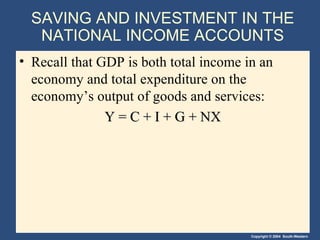
SAVING AND INVESTMENT IN THE NATIONAL INCOME ACCOUNTS Recall that GDP is both total income in an economy and total expenditure on the economy’s output of goods and services: Y = C + I + G + NX
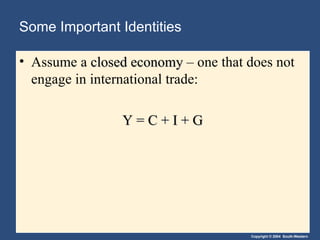
Some Important Identities Assume a  closed economy  – one that does not engage in international trade: Y = C + I + G
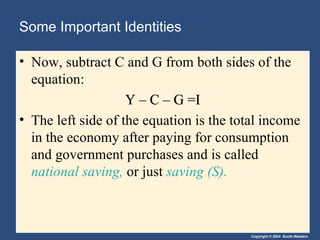
Some Important Identities Now, subtract C and G from both sides of the equation: Y – C – G =I The left side of the equation is the total income in the economy after paying for consumption and government purchases and is called  national saving,  or just  saving (S).
Some Important Identities Substituting  S  for  Y - C - G , the equation can be written as: S = I
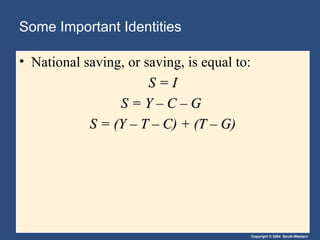
Some Important Identities National saving, or saving, is equal to: S = I S = Y – C – G  S = (Y – T – C) + (T – G)
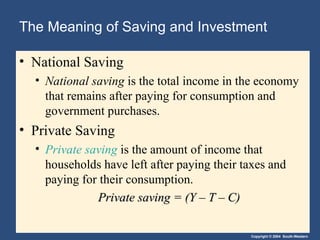
The Meaning of Saving and Investment National Saving National saving  is the total income in the economy that remains after paying for consumption and government purchases. Private Saving Private saving  is the amount of income that households have left after paying their taxes and paying for their consumption. Private saving = (Y – T – C)
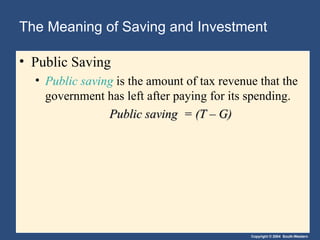
The Meaning of Saving and Investment Public Saving Public saving  is the amount of tax revenue that the government has left after paying for its spending. Public saving  = (T – G)
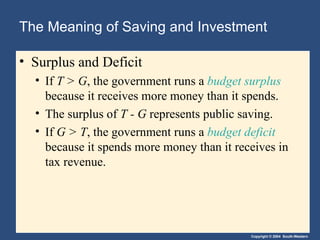
The Meaning of Saving and Investment Surplus and Deficit If  T > G , the government runs a  budget surplus  because it receives more money than it spends. The surplus of  T - G  represents public saving. If  G > T , the government runs a  budget deficit  because it spends more money than it receives in tax revenue.
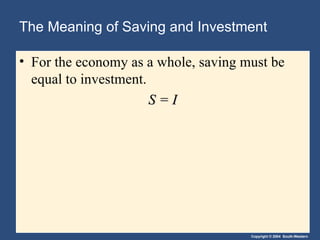
The Meaning of Saving and Investment For the economy as a whole, saving must be equal to investment.  S = I
THE MARKET FOR LOANABLE FUNDS Financial markets coordinate the economy’s saving and investment in the  market for loanable funds.
THE MARKET FOR LOANABLE FUNDS The  market for loanable funds  is the market in which those who want to save supply funds and those who want to borrow to invest demand funds.
THE MARKET FOR LOANABLE FUNDS Loanable funds  refers to all income that people have chosen to save and lend out, rather than use for their own consumption.
Supply and Demand for Loanable Funds The supply of loanable funds   comes from people who have extra income they want to save and lend out. The demand for loanable funds   comes from households and firms that wish to borrow to make investments.
Supply and Demand for Loanable Funds The interest rate is the price of the loan. It represents the amount that borrowers pay for loans and the amount that lenders receive on their saving. The interest rate in the market for loanable funds is the real interest rate.
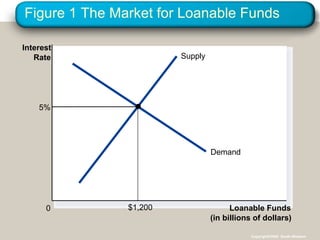
Supply and Demand for Loanable Funds Financial markets work much like other markets in the economy. The equilibrium of the supply and demand for loanable funds determines the  real interest rate .
Figure 1 The Market for Loanable Funds Loanable Funds (in billions of dollars) 0 Interest Rate Copyright©2004  South-Western Supply Demand 5% $1,200
Supply and Demand for Loanable Funds Government Policies That Affect Saving and Investment Taxes and saving Taxes and investment Government budget deficits
Policy 1: Saving Incentives Taxes on interest income substantially reduce the future payoff from current saving and, as a result, reduce the incentive to save.
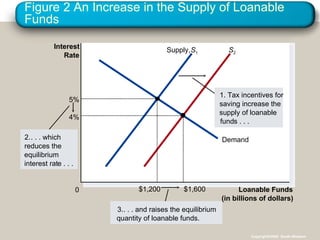
Policy 1: Saving Incentives A tax decrease increases the incentive for households to save at any given interest rate.  The supply of loanable funds curve shifts to the right. The equilibrium interest rate decreases. The quantity demanded for loanable funds increases.
Figure 2 An Increase in the Supply of Loanable Funds Loanable Funds (in billions of dollars) 0 Interest Rate Copyright©2004  South-Western Supply,  S 1 S 2 2.  . . . which reduces the equilibrium interest rat e . . . 3.  . . . and raises the equilibrium quantity of loanable funds. Demand 1. Tax incentives for saving increase the supply of loanable fund s . . . 5% $1,200 4% $1,600
Policy 1: Saving Incentives If a change in tax law encourages greater saving, the result will be  lower  interest rates and  greater  investment.
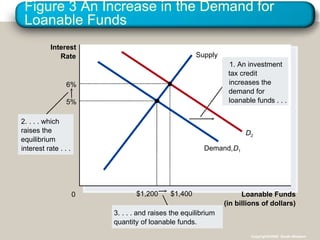
Policy 2: Investment Incentives An investment tax credit increases the incentive to borrow. Increases the demand for loanable funds. Shifts the demand curve to the right. Results in a higher interest rate and a greater quantity saved.
Policy 2: Investment Incentives If a change in tax laws encourages greater investment, the result will be  higher  interest rates and  greater  saving.
Figure 3 An Increase in the Demand for Loanable Funds Loanable Funds (in billions of dollars) 0 Interest Rate Copyright©2004  South-Western 1. An investment tax credit increases the demand for  loanable fund s . . . 2.  . . . which raises the equilibrium interest rate . . . 3.  . . . and raises the equilibrium quantity of loanable funds. Supply Demand,  D 1 D 2 5% $1,200 6% $1,400
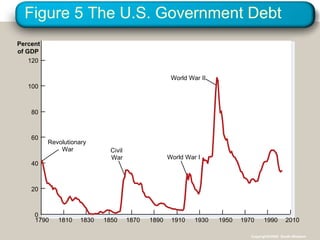
Policy 3: Government Budget Deficits and Surpluses When the government spends more than it receives in tax revenues, the short fall is called the  budget deficit . The accumulation of past budget deficits is called the government  debt.
Policy 3: Government Budget Deficits and Surpluses Government borrowing to finance its budget deficit reduces the supply of loanable funds available to finance investment by households and firms.  This fall in investment is referred to as  crowding out . The deficit borrowing crowds out private borrowers who are trying to finance investments.
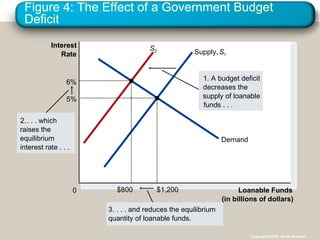
Policy 3: Government Budget Deficits and Surpluses A budget deficit decreases the supply of loanable funds.  Shifts the supply curve to the left.  Increases the equilibrium interest rate. Reduces the equilibrium quantity of loanable funds.
Figure 4: The Effect of a Government Budget Deficit Loanable Funds (in billions of dollars) 0 Interest Rate Copyright©2004  South-Western 3.  . . . and reduces the equilibrium quantity of loanable funds. S 2 2.  . . . which raises the equilibrium interest rat e . . . Supply,  S 1 Demand $1,200 5% $800 6% 1. A budget deficit decreases the supply of loanable fund s . . .
Policy 3: Government Budget Deficits and Surpluses When government reduces national saving by running a deficit, the interest rate  rises  and investment  falls .
Policy 3: Government Budget Deficits and Surpluses A budget surplus  increases  the supply of loanable funds,  reduces  the interest rate, and  stimulates  investment.
Figure 5 The U.S. Government Debt Percent of GDP 1790 1810 1830 1850 1870 1890 1910 1930 1950 1970 1990 2010 0 20 40 60 80 100 120 Copyright©2004  South-Western Revolutionary War Civil War World War I World War II
Summary The U.S. financial system is made up of financial institutions such as the bond market, the stock market, banks, and mutual funds. All these institutions act to direct the resources of households who want to save some of their income into the hands of households and firms who want to borrow.
Summary National income accounting identities reveal some important relationships among macroeconomic variables. In particular, in a closed economy, national saving must equal investment. Financial institutions attempt to match one person’s saving with another person’s investment.
Summary The interest rate is determined by the supply and demand for loanable funds. The supply of loanable funds comes from households who want to save some of their income. The demand for loanable funds comes from households and firms who want to borrow for investment.
Summary National saving equals private saving plus public saving. A government budget deficit represents negative public saving and, therefore, reduces national saving and the supply of loanable funds. When a government budget deficit crowds out investment, it reduces the growth of productivity and GDP.

26

  • 1.
    26 Saving, Investment,and the Financial System
  • 2.
    The Financial System The financial system consists of the group of institutions in the economy that help to match one person’s saving with another person’s investment. It moves the economy’s scarce resources from savers to borrowers.
  • 3.
    FINANCIAL INSTITUTIONS INTHE U.S. ECONOMY The financial system is made up of financial institutions that coordinate the actions of savers and borrowers. Financial institutions can be grouped into two different categories: financial markets and financial intermediaries.
  • 4.
    FINANCIAL INSTITUTIONS INTHE U.S. ECONOMY Financial Markets Stock Market Bond Market Financial Intermediaries Banks Mutual Funds
  • 5.
    FINANCIAL INSTITUTIONS INTHE U.S. ECONOMY Financial markets are the institutions through which savers can directly provide funds to borrowers. Financial intermediaries are financial institutions through which savers can indirectly provide funds to borrowers.
  • 6.
    Financial Markets TheBond Market A bond is a certificate of indebtedness that specifies obligations of the borrower to the holder of the bond. Characteristics of a Bond Term : The length of time until the bond matures. Credit Risk : The probability that the borrower will fail to pay some of the interest or principal. Tax Treatment : The way in which the tax laws treat the interest on the bond. Municipal bonds are federal tax exempt. IOU
  • 7.
    Financial Markets The Stock Market Stock represents a claim to partial ownership in a firm and is therefore, a claim to the profits that the firm makes. The sale of stock to raise money is called equity financing. Compared to bonds, stocks offer both higher risk and potentially higher returns. The most important stock exchanges in the United States are the New York Stock Exchange, the American Stock Exchange, and NASDAQ.
  • 8.
    Financial Markets The Stock Market Most newspaper stock tables provide the following information: Price (of a share) Volume (number of shares sold) Dividend (profits paid to stockholders) Price-earnings ratio
  • 9.
    Financial Intermediaries Financialintermediaries are financial institutions through which savers can indirectly provide funds to borrowers.
  • 10.
    Financial Intermediaries Bankstake deposits from people who want to save and use the deposits to make loans to people who want to borrow. pay depositors interest on their deposits and charge borrowers slightly higher interest on their loans.
  • 11.
    Financial Intermediaries Banks Banks help create a medium of exchange by allowing people to write checks against their deposits. A medium of exchanges is an item that people can easily use to engage in transactions. This facilitates the purchases of goods and services.
  • 12.
    Financial Intermediaries MutualFunds A mutual fund is an institution that sells shares to the public and uses the proceeds to buy a portfolio, of various types of stocks, bonds, or both. They allow people with small amounts of money to easily diversify.
  • 13.
    Financial Intermediaries Other Financial Institutions Credit unions Pension funds Insurance companies Loan sharks
  • 14.
    SAVING AND INVESTMENTIN THE NATIONAL INCOME ACCOUNTS Recall that GDP is both total income in an economy and total expenditure on the economy’s output of goods and services: Y = C + I + G + NX
  • 15.
    Some Important IdentitiesAssume a closed economy – one that does not engage in international trade: Y = C + I + G
  • 16.
    Some Important IdentitiesNow, subtract C and G from both sides of the equation: Y – C – G =I The left side of the equation is the total income in the economy after paying for consumption and government purchases and is called national saving, or just saving (S).
  • 17.
    Some Important IdentitiesSubstituting S for Y - C - G , the equation can be written as: S = I
  • 18.
    Some Important IdentitiesNational saving, or saving, is equal to: S = I S = Y – C – G S = (Y – T – C) + (T – G)
  • 19.
    The Meaning ofSaving and Investment National Saving National saving is the total income in the economy that remains after paying for consumption and government purchases. Private Saving Private saving is the amount of income that households have left after paying their taxes and paying for their consumption. Private saving = (Y – T – C)
  • 20.
    The Meaning ofSaving and Investment Public Saving Public saving is the amount of tax revenue that the government has left after paying for its spending. Public saving = (T – G)
  • 21.
    The Meaning ofSaving and Investment Surplus and Deficit If T > G , the government runs a budget surplus because it receives more money than it spends. The surplus of T - G represents public saving. If G > T , the government runs a budget deficit because it spends more money than it receives in tax revenue.
  • 22.
    The Meaning ofSaving and Investment For the economy as a whole, saving must be equal to investment. S = I
  • 23.
    THE MARKET FORLOANABLE FUNDS Financial markets coordinate the economy’s saving and investment in the market for loanable funds.
  • 24.
    THE MARKET FORLOANABLE FUNDS The market for loanable funds is the market in which those who want to save supply funds and those who want to borrow to invest demand funds.
  • 25.
    THE MARKET FORLOANABLE FUNDS Loanable funds refers to all income that people have chosen to save and lend out, rather than use for their own consumption.
  • 26.
    Supply and Demandfor Loanable Funds The supply of loanable funds comes from people who have extra income they want to save and lend out. The demand for loanable funds comes from households and firms that wish to borrow to make investments.
  • 27.
    Supply and Demandfor Loanable Funds The interest rate is the price of the loan. It represents the amount that borrowers pay for loans and the amount that lenders receive on their saving. The interest rate in the market for loanable funds is the real interest rate.
  • 28.
    Supply and Demandfor Loanable Funds Financial markets work much like other markets in the economy. The equilibrium of the supply and demand for loanable funds determines the real interest rate .
  • 29.
    Figure 1 TheMarket for Loanable Funds Loanable Funds (in billions of dollars) 0 Interest Rate Copyright©2004 South-Western Supply Demand 5% $1,200
  • 30.
    Supply and Demandfor Loanable Funds Government Policies That Affect Saving and Investment Taxes and saving Taxes and investment Government budget deficits
  • 31.
    Policy 1: SavingIncentives Taxes on interest income substantially reduce the future payoff from current saving and, as a result, reduce the incentive to save.
  • 32.
    Policy 1: SavingIncentives A tax decrease increases the incentive for households to save at any given interest rate. The supply of loanable funds curve shifts to the right. The equilibrium interest rate decreases. The quantity demanded for loanable funds increases.
  • 33.
    Figure 2 AnIncrease in the Supply of Loanable Funds Loanable Funds (in billions of dollars) 0 Interest Rate Copyright©2004 South-Western Supply, S 1 S 2 2. . . . which reduces the equilibrium interest rat e . . . 3. . . . and raises the equilibrium quantity of loanable funds. Demand 1. Tax incentives for saving increase the supply of loanable fund s . . . 5% $1,200 4% $1,600
  • 34.
    Policy 1: SavingIncentives If a change in tax law encourages greater saving, the result will be lower interest rates and greater investment.
  • 35.
    Policy 2: InvestmentIncentives An investment tax credit increases the incentive to borrow. Increases the demand for loanable funds. Shifts the demand curve to the right. Results in a higher interest rate and a greater quantity saved.
  • 36.
    Policy 2: InvestmentIncentives If a change in tax laws encourages greater investment, the result will be higher interest rates and greater saving.
  • 37.
    Figure 3 AnIncrease in the Demand for Loanable Funds Loanable Funds (in billions of dollars) 0 Interest Rate Copyright©2004 South-Western 1. An investment tax credit increases the demand for loanable fund s . . . 2. . . . which raises the equilibrium interest rate . . . 3. . . . and raises the equilibrium quantity of loanable funds. Supply Demand, D 1 D 2 5% $1,200 6% $1,400
  • 38.
    Policy 3: GovernmentBudget Deficits and Surpluses When the government spends more than it receives in tax revenues, the short fall is called the budget deficit . The accumulation of past budget deficits is called the government debt.
  • 39.
    Policy 3: GovernmentBudget Deficits and Surpluses Government borrowing to finance its budget deficit reduces the supply of loanable funds available to finance investment by households and firms. This fall in investment is referred to as crowding out . The deficit borrowing crowds out private borrowers who are trying to finance investments.
  • 40.
    Policy 3: GovernmentBudget Deficits and Surpluses A budget deficit decreases the supply of loanable funds. Shifts the supply curve to the left. Increases the equilibrium interest rate. Reduces the equilibrium quantity of loanable funds.
  • 41.
    Figure 4: TheEffect of a Government Budget Deficit Loanable Funds (in billions of dollars) 0 Interest Rate Copyright©2004 South-Western 3. . . . and reduces the equilibrium quantity of loanable funds. S 2 2. . . . which raises the equilibrium interest rat e . . . Supply, S 1 Demand $1,200 5% $800 6% 1. A budget deficit decreases the supply of loanable fund s . . .
  • 42.
    Policy 3: GovernmentBudget Deficits and Surpluses When government reduces national saving by running a deficit, the interest rate rises and investment falls .
  • 43.
    Policy 3: GovernmentBudget Deficits and Surpluses A budget surplus increases the supply of loanable funds, reduces the interest rate, and stimulates investment.
  • 44.
    Figure 5 TheU.S. Government Debt Percent of GDP 1790 1810 1830 1850 1870 1890 1910 1930 1950 1970 1990 2010 0 20 40 60 80 100 120 Copyright©2004 South-Western Revolutionary War Civil War World War I World War II
  • 45.
    Summary The U.S.financial system is made up of financial institutions such as the bond market, the stock market, banks, and mutual funds. All these institutions act to direct the resources of households who want to save some of their income into the hands of households and firms who want to borrow.
  • 46.
    Summary National incomeaccounting identities reveal some important relationships among macroeconomic variables. In particular, in a closed economy, national saving must equal investment. Financial institutions attempt to match one person’s saving with another person’s investment.
  • 47.
    Summary The interestrate is determined by the supply and demand for loanable funds. The supply of loanable funds comes from households who want to save some of their income. The demand for loanable funds comes from households and firms who want to borrow for investment.
  • 48.
    Summary National savingequals private saving plus public saving. A government budget deficit represents negative public saving and, therefore, reduces national saving and the supply of loanable funds. When a government budget deficit crowds out investment, it reduces the growth of productivity and GDP.