The Loanable Funds theory
We use the term “loanable
funds market” to describe the
arrangements and institutions
by which saving of households
is made available to borrowers.
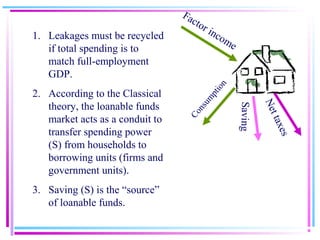
Factor income
Consum
ption
1. Leakages must be recycled
if total spending is to
match full-employment
GDP.
2. According to the Classical
theory, the loanable funds
market acts as a conduit to
transfer spending power
(S) from households to
borrowing units (firms and
government units).
3. Saving (S) is the “source”
of loanable funds.
Saving
Nettaxes
1. To have a more secure future, to start a
business, to finance a child’s education,
to satisfy miserliness, . . .
2. To earn interest.
We view interest as
the “reward for
saving” or the
“reward for
postponing
gratification.”
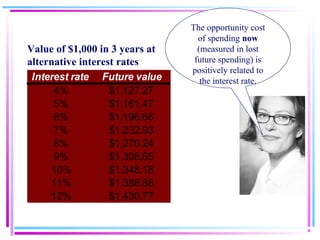
Interest rate Future value
4% $1,127.27
5% $1,161.47
6% $1,196.68
7% $1,232.93
8% $1,270.24
9% $1,308.65
10% $1,348.18
11% $1,388.88
12% $1,430.77
Value of $1,000 in 3 years at
alternative interest rates
The opportunity cost
of spending now
(measured in lost
future spending) is
positively related to
the interest rate.
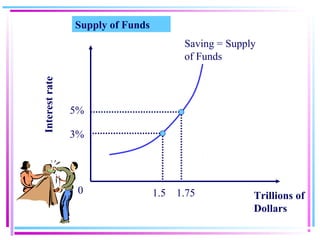
Saving = Supply
of Funds
Trillions of
Dollars
0
Interestrate
3%
5%
1.5 1.75
Supply of Funds
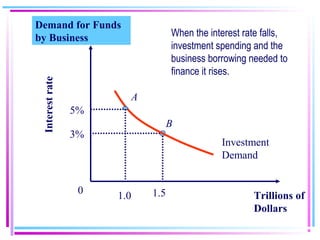
•To finance the acquisition of long-lived capital goods.
•The rate of interest is the cost of borrowing or the price of
loanable funds.
•The investment demand curve indicates the level of
investment spending at various interest rates.
•As the interest rate decreases, more investment projects
become attractive in the assessment of business decision-
makers—hence, the investment demand function is
downward-sloping with respect to the interest rate.
Investment
Demand
Trillions of
Dollars
0
Interestrate
3%
5%
1.5
Demand for Funds
by Business
1.0
A
B
When the interest rate falls,
investment spending and the
business borrowing needed to
finance it rises.
Public sector borrowing
•Let G denote public sector (or government)
spending for goods and services in a year
•T is net tax receipts in a year.
•If G is greater than T, the the public sector
has a budget deficit equal to G – T.
•If T is greater than G, then the public sector
has a surplus equal to T – G.
•If the public sector has a budget deficit, it
must borrow.
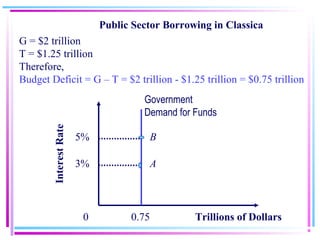
Public Sector Borrowing in Classica
G = $2 trillion
T = $1.25 trillion
Therefore,
Budget Deficit = G – T = $2 trillion - $1.25 trillion = $0.75 trillion
0.750
5%
3%
Government
Demand for Funds
InterestRate
Trillions of Dollars
A
B
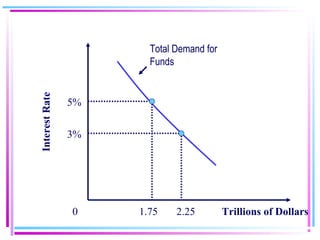
[1] [2] [3]= [1]+ [2]
InterestRate Business Demand GovernmentDemand Total Demand
5% 1.0 0.75 1.75
3% 1.5 0.75 2.25
Demand for Loanable Funds (in Trillions)
InterestRate
Trillions of Dollars0
3%
5%
1.75 2.25
Total Demand for
Funds
InterestRate
Trillions of Dollars
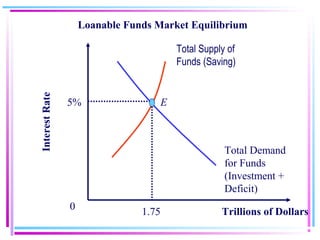
Loanable Funds Market Equilibrium
Total Supply of
Funds (Saving)
Total Demand
for Funds
(Investment +
Deficit)
E5%
0
1.75
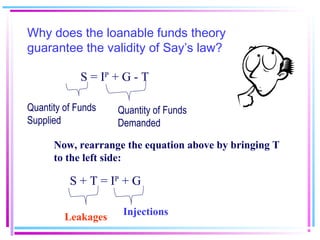
Why does the loanable funds theory
guarantee the validity of Say’s law?
S = IP
+ G - T
Quantity of Funds
Supplied
Quantity of Funds
Demanded
Now, rearrange the equation above by bringing T
to the left side:
S + T = IP
+ G
Leakages
Injections
So long as the loanable funds
market “clears,” leakages
(Saving) will be offset to
injections (investment and
government spending).
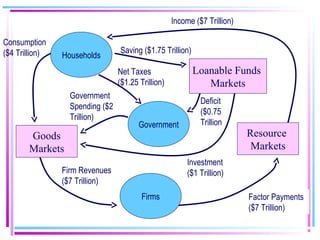
Firms
Government
Households
Resource
Markets
Goods
Markets
Loanable Funds
Markets
Income ($7 Trillion)
Factor Payments
($7 Trillion)
Government
Spending ($2
Trillion)
Investment
($1 Trillion)
Consumption
($4 Trillion)
Firm Revenues
($7 Trillion)
Deficit
($0.75
Trillion
Income ($7 Trillion)
Saving ($1.75 Trillion)
Net Taxes
($1.25 Trillion)
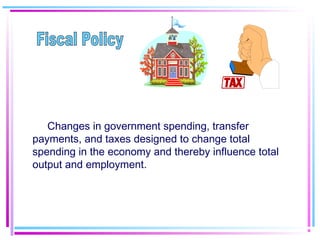
Changes in government spending, transfer
payments, and taxes designed to change total
spending in the economy and thereby influence total
output and employment.
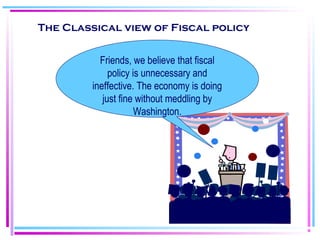
The Classical view of Fiscal policy
Friends, we believe that fiscal
policy is unnecessary and
ineffective. The economy is doing
just fine without meddling by
Washington.
•Crowding out is the idea that an increase in one
component of spending will cause a decrease in other
spending components.
•An increase in G may cause a decrease in C, IP
, or
both—that is, government spending may “crowd out”
private spending.
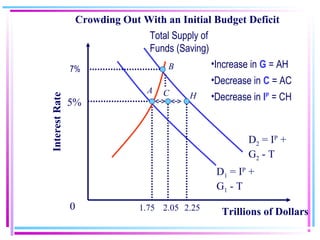
InterestRate
Trillions of Dollars
Crowding Out With an Initial Budget Deficit
Total Supply of
Funds (Saving)
D1 = IP
+
G1 - T
H
5%
0 1.75
D2 = IP
+
G2 - T
7%
2.05 2.25
A C
B •Increase in G = AH
•Decrease in C = AC
•Decrease in IP
= CH
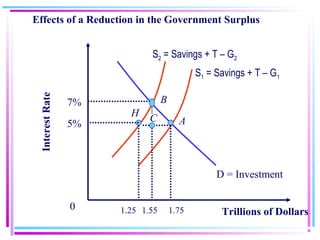
InterestRate
Trillions of Dollars
Effects of a Reduction in the Government Surplus
S1 = Savings + T – G1
D = Investment
B
5%
0 1.75
S2 = Savings + T – G2
A
H
7%
C
1.25 1.55

2313f05no12

  • 1.
    The Loanable Fundstheory We use the term “loanable funds market” to describe the arrangements and institutions by which saving of households is made available to borrowers.
  • 2.
    Factor income Consum ption 1. Leakagesmust be recycled if total spending is to match full-employment GDP. 2. According to the Classical theory, the loanable funds market acts as a conduit to transfer spending power (S) from households to borrowing units (firms and government units). 3. Saving (S) is the “source” of loanable funds. Saving Nettaxes
  • 3.
    1. To havea more secure future, to start a business, to finance a child’s education, to satisfy miserliness, . . . 2. To earn interest. We view interest as the “reward for saving” or the “reward for postponing gratification.”
  • 4.
    Interest rate Futurevalue 4% $1,127.27 5% $1,161.47 6% $1,196.68 7% $1,232.93 8% $1,270.24 9% $1,308.65 10% $1,348.18 11% $1,388.88 12% $1,430.77 Value of $1,000 in 3 years at alternative interest rates The opportunity cost of spending now (measured in lost future spending) is positively related to the interest rate.
  • 5.
    Saving = Supply ofFunds Trillions of Dollars 0 Interestrate 3% 5% 1.5 1.75 Supply of Funds
  • 6.
    •To finance theacquisition of long-lived capital goods. •The rate of interest is the cost of borrowing or the price of loanable funds. •The investment demand curve indicates the level of investment spending at various interest rates. •As the interest rate decreases, more investment projects become attractive in the assessment of business decision- makers—hence, the investment demand function is downward-sloping with respect to the interest rate.
  • 7.
    Investment Demand Trillions of Dollars 0 Interestrate 3% 5% 1.5 Demand forFunds by Business 1.0 A B When the interest rate falls, investment spending and the business borrowing needed to finance it rises.
  • 8.
    Public sector borrowing •LetG denote public sector (or government) spending for goods and services in a year •T is net tax receipts in a year. •If G is greater than T, the the public sector has a budget deficit equal to G – T. •If T is greater than G, then the public sector has a surplus equal to T – G. •If the public sector has a budget deficit, it must borrow.
  • 10.
    Public Sector Borrowingin Classica G = $2 trillion T = $1.25 trillion Therefore, Budget Deficit = G – T = $2 trillion - $1.25 trillion = $0.75 trillion 0.750 5% 3% Government Demand for Funds InterestRate Trillions of Dollars A B
  • 11.
    [1] [2] [3]=[1]+ [2] InterestRate Business Demand GovernmentDemand Total Demand 5% 1.0 0.75 1.75 3% 1.5 0.75 2.25 Demand for Loanable Funds (in Trillions)
  • 12.
  • 13.
    InterestRate Trillions of Dollars LoanableFunds Market Equilibrium Total Supply of Funds (Saving) Total Demand for Funds (Investment + Deficit) E5% 0 1.75
  • 14.
    Why does theloanable funds theory guarantee the validity of Say’s law? S = IP + G - T Quantity of Funds Supplied Quantity of Funds Demanded Now, rearrange the equation above by bringing T to the left side: S + T = IP + G Leakages Injections
  • 15.
    So long asthe loanable funds market “clears,” leakages (Saving) will be offset to injections (investment and government spending).
  • 16.
    Firms Government Households Resource Markets Goods Markets Loanable Funds Markets Income ($7Trillion) Factor Payments ($7 Trillion) Government Spending ($2 Trillion) Investment ($1 Trillion) Consumption ($4 Trillion) Firm Revenues ($7 Trillion) Deficit ($0.75 Trillion Income ($7 Trillion) Saving ($1.75 Trillion) Net Taxes ($1.25 Trillion)
  • 17.
    Changes in governmentspending, transfer payments, and taxes designed to change total spending in the economy and thereby influence total output and employment.
  • 18.
    The Classical viewof Fiscal policy Friends, we believe that fiscal policy is unnecessary and ineffective. The economy is doing just fine without meddling by Washington.
  • 19.
    •Crowding out isthe idea that an increase in one component of spending will cause a decrease in other spending components. •An increase in G may cause a decrease in C, IP , or both—that is, government spending may “crowd out” private spending.
  • 20.
    InterestRate Trillions of Dollars CrowdingOut With an Initial Budget Deficit Total Supply of Funds (Saving) D1 = IP + G1 - T H 5% 0 1.75 D2 = IP + G2 - T 7% 2.05 2.25 A C B •Increase in G = AH •Decrease in C = AC •Decrease in IP = CH
  • 21.
    InterestRate Trillions of Dollars Effectsof a Reduction in the Government Surplus S1 = Savings + T – G1 D = Investment B 5% 0 1.75 S2 = Savings + T – G2 A H 7% C 1.25 1.55