Loanable Funds Market
The Market for Loans Market for loanable funds is the market in which those who want to save supply funds and … those who want to borrow to invest demand funds.
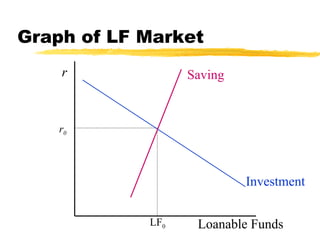
Saving is the source of the supply of loanable funds Investment is the source of the demand for loanable funds
The Price of Loanable Funds The interest rate is the price of the loan It represents the amount that borrowers pay for loans  and the amount that lenders receive on their savings.
Demand for loanable funds Demand for funds comes from households and businesses who wish to borrow to make investments.  High interest makes borrowing more expensive, the quantity of loanable funds demanded falls as interest rates rise. Mortgages, new equipment or factories
Supply of Loanable Funds Supply comes from those who have extra money to save or lend out. This lending can occur directly such as the  purchase of a bond or indirectly as savings.  High interest rates make saving more attractive
Interest Rate Nominal interest  rate  is the interest rate as usually reported – the monetary return to saving and cost of borrowing. The real interest is the interest corrected for inflation; it equals the nominal-inflation. Real interest more accurately reflects  the real return to savings or cost of borrowing. Supply and demand for loanable funds depends on real interest rate
Graph of LF Market r Loanable Funds Investment Saving r 0 LF 0
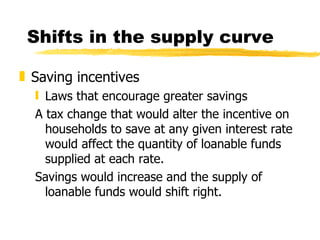
Shifts in the supply curve Saving incentives Laws that encourage greater savings A tax change that would alter the incentive on households to save at any given interest rate would affect the quantity of loanable funds supplied at each rate. Savings would increase and the supply of loanable funds would shift right.
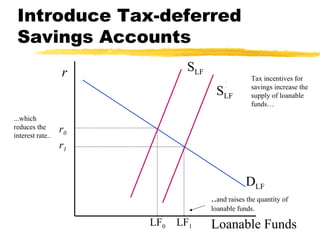
Introduce Tax-deferred Savings Accounts r Loanable Funds D LF S LF r 0 LF 0 S LF 1 r 1 LF 1 Tax incentives for savings increase the supply of loanable funds… ...which reduces the interest rate.. .. and raises the quantity of loanable funds.
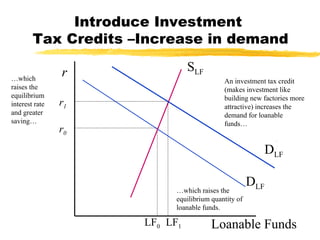
Introduce Investment  Tax Credits –Increase in demand r Loanable Funds D LF S LF r 0 LF 0 D LF 1 r 1 LF 1 An investment tax credit (makes investment like building new factories more attractive) increases the demand for loanable funds… … which raises the equilibrium interest rate and greater saving… … which raises the equilibrium quantity of loanable funds.
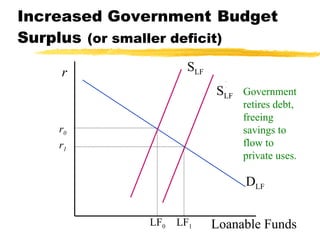
Increased Government   Budget Surplus   (or smaller deficit) r Loanable Funds D LF S LF r 0 LF 0 S LF 1 r 1 LF 1 Government retires debt, freeing savings to flow to private uses.
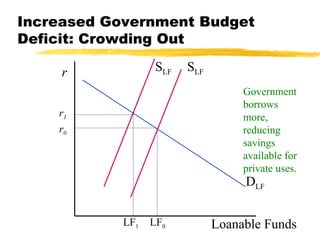
Increased Government Budget Deficit: Crowding Out r Loanable Funds D LF S LF r 0 LF 0 S LF 1 r 1 LF 1 Government borrows more, reducing savings available for private uses.
Budget Deficit In reality, government budget deficits affect the real interest rate. When the government reduces national savings by running a budget deficit, the interest rate rises, and investment falls. Because investment is important for long –run economic growth, government budget deficits reduce economy’s growth rate.
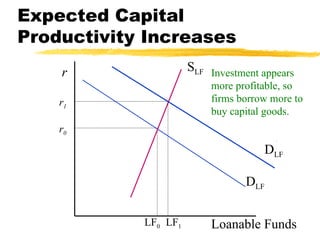
Expected Capital Productivity Increases r Loanable Funds D LF S LF r 0 LF 0 D LF 1 r 1 LF 1 Investment appears more profitable, so firms borrow more to buy capital goods.

Loanable funds

  • 1.
  • 2.
    The Market forLoans Market for loanable funds is the market in which those who want to save supply funds and … those who want to borrow to invest demand funds.
  • 3.
    Saving is thesource of the supply of loanable funds Investment is the source of the demand for loanable funds
  • 4.
    The Price ofLoanable Funds The interest rate is the price of the loan It represents the amount that borrowers pay for loans and the amount that lenders receive on their savings.
  • 5.
    Demand for loanablefunds Demand for funds comes from households and businesses who wish to borrow to make investments. High interest makes borrowing more expensive, the quantity of loanable funds demanded falls as interest rates rise. Mortgages, new equipment or factories
  • 6.
    Supply of LoanableFunds Supply comes from those who have extra money to save or lend out. This lending can occur directly such as the purchase of a bond or indirectly as savings. High interest rates make saving more attractive
  • 7.
    Interest Rate Nominalinterest rate is the interest rate as usually reported – the monetary return to saving and cost of borrowing. The real interest is the interest corrected for inflation; it equals the nominal-inflation. Real interest more accurately reflects the real return to savings or cost of borrowing. Supply and demand for loanable funds depends on real interest rate
  • 8.
    Graph of LFMarket r Loanable Funds Investment Saving r 0 LF 0
  • 9.
    Shifts in thesupply curve Saving incentives Laws that encourage greater savings A tax change that would alter the incentive on households to save at any given interest rate would affect the quantity of loanable funds supplied at each rate. Savings would increase and the supply of loanable funds would shift right.
  • 10.
    Introduce Tax-deferred SavingsAccounts r Loanable Funds D LF S LF r 0 LF 0 S LF 1 r 1 LF 1 Tax incentives for savings increase the supply of loanable funds… ...which reduces the interest rate.. .. and raises the quantity of loanable funds.
  • 11.
    Introduce Investment Tax Credits –Increase in demand r Loanable Funds D LF S LF r 0 LF 0 D LF 1 r 1 LF 1 An investment tax credit (makes investment like building new factories more attractive) increases the demand for loanable funds… … which raises the equilibrium interest rate and greater saving… … which raises the equilibrium quantity of loanable funds.
  • 12.
    Increased Government Budget Surplus (or smaller deficit) r Loanable Funds D LF S LF r 0 LF 0 S LF 1 r 1 LF 1 Government retires debt, freeing savings to flow to private uses.
  • 13.
    Increased Government BudgetDeficit: Crowding Out r Loanable Funds D LF S LF r 0 LF 0 S LF 1 r 1 LF 1 Government borrows more, reducing savings available for private uses.
  • 14.
    Budget Deficit Inreality, government budget deficits affect the real interest rate. When the government reduces national savings by running a budget deficit, the interest rate rises, and investment falls. Because investment is important for long –run economic growth, government budget deficits reduce economy’s growth rate.
  • 15.
    Expected Capital ProductivityIncreases r Loanable Funds D LF S LF r 0 LF 0 D LF 1 r 1 LF 1 Investment appears more profitable, so firms borrow more to buy capital goods.