Name:_____________________________________
Coursework Deadlines
21st of October – Preliminary Task due

16th of December – Research & Planning due

10th of February – Completed first draft of the main task due

30th of March – Final deadline for all coursework


You will use a blog to present your work for the main task. The
recommended site to use is blogger – blogspot.com

Make sure you remember your login details.

Blog address:


Coursework drop-in sessions are available every lunch time, and
after school Tuesdays-Thursdays in the new Media room.


The foundation portfolio is worth 50% of your AS in Media Studies. You complete the
following coursework brief:
Print

Preliminary exercise: using DTP and an image manipulation program, produce the front page of a
new school/college magazine, featuring a photograph of a student in medium close-up plus some
appropriately laid-out text and a masthead. Additionally candidates must produce a DTP mock-up of
the layout of the contents page to demonstrate their grasp of the program.

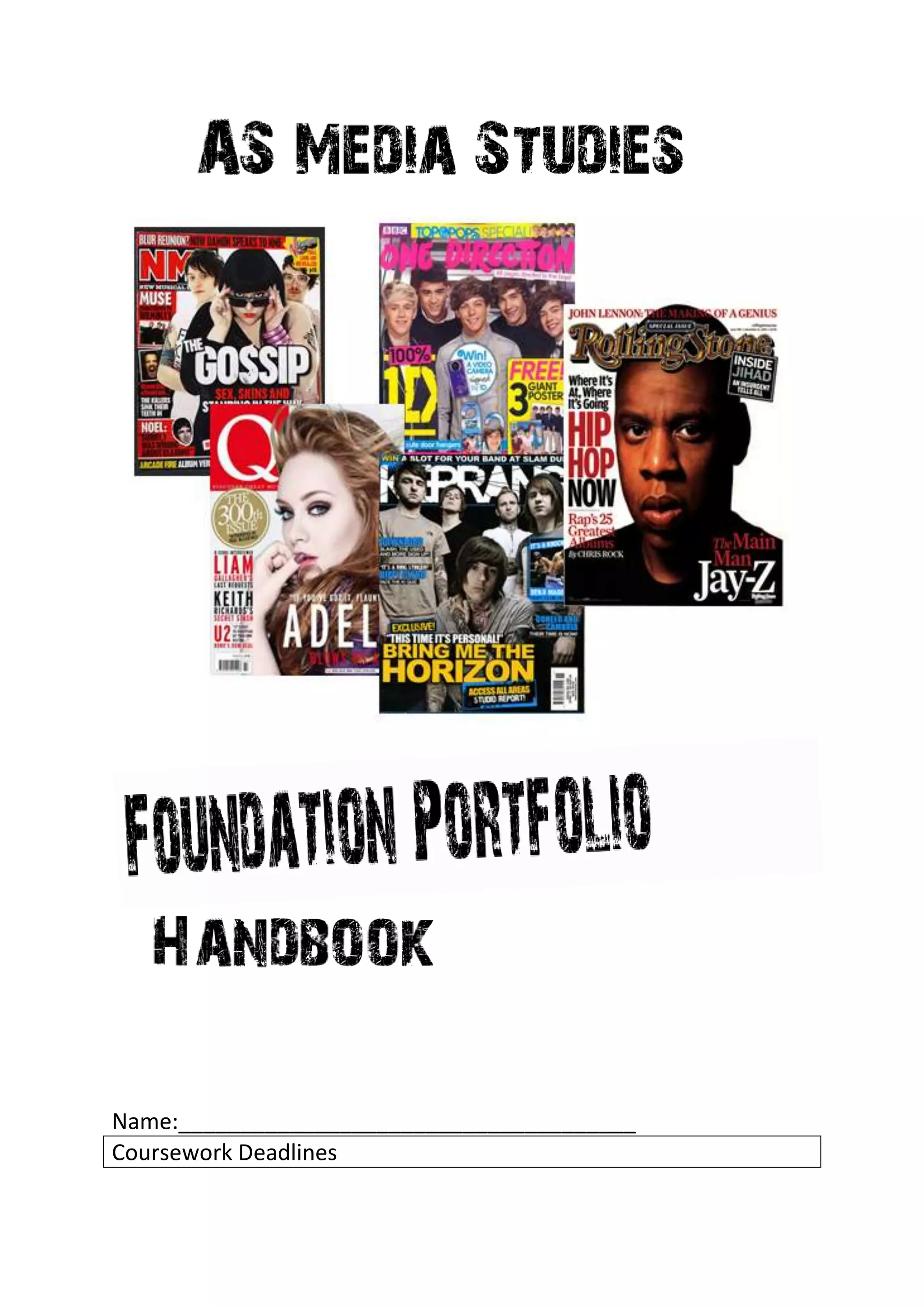
Main task: the front page, contents and double page spread of a new music magazine. All images
and text used must be original, produced by the candidate, minimum of FOUR images per candidate.


The Preliminary Task
You must complete a preliminary task in order to develop the necessary skills to succeed in
the Foundation Portfolio. For the preliminary task you will produce the front page and a
draft of a contents page for a new school magazine.

Research into school magazines
You will need to analyse the front cover and contents page of 2 or 3 school magazines. You
should analyse:
       Typography – what style and size fonts are used? Why?
       Layout – is it cluttered or ordered? Where have key things been placed?
       Language – what type of language is used?
       Colour – what effect does colour have? What are the connotations of the colours?
       Camerawork – in the images what shot types and angles have been used? Why?
       Mise-en-scene – in the images what props, costumes, and settings have been used?
       Mode of address – how does the magazine speak to the audience? What is the
       tone?

Remember to analyse the effect of specific examples, and use relevant terminology.

Summarise the conventions of school magazines in relation to content and design.

Planning your school magazine
You will need to create rough drafts for your school magazine. This should include:
       Draft layouts
       Sample font styles
       Sample colour schemes


Creating your school magazine
You will produce the front cover of a new school magazine. Your front cover should use
typical conventions (masthead, cover lines, one main image, etc.) and include a picture of a
student in MEDIUM CLOSE-UP. You will also need to include a detailed draft for the
contents page.
Evaluating your school magazine
Once you have completed your magazine you will need to produce an evaluation. Your
evaluation should address the following questions:
       How have you used media conventions in your preliminary task? (e.g. conventions
       of layout, font, images, content)
       How have you used media language in your product? (What is the intended effect of
       your use of shot types/angles, mise-en-scene, layout, font, colour, images?)
       How have you addressed your audience? (What is the mode of address? Formal or
       informal? Give examples.)
       What skills have you developed during the preliminary task? (e.g. analytical,
       research, planning, production)

The deadline for the completion of the preliminary task is Friday the 21st of October. You should
hand in the research, planning, product, and evaluation. This work will be assessed and a mark
recorded on GO.


The Main Task – Research & Planning
Research and Planning is worth 20% of your mark for the Foundation Portfolio. To achieve a
Level 4 (A) for Research and Planning you must produce work to meet the following criteria:

        There is excellent research into similar products and a potential target audience.
        There is excellent organisation of actors, locations, costumes or props.
        There is excellent work on layouts, and drafting.
        There is an excellent level of care in the presentation of the research and planning
        Time management is excellent.


Audience research
You will need to complete research into your target audience to find out who they are (the
demographic), what their interests are (the psychographic), and how to make your product
appealing to them. In order to do this you should:
       Complete an initial questionnaire to find out about the target audience for your
       music magazine (age, gender, interests, what they find appealing about music
       magazines)
       Use the internet to research the target audience for a similar music magazine
       (Publisher’s websites sometimes have media packs which contain useful information
       about the target audience)
       Complete a second questionnaire and/or focus group to get feedback on your ideas
       and drafts for your magazine
You must complete detailed summaries of each piece of audience research you do and
explain how this information will help you.

Research into similar products
You will need to analyse three front covers, contents pages, and double page spreads from
music magazines similar to the one you intend to produce. Your analysis should focus on:
Typography – what style fonts are used? Why?
       Layout – is it cluttered or ordered? Where have key things been placed?
       Language – what type of language is used?
       Colour – what effect does colour have? What are the connotations of the colours?
       Camerawork – in the images what shot types and angles have been used? Why?
       Mise-en-scene – in the images what props, costumes, and settings have been used?
       Mode of address – how does the magazine speak to the audience? What is the
       tone?

Remember to analyse the effect of specific examples, and use relevant terminology.

Summarise what you find out about the conventions of music magazines in relation to
content, design, and mode of address.

Planning
You will need to plan your music magazine. Your planning should include:
       Draft font styles and colour schemes
       Drafts of each page
       Draft text

You will also need to complete a production plan for your photography including dates,
locations, equipment, personnel, props, and costumes.

Research into institutions
Find out about companies that produce similar music magazines to the one you intend to
produce, and summarise your findings. You should find out about:
       What other magazines do they produce?
       What demographics do they cater for?
       What other media are owned by the company?
       What examples or cross-media convergence can be identified?
       Are the company a subsidiary? If so, of who, and what other types of media are owned?


Pitching your music magazine
Your pitch should summarise the key findings of your research into similar magazines and
the target audience, and explain why your magazine will be successful in following
conventions and appealing to the target audience. Your pitch should include some draft
work and sample content.

The deadline for your Research and Planning is Friday, the 16th of December. Your work
needs to be completed and uploaded to you blog by that date. It is your responsibility to
ensure your teacher has your blog address. This work will be assessed and a mark recorded
in GO. This mark contributes 20% to your overall mark for the Foundation Portfolio.


Main Task – Construction
Your coursework product is worth 60% of your total mark for the Foundation Portfolio. The
criteria to achieve a Level 4 (A) for the magazine are:
There is evidence of excellence in the creative use of most of the following technical skills:

        framing a shot, including and excluding elements as appropriate;
        using a variety of shot distances as appropriate;
        shooting material appropriate to the task set;
        selecting mise-en-scène including colour, figure, lighting, objects and setting;
        manipulating photographs as appropriate to the context for presentation, including cropping
        and resizing;
        accurately using language and register;
        appropriately integrating illustration and text;
        showing understanding of conventions of layout and page design;
        showing awareness of the need for variety in fonts and text size;
        using ICT appropriately for the task set.

In order to produce a successful magazine you will need to:
        Take a range of photographs. Do not use the same set of pictures on every page of your
        magazine. Make sure that the pictures are taken specifically for your magazine, and that
        you have thought carefully about your use of mise-en-scene and camerawork.
        Develop a house style across your magazine pages.
        Follow conventions in terms of layout, images, content, and language.
        Use fonts, colours, images, and language that are suited to your genre of music and will
        appeal to your target audience.

The deadline for the completion of the first draft of you magazine is Friday the 10th of February.
Your work will be assessed and targets set to help you improve. You will then have until Friday the
30th of March to complete these improvements.


Main Task – Evaluation
The evaluation is worth 20% of the total marks for your Foundation Portfolio. You should
present your evaluation as a blog entry. The criteria to achieve a Level 4 (A) for the
evaluation is:

        Excellent understanding of issues around audience, institution, technology, representation,
        forms and conventions in relation to production.
        Excellent ability to refer to the choices made and outcomes.
        Excellent understanding of their development from preliminary to full task.
        Excellent ability to communicate.
        Excellent skill in the use of digital technology or ICT in the evaluation

You should not see the evaluation as a written essay. You are marked on your use of the blog
format, so you need to be as creative as you can in your use of the blog. You should ensure you use
a range of images from your magazine and other magazines to illustrate the points you make. You
could also embed videos, powerpoints, mind-maps, links, etc.


Audience feedback
Before you begin your evaluation you need to get feedback from your target audience on
your finished magazine. This could be through a questionnaire and/or a focus group.

Questions
In your evaluation you need to answer the following questions:

       In what ways does your media product use, develop or challenge forms and conventions of
       real media products?

       How does your media product represent particular social groups?

       What kind of media institution might distribute your media product and why?

       Who would be the audience for your media product?

       How did you attract/address your audience?

       What have you learnt about technologies from the process of constructing this product?

       Looking back at your preliminary task, what do you feel you have learnt in the progression
       from it to the full product?

Conventions – how does your magazine follow conventions? You may want to consider the
conventions of magazine design (layout, use of fonts) and the conventions of music
magazine (colours, mode of address, content, images). Use specific examples. Support the
points you make with images from your magazine, and images from existing magazines.

Representation – what different social groups have you represented? You may want to
focus on areas such as gender or age. How have you constructed the representations?
Think about your use of images and mise-en-scene, and the use of language. Refer to
specific examples from your own and existing magazines.

Institutions – look back at the research you did into the type of institutions who produce
music magazines. Which institution would be most suitable to distribute your magazine?
Why?

Target audience – who is your target audience? Refer to the audience research you have
done? How have you appealed to the target audience? Consider your use of colour,
images, layout, and the content of your magazine.

Technologies – what technology did you use in making your magazine? You should consider
your use of digital cameras, photo editing software, and publishing programmes. What did
the technology you used allow you to do? What skills have you developed?

Preliminary Task – How have your skills developed from the preliminary task? Compare
your preliminary task to your completed magazine. In what ways does your music magazine
look more professional?
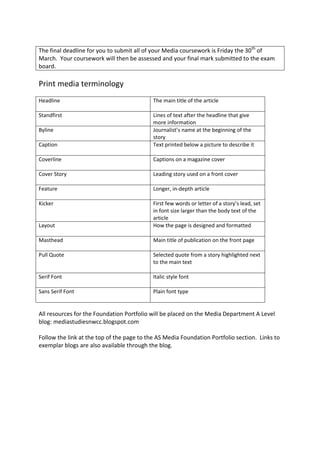
The final deadline for you to submit all of your Media coursework is Friday the 30th of
March. Your coursework will then be assessed and your final mark submitted to the exam
board.

Print media terminology
Headline                                    The main title of the article

Standfirst                                  Lines of text after the headline that give
                                            more information
Byline                                      Journalist’s name at the beginning of the
                                            story
Caption                                     Text printed below a picture to describe it

Coverline                                   Captions on a magazine cover

Cover Story                                 Leading story used on a front cover

Feature                                     Longer, in-depth article

Kicker                                      First few words or letter of a story’s lead, set
                                            in font size larger than the body text of the
                                            article
Layout                                      How the page is designed and formatted

Masthead                                    Main title of publication on the front page

Pull Quote                                  Selected quote from a story highlighted next
                                            to the main text

Serif Font                                  Italic style font

Sans Serif Font                             Plain font type


All resources for the Foundation Portfolio will be placed on the Media Department A Level
blog: mediastudiesnwcc.blogspot.com

Follow the link at the top of the page to the AS Media Foundation Portfolio section. Links to
exemplar blogs are also available through the blog.

AS Media Foundation portfolio handbook

  • 1.
  • 2.
    21st of October– Preliminary Task due 16th of December – Research & Planning due 10th of February – Completed first draft of the main task due 30th of March – Final deadline for all coursework You will use a blog to present your work for the main task. The recommended site to use is blogger – blogspot.com Make sure you remember your login details. Blog address: Coursework drop-in sessions are available every lunch time, and after school Tuesdays-Thursdays in the new Media room. The foundation portfolio is worth 50% of your AS in Media Studies. You complete the following coursework brief:
  • 3.
    Print Preliminary exercise: usingDTP and an image manipulation program, produce the front page of a new school/college magazine, featuring a photograph of a student in medium close-up plus some appropriately laid-out text and a masthead. Additionally candidates must produce a DTP mock-up of the layout of the contents page to demonstrate their grasp of the program. Main task: the front page, contents and double page spread of a new music magazine. All images and text used must be original, produced by the candidate, minimum of FOUR images per candidate. The Preliminary Task You must complete a preliminary task in order to develop the necessary skills to succeed in the Foundation Portfolio. For the preliminary task you will produce the front page and a draft of a contents page for a new school magazine. Research into school magazines You will need to analyse the front cover and contents page of 2 or 3 school magazines. You should analyse: Typography – what style and size fonts are used? Why? Layout – is it cluttered or ordered? Where have key things been placed? Language – what type of language is used? Colour – what effect does colour have? What are the connotations of the colours? Camerawork – in the images what shot types and angles have been used? Why? Mise-en-scene – in the images what props, costumes, and settings have been used? Mode of address – how does the magazine speak to the audience? What is the tone? Remember to analyse the effect of specific examples, and use relevant terminology. Summarise the conventions of school magazines in relation to content and design. Planning your school magazine You will need to create rough drafts for your school magazine. This should include: Draft layouts Sample font styles Sample colour schemes Creating your school magazine You will produce the front cover of a new school magazine. Your front cover should use typical conventions (masthead, cover lines, one main image, etc.) and include a picture of a student in MEDIUM CLOSE-UP. You will also need to include a detailed draft for the contents page.
  • 4.
    Evaluating your schoolmagazine Once you have completed your magazine you will need to produce an evaluation. Your evaluation should address the following questions: How have you used media conventions in your preliminary task? (e.g. conventions of layout, font, images, content) How have you used media language in your product? (What is the intended effect of your use of shot types/angles, mise-en-scene, layout, font, colour, images?) How have you addressed your audience? (What is the mode of address? Formal or informal? Give examples.) What skills have you developed during the preliminary task? (e.g. analytical, research, planning, production) The deadline for the completion of the preliminary task is Friday the 21st of October. You should hand in the research, planning, product, and evaluation. This work will be assessed and a mark recorded on GO. The Main Task – Research & Planning Research and Planning is worth 20% of your mark for the Foundation Portfolio. To achieve a Level 4 (A) for Research and Planning you must produce work to meet the following criteria: There is excellent research into similar products and a potential target audience. There is excellent organisation of actors, locations, costumes or props. There is excellent work on layouts, and drafting. There is an excellent level of care in the presentation of the research and planning Time management is excellent. Audience research You will need to complete research into your target audience to find out who they are (the demographic), what their interests are (the psychographic), and how to make your product appealing to them. In order to do this you should: Complete an initial questionnaire to find out about the target audience for your music magazine (age, gender, interests, what they find appealing about music magazines) Use the internet to research the target audience for a similar music magazine (Publisher’s websites sometimes have media packs which contain useful information about the target audience) Complete a second questionnaire and/or focus group to get feedback on your ideas and drafts for your magazine You must complete detailed summaries of each piece of audience research you do and explain how this information will help you. Research into similar products You will need to analyse three front covers, contents pages, and double page spreads from music magazines similar to the one you intend to produce. Your analysis should focus on:
  • 5.
    Typography – whatstyle fonts are used? Why? Layout – is it cluttered or ordered? Where have key things been placed? Language – what type of language is used? Colour – what effect does colour have? What are the connotations of the colours? Camerawork – in the images what shot types and angles have been used? Why? Mise-en-scene – in the images what props, costumes, and settings have been used? Mode of address – how does the magazine speak to the audience? What is the tone? Remember to analyse the effect of specific examples, and use relevant terminology. Summarise what you find out about the conventions of music magazines in relation to content, design, and mode of address. Planning You will need to plan your music magazine. Your planning should include: Draft font styles and colour schemes Drafts of each page Draft text You will also need to complete a production plan for your photography including dates, locations, equipment, personnel, props, and costumes. Research into institutions Find out about companies that produce similar music magazines to the one you intend to produce, and summarise your findings. You should find out about: What other magazines do they produce? What demographics do they cater for? What other media are owned by the company? What examples or cross-media convergence can be identified? Are the company a subsidiary? If so, of who, and what other types of media are owned? Pitching your music magazine Your pitch should summarise the key findings of your research into similar magazines and the target audience, and explain why your magazine will be successful in following conventions and appealing to the target audience. Your pitch should include some draft work and sample content. The deadline for your Research and Planning is Friday, the 16th of December. Your work needs to be completed and uploaded to you blog by that date. It is your responsibility to ensure your teacher has your blog address. This work will be assessed and a mark recorded in GO. This mark contributes 20% to your overall mark for the Foundation Portfolio. Main Task – Construction
  • 6.
    Your coursework productis worth 60% of your total mark for the Foundation Portfolio. The criteria to achieve a Level 4 (A) for the magazine are: There is evidence of excellence in the creative use of most of the following technical skills: framing a shot, including and excluding elements as appropriate; using a variety of shot distances as appropriate; shooting material appropriate to the task set; selecting mise-en-scène including colour, figure, lighting, objects and setting; manipulating photographs as appropriate to the context for presentation, including cropping and resizing; accurately using language and register; appropriately integrating illustration and text; showing understanding of conventions of layout and page design; showing awareness of the need for variety in fonts and text size; using ICT appropriately for the task set. In order to produce a successful magazine you will need to: Take a range of photographs. Do not use the same set of pictures on every page of your magazine. Make sure that the pictures are taken specifically for your magazine, and that you have thought carefully about your use of mise-en-scene and camerawork. Develop a house style across your magazine pages. Follow conventions in terms of layout, images, content, and language. Use fonts, colours, images, and language that are suited to your genre of music and will appeal to your target audience. The deadline for the completion of the first draft of you magazine is Friday the 10th of February. Your work will be assessed and targets set to help you improve. You will then have until Friday the 30th of March to complete these improvements. Main Task – Evaluation The evaluation is worth 20% of the total marks for your Foundation Portfolio. You should present your evaluation as a blog entry. The criteria to achieve a Level 4 (A) for the evaluation is: Excellent understanding of issues around audience, institution, technology, representation, forms and conventions in relation to production. Excellent ability to refer to the choices made and outcomes. Excellent understanding of their development from preliminary to full task. Excellent ability to communicate. Excellent skill in the use of digital technology or ICT in the evaluation You should not see the evaluation as a written essay. You are marked on your use of the blog format, so you need to be as creative as you can in your use of the blog. You should ensure you use a range of images from your magazine and other magazines to illustrate the points you make. You could also embed videos, powerpoints, mind-maps, links, etc. Audience feedback
  • 7.
    Before you beginyour evaluation you need to get feedback from your target audience on your finished magazine. This could be through a questionnaire and/or a focus group. Questions In your evaluation you need to answer the following questions: In what ways does your media product use, develop or challenge forms and conventions of real media products? How does your media product represent particular social groups? What kind of media institution might distribute your media product and why? Who would be the audience for your media product? How did you attract/address your audience? What have you learnt about technologies from the process of constructing this product? Looking back at your preliminary task, what do you feel you have learnt in the progression from it to the full product? Conventions – how does your magazine follow conventions? You may want to consider the conventions of magazine design (layout, use of fonts) and the conventions of music magazine (colours, mode of address, content, images). Use specific examples. Support the points you make with images from your magazine, and images from existing magazines. Representation – what different social groups have you represented? You may want to focus on areas such as gender or age. How have you constructed the representations? Think about your use of images and mise-en-scene, and the use of language. Refer to specific examples from your own and existing magazines. Institutions – look back at the research you did into the type of institutions who produce music magazines. Which institution would be most suitable to distribute your magazine? Why? Target audience – who is your target audience? Refer to the audience research you have done? How have you appealed to the target audience? Consider your use of colour, images, layout, and the content of your magazine. Technologies – what technology did you use in making your magazine? You should consider your use of digital cameras, photo editing software, and publishing programmes. What did the technology you used allow you to do? What skills have you developed? Preliminary Task – How have your skills developed from the preliminary task? Compare your preliminary task to your completed magazine. In what ways does your music magazine look more professional?
  • 8.
    The final deadlinefor you to submit all of your Media coursework is Friday the 30th of March. Your coursework will then be assessed and your final mark submitted to the exam board. Print media terminology Headline The main title of the article Standfirst Lines of text after the headline that give more information Byline Journalist’s name at the beginning of the story Caption Text printed below a picture to describe it Coverline Captions on a magazine cover Cover Story Leading story used on a front cover Feature Longer, in-depth article Kicker First few words or letter of a story’s lead, set in font size larger than the body text of the article Layout How the page is designed and formatted Masthead Main title of publication on the front page Pull Quote Selected quote from a story highlighted next to the main text Serif Font Italic style font Sans Serif Font Plain font type All resources for the Foundation Portfolio will be placed on the Media Department A Level blog: mediastudiesnwcc.blogspot.com Follow the link at the top of the page to the AS Media Foundation Portfolio section. Links to exemplar blogs are also available through the blog.