Media Language
   Media Language means the way in which a
    text is constructed to create meaning for a
    reader or viewer of the text.

   All media texts are constructed; someone has
    made decisions about how they should be
    constructed so that the form matches the
    content and with a particular audience in
    mind.
   The description of deconstructing a text is
    generally used in relation to a particular way of
    reading a text, called semiotics.

   Deconstructing is key.

   You need to be able to deconstruct your own
    projects to justify your design decisions.

   When deconstructing, your job is to identify the
    different elements which construct the text and
    the contextual factors which frame it.
SEMIOTICS - how meaning is
 constructed through language and
 codes.

    Ferdinand de Saussure (1857-1913)
          the signifier and signified
    how there can be two levels of meaning in
           an object within a media text.
   Firstly there’s the signifier—which is what is
    there in front of us, what we see, the form
    the sign takes.

   Then there’s the signified—which is an idea
    we associate with the signifier, the concept
    it represents.
   THE SIGN OR SYMBOL WE SEE DOES NOT MAKE
    SENSE WITHOUT THE ACTUAL OBJECT AND THE
    MEANING IT CREATES.

   For example, if in a film the characters are talking
    about a bank, its up to the audience to determine
    which bank they mean—a grassy slope or a place to
    deposit your money?

   THINK ABOUT HOW YOU HAVE CREATED
    MEANINGS IN YOUR PRODUCTION WORK… CAN
    AUDIENCES CLEARLY MAKE SENSE OF
    DIFFERENT SIGNS YOU USE? OR IS THERE
    ANYTHING AMBIGUOUS – SOMETHING THAT
    ISN’T CLEAR TO THE AUDIENCE?
   looks at how the audience will interpret meaning
    from a particular media text.

   The denotation is an object placed within
    media texts, e.g. a poppy. It is then up to the
    audience to draw on their own cultural, social
    and historical knowledge to interpret its
    connotations.

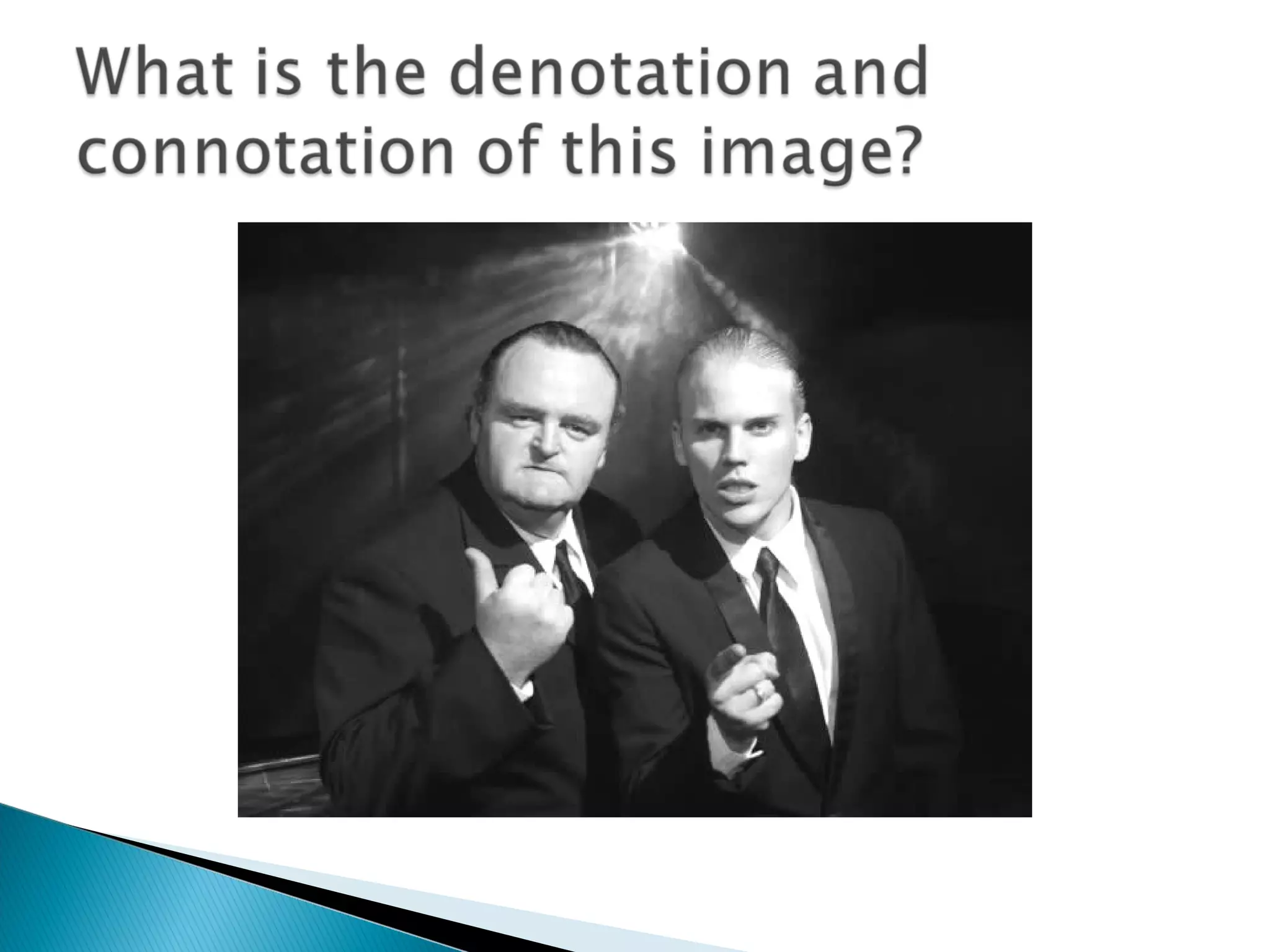
   looking at some images and describing what we
    see. This level of analysis is called denotation.
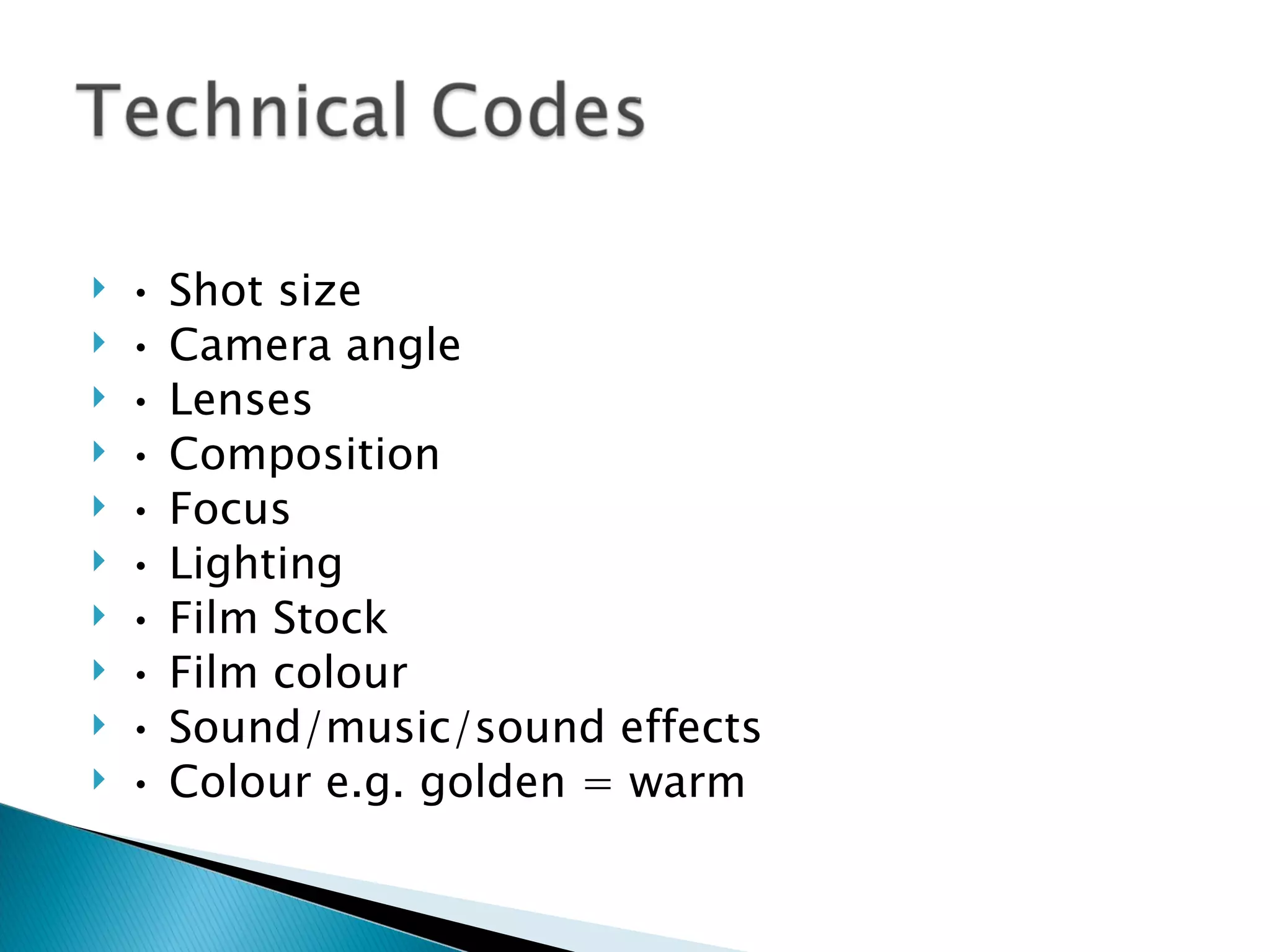
   In order to analyse the denotation and
    connotation of a moving image it is important
    to think about the micro areas and referring
    to the technical codes.
   •   Shot size
   •   Camera angle
   •   Lenses
   •   Composition
   •   Focus
   •   Lighting
   •   Film Stock
   •   Film colour
   •   Sound/music/sound effects
   •   Colour e.g. golden = warm
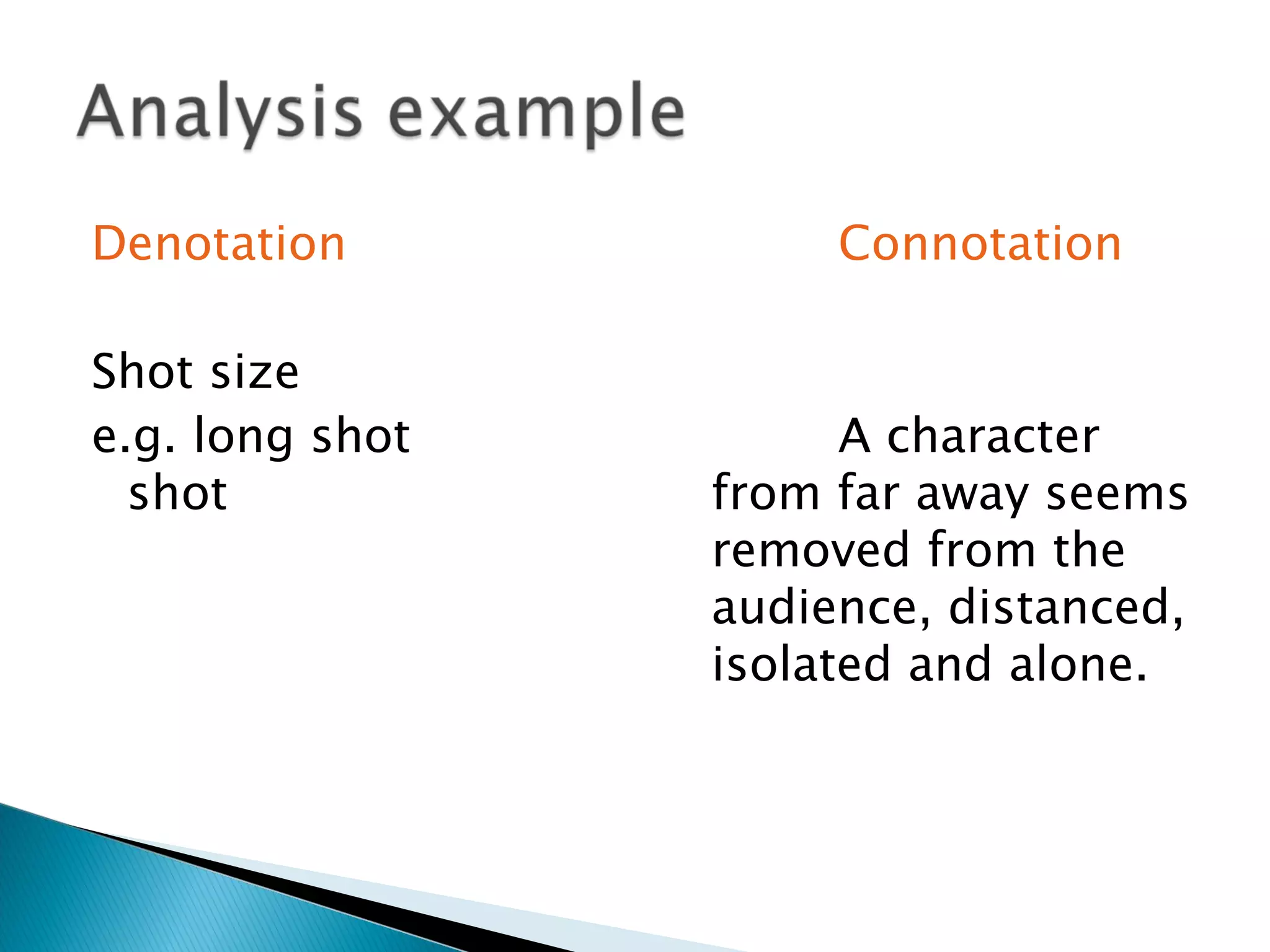
Denotation            Connotation

Shot size
e.g. long shot         A character
  shot           from far away seems
                 removed from the
                 audience, distanced,
                 isolated and alone.
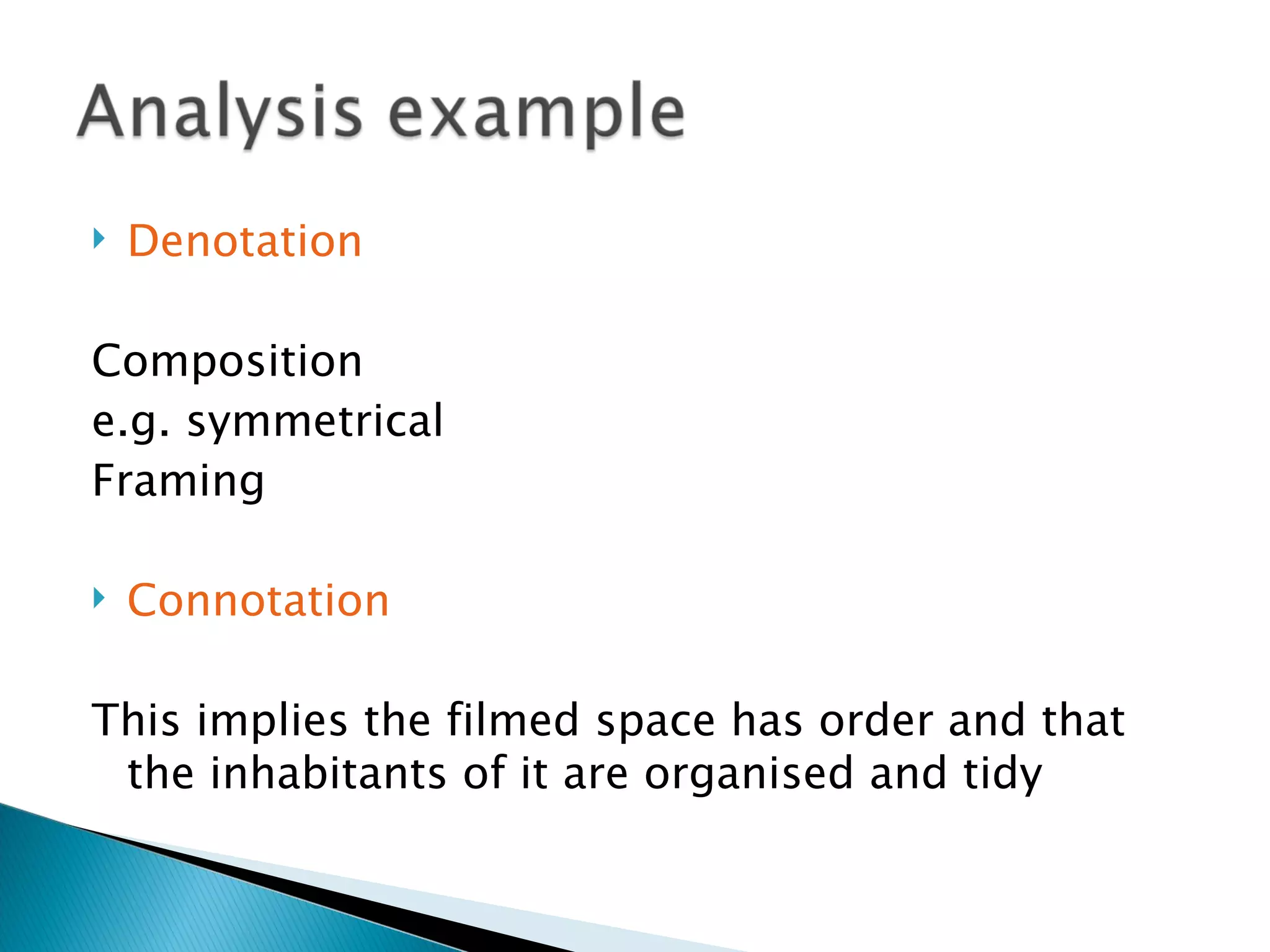
   Denotation

Composition
e.g. symmetrical
Framing

   Connotation

This implies the filmed space has order and that
 the inhabitants of it are organised and tidy
   •   Setting
   •   Props
   •   NVC (non-verbal communication)
   •   Dress

   Denotation: NVC— e.g. hunched shoulders,
    head hanging down

   Connotation: The character is vulnerable,
    unhappy or depressed
   Although Media Language is a separate area
    in itself, you will still need to use media
    language if you have a question based on the
    other areas:
   Narrative
   Genre
   Representation
   Audience
   Using the handout and the information you
    have gather today, discuss the following:

   SE7EV opening sequence

   Referring to the micro areas and media
    language, analyse the opening sequence of
    SE7EN.
   Blog your answer!
   Continuing to look at meanings within a
    media text, Hall’s theory thinks about the
    preferred meaning of a text.

   If something is encoded it is what is
    written within a media text. An image has
    been placed in the text by the producer and
    will challenge or promote dominant
    ideologies. Decoding is when the
    audience reads into this piece of media and
    makes their own interpretation of what the
    image means.
   Hall thinks the media circulates dominant
    ideas, and his theory says that producers
    place dominant ideas in different media. So
    basically, they would have cleverly encoded
    their views and opinions into say a film or
    newspaper article with the intention of the
    audience interpreting this preferred or
    intended meaning.
   Hall says there are three ways the audience decodes
    texts:

a   The audience fully accepts the preferred meaning, showing they
    agree with dominant values.

g   The audience takes a negotiated position, meaning that they only
    agree with some-not all of the preferred meaning.

g   The audience takes an oppositional position, whereby they understand
    the preferred meaning but decide to make their own interpretation


       WRITE A LIST OF ALL THE VALUES YOU ENCODED IN YOUR
    VIDEO PRODUCT. WHAT WERE YOUR PREFERRED MEANINGS? DO
    YOU THINK AUDIENCES PICKED UP ON THIS?

Media language lesson one

  • 1.
  • 2.
    Media Language means the way in which a text is constructed to create meaning for a reader or viewer of the text.  All media texts are constructed; someone has made decisions about how they should be constructed so that the form matches the content and with a particular audience in mind.
  • 3.
    The description of deconstructing a text is generally used in relation to a particular way of reading a text, called semiotics.  Deconstructing is key.  You need to be able to deconstruct your own projects to justify your design decisions.  When deconstructing, your job is to identify the different elements which construct the text and the contextual factors which frame it.
  • 4.
    SEMIOTICS - howmeaning is constructed through language and codes.  Ferdinand de Saussure (1857-1913) the signifier and signified  how there can be two levels of meaning in an object within a media text.
  • 5.
    Firstly there’s the signifier—which is what is there in front of us, what we see, the form the sign takes.  Then there’s the signified—which is an idea we associate with the signifier, the concept it represents.
  • 6.
    THE SIGN OR SYMBOL WE SEE DOES NOT MAKE SENSE WITHOUT THE ACTUAL OBJECT AND THE MEANING IT CREATES.  For example, if in a film the characters are talking about a bank, its up to the audience to determine which bank they mean—a grassy slope or a place to deposit your money?  THINK ABOUT HOW YOU HAVE CREATED MEANINGS IN YOUR PRODUCTION WORK… CAN AUDIENCES CLEARLY MAKE SENSE OF DIFFERENT SIGNS YOU USE? OR IS THERE ANYTHING AMBIGUOUS – SOMETHING THAT ISN’T CLEAR TO THE AUDIENCE?
  • 7.
    looks at how the audience will interpret meaning from a particular media text.  The denotation is an object placed within media texts, e.g. a poppy. It is then up to the audience to draw on their own cultural, social and historical knowledge to interpret its connotations.  looking at some images and describing what we see. This level of analysis is called denotation.
  • 9.
    In order to analyse the denotation and connotation of a moving image it is important to think about the micro areas and referring to the technical codes.
  • 10.
    • Shot size  • Camera angle  • Lenses  • Composition  • Focus  • Lighting  • Film Stock  • Film colour  • Sound/music/sound effects  • Colour e.g. golden = warm
  • 11.
    Denotation Connotation Shot size e.g. long shot A character shot from far away seems removed from the audience, distanced, isolated and alone.
  • 12.
    Denotation Composition e.g. symmetrical Framing  Connotation This implies the filmed space has order and that the inhabitants of it are organised and tidy
  • 13.
    • Setting  • Props  • NVC (non-verbal communication)  • Dress  Denotation: NVC— e.g. hunched shoulders, head hanging down  Connotation: The character is vulnerable, unhappy or depressed
  • 14.
    Although Media Language is a separate area in itself, you will still need to use media language if you have a question based on the other areas:  Narrative  Genre  Representation  Audience
  • 15.
    Using the handout and the information you have gather today, discuss the following:  SE7EV opening sequence  Referring to the micro areas and media language, analyse the opening sequence of SE7EN.  Blog your answer!
  • 16.
    Continuing to look at meanings within a media text, Hall’s theory thinks about the preferred meaning of a text.  If something is encoded it is what is written within a media text. An image has been placed in the text by the producer and will challenge or promote dominant ideologies. Decoding is when the audience reads into this piece of media and makes their own interpretation of what the image means.
  • 17.
    Hall thinks the media circulates dominant ideas, and his theory says that producers place dominant ideas in different media. So basically, they would have cleverly encoded their views and opinions into say a film or newspaper article with the intention of the audience interpreting this preferred or intended meaning.
  • 18.
    Hall says there are three ways the audience decodes texts: a The audience fully accepts the preferred meaning, showing they agree with dominant values. g The audience takes a negotiated position, meaning that they only agree with some-not all of the preferred meaning. g The audience takes an oppositional position, whereby they understand the preferred meaning but decide to make their own interpretation  WRITE A LIST OF ALL THE VALUES YOU ENCODED IN YOUR VIDEO PRODUCT. WHAT WERE YOUR PREFERRED MEANINGS? DO YOU THINK AUDIENCES PICKED UP ON THIS?