Meet
y o u r
E d u c a t o r
Dr. J. JANARDHAN
Ph.D. (Journalism & Mass Communication)
MJMC, FAC (FTII)
10+ Y e a r s E x p e r i e n c e
SOVIET
MONTAGES
DID YOU KNOW?
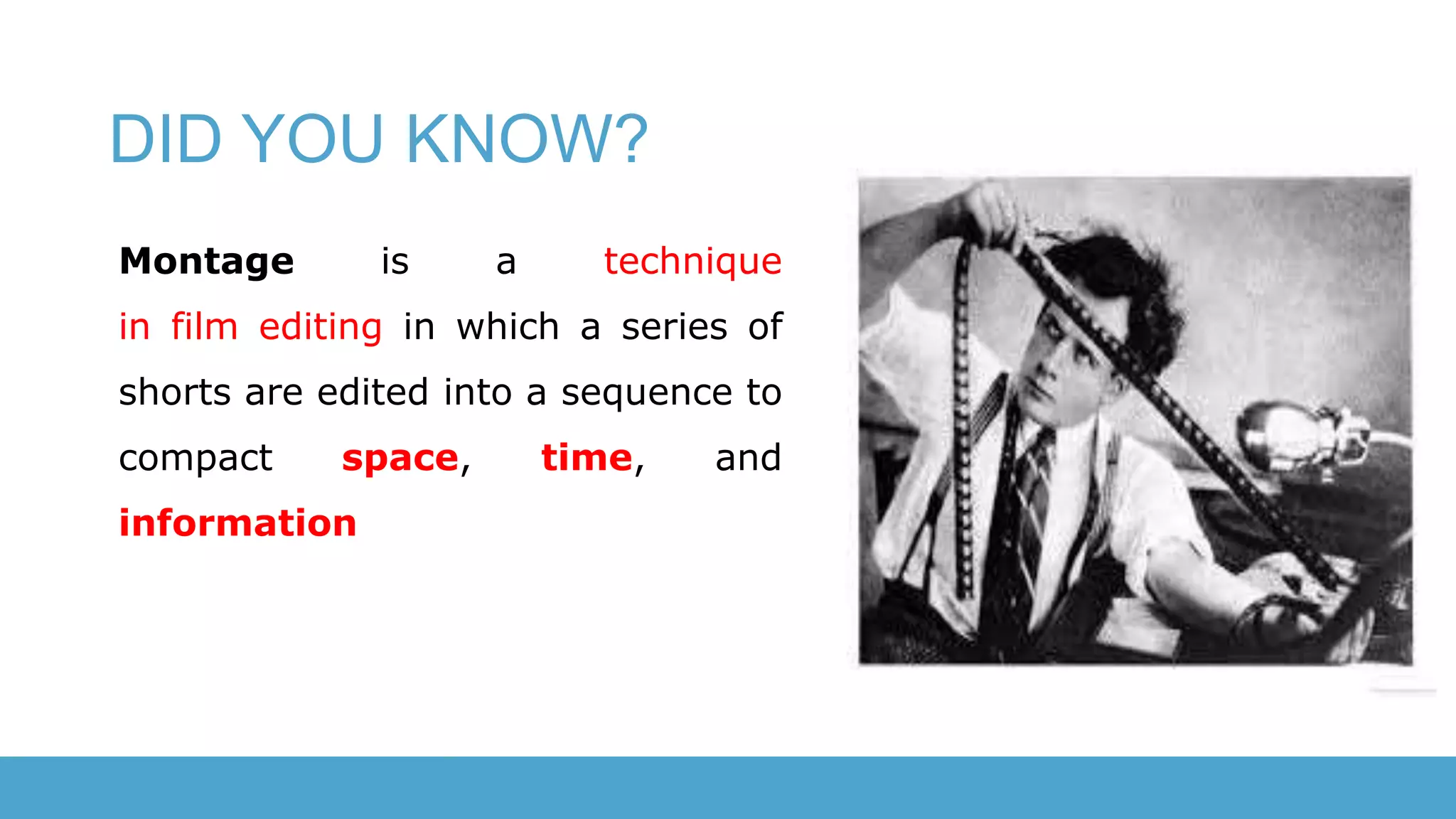
Montage is a technique
in film editing in which a series of
shorts are edited into a sequence to
compact space, time, and
information
DID YOU KNOW?
Visual montage may combine
shots to tell a story chronologically
or may juxtapose images to
produce an impression or to
illustrate an association of ideas
DID YOU KNOW?
Montage may also be applied to the
combination of sounds for artistic
expression. Dialogue, music, and
sound effects may be combined in
complex patterns,
Ex:Alfred Hitchcock’s Blackmail (1929),
DID YOU KNOW?
Montage technique developed early
in cinema, primarily through the work
of the American directors Edwin S.
Porter (1870–1941) and D.W. Griffith
(1875–1948).
What is Soviet Montage?
Soviet
Montage
Standard file format for photographic images
•Just like French Impressionist cinema, Soviet Montage
came from the concept that film theory
•Director Lev Kulshov first conceptualized montage theory
on the basis that one frame may not be enough to convey
an idea or an emotion
•The audience are able to view two separate images and
subconsciously give them a collective context.
Soviet
Montage
Standard file format for photographic images
•Soviet Montage is so intertwined with the history of the
U.S.S.R. and the Russian Revolution
• Soviet Montage is bound to happen when a state
attempts to seize complete control of a nation's entire film
industry
• The use of montage theory is shaped along with The
ways in which communism shaped
Soviet
Montage
Standard file format for photographic images
•Without the historical context it would be hard to
differentiate the desires of the Soviet Union and the
experimental maneuver from the Russian filmmakers
•After the Bolshevik revolution, the People'
Commissariat of Education was established until the
new government could take complete control the film
industry.
•Lenin would finally nationalize the film industry entirely
in 1919
•Causing production companies were dissolved.
SOVIET MONTAGE
• Entire generation of filmmakers disappeared
• The nation's State Film School was founded in the same year,
• Director Lev Kuleshov, invited to create his own workshop
• His task was to train those who the Soviets deemed more
important to the film industry, including filmmakers and actors
alike.
SOVIET MONTAGE
• Under the New Economic Policy, a limited amount of privately
owned production companies were allowed to create films.
•By this time, the government had placed film as a priority
•Lenin famously saying "Of all the arts, for us the cinema is
most important“
what is
Montage
Style?
For Pudovkin, believed that shots were like bricks, to
be joined together to build a sequence.
In the montage movement, usually did not have one
protagonist, they have social groups.
They also did not resort to professional actors in
their films
Soviet filmmakers would usually get normal people to
act, because non-actors have the genuine emotion,
It was called typage.
Soviet
Montage
• The fall of Soviet Montage was due to the Soviet
government itself,
•They did not allowed complicated films and some
filmmakers
•The government introduced a film movement that is based
on reality, Soviet Realism in 1934.
•The movement ended when Vertov released
films Enthusiasm (1931) and Pardovkin's Desserter (1933)
Eisenstein
• Eisenstein was the big theorist of montage
• Worked on how things such as changing the duration of a
shot
• Using movement in the shot, and its emotional content,
would affect audiences.
•The most famous montage sequence of all is the Odessa
Steps scene from Battleship Potemkin, where protesting
citizens are mowed down by Tsarist troops.
•It also uses ‘stretch time’
Vertical Montage
•Another idea of Eisenstein’s is ‘vertical
montage’
• It is about how elements of the images (like how
the shot is composed, and how an actor moves)
work together with the soundtrack.
Dziga Vertov
Dziga Vertov
• His 1929 Man with a Movie Camera is a ‘city symphony’.
• It covers lots of different kinds of events during a ‘day in
the life’ of the city
• Vertov uses parts of objects
close-ups
low and high angle shots
patterns and shapes
• To build up a sense of time and place
• The end of the film is really powerful, with a rapid pileup
of shots
Montage in modern films
• Modern Filmmaker Geoffrey Reggio used a lot
of Vertov’s ideas in 1980s film Koyaanisqatsi (Life
out of Balance)
• Vertov wanted to celebrate the crowd and the
modern city, but Reggio made an environmentalist
diatribe.
•He used time-lapse and slow motion to show
modern life as a nightmare.
•He used ‘intellectual montage’
• Sergio Leone‘s spaghetti Westerns.
• There’s a great three-man showdown
in The Good, The Bad and The Ugly
that uses loads of Soviet montage ideas:
• Alex Cox introduced ‘rhythmic montage’ in his Sci-fi
Repo Man
Soviet Montage
1. Strike (1925), dir. Eisenstein
2. October (1928), dir. Eisenstein
3. Battleship Potemkin (1925), dir. Eisenstein
4. Man with a Movie Camera (1929), dir. Vertov
5. Koyaanisqatsi (1982), dir. Reggio
6. The Good, The Bad and The Ugly (1966), dir. Leone
7. Repo Man (1984), dir. Cox
MUST WATCH
Soviet montage 2019 new

Soviet montage 2019 new

  • 1.
    Meet y o ur E d u c a t o r Dr. J. JANARDHAN Ph.D. (Journalism & Mass Communication) MJMC, FAC (FTII) 10+ Y e a r s E x p e r i e n c e
  • 2.
  • 3.
    DID YOU KNOW? Montageis a technique in film editing in which a series of shorts are edited into a sequence to compact space, time, and information
  • 4.
    DID YOU KNOW? Visualmontage may combine shots to tell a story chronologically or may juxtapose images to produce an impression or to illustrate an association of ideas
  • 5.
    DID YOU KNOW? Montagemay also be applied to the combination of sounds for artistic expression. Dialogue, music, and sound effects may be combined in complex patterns, Ex:Alfred Hitchcock’s Blackmail (1929),
  • 6.
    DID YOU KNOW? Montagetechnique developed early in cinema, primarily through the work of the American directors Edwin S. Porter (1870–1941) and D.W. Griffith (1875–1948).
  • 7.
  • 8.
    Soviet Montage Standard file formatfor photographic images •Just like French Impressionist cinema, Soviet Montage came from the concept that film theory •Director Lev Kulshov first conceptualized montage theory on the basis that one frame may not be enough to convey an idea or an emotion •The audience are able to view two separate images and subconsciously give them a collective context.
  • 9.
    Soviet Montage Standard file formatfor photographic images •Soviet Montage is so intertwined with the history of the U.S.S.R. and the Russian Revolution • Soviet Montage is bound to happen when a state attempts to seize complete control of a nation's entire film industry • The use of montage theory is shaped along with The ways in which communism shaped
  • 10.
    Soviet Montage Standard file formatfor photographic images •Without the historical context it would be hard to differentiate the desires of the Soviet Union and the experimental maneuver from the Russian filmmakers •After the Bolshevik revolution, the People' Commissariat of Education was established until the new government could take complete control the film industry. •Lenin would finally nationalize the film industry entirely in 1919 •Causing production companies were dissolved.
  • 11.
    SOVIET MONTAGE • Entiregeneration of filmmakers disappeared • The nation's State Film School was founded in the same year, • Director Lev Kuleshov, invited to create his own workshop • His task was to train those who the Soviets deemed more important to the film industry, including filmmakers and actors alike.
  • 12.
    SOVIET MONTAGE • Underthe New Economic Policy, a limited amount of privately owned production companies were allowed to create films. •By this time, the government had placed film as a priority •Lenin famously saying "Of all the arts, for us the cinema is most important“
  • 13.
    what is Montage Style? For Pudovkin,believed that shots were like bricks, to be joined together to build a sequence. In the montage movement, usually did not have one protagonist, they have social groups. They also did not resort to professional actors in their films Soviet filmmakers would usually get normal people to act, because non-actors have the genuine emotion, It was called typage.
  • 14.
    Soviet Montage • The fallof Soviet Montage was due to the Soviet government itself, •They did not allowed complicated films and some filmmakers •The government introduced a film movement that is based on reality, Soviet Realism in 1934. •The movement ended when Vertov released films Enthusiasm (1931) and Pardovkin's Desserter (1933)
  • 15.
    Eisenstein • Eisenstein wasthe big theorist of montage • Worked on how things such as changing the duration of a shot • Using movement in the shot, and its emotional content, would affect audiences. •The most famous montage sequence of all is the Odessa Steps scene from Battleship Potemkin, where protesting citizens are mowed down by Tsarist troops. •It also uses ‘stretch time’
  • 16.
    Vertical Montage •Another ideaof Eisenstein’s is ‘vertical montage’ • It is about how elements of the images (like how the shot is composed, and how an actor moves) work together with the soundtrack.
  • 17.
  • 18.
    Dziga Vertov • His1929 Man with a Movie Camera is a ‘city symphony’. • It covers lots of different kinds of events during a ‘day in the life’ of the city • Vertov uses parts of objects close-ups low and high angle shots patterns and shapes • To build up a sense of time and place • The end of the film is really powerful, with a rapid pileup of shots
  • 19.
    Montage in modernfilms • Modern Filmmaker Geoffrey Reggio used a lot of Vertov’s ideas in 1980s film Koyaanisqatsi (Life out of Balance) • Vertov wanted to celebrate the crowd and the modern city, but Reggio made an environmentalist diatribe. •He used time-lapse and slow motion to show modern life as a nightmare. •He used ‘intellectual montage’
  • 20.
    • Sergio Leone‘sspaghetti Westerns. • There’s a great three-man showdown in The Good, The Bad and The Ugly that uses loads of Soviet montage ideas: • Alex Cox introduced ‘rhythmic montage’ in his Sci-fi Repo Man Soviet Montage
  • 21.
    1. Strike (1925),dir. Eisenstein 2. October (1928), dir. Eisenstein 3. Battleship Potemkin (1925), dir. Eisenstein 4. Man with a Movie Camera (1929), dir. Vertov 5. Koyaanisqatsi (1982), dir. Reggio 6. The Good, The Bad and The Ugly (1966), dir. Leone 7. Repo Man (1984), dir. Cox MUST WATCH