Universities in 2020: A technology perspective Virginia  Tech  Task Force January 28, 2011 Lee Rainie: Director, Pew Internet Project Email:  [email_address]
Eli Noam 1995 to AAAS Creation of knowledge and evaluation of its validity Preservation of information Transmission of information to others
Some big questions for universities What’s the franchise? What’s the commodity?  What “business” are we in? Who are our “competitors”? How should knowledge and teaching be organized? How do we foster cross-discipline collaboration?  What teaching is best done in physical space? What can be done virtually?  What are the correct social / pedagogical norms of those spaces? How should intellectual property be handled when “ napsterization ”  looms over every idea? What new knowledge forms and distribution platforms merit attention and reward?
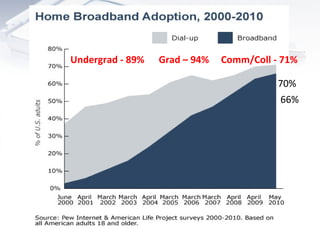
Internet and Broadband Revolution
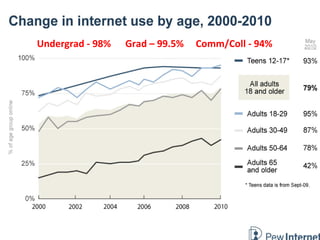
Undergrad - 98%  Grad – 99.5%  Comm/Coll - 94%
70%  66%  Undergrad - 89%  Grad – 94%  Comm/Coll - 71%
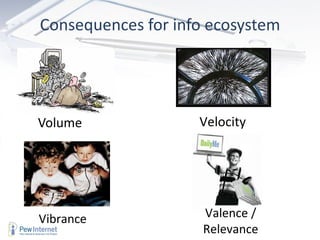
Consequences for info ecosystem Volume Velocity Vibrance Valence / Relevance
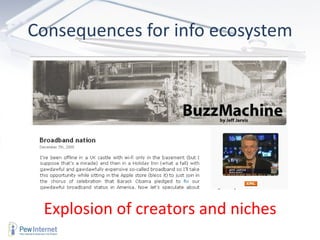
Consequences for info ecosystem Explosion of creators and niches
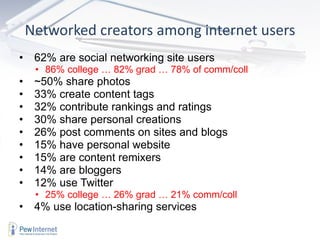
Networked creators among internet users 62% are social networking site users 86% college … 82% grad … 78% of comm/coll ~50% share photos 33% create content tags  32% contribute rankings and ratings 30% share personal creations  26% post comments on sites and blogs 15% have personal website 15% are content remixers  14% are bloggers 12% use Twitter 25% college … 26% grad … 21% comm/coll 4% use location-sharing services
Wireless Connectivity Revolution
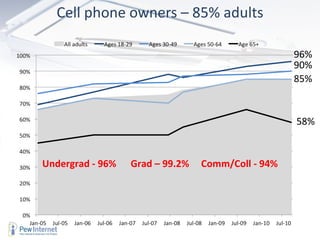
Cell phone owners – 85% adults 96%  90%  85%  58%  Undergrad - 96%  Grad – 99.2%  Comm/Coll - 94%
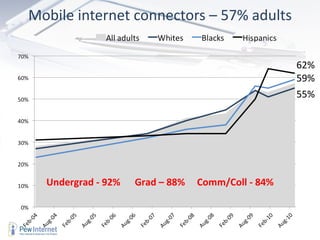
Mobile internet connectors – 57% adults 62%  59%  55%  Undergrad - 92%  Grad – 88%  Comm/Coll - 84%
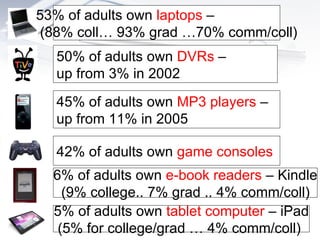
53% of adults own  laptops  –  (88% coll… 93% grad …70% comm/coll) 45% of adults own  MP3 players  –  up from 11% in 2005 50% of adults own  DVRs  –  up from 3% in 2002 42% of adults own  game consoles 6% of adults own  e-book readers  – Kindle (9% college.. 7% grad .. 4% comm/coll) 5% of adults own  tablet computer  – iPad (5% for college/grad … 4% comm/coll)
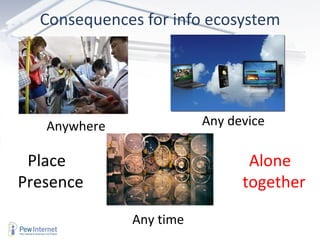
Consequences for info ecosystem Anywhere  Any device Presence  Place Any time  Alone together
Social Networking Revolution
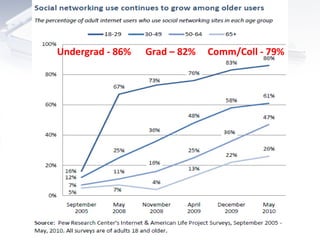
Undergrad - 86%  Grad – 82%  Comm/Coll - 79%
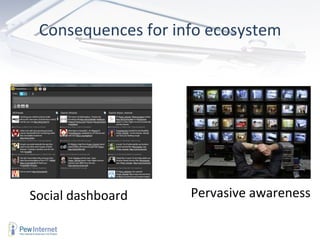
Consequences for info ecosystem Social dashboard Pervasive awareness
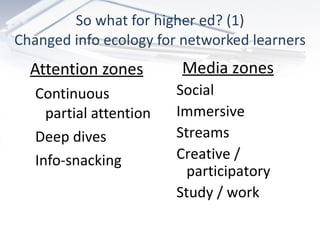
So what for higher ed? (1) Changed info ecology for networked learners Attention zones Continuous partial attention Deep dives Info-snacking Media zones Social Immersive Streams Creative / participatory Study / work
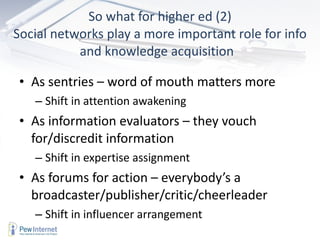
So what for higher ed (2) Social networks play a more important role for info and knowledge acquisition  As sentries – word of mouth matters more Shift in attention awakening As information evaluators – they vouch for/discredit information Shift in expertise assignment As forums for action – everybody’s a broadcaster/publisher/critic/cheerleader Shift in influencer arrangement
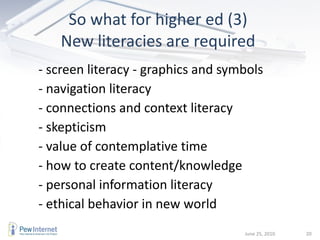
So what for higher ed (3)  New literacies are required  - screen literacy - graphics and symbols - navigation literacy - connections and context literacy - skepticism - value of contemplative time - how to create content/knowledge - personal information literacy - ethical behavior in new world June 25, 2010
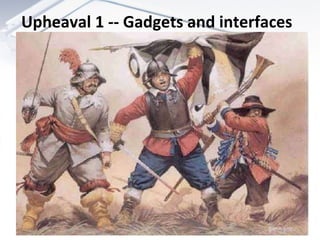
Upheaval 1 -- Gadgets and interfaces
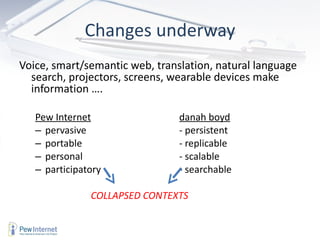
Changes underway Voice, smart/semantic web, translation, natural language search, projectors, screens, wearable devices make information …. Pew Internet danah boyd pervasive - persistent portable - replicable personal - scalable participatory - searchable     COLLAPSED CONTEXTS
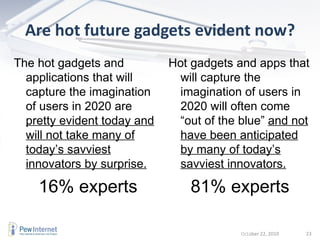
Are hot future gadgets evident now? October 22, 2010 July 9, 2010 Hot gadgets and apps that will capture the imagination of users in 2020 will often come “out of the blue”  and not have been anticipated by many of today’s savviest innovators.   81% experts The hot gadgets and applications that will capture the imagination of users in 2020 are  pretty evident today and will not take many of today’s savviest innovators by surprise. 16% experts
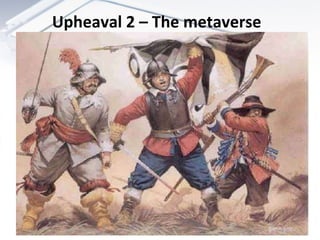
Upheaval 2 – The metaverse
The virtual world merges with real world Metaverse Roadmap: The internet of things enhances the internet of people Augmented reality Mirror worlds Life logging  Virtual worlds
Upheaval 3 – The exaflood
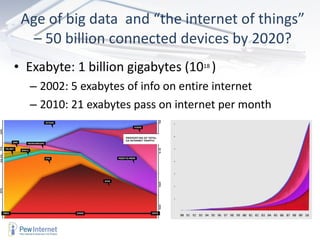
Age of big data  and “the internet of things” – 50 billion connected devices by 2020? Exabyte: 1 billion gigabytes (10 18   ) 2002: 5 exabytes of info on entire internet 2010: 21 exabytes pass on internet per month
Networked learners of the future More self directed and less dependent on top-down instructions Better arrayed to capture new information inputs More reliant on feedback and response More attuned to group outreach and group knowledge More open to cross discipline insights, creating their own “tagged” taxonomies More oriented towards people being their own individual nodes of production
Implications for higher ed Constant connectivity changes social patterns and info flows: real-time info/analytics become powerful Knowledge and tribal niches proliferate even more Credentialing and validation of knowledge is expanded New “market players” enter the space – commercial, open source
Thank you! Lee Rainie Director – Pew Internet Project [email_address] Twitter - @lrainie 202-419-4500

Universities in 2020: A Technology Perspective by Lee Rainie

  • 1.
    Universities in 2020:A technology perspective Virginia Tech Task Force January 28, 2011 Lee Rainie: Director, Pew Internet Project Email: [email_address]
  • 2.
    Eli Noam 1995to AAAS Creation of knowledge and evaluation of its validity Preservation of information Transmission of information to others
  • 3.
    Some big questionsfor universities What’s the franchise? What’s the commodity? What “business” are we in? Who are our “competitors”? How should knowledge and teaching be organized? How do we foster cross-discipline collaboration? What teaching is best done in physical space? What can be done virtually? What are the correct social / pedagogical norms of those spaces? How should intellectual property be handled when “ napsterization ” looms over every idea? What new knowledge forms and distribution platforms merit attention and reward?
  • 4.
  • 5.
    Undergrad - 98% Grad – 99.5% Comm/Coll - 94%
  • 6.
    70% 66% Undergrad - 89% Grad – 94% Comm/Coll - 71%
  • 7.
    Consequences for infoecosystem Volume Velocity Vibrance Valence / Relevance
  • 8.
    Consequences for infoecosystem Explosion of creators and niches
  • 9.
    Networked creators amonginternet users 62% are social networking site users 86% college … 82% grad … 78% of comm/coll ~50% share photos 33% create content tags 32% contribute rankings and ratings 30% share personal creations 26% post comments on sites and blogs 15% have personal website 15% are content remixers 14% are bloggers 12% use Twitter 25% college … 26% grad … 21% comm/coll 4% use location-sharing services
  • 10.
  • 11.
    Cell phone owners– 85% adults 96% 90% 85% 58% Undergrad - 96% Grad – 99.2% Comm/Coll - 94%
  • 12.
    Mobile internet connectors– 57% adults 62% 59% 55% Undergrad - 92% Grad – 88% Comm/Coll - 84%
  • 13.
    53% of adultsown laptops – (88% coll… 93% grad …70% comm/coll) 45% of adults own MP3 players – up from 11% in 2005 50% of adults own DVRs – up from 3% in 2002 42% of adults own game consoles 6% of adults own e-book readers – Kindle (9% college.. 7% grad .. 4% comm/coll) 5% of adults own tablet computer – iPad (5% for college/grad … 4% comm/coll)
  • 14.
    Consequences for infoecosystem Anywhere Any device Presence Place Any time Alone together
  • 15.
  • 16.
    Undergrad - 86% Grad – 82% Comm/Coll - 79%
  • 17.
    Consequences for infoecosystem Social dashboard Pervasive awareness
  • 18.
    So what forhigher ed? (1) Changed info ecology for networked learners Attention zones Continuous partial attention Deep dives Info-snacking Media zones Social Immersive Streams Creative / participatory Study / work
  • 19.
    So what forhigher ed (2) Social networks play a more important role for info and knowledge acquisition As sentries – word of mouth matters more Shift in attention awakening As information evaluators – they vouch for/discredit information Shift in expertise assignment As forums for action – everybody’s a broadcaster/publisher/critic/cheerleader Shift in influencer arrangement
  • 20.
    So what forhigher ed (3) New literacies are required - screen literacy - graphics and symbols - navigation literacy - connections and context literacy - skepticism - value of contemplative time - how to create content/knowledge - personal information literacy - ethical behavior in new world June 25, 2010
  • 21.
    Upheaval 1 --Gadgets and interfaces
  • 22.
    Changes underway Voice,smart/semantic web, translation, natural language search, projectors, screens, wearable devices make information …. Pew Internet danah boyd pervasive - persistent portable - replicable personal - scalable participatory - searchable COLLAPSED CONTEXTS
  • 23.
    Are hot futuregadgets evident now? October 22, 2010 July 9, 2010 Hot gadgets and apps that will capture the imagination of users in 2020 will often come “out of the blue” and not have been anticipated by many of today’s savviest innovators. 81% experts The hot gadgets and applications that will capture the imagination of users in 2020 are pretty evident today and will not take many of today’s savviest innovators by surprise. 16% experts
  • 24.
    Upheaval 2 –The metaverse
  • 25.
    The virtual worldmerges with real world Metaverse Roadmap: The internet of things enhances the internet of people Augmented reality Mirror worlds Life logging Virtual worlds
  • 26.
    Upheaval 3 –The exaflood
  • 27.
    Age of bigdata and “the internet of things” – 50 billion connected devices by 2020? Exabyte: 1 billion gigabytes (10 18 ) 2002: 5 exabytes of info on entire internet 2010: 21 exabytes pass on internet per month
  • 28.
    Networked learners ofthe future More self directed and less dependent on top-down instructions Better arrayed to capture new information inputs More reliant on feedback and response More attuned to group outreach and group knowledge More open to cross discipline insights, creating their own “tagged” taxonomies More oriented towards people being their own individual nodes of production
  • 29.
    Implications for highered Constant connectivity changes social patterns and info flows: real-time info/analytics become powerful Knowledge and tribal niches proliferate even more Credentialing and validation of knowledge is expanded New “market players” enter the space – commercial, open source
  • 30.
    Thank you! LeeRainie Director – Pew Internet Project [email_address] Twitter - @lrainie 202-419-4500

Editor's Notes

  • #7 Rise of broadband at home was transformative – internet becomes a central info and communications hub in the home after the switch from dial-up. People do more stuff online; privilege the internet over other info sources in many cases; report better outcomes from internet use, and, most importantly become content creators. Two thirds of adults and 80% of teens are content creators. This is the big change the internet has introduced to media landscape. Probably take a minute to say this.
  • #8 The info ecology changes thanks to rise of internet/broadband. Volume of information rises 20-30% per year. Never had anything close to this in human history. Velocity of information increases, especially in groups. Personally relevant news speeds up as people customize personal feeds, alerts, listservs, group communications. Vibrance of information/media increases as bandwidth increases and computing power grows so media experiences become more immersive and compelling Valence/relevance of information grows in the era of the “Daily Me” and “Daily Us” and custom feeds. 2 mins
  • #9 Perhaps biggest change in info ecology is the democratization of media – and proliferation of niches. The Long Tail becomes reality for media and brands.
  • #10 This is the way Pew Internet measures content creation….
  • #12 Quick rundown of growth of cell ownership – 30 seconds
  • #13 Rundown of mobile connectivity Cell phones – 39% of cell owners Laptops – 87% of laptop owners Overall that adds up to 57% of adults
  • #15 The change wrought by mobile is that people are perpetually connected and pervasively available. It means that media and people are available anywhere with any device on any of three screens. Quick tout of Nielsen 3-Screen research (unless you want to do that) and how this shifts the venues and times of people’s encounters with media. Consumers run the playlist now, not the media companies. This changes people’s sense of place (and placelessness) and present. They can be with any one at any time and this creates the reality of “absent presence”.
  • #17 Quick rundown of our data on rise of social networking. This amplifies long term trends dating to 20 th century in technology, new social roles, workforce structure, politics and culture. Right now, 48% of American adults use social networking sites and fastest growth is taking place in the 50+ age cohort
  • #19 Most importantly, mobile connectivity changes people’s sense of time and their allocation of attention to media. They can exist in three separate zones of attention depending on their circumstances, frame of mind, and needs. Continuous partial attention / multitasking – perpetually interruptable and interrupting Deep dives – the rise of amateur experts who can find out anything about subjects that matter to them. The special case is health research. Info-snacking – this is particularly enabled by mobile because it allows people to get little info-hits when they are in transactional situations or when they have “micro-boredom” to kill Mobile also adds to the number of media zones that people can inhabit, again, reflecting their circumstances, frame of mind, and needs Social zone – what are my friends doing; telling them what I’m doing: highly interactive and involves disclosure of interests of the moment – direct cues about where attention and intentions are focused – people take direction from the people in their social networks about what to examine Immersive zone – 1) gaming and 2) couch potato space – less interruptable and less interested in being interrupted, more attentive to media and more disrupted (unhappily) by interventions Streams – this is the zone people are in when they want to “catch up” with news or developments. Similar to the social zone, but more open to media inputs from organizations …. Checking for “headlines” of all kinds …. Less annoyed at relevant commercial information – indeed “networked information” is a hallmark of this zone Creative / participatory zone – this is the place where people create content to share online…. They comment on / rank /rate the media they’ve experienced; they remix it at times. Commercial messaging is part of the play and participation environment. This is “conversational” space for commercial messaging and there are opportunities and dangers. This is where the most engaged customers are: they can be evangelists OR provocateurs, depending on their mood and the way they encounter brands.
  • #20 In the challenging new media ecosystem – as more information comes at them from more sources at ever-greater speeds – people cope with the change by relying more and more on their social networks. There are three important ways they do that. The first is that they rely on their networks to act as their “alert” system – sentries. We hear from more and more people who begin and end their days by checking in with their social networks to see what’s new, what’s worth viewing, what’s most enjoyable in media spaces.
  • #22 Cromwell’s soldiers http://www.doyle.com.au/history_pt3.htm
  • #25 Cromwell’s soldiers http://www.doyle.com.au/history_pt3.htm
  • #27 Cromwell’s soldiers http://www.doyle.com.au/history_pt3.htm