Acute Respiratory Distress Syndrome
Dr imran Gafoor
Critical care medicine
Ramkrishna care hospital,Raipur
2019
ARDS
Objectives
Updated definition of ARDS
Briefly review Pathophysiology and Pathogenesis
Etiology/Risk factors
Clinical Presentation
Diagnosis, Differential Diagnosis
Management
ARDS is a syndrome rather than
disease
there is no disease modifying drug
therapy for ARDS
NEJM 2017
ARDS
Pathophysiology
 Acute inflammation affecting alvelo capillary membrane
causing high permeability pulmonary edema
ARDS
Pathological Stages
Initial "exudative" stage-diffuse alveolar damage
within the first week
“Proliferative" stage-resolution of pulmonary
edema, proliferation of type II alveolar cells,
squamous metaplasia, interstitial infiltration by
myofibroblasts, and early deposition of collagen.
Some patients progress to a third "fibrotic" stage,
characterized by obliteration of normal lung
architecture, diffuse fibrosis, and cyst formation
Risk Factors
Sepsis
Severe trauma
Surface burns
Multiple blood
transfusions
Drug overdose
Following bone marrow
transplantation
Multiple fractures
Aspiration
Pneumonia
Pulmonary contusion
Pulmonary embolism
Inhalational injury
Near drowning
ARDS
Clinical Presentation
Dyspnea, Tachypnea
Persistent hypoxemia, despite the
administration of high concentrations of
inspired oxygen
Increase in the shunt fraction
Decrease in pulmonary compliance
Increase in the dead space ventilation
Management of ARDS
Basic Management Strategies for Patients
with ALI/ARDS
 Identify and treat underlying causes
 Ventilatory support
 Lung protective ventilatory support strategy
 Application of PEEP
 Restore and maintain hemodynamic function
 Conservative fluid replacement strategy
 Vasopressors and inotropics support
 Prevent complications of critical illness
 Ensure adequate nutrition
 Avoid oversedation
 Using weaning protocol with spontaneous breathing trials
 Continous use of steroids for fibroproliferative phase ?
questionable
Fluid management and vasoactive
support
SAFE trial
Resuscitation with saline is as beneficial as
resuscitation with albumin in critically ill
patients with shock
FACTT trial
 Prospective, Randomized, Multi-Center Trial
Utility and safety of using a pulmonary artery
catheter versus central venous catheter to guide
the volume replacement
Liberal versus conservative fluid replacement
ARDS
FACTT
The Use of Conservative fluid management
strategy was associated with
Significant improvement in oxygenation
index
 Significant improvement in Lung Injury
score
 increase in the number of ventilator- free
days
ARDS
Mechanical Ventilation
Ventilator associated lung injury
Volutrauma
Atelectotrauma
Biotrauma
Barotrauma
Air embolism/translocation
NHLBI ARDS Network
Compared low tidal volumes (6ml/kg of
ideal body weight ) against conventional
tidal volumes (12ml/kg ideal body weight )
Significant decrease in mortality
associated with the use of low tidal
volumes (39.8% versus 31%, P= 0.007)
NHLBI ARDS Network
Improved Survival with Low VT
ARDS
High versus Low PEEP
Higher PEEP along with low tidal volume
ventilation should be considered for
patients receiving mechanical ventilation for
ARDS. This suggestion is based on a
2010 meta-analysis of 3 randomized trials
(n=2,229) testing higher vs. lower PEEP in
patients with acute lung injury or ARDS, in which
ARDS patients receiving higher PEEP had a
strong trend toward improved survival.
ARDS
Mechanical Ventilation
ARDS
Mechanical Ventilation
ARDS
Mechanical Ventilation
 Neuromuscular blockers in early acute
respiratory distress syndrome.  
                                 N Engl J Med, 2010;363:1107-16.
 This multicenter RCT of 340 patients with severe ARDS
found early use of 48 hours of neuromuscular blockade
reduced mortality compared to placebo (NNT of 11 to
prevent one death at 90 days in all patients, and a NNT of
7 in a prespecified analysis of patients with a PaO2:FiO2
less than 120).
Basic management Strategies for patients
with ALI/ARDS
 Identify and treat underlying causes
 Ventilatory support
 Lung protective ventilatory support strategy
 Application of PEEP
 Restore and maintain hemodynamic function
 Conservative fluid replacement strategy
 Vasopressors and inotropics support
 Prevent complications of critical illness
 Ensure adequate nutrition
 Avoid oversedation
 Using weaning protocol with spontaneous breathing trials
 Continous use of steroids for fibroproliferative phase,?
questionable
ARDS
Inhaled NO
Steroids
Prone Position
High Frequency Oscillatory
Ventilation
ECMO
Inhaled Nitric Oxide
It is a bronchial and vascular smooth muscle
dilator
Decreases the Platelets Adherence and
Aggregation
Improves Ventilation –Perfusion ratio
Reduction in Pulmonary Artery Pressure and
pulmonary Vascular Resistance
Inhaled Nitric Oxide
Two Prospective, Randomized, Placebo
Controlled Clinical Trials failed to
demonstrate an improvement in the
survival.
However, there was improvement in the
oxygenation…
ARDS
Steroid
 A protocol for steroids in late ARDS, based on the Meduri
paper*
 The patient must have no demonstrable infection
 broncho-alveolar lavage may be necessary to confirm this. This
includes undrained abscesses, disseminated fungal infection and
septic shock
 Steroids should not be started less than 7 days, or more than
28 days, from admission
 The patient should not have a history of gastric ulceration of
active gastrointestinal bleeding
 Patients with burns requiring skin grafting, pregnant patients,
AIDS, and those in whom life support is expected to be
withdrawn, are unsuitable
*Meduri GU, Kohler G, Headley S, Tolley E, Stentz F, Postlethwaite A. Inflammatory cytokines in the BAL of patients
with ARDS. Persistent elevation over time predicts poor outcome. Chest 1995; 108(5):1303-1314.(2) Meduri GU,
Headley AS, Golden E, Carson SJ, Umberger RA, Kelso T et al. Effect of prolonged methylprednisolone therapy in
unresolving acute respiratory distress syndrome: a randomized controlled trial. JAMA 1998; 280(2):159-165.
ARDS
Steroids
The patient should have evidence of ARDS and
require an FiO2 >/= 50%
The steroid regimen:
 Loading dose 2mg/kg
 Then 2mg/kg/day from day 1 to 14
 Then 1mg/kg/day from day 15 to 21
 Then 0.5mg/kg/day from day 22 to 28
 Then 0.25mg/kg/day on days 29 and 30
 Finally 0.125mg/kg on days 31 and 32.
Prone Positioning advantages :
Relieves the cardiac and abdominal
compression exerted on the lower lobes
Makes regional Ventilation/Perfusion ratios
and chest elastance more uniform
Increases end expiratory lung volume
↓ VILI
Facilitates drainage of secretions
Conclusions
• In patients with severe ARDS, early application of prolonged prone-
positioning sessions significantly decreased 28-day and 90-day
mortality.
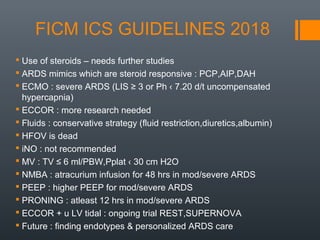
FICM ICS GUIDELINES 2018
 Use of steroids – needs further studies
 ARDS mimics which are steroid responsive : PCP,AIP,DAH
 ECMO : severe ARDS (LIS ≥ 3 or Ph ‹ 7.20 d/t uncompensated
hypercapnia)
 ECCOR : more research needed
 Fluids : conservative strategy (fluid restriction,diuretics,albumin)
 HFOV is dead
 iNO : not recommended
 MV : TV ≤ 6 ml/PBW,Pplat ‹ 30 cm H2O
 NMBA : atracurium infusion for 48 hrs in mod/severe ARDS
 PEEP : higher PEEP for mod/severe ARDS
 PRONING : atleast 12 hrs in mod/severe ARDS
 ECCOR + u LV tidal : ongoing trial REST,SUPERNOVA
 Future : finding endotypes & personalized ARDS care
 Survivors commonly suffer from muscle weakness &
neuropychiatric illness ( not chronic respi insufficiency)
NEJM 2003

Ards

  • 1.
    Acute Respiratory DistressSyndrome Dr imran Gafoor Critical care medicine Ramkrishna care hospital,Raipur 2019
  • 2.
    ARDS Objectives Updated definition ofARDS Briefly review Pathophysiology and Pathogenesis Etiology/Risk factors Clinical Presentation Diagnosis, Differential Diagnosis Management
  • 3.
    ARDS is asyndrome rather than disease there is no disease modifying drug therapy for ARDS
  • 4.
  • 5.
    ARDS Pathophysiology  Acute inflammationaffecting alvelo capillary membrane causing high permeability pulmonary edema
  • 6.
    ARDS Pathological Stages Initial "exudative"stage-diffuse alveolar damage within the first week “Proliferative" stage-resolution of pulmonary edema, proliferation of type II alveolar cells, squamous metaplasia, interstitial infiltration by myofibroblasts, and early deposition of collagen. Some patients progress to a third "fibrotic" stage, characterized by obliteration of normal lung architecture, diffuse fibrosis, and cyst formation
  • 7.
    Risk Factors Sepsis Severe trauma Surfaceburns Multiple blood transfusions Drug overdose Following bone marrow transplantation Multiple fractures Aspiration Pneumonia Pulmonary contusion Pulmonary embolism Inhalational injury Near drowning
  • 8.
    ARDS Clinical Presentation Dyspnea, Tachypnea Persistenthypoxemia, despite the administration of high concentrations of inspired oxygen Increase in the shunt fraction Decrease in pulmonary compliance Increase in the dead space ventilation
  • 9.
  • 10.
    Basic Management Strategiesfor Patients with ALI/ARDS  Identify and treat underlying causes  Ventilatory support  Lung protective ventilatory support strategy  Application of PEEP  Restore and maintain hemodynamic function  Conservative fluid replacement strategy  Vasopressors and inotropics support  Prevent complications of critical illness  Ensure adequate nutrition  Avoid oversedation  Using weaning protocol with spontaneous breathing trials  Continous use of steroids for fibroproliferative phase ? questionable
  • 11.
    Fluid management andvasoactive support SAFE trial Resuscitation with saline is as beneficial as resuscitation with albumin in critically ill patients with shock FACTT trial  Prospective, Randomized, Multi-Center Trial Utility and safety of using a pulmonary artery catheter versus central venous catheter to guide the volume replacement Liberal versus conservative fluid replacement
  • 12.
    ARDS FACTT The Use ofConservative fluid management strategy was associated with Significant improvement in oxygenation index  Significant improvement in Lung Injury score  increase in the number of ventilator- free days
  • 13.
    ARDS Mechanical Ventilation Ventilator associatedlung injury Volutrauma Atelectotrauma Biotrauma Barotrauma Air embolism/translocation
  • 14.
    NHLBI ARDS Network Comparedlow tidal volumes (6ml/kg of ideal body weight ) against conventional tidal volumes (12ml/kg ideal body weight ) Significant decrease in mortality associated with the use of low tidal volumes (39.8% versus 31%, P= 0.007)
  • 15.
    NHLBI ARDS Network ImprovedSurvival with Low VT
  • 16.
    ARDS High versus LowPEEP Higher PEEP along with low tidal volume ventilation should be considered for patients receiving mechanical ventilation for ARDS. This suggestion is based on a 2010 meta-analysis of 3 randomized trials (n=2,229) testing higher vs. lower PEEP in patients with acute lung injury or ARDS, in which ARDS patients receiving higher PEEP had a strong trend toward improved survival.
  • 17.
  • 18.
  • 19.
    ARDS Mechanical Ventilation  Neuromuscularblockers in early acute respiratory distress syndrome.                                    N Engl J Med, 2010;363:1107-16.  This multicenter RCT of 340 patients with severe ARDS found early use of 48 hours of neuromuscular blockade reduced mortality compared to placebo (NNT of 11 to prevent one death at 90 days in all patients, and a NNT of 7 in a prespecified analysis of patients with a PaO2:FiO2 less than 120).
  • 20.
    Basic management Strategiesfor patients with ALI/ARDS  Identify and treat underlying causes  Ventilatory support  Lung protective ventilatory support strategy  Application of PEEP  Restore and maintain hemodynamic function  Conservative fluid replacement strategy  Vasopressors and inotropics support  Prevent complications of critical illness  Ensure adequate nutrition  Avoid oversedation  Using weaning protocol with spontaneous breathing trials  Continous use of steroids for fibroproliferative phase,? questionable
  • 21.
    ARDS Inhaled NO Steroids Prone Position HighFrequency Oscillatory Ventilation ECMO
  • 22.
    Inhaled Nitric Oxide Itis a bronchial and vascular smooth muscle dilator Decreases the Platelets Adherence and Aggregation Improves Ventilation –Perfusion ratio Reduction in Pulmonary Artery Pressure and pulmonary Vascular Resistance
  • 23.
    Inhaled Nitric Oxide TwoProspective, Randomized, Placebo Controlled Clinical Trials failed to demonstrate an improvement in the survival. However, there was improvement in the oxygenation…
  • 25.
    ARDS Steroid  A protocolfor steroids in late ARDS, based on the Meduri paper*  The patient must have no demonstrable infection  broncho-alveolar lavage may be necessary to confirm this. This includes undrained abscesses, disseminated fungal infection and septic shock  Steroids should not be started less than 7 days, or more than 28 days, from admission  The patient should not have a history of gastric ulceration of active gastrointestinal bleeding  Patients with burns requiring skin grafting, pregnant patients, AIDS, and those in whom life support is expected to be withdrawn, are unsuitable *Meduri GU, Kohler G, Headley S, Tolley E, Stentz F, Postlethwaite A. Inflammatory cytokines in the BAL of patients with ARDS. Persistent elevation over time predicts poor outcome. Chest 1995; 108(5):1303-1314.(2) Meduri GU, Headley AS, Golden E, Carson SJ, Umberger RA, Kelso T et al. Effect of prolonged methylprednisolone therapy in unresolving acute respiratory distress syndrome: a randomized controlled trial. JAMA 1998; 280(2):159-165.
  • 26.
    ARDS Steroids The patient shouldhave evidence of ARDS and require an FiO2 >/= 50% The steroid regimen:  Loading dose 2mg/kg  Then 2mg/kg/day from day 1 to 14  Then 1mg/kg/day from day 15 to 21  Then 0.5mg/kg/day from day 22 to 28  Then 0.25mg/kg/day on days 29 and 30  Finally 0.125mg/kg on days 31 and 32.
  • 27.
    Prone Positioning advantages: Relieves the cardiac and abdominal compression exerted on the lower lobes Makes regional Ventilation/Perfusion ratios and chest elastance more uniform Increases end expiratory lung volume ↓ VILI Facilitates drainage of secretions
  • 29.
    Conclusions • In patientswith severe ARDS, early application of prolonged prone- positioning sessions significantly decreased 28-day and 90-day mortality.
  • 30.
    FICM ICS GUIDELINES2018  Use of steroids – needs further studies  ARDS mimics which are steroid responsive : PCP,AIP,DAH  ECMO : severe ARDS (LIS ≥ 3 or Ph ‹ 7.20 d/t uncompensated hypercapnia)  ECCOR : more research needed  Fluids : conservative strategy (fluid restriction,diuretics,albumin)  HFOV is dead  iNO : not recommended  MV : TV ≤ 6 ml/PBW,Pplat ‹ 30 cm H2O  NMBA : atracurium infusion for 48 hrs in mod/severe ARDS  PEEP : higher PEEP for mod/severe ARDS  PRONING : atleast 12 hrs in mod/severe ARDS  ECCOR + u LV tidal : ongoing trial REST,SUPERNOVA  Future : finding endotypes & personalized ARDS care
  • 31.
     Survivors commonlysuffer from muscle weakness & neuropychiatric illness ( not chronic respi insufficiency) NEJM 2003