ACUTE RESPIRATORY DISTRESS SYNDROME (ARDS) Timothy G. Janz, MD Department of Emergency Medicine Pulmonary/Critical Care Division Department of Internal Medicine
ARDS Definitions Acute Lung Injury 150 – 200 mmHg < PaO 2 /FIO 2  < 250 – 300 mmHg ARDS PaO 2 /FIO 2  < 150 – 200 mmHg
ARDS Epidemiology Incidence: 5 – 71 per 100,000 Financial cost: $5,000,000,000 per annum
ARDS Pathophysiology Profound inflammatory response Diffuse alveolar damage acute exudative phase (1-7days) proliferative phase (3-10 days) chronic/fibrotic phase (> 1-2 weeks)
ARDS  Acute Exudative Phase Basement membrane disruption Type I pneumocytes destroyed Type II pneumocytes preserved Surfactant deficiency inhibited by fibrin decreased type II production  Microatelectasis/alveolar collapse
ARDS  Acute Exudative Phase
ARDS Proliferative Phase Type II pneumocyte proliferate differentiate into Type I cells reline alveolar walls Fibroblast proliferation interstitial/alveolar fibrosis
ARDS Proliferative Phase
ARDS Fibrotic Phase Characterized by: local fibrosis vascular obliteration Repair process: resolution vs fibrosis
ARDS Pathophysiology Interstitial/alveolar edema Severe hypoxemia due to intra-pulmonary shunt (V/Q = 0) shunt ~ 25% - 50% Increased airway resistance
ARDS Pathophysiology High ventilatory demands high metabolic state increased V D /V T decreased lung compliance Pulmonary HTN neurohumoral factors, hypoxia, edema
ARDS Etiology
ARDS Etiology Hospital-acquired infection/sepsis massive blood transfusions gastric aspiration Community-acquired trauma pneumonia drugs/aspiration/inhalations
ARDS Clinical Phases I. Injury Phase II. Latent/Lag Phase III. ARF Phase IV. Recuperative/Terminal Phase
ARDS Clinical Features Acute dyspnea/tachypnea rales/rhonchi/wheezing Resistant hypoxemia PaO 2 /FIO 2  < 150 – 200 mmHg CXR diffuse, bilateral infiltrates No evidence of LV failure (PAWP  <  18 mmHg)
ARDS Clinical Features: CXR
ARDS Differential Diagnosis CARDIOGENIC PULMONARY EDEMA Bronchopneumonia Hypersensitivity pneumonitis Pulmonary hemorrhage Acute interstitial pneumonia  (Hamman-Rich Syndrome)
ARDS Diagnosis Resistant hypoxemia PaO 2 /FIO 2  < 150 – 200 mmHg CXR diffuse, bilateral infiltrates No evidence of LV failure (PAWP  <  18 mmHg)
ARDS Diagnosis
ARDS Diagnosis Based on clinical criteria no diagnostic tests Confirmatory tests: PA catheter PAWP = normal/reduced [bronchial secretion protein]:[serum protein]  ratio > 70% - 80%
ARDS Treatment: Standard Rx underlying cause Adequate oxygenation/ventilation PaO 2  > 60 mmHg; SaO 2  > 90% PEEP usually needed to meet O 2  goals Prevents/corrects alveolar collapse converts:  (V/Q = 0) to V/Q mismatch
ARDS “Open-Lung “ Approach to PEEP Amato ,  Am J Respir Crit Care Med  1995; 152:1835
ARDS Treatment: PEEP “Open-lung” approach Not practical Does not improve outcomes Optimal PEEP ??? Most cases: PEEP ~ 15 – 20 cmH 2 O
ARDS Optimal PEEP Maximize lung compliance Crs = Vt/(P plateau  – PEEP) Maximize O 2  delivery DO 2  = 10 x CO x (1.34 x Hgb x SaO 2 ) Lowest PEEP to oxygenate @ FIO 2   <  .60 Empiric approach: PEEP = 16 cmH 2 O and Vt = 6 ml/kg
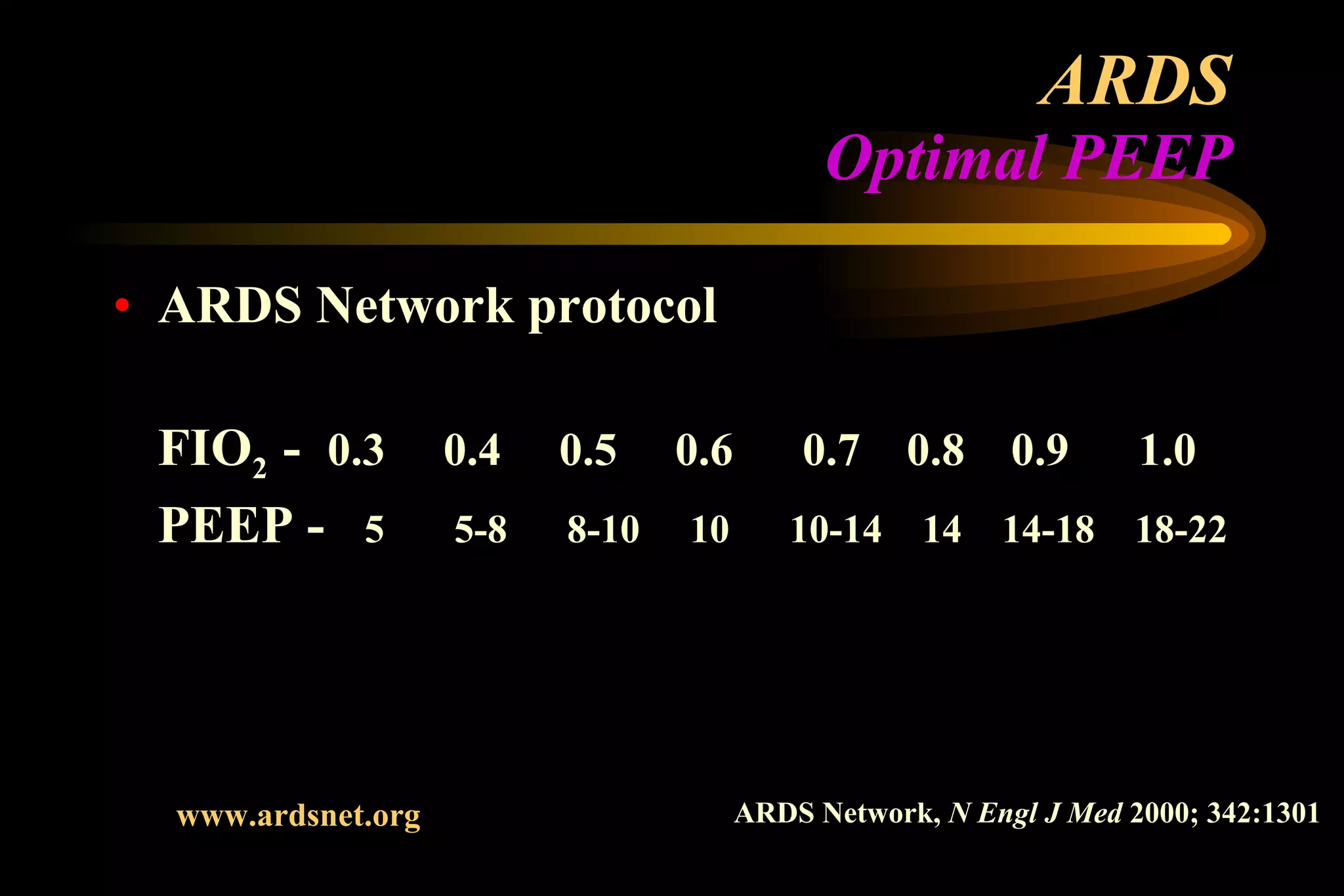
ARDS Optimal PEEP ARDS Network protocol FIO 2  -  0.3  0.4  0.5  0.6  0.7  0.8  0.9  1.0 PEEP -  5  5-8  8-10  10  10-14  14  14-18  18-22 ARDS Network,  N Engl J Med  2000; 342:1301 www.ardsnet.org
ARDS Ventilator-Induced Lung Injury
ARDS Treatment:Lung-Protective Ventilation ARDS Network,  N Engl J Med  2000; 342:1301 ardsnet.org
ARDS Treatment: Lung-Protective Ventilation V T  = 6 mL/kg Limit plateau pressures  <  30 cmH 2 O Volume controlled ventilation  Limit peak airway pressures  <  40 cmH 2 O Pressure controlled ventilation
ARDS Treatment: Lung-Protective Ventilation V T  = 6 mL/kg Limit peak airway pressures  <  40 cmH 2 O Limit plateau pressures  <  30 cmH 2 O
ARDS Treatment: Lung-Protective Ventilation Complications: (derecruitement)  Elevated PaCO 2 Limit: pH  >  7.20 –7.25 Worsening hypoxemia Correction:  Recruitement maneuver  increasing PEEP
ARDS Treatment: Mechanical Ventilation (MV) Pressure controlled ventilation Controlled airway pressures Controlled inspiratory times Patient comfort Effectiveness: PCV = VCV
ARDS Treatment:  Alternate Modes of MV Inverse-ratio ventilation Airway pressure-release ventilation Bilevel airway pressure ventilation Proportional-assist ventilation High-frequency ventilation ECMO Tracheal gas insufflation
ARDS Treatment: Prone Positioning Chatte,  Am J Respir Crit Care Med 1997; 25:1539
ARDS Treatment: Prone Positioning
ARDS Treatment: Prone Positioning 65% responders Multiple proposed mechanisms Improved oxygenation Difficult to implement  No improvement in outcomes
ARDS Treatment: Partial Liquid Ventilation Lungs filled to FRC with perflubron 17 times more O 2  dissolved than water Low surface tension Gravitates to dependent areas of lungs Nontoxic Minimally absorbed Eliminated by evaporation
ARDS Treatment: Partial Liquid Ventilation Used as lavage + conventional MV Multiple proposed mechanisms Improves oxygenation No improvement in outcomes
ARDS Treatment: Vasodilators Gerlach,  Eur J Clin Invest  1993; 23:499
ARDS Treatment: Vasodilators NO has 83% response rate Problems: Special equipment Rebound phenomenon  No improvements in outcomes Prostacyclin may be better agent
ARDS Treatment: Other Modalities Antiinflammatory agents Steroids may have a role Antioxidants Surfactant replacement Increased alveolar fluid removal Effect sodium channels Activate Na + -K + -ATPase pump
ARDS Prognosis Mortality 30% - 50% Death from respiratory failure = 15% - 18% Most common cause of death - sepsis/infection Outcomes Majority have near-normal lung function Small % develop pulmonary fibrosis Neuropsychiatric sequelae – may be high
The End

Acute Respiratory Distress Syndrome

  • 1.
    ACUTE RESPIRATORY DISTRESSSYNDROME (ARDS) Timothy G. Janz, MD Department of Emergency Medicine Pulmonary/Critical Care Division Department of Internal Medicine
  • 2.
    ARDS Definitions AcuteLung Injury 150 – 200 mmHg < PaO 2 /FIO 2 < 250 – 300 mmHg ARDS PaO 2 /FIO 2 < 150 – 200 mmHg
  • 3.
    ARDS Epidemiology Incidence:5 – 71 per 100,000 Financial cost: $5,000,000,000 per annum
  • 4.
    ARDS Pathophysiology Profoundinflammatory response Diffuse alveolar damage acute exudative phase (1-7days) proliferative phase (3-10 days) chronic/fibrotic phase (> 1-2 weeks)
  • 5.
    ARDS AcuteExudative Phase Basement membrane disruption Type I pneumocytes destroyed Type II pneumocytes preserved Surfactant deficiency inhibited by fibrin decreased type II production Microatelectasis/alveolar collapse
  • 6.
    ARDS AcuteExudative Phase
  • 7.
    ARDS AcuteExudative Phase
  • 8.
    ARDS AcuteExudative Phase
  • 9.
    ARDS Proliferative PhaseType II pneumocyte proliferate differentiate into Type I cells reline alveolar walls Fibroblast proliferation interstitial/alveolar fibrosis
  • 10.
  • 11.
    ARDS Fibrotic PhaseCharacterized by: local fibrosis vascular obliteration Repair process: resolution vs fibrosis
  • 12.
    ARDS Pathophysiology Interstitial/alveolaredema Severe hypoxemia due to intra-pulmonary shunt (V/Q = 0) shunt ~ 25% - 50% Increased airway resistance
  • 13.
    ARDS Pathophysiology Highventilatory demands high metabolic state increased V D /V T decreased lung compliance Pulmonary HTN neurohumoral factors, hypoxia, edema
  • 14.
  • 15.
    ARDS Etiology Hospital-acquiredinfection/sepsis massive blood transfusions gastric aspiration Community-acquired trauma pneumonia drugs/aspiration/inhalations
  • 16.
    ARDS Clinical PhasesI. Injury Phase II. Latent/Lag Phase III. ARF Phase IV. Recuperative/Terminal Phase
  • 17.
    ARDS Clinical FeaturesAcute dyspnea/tachypnea rales/rhonchi/wheezing Resistant hypoxemia PaO 2 /FIO 2 < 150 – 200 mmHg CXR diffuse, bilateral infiltrates No evidence of LV failure (PAWP < 18 mmHg)
  • 18.
  • 19.
  • 20.
    ARDS Differential DiagnosisCARDIOGENIC PULMONARY EDEMA Bronchopneumonia Hypersensitivity pneumonitis Pulmonary hemorrhage Acute interstitial pneumonia (Hamman-Rich Syndrome)
  • 21.
    ARDS Diagnosis Resistanthypoxemia PaO 2 /FIO 2 < 150 – 200 mmHg CXR diffuse, bilateral infiltrates No evidence of LV failure (PAWP < 18 mmHg)
  • 22.
  • 23.
    ARDS Diagnosis Basedon clinical criteria no diagnostic tests Confirmatory tests: PA catheter PAWP = normal/reduced [bronchial secretion protein]:[serum protein] ratio > 70% - 80%
  • 24.
    ARDS Treatment: StandardRx underlying cause Adequate oxygenation/ventilation PaO 2 > 60 mmHg; SaO 2 > 90% PEEP usually needed to meet O 2 goals Prevents/corrects alveolar collapse converts: (V/Q = 0) to V/Q mismatch
  • 25.
    ARDS “Open-Lung “Approach to PEEP Amato , Am J Respir Crit Care Med 1995; 152:1835
  • 26.
    ARDS Treatment: PEEP“Open-lung” approach Not practical Does not improve outcomes Optimal PEEP ??? Most cases: PEEP ~ 15 – 20 cmH 2 O
  • 27.
    ARDS Optimal PEEPMaximize lung compliance Crs = Vt/(P plateau – PEEP) Maximize O 2 delivery DO 2 = 10 x CO x (1.34 x Hgb x SaO 2 ) Lowest PEEP to oxygenate @ FIO 2 < .60 Empiric approach: PEEP = 16 cmH 2 O and Vt = 6 ml/kg
  • 28.
    ARDS Optimal PEEPARDS Network protocol FIO 2 - 0.3 0.4 0.5 0.6 0.7 0.8 0.9 1.0 PEEP - 5 5-8 8-10 10 10-14 14 14-18 18-22 ARDS Network, N Engl J Med 2000; 342:1301 www.ardsnet.org
  • 29.
  • 30.
    ARDS Treatment:Lung-Protective VentilationARDS Network, N Engl J Med 2000; 342:1301 ardsnet.org
  • 31.
    ARDS Treatment: Lung-ProtectiveVentilation V T = 6 mL/kg Limit plateau pressures < 30 cmH 2 O Volume controlled ventilation Limit peak airway pressures < 40 cmH 2 O Pressure controlled ventilation
  • 32.
    ARDS Treatment: Lung-ProtectiveVentilation V T = 6 mL/kg Limit peak airway pressures < 40 cmH 2 O Limit plateau pressures < 30 cmH 2 O
  • 33.
    ARDS Treatment: Lung-ProtectiveVentilation Complications: (derecruitement) Elevated PaCO 2 Limit: pH > 7.20 –7.25 Worsening hypoxemia Correction: Recruitement maneuver increasing PEEP
  • 34.
    ARDS Treatment: MechanicalVentilation (MV) Pressure controlled ventilation Controlled airway pressures Controlled inspiratory times Patient comfort Effectiveness: PCV = VCV
  • 35.
    ARDS Treatment: Alternate Modes of MV Inverse-ratio ventilation Airway pressure-release ventilation Bilevel airway pressure ventilation Proportional-assist ventilation High-frequency ventilation ECMO Tracheal gas insufflation
  • 36.
    ARDS Treatment: PronePositioning Chatte, Am J Respir Crit Care Med 1997; 25:1539
  • 37.
  • 38.
    ARDS Treatment: PronePositioning 65% responders Multiple proposed mechanisms Improved oxygenation Difficult to implement No improvement in outcomes
  • 39.
    ARDS Treatment: PartialLiquid Ventilation Lungs filled to FRC with perflubron 17 times more O 2 dissolved than water Low surface tension Gravitates to dependent areas of lungs Nontoxic Minimally absorbed Eliminated by evaporation
  • 40.
    ARDS Treatment: PartialLiquid Ventilation Used as lavage + conventional MV Multiple proposed mechanisms Improves oxygenation No improvement in outcomes
  • 41.
    ARDS Treatment: VasodilatorsGerlach, Eur J Clin Invest 1993; 23:499
  • 42.
    ARDS Treatment: VasodilatorsNO has 83% response rate Problems: Special equipment Rebound phenomenon No improvements in outcomes Prostacyclin may be better agent
  • 43.
    ARDS Treatment: OtherModalities Antiinflammatory agents Steroids may have a role Antioxidants Surfactant replacement Increased alveolar fluid removal Effect sodium channels Activate Na + -K + -ATPase pump
  • 44.
    ARDS Prognosis Mortality30% - 50% Death from respiratory failure = 15% - 18% Most common cause of death - sepsis/infection Outcomes Majority have near-normal lung function Small % develop pulmonary fibrosis Neuropsychiatric sequelae – may be high
  • 45.