0Three-Dimensional Art Sculpture Architecture Craft & Design
0“The mother art is architecture. Without an architecture of our own, we have no soul of our own civilization.”                       –Frank Lloyd Wright
0IntroductionWhat is architecture?Why is architecture important to us?Why does architecture, of all the arts, have the greatest impact on our lives?
What is Architecture?Architecture is the art of building. It satisfies a basic, universal human need for shelter. An architect is an artist who designs structures to enclose residential, commercial, or public space. Architects work with construction technologies, building materials, topography, contractors, and governmental regulations within a project budget to satisfy their clients' wants and needs.
ArchitectureArchitecture - The art and science of designing buildings, and other structures to meet our personal and communal needs.It is also a vehicle for artistic expression in three-dimensions.The architect mediates between the client and the selected site.
 Architectural MaterialsStone, Wood, Concrete, Iron, Steel
Dolmen, Megalithic. Donegal, Ireland
STONE CONSTRUCTIONMassive and virtually indestructible. Symbol of strength and permanence.expresses warmthTerms:Kivas - Circular underground communities centers created by the native American Cliff dwellers. Adobe - dried mud used in architectural construction.
Post and Lintel Construction
Post and Lintel ConstructionStonehenge,   Megalithic, Wiltshire, England
Cliff Dwellings, Mesa Verde, Colorado (Native American, Pre-Columbian).
Dry MasonryWalls of Fortress of Machu Picchu, Urubamba Valley, Peru (Incan, 1490–1530).
Stone as a favored materialTemple of Amen-Re, Karnak (Egyptian, XVIII dynasty, 1570–1342 BCE).
Stone as a favored material Ictinos and Callicrates. The Parthenon, The Acropolis, Athens, Greece
The ArchArches span distances without the use of interior supports.They provide support for other structures, such as roofs.They, also, serve as symbolic gateways, as in the Arch of Triumph in Paris, France.
  Rounded ArchesRounded arches enclosing square bay
 Pointed ArchesPointed arches enclosing rectangular bay.
Tunnel or barrel vault
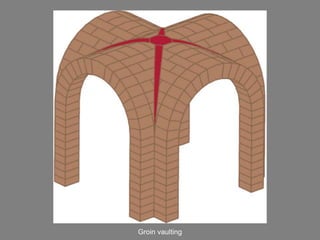
Groin vaulting
Ribbed vaulting: Groin vault showing ribs that carry greatest loads
Flying buttress
Notre Dame Cathedral,  Gothic,  Paris,  France
Stone is an elegant Gothic structural method for examples see:Cathedral of Notre DamePointed archesGroin vaultingRibbed vaultingFlying buttressesAmple fenestrationStained glass windows
DomesDomes are hemispherical formsThey are rounded when viewed from underneathThey are extensions of the principle of the archThey are capable of enclosing a vast 	amount of spacePendentives - triangular surfaces used to support the dome on a square base. Piers - structures under the pendentives that the load of the dome is transferred toVeneers - thin facades
Dome
The Pantheon, Rome
HagiaSophia,  Byzantine Church,  Istanbul
Other Uses of Stone in ConstructionStone is rarely used today as a structural materialExpensive to quarry and transportMostly stone veneers are usedDecorative stone used on façadesStone slabs are used for entry halls, patios, and gardens.
Wood ConstructionAdvantages:AttractiveVersatileAbundant/RenewableLightCan be worked onsite with portable hand toolsVariety of colors and grainsWeathers wellCan be paintedCan be used on the façade or as a structural materialDisadvantages:WarpsCracksHighly flammableTermitesRot
Post and Beam Construction Similar to post-and-lintel construction Vertical and horizontal timbers are cut and pieced together with wooden pegs The beams allow for windows, doors, and interior supports Supports another story or roofs
Postandbeam construction
Post and Beam
TrussesTrusses - Lengths of wood, iron, or steel pieced together in a triangular shapeTrusses span larger distancesTrusses are used as design and engineering elements
Trusses
Balloon FramingAn American construction building technique.A product of the Industrial Revolution (early 20th century)Mass production and assembly of materialsOriginally “balloon framing” was an insulting term due to the fact that people were skeptical that it would work.
Balloon framing.
Cape Cod–style houses built by Levitt & Sons, Levittown, NY (c. 1947–1951).
CAST IRON CONSTRUCTIONCast-IronWas also a product of the 19th century’s Industrial RevolutionIt was a welcome alternative to stone and woodAllowed for the erection of taller buildings with thinner wallsHas great strength but is heavyPrefabrication Steel-cage construction
Engraving of Sir Joseph Paxton’s Crystal Palace, London (1851).
GUSTAVE EIFFEL. Eiffel Tower, Paris (1889).
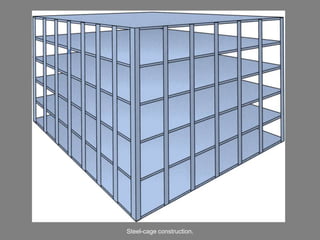
Steel-Cage ArchitectureVery strong metal with some carbon and other metalsHarder than cast iron and very expensive; however, less of the material needs to be usedSkeletal forms of steel result in “steel cages”Façades and inner walls are hung from the skeleton
TermsSteel - strong metal of iron alloyed with small amounts of carbon and a variety of other metals. Steel cages - skeletal forms onto which I-beams can be riveted or welded. Pilasters
Steel-cage construction.
Louis Sullivan. Wainwright Building, St. Louis, MO (1890).
“Less is more.”–Ludwig Miës van der Rohe
REINFORCED CONCRETEReinforced Concrete - (or ferroconcrete)Steel rods and/or steel mesh are inserted into wet concrete.Steel is inserted at points of greatest stress before hardening.Advantages: Less susceptible to pulling apart at stress pointsThe concrete prevents the steel from rusting. Can span great distances then stoneSupports more weight then steelCan take on more natural shapes.
FRANK LLOYD WRIGHT. Kaufmann House (“Fallingwater”), Bear Run, PA (1936).
MOSHE SAFDIE.   Habitat, Expo 67, Montreal (1967).
STEEL-CABLE ARCHITECTURESteel-cable bridges are not new. The Asian culture has made suspension bridges for thousands of years. Steel Cable - many parallel wires are intertwined so that they share the stress of the load. Advantages:Strong FlexibleCan sway during weather and traffic conditions
Figure 11.18, p.228: JOHN A. ROEBLING. Brooklyn Bridge, New York (1869–1883).
SHELL ARCHITECTURE Modern materials and engineering methods now enclose spaces with inexpensive shell structures. Shells are capable of spanning greater spaces Constructed from reinforced concrete, wood, steel, etc. Concept as old as the tent or new as a geodesic dome
BUCKMINSTER FULLER. United States Pavilion, Expo 67, Montreal (1967).
NEW MATERIALS, NEW VISIONSNew idea in architecture: “If you can think it, we can build it.”Global architects now adopt high-tech metals and methods.Different visions concerning assembling designs and buildings have created new and interesting buildings. Architects are also using unorthodox building materials.
EERO SAARINEN. Jefferson National Expansion Memorial, Gateway Arch, St. Louis, MO (1966).
Discussion Questions:Why is architecture so important to us as humans?Why is architecture an artform and a science (engineering)?

Architecture

  • 1.
    0Three-Dimensional Art SculptureArchitecture Craft & Design
  • 2.
    0“The mother artis architecture. Without an architecture of our own, we have no soul of our own civilization.” –Frank Lloyd Wright
  • 3.
    0IntroductionWhat is architecture?Whyis architecture important to us?Why does architecture, of all the arts, have the greatest impact on our lives?
  • 4.
    What is Architecture?Architectureis the art of building. It satisfies a basic, universal human need for shelter. An architect is an artist who designs structures to enclose residential, commercial, or public space. Architects work with construction technologies, building materials, topography, contractors, and governmental regulations within a project budget to satisfy their clients' wants and needs.
  • 5.
    ArchitectureArchitecture - Theart and science of designing buildings, and other structures to meet our personal and communal needs.It is also a vehicle for artistic expression in three-dimensions.The architect mediates between the client and the selected site.
  • 6.
    Architectural MaterialsStone,Wood, Concrete, Iron, Steel
  • 7.
  • 8.
    STONE CONSTRUCTIONMassive andvirtually indestructible. Symbol of strength and permanence.expresses warmthTerms:Kivas - Circular underground communities centers created by the native American Cliff dwellers. Adobe - dried mud used in architectural construction.
  • 9.
    Post and LintelConstruction
  • 10.
    Post and LintelConstructionStonehenge, Megalithic, Wiltshire, England
  • 11.
    Cliff Dwellings, MesaVerde, Colorado (Native American, Pre-Columbian).
  • 12.
    Dry MasonryWalls ofFortress of Machu Picchu, Urubamba Valley, Peru (Incan, 1490–1530).
  • 13.
    Stone as afavored materialTemple of Amen-Re, Karnak (Egyptian, XVIII dynasty, 1570–1342 BCE).
  • 14.
    Stone as afavored material Ictinos and Callicrates. The Parthenon, The Acropolis, Athens, Greece
  • 15.
    The ArchArches spandistances without the use of interior supports.They provide support for other structures, such as roofs.They, also, serve as symbolic gateways, as in the Arch of Triumph in Paris, France.
  • 16.
    RoundedArchesRounded arches enclosing square bay
  • 17.
    Pointed ArchesPointedarches enclosing rectangular bay.
  • 18.
  • 19.
  • 20.
    Ribbed vaulting: Groinvault showing ribs that carry greatest loads
  • 21.
  • 22.
    Notre Dame Cathedral, Gothic, Paris, France
  • 23.
    Notre Dame Cathedral, Gothic, Paris, France
  • 24.
    Stone is anelegant Gothic structural method for examples see:Cathedral of Notre DamePointed archesGroin vaultingRibbed vaultingFlying buttressesAmple fenestrationStained glass windows
  • 25.
    DomesDomes are hemisphericalformsThey are rounded when viewed from underneathThey are extensions of the principle of the archThey are capable of enclosing a vast amount of spacePendentives - triangular surfaces used to support the dome on a square base. Piers - structures under the pendentives that the load of the dome is transferred toVeneers - thin facades
  • 26.
  • 27.
  • 28.
    HagiaSophia, ByzantineChurch, Istanbul
  • 29.
    Other Uses ofStone in ConstructionStone is rarely used today as a structural materialExpensive to quarry and transportMostly stone veneers are usedDecorative stone used on façadesStone slabs are used for entry halls, patios, and gardens.
  • 30.
    Wood ConstructionAdvantages:AttractiveVersatileAbundant/RenewableLightCan beworked onsite with portable hand toolsVariety of colors and grainsWeathers wellCan be paintedCan be used on the façade or as a structural materialDisadvantages:WarpsCracksHighly flammableTermitesRot
  • 31.
    Post and BeamConstruction Similar to post-and-lintel construction Vertical and horizontal timbers are cut and pieced together with wooden pegs The beams allow for windows, doors, and interior supports Supports another story or roofs
  • 32.
  • 33.
  • 34.
    TrussesTrusses - Lengthsof wood, iron, or steel pieced together in a triangular shapeTrusses span larger distancesTrusses are used as design and engineering elements
  • 35.
  • 36.
    Balloon FramingAn Americanconstruction building technique.A product of the Industrial Revolution (early 20th century)Mass production and assembly of materialsOriginally “balloon framing” was an insulting term due to the fact that people were skeptical that it would work.
  • 37.
  • 38.
    Cape Cod–style housesbuilt by Levitt & Sons, Levittown, NY (c. 1947–1951).
  • 39.
    CAST IRON CONSTRUCTIONCast-IronWasalso a product of the 19th century’s Industrial RevolutionIt was a welcome alternative to stone and woodAllowed for the erection of taller buildings with thinner wallsHas great strength but is heavyPrefabrication Steel-cage construction
  • 40.
    Engraving of SirJoseph Paxton’s Crystal Palace, London (1851).
  • 41.
    GUSTAVE EIFFEL. EiffelTower, Paris (1889).
  • 42.
    Steel-Cage ArchitectureVery strongmetal with some carbon and other metalsHarder than cast iron and very expensive; however, less of the material needs to be usedSkeletal forms of steel result in “steel cages”Façades and inner walls are hung from the skeleton
  • 43.
    TermsSteel - strongmetal of iron alloyed with small amounts of carbon and a variety of other metals. Steel cages - skeletal forms onto which I-beams can be riveted or welded. Pilasters
  • 44.
  • 45.
    Louis Sullivan. WainwrightBuilding, St. Louis, MO (1890).
  • 46.
  • 47.
    REINFORCED CONCRETEReinforced Concrete- (or ferroconcrete)Steel rods and/or steel mesh are inserted into wet concrete.Steel is inserted at points of greatest stress before hardening.Advantages: Less susceptible to pulling apart at stress pointsThe concrete prevents the steel from rusting. Can span great distances then stoneSupports more weight then steelCan take on more natural shapes.
  • 48.
    FRANK LLOYD WRIGHT.Kaufmann House (“Fallingwater”), Bear Run, PA (1936).
  • 49.
    MOSHE SAFDIE. Habitat, Expo 67, Montreal (1967).
  • 50.
    STEEL-CABLE ARCHITECTURESteel-cable bridgesare not new. The Asian culture has made suspension bridges for thousands of years. Steel Cable - many parallel wires are intertwined so that they share the stress of the load. Advantages:Strong FlexibleCan sway during weather and traffic conditions
  • 51.
    Figure 11.18, p.228:JOHN A. ROEBLING. Brooklyn Bridge, New York (1869–1883).
  • 52.
    SHELL ARCHITECTURE Modernmaterials and engineering methods now enclose spaces with inexpensive shell structures. Shells are capable of spanning greater spaces Constructed from reinforced concrete, wood, steel, etc. Concept as old as the tent or new as a geodesic dome
  • 53.
    BUCKMINSTER FULLER. UnitedStates Pavilion, Expo 67, Montreal (1967).
  • 54.
    NEW MATERIALS, NEWVISIONSNew idea in architecture: “If you can think it, we can build it.”Global architects now adopt high-tech metals and methods.Different visions concerning assembling designs and buildings have created new and interesting buildings. Architects are also using unorthodox building materials.
  • 55.
    EERO SAARINEN. JeffersonNational Expansion Memorial, Gateway Arch, St. Louis, MO (1966).
  • 56.
    Discussion Questions:Why isarchitecture so important to us as humans?Why is architecture an artform and a science (engineering)?