Architecture Chapter 12
Architecture Architecture is essentially just a shelter from the elements BUT, it can be an important record of a society
Three Key Issues in Architecture Function-how a building is used Form-how it looks Structure-how it stands up
An Art and Science As an art, architecture creates indoor spaces and an exterior that can be beautiful As a science, architecture has to be able to withstand weather and stress Three essential components Supporting skeleton Outer skin Operating equipment
Dolmen . Crocuno, north of Carnac, France. Copyright ©2011, ©2009 Pearson Prentice Hall Inc.
Styles, Materials, and Methods Dry Masonry Basically piling stones on top of one another If the stones have been cut befores stacking they are  dressed
Great Zimbabwe . Zimbabwe. Plan. Before 1450. Height of wall 30'. Copyright ©2011, ©2009 Pearson Prentice Hall Inc.
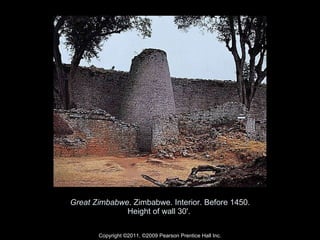
Great Zimbabwe . Zimbabwe. Interior. Before 1450. Height of wall 30'.  Copyright ©2011, ©2009 Pearson Prentice Hall Inc.
 
The Great Zimbabwe Built in the 12th century It’s walls are made up of dressed stone The walls are 15 feet thick at the bottom to add stability There are no windows as these could weaken the structure
Machu Picchu-Dry Masonry
Mesa Verde-Dry Masonry
Styles, Materials, and Methods Post and beam Vertical posts support horizontal beams A row of columns connected be beams is called a colonade
Post-and-Beam Construction . Figure 1. Copyright ©2011, ©2009 Pearson Prentice Hall Inc.
Post-and-Beam Construction . Figure 2. Copyright ©2011, ©2009 Pearson Prentice Hall Inc.
Colonnade and Court of Amenhotep III . Temple of Amun-Mut-Khonsu. View of the great court with double row of papyrus-clustered columns. Luxor, Thebes, Egypt. 18th dynasty. c. 1390 B.C.E. Copyright ©2011, ©2009 Pearson Prentice Hall Inc.
Styles, Materials, and Methods Round arch,Vault, and Dome The round arch enabled builders to move their beams further apart An arch can be supported by a column or a pier, a massive column A vault is a curving ceiling or roof structure A barrel vault is when the arch is extended in depth to create a tunnel Groin vault is an intersection of two barrel vaults Keystone is the last stone placed in an arch at the top Arches supported by column creates and arcade
Round Arch. Copyright ©2011, ©2009 Pearson Prentice Hall Inc.
Barrel Vault. Copyright ©2011, ©2009 Pearson Prentice Hall Inc.
Groin Vault. Copyright ©2011, ©2009 Pearson Prentice Hall Inc.
Arcade . Copyright ©2011, ©2009 Pearson Prentice Hall Inc.
Pont du Gard . Nîmes, France. 15 C.E. Height 161', length 902'. Copyright ©2011, ©2009 Pearson Prentice Hall Inc.
Styles, Materials, and Methods The dome An arch rotated 180 degrees on it vertical axis They can be rounded or pointed
Dome (arch rotated 180°). Copyright ©2011, ©2009 Pearson Prentice Hall Inc.
Dome on a cylinder. Copyright ©2011, ©2009 Pearson Prentice Hall Inc.
Dome on pendentives. Copyright ©2011, ©2009 Pearson Prentice Hall Inc.
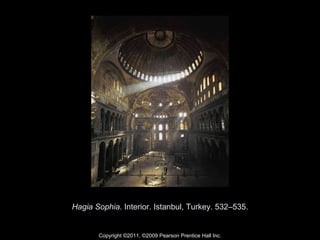
Hagia Sophia A Byzantine cathedral built in the sixth century The dome rests on curving triangular sections called pendentives over a square base
Hagia Sophia . Exterior. Istanbul, Turkey. 532–535. Copyright ©2011, ©2009 Pearson Prentice Hall Inc.
Hagia Sophia . Interior. Istanbul, Turkey. 532–535. Copyright ©2011, ©2009 Pearson Prentice Hall Inc.
Styles, Materials, and Methods Pointed arch and vault Also called the Gothic Arch Pointed vaults allowed for wider aisles and higher ceilings
Notre Dame de Chartres.  Chartres, France. 1145–1513. Height 122', width 53', length 130'. Copyright ©2011, ©2009 Pearson Prentice Hall Inc.
Gothic Arch . Copyright ©2011, ©2009 Pearson Prentice Hall Inc.
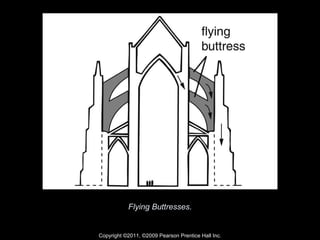
Styles, Materials, and Methods Butresses Butresses are built on the outside of an arch to support the weight Flying butresses allowed even taller arches to be supported Flying butresses also allowed for larger windows
Flying Buttresses . Copyright ©2011, ©2009 Pearson Prentice Hall Inc.
Styles, Materials, and Methods Truss and frame Truss is a triangular framework used to span and support Balloon frame heavy timbers are replaced with thin studs nailed together
Trusse s. Copyright ©2011, ©2009 Pearson Prentice Hall Inc.
Balloon Frame . Copyright ©2011, ©2009 Pearson Prentice Hall Inc.
Styles, Materials, and Methods Cast Iron Iron is lighter and stronger than wood The invention of uniform smelting allowed iron to be used as a building material
Joseph Paxton.  Crystal Palace . London. 1850–1851. Copyright ©2011, ©2009 Pearson Prentice Hall Inc.
Styles, Materials, and Methods Steel and Reinforced Concrete Steel frames and rising land prices fueled higher buildings Louis Sullivan invented the skyscraper
Louis Sullivan.  Wainwright Building . St. Louis, Missouri. 1890–1891. Copyright ©2011, ©2009 Pearson Prentice Hall Inc.
Steel-Frame Construction. Copyright ©2011, ©2009 Pearson Prentice Hall Inc.
Ludwig Mies van der Rohe and Philip Johnson.  Seagram Building . New York. 1956–1958. Photograph: Ezra Stoller © Esto.  Copyright ©2011, ©2009 Pearson Prentice Hall Inc.
Recent Innovations We now have computers to help us plan structures and analyze structural physics Suspension Structure and new materials like carbon fiber allow for exciting new designs
Suspension Structure. Copyright ©2011, ©2009 Pearson Prentice Hall Inc.
Eero Saarinen.  Shell Structure  ( TWA Terminal ). Kennedy Airport, New York. 1956–1962. Copyright ©2011, ©2009 Pearson Prentice Hall Inc.
Jeppesen Terminal Building . Denver International Airport. 1994. Copyright ©2011, ©2009 Pearson Prentice Hall Inc.
Testa and Weiser.  Carbon Tower . 2005. Copyright ©2011, ©2009 Pearson Prentice Hall Inc.
Frank O. Gehry.  Guggenheim Museum Bilbao . Bilbao, Spain. 1997. Copyright ©2011, ©2009 Pearson Prentice Hall Inc.
Designing with Nature Most innovations in the 20th century did not involve working in conjunction with the surrounding environment Frank Lloyd Wright is one of the most influential architects of the era He was the first to use open planning in houses, eliminating wall between rooms He often used the surrounding environment to plan his structures
Frank Lloyd Wright.  Fallingwater  (Edgar Kaufmann Residence). Bear Run, Pennsylvania. 1936. Scott Frances\Esto Photographics, Inc.  Copyright ©2011, ©2009 Pearson Prentice Hall Inc.
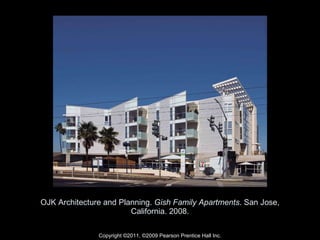
OJK Architecture and Planning.  Gish Family Apartments . San Jose, California. 2008. Copyright ©2011, ©2009 Pearson Prentice Hall Inc.
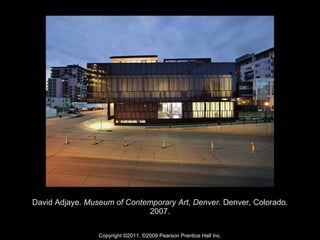
David Adjaye.  Museum of Contemporary Art, Denver . Denver, Colorado. 2007. Copyright ©2011, ©2009 Pearson Prentice Hall Inc.
Michelle Kaufmann.  mkSolaire Home . 2008. Copyright ©2011, ©2009 Pearson Prentice Hall Inc.

Art Appreciation-Chapter 12-Architecture

  • 1.
  • 2.
    Architecture Architecture isessentially just a shelter from the elements BUT, it can be an important record of a society
  • 3.
    Three Key Issuesin Architecture Function-how a building is used Form-how it looks Structure-how it stands up
  • 4.
    An Art andScience As an art, architecture creates indoor spaces and an exterior that can be beautiful As a science, architecture has to be able to withstand weather and stress Three essential components Supporting skeleton Outer skin Operating equipment
  • 5.
    Dolmen . Crocuno,north of Carnac, France. Copyright ©2011, ©2009 Pearson Prentice Hall Inc.
  • 6.
    Styles, Materials, andMethods Dry Masonry Basically piling stones on top of one another If the stones have been cut befores stacking they are dressed
  • 7.
    Great Zimbabwe .Zimbabwe. Plan. Before 1450. Height of wall 30'. Copyright ©2011, ©2009 Pearson Prentice Hall Inc.
  • 8.
    Great Zimbabwe .Zimbabwe. Interior. Before 1450. Height of wall 30'. Copyright ©2011, ©2009 Pearson Prentice Hall Inc.
  • 9.
  • 10.
    The Great ZimbabweBuilt in the 12th century It’s walls are made up of dressed stone The walls are 15 feet thick at the bottom to add stability There are no windows as these could weaken the structure
  • 11.
  • 12.
  • 13.
    Styles, Materials, andMethods Post and beam Vertical posts support horizontal beams A row of columns connected be beams is called a colonade
  • 14.
    Post-and-Beam Construction .Figure 1. Copyright ©2011, ©2009 Pearson Prentice Hall Inc.
  • 15.
    Post-and-Beam Construction .Figure 2. Copyright ©2011, ©2009 Pearson Prentice Hall Inc.
  • 16.
    Colonnade and Courtof Amenhotep III . Temple of Amun-Mut-Khonsu. View of the great court with double row of papyrus-clustered columns. Luxor, Thebes, Egypt. 18th dynasty. c. 1390 B.C.E. Copyright ©2011, ©2009 Pearson Prentice Hall Inc.
  • 17.
    Styles, Materials, andMethods Round arch,Vault, and Dome The round arch enabled builders to move their beams further apart An arch can be supported by a column or a pier, a massive column A vault is a curving ceiling or roof structure A barrel vault is when the arch is extended in depth to create a tunnel Groin vault is an intersection of two barrel vaults Keystone is the last stone placed in an arch at the top Arches supported by column creates and arcade
  • 18.
    Round Arch. Copyright©2011, ©2009 Pearson Prentice Hall Inc.
  • 19.
    Barrel Vault. Copyright©2011, ©2009 Pearson Prentice Hall Inc.
  • 20.
    Groin Vault. Copyright©2011, ©2009 Pearson Prentice Hall Inc.
  • 21.
    Arcade . Copyright©2011, ©2009 Pearson Prentice Hall Inc.
  • 22.
    Pont du Gard. Nîmes, France. 15 C.E. Height 161', length 902'. Copyright ©2011, ©2009 Pearson Prentice Hall Inc.
  • 23.
    Styles, Materials, andMethods The dome An arch rotated 180 degrees on it vertical axis They can be rounded or pointed
  • 24.
    Dome (arch rotated180°). Copyright ©2011, ©2009 Pearson Prentice Hall Inc.
  • 25.
    Dome on acylinder. Copyright ©2011, ©2009 Pearson Prentice Hall Inc.
  • 26.
    Dome on pendentives.Copyright ©2011, ©2009 Pearson Prentice Hall Inc.
  • 27.
    Hagia Sophia AByzantine cathedral built in the sixth century The dome rests on curving triangular sections called pendentives over a square base
  • 28.
    Hagia Sophia .Exterior. Istanbul, Turkey. 532–535. Copyright ©2011, ©2009 Pearson Prentice Hall Inc.
  • 29.
    Hagia Sophia .Interior. Istanbul, Turkey. 532–535. Copyright ©2011, ©2009 Pearson Prentice Hall Inc.
  • 30.
    Styles, Materials, andMethods Pointed arch and vault Also called the Gothic Arch Pointed vaults allowed for wider aisles and higher ceilings
  • 31.
    Notre Dame deChartres. Chartres, France. 1145–1513. Height 122', width 53', length 130'. Copyright ©2011, ©2009 Pearson Prentice Hall Inc.
  • 32.
    Gothic Arch .Copyright ©2011, ©2009 Pearson Prentice Hall Inc.
  • 33.
    Styles, Materials, andMethods Butresses Butresses are built on the outside of an arch to support the weight Flying butresses allowed even taller arches to be supported Flying butresses also allowed for larger windows
  • 34.
    Flying Buttresses .Copyright ©2011, ©2009 Pearson Prentice Hall Inc.
  • 35.
    Styles, Materials, andMethods Truss and frame Truss is a triangular framework used to span and support Balloon frame heavy timbers are replaced with thin studs nailed together
  • 36.
    Trusse s. Copyright©2011, ©2009 Pearson Prentice Hall Inc.
  • 37.
    Balloon Frame .Copyright ©2011, ©2009 Pearson Prentice Hall Inc.
  • 38.
    Styles, Materials, andMethods Cast Iron Iron is lighter and stronger than wood The invention of uniform smelting allowed iron to be used as a building material
  • 39.
    Joseph Paxton. Crystal Palace . London. 1850–1851. Copyright ©2011, ©2009 Pearson Prentice Hall Inc.
  • 40.
    Styles, Materials, andMethods Steel and Reinforced Concrete Steel frames and rising land prices fueled higher buildings Louis Sullivan invented the skyscraper
  • 41.
    Louis Sullivan. Wainwright Building . St. Louis, Missouri. 1890–1891. Copyright ©2011, ©2009 Pearson Prentice Hall Inc.
  • 42.
    Steel-Frame Construction. Copyright©2011, ©2009 Pearson Prentice Hall Inc.
  • 43.
    Ludwig Mies vander Rohe and Philip Johnson. Seagram Building . New York. 1956–1958. Photograph: Ezra Stoller © Esto. Copyright ©2011, ©2009 Pearson Prentice Hall Inc.
  • 44.
    Recent Innovations Wenow have computers to help us plan structures and analyze structural physics Suspension Structure and new materials like carbon fiber allow for exciting new designs
  • 45.
    Suspension Structure. Copyright©2011, ©2009 Pearson Prentice Hall Inc.
  • 46.
    Eero Saarinen. Shell Structure ( TWA Terminal ). Kennedy Airport, New York. 1956–1962. Copyright ©2011, ©2009 Pearson Prentice Hall Inc.
  • 47.
    Jeppesen Terminal Building. Denver International Airport. 1994. Copyright ©2011, ©2009 Pearson Prentice Hall Inc.
  • 48.
    Testa and Weiser. Carbon Tower . 2005. Copyright ©2011, ©2009 Pearson Prentice Hall Inc.
  • 49.
    Frank O. Gehry. Guggenheim Museum Bilbao . Bilbao, Spain. 1997. Copyright ©2011, ©2009 Pearson Prentice Hall Inc.
  • 50.
    Designing with NatureMost innovations in the 20th century did not involve working in conjunction with the surrounding environment Frank Lloyd Wright is one of the most influential architects of the era He was the first to use open planning in houses, eliminating wall between rooms He often used the surrounding environment to plan his structures
  • 51.
    Frank Lloyd Wright. Fallingwater (Edgar Kaufmann Residence). Bear Run, Pennsylvania. 1936. Scott Frances\Esto Photographics, Inc. Copyright ©2011, ©2009 Pearson Prentice Hall Inc.
  • 52.
    OJK Architecture andPlanning. Gish Family Apartments . San Jose, California. 2008. Copyright ©2011, ©2009 Pearson Prentice Hall Inc.
  • 53.
    David Adjaye. Museum of Contemporary Art, Denver . Denver, Colorado. 2007. Copyright ©2011, ©2009 Pearson Prentice Hall Inc.
  • 54.
    Michelle Kaufmann. mkSolaire Home . 2008. Copyright ©2011, ©2009 Pearson Prentice Hall Inc.

Editor's Notes

  • #6 James Lynch/The Ancient Art & Architecture Collection Ltd.
  • #8 Casement Creative Services Inc.
  • #9 Casement Creative Services Inc.
  • #17 Alistar Duncan © Dorling Kindersley.
  • #23 Photograph: Duane Preble.
  • #29 Copyright Erich Lessing/Art Resource, NY.
  • #30 Copyright Erich Lessing/Art Resource, NY.
  • #32 Copyright Scala/Art Resource, NY.
  • #40 Stock Montage, Inc. © The Newberry Library.
  • #42 © Art on File/CORBIS. All Rights Reserved.
  • #44 Photograph: Ezra Stoller © Esto.
  • #48 Photograph provided courtesy of the Denver International Airport.
  • #49 Model of proposed 40-story skyscraper.
  • #50 Photographer: Erika Ede, 1997. All rights reserved. Partial or total reproduction prohibited.
  • #52 Scott Frances\\Esto Photographics, Inc.
  • #53 Owner: First Community Housing. Architect: The Office of Jerome King. Structural Engineer: Vertech Engineering. Landscape Architect: Cottong & Taniguchi. Civil Engineer: Charles Davidson Co. Photo: Bernard André Photography.
  • #54 Photo by Dean Kaufman, courtesy Museum of Contemporary Art Denver.
  • #55 As exhibited at Museum of Science and Industry, Chicago. michelle@michellekaufmann.com. Photo by John Swain Photography, courtesy of Michelle Kaufmann.