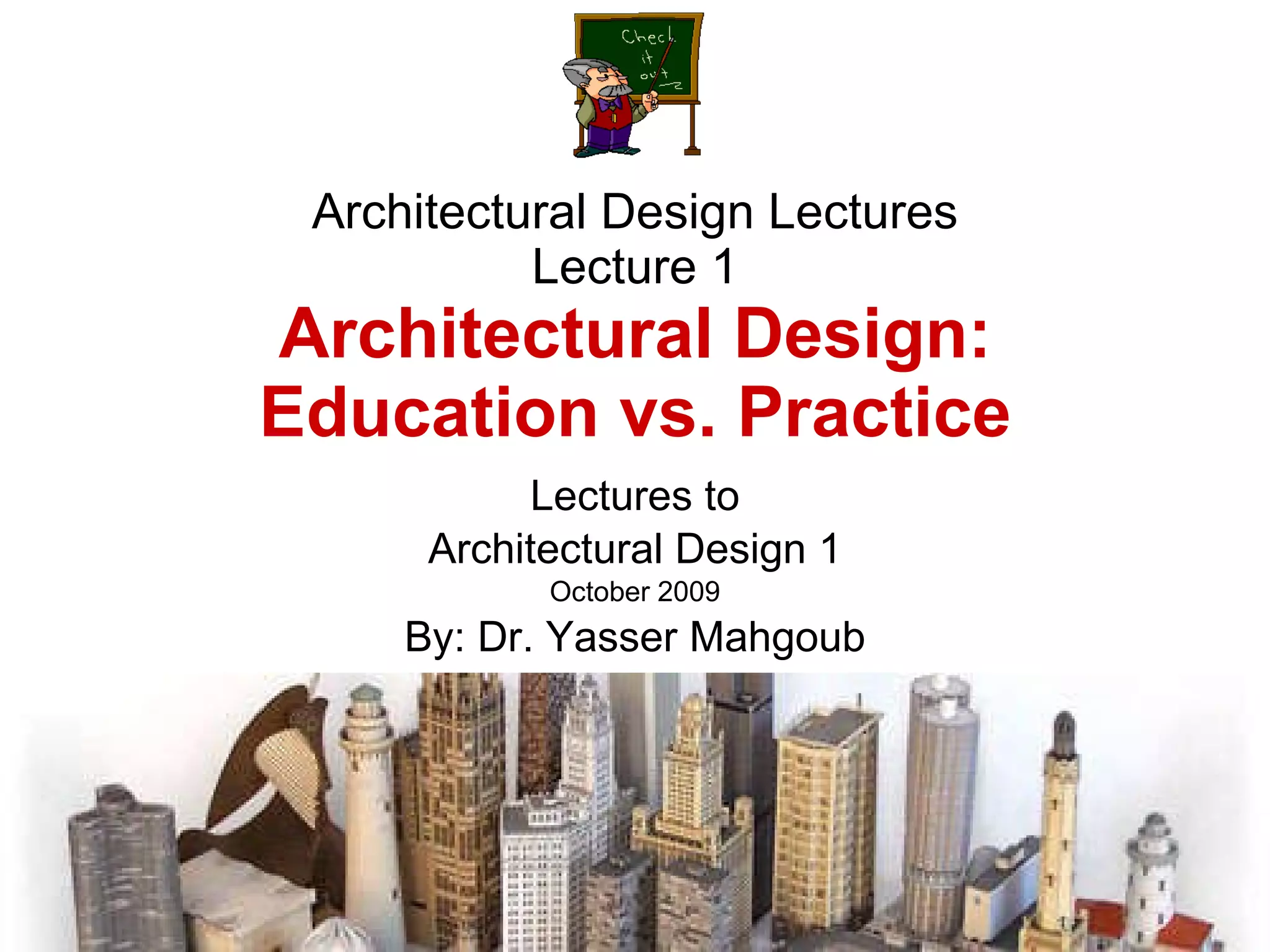
Architectural Design Lectures Lecture 1 Architectural Design: Education vs. Practice Lectures to Architectural Design 1 October 2009 By: Dr. Yasser Mahgoub
 
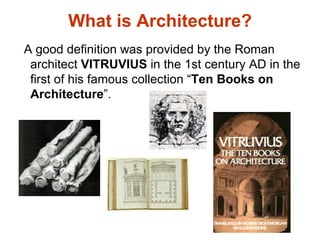
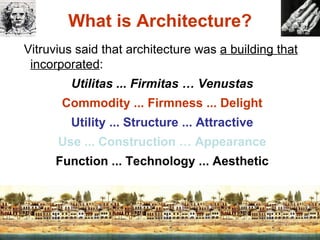
What is Architecture? A good definition was provided by the Roman architect  VITRUVIUS  in the 1st century AD in the first of his famous collection “ Ten Books on Architecture ”.
What is Architecture? Vitruvius said that architecture was  a building that incorporated : Utilitas ... Firmitas … Venustas Commodity ... Firmness ... Delight Utility ... Structure ... Attractive Use ... Construction … Appearance Function ... Technology ... Aesthetic
The Difference Between  Architecture and Building Any Building  ≠  Architecture Architecture   =   Design   BEFORE   Building Architecture is DESIGNED Buildings, Spaces and Environments.  According to  Human Needs  Using  Technology and Science, With  Aesthetic Qualities.
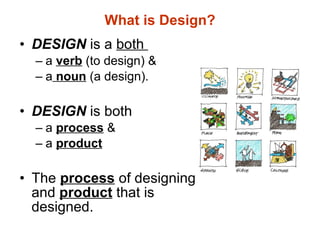
What is Design? DESIGN  is a  both  a  verb  (to design) &  a   noun  (a design). DESIGN  is both a  process  & a  product The  process  of designing and  product  that is designed.
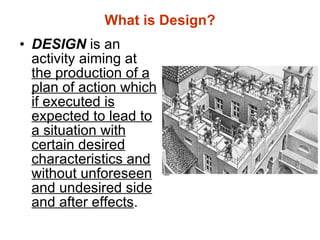
What is Design? DESIGN  is an activity aiming at  the production of a plan of action which if executed is expected to lead to a situation with certain desired characteristics and without unforeseen and undesired side and after effects .
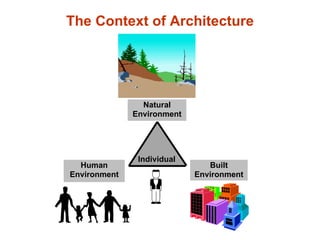
The Context of Architecture Earth Climate Ecology Resources Cities Neighborhoods Buildings Interior Spaces Individual Groups Psychological Social Cultural Individual Human Environment Built Environment Natural Environment
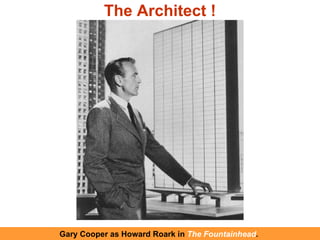
Gary Cooper as Howard Roark in  The   Fountainhead .   The Architect !
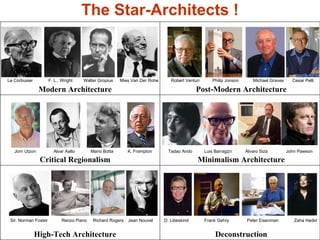
The Star-Architects ! Sir. Norman Foster Renzo Piano Richard Rogers Jean Nouvel High-Tech Architecture Robert Venturi Philip Jonson Michael Graves Cesar Pelli Post-Modern Architecture Le Corbusier F. L.. Wright Walter Gropius Mies Van Der Rohe Modern Architecture D. Libeskind Frank Gehry Peter Eisenman Zaha Hadid Deconstruction Tadao Ando Luis Barrag‡n Álvaro Siza John Pawson Minimalism Architecture Jorn Utzon Alvar Aalto Mario Botta K. Frampton Critical Regionalism
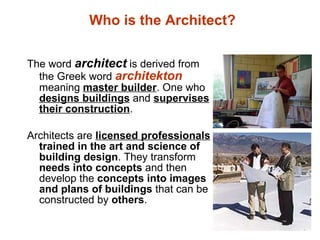
Who is the Architect? The word  architect  is derived from the Greek word  architekton   meaning  master builder . One who  designs buildings  and  supervises their construction . Architects are  licensed professionals   trained in the art and science of building design . They transform  needs into concepts  and then develop the  concepts into images and plans of buildings  that can be constructed by  others .
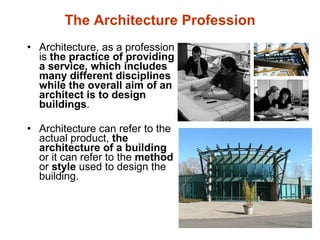
The Architecture Profession Architecture, as a profession is  the practice of providing a service, which includes many different disciplines while the overall aim of an architect is to design buildings .   Architecture can refer to the actual product,  the architecture of a building  or it can refer to the  method  or  style  used to design the building.
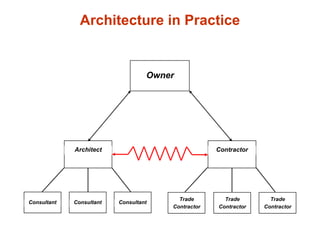
Architecture in Practice Owner Consultant Consultant Consultant Trade Contractor Trade Contractor Trade Contractor Architect Contractor
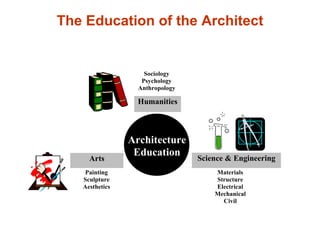
Sociology Psychology Anthropology Materials Structure Electrical Mechanical Civil Painting Sculpture Aesthetics Architecture Education Arts Science & Engineering Humanities The Education of the Architect
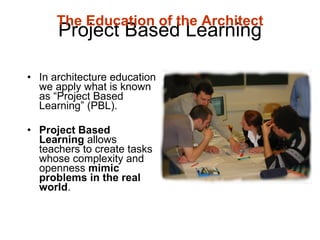
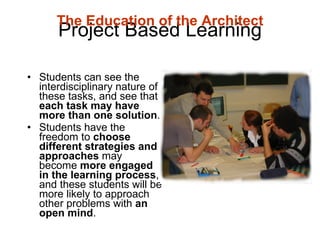
Project Based Learning In architecture education we apply what is known as “Project Based Learning” (PBL). Project Based Learning  allows teachers to create tasks whose complexity and openness  mimic problems in the real world .  The Education of the Architect
Project Based Learning Students can see the interdisciplinary nature of these tasks, and see that  each task may have more than one solution .  Students have the freedom to  choose different strategies and approaches  may become  more engaged in the learning process , and these students will be more likely to approach other problems with  an open mind .  The Education of the Architect
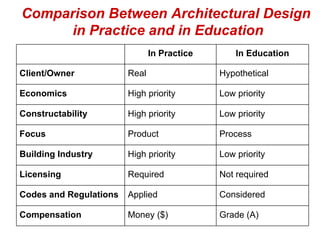
Comparison Between Architectural Design  in Practice and in Education Grade (A) Money ($) Compensation Considered Applied Codes and Regulations Not required Required Licensing High priority Product High priority High priority Real In Practice Low priority Building Industry Process Focus Low priority Constructability Low priority Economics Hypothetical Client/Owner In Education
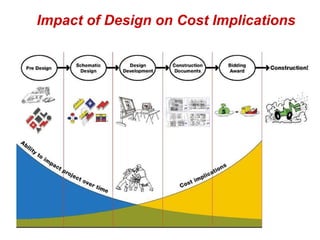
Impact of Design on Cost Implications


Thank you Dr. Yasser Mahgoub http://ymahgou.fortunecity.com/

Architectural Design 1 Lectures by Dr. Yasser Mahgoub - Lecture 1 Introduction

  • 1.
    Architectural Design LecturesLecture 1 Architectural Design: Education vs. Practice Lectures to Architectural Design 1 October 2009 By: Dr. Yasser Mahgoub
  • 2.
  • 3.
    What is Architecture?A good definition was provided by the Roman architect VITRUVIUS in the 1st century AD in the first of his famous collection “ Ten Books on Architecture ”.
  • 4.
    What is Architecture?Vitruvius said that architecture was a building that incorporated : Utilitas ... Firmitas … Venustas Commodity ... Firmness ... Delight Utility ... Structure ... Attractive Use ... Construction … Appearance Function ... Technology ... Aesthetic
  • 5.
    The Difference Between Architecture and Building Any Building ≠ Architecture Architecture = Design BEFORE Building Architecture is DESIGNED Buildings, Spaces and Environments. According to Human Needs Using Technology and Science, With Aesthetic Qualities.
  • 6.
    What is Design?DESIGN is a both a verb (to design) & a noun (a design). DESIGN is both a process & a product The process of designing and product that is designed.
  • 7.
    What is Design?DESIGN is an activity aiming at the production of a plan of action which if executed is expected to lead to a situation with certain desired characteristics and without unforeseen and undesired side and after effects .
  • 8.
    The Context ofArchitecture Earth Climate Ecology Resources Cities Neighborhoods Buildings Interior Spaces Individual Groups Psychological Social Cultural Individual Human Environment Built Environment Natural Environment
  • 9.
    Gary Cooper asHoward Roark in The Fountainhead . The Architect !
  • 10.
    The Star-Architects !Sir. Norman Foster Renzo Piano Richard Rogers Jean Nouvel High-Tech Architecture Robert Venturi Philip Jonson Michael Graves Cesar Pelli Post-Modern Architecture Le Corbusier F. L.. Wright Walter Gropius Mies Van Der Rohe Modern Architecture D. Libeskind Frank Gehry Peter Eisenman Zaha Hadid Deconstruction Tadao Ando Luis Barrag‡n Álvaro Siza John Pawson Minimalism Architecture Jorn Utzon Alvar Aalto Mario Botta K. Frampton Critical Regionalism
  • 11.
    Who is theArchitect? The word architect is derived from the Greek word architekton meaning master builder . One who designs buildings and supervises their construction . Architects are licensed professionals trained in the art and science of building design . They transform needs into concepts and then develop the concepts into images and plans of buildings that can be constructed by others .
  • 12.
    The Architecture ProfessionArchitecture, as a profession is the practice of providing a service, which includes many different disciplines while the overall aim of an architect is to design buildings .  Architecture can refer to the actual product, the architecture of a building or it can refer to the method or style used to design the building.
  • 13.
    Architecture in PracticeOwner Consultant Consultant Consultant Trade Contractor Trade Contractor Trade Contractor Architect Contractor
  • 14.
    Sociology Psychology AnthropologyMaterials Structure Electrical Mechanical Civil Painting Sculpture Aesthetics Architecture Education Arts Science & Engineering Humanities The Education of the Architect
  • 15.
    Project Based LearningIn architecture education we apply what is known as “Project Based Learning” (PBL). Project Based Learning allows teachers to create tasks whose complexity and openness mimic problems in the real world . The Education of the Architect
  • 16.
    Project Based LearningStudents can see the interdisciplinary nature of these tasks, and see that each task may have more than one solution . Students have the freedom to choose different strategies and approaches may become more engaged in the learning process , and these students will be more likely to approach other problems with an open mind . The Education of the Architect
  • 17.
    Comparison Between ArchitecturalDesign in Practice and in Education Grade (A) Money ($) Compensation Considered Applied Codes and Regulations Not required Required Licensing High priority Product High priority High priority Real In Practice Low priority Building Industry Process Focus Low priority Constructability Low priority Economics Hypothetical Client/Owner In Education
  • 18.
    Impact of Designon Cost Implications
  • 19.
  • 20.
  • 21.
  • 22.
  • 23.
  • 24.
  • 25.
  • 26.
    Thank you Dr.Yasser Mahgoub http://ymahgou.fortunecity.com/