From Latin ‘sculpere,’ which means to carve.
The art or practice of creating 3D forms or figures.
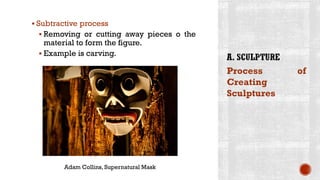
▪ Subtractive process
▪ Removing or cutting away pieces o the
material to form the figure.
▪ Example is carving.
Process of
Creating
Sculptures
Adam Collins, Supernatural Mask
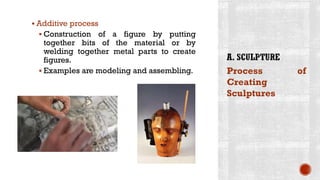
▪ Additive process
▪ Construction of a figure by putting
together bits of the material or by
welding together metal parts to create
figures.
▪ Examples are modeling and assembling. Process of
Creating
Sculptures
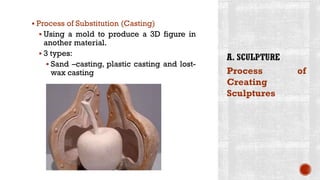
▪ Process of Substitution (Casting)
▪ Using a mold to produce a 3D figure in
another material.
▪ 3 types:
▪ Sand –casting, plastic casting and lost-
wax casting Process of
Creating
Sculptures
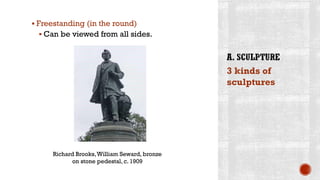
▪ Freestanding (in the round)
▪ Can be viewed from all sides.
3 kinds of
sculptures
Richard Brooks,William Seward, bronze
on stone pedestal, c. 1909
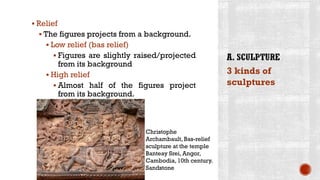
▪ Relief
▪ The figures projects from a background.
▪ Low relief (bas relief)
▪ Figures are slightly raised/projected
from its background
▪ High relief
▪ Almost half of the figures project
from its background.
3 kinds of
sculptures
Christophe
Archambault, Bas-relief
sculpture at the temple
Banteay Srei, Angor,
Cambodia, 10th century.
Sandstone
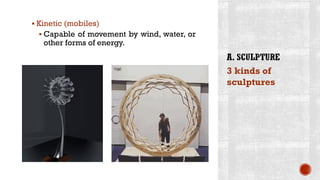
▪ Kinetic (mobiles)
▪ Capable of movement by wind, water, or
other forms of energy.
3 kinds of
sculptures
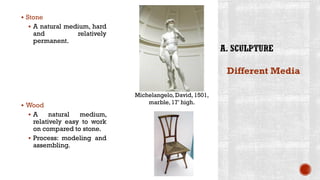
▪ Stone
▪ A natural medium, hard
and relatively
permanent.
▪ Wood
▪ A natural medium,
relatively easy to work
on compared to stone.
▪ Process: modeling and
assembling.
Different Media
Michelangelo, David, 1501,
marble, 17’ high.
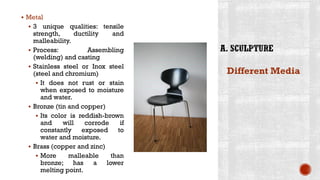
▪ Metal
▪ 3 unique qualities: tensile
strength, ductility and
malleability.
▪ Process: Assembling
(welding) and casting
▪ Stainless steel or Inox steel
(steel and chromium)
▪ It does not rust or stain
when exposed to moisture
and water.
▪ Bronze (tin and copper)
▪ Its color is reddish-brown
and will corrode if
constantly exposed to
water and moisture.
▪ Brass (copper and zinc)
▪ More malleable than
bronze; has a lower
melting point.
Different Media
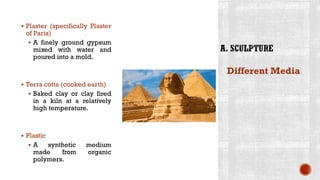
▪ Plaster (specifically Plaster
of Paris)
▪ A finely ground gypsum
mixed with water and
poured into a mold.
▪ Terra cotta (cooked earth)
▪ Baked clay or clay fired
in a kiln at a relatively
high temperature.
▪ Plastic
▪ A synthetic medium
made from organic
polymers.
Different Media
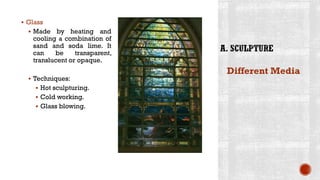
▪ Glass
▪ Made by heating and
cooling a combination of
sand and soda lime. It
can be transparent,
translucent or opaque.
▪ Techniques:
▪ Hot sculpturing.
▪ Cold working.
▪ Glass blowing.
Different Media
The art of designing buildings and other structures which will serve a
definite function.
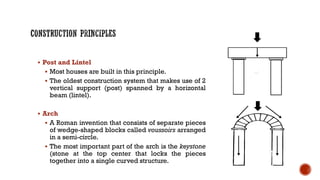
▪ Post and Lintel
▪ Most houses are built in this principle.
▪ The oldest construction system that makes use of 2
vertical support (post) spanned by a horizontal
beam (lintel).
▪ Arch
▪ A Roman invention that consists of separate pieces
of wedge-shaped blocks called voussoirs arranged
in a semi-circle.
▪ The most important part of the arch is the keystone
(stone at the top center that locks the pieces
together into a single curved structure.
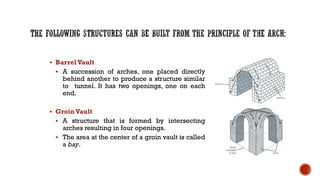
▪ Barrel Vault
▪ A succession of arches, one placed directly
behind another to produce a structure similar
to tunnel. It has two openings, one on each
end.
▪ GroinVault
▪ A structure that is formed by intersecting
arches resulting in four openings.
▪ The area at the center of a groin vault is called
a bay.
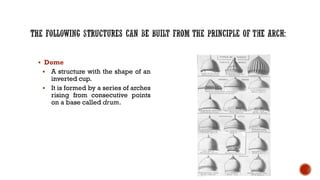
▪ Dome
▪ A structure with the shape of an
inverted cup.
▪ It is formed by a series of arches
rising from consecutive points
on a base called drum.
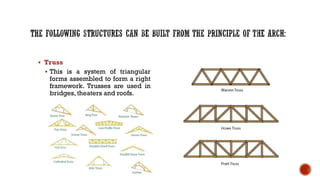
▪ Truss
▪ This is a system of triangular
forms assembled to form a right
framework. Trusses are used in
bridges, theaters and roofs.
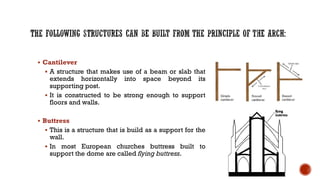
▪ Cantilever
▪ A structure that makes use of a beam or slab that
extends horizontally into space beyond its
supporting post.
▪ It is constructed to be strong enough to support
floors and walls.
▪ Buttress
▪ This is a structure that is build as a support for the
wall.
▪ In most European churches buttress built to
support the dome are called flying buttress.
▪ Since architecture is considered as the most
functional of the arts, materials to be used in
construction must have compressive and tensile
strength.
▪ Compressive strength
▪ Refers tot hose materials that can support heavy
weights without crumbling or breaking down.
▪ Tensile strength
▪ Refers to those materials that can withstand
being pulled or stretched without breaking.
Characteristics
▪ Stones
▪ favored over other materials for its durability,
adaptability to sculptural treatment and its use
for building simple structures in its natural state.
▪ Difficult to quarry, transport and cut.
▪ Bricks
▪ compare favorably with stones as a structural
material.
▪ Fire and water resistant, easy to produce,
transport and use.
▪ The size is limited by the need for efficient
drying, firing, and handling.
▪ Lumber (wood)
▪ All parts of a building can be constructed using
wood excepts the foundations.
▪ Its major disadvantages are susceptibility to fire,
mold and termites.
▪ Iron and Steel
▪ Provide far stronger and taller structures with less
use of material when compared to stone or wood.
▪ Can produce greater unsupported spans over
openings in the interior or exterior spaces.
▪ Concrete
▪ A mixture of cement and water, with aggregates of
sand and gravel, which hardens rapidly resulting
in a fire resisting solid of great compressive
strength.
THANK YOU!

6.2 Plastic or Three-Dimensional Arts.pdf

  • 2.
    From Latin ‘sculpere,’which means to carve. The art or practice of creating 3D forms or figures.
  • 3.
    ▪ Subtractive process ▪Removing or cutting away pieces o the material to form the figure. ▪ Example is carving. Process of Creating Sculptures Adam Collins, Supernatural Mask
  • 4.
    ▪ Additive process ▪Construction of a figure by putting together bits of the material or by welding together metal parts to create figures. ▪ Examples are modeling and assembling. Process of Creating Sculptures
  • 5.
    ▪ Process ofSubstitution (Casting) ▪ Using a mold to produce a 3D figure in another material. ▪ 3 types: ▪ Sand –casting, plastic casting and lost- wax casting Process of Creating Sculptures
  • 6.
    ▪ Freestanding (inthe round) ▪ Can be viewed from all sides. 3 kinds of sculptures Richard Brooks,William Seward, bronze on stone pedestal, c. 1909
  • 7.
    ▪ Relief ▪ Thefigures projects from a background. ▪ Low relief (bas relief) ▪ Figures are slightly raised/projected from its background ▪ High relief ▪ Almost half of the figures project from its background. 3 kinds of sculptures Christophe Archambault, Bas-relief sculpture at the temple Banteay Srei, Angor, Cambodia, 10th century. Sandstone
  • 8.
    ▪ Kinetic (mobiles) ▪Capable of movement by wind, water, or other forms of energy. 3 kinds of sculptures
  • 9.
    ▪ Stone ▪ Anatural medium, hard and relatively permanent. ▪ Wood ▪ A natural medium, relatively easy to work on compared to stone. ▪ Process: modeling and assembling. Different Media Michelangelo, David, 1501, marble, 17’ high.
  • 10.
    ▪ Metal ▪ 3unique qualities: tensile strength, ductility and malleability. ▪ Process: Assembling (welding) and casting ▪ Stainless steel or Inox steel (steel and chromium) ▪ It does not rust or stain when exposed to moisture and water. ▪ Bronze (tin and copper) ▪ Its color is reddish-brown and will corrode if constantly exposed to water and moisture. ▪ Brass (copper and zinc) ▪ More malleable than bronze; has a lower melting point. Different Media
  • 11.
    ▪ Plaster (specificallyPlaster of Paris) ▪ A finely ground gypsum mixed with water and poured into a mold. ▪ Terra cotta (cooked earth) ▪ Baked clay or clay fired in a kiln at a relatively high temperature. ▪ Plastic ▪ A synthetic medium made from organic polymers. Different Media
  • 12.
    ▪ Glass ▪ Madeby heating and cooling a combination of sand and soda lime. It can be transparent, translucent or opaque. ▪ Techniques: ▪ Hot sculpturing. ▪ Cold working. ▪ Glass blowing. Different Media
  • 13.
    The art ofdesigning buildings and other structures which will serve a definite function.
  • 14.
    ▪ Post andLintel ▪ Most houses are built in this principle. ▪ The oldest construction system that makes use of 2 vertical support (post) spanned by a horizontal beam (lintel). ▪ Arch ▪ A Roman invention that consists of separate pieces of wedge-shaped blocks called voussoirs arranged in a semi-circle. ▪ The most important part of the arch is the keystone (stone at the top center that locks the pieces together into a single curved structure.
  • 15.
    ▪ Barrel Vault ▪A succession of arches, one placed directly behind another to produce a structure similar to tunnel. It has two openings, one on each end. ▪ GroinVault ▪ A structure that is formed by intersecting arches resulting in four openings. ▪ The area at the center of a groin vault is called a bay.
  • 16.
    ▪ Dome ▪ Astructure with the shape of an inverted cup. ▪ It is formed by a series of arches rising from consecutive points on a base called drum.
  • 17.
    ▪ Truss ▪ Thisis a system of triangular forms assembled to form a right framework. Trusses are used in bridges, theaters and roofs.
  • 18.
    ▪ Cantilever ▪ Astructure that makes use of a beam or slab that extends horizontally into space beyond its supporting post. ▪ It is constructed to be strong enough to support floors and walls. ▪ Buttress ▪ This is a structure that is build as a support for the wall. ▪ In most European churches buttress built to support the dome are called flying buttress.
  • 19.
    ▪ Since architectureis considered as the most functional of the arts, materials to be used in construction must have compressive and tensile strength. ▪ Compressive strength ▪ Refers tot hose materials that can support heavy weights without crumbling or breaking down. ▪ Tensile strength ▪ Refers to those materials that can withstand being pulled or stretched without breaking. Characteristics
  • 20.
    ▪ Stones ▪ favoredover other materials for its durability, adaptability to sculptural treatment and its use for building simple structures in its natural state. ▪ Difficult to quarry, transport and cut. ▪ Bricks ▪ compare favorably with stones as a structural material. ▪ Fire and water resistant, easy to produce, transport and use. ▪ The size is limited by the need for efficient drying, firing, and handling.
  • 21.
    ▪ Lumber (wood) ▪All parts of a building can be constructed using wood excepts the foundations. ▪ Its major disadvantages are susceptibility to fire, mold and termites. ▪ Iron and Steel ▪ Provide far stronger and taller structures with less use of material when compared to stone or wood. ▪ Can produce greater unsupported spans over openings in the interior or exterior spaces. ▪ Concrete ▪ A mixture of cement and water, with aggregates of sand and gravel, which hardens rapidly resulting in a fire resisting solid of great compressive strength.
  • 22.