ARCHITECTURE
CHAPTER VI
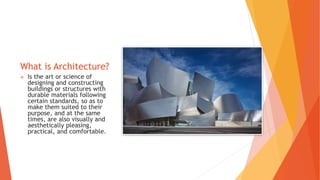
What is Architecture?
 Is the art or science of
designing and constructing
buildings or structures with
durable materials following
certain standards, so as to
make them suited to their
purpose, and at the same
times, are also visually and
aesthetically pleasing,
practical, and comfortable.
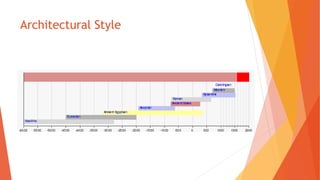
Architectural Style
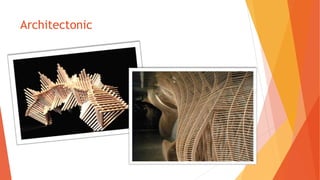
Architectonic
Elements of Architecture
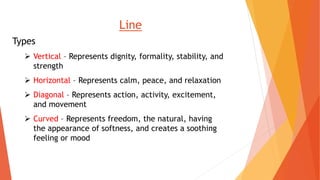
Line
Types
 Vertical – Represents dignity, formality, stability, and
strength
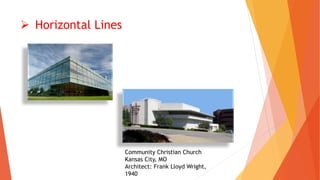
 Horizontal – Represents calm, peace, and relaxation
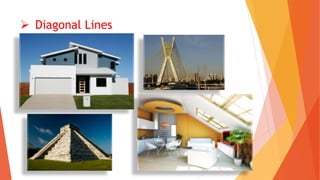
 Diagonal – Represents action, activity, excitement,
and movement
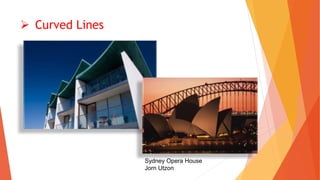
 Curved – Represents freedom, the natural, having
the appearance of softness, and creates a soothing
feeling or mood
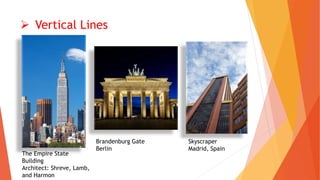
 Vertical Lines
Skyscraper
Madrid, Spain
Brandenburg Gate
Berlin
The Empire State
Building
Architect: Shreve, Lamb,
and Harmon
 Horizontal Lines
Community Christian Church
Kansas City, MO
Architect: Frank Lloyd Wright,
1940
 Diagonal Lines
 Curved Lines
Sydney Opera House
Jorn Utzon
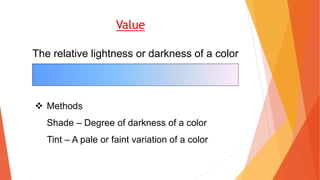
The relative lightness or darkness of a color
 Methods
Shade – Degree of darkness of a color
Tint – A pale or faint variation of a color
Value
Value
Downtown buildings in Bangalore, India
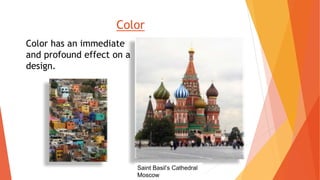
Color has an immediate
and profound effect on a
design.
Color
Saint Basil’s Cathedral
Moscow
Warm Colors
Reds, oranges, yellows
Cool Colors
Blues, purples, greens
Colors can affect how humans feel and act
The surface look or feel of something
Smooth Surface – Reflects more light and
therefore is a more intense color.
Rough Surface – Absorbs more light and
therefore appears darker.
Texture
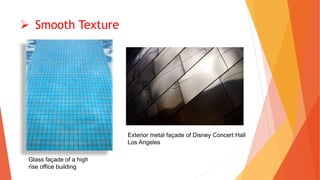
 Smooth Texture
Exterior metal façade of Disney Concert Hall
Los Angeles
Glass façade of a high
rise office building
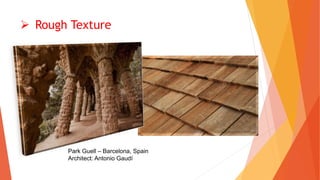
 Rough Texture
Park Guell – Barcelona, Spain
Architect: Antonio Gaudí
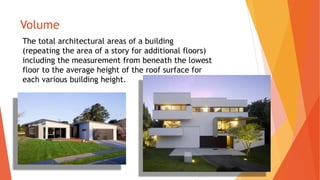
Volume
The total architectural areas of a building
(repeating the area of a story for additional floors)
including the measurement from beneath the lowest
floor to the average height of the roof surface for
each various building height.
Form: (3D)The shape and structure of something as
distinguished from its substance or material.
Shape: (2D)The two-dimensional contour that
characterizes an object or area.
Form and Shape
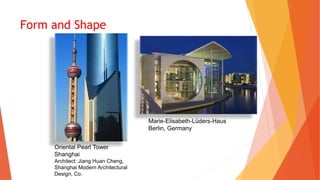
Form and Shape
Oriental Pearl Tower
Shanghai
Architect: Jiang Huan Cheng,
Shanghai Modern Architectural
Design, Co.
Marie-Elisabeth-Lüders-Haus
Berlin, Germany
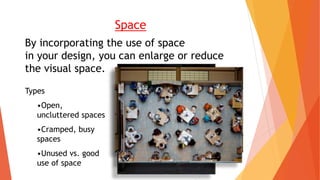
By incorporating the use of space
in your design, you can enlarge or reduce
the visual space.
Types
•Open,
uncluttered spaces
•Cramped, busy
spaces
•Unused vs. good
use of space
Space
Architectural Styles
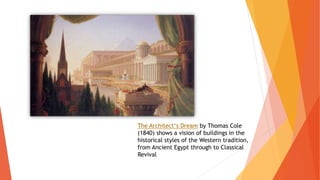
The Architect‘s Dream by Thomas Cole
(1840) shows a vision of buildings in the
historical styles of the Western tradition,
from Ancient Egypt through to Classical
Revival
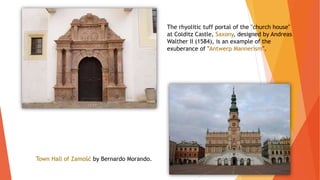
The rhyolitic tuff portal of the "church house"
at Colditz Castle, Saxony, designed by Andreas
Walther II (1584), is an example of the
exuberance of "Antwerp Mannerism".
Town Hall of Zamość by Bernardo Morando.
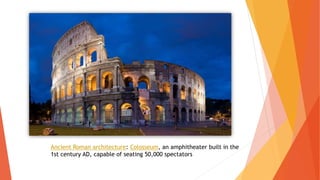
Ancient Roman architecture: Colosseum, an amphitheater built in the
1st century AD, capable of seating 50,000 spectators
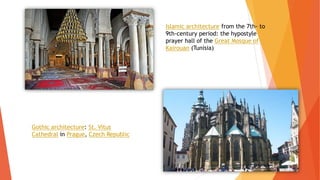
Islamic architecture from the 7th- to
9th-century period: the hypostyle
prayer hall of the Great Mosque of
Kairouan (Tunisia)
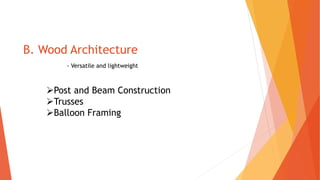
Gothic architecture: St. Vitus
Cathedral in Prague, Czech Republic
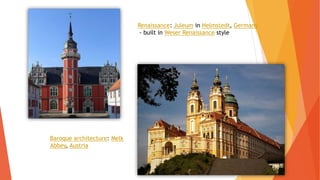
Renaissance: Juleum in Helmstedt, Germany
- built in Weser Renaissance style
Baroque architecture: Melk
Abbey, Austria
Kinds of Architecture According to Mediums Used
A. Stone Architecture
Post and Lintel Construction
Arches
Vaults
Domes
- Massive and virtually indestructible.
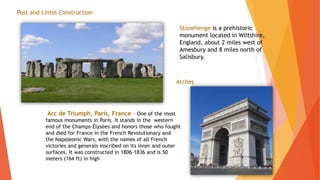
Stonehenge is a prehistoric
monument located in Wiltshire,
England, about 2 miles west of
Amesbury and 8 miles north of
Salisbury.
Post and Lintel Construction
Arches
Arc de Triumph, Paris, France – One of the most
famous monuments in Paris. It stands in the western
end of the Champs-Élysées and honors those who fought
and died for France in the French Revolutionary and
the Napoleonic Wars, with the names of all French
victories and generals inscribed on its inner and outer
surfaces. It was constructed in 1806-1836 and is 50
meters (164 ft) in high
Vault
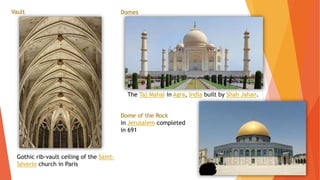
Gothic rib-vault ceiling of the Saint-
Séverin church in Paris
Domes
The Taj Mahal in Agra, India built by Shah Jahan.
Dome of the Rock
in Jerusalem completed
in 691
B. Wood Architecture
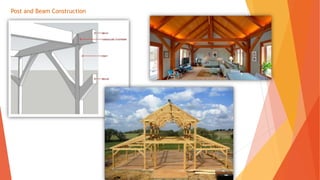
Post and Beam Construction
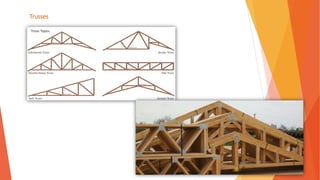
Trusses
Balloon Framing
- Versatile and lightweight
Post and Beam Construction
Trusses
Balloon Framing
C. Cast-Iron Architecture
- Iron has a great strength, and heavy.
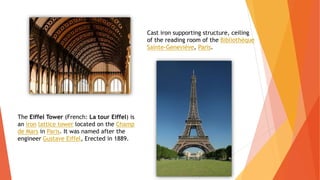
Cast iron supporting structure, ceiling
of the reading room of the Bibliothèque
Sainte-Geneviève, Paris.
The Eiffel Tower (French: La tour Eiffel) is
an iron lattice tower located on the Champ
de Mars in Paris. It was named after the
engineer Gustave Eiffel, Erected in 1889.
D. Steel-Cage Architecture
- Steel is strong metal of iron.
- Harder than iron.
- Rust and fire resistant.
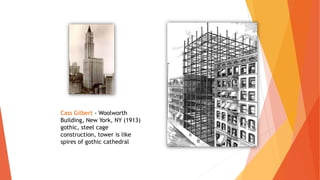
Cass Gilbert - Woolworth
Building, New York, NY (1913)
gothic, steel cage
construction, tower is like
spires of gothic cathedral
E. Reinforced Concrete
- Uses concrete that is strengthen by steel rods or mesh.
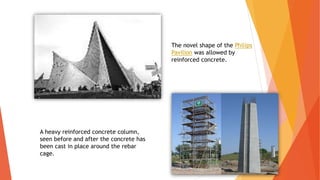
The novel shape of the Philips
Pavilion was allowed by
reinforced concrete.
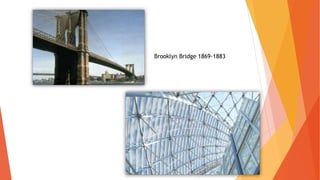
A heavy reinforced concrete column,
seen before and after the concrete has
been cast in place around the rebar
cage.
F. Steel-Cable Architecture
- Uses strong cables composed of intertwined steel wire.
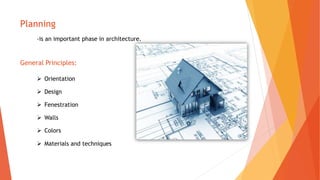
Brooklyn Bridge 1869-1883
Architectural Planning
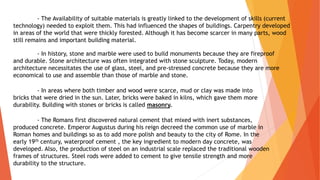
Planning
-is an important phase in architecture.
General Principles:
 Orientation
 Design
 Fenestration
 Walls
 Colors
 Materials and techniques
Building Materials
- The Availability of suitable materials is greatly linked to the development of skills (current
technology) needed to exploit them. This had influenced the shapes of buildings. Carpentry developed
in areas of the world that were thickly forested. Although it has become scarcer in many parts, wood
still remains and important building material.
- In history, stone and marble were used to build monuments because they are fireproof
and durable. Stone architecture was often integrated with stone sculpture. Today, modern
architecture necessitates the use of glass, steel, and pre-stressed concrete because they are more
economical to use and assemble than those of marble and stone.
- In areas where both timber and wood were scarce, mud or clay was made into
bricks that were dried in the sun. Later, bricks were baked in kilns, which gave them more
durability. Building with stones or bricks is called masonry.
- The Romans first discovered natural cement that mixed with inert substances,
produced concrete. Emperor Augustus during his reign decreed the common use of marble in
Roman homes and buildings so as to add more polish and beauty to the city of Rome. In the
early 19th century, waterproof cement , the key ingredient to modern day concrete, was
developed. Also, the production of steel on an industrial scale replaced the traditional wooden
frames of structures. Steel rods were added to cement to give tensile strength and more
durability to the structure.
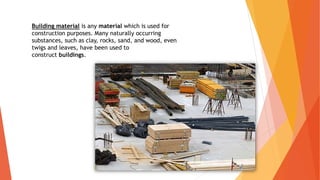
Building material is any material which is used for
construction purposes. Many naturally occurring
substances, such as clay, rocks, sand, and wood, even
twigs and leaves, have been used to
construct buildings.
Philippine Architecture
Indigenous Architecture
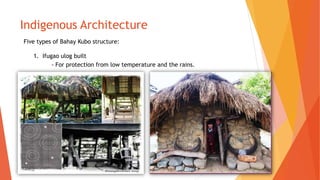
Five types of Bahay Kubo structure:
1. Ifugao ulog built
- For protection from low temperature and the rains.
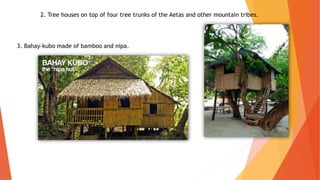
2. Tree houses on top of four tree trunks of the Aetas and other mountain tribes.
3. Bahay-kubo made of bamboo and nipa.
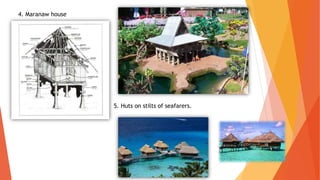
4. Maranaw house
5. Huts on stilts of seafarers.
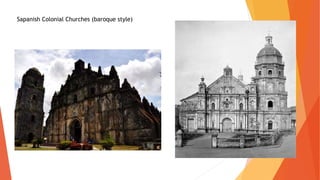
Sapanish Colonial Churches (baroque style)
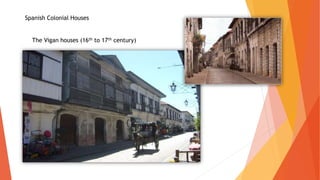
Spanish Colonial Houses
The Vigan houses (16th to 17th century)
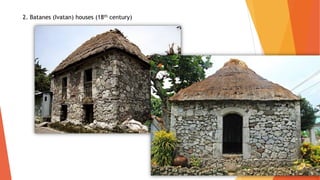
2. Batanes (Ivatan) houses (18th century)
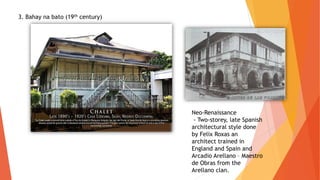
3. Bahay na bato (19th century)
Neo-Renaissance
- Two-storey, late Spanish
architectural style done
by Felix Roxas an
architect trained in
England and Spain and
Arcadio Arellano – Maestro
de Obras from the
Arellano clan.
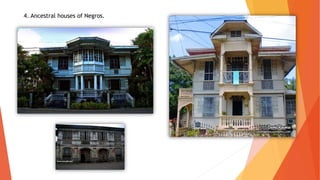
4. Ancestral houses of Negros.
Modern Architecture in the Philippines
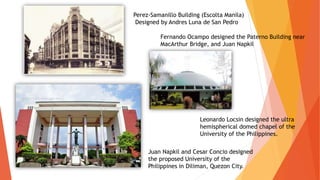
Perez-Samanillo Building (Escolta Manila)
Designed by Andres Luna de San Pedro
Fernando Ocampo designed the Paterno Building near
MacArthur Bridge, and Juan Napkil
Juan Napkil and Cesar Concio designed
the proposed University of the
Philippines in Diliman, Quezon City.
Leonardo Locsin designed the ultra
hemispherical domed chapel of the
University of the Philippines.

Architecture 2

  • 1.
  • 2.
    What is Architecture? Is the art or science of designing and constructing buildings or structures with durable materials following certain standards, so as to make them suited to their purpose, and at the same times, are also visually and aesthetically pleasing, practical, and comfortable.
  • 3.
  • 4.
  • 5.
  • 6.
    Line Types  Vertical –Represents dignity, formality, stability, and strength  Horizontal – Represents calm, peace, and relaxation  Diagonal – Represents action, activity, excitement, and movement  Curved – Represents freedom, the natural, having the appearance of softness, and creates a soothing feeling or mood
  • 7.
     Vertical Lines Skyscraper Madrid,Spain Brandenburg Gate Berlin The Empire State Building Architect: Shreve, Lamb, and Harmon
  • 8.
     Horizontal Lines CommunityChristian Church Kansas City, MO Architect: Frank Lloyd Wright, 1940
  • 9.
  • 10.
     Curved Lines SydneyOpera House Jorn Utzon
  • 11.
    The relative lightnessor darkness of a color  Methods Shade – Degree of darkness of a color Tint – A pale or faint variation of a color Value
  • 12.
  • 13.
    Color has animmediate and profound effect on a design. Color Saint Basil’s Cathedral Moscow
  • 14.
    Warm Colors Reds, oranges,yellows Cool Colors Blues, purples, greens
  • 15.
    Colors can affecthow humans feel and act
  • 16.
    The surface lookor feel of something Smooth Surface – Reflects more light and therefore is a more intense color. Rough Surface – Absorbs more light and therefore appears darker. Texture
  • 17.
     Smooth Texture Exteriormetal façade of Disney Concert Hall Los Angeles Glass façade of a high rise office building
  • 18.
     Rough Texture ParkGuell – Barcelona, Spain Architect: Antonio Gaudí
  • 19.
    Volume The total architecturalareas of a building (repeating the area of a story for additional floors) including the measurement from beneath the lowest floor to the average height of the roof surface for each various building height.
  • 20.
    Form: (3D)The shapeand structure of something as distinguished from its substance or material. Shape: (2D)The two-dimensional contour that characterizes an object or area. Form and Shape
  • 21.
    Form and Shape OrientalPearl Tower Shanghai Architect: Jiang Huan Cheng, Shanghai Modern Architectural Design, Co. Marie-Elisabeth-Lüders-Haus Berlin, Germany
  • 22.
    By incorporating theuse of space in your design, you can enlarge or reduce the visual space. Types •Open, uncluttered spaces •Cramped, busy spaces •Unused vs. good use of space Space
  • 23.
  • 24.
    The Architect‘s Dreamby Thomas Cole (1840) shows a vision of buildings in the historical styles of the Western tradition, from Ancient Egypt through to Classical Revival
  • 25.
    The rhyolitic tuffportal of the "church house" at Colditz Castle, Saxony, designed by Andreas Walther II (1584), is an example of the exuberance of "Antwerp Mannerism". Town Hall of Zamość by Bernardo Morando.
  • 26.
    Ancient Roman architecture:Colosseum, an amphitheater built in the 1st century AD, capable of seating 50,000 spectators
  • 27.
    Islamic architecture fromthe 7th- to 9th-century period: the hypostyle prayer hall of the Great Mosque of Kairouan (Tunisia) Gothic architecture: St. Vitus Cathedral in Prague, Czech Republic
  • 28.
    Renaissance: Juleum inHelmstedt, Germany - built in Weser Renaissance style Baroque architecture: Melk Abbey, Austria
  • 29.
    Kinds of ArchitectureAccording to Mediums Used
  • 30.
    A. Stone Architecture Postand Lintel Construction Arches Vaults Domes - Massive and virtually indestructible.
  • 31.
    Stonehenge is aprehistoric monument located in Wiltshire, England, about 2 miles west of Amesbury and 8 miles north of Salisbury. Post and Lintel Construction Arches Arc de Triumph, Paris, France – One of the most famous monuments in Paris. It stands in the western end of the Champs-Élysées and honors those who fought and died for France in the French Revolutionary and the Napoleonic Wars, with the names of all French victories and generals inscribed on its inner and outer surfaces. It was constructed in 1806-1836 and is 50 meters (164 ft) in high
  • 32.
    Vault Gothic rib-vault ceilingof the Saint- Séverin church in Paris Domes The Taj Mahal in Agra, India built by Shah Jahan. Dome of the Rock in Jerusalem completed in 691
  • 33.
    B. Wood Architecture Postand Beam Construction Trusses Balloon Framing - Versatile and lightweight
  • 34.
    Post and BeamConstruction
  • 35.
  • 36.
  • 37.
    C. Cast-Iron Architecture -Iron has a great strength, and heavy.
  • 38.
    Cast iron supportingstructure, ceiling of the reading room of the Bibliothèque Sainte-Geneviève, Paris. The Eiffel Tower (French: La tour Eiffel) is an iron lattice tower located on the Champ de Mars in Paris. It was named after the engineer Gustave Eiffel, Erected in 1889.
  • 39.
    D. Steel-Cage Architecture -Steel is strong metal of iron. - Harder than iron. - Rust and fire resistant.
  • 40.
    Cass Gilbert -Woolworth Building, New York, NY (1913) gothic, steel cage construction, tower is like spires of gothic cathedral
  • 41.
    E. Reinforced Concrete -Uses concrete that is strengthen by steel rods or mesh.
  • 42.
    The novel shapeof the Philips Pavilion was allowed by reinforced concrete. A heavy reinforced concrete column, seen before and after the concrete has been cast in place around the rebar cage.
  • 43.
    F. Steel-Cable Architecture -Uses strong cables composed of intertwined steel wire.
  • 44.
  • 45.
  • 46.
    Planning -is an importantphase in architecture. General Principles:  Orientation  Design  Fenestration  Walls  Colors  Materials and techniques
  • 47.
  • 48.
    - The Availabilityof suitable materials is greatly linked to the development of skills (current technology) needed to exploit them. This had influenced the shapes of buildings. Carpentry developed in areas of the world that were thickly forested. Although it has become scarcer in many parts, wood still remains and important building material. - In history, stone and marble were used to build monuments because they are fireproof and durable. Stone architecture was often integrated with stone sculpture. Today, modern architecture necessitates the use of glass, steel, and pre-stressed concrete because they are more economical to use and assemble than those of marble and stone. - In areas where both timber and wood were scarce, mud or clay was made into bricks that were dried in the sun. Later, bricks were baked in kilns, which gave them more durability. Building with stones or bricks is called masonry. - The Romans first discovered natural cement that mixed with inert substances, produced concrete. Emperor Augustus during his reign decreed the common use of marble in Roman homes and buildings so as to add more polish and beauty to the city of Rome. In the early 19th century, waterproof cement , the key ingredient to modern day concrete, was developed. Also, the production of steel on an industrial scale replaced the traditional wooden frames of structures. Steel rods were added to cement to give tensile strength and more durability to the structure.
  • 49.
    Building material isany material which is used for construction purposes. Many naturally occurring substances, such as clay, rocks, sand, and wood, even twigs and leaves, have been used to construct buildings.
  • 50.
  • 51.
    Indigenous Architecture Five typesof Bahay Kubo structure: 1. Ifugao ulog built - For protection from low temperature and the rains.
  • 52.
    2. Tree houseson top of four tree trunks of the Aetas and other mountain tribes. 3. Bahay-kubo made of bamboo and nipa.
  • 53.
    4. Maranaw house 5.Huts on stilts of seafarers.
  • 54.
  • 55.
    Spanish Colonial Houses TheVigan houses (16th to 17th century)
  • 56.
    2. Batanes (Ivatan)houses (18th century)
  • 57.
    3. Bahay nabato (19th century) Neo-Renaissance - Two-storey, late Spanish architectural style done by Felix Roxas an architect trained in England and Spain and Arcadio Arellano – Maestro de Obras from the Arellano clan.
  • 58.
  • 59.
    Modern Architecture inthe Philippines
  • 60.
    Perez-Samanillo Building (EscoltaManila) Designed by Andres Luna de San Pedro Fernando Ocampo designed the Paterno Building near MacArthur Bridge, and Juan Napkil Juan Napkil and Cesar Concio designed the proposed University of the Philippines in Diliman, Quezon City. Leonardo Locsin designed the ultra hemispherical domed chapel of the University of the Philippines.

Editor's Notes

  • #8 The Empire State Building in New York City, an international landmark, is an excellent example of the architectural style know as Art Deco. It was designed by the architectural firm of Shreve, Lamb, and Harmon. William Lamb was the chief designer. The vertical characteristics represent dignity, formality, stability, and strength.
  • #9 Horizontal lines represent calm, peace, and relaxation. Frank Lloyd Wright was well know for using horizontal lines in many of his designs.
  • #10 Diagonal lines give the sense of movement, action, and activity. The upper right image shows the Octavio Frias de Oliverira Bridge in Sao Paulo, Brazil. This is a cable-stayed suspension bridge which opened in May 2008. It is the only bridge in the world that has two curved approaches supported by a single concrete mast.
  • #11 Flowing, curved lines are used in the roof of this apartment building, the roof structure of the Sydney Opera House, and the Sydney Harbor Bridge in the background. Curved lines often appear more natural than angular lines and give the sense of freedom and soothing mood. The Sydney Opera House is a world-famous work of architecture. The Danish architect Jorn Utzon won an international competition to design the structure. After extensive testing, Utzon decided to use a design based on sections of a sphere.
  • #12 Add black to obtain a shade. Add white to obtain a tint.
  • #13 The different buildings use varying values of blue/green.
  • #14 Saint Basil’s Cathedral was designed in the shape of the flame of a bonfire rising into the sky. Bright colors create a festive feeling and sense of excitement.
  • #15 How would the building in the top picture look without the red accent? Do the green colors in the bottom picture energize you or make you feel calm and cool?
  • #16 Which color scheme creates the most excitement? Why? Which color scheme feel the most opulent? Which color scheme would you choose for a playroom? Living room? Bedroom?
  • #19 Park Gruell is a famous park and sculpture garden in Barcelona, Spain designed by Antonio Gaudi in the expressionist style. It was originally designed as a housing development but was commercially unsuccessful and was later turned into a park.
  • #21 Form can also be described as the composition of geometric shapes. Shape can be described as the contour, profile, or silhouette.
  • #22 The Oriental Tower is a television tower in Shanghai and includes fifteen observatory levels and a revolving restaurant. Its design includes 11 spheres, large and small. The two largest spheres (shown) have diameters of 164 ft (the lower sphere) and 148 ft (the upper sphere). The design is based on the Tang Dynasty poem Pipa Song by Bai Juyi about the wonderful sprinkling sound produced by a pipa instrument, like pearls, big and small, falling on a jade plate.
  • #23 [click] Open space [click] Busy, well used space