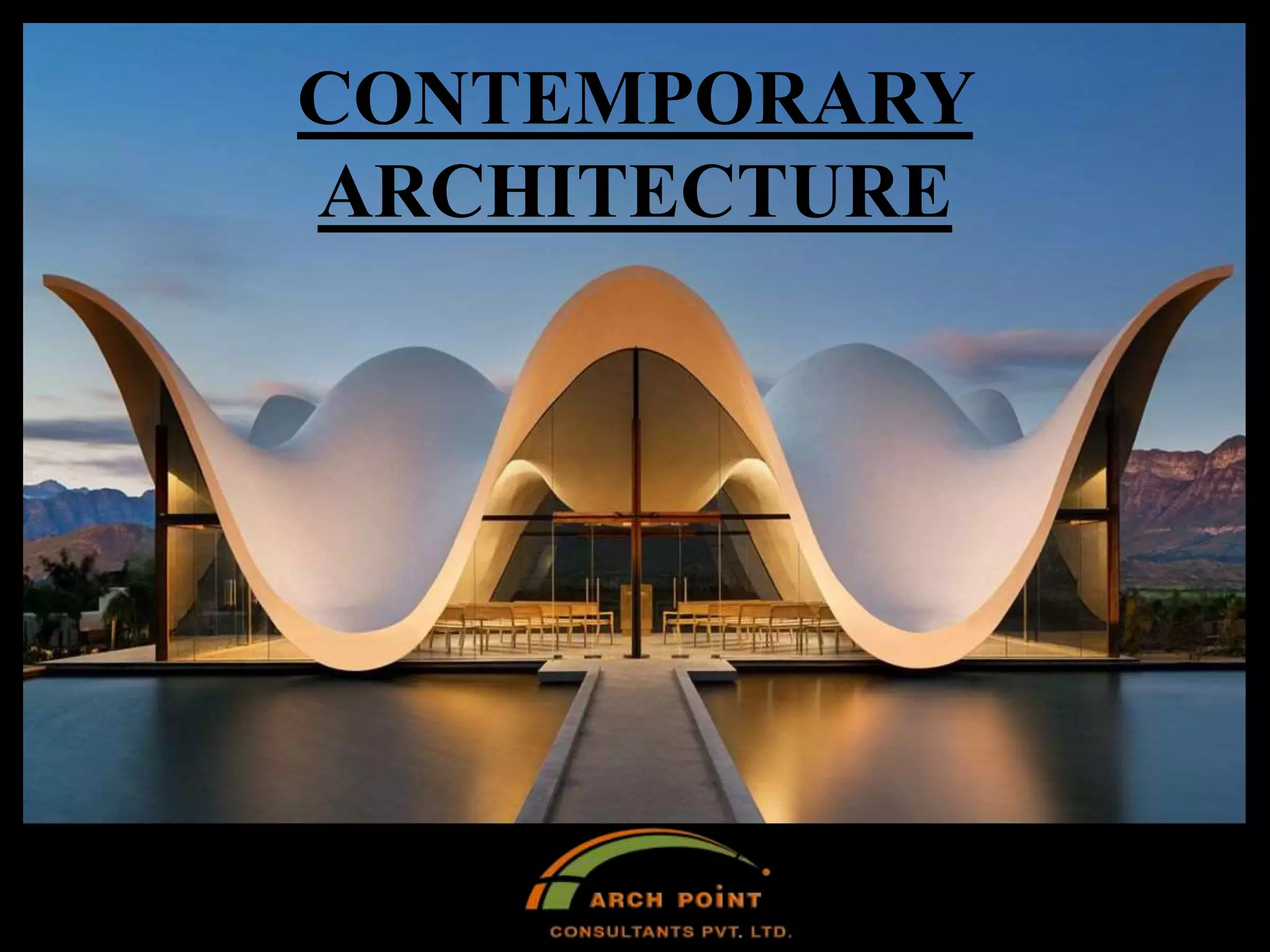
CONTEMPORARY
ARCHITECTURE
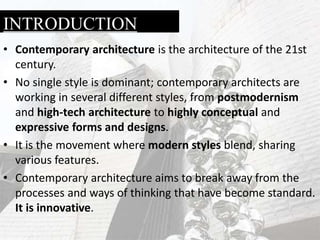
• Contemporary architecture is the architecture of the 21st
century.
• No single style is dominant; contemporary architects are
working in several different styles, from postmodernism
and high-tech architecture to highly conceptual and
expressive forms and designs.
• It is the movement where modern styles blend, sharing
various features.
• Contemporary architecture aims to break away from the
processes and ways of thinking that have become standard.
It is innovative.
INTRODUCTION
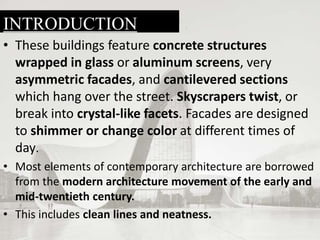
• These buildings feature concrete structures
wrapped in glass or aluminum screens, very
asymmetric facades, and cantilevered sections
which hang over the street. Skyscrapers twist, or
break into crystal-like facets. Facades are designed
to shimmer or change color at different times of
day.
• Most elements of contemporary architecture are borrowed
from the modern architecture movement of the early and
mid-twentieth century.
• This includes clean lines and neatness.
INTRODUCTION
What Contemporary
Architecture Is Not ?
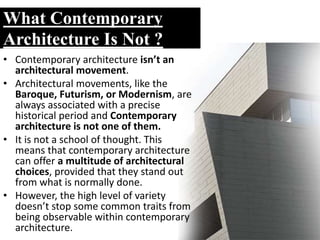
• Contemporary architecture isn’t an
architectural movement.
• Architectural movements, like the
Baroque, Futurism, or Modernism, are
always associated with a precise
historical period and Contemporary
architecture is not one of them.
• It is not a school of thought. This
means that contemporary architecture
can offer a multitude of architectural
choices, provided that they stand out
from what is normally done.
• However, the high level of variety
doesn’t stop some common traits from
being observable within contemporary
architecture.
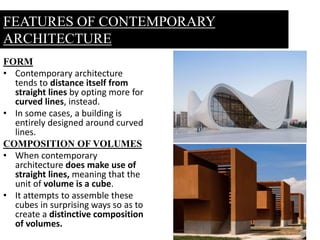
FORM
• Contemporary architecture
tends to distance itself from
straight lines by opting more for
curved lines, instead.
• In some cases, a building is
entirely designed around curved
lines.
COMPOSITION OF VOLUMES
• When contemporary
architecture does make use of
straight lines, meaning that the
unit of volume is a cube.
• It attempts to assemble these
cubes in surprising ways so as to
create a distinctive composition
of volumes.
FEATURES OF CONTEMPORARY
ARCHITECTURE
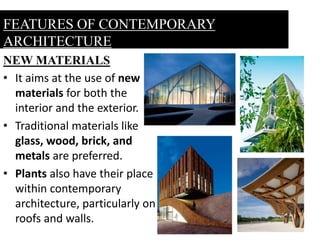
NEW MATERIALS
• It aims at the use of new
materials for both the
interior and the exterior.
• Traditional materials like
glass, wood, brick, and
metals are preferred.
• Plants also have their place
within contemporary
architecture, particularly on
roofs and walls.
FEATURES OF CONTEMPORARY
ARCHITECTURE
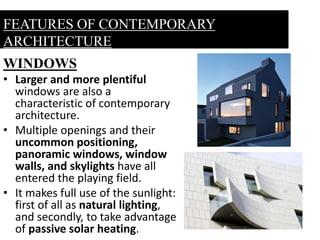
WINDOWS
• Larger and more plentiful
windows are also a
characteristic of contemporary
architecture.
• Multiple openings and their
uncommon positioning,
panoramic windows, window
walls, and skylights have all
entered the playing field.
• It makes full use of the sunlight:
first of all as natural lighting,
and secondly, to take advantage
of passive solar heating.
FEATURES OF CONTEMPORARY
ARCHITECTURE
ENVIRONMENTAL
CONSIDERATIONS
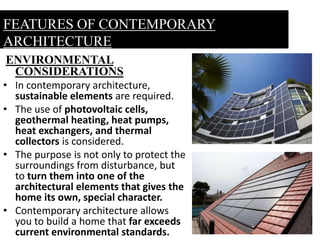
• In contemporary architecture,
sustainable elements are required.
• The use of photovoltaic cells,
geothermal heating, heat pumps,
heat exchangers, and thermal
collectors is considered.
• The purpose is not only to protect the
surroundings from disturbance, but
to turn them into one of the
architectural elements that gives the
home its own, special character.
• Contemporary architecture allows
you to build a home that far exceeds
current environmental standards.
FEATURES OF CONTEMPORARY
ARCHITECTURE
ANIMATED
ARCHITECTURE
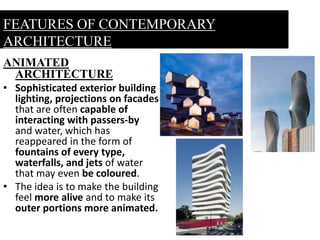
• Sophisticated exterior building
lighting, projections on facades
that are often capable of
interacting with passers-by
and water, which has
reappeared in the form of
fountains of every type,
waterfalls, and jets of water
that may even be coloured.
• The idea is to make the building
feel more alive and to make its
outer portions more animated.
FEATURES OF CONTEMPORARY
ARCHITECTURE
REINFORCED CONCRETE
ADVANCES
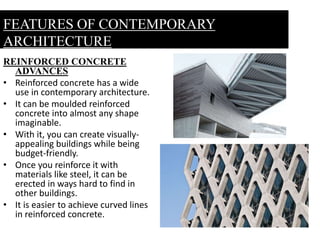
• Reinforced concrete has a wide
use in contemporary architecture.
• It can be moulded reinforced
concrete into almost any shape
imaginable.
• With it, you can create visually-
appealing buildings while being
budget-friendly.
• Once you reinforce it with
materials like steel, it can be
erected in ways hard to find in
other buildings.
• It is easier to achieve curved lines
in reinforced concrete.
FEATURES OF CONTEMPORARY
ARCHITECTURE
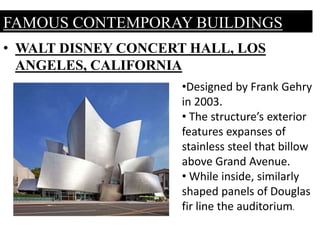
• WALT DISNEY CONCERT HALL, LOS
ANGELES, CALIFORNIA
FAMOUS CONTEMPORAY BUILDINGS
•Designed by Frank Gehry
in 2003.
• The structure’s exterior
features expanses of
stainless steel that billow
above Grand Avenue.
• While inside, similarly
shaped panels of Douglas
fir line the auditorium.
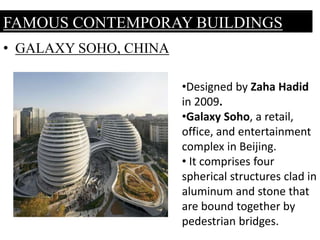
• GALAXY SOHO, CHINA
FAMOUS CONTEMPORAY BUILDINGS
•Designed by Zaha Hadid
in 2009.
•Galaxy Soho, a retail,
office, and entertainment
complex in Beijing.
• It comprises four
spherical structures clad in
aluminum and stone that
are bound together by
pedestrian bridges.
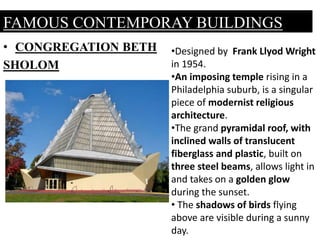
• CONGREGATION BETH
SHOLOM
FAMOUS CONTEMPORAY BUILDINGS
•Designed by Frank Llyod Wright
in 1954.
•An imposing temple rising in a
Philadelphia suburb, is a singular
piece of modernist religious
architecture.
•The grand pyramidal roof, with
inclined walls of translucent
fiberglass and plastic, built on
three steel beams, allows light in
and takes on a golden glow
during the sunset.
• The shadows of birds flying
above are visible during a sunny
day.
Contemporary architecture

Contemporary architecture

  • 1.
  • 2.
    • Contemporary architectureis the architecture of the 21st century. • No single style is dominant; contemporary architects are working in several different styles, from postmodernism and high-tech architecture to highly conceptual and expressive forms and designs. • It is the movement where modern styles blend, sharing various features. • Contemporary architecture aims to break away from the processes and ways of thinking that have become standard. It is innovative. INTRODUCTION
  • 3.
    • These buildingsfeature concrete structures wrapped in glass or aluminum screens, very asymmetric facades, and cantilevered sections which hang over the street. Skyscrapers twist, or break into crystal-like facets. Facades are designed to shimmer or change color at different times of day. • Most elements of contemporary architecture are borrowed from the modern architecture movement of the early and mid-twentieth century. • This includes clean lines and neatness. INTRODUCTION
  • 4.
    What Contemporary Architecture IsNot ? • Contemporary architecture isn’t an architectural movement. • Architectural movements, like the Baroque, Futurism, or Modernism, are always associated with a precise historical period and Contemporary architecture is not one of them. • It is not a school of thought. This means that contemporary architecture can offer a multitude of architectural choices, provided that they stand out from what is normally done. • However, the high level of variety doesn’t stop some common traits from being observable within contemporary architecture.
  • 5.
    FORM • Contemporary architecture tendsto distance itself from straight lines by opting more for curved lines, instead. • In some cases, a building is entirely designed around curved lines. COMPOSITION OF VOLUMES • When contemporary architecture does make use of straight lines, meaning that the unit of volume is a cube. • It attempts to assemble these cubes in surprising ways so as to create a distinctive composition of volumes. FEATURES OF CONTEMPORARY ARCHITECTURE
  • 6.
    NEW MATERIALS • Itaims at the use of new materials for both the interior and the exterior. • Traditional materials like glass, wood, brick, and metals are preferred. • Plants also have their place within contemporary architecture, particularly on roofs and walls. FEATURES OF CONTEMPORARY ARCHITECTURE
  • 7.
    WINDOWS • Larger andmore plentiful windows are also a characteristic of contemporary architecture. • Multiple openings and their uncommon positioning, panoramic windows, window walls, and skylights have all entered the playing field. • It makes full use of the sunlight: first of all as natural lighting, and secondly, to take advantage of passive solar heating. FEATURES OF CONTEMPORARY ARCHITECTURE
  • 8.
    ENVIRONMENTAL CONSIDERATIONS • In contemporaryarchitecture, sustainable elements are required. • The use of photovoltaic cells, geothermal heating, heat pumps, heat exchangers, and thermal collectors is considered. • The purpose is not only to protect the surroundings from disturbance, but to turn them into one of the architectural elements that gives the home its own, special character. • Contemporary architecture allows you to build a home that far exceeds current environmental standards. FEATURES OF CONTEMPORARY ARCHITECTURE
  • 9.
    ANIMATED ARCHITECTURE • Sophisticated exteriorbuilding lighting, projections on facades that are often capable of interacting with passers-by and water, which has reappeared in the form of fountains of every type, waterfalls, and jets of water that may even be coloured. • The idea is to make the building feel more alive and to make its outer portions more animated. FEATURES OF CONTEMPORARY ARCHITECTURE
  • 10.
    REINFORCED CONCRETE ADVANCES • Reinforcedconcrete has a wide use in contemporary architecture. • It can be moulded reinforced concrete into almost any shape imaginable. • With it, you can create visually- appealing buildings while being budget-friendly. • Once you reinforce it with materials like steel, it can be erected in ways hard to find in other buildings. • It is easier to achieve curved lines in reinforced concrete. FEATURES OF CONTEMPORARY ARCHITECTURE
  • 11.
    • WALT DISNEYCONCERT HALL, LOS ANGELES, CALIFORNIA FAMOUS CONTEMPORAY BUILDINGS •Designed by Frank Gehry in 2003. • The structure’s exterior features expanses of stainless steel that billow above Grand Avenue. • While inside, similarly shaped panels of Douglas fir line the auditorium.
  • 12.
    • GALAXY SOHO,CHINA FAMOUS CONTEMPORAY BUILDINGS •Designed by Zaha Hadid in 2009. •Galaxy Soho, a retail, office, and entertainment complex in Beijing. • It comprises four spherical structures clad in aluminum and stone that are bound together by pedestrian bridges.
  • 13.
    • CONGREGATION BETH SHOLOM FAMOUSCONTEMPORAY BUILDINGS •Designed by Frank Llyod Wright in 1954. •An imposing temple rising in a Philadelphia suburb, is a singular piece of modernist religious architecture. •The grand pyramidal roof, with inclined walls of translucent fiberglass and plastic, built on three steel beams, allows light in and takes on a golden glow during the sunset. • The shadows of birds flying above are visible during a sunny day.