hist
ory
of
archit
ect
ure
History of Architecture
Part I- Ancient Architecture
Lecture - IV
hist
ory
of
archit
ect
ure
Greek
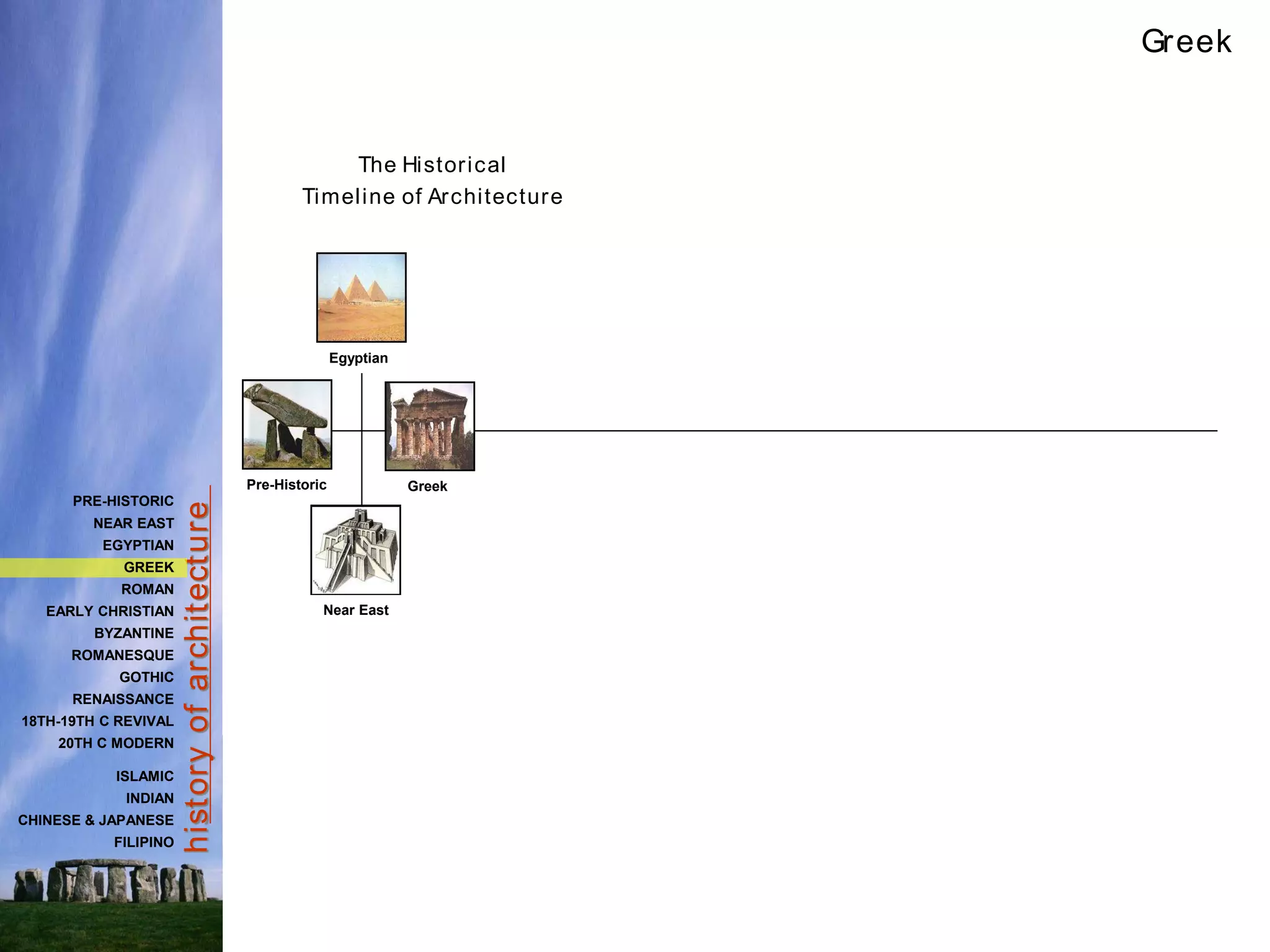
The Historical
Timeline of Architecture
PRE-HISTORIC
NEAR EAST
EGYPTIAN
GREEK
ROMAN
EARLY CHRISTIAN
BYZANTINE
ROMANESQUE
GOTHIC
RENAISSANCE
18TH-19TH C REVIVAL
20TH C MODERN
ISLAMIC
INDIAN
CHINESE & JAPANESE
FILIPINO
Pre-Historic
Egyptian
Near East
Greek
hist
ory
of
archit
ect
ure
INFLUENCES
HISTORY
Aegean Period (Minoan)
• Civilizations on Crete and Greek mainland from 1900 to
1100 BC
• The first great commercial and naval power in the
Mediterranean, founded on trade with the whole eastern
seaboard: Asia Minor, Cyprus, Syria, Palestine, Egypt and
Libya, even South Italy and Sicily on the west
• Trade and communications produced a unity of culture
and economic stability
• Knossos was the largest city, had a magnificent palace
Mycenaean or Helladic (1550 to 1100 BC)
• Continuation of Cretan ideas and craftsmanship on
mainland Greece
• Wealth due to their control of metal trading between
Europe and Middle East
Hellenic Period (800 to 323 BC)
• City-states developed on the plains between mountains –
Sparta and Athens were most important
• The "polis" emerged as the basis of Greek society
• Each had its own ruler, government and laws
• A federal unity existed between city-states due to
common language, customs, religion
• Several different forms of government: Oligarchic,
Tyrannic, Democratic
• Under Pericles (444 BC to 429 BC), peak of Athenian
prosperity
• Outburst of building activity and construction,
developments in art, law-making, philosophy and science
• Philosophers – Socrates, Plato, Aristotle
• Among best soldiers in the ancient world – Hoplite Army
defeated repeated invasions by Darius and Xerxes of
Persia
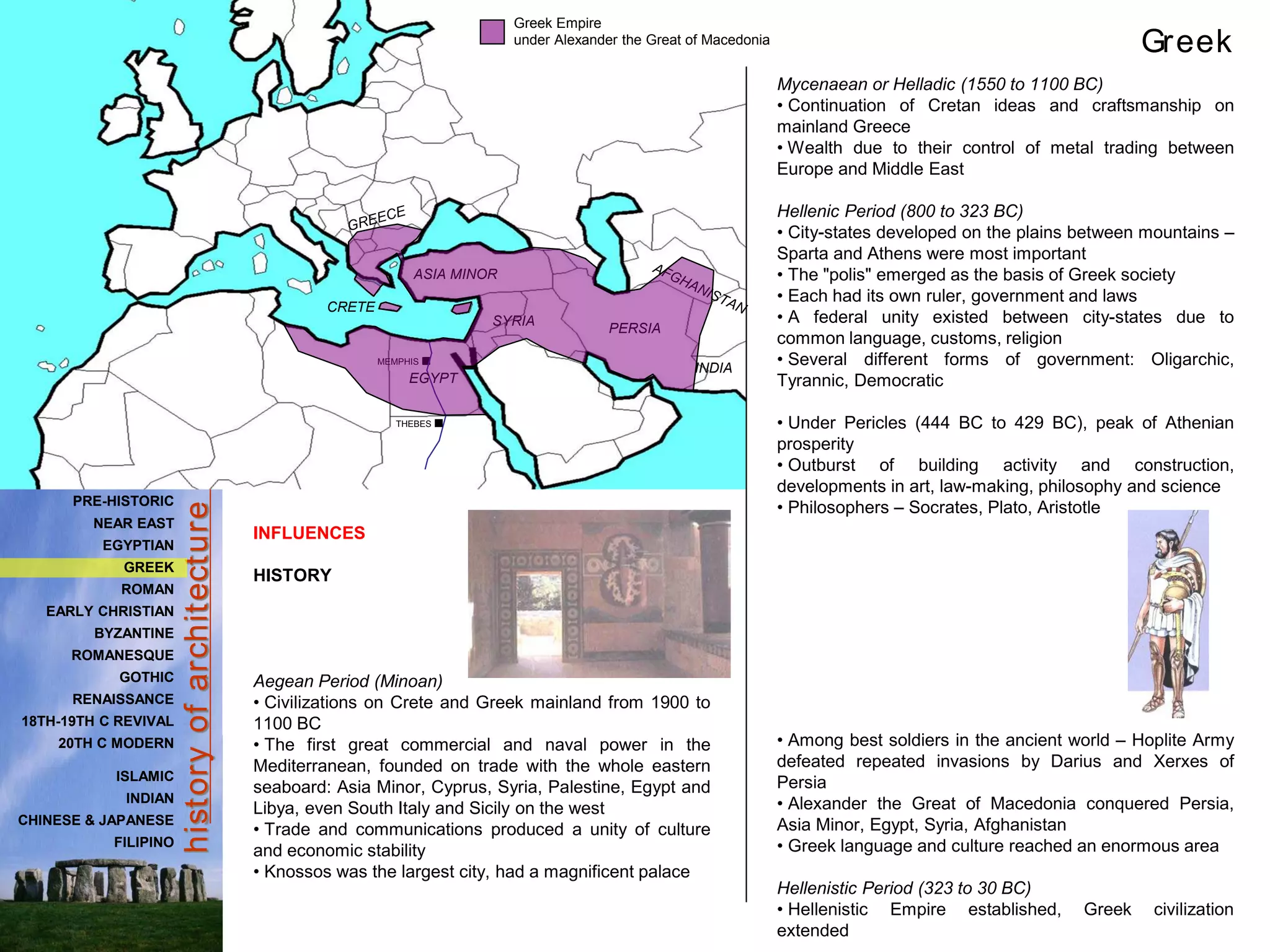
• Alexander the Great of Macedonia conquered Persia,
Asia Minor, Egypt, Syria, Afghanistan
• Greek language and culture reached an enormous area
Hellenistic Period (323 to 30 BC)
• Hellenistic Empire established, Greek civilization
extended
Greek
MEMPHIS
Greek Empire
under Alexander the Great of Macedonia
PERSIA
EGYPT
THEBES
CRETE
ASIA MINOR
INDIA
SYRIA
PRE-HISTORIC
NEAR EAST
EGYPTIAN
GREEK
ROMAN
EARLY CHRISTIAN
BYZANTINE
ROMANESQUE
GOTHIC
RENAISSANCE
18TH-19TH C REVIVAL
20TH C MODERN
ISLAMIC
INDIAN
CHINESE & JAPANESE
FILIPINO
hist
ory
of
archit
ect
ure
GEOLOGY & CLIMATE
• On the mainland, rugged mountains made
communication difficult
• Mountains separated inhabitants into groups, clans,
states
• archipelago and islands: sea was the inevitable means of
trade and communications
• Between rigorous cold and relaxing heat
• Clear atmosphere and intense light - conducive to
creating precise and exact forms
• Judicial activities, dramatic presentations, public
ceremonies took place in the open air
RELIGION
Aegean religion:
• Primitive stage of nature worship
• Priestesses conducted religious rites, sacred games,
ritual dances, worship on sacrificial altars
Greek religion:
• A highly developed form of nature worship
• Gods as personifications of natural elements, or deified
mortals
• Gods could influence events in the human world
• Greeks sought advice from oracles – oracle at Delphi
Greek
ARCHITECTURAL CHARACTER
DESCRIPTION
Aegean
• Rough and massive
Hellenic
• Mostly religious architecture
• "carpentry in marble“ - timber forms imitated in stone with
remarkable exactness
Hellenistic
• Not religious in character, but civic – for the people
• Provided inspiration for Roman building types
• Dignified and gracious structures
• Symmetrical, orderly
CONSTRUCTION SYSTEM
• Columnar and trabeated
• Roof truss appeared, enabling large spaces to be
unhindered by columns
MATERIALS
• Timber and terra cotta
• Stone
PRE-HISTORIC
NEAR EAST
EGYPTIAN
GREEK
ROMAN
EARLY CHRISTIAN
BYZANTINE
ROMANESQUE
GOTHIC
RENAISSANCE
18TH-19TH C REVIVAL
20TH C MODERN
ISLAMIC
INDIAN
CHINESE & JAPANESE
FILIPINO
hist
ory
of
archit
ect
ure
EXAMPLES
HOUSES
On islands:
• Flat roofing
• Drawn together in blocks
• Two to four storeys high
• Light admitted through light wells
On mainland:
• Single-storeyed house with deep plan
• Columned entrance porch with central doorway
• Living apartment proper with sleeping room behind
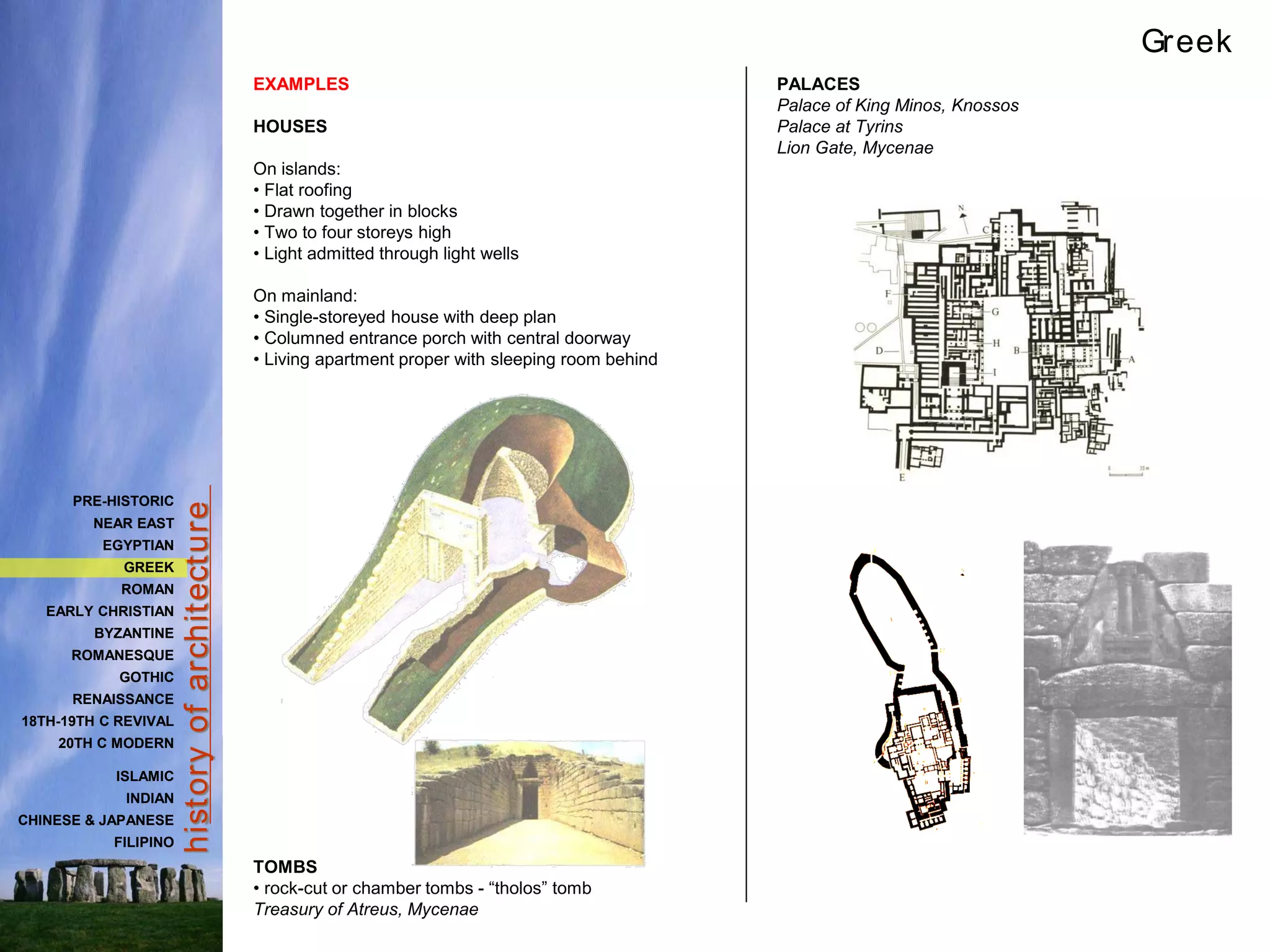
TOMBS
• rock-cut or chamber tombs - “tholos” tomb
Treasury of Atreus, Mycenae
Greek
PALACES
Palace of King Minos, Knossos
Palace at Tyrins
Lion Gate, Mycenae
PRE-HISTORIC
NEAR EAST
EGYPTIAN
GREEK
ROMAN
EARLY CHRISTIAN
BYZANTINE
ROMANESQUE
GOTHIC
RENAISSANCE
18TH-19TH C REVIVAL
20TH C MODERN
ISLAMIC
INDIAN
CHINESE & JAPANESE
FILIPINO
hist
ory
of
archit
ect
ure
Greek
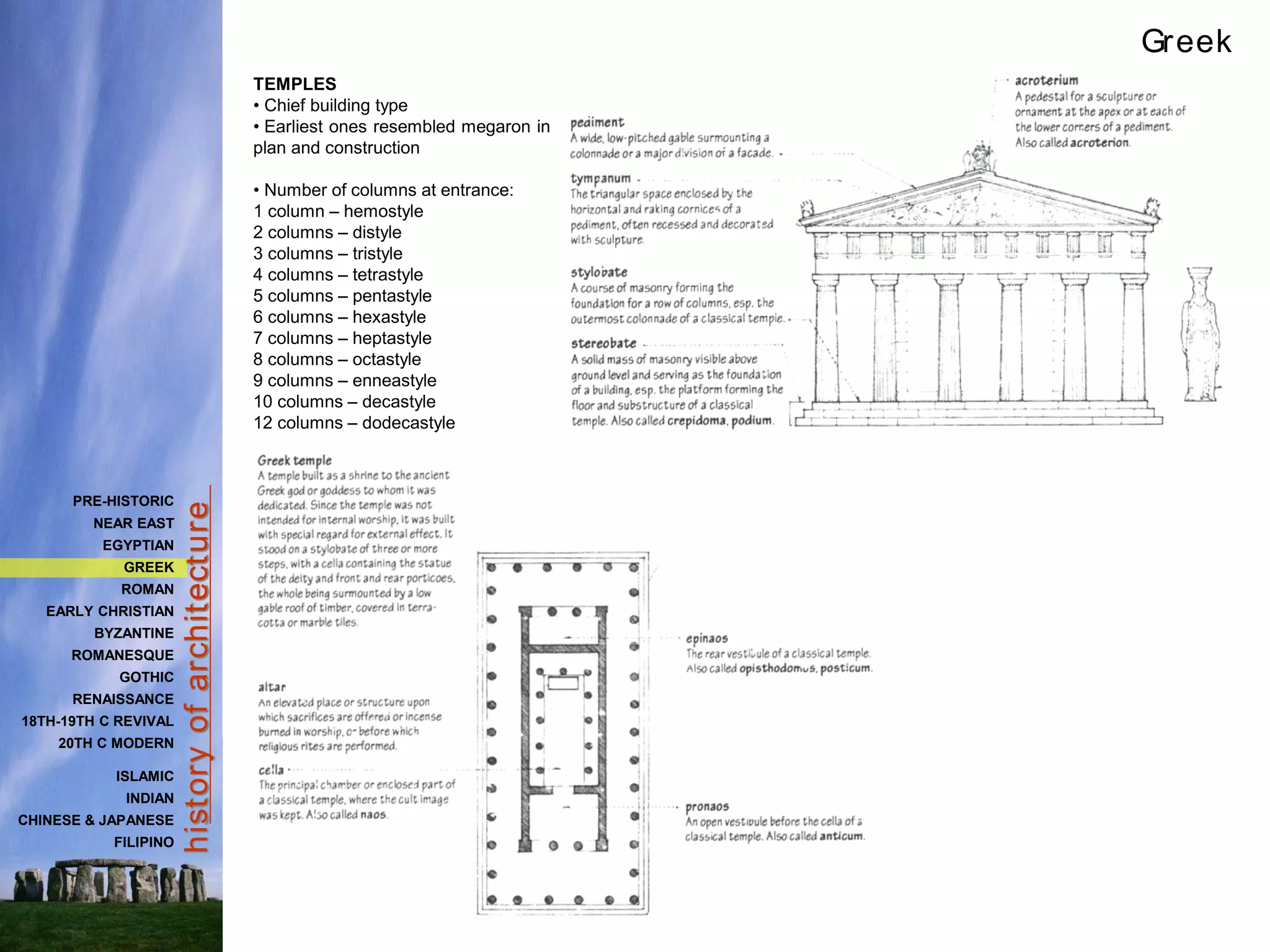
TEMPLES
• Chief building type
• Earliest ones resembled megaron in
plan and construction
• Number of columns at entrance:
1 column – hemostyle
2 columns – distyle
3 columns – tristyle
4 columns – tetrastyle
5 columns – pentastyle
6 columns – hexastyle
7 columns – heptastyle
8 columns – octastyle
9 columns – enneastyle
10 columns – decastyle
12 columns – dodecastyle
PRE-HISTORIC
NEAR EAST
EGYPTIAN
GREEK
ROMAN
EARLY CHRISTIAN
BYZANTINE
ROMANESQUE
GOTHIC
RENAISSANCE
18TH-19TH C REVIVAL
20TH C MODERN
ISLAMIC
INDIAN
CHINESE & JAPANESE
FILIPINO
hist
ory
of
archit
ect
ure
Greek
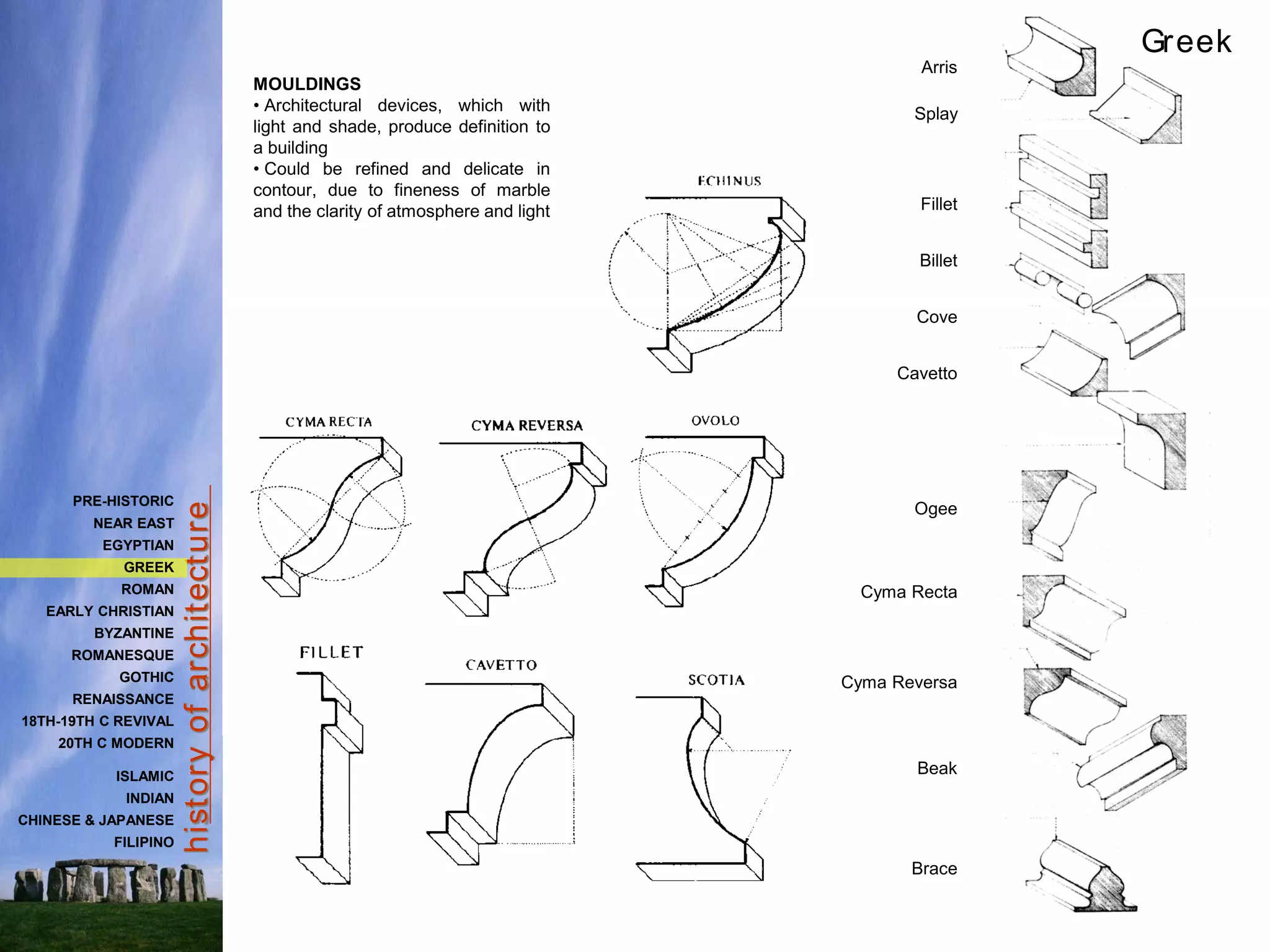
MOULDINGS
• Architectural devices, which with
light and shade, produce definition to
a building
• Could be refined and delicate in
contour, due to fineness of marble
and the clarity of atmosphere and light
Arris
Splay
Fillet
Billet
Cove
Cavetto
Ogee
Cyma Recta
Cyma Reversa
Beak
Brace
PRE-HISTORIC
NEAR EAST
EGYPTIAN
GREEK
ROMAN
EARLY CHRISTIAN
BYZANTINE
ROMANESQUE
GOTHIC
RENAISSANCE
18TH-19TH C REVIVAL
20TH C MODERN
ISLAMIC
INDIAN
CHINESE & JAPANESE
FILIPINO
hist
ory
of
archit
ect
ure
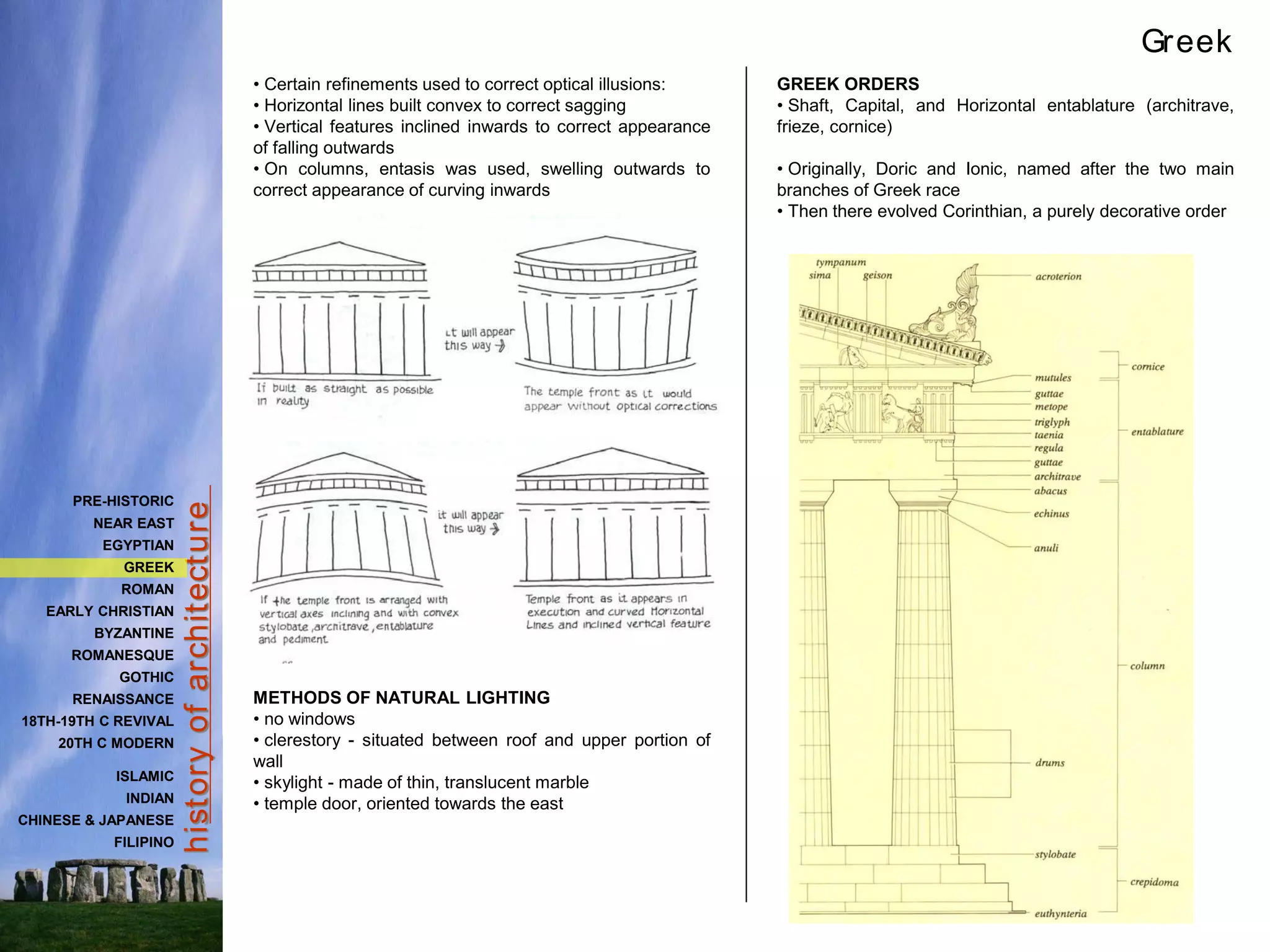
• Certain refinements used to correct optical illusions:
• Horizontal lines built convex to correct sagging
• Vertical features inclined inwards to correct appearance
of falling outwards
• On columns, entasis was used, swelling outwards to
correct appearance of curving inwards
METHODS OF NATURAL LIGHTING
• no windows
• clerestory - situated between roof and upper portion of
wall
• skylight - made of thin, translucent marble
• temple door, oriented towards the east
Greek
GREEK ORDERS
• Shaft, Capital, and Horizontal entablature (architrave,
frieze, cornice)
• Originally, Doric and Ionic, named after the two main
branches of Greek race
• Then there evolved Corinthian, a purely decorative order
PRE-HISTORIC
NEAR EAST
EGYPTIAN
GREEK
ROMAN
EARLY CHRISTIAN
BYZANTINE
ROMANESQUE
GOTHIC
RENAISSANCE
18TH-19TH C REVIVAL
20TH C MODERN
ISLAMIC
INDIAN
CHINESE & JAPANESE
FILIPINO
hist
ory
of
archit
ect
ure
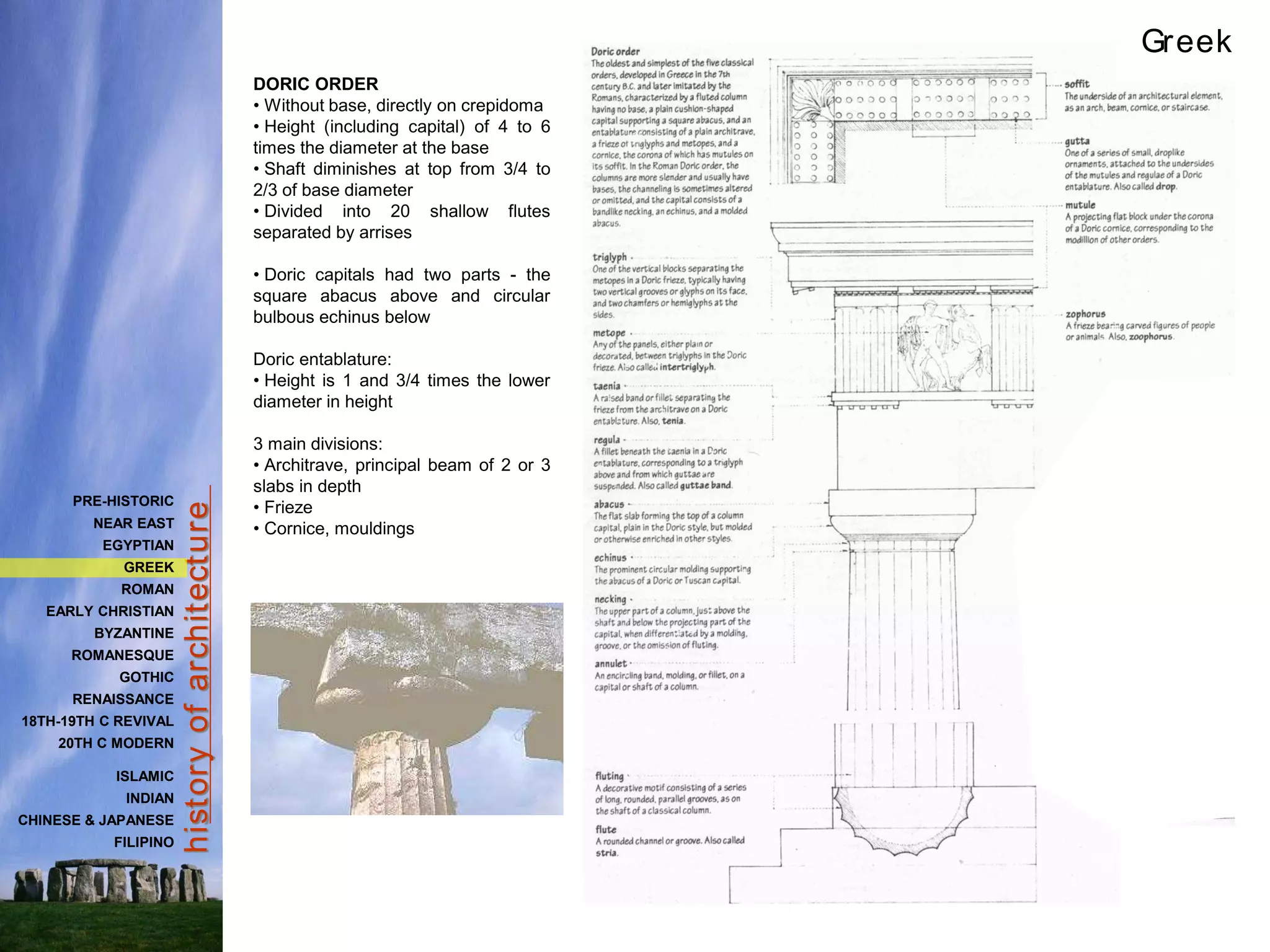
DORIC ORDER
• Without base, directly on crepidoma
• Height (including capital) of 4 to 6
times the diameter at the base
• Shaft diminishes at top from 3/4 to
2/3 of base diameter
• Divided into 20 shallow flutes
separated by arrises
• Doric capitals had two parts - the
square abacus above and circular
bulbous echinus below
Doric entablature:
• Height is 1 and 3/4 times the lower
diameter in height
3 main divisions:
• Architrave, principal beam of 2 or 3
slabs in depth
• Frieze
• Cornice, mouldings
Greek
PRE-HISTORIC
NEAR EAST
EGYPTIAN
GREEK
ROMAN
EARLY CHRISTIAN
BYZANTINE
ROMANESQUE
GOTHIC
RENAISSANCE
18TH-19TH C REVIVAL
20TH C MODERN
ISLAMIC
INDIAN
CHINESE & JAPANESE
FILIPINO
hist
ory
of
archit
ect
ure
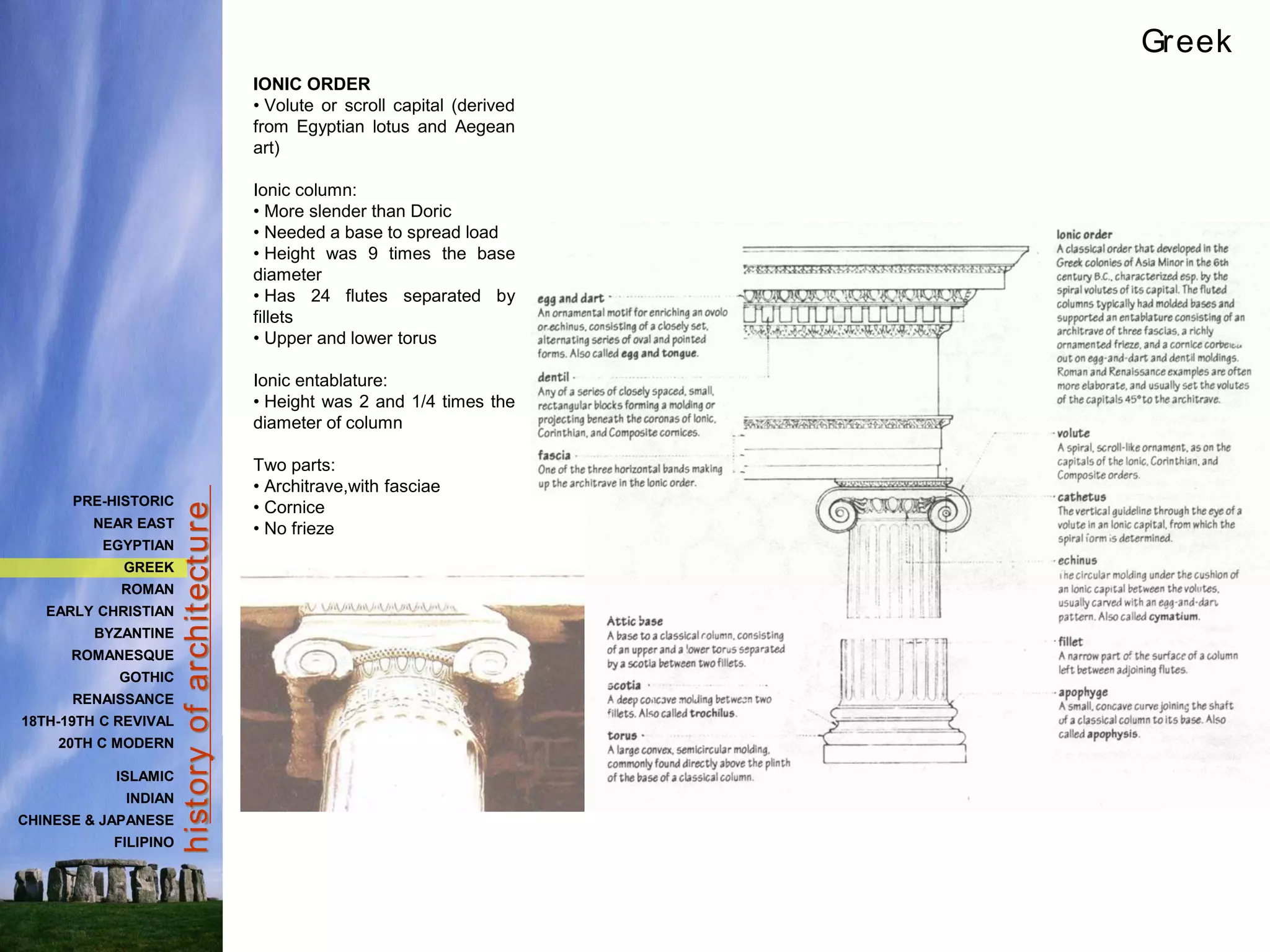
IONIC ORDER
• Volute or scroll capital (derived
from Egyptian lotus and Aegean
art)
Ionic column:
• More slender than Doric
• Needed a base to spread load
• Height was 9 times the base
diameter
• Has 24 flutes separated by
fillets
• Upper and lower torus
Ionic entablature:
• Height was 2 and 1/4 times the
diameter of column
Two parts:
• Architrave,with fasciae
• Cornice
• No frieze
Greek
PRE-HISTORIC
NEAR EAST
EGYPTIAN
GREEK
ROMAN
EARLY CHRISTIAN
BYZANTINE
ROMANESQUE
GOTHIC
RENAISSANCE
18TH-19TH C REVIVAL
20TH C MODERN
ISLAMIC
INDIAN
CHINESE & JAPANESE
FILIPINO
hist
ory
of
archit
ect
ure
Greek
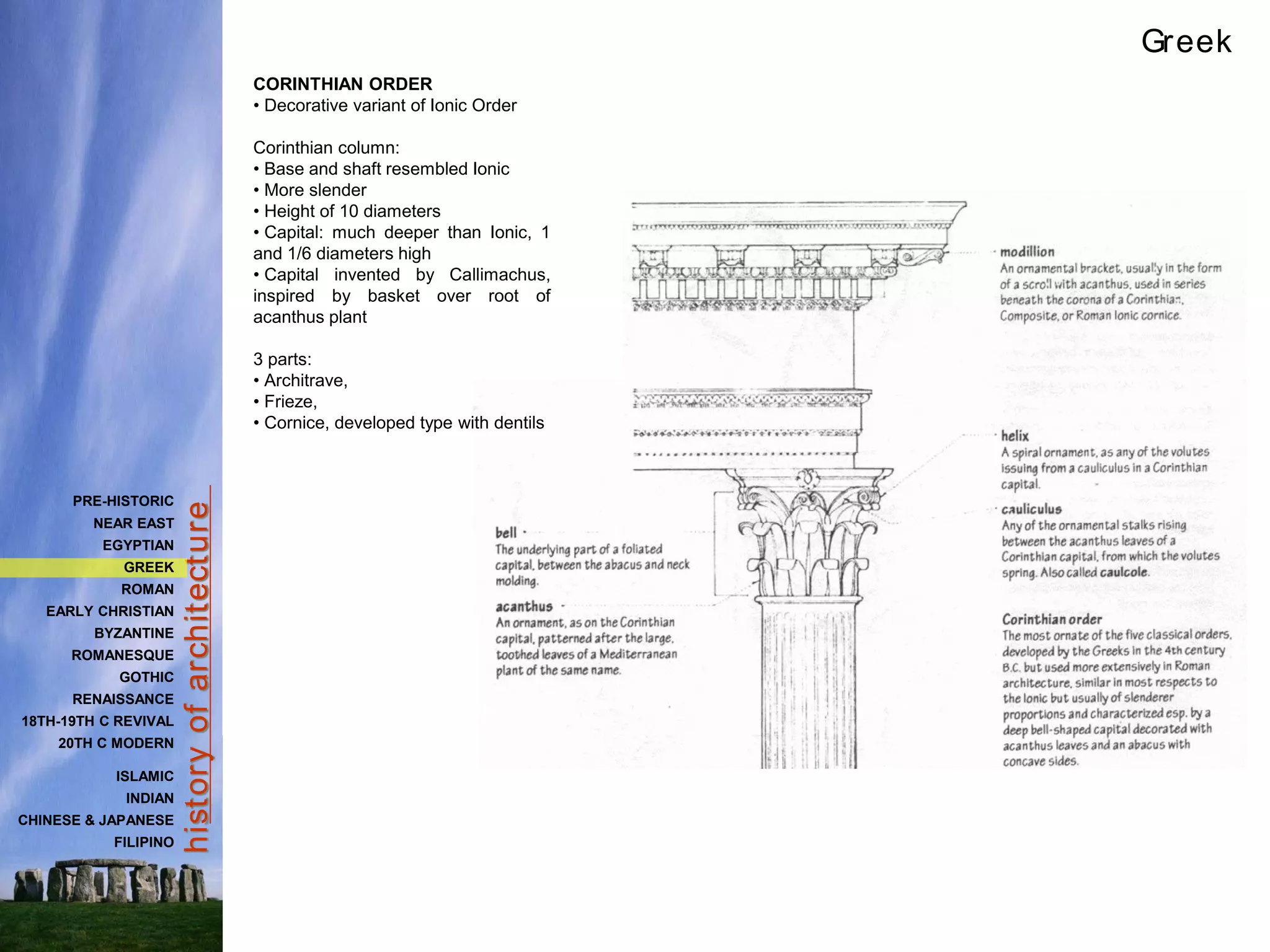
CORINTHIAN ORDER
• Decorative variant of Ionic Order
Corinthian column:
• Base and shaft resembled Ionic
• More slender
• Height of 10 diameters
• Capital: much deeper than Ionic, 1
and 1/6 diameters high
• Capital invented by Callimachus,
inspired by basket over root of
acanthus plant
3 parts:
• Architrave,
• Frieze,
• Cornice, developed type with dentils
PRE-HISTORIC
NEAR EAST
EGYPTIAN
GREEK
ROMAN
EARLY CHRISTIAN
BYZANTINE
ROMANESQUE
GOTHIC
RENAISSANCE
18TH-19TH C REVIVAL
20TH C MODERN
ISLAMIC
INDIAN
CHINESE & JAPANESE
FILIPINO
hist
ory
of
archit
ect
ure
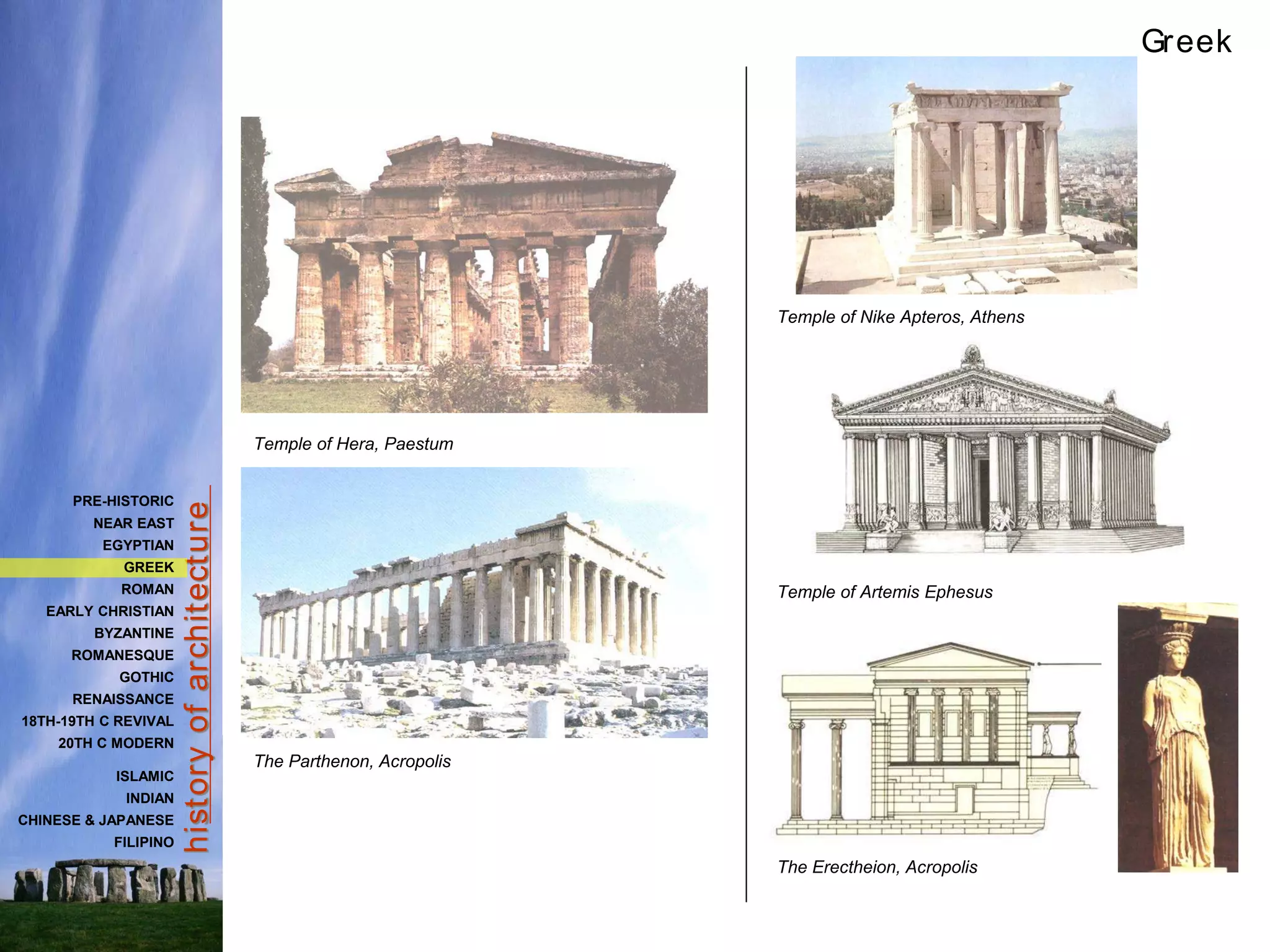
Temple of Nike Apteros, Athens
Temple of Artemis Ephesus
The Erectheion, Acropolis
Greek
PRE-HISTORIC
NEAR EAST
EGYPTIAN
GREEK
ROMAN
EARLY CHRISTIAN
BYZANTINE
ROMANESQUE
GOTHIC
RENAISSANCE
18TH-19TH C REVIVAL
20TH C MODERN
ISLAMIC
INDIAN
CHINESE & JAPANESE
FILIPINO
Temple of Hera, Paestum
The Parthenon, Acropolis
hist
ory
of
archit
ect
ure
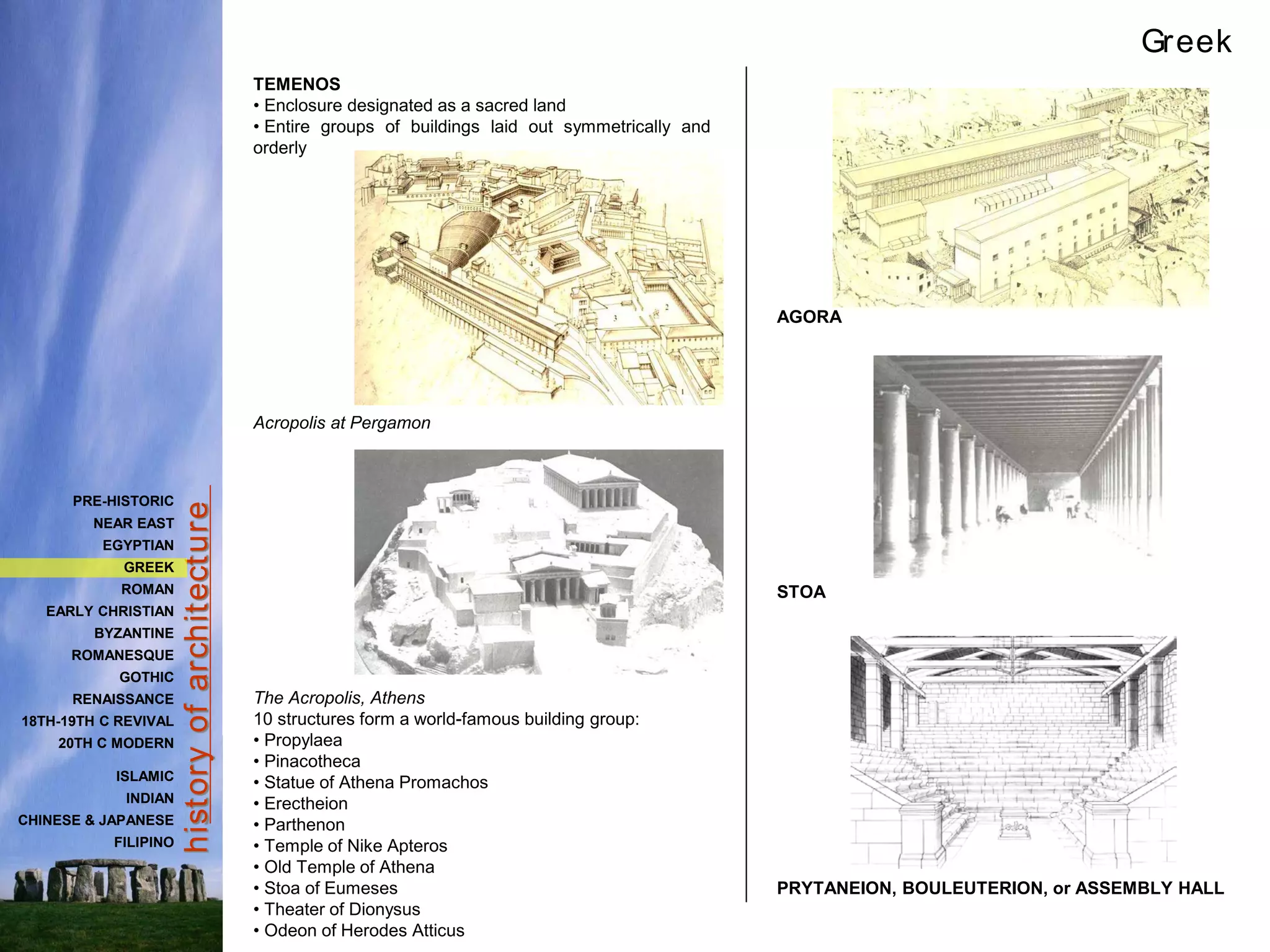
AGORA
STOA
PRYTANEION, BOULEUTERION, or ASSEMBLY HALL
TEMENOS
• Enclosure designated as a sacred land
• Entire groups of buildings laid out symmetrically and
orderly
Acropolis at Pergamon
The Acropolis, Athens
10 structures form a world-famous building group:
• Propylaea
• Pinacotheca
• Statue of Athena Promachos
• Erectheion
• Parthenon
• Temple of Nike Apteros
• Old Temple of Athena
• Stoa of Eumeses
• Theater of Dionysus
• Odeon of Herodes Atticus
Greek
PRE-HISTORIC
NEAR EAST
EGYPTIAN
GREEK
ROMAN
EARLY CHRISTIAN
BYZANTINE
ROMANESQUE
GOTHIC
RENAISSANCE
18TH-19TH C REVIVAL
20TH C MODERN
ISLAMIC
INDIAN
CHINESE & JAPANESE
FILIPINO
hist
ory
of
archit
ect
ure
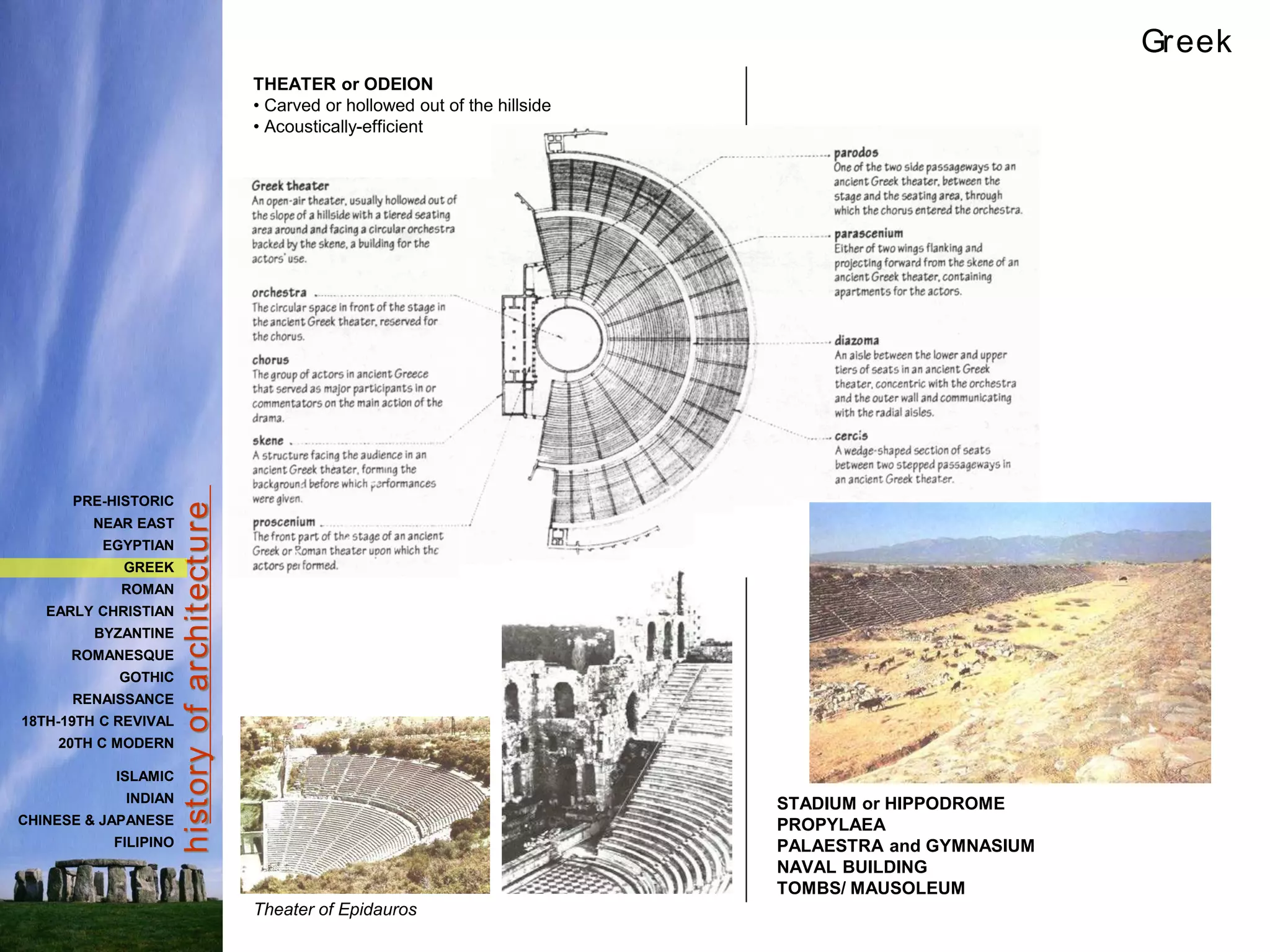
STADIUM or HIPPODROME
PROPYLAEA
PALAESTRA and GYMNASIUM
NAVAL BUILDING
TOMBS/ MAUSOLEUM
Greek
PRE-HISTORIC
NEAR EAST
EGYPTIAN
GREEK
ROMAN
EARLY CHRISTIAN
BYZANTINE
ROMANESQUE
GOTHIC
RENAISSANCE
18TH-19TH C REVIVAL
20TH C MODERN
ISLAMIC
INDIAN
CHINESE & JAPANESE
FILIPINO
THEATER or ODEION
• Carved or hollowed out of the hillside
• Acoustically-efficient
Theater of Epidauros
hist
ory
of
archit
ect
ure
Greek
PRE-HISTORIC
NEAR EAST
EGYPTIAN
GREEK
ROMAN
EARLY CHRISTIAN
BYZANTINE
ROMANESQUE
GOTHIC
RENAISSANCE
18TH-19TH C REVIVAL
20TH C MODERN
ISLAMIC
INDIAN
CHINESE & JAPANESE
FILIPINO

Lec-IV_Ancient Greek Architecture.pdf

  • 1.
    hist ory of archit ect ure History of Architecture PartI- Ancient Architecture Lecture - IV
  • 2.
    hist ory of archit ect ure Greek The Historical Timeline ofArchitecture PRE-HISTORIC NEAR EAST EGYPTIAN GREEK ROMAN EARLY CHRISTIAN BYZANTINE ROMANESQUE GOTHIC RENAISSANCE 18TH-19TH C REVIVAL 20TH C MODERN ISLAMIC INDIAN CHINESE & JAPANESE FILIPINO Pre-Historic Egyptian Near East Greek
  • 3.
    hist ory of archit ect ure INFLUENCES HISTORY Aegean Period (Minoan) •Civilizations on Crete and Greek mainland from 1900 to 1100 BC • The first great commercial and naval power in the Mediterranean, founded on trade with the whole eastern seaboard: Asia Minor, Cyprus, Syria, Palestine, Egypt and Libya, even South Italy and Sicily on the west • Trade and communications produced a unity of culture and economic stability • Knossos was the largest city, had a magnificent palace Mycenaean or Helladic (1550 to 1100 BC) • Continuation of Cretan ideas and craftsmanship on mainland Greece • Wealth due to their control of metal trading between Europe and Middle East Hellenic Period (800 to 323 BC) • City-states developed on the plains between mountains – Sparta and Athens were most important • The "polis" emerged as the basis of Greek society • Each had its own ruler, government and laws • A federal unity existed between city-states due to common language, customs, religion • Several different forms of government: Oligarchic, Tyrannic, Democratic • Under Pericles (444 BC to 429 BC), peak of Athenian prosperity • Outburst of building activity and construction, developments in art, law-making, philosophy and science • Philosophers – Socrates, Plato, Aristotle • Among best soldiers in the ancient world – Hoplite Army defeated repeated invasions by Darius and Xerxes of Persia • Alexander the Great of Macedonia conquered Persia, Asia Minor, Egypt, Syria, Afghanistan • Greek language and culture reached an enormous area Hellenistic Period (323 to 30 BC) • Hellenistic Empire established, Greek civilization extended Greek MEMPHIS Greek Empire under Alexander the Great of Macedonia PERSIA EGYPT THEBES CRETE ASIA MINOR INDIA SYRIA PRE-HISTORIC NEAR EAST EGYPTIAN GREEK ROMAN EARLY CHRISTIAN BYZANTINE ROMANESQUE GOTHIC RENAISSANCE 18TH-19TH C REVIVAL 20TH C MODERN ISLAMIC INDIAN CHINESE & JAPANESE FILIPINO
  • 4.
    hist ory of archit ect ure GEOLOGY & CLIMATE •On the mainland, rugged mountains made communication difficult • Mountains separated inhabitants into groups, clans, states • archipelago and islands: sea was the inevitable means of trade and communications • Between rigorous cold and relaxing heat • Clear atmosphere and intense light - conducive to creating precise and exact forms • Judicial activities, dramatic presentations, public ceremonies took place in the open air RELIGION Aegean religion: • Primitive stage of nature worship • Priestesses conducted religious rites, sacred games, ritual dances, worship on sacrificial altars Greek religion: • A highly developed form of nature worship • Gods as personifications of natural elements, or deified mortals • Gods could influence events in the human world • Greeks sought advice from oracles – oracle at Delphi Greek ARCHITECTURAL CHARACTER DESCRIPTION Aegean • Rough and massive Hellenic • Mostly religious architecture • "carpentry in marble“ - timber forms imitated in stone with remarkable exactness Hellenistic • Not religious in character, but civic – for the people • Provided inspiration for Roman building types • Dignified and gracious structures • Symmetrical, orderly CONSTRUCTION SYSTEM • Columnar and trabeated • Roof truss appeared, enabling large spaces to be unhindered by columns MATERIALS • Timber and terra cotta • Stone PRE-HISTORIC NEAR EAST EGYPTIAN GREEK ROMAN EARLY CHRISTIAN BYZANTINE ROMANESQUE GOTHIC RENAISSANCE 18TH-19TH C REVIVAL 20TH C MODERN ISLAMIC INDIAN CHINESE & JAPANESE FILIPINO
  • 5.
    hist ory of archit ect ure EXAMPLES HOUSES On islands: • Flatroofing • Drawn together in blocks • Two to four storeys high • Light admitted through light wells On mainland: • Single-storeyed house with deep plan • Columned entrance porch with central doorway • Living apartment proper with sleeping room behind TOMBS • rock-cut or chamber tombs - “tholos” tomb Treasury of Atreus, Mycenae Greek PALACES Palace of King Minos, Knossos Palace at Tyrins Lion Gate, Mycenae PRE-HISTORIC NEAR EAST EGYPTIAN GREEK ROMAN EARLY CHRISTIAN BYZANTINE ROMANESQUE GOTHIC RENAISSANCE 18TH-19TH C REVIVAL 20TH C MODERN ISLAMIC INDIAN CHINESE & JAPANESE FILIPINO
  • 6.
    hist ory of archit ect ure Greek TEMPLES • Chief buildingtype • Earliest ones resembled megaron in plan and construction • Number of columns at entrance: 1 column – hemostyle 2 columns – distyle 3 columns – tristyle 4 columns – tetrastyle 5 columns – pentastyle 6 columns – hexastyle 7 columns – heptastyle 8 columns – octastyle 9 columns – enneastyle 10 columns – decastyle 12 columns – dodecastyle PRE-HISTORIC NEAR EAST EGYPTIAN GREEK ROMAN EARLY CHRISTIAN BYZANTINE ROMANESQUE GOTHIC RENAISSANCE 18TH-19TH C REVIVAL 20TH C MODERN ISLAMIC INDIAN CHINESE & JAPANESE FILIPINO
  • 7.
    hist ory of archit ect ure Greek MOULDINGS • Architectural devices,which with light and shade, produce definition to a building • Could be refined and delicate in contour, due to fineness of marble and the clarity of atmosphere and light Arris Splay Fillet Billet Cove Cavetto Ogee Cyma Recta Cyma Reversa Beak Brace PRE-HISTORIC NEAR EAST EGYPTIAN GREEK ROMAN EARLY CHRISTIAN BYZANTINE ROMANESQUE GOTHIC RENAISSANCE 18TH-19TH C REVIVAL 20TH C MODERN ISLAMIC INDIAN CHINESE & JAPANESE FILIPINO
  • 8.
    hist ory of archit ect ure • Certain refinementsused to correct optical illusions: • Horizontal lines built convex to correct sagging • Vertical features inclined inwards to correct appearance of falling outwards • On columns, entasis was used, swelling outwards to correct appearance of curving inwards METHODS OF NATURAL LIGHTING • no windows • clerestory - situated between roof and upper portion of wall • skylight - made of thin, translucent marble • temple door, oriented towards the east Greek GREEK ORDERS • Shaft, Capital, and Horizontal entablature (architrave, frieze, cornice) • Originally, Doric and Ionic, named after the two main branches of Greek race • Then there evolved Corinthian, a purely decorative order PRE-HISTORIC NEAR EAST EGYPTIAN GREEK ROMAN EARLY CHRISTIAN BYZANTINE ROMANESQUE GOTHIC RENAISSANCE 18TH-19TH C REVIVAL 20TH C MODERN ISLAMIC INDIAN CHINESE & JAPANESE FILIPINO
  • 9.
    hist ory of archit ect ure DORIC ORDER • Withoutbase, directly on crepidoma • Height (including capital) of 4 to 6 times the diameter at the base • Shaft diminishes at top from 3/4 to 2/3 of base diameter • Divided into 20 shallow flutes separated by arrises • Doric capitals had two parts - the square abacus above and circular bulbous echinus below Doric entablature: • Height is 1 and 3/4 times the lower diameter in height 3 main divisions: • Architrave, principal beam of 2 or 3 slabs in depth • Frieze • Cornice, mouldings Greek PRE-HISTORIC NEAR EAST EGYPTIAN GREEK ROMAN EARLY CHRISTIAN BYZANTINE ROMANESQUE GOTHIC RENAISSANCE 18TH-19TH C REVIVAL 20TH C MODERN ISLAMIC INDIAN CHINESE & JAPANESE FILIPINO
  • 10.
    hist ory of archit ect ure IONIC ORDER • Voluteor scroll capital (derived from Egyptian lotus and Aegean art) Ionic column: • More slender than Doric • Needed a base to spread load • Height was 9 times the base diameter • Has 24 flutes separated by fillets • Upper and lower torus Ionic entablature: • Height was 2 and 1/4 times the diameter of column Two parts: • Architrave,with fasciae • Cornice • No frieze Greek PRE-HISTORIC NEAR EAST EGYPTIAN GREEK ROMAN EARLY CHRISTIAN BYZANTINE ROMANESQUE GOTHIC RENAISSANCE 18TH-19TH C REVIVAL 20TH C MODERN ISLAMIC INDIAN CHINESE & JAPANESE FILIPINO
  • 11.
    hist ory of archit ect ure Greek CORINTHIAN ORDER • Decorativevariant of Ionic Order Corinthian column: • Base and shaft resembled Ionic • More slender • Height of 10 diameters • Capital: much deeper than Ionic, 1 and 1/6 diameters high • Capital invented by Callimachus, inspired by basket over root of acanthus plant 3 parts: • Architrave, • Frieze, • Cornice, developed type with dentils PRE-HISTORIC NEAR EAST EGYPTIAN GREEK ROMAN EARLY CHRISTIAN BYZANTINE ROMANESQUE GOTHIC RENAISSANCE 18TH-19TH C REVIVAL 20TH C MODERN ISLAMIC INDIAN CHINESE & JAPANESE FILIPINO
  • 12.
    hist ory of archit ect ure Temple of NikeApteros, Athens Temple of Artemis Ephesus The Erectheion, Acropolis Greek PRE-HISTORIC NEAR EAST EGYPTIAN GREEK ROMAN EARLY CHRISTIAN BYZANTINE ROMANESQUE GOTHIC RENAISSANCE 18TH-19TH C REVIVAL 20TH C MODERN ISLAMIC INDIAN CHINESE & JAPANESE FILIPINO Temple of Hera, Paestum The Parthenon, Acropolis
  • 13.
    hist ory of archit ect ure AGORA STOA PRYTANEION, BOULEUTERION, orASSEMBLY HALL TEMENOS • Enclosure designated as a sacred land • Entire groups of buildings laid out symmetrically and orderly Acropolis at Pergamon The Acropolis, Athens 10 structures form a world-famous building group: • Propylaea • Pinacotheca • Statue of Athena Promachos • Erectheion • Parthenon • Temple of Nike Apteros • Old Temple of Athena • Stoa of Eumeses • Theater of Dionysus • Odeon of Herodes Atticus Greek PRE-HISTORIC NEAR EAST EGYPTIAN GREEK ROMAN EARLY CHRISTIAN BYZANTINE ROMANESQUE GOTHIC RENAISSANCE 18TH-19TH C REVIVAL 20TH C MODERN ISLAMIC INDIAN CHINESE & JAPANESE FILIPINO
  • 14.
    hist ory of archit ect ure STADIUM or HIPPODROME PROPYLAEA PALAESTRAand GYMNASIUM NAVAL BUILDING TOMBS/ MAUSOLEUM Greek PRE-HISTORIC NEAR EAST EGYPTIAN GREEK ROMAN EARLY CHRISTIAN BYZANTINE ROMANESQUE GOTHIC RENAISSANCE 18TH-19TH C REVIVAL 20TH C MODERN ISLAMIC INDIAN CHINESE & JAPANESE FILIPINO THEATER or ODEION • Carved or hollowed out of the hillside • Acoustically-efficient Theater of Epidauros
  • 15.