ARCHITECTURE, SPACE, FORM AND ORDER CIRCULATION
CIRCULATION INTRODUCTION Our  journey or circulation path  can be conceived of as the  perceptual  thread that links the spaces of a building, or any series of  interior or exterior  spaces, together Since we move in  Time Through a  Sequence Of  Spaces We experience a space in relation to where we’ve been and where we anticipate going In this  topic  we’ll look at the principal components of a building’s  circulation   system  as  positive elements  that affect our perception of the forms and spaces of the building
CIRCULATION Before passing into the  interior of a building , we have to  approach  its  entrance  along a path This is the  first phase  of the  circulation system , when we are preparing to  see ,  experience , and  use  the spaces within a building The approach and entrance  can vary in duration from a few paces through a compressed space, to a lengthy and circuitous route It can be  perpendicular  to the  primary   façade  or be  oblique  to it The  nature of the approach  may  contrast  with what is  confronted at its termination , or it may be continued on into the building’s interior sequence of spaces,  obscuring  the  distinction  between  inside and outside
CIRCULATION APPROACH The Distant View ENTRANCE From Outside to inside CONFIGURATION OF THE PATH The Sequences of Spaces PATH-SPACE RELATIONSHIPS Edges, Nodes, and Terminations of the Path FORM OF THE CIRCULATION SPACE Corridors, Halls, Galleries, Stairways and Rooms
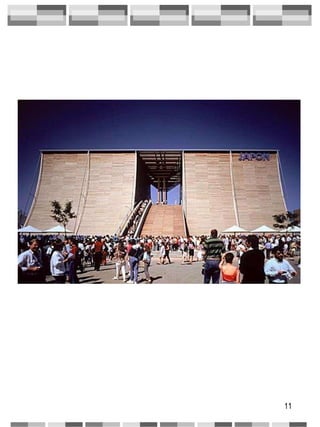
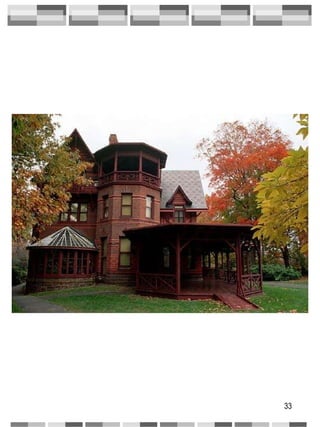
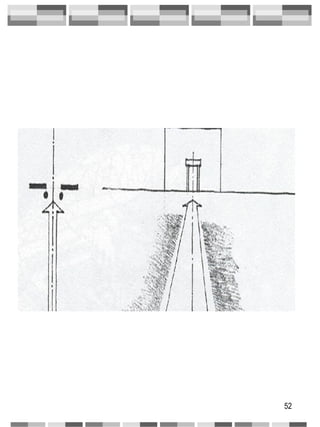
CIRCULATION APPROACH FRONTAL A  Frontal approach  leads directly to the entrance of a building along a straight,  axial path. The  visual goal  that  terminates  the approach is clear It may be the  entire front facade  of a building or an  elaborated entrance  within  the plane
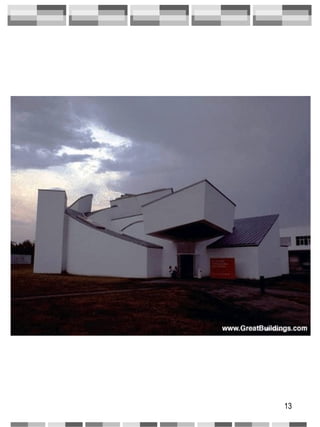
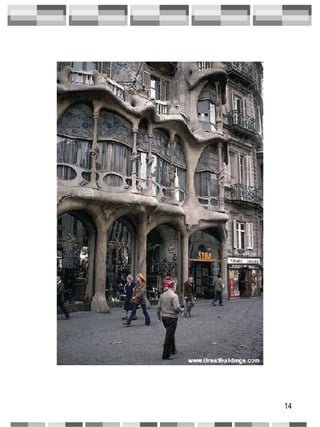
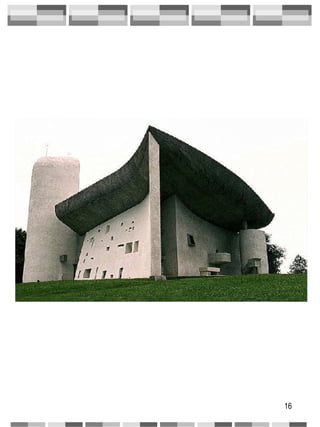
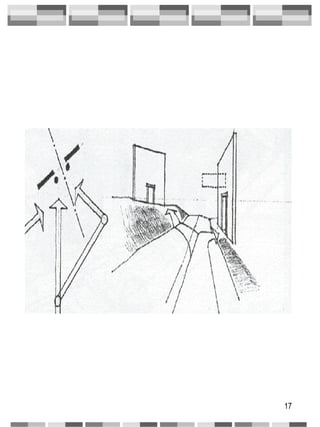
CIRCULATION OBLIQUE An  oblique approach  enhances the effect of  perspective  on the  front   façade  and  form of a building The path can be redirected one or more times to delay and prolong the  sequence of the approach If a building is approached at an  extreme angle , its  entrance  can  project  beyond its  façade  to be more clearly visible
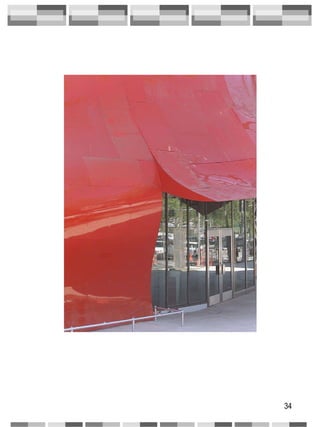
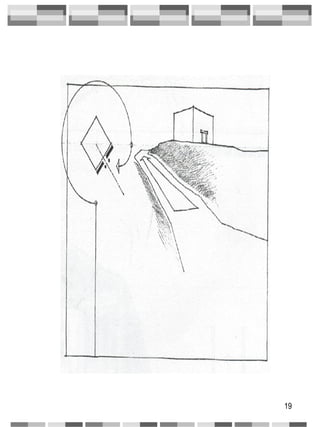
CIRCULATION SPIRAL A spiral path  prolongs the sequence of the approach  and  emphasizes the three-dimensional form of a building  as we move around its  perimeter The building entrance  might be  viewed intermittently  during the approach to clarify its position or it may be hidden until the point of arrival
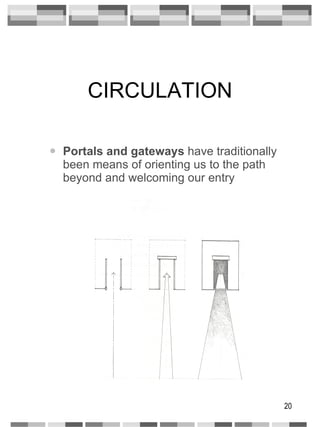
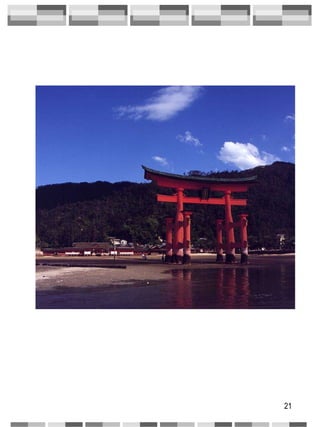
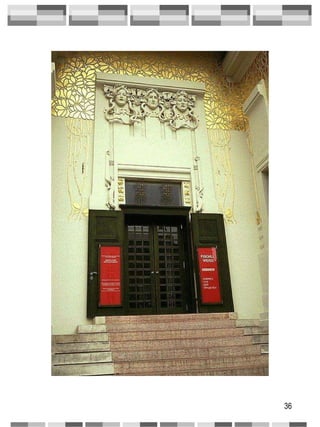
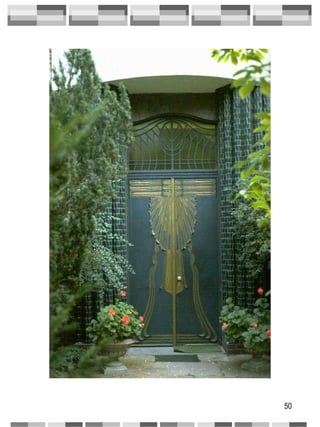
CIRCULATION Portals and gateways  have traditionally been means of orienting us to the path beyond and welcoming our entry
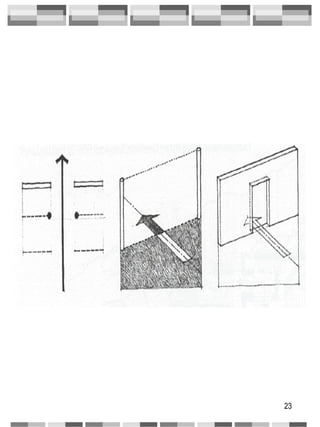
CIRCULATION ENTRANCE Entering  into a defined field of exterior space, a building or a room within a building involves the act of  penetrating a vertical plane  that distinguishes one space from another and separates, where you are, from where you are going
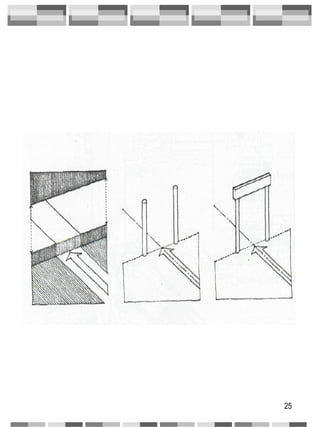
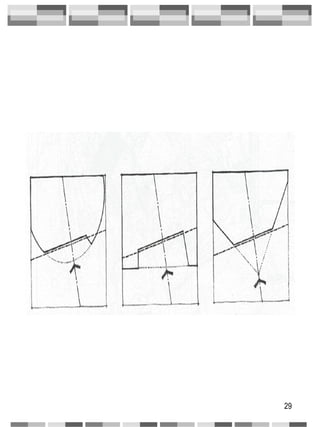
CIRCULATION This act of  entering  can be made significant in a number of ways not just by punching a hole in a wall A  passage  can be created through an  implied plane  established by  two pillars  or an  overhead beam If  greater visual and spatial continuity  between two spaces is desired, even a  change in level  can establish  a threshold  and mark the passage from one place to another
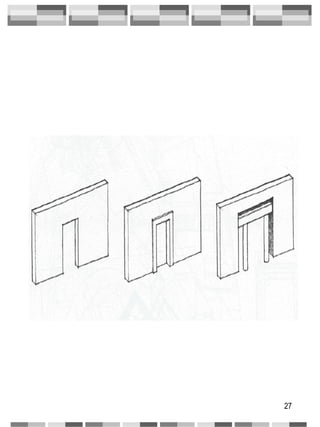
CIRCULATION Normally when  a wall  is used to define and enclose a space or series of spaces, an  entrance  is accommodated by an  opening in the plane of the wall However, the form of the openings can range from a simple hole in the wall to an elaborate, articulated gateway
CIRCULATION No matter what the form of the space being entered or the form of its enclosure, the entrance into the space is best signified by  establishing  a  real or implied plane   perpendicualr to the path of approach
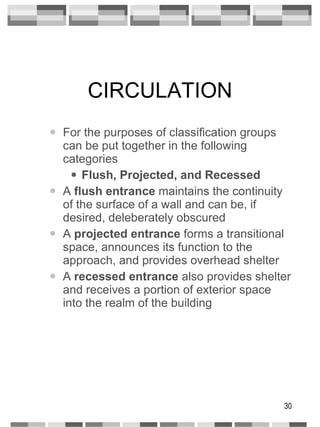
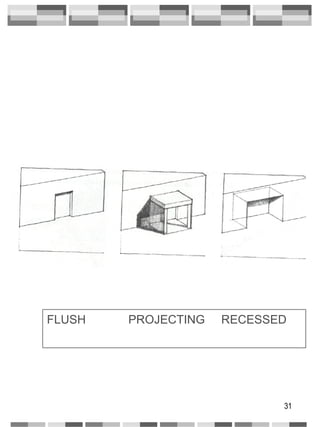
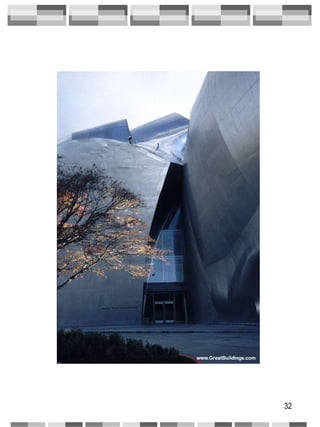
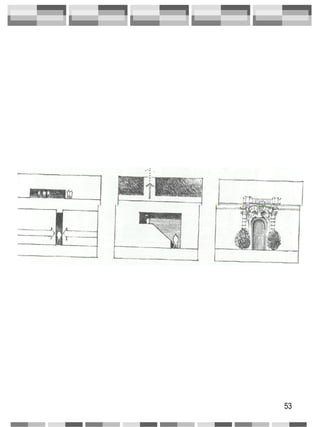
CIRCULATION For the purposes of classification groups can be put together in the following categories Flush, Projected, and Recessed A  flush entrance  maintains the continuity of the surface of a wall and can be, if desired, deleberately obscured A  projected entrance  forms a transitional space, announces its function to the  approach, and provides overhead shelter A  recessed entrance  also provides shelter and receives a portion of exterior space into the realm of the building
FLUSH  PROJECTING  RECESSED
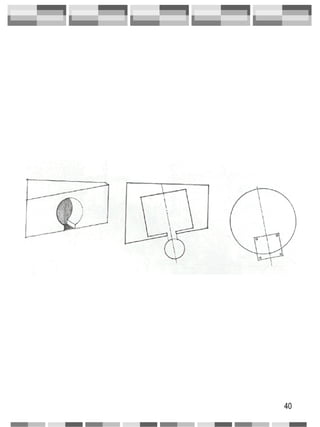
CIRCULATION In each of the categories, the  form  of the  entrance  can be similar to, and serve as a preview of the  form of the space  about to be  entered Or it can  contrast  with the  form of the space  about to be entered to  reinforce  its  boundaries  and  emphasize its character  as a place
CIRCULATION From a  location point  of view an entrance can be  centered within the frontal plane  of a building, or be  placed off-center  to create a condition of  local symmetry  about its opening The  location  of an entrance relative to the form of the space being entered will determine the  configuration of the path  and the  pattern of the activities  within the space
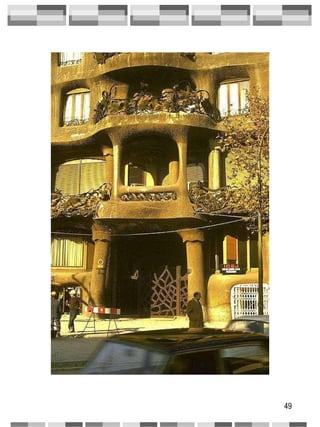
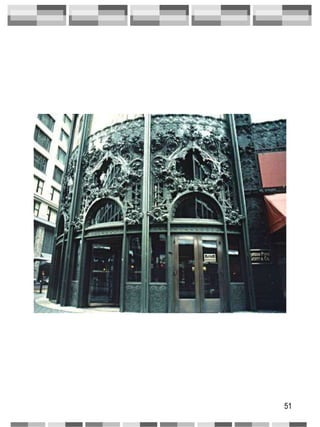
CIRCULATION The idea of an entrance may be visually reinforced by: Making the opening lower, wider, or narrower than anticipated Making the entrance deep or circuitous Articulating the opening with ornamentation or decorative embellishment
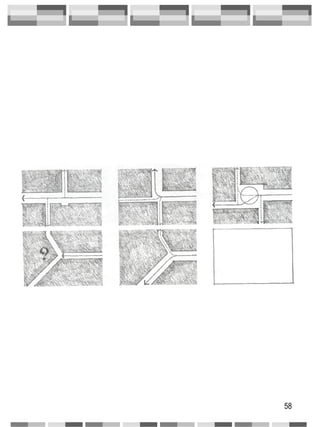
CIRCULATION CONFIGURATION OF THE PATH All  paths of movement , those of people, cars, goods, or services are  linear  in nature All paths have a starting point , after which we are taken through a sequence of spaces to our  destination
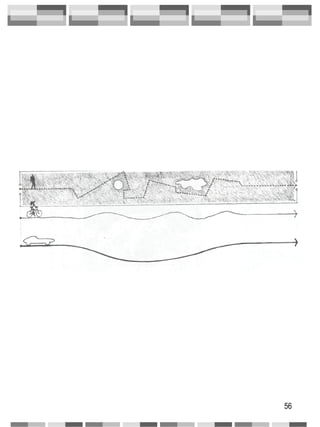
CIRCULATION The  contour of a path  depends on our  mode of transportation Pedestrians  are free to turn, pause, stop and rest at will Wheeled vehicles , for example, a bicycle has less freedom, a car even less, in changing pace and direction abruptly Interestingly whilst wheeled vehicles may require a path with smooth contours, reflecting turning radius’s,  the width of   the path  can be tailored tightly to its dimensions, pedestrians need a greater volume of space than their bodily dimensions and greater freedom of choice along a path
CIRCULATION Persons  approaching an intersection or crossing are always faced with a  decision The Continuity and Scale  of each path at the intersection helps us to distinguish between  majour routes  leading to  major spaces  and  secondary paths  leading to  less important spaces If the  paths  at a crossing are  equal ,  sufficient space  must be provided to allow people to  pause and orient themselves The  form and scale of entrances and  paths must also convey the functional and symbolic distinction between  public promenades, private halls, and service corridors
CIRCULATION The  nature of the configuration  of a path influences and is influenced by the organizational pattern of the spaces it links The  configuration of a path  may  reinforce  a  spatial organization  by  paralleling  its pattern On the other hand  the configuration  may  contrast  with the form of the spatial organization and serve as a visual counterpoint to it Once we are at the stage of being able to  map out the overall configuration   of the   paths  in a building mentally,  our orientation  within the building and our understanding of its spatial layout will be  made clear
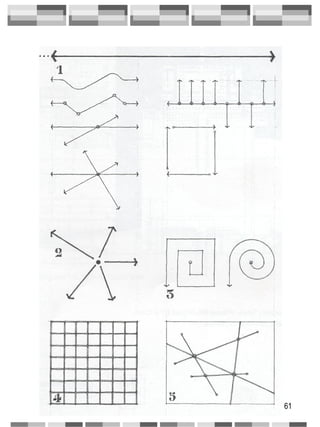
CIRCULATION LINEAR All paths are  linear A Straight path, can be the  primary organizing element  for a series of spaces Also it can be  curvilinear or segmental ,  intersect  other paths, have  branches  or form a  loop RADIAL A  Radial  configuration has  linear paths   extending from or terminating  at a  central, common point SPIRAL A  Spiral configuration  is a  single,   continuous path  that  originates  from a  central point ,  revolves around it  and becomes  increasingly distant  from it
CIRCULATION GRID A Grid configuration  consists of  two sets  of  parallel paths  that  intersect at regular   intervals  and create square or rectangular fields of space NETWORK A  Nework configuration  consists of  paths  that  connect established points  in  space COMPOSITE In reality, a building usually employs a  combination of the different paths Important points  in any  pattern  are  centers  of  activity, entrances to rooms   and halls  and  places  for  vertical circulation  provided by  stairways/ramps  and  elevators
CIRCULATION These  nodes   punctuate  the  paths  of  movement  through a building and provide  opportunites  for  pause, rest and reorientation To  avoid  the creation of a  disorienting maze , a  hierarchical order  among the paths and nodes of a building should be established by differentiating their  scale, form, length and placement
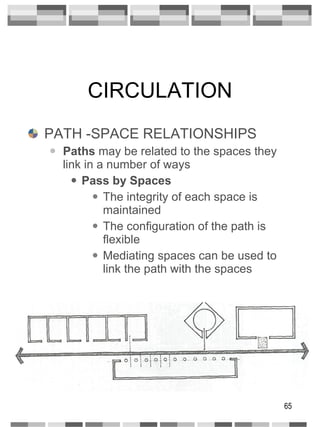
CIRCULATION PATH -SPACE RELATIONSHIPS Paths  may be related to the spaces they link in a number of ways Pass by Spaces The integrity of each space is maintained The configuration of the path is flexible Mediating spaces can be used to link the path with the spaces
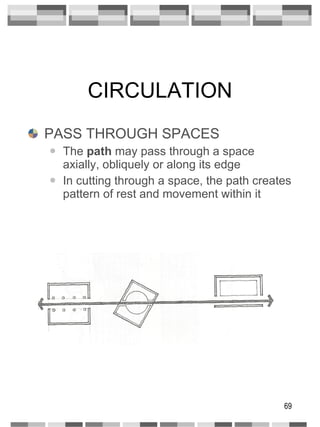
CIRCULATION PASS THROUGH SPACES The  path  may pass through a space axially, obliquely or along its edge In cutting through a space, the path creates pattern of rest and movement within it
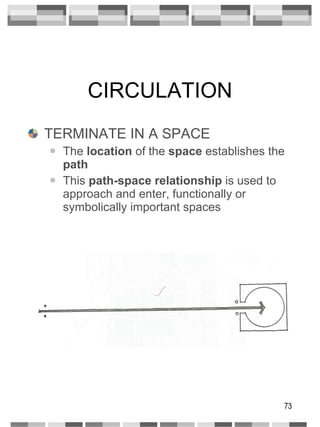
CIRCULATION TERMINATE IN A SPACE The  location  of the  space  establishes the  path This  path-space relationship  is used to approach and enter, functionally or symbolically important spaces
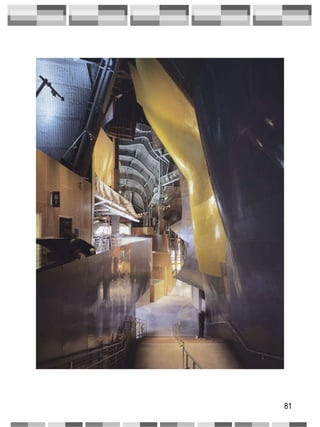
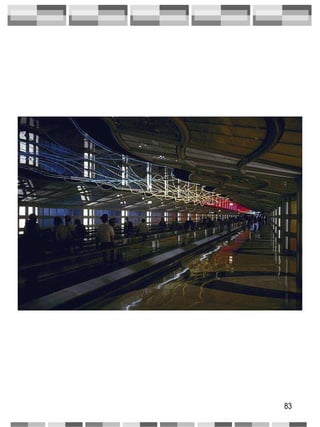
CIRCULATION FORM OF THE CIRCULATION SPACE Spaces for movement  form an integral part of any  building organization  and occupy a significant amount of the volume of a building If considered just as  functional linking   devices , then  circulation paths  would be endless,  corridor-like spaces The form and scale  of a  circulation space , however, should  accommodate  the  movement of people  as they walk, pause, rest, or take in a view along a path
CIRCULATION The  form of a circulation space  varies according to how: Its boundaries are defined Its form relates to the form of the spaces it links Its qualities of scale, proportion, light and view are articulated Entrances open onto it It handles changes in level with stairs and ramps
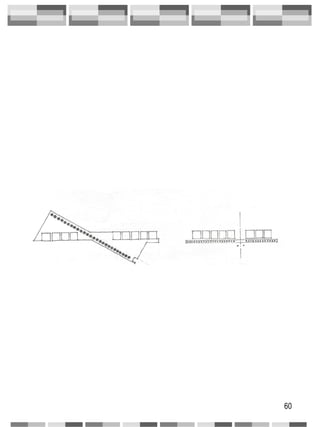
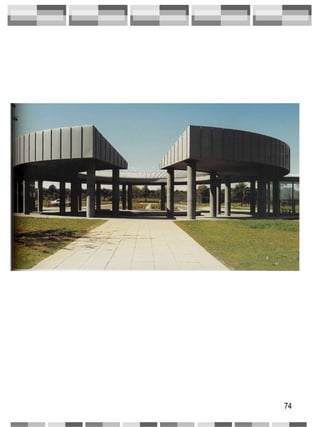
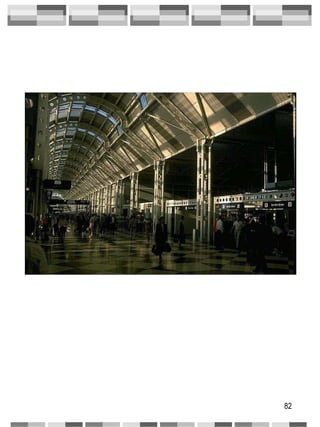
CIRCULATION A circulation space may be: Enclosed Forming a public galleria or private corridor that relates to the spaces it links Open on One Side Forming a colonnaded passageway that becomes a physical extension of the space it passes through
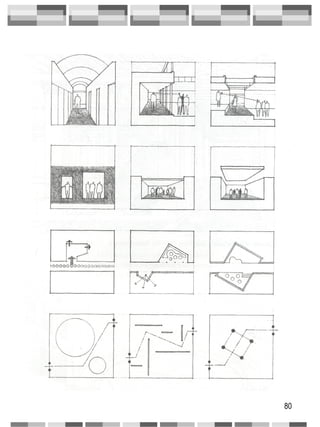
CIRCULATION The  width and height  of a  circulation space   should be proportionate with the type and amount of movement  it must handle A distinction in scale  should be established between a  public promenade,   a more private hall, and a service corridor A narrow, enclosed path  naturally  encourages forward motion To  accommodate more traffic  as well as to create spaces for pausing, resting, or viewing,  sections of a path can be widened
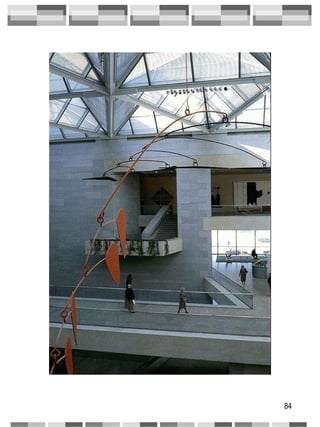
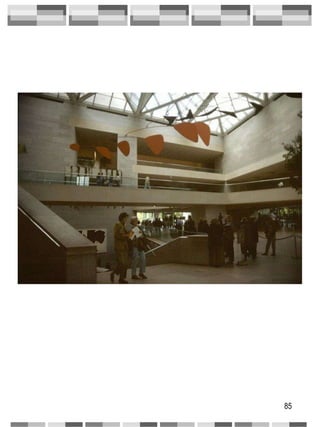
CIRCULATION The path  can also be  enlarged  by  merging  with the  spaces  it  passes through Within a large space , a  path  can be  random , without form or definition, and be  determined  by the  activities and arrangement of furnishings within the space
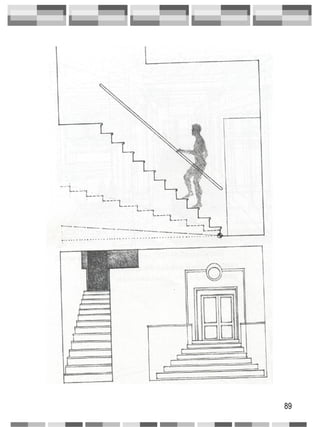
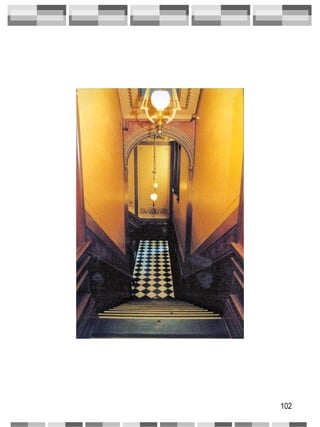
CIRCULATION Stairs and stairways  provide for our  vertical movement  between the levels of a building or outdoor space The slope of a stairway, determined  by  the dimensions of its risers and treads , should be proportioned to fit our body movement and capability If steep,  a stair can make ascent  physically   tiring  as well as  psychologically forbidding , and can make  descent precarious If shallow , a stair must have  treads deep enough to fit  our stride
CIRCULATION A  stairway  must be  wide  enough to comfortably accommodate our passage as well as any furnishings and equipment that must be moved up or down the steps The  width  of a  stairway  also provides a  visual clue  to the  public or private   nature  of the stairway Wide, shallow steps  can serve as an  invitation , while a  narrow, steep stairway  can lead to more  private places While the act of  walking up  a  stairway  may convey privacy, aloofness, or detachment, the  process of going down  can imply moving toward secure, protected or stable ground
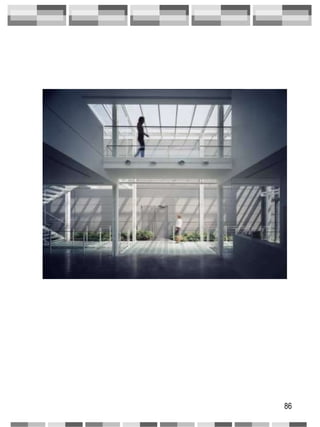
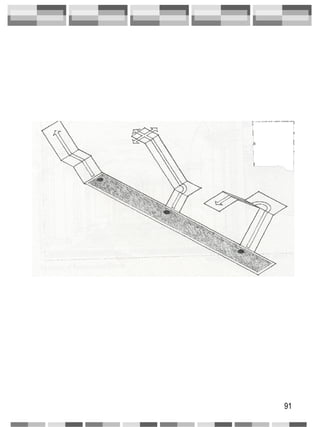
CIRCULATION Landings  interrupt the run of a stair and enable it to change direction Landings  also provide opportunities for rest and possibilities for access and outlook from the stairway Together with the pitch of the stairs, the   locations of landings determine the rhythm and choreography of our movements as we ascend or descend its steps Stairs  in  accommodating a change in level , can  reinforce   the path of movement , interrupt it, accommodate a change in its course, or terminate it prior to entering a major space
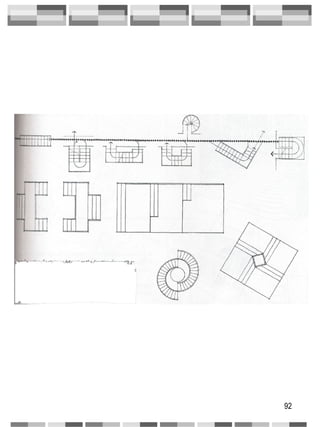
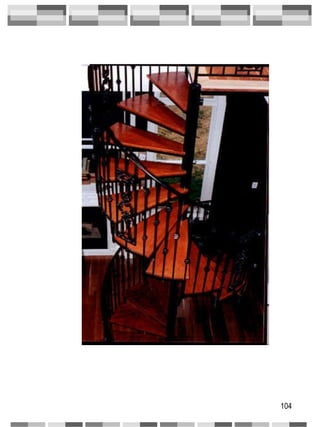
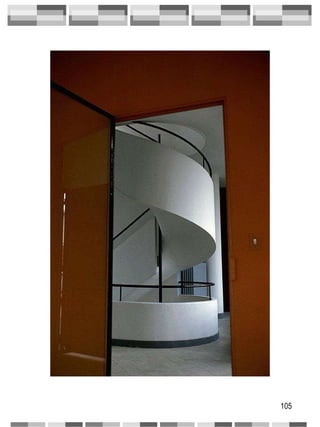
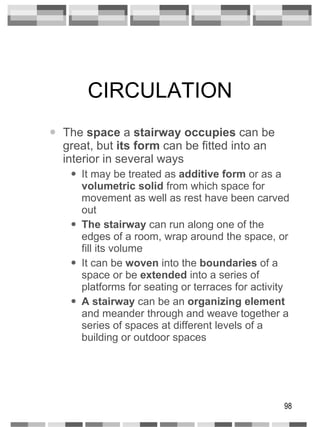
CIRCULATION The configuration of a stairway  determines  the direction of our path  as we  ascend  or  descend  its steps There are  several basic ways  in which to  configure  the  runs of stairs Straight run stair L shaped stair U shaped stair Circular stair Spiral stair Geometric stair
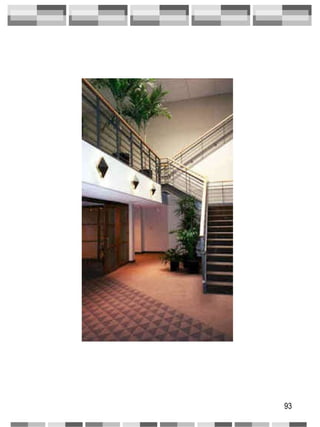
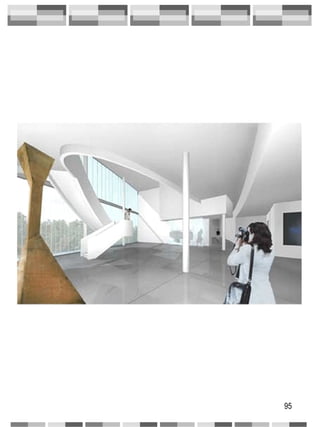
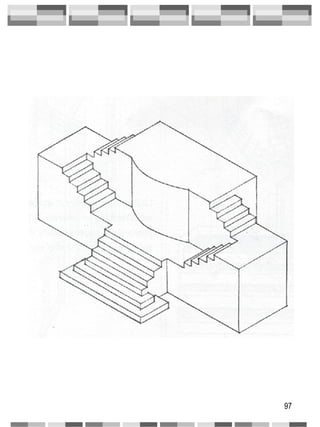
CIRCULATION The  space  a  stairway occupies  can be great, but  its form  can be fitted into an interior in several ways It may be treated as  additive form  or as a  volumetric solid  from which space for movement as well as rest have been carved out The stairway  can run along one of the edges of a room, wrap around the space, or fill its volume It can be  woven  into the  boundaries  of a space or be  extended  into a series of platforms for seating or terraces for activity A stairway  can be an  organizing element  and meander through and weave together a series of spaces at different levels of a building or outdoor spaces
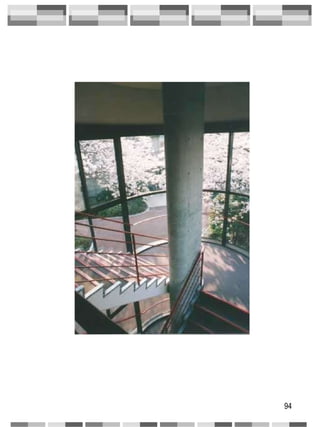
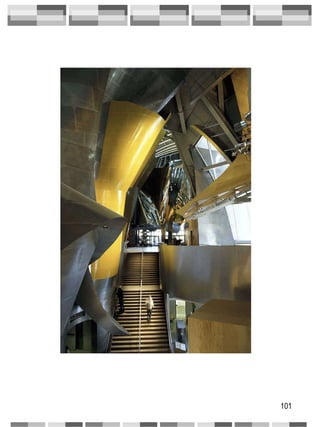
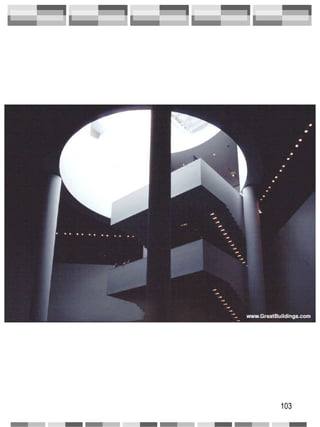
CIRCULATION Landings  which are visible on approach invite ascent, as do treads which spill out at the bottom of a stairway On the other hand , to offer accesss to a private place or signify unapproachability, the path of a stair can rise steeply between walls through a narrow shaft of space Stairs are three-dimensional forms  just as moving up or down a stairway is a three-dimensional experience This three-dimensional  quality can be exploited when we treat it as sculpture, freestanding within a space or attached to a wall plane Further a space  can itself become an  oversized elaborated stairway
Circulation (architecture)

Circulation (architecture)

  • 1.
    ARCHITECTURE, SPACE, FORMAND ORDER CIRCULATION
  • 2.
    CIRCULATION INTRODUCTION Our journey or circulation path can be conceived of as the perceptual thread that links the spaces of a building, or any series of interior or exterior spaces, together Since we move in Time Through a Sequence Of Spaces We experience a space in relation to where we’ve been and where we anticipate going In this topic we’ll look at the principal components of a building’s circulation system as positive elements that affect our perception of the forms and spaces of the building
  • 3.
    CIRCULATION Before passinginto the interior of a building , we have to approach its entrance along a path This is the first phase of the circulation system , when we are preparing to see , experience , and use the spaces within a building The approach and entrance can vary in duration from a few paces through a compressed space, to a lengthy and circuitous route It can be perpendicular to the primary façade or be oblique to it The nature of the approach may contrast with what is confronted at its termination , or it may be continued on into the building’s interior sequence of spaces, obscuring the distinction between inside and outside
  • 4.
    CIRCULATION APPROACH TheDistant View ENTRANCE From Outside to inside CONFIGURATION OF THE PATH The Sequences of Spaces PATH-SPACE RELATIONSHIPS Edges, Nodes, and Terminations of the Path FORM OF THE CIRCULATION SPACE Corridors, Halls, Galleries, Stairways and Rooms
  • 10.
    CIRCULATION APPROACH FRONTALA Frontal approach leads directly to the entrance of a building along a straight, axial path. The visual goal that terminates the approach is clear It may be the entire front facade of a building or an elaborated entrance within the plane
  • 15.
    CIRCULATION OBLIQUE An oblique approach enhances the effect of perspective on the front façade and form of a building The path can be redirected one or more times to delay and prolong the sequence of the approach If a building is approached at an extreme angle , its entrance can project beyond its façade to be more clearly visible
  • 18.
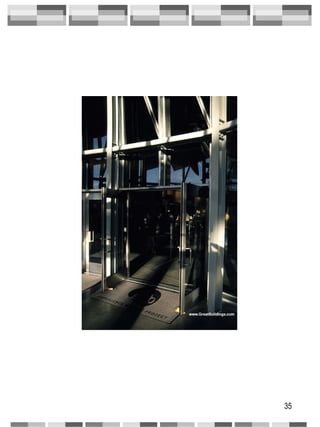
    CIRCULATION SPIRAL Aspiral path prolongs the sequence of the approach and emphasizes the three-dimensional form of a building as we move around its perimeter The building entrance might be viewed intermittently during the approach to clarify its position or it may be hidden until the point of arrival
  • 20.
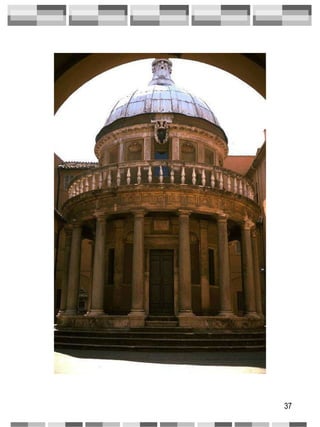
    CIRCULATION Portals andgateways have traditionally been means of orienting us to the path beyond and welcoming our entry
  • 22.
    CIRCULATION ENTRANCE Entering into a defined field of exterior space, a building or a room within a building involves the act of penetrating a vertical plane that distinguishes one space from another and separates, where you are, from where you are going
  • 24.
    CIRCULATION This actof entering can be made significant in a number of ways not just by punching a hole in a wall A passage can be created through an implied plane established by two pillars or an overhead beam If greater visual and spatial continuity between two spaces is desired, even a change in level can establish a threshold and mark the passage from one place to another
  • 26.
    CIRCULATION Normally when a wall is used to define and enclose a space or series of spaces, an entrance is accommodated by an opening in the plane of the wall However, the form of the openings can range from a simple hole in the wall to an elaborate, articulated gateway
  • 28.
    CIRCULATION No matterwhat the form of the space being entered or the form of its enclosure, the entrance into the space is best signified by establishing a real or implied plane perpendicualr to the path of approach
  • 30.
    CIRCULATION For thepurposes of classification groups can be put together in the following categories Flush, Projected, and Recessed A flush entrance maintains the continuity of the surface of a wall and can be, if desired, deleberately obscured A projected entrance forms a transitional space, announces its function to the approach, and provides overhead shelter A recessed entrance also provides shelter and receives a portion of exterior space into the realm of the building
  • 31.
  • 39.
    CIRCULATION In eachof the categories, the form of the entrance can be similar to, and serve as a preview of the form of the space about to be entered Or it can contrast with the form of the space about to be entered to reinforce its boundaries and emphasize its character as a place
  • 42.
    CIRCULATION From a location point of view an entrance can be centered within the frontal plane of a building, or be placed off-center to create a condition of local symmetry about its opening The location of an entrance relative to the form of the space being entered will determine the configuration of the path and the pattern of the activities within the space
  • 48.
    CIRCULATION The ideaof an entrance may be visually reinforced by: Making the opening lower, wider, or narrower than anticipated Making the entrance deep or circuitous Articulating the opening with ornamentation or decorative embellishment
  • 54.
    CIRCULATION CONFIGURATION OFTHE PATH All paths of movement , those of people, cars, goods, or services are linear in nature All paths have a starting point , after which we are taken through a sequence of spaces to our destination
  • 55.
    CIRCULATION The contour of a path depends on our mode of transportation Pedestrians are free to turn, pause, stop and rest at will Wheeled vehicles , for example, a bicycle has less freedom, a car even less, in changing pace and direction abruptly Interestingly whilst wheeled vehicles may require a path with smooth contours, reflecting turning radius’s, the width of the path can be tailored tightly to its dimensions, pedestrians need a greater volume of space than their bodily dimensions and greater freedom of choice along a path
  • 57.
    CIRCULATION Persons approaching an intersection or crossing are always faced with a decision The Continuity and Scale of each path at the intersection helps us to distinguish between majour routes leading to major spaces and secondary paths leading to less important spaces If the paths at a crossing are equal , sufficient space must be provided to allow people to pause and orient themselves The form and scale of entrances and paths must also convey the functional and symbolic distinction between public promenades, private halls, and service corridors
  • 59.
    CIRCULATION The nature of the configuration of a path influences and is influenced by the organizational pattern of the spaces it links The configuration of a path may reinforce a spatial organization by paralleling its pattern On the other hand the configuration may contrast with the form of the spatial organization and serve as a visual counterpoint to it Once we are at the stage of being able to map out the overall configuration of the paths in a building mentally, our orientation within the building and our understanding of its spatial layout will be made clear
  • 62.
    CIRCULATION LINEAR Allpaths are linear A Straight path, can be the primary organizing element for a series of spaces Also it can be curvilinear or segmental , intersect other paths, have branches or form a loop RADIAL A Radial configuration has linear paths extending from or terminating at a central, common point SPIRAL A Spiral configuration is a single, continuous path that originates from a central point , revolves around it and becomes increasingly distant from it
  • 63.
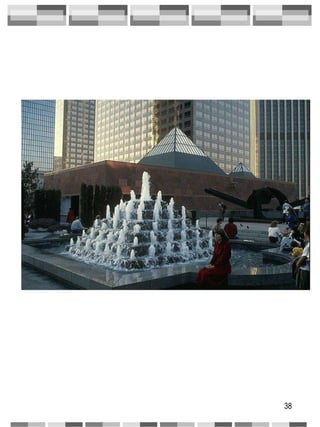
    CIRCULATION GRID AGrid configuration consists of two sets of parallel paths that intersect at regular intervals and create square or rectangular fields of space NETWORK A Nework configuration consists of paths that connect established points in space COMPOSITE In reality, a building usually employs a combination of the different paths Important points in any pattern are centers of activity, entrances to rooms and halls and places for vertical circulation provided by stairways/ramps and elevators
  • 64.
    CIRCULATION These nodes punctuate the paths of movement through a building and provide opportunites for pause, rest and reorientation To avoid the creation of a disorienting maze , a hierarchical order among the paths and nodes of a building should be established by differentiating their scale, form, length and placement
  • 65.
    CIRCULATION PATH -SPACERELATIONSHIPS Paths may be related to the spaces they link in a number of ways Pass by Spaces The integrity of each space is maintained The configuration of the path is flexible Mediating spaces can be used to link the path with the spaces
  • 69.
    CIRCULATION PASS THROUGHSPACES The path may pass through a space axially, obliquely or along its edge In cutting through a space, the path creates pattern of rest and movement within it
  • 73.
    CIRCULATION TERMINATE INA SPACE The location of the space establishes the path This path-space relationship is used to approach and enter, functionally or symbolically important spaces
  • 75.
    CIRCULATION FORM OFTHE CIRCULATION SPACE Spaces for movement form an integral part of any building organization and occupy a significant amount of the volume of a building If considered just as functional linking devices , then circulation paths would be endless, corridor-like spaces The form and scale of a circulation space , however, should accommodate the movement of people as they walk, pause, rest, or take in a view along a path
  • 76.
    CIRCULATION The form of a circulation space varies according to how: Its boundaries are defined Its form relates to the form of the spaces it links Its qualities of scale, proportion, light and view are articulated Entrances open onto it It handles changes in level with stairs and ramps
  • 77.
    CIRCULATION A circulationspace may be: Enclosed Forming a public galleria or private corridor that relates to the spaces it links Open on One Side Forming a colonnaded passageway that becomes a physical extension of the space it passes through
  • 78.
    CIRCULATION The width and height of a circulation space should be proportionate with the type and amount of movement it must handle A distinction in scale should be established between a public promenade, a more private hall, and a service corridor A narrow, enclosed path naturally encourages forward motion To accommodate more traffic as well as to create spaces for pausing, resting, or viewing, sections of a path can be widened
  • 79.
    CIRCULATION The path can also be enlarged by merging with the spaces it passes through Within a large space , a path can be random , without form or definition, and be determined by the activities and arrangement of furnishings within the space
  • 87.
    CIRCULATION Stairs andstairways provide for our vertical movement between the levels of a building or outdoor space The slope of a stairway, determined by the dimensions of its risers and treads , should be proportioned to fit our body movement and capability If steep, a stair can make ascent physically tiring as well as psychologically forbidding , and can make descent precarious If shallow , a stair must have treads deep enough to fit our stride
  • 88.
    CIRCULATION A stairway must be wide enough to comfortably accommodate our passage as well as any furnishings and equipment that must be moved up or down the steps The width of a stairway also provides a visual clue to the public or private nature of the stairway Wide, shallow steps can serve as an invitation , while a narrow, steep stairway can lead to more private places While the act of walking up a stairway may convey privacy, aloofness, or detachment, the process of going down can imply moving toward secure, protected or stable ground
  • 90.
    CIRCULATION Landings interrupt the run of a stair and enable it to change direction Landings also provide opportunities for rest and possibilities for access and outlook from the stairway Together with the pitch of the stairs, the locations of landings determine the rhythm and choreography of our movements as we ascend or descend its steps Stairs in accommodating a change in level , can reinforce the path of movement , interrupt it, accommodate a change in its course, or terminate it prior to entering a major space
  • 96.
    CIRCULATION The configurationof a stairway determines the direction of our path as we ascend or descend its steps There are several basic ways in which to configure the runs of stairs Straight run stair L shaped stair U shaped stair Circular stair Spiral stair Geometric stair
  • 98.
    CIRCULATION The space a stairway occupies can be great, but its form can be fitted into an interior in several ways It may be treated as additive form or as a volumetric solid from which space for movement as well as rest have been carved out The stairway can run along one of the edges of a room, wrap around the space, or fill its volume It can be woven into the boundaries of a space or be extended into a series of platforms for seating or terraces for activity A stairway can be an organizing element and meander through and weave together a series of spaces at different levels of a building or outdoor spaces
  • 100.
    CIRCULATION Landings which are visible on approach invite ascent, as do treads which spill out at the bottom of a stairway On the other hand , to offer accesss to a private place or signify unapproachability, the path of a stair can rise steeply between walls through a narrow shaft of space Stairs are three-dimensional forms just as moving up or down a stairway is a three-dimensional experience This three-dimensional quality can be exploited when we treat it as sculpture, freestanding within a space or attached to a wall plane Further a space can itself become an oversized elaborated stairway