Architectural Patterns of
Animals
Architectural Patterns of Animals
Hierarchical Organization of Complexity
- Five (5) major grades of organization
- Each successive grade is more complex than and builds on the preceding ones
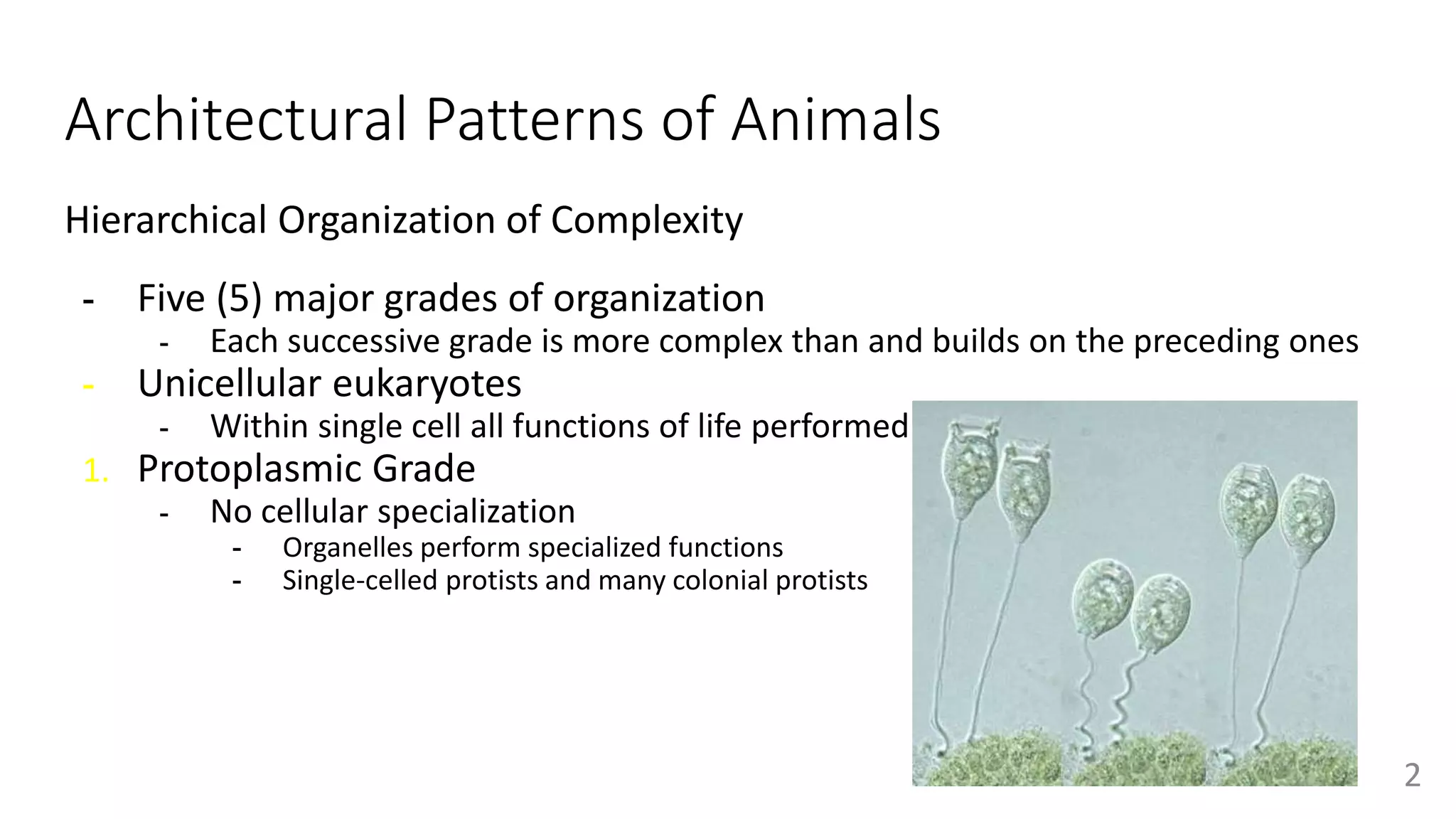
- Unicellular eukaryotes
- Within single cell all functions of life performed
1. Protoplasmic Grade
- No cellular specialization
- Organelles perform specialized functions
- Single-celled protists and many colonial protists
2
Architectural Patterns of Animals
Hierarchical Organization of Complexity
- Five (5) major grades of organization
- Each successive grade is more complex than and builds on the preceding ones
2. Cellular grade
- Multicellular organisms
- Cell specialization
- Cells cannot survive apart from the whole
- Sponges, some colonial protists
3
Architectural Patterns of Animals
Hierarchical Organization of Complexity
- Five (5) major grades of organization
- Each successive grade is more complex than and builds on the preceding ones
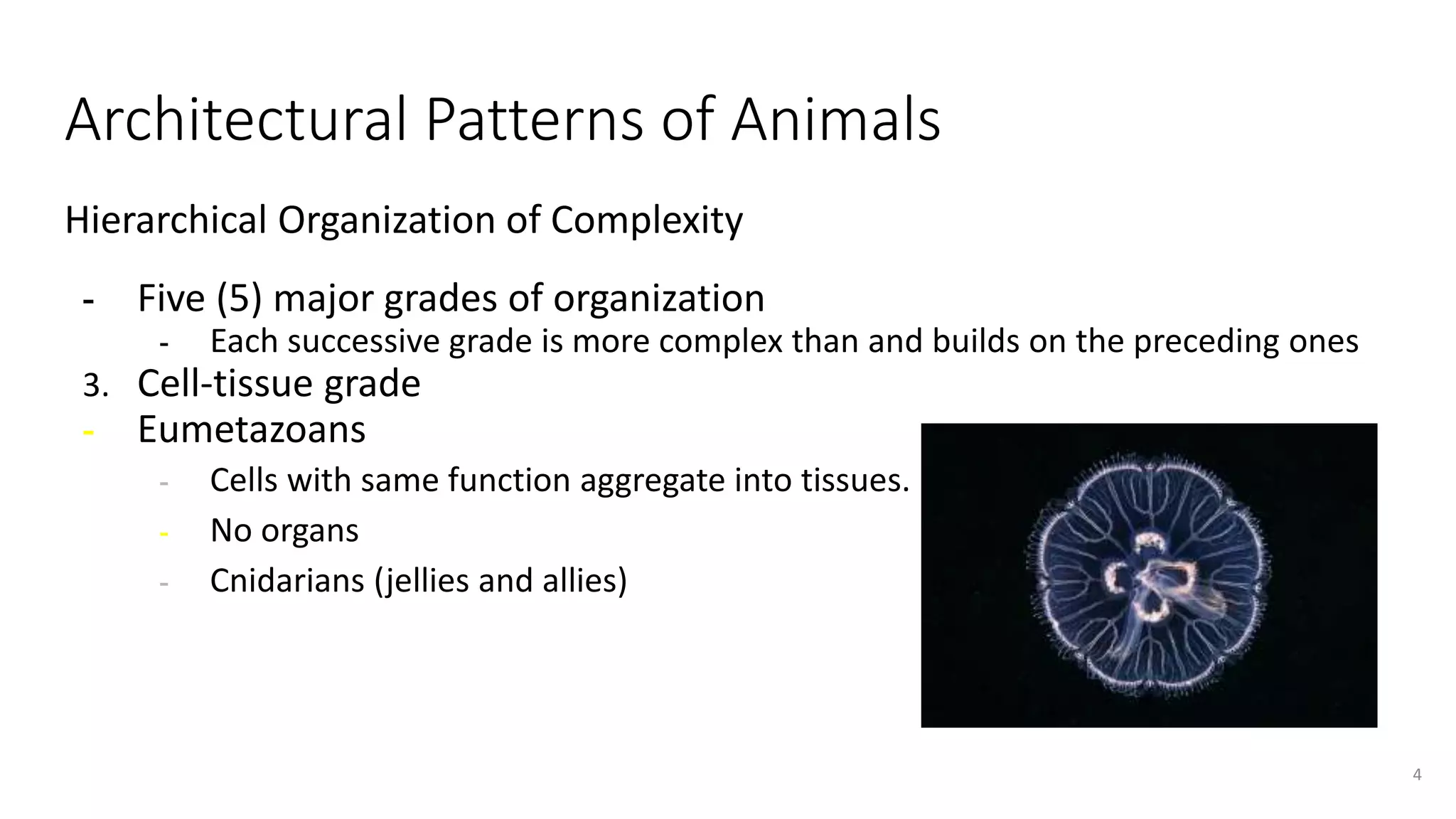
3. Cell-tissue grade
- Eumetazoans
- Cells with same function aggregate into tissues.
- No organs
- Cnidarians (jellies and allies)
4
Architectural Patterns of Animals
Hierarchical Organization of Complexity
- Five (5) major grades of organization
- Each successive grade is more complex than and builds on the preceding ones
4. Tissue-organ grade
- Tissues arranged into organs
- Parenchyma and stroma
- Platyhelminthes
5
Architectural Patterns of Animals
Hierarchical Organization of Complexity
- Five (5) major grades of organization
- Each successive grade is more complex than and builds on the preceding ones
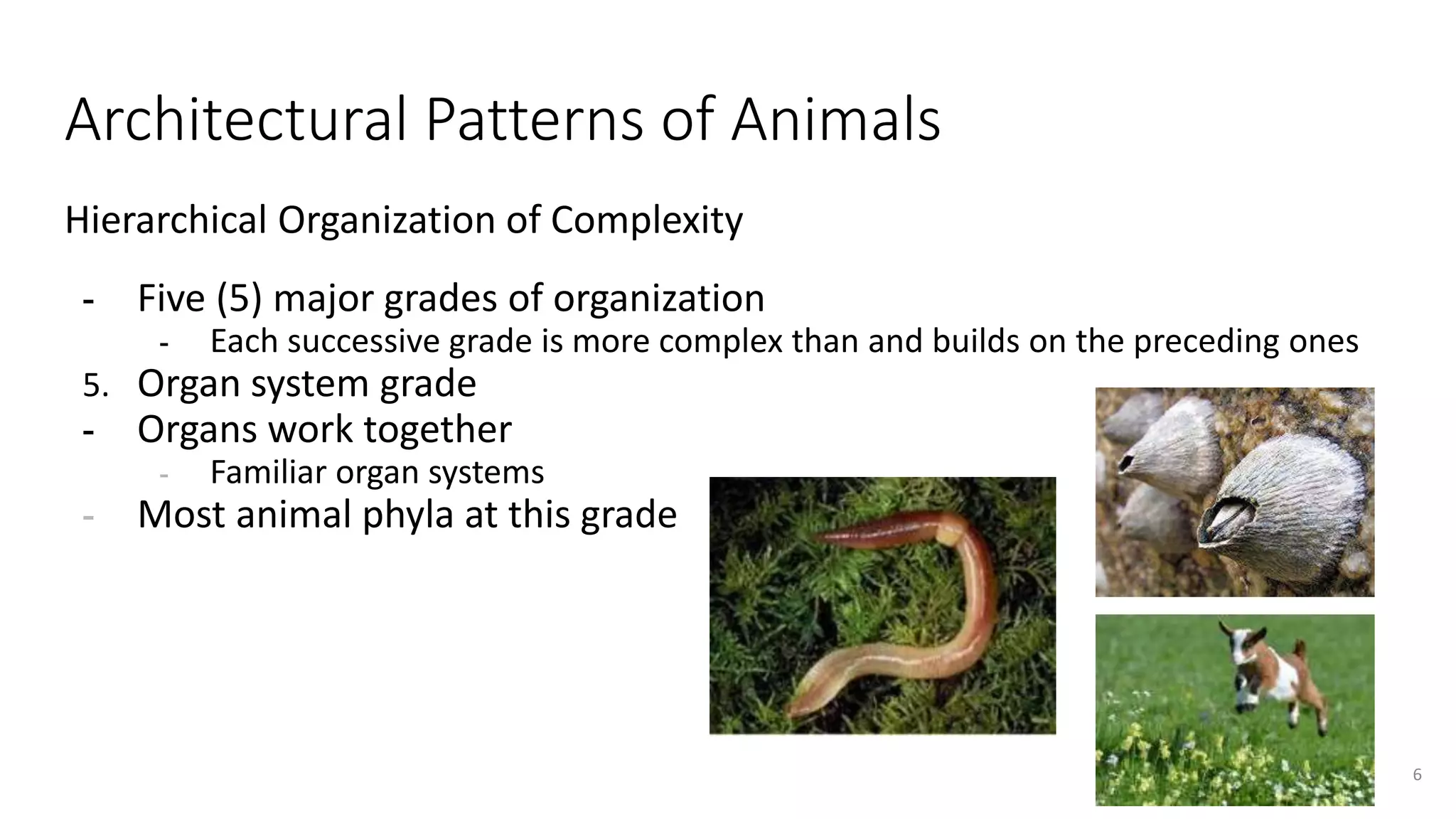
5. Organ system grade
- Organs work together
- Familiar organ systems
- Most animal phyla at this grade
6
Architectural Patterns of Animals
Animal Symmetry
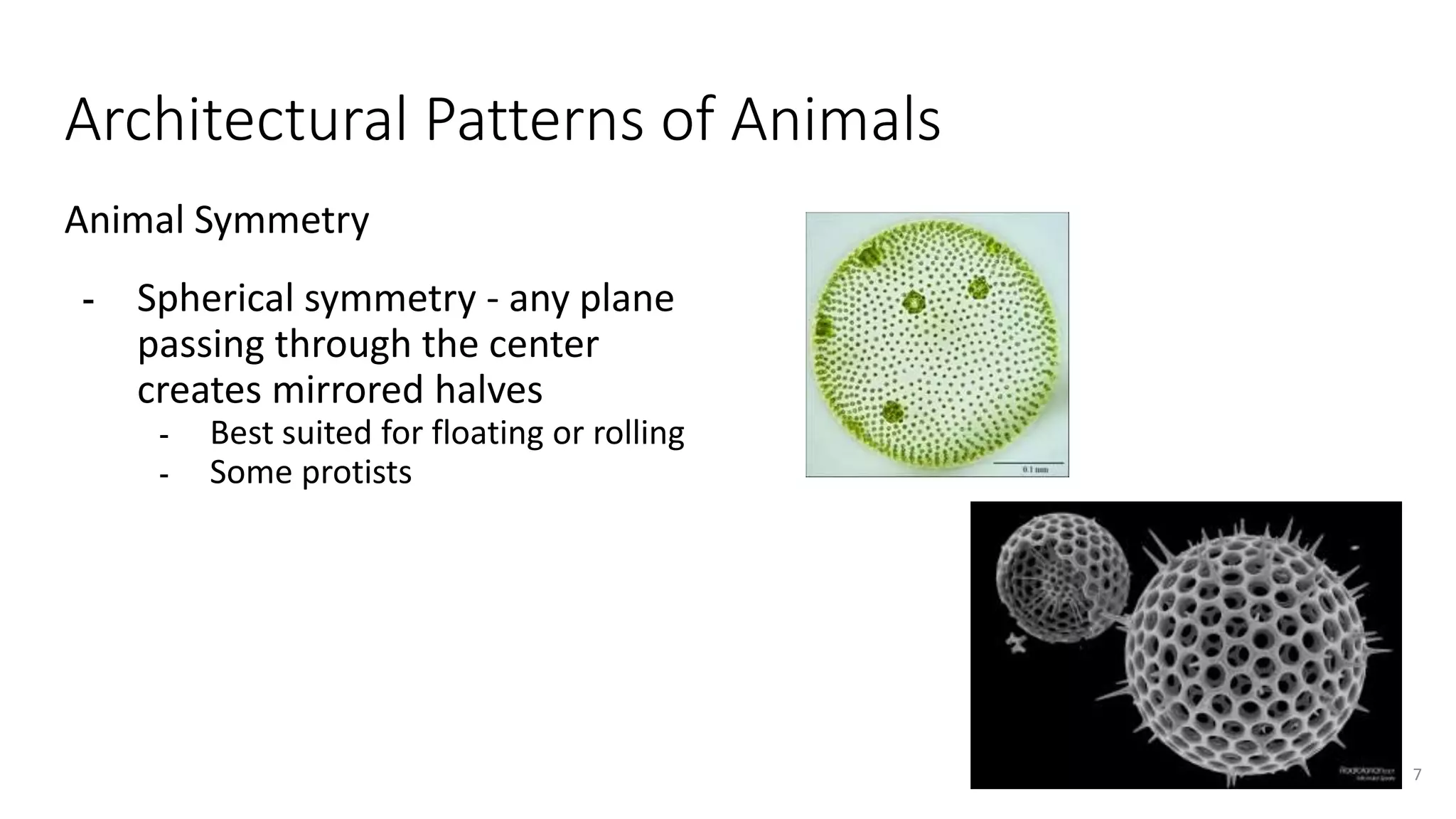
- Spherical symmetry - any plane
passing through the center
creates mirrored halves
- Best suited for floating or rolling
- Some protists
7
Architectural Patterns of Animals
Animal Symmetry
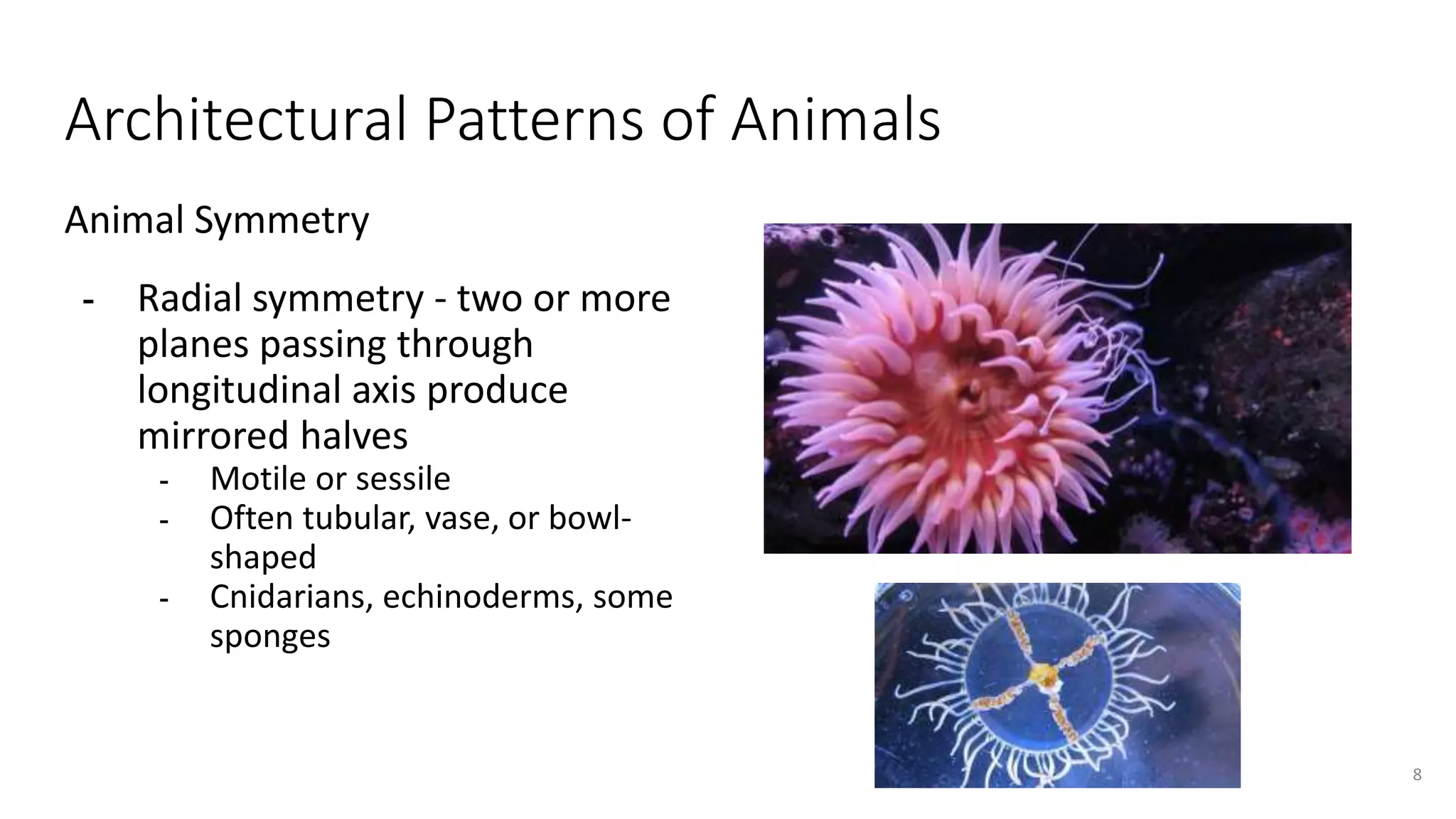
- Radial symmetry - two or more
planes passing through
longitudinal axis produce
mirrored halves
- Motile or sessile
- Often tubular, vase, or bowl-
shaped
- Cnidarians, echinoderms, some
sponges
8
Architectural Patterns of Animals
Animal Symmetry
- Radial symmetry - two or more
planes passing through
longitudinal axis produce
mirrored halves
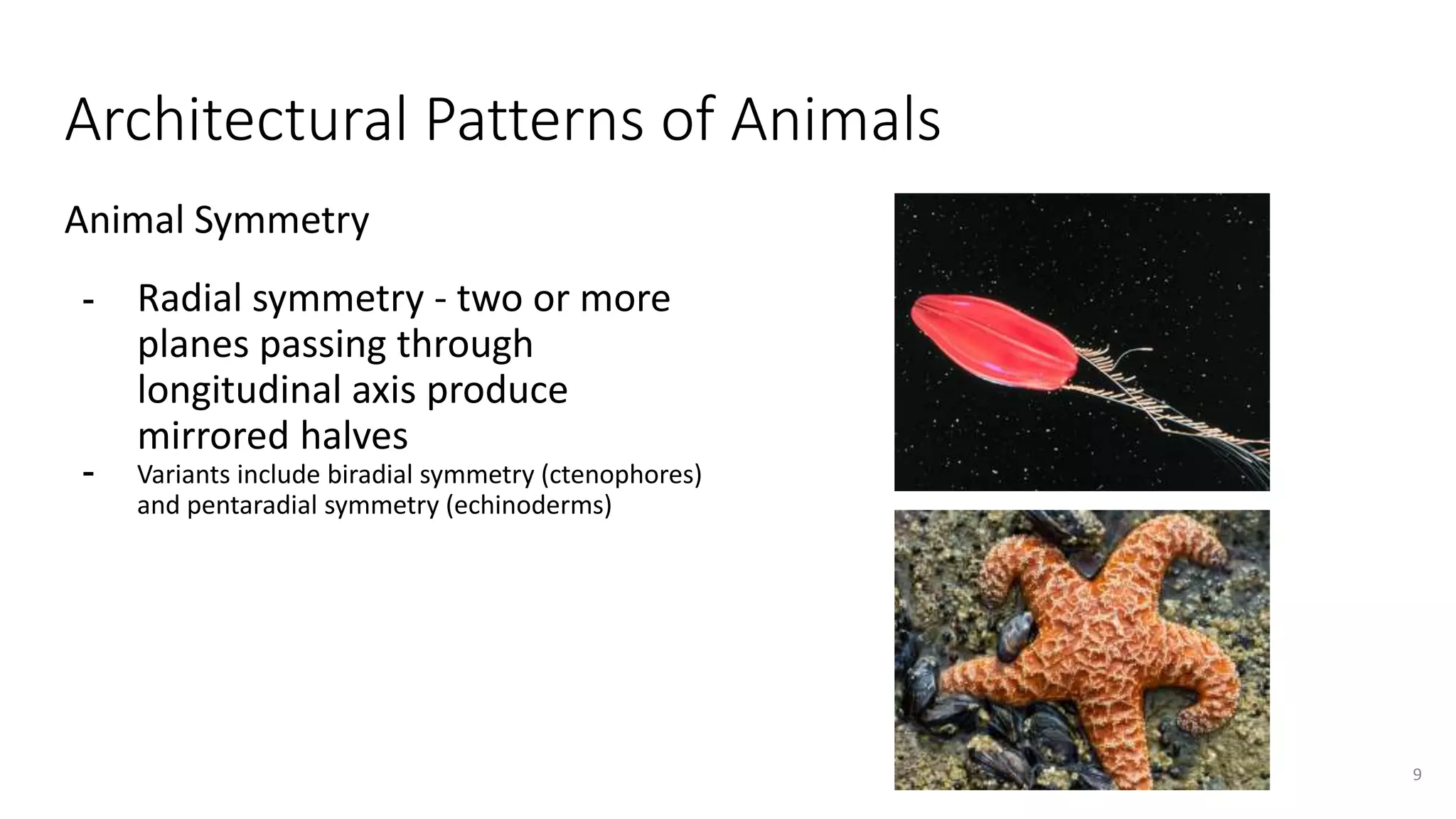
- Variants include biradial symmetry (ctenophores)
and pentaradial symmetry (echinoderms)
9
Architectural Patterns of Animals
Animal Symmetry
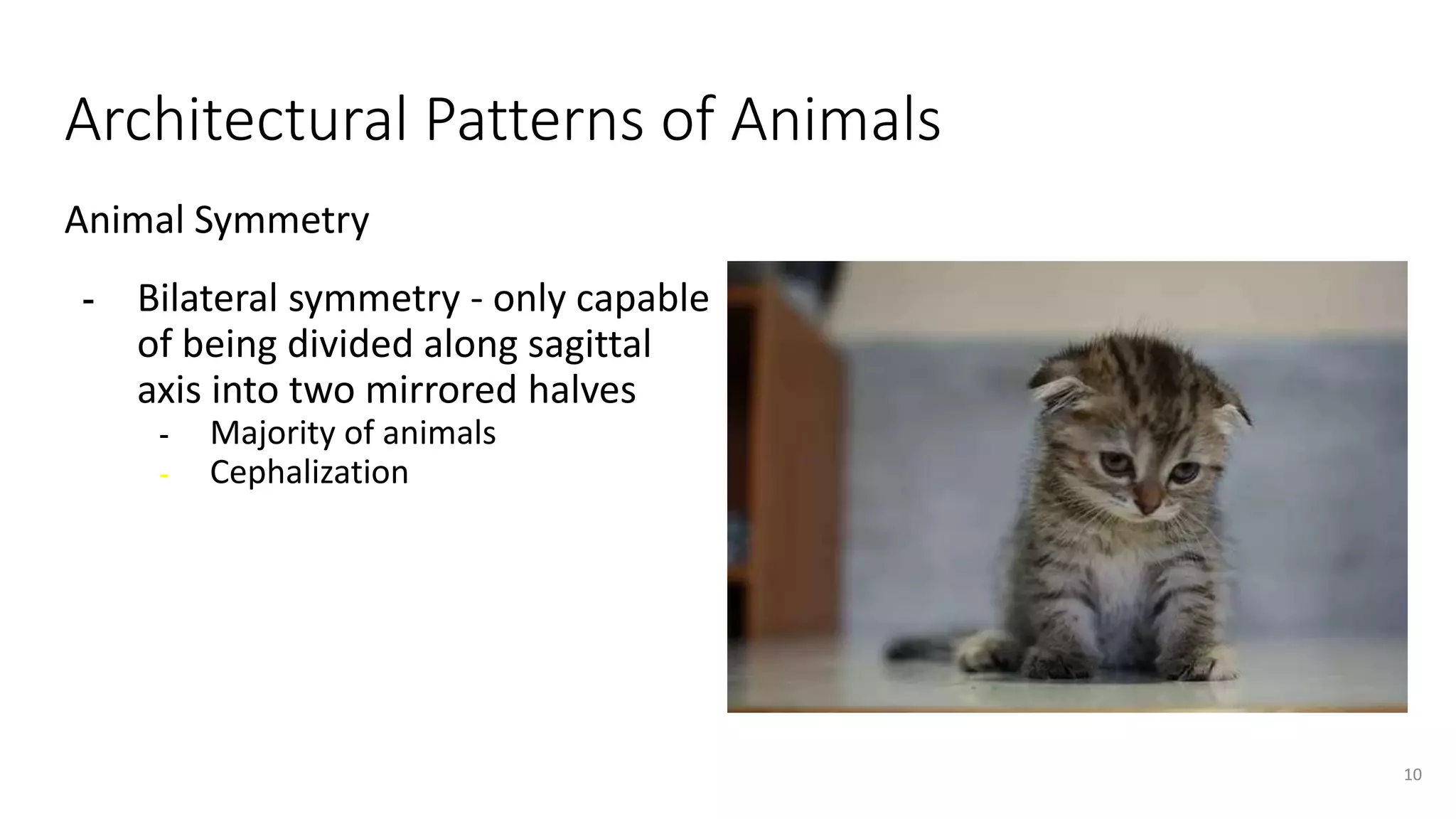
- Bilateral symmetry - only capable
of being divided along sagittal
axis into two mirrored halves
- Majority of animals
- Cephalization
10
Architectural Patterns of Animals
Body Cavities and Germ Layers
- Body cavity - any internal, open
space
- Gut (digestive tract) is an obvious
example
- Many animals have a second
cavity
- Following the blastula stage, cells
differentiate into germ layers
- Gastrula now formed
11
Architectural Patterns of Animals
Body Cavities and Germ Layers
- Diploblasts have two germ layers
- Ectoderm, endoderm
- Triploblasts have three germ
layers
- Ectoderm, endoderm, and
mesoderm
- Mesoderm forms by 1 of 2 plans
- Schizocoelous
- Enterocoelous
12
Architectural Patterns of Animals
Body Cavities and Germ Layers
- Diploblasts have two germ layers
- Ectoderm, endoderm
- Triploblasts have three germ
layers
- Ectoderm, endoderm, and
mesoderm
- Mesoderm forms by 1 of 2 plans
- Schizocoelous
- Enterocoelous
13
Architectural Patterns of Animals
Triploblasts and the Coelom
- Three coelomic arrangements
are recognized
- Coelom - fluid-filled cavity
completely surrounded by
mesoderm
- Acoelomate - mesoderm cells
completely fills the blastocoel,
no coelom present
- Phyla Platyhelminthes,
Acoelomorpha, Gnathostomulida,
Nemertina, Mesozoa. All are
protostomes.
Ectoderm
Mesoderm
Endoderm
Gut cavity
14
Architectural Patterns of Animals
Triploblasts and the Coelom
- Three coelomic arrangements
are recognized
- Coelom - fluid-filled cavity
completely surrounded by
mesoderm
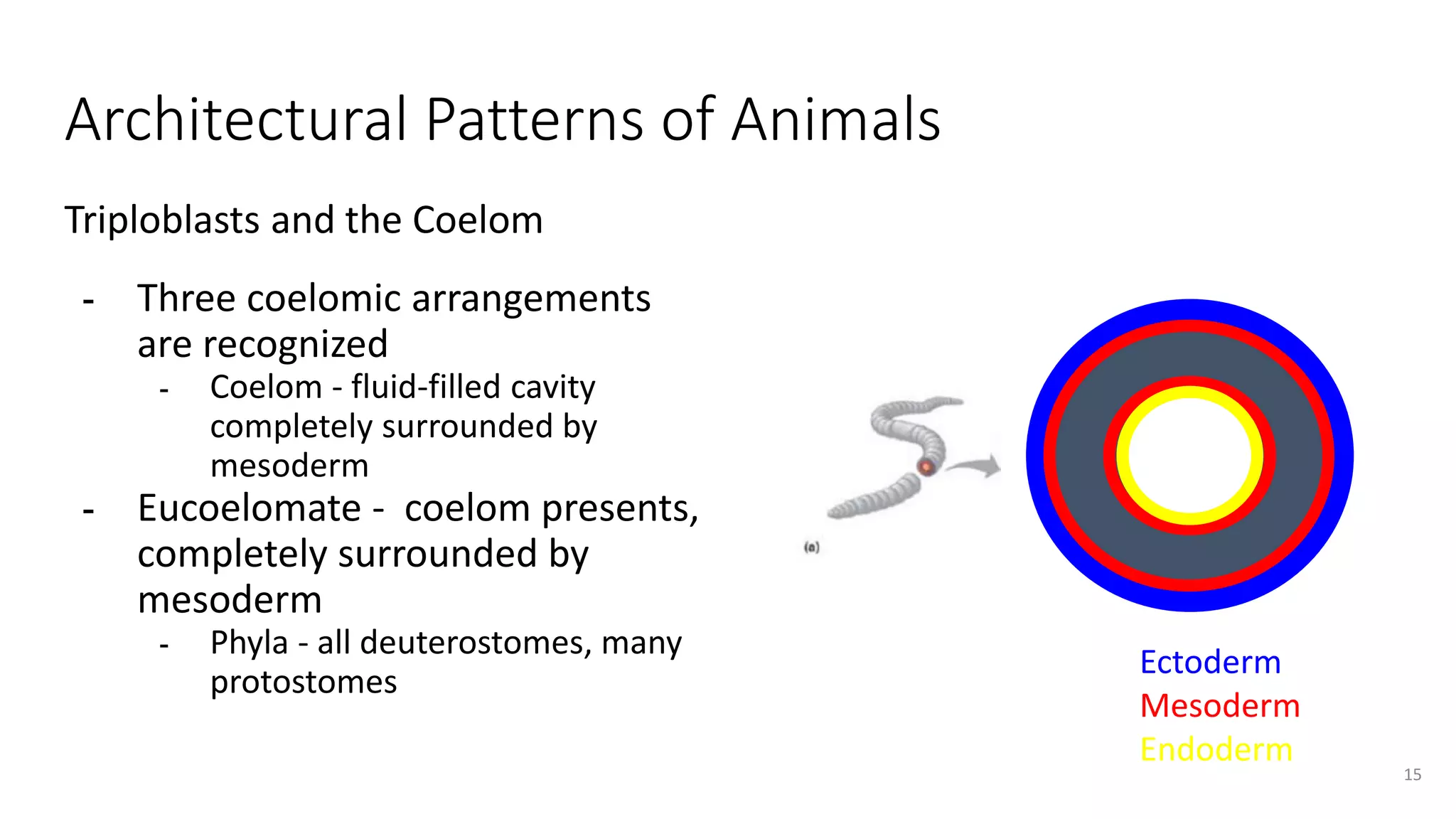
- Eucoelomate - coelom presents,
completely surrounded by
mesoderm
- Phyla - all deuterostomes, many
protostomes
Ectoderm
Mesoderm
Endoderm
Gut cavity
15
Architectural Patterns of Animals
Triploblasts and the Coelom
- Three coelomic arrangements
are recognized
- Coelom - fluid-filled cavity
completely surrounded by
mesoderm
- Pseudocoelomate - false coelom
present, incompletely
surrounded by mesoderm
- Phyla - many protostomes
Ectoderm
Mesoderm
Endoderm
Gut cavity
16
Architectural Patterns of Animals
Segmentation
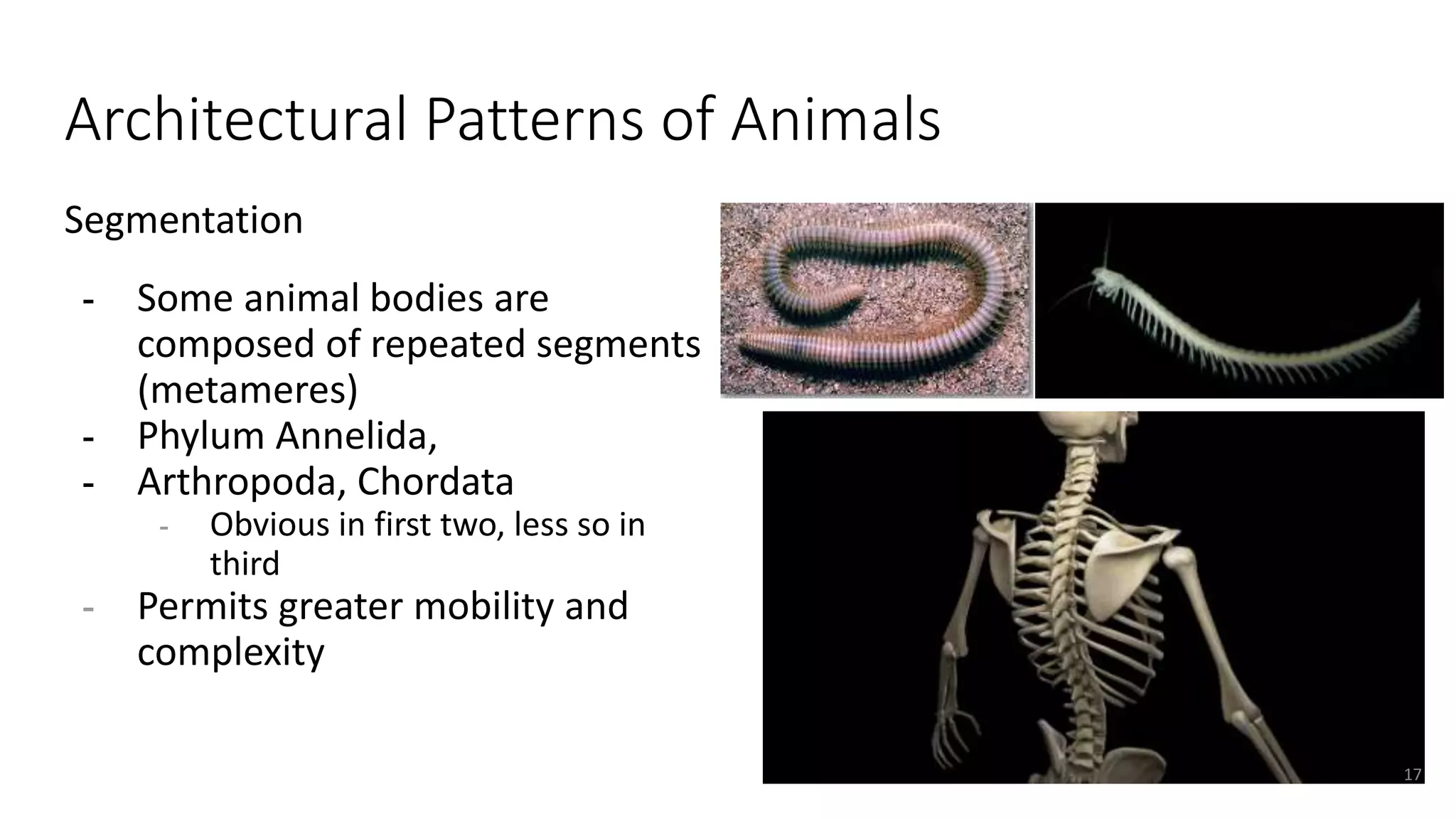
- Some animal bodies are
composed of repeated segments
(metameres)
- Phylum Annelida,
- Arthropoda, Chordata
- Obvious in first two, less so in
third
- Permits greater mobility and
complexity
17

Architectural patterns of animals

  • 1.
  • 2.
    Architectural Patterns ofAnimals Hierarchical Organization of Complexity - Five (5) major grades of organization - Each successive grade is more complex than and builds on the preceding ones - Unicellular eukaryotes - Within single cell all functions of life performed 1. Protoplasmic Grade - No cellular specialization - Organelles perform specialized functions - Single-celled protists and many colonial protists 2
  • 3.
    Architectural Patterns ofAnimals Hierarchical Organization of Complexity - Five (5) major grades of organization - Each successive grade is more complex than and builds on the preceding ones 2. Cellular grade - Multicellular organisms - Cell specialization - Cells cannot survive apart from the whole - Sponges, some colonial protists 3
  • 4.
    Architectural Patterns ofAnimals Hierarchical Organization of Complexity - Five (5) major grades of organization - Each successive grade is more complex than and builds on the preceding ones 3. Cell-tissue grade - Eumetazoans - Cells with same function aggregate into tissues. - No organs - Cnidarians (jellies and allies) 4
  • 5.
    Architectural Patterns ofAnimals Hierarchical Organization of Complexity - Five (5) major grades of organization - Each successive grade is more complex than and builds on the preceding ones 4. Tissue-organ grade - Tissues arranged into organs - Parenchyma and stroma - Platyhelminthes 5
  • 6.
    Architectural Patterns ofAnimals Hierarchical Organization of Complexity - Five (5) major grades of organization - Each successive grade is more complex than and builds on the preceding ones 5. Organ system grade - Organs work together - Familiar organ systems - Most animal phyla at this grade 6
  • 7.
    Architectural Patterns ofAnimals Animal Symmetry - Spherical symmetry - any plane passing through the center creates mirrored halves - Best suited for floating or rolling - Some protists 7
  • 8.
    Architectural Patterns ofAnimals Animal Symmetry - Radial symmetry - two or more planes passing through longitudinal axis produce mirrored halves - Motile or sessile - Often tubular, vase, or bowl- shaped - Cnidarians, echinoderms, some sponges 8
  • 9.
    Architectural Patterns ofAnimals Animal Symmetry - Radial symmetry - two or more planes passing through longitudinal axis produce mirrored halves - Variants include biradial symmetry (ctenophores) and pentaradial symmetry (echinoderms) 9
  • 10.
    Architectural Patterns ofAnimals Animal Symmetry - Bilateral symmetry - only capable of being divided along sagittal axis into two mirrored halves - Majority of animals - Cephalization 10
  • 11.
    Architectural Patterns ofAnimals Body Cavities and Germ Layers - Body cavity - any internal, open space - Gut (digestive tract) is an obvious example - Many animals have a second cavity - Following the blastula stage, cells differentiate into germ layers - Gastrula now formed 11
  • 12.
    Architectural Patterns ofAnimals Body Cavities and Germ Layers - Diploblasts have two germ layers - Ectoderm, endoderm - Triploblasts have three germ layers - Ectoderm, endoderm, and mesoderm - Mesoderm forms by 1 of 2 plans - Schizocoelous - Enterocoelous 12
  • 13.
    Architectural Patterns ofAnimals Body Cavities and Germ Layers - Diploblasts have two germ layers - Ectoderm, endoderm - Triploblasts have three germ layers - Ectoderm, endoderm, and mesoderm - Mesoderm forms by 1 of 2 plans - Schizocoelous - Enterocoelous 13
  • 14.
    Architectural Patterns ofAnimals Triploblasts and the Coelom - Three coelomic arrangements are recognized - Coelom - fluid-filled cavity completely surrounded by mesoderm - Acoelomate - mesoderm cells completely fills the blastocoel, no coelom present - Phyla Platyhelminthes, Acoelomorpha, Gnathostomulida, Nemertina, Mesozoa. All are protostomes. Ectoderm Mesoderm Endoderm Gut cavity 14
  • 15.
    Architectural Patterns ofAnimals Triploblasts and the Coelom - Three coelomic arrangements are recognized - Coelom - fluid-filled cavity completely surrounded by mesoderm - Eucoelomate - coelom presents, completely surrounded by mesoderm - Phyla - all deuterostomes, many protostomes Ectoderm Mesoderm Endoderm Gut cavity 15
  • 16.
    Architectural Patterns ofAnimals Triploblasts and the Coelom - Three coelomic arrangements are recognized - Coelom - fluid-filled cavity completely surrounded by mesoderm - Pseudocoelomate - false coelom present, incompletely surrounded by mesoderm - Phyla - many protostomes Ectoderm Mesoderm Endoderm Gut cavity 16
  • 17.
    Architectural Patterns ofAnimals Segmentation - Some animal bodies are composed of repeated segments (metameres) - Phylum Annelida, - Arthropoda, Chordata - Obvious in first two, less so in third - Permits greater mobility and complexity 17